

Playbook, Perspective, and Pattern for Founders Raising Now.
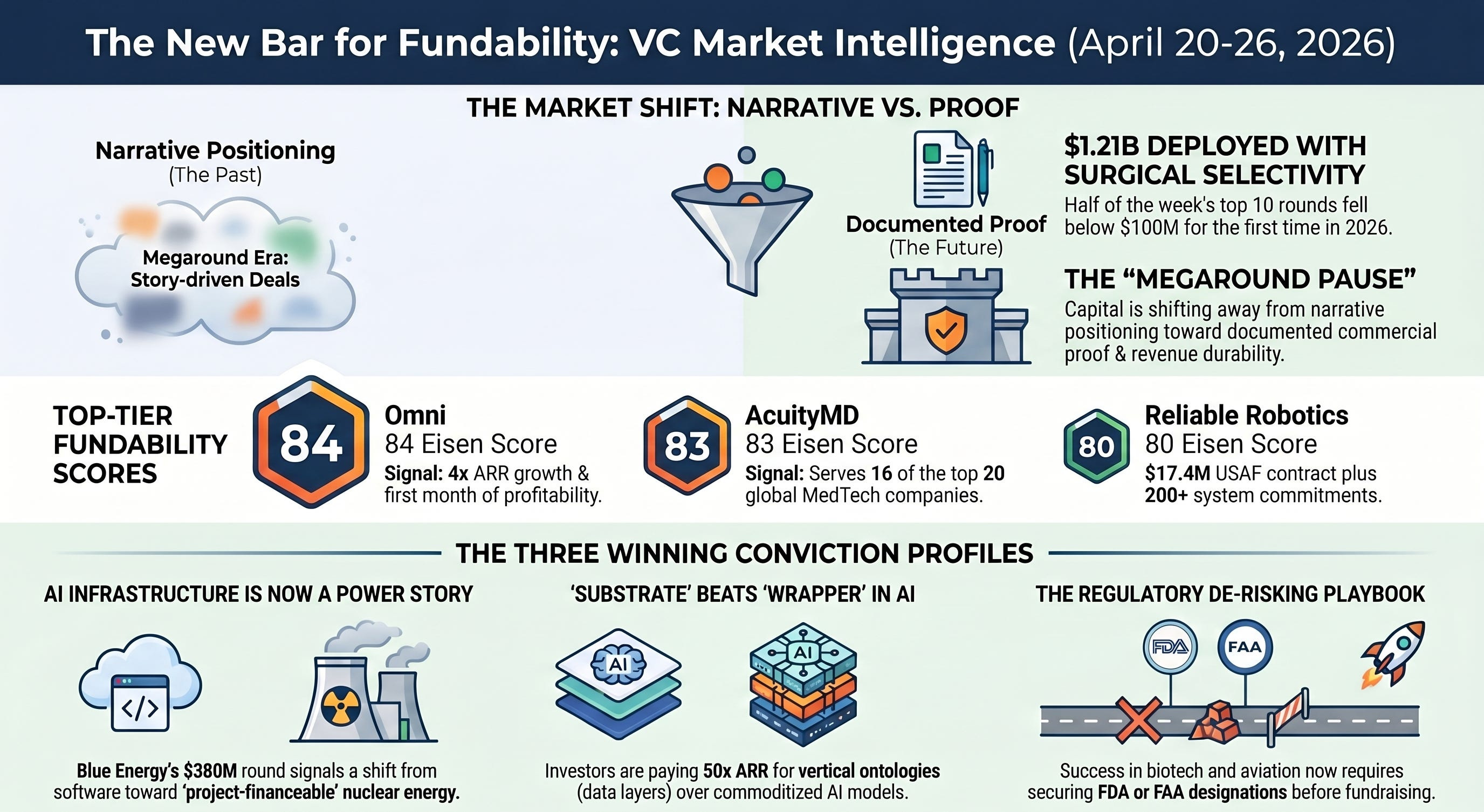
In the week of April 20-26, 2026, the venture market broke from a four-month rhythm. For the first time in 2026, half of the top 10 U.S. funding rounds came in under $100 million, per Crunchbase. The megaround era did not end. It paused. And the deals that closed reveal what capital is willing to underwrite when the easy money is harder to find.
Blue Energy raised $380 million to build prefabricated nuclear reactors for AI data centers, led by VXI Capital. The financing structure: equity blended with debt - signals that AI infrastructure is no longer a software story. It is a powerful story. Capital is moving past compute and networking into the gigawatts that compute requires.
Omni closed $120 million at a $1.5 billion valuation led by ICONIQ, more than doubling its $650 million mark from March 2025. The Fortune-confirmed thesis: the moat for vertical AI is no longer the model. It is the governed semantic layer that sits between enterprise data and the AI agents querying it. AcuityMD ($80M, $955M valuation, StepStone lead) earned its near-unicorn valuation on the same principle: a proprietary MedTech ontology embedded in 16 of the top 20 medical device companies.
Reliable Robotics secured $160 million led by Nimble Partners at a near-billion valuation, with 200+ system commitments from commercial and military customers and a $17.4 million U.S. Air Force contract for Indo-Pacific cargo operations [6]. Three biotechs - Ray Therapeutics ($125M Series B, Janus Henderson lead), Tortugas Neuroscience ($106M Seed plus Series A, Cure Ventures lead), and Serif Biomedicines ($50M, Flagship Pioneering) - took $281 million combined on derisked clinical-stage assets and FDA regulatory momentum.
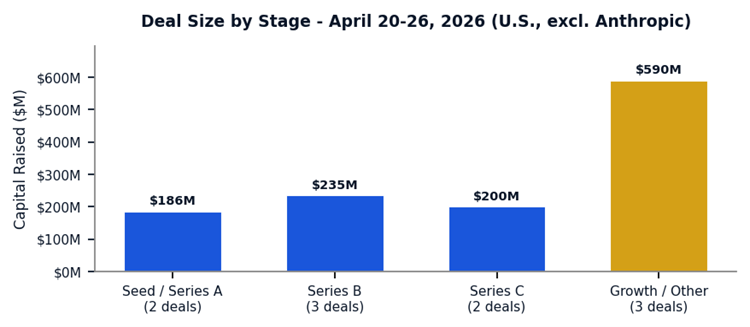
Total tracked U.S. capital this week, excluding Anthropic’s $5 billion partnership extension with Amazon: approximately $1.21 billion across 10 verified deals [1]. The pattern is selectivity, not scale. Fundable Notes turns weekly funding trends into precise actions using the proprietary Eisen Fundability Scoring system.
DEAL SCORECARD
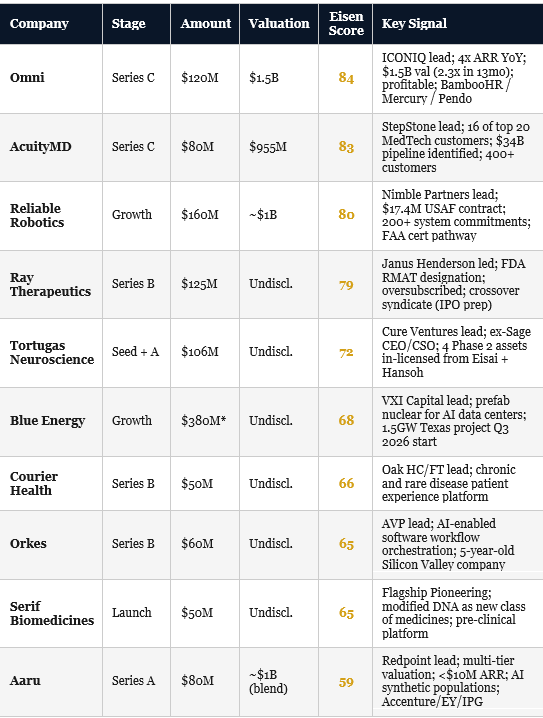
What the scorecard says at a glance: Omni scores highest (84) because the data layer thesis has converted to revenue: 4x ARR growth, profitability hit last month, and customers like Mercury, BambooHR (100,000+ end users), Pendo, and Synthesia consolidating onto a single, governed semantic layer. AcuityMD (83) is the second signal: an embedded MedTech ontology serving 16 of the top 20 medical device companies, which cannot be replicated by a horizontal AI platform. Reliable Robotics (80) earned its score on procurement-validated dual-use: a U.S. Air Force contract plus 200+ system commitments convert pre-commercial revenue into investable conviction. Ray Therapeutics (79) validates that crossover investor syndicates (Janus Henderson, Adage, Franklin Templeton, Marshall Wace) signal IPO readiness in oversubscribed biotech rounds with FDA RMAT designation. The week’s median Eisen Score (70) confirms what Crunchbase data already shows: capital is flowing to companies with documented traction or de-risked science, not narrative positioning.
WHAT CHANGED THIS WEEK: 5 MARKET SHIFTS
SHIFT 1: AI INFRASTRUCTURE CROSSED INTO THE ENERGY LAYER - $380M FOR PREFAB NUCLEAR
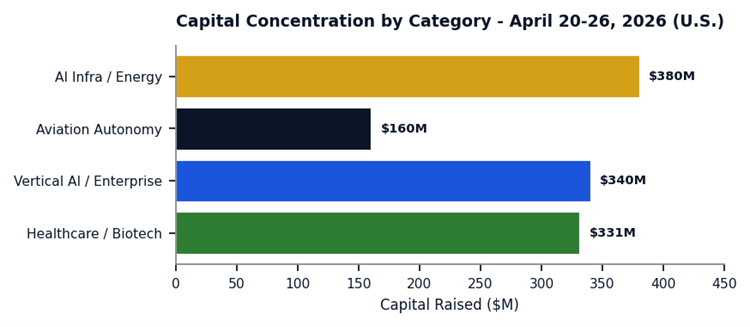
Pattern: Blue Energy raised $380 million in a hybrid equity-and-debt growth round led by VXI Capital, with Engine Ventures, At One Ventures, and Tamarack Global participating. The capital funds a 1.5-gigawatt prefabricated nuclear plant in Texas, with construction targeted for Q3 2026, specifically positioned for AI data center power purchase agreements. This is the second-largest announced U.S. round of the week and the largest non-software, non-biotech check.
Perspective: VXI Capital, Engine Ventures, and At One Ventures are not traditional venture firms. They are infrastructure capital allocators willing to write equity-debt blended checks against multi-year project finance timelines. The investor profile signals a structural shift: AI infrastructure is no longer a software thesis. It is a powerful thesis. Hyperscalers are projected to spend $650 billion on AI infrastructure in 2026, and the binding constraint is no longer compute or networking - it is dispatchable, carbon-free baseload power. Blue Energy’s MIT-spun, factory-built reactor model claims a 48-month deployment timeline, compared with the industry-standard decades.
Founder Blindspot: Founders see the Blue Energy round and think ‘energy is the new AI.’ Wrong framing. The investable thesis is not ‘energy.’ It is ‘project-financeable infrastructure that hyperscalers will sign 20-year power purchase agreements against, before construction begins.’ Blue Energy did not raise $380 million on a technology demonstration. It is supported by a procurement-grade financing structure that enables data center operators to lock in capacity at fixed prices without bearing upfront capital costs. The moat is the financing model, not the reactor design.
Playbook: If you are building any infrastructure adjacent to AI compute, power, cooling, water, transmission, or interconnection, reframe your fundraising around the contract structure, not the technology stack. Investors at this layer underwrite off-take agreements, not unit economics. Name the customer category, the contract length, and the revenue-per-megawatt your model supports. If your plan does not include a draft power purchase agreement template, you are not yet pitchable to this capital pool.
Contrast: In Q1 2026, AI infrastructure capital concentrated in compute (OpenAI, Anthropic, xAI, Waymo - $188 billion combined per Crunchbase). In April 2026, that capital migrated downstream into the physical layer, constraining compute. Six months ago, no venture firm wrote $380 million for a pre-revenue nuclear startup. This week, three firms co-led one.
What this means for your raise: If your product depends on power-intensive infrastructure or solves an energy constraint for AI workloads, your TAM just expanded. But the capital you can address is different. It sits with PE, infrastructure funds, and corporate strategics, not with traditional VCs. Build your investor list accordingly.
SHIFT 2: VERTICAL ONTOLOGIES BEAT MODELS - OMNI AND ACUITYMD PROVE THE THESIS
Pattern: Omni raised $120 million at a $1.5 billion valuation led by ICONIQ, with revenue 4x year-over-year and the company hitting profitability for the first time last month. AcuityMD raised $80 million at a $955 million valuation led by StepStone Group, with 16 of the top 20 MedTech companies as paying customers. Both companies sell governed data layers that sit between enterprise systems and AI agents. Combined: $200 million into vertical ontology platforms at near-or-above unicorn pricing.
Perspective: ICONIQ partner Matt Jacobson stated the thesis directly: “The barrier in data has shifted from access to understanding. Everyone can ask questions, but without a shared layer of business context, the answers can break down. Data analytics is one of the top workloads for AI agents, and Omni is building a governed data layer to help those agents get it right”. AcuityMD’s MedTech ontology (mapping physicians, facilities, networks, procedures, and reimbursement dynamics into a continuously enriched knowledge graph) is the same architecture applied to a regulated vertical. The pattern is clear: AI agents without governed context produce hallucinations; agents with vertical ontologies produce trusted answers. Investors will pay 50x ARR for the latter.
Founder Blindspot: Founders building vertical AI think the differentiator is the AI model. It is not. The differentiator is the proprietary ontology of business entities, relationships, and rules that the AI queries against. Omni founders Colin Zima, Jamie Davidson, and Chris Merrick spent the past four years building a semantic layer that encodes how each customer defines revenue, who can see which numbers, and how key metrics should be calculated. AcuityMD spent seven years building a MedTech-specific knowledge graph aligned with each customer’s contracting information, product indications, and CRM activity. Neither company is selling “AI for X.” They are selling the data substrate that enables “AI for X.”
Playbook: If you are building vertical AI for a regulated or complex industry, audit your data layer this week. Ask: Do we have a proprietary ontology that maps the entities, relationships, and business rules of our target industry? Is that ontology continuously enriched by customer usage? Does any competitor have access to a similar context at scale? If two answers are ‘no,’ your moat is the model, not the data - and the model is commoditized. Pivot your roadmap toward ontology depth before your next investor conversation. The Eisen score on data flywheel quality is now the most predictive signal of vertical AI fundability.
Contrast: In 2024, vertical AI companies typically raised on workflow automation pitches at modest revenue multiples. In April 2026, Omni raised at a premium revenue multiple on a ‘governed semantic layer’ thesis - and the lead investor compared the architecture to Snowflake’s early advantage over Amazon Redshift. The category language shifted. So did the multiples.
What this means for your raise: Sequoia leading three rounds in Harvey [March report] is the conviction signal for legal AI. ICONIQ leading Omni at $1.5B is the conviction signal for the data layer beneath every vertical AI play. If your product is a workflow tool with AI features bolted on, your Series B will get delayed, not declined. If your product is the context layer that competitors must replicate to stay relevant, you can clear premium multiples.
SHIFT 3: PROCUREMENT VALIDATION CROSSED FROM DEFENSE INTO COMMERCIAL AVIATION
Pattern: Reliable Robotics raised $160 million led by Nimble Partners, with participation from Eclipse, Lightspeed, Coatue, Pathbreaker, RTX Ventures (RTX Corp’s defense arm), AE Ventures (Boeing’s strategic partner), Presidio Ventures (Sumitomo), and Cox Enterprises. The valuation is approximately $1 billion. Total commitments now exceed 200 systems from commercial and military customers, including a $17.4 million U.S. Air Force contract for Indo-Pacific cargo operations and a city-led slot in the FAA’s Advanced Air Mobility Integration Pilot Program through Albuquerque. Total raised: approximately $300 million.
Perspective: This is not a defense round. It is a procurement-validated commercial round dressed in defense clothes. Reliable Robotics chose the Cessna Caravan, which is already FAA-certified, already flying cargo for FedEx, and already familiar to FAA inspectors. CEO Robert Rose retrofits autonomy onto a known airframe instead of asking the FAA to certify a new one. That is the wedge Wing, Zipline, and Amazon Prime Air missed. The investor logic: dual-use programs let Air Force operational hours feed directly into the FAA case for civil certification. Capital underwrites the regulatory pathway, not the technology.
Founder Blindspot: Founders see the Reliable Robotics round and think ‘autonomous aircraft is the next defense AI.’ Partial truth, wrong frame. The investable insight is procurement architecture: Reliable’s $17.4 million Air Force contract generates the operational data that funds FAA certification. The FAA certification creates commercial cargo revenue. The commercial cargo revenue funds aerospace M&A. Each step de-risks the next. Founders chasing “defense AI” build for one buyer and one budget cycle. Reliable engineered a chain of buyers across two regulatory regimes.
Playbook: If you are building any technology that requires regulatory certification (aviation, medical devices, autonomous vehicles, financial infrastructure, drug delivery), map your procurement chain before your seed round. For each step, identify: the program that pays for it, the agency that certifies it, the customer that uses it, and the data that flows from one stage to the next. If your chain has fewer than three reinforcing steps, your fundraising will stall at the first regulatory question. Reliable’s chain has five.
Contrast: Six months ago, Wing and Amazon Prime Air led the autonomous aviation narrative on purpose-built aircraft. In April 2026, $160 million went to a company retrofitting autonomy onto a 40-year-old certified airframe. The investor preference shifted from “novel hardware” to “fastest path through existing regulation.” The Federal Aviation Administration is the bottleneck, not the technology stack.
What this means for your raise: If your product needs a regulator’s signoff to scale, the most valuable line in your deck is not your performance benchmark. It is your certification timeline backed by a named program, a named contract, and a named precedent.
SHIFT 4: BIOTECH RETURNED WITH DERISKED MECHANISMS AND CROSSOVER SYNDICATES
Pattern: Three biotechs absorbed $281 million combined this week. Ray Therapeutics raised $125 million in an oversubscribed Series B led by Janus Henderson, with crossover investors Adage Capital, Franklin Templeton, Invus, and Marshall Wace. The announcement followed shortly after the FDA Regenerative Medicine Advanced Therapy (RMAT) designation for lead candidate RTx-015 in retinitis pigmentosa. Tortugas Neuroscience launched with $106 million in Seed and Series A financing led by Cure Ventures (with Column Group and AN Venture Partners), built around four Phase 2 assets in-licensed from Eisai (Japan) and Hansoh (China). Serif Biomedicines launched with $50 million from Flagship Pioneering on a ‘modified DNA as a new class of medicines’ platform.
Perspective: The Ray Therapeutics syndicate is the structural signal. Janus Henderson, Adage, Franklin Templeton, and Marshall Wace are not biotech specialists - they are crossover funds that participate in private rounds when they expect a public offering within 18 months. This is the same investor pattern that preceded Schrodinger, Recursion, and AbCellera’s IPOs. The capital is paying for the IPO setup, not the science. Tortugas validates a parallel pattern: ex-Sage Therapeutics CEO Jeff Jonas and CSO Al Robichaud assembled a four-asset clinical-stage portfolio through in-licensing rather than discovery, compressing the path to data by years [16][17]. Both companies converted derisking into premium pricing.
Founder Blindspot: Biotech founders see Ray and Tortugas and assume preclinical platforms are dead. Wrong reading. Investors are not avoiding early-stage science. They are avoiding novel mechanism risk on top of novel chemistry risk on top of novel clinical risk. Tortugas eliminated novel chemistry risk by in-licensing four phase 2 assets. Ray eliminated mechanism uncertainty by securing the FDA RMAT designation before the Series B closed. Each company stripped one risk layer from the standard biotech bundle. Crossover investors paid for the resulting clarity.
Playbook: If you are building a biotech raising on novel science, list every risk dimension your investor will underwrite: target validity, mechanism risk, chemistry risk, formulation risk, clinical risk, regulatory risk, and commercial risk. For your next round, eliminate the two with the highest perceived overhang. In-license a derisked asset. Pursue early FDA designations (Fast Track, Breakthrough, RMAT, Orphan). Recruit operators who have already shipped a drug in your indication. The fundraising math is not about adding more upside - it is about removing the specific risks that block crossover capital.
Contrast: In 2023, biotech rounds required clean preclinical data and a discovery platform. In April 2026, two of the three top biotech rounds went to companies that bought their pipelines (Tortugas in-licensed from Eisai and Hansoh; Ray secured FDA designation through 4BIO’s regulatory operators). The model shifted from “we built it” to “we de-risked it.” Investors paid the same multiple for less risk.
What this means for your raise: If you cannot describe the specific risk you removed since your last round, your crossover syndicate will not show up. Janus Henderson did not lead Ray’s Series B because the science improved. They led because the FDA designated the regulatory pathway. Find your equivalent designation before your next investor meeting.
SHIFT 5: THE MEGAROUND PAUSE - CRUNCHBASE FLAGS UNUSUAL SELECTIVITY
Pattern: Crunchbase reported that for the week of April 18-24, 2026, “just half of the top 10 rounds crossed the $100 million mark, which is somewhat unusual in this high-flying era for venture megarounds”. Excluding Anthropic’s $5 billion extension of its Amazon partnership, the next nine deals on the list ranged from $50 million to $160 million. After a Q1 2026 that included four single-company megarounds totaling $188 billion (OpenAI $122B, Anthropic $30B, xAI $20B, Waymo $16B per Crunchbase), April produced a structural cool-off.
Perspective: This is not a market correction. It is a redistribution. Late-stage funding in Q1 2026 reached $246.6 billion across 584 deals, a 205% year-over-year increase, according to Crunchbase data. The capital did not disappear; it concentrated in fewer rounds. The April pause reflects the second-order effect: when the top four AI companies absorb 63% of global venture funding in a single quarter, the supply curve shifts. Funds that wrote $200-500 million checks at $5-15 billion valuations in March face higher scrutiny in April. Companies that would have raised at premium multiples three months ago now face longer diligence timelines and harder questions on revenue durability.
Founder Blindspot: Founders interpret the April pause as “capital is drying up.” Wrong reading. Capital is becoming selective. The companies that closed this week (Omni at 4x ARR growth and profitability; AcuityMD at $34B in identified pipeline; Reliable Robotics at 200+ system commitments) all had documented commercial proof. The companies that did not close are the ones with narrative-only positioning. Founders should not delay raises out of fear; they should accelerate the assembly of their proof stack to clear the new selectivity bar.
Playbook: Audit your fundraise readiness against the April 20-26 bar. For each metric an investor would underwrite (revenue, growth rate, retention, named customers, regulatory progress, contract commitments), ask: do I have publicly defensible data for the past 90 days? If you cannot show three of those metrics with primary-source evidence, your raise will not close at the multiples you expect. Spend the next 30 days assembling proof, not deck polish. The deck is the cover; the proof stack is the read.
Contrast: In Q1 2026, the AI ‘super-cycle’ framing pulled capital toward narrative-driven megarounds. In April 2026, even the megarounds came with structure: Anthropic’s $5 billion was a partnership extension with Amazon, not a pure equity raise. The week’s signal is unmistakable: capital is repricing the gap between narrative and proof.
What this means for your raise: Q2 2026 will reward founders who treat April’s selectivity as the new baseline rather than a temporary dip. The mega-fund LP cycle ($30B+ committed across Kleiner Perkins, Thrive, General Catalyst, and Founders Fund - reported in March) means the capital is loaded [March 23-28 report]. The bar to access it just rose.
THE DEALS THAT MATTER: TOP 5
OMNI
AI Analytics / Enterprise Data Layer | Series C | $120M | $1.5B
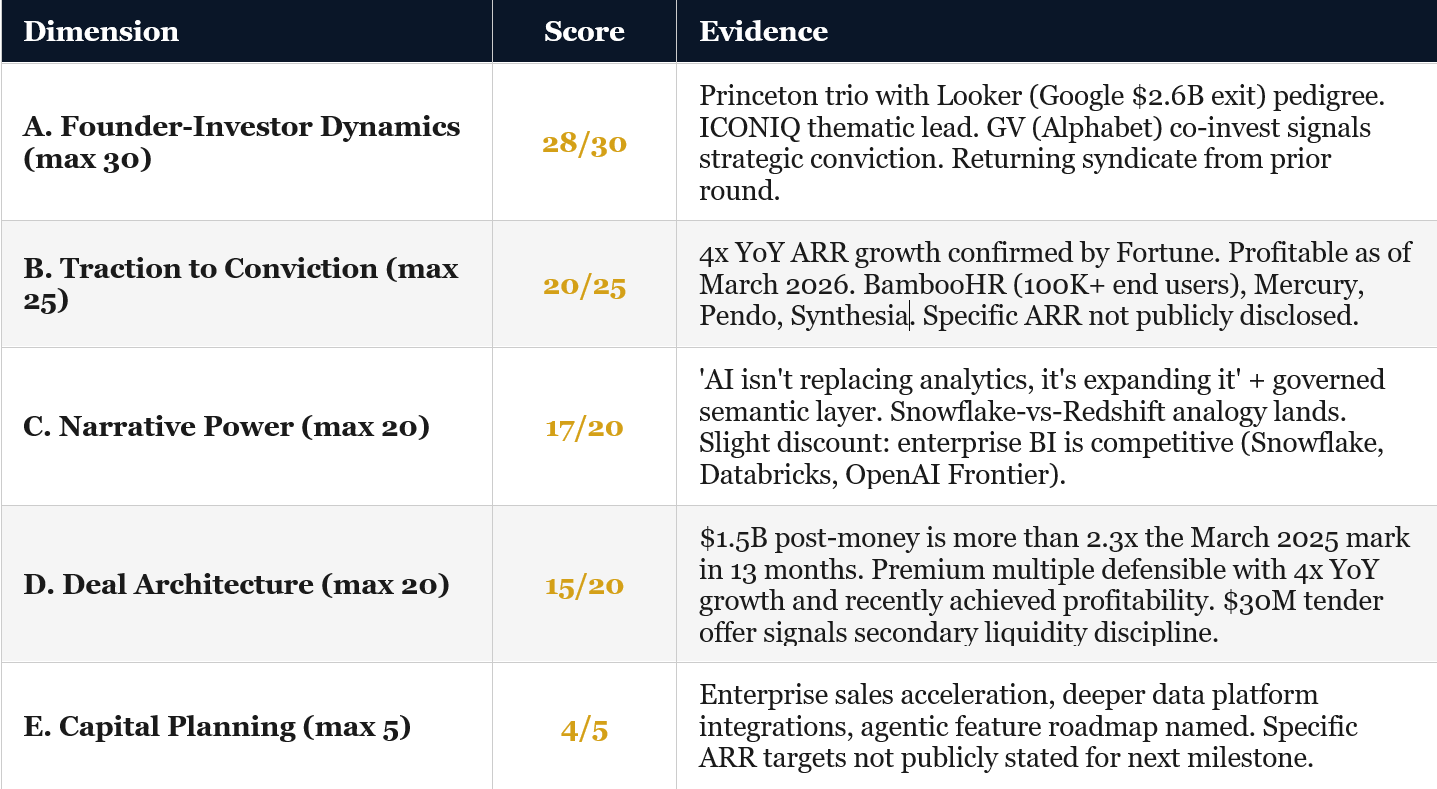
EISEN FUNDABILITY SCORE: 84 / 100
Why this scored: The highest score this week reflects a rare combination at this stage: 4x year-over-year ARR growth, profitability hit last month, ICONIQ leading at a $1.5 billion valuation that more than doubled in 13 months, and a customer roster (BambooHR, Mercury, Pendo, Synthesia, Heidi AI, Guitar Center) that validates the enterprise pull.
The Setup: Founded in 2022 by three Princeton graduates - CEO Colin Zima, Jamie Davidson, and Chris Merrick - who reconnected after Google acquired their former employer, Looker, for $2.6 billion in 2020. Omni builds a semantic layer: a governed translation layer that sits between a company’s raw data and whatever (or whoever) is querying it. When AI agents use Omni, they follow versioned definitions and access rules, returning the answer a trained analyst would give. BambooHR alone uses the platform to serve more than 100,000 end users.
The Numbers: $120M Series C (April 23, 2026) | $1.5B post-money (vs. $650M in March 2025, more than 2.3x in 13 months) | Lead: ICONIQ (partner Matt Jacobson) | Co-investors: Theory Ventures, First Round Capital, Redpoint Ventures, GV (Alphabet) | $30M employee tender offer included | Revenue 4x year-over-year | Profitable as of March 2026 | Total funding ~$217M | Customers: BambooHR, Mercury, Checkr, Cribl, dbt Labs, Guitar Center, Heidi AI, Pendo, Synthesia [3][4][19].
Fundability Lessons: Omni’s playbook is the textbook example of vertical AI fundability in 2026. Three deliberate moves: (1) Define the architectural moat - the semantic layer is structurally different from generic AI workflow tools, and competitors must rebuild from the ground up to match it. (2) Convert the architecture into pricing power - 4x ARR growth at first profitability allows ICONIQ to underwrite premium multiples without aggressive margin assumptions. (3) Anchor the syndicate to a thematic lead - ICONIQ specializes in enterprise software at scale; their conviction sets the bar for the next round.
The key lesson: vertical AI valuations at 50x ARR are achievable, but only when the architectural moat is verifiable, the growth is documented, and the lead investor can articulate a Snowflake vs. Redshift analogy for your category.
Your Takeaway: If you are building any vertical AI, audit the layer you operate at. Tools that wrap LLMs are commoditizing. Tools that govern the data the LLMs query against are becoming the new infrastructure. Identify whether your product is the wrapper or the substrate. If you are the wrapper, your moat is distribution. If you are the substrate, your moat is the ontology, and the multiples reflect that difference.
The Founder Mistake to Avoid: Founders see Omni’s $1.5B valuation and try to copy the surface-level positioning (“We are the semantic layer for X industry”). The mistake is treating the semantic layer as a marketing claim rather than a four-year engineering investment. Omni built the layer before they sold it. Wrappers cannot retrofit the substrate without restarting product development. Pick your layer at the architecture stage, not the pitch stage.
ACUITYMD
MedTech Vertical AI / Commercial Intelligence | Series C | $80M | $955M
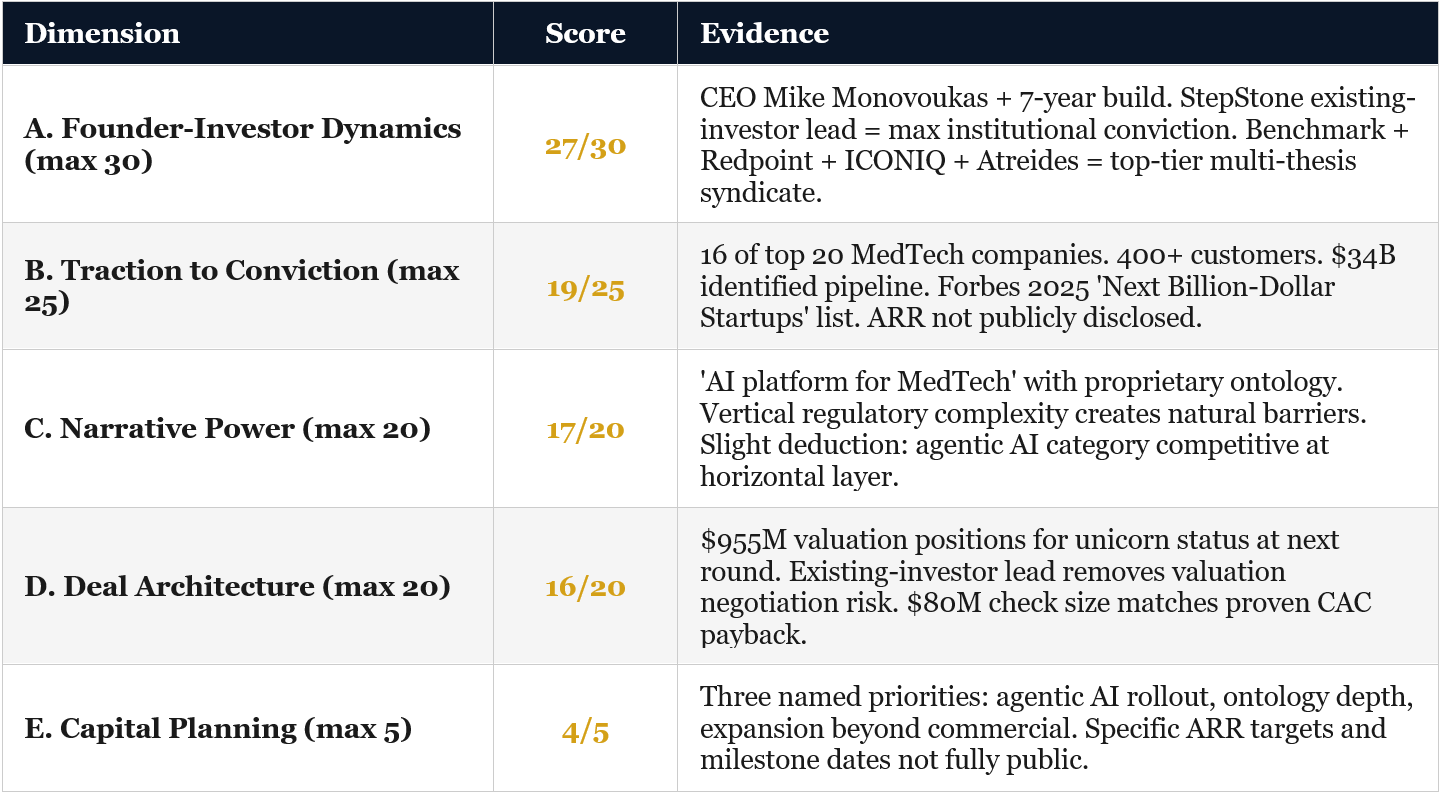
EISEN FUNDABILITY SCORE: 83 / 100
Why this scored: Customer concentration that no horizontal AI platform can replicate: 16 of the top 20 MedTech companies, 400+ total customers, $34 billion in pipeline identified for those customers, and a top-tier syndicate (StepStone, Benchmark, Redpoint, ICONIQ, Atreides) that funded the round at a near-unicorn $955 million.
The Setup: Founded in 2019, Boston-based AcuityMD aggregates fragmented MedTech commercial data (claims databases, FDA filings, government records, and market signals) into a proprietary MedTech ontology that maps physicians, facilities, networks, procedures, and reimbursement dynamics. The platform aligns that ontology with each customer’s internal contracting, product indications, territory structure, and CRM activity. AcuityAI, now in open beta, runs on the ontology to surface answers no horizontal AI platform can produce.
The Numbers: $80M Series C (April 21, 2026) | $955M valuation (Forbes 2025 “Next Billion-Dollar Startups” list) | Lead: StepStone Group (existing investor doubling down) | Co-investors: Benchmark, Redpoint Ventures, ICONIQ, Atreides Management | Total funding $160M+ | Customers: 400+ MedTech companies including 16 of the top 20 globally | $34B in customer pipeline identified to date | CEO: Mike Monovoukas (co-founder).
Fundability Lessons: AcuityMD demonstrates the embedded vertical ontology playbook in a regulated industry. The MedTech sales cycle is constrained by hospital consolidation, regulatory fluctuation, reimbursement updates, and procurement complexity that no individual sales rep can track. AcuityMD’s ontology compresses that complexity into a queryable knowledge graph - and once a MedTech company’s CRM, contracts, and territory data are aligned to that ontology, switching becomes operationally expensive. StepStone, leading the Series C as an existing investor “doubling down”, is the strongest single signal in vertical AI: the institutional money that already saw the books wants more.
The key lesson: in regulated verticals, the moat is data integration depth, not AI sophistication. Once your ontology is wired into customer CRMs and operating systems, the customer’s switching cost is not the price of your software. It is the cost of rebuilding their commercial intelligence from scratch.
Your Takeaway: If you sell into a regulated industry (medical devices, financial services, energy, defense, life sciences), audit how deeply your product is integrated into customer operating systems. If a customer can swap you out in a quarter, your moat is shallow. If swapping you out requires a 12-month re-implementation across CRM, contracts, and reporting, your retention math compounds, and your valuation multiple should reflect it.
The Founder Mistake to Avoid: Founders see AcuityMD and try to build the same product in another vertical without gaining the depth of data integration. The AI is the marketing claim. The ontology is the moat. AcuityMD spent seven years aggregating claims databases, FDA filings, and government records into a continuously enriched knowledge graph before AcuityAI shipped in beta. Verticals with similar data complexity (legal, financial regulatory, life sciences clinical) require multi-year investments in ontologies before the AI layer becomes defensible. Skip the ontology, skip the moat.
Aviation Autonomy / Dual-Use | Growth | $160M | ~$1.0B
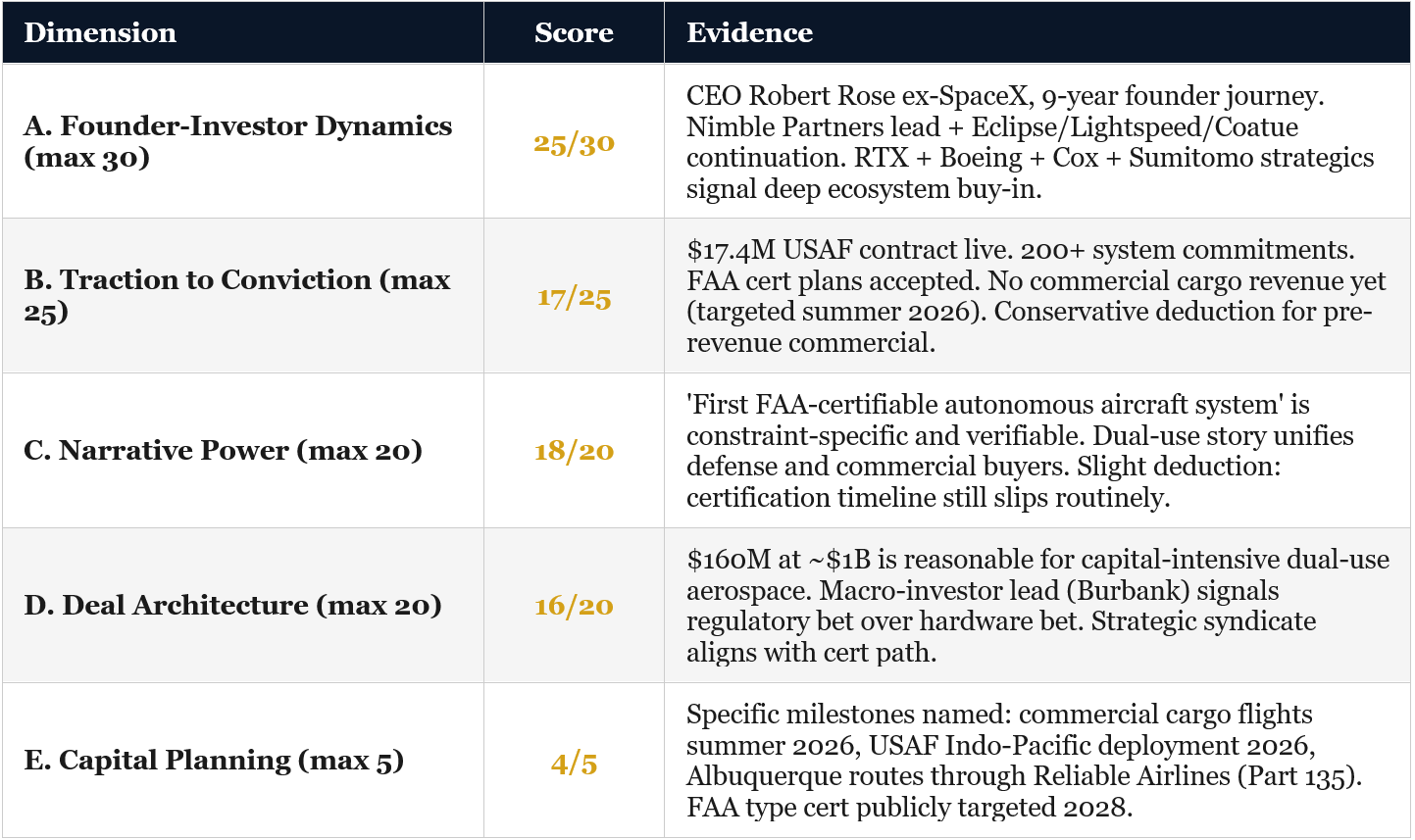
EISEN FUNDABILITY SCORE: 80 / 100
Why this scored: 200+ system commitments from commercial and military customers, a $17.4M U.S. Air Force contract for Indo-Pacific cargo operations, a city-led FAA pilot program slot through Albuquerque, and a syndicate that includes RTX Ventures (RTX Corp’s defense arm), AE Ventures (Boeing strategic partner), Eclipse, Lightspeed, and Coatue. Procurement-validated dual-use is now an investable category with a working template.
The Setup: Co-founded in 2017 by CEO Robert Rose (ex-SpaceX) and Juerg Frefel, Reliable Robotics builds the Reliable Autonomy System (RAS), the first FAA-certifiable system enabling fully automated aircraft operation. The strategic insight: retrofit autonomy onto an already-certified airframe (the Cessna 208 Caravan, which currently flies cargo for FedEx) rather than ask the FAA to certify both new hardware and new autonomy simultaneously. That structural choice halves the regulatory pathway.
The Numbers: $160M growth round (April 21, 2026) | ~$1B valuation per Bloomberg interview with CEO [14] | Lead: Nimble Partners (founded 2020 by hedge fund veteran John Burbank, who joins board) | Existing investors: Eclipse, Lightspeed, Coatue, Pathbreaker | New investors: Island Green Capital, Socium Ventures (Cox Enterprises), AE Ventures (Boeing strategic partner), RTX Ventures, Presidio Ventures (Sumitomo), UP.Partners, KAS Venture Partners | Total funding to date: ~$300M | 200+ system commitments | $17.4M USAF contract (August 2025) | FAA Advanced Air Mobility Pilot Program slot through Albuquerque (March 2026) | Workforce nearly tripled since prior round.
Fundability Lessons: Reliable Robotics is the clearest example of procurement-architecture fundability in 2026. The capital stack mirrors the regulatory stack: defense customers fund operational hours; operational hours fund FAA certification work; FAA certification funds commercial cargo revenue; commercial cargo revenue funds aerospace M&A. Each capital provider underwrites a specific de-risking step. Nimble’s John Burbank is a macro investor, not an aerospace specialist - his bet is on the regulatory timeline clearing rather than on the hardware. RTX Ventures and AE Ventures (Boeing) bring strategic depth to the certification path. The investor syndicate is itself the de-risking mechanism.
The key lesson: in regulated dual-use categories, your fundability is determined by the chain of buyers and certifications you have lined up, not the technology you have built. Reliable’s chain has five reinforcing steps. Most aviation autonomy founders rely on demos. Reliable raised on a flight schedule.
Your Takeaway: If your product requires a regulator’s signoff (FAA, FDA, FERC, NRC, OCC, banking regulators), build a procurement chain document before your seed round. For each stage of certification, name: the program that pays for the work, the customer that uses the result, the regulator that approves the next step, and the data each stage produces for the next. If your chain has fewer than three reinforcing nodes, it will not survive Series B diligence.
The Founder Mistake to Avoid: Founders building defense or regulated technology assume that defense contracts substitute for commercial validation. They do not. Defense contracts validate technical capability under contested conditions. Commercial validation requires the regulatory pathway to scale. Reliable did both deliberately: the Air Force contract pays for operational data, which feeds the FAA certification case. If your defense contract does not also generate commercial-track regulatory progress, you have a budget cycle, not a moat.
RAY THERAPEUTICS
Biotech / Optogenetic Gene Therapy | Series B | $125M | Undisclosed
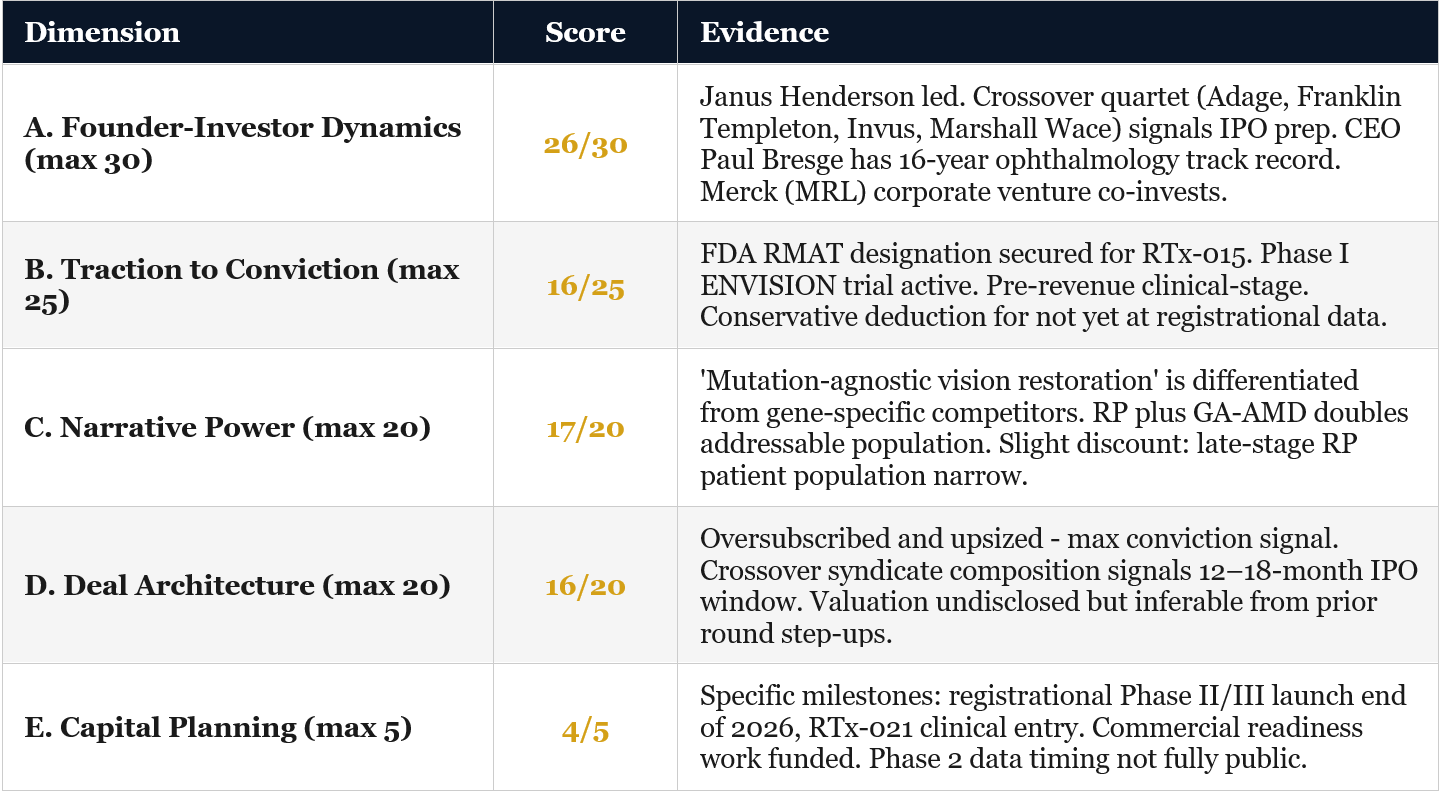
EISEN FUNDABILITY SCORE: 79 / 100
Why this scored: FDA Regenerative Medicine Advanced Therapy (RMAT) designation for the lead candidate landed before the Series B closed. Janus Henderson led an oversubscribed and upsized round with Adage Capital, Franklin Templeton, Invus, and Marshall Wace as new crossover investors - the syndicate signature of a private company being primed for an IPO within 18 months.
The Setup: Founded in 2021 in Berkeley, California, Ray Therapeutics develops optogenetic gene therapies that use bioengineered light-sensitive proteins to restore visual function in patients with severe retinal degeneration. CEO Paul Bresge entered ophthalmologic gene therapy 16 years ago after his daughter was diagnosed with retinitis pigmentosa. The platform’s mutation-agnostic design addresses both rare inherited disorders (RP) and larger indications (geographic atrophy AMD), unlocking a TAM that mutation-specific therapies cannot reach.
The Numbers: $125M Series B (April 21, 2026, oversubscribed and upsized) | Lead: Janus Henderson Investors | New crossover investors: Adage Capital Management, Franklin Templeton, Invus, Marshall Wace | Existing investors: 4BIO Capital, Deerfield Management, MRL Ventures Fund (Merck corporate venture arm), Norwest, Novo Holdings, Platanus | Total raised: $247M | Lead candidate RTx-015 has FDA RMAT designation for retinitis pigmentosa | Phase I ENVISION trial active, registrational Phase II/III planned end of 2026 | Second program RTx-021 for Stargardt disease and geographic atrophy AMD.
Fundability Lessons: Ray Therapeutics demonstrates the crossover-investor playbook for biotech IPO preparation. Three structural moves earned the round: (1) FDA RMAT designation, secured weeks before the Series B closed, removed regulatory pathway uncertainty for the lead asset. (2) The mutation-agnostic platform expanded the TAM beyond what gene-specific competitors (MeiraGTx, Beacon Therapeutics, AAVantgarde Bio) can address. (3) The investor mix (specialist biotech funds plus public-market crossover funds) signals a 12-18 month IPO window. Janus Henderson, Adage, Franklin Templeton, and Marshall Wace participate in private rounds when they expect to convert their position into public stock. The capital is paying for the IPO setup, not just the science.
The key lesson: in clinical-stage biotech, FDA regulatory milestones are valuation events. Securing RMAT, Breakthrough, Fast Track, or Orphan Designation before a financing round changes both the syndicate composition and the multiple. Plan your regulatory milestones around your fundraising calendar, not the other way around.
Your Takeaway: If you are a clinical-stage biotech raising on a novel mechanism, identify which FDA designation programs your asset qualifies for. RMAT is for regenerative medicine; Breakthrough is for serious conditions with preliminary evidence of substantial improvement; Fast Track accelerates review for unmet medical need. Each designation removes a discrete risk dimension that crossover investors price into their model. Sequence the designation submissions to land before your next round opens.
The Founder Mistake to Avoid: Founders chase platform breadth at Series A and B, hoping that a wider pipeline justifies a higher valuation. Ray Therapeutics did the opposite - they concentrated on RTx-015 to a regulatory designation, then expanded the syndicate around that proof point. Breadth without designation reads as dilution to crossover investors. Depth on a single asset, validated by a regulator, reads as conviction. Pick your wedge and earn the designation before you broaden the platform narrative.
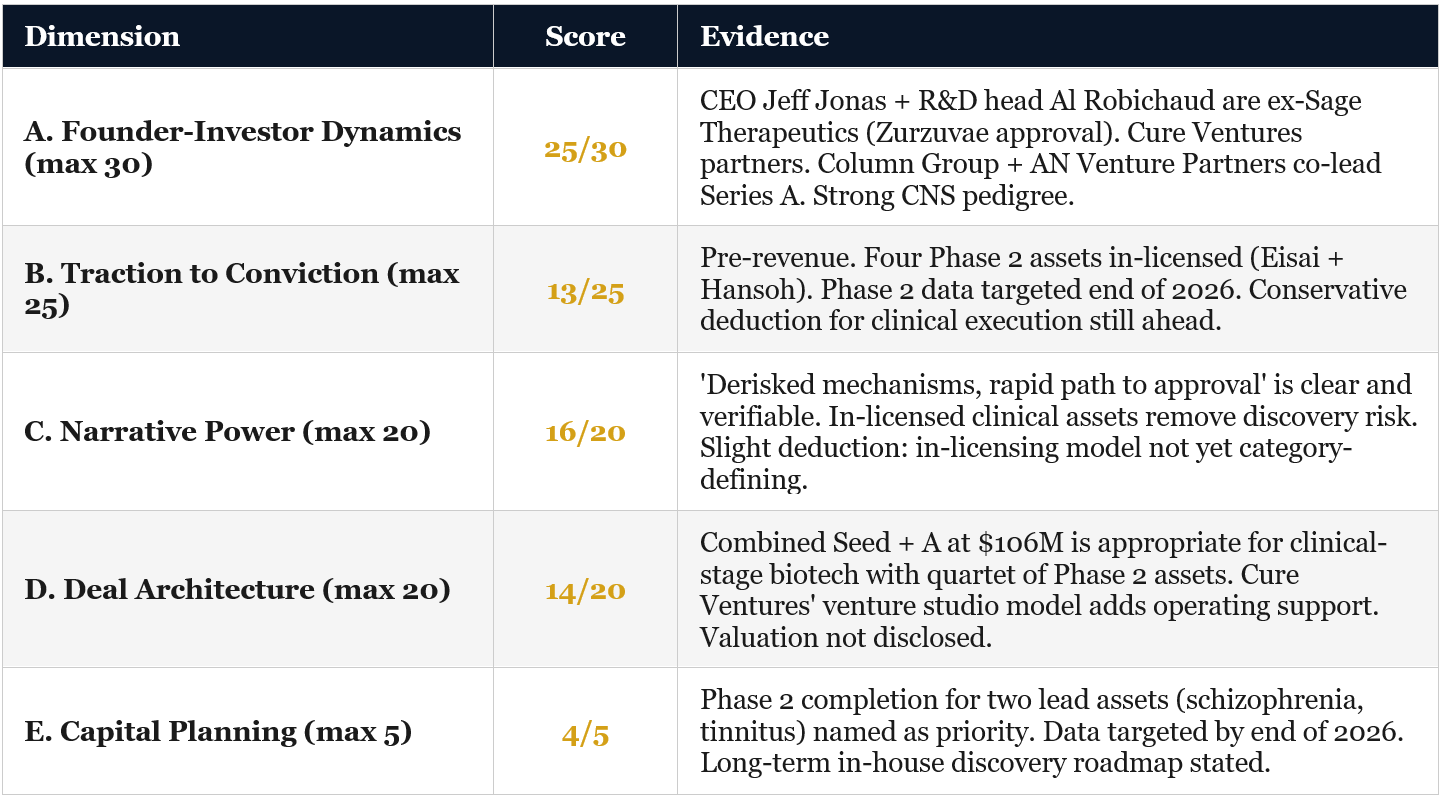
TORTUGAS NEUROSCIENCE
Biotech / Neurology / In-Licensed Pipeline | Seed + Series A | $106M | Undisclosed
EISEN FUNDABILITY SCORE: 72 / 100
Why this scored: Two former Sage Therapeutics executives (CEO Jeff Jonas and President of R&D Al Robichaud, both now Cure Ventures partners) launched a neurology-focused biotech with four Phase 2 clinical-stage assets in-licensed from Eisai (Japan) and Hansoh Pharmaceutical (China) - converting what would normally be five years of discovery work into immediate Phase 2 execution.
The Setup: Tortugas launched April 21, 2026, from Framingham, Massachusetts, with $106 million across Seed and Series A financing. The pipeline includes: TRTL-107 (D2/D3 partial agonist + 5-HT2A antagonist for schizophrenia, from Hansoh); TRTL-913 (GABAA positive allosteric modulator for tinnitus, from Hansoh); a GAT-1 inhibitor for focal epilepsy (from Eisai); and a PDE9 inhibitor for reversible encephalopathies (from Eisai). All four assets are oral once-daily small molecules with derisked mechanisms.
The Numbers: $106M combined Seed and Series A (April 21, 2026) | Lead: Cure Ventures (founding investor, led Seed and co-leading Series A) | Co-leads on Series A: The Column Group, AN Venture Partners | Pre-revenue, four Phase 2 assets | Phase 2 data on schizophrenia and tinnitus assets targeted by end of 2026 | CEO Jeff Jonas and CSO Al Robichaud are both former Sage Therapeutics executives, where Sage’s Zurzuvae became the first FDA-approved oral drug for postpartum depression before the company was sold to Supernus Pharmaceuticals.
Fundability Lessons: Tortugas validates the in-licensing playbook for de novo company formation. Three structural moves earned the round: (1) Cross-border in-licensing from Eisai and Hansoh compressed the discovery timeline from years to months while securing assets with already-validated biology. (2) The CEO and CSO are the same Sage Therapeutics duo that took Zurzuvae through FDA approval - operator pedigree on a similar regulatory path [16]. (3) Cure Ventures led the Seed and co-led the Series A, with Column Group and AN Venture Partners completing the syndicate. The structure reads as “experienced operators executing on derisked assets,” which is the cleanest possible biotech narrative for a pre-revenue launch.
The key lesson: in biotech, derisking happens at three layers - target validity, mechanism, and clinical execution. In-licensing already-clinical assets eliminates the first two layers. Bringing in operators who have shipped a drug in your indication eliminates execution risk. Tortugas eliminated all three before announcing the launch. The $106 million is the result.
Your Takeaway: If you are forming a new biotech, audit whether your differentiation is in discovery or development. Discovery-stage platforms compete in an oversaturated market for early capital. Development-stage in-licensors compete in a less crowded market with faster paths to data. Cross-border licensing from Asian pharma (Eisai, Hansoh, Daiichi Sankyo, Chugai) is now a repeatable playbook for U.S. biotech formation. Map your asset acquisition strategy before your seed pitch.
The Founder Mistake to Avoid: Biotech founders default to ‘we discovered it’ as the differentiation pitch. Tortugas chose the opposite: “We did not discover these molecules - we identified the right ones globally and brought them to U.S. trials.” That is a venture-grade insight. The Sage operator team, plus the Eisai/Hansoh asset library, is structurally hard to replicate; novel discovery platforms are not. Identify whether your edge is the science or the assembly. Both are fundable. Confusing them is not.
THIS WEEK PLAYBOOK: 5 DAYS, 5 DELIVERABLES
This week’s data gave you 5 shifts. Here is how to translate them into actions that alter raises before Friday.
1. PROCUREMENT CHAIN MAP: NAME EVERY BUYER, EVERY CERTIFICATION
Why this matters: Reliable Robotics raised $160M because every step of its certification pathway is tied to a paying customer or a regulatory milestone. Founders pitch the technology; investors underwrite the chain.
Deliverable: Build a five-row procurement chain document.
Row 1: Who pays for early validation?
Row 2: Which regulator approves the next step?
Row 3: Who pays for commercial pilots?
Row 4: Which agency signs off for full commercial operation?
Row 5: Who buys at scale?
For each row, list the named program, the contract amount or grant, and the data each stage produces for the next.
Expected outcome: A one-page chain that converts pre-revenue technology into a procurement narrative an institutional investor can underwrite.
Wrong: “We are building autonomous aircraft for the FAA.”
Right: “The USAF $17.4M Indo-Pacific cargo contract pays for operational hours that feed the FAA’s certification case for the Cessna 208 Caravan retrofit, which we will commercialize through Reliable Airlines (Part 135) starting summer 2026.”
2. ONTOLOGY DEPTH AUDIT: ARE YOU THE WRAPPER OR THE SUBSTRATE?
Why this matters: Omni’s $1.5B valuation is built on a four-year investment in semantic layer engineering that competitors must rebuild from the ground up. AcuityMD’s $955M valuation is built on a seven-year MedTech ontology that no horizontal AI platform can replicate.
Deliverable: Map your data layer in three columns.
Column 1: What entities and relationships does your product encode?
Column 2: How does that encoding deepen with customer usage?
Column 3: How long would a competitor need to replicate it?
If column 3 is under 12 months, your moat is the model, not the data - and the model is commoditized.
Expected outcome: A one-page ontology audit that classifies you as a wrapper or substrate, with a 90-day plan to deepen your position.
3. REGULATORY DESIGNATION SEQUENCING (BIOTECH AND REGULATED TECH)
Why this matters: Ray Therapeutics secured FDA RMAT designation for RTx-015 weeks before closing the Series B, which reorganized the syndicate from biotech specialists to crossover IPO-prep investors. Designations are valuation events.
Deliverable: Identify every regulatory designation your asset or product qualifies for (RMAT, Breakthrough, Fast Track, Orphan, EUA, FDA Pre-Cert, etc.). For each, list: eligibility criteria, submission timeline, expected decision window, and the syndicate change you expect when the designation lands. Sequence submissions so that at least one designation precedes your next financing window by 30-60 days.
Expected outcome: A regulatory milestone calendar synchronized with your fundraising calendar.
4. CONVICTION SYNDICATE DESIGN: WHO IS YOUR CROSSOVER LEAD?
Why this matters: Janus Henderson, Adage, Franklin Templeton, and Marshall Wace participating in Ray’s Series B is the syndicate signature of a pre-IPO biotech. ICONIQ leading Omni at $1.5B is the syndicate signature of a vertical AI platform play. Match your syndicate to your stage thesis.
Deliverable: Build a target syndicate document with three columns.
Column 1: lead investors whose thesis matches your category.
Column 2: crossover or institutional co-investors who signal stage maturity.
Column 3: strategic investors whose business benefits from your product working.
For each, name the specific partner, their last three deals in your space, and the warm intro path to them.
Expected outcome: A 9-investor target list, each matched by partner-level thesis fit, ready for warm outreach over the next 30 days.
5. PROOF STACK FOR THE NEW SELECTIVITY BAR
Why this matters: Crunchbase’s note that ‘just half of the top 10 rounds crossed the $100 million mark’ is the new selectivity bar. The companies that raised this week (Omni at 4x ARR, AcuityMD at 16 of the top 20 customers, Reliable at 200+ system commitments) all had documented commercial proof at the moment of announcement.
Deliverable: Build a single “Proof Stack” slide with four rows: (1) named customers and their measurable outcomes; (2) revenue trajectory with growth rate and a profitability or margin path; (3) retention or expansion metric (NRR, seat growth, contract renewals); (4) a regulatory, certification, or procurement milestone that occurred in the past 90 days. If any row is empty, that gap is your fundraising obstacle - work on the gap before the next investor meeting.
Expected outcome: A one-slide proof stack that replaces narrative with evidence and clears the April 2026 selectivity bar.
LOOKING FORWARD: NEXT 1-3 WEEKS
SCENARIO 1: ENERGY-FOR-AI BECOMES THE LARGEST INFRASTRUCTURE SUB-CATEGORY OF Q2 2026 (HIGH PROBABILITY)
Evidence: Blue Energy $380M (April 21). Valar Atomics raised $450M earlier in April at a $2B valuation per Bloomberg sourcing. The U.S. Department of Energy and the Texas grid operator are both signaling the urgency of procuring capacity for AI workloads. Hyperscalers are projected to spend $650B on AI infrastructure in 2026, and power is the binding constraint.
What to watch: Hyperscaler power purchase agreement announcements. Department of Energy small modular reactor licensing decisions. Any new equity-debt blended rounds for prefab nuclear, geothermal, or grid-scale storage.
What founders should do: If you build any infrastructure adjacent to AI compute (power, cooling, water, transmission, interconnection), reframe your fundraising around contract structure. The investors writing $300M+ checks here are infrastructure capital allocators, not VCs. Build the appropriate target list now.
SCENARIO 2: VERTICAL AI ONTOLOGY ROUNDS ACCELERATE TO 2-3 PER WEEK (HIGH PROBABILITY)
Evidence: Omni $120M at $1.5B (April 23) [3]. AcuityMD $80M at $955M (April 21). Harvey $200M at $11B (March, legal AI) [March 23-28 report]. The pattern is identifiable across legal, medtech, and analytics, and is now spreading. ICONIQ, StepStone, Sequoia, and Index are all explicitly underwriting governed data layers for vertical AI.
What to watch: Ontology-platform rounds in financial services compliance, life sciences clinical operations, energy regulatory, and defense procurement. Watch for $80M-200M Series B and C rounds at 30-50x ARR multiples in regulated verticals.
What founders should do: If you sell vertical AI, the question is no longer ‘is your model better?’ It is ‘what proprietary ontology of business entities, relationships, and rules does your product own?’ If you cannot describe the ontology in one paragraph, build it before the next investor conversation. Wrappers are losing the round; substrates are winning.
SCENARIO 3: BIOTECH IPO WINDOW REOPENS BY Q3 2026 (MEDIUM-HIGH PROBABILITY)
Evidence: Ray Therapeutics’ Janus Henderson, Adage, Franklin Templeton, and Marshall Wace syndicate is the structural signature of pre-IPO biotech preparation. According to Crunchbase coverage, several biotechs filed S-1s in April. Crossover funds participating in private rounds at this scale typically signal IPO targeting within 12-18 months.
What to watch: Biotech S-1 filings in May and June. FDA Phase 3 readouts in retinal disease, neurology, and oncology. Crossover-fund participation in Series B and C rounds for clinical-stage biotechs with 18-month catalyst paths.
What founders should do: If you are a clinical-stage biotech, sequence your regulatory designations, data readouts, and next financing round so they reinforce each other within a 12-month window. Crossover capital is selective but available. The bar is an FDA designation, plus a crossover-grade syndicate, plus a catalyst within 18 months.
WILD CARD: SECONDARY MARKETS ABSORB MORE PRIMARY CAPITAL (MEDIUM)
Evidence: Robinhood Ventures Fund I purchased $75M of OpenAI common stock in a publicly disclosed secondary transaction. Omni’s $120M Series C included a $30M employee tender offer. Both signal that secondary liquidity is becoming a structural component of late-stage rounds rather than an afterthought.
What founders should do: If you are at $50M+ ARR with a long path to an IPO, plan for employee secondary tenders as part of your next-round structure. The talent retention math has shifted - employees who joined in 2020-2022 are now expecting partial liquidity events at Series C and D, rather than waiting for an IPO. Build the tender into your round before the round opens.
THE BOTTOM LINE
The real insight from this week is not that capital paused, or that biotech returned, or that energy is hot. The real insight is that the venture market repriced the gap between narrative and proof, and the companies that closed all sat on the proof side.
Profile 1: Vertical AI ontologies with documented growth and profitability. Omni at $120M / $1.5B (4x YoY ARR, profitable, BambooHR + Mercury + Pendo + Synthesia). AcuityMD at $80M / $955M (16 of the top 20 MedTech, $34B identified pipeline). The proof is in the depth of data integration, not AI sophistication.
Profile 2: Procurement-validated dual-use infrastructure. Reliable Robotics at $160M / ~$1B (USAF $17.4M contract, 200+ system commitments, FAA cert pathway, Albuquerque pilot program). Blue Energy at $380M (1.5GW Texas project for AI data center power purchase agreements). The proof is in the named programs and contract structures, not in technology demos.
Profile 3: Derisked clinical-stage biotechs with crossover-investor syndicates. Ray Therapeutics at $125M Series B (Janus Henderson lead, FDA RMAT designation, IPO-grade syndicate). Tortugas Neuroscience at $106M (Sage operators, four Phase 2 in-licensed assets). The proof is regulatory designation and operator pedigree, not platform breadth.
Everything else competed for the remaining selectivity capital. With Crunchbase noting that “just half of the top 10 rounds crossed the $100 million mark, which is somewhat unusual”, the message is clear: April 2026 is the new bar. Q1 narrative-driven multiples are not coming back at Series B without proof.
5 NEW RULES FOR FOUNDERS (EVIDENCE-BASED)
Rule 1: Energy is the new compute. AI infrastructure capital is migrating downstream from chips and networking into power and the grid. If your product solves any constraint between AI workloads and the electricity that runs them, your TAM is in the trillions, and your investor pool is infrastructure capital - not traditional VCs.
Rule 2: Substrate beats wrapper. Vertical AI multiples now hinge on ontology depth rather than model sophistication. The company's pricing at 50x ARR (Omni) owns the data layer that competitors must replicate. The companies pricing at 5-10x ARR sell on top of someone else’s ontology.
Rule 3: Procurement chains are pitchable. Reliable Robotics’ chain (USAF contract → operational hours → FAA case → commercial cargo → aerospace M&A) is a pitch artifact, not just an operating plan. If your regulated technology does not have a five-step chain on the wall, your Series B will stall at the first regulatory diligence question.
Rule 4: FDA designations are valuation events. RMAT, Breakthrough, Fast Track, and Orphan each remove a discrete risk dimension that crossover investors price into their model. Sequence your designations to land 30-60 days before your next financing window opens.
Rule 5: The April selectivity bar is the new baseline. Q2 2026 will not return to narrative-driven megarounds outside the four frontier AI labs. Founders raising at any stage should assume documented proof is the entry ticket, not the upgrade. Polish the deck last; assemble the proof stack first.
4 MONDAY ACTIONS (DO THESE BEFORE 5 PM TODAY)
(1) Procurement Chain Document: Write the five-step chain from the first paying customer to commercial scale. Name each program, contract, regulator, and data product.
(2) Ontology Audit: classify your product as a wrapper or a substrate. If wrapper, draft a 90-day plan to deepen the data layer.
(3) Regulatory Calendar: list every designation your asset or product qualifies for. Sequence submissions to land before your next round opens.
(4) Crossover Syndicate Map: identify three crossover or institutional investors whose participation would signal stage maturity for your category. Build the warm intro path to each.
Your competitors are reading the same data. The founders who act fast own the narrative.
RESEARCH METHODOLOGY AND SOURCES
Data collection period: April 20-26, 2026 (Crunchbase weekly tracking window April 18-24, with full overlap on April 20-24). Verification standard: minimum of 2 independent sources per featured deal; official press releases prioritized. Eisen Fundability Scores are proprietary analytical estimates, not endorsements or investment advice. All dollar amounts reflect announced figures at close.
Total deals tracked: 10 verified U.S. deals, $1.21B total. Excluded: Anthropic’s $5B Amazon partnership extension (per user request); OpenAI $75M Robinhood Ventures purchase (secondary transaction, not primary issuance); Cloudsmith $72M Series C (Belfast, Northern Ireland - non-U.S.); EVAS Intelligence ¥1.5B (~$211M Series B - China-based). Research completion timestamp: April 27, 2026.
DISCLAIMER: This report is for informational and strategic intelligence purposes only. It does not constitute investment advice. Eisen Fundability Scores are analytical frameworks, not financial recommendations. All data is sourced from publicly available information and primary company announcements. Powered by the Eisen Fundability Framework.
If this article was useful, share it with founders who are about to raise.
— Leon Eisen, 4x Founder, Venture Capitalist, and Creator of Fundables OS™