

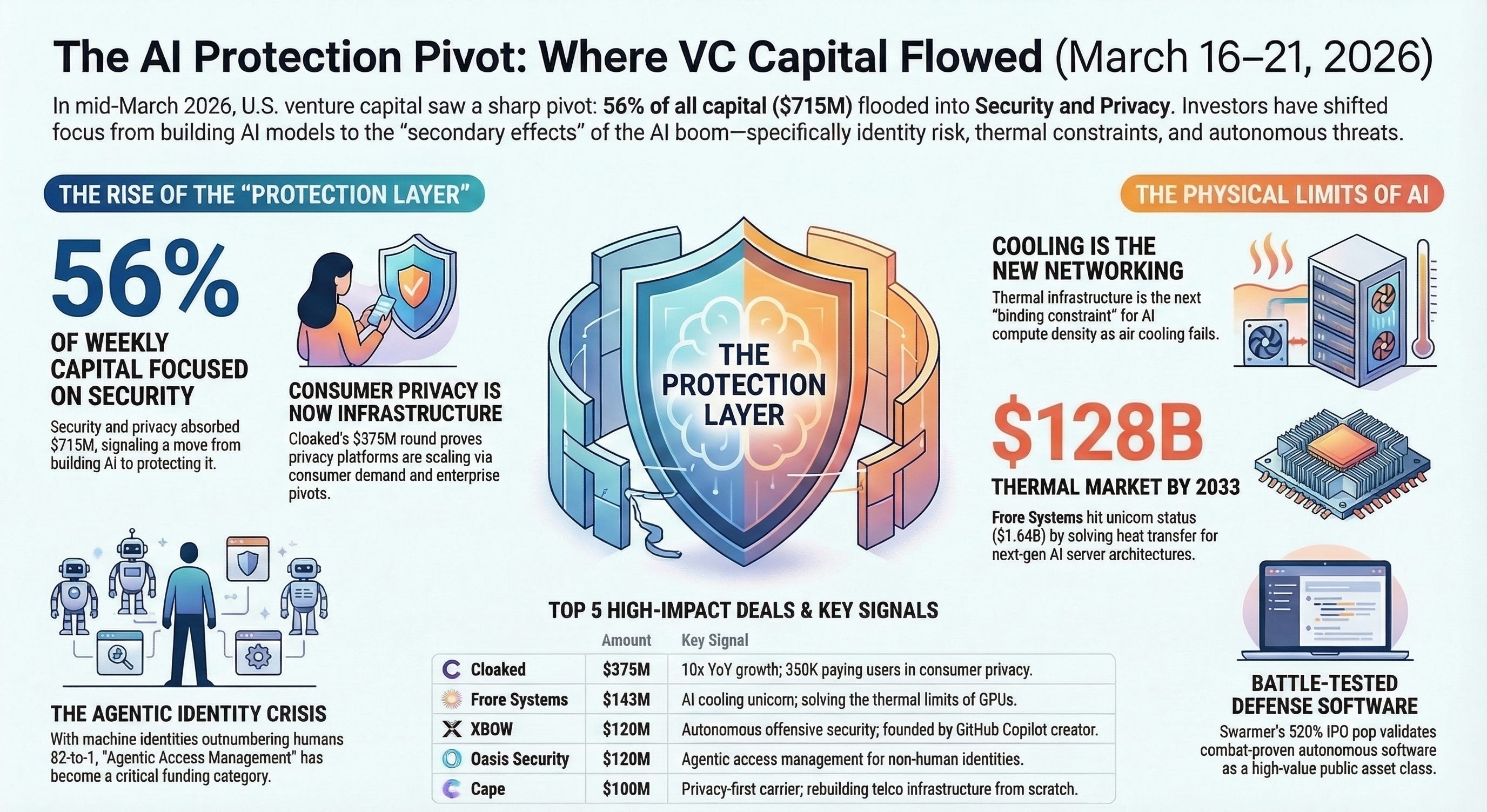
Ten deals. Four new unicorns. 56% of the capital went into one category that nobody predicted. Privacy became infrastructure, cooling became a constraint, and defense tech got its public market moment.
In the week of March 16–21, 2026, the largest U.S. venture deal was not in AI models, robotics, or enterprise SaaS. It was a $375 million Series B for a consumer privacy company called Cloaked, backed by General Catalyst’s Customer Value Fund, which has 350,000 paying customers and grew 10x in one year. That is a category signal, not a one-off.
Four companies crossed the billion-dollar valuation threshold this week: Cloaked (consumer privacy), Frore Systems ($1.64B for AI chip cooling), XBOW ($1B+ for autonomous offensive security), and Cape ($900M for a privacy-first mobile carrier, nearing unicorn). Security and privacy absorbed $715 million in a single week, more than physical AI and robotics captured the prior week.
Meanwhile, on the public markets, Ukrainian drone-swarm software company Swarmer debuted on Nasdaq at $5 per share and closed up 520% on day one — the strongest U.S. IPO since Newsmax, with $310K in annual revenue. The defense tech narrative just crossed from private to public.
Last week was about building the future. This week was about protecting it.
THE WEEK IN ONE SENTENCE
Security, privacy, and AI infrastructure cooling collectively absorbed $1.27B across 10 verified U.S. deals, while the largest single round ($375M) went to a consumer privacy platform, signaling that the AI buildout’s secondary effects (identity risk, thermal limits, autonomous threats) are commanding primary capital this week.

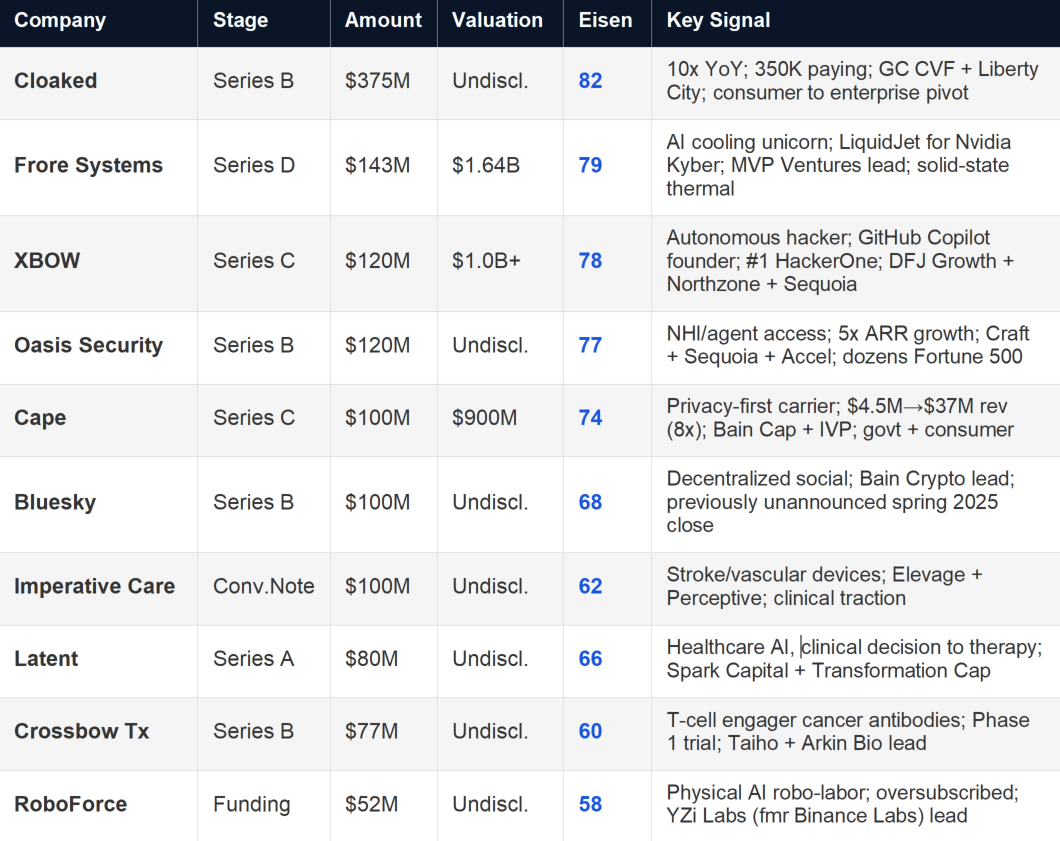
DEALS SCORECARD
What the Scorecard Says at a Glance
This week’s scorecard looks nothing like last week’s. The highest-scoring deals are not in AI models, robotics, or infrastructure compute. They are in security and privacy. Cloaked (Score 82) scores highest on the strength of 10x consumer growth, a credible enterprise pivot, and a funding structure (General Catalyst’s Customer Value Fund) that signals growth-equity conviction, not early-stage speculation. Frore (Score 79) represents the thermal-constraint thesis, the idea that cooling is the physical limit on AI compute density, and achieved unicorn status on it. XBOW (Score 78) and Oasis (Score 77) both demonstrate that the next security category is not about defending human users; it is about governing AI agents and outpacing AI-powered attackers.
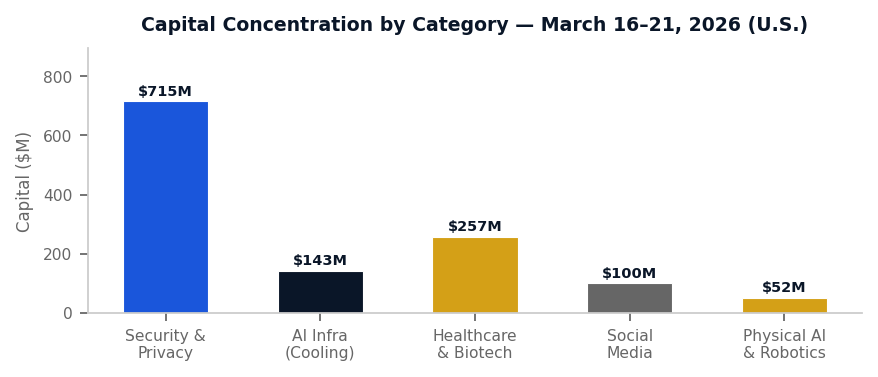
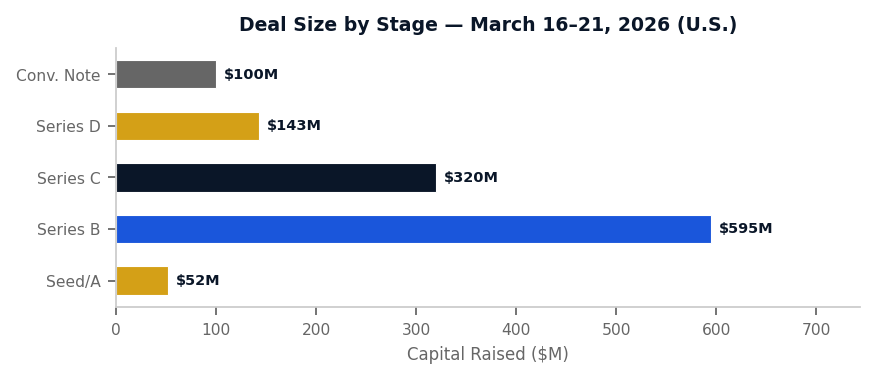
The total capital this week ($1.27B) is 61% lower than last week’s $3.24B, but the category concentration is sharper. Security and privacy absorbed 56% of all capital. That is not a rotation. That is a thesis forming in real time.
What Changed This Week
SHIFT 1: Security Became the Largest Category This Week
Pattern
Cloaked ($375M consumer privacy), XBOW ($120M autonomous offensive security), Oasis Security ($120M non-human identity), and Cape ($100M privacy-first mobile carrier) collectively raised $715M in one week. Four security/privacy companies. Three new unicorns. All announced March 16–19. No SaaS, no dev tools, no AI model companies in the top 5.
Perspective
This is not a coincidence. The AI buildout created a secondary wave: every AI agent deployed creates a new identity to govern (Oasis). Every AI-powered attacker creates demand for AI-powered defenders (XBOW). Every data breach makes privacy infrastructure more valuable (Cloaked, Cape). Investors are funding the protection layer of the AI economy. The offense-defense cycle that drives cybersecurity spending just accelerated by an order of magnitude because both sides now use AI.
Founder Blindspot
Founders in security think the buyer is the CISO. Wrong. Cloaked’s largest growth vector is consumers — 350,000 paying individuals. Cape’s buyer is anyone who owns a phone. The security market just bifurcated: enterprise security (governed by procurement) and consumer security (governed by fear and convenience). Consumers are growing faster. Enterprise is paying more per seat. Smart founders are building for both. Cloaked’s enterprise product launched less than a year after the consumer product proved demand.
Playbook
If you are building in security, reframe your pitch from “we protect against X threat” to “we govern the AI attack surface that didn’t exist 18 months ago.” Oasis’s framing, machine identities outnumber humans 82-to-1, is the constraint language that converts. Name the new attack surface. Quantify how many entities (agents, tokens, non-human identities) your customer now has to govern. That number is your TAM narrative.
Contrast
Last week, $3.24B was invested in AI infrastructure, robotics, and developer tools. This week, $715M went to protecting the systems those tools built. The buildout creates the threat. The threat creates the next funding wave. Founders who see only the buildout are one cycle behind.
What this means for your raise: If you solve a security problem that only exists because of AI deployment, your TAM is growing faster than any application category. Name the AI-created attack surface. Quantify the entities at risk. Fund the protection layer.
SHIFT 2: Colling is the New Networking - the Thermal Constraint Thesis
Pattern
Frore Systems raised $143M in a Series D at a $1.64B valuation (March 16). An eight-year-old company founded by former Qualcomm engineers is developing solid-state cooling chips for AI data centers. This follows Accelsius ($65M Series B in January 2026 for two-phase liquid cooling). The data center cooling market: $31.4B in 2026, projected to be $128.3B by 2033. Jensen Huang personally influenced Frore’s pivot from edge-device cooling to AI data-center liquid cooling.
Perspective
Last week, $700M went to AI networking (Nexthop + Eridu). This week, $143M went to AI cooling. The pattern is identical: investors are systematically funding every physical constraint that limits AI compute density. Networking was the first constraint. Cooling is the second. Power delivery is third. Each constraint layer absorbs $100M–$500M rounds as it becomes binding. Frore’s CEO said it directly: “Cooling has become the single greatest limiter of AI performance.” When the CEO names the constraint and Jensen Huang validates it, investors write the check.
Founder Blindspot
Founders see “AI infrastructure” and think compute or models. Wrong. The infrastructure layers that are under-invested relative to demand are physical: cooling, power, and interconnect. These are hardware problems with software-defined solutions. Frore’s LiquidJet is a solid-state device — no mechanical pumps, no fans. The innovation is in materials science and fluid dynamics, not in AI algorithms. The hardest infrastructure companies to build are also the hardest to compete with.
Playbook
If you operate anywhere in the AI data center physical stack, identify which constraint becomes binding at the next scale threshold. Frore’s thesis: air cooling fails at current GPU power densities. Name your equivalent — “At X watts per rack, Y system physically fails.” Build your pitch around the failure point, not the improvement percentage.
Contrast
In 2024, AI infrastructure funding meant compute and models. In Q1 2026, the capital is flowing downstream: networking (March 10), cooling (March 16), and security (March 19). Every week reveals the next physical constraint. The investable surface area of AI infrastructure is expanding, not contracting.
What this means for your raise: The thermal stack is now a unicorn category. If you solve any physical constraint in AI compute, like cooling, power delivery, or rack density, you are building in the fastest-growing infrastructure sub-category of 2026.
SHIFT 3: The Autonomous Security Market Just Crossed $1B in a Week
Pattern
XBOW ($120M, $1B+ valuation, March 18): autonomous offensive security — AI that thinks like a hacker at machine speed. Oasis Security ($120M, March 19): agentic access management for non-human identities. Add last week’s Kai ($125M, agentic cybersecurity). Three deals totaling $365M in under two weeks. All three were specifically built for AI-era threats that did not exist before 2024.
Pattern
The cybersecurity market is splitting into two eras: pre-AI and post-AI. Pre-AI security protected human users from human attackers. Post-AI security governs AI agents, defends against AI-powered attacks, and secures machine identities that outnumber humans 82-to-1. The tools are different. The buyers are different. The economics are different. XBOW’s founder created GitHub Copilot. He knows exactly how LLMs reason, and he weaponized that knowledge for defense. That’s category-defining credibility.
Founder Blindspot
Founders assume cybersecurity is a mature market with entrenched incumbents. It is for pre-AI threats. For post-AI threats, the market is greenfield. Every AI agent deployed creates identities, access pathways, and attack surfaces that CrowdStrike and Palo Alto were not designed to govern. The incumbent’s installed base is a liability, not an asset, when the threat model changes. That is why two-year-old companies are raising at $1B+.
Founder Blindspot
Audit your company’s AI agent deployments this week. Count the non-human identities, API tokens, and service accounts that have been created in the last 90 days. For most enterprises, that number has doubled since January. If you are building security products, your pitch should include that growth rate. If you are a non-security founder, understand that “AI-native security” will be a due diligence checkbox within 6 months.
What this means for your raise: Post-AI cybersecurity is a category-creation moment. Two-year-old companies are raising at unicorn valuations because the threat model is new. If you govern, defend, or audit AI systems, your market is uncapped and growing with every agent deployed.
SHIFT 4: Consumer Privacy Crossed From Feature to Platform
Pattern
Cloaked ($375M) and Cape ($100M) both raised this week on the same thesis: privacy is not a feature, it is infrastructure. Cloaked bundles identity masking, data removal, VPN, call screening, and dark web monitoring into one consumer subscription, then extends to the enterprise. Cape rebuilt a mobile carrier from scratch to eliminate cellular surveillance. Both companies grew revenue 8–10x in a single year. Both raised from growth-equity investors, not seed funds.
Perspective
The privacy market has been waiting for a platform company since 2018 (GDPR). Six years of point solutions (VPN here, password manager there, data broker removal over there) created fragmentation that consumers hate, and enterprises can’t govern. Cloaked’s 10x growth proves that bundling works: one subscription, one platform, every privacy vector. That is the “Slack of privacy” thesis: consolidating a fragmented workflow into one product. General Catalyst’s Customer Value Fund is not a VC vehicle; it is a growth fund. This is growth-equity conviction, not venture experimentation.
Perspective
Founders in privacy assume the buyer is privacy-conscious by default. Wrong. Cloaked’s growth came from making privacy effortless: one-click identity generation, automatic data removal, and AI call screening. The product sells on convenience, not ideology. Cape sells on “your carrier is tracking you,” a fear message, not a feature message. The privacy market scales on fear and convenience, not on regulation compliance.
Playbook
If you are in privacy or identity, build the bundle. The single-feature privacy company (VPN-only, password-only) is now a point solution competing against platforms. Cloaked proved the unit economics of bundling. If you are not in privacy, check whether your product handles user data in a way that creates liability. If yes, your “privacy story” is now a due diligence requirement, not a marketing asset.
What this means for your raise: Consumer privacy is now a growth-equity category. 10x revenue growth + bundled platform + enterprise expansion = the playbook that commands $375M checks. If your product touches personal data, your privacy architecture is now an investor question.
SHIFT 5: Defence Tech Got Its Public Market Validation - and It Changed the math.
Playbook
Swarmer IPO’d on Nasdaq at $5/share (March 17), closed at $31 (+520%), and hit $55 on day two (+1,097% cumulative). Erik Prince as chairman. Deployed in 100,000+ combat missions in Ukraine. Revenue: $310K. Market cap at close: $382M. This is the strongest U.S. IPO debut since Newsmax, and it happened with pre-revenue-scale financials.
Perspective
Swarmer’s 520% pop is not rational on fundamentals. It is a signal. Public market investors are pricing “battle-tested autonomous software” as its own asset class, separate from drone hardware manufacturers. The investor thesis: Ukraine is the proving ground, and the companies that survive real combat deployment have a moat no lab-tested competitor can replicate. The analogy is Palantir — which went public in 2020 with a similar “government-first, real-world-validated” narrative and traded at 20x+ revenue for years.
Founder Blindspot
Founders in defense tech focus on government contracts. Swarmer’s S-1 shows $33.1M in projected revenue from committed contracts and MOUs, but the stock moved on narrative, not financials. The lesson: public markets price defense tech on deployment proof and geopolitical timing, not on P&L metrics. Private founders should note: if public investors will pay 1,000x revenue for combat-validated drone software, private market valuations for defense AI are severely underpriced relative to public appetite.
Playbook
If you are in defense tech, build your “deployment proof” dossier now. Document every real-world deployment, mission count, and operational metric. Swarmer’s S-1 cited 86,000+ combat missions. That is the proof that commands a market cap 1,000x revenue. If you are not in defense tech, watch the Swarmer price action over the next 30 days. If it holds above $25 (5x IPO), defense tech IPOs will accelerate in Q2, and secondary effects will pull private market valuations up across the entire sector.
What this means for your raise: Public markets just validated defense tech at irrational multiples. If Swarmer holds, private defense valuations will reprice upward. Build your deployment proof before the window opens wider.
The Deals That Matter
CLOAKED — Consumer Privacy Platform
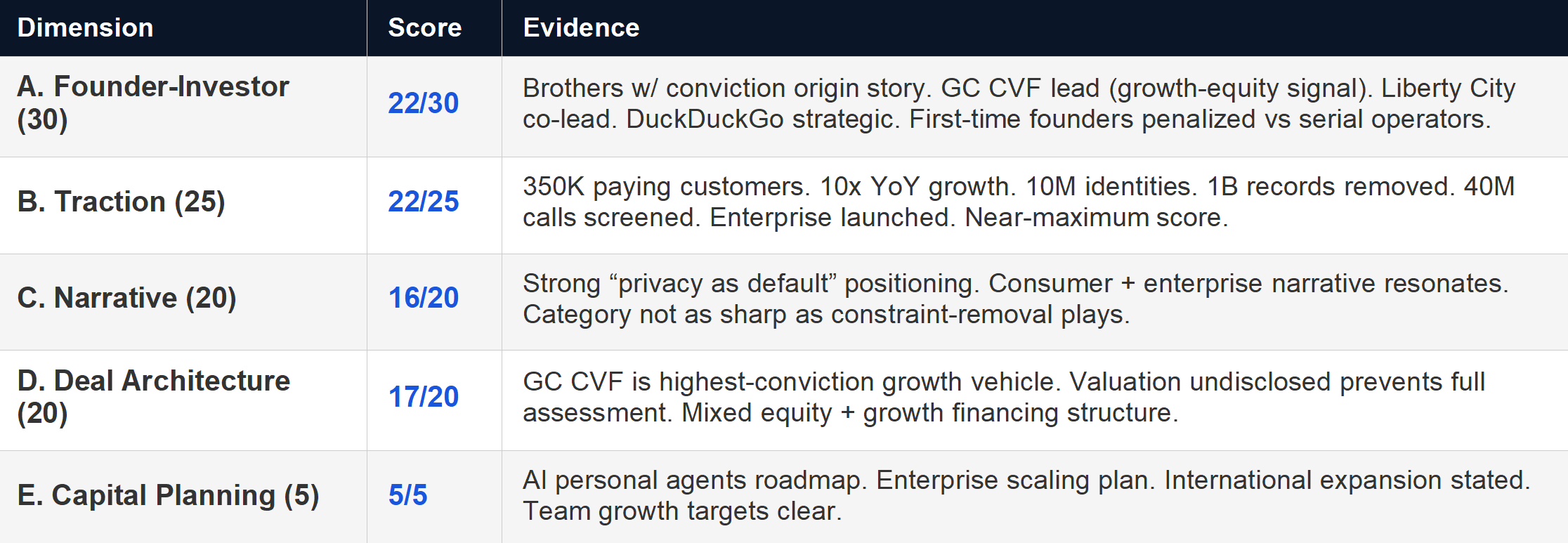
Series B, $375M, Eisen Fundability Score: 82 / 100
Why this scored: Highest score this week on verified consumer traction at scale (350K paying, 10x YoY), a growth-equity lead (General Catalyst CVF), and a credible enterprise expansion that transforms a consumer product into infrastructure. The score is held back by undisclosed valuation and limited public enterprise metrics.
The Setup
Founded in 2020 by brothers Arjun and Abhijay Bhatnagar. The origin: Arjun built an AI system to analyze his own data, which then contacted his ex-girlfriend without his permission. That moment crystallized the company’s mission: give people control over their data before it’s exposed. Cloaked started with virtual identities (unlimited unique phone numbers, email addresses, and passwords). It expanded to automated data removal (1B+ records scrubbed from broker sites), AI call screening (40M+ calls processed), VPN, identity theft insurance, and dark web monitoring. In late 2025, it launched Cloaked Enterprise to protect employees’ personal digital exposure.
The Numbers
$375M Series B + growth financing (March 19, 2026) │ Valuation undisclosed │ Leads: General Catalyst (Customer Value Fund) + Liberty City Ventures │ Syndicate: Lux Capital, Human Capital, Marquee Ventures, Fifth Growth Fund, NFL Players Association, LG Technology Ventures, Assurant Ventures, DuckDuckGo │ 350,000+ paying customers │ 10x YoY growth │ 10M+ identities disguised │ 1B+ data broker records removed │ 40M+ calls screened │ ~70 employees │ Total raised: $400M+
Fundability Lessons
Cloaked proves a principle most founders miss: consumer traction at 10x growth converts to growth-equity checks at Series B. General Catalyst’s Customer Value Fund is not a traditional VC fund — it is structured for companies with provable unit economics and compounding consumer engagement. That distinction matters. GC led Cloaked in every round but only led a round for the first time now — the signal is that GC waited until growth-equity conviction was warranted, then committed at scale.
The key lesson: the best growth investors wait for proof before moving decisively. 10x growth is the trigger. Not the pitch.
Your Takeaway
The privacy market is a bundle of opportunities. Cloaked’s 10x growth came from consolidating 5+ point solutions into one subscription. If you are in any fragmented consumer category where users currently use 3+ tools for the same job, the bundling playbook is proven and funded. Build the platform, not the feature.
The Founder Mistake to Avoid
Founders see Cloaked and think “build a privacy app.” Wrong lesson. Cloaked’s edge is the enterprise pivot; the consumer product proves demand, but the enterprise product (Digital Workforce Protection) creates revenue concentration and contract stickiness. A consumer-only privacy product is a nice lifestyle business. A consumer + enterprise platform is a venture-scale company. The pivot must be architected from day one, not discovered at Series B.
FRORE SYSTEMS — AI Thermal Infrastructure
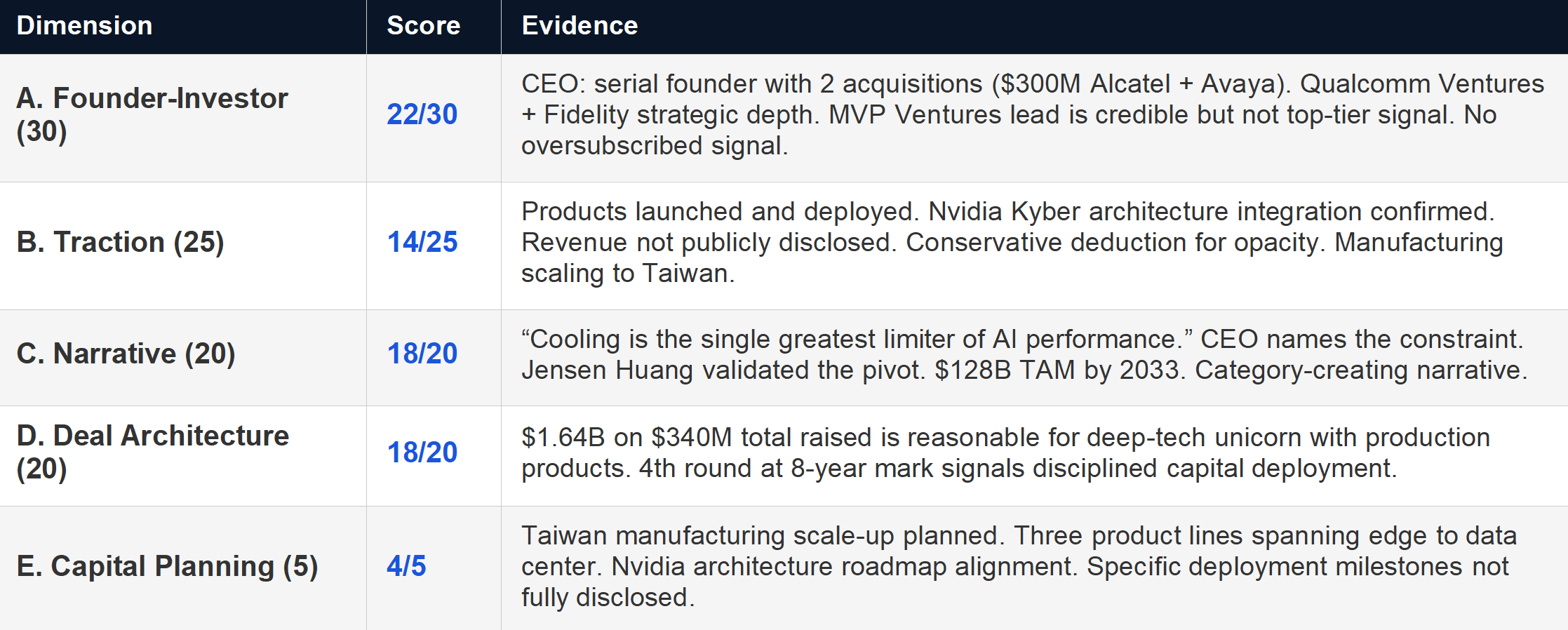
Series D, $143M, Eisen Fundability Score: 79 / 100
Why this scored
New unicorn on a thesis that did not exist as a standalone category two years ago: the thermal stack as foundational AI infrastructure. Backed by Fidelity, Qualcomm Ventures, and MVP Ventures. Jensen Huang personally catalyzed the company’s pivot from edge-device cooling to AI data center liquid cooling. Revenue opacity and a non-top-tier VC lead prevent a higher score.
The Setup
Founded in 2018 by former Qualcomm engineers Dr. Seshu Madhavapeddy (CEO, previously co-founded Spatial Wireless, acquired for $300M by Alcatel-Lucent, and Sipera Systems, acquired by Avaya) and Dr. Surya Ganti (CTO, invented the AirJet technology after roles at Intel and Qualcomm). Frore initially focused on developing solid-state cooling chips for smartphones and tablets — small devices without traditional fans. The pivot followed the company's engagement with Jensen Huang, who influenced its move to liquid cooling for modern AI server systems. The result: LiquidJet, a 3D short-loop, jet-channel, multi-stage direct liquid-cooling cold plate that uses high-frequency vibrating membranes to create pressurized jets of liquid - no mechanical pumps, no moving parts in the traditional sense. LiquidJet Nexus, unveiled the week of the raise, is designed specifically for Nvidia’s next-generation Kyber architecture in 1/2U AI server trays.
The Numbers
$143M Series D (March 16, 2026) │ $1.64B valuation (unicorn status) │ Lead: MVP Ventures │ Syndicate: Fidelity Management & Research, Top Tier, Mayfield Fund, Qualcomm Ventures, Clear Ventures, Addition, StepStone Group, Alumni Ventures, Prosperity7 │ Total raised: $340M │ Prior: $80M Series C in 2024 │ Products: AirJet (solid-state air cooling), LiquidJet (AI data center), LiquidJet Nexus (Nvidia Kyber) │ Performance: 75% higher heat transfer, ~8°C cooler GPUs, ~4% higher AI token throughput │ Manufacturing expansion: Taiwan scale-up planned
Fundability Lessons
Frore proves that patient deep-tech companies can break out when the market catches up to the physics. Eight years from founding to unicorn status, but the last two years accounted for 90% of the value. The catalyst was not a product improvement; it was the external forcing function of AI power densities exceeding the physical limits of air cooling. Frore did not create the market. NVIDIA’s GPU roadmap did. Frore positioned for the upcoming constraint.
The key lesson: if you are building deep tech, the most important strategic decision is identifying which external forcing function will make your technology essential — and ensuring you are production-ready when it arrives. Frore spent 6 years building the capability and 2 years riding the wave.
Your Takeaway
If you operate in AI data center infrastructure, map the thermal profile of the next 2 GPU generations. Every watt of compute becomes heat. Every generation increases wattage. At current trajectories, air cooling fails within 18 months for the densest configurations. If your product sits in the thermal path, cold plates, coolant distribution, heat exchangers, or immersion systems, the market is following a predictable hardware release schedule. Build your fundraising around that timeline.
The Founder Mistake to Avoid
Founders see “AI cooling startup” and assume commodity hardware. Wrong. Frore’s moat is solid-state technology — no mechanical pumps, no moving parts — which means higher reliability at scale and fundamentally different failure modes than traditional liquid cooling. The cooling market’s competitive advantage is in the physics of the approach, not the product label. If your solution requires mechanical components, you are competing on price. If it requires novel materials science and fluid dynamics, you are competing on capability. The moat is in the physics, not the plumbing.
XBOW - Autonomous Offensive Security
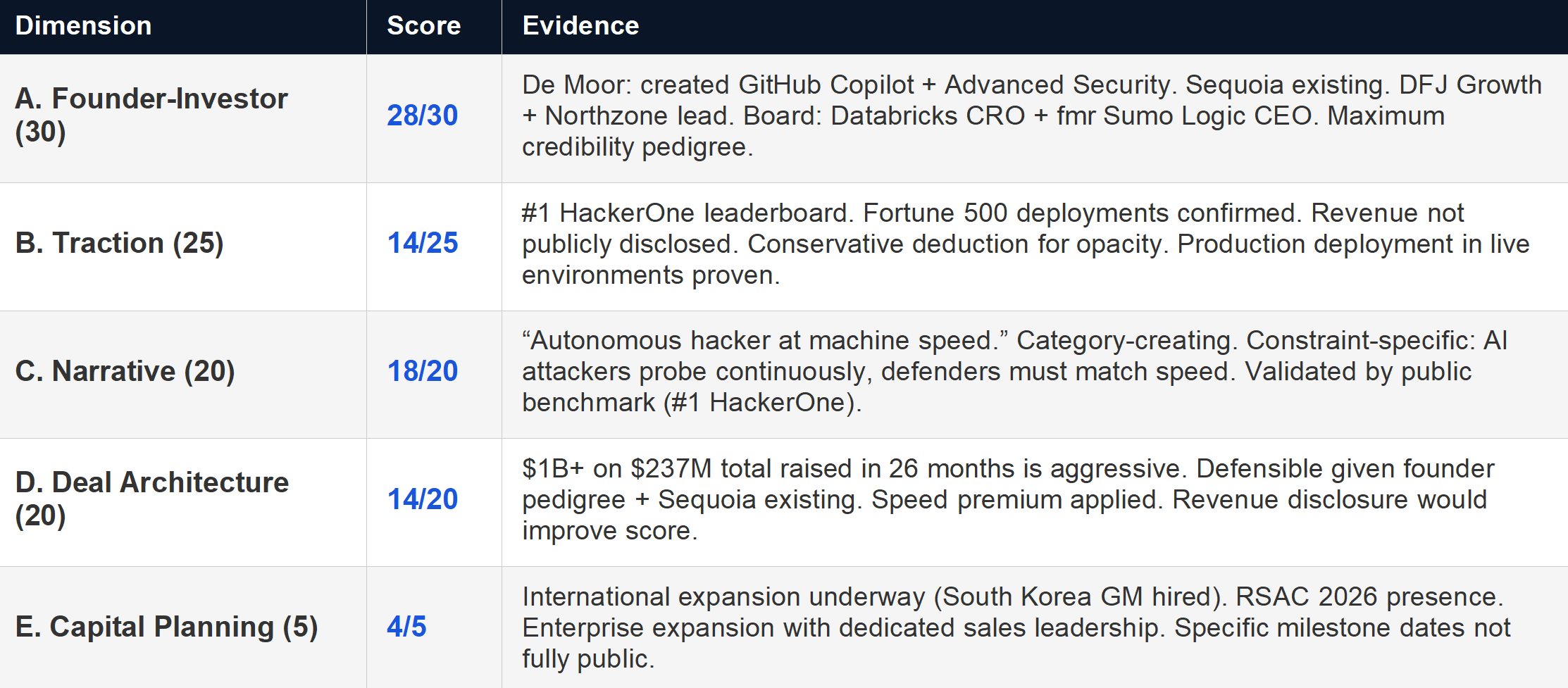
Series, $120M, Eisen Fundability Score: 78 / 100
Why this scored
Unicorn in under 26 months. Founded in January 2024 by Oege de Moor, the creator of GitHub Copilot and GitHub Advanced Security, arguably the person who best understands how LLMs reason about code, and how that reasoning can be weaponized for both attack and defense. DFJ Growth + Northzone lead, Sequoia, and Altimeter as existing investors. The speed from founding to $1B+ valuation is exceptional even by 2026 standards.
The Setup
Oege de Moor created GitHub Copilot and GitHub Advanced Security, then left to found XBOW in January 2024 with a single insight: if LLMs can write code, they can also find flaws in code at machine speed. Traditional penetration testing is point-in-time, manual, and talent-constrained. XBOW applies AI reasoning and adversarial workflows to continuously test applications for vulnerabilities — matching the speed and persistence of AI-powered attackers. The company reached #1 on the HackerOne leaderboard, proving its autonomous system could outperform elite human hackers on standardized benchmarks. CISO Nico Waisman (formerly CISO at Lyft) assembled a team of top offensive security professionals to train the platform to think like a real-world adversary. Fortune 500 and global enterprises now rely on XBOW as a mission-critical layer in their security stack.
The Numbers
$120M Series C (March 18, 2026) │ $1B+ valuation │ Leads: DFJ Growth + Northzone │ New investors: Sofina, Alkeon Capital │ Existing: Altimeter, NFDG Ventures, Sequoia Capital │ Total raised: $237M │ Founded: January 2024 │ Founder: Oege de Moor (creator of GitHub Copilot + Advanced Security) │ CISO: Nico Waisman (fmr Lyft) │ Board additions: Ron Gabrisko (CRO Databricks), Ramin Sayar (fmr CEO Sumo Logic) │ Global expansion: WonLae Lee hired as GM South Korea (early 2026)
Fundability Lessons
XBOW represents the “creator becomes defender” investment thesis at its most powerful. When the person who built the attack surface also builds the defense system, investor risk perception collapses. De Moor does not need to explain how LLMs reason about code. He invented the commercial implementation. That credibility cannot be replicated by a team of security engineers who learned LLMs after the fact. The fundability lesson: at the highest-conviction levels, investors bet on founders whose prior work created the market they now serve. GitHub Copilot created the market for AI-assisted code generation. That market created new attack surfaces. De Moor’s XBOW, a product he created, defends against surface attacks. That loop is the most fundable founder-market fit possible.
Your Takeaway
If you built a system that created a new category of risk, and you understand that risk better than anyone because you built the system, you are sitting on the most fundable security thesis in venture. The lesson for all founders: your deepest domain expertise creates your highest-conviction fundraising opportunity. XBOW is not “an AI security company.” It is “the company founded by the person who knows how AI code generation actually works, defending against the vulnerabilities that process creates.”
The Founder Mistake to Avoid
Founders see XBOW and think, “I’ll build another AI security tool.” Wrong. XBOW’s unfair advantage is that its founder literally built the AI code generation system (Copilot) that created the new attack surface. He understands LLM reasoning from the inside. The lesson is not “build AI security” — it is “build security from the perspective of the attacker’s toolchain.” Domain credibility at the level of “I built the system you’re trying to defend against” is unreplicable. If you cannot make that claim, find the founder who can.
OASIS SECURITY — Agentic Access Management
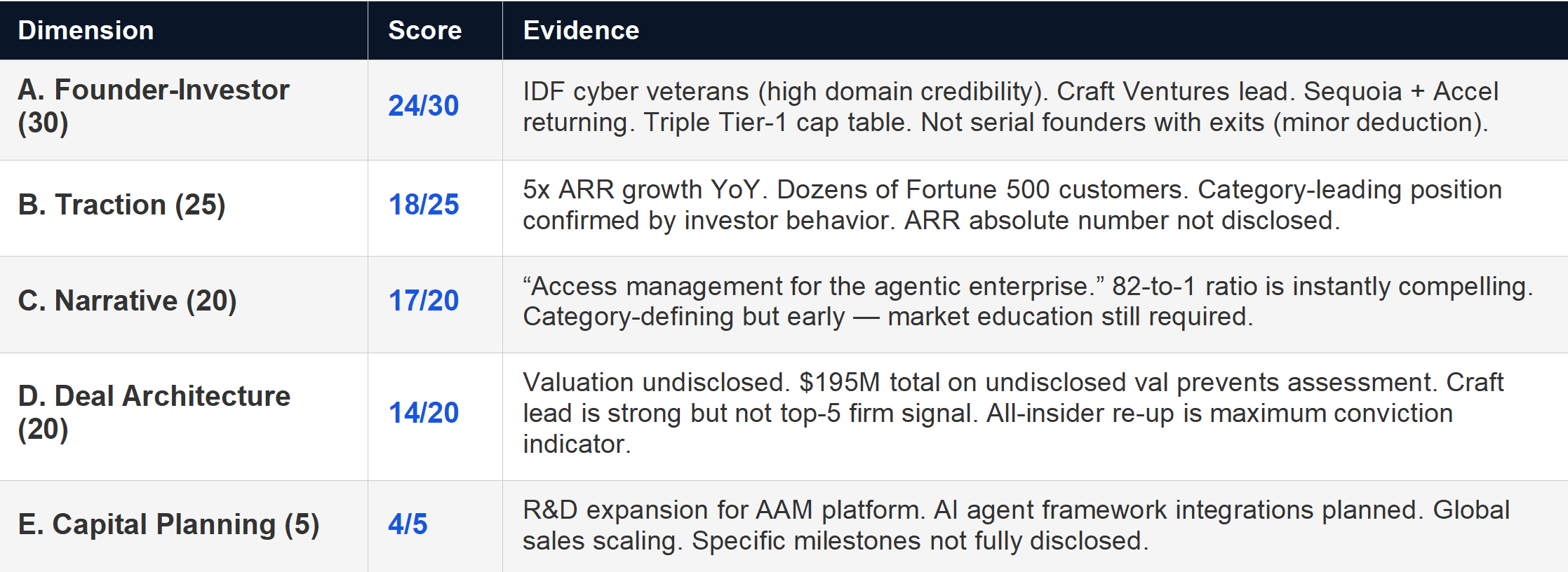
Series B, $120M, Eisen Fundabolity Score: 77 / 100
Why this scored
The category-defining company for non-human identity governance. Craft Ventures lead, with Sequoia and Accel as returning investors. All three of those names in one cap table is a conviction signal. Dozens of Fortune 500 customers. 5x ARR growth YoY. Founded by Israeli Defense Forces cyber veterans Danny Brickman and Amit Zimerman in 2022. The bet: every enterprise deploying AI agents needs a governance layer for machine identities, and Oasis built the platform for this shift before most enterprises knew they had the problem.
The Setup
Oasis Security emerged from stealth in January 2024 with $40M in funding, including a $35M Series A led by Sequoia Capital. Months later, it added a $35M extension backed by Accel, Cyberstarts, and Sequoia. The thesis was precise: as enterprises deploy AI agents, service accounts, and automated workflows, the number of non-human identities with system access is exploding. According to data cited by Palo Alto Networks, machine identities now outnumber humans 82-to-1 in enterprise environments. Traditional identity and access management (IAM) was built for human users: login/logout, MFA, and role-based access. Machine identities behave differently. They’re always-on, often over-permissioned, rarely rotated, and invisible to conventional security tools. Oasis’s Agentic Access Management platform delivers discovery, policy intelligence, and lifecycle enforcement for these identities across hybrid environments.
The Numbers
$120M Series B (March 19, 2026) │ Valuation undisclosed │ Lead: Craft Ventures │ Existing investors: Cyberstarts, Sequoia Capital, Accel │ Total raised: $195M │ Founded 2022 (Danny Brickman + Amit Zimerman, IDF cyber veterans) │ HQ: New York + Tel Aviv │ Customers: dozens of Fortune 500 companies │ ARR growth: 5x YoY │ Market context: 79% of IT professionals feel unprepared for non-human identity attacks
Fundability Lessons
Oasis proves that the fastest path to fundability in security is naming a problem that is both structurally new and quantifiably massive. “Machine identities outnumber humans 82-to-1” is not a positioning statement — it is a TAM declaration. Every enterprise customer who hears that number immediately maps it to their own environment and realizes the gap. 5x ARR growth confirms the gap is real and buyers are moving. Sequoia invested in the Series A, Accel in the extension, and both re-upped in the Series B. When Sequoia and Accel both return, the signal to the market is: this company owns the category.
The key lesson: investor re-up behavior at Tier 1 firms is the most powerful external validation available. It is worth more than any customer testimonial or market sizing slide.
Your Takeaway
If you are building enterprise software, audit how many AI agents and non-human identities your product creates in customer environments. That number is a governance liability — and a potential selling point if you build the governance layer in. Within 6 months, “agentic access management” will be a standard due diligence checkbox for enterprise buyers. If your product deploys AI agents without identity governance, you will lose deals to competitors who include it.
The Founder Mistake to Avoid
Founders see “non-human identity” as a niche. It is the opposite. Machine identities outnumber human identities 82-to-1, and the ratio is accelerating with every AI agent deployment. Every service account, API token, and automated workflow requires governance. The TAM grows with every AI deployment across every enterprise. That is not a niche. It is the largest identity market ever, and it only started 18 months ago. Do not confuse “new” with “small.”
CAPE — Privacy-First Mobile Carrier
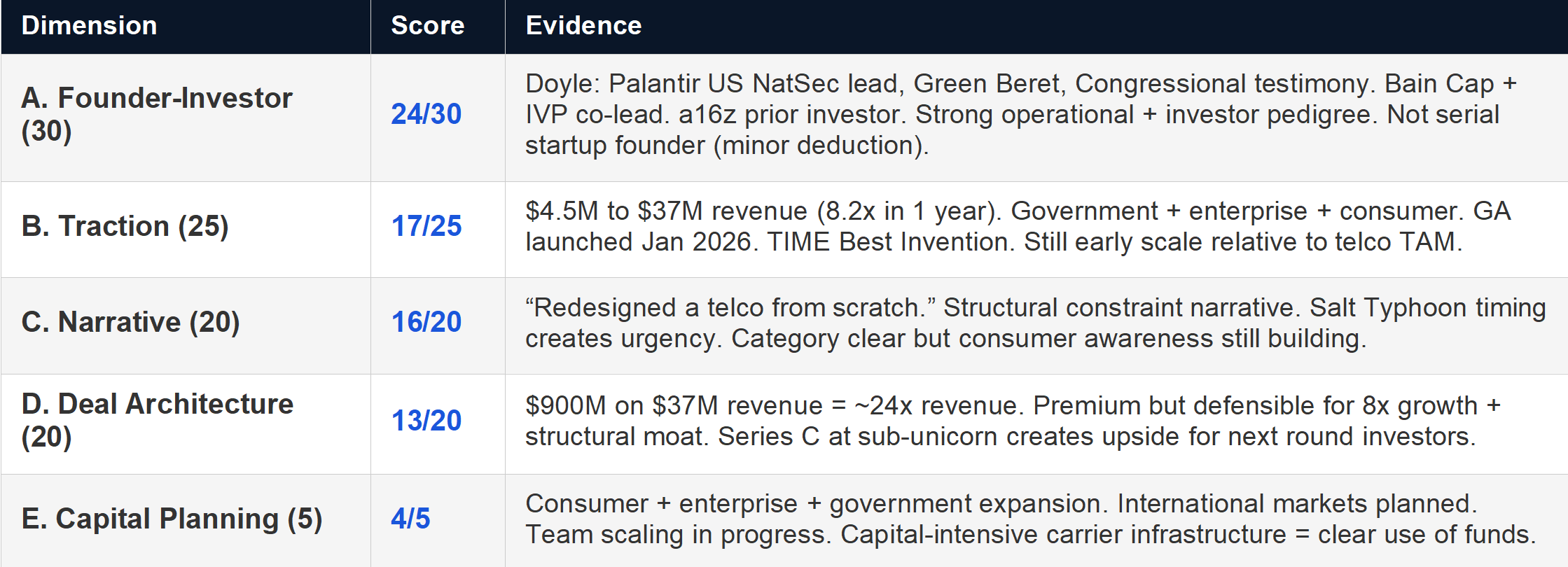
Series C, $100M, Eisen Fundability Score: 74 / 100
Why this scored
The only company in this week’s top 10 that rebuilt an entire industry layer from scratch to solve a structural flaw. CEO John Doyle led Palantir’s U.S. National Security business and is a former Army Green Beret who testified before Congress on cellular security risks. Revenue grew from $4.5M (2024) to $37M (2025) — 8.2x in one year. Bain Capital Ventures + IVP co-lead at $900M valuation. Government, enterprise, and consumer traction across all three verticals.
The Setup
Cellular networks were designed for connectivity, not privacy. Every traditional carrier tracks location, app usage, and communication metadata as core functions of its network architecture. When carriers like AT&T and Verizon are compromised — as they were in the Salt Typhoon hacks reported on March 9, 2026 - the damage is structural. No app or add-on fixes a fundamentally surveillance-oriented infrastructure. Cape rebuilt the telco stack from scratch. It operates as an MVNO (mobile virtual network operator) but, unlike standard MVNOs, it builds and operates its own mobile core and SIM infrastructure. Features include daily IMSI rotation (changing SIM identity numbers to prevent tracking), disappearing call/text logs, secondary phone numbers, and end-to-end privacy by design. Cape launched to general availability in January 2026 after beta testing with government agencies. Price: $99/month for unlimited talk, text, and data with full privacy protection.
The Numbers
$100M Series C (March 19, 2026) │ $900M valuation │ Co-leads: Bain Capital Ventures + IVP │ New investors: 01 Advisors, 137 Ventures, Definition, Fifth Down Capital │ Prior investor: Andreessen Horowitz │ Total raised: $191M │ Revenue: $4.5M (2024) → $37M (2025) = 8.2x growth │ CEO: John Doyle (fmr Palantir US Nat’l Security lead, Army Green Beret) │ GA launch: January 2026 │ Named TIME Best Invention (Privacy & Security category)
Fundability Lessons
Cape proves the “structural redesign” investment thesis: when the problem is architectural (cellular networks designed for surveillance), only a structural solution (rebuilding the carrier stack) works. Apps and add-ons cannot patch a foundation. This thesis applies beyond telecom. In any industry where the underlying infrastructure creates the vulnerability, the winning company will be the one that rebuilds the layer, not the one that patches it. The $900M valuation at Series C for a company with $37M in revenue reflects investor conviction that the structural approach creates a defensible moat that no competitor can replicate without also rebuilding the stack.
The key lesson: structural moats command premium multiples because they are capital-intensive to replicate.
Your Takeaway
Identify the structural flaw in your industry’s infrastructure. If the problem is embedded in the foundation, not in the application layer, the highest-conviction investor thesis is the company that rebuilds the foundation. Cape’s insight was that no amount of software can fix a carrier that was designed to track you. The analog in your market: what fundamental infrastructure assumption creates the problem your customers have? If you can name it and rebuild it, you have a Cape-level thesis.
The Founder Mistake to Avoid
Founders see Cape and think “privacy MVNO.” That undersells it by an order of magnitude. Cape built its own mobile core and SIM infrastructure. Daily IMSI rotation, disappearing call logs, and secondary numbers are not features you bolt onto an existing carrier — they require owning the entire stack. The lesson: when the constraint is structural, the solution must be structural. No app or add-on fixes a flawed foundation. If your market has a structural flaw, rebuild the layer — don’t patch it. The companies that patch compete on features. The company that rebuilds competes on architecture. Only one of those creates a durable moat.
This Week Playbook: 5 Days, 5 Deliverables
This week’s data gave you 5 shifts. Here is how to translate them into actions that alter raises before Friday.
1. AI Attack Surface Audit: Count Your Non-Human Identitites
Why this matters: Oasis raised $120M because machine identities outnumber humans 82-to-1 and are growing in number. XBOW raised $120M because AI-powered attackers probe every surface at machine speed. If you don’t know how many non-human identities your product or your customers’ systems contain, you cannot quantify the risk — or the opportunity.
Deliverable: Count every API token, service account, AI agent credential, and automated identity your company uses. For each: Is it over-permissioned? When was it last rotated? Could it be compromised without detection? Write a one-page “AI identity posture” document. This becomes both a security artifact and a fundraising proof point.
Wrong: “We use AI securely.”
Right: “We govern 847 non-human identities across 12 systems with automated rotation and anomaly detection.”
2. Privacy Architecture Review: Is Your Data Handling Investable?
Why this matters: Cloaked raised $375M because consumers and enterprises are willing to pay for privacy. If your product collects, stores, or processes personal data, investors will ask how you handle it. The answer must be specific, not generic.
Deliverable: Map your data flows end-to-end. For each user data touchpoint: What is collected? Where is it stored? Who has access? Is it encrypted at rest and in transit? Can a user delete all their data in one action? Write a one-paragraph privacy architecture statement. If you cannot write it in one paragraph, your architecture is too complex for investor diligence.
3. Constraint Inventory: Name the Physical Limit
Why this matters: Frore raised $143M by naming the thermal constraint. Nexthop raised $500M by naming the networking constraint. Cape raised $100M by naming the cellular surveillance constraint. Every unicorn this month has a named physical or structural constraint at the center of its pitch.
Deliverable: Write this sentence: “At [specific scale], [specific system] physically/structurally fails because of [named constraint]. We are the only production-ready solution for [constraint].” If you cannot complete this sentence, your pitch is missing its most fundable element.
4. Eisen Fundability Score: Find Your Gaps
Why this matters: Cloaked scored 82. XBOW scored 78. Most founders score 55–65 on honest self-assessment. The gap between where you are and where funded companies are is your obstacle list.
Deliverable: Score yourself on all 5 Eisen dimensions (max 100). Be ruthless. If a metric is not publicly verifiable, assume it is weak. Find your 2 lowest scores. For each, write one action that moves the score 5+ points in 30 days. This is your fundraising sprint plan.
5. Deployment Proof Dossier: Build Your Swarmer Moment
Why this matters: Swarmer IPO’d with $310K revenue and hit $382M market cap because it had 86,000+ combat missions documented. Cape grew 8x after it began shipping to government agencies. XBOW hit #1 on HackerOne. Deployment proof converts skeptics. Every other proof point is secondary.
Deliverable: Compile every deployment metric your company has: mission count, customer count, volume processed, uptime, performance benchmarks, and ROI documented. Format as a one-page “deployment proof stack.” This is the page that goes between your traction slide and your ask slide. It converts the investor’s internal conversation from “interesting” to “proven.”
Looking Forward: Next 1-3 Weeks
Scenario 1: AI Security Becomes a Category Unto Itself
Evidence: XBOW ($120M), Oasis ($120M), Kai ($125M last week), Cloaked ($375M), Cape ($100M) — $840M+ into AI-era security in 10 days. The RSAC 2026 conference is next week. Every major security vendor will announce AI agent governance products. The category will have a name by April.
What to watch: RSAC 2026 announcements. CrowdStrike and Palo Alto AI agent security products. Acquisition interest in Oasis-type companies from platform players.
What founders should do: If you are in AI security, present at or attend RSAC. If you are not, understand that “agentic security posture” will be a standard investor question within one quarter.
Scenario 2: The “Physical Constraint” Thesis Expands to Power and Density
Evidence: Networking (Nexthop $500M, March 10), cooling (Frore $143M, March 16), optics (Ayar Labs $500M, March 3). Three consecutive weeks, three different physical constraints, $1.14B total. The next constraint: power delivery and rack density. Hyperscalers are projected to spend $650B on AI infrastructure in 2026, and every physical layer will absorb a share.
What to watch: Nvidia GTC announcements on power architecture. Any $100M+ rounds in power management or rack-level density optimization.
What founders should do: If you solve any physical constraint in the data center stack, move your fundraising timeline forward. The investor thesis for “physical AI infrastructure” is being validated weekly.
Scenario 3: Defense Tech IPO Window Opens Wider
Evidence: Swarmer’s 520% debut. Defense venture funding reached an all-time high of $8.4B in 2025. Anduril, Shield AI, and Rebellion Defense are all at IPO-ready scale. Crunchbase identified 12 additional defense tech IPO candidates this week. The Iran conflict and the Ukraine war provide a sustained demand signal.
What to watch: Swarmer’s price stability over the next 30 days. Any Anduril or Shield AI IPO filing signals. Congressional defense appropriations for autonomous systems.
What founders should do: If you are in defense tech, build your public-market narrative now. Document deployment proof at Swarmer’s level of specificity (mission count, environment, operational metrics). The public market window is opening.
Wild Card: Swarmer-Style Micro-IPOs Create a New Asset Class
Swarmer raised $15M at $5/share and hit $382M market cap. That is not a traditional IPO. It is a public venture round. If this model works (a small raise, a massive pop, and retail + institutional demand), it creates an alternative to Series C/D rounds for defense and deep-tech companies. Watch for copycats in Q2.
The Bottom Line
The real insight from this week is not that security is hot. The real insight is that the AI buildout’s secondary effects — identity risk, thermal limits, autonomous threats, privacy erosion — are now commanding primary capital. The companies funded this week are not building AI. They are building the protection, governance, and physical infrastructure layers that AI requires to function at scale.
Profile 1: AI-created threat remediation. Cloaked ($375M) protects identities exposed by AI-era data risks. XBOW ($120M) defends against AI-powered attackers. Oasis ($120M) governs AI agent identities. Each company’s TAM grows with every AI agent deployed.
Profile 2: Physical constraint removal at production scale. Frore ($143M) removes the thermal constraint. Cape ($100M) removes the cellular surveillance constraint. Each company owns a specific, named constraint in a scaling system.
Everything else is competing for the remaining 15% of conviction capital.
New Rules for Founders (Evidence-Based)
Rule 1: The AI buildout creates the next funding wave. Networking was week 1. Cooling was week 2. Security was week 3. If you map the secondary effects of AI deployment, you can predict where capital flows next.
Rule 2: Consumer traction at 10x converts to growth-equity checks. Cloaked proved that 350K paying consumers and 10x growth led to $375M in Series B revenue. Consumer is a proof mechanism.
Rule 3: Two-year-old companies are raising at $1B+ when the threat model is new. XBOW (founded January 2024) hit unicorn status by March 2026. When the category is greenfield, speed beats tenure. Build fast, deploy in production, score public benchmarks.
Rule 4: Deployment proof outweighs revenue at every stage. Swarmer: $310K revenue, $382M market cap. Cape: $37M revenue, $900M valuation. The common factor: documented, production-grade deployment that competitors cannot replicate. Revenue comes later. Proof comes first.
Rule 5: Bundle beats feature. Cloaked’s 10x growth came from consolidating 5 privacy tools into one platform. In fragmented markets, the first company to bundle effectively owns the category. Build the platform before someone bundles you out of relevance.
This Week's Actions
AI Identity Audit: Count your non-human identities. Write a one-page posture document. This is now a due diligence requirement.
Privacy Architecture Statement: Map your data flows. Write a one-paragraph privacy architecture. Investors will ask. Have the answer ready.
Constraint One-Liner: “At [scale], [system] fails because of [constraint]. We solve it.” Write this sentence before your next investor meeting.
Deployment Proof Stack: Compile every deployment metric into one page. Mission count. Customer count. Volume processed. Uptime. ROI. This page converts skeptics.
Your competitors are reading the same data. The founders who act own the narrative.
Research Methodology
• Data collection period: March 14–20, 2026 (Crunchbase coverage window, full overlap with report scope)
• Verification standard: minimum 2 independent sources per featured deal; official press releases prioritized
• Eisen Fundability Scores are proprietary analytical estimates, not endorsements or investment advice
• All dollar amounts reflect announced figures at close
• Research completion timestamp: March 21, 2026
• Total deals analyzed: 10 (U.S., verified) + 1 IPO (Swarmer, context).
DISCLAIMER: This report is for informational and strategic intelligence purposes only. It does not constitute investment advice. Eisen Fundability Scores are analytical frameworks, not financial recommendations. All data is sourced from publicly available information and primary company announcements.