

Playbook, Perspective, and Pattern for Founders Raising Now
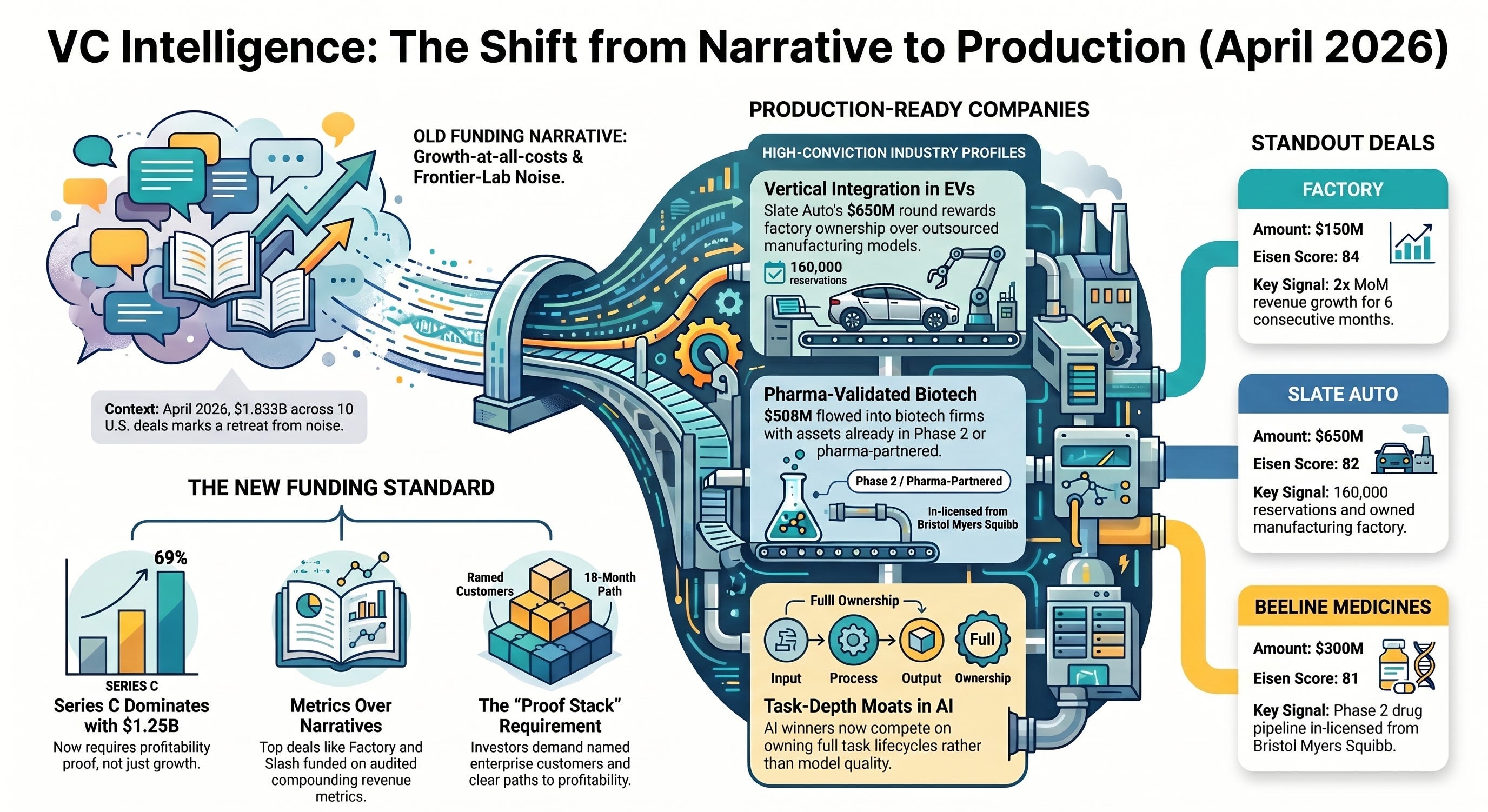
The week of April 13–19, 2026, did not bring a single $1B+ venture round. Instead, it delivered something harder to copy: four distinct conviction profiles, each absorbing meaningful capital. That is a tell. In a quarter defined by four mega-rounds capturing 65% of global VC, a week of concentrated mid-size deals shows where capital is flowing when the frontier-lab noise subsides.
Slate Auto closed $650M Series C at roughly $1.4B total raised, led again by TWG Global. A Bezos-backed EV startup with 160,000 reservations and a Warsaw, Indiana factory on a defined late-2026 delivery timeline is no longer a venture bet. It is infrastructure financing with a hardware risk profile.
Beeline Medicines debuted with $300M Series A from Bain Capital Life Sciences, built around five immunology assets licensed from Bristol Myers Squibb. The lead drug, afimetoran, is already in Phase 2 for lupus and has an FDA Fast Track designation. That is not a biotech Series A. That is a pharma carve-out with venture packaging.
Factory hit unicorn status at $1.5B with a $150M Series C led by Khosla Ventures, co-led by Sequoia, Insight, and Blackstone. Revenue doubled month-over-month for six consecutive months, with NVIDIA, Adobe, Morgan Stanley, EY, and Palo Alto Networks as enterprise customers. Keith Rabois joined the board. The AI coding category just minted another winner.
Glydways closed an oversubscribed $170M Series C with Suzuki, ACS Group, and Khosla Ventures at a ~$700M valuation, and is already in talks for another $250M at $1B+. Slash hit $1.4B at $250M ARR. nEye.ai raised $80M for optical switching, backed by Alphabet’s CapitalG, Microsoft’s M12, and Micron. Turion Space raised $75M+ for orbital intelligence. The week’s signal: capital is rewarding production-readiness over narrative across every category beyond AI.
THE WEEK IN ONE SENTENCE
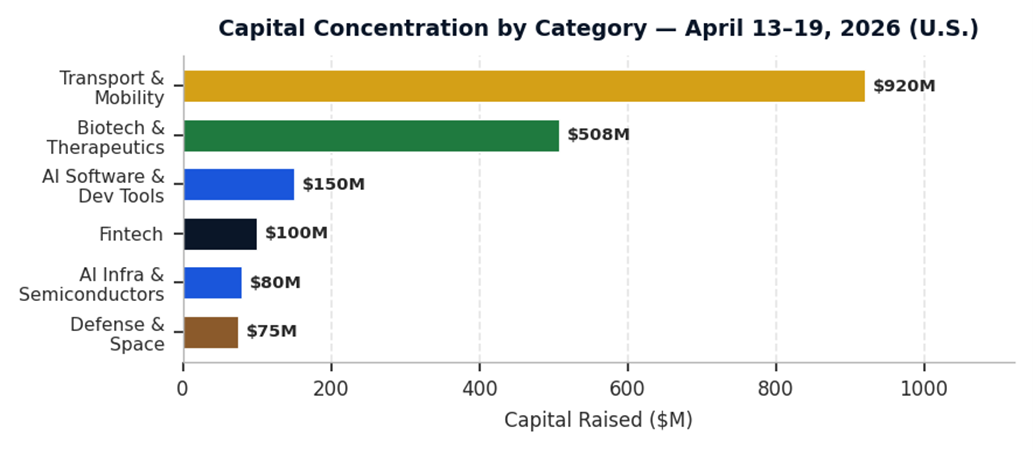
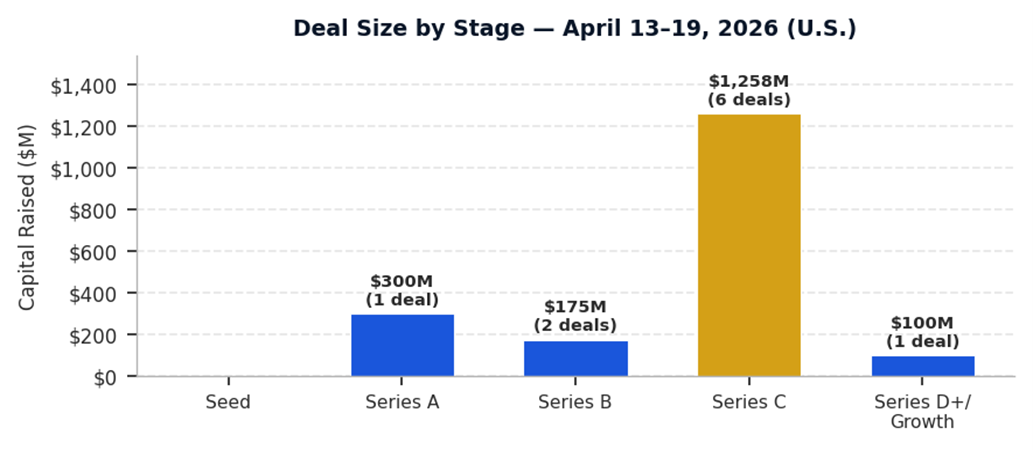
Ten verified U.S. deals absorbed $1.833B across EV manufacturing, immunology biotech, AI software, autonomous mobility, fintech, optical semiconductors, and defense space, with Series C deployment dominating ($1.258B across six deals), a reappearing unicorn formation pattern (three new unicorns in one week), and zero $500M+ pure-AI rounds. This makes the most category-diverse deployment week of Q2 2026 so far.

DEAL SCORECARD
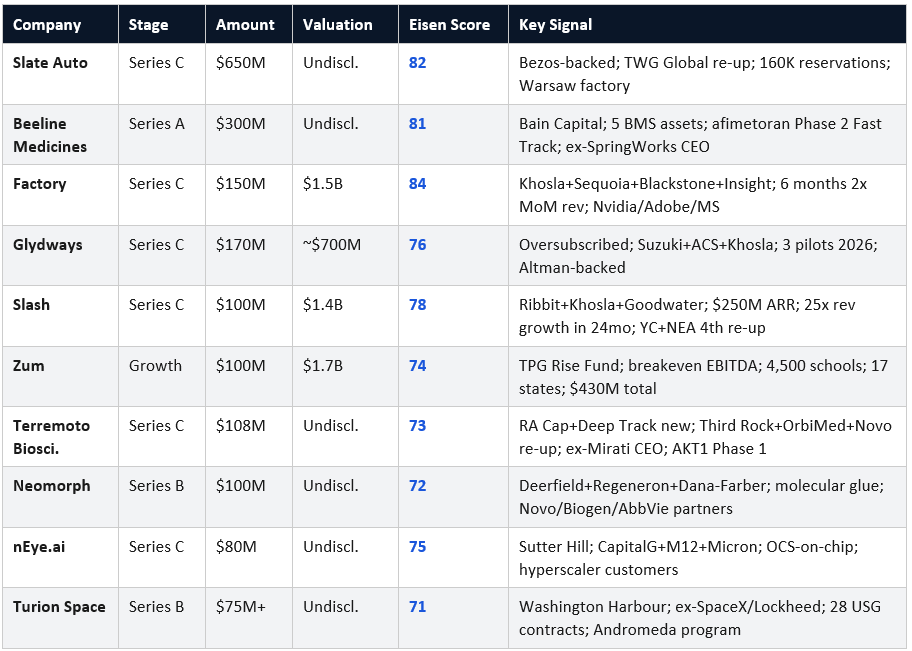
What the scorecard says at a glance
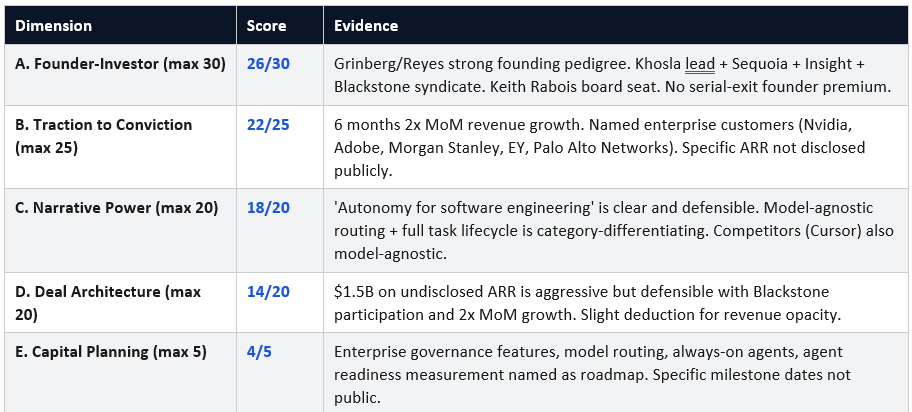
Factory scores highest (84) because this is a traction-conversion story with top-tier investor concentration. Revenue doubling month-over-month for six consecutive months, combined with a Khosla-Sequoia-Insight-Blackstone syndicate and Keith Rabois taking a board seat, is the strongest combined signal in any deal this week.
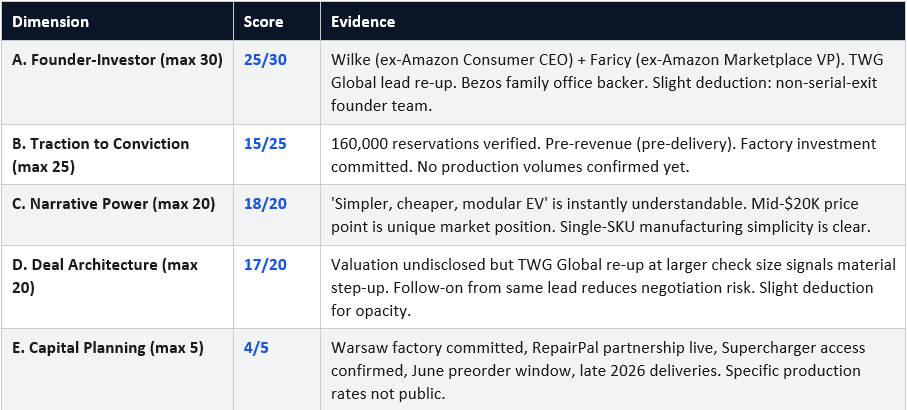
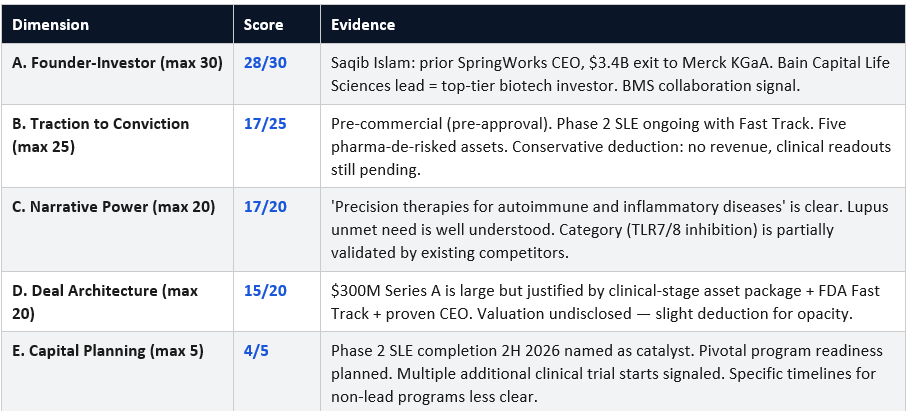
Slate Auto (82) scores second because the proof is physical: 160,000 reservations, a reindustrialized Indiana factory, and a lead investor writing its second nine-figure check. Beeline Medicines (81) is the week’s biotech outlier, a $300M Series A is only defensible when the pipeline is already in Phase 2 with FDA Fast Track, which it is.
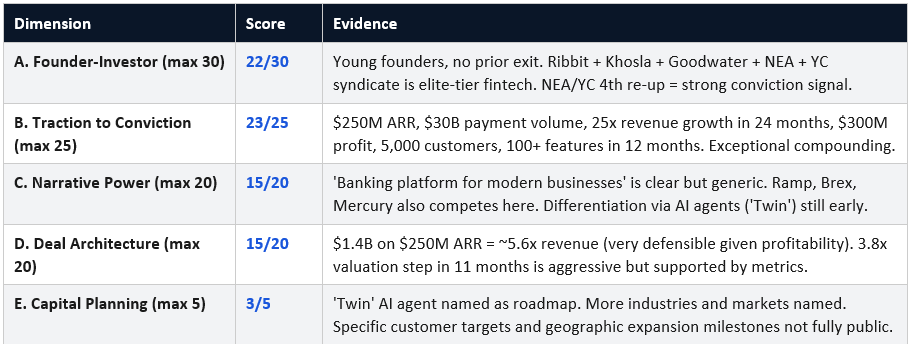
Slash (78) earned unicorn status the hard way: pivoting away from a collapsed core customer (Yeezy after Kanye West’s antisemitic remarks ended its sneaker-reselling wedge) and compounding from $10M to $250M ARR in 24 months. The week’s median Eisen Score is 76, higher than March 23–28 (71). That tells you something: when mega-rounds retreat, the remaining capital concentrates into companies that can prove unit economics, not narrative.
WHAT CHANGED THIS WEEK: 5 MARKET SHIFTS
SHIFT 1. SERIES C IS THE NEW SERIES A: SCALING CAPITAL NOW COMES WITH PROFITABILITY PROOF
Pattern
Six Series C rounds this week (Slate $650M, Glydways $170M, Factory $150M, Terremoto $108M, Slash $100M, nEye $80M) totaling $1.258B. Every single Series C this week came with a specific profitability or commercial-readiness signal: Slate has 160,000 reservations and a production timeline; Factory doubled revenue MoM for six months; Slash reached $250M ARR; Zum reached breakeven EBITDA. No Series C this week closed on narrative alone.
Perspective
In 2021, Series C was about scaling growth. In 2024, Series C was about proving survival. In April 2026, Series C became the stage at which investors pay for capital efficiency backed by named enterprise customers or quantified commercial traction. Khosla Ventures led or co-led three of this week’s Series C deals (Glydways, Factory, Slash), a concentration that tells you what a top-tier fund is actually underwriting: production-ready platforms with demonstrated revenue momentum. The narrative bar at Series C is no longer “we will grow.” It is “we have grown, here is the evidence.”
Founder Blindspot
Some founders preparing for a Series C assume the bar is the same as 2023: strong growth story, clean burn, aligned cap table. That is now the Series A bar. At Series C in April 2026, the bar is: named enterprise customers you can call on for references, a month-over-month revenue trajectory a partner can verify, and a clear line to profitability within 18 months. If you cannot show all three, your Series C will either be a bridge round disguised as a Series C or a down-round at flat valuation. The companies closing at premium multiples this week (Factory at $1.5B, Slash at $1.4B) did not get there on story. They got there on compounding metrics that investors could audit.
Playbook
Before your next investor meeting, build a ‘Proof Stack’ slide with three components: (1) named enterprise customers that would take a reference call, (2) a revenue trajectory chart showing MoM or QoQ growth with specific numbers, (3) a path to profitability expressed in months and burn-per-dollar-of-ARR. Factory’s board pitch included customers such as Morgan Stanley, EY, Palo Alto Networks, and Adobe, along with the 2x MoM growth line. That package converts investor skepticism into term sheets.
Contrast
In March 2026, $500M+ rounds were the category benchmark: Shield AI at $2B, Harvey at $200M/$11B, Replit at $400M/$9B earlier. This week, not a single $500M+ pure venture round closed. Capital compressed into the $100–200M range with much tighter diligence. That is not a cooling. That is a filtering.
What this means for your raise: Series C investors are now underwriting profitability trajectories rather than growth narratives. Build your proof stack with customer names, revenue deltas, and burn efficiency before your next partner meeting.
SHIFT 2. EV MANUFACTURING RETURNS TO THE CAPITAL STACK, BUT ONLY FOR VERTICAL INTEGRATION
Pattern
Slate Auto raised $650M Series C led by TWG Global, the same investor that led its $590M Series B in late 2024. Total raised now ~$1.4B. CEO Peter Faricy confirmed that production remains on time and on budget, with first deliveries scheduled for late 2026 and preorders opening in June. The company owns its Warsaw, Indiana factory (a $400M investment), its manufacturing architecture (a single base truck with accessorization after delivery), and its service network (a 4,000-location RepairPal partnership).
Perspective
For two years, EV startups have been the graveyard sector of venture capital. Fisker liquidated. Lordstown Motors liquidated. Canoo liquidated. Even Rivian had to raise emergency capital. Into that graveyard, TWG Global (the investment vehicle of Guggenheim Partners’ Mark Walter and former Legendary Entertainment CEO Thomas Tull) has deployed over $1B across two rounds. That is not a venture bet. That is a conviction that vertical integration, such as factory ownership, platform simplicity, and a service network, creates a defensible cost structure that horizontal EV companies cannot match. The Slate Truck target price is mid-$20,000s. Every legacy EV that failed did so because unit economics broke at scale. Slate’s bet is that owning every layer is what fixes unit economics.
Founder Blindspot
If founders see Slate’s $650M round and think ‘EVs are back,’ they are wrong. EVs as a category are not back. Vertical integration is being re-rewarded. The EV startups that failed in 2024–2025 all shared one trait: they outsourced manufacturing, relied on platform partnerships, or scaled sales before scaling production. Slate owns its factory, manufactures a single vehicle configuration, and is pre-selling with refundable reservations. That stack is what TWG Global is funding.
Playbook
If you are building a hardware-intensive business, audit the depth of your integration before your next raise. For each layer, manufacturing, distribution, service, software, customer acquisition, ask: “Do we own this, or do we rent it?” Rented layers look cheap early and expensive at scale. Owned layers look expensive early and cheap at scale. Investors funding production-stage hardware companies in 2026 are paying for owned layers. Reframe your pitch around what you own, not what you build.
Contrast
In 2023, a $650M round for a pre-production EV startup would have required Tesla-level founder celebrity or a Ford-scale strategic partnership. In April 2026, it was led by a PE-adjacent sports-and-media conglomerate (TWG also owns the Dodgers and Chelsea FC) based on factory ownership, reservation data, and a mid-$20K target price. The investor profile shift is the real signal: hardware manufacturing is being re-underwritten as an infrastructure asset class, not a venture asset class.
What this means for your raise: Vertical integration is a fundraising thesis again. Audit your owned versus rented layers before your next hardware or physical infrastructure upgrade.
SHIFT 3. AI CODING JUST MINTED ANOTHER UNICORN, AND THE CATEGORY IS NOW A 5-PLAYER MARKET
Pattern
Factory raised a $150M Series C at a $1.5B valuation (Khosla lead, Sequoia, Blackstone, and Insight co-invest). Revenue doubled month-over-month for six consecutive months. Customers include Nvidia, Adobe, EY, Morgan Stanley, Palo Alto Networks, Adyen, MongoDB, Bayer, and Zapier. Cursor/Anysphere is reportedly targeting a $50B valuation. Anthropic’s Claude Code crossed $2.5B in annualized revenue. Replit is targeting $1B ARR. Cognition continues to raise.
Perspective
AI coding is no longer a single-winner market. It is a five-player market (Anthropic (Claude Code), Cursor (Anysphere), Replit, Cognition, and now Factory), with a sixth player (GitHub Copilot) controlling the incumbent distribution. Factory’s positioning is narrower and more defensible than a general coding assistant: Droids are agentic systems that handle refactors, debugging, incident response, migrations, ticket execution, and code review, operating across IDEs, terminals, browsers, Slack, Teams, and CI/CD pipelines. The pitch is not “faster typing.: The pitch is “autonomous task completion across the software development lifecycle.” That framing justifies a $1.5B valuation in a crowded category: Factory is now competing on depth of task ownership.
Founder Blindspot
If founders in AI tooling see Factory and assume the window for new entrants is closing, it’s partially true. The pure-play coding assistant window has closed. But the agentic workflow window for specific functions (compliance review, security operations, ticket management, incident response) is still open. Factory’s Droids succeed because they own complete task cycles, not because they generate better code. If you are building AI tooling, stop competing on ‘better AI.’ Start competing on ‘owns more of the task end-to-end.’ The former is an arms race. The latter is a moat.
Playbook
Map the task lifecycle in your target customer’s workflow:
Intake → analysis → execution → review → handoff.
For each step, identify whether your product currently touches it. If you only touch one or two steps, you are an assistant, and assistants commoditize. If you touch four or more, you are a platform, and platforms defend premium multiples. Factory’s Droids touch all five. That is the differentiation thesis. Apply it to your category.
Contrast
Twelve months ago, any AI coding startup could raise on the claim that AI makes developers faster. In April 2026, the capital is going to companies that make developers optional for complete task cycles. That is a different product category, a different price point, and a different buyer (a CIO, not an engineering manager). Reframe your product around who signs the PO, not who uses the tool.
What this means for your raise: Task-ownership depth is the new defensibility thesis in AI tooling. Map your task lifecycle coverage before your next investor meeting.
SHIFT 4. AUTONOMOUS MOBILITY FRAGMENTS: PURPOSE-BUILT INFRASTRUCTURE BEATS GENERAL-PURPOSE ROBOTAXIS
Pattern
Glydways raised an oversubscribed $170M Series C, co-led by Suzuki Motor Corporation, ACS Group, and Khosla Ventures, at a ~$700M valuation. It is already in talks to raise another $250M at $1B+ valuation (per Bloomberg). Glydways uses dedicated 2-meter-wide guideways for autonomous electric pods, not open-road self-driving. Commercial pilots launch this year in South Metro Atlanta, New York, and the UAE. Vinod Khosla stated on record that Glydways is the better long-term mobility solution for cities.
Perspective
The autonomous mobility category is splitting into two investment theses. Thesis one: open-road robotaxis (Waymo, Zoox, Tesla FSD) solving the general case — capital-intensive, regulation-dependent, slow to scale. Thesis two: dedicated-guideway autonomous transit (Glydways) solving the closed-loop case — infrastructure-intensive up front, but technically simpler, regulation-compatible, and economically viable at public transit fare levels. Glydways’ 2-meter guideway eliminates the hardest safety problem in autonomy: unpredictable pedestrians, cyclists, and human drivers. That is the thesis Suzuki (manufacturer), Obayashi (general contractor), and Khosla (venture) are collectively underwriting. Closed infrastructure creates a dramatically lower technical risk profile than open-road autonomy.
Founder Blindspot
If founders in autonomous mobility assume the category is a winner-takes-all race against Waymo, they are wrong. The real competition is between general-purpose autonomy (open-road) and purpose-built autonomy (dedicated infrastructure). The purpose-built path has a dramatically lower technical risk profile because the operating environment is controlled. It also has a higher capital requirement because the infrastructure must be built. Investors in April 2026 are funding both bets, but the purpose-built bet is getting faster deal closes because the technical risk is quantifiable.
Playbook
If you operate in any category where autonomy is the product, define your ‘operating environment complexity’ explicitly. Open environments (roads, public spaces, uncontrolled airspace) carry regulatory and safety risks that can kill valuation multiples. Closed environments (dedicated guideways, private facilities, controlled airspace) carry infrastructure cost risk but much lower technical risk. Investors have clear preferences for closed environments in 2026. If you can reframe your product to operate in a controlled environment, your fundraising path gets materially easier.
Contrast
Eight months ago, Glydways raised at a $350–400M valuation on a concept with no public deployments. In April 2026, it closed at ~$700M with three pilots launching this year, and is already in talks for $1B+. The valuation step is justified by deployment evidence, not narrative, and the lead investors are a Japanese automaker, a Spanish construction conglomerate, and Khosla Ventures. That investor mix tells you what funders a purpose-built autonomy play needs: a manufacturer, a builder, and a venture partner.
What this means for your raise: Purpose-built autonomy in controlled environments is a cheaper, more fundable path than open-road robotaxis. Reframe your operating environment before your next meeting.
SHIFT 5. BIOTECH CARVE-OUTS ARE THE NEW PLATFORM PLAY: $500M+ FLOWED INTO 3 DEALS
Pattern
Beeline Medicines debuted with $300M Series A (Bain Capital), built around five BMS-licensed immunology assets. Terremoto Biosciences raised $108M Series C with new investors including RA Capital Management, Deep Track Capital, Osage University Partners, and BeOne Medicines, alongside existing backers OrbiMed, Third Rock, Novo Holdings, and Cormorant. Neomorph raised $100M Series B led by Deerfield, with Regeneron Ventures, Dana-Farber’s Binney Street Capital, and partnerships already in place with Novo Nordisk, Biogen, and AbbVie. Total biotech capital this week: $508M across three deals, all with either pharma-carve-out assets or established pharma partnerships already signed.
Perspective
The biotech capital model has shifted. In 2020–2022, platform biotechs raised on discovery-stage science. In 2023–2024, that capital was mostly burned. In 2026, the reopened biotech funding window is not for discovery. It is for clinical-stage assets that have already been de-risked by large pharma, now packaged into newly formed companies. Beeline’s five assets came from Bristol Myers Squibb. Neomorph’s partnerships already include Novo, Biogen, and AbbVie. Terremoto’s CEO, Charles Baum, built Mirati Therapeutics, which was acquired by Bristol Myers Squibb for $4.8B. The ‘platform’ is no longer the science. The platform is the pharma relationship, the de-risked asset, and the clinical path that is already Phase 1- or Phase 2-ready on day one.
Founder Blindspot
Some founders in biotech mistakenly assume the fundability question is “Is my science good enough?” The question is “Is my clinical path already de-risked, and by whom?” Beeline raised $300M on day one of operations because afimetoran is already in Phase 2 with Fast Track Designation. Neomorph raised $100M with Novo, Biogen, and AbbVie already as partners. The investor evaluation is not “Is this team smart enough?” It is ‘has a pharma already validated this program with real money or real partnership?’ If yes, premium multiples. If no, discovery-stage valuations that haven’t closed reliably in 18 months.
Playbook
If you are raising biotech capital in 2026, map your ‘pharma validation’ explicitly. For each program, identify: (1) whether it has a top-20 pharma in-licensed, partnered, or made an equity commitment? (2) Is the clinical path already IND-cleared or Phase 1/2 underway? (3) Does your leadership team include anyone with a prior pharma exit? Three ‘yes’ answers put you in the current fundable band. Zero or one ‘yes’ answers puts you in the uncertain-timeline band that requires 12+ months to close. Plan your capital timeline accordingly.
Contrast
In 2021, biotech Series A rounds averaged $75M on discovery-stage platforms. In April 2026, Beeline closed $300M Series A on clinical-stage, pharma-de-risked assets, a 4x deal size for a qualitatively different asset profile. The market isn’t paying more for biotech. It is paying more for a specific de-risked asset class and paying much less for everything else.
What this means for your raise: Pharma-validated assets raise at platform-company multiples. Discovery-stage platforms without pharma partners grow more slowly, or not at all, in 2026.
THE DEALS THAT MATTER: TOP 5 DEEP DIVES
1. FACTORY
AI Software Engineering / Agentic Coding | Series C | $150M | $1.5B valuation
Eisen Fundability Score: 84/100
Investor: Khosla Ventures (lead), Sequoia, Insight, Blackstone | April 16, 2026
Why this scored
The highest Eisen Score this week reflects a rare convergence: verified enterprise traction (hundreds of thousands of developers across Nvidia, Adobe, EY, Morgan Stanley, Palo Alto Networks, Adyen, MongoDB, Bayer, Zapier), revenue doubling month-over-month for six consecutive months, a four-firm top-tier syndicate (Khosla + Sequoia + Insight + Blackstone), and Keith Rabois taking a board seat. This is not an AI tooling round. This is the makings of a category operating system.
The Setup
The Factory was founded three years ago by Matan Grinberg (who left his doctoral program to start the company) and Eno Reyes. The mission: bring autonomy to software engineering. The product, Droids, is an agentic system designed to handle the full software development lifecycle: refactoring, debugging, incident response, migrations, ticket execution, and code review. Droids operate across IDEs, terminals, browsers, desktop apps, Slack, Teams, backlog systems, and CI/CD workflows. The differentiation from Cursor, Claude Code, and GitHub Copilot: model-agnostic routing (Claude one moment, DeepSeek the next) and end-to-end task ownership, not just completion suggestions.
The Numbers
$150M Series C (April 16, 2026) | $1.5B valuation | Lead: Khosla Ventures | Co-investors: Sequoia Capital, Insight Partners, Blackstone, Evantic Capital, 20VC, NEA, Mantis VC | Keith Rabois (Managing Director, Khosla) joined the board | Revenue: doubled month-over-month for six consecutive months | Customers named: Nvidia, Adobe, EY, Morgan Stanley, Palo Alto Networks, Adyen, MongoDB, Bayer, Zapier, Clari, Bilt, Profound, Rogo | Founded: 2023
Fundability Lessons
Factory’s round is a case study in how to raise into a crowded category. Cursor is targeting $50B. Anysphere is at $2B+ ARR. Claude Code is at $2.5B on an annualized basis. GitHub Copilot has 20M+ professional users. Into that market, a three-year-old company closed $150M at $1.5B in Series C. The key signal: Blackstone participation. Private equity firms with $1T+ AUM do not participate in Series C rounds that will not produce an exit. When Blackstone writes a check to an AI coding company, it signals the firm sees a path to an IPO or a strategic acquisition, indicating the category has matured from venture-risk to private-equity-risk in institutional perception. The fundability lesson is that in crowded AI categories, the defensible moat is no longer the model, the speed, or the UX. It is the breadth of the task lifecycle that your product owns.
Your Takeaway
If you are building AI tooling, map the full task lifecycle your customer runs through. If your product touches one step (e.g., code completion), you are an assistant, and assistants commoditize in crowded markets. If your product touches four or more steps (intake → analysis → execution → review → handoff), you are a platform, and platforms can justify $1B+ valuations even in saturated categories. Factory’s Droids touch the full cycle. That task depth is the only thing that justifies a premium valuation against Cursor.
The Founder Mistake to Avoid
If founders see Factory’s $1.5B valuation and want to build “AI agents for X,” it’s the wrong lesson. Factory’s edge is not that Droids are AI agents; every coding tool in the market now has an agent mode. Factory’s edge is that Droids take full task ownership across the development lifecycle, working asynchronously on long-running tasks rather than synchronously on prompt completion. The distinction matters because synchronous tools compete on latency and model quality. Asynchronous tools compete on task completion rates. The former is a commodity feature race. The latter is an infrastructure bet.
Score Breakdown
2. SLATE AUTO
Electric Vehicles / Vertical Integration | Series C | $650M | Valuation undisclosed
Eisen Fundability Score (EFS): 82/100
Investors: TWG Global (lead, re-up)|April 13, 2026
Why this scored
The largest round of the week reflects a rare combination in EV venture capital: proven investor re-up (TWG Global leading its second consecutive nine-figure round), vertical integration (factory, platform, service network all owned), consumer validation (160,000 reservations), and an executable production timeline (late 2026 first deliveries, June 2026 preorder window). In a category where most venture bets have failed, this one is structurally different.
The Setup
Slate Auto was founded in 2022 and is co-founded by Jeff Wilke, Amazon’s former Consumer CEO. Current CEO Peter Faricy was previously VP of Amazon Marketplace. The company is building one vehicle, a lower-cost electric pickup truck priced in the mid-$20,000s, with a modular platform that allows accessorization after delivery to customize into SUVs or other configurations. Slate will manufacture at a reindustrialized factory in Warsaw, Indiana (a ~$400M investment expected to create 2,000+ jobs). The service network partnership with RepairPal gives access to 4,000+ independent service centers nationally. Charging uses the Tesla Supercharger network via NACS port.
The Numbers
$650M Series C (April 13, 2026) | Valuation undisclosed | Lead: TWG Global (run by Guggenheim Partners CEO Mark Walter and investor Thomas Tull) | Prior rounds: $590M Series B (late 2024) also led by TWG Global | Total raised: ~$1.4B since 2022 founding | Reservations: 160,000+ | Warsaw, Indiana factory investment: $400M | First deliveries: late 2026 | Preorder window: opens June 2026 | Retail price: announced June 2026, mid-$20,000s target
Fundability Lessons
Slate’s round is the clearest evidence in venture capital that EV manufacturing is now being underwritten as an infrastructure asset class rather than a venture asset class. TWG Global is not a typical Silicon Valley VC. It is the investment vehicle of Guggenheim Partners’ CEO, Mark Walter (also owner of the LA Dodgers), and former Legendary Entertainment CEO, Thomas Tull. Its portfolio spans financial services, insurance, sports teams (Dodgers, Chelsea FC), and technology (Palantir). When a firm of that profile writes a second nine-figure check into a pre-production EV company, the thesis is not ‘EVs will be big.’ The thesis is ‘vertical integration at this specific price point solves unit economics that every failed EV competitor got wrong.’ The fundability lesson: investor profile is a leading indicator of how your company is being categorized. If your lead investor is a VC, you are in the venture risk bucket. If your lead investor is a PE-adjacent or infrastructure-adjacent capital allocator, you are being underwritten as an infrastructure investment. The latter pays higher multiples on lower growth expectations.
Your Takeaway
If you are building a hardware-intensive or capital-intensive business, the investor profile you target determines the thesis under which you will be evaluated. Venture capital evaluates growth velocity. Infrastructure capital evaluates unit economics and predictable scale. Most capital-intensive founders default to venture firms out of habit, then wonder why diligence keeps pushing back on questions about the path to profitability. Match your capital source to your capital thesis. If you are infrastructure, pitch infrastructure investors, not venture firms.
The Founder Mistake to Avoid
Some founders see Slate’s $650M round and think, “EV is raising again — I should raise too.” Wrong reading. Slate’s round is not a signal that EVs as a category are attractive. It is a signal that one specific business model (vertically integrated, single-SKU, low price point, reservation-pre-sold, factory-owned) is fundable. Every EV startup that failed had at least one layer outsourced: manufacturing via contract (Fisker), platform via partnership (Canoo), or sales before production (Lordstown). Do not interpret one vertical-integration success as permission for horizontal EV bets. The capital is moving to a very specific structure, not to the category.
Score Breakdown
3. BEELINE MEDICINES
Precision Immunology / Clinical-Stage Biotech | Series A | $300M | Valuation undisclosed
EFS: 81/100
Investors: Bain Capital Life Sciences (lead)|April 15, 2026
Why this scored
A $300M Series A is exceptional. What makes this one fundable is that it is not a true Series A in the traditional sense. Beeline launched in July 2025 as a joint venture between Bain Capital and Bristol Myers Squibb, with five clinical-stage assets already in-licensed from BMS. The company publicly debuted on April 15 with afimetoran, a daily oral drug for systemic lupus erythematosus, already in Phase 2 with FDA Fast Track Designation. That is not venture risk. That is pharma carve-out risk.
The Setup
CEO Saqib Islam is the former CEO of SpringWorks Therapeutics, a Pfizer spinoff that was acquired by Merck KGaA for $3.4B in 2025. Beeline operates from Stamford, Connecticut, and Boston, Massachusetts. The pipeline: afimetoran (BMS-986256, an oral TLR7/8 inhibitor, Phase 2 SLE); BMS-986326 (an IL-2-CD25 fusion protein, Phase 1b for atopic dermatitis and cutaneous/systemic lupus); lomedeucitinib (an oral TYK2 inhibitor, Phase 2 psoriasis); and two additional preclinical assets. Phase 2 SLE data for afimetoran is expected in the second half of 2026, with a pivotal program to follow.
The Numbers
$300M Series A (announced April 15, 2026; company formed July 2025) | Lead: Bain Capital Life Sciences | Pipeline: five clinical/preclinical assets in-licensed from Bristol Myers Squibb | Lead asset: afimetoran (Phase 2 SLE, FDA Fast Track Designation) | Additional clinical assets: BMS-986326 (Phase 1b), lomedeucitinib (Phase 2) | Next major catalyst: Phase 2 SLE readout 2H 2026 | CEO: Saqib Islam (former SpringWorks CEO, acquired by Merck KGaA for $3.4B)
Fundability Lessons
Beeline is the cleanest example of the ‘pharma carve-out platform’ thesis in 2026. The venture-capital market learned a hard lesson in 2022–2024: discovery-stage platform biotechs burned capital without reaching clinical readouts. The new playbook is to license already-Phase-2 assets from large pharma (who have de-prioritized them for portfolio reasons, not efficacy reasons), wrap them in a focused Newco with a dedicated executive team, and fund the clinical path to approval. Bain Capital has now executed this blueprint multiple times. The investor calculus is that a Phase 2-ready asset with pharma-grade CMC, safety data, and regulatory relationships is worth dramatically more than a preclinical asset with equivalent biology. The fundability lesson: if you are raising biotech capital in 2026, map your program’s pharma adjacency.’ Partnered programs, in-licensed programs, and programs with pharma board members raise faster and at higher multiples than unpartnered programs at the same clinical stage.
Your Takeaway
If you are building any clinical-stage biotech, build your ‘pharma validation’ slide. For each program, document: (1) any in-license or partnership with top-20 pharma, (2) any board member, advisor, or executive with a prior pharma exit, (3) any named collaborations on CMC, regulatory, or clinical operations. Programs with all three raise at 2–3x the multiple of programs with none. Beeline’s $300M Series A is priced off the BMS relationship, the Bain Capital lead, and the Saqib Islam track record.
The Founder Mistake to Avoid
Some biotech founders see Beeline’s $300M Series A and think it validates larger Series A rounds across the industry. Wrong reading. Beeline’s round is priced on the BMS license, the Fast Track designation, and a proven CEO with a prior $3.4B exit. Replace any one of those three pillars, and the round would have been $100M or less. Do not read Beeline as a signal that biotech Series A sizes are increasing — read it as a signal that specific pharma-adjacent structures are being funded at pharma multiples, and generic early-stage biotech is not.
Score Breakdown
4. SLASH
Fintech / AI-Native Business Banking | Series C | $100M | $1.4B valuation
EFS: 78/100
Investors: Ribbit Capital (lead), Khosla, Goodwater | April 16, 2026
Why this scored
A $100M Series C is not remarkable in 2026. What is remarkable: Slash reached this valuation by pivoting away from the sneaker-reselling market that collapsed when its primary customer (Yeezy) imploded, then compounding from $10M to $250M ARR in 24 months. The round is led by Ribbit Capital (which has backed Robinhood, Coinbase, and Credit Karma) and Khosla Ventures (an early investor in Stripe, Affirm, and Ramp). NEA and Y Combinator are re-upping for their fourth consecutive round. This is the cleanest ‘comeback compounding’ story of Q2 2026.
The Setup
Slash Financial was founded in 2021 by Victor Cardenas (a Stanford dropout) and Kevin Bai (a University of Waterloo dropout), both then 19 (now 24). The company initially built vertical banking software for sneaker resellers, with Yeezy as its primary customer. When Adidas terminated its Yeezy partnership in 2022 following Kanye West’s antisemitic remarks, Slash’s core market collapsed effectively overnight. The founders pivoted to multi-vertical business banking serving e-commerce brands, affiliate marketers, gaming companies, crypto-native firms, and home services operators. The underlying banking infrastructure is built on Column N.A. (a chartered bank founded by former Plaid executives), which protected Slash from the Synapse BaaS collapse that disrupted many fintech competitors.
The Numbers
$100M Series C (April 16, 2026) | $1.4B valuation (up from $370M Series B in May 2025 = 3.8x in 11 months) | Lead: Ribbit Capital | Co-leads: Khosla Ventures + Goodwater Capital | Repeat investors: NEA, Y Combinator (4th consecutive round) | Total funding: $160M | ARR: $250M+ (up from $10M in 24 months = 25x growth) | Annualized payment volume: $30B+ | Stablecoin payment volume: $1B+ within 9 months of product launch | Customer count: 5,000+ businesses | Upcoming product: ‘Twin’ — AI financial agent
Fundability Lessons
Slash’s trajectory illustrates the highest-leverage fundability signal in 2026: revenue compounding rate combined with output-to-headcount ratio. Ribbit founder Micky Malka stated in the announcement that ‘the ratio of output to headcount is something we’re only starting to see from the best AI-native companies.’ That framing is the real investor thesis. Slash did not raise at $1.4B because it has $250M ARR — many companies have $250M ARR and lower valuations. Slash raised at $1.4B because it achieved $250M ARR with minimal headcount growth, shipped 100+ features in the last 12 months, and demonstrated that AI agents can replace entire operational functions. The fundability lesson is that ARR alone is no longer sufficient. Investors in 2026 want to see ARR per employee, features shipped per quarter, and capital efficiency that prove the AI-native structure. Those signals together justify premium multiples. ARR alone does not.
Your Takeaway
If you are raising in 2026, build a ‘leverage profile’ into your pitch deck. Three numbers matter: (1) ARR per full-time employee, (2) features shipped per quarter, (3) gross margin percentage. Slash’s output: $250M ARR with reportedly minimal headcount growth, 100+ features in 12 months. Those are AI-native leverage numbers. If your company’s ratios are closer to traditional SaaS (ARR per FTE in the $300–500K range, monthly feature cadence, 70% gross margin), you will be benchmarked as SaaS and valued as SaaS. AI-native leverage justifies AI-native multiples. Match the framing to the metrics.
The Founder Mistake to Avoid
Some founders see Slash at $1.4B and want to build “vertical banking for X.” The vertical wedge is not the key insight. Slash started in verticals (sneaker resellers), watched those verticals collapse, and pivoted to a multi-vertical generalist. The actual insight is that banking infrastructure built on a chartered bank (Column) with AI-native operational scale compounds faster than horizontal competitors like Ramp (valued at $32B) and Brex (acquired by Capital One). The lesson is not ‘pick a vertical.’ The lesson is ‘own your infrastructure layer and build AI-native operational leverage from day one.’ Any company that outsources banking infrastructure to a BaaS provider and adds human headcount to scale is the kind of business that competes with Slash and loses.
Score Breakdown
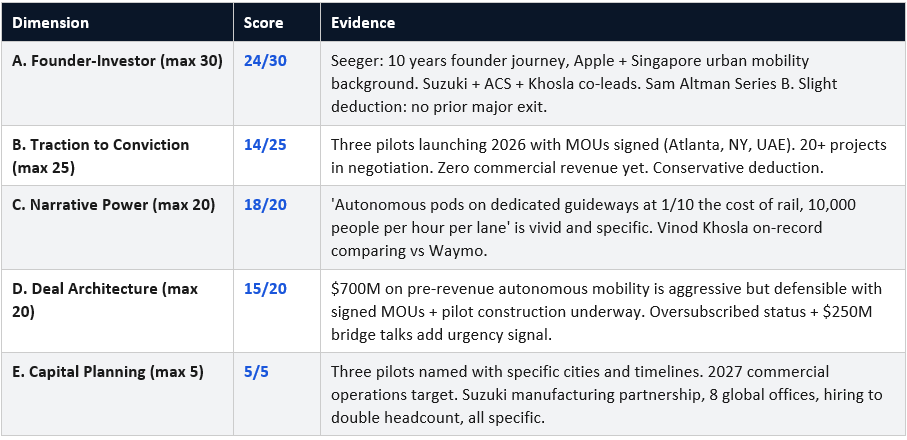
5. GLYDWAYS
Autonomous Mobility / Dedicated-Guideway Transit | Series C | $170M | ~$700M valuation
EFS: 76/100
Investors: Suzuki, ACS Group, Khosla Ventures (co-leads)|April 14, 2026
Why this scored
An oversubscribed $170M Series C at ~$700M valuation, with Glydways already in talks for another $250M at $1B+, reflects an investor consensus that is clean and specific: dedicated-guideway autonomy is a fundamentally different risk profile than open-road robotaxi autonomy, and the former is now mature enough to deploy. Three commercial pilots launch this year. Twenty-plus projects are in negotiation globally. Suzuki is the vehicle manufacturer. Obayashi and ACS Group are the infrastructure builders. That investor mix tells you everything.
The Setup
Glydways was founded in 2016 by co-CEO Mark Seeger, a Dutch-born engineer who previously worked as a product designer at Apple and spent years in Singapore studying urban mobility. The company builds autonomous electric pods that operate on dedicated 2-meter-wide guideways — not open roads. The system is designed to move up to 10,000 people per hour per lane at 90% lower infrastructure cost than traditional rail. Riders get on-demand direct rides at public transit fare levels. Three commercial pilots launch in 2026: South Metro Atlanta (construction broke ground earlier this year, operations near Hartsfield-Jackson airport by year-end), the New York City metro area, and the UAE (Abu Dhabi and Dubai agreements both signed). Sam Altman is a Series B backer.
The Numbers
$170M Series C oversubscribed (April 14, 2026) | ~$700M valuation per co-CEO Mark Seeger (Bloomberg interview) | Co-leads: Suzuki Motor Corporation, ACS Group (Spanish construction conglomerate), Khosla Ventures | Existing investor participation: Mitsui Chemicals, Gates Frontier (Bill Gates’s investment firm) | New investor: Obayashi Corporation (major Japanese general contractor) | Total raised: $250M+ | Employees: ~270, planning to double in next 2 years | Pilots launching 2026: South Metro Atlanta, New York area, UAE (Abu Dhabi + Dubai) | Commercial operations: targeted for 2027 | In talks for additional: $250M at $1B+ valuation (per Bloomberg)
Fundability Lessons
Glydways’ round is the clearest evidence that autonomous mobility is fragmenting into two investment theses with very different capital profiles. Waymo raised $16B for open-road robotaxis, a general-purpose autonomy, which requires solving every edge case in uncontrolled environments. Glydways raised $170M at $700M for dedicated-guideway autonomy, purpose-built autonomy that operates in a controlled environment. The technical risk of the second thesis is dramatically lower because the operating environment is controlled, but the capital requirement shifts from software scaling to infrastructure deployment. The fundability lesson is that in any category where autonomy or AI-driven operation is the product, defining your ‘operating environment complexity’ is critical to the valuation thesis you will receive. Open environments get higher headline valuations but take 10+ years and billions in capital to reach commercial scale. Closed environments get lower headline valuations but reach commercial revenue in 2–3 years. Which capital path matches your company depends on what environment you operate in.
Your Takeaway
If you are in any autonomy-adjacent category, explicitly define your operating environment. ‘We operate in open environments’ is a different capital thesis than ‘we operate in controlled infrastructure.’ Open environments pitch to venture firms with decade-long patience. Controlled infrastructure pitches to a mixed investor base: manufacturers (who will build your hardware), construction firms (who will deploy your infrastructure), and venture partners (who underwrite the software). Glydways’ investor mix, Suzuki (manufacturer), Obayashi and ACS (builders), Khosla (venture), is a template for any purpose-built autonomy play. Match your investor base to your operating environment, not to category norms.
The Founder Mistake to Avoid
Some founders in autonomous mobility see Glydways and think, “I should build dedicated infrastructure.” That misses the structural trade-off. Dedicated infrastructure solves technical risk but creates enormous upfront capital costs and geographic limitations. Glydways will need to build infrastructure in every city it deploys in, a much higher fixed cost than a software-only robotaxi play. The valuation premium for closed environments is not “closed is better.” It is “closed exchanges technical risk for capital risk.” Investors in 2026 are specifically rewarding that trade in mobility because technical risk has killed so many open-road bets. Do not generalize from this to “dedicated is always better.” In categories where technical risk has been the bottleneck, investors are now willing to pay for structural alternatives that bypass that risk entirely.
Score Breakdown
THIS WEEK’S PLAYBOOK: 5 DAYS, 5 DELIVERABLES
This week’s data gave you 5 shifts. Here is how to translate them into actions that alter raises before Friday.
DAY 1. PROFITABILITY PROOF STACK: IS YOUR SERIES C UNDERWRITABLE?
Why this matters: Six of this week’s deals were Series C rounds totaling $1.258B. Every single one came with a specific profitability or commercial-readiness signal — not a narrative. Slate has 160,000 reservations. The Factory has 2x MoM growth for 6 months. Slash reached $250M ARR in 24 months. If your Series C pitch leads with a growth narrative, you are at the back of the queue.
Deliverable: Build a ‘Profitability Proof Stack’ slide with three lines: (1) current ARR or revenue, (2) MoM or QoQ growth rate with trailing 6 months of actual numbers, (3) path to profitability expressed in months from today plus current burn-per-dollar-of-ARR. If you cannot fill all three lines with audited numbers, your Series C is 12+ months out, not 6 months out. Revise your timeline.
Expected outcome: A one-slide profitability proof stack that determines whether your Series C is underwritable now or needs a 6-month runway extension.
REFRAME:
Wrong: “We are growing 200% year-over-year and burning X.”
Right: “We ship X of ARR per engineer. At the current growth rate, we will hit profitability in month Y. Our top 10 customers represent $Z in contracted ARR with a net dollar retention of Q%.”
DAY 2. INTEGRATION DEPTH AUDIT: WHAT DO YOU OWN?
Why this matters: Slate Auto raised $650M because it owns its factory, platform, and service network. Every failed EV startup outsourced at least one of those layers. The same logic applies to any capital-intensive company: rented layers look cheap early and expensive at scale.
Deliverable: Build an ‘integration depth’ table for your business. For each layer — manufacturing, distribution, service, infrastructure, customer acquisition — note whether you own it, partner it, or rent it. Then for each rented layer, estimate the cost in the next 24 months of owning it. Present this to investors before they ask. It reframes your capital ask from ‘we need money to scale’ to ‘we need money to own what we currently rent.’
Expected outcome: An integration depth table that upgrades your capital narrative from growth-financing to ownership-financing.
DAY 3. TASK LIFECYCLE MAPPING: ARE YOU AN ASSISTANT OR A PLATFORM?
Why this matters: Factory reached $1.5B in a crowded AI coding market because Droids owns the full task lifecycle, not just one step. Assistants commoditize in crowded categories. Platforms defend premium multiples.
Deliverable: Map your target customer’s task lifecycle in 5 stages. For each stage, note whether your product touches it, and how deep. If you touch 1–2 stages, you are an assistant and priced as a tool. If you touch 4–5 stages, you are a platform and priced as infrastructure. Rewrite your next investor deck around the stages you own end to end.
Expected outcome: A task lifecycle map that reframes your product from ‘feature competing with features’ to ‘platform owning a complete workflow.’
DAY 4. INVESTOR PROFILE MATCHING: VENTURE VS INFRASTRUCTURE CAPITAL
Why this matters: Slate Auto was funded by TWG Global (PE-adjacent, sports/media/finance). Glydways was co-led by Suzuki (manufacturer), ACS (builder), and Khosla (venture). Beeline was led by Bain Capital Life Sciences (biotech specialist). Every one of this week’s top deals matched a specific investor profile to a specific capital thesis.
Deliverable: Audit your current target investor list. For each firm, classify: (1) pure venture (evaluates growth velocity), (2) growth-stage or crossover (evaluates path to profitability), (3) PE-adjacent or infrastructure (evaluates unit economics), (4) strategic or corporate (evaluates supply-chain or distribution fit). Then ask: “Does your business model match the thesis your target investor evaluates?” If you are infrastructure pitching venture firms, you are 6+ months from a term sheet. Reframe to match.
Expected outcome: An investor-profile-matched target list where every firm’s evaluation criteria aligns with your capital thesis.
DAY 5. PHARMA VALIDATION / PARTNER VALIDATION SLIDE
Why this matters: Beeline raised $300M Series A on day one because BMS had already validated the program with five in-licensed assets. Neomorph raised $100M with Novo, Biogen, and AbbVie already as partners. For biotech and for enterprise software, validation from tier-one partners is worth more than equivalent unpartnered traction.
Deliverable: Build a Partner Validation slide listing every tier-one partner (pharma, enterprise, government, or academic) with a relationship that an investor can verify independently. Include named contracts, in-license agreements, board advisors from partner organizations, and any LOI or MOU that is signed. If you do not have any, identify 2–3 target partners you can close a formal relationship with in the next 90 days. That relationship may be the single highest-leverage activity on your fundraising path.
Expected outcome: A partner validation slide that converts your diligence package from ‘trust us’ to “here are the third parties who already validated us.”
LOOKING FORWARD: NEXT 1–3 WEEKS
SCENARIO 1: SERIES C CONCENTRATION INTENSIFIES (HIGH PROBABILITY)
Evidence: Six of ten U.S. deals this week were Series C. Seed and Series A counts dropped to 2–3 combined. The Q1 2026 Crunchbase data shows the early-stage deal count down 30% year-over-year, even as deal sizes rose. That pattern is accelerating: growth-stage capital is being concentrated into fewer, larger rounds, while seed and Series A rounds are being starved of deal volume.
What to watch: The next two weekly Crunchbase roundups. If Series C continues to account for 50%+ of weekly deployments, the concentration pattern has structural permanence. Also watch for pre-emptive growth rounds: companies accepting term sheets before formally starting a process.
What founders should do: If you are at $20M+ ARR with clean unit economics, accelerate your Series C timeline by one quarter. If you are at Seed or Series A, extend your cash runway by 6+ months. The deal window for your stage has narrowed, and your close timeline should assume 9+ months, not 4–6.
SCENARIO 2: EV MANUFACTURING CAPITAL RE-OPENS FOR VERTICALLY INTEGRATED PLAYERS (MEDIUM-HIGH PROBABILITY)
Evidence: Slate Auto’s $650M TWG-led round + 160,000 reservations is the first major vertically integrated EV capital deployment since the 2024–2025 sector collapse. Ford publicly committed to launching a $30K compact pickup by the end of 2026. Rivian continues to scale. The category’s unit economics question is being retested, and specific structures are being funded.
What to watch: Any additional venture capital into vertically integrated EV manufacturers over the next 6 weeks. Also watch Chinese EV makers (BYD, Windrose) entering U.S. or European markets — their entry creates procurement pressure on Slate and Ford.
What founders should do: If you are building in any hardware-intensive category (not just EVs), audit your integration depth now. The capital market is newly willing to fund vertical integration because it is the differentiator that separates survivors from failures.
SCENARIO 3: AI CODING CONSOLIDATION BEGINS IN THE NEXT 6 MONTHS (MEDIUM PROBABILITY)
Evidence: The AI coding market now has five well-capitalized competitors (Anthropic’s Claude Code, Cursor/Anysphere, Replit, Factory, Cognition) plus the incumbent distribution leader (GitHub Copilot). Cursor is reportedly targeting $50B. Factory just closed at $1.5B. This is consolidation math — within 12 months, 2 of these 5 will either be acquired or face revenue pressure that forces a strategic pivot.
What to watch: Any acquisition rumors involving Cursor, Cognition, or Factory. GitHub Copilot enterprise pricing changes. OpenAI Codex enterprise expansion.
What founders should do: If you are in AI developer tools or productivity software, build your strategic acquirer list now. The 3 companies for whom acquiring you would create the most enterprise value should be the starting point for business development conversations before your next round, not after.
WILD CARD: REFLECTION AI AND FLUIDSTACK CLOSE LATER THIS MONTH (MEDIUM)
Evidence: Reflection AI is in talks to raise $2.5B at a $25B valuation per the Wall Street Journal. Fluidstack is in talks to raise $1B at $18B per Bloomberg. Both are still “in talks,” meaning excluded from this week’s totals per our integrity gate. If either closes within the next 3 weeks, the AI infrastructure category resets.
What founders should do: Watch these closely. If Reflection closes, open-source AI models with enterprise support may become the dominant GTM for AI infrastructure. If Fluidstack closes at $18B, specialized AI data centers become a venture asset class on par with model labs. Either outcome changes the competitive landscape for any company building on proprietary models or general-purpose compute.
THE BOTTOM LINE
The real insight from this week is not that a single category dominated. It is that capital concentrated into four distinct conviction profiles, and the proof requirements for each are non-negotiable.
Profile 1: Vertically integrated, production-ready hardware. Slate Auto ($650M, TWG-led): factory ownership + reservation pre-sale + service network. The proof is physical — a Warsaw, Indiana factory with 2,000+ committed jobs and 160,000 customer deposits. No demo, no pilot, no POC.
Profile 2: AI-native platforms with compounding leverage metrics. Factory ($150M, $1.5B): 2x MoM revenue growth for 6 months, named enterprise customers, Keith Rabois board seat. Slash ($100M, $1.4B): 25x revenue growth in 24 months, $300M profit, output-to-headcount ratio flagged as ‘AI-native’ by Ribbit. The proof is operational leverage, not just ARR.
Profile 3: Pharma-validated clinical-stage biotech. Beeline Medicines ($300M, Bain-led): 5 BMS-licensed assets, afimetoran Phase 2 with Fast Track designation, proven CEO with a prior $3.4B exit. Neomorph ($100M, Deerfield-led): Novo + Biogen + AbbVie partnerships already in place. The proof is pharma validation, not just biology.
Profile 4: Purpose-built infrastructure with strategic investor mix. Glydways ($170M, Suzuki+ACS+Khosla): dedicated guideways, manufacturer + builder + venture syndicate, three live pilots launching this year. Turion Space ($75M+, Washington Harbour-led): 28 government contracts, Space Force Andromeda program participation. nEye.ai ($80M, Sutter Hill-led): hyperscaler customers, CapitalG + M12 strategic investors. The proof is specific deployment environments backed by strategic partners.
Everything else is competing for the remaining conviction capital. And with Q2 2026 beginning, four top-tier firms (Kleiner, Thrive, General Catalyst, Founders Fund) sitting on $30B+ in fresh commitments, that remaining capital is larger than ever and more selective than ever.
5 NEW RULES FOR FOUNDERS (EVIDENCE-BASED)
Rule 1: Series C is underwritten on profitability trajectories, not growth narratives. Every Series C this week came with a specific proof point for profitability or commercial readiness. Build your proof stack with customer names, revenue deltas, and burn efficiency before your partner meeting.
Rule 2: Vertical integration is a fundability thesis, not a cost strategy. Slate’s $650M was priced on factory ownership plus reservation pre-sale, not on EV category enthusiasm. If you are in hardware or capital-intensive categories, audit your owned-versus-rented layers before your next raise.
Rule 3: Task-ownership depth is the new moat in crowded AI categories. Factory raised at $1.5B against Cursor, Claude Code, Replit, and Copilot because Droids own the full task lifecycle. Map your task lifecycle coverage: 1–2 stages are an assistant; 4–5 stages are a platform.
Rule 4: Pharma-validated biotech raises at platform multiples. Unpartnered biotech does not. Beeline closed $300M Series A on a BMS license package plus FDA Fast Track. If you are in a clinical-stage biotech without a pharma partnership, your funding timeline is 12+ months longer than pharma-partnered peers.
Rule 5: Investor profile determines your valuation thesis. Match your capital source to your capital thesis. Slate’s TWG Global lead, Glydways’ Suzuki-ACS-Khosla mix, and Beeline’s Bain Capital Life Sciences lead each signal how the company is being evaluated. If you pitch the wrong investor profile, you will be evaluated against the wrong benchmark and lose.
4 WEEK’S ACTIONS
Profitability Proof Stack: Build a one-slide answer to ‘show me your path to profitability in months with current burn-per-dollar-of-ARR.’ If you cannot fill that slide today, your Series C timeline is 6+ months longer than you planned.
Integration Depth Audit: Map every layer of your business — manufacturing, distribution, infrastructure, service — as owned, partnered, or rented. For each rented layer, estimate the 24-month cost of owning it. That is your real capital ask, not your growth number.
Task Lifecycle Map: Diagram your target customer’s full task cycle in 5 stages. Identify how many stages your product has. Rewrite your investor one-liner around the stages you own end-to-end, not the feature you do best.
Partner Validation Slide: List every tier-one partner (pharma, enterprise, government, academic) with a relationship that an investor can independently verify. If you have zero, identify 2–3 target partners to close a formal relationship with in the next 90 days.
Your competitors are reading the same data. The founders who act FAST own the narrative by Friday.
Research Methodology
• Data collection period: April 13–19, 2026
• Verification standard: minimum 2 independent primary sources per featured deal; official press releases prioritized across all 10 deals.
• Eisen Fundability Scores are proprietary analytical estimates, not endorsements or investment advice.
• All dollar amounts reflect announced figures at close, not post-close adjustments or extension speculation.
• Research completion timestamp: April 19, 2026.
• Total U.S. deals tracked: 10 (verified at HIGH confidence).
• Total U.S. capital deployed (verified window): $1.833B.
DISCLAIMER: This report is for informational and strategic intelligence purposes only. It does not constitute investment advice. Eisen Fundability Scores are analytical frameworks, not financial recommendations. All data is sourced from publicly available information and primary company announcements. Powered by the Fundables OS™.
If this article was useful, share it with one founder who’s about to raise.
— Leon Eisen, 4x Founder, Venture Capitalist, and Creator of Fundables OS™