

Playbook, Perspective, and Pattern for Founders Raising Now
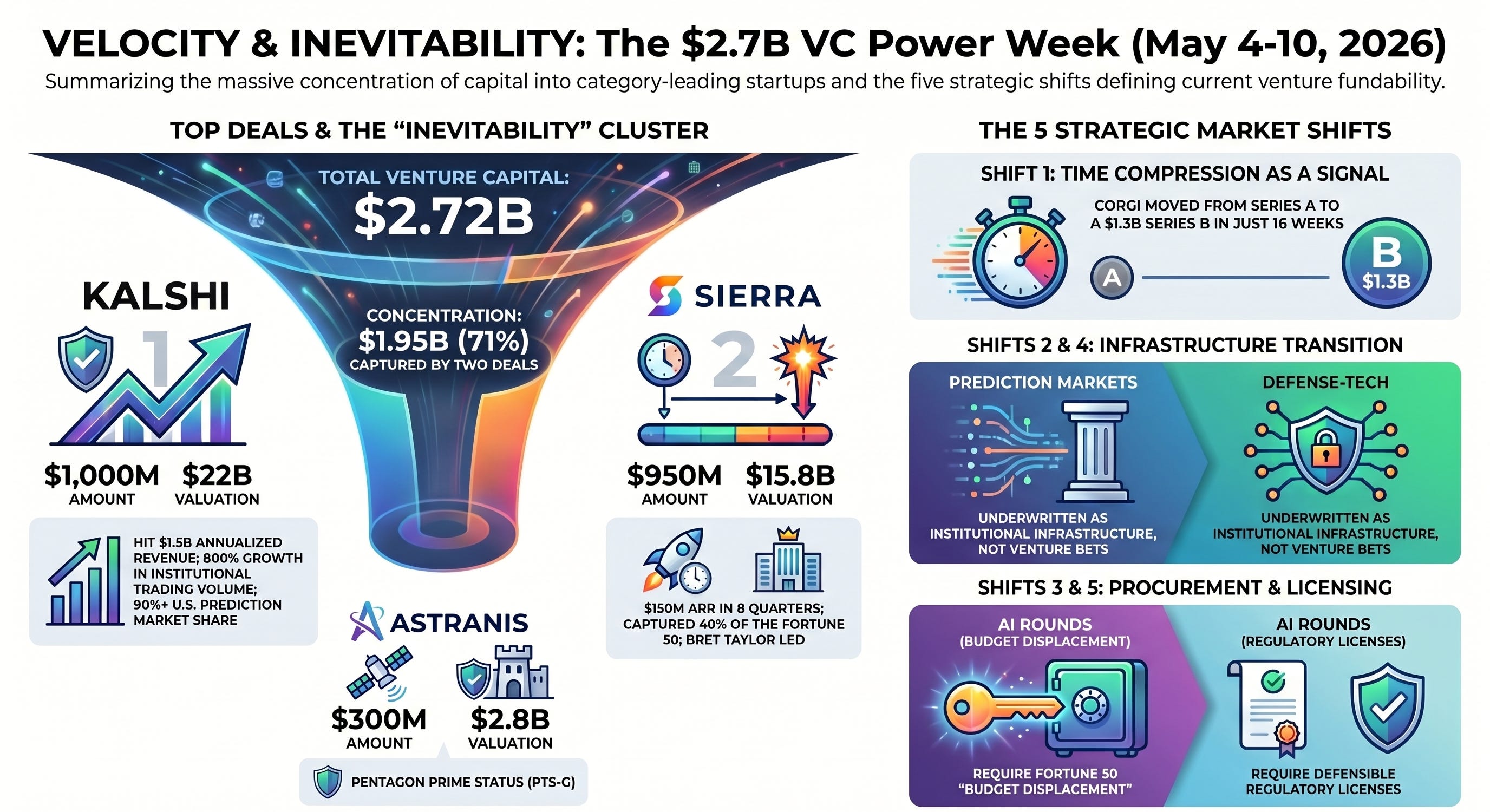
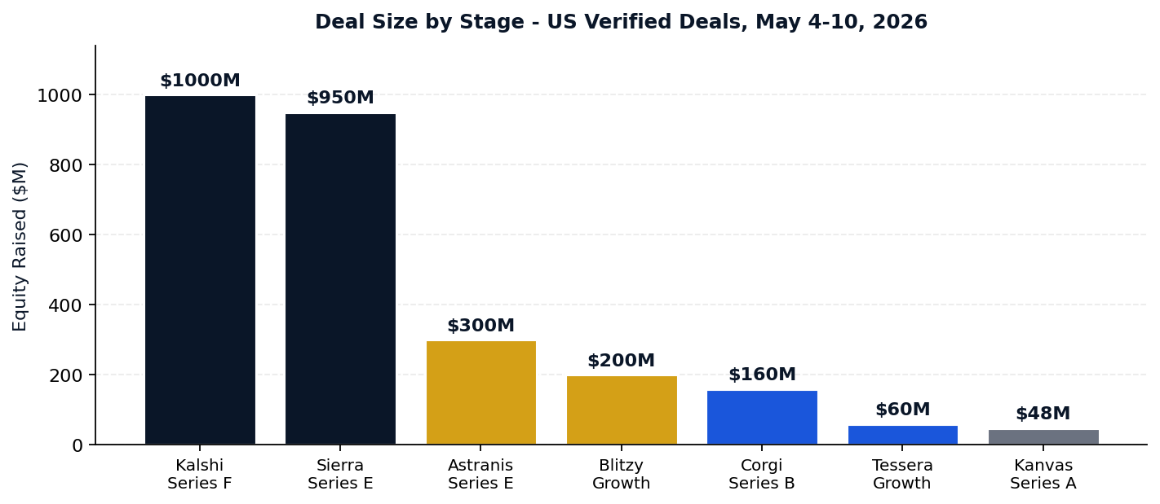
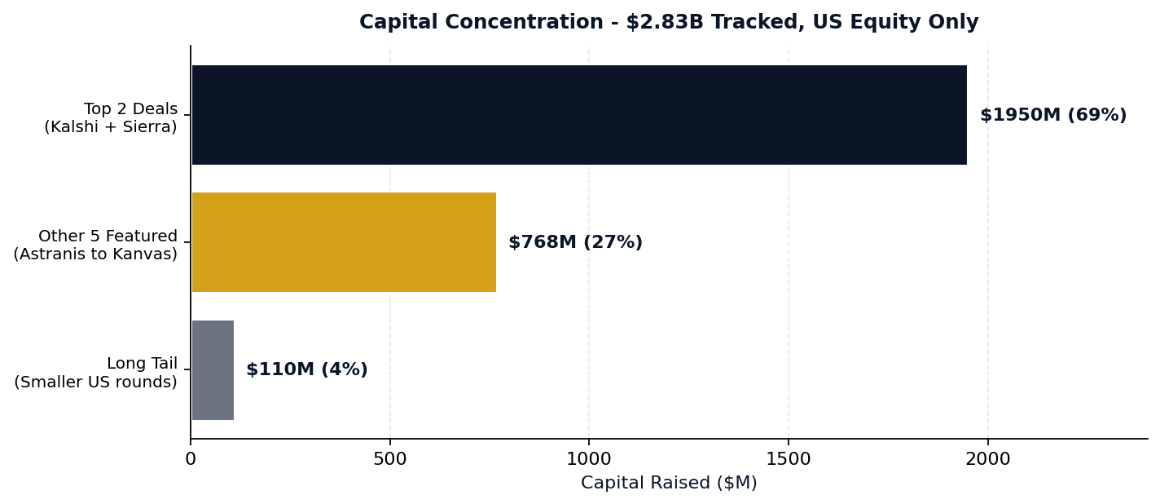
In the week of May 4-10, 2026, two deals took 71 percent of the U.S. venture capital tracked. Kalshi raised $1 billion at a $22 billion valuation. Sierra raised $950 million at a valuation of $15.8 billion. Together, they swallowed $1.95 billion of the $2.72 billion in equity tracked across seven verified U.S.-featured deals.
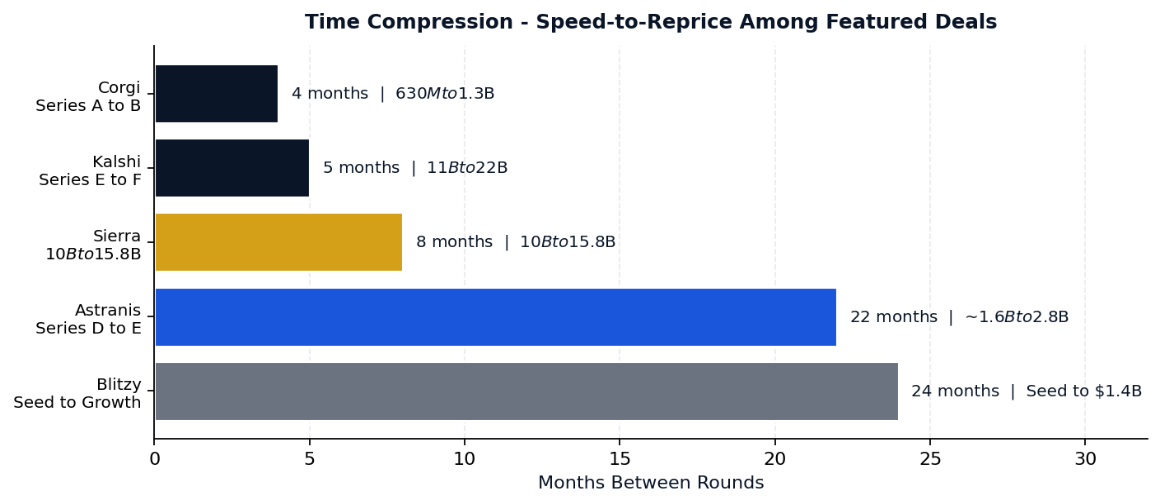
The five other deals (Astranis ($300M), Blitzy ($200M), Corgi ($160M), Tessera Labs ($60M), and Kanvas Biosciences ($48M) ) split the remainder. The pattern is not size. The pattern is time. Corgi went from a $108M Series A to a $1.3B unicorn in 16 weeks. Sierra hit $150M ARR in eight quarters. Kalshi doubled its valuation in five months. The market is paying a premium for founders who bend the curve.
What changed: this week confirmed that capital is no longer waiting for proof. It is paying ahead of it, but only for companies whose category position makes the next milestone inevitable. If your raise depends on time-to-traction, the way most do, your bar just moved.
THE WEEK DEAL SCORCARD
Capital concentrated into category leaders with compressed timelines, not first-time stories with bigger TAM slides.
Weekly Snapshot, Verified U.S. Deals
• Total tracked U.S. equity capital: $2.72 billion across 7 featured verified deals, plus an additional $155M in Astranis debt facility
• Average featured deal size: $388 million (skewed by Kalshi and Sierra; median is $200M)
• Median valuation across featured deals: $2.05 billion
• Highest Eisen Fundability Score: Kalshi and Sierra tied at 95/100
• Median Eisen Score: 75/100
• Fastest Series A to Series B: Corgi - 16 weeks (4 months)
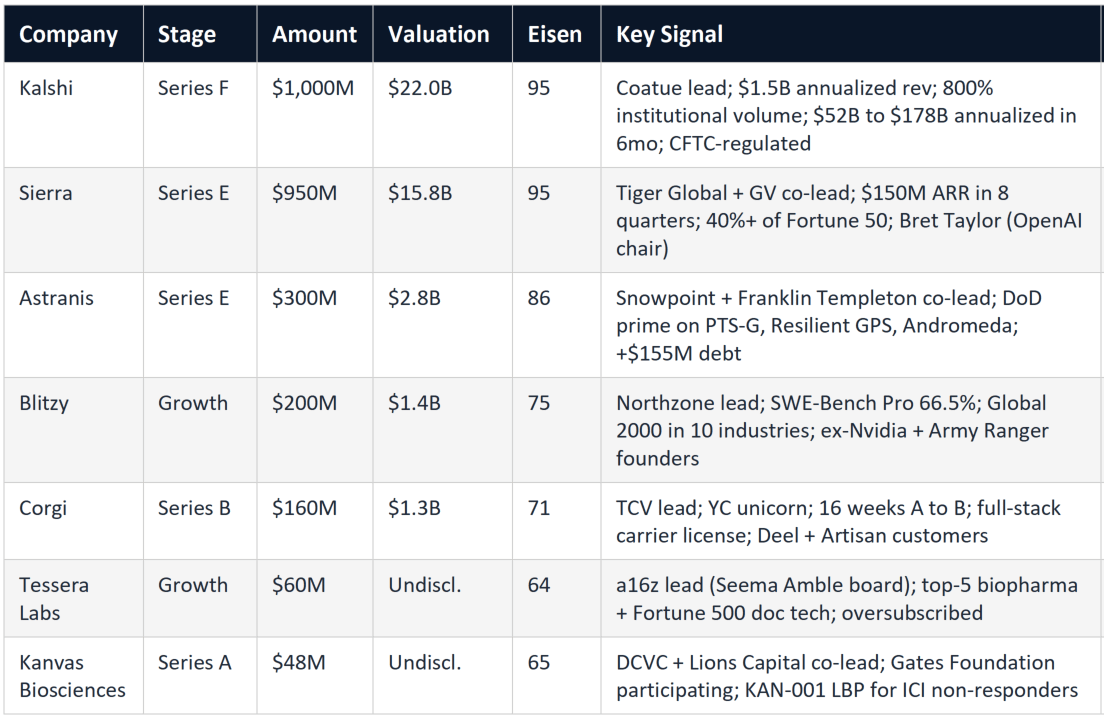
What the scorecard says at a glance
Kalshi and Sierra tied at 95 because both deals are category-locked. Kalshi controls 90%+ of U.S. prediction market activity and runs $178B in annualized trading on a CFTC-regulated exchange. Sierra serves more than 40% of the Fortune 50, with $150M in ARR built over eight quarters. These are not bets on a thesis. They are bets on inevitability. Astranis (86) shows what defense-linked space deals look like when the round is underwritten by Pentagon program-of-record selection rather than a TAM slide. Blitzy (75) and Corgi (71) cleared their unicorn rounds on different proof: Blitzy on a public benchmark score (66.5% on SWE-Bench Pro), Corgi on raw growth velocity (4 months from Series A to a $1.3B mark). The week’s median Eisen Score (75) reflects a market where capital is accelerating to category leaders and slowing for everything else.
WHAT CHANGED THIS WEEK: 5 MARKET SHIFTS
SHIFT 1: Time Compression is the New Fundability Signal
Pattern (what happened): Five of the seven featured deals show round-to-round time compression that would have been called overpriced 18 months ago. Corgi closed a $160M Series B at $1.3B just 16 weeks after announcing a combined $108M seed and Series A at a $630M valuation. Kalshi doubled from $11B to $22B in five months. Sierra moved from $10B (September 2025) to $15.8B (May 2026) in eight months. Astranis closed Series E roughly 22 months after Series D, with Pentagon program selection in between.
Perspective (what it means): Investors are pricing speed-to-milestone, not the size of the milestone. The underwriting question is no longer “how big is the prize” but “how fast can this team prove the next stage”. Kleiner Perkins partner Mamoon Hamid framed this in his April 29 statement on Rogo: “When a platform becomes the operating system for an entire industry, the opportunity is generational”. Translation: VCs will pay a premium for category lock-in that arrives in quarters, not years.
Founder Blindspot (what most miss): Founders read the headline numbers and conclude the bar is higher. The bar that moved is timing, not amount. Most decks still pitch “we will hit $10M ARR in 18 months”. The companies funded this week pitched “we hit $150M ARR in eight quarters and the curve is accelerating”. Velocity and trajectory beat the target.
Playbook (what to do): Add a slide titled “Compression Curve” before your traction slide. Plot two lines: industry median time to your current milestone, and your actual time. If yours is materially faster, lead with it. If it is not, do not raise this quarter; work on the velocity instead. Specific deliverable: build a trajectory chart showing the last three milestones with elapsed days between each. Send it to two operators who have raised at your stage in the last six months for a sanity check.
Contrast: In Q1 2025, the average gap between Series A and Series B rounds for AI application companies was 16-22 months. Corgi did it in 16 weeks. The norm shifted.
What this means for your raise: if your story does not include a number that ends in “in N quarters” or “‘in N months”, you have not packaged compression. Investors are not asking “what did you do” anymore. They are asking “how fast did you do it”.
SHIFT 2: Prediction Markets are Now Institutional Infrastructure
Pattern: Kalshi raised a $1B Series F at a $22B valuation from Coatue, Sequoia, a16z, IVP, Paradigm, Morgan Stanley, and ARK Invest. Annualized trading volume tripled from $52B to $178B in six months. Institutional trading volume grew 800% in the same window. The platform now hosts more than 90% of U.S. prediction market activity and generates roughly $1.5B in annualized revenue.
Perspective: Coatue’s Philippe Laffont said the quiet part out loud: “Consumers have already embraced it, and we believe institutions will follow.” Morgan Stanley’s check is the institutional tell. Event contracts are being treated as a hedging asset class, not a sports-betting novelty. CFTC federal preemption is the regulatory moat. Multiple states, including Nevada, New Jersey, Illinois, Wisconsin, and Connecticut, are litigating, and U.S. District Judge Michael T. Liburdi ruled in early May that federal law preempts state gambling laws on derivatives, granting Kalshi injunctive relief.
Founder Blindspot: Most fintech founders read this as a regulatory story and miss the structural one. The real signal is that a category that did not exist as an institutional product five years ago is now backed by Morgan Stanley and ARK. New asset classes get funded when an incumbent regulator (CFTC) provides a defensible jurisdictional position. If your category sits in a regulatory gray zone, your fundability is bottlenecked on legal clarity, not product traction.
Playbook: If you operate in any regulated frontier (DePIN, AI agents acting on behalf of users, autonomous capital allocation, alternative exchanges), build a one-page “Regulatory Architecture” brief. Three sections:
(1) Which agency has jurisdiction?
(2) What specific federal precedent supports your interpretation?
(3) What state-level challenges have you anticipated?
This document is not legal cover. It is investor due diligence material that compresses 30 days of partner-meeting questions into one page.
Contrast: Polymarket is reportedly raising $400M. The category that did not exist as fundable 18 months ago now has two players competing for billions. Founders in adjacent regulated frontiers should expect their regulatory architecture to become a checkable line item in pre-DD.
What this means for your raise: regulatory positioning is now part of the deck, not an appendix. If you cannot explain in one paragraph why your jurisdictional position is defensible, you are pre-product-market-fit in the eyes of late-stage investors.
SHIFT 3: Agentic AI at the Fortune 50 is the New $100M+ ARR Bar.
Pattern: Sierra closed $950M at $15.8B with $150M ARR built across eight quarters and customers including Prudential, Cigna, Blue Cross Blue Shield, Rocket Mortgage, and more than 40% of the Fortune 50. Bret Taylor told CNBC the addressable market for customer service alone is $400B annually and that ‘a bulk of that’ is moving to AI agents. Blitzy closed $200M at $1.4B, with adoption across dozens of Global 2000 enterprises across 10 industries, and a record 66.5% on SWE-Bench Pro. Tessera Labs added $60M in funding from a16z, with a top-5 biopharma and a Fortune 500 document technology firm as named customers.
Perspective: The pattern in agentic AI funding is now: (a) named Fortune 50 or Global 2000 customers, (b) revenue concentration showing the platform is replacing line-item software spend, not augmenting it, (c) a public benchmark or measurable ROI metric. Sierra’s “constellation of models” framing won because it described what Fortune 50 procurement teams already worry about - vendor dependency and model lock-in. Blitzy’s SWE-Bench Pro score gave Northzone something to underwrite that was not a vibe check.
Founder Blindspot: Most agentic AI founders pitch “we have an AI agent that does X” and lead with feature velocity. The funded companies pitch “we replaced X spend at Y named enterprise customers” and lead with budget displacement. The market has moved from features to a procurement category. Sierra is not selling a chatbot. It is selling against the customer service line item in the Fortune 50 P&L.
Playbook: Replace your “Features” slide with a “budget displacement” slide. List the specific procurement category you replace (customer support, ERP modernization, legal research, etc.), the typical annual spend at your customer size, and the percentage you are capturing. Specific deliverable: build a 1-page “Budget Displacement Stack” showing 3 named customers, the line item you replaced, and the dollar value. This goes after your team slide, before your traction slide.
Contrast: In 2025, Series B AI rounds closed on $5-15M ARR with growth metrics. In May 2026, Sierra is raising on $150M ARR, and Blitzy is on enterprise deployments at the Global 2000 scale. The bar moved 10x in 12 months for category-defining deals.
What this means for your raise: “We have AI in our product” is now a disqualifier. The check you want is from an investor who can say, “We are funding the company that owns budget category X”. Identify your category before your next pitch.
SHIFT 4: Procrument-Anchored Defense is being Underwritten as Infrastructure
Pattern: Astranis closed a $300M Series E plus $155M debt facility at $2.8B, co-led by Snowpoint Ventures and Franklin Templeton, with participation from a16z, BlackRock, Baillie Gifford, and Fidelity. The company holds initial-phase prime contractor selection on three named DoD programs of record: Protected Tactical Satcom-Global (PTS-G), Resilient GPS, and Andromeda. The Department of Defense FY2027 satellite communications budget request is $8.6 billion, $4.5 billion above the prior-year appropriation.
Perspective: Snowpoint general partner Alexander Creasey explicitly tied the round to the procurement signal: “GEO is the single most important orbit for national security, and that’s the orbit where we are seeing the largest need for new capability by Space Force”. The investor profile (PE + sovereign + crossover) is now structurally different from venture-led defense rounds in 2024. Astranis added $155M in delayed-draw debt from Trinity Capital, which is the financing structure of a defense prime, not a venture-backed startup. Capital is being allocated against the FY2027 budget request, not against the company’s runway.
Founder Blindspot: Most defense-tech founders position around their technology like “we have the best autonomous X”. The funded companies position around procurement specifics, such as the named program, the prime selection phase, and the contract vehicle. Astranis did not rely on satellite tech. It raised on the PTS-G prime selection plus the FY2027 satcom budget shape.
Playbook: If you sell to government or defense, build a “Procurement Position Map.” Three rows:
(1) the specific program of record or contract vehicle your product targets,
(2) your current selection phase (e.g., ‘OTA prime’, ‘CSO awardee’, ‘Phase II SBIR’),
(3) the FY budget alignment (which line in the President’s Budget Request maps to your contract).
This document prepares you for your meeting with strategic and crossover capital. Without it, you are positioned as venture defense - a category that is now harder to fund than infrastructure-style defense.
Contrast: In 2024, defense-tech rounds were typically led by venture firms at $200-500M and priced as software companies. In May 2026, Astranis was priced as infrastructure: debt-blended, crossover-syndicated, and tied to specific Pentagon programs. The investor profile and the underwriting model have both changed.
What this means for your raise: Defense as a venture category is being replaced by defense as an infrastructure category. If you cannot name the specific program your product is selected against, your round will be capped at venture pricing instead of infrastructure pricing, a 2-3x difference at later stages.
SHIFT 5: AI-Native Means License Infrastructure, not just an AI Wrapper
Pattern: Corgi raised $160M Series B at $1.3B 16 weeks after a $108M Series A at $630M. The differentiator: Corgi is not an insurtech broker or MGA. It is a licensed full-stack insurance carrier built from scratch on an AI-native stack. Customers include Deel and Artisan. TCV’s lead and the entry of generalist growth capital reset the cap table from AI- and fintech-focused funds to multi-stage growth investors. Tessera Labs ($60M, a16z lead) is positioned similarly: not “AI for ERP,” but the AI-native platform that owns the ERP transformation workflow with named Fortune 500 customers.
Perspective: TCV does not invest in insurtech broker startups. It invests in category-defining infrastructure. The Series B at 4 months is the speed signal, but the change in lead investor is the structural signal. When a generalist growth fund leads at the Series B, the company has crossed from “AI startup” into “AI-native infrastructure.” This is the shift from competing on AI to competing as the new default platform in the category.
Founder Blindspot: Founders building “AI for X industry” often position themselves as “we are the AI-powered version of [incumbent].” The funded company’s position is: “We are the AI-native carrier/platform/exchange that the incumbents will eventually license from us.” The difference is who owns the regulatory or technical license. Corgi is a carrier. Kalshi is a CFTC-regulated exchange. Astranis holds DoD program prime status. Sierra’s Bret Taylor sits on the OpenAI board. The license, the contract, or the platform position is the moat.
Playbook: Audit your “license stack”. List every regulatory license, technical certification, exclusive contract, or platform position your company holds that competitors cannot easily replicate. If the list is empty, your AI advantage lasts at most 12 months. Specific deliverable: a single page titled “Defensible Position” with three sections:
(1) what we are licensed/certified/contracted to do that others are not,
(2) what acquired or built moat we own (data, distribution, regulatory),
(3) the specific replication cost in months and dollars for a competitor to match.
Contrast: Insurtech 1.0 (Lemonade, Hippo, Root) raised on growth metrics and went public on revenue. Insurtech 2.0, Corgi, is raising on speed plus a carrier license, not on a different growth model. The category bar moved.
What this means for your raise: “AI-native” without a license, contract, or platform position is positioning, not architecture. Generalist growth capital is reading the difference. If you cannot name your defensible position in one sentence, you are being passed for the company that can.
THE DEALS THAT MATTER: TOP 5
KALSHI
Prediction Markets / Event Contracts | Series F | $1.0B | $22.0B
EISEN FUNDABILITY SCORE: 95 / 100
Why this scored
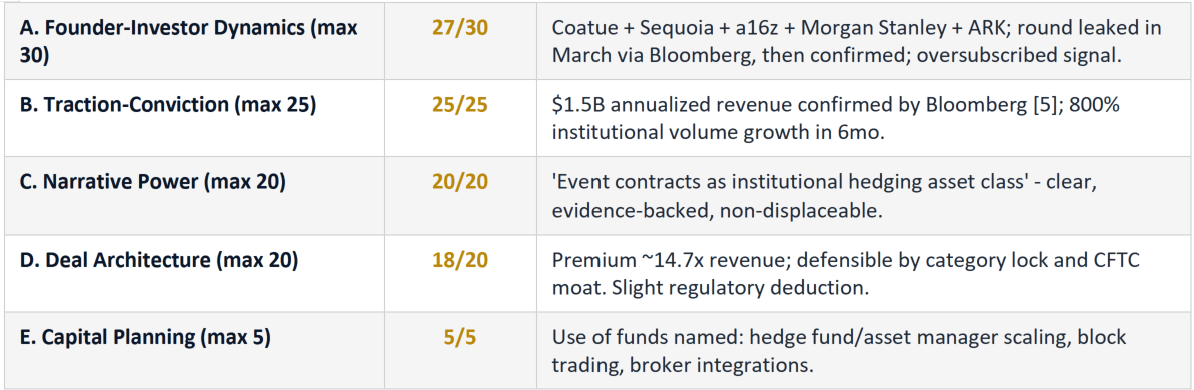
Tied for the highest score this week. Kalshi combines category control (90%+ of U.S. prediction market activity), institutional adoption (800% growth in institutional trading volume), revenue scale ($1.5B annualized), and federal regulatory positioning (CFTC-regulated exchange with court-affirmed federal preemption). The cap table now includes Coatue, Sequoia, a16z, Paradigm, IVP, Morgan Stanley, and ARK Invest. This is no longer a venture deal. It is an institutional asset class being priced.
The Setup
Founded in 2018 by Tarek Mansour and Luana Lopes Lara, MIT classmates [25][26]. Kalshi spent its first years building CFTC regulatory clearance, receiving designated contract market approval in November 2020 and launching the platform in July 2021. The Series F was led by Coatue Management on May 7, 2026.
The Numbers
$1.5B annualized revenue. Annualized trading volume tripled from $52B to $178B in six months. Institutional trading volume is up 800% over the same window. 90%+ of U.S. prediction market activity. 2 million monthly active users [10]. Valuation doubled from $11B (December 2025) to $22B in five months.
Eisen Fundability Score Breakdown
The Pattern
When a category leader controls 90%+ market share AND the regulatory moat AND posts trillion-dollar TAM growth math, the round is not priced on fundamentals. It is priced on inevitability. Coatue and Morgan Stanley are not betting on Kalshi’s product. They are betting that prediction markets will become the next institutional asset class and that Kalshi is the only fundable winner.
The Perspective
If your company has 90%+ category control plus a defensible regulatory or contractual moat, fundraising stops being about pitch quality. It becomes about access to the institutional capital pool that sets the price of inevitability. The pitch becomes shorter, not longer, at this stage - it is mostly term-sheet negotiation.
The Playbook
If you compete in a category with regulatory friction, build the regulatory architecture before product-market fit, not after. Kalshi spent three years pre-launch on CFTC clearance. That investment looks expensive in year 2 and obvious in year 7. Specific founder action: identify the federal regulator with potential jurisdiction over your product. Schedule one no-action letter conversation in the next 60 days.
Founder Mistake to Avoid
Trying to scale on multi-state compliance instead of federal preemption. Kalshi’s defensible position is that it is regulated by the CFTC, which preempts state-level gambling regulators. Founders who build state-by-state compliance create operating leverage that disappears when one state changes its mind. Federal jurisdiction is the asymmetric position.
SIERRA
Agentic AI / Customer Service | Series E | $950M | $15.8B
EISEN FUNDABILITY SCORE: 95 / 100
Why this scored
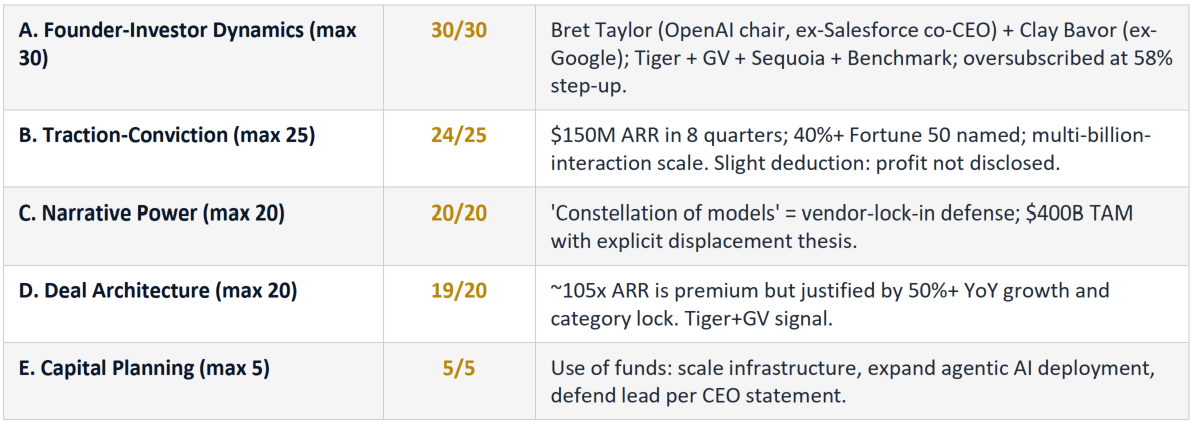
Tied with Kalshi for top score. Sierra is the cleanest ‘category locked + budget displacement’ story this week: $150M ARR built in eight quarters, more than 40% of the Fortune 50 as customers, OpenAI board chair as co-founder, a $400B procurement category as the addressable market. The Tiger Global plus GV co-lead structure is what crossover-style late-stage looks like in 2026.
The Setup
Founded in 2023 by Bret Taylor (current OpenAI board chair, former Salesforce co-CEO, former Twitter chairman) and Clay Bavor (former Google leader who led Google Labs and AR/VR), Sierra publicly launched in February 2024. Sierra builds AI agents for enterprise customer service deployments. The Series E was led by Tiger Global and GV with participation from Sequoia, Benchmark, and Greenoaks on May 4, 2026.
The Numbers
$150M ARR achieved in 8 quarters from public launch in February 2024 - up from $100M ARR in November 2025. Named customers include Prudential, Cigna, Blue Cross Blue Shield, and Rocket Mortgage. More than 40% of the Fortune 50 use the platform. Valuation jumped from $10B (September 2025, Greenoaks-led $350M round) to $15.8B, a 58% step-up in 8 months. Bret Taylor estimates the customer service spend addressable to AI agents at approximately $400B annually.
Eisen Fundability Score Breakdown
The Pattern
Sierra is what Series E AI looks like when the category has settled. The pitch is no longer “we have an AI for X”. It is “we displaced 40% of the Fortune 50’s customer-service software spend in 8 quarters, and the curve is accelerating.” Tiger Global’s check is the institutional read. This is no longer a venture-priced AI bet; it is a budget-displacement-priced enterprise software bet.
The Perspective
Bret Taylor’s framing is the move: “We are trying to invest aggressively so we can continue to expand our lead”. Notice the verb is “lead”, not the noun “product” or “technology”. The company is now competing on category position, not feature velocity. The right question for an investor is no longer “how good is your AI” but “how hard is it to take share from you.”
The Playbook
If you serve Fortune 500 enterprises, replace your “AI capability” slide with a “Customer Concentration” slide. Three columns: customer name, the line item your product replaces, and the percentage of that line item you have captured. Specific founder action: rebuild your top-of-funnel pitch to lead with named-customer line-item displacement. Drop the generic “we improve productivity” framing entirely. That language is now correlated with smaller checks at later stages.
Founder Mistake to Avoid
Pitching the model architecture instead of the customer concentration. Sierra’s “constellation of models” is real product differentiation, but it is not what closed the Series E. The 40% Fortune 50 customer base did. Most agentic AI founders over-index on technical defensibility and under-index on procurement-category capture. The capital is going to companies that can name the budget category, not the model architecture.
ASTRANIS
Defense Space / GEO Satellites | Series E | $300M (+$155M debt) | $2.8B
EISEN FUNDABILITY SCORE: 86 / 100
Why this scored
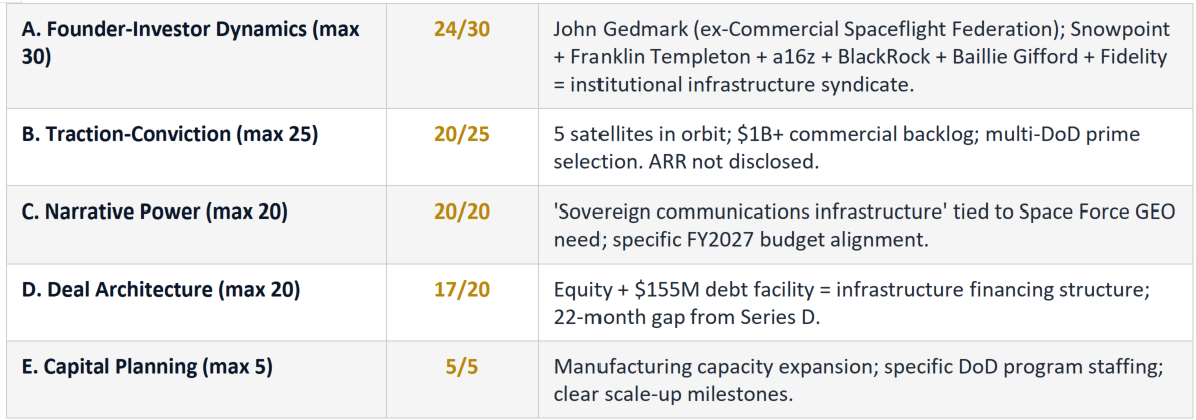
The week’s clearest “venture-to-infrastructure” transition. Astranis has flown five micro-GEO satellites into commercial service, holds initial-phase prime selection on three named Pentagon programs of record (PTS-G, Resilient GPS, Andromeda), and closed a debt-blended Series E that mirrors how a defense prime is capitalized. Snowpoint, Franklin Templeton, a16z, BlackRock, Baillie Gifford, and Fidelity are not a venture syndicate. It is an institutional infrastructure syndicate.
The Setup
Founded in 2015 by John Gedmark and Ryan McLinko. Astranis builds smaller GEO satellites (a few hundred kilograms each) designed for dedicated coverage. The Series E closed May 6, 2026, with $300M equity co-led by Snowpoint Ventures and Franklin Templeton, plus a $155M delayed-draw credit facility from Trinity Capital. Total raised now exceeds $1.2 billion.
The Numbers
Five satellites in orbit. Commercial backlog exceeds $1 billion. 500 employees. 153,000 sq ft headquarters in Northern California. Pentagon FY2027 satcom budget request: $8.6B, $4.5B above the prior-year appropriation. The macro signal Snowpoint and Franklin Templeton are priced into the round. Customers include Thaicom, Orbith, Chunghwa Telecom (Taiwan), and MB Group (Oman); selected as prime for PTS-G, Resilient GPS, and Andromeda DoD programs.
Eisen Fundability Score Breakdown
The Pattern
Defense space is being underwritten as infrastructure, not a venture. The investor profile has shifted from venture firms ($200-500M rounds in 2024) to crossover and growth capital plus debt facilities ($300-450M rounds in 2026). Astranis closed an equity round AND a debt facility AND tied both to Pentagon program-of-record selection. That is the financing structure of a defense prime, not a startup.
The Perspective
The macro framing is the FY2027 budget request. Pentagon satcom spending is requesting a 110% increase year-over-year. Capital is allocated to that budget shape, not to the company’s runway. Astranis raised because the Pentagon’s checkbook signaled it would write checks the company could fulfill; the round is aligned with government contract velocity, not typical venture milestones.
The Playbook
If you sell to the Department of Defense or any government, build a “Procurement-to-Capital Map.” This document condenses 6-12 months of investor education into a single page. Specific founder action: pull the relevant FY2027 President’s Budget Request line for your contract vehicle and include the dollar amount in your investor deck.
Founder Mistake to Avoid
Positioning as a venture-tech defense company when your business model is infrastructure-shaped. If your revenue mix is 80%+ government contracts on multi-year programs of record, you are not a venture company. You are an infrastructure company. Pricing yourself as a venture compresses your valuation by 2-3x at later stages. The right comparable is United Launch Alliance or Maxar, not a SaaS company.
BLITZY
Autonomous Software Development | Growth | $200M | $1.4B
EISEN FUNDABILITY SCORE: 75 / 100
Why this scored
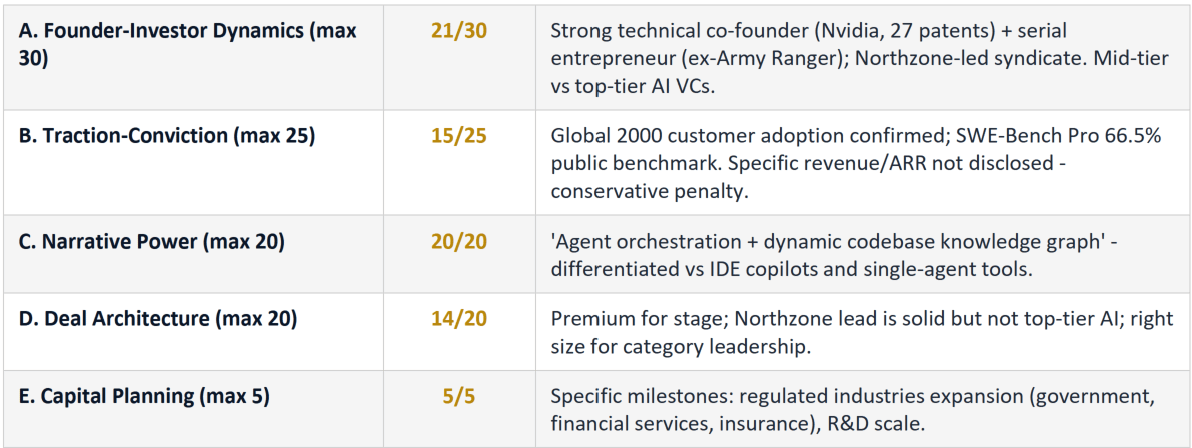
The Boston area’s newest unicorn, Blitzy, raised on a public benchmark plus an enterprise adoption story. Its 66.5% on SWE-Bench Pro is a cited record, surpassing the latest releases from major incumbents [13]. Adoption across dozens of Global 2000 enterprises in 10 industries is the proof point that converted Northzone, PSG, and Battery Ventures. Headcount has more than doubled in six months.
The Setup
Founded in 2023 by Brian Elliott (former Army Ranger and serial entrepreneur, who founded Wove) and Sid Pardeshi (Nvidia Master Inventor with more than 27 patents on neural networks, image generation, and AI-driven interface translation). The two met while building advanced software systems at Harvard. The $200M growth round was announced on May 5, 2026.
The Numbers
SWE-Bench Pro score: 66.5% - reported as a record [14][21]. Global 2000 enterprise adoption across 10 industries. Headcount more than doubled in 6 months. Total raised exceeds $204M. Lead: Northzone. New investors: PSG, Battery Ventures, Jump Capital, Morgan Creek Digital, Defiant. Strategic: Liberty Mutual Strategic Ventures, Erie Strategic Ventures, BAL Ventures [13][14].
Eisen Fundability Score Breakdown
The Pattern
Blitzy proves that public benchmarks are now bankable. The 66.5% SWE-Bench Pro score gave Northzone something measurable to underwrite, a number that the partner can defend in IC, unlike vibes about ‘better than Cursor’. In a category with several well-funded competitors (Cursor, Cognition Labs, Lovable), the public benchmark, plus the named Global 2000 adoption combination, was what cleared the unicorn round.
The Perspective
AI coding tools are now competing on enterprise depth rather than developer experience. GitHub Copilot, Cursor, and Cognition’s Devin all win on different vectors. Blitzy is positioned around what those tools cannot do well: large legacy codebases (100M+ lines of code) understood as a single dynamic knowledge graph, with agents that run for days or weeks. The bet is that enterprise-scale autonomous coding is a different market from developer copilots.
The Playbook
If you operate in a category with public benchmarks (AI coding, model evals, scientific AI, legal research, RAG systems), get on the leaderboard. Specific founder action: identify the 1-2 most relevant public benchmarks in your category. Run your system. Publish the result. If you cannot top a known incumbent, make the benchmark conditions specific and reproducible. Investors at the growth stage are looking for measurable proof - benchmarks are now part of the deck.
Founder Mistake to Avoid
Competing on developer experience when the category has settled around enterprise depth. Cursor and GitHub Copilot are competing on UX and inference speed. Blitzy is competing on inference duration (days to weeks) and codebase understanding (100M+ lines). These are different markets. Trying to compete in both compresses positioning and confuses investors.
CORGI
AI-Native Insurance Carrier | Series B | $160M | $1.3B
EISEN FUNDABILITY SCORE: 71 / 100
Why this scored
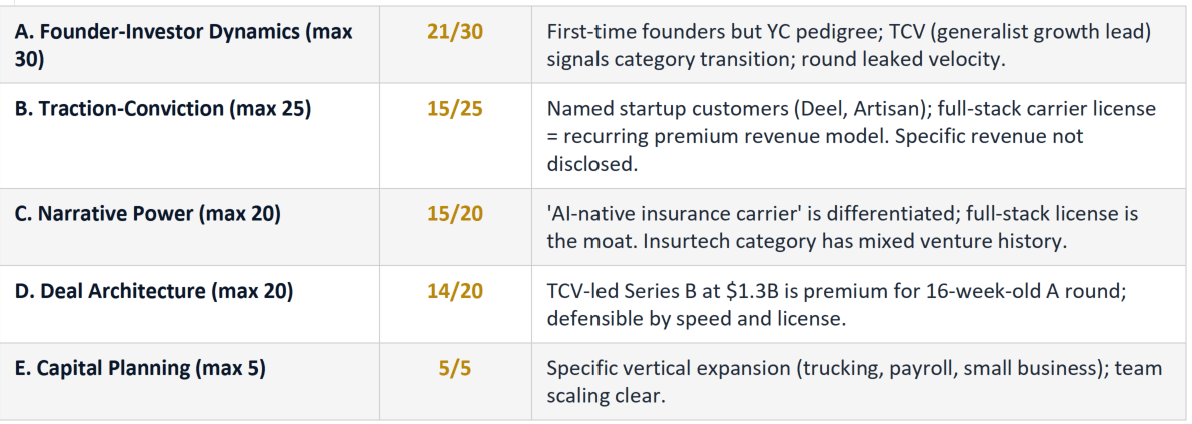
Y Combinator’s newest unicorn, Corgi, went from idea to $1.3B valuation in less than two years and from Series A to Series B in 16 weeks, one of the fastest A-to-B reprices on record. The lead investor change from Y Combinator/Kindred at the Series A to TCV at the Series B is the structural signal: generalist growth capital now classifies Corgi as AI-native infrastructure, not insurtech.
The Setup
Founded in 2024 by Emily Yuan and Nico Laqua, the Y Combinator Spring 2024 batch. Corgi is a licensed AI-native insurance carrier serving startups, designed and operated end-to-end on a modern AI stack. The Series B was led by TCV, with participation from existing investors Kindred Ventures, Leblon Capital, and Seven Stars Ventures, as well as new investors First Order Fund, Repeat VC, and Audeo Ventures. Announced May 6, 2026.
The Numbers
$160M Series B at $1.3B valuation, 16 weeks after a $108M Series A at $630M (combined seed plus Series A). Total raised: $268M. Customers include Deel and Artisan. Coverage areas: general liability, cyber liability, tech and AI liability. Expansion verticals: trucking, payroll, small business.
Eisen Fundability Score Breakdown
The Pattern
16 weeks from Series A to Series B is a structural signal, not an outlier. When a generalist growth lead enters at the Series B (TCV vs the Series A YC/seed-stage syndicate), the company has crossed a category threshold. The Series A priced Corgi as “AI-native insurtech.” The Series B prices it as “AI-native infrastructure with a regulatory license.” Different category, different multiple.
The Perspective
The carrier license is the moat. Without it, Corgi would be an MGA (managing general agent) competing with thousands of others on distribution and underwriting math. With it, Corgi can design coverage products that others cannot offer and capture the full premium economics. The license takes years to acquire, which is why Corgi’s 4-month A-to-B speed feels suspicious until you realize the license was the real fundability signal.
The Playbook
If your category has a regulatory or technical license that takes years to acquire, get it before you need it. The license is the asymmetric position. Specific founder action: list every license, certification, or platform position your company holds. For each one, write the dollar value of the moat it creates either as a direct revenue capture or as a defensive cost competitors must absorb to match you. This becomes your one-page Defensible Position Brief.
Founder Mistake to Avoid
Pitching the AI before the license. Corgi’s pitch leads with the carrier license and treats AI as the operating model. Most insurtech founders lead with AI and treat the license as an addendum. The funded version inverts the order: license first, AI as the execution layer. Investors at the growth stage are buying the asymmetric position, not the technology.
FUNDRAISING PLAYBOOK: 5 ACTIONS BASED ON THIS WEEK
This week’s data demands five specific changes to how you raise. Each plan below produces a concrete document or asset you can use in your next investor conversation. Time estimates assume a focused founder working 4-6 hours on the deliverable.
PLAN 1: Build a Compression Curve Slide
Focus: Narrative/positioning/investor framing
Why this matters: Five of the seven featured deals this week were priced on time-to-milestone, not size-of-milestone. Corgi at 16 weeks A-to-B and Sierra at 8 quarters to $150M ARR set the new benchmark. If your deck does not show explicit velocity, you are pricing yourself for 2024.
Exact deliverable: A single chart titled “Compression Curve.” X-axis: months. Y-axis: revenue, customers, or product milestones. Two lines: industry median time to your current milestone, and your actual time. Place this slide before traction.
Expected outcome: Investors stop asking “what is your traction” and start asking “how did you compress the timeline.” The conversation shifts from milestones to mechanics, which is where your moat lives.
Reframe:
Wrong: “We have $5M ARR.”
Right: “We hit $5M ARR in 11 months. The category median is 26.”
PLAN 2: Write Your Budget Displacement Stack
Focus: Proof/traction/metrics packaging
Why this matters: Sierra raised on Fortune 50 customer concentration plus named line-item displacement. Tessera Labs raised on a top-5 biopharma plus Fortune 500 doc tech as named accounts. Investors are no longer underwriting features. They are underwriting procurement-category capture.
Exact deliverable: A 1-page Budget Displacement Stack. Three columns:
(1) named customer,
(2) the specific line item your product replaces (e.g., “Customer service contact center spend”),
(3) the dollar value or percentage of that line item you have captured. Include 3 customers minimum.
Expected outcome: Replaces 4-6 slides of feature comparison with one slide of procurement-grade evidence. Compresses partner-meeting follow-ups by approximately 30%.
Reframe:
Wrong: “Our AI improves productivity by 5x.”
Right: “At [Named Customer], we replaced their $4.2M annual customer service contact center spend with a $1.1M annual platform contract.”
PLAN 3: Score Yourself on the 5 Fundables OS Forces.
Focus: Self-score (Eisen Fundability Score) plus gap diagnosis
Why this matters: This week’s median Eisen Score was 75, with the unicorn cluster at 71-75 and the inevitable cluster at 86-95. Knowing where you sit tells you whether to raise this quarter or fix specific gaps first.
Exact deliverable: Score yourself on all five Eisen dimensions: Founder-Investor Dynamics (30), Traction-Conviction (25), Narrative Power (20), Deal Architecture (20), Capital Planning (5). Identify your two lowest dimensions. Write one specific 30-day action per gap.
Expected outcome: A clear self-diagnosis showing whether your gaps are pre-funding (fix before raising) or in-process (fix during raise via the right investor partnership).
Reframe:
Wrong: “We need more revenue before we can raise.”
Right: “Our Traction-Conviction is 15/25, and Deal Architecture is 12/20. We need 3 named enterprise customers and a thesis-fit lead investor before we raise.”
PLAN 4: Build Your Thesis-Fit Investor List.
Focus: Deal architecture/investor targeting/process design
Why this matters: Two structural signals from this week:
(a) crossover and growth capital are leading at later stages (Tiger Global, TCV, Coatue), and
(b) when the lead investor changes from a category-specialist to a generalist growth fund, the company has crossed a category threshold. A wrong investor profile at your stage caps your valuation.
Exact deliverable: Cut your target investor list from 100+ to 25-35 thesis-fit names. For each: (1) recent fund size and vintage, (2) the partner whose thesis aligns with your category, (3) their last 3 led deals in your sector. The right list is small and specific, not large and aspirational.
Expected outcome: Higher hit rate on first meetings. Faster time-to-term-sheet. The right investor profile compresses fundraising duration by 30-50%.
Reframe:
Wrong: “I need to email 200 VCs.”
Right: “I need to get the right intro to 12 partners whose thesis fits my category and whose recent deals match my stage.”
PLAN 5: Write Your Defensible Position Brief
Focus: Momentum/follow-up/ FOMO/conversion mechanics
Why this matters: Kalshi’s CFTC moat, Astranis’s Pentagon prime selection, Corgi’s carrier license, Sierra’s OpenAI co-founder credibility - every featured deal this week had a defensible position that competitors cannot replicate in months. Without one, your fundability is bottlenecked.
Exact deliverable: A 1-page Defensible Position brief with three sections:
(1) what you are licensed/certified/contracted to do that others are not,
(2) what acquired or built moat you own (data, distribution, regulatory, talent),
(3) the specific replication cost in months and dollars for a competitor to match you.
Expected outcome: Converts “investors are interested” into “investors are competing.” Without a defensible position, momentum dissipates between meetings. With one, FOMO compounds.
Reframe:
Wrong: “Our AI is better.”
Right: “We hold [specific license/certification/contract]. Replication takes a competitor 18 months and $40M.”
LOOKING FORWARD: NEXT 1-3 WEEKS
SCENARIO 1: Polymarket announces or completes a $400M+ raise
Why this is likely: Polymarket is reportedly seeking $400M, and Kalshi’s $1B raise establishes the category benchmark. Polymarket needs to close before institutional capital finishes allocating to the category.
What founders should watch: The lead investor and valuation. If a generalist growth fund leads at $5B+, prediction markets are now a settled category. If a venture firm leads at $2-3B, the category is still being priced as venture.
What founders should do before others notice: If you operate in any regulated market structure (DePIN, alternative exchanges, AI-managed funds, autonomous capital), publish your regulatory architecture brief now. Two raises in the same category create a comparable framework that benefits the third entrant.
SCENARIO 2: A Fortune 50 procurement-anchored AI deal closes at $2B+
Why this is likely: Sierra at $15.8B with $150M ARR establishes the new revenue-multiple ceiling for category-leading agentic AI. Anthropic, Anysphere, Periodic Labs, and other category leaders are reportedly raising. The market has demonstrated appetite for $1B+ AI rounds priced on Fortune 50 customer concentration.
What founders should watch: The named customer list disclosed in the announcement. If the deal lists 3+ Fortune 100 customers by name, the procurement-displacement playbook is now table stakes. If it lists none, the category is still pricing on TAM math.
What founders should do before others notice: Lock in 2-3 reference customer agreements you can disclose by name in fundraising materials. The deals being funded right now have named customers. The rest get smaller checks.
SCENARIO 3: A defense-tech round closes with a debt-blended structure
Why this is likely: Astranis demonstrated that institutional infrastructure capital plus debt facilities will write large checks against Pentagon program-of-record selection. True Anomaly closed a $600M Series D the prior week. The Pentagon's FY2027 budget request is up significantly across multiple categories.
What founders should watch: Whether the round includes a credit facility. Equity-only rounds in defense are still venture. Equity-plus-debt rounds are infrastructure - and price 2-3x higher at the same revenue level.
What founders should do before others notice: If you sell to DoD or government, identify the right debt provider for your stage and build a relationship before you need to raise. Trinity Capital, Hercules Capital, Western Technology Investment - the specialty lenders have differentiated these. The right call now creates the right structure later.
WILD CARD: A non-AI rotation
If next week’s biggest round goes to a non-AI category (climate, biotech, fintech, consumer), it signals the AI mega-round concentration is starting to crowd out other thesis allocations. Watch for crossover funds (Coatue, Tiger, Greenoaks, GV) leading the rotation, not specialist funds. If it does not happen, AI continues to swallow allocation.
THE BOTTOM LINE
The real insight from this week is not that $2.72B got deployed. It is that 71% of it went to two companies that positioned themselves on inevitability and time compression. The capital is no longer waiting. The bar moved from ‘show me the proof’ to “show me how fast you got the proof.” Founders who package velocity and category lock-in will get 2-3x the valuation of founders who package growth and TAM. The other five featured deals are priced lower because their inevitability story is weaker, even though their fundamentals are strong.
Five New Rules for Founders
Rule 1: Time compression is the new signal of fundability. If your last round was 18+ months ago and your milestone progression looks linear, you will be priced as a venture. If it looks exponential and recent, you can price it as infrastructure. The math is being done in months, not years.
Rule 2: Procurement-category displacement beats feature velocity. Sierra raised on Fortune 50 customer concentration with named line-item displacement. Investors are now underwriting which budget category you replace, not which feature you deliver.
Rule 3: Regulatory or technical license is the asymmetric position. Kalshi’s CFTC clearance, Corgi’s carrier license, Astranis’s DoD prime selection, every category-leading deal this week has an asymmetric position that competitors cannot replicate in months. Without one, your moat is 12 months.
Rule 4: When the lead investor profile changes, the category has shifted. Generalist growth capital leading at the Series B (TCV in Corgi) means the company has crossed from a category startup to a category infrastructure company. Match your investor profile to your category status, not your stage.
Rule 5: Public benchmarks are now bankable. Blitzy’s 66.5% on SWE-Bench Pro is what gave Northzone something to underwrite. In any category with a public benchmark, the leaderboard position is part of the deck. If you are not on it, get on it.
4 Monday Actions
Compression Curve Slide. Build the velocity chart this week. If your timeline is not materially better than the category median, do not raise this quarter - work on the velocity instead.
Budget Displacement Stack. Email three of your largest customers and ask: “What line item did our product replace, and what was your prior annual spend on it?” Use those answers to rebuild your traction slide.
Eisen Fundability Self-Score. Score your company across all five dimensions. Identify your two lowest. Commit to one concrete 30-day action per gap.
Defensible Position Brief. Write the 1-page brief: what you are licensed/certified/contracted to do, your acquired moat, the replication cost for a competitor in months and dollars. If the page is empty, your fundability has a 12-month half-life. Fix it now.
Research Methodology
Data collection period: May 4-10, 2026 (full week, primary source verification only).
Verification standard: minimum 2 independent sources per featured deal; official press releases prioritized.
Eisen Fundability Scores are proprietary analytical estimates, not endorsements or investment advice.
All dollar amounts reflect announced figures at close, not post-close adjustments.
Research completion timestamp: May 10, 2026.
Total featured deals analyzed: 7 (U.S., verified).
Excluded - prior week deals resurfaced: True Anomaly $600M, Castelion $350M, Hightouch $150M, Avoca $125M, Eon $300M, Curative $150M, Angle Health $134M, Antithesis $105M, Standard Intelligence $75M, JuliaHub $65M, Rogo $160M (all April 25-May 1 window per Crunchbase weekly coverage).
DISCLAIMER: This article is for informational and strategic intelligence purposes only. It does not constitute investment advice. The Eisen Fundability Score is a proprietary diagnostic within Fundables OS™, not a financial recommendation. Worked examples reference publicly disclosed rounds from the Eisen VC Market Intelligence Report. Valuations, ARR, and investor participation are sourced from primary company announcements and tier-one coverage.
If this article was useful, share it with founders who are about to raise.
— Leon Eisen, 4x Founder, Venture Capitalist, and Creator of Fundables OS™