

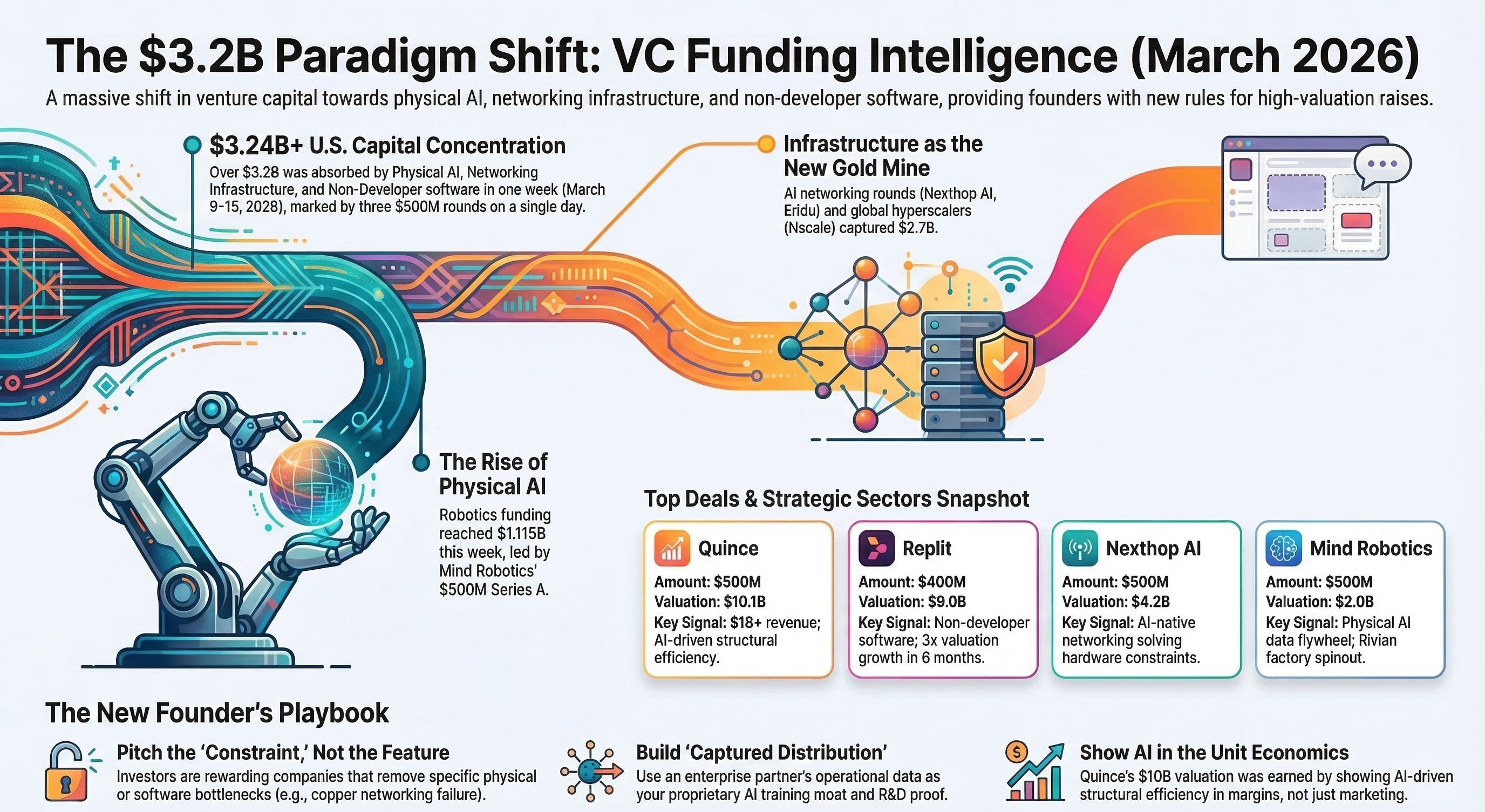
Six meaningful deals. Three sectors. Zero enterprise SaaS.
In the week of March 9–15, 2026, the top three verified U.S. funding rounds were announced on the same day (March 11) at exactly $500M each: Nexthop AI (AI networking), Mind Robotics (industrial robots), and Quince (consumer commerce). That is what a paradigm shift in capital markets looks like.
Globally, the week opened March 9 with London-based Nscale closing $2B in Series C funding at a $14.6B valuation with Nvidia as a strategic investor — the largest Series C in European history. The AI infrastructure buildout is no longer a U.S. story.
Replit’s $400M Series D tripled the company’s valuation from $3B to $9B in under six months, driven by non-technical enterprise users at Zillow, PayPal, and Adobe. The non-developer software market just became a billion-dollar category.
Mind Robotics, spun out of Rivian by CEO RJ Scaringe, raised $500M Series A, one of the largest Series A rounds in robotics history, without shipping a single public product. The investor logic: Rivian’s factory is the proof. The data flywheel is the moat.
THE WEEK IN ONE SENTENCE
Physical AI, AI networking infrastructure, and non-developer software collectively accounted for $3.24B+ in verified U.S. deals, while globally, AI infrastructure hyperscalers captured another $2B+, making this one of the most concentrated single-thesis weeks in 2026 venture history.

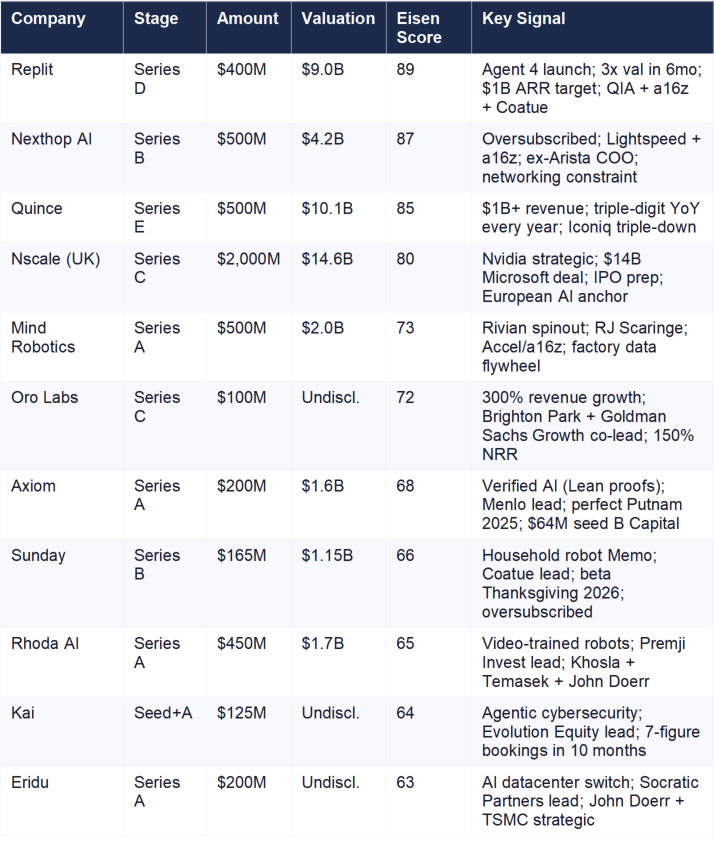
DEAL SCORECARD
What the Scorecard Says at a Glance
Replit scores highest (89) because the metrics are verified and compounding. 150,000 paying customers, 50 million total users, 85% of Fortune 500 with users on the platform, and a $1B ARR target backed by real enterprise case studies. That is, traction-to-conviction conversion at Series D. Nexthop (87) scores on constraint specificity and top-tier strategic validation from the most credible operational pedigree in networking. Quince (85) is the week’s outlier: a non-AI-primary company that earned near-top scores purely on fundamentals: $1B+ revenue, triple-digit YoY growth every year, and an Iconiq triple-down at $10.1B. Mind Robotics (73) scores lower specifically because it is pre-revenue, but founder pedigree and Rivian’s captured deployment environment justify the gap. All 11 deals are verified at high confidence against official primary sources.
WHAT CHANGED THIS WEEK: 5 KEY MARKET SHIFTS
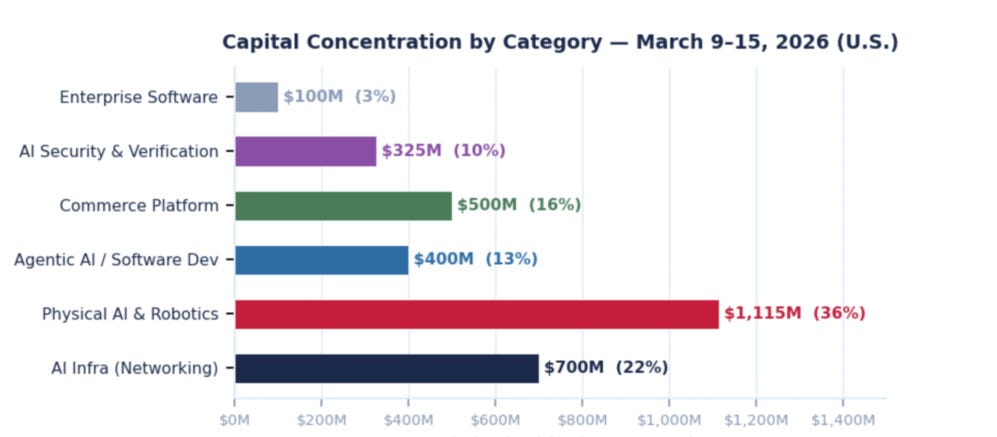
Seed/Series A dominated by six physical AI, robotics, and networking companies. AI Infrastructure (Networking): Nexthop $500M + Eridu $200M. Physical AI & Robotics: Mind $500M + Rhoda $450M + Sunday $165M.
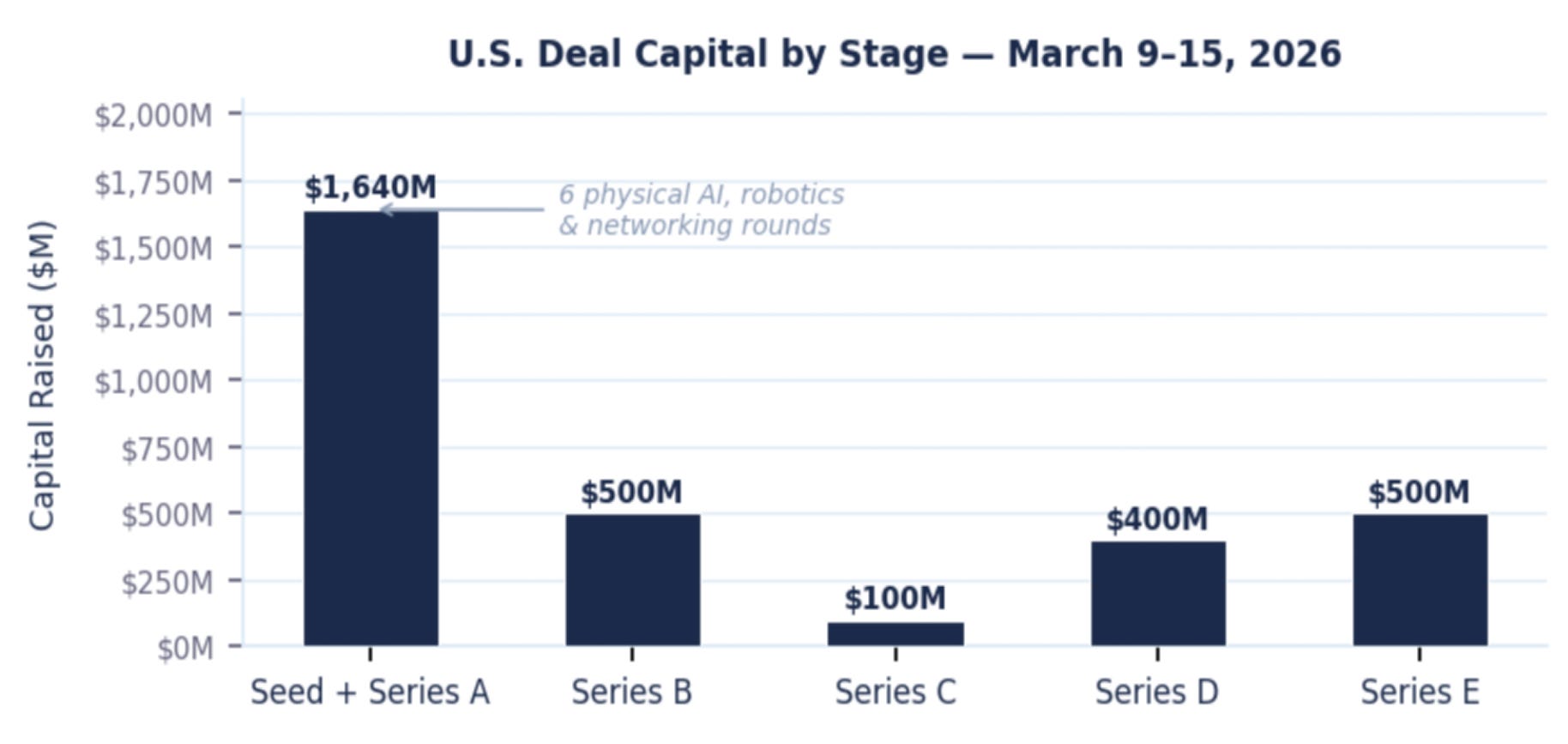
Bars represent capital raised per stage ($M). Seed/Series A dominated by six physical AI, robotics, and networking companies ($1.64B across 6 deals). Series B: Nexthop AI $500M. Series C: Oro Labs $100M. Series D: Replit $400M. Series E: Quince $500M. Nscale (UK, $2B) excluded from totals.
SHIFT #1: Physical AI Is No Longer A Thesis, It’s A Category
PATTERN
Mind Robotics (Rivian spinout) raised $500M Series A. Rhoda AI emerged from stealth with $450M Series A ($1.7B valuation, led by Premji Invest), training robots on hundreds of millions of internet videos. Sunday raised $165M Series B for household robot Memo (beta by Thanksgiving 2026). Three physical AI companies, $1.115B, in one week. All announced March 10–12.
PERSPECTIVE
The robotics investment thesis has bifurcated. 2025’s humanoid robot narrative absorbed attention. March 2026 shows a different bet: investors are funding robots for captured, high-data environments such as factories, warehouses, and homes, where ground-truth deployment data already exists. The moat is the training data and the customer lock-in, not the hardware.
FOUNDER BLINDSPOT
Founders see these rounds and assume physical AI requires hardware expertise. Wrong. Mind Robotics is building foundation models and deployment infrastructure first. The hardware is a delivery mechanism. Rivian’s factory generates the data. The data is the moat. Founders in any physical environment with operational data are sitting on a similar asset.
PLAYBOOK
If you operate in any industry with repetitive physical processes (manufacturing, logistics, healthcare, retail operations), map your operational data inventory this week. For each data stream, ask: Is it proprietary? Could it train an AI model? Does any competitor have it at scale? Two ‘yes’ answers mean a data flywheel thesis worth including in your fundraise.
CONTRAST
In 2024, physical AI rounds required a humanoid form factor for premium multiples. In March 2026, the highest-conviction checks went to purpose-built industrial robots backed by proprietary factory data, not general-purpose human-shaped robots. Form follows function. Data follows the moat.
What this means for your raise: If you operate in a physical environment and generate operational data, that data is now an investment thesis, not just a business advantage.
SHIFT #2: AI networking Is The Trillion-Dollar Infrastructure Bet of Q1 2026
PATTERN
Nexthop AI raised a $500M Series B at a $4.2B valuation (Lightspeed, a16z, Altimeter, oversubscribed). Eridu emerged from stealth with $200M Series A for an AI datacenter switch (John Doerr). Globally, Nscale raised $2B Series C at $14.6B (Nvidia strategic). Three AI networking/infrastructure rounds: $2.7B globally in one week.
PERSPECTIVE
Two consecutive weeks, $1B+ into the sub-compute networking layer of AI infrastructure: Ayar Labs $500M (March 3) and Nexthop AI $500M (March 10). Hyperscalers are projected to spend $650B on AI infrastructure in 2026. The constraint is not demand; it is the ability to build the physical layer fast enough. Investors are funding companies that solve that constraint.
FOUNDER BLINDSPOT
Founders assume AI networking requires deep semiconductor expertise. Nexthop’s edge is software-hardware co-design and hyperscaler relationships built over 17 years at Arista Networks. The open-source networking stack (SONiC, FBOSS) is accessible. The constraints are hyperscaler relationships and production-ready integration, not chip design. Relationship pedigree outweighs technical novelty.
PLAYBOOK
If you are building AI infrastructure, name the specific bottleneck in the AI data center that your product removes (the constraint). ‘We improve networking throughput by 20%’ loses to ‘copper networking physically fails at 10,000-GPU scale, and we are the only production-ready alternative.’ Constraint language converts investors. Performance language bores them.
CONTRAST
Six months ago, AI networking was Cisco and Arista’s domain. In March 2026, $700M in a single week went to two startups displacing incumbents. The window for infrastructure-layer startup positioning is open and narrowing.
What this means for your raise: Name the specific bottleneck in the AI data center your product removes. Not the percentage improvement. The constraint.
SHIFT #3: The Non-developer Software Market Just Became A $9B Category
PATTERN
Replit raised $400M Series D at a $9B valuation, 3x from $3B in September 2025. Alongside: Replit Agent 4 launched. Investors: a16z, Coatue, QIA, Y Combinator, Databricks Ventures. Enterprise customers: Zillow (600 seats, 7,000 internal apps built), Talkdesk (2-day builds vs. 2 weeks), PayPal, Adobe. Simultaneously, Lovable hit $6.6B valuation with $400M ARR and just 146 employees.
PERSPECTIVE
This is not a story about coding tools. It is an addressable market story. Replit targets 50 million users, that is, the non-technical majority. Every Fortune 500 company has thousands of employees who need software but cannot write code. Replit’s $9B thesis is: the workforce multiplier is larger than the developer productivity market. Non-technical users outnumber developers 20-to-1.
FOUNDER BLINDSPOT
Founders in enterprise software assume technical buyers are the only buyers. Replit proves the opposite: the biggest growth opportunity lies with non-technical employees like sales, marketing, HR, and operations, who now have the power to build their own tools. If your product requires a developer to deploy, your addressable market is 5% of your potential workforce.
PLAYBOOK
Identify the highest-friction, highest-frequency task in your target customer’s workflow that currently requires an engineer to build or modify. That gap is your market. The question is not ‘can we make developers more productive?’ It is ‘Can we eliminate the dependency on developers entirely for X task?’ Reframe your product around dependency removal, not capability enhancement.
CONTRAST
In 2023, developer productivity tools cleared Series A on ‘we make engineers 20% faster.’ In March 2026, $9B was invested in a platform that enables non-developers to build production apps. The multiplier effect shifted the market entirely.
What this means for your raise: If your product requires technical expertise to deploy, your TAM is limited to 5% of your potential users. The other 95% is worth more.
SHIFT #4: What Quince Proves being The Non-AI $10B Exception.
PATTERN
Quince raised $500M Series E at a $10.1B valuation. Lead: Iconiq Capital (triple-down from Series D at $4.5B). $1B+ in top-line revenue confirmed. Triple-digit YoY growth every single year since launch. AI-powered demand forecasting and small-batch production eliminate inventory waste. Canada expansion completed in January 2026.
PERSPECTIVE
Quince at $10.1B is not an e-commerce story. It is a structural efficiency story. Iconiq’s thesis: ‘Quince has built a hyperefficient infrastructure that corrects structural inefficiencies that have long defined retail economics.’ AI is embedded in the operating model - demand forecasting, production planning, supply chain compression. The premium multiple is for platform economics, not retail growth.
FOUNDER BLINDSPOT
Non-AI founders see Quince’s $10.1B and think ‘proof that traditional business models still get funded.’ That reading misses the real signal. Quince earned premium multiples by structurally redesigning its industry using AI and supply chain innovation. That is a platform thesis applied to consumer goods. Without the AI efficiency story, this is a $3B company.
PLAYBOOK
If you are not an AI company raising growth rounds, build a ‘structural efficiency’ page in your deck. Show what the traditional unit economics of your industry look like versus yours. If you cannot show a 2x improvement in a core unit economic metric (CAC, LTV, inventory turns, gross margin), you will not get premium multiples. The AI must show up in the economics, not just the marketing.
CONTRAST
In 2023, consumer and e-commerce companies struggled to raise at a 5x revenue multiple. In March 2026, Quince raised at ~10x revenue, but only because it demonstrated AI-driven structural efficiency at $1B+ scale. Revenue is necessary. Structural efficiency at scale is sufficient.
What this means for your raise: $1B+ revenue with triple-digit YoY growth and AI-embedded unit economics is the bar for a $10B valuation. Build your AI efficiency story before your next growth equity meeting.
SHIFT #5: A16Z Made Four Bets in One Week, All On The same Thesis
PATTERN
a16z appeared as lead or major investor in at least four of the week’s top U.S. deals: Nexthop AI ($500M), Mind Robotics ($500M), Replit ($400M), and Axiom ($200M). That is $1.6B+ deployed by one firm across four sectors in one week. All announced March 10–11.
PERSPECTIVE
This is not diversification. It is one thesis expressed across multiple verticals: vertically integrated, constraint-solving, production-ready platforms led by founders who have already built and scaled something hard. Raghu Raghuram on Nexthop: ‘tackling one of the most important infrastructure challenges in AI today.’ Sarah Wang on Mind Robotics: ‘one of the very few founders who built and scaled a vertically integrated hardware company.’
FOUNDER BLINDSPOT
Founders see a16z’s breadth and think ‘they fund everything.’ Wrong. Four $200M+ bets in one week is a concentrated thesis. The pattern: full-stack platforms that own the constraint layer in their category, led by founders with demonstrated production-scale hardware or complex systems execution. Software-only, API-layer, point-solution companies are not in this thesis.
PLAYBOOK
If a16z is on your target list, audit their deal announcements over the last 90 days, not their blog posts. The pattern this week is the real signal: production-ready constraint removal, vertical integration, and a founder who built something hard. If you do not meet all three criteria, reframe before you reach out.
CONTRAST
In 2023, a16z spread across 100+ investments per year. In March 2026, each partner appears to be making 3–5 concentrated bets per quarter with $200M+ checks. The firm is writing fewer, larger, higher-conviction rounds. A good idea is no longer sufficient to get a meeting.
What this means for your raise: If a16z is your target, you must own the constraint layer and have demonstrated production-scale execution. Portfolio overlap is a feature, not a conflict.
THE TOP 4 DEALS THAT MATTER
REPLIT
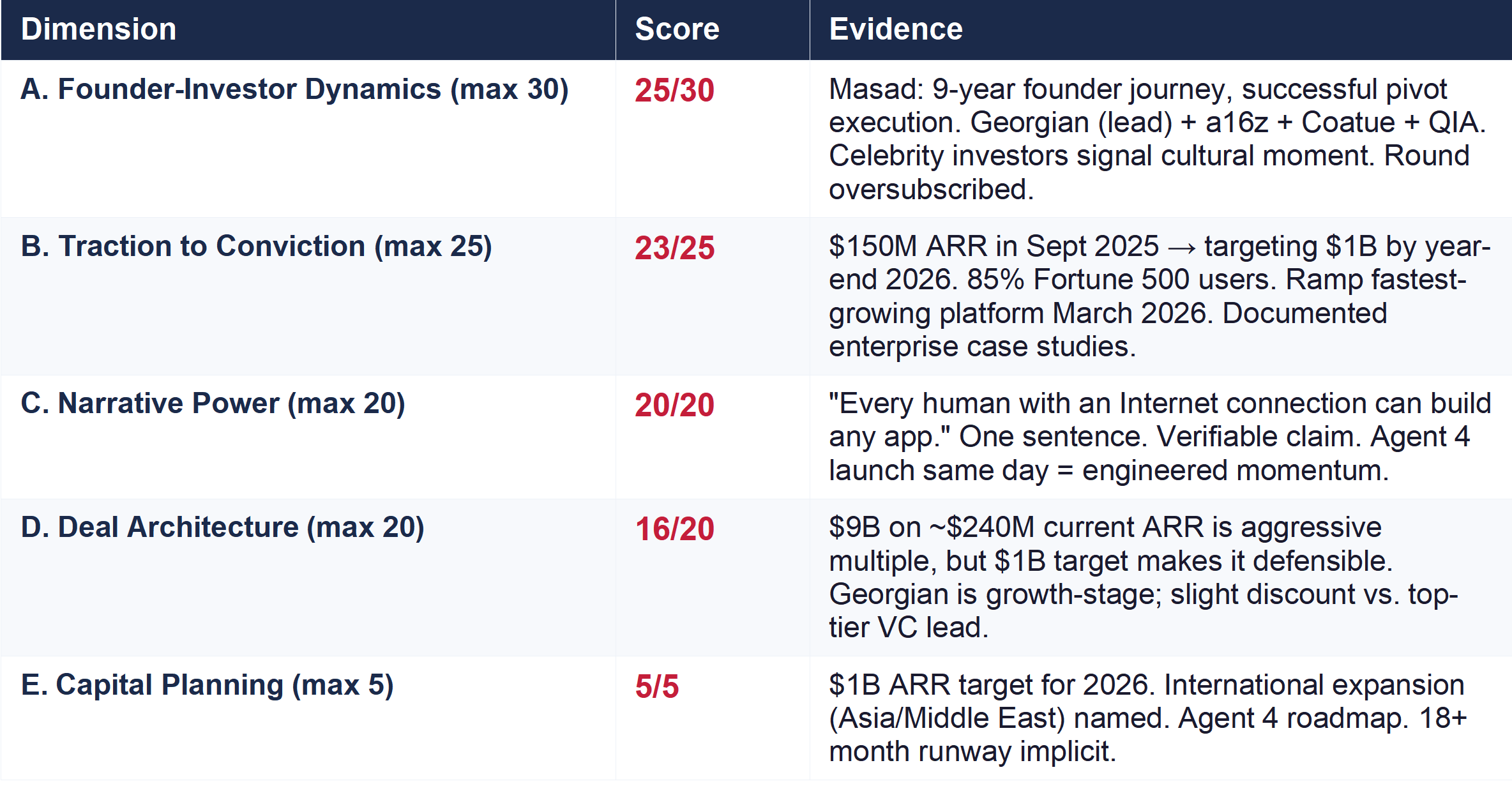
Eisen Fundability Score: 89/100
Why this scored: The highest score this week reflects a rare combination: verified enterprise traction at scale, a sovereign-plus-institutional syndicate, a one-sentence product narrative that resonates instantly with non-technical investors, and a $1B ARR target backed by documented enterprise case studies.
The Setup
Founded in 2016, CEO Amjad Masad spent nine years grinding before a controversial pivot: away from professional developers and toward non-programmers. That pivot turned out to be the entire market. With Agent 4, users start by clicking buttons to describe what they want to create: spreadsheets, data visualizations, 3D games, and the agent builds it. No code required.
The Numbers
$400M Series D (March 11, 2026) │ $9.0B post-money valuation (3x from $3B in September 2025) │ Lead: Georgian │ Co-investors: a16z, Coatue, QIA, 1789 Capital, Y Combinator, Accenture Ventures, Okta Ventures, Databricks Ventures │ 50M+ total users │ 150K paying customers │ 85% of Fortune 500 has users on platform │ Targeting $1B ARR by end of 2026 │ Agent 4 launched same day as announcement
Fundability Lessons
Lovable hit a $6.6B valuation with $400M ARR and just 146 employees. Cursor parent Anysphere crossed $2B ARR. Claude Code crossed $2.5B in annualized revenue. The economics of AI-powered software development appear to be fundamentally different: minimal headcount, near-zero marginal cost per user, and demand that compounds as more non-developers discover they can build. The investor thesis is not ‘AI coding is hot.’ It is ‘the total addressable market for software creation just expanded by 20x.’ When Zillow’s 600 non-technical employees build 7,000 internal apps on the platform, and Talkdesk replaces a 2-week engineering cycle with a 2-day Replit build, the product has crossed from tool to infrastructure.
The key lesson: traction that compounds. Every new enterprise user makes the platform more defensible, justifying premium multiples at any stage.
Your Takeaway
Identify who in your target customer’s organization cannot currently build what they need. That gap is your market. Replit’s insight was that Zillow’s 600 non-technical employees wanted to build apps but couldn’t. The 20x market expansion came from removing the engineering dependency, not from making engineers more efficient.
NEXTHOP AI
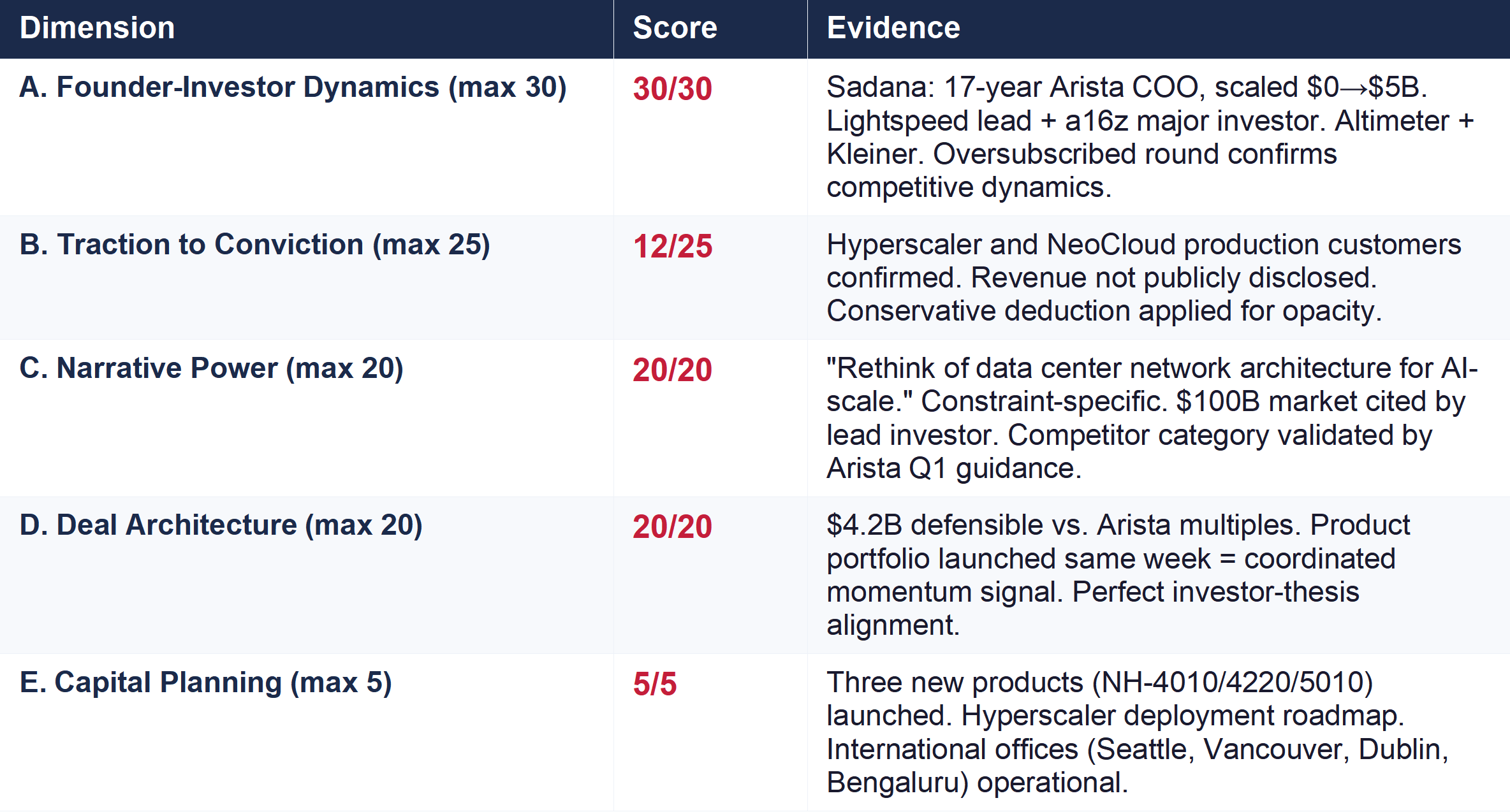
Eisen Fundability Score: 87/100
Why this scored: Production-ready AI networking hardware solving a specific physics constraint in the AI data center, backed by the most credible operational pedigree in the networking industry. Oversubscribed at a valuation that is defensible against the Arista comparable.
The Setup
Nexthop AI is led by Anshul Sadana, former COO of Arista Networks, who spent 17 years scaling the company from $0 to over $5B in sales. He left to build AI-native networking from scratch. The thesis: general-purpose data center switches were not designed for AI traffic patterns. As GPU clusters scale, the mismatch becomes a constraint rather than an inconvenience.
The Numbers
$500M Series B (March 10, 2026) │ $4.2B valuation │ Oversubscribed │ Lead: Lightspeed Venture Partners │ Co-investors: Andreessen Horowitz, Altimeter, Kleiner Perkins, all existing investors │ New products: NH-4010 (51.2 Tbps, 20% more power-efficient), NH-4220 (102.4 Tbps), NH-5010 │ Operating systems: SONiC, FBOSS │ Customers: hyperscalers and NeoClouds (named, not disclosed) │ Market TAM: $100B+ by 2031 (per Lightspeed thesis)
Fundability Lessons
Nexthop’s round follows Ayar Labs' $500M round for co-packaged optics (March 3) by exactly one week. Two consecutive weeks, $1B into the sub-compute infrastructure layer. The investment thesis has moved from ‘AI is growing’ to ‘the physical layer constraining AI scale will absorb $10B+ in 2026.’ Nexthop is not competing with Cisco. It is built for a workload that did not exist when Cisco’s products were designed. Lightspeed’s Guru Chahal stated directly that this creates one of the largest infrastructure market opportunities in a generation, with the potential to build a $100B+ company. That is not a feature thesis — it is a category-creation thesis.
The key lesson: an 11-year-old company with a 17-year operator pedigree cleared $500M because the constraint it removes is binary, copper physically fails at scale. There is no second option.
Your Takeaway
If you are in AI infrastructure, your pitch must answer ‘what breaks at 10,000 GPUs?’ Not what improves. What breaks. Nexthop answers that copper networking loses signal integrity and burns unsustainable power at that scale. That is the constraint. Name your constraint with that level of specificity.
QUINCE
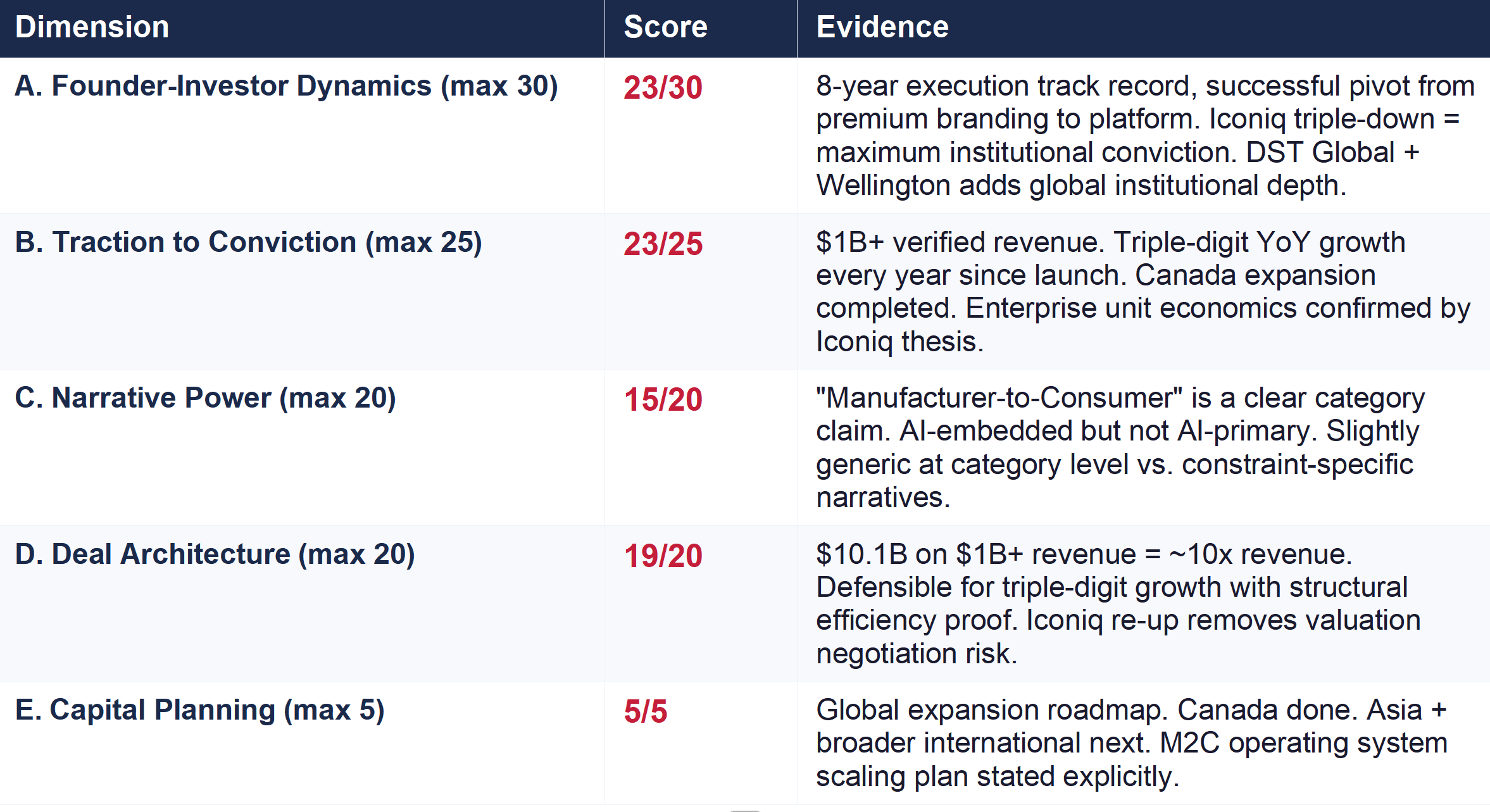
Eisen Fundability Score: 87/100
Why this scored: The only non-AI-primary company in the top 5. It earned this score purely on verified fundamentals: $1B+ revenue, triple-digit YoY growth every year, AI-embedded unit economics, and an Iconiq triple-down that signals institutional conviction at the highest level.
The Setup
Quince launched in 2020 on a simple premise: premium quality should not require traditional retail markup. Starting with cashmere and expanding to apparel, home, accessories, beauty, and wellness, the company eliminated every layer between the manufacturer and the consumer. The model: own the design, own the factory relationship, own the technology, eliminate the middlemen.
The Numbers
$500M Series E (March 11, 2026) │ $10.1B post-money valuation │ Lead: Iconiq Capital (triple-down from $200M Series D at $4.5B, early 2025 = 2.2x val in < 1 year) │ Co-investors: Basis Set Ventures, Wellington Management, DST Global, Baillie Gifford, Notable Capital │ Revenue: $1B+ (company confirmed) │ Growth: Triple-digit YoY every fiscal year since launch │ Canada expanded January 2026
Fundability Lessons
Iconiq’s Yoonkee Sull described Quince’s approach as ‘hyperefficient infrastructure that corrects structural inefficiencies that have long defined retail economics.’ That is a platform thesis, not a retail thesis. The $10.1B premium is not for revenue. It is the M2C operating system that makes the revenue compounding. Quince at $10.1B proves a principle that applies to any sector: if you can show that AI fundamentally changed your unit economics, not improved them, but changed them structurally, you can justify premium growth-equity multiples even outside software.
The lesson is that investors at the growth stage are paying for the operating system beneath the revenue, not the revenue itself.
Your Takeaway
If you are a non-AI company raising growth rounds, build a ‘structural efficiency’ page in your deck. Show what the traditional unit economics of your industry look like versus yours. The AI must show up in the margins, not just the marketing. Quince’s AI-powered demand forecasting directly reduces inventory waste and production overruns, making measurable improvements in unit economics.
MIND ROBOTICS
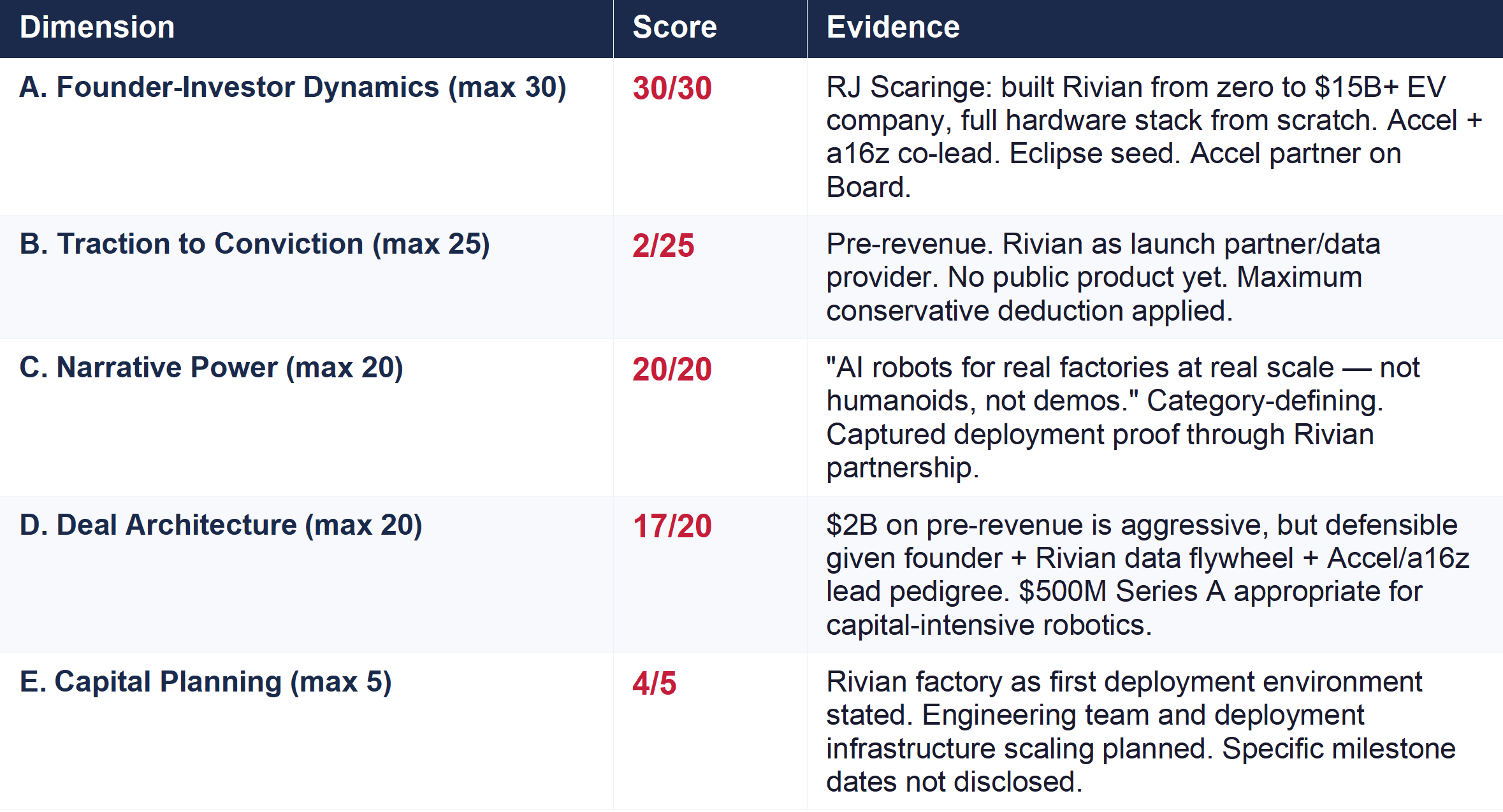
Eisen Fundability Score: 73/100
Why this scored: One of the largest Series A rounds in robotics history for a pre-revenue company was earned on the founder’s pedigree. RJ Scaringe built Rivian from zero to $15B+, captured the deployment environment (Rivian’s factory), and a proprietary data flywheel competitors cannot replicate.
The Setup
Mind Robotics was created by Rivian CEO and founder RJ Scaringe and spun out of Rivian in November 2025. The core insight: Rivian’s manufacturing floor generates ground-truth operational data at scale - the exact data needed to train AI models for dexterous, adaptable factory robotics. The company is not building general-purpose robots. It is building AI foundation models for the 40% of factory work that requires human-like reasoning.
The Numbers
$500M Series A (March 11, 2026, closing later in the month) │ $2.0B valuation │ Co-leads: Accel + Andreessen Horowitz │ Accel partner Sameer Gandhi joins Board │ Prior: $115M seed led by Eclipse Capital (late 2025) │ Total: $615M │ Rivian: major shareholder and partner │ Founder: RJ Scaringe (also Rivian CEO and Founder)
Fundability Lessons
Mind Robotics represents the ‘captured distribution’ investment thesis at its clearest: the spinout parent is also the first customer, first data source, and first proving ground. Every robot improvement at Rivian’s factory strengthens the model for every future customer. This flywheel structure is why $500M cleared at the pre-revenue stage.
The lesson is that at pre-revenue, the strongest proof you can provide is a named enterprise partner whose business operations generate the training data your product needs. That relationship converts ‘we believe this will work’ into ‘we already have the ground truth to prove it.’ It upgrades investor risk perception from speculative to structured.
Your Takeaway
The ‘captured distribution’ play is underutilized. If you are building a physical product, the most powerful fundraising accelerant is a named enterprise customer that also serves as your R&D environment. Get that relationship signed and producing operational data before your seed round. It converts pre-revenue to conviction.
THIS WEEK PLAYBOOK: 5 DAYS, 5 DELIVERABLES
This week’s data gave you 5 shifts. Here is how to translate them into actions that make a difference.
1. Physical AI Audit: Do You Own A Data Flywheel?
Why this matters: Mind Robotics raised $500M pre-revenue because Rivian’s factory generates ground-truth operational data that no competitor can replicate. Every company that operates physical processes has a version of this asset.
Deliverable: Map every operational data stream your company generates. For each stream: (1) Is it proprietary? (2) Could it train an AI model? (3) Does any competitor have access to similar data at scale? Two “yes” answers = a data flywheel thesis. Write a one-paragraph description of your data flywheel this week. This becomes your defensibility narrative.
Expected outcome: A data-flywheel statement that converts your operations into an investable thesis.
Wrong: “We use AI to improve our product.”
Right: “We operate in an environment that generates proprietary operational data that creates an AI training advantage competitors cannot replicate.”
2. Constraint Mapping: What Breaks Without You?
Why this matters: Nexthop AI raised $500M by naming a specific physics constraint. Replit raised $400M by naming the constraint that locks software creation to 5% of the workforce.
Deliverable: Write this sentence: “[Your customer] cannot [scale/function/comply] beyond [specific threshold] without solving [specific constraint]. We solve [constraint] by [mechanism].” Test it on two founders outside your sector. If they immediately understand the constraint, you have it.
Expected outcome: A constraint-specific one-liner that replaces your current company description.
3. Proof Stack Build: Calculate Your Eisen Fundability Score
Why this matters: Replit scored 89/100 and Nexthop scored 87/100 this week. Both scores reflect specific, verifiable evidence across all five Eisen dimensions. Most founders score 55–70 on honest self-assessment. The gap between where you are and where funded companies are is your fundraising obstacle list.
Deliverable: Score yourself on the 5 Eisen dimensions (max 100). If a metric is not publicly verifiable, do not assume it is strong. Find your 2 lowest scores. For each, write one concrete action that moves it 5+ points in the next 30 days.
Expected outcome: A clear picture of why your raise is not closing faster, and a specific 30-day sprint plan.
Eisen Fundability Score Breakdown:
• Founder-Investor Dynamics (30 pts): Track record + investor quality + round competition signal
• Traction-Conviction (25 pts): Growth trajectory + business model validation + market proof
• Narrative Power (20 pts): Category position + story clarity + tailwinds
• Deal Architecture (20 pts): Valuation reasonableness + investor alignment + round construction
• Capital Planning (5 pts): Runway + milestone clarity
85+: Launch your round now. Momentum is on your side; delay costs you.
70–84: One more traction milestone before launching. Identify the lowest-hanging fruit that moves your Traction-Conviction score by 5+ points.
Below 70: Don’t launch a broad process. Run a quiet round with 3–5 strategic investors whose portfolios align with your customers. Build to 70+ before going wide.
4. Syndicate Architecture: Who Is Your Strategic Anchor?
Why this matters: Lightspeed + a16z in Nexthop. Rivian in Mind Robotics. Iconiq triple-down in Quince. QIA in Replit. The lead investor or strategic co-investor already had a relationship before the round. This is not cold outreach. Strategic anchors who depend on your product working are your most powerful conviction signal.
Deliverable: Identify 3 potential strategic anchor investors or partners whose business model is constrained by the problem you solve. For each: (1) Name the specific way their business benefits from your product working. (2) Identify the internal champion. (3) Draft a one-sentence thesis-fit statement. This is your warm outreach starting point.
Expected outcome: 3 strategic co-investor targets who convert your round from financial-only to conviction-validated.
5. Momentum Design: Build Your Agent 4 Moments
Why this matters: Replit announced its $400M raise and launched Agent 4 on the same day. Sierra Space announced its new CEO and closed $550M the same week. These are not accidents. Momentum is designed, not discovered. Co-announcing product milestones with fundraising creates a reinforcing signal that is very difficult to manufacture artificially.
Deliverable: Identify your ‘Agent 4 moment’ — the product, customer, or regulatory milestone you can announce simultaneously with your round or closing. Write a 14-day follow-up sequence: Day 1 (meeting debrief), Day 3 (proof point), Day 7 (milestone update), Day 14 (deadline or urgency signal). Every touchpoint is tied to a concrete event.
Expected outcome: A structured momentum sequence that keeps investors engaged and creates natural urgency without manufactured pressure.
LOOKING FORWARD: NEXT 1–3 WEEKS
Scenario 1: Physical AI / Robotics Capital Surge Continues (HIGH PROBABILITY)
Evidence: Three robotics deals in one week ($1.115B). Figure AI’s Amazon commercial deployment confirmed Q1 2026. SkildAI’s $1.4B round in January and Mind Robotics $500M in March signal a monthly cadence of $500M+ robotics rounds. The robotics sector is projected to reach $20B+ in total funding in 2026.
What to watch: Figure AI’s next commercial customer announcement. Mind Robotics’ first public product reveal. NVidia GTC 2026 robotics/physical AI announcements.
What founders should do: If you build in logistics, manufacturing, or any labor-intensive operation, document your operational data inventory before your next investor meeting. That data is now an investment thesis.
Scenario 2: AI Networking Becomes the Largest Infrastructure Sub-Category of Q2 2026 (HIGH PROBABILITY)
Evidence: Ayar Labs ($500M CPO, March 3) + Nexthop AI ($500M switches, March 10) + Eridu ($200M switches, March 10) + Nscale ($2B data centers, March 9) = $3.2B into AI infrastructure in 10 days. Hyperscalers projected to spend $650B on AI infrastructure in 2026. That capital creates procurement demand for every layer of the stack.
What to watch: Nvidia GTC announcements on networking architecture. Broadcom Q1 2026 AI revenue guidance (already up 106% YoY as of last quarter). CoreWeave IPO pricing as a public market appetite signal.
What founders should do: If you solve any constraint in the AI data center stack — power, cooling, networking, storage, memory bandwidth — position your company as a constraint-removal play immediately. The window is open.
Scenario 3: ‘Vibe Coding’ Consolidation Creates M&A Pressure (MEDIUM PROBABILITY)
Evidence: Claude Code at $2.5B annualized revenue. Cursor at $2B ARR. Replit targeting $1B ARR by year-end. Lovable at $400M ARR with 146 employees. GitHub Copilot with 20M+ professional users. Five well-capitalized competitors in one category is consolidation math — within 12 months, 2–3 of these companies will be acquired or face existential revenue pressure.
What to watch: Microsoft’s GitHub Copilot enterprise bundling strategy. Any OpenAI Codex enterprise pricing changes. Acquisition rumors involving Cursor or Lovable.
What founders should do: If you are in AI developer tools or productivity software, build your strategic acquirer list now. Identify the 3 companies for whom acquiring you creates the most enterprise value, and start those conversations while your leverage is high.
Wild Card: Three Mega-Funds Simultaneously Deployed Means Q2 Acceleration (MEDIUM PROBABILITY)
Founders Fund is reportedly close to closing a new $6B fund (reported March 10, 2026). General Catalyst is in talks to raise a $10B fund. Andreessen Horowitz closed a $15B fund in January 2026. Three of the five most active funds in this week’s deals are simultaneously sitting on record dry powder. When top-tier funds are fully capitalized, deal pace accelerates.
What founders should do: If you have been waiting for the ‘right time’ to raise, Q2 2026 may be the highest-conviction deployment window since Q1 2025. Move your fundraising timeline forward by one quarter if your proof stack is ready.
THE BOTTOM LINE
The real insight from this week is not that robotics or AI networking is hot. The real insight is that capital is rewarding two distinct profiles with premium multiples, and nothing in between.
Profile 1: Constraint-removal infrastructure at production scale. Nexthop AI ($500M, $4.2B) removes a physics constraint. Nscale ($2B, $14.6B) removes a compute scarcity constraint. Mind Robotics ($500M, $2B) removes a manufacturing dexterity constraint. Each company owns a specific, named constraint in a scaling system.
Profile 2: Traction-proof platforms with compounding unit economics. Replit ($400M, $9B): 3x valuation in 6 months on enterprise adoption. Quince ($500M, $10.1B): $1B+ revenue, triple-digit growth every year, Iconiq triple-down. Both companies have proof that compounds.
Everything else is competing for the remaining 10% of conviction capital.
5 New Rules for Founders (Evidence-Based)
Rule 1: Constraint language converts. Feature language bores. Nexthop does not “improve networking performance.” It removes the constraint that prevents AI clusters from scaling beyond 10K GPUs. Reframe your product around what stops without you.
Rule 2: Captured distribution is the most fundable proof point at the pre-revenue stage. Mind Robotics raised $500M pre-revenue because Rivian’s factory is the test environment and data source. Find your version of “Rivian” before your seed round.
Rule 3: Platform lock-in at $10B requires structural efficiency proof, not AI positioning. Quince earned $10.1B not by calling itself an AI company — but by showing that AI fundamentally changed its unit economics. If AI does not appear in your margins, it will not appear in your valuation.
Rule 4: a16z’s four-bet week is a targeting signal. Full-stack, vertically integrated, constraint-solving platforms led by founders who have scaled hardware or complex systems. That is the thesis. Match it or target a different firm.
Rule 5: The non-developer software market is worth more than the developer tools market. Replit’s $9B valuation at a $1B ARR target makes it the most expensive developer productivity tool. If your product requires a developer to deploy, your TAM is 5% of your potential market.
Research Methodology
● Data collection period: March 9–15, 2026 (Crunchbase March 7–13 coverage window, full overlap with report scope)
● Verification standard: minimum 2 independent sources per featured deal; official press releases prioritized
● Eisen Fundability Scores are proprietary analytical estimates, not endorsements or investment advice
● All dollar amounts reflect announced figures at close
● Research completion timestamp: March 15, 2026
● Total deals analyzed: 11 (U.S., verified). Global context: Nscale (UK) included separately.
● Total excluded: 0 (all included deals met dual-source verification standard)