

Playbook, Perspective, and Pattern for Founders Raising Now
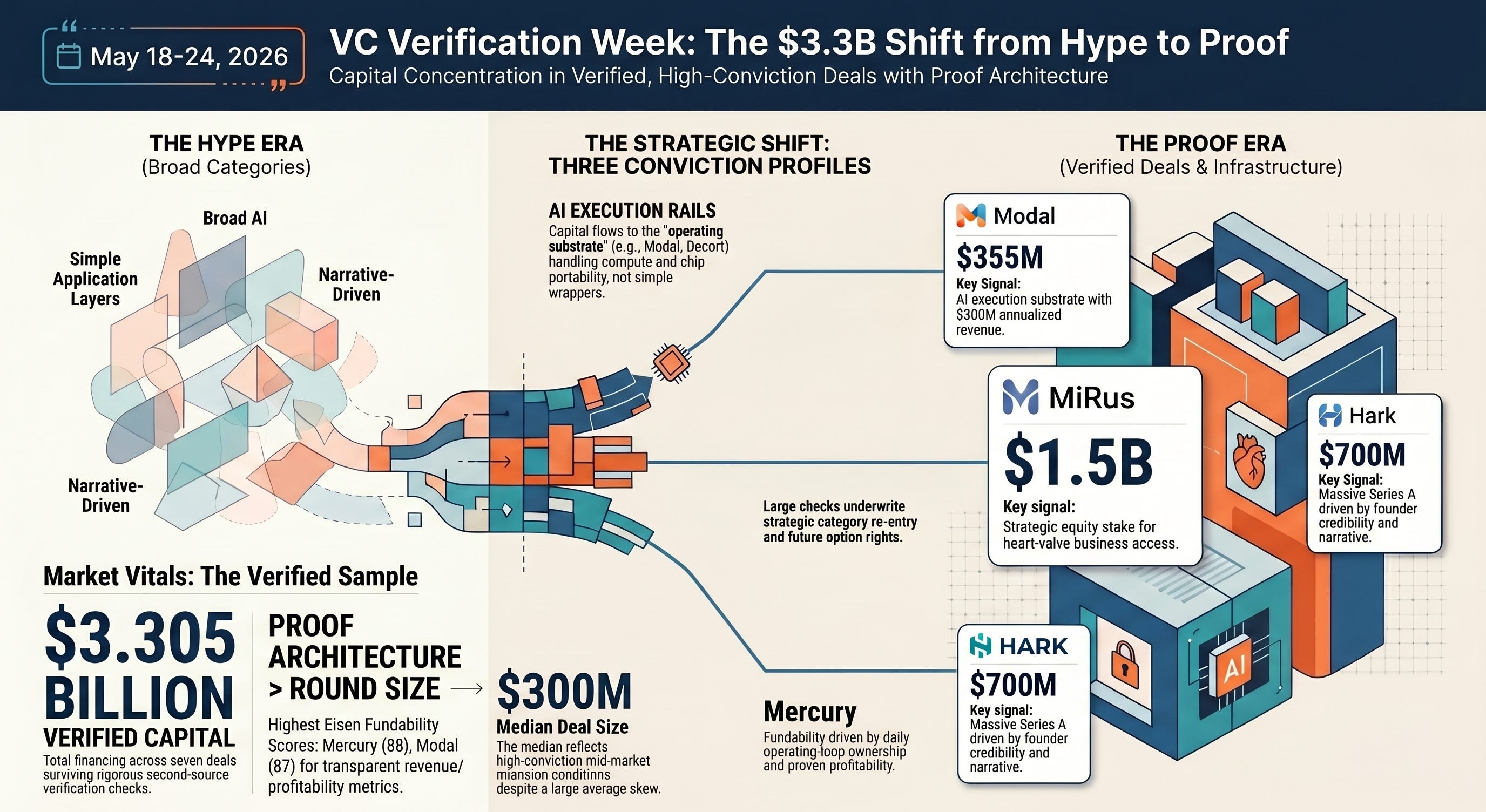
The week of May 18-24, 2026, was not a broad venture reopening. It was a verification week. The founder consequence is direct. Investors are not rewarding category language. They are rewarding proof of architecture. The round has to show the bottleneck, the proof, the capital fit, and the next underwriting milestone before the investor builds that story for you.
The long-form playbook remains, because the market signal is still strong: weak proof is now more dangerous than a smaller market story.
Primary insight: Capital concentrated in companies that made investor risk controllable: Modal and Decart in AI execution infrastructure, MiRus through strategic control rights, and Mercury through workflow distribution plus profitability.
· Total tracked disclosed financing: $3.305 billion across seven public financings kept after the verification gate.
· High-confidence financing total: $3.055 billion across five financings, anchored by Reuters, Business Insider, Wall Street Journal, and Axios support.
· Medium-confidence financing kept with explicit caveat: $0.250 billion across Farther and Primer.
· Average deal size: $472.1 million; excluding MiRus, average deal size falls to $300.8 million.
· Median deal size: $300 million.
· Median disclosed valuation: approximately $4.925 billion across Hark, Modal, Decart, and Mercury.
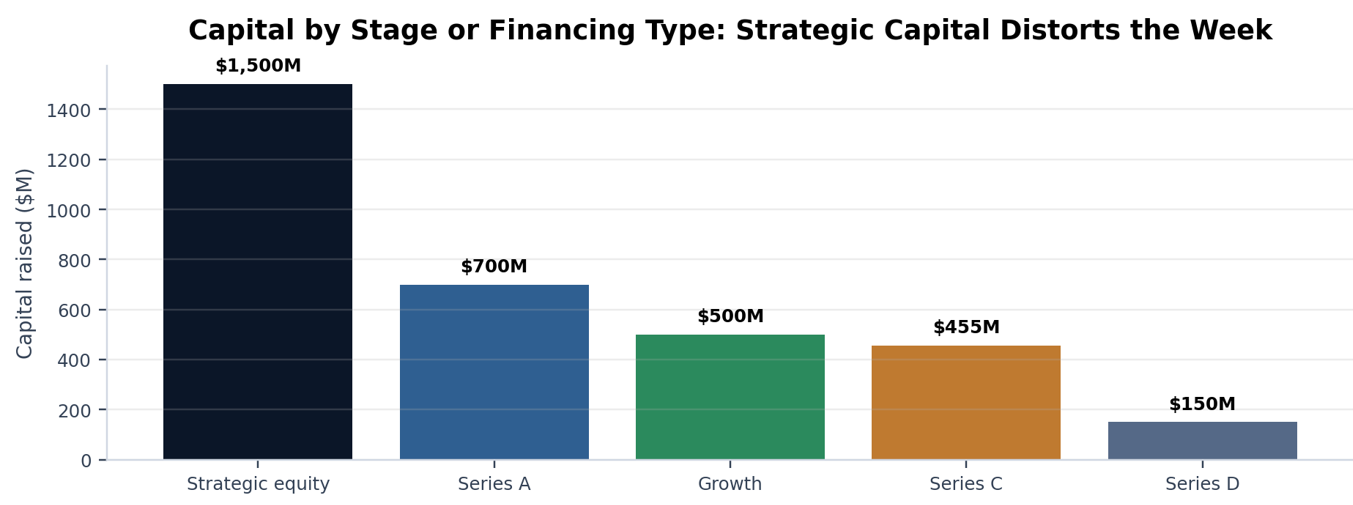
· Largest disclosed financing: MiRus, a $1.5B strategic minority investment from Boston Scientific for an approximate 34% stake and an option path tied to the heart-valve business.
· Largest conventional venture round: Hark, a $700M Series A at a $6B valuation.
· Cleanest operating-proof round: Mercury, $200M at a $5.2B valuation with four consecutive years of profitability, $650M annualized revenue, and more than 300,000 customers.
· Median Eisen Fundability Score across the corrected sample: 77. The score is strong enough to show market appetite, but not broad enough to call this a risk-on week.
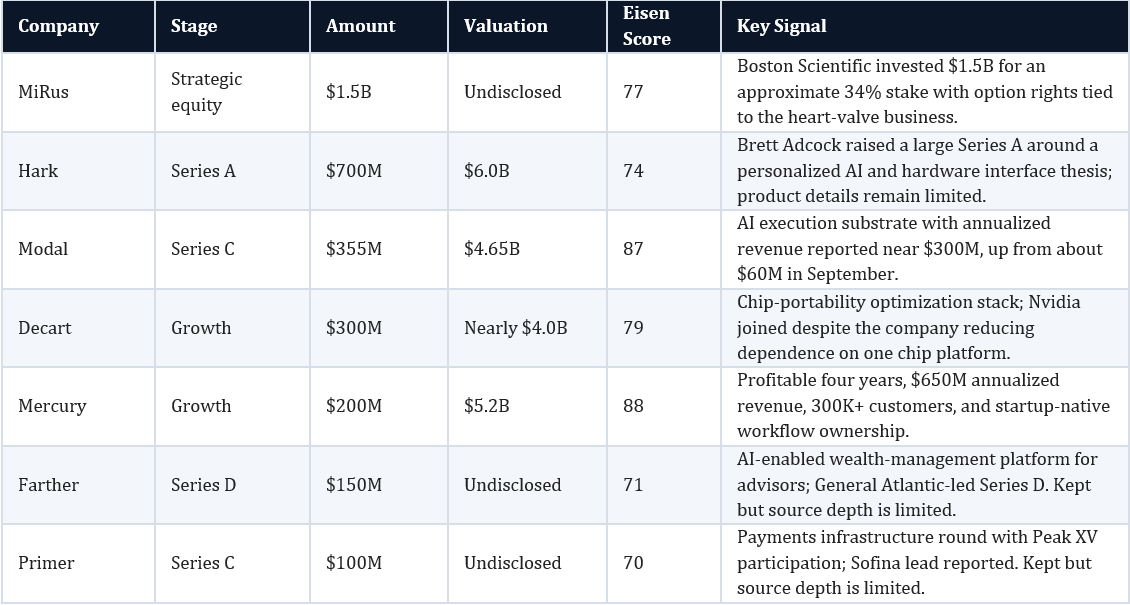
DEAL SCORECARD
Eisen Fundability Scores are calculated across five dimensions: Founder-Investor Dynamics (30%), Traction-to-Conviction Conversion (25%), Narrative Power (20%), Deal Architecture (20%), and Capital Planning (5%). Scores 90-100 are considered inevitable. Missing public metrics are penalized. Strong investors do not erase weak public proof. Strategic importance does not become revenue unless the source says it is revenue.
What the scorecard says at a glance
Mercury (88) and Modal (87) now lead the corrected scorecard. That matters. The highest scores did not go to the largest checks. They went to companies where public proof reduces investor uncertainty. Mercury had profitability, revenue scale, and customer volume. Modal had revenue acceleration, compute scarcity, and production-AI infrastructure gravity.
Decart (79) remains a strong market signal, but the score is capped by the missing revenue disclosure. Its fundability comes from a precise bottleneck: AI companies need the flexibility to run workloads across scarce processor environments. NVIDIA joining the round despite that chip-portability logic makes the strategic signal stronger, not weaker.
MiRus (77) remains one of the week’s most important transactions because it shows how strategic capital can compress valuation debate. Boston Scientific did not simply write a financial check. It bought a strategic option into a category it wants to re-enter. The score is capped because a standalone valuation and operating metrics are not public.
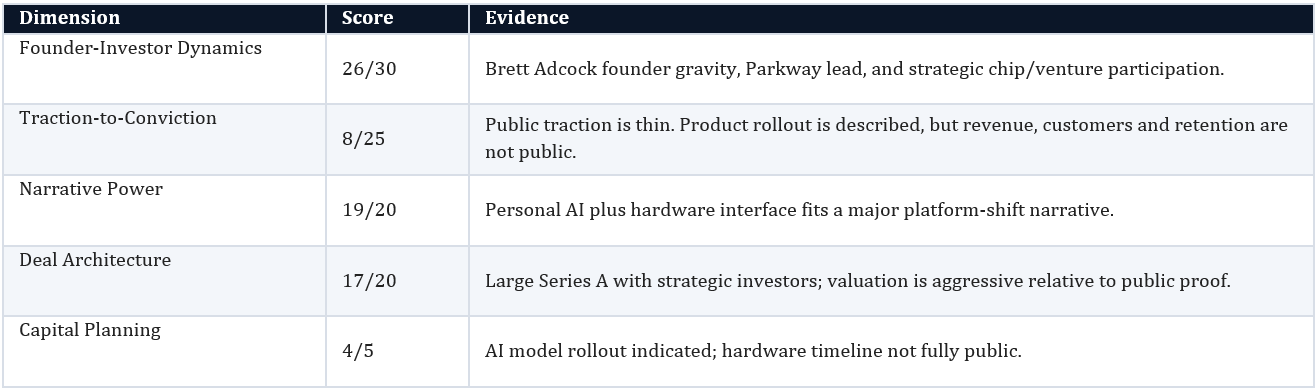
Hark (74) is the founder-gravity outlier. A $700M Series A at a $6B valuation is a massive signal, but the score stays conservative because revenue, customers, retention, and hardware timing are not public. The lesson is not that every pre-product AI hardware company can raise at this level. The lesson is that founder credibility plus a strategic syndicate can temporarily substitute for public traction, but only for a rare subset of founders.
Farther (71) and Primer (70) stay in the sample as medium-confidence workflow-fintech signals. They support the pattern, not the headline. In the corrected report, neither is allowed to draw a conclusion larger than the source depth supports.
WHAT CHANGED THIS WEEK: 5 MARKET SHIFTS
Each shift below is ranked by structural impact on founder fundraising, not by deal size alone. The report deliberately avoids unsupported category inflation. The question is not “what sounded exciting this week?” The question is “what can a founder safely learn from the data that survived?”
SHIFT 1: AI EXECUTION RAILS BEAT AI WRAPPERS
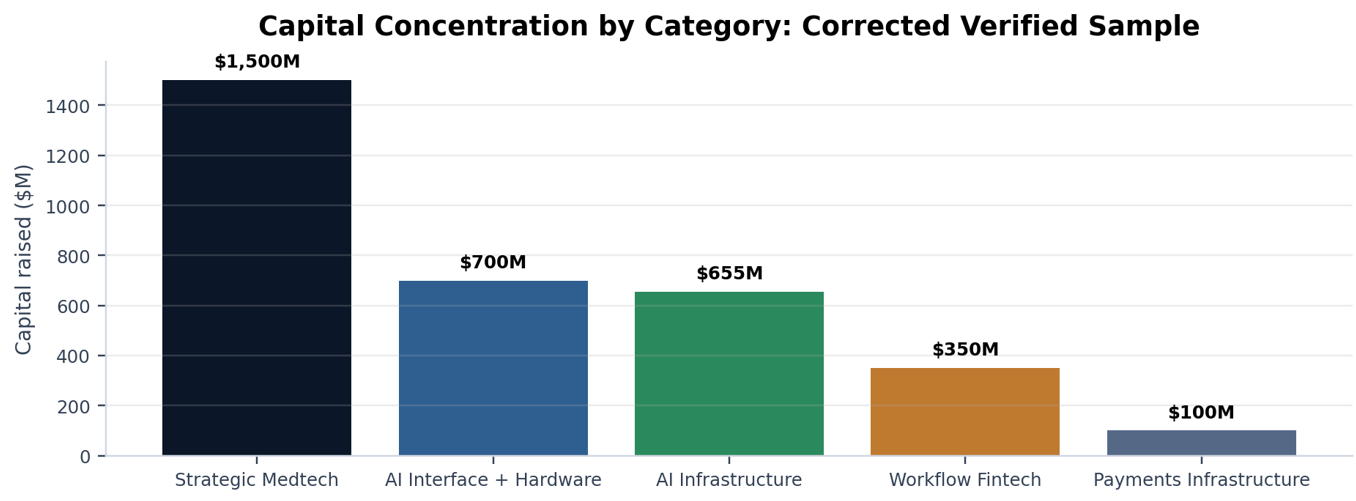
Pattern: Modal raised $355M at a $4.65B valuation with annualized revenue reported near $300M, up from roughly $60M in September. Decart raised $300M at nearly $4B with NVIDIA joining as an investor, and Amazon was described as a major customer. Together, those two verified AI infrastructure financings represent $655M of corrected capital.
Perspective: Investors are not paying premium multiples for another AI output layer. They are paying for execution rails: compute access, sandboxing, portability, optimization, and the ability to move AI-generated work into production. Modal sits in the execution environment. Decart sits in the chip-switching and optimization constraint. Both are closer to the operating substrate than to the application wrapper.
Founder Blindspot: Founders still write “AI-native” on the first slide and expect that to create urgency. That phrase now does almost nothing. The investor question has changed: what breaks when customers put AI into production, and why are you the company that owns that breakage point?
Playbook: Rewrite the first slide of your deck into a bottleneck claim. Use this structure: “AI adoption in your specific workflow fails at your specific operational constraint. We own your scarce capability that makes deployment reliable, cheaper, or faster.” Then attach one usage metric that proves the constraint is intensifying.
Contrast: In 2023 and 2024, “we use AI” was often enough to open a conversation. In 2026, the premium language is “AI cannot scale without this layer.” The market moved from model excitement to production dependency.
What this means for your raise next week: If your AI company cannot prove infrastructure gravity, investors will compare you to a cheaper wrapper before they compare you to Modal or Decart.
SHIFT 2: STRATEGIC CAPITAL BECAME DEAL ARCHITECTURE
Pattern: Boston Scientific invested $1.5B in MiRus for an approximate 34% stake and potential rights tied to the heart-valve business. In the same week, policy capital moved around quantum and strategic technology through the EUR 5B Scaleup Europe Fund, France’s quantum and microelectronics commitments, and the U.S. quantum investment plan. These are not identical instruments, but they point in the same direction: capital is now underwriting strategic control, not only growth.
Perspective: Strategic capital changes the round by changing the risk buyer. A corporate investor can price distribution access, regulatory learning, category re-entry, and future option value differently from a financial VC. A policy-backed pool can price sovereignty and industrial capacity differently from a growth fund. That is why founders in regulated or strategic categories must design the capital stack, not just collect investor logos.
Founder Blindspot: Founders call strategic money “validation” and stop there. That is dangerous. A strategic check can accelerate the company, but it can also pre-wire future control, limit exit competition, or make later investors worry that the best buyer already has special rights.
Playbook: Build a one-page strategic capital memo before accepting any corporate or sovereign-aligned investor. List what the investor wants to control, what it can accelerate, what rights it may request, which future bidders may hesitate, and how the structure affects your next financing.
Contrast: Strategic capital used to look like a helpful endorsement after the VC round. This week, it became the financing architecture itself.
What this means for your raise next week: If your category touches healthcare, chips, quantum, energy, defense-adjacent technology, or regulated infrastructure, your cap table is now part of your pitch.
SHIFT 3: WORKFLOW DISTRIBUTION STILL CLEARS IN FINTECH
Pattern: Mercury raised $200M at a $5.2B valuation while disclosing $650M annualized revenue, more than 300,000 customers, and four consecutive years of profitability. Farther raised a reported $150M Series D led by General Atlantic. Primer raised a reported $100M round with Peak XV participation. The corrected fintech/workflow cluster represents $450M, but Mercury is the strongest proof point.
Perspective: This does not mean fintech is broadly easy again. It means workflow-native fintech remains fundable. Mercury is not being valued as a better bank interface. It is being valued as startup financial infrastructure: bank accounts, payments, cash management, and eventually a broader operating layer for company formation and financial control.
Founder Blindspot: Fintech founders still lead with market size, pain, and product convenience. Investors care more about where the product sits in the customer’s operating loop. A product used daily and that stores operational memory has a different fundability profile from a product that merely reduces friction.
Playbook: Create a workflow-dependency slide. Show the daily or weekly loop, the data you capture, the decisions the customer makes within your product, the natural expansion products that emerge, and the operational pain that arises if the product disappears.
Contrast: The last fintech cycle rewarded new access and acquisition velocity. The current cycle rewards dependency, profitability, embedded distribution, and evidence that the customer’s workflow would be damaged by churn.
What this means for your raise next week: If you are a fintech founder, stop pitching “large market plus better UX.” Pitch the operating loop you own and the proof that customers would suffer without it.
SHIFT 4: PUBLIC PROOF OUTRANKED ROUND SIZE
Pattern: Hark raised the largest conventional venture round in the corrected sample: $700M at a $6B valuation. But Mercury and Modal scored higher because their public proof is stronger. Mercury disclosed revenue, profitability, and customer volume. Modal disclosed revenue acceleration and infrastructure demand. Hark disclosed founder credibility, strategic investors, and a product direction, but not revenue, customers, or retention.
Perspective: This is the key fundability distinction founders miss. A big round is not automatically the best model to copy. In a public market-intelligence report, the most instructive company is often the one where the evidence architecture is visible. Investors may have seen Hark’s internal proof. The public founder cannot copy what is not visible.
Founder Blindspot: Founders confuse investor confidence with public replicability. The fact that one extraordinary founder can raise before the market sees traction does not mean the pattern is broadly fundable. For most founders, missing proof creates delay, not FOMO.
Playbook: Before your next investor call, separate your narrative into two pages: the belief page and the proof page. The belief page explains the future. The proof page explains why the future is already becoming visible. If the proof page is weak, do not make the belief page louder. Make the proof stronger.
Contrast: In the easy-money cycle, the size of the round itself often became a credibility signal. In the corrected 2026 read, public proof quality is the stronger lesson from the founder.
What this means for your raise next week: Do not copy the largest raise. Copy the most repeatable proof architecture.
SHIFT 5: SCARCITY ASSETS REFRAMED THE EXIT CONVERSATION
Pattern: SpaceX IPO coverage during the week pushed founders and investors back into scarcity-asset thinking. Axios analyzed an extraordinary IPO TAM framing, while other market commentary discussed the impact of a possible mega-listing on index demand and investor appetite. This report treats SpaceX as a structural exit-window signal only, not as venture capital raised.
Perspective: The exit window does not reopen equally for everyone. A mega-scarcity asset can improve sentiment for the rare company that looks irreplaceable while making ordinary companies look more ordinary. Late-stage investors become more willing to discuss IPO paths but also more demanding of the financial and strategic profile required to merit that path.
Founder Blindspot: Founders hear “IPO window” and assume valuation pressure relaxes. The better question is whether the company has scarcity, scale, governance readiness, revenue quality, and a credible public comp set. Without those, the IPO narrative can make the company look less prepared, not more.
Playbook: If you are Series B or later, add a short exit-readiness paragraph to the investor memo. Do not promise an IPO. Explain the likely exit path, the milestone sequence, the public comp set, and the evidence that would make the path credible within 18 to 36 months.
Contrast: The 2022 to 2024 posture was delayed and survival. The 2026 posture is selective reopening for companies that can look scarce, strategic, and financially viable.
What this means for your raise next week: Do not say “the IPO window is open.” Say why your company could qualify for it and what evidence will make that true.
THE DEALS THAT MATTER: TOP 5
These five deep dives are selected for their founder-learning value, not solely for deal size. Mercury and Modal show the cleanest operating proof. Decart shows bottleneck ownership. MiRus shows strategic control architecture. Hark shows founder-gravity financing with a warning label.
MERCURY
Fintech / Business Banking Infrastructure | Growth | $200M | $5.2B
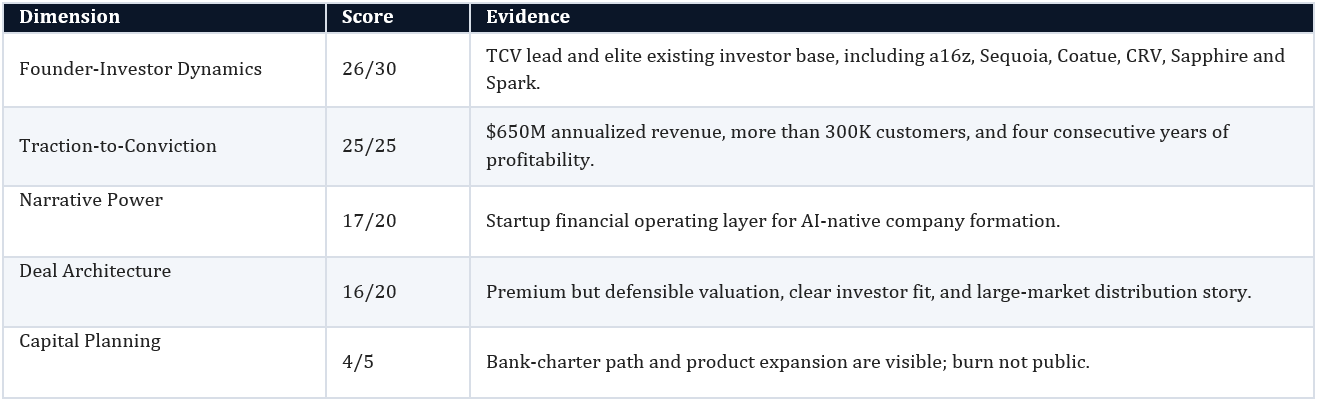
EISEN FUNDABILITY SCORE: 88 / 100
Why this scored: Mercury has the rare late-stage combination investors trust: profitability, scale, workflow ownership, and a customer base that expands with AI startup formation. The score is high because the company made the risk easy to underwrite.
The Setup: Mercury started as a banking startup, but the fundability case is broader. It sits inside a founder’s financial operating system: cash, payments, treasury, vendor flows, cards, and company formation velocity. The customer does not use Mercury as a one-time tool. The customer lives inside the workflow.
The Numbers: Mercury raised $200M at a $5.2B valuation. TCV led. Existing investors, including Andreessen Horowitz, Sequoia, Coatue, CRV, Sapphire Ventures, and Spark, participated. The company reported $650M in annualized revenue, more than 300,000 customers, and four consecutive years of profitability. Reuters also reported that the OCC granted conditional approval to Mercury Bank.
Fundability Lessons: Three deliberate choices created fundability: visible profitability, a large enough customer base to reduce concentration risk, and a product surface that expands into adjacent financial workflows. The lesson to be repeated is not the category. It is the proof architecture.
The Pattern: Workflow-native fintech can still command premium valuations. Generic fintech cannot. Mercury is the exception that proves the market is not closed; it is selective.
The Perspective: The investor logic is not “fintech is back.” The investor logic is that Mercury owns a high-frequency operating layer for startups and can compound alongside the next wave of AI company formation. Workflow ownership becomes distribution leverage.
The Playbook: Build a workflow ownership slide. Show the customer’s weekly operating loop, the data you capture, the expansion products that become natural, and the switching cost created by usage history. Put the dependency before the TAM.
The Founder Mistake to Avoid: Do not pitch “we are a better fintech product.” Pitch: “We own the financial workflow where the customer already makes decisions.”
MODAL
AI Infrastructure / Cloud Compute Execution | Series C | $355M | $4.65B
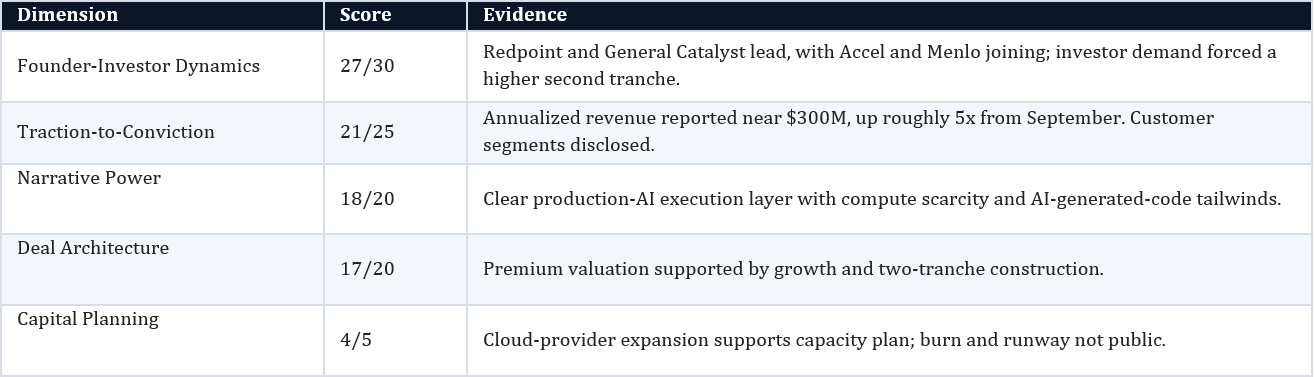
EISEN FUNDABILITY SCORE: 87 / 100
Why this scored: Modal converted the AI infrastructure story into operating proof. Revenue acceleration, compute scarcity, and production-AI demand make the round easier to explain inside an investment committee.
The Setup: Modal provides developers with the infrastructure to run AI-, data-, and compute-heavy workloads. As AI-generated code moves from demo to deployment, the bottleneck shifts from writing code to safely executing, testing, scaling, and paying for the right compute layer.
The Numbers: Modal raised $355M in a Series C at a $4.65B valuation. Redpoint Ventures and General Catalyst led, with Accel and Menlo Ventures joining. Reuters reported that annualized revenue rose from about $60M in September to about $300M. The company also expanded its cloud-provider partnerships from five to thirteen.
Fundability Lessons: Modal’s fundability lesson is that a revenue acceleration chart can turn an abstract infrastructure thesis into an investment-committee argument. The market can believe the future because the present is already moving.
The Pattern: Production AI needs an execution substrate. Modal is not selling AI magic. It is selling the environment where AI-generated and compute-heavy work actually runs.
The Perspective: Infrastructure gets paid when customer usage increases with deployment intensity. If AI usage expands, Modal has a logical claim on more workload. That is why the valuation can be defended with a clearer story than a generic AI application.
The Playbook: Show the workflow that breaks without your product. Then show the metric proving customers use more of you as they deploy more AI. If usage does not compound with customer AI adoption, your infrastructure label is weak.
The Founder Mistake to Avoid: Do not borrow the label “AI infrastructure” without proving dependency. Investors do not fund labels. They fund control points.
DECART
AI Infrastructure / Chip Portability + World Models | Growth | $300M | Nearly $4B
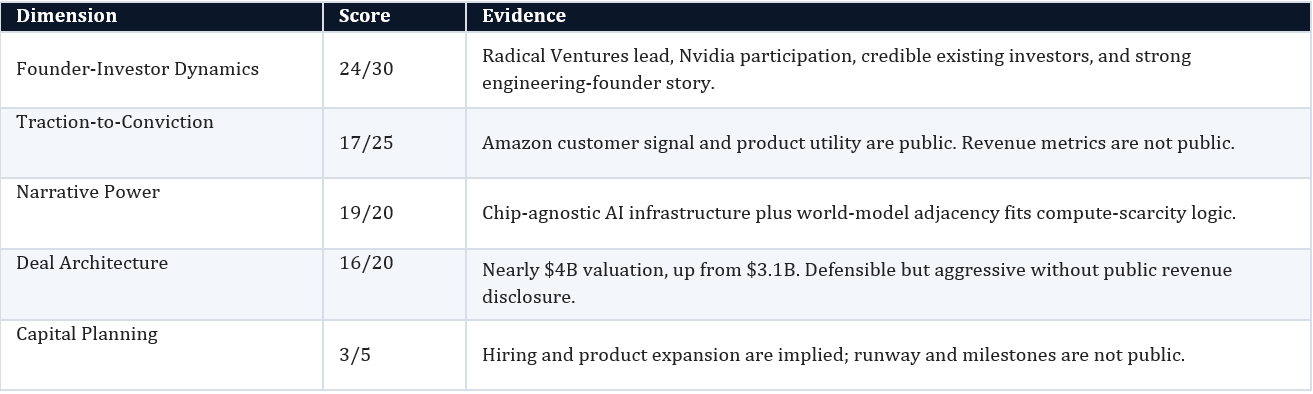
EISEN FUNDABILITY SCORE: 79 / 100
Why this scored: Decart scored high because it owns a specific AI infrastructure bottleneck: reducing friction when companies move workloads across scarce chip platforms. The score is capped by limited public revenue data.
The Setup: AI companies need compute wherever they can get it. Decart’s optimization stack helps developers move workloads across Nvidia, Amazon, Google, and other processor environments. That puts the company near a real constraint: compute scarcity and platform lock-in.
The Numbers: Decart raised $300M in a round led by Radical Ventures at nearly $4B. The Wall Street Journal reported that Nvidia joined as a new investor and that Amazon is both a major customer and a chip-supplier relationship. The same report described Decart’s prior valuation at $3.1B in August.
Fundability Lessons: The strongest fundability move is to translate technical portability into business leverage. If a CFO cannot understand the strategic value of the switching layer, the story is still too technical.
The Pattern: Investors are paying for portability because compute scarcity makes lock-in expensive. A company that lowers chip-switching cost is not a nice-to-have. It becomes an arbitrage layer across the AI supply chain.
The Perspective: Decart’s round is not mainly a model story. It is an infrastructure risk-reduction story. The company helps buyers reduce their dependence on a single processor environment. Strategic investors understand that immediately.
The Playbook: If you reduce dependency on a single vendor, chip, cloud, data source, or model provider, make that the headline. Quantify the risk you remove: dollars saved, time saved, failure risk reduced, and procurement flexibility gained.
The Founder Mistake to Avoid: Do not pitch optionality as abstract flexibility. Tie it to a buyer’s budget risk, compute risk, or strategic concentration risk.
MIRUS
Medtech / Structural Heart | Strategic Minority Investment | $1.5B | Undisclosed
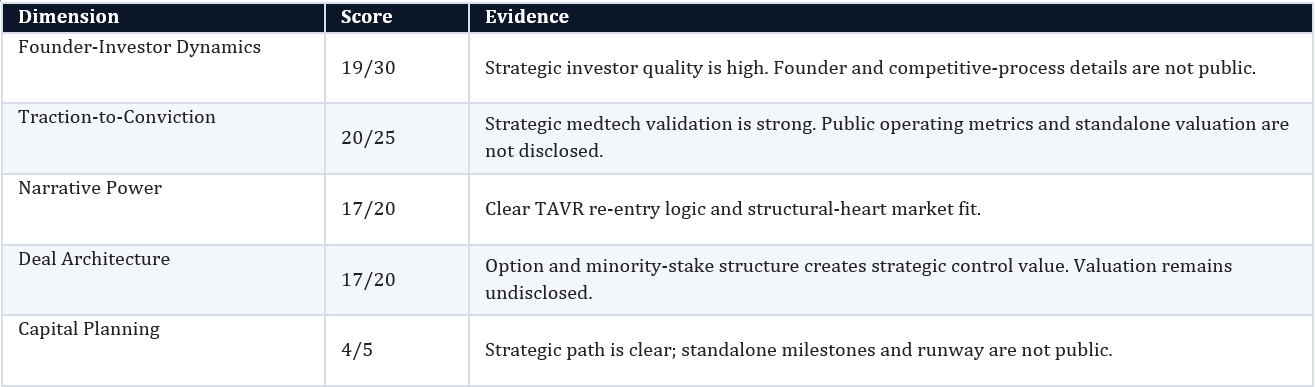
EISEN FUNDABILITY SCORE: 77 / 100
Why this scored: MiRus matters because strategic capital created fundability without a conventional public valuation. The score is limited by opacity, but the control-rights structure is one of the week’s strongest lessons.
The Setup: Boston Scientific had exited the balloon-expandable TAVR market and used the MiRus transaction as a path back into the category. That makes the investment less about generic growth capital and more about strategic access, portfolio repair, and future option value.
The Numbers: Boston Scientific invested $1.5B for an approximate 34% equity stake in MiRus and potential rights tied to the heart-valve business. The company is privately held, so this report does not infer a standalone valuation. Reuters positioned the move as a re-entry path into the TAVR market.
Fundability Lessons: The replicable lesson is not “rise from a corporation.” The lesson is to design the financing around the specific risk that the corporation can uniquely underwrite.
The Pattern: In regulated medtech, strategic control can become the round. The investor is not only buying upside. It is buying a future right, category access, and a way to de-risk a portfolio gap.
The Perspective: A strategic investor can price regulatory, clinical, and distribution risk differently from a VC because it can convert the asset into its own channel. That can be powerful for the founder, but it also changes future optionality.
The Playbook: If your category has a small number of strategic acquirers, map each one’s portfolio gap and option value. Then decide whether the round should be venture capital, strategic capital, or a hybrid. Treat rights as economic terms, not legal afterthoughts.
The Founder Mistake to Avoid: Do not accept strategic capital without understanding how it affects future bidders, diligence rights, and exit optionality.
HARK
AI Interface + Hardware | Series A | $700M | $6.0B
EISEN FUNDABILITY SCORE: 74 / 100
Why this scored: Hark’s $700M Series A is a huge financing, but the score stays conservative because public traction is thin. The deal is an exceptional founder case, not a general market template.
The Setup: Brett Adcock, CEO of Figure AI and a prior founder of Archer Aviation, is building a personalized AI system plus hardware interface. The company is secretive publicly, but the founder profile and investor mix created enough conviction for a massive Series A.
The Numbers: Hark raised $700M at a $6B valuation. Parkway Venture Capital led. Business Insider reported participation from Nvidia, AMD Ventures, Salesforce Ventures, and others. Hark plans to roll out AI models in the summer and give users early access to its personal AI platform. A hardware device timeline was not disclosed.
Fundability Lessons: The Hark lesson is asymmetric. For rare founders, the market can fund narrative plus founder proof before product proof. For everyone else, Hark raises the burden of proof because investors will ask what your credibility stack removes.
The Pattern: Exceptional founders can still raise ahead of visible proof when the narrative links to a platform shift and the syndicate includes strategic players. But that is not a broad market template.
The Perspective: Hark shows how founder credibility compresses early risk. It does not show that pre-product AI hardware is broadly fundable at premium valuations. The difference matters for founders trying to copy the wrong part of the deal.
The Playbook: If you are pre-traction, build a credibility stack: founder proof, unfair technical access, strategic investors, talent density, and first-deployment path. Then show exactly which risk each element removes.
The Founder Mistake to Avoid: Do not imitate the valuation. Imitate the risk-reduction stack. Most founders cannot raise money on charisma alone, and those who try will get polite investor curiosity rather than conviction.
FUNDRAISING PLAYBOOK BASED ON WHAT THIS WEEK REVEALED
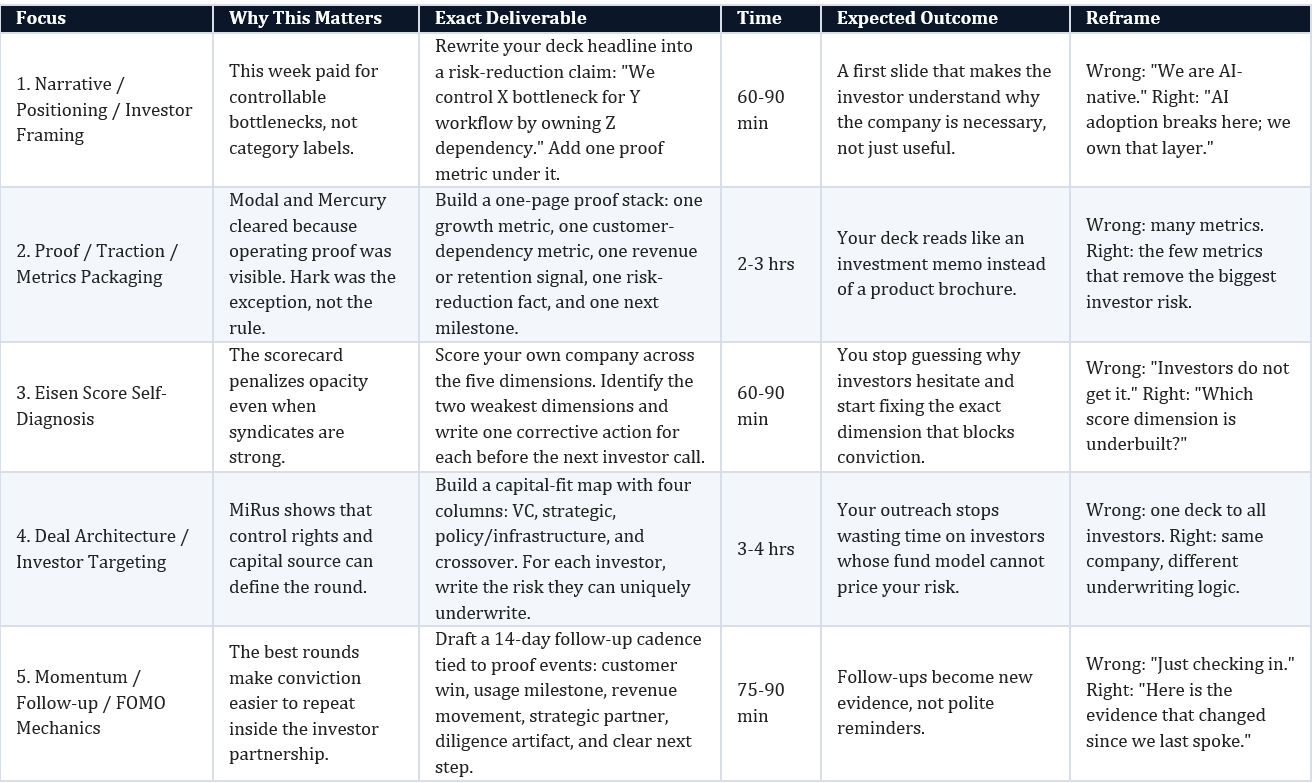
This section translates the corrected weekly signal into founder action. No task below is a generic “improve your pitch” instruction. Each plan produces a concrete artifact you can use this week.
How to apply the playbook
Start with the bottleneck claim. A founder who cannot express the company as a risk-reduction mechanism will keep pitching utility. Utility creates interest. Risk reduction creates urgency.
Then build the proof stack. Do not dump every metric into the deck. Select the three to five facts that make the investment case harder to dismiss. The strongest proof is not always the largest number. It is the number that resolves the investor’s biggest doubt.
After that, run the Eisen Score. The purpose is not to feel good. The purpose is to identify the gap before the investor does. If your lowest dimension is Traction-to-Conviction, do not rewrite the story first. Build better proof. If your lowest dimension is Deal Architecture, fix investor targeting and round construction before you open the process.
Finally, connect follow-up to movement. Every investor update should answer one question: What new evidence makes this deal easier to underwrite than it was two weeks ago?
LOOKING FORWARD: NEXT 1-3 WEEKS
Scenario 1: AI infrastructure keeps clearing, but proof disclosure becomes the bar
Why this is likely: Modal and Decart both point to infrastructure pain. Modal had a clean public revenue signal. Decart had a strong bottleneck narrative and strategic investor signal. Investors will keep funding infrastructure, but the bar for public proof will rise quickly.
What founders should watch: rounds tied to compute access, agent execution, data pipelines, chip portability, inference cost reduction, AI deployment tooling, and governance infrastructure. Watch whether Series B and Series C coverage increasingly discloses revenue, usage, cloud capacity, or customer density.
What founders should do before others notice: build a production-dependency slide and attach one operating metric to it. If you cannot show revenue, show usage intensity, deployment frequency, cost reduction, reliability improvement, or evidence of switching costs.
Scenario 2: Strategic and policy capital becomes more active in deeptech
Why this is likely: MiRus, the EQT Scaleup Europe Fund, France’s quantum and microelectronics commitments, and the U.S. quantum investment plan all point to capital formation outside classic venture funds.
What founders should watch: corporate option structures, government equity stakes, sovereign funds, infrastructure funds, and strategic co-leads in healthcare, quantum, chips, energy, robotics, and critical infrastructure.
What founders should do before others notice: write a control-rights memo before accepting strategic money. Define which rights you will grant, which rights are unacceptable, and how future bidders will interpret the structure.
Scenario 3: Workflow-native fintech continues to outperform generic fintech
Why this is likely: Mercury showed profitability and workflow dependency. Farther and Primer, even with medium public source depth, fit the broader theme that financial infrastructure clears when the product is embedded in operating behavior.
What founders should watch: whether fintech rounds disclose customer count, embedded workflow data, profitability, expansion revenue, bank-charter progress, payment volume, or advisor/user productivity gains.
What founders should do before others notice: move your deck away from “market pain” and toward “operating loop ownership.” The phrase “we make it easier” is weaker than “we sit where the decision already happens.”
Wildcard: SpaceX improves the scarcity-asset narrative while making average startups look less scarce
Why this matters: A mega-IPO narrative can create excitement, but it also changes comparison psychology. Investors will ask which companies deserve public-market scarcity pricing and which companies are only using the IPO window as mood music.
What founders should watch: investor language around irreplaceability, monopoly-like infrastructure, public-market comparables, index demand, and governance readiness.
What founders should do before others notice: create an exit-readiness paragraph that explains why your company could become a strategic asset, not just a scaled software business.
THE BOTTOM LINE
The real insight is not that $3.305B was publicly validated this week. The real insight is that the market punished weak verification and rewarded companies that made risk easy to underwrite.
The first version of the report looked broader. The corrected version is sharper. A smaller verified sample gives founders a better operating signal: proof quality matters more than headline quantity.
5 New Rules for Founders
· Do not pitch AI. Pitch the execution bottleneck your company controls.
· Do not treat strategic money as free validation. Model the control rights and future optionality.
· Do not lead fintech with market size. Lead with workflow ownership and dependency proof.
· Do not assume founder charisma replaces traction. It only buys time to prove the case.
· Do not cite the IPO window unless you can explain why your company qualifies as scarce.
Four Actions
· Rewrite your first slide as a risk-reduction claim.
· Build a one-page proof stack with the three metrics investors should remember.
· Run your Eisen Score and fix the two weakest dimensions before the next call.
· Rebuild the investor list around capital-fit: VC, strategic, policy, infrastructure, or crossover.
Final line: the founders who update their proof architecture this week will sound prepared; the founders who keep pitching old category language will sound late.
RESEARCH METHODOLOGY
Data collection period: May 18-24, 2026. Rewrite and verification completion timestamp: May 25, 2026. Verification standard: minimum two independent primary sources per featured deal, with company press releases prioritized as anchor source. Eisen Fundability Scores are proprietary analytical estimates, not endorsements or investment advice. All dollar amounts reflect announced primary capital at close.
Deals excluded from financing totals: SpaceX S-1 because it is an IPO filing, not a private financing; Alice & Bob extension because no extension amount was disclosed; U.S. and French public funding packages because they are policy capital, not venture rounds; Playground Global and EQT fund announcements because they are fund-formation events, not portfolio financings.
DISCLAIMER: This article is for informational and strategic intelligence purposes only. It does not constitute investment advice. The Eisen Fundability Score is a proprietary diagnostic within Fundables OS™, not a financial recommendation.
If this article was useful, share it with founders who are about to raise.
— Leon Eisen, 4x Founder, Venture Capitalist, and Creator of Fundables OS™