

Playbook, Perspective, and Pattern for founders raising now. This report strips out the giant rounds and the public-market traffic so you can read the part of the market that actually prices your round.
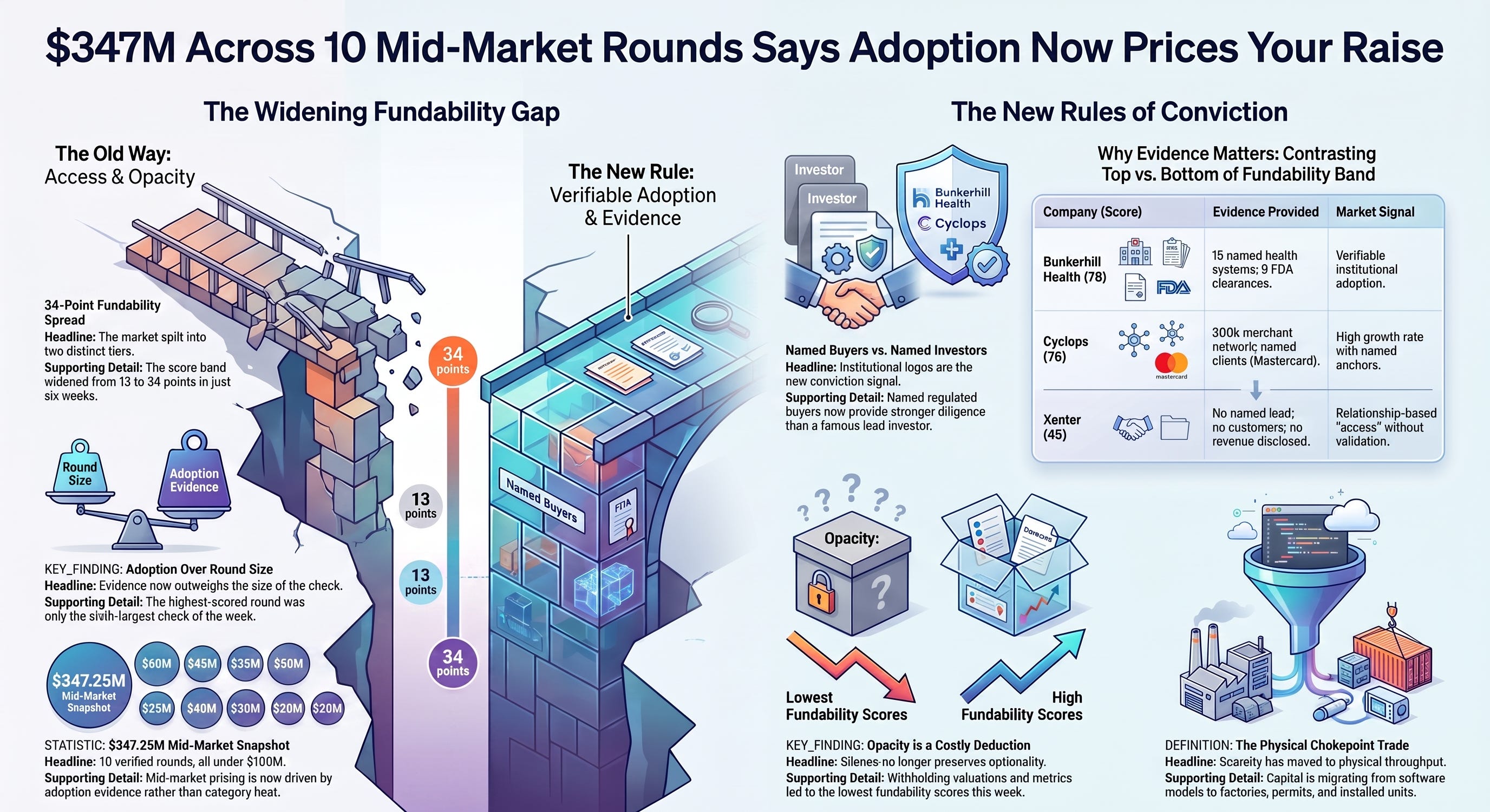
The week of July 13-19, 2026, did not produce a consensus. It produced a gap. Set aside the billion-dollar infrastructure headlines and the late-stage markups. What is left is the market that prices your Series A and Series B: ten verified rounds, every one under $100M, that together moved about $347M. Six weeks ago, the mid-market cleared inside a 13-point fundability band. This week, the band opened to 34 points, from 45 to 79.
That gap is the story. Two rounds landed roughly $33M apart in size and 34 points apart in score. The larger check bought the lower score.
A healthcare platform operating across 15 named hospital systems rose to the top of the readiness curve on the 6th-largest check of the week. A compliance company with 500 regulated institutions on its platform cleared without a disclosed valuation. A medtech company raised the third-largest round of the week with no named lead investor, no named customer, and no disclosed valuation, and scored lowest. Same week. Same market. Opposite prices.
Here is the consequence. **The market stopped paying a floor price for a credible story.** Capital this week underwrote adoption you can name and count: named institutional buyers, cleared regulatory artifacts, contracted revenue, and a lead investor willing to put a number on the company. Read every shift below through that lens. Each one tells you what a diligence partner will ask you to produce before the second meeting.
The Week at a Glance
Primary insight: With the giant rounds and public-market traffic removed, the mid-market is priced on adoption evidence rather than category heat. Capital concentrated where a founder could name the institutional buyer, the regulator, or the contract, and it discounted sharply where the round was opaque about who is buying and at what price.
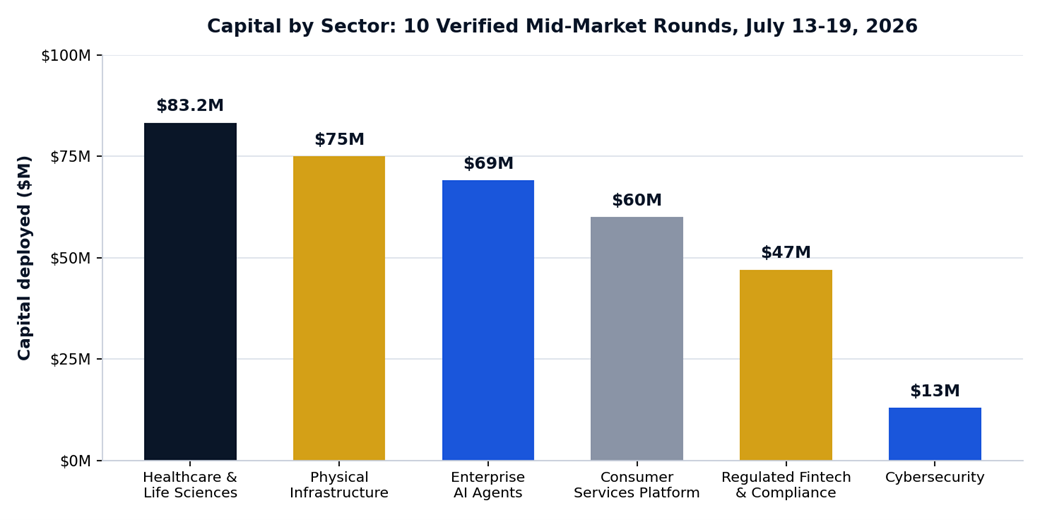
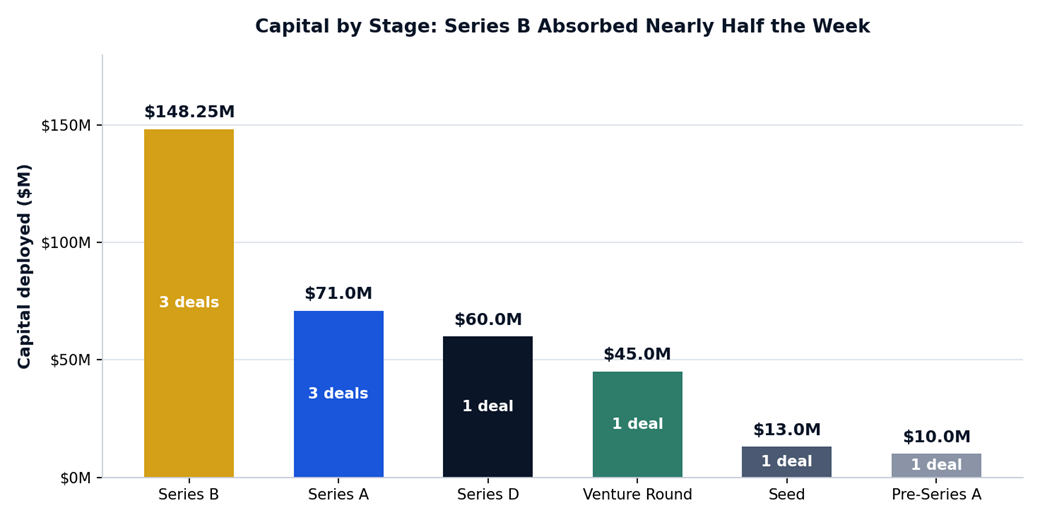
• Total tracked mid-market capital (10 verified rounds): approximately $347.25M, all under $100M per deal.
• Average round size: $34.7M across the ten.
• Median round size: $26.0M, the midpoint between Hadrius and Bunkerhill Health.
• Disclosed valuations: only two of ten. Fora at $1B post-money and Kind Designs at $70M. Eight rounds disclosed nothing, and the deductions for that opacity account for most of the spread below.
• Largest tracked round: Senra Systems, $65M Series B, software-driven wire harness manufacturing for aerospace and defense.
• Highest Eisen Fundability Score: Bunkerhill Health at 79, on a $25M Series B, the sixth-largest check of the week.
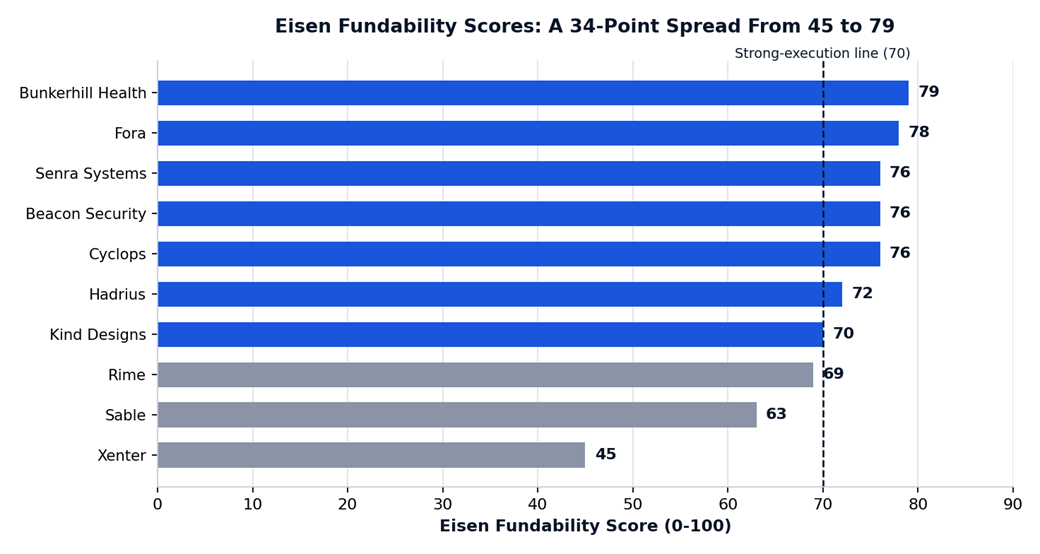
• Defining structural feature: an Eisen Score band of 45 to 79. A 34-point spread, against a 13-point spread in the June 1-7 issue. The mid-market stopped clearing at a single price.
Deal Scorecard
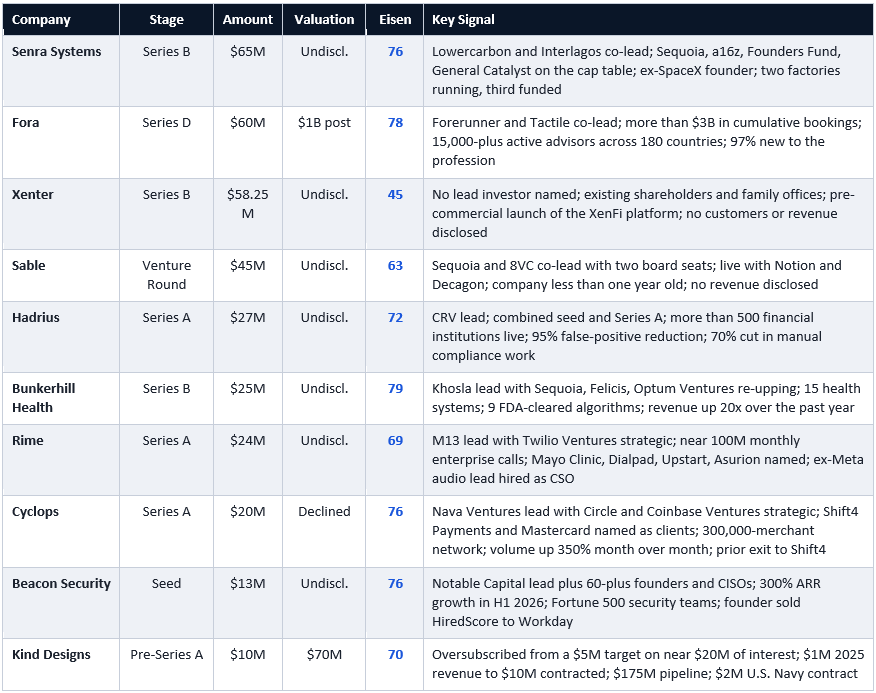
Eisen Fundability Scores are calculated across the 5Ps-weighted dimensions: Founder-Investor Dynamics (Process, 30%), Traction-to-Conviction Conversion (Proof, 25%), Narrative Power (Positioning, 20%), Deal Architecture (Packaging, 20%), and Capital Planning (Planning, 5%). Scores of 85 and above signal an inevitable outcome. Scores of 70 to 84 signal strong execution. Scores below 70 signal an early stage or the need for repositioning. Missing metrics are scored conservatively, and opacity is penalized rather than assumed strong.
What the Scorecard Says at a Glance
The spread is the message. Six weeks ago, every tracked deal cleared inside 13 points. This week, the band ran 34 points wide. Nothing about the market got worse. What changed is that the opacity discount became large enough to be visible. Eight of ten rounds disclosed no valuation, and the companies that offset that with named buyers and countable outcomes held the top of the band. The companies that offset it with nothing fell to the bottom.
Bunkerhill Health (79) is the cleanest case of the week, and it is not the biggest check. It scored highest on the sixth-largest round because every claim in the story is something a diligence partner can call and confirm: fifteen named health systems including Cleveland Clinic, Mayo Clinic, and Intermountain Health, nine FDA-cleared clinical algorithms, more than twenty agents running live at a single academic system, and revenue up twentyfold over the past year. That is institutional adoption, regulatory artifact, and growth rate in one package.
Fora (78) and Senra Systems (76) reach the same place through different evidence. Fora put a number on itself, $1B post-money, and backed it with more than $3B in cumulative bookings across 15,000-plus active advisors. Senra declined the valuation but produced physical throughput: two operating factories, a third funded by this round, and a cap table of Sequoia, Andreessen Horowitz, Founders Fund, and General Catalyst that had already priced the company once. Different proof, identical underwriting test: what already exists in the world at scale.
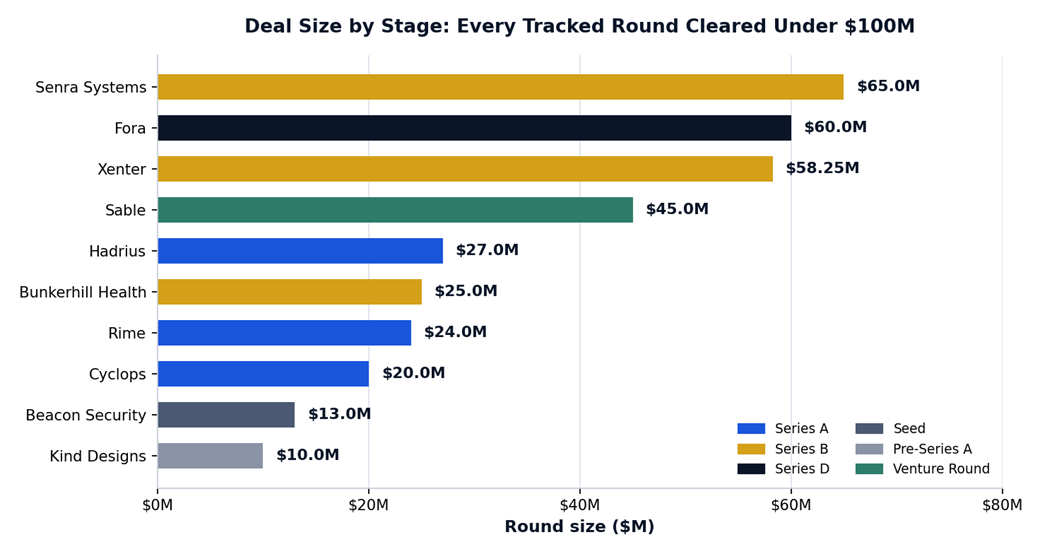
The bottom of the band is the more useful lesson. Xenter (45) raised $58.25M, the third-largest round of the week, with no named lead investor, no named customer, no revenue figure, and no valuation. Sable (63) raised $45M from Sequoia and 8VC on a company less than a year old, with two named logos and no revenue figure. In both cases, the capital is real. The fundability signal is thinner because almost nothing in the announcement can be confirmed by a third party. Cyclops is the instructive counterexample. It explicitly declined to provide a valuation and still scored 76 because it named Shift4 Payments and Mastercard as clients and reported a 300,000-merchant network and 350% month-over-month volume growth. Withholding the price cost it points. Withholding the adoption evidence would have cost it the band. The scoreboard separates a funded company from a fundable round, and this week, the gap between the two was an evidence gap far more than a valuation gap.
What Changed This Week: 5 Market Shifts
Each shift is verified against multiple primary sources and ranked by structural impact on founder fundraising, not by deal size. Every shift ends with what it means for your raise.
Shift 1: The Mid-Market Stopped Clearing at One Price
Pattern: The Eisen band ran from 45 to 79 this week, a 34-point spread. In the June 1-7 issue, the same methodology produced a 13-point spread. The top five scores this week (Bunkerhill 79, Fora 78, Senra 76, Beacon 76, Cyclops 76) came on checks of $25M, $60M, $65M, $13M, and $20M. The bottom three (Rime 69, Sable 63, Xenter 45) came on checks of $24M, $45M, and $58.25M. Check that size and score are completely decoupled.
Perspective: A wide band means the market is running two different underwriting processes at once. One process prices adoption. The other price access, meaning founder pedigree, investor relationships, and category position. Both got funded this week. Only one got a strong fundability score, because only one produces evidence that a later investor can independently confirm. When access capital and adoption capital are both available, founders systematically misread a closed round as a validated round.
Founder Blindspot: Founders treat the wire as the verdict. It is not. A $45M round closed on relationships prices your next round against a bar you have not yet cleared. The companies at the bottom of this week’s band raised more money on less evidence, which compresses their runway to prove the thing they did not have to prove this time. The selection error is optimizing for the round you can close instead of the round you can defend.
Playbook: Run a third-party verification test on your own deck. Take every claim on your first five slides and mark each one as verifiable or unverifiable by someone outside your company. A named customer is verifiable. A regulatory clearance is verifiable. A contracted revenue figure that a buyer would confirm is verifiable. Market size, model quality, and roadmap are not. If fewer than half your claims survive, that ratio is your real score, not the amount you last raised.
Contrast: In early June, the mid-market rewarded a single attribute, deployed usage, and priced everyone inside a narrow band around it. In mid-July, the market split. Adoption evidence held its price. Everything else negotiated.
What this means for your raise: If your round would close today on relationships rather than evidence, take the money and immediately build the evidence, because the next investor will underwrite against a 79, not a 63.
Shift 2: Named Buyers Replaced Named Investors as the Conviction Signal
Pattern: Every round in the top half of the band names institutional customers in the announcement. Bunkerhill named Cleveland Clinic, Mayo Clinic, Intermountain Health, and the University of Texas Medical Branch. Cyclops named Shift4 Payments and Mastercard as clients on a round for which it explicitly declined to disclose the valuation. Rime named Mayo Clinic, Dialpad, Upstart, and Asurion. Hadrius disclosed more than 500 financial institutions on the platform. Beacon disclosed Fortune 500 security teams and pulled 60-plus founders and CISOs onto the cap table. Kind Designs named a $2M U.S. Navy contract alongside Miami Beach hospitality projects.
Perspective: A famous lead investor tells a later investor that someone smart did diligence. A named regulated buyer tells them the diligence has already been completed within the institution, with procurement, legal, and security reviews. In 2026, the second signal is cheaper to verify and harder to manufacture. That is why a $13M seed and a $25M Series B outscored a $58.25M Series B this week, and why a company that refused to name its valuation still cleared 76 by naming two of the largest names in payments. The buyer list did the underwriting that the investor list could not.
Founder Blindspot: Founders spend the announcement on the syndicate. They lead with the fund names, board seats, and the angel roster, then bury the customers behind a phrase like "leading enterprises." Investors read the reverse order. The wrong instinct is treating customer names as a competitive secret while treating investor names as a public asset. In regulated categories, the customer list is the moat proof, and hiding it reads as an absence rather than as discretion.
Playbook: Build a named-buyer sheet this week. Three columns: institution name, what they run in production, and how long they have run it. Get written permission to name at least three. If you cannot name three, that is your fundraising blocker, not your deck design. Then move the sheet to slide two, directly behind the one-liner, ahead of the team slide, and ahead of the market slide.
Contrast: In the June tape, deployed usage volume was the headline metric, and the counts were anonymous: visits, stores, scanners, practices. This week, the market wanted the institutions attached to the counts. Volume without an institution behind it lost its premium.
What this means for your raise: If your traction slide has numbers but no institution names, you are asking an investor to take your count on faith. Attach the buyer or expect to be asked for references before term-sheet conversations start.
Shift 3: The Chokepoint Trade Moved From Data to Physical Throughput
Pattern: The largest tracked round of the week went to wire harness manufacturing. Senra Systems raised $65M to fund a third factory, with Lowercarbon and Interlagos co-leading and Sequoia, Andreessen Horowitz, Founders Fund, General Catalyst, and 8VC returning. Kind Designs raised an oversubscribed $10M to triple production capacity at a seawall factory, having converted $1M of 2025 revenue into $10M of contracted revenue and a $175M pipeline. Neither company sells a model. Both sell units that leave a building.
Perspective: Six weeks ago, the scarce-input trade was about data: proprietary, non-scrapable training sets underneath a robotics gold rush. This week, the same thesis manifested in factories, permits, and installed units. The logic did not change. The layer moved. When the application layer commoditizes, capital migrates to whatever cannot be spun up in a quarter, and a qualified aerospace production line or a permitted coastal installation is harder to replicate than a dataset.
Founder Blindspot: Founders in industrial categories still lead with the software layer because they believe investors pay software multiples. Senra’s own framing is that wire harnesses are still built on documents, spreadsheets, and tribal knowledge, and the round funded a factory, not a seat license. The selection error is describing throughput as a software product and losing the one claim that is genuinely hard to copy.
Playbook: Write your capacity statement in one line: units produced per period today, units per period after this round, and the constraint that stops a competitor from matching it. Then name the specific physical or regulatory asset the round buys: the factory, the permit, the qualification, the line. Make that asset the use-of-funds headline rather than hiring and go-to-market.
Contrast: In June, the fundable bottleneck was the dataset the application layer had to buy. In July, it is the physical capacity that the program schedule cannot proceed without. Both are picks and shovels. The shovels got heavier.
What this means for your raise: If you compress an industrial constraint, lead with capacity and the asset that creates it. A throughput number attached to a funded facility is a stronger 2026 claim than a gross margin projection.
Shift 4: Compliance Became the Product, Not the Cost Line
Pattern: Four of the ten tracked rounds sell into the review-and-oversight layer of a regulated industry. Hadrius consolidates compliance reviews for more than 500 financial institutions and reports a 95% reduction in false positives and a 70% reduction in manual reviews. Beacon Security sells the trusted data layer that lets security agents act, and it grew ARR by 300% in the first half of 2026. Bunkerhill ships nine FDA-cleared algorithms inside hospital operations. Rime sells speech models specifically into healthcare and financial services, where pronunciation, latency, and compliance are the buying criteria.
Perspective: As AI generates more of the communications, trades, code, and clinical output within an institution, the review burden scales with its output. That creates a budget line that did not exist at this size two years ago, and it is a budget line the buyer cannot defer, because a regulator sets the deadline. Investors are underwriting a compulsory spend rather than a discretionary one. That is why a compliance company with no disclosed valuation still scored 72 while a medtech platform with a larger check scored 45.
Founder Blindspot: Founders build the generation product because it demos well, then treat the review, audit, and governance surface as a feature to add later. Buyers in regulated categories purchase in the opposite order. They cannot deploy the generator until the oversight layer is in place. The selection error is building the thing the user wants and ignoring the thing the institution requires before the user is allowed to have it.
Playbook: Identify the mandatory review step your product creates or removes, then quantify it in the buyer’s units: hours of review removed per week, false positives eliminated, audit artifacts produced automatically. Hadrius reports saving 20+ hours per team per week. That is a procurement number, not a marketing number. If you cannot express your value in the compliance officer’s units, you are selling to the wrong person in the building.
Contrast: In 2024, compliance features were a checkbox used to unblock a deal. In mid-2026, the compliance layer is the deal, and it is priced as infrastructure rather than as overhead.
What this means for your raise: If your product creates output that someone in a regulated institution must review, build and price the review layer yourself. That layer is the recurring revenue, and it is what a specialist investor will underwrite.
Shift 5: Opacity Stopped Being Neutral and Became a Deduction
Pattern: Eight of ten rounds disclosed no valuation. That alone is normal. What changed is what the silence cost, and the cost was not uniform. Xenter raised $58.25M with no named lead investor, no named customer, no revenue figure, and no valuation, and scored 45. Cyclops also gave no valuation, explicitly declining to state one, but published a 300,000-merchant network, 350% month-over-month volume growth, and two named clients, and scored 76. Kind Designs, the smallest round of the week at $10M, disclosed its valuation, prior valuation, revenue, contracted revenue, pipeline, and a federal contract, and scored 70.
Perspective: Disclosure is not vanity. It is a costly signal. Naming a lead investor means that someone has publicly accepted pricing risk. Naming a valuation means the company will be measured against it. Naming a customer means that the customer has agreed to be associated with you. Every one of those is expensive to fake and cheap to verify, which is exactly what makes it useful to the next investor. The three-way comparison above sets the exchange rate. Withholding the price alone costs a few points. Withholding the buyers and the operating numbers costs the band. When a large round arrives with none of them, a sophisticated reader does not assume the numbers are good. They assume the numbers were not strong enough to include.
Founder Blindspot: Founders believe withholding is neutral, that they preserve optionality by staying quiet. In a market where the median round discloses little, silence is not distinctive; it is indistinguishable. The founders who scored highest this week understood that the point of disclosure is not transparency for its own sake. It is a separation from everyone else who stayed quiet.
Playbook: Choose your disclosure package before you announce, not after. Pick the three hardest numbers you are willing to stand behind for twelve months and put them in the release: a customer count with a named anchor, a growth rate with a defined period, and either a valuation or a contracted revenue figure. If you withhold the valuation, overpay on the other two, because that is exactly the trade the top of this week’s band made. Then decide what you will not disclose and have a one-sentence reason ready. An answered question closes. An unanswered question compounds.
Contrast: In the June tape, undisclosed valuations read as a sign of speed, of deals closing faster than the paperwork. In the July tape, the same silence read as a gap because the companies that did disclose separated so clearly from those that did not.
What this means for your raise: Decide what you will publish before you take the meeting. If the honest answer is that no number in your business is strong enough to name, your next two weeks belong to the number, not to the round.
The Deals That Matter: Top 5
Five deep dives across healthcare AI, consumer services platforms, defense manufacturing, cybersecurity, and climate infrastructure. Each is selected for a distinct playbook value, not deal size. All metrics are verified against two or more primary sources.
Bunkerhill Health
Agentic AI Platform for Health Systems | Series B | $25M | Valuation Undisclosed
Eisen Fundability Score: 79 / 100
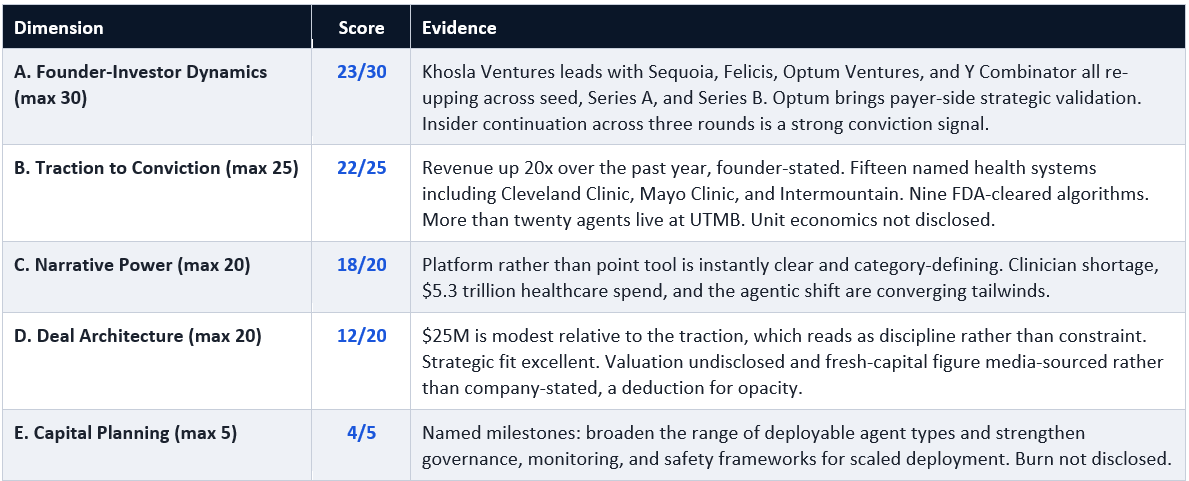
Why this scored: The highest score of the week arrived on the sixth-largest check. Bunkerhill is not selling hospitals a diagnostic tool. It sells them a platform to build and run their own agents, meaning the customer supplies the use case and Bunkerhill supplies the deployment layer. Every claim in the announcement is externally checkable: fifteen named health systems, nine FDA-cleared clinical algorithms, more than twenty agents live at a single academic medical center, and twentyfold revenue growth over the past year.
The Setup: Bunkerhill’s Carebricks platform lets a health system turn its own clinical or operational idea into a production agent that spans imaging review, registry management, prior authorization, nephrology triage, and follow-up workflows. The bet is that the constraint in healthcare AI was never model quality. It was that hospitals had more good ideas than capacity to build them, and no safe path from protocol to production. Khosla Ventures framed the thesis directly: the bottleneck was getting a health system to actually run the technology, and Bunkerhill closed that gap.
The Numbers: $25M Series B led by Khosla Ventures, with Sequoia Capital, Felicis, Optum Ventures, and Y Combinator all continuing. Total funding to date: $55M across seed, Series A, and Series B. Fifteen health systems on Carebricks, including Cleveland Clinic, Mayo Clinic, Intermountain Health, Ballad Health, Sentara Health, Endeavor Health, and the University of Texas Medical Branch. More than twenty agents live at UTMB across clinical care, operations, and administration. Nine FDA-cleared clinical algorithms. Revenue up 20x over the past year with more than a dozen health systems signed in that period, both figures founder-stated to Fortune rather than independently audited. U.S. healthcare spending reached $5.3 trillion in 2024, the market context the company cites.
Fundability Lessons: Bunkerhill is the platform-versus-point-tool template. Three moves built the 79-point case. First, make the customer the author, so every new deployment is evidence of adoption depth rather than another sales cycle. Second, accumulate regulatory artifacts, as nine FDA clearances form a moat that no other model can circumvent. Third, publish the institutional list, since in healthcare the buyer’s name carries more diligence weight than the investor’s.
Your Takeaway: If your buyers are institutions with procurement and regulatory review processes, your fundability depends on how many of them will let you use their names. Count the institutions, count the artifacts, and count the growth rate. Those three numbers together price a round more reliably than any valuation you could negotiate.
The Founder Mistake to Avoid: Founders build the agent instead of the agent factory. Selling one hospital one workflow means re-earning conviction with every deal and capping the account at a single line item. Bunkerhill scored 79 because its customers expand the product themselves. If your growth requires you to invent the next use case, you own a product. If your customer invents it, you own a platform, and only one of those compounds.
Fora
AI-Enabled Platform for Travel Entrepreneurs | Series D | $60M | $1B Post-Money
Eisen Fundability Score: 78 / 100
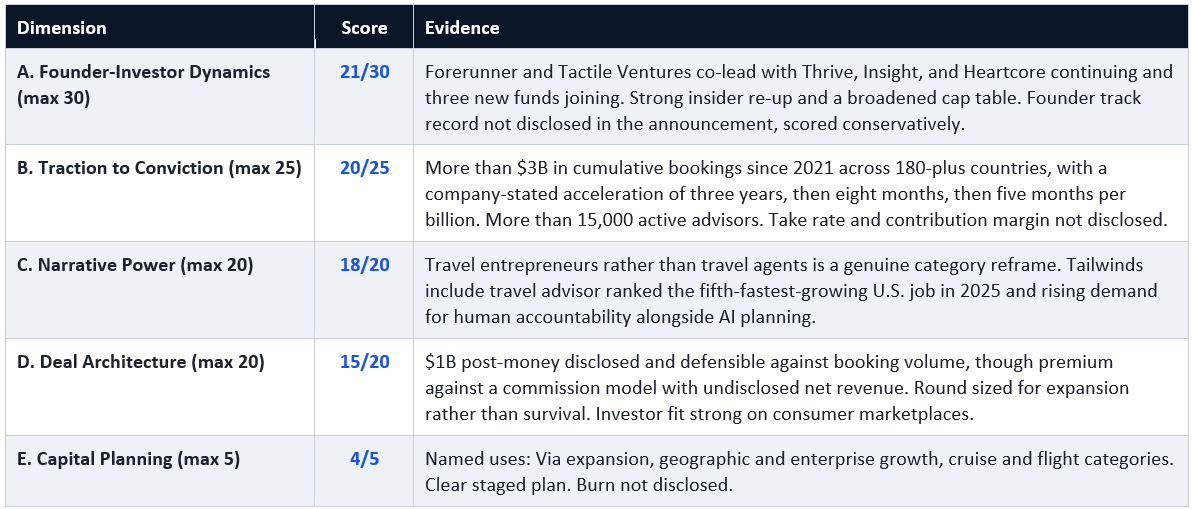
Why this scored: Fora is the only tracked round this week to name its own price and have the throughput to defend it. More than $3B in cumulative bookings since 2021, with the company reporting three years to the first billion, eight months to the second, and five months to the third, across 15,000-plus active advisors in 180 countries. The score reflects verifiable platform volume and a disclosed valuation against a commission-based model whose unit economics remain undisclosed.
The Setup: Founded in 2021 and headquartered in New York, Fora recruits career changers into the travel advisory profession and gives them the booking infrastructure, training, certification, and supplier relationships to run a business. Ninety-seven percent of its advisors are new to the profession, a roster that includes former physicians, attorneys, traders, parents, and retirees. Its embedded AI assistant, Via, compresses the administrative work around destination research, supplier knowledge, itineraries, and proposals. The strategic claim is not that AI replaces the advisor. It is that AI expands the number of clients one trusted human can serve.
The Numbers: $60M Series D at a $1B post-money valuation, co-led by Forerunner and Tactile Ventures, with continued participation from Thrive Capital, Insight Partners, and Heartcore Capital, and new capital from PLUS Capital, BlackPines Capital Partners, and Tribeca Venture Partners. Total funding $138.5M. More than $3B in cumulative bookings across 180-plus countries, with three years to the first billion, eight months to the second, and five months to the third. More than 15,000 active advisors, 97% new to the profession, with individual advisor businesses ranging from supplemental income to more than $10M in annual bookings. Monetization is based on quarterly membership fees, plus training, certification, and technology. Use of funds: scaling Via, geographic and enterprise expansion, and growth in cruise and flight bookings.
Fundability Lessons: Fora is the human-in-the-loop template that stopped apologizing. First, price the network rather than the software, so the fundable unit is booking volume and advisor count, not seats. Second, define a new supply category, travel entrepreneurs rather than travel agents, which reframes 97% inexperience from a weakness into a growth engine. Third, disclose the valuation, which, in a week when eight of ten rounds went dark, is itself a signal of conviction.
Your Takeaway: If your model makes skilled human labor more scalable, stop positioning against full automation and start measuring throughput per person. Investors this week paid a unicorn price for augmented labor with volume behind it and discounted autonomous claims with no volume at all. The defensible number is what your network produced, not what your software could theoretically replace.
The Founder Mistake to Avoid: Founders in services-plus-software categories hide the humans because they believe investors only pay software multiples. The mistake is describing a labor network as a pure software company, which invites a comparison you will lose on gross margin. Fora scored 78 by making the advisor base the asset and the AI the multiplier. If humans create your value, count them, name their output, and price the network.
Senra Systems
Software-Driven Wire Harness Manufacturing | Series B | $65M | Valuation Undisclosed
Eisen Fundability Score: 76 / 100
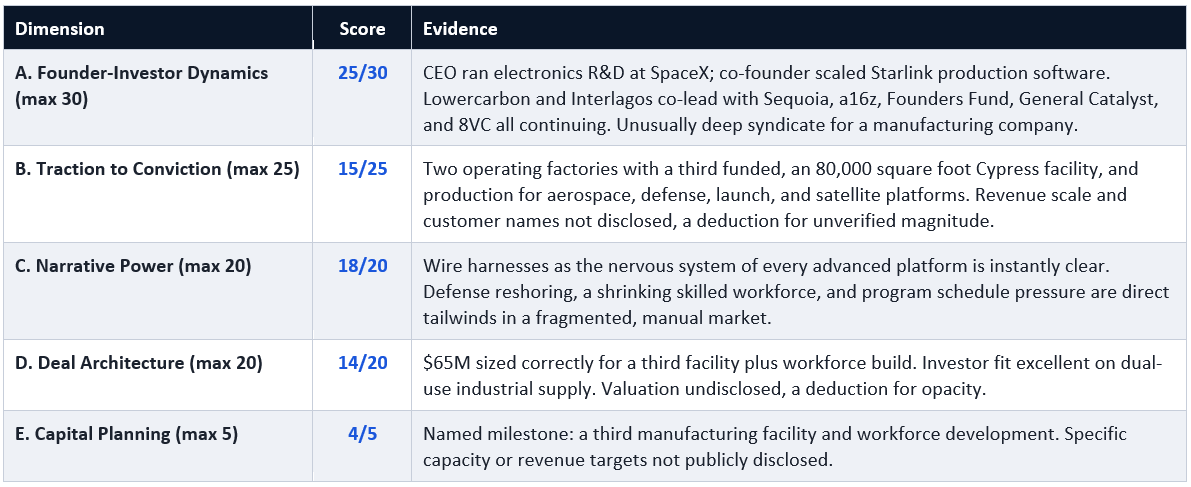
Why this scored: Senra is the clearest physical chokepoint play of the week and the largest tracked round. Wire harnesses are used in aircraft, spacecraft, launch vehicles, satellites, and defense systems, and they are still assembled from documents, spreadsheets, and tribal knowledge. The score reflects an exceptional founder and syndicate against traction that is physically real but not disclosed at a revenue scale, and a round that named no valuation.
The Setup: Co-founder and CEO Jordan Black ran the electronics research and development team at SpaceX, where the overwhelming majority of harness work for Falcon and Dragon was outsourced. Co-founder Benjamin Shanahan wrote application software that scaled Starlink production. They started Senra in 2023. The company’s software layer, Amp, unifies quoting, engineering, manufacturing, supply chain, and production, and the operating model pairs that software with a trained workforce rather than attempting to remove humans from an assembly step robots still handle poorly. The thesis is that a national production bottleneck becomes capacity when you digitize the process around the hands.
The Numbers: $65M Series B co-led by Lowercarbon Capital and Interlagos, with participation from General Catalyst, Sequoia Capital, Andreessen Horowitz, Founders Fund, 8VC, CIV, Dylan Field, The Friedkin Group, Jaws Estates Capital, Sozo Ventures, and Alumni Ventures. Total funding raised now exceeds $112M. A new 80,000-square-foot facility in Cypress, California, with a third factory funded by this round. Customers span aerospace, defense, launch, and satellite platforms. Revenue and customer names not publicly disclosed. Use of funds: a third manufacturing facility and workforce expansion.
Fundability Lessons: Senra is the reindustrialization template. First, pick a bottleneck the buyer already knows is a bottleneck, so the pitch requires no market education, and the urgency is supplied by program schedules rather than by you. Second, build the software as the operating system for the factory rather than as the product, which lets you capture throughput economics instead of seat economics. Third, sequence factories as milestones, since each facility answers a specific question: can we build one, can we scale one, can we replicate one.
Your Takeaway: In industrial categories, capacity is the traction metric. Frame every round against the next unit of capacity it funds and the specific doubt that unit retires. That structure converts a capital-intensive business, usually a venture negative, into a legible series of de-risking steps, which is exactly how a specialist investor wants to underwrite you.
The Founder Mistake to Avoid: Founders in hard manufacturing lead with the software platform out of fear of the factory multiplier. The mistake is disguising the asset, which makes it hard for you to copy. Senra’s cap table could not be assembled due to an issue with the quoting tool. It assembled because a defense industrial base with shrinking skilled labor cannot source harnesses fast enough. Lead with the shortage, then show the software that resolves it.
Beacon Security
Agentic Security Data Layer | Seed | $13M | Valuation Undisclosed
Eisen Fundability Score: 76 / 100
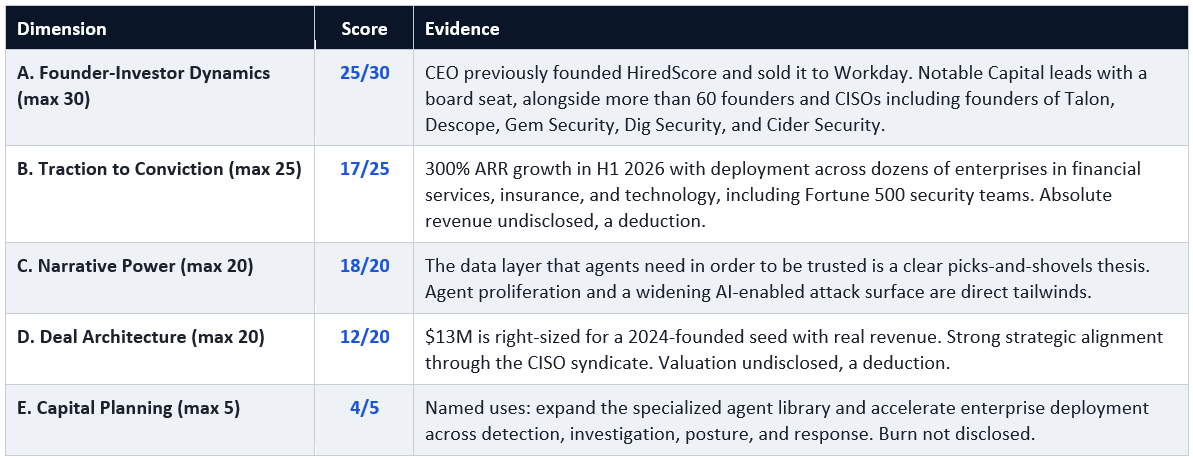
Why this scored: Beacon is the smallest round in the top half of the band and it earned the position on evidence rather than size. A founder with a prior exit to Workday, 300% ARR growth in the first half of 2026, Fortune 500 security teams in production, and more than sixty founders and CISOs on the cap table. The score reflects exceptional early proof against an undisclosed revenue base and no disclosed valuation.
The Setup: Founded in 2024 in New York by CEO Gal Tal-Hochberg, who previously founded HiredScore and sold it to Workday, alongside Or Mattatia and Iddo Israely. Beacon sits between telemetry sources and downstream security tools, connecting, normalizing, and enriching data so that human analysts and autonomous agents reason on the same clean picture. The framing from Notable Capital is precise: the bottleneck was never detection; it was trust in your own data, and adding agents makes that problem less forgiving, not more.
The Numbers: $13M seed led by Notable Capital, with Holly Ventures, AlphaDrive Ventures, SVCI, Jefferies Family Office, and more than 60 founders and chief information security officers participating, including founders from Talon, Descope, Gem Security, Dig Security, and Cider Security. ARR up 300% in the first half of 2026. Deployed across dozens of enterprises in financial services, insurance, and technology, including Fortune 500 security teams. Absolute revenue not disclosed. Use of funds: expand the library of specialized security agents and accelerate enterprise deployment across detection, investigation, posture management, and incident response.
Fundability Lessons: Beacon is the buyer-coalition template. First, convert your buyers into your cap table, because sixty CISOs writing checks is simultaneously a distribution channel, a reference network, and the most credible diligence a security investor can get. Second, publish a rate rather than a level, since 300% growth in a defined half-year window is verifiable in shape even when the base is private. Third, sell the layer beneath the category everyone else is crowding into, so you benefit from agent adoption without competing feature-for-feature with agent vendors.
Your Takeaway: A seed round can outscore a Series B. What separated Beacon from larger rounds this week was that a stranger could verify the claims: a documented growth rate, an identifiable buyer segment, and an angel roster of named operators. If you are pre-revenue disclosure, publish the rate, the segment, and the people who staked their reputations on you.
The Founder Mistake to Avoid: Founders raise a quiet seed and save the proof for the Series A. The mistake is treating the seed announcement as a formality rather than as the first public price on your evidence. Beacon scored 76 at seed because it disclosed like a Series A. If you announce with only a fund name and a mission statement, you have spent your announcement and bought nothing.
Kind Designs
3D-Printed Coastal Infrastructure | Pre-Series A | $10M | $70M Valuation
Eisen Fundability Score: 70 / 100
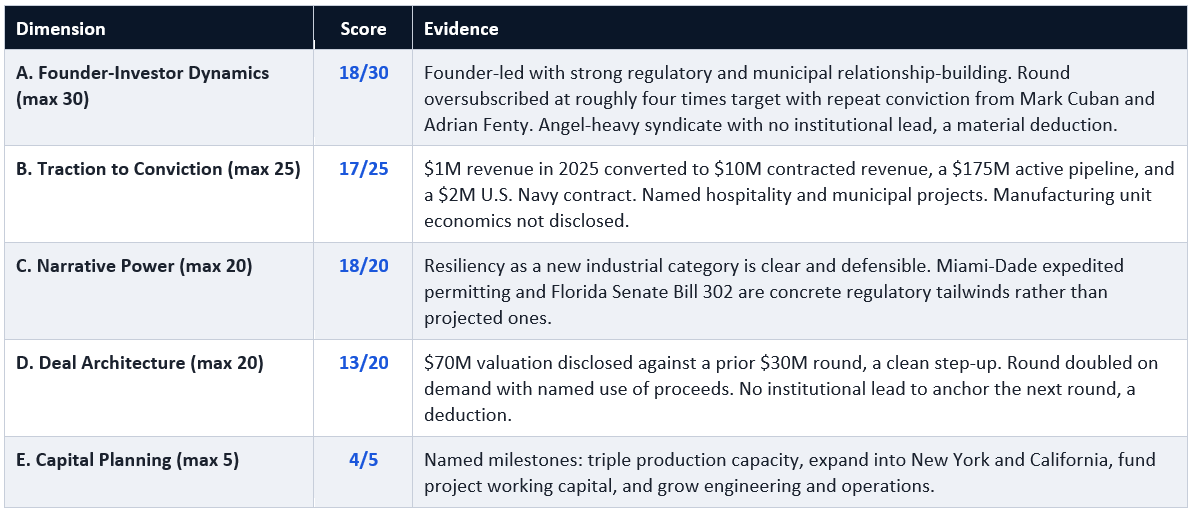
Why this scored: The smallest round of the week is the best momentum-design case in the report. Kind Designs set out to raise $5M, drew nearly $20M of interest, and doubled the round to $10M at a $70M valuation. It disclosed its price, revenue, contracted revenue, pipeline, and a federal contract. The score reflects a genuine demand signal and full disclosure against an angel-heavy syndicate with no institutional lead.
The Setup: Founded and led by CEO Anya Freeman, the Miami company uses large-scale 3D printing and ecological engineering to produce Living Seawalls, seawall tiles, artificial reefs, and living shorelines that hold back water while restoring marine habitat. The category argument is blunt: seawalls are a multi-hundred-billion-dollar market that has never had a technology company inside it. In a single year, the company moved from residential installations to municipal, hospitality, and federal defense work.
The Numbers: $10M Pre-Series A at a $70M valuation, doubled from a $5M target after roughly $20M of investor interest, bringing total funding to $21.5M. Investors include returning backers Mark Cuban and former Washington D.C. Mayor Adrian Fenty, plus NBA forward Kyle Kuzma, NY Angels, and TaMiami. Revenue of $1M in 2025, $10M in contracted revenue secured, a $175M active pipeline, and a $2M U.S. Navy contract. Named projects include the Fontainebleau, Pagani, and Ritz-Carlton in Miami Beach, as well as completed municipal work in Miami Shores and Longboat Key. Regulatory tailwinds include expedited Miami-Dade permitting for the company’s systems and Florida Senate Bill 302, which provides incentives for adopting living seawalls. Use of funds: triple factory production capacity, expand into New York and California, fund working capital for municipal and federal projects, and grow the engineering and operations team.
Fundability Lessons: Kind Designs is the oversubscription template. First, set a target you can clear and let excess demand set the price, since a round doubled by investor interest prices better than a round negotiated down from an ambitious ask. Second, convert a climate story into a procurement story, because contracted revenue and a Navy contract underwrite far more cleanly than avoided carbon. Third, disclose everything, which in a week where eight of ten rounds disclosed nothing produced separation, a $10M check could not otherwise buy.
Your Takeaway: Momentum is designed, not discovered. Size the round against demand you can already see, run a compressed process so interest concentrates in time, and publish the outcome, including the price. A double round at a disclosed valuation signals to the next investor that the market cleared above your ask. A quiet round at your ask tells them nothing.
The Founder Mistake to Avoid: Climate and infrastructure founders pitch the mission and hope the economics follow. Mark Cuban’s own account of the pitch is the tell: most climate founders pitch saving the planet, and this one pitched disrupting a multi-billion-dollar market faster and cheaper. The mistake is to lead with the externality rather than the buyer. Regulation and permitting are your distribution advantage, so name them as market access rather than as virtue.
Fundraising Playbook: 5 Tactical Plans From This Week
Five plans, each producing a concrete output you can use immediately. No vague tasks. Each is built directly from this week’s verified signals.
1. The Named-Buyer Sheet (Positioning and Narrative)
Why this matters: Every one of the four highest-scoring rounds named institutional customers in the announcement. Bunkerhill named the Cleveland Clinic and the Mayo Clinic. Rime named Mayo Clinic and Asurion. Beacon named Fortune 500 security teams. Hadrius disclosed 500-plus financial institutions. The three lowest scorers named none.
Deliverable: A one-page named-buyer sheet with three columns: institution name, what they run in production, and how long they have run it. Secure written permission to name at least three. Place it on slide two, directly behind your one-liner.
Time estimate: 3 to 6 hours, including permission requests, for completion before your next investor meeting.
Expected outcome: A traction claim a partner can verify with one phone call. Diligence shifts from proving you have customers to sizing how fast you can add them.
Reframe: Wrong approach: leading enterprises trust us. Right approach: three named institutions, what each runs, and how long it has been live.
2. The Disclosure Package (Traction and Metrics Packaging)
Why this matters: Eight of ten rounds disclosed no valuation this week, and the deduction for that silence produced most of a 34-point spread. The $10M round that disclosed everything outscored the $58.25M round that disclosed nothing by 25 points.
Deliverable: A three-number disclosure package you will stand behind for twelve months: a customer count with a named anchor, a growth rate over a defined period, and either a valuation or a contracted revenue figure. Plus a written one-sentence reason for each item you choose not to disclose.
Time estimate: 2 to 4 hours, decided before you announce rather than during the press cycle.
Expected outcome: Separation from the median round. An answered question closes. An unanswered question compounds into a discount at your next raise.
Reframe: Wrong approach: stay quiet to preserve optionality. Right approach: publish three numbers you can defend and one sentence explaining the rest.
3. Eisen Self-Score and Verification Audit (Readiness)
Why this matters: This week’s band ran 45 to 79. The gap was almost entirely deal architecture and traction-to-conviction, the two dimensions that depend on what an outsider can confirm rather than on what you believe.
Deliverable: Score your round across the five dimensions: founder-investor dynamics, traction-to-conviction, narrative power, deal architecture, and capital planning. Then run the verification audit: mark every claim on your first five slides as verifiable or unverifiable by a third party. Identify your lowest two dimensions and write one concrete action to lift each.
Time estimate: 2 to 3 hours, repeated before each raise and after each material customer win.
Expected outcome: A ranked list of your two weakest dimensions with a specific fix for each, plus a verifiable-claim ratio that tells you what an investor will actually underwrite.
Reframe: Wrong approach: improve the pitch everywhere. Right approach: fix the lowest two scored dimensions and convert your three weakest claims into verifiable ones.
4. The Compulsory-Spend Map (Investor Targeting and Deal Architecture)
Why this matters: Four of ten tracked rounds sell into a review or oversight layer that a regulated buyer cannot defer. Those four averaged a materially higher score than the six that sell into discretionary budgets, and they attracted specialists who could price the regulatory risk directly.
Deliverable: Map your revenue to budget type. For each product line, write whether the buyer’s spend is compulsory, driven by a regulator, an auditor, or a program schedule, or discretionary. Then build a target list of investors who have priced compulsory-spend risk in your exact category, naming the specific deal each did and the warm path.
Time estimate: 6 to 10 hours of research, refreshed each quarter.
Expected outcome: A 12- to 15-name investor list ordered by ability to underwrite your core risk, and a clear view of which revenue line to lead with in every first meeting.
Reframe: Wrong approach: start with the famous generalists. Right approach: start with the specialist who already priced a compulsory-spend business in your category.
5. The Momentum Design Sequence (Conversion Mechanics)
Why this matters: The most efficient round of the week was the smallest. A $5M target drew nearly $20M of interest and cleared at $10M on a $70M valuation, a clean step-up from a prior $30M round. Excess demand sets the price rather than negotiation.
Deliverable: A 14-day momentum sequence: set a round target you can clear on existing conversations, open and close outreach inside a single two-week window so interest concentrates in time, tie every follow-up to a dated milestone rather than a check-in, and publish the outcome including the price if the round clears above target.
Time estimate: 3 to 5 hours to build the sequence, then 14 days to run it.
Expected outcome: A round priced by demand rather than by negotiation, and an announcement that signals to the next investor that the market cleared above your ask.
Reframe: Wrong approach: raise the maximum you can justify and negotiate down. Right approach: set a target you can clear, compress the window, and let oversubscription set the price.
Looking Forward: Next 1 to 3 Weeks
Three evidence-based scenarios and one wild card. Predictions are anchored to this week’s verified data, not speculation.
Scenario 1: Disclosure Becomes a Competitive Tactic (High Probability)
Evidence: Two of ten rounds disclosed a valuation this week, and both scored in the top half of the band while the largest undisclosed round scored lowest. The separation was visible enough that founders and their communications teams would notice it.
What to watch: Announcements that lead with a customer count, a growth rate, or a valuation in the headline rather than the amount and the lead investor. Watch specifically for seed and Series A releases that disclose ARR growth rates, which historically remained private until Series B.
What founders should do: If you are announcing in the next three weeks, decide your disclosure package now. The first movers in your category set the reference point, and matching later reads as reactive rather than confident.
Scenario 2: Specialist Capital Keeps Leading the Regulated Layer (High Probability)
Evidence: In the four compliance-and-oversight rounds this week, the leads were firms with direct category exposure: Khosla in healthcare, with Optum Ventures alongside; CRV in fintech infrastructure; Notable Capital in security, with a 60-CISO syndicate; and M13 in enterprise voice, with Twilio Ventures as a strategic. Generalist leads were absent from the regulated tape.
What to watch: Regulated-category rounds where a domain specialist or a strategist takes the lead position and generalist names appear only as participants. Watch for corporate strategics writing earlier checks to lock in the integration path before a competitor does.
What founders should do: If your category is clinical, financial, or security-regulated, build the specialist pool before you open the round. Put three names that can underwrite your compliance risk at the top of the list ahead of any generalist conversation.
Scenario 3: Industrial Capacity Rounds Multiply (Medium-High Probability)
Evidence: The largest tracked round of the week funded a third factory, and the most oversubscribed round funded tripling production capacity. Both sit within a broader reindustrialization trade in which defense schedules, permitting, and skilled-labor shortages create an urgency that software alone cannot resolve.
What to watch: New rounds for component manufacturing, qualification-heavy supply, permitted physical installation, and workforce-development-as-product. Watch for software investors leading rounds whose use of funds is for building rather than hiring.
What founders should do: If you build anything physical, audit your capacity position this week. Write down your current units per period, the constraint, and what the next unit of capacity costs. That single sheet is now the core of an industrial fundraise.
Wild Card: Score Compression for Access-Priced Rounds (Medium Probability)
Evidence: Three rounds this week closed on founder pedigree, investor relationships, and category position rather than on disclosed adoption, and all three landed in the bottom of the band. Those companies now carry a higher post-money and a shorter clock to produce the evidence the market did not require this time.
What founders should do: If your last round priced on access rather than adoption, treat the next two quarters as an evidence sprint rather than a growth sprint. Pick the single disclosure you cannot currently make, whether a named buyer, a growth rate, or a contracted revenue figure, and build it before you need it. The founders who generate the proof before the bar reaches them keep the multiple. The ones who wait negotiate against it.
The Bottom Line
The real insight is not the $347M total. It is that the mid-market stopped clearing at a single price. A 34-point fundability spread, up from 13 points six weeks earlier, means the market ran two underwriting processes at once: one that priced verifiable adoption and one that priced access. Both funded companies this week. Only one produced a strong fundability score. Three conviction profiles took the week.
Profile 1: Verified institutional adoption. Bunkerhill Health (79), Cyclops (76), Hadrius (72), and Rime (69) named the institutions that run them in production. Fifteen health systems, Shift4 Payments and Mastercard, more than 500 financial institutions, and a customer list including Mayo Clinic and Asurion. The proof is that a named, regulated buyer has already done the diligence.
Profile 2: Priced and disclosed. Fora (78) and Kind Designs (70) named their valuations in a week when eight of ten rounds did not. Fora backed $1B with more than $3B in bookings. Kind Designs backed $70M with contracted revenue, a pipeline, and a federal contract. The proof is a number the founder agreed to be measured against.
Profile 3: Physical capacity. Senra Systems (76) and Beacon Security (76) own a layer beneath a crowded category. Senra owns aerospace-grade production capacity. Beacon owns the data foundation every security agent depends on. The proof is that competitors have to route through them.
Everything else competed on access. The message is unmistakable. Name the buyer, publish the number, or own the capacity. A round that closes without any of the three is capital, not conviction, and the difference shows up at your next raise rather than at this one.
5 New Rules for Founders
• Adoption prices the round, not the check size. The highest score this week came on the sixth-largest round. Investors underwrite what a stranger can confirm.
• Name the buyer. A famous investor says someone smart did diligence. A named regulated institution says the diligence already happened inside a procurement process.
• Disclosure is a costly signal, so use it. In a market where eight of ten rounds go dark, publishing three defensible numbers is the cheapest separation available.
• Own the compulsory spend. If a regulator, auditor, or program schedule sets your buyer’s deadline, you are selling into a budget that cannot be deferred.
• Capacity is traction in physical categories. Units per period, the constraint, and the cost of the next unit outrank any margin projection.
4 Monday Actions
• Build the named-buyer sheet. Three institutions, what each runs in production, how long it has been live, with written permission to name them. Slide two.
• Set your disclosure package. Three numbers you will stand behind for twelve months, and a one-sentence reason for each item you withhold.
• Run the verification audit. Mark every claim on your first five slides as verifiable or unverifiable by a third party. That ratio is your real score.
• Map your compulsory spend. Label every revenue line as regulator-driven or discretionary, then rebuild your investor list around whoever has priced the first kind.
Your competitors are reading the same tape. The founders who publish proof this week set the reference price. The ones who stay quiet negotiate against it.
Research Methodology and Sources
Data collection period: July 13-19, 2026, with verified primary disclosures clustered from July 14 to July 16. Verification standard: a minimum of two independent primary sources per featured deal, with company press releases and regulated newswires prioritized as anchor sources and at least one tier-one outlet per deal for corroboration. Eisen Fundability Scores are proprietary analytical estimates, not endorsements or investment advice. All dollar figures reflect announced primary capital at close unless noted.
Total deals tracked: 10 verified U.S. mid-market rounds, approximately $347.25M in combined primary capital, every round under $100M. Editorial scope for this issue excludes giant rounds and public-market events by request.
Core Capital Totals and What They Include
The $347.25M weekly total includes only the ten verified U.S. rounds in the scorecard, each independently confirmed at the stated amount and stage. Combined seed-and-Series-A disclosures are counted once at the total stated by the company. No announced-but-unclosed round was counted. No aggregator-only figure was treated as fact without corroboration in a company release or tier-one outlet.
Exclusions and Documented Rationale
• Giant rounds and public-market scale, excluded by editorial scope: Fireworks ($1.505B), Wonder ($650M), Chai Discovery ($400M), Emergent ($130M), Spectro Cloud (more than $100M), TerraFirma (about $115M), and the non-U.S. giant rounds Helsing ($1.8B), Quantum Systems ($1.2B), and PixVerse ($439M).
• Non-U.S. rounds, excluded for scorecard comparability: microagi (Munich), Whale (Singapore), Monumental (Amsterdam), InsideDesk (Toronto), Valarian (London), and Velocity (London).
• Dual-headquarters rounds, excluded on the same principle: Oak (Tel Aviv and San Francisco) and TytoCare (New York and Netanya). TytoCare additionally reported its raise as more than $25M without a specific figure, failing the amount-precision standard.
• Geography discrepancy resolved: Velocity’s $38M Series A was listed as Boston-based in one daily roundup. The company’s own BusinessWire release carries a London dateline, and independent coverage confirms a London headquarters. Excluded from the U.S. scorecard.
• Recirculated or prior-window: Venus Aerospace ($91M Series B, announced July 8), Fomo ($75M Series B, announced June 23), and Bespoke Labs ($40M Series A, reported July 6). Each appeared in a listing dated inside this window, and each was traced to an earlier original announcement.
• Amount and stage flags carried into scoring: Bunkerhill Health’s $25M fresh-capital figure is media-sourced rather than company-stated and is penalized in deal architecture. Sable’s round carries no company-stated stage label and is recorded as a venture round. Xenter’s round closed on June 30 and was first announced on July 16, so it is counted in this window as of the announcement date.
Primary and Secondary Validation Sources
Anchor company and newswire sources reviewed for the featured deals include the PRNewswire releases for Fora, Senra Systems, Xenter, Hadrius, Cyclops, and Beacon Security, the BusinessWire releases for Rime and Kind Designs, the ACCESS Newswire release for Sable, and the company announcement pages for Bunkerhill Health and Fora. Tier-one corroboration reviewed includes TechCrunch (Fora, Senra Systems, Rime), Fortune (Bunkerhill Health, Sable, Cyclops), Axios and Axios Pro (Senra Systems, Beacon Security), Skift (Fora), SecurityWeek and Calcalist CTech (Beacon Security), VentureBeat and Refresh Miami (Kind Designs, Cyclops), and The Block and FinTech Futures (Velocity, used for the geography correction). Sector and macro context drew on the Tech Startups daily funding roundups for July 14, July 15, and July 16, as well as the Crunchbase first-half 2026 market data referenced therein. Secondary corroboration drew on FinSMEs, Pulse 2.0, citybiz, HIT Consultant, The Next Web, and CMSWire, each used only to confirm figures already anchored in a primary source.
Verification Notes
All ten featured rounds are rated high source confidence, meaning each was confirmed by a company or lead-investor source plus at least one independent tier-one outlet. Two valuation figures are disclosed and sourced to company releases: Fora at $1B post-money and Kind Designs at $70M. Eight rounds disclosed no valuation, and each carries an explicit deal-architecture deduction rather than a neutral treatment. Xenter disclosed no lead investor, no customer, and no revenue, and its score reflects a compounded opacity penalty rather than an assumption of strength. All internal figures in this report, including the weekly total, average, median, chart values, and scorecard entries, were checked for arithmetic consistency before delivery.
Research completion timestamp: July 19, 2026.
DISCLAIMER: This article is for informational and strategic intelligence purposes only. It does not constitute investment advice. The Eisen Fundability Score is a proprietary diagnostic within Fundables OS™, not a financial recommendation.
If this article was useful, share it with founders who are about to raise.
— Leon Eisen, 4x Founder, Venture Capitalist, and Creator of Fundables OS™