

Playbook, Perspective, and Pattern for Founders Raising Now
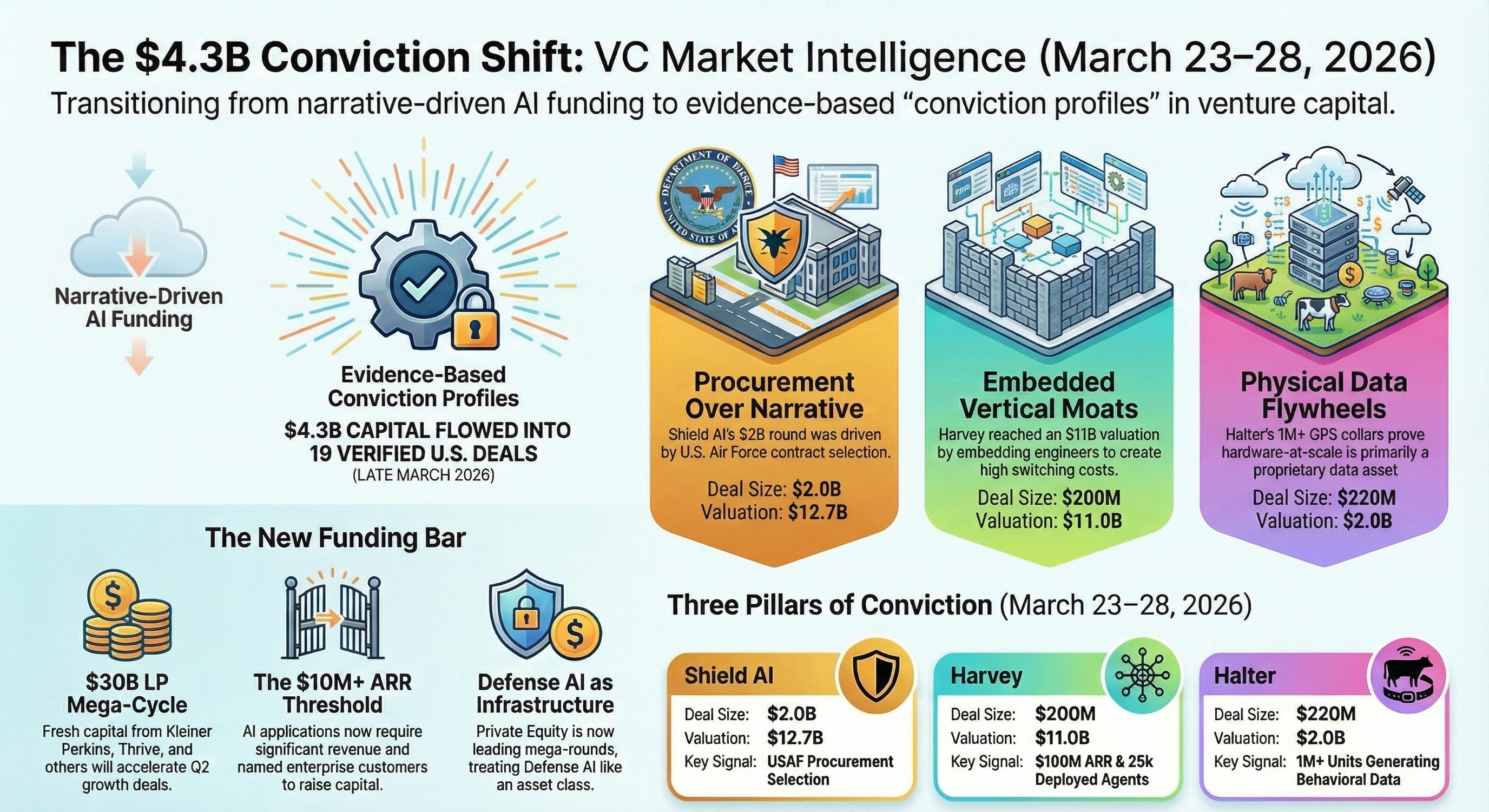
In the week of March 23–28, 2026, Defense AI and legal AI are clear winners. Shield AI raised $2 billion at a $12.7 billion valuation (more than doubling its value in 12 months) after the U.S. Air Force selected its Hivemind autonomy software for the Collaborative Combat Aircraft program. That is not investor enthusiasm. That is procurement-validated conviction.
Harvey closed $200M at $11 billion (jumping $3B in valuation in three months), with $190M ARR, 100,000+ lawyers on the platform, and Sequoia leading for the third consecutive round. Legal AI is no longer a vertical experiment. It is a category with a clear winner.
Meanwhile, Kleiner Perkins raised $3.5 billion across two funds, joining Thrive Capital ($10B), General Catalyst (~$10B target), and Founders Fund ($6B) in the largest LP capital deployment cycle in venture history.
The dry powder is loaded. Q2 is the deployment window.
DEAL SCORECARD
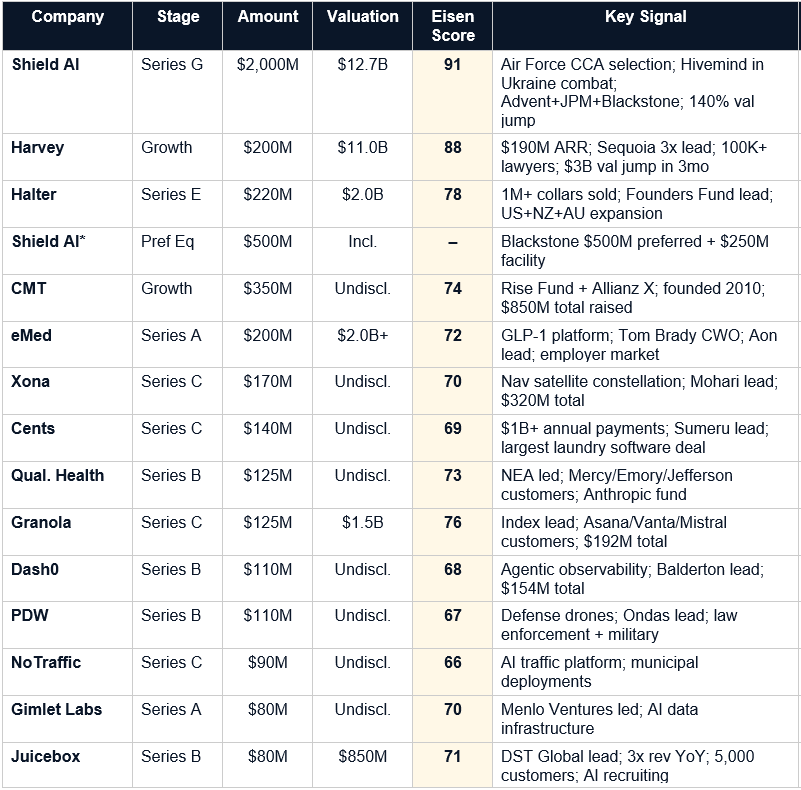
What the scorecard says at a glance: Shield AI scores highest (91) because this is a procurement story. The U.S. Air Force selected Hivemind for the CCA program in February, and capital followed the contract. Harvey (88) is the week’s second signal: $190M ARR with Sequoia leading three consecutive rounds is the strongest traction-to-conviction conversion in vertical AI. Granola (76) jumped to $1.5B on $125M in funding because meeting AI crossed from a tool to enterprise infrastructure. Halter (78) proved that the data flywheel thesis from robotics applies identically to agtech - 1 million GPS collars generating proprietary behavioral data. The week’s median Eisen Score (71) reflects a market where capital is going to companies with demonstrable traction, not narrative positioning.
WHAT CHANGED THIS WEEK: 5 MARKET SHIFTS
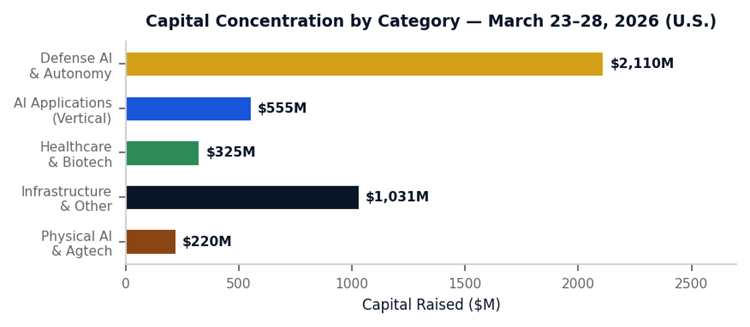
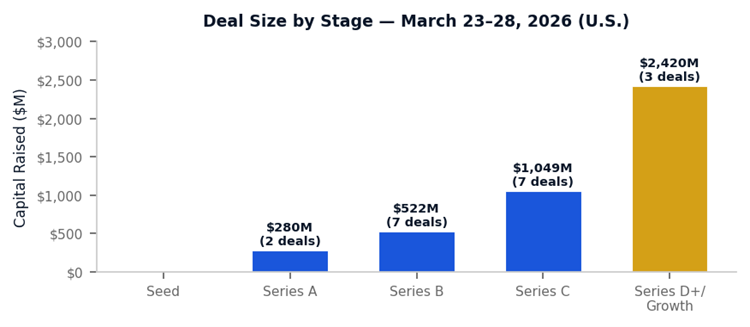
SHIFT 1: DEFENSE AI CROSSED THE $2B SINGLE-WEEK THRESHOLD - AUTONOMY IS NOW PROCUREMENT, NOT THESIS
Pattern: Shield AI raised $2B at $12.7B (Advent + JPMorgan + Blackstone, March 26). Performance Drone Works raised $110M Series B (Ondas lead). Combined: $2.1B into defense AI in one week. Shield AI’s valuation jumped 140% in 12 months. The catalyst: U.S. Air Force CCA program selection in February 2026.
Perspective: This round was not led by traditional VCs. Advent International (PE), JPMorgan’s Security and Resiliency Initiative, and Blackstone are institutional capital allocators who underwrite government contracts, not narratives. When PE firms lead $1.5B rounds in defense AI, the sector has crossed from venture thesis to infrastructure asset class. Shield AI’s Hivemind ran autonomously on the same drone as Anduril’s Lattice in the same flight test. The Pentagon is now treating autonomy software as interchangeable modules, not proprietary stacks. That is a procurement architecture shift.
Founder blindspot: Founders see Shield AI’s $12.7B and think ‘defense tech is hot.’ Wrong lesson. Shield AI earned this valuation because its software was selected by the Air Force through a formal procurement process. Over 130 combat sorties in Ukraine validated the technology in contested environments. Institutional capital followed a government contract, not a demo day. The moat is not the technology. It is the production-validated deployment record that no competitor can replicate without years of operational data.
Playbook: If you are building defense or government technology, stop positioning as ‘AI for defense.’ Start positioning as ‘procurement-ready infrastructure with validated deployment data.’ Identify the specific government program your product fits. Write your pitch around the program name, the constraint it addresses, and the deployment evidence you have. Government buyers do not fund these; they fund solutions to named requirements.
Contrast: In 2024, defense AI rounds were led by venture firms at $200–500M. In March 2026, a $1.5B round was led by Advent International (PE) with JPMorgan and Blackstone, the same capital structure you see in defense primes. The investor profile has changed. The round size has changed. The valuation methodology has changed. Defense AI is being underwritten like infrastructure, not like software.
What this means for your raise: If your product has government or enterprise production deployments, lead with the deployment record. Institutional capital is now flowing to defense AI, but only to companies with validated operational data, not pitch decks.
SHIFT 2: LEGAL AI REACHED $11B - VERTICAL AI IS THE NEW ENTERPRISE SOFTWARE PLAYBOOK
Pattern: Harvey raised $200M at $11B (GIC + Sequoia co-lead, March 25). $190M ARR confirmed. 100,000+ lawyers across 1,300 organizations. Sequoia has now led three rounds in Harvey, a rarity the firm calls the ‘ultimate sign of conviction.’ Steno raised $49M Series C in legal services the same week. Valuation jumped from $8B to $11B in three months.
Perspective: Harvey is not a legal chatbot. It is a workflow operating system with 25,000+ custom agents running contract analysis, due diligence, and litigation workflows. Pat Grady at Sequoia compared Harvey to Salesforce during the cloud transition, the company that defined what it means to be a native application company in its era. The investor logic: professional services firms have $800B+ in annual spend. The company that becomes the operating system for legal work captures recurring revenue at Salesforce-like margins. The $11B is not a bet on AI. It is a bet on platform lock-in.
Founder blindspot: Founders see Harvey and think, ‘I should build AI for [industry].’ That misses the critical differentiator. Harvey does not sell features. It embeds legal engineers directly inside customer organizations who build and maintain the agents. That embedded engineering model creates switching costs no API wrapper can replicate. The lesson is not ‘vertical AI is hot.’ It is ‘embedded delivery converts tool revenue into infrastructure revenue.’
Playbook: If you are building vertical AI, design your delivery model before your product roadmap. Harvey’s legal engineers embedded inside law firms is the difference between $190M ARR and $19M ARR. Ask yourself: Does my customer need ongoing configuration, customization, or optimization? If yes, embed your team inside theirs. That relationship becomes your moat. Not the model. Not the features. The ongoing embedded relationship.
Contrast: In 2024, vertical AI companies raised at $1–3B with 50–70% gross margins. In March 2026, Harvey raised at $11B with an embedded delivery model that creates enterprise lock-in. The playbook shifted from ‘build an AI product for an industry’ to ‘become the operating system for an industry’s core workflows.’
What this means for your raise: Sequoia leading three consecutive rounds in the same company is the single strongest conviction signal in venture. If you are building vertical AI, your competitive question is not ‘is my AI better?’ Am I embedded deeply enough that switching costs compound over time?’
SHIFT 3: THE LP MEGA-CYCLE IS THE BIGGEST FUNDRAISING SIGNAL OF Q1 2026
Pattern: Kleiner Perkins raised $3.5B ($1B early + $2.5B growth, March 24). Thrive Capital secured $10B. General Catalyst targeting ~$10B. Founders Fund closed $6B for its fourth growth vehicle. Combined: $30B+ in new LP commitments to four firms in Q1 2026. This is the largest simultaneous fund deployment cycle in venture history.
Perspective: When four of the most active firms in your deal pipeline are simultaneously sitting on record dry powder, deal pace accelerates. Kleiner Perkins framed its raise around what it calls the ‘AI super-cycle’ — a period where AI-native companies reach product-market fit and scale faster than in any previous technology wave. The $2.5B growth vehicle is specifically designed to take meaningful ownership stakes before IPOs. That means growth rounds will get larger, faster, and more competitive in Q2. Founders with traction will see term sheets before they ask.
Founder Blindspot: Founders see mega-fund announcements and think ‘there’s more money available.’ Partially right. But the critical nuance: these funds are concentrated in 5 partners writing $50–200M+ checks into companies already doing $20–50M ARR. If you are pre-revenue or sub-$5M ARR, this capital is not for you. It is for the company of two stages ahead of you. The mega-cycle increases competition at the growth stage and has no effect at the seed.
Playbook: If you are at $10M+ ARR with 100%+ growth: move your fundraising timeline forward by one quarter. These funds will deploy aggressively in Q2–Q3 2026. Build your target list around the specific partners at these firms and the sectors they have deployed into in the last 90 days. Do not target the firm. Target the partner. Kleiner’s Mamoon Hamid and Ilya Fushman have specific sector theses: match your company to the partner, not the brand.
Contrast: In 2024, growth-stage funds averaged $2–4B in size. In Q1 2026, four firms raised a combined $30B+ in a single quarter. The competition for growth-stage deals will be the most intense since 2021, but with a critical difference: these funds are underwriting to revenue, not narrative.
What this means for your raise: Q2 2026 may be the highest-conviction growth-stage deployment window since Q1 2025. If your proof stack is ready, raise now. If it is not ready, do not rush; these funds will also create more demanding diligence standards.
SHIFT 4: DATA FLYWHEELS NOW WORK OUTSIDE THE FACTORY - HALTER PROVES THE THESIS SCALES
Pattern: Halter raised $220M Series E at $2B valuation (Founders Fund lead, March 24). The New Zealand-born agtech company has sold 1 million+ GPS collars that use AI and audio cues to virtually herd cattle, with no physical fences required. The company is expanding across the U.S., New Zealand, Australia, and into new markets.
Perspective: Two weeks ago, Mind Robotics raised $500M Series A on the ‘captured deployment’ thesis: Rivian’s factory generates proprietary operational data that trains AI models. Halter is the same thesis applied to agriculture. Each GPS collar generates continuous behavioral data, including movement patterns, grazing habits, and health signals, that trains the AI to manage herds more effectively. The more collars deployed, the better the model. The flywheel is identical to Mind Robotics, but the environment is a ranch rather than a factory.
Founder Blindspot: Founders in physical industries think the data flywheel thesis only applies to manufacturing or robotics. Halter proves it applies to any situation where repetitive physical processes generate continuous data streams. Ranching. Logistics. Construction. Agriculture. Healthcare operations. If your business involves physical processes that generate data, that data is a potential AI training asset - Founders Fund just valued it at $2B.
Playbook: Revisit the data flywheel audit from last week. If you operate in any physical environment, map your operational data streams again with this expanded lens. The question is not ‘do we have factory data?’ It is ‘do we have continuous, proprietary data from physical operations that compounds in value with scale?’ Halter’s million collars generate data no competitor can replicate. What is your equivalent?
Contrast: On March 9–15, Mind Robotics proved the data flywheel thesis works in factories. From March 23–28, Halter proved it works on ranches. The thesis is expanding across physical environments. The common denominator: proprietary operational data at scale, not hardware.
What this means for your raise: The data flywheel thesis now applies to any physical industry. If you generate continuous operational data from physical processes, that data is an investable asset. Frame it as a flywheel, not a feature.
SHIFT 5: AI APPLICATIONS ARE WINNING THE TRACTION WAR - REVENUE BEATS NARRATIVE
Pattern: Harvey: $190M ARR, $11B. Granola: $125M Series C at $1.5B (Index Ventures, customers include Asana, Vanta, Mistral AI). Juicebox: $80M Series B at $850M (DST Global, 3x revenue YoY, 5,000 customers). Qualified Health: $125M Series B (NEA lead, deployed at Mercy, Emory, Jefferson Health). The AI application layer absorbed $530M+ this week across four companies, all with named enterprise customers and disclosed traction metrics.
Perspective: March 2026’s Crunchbase data shows U.S. startup funding slowed dramatically from February’s $189B record (driven by OpenAI's $110B, Anthropic's $30B, and Waymo's $16B). But early- and seed-stage dealmaking remained close to prior months’ levels. The slowdown is in mega-rounds, not in application-layer companies with real revenue. Investors are separating ‘AI infrastructure bets’ (fewer, larger) from ‘AI application bets’ (more selective, traction-required). The bar for application-layer funding is now $10M+ ARR with named enterprise customers. Below that, you wait.
Founder Blindspot: Founders building AI applications think they are competing with other AI applications. They are not. They are competing with the implicit bar set by Harvey ($190M ARR), Granola (Asana/Vanta as customers), and Juicebox (5,000 customers, 3x revenue growth). If your application does not have named enterprise customers and measurable revenue growth, you are not in the same conversation. The bar rose this week.
Playbook: Before your next investor meeting, build a ‘proof stack’ slide with three components: (1) named enterprise customers, (2) measurable workflow impact (time saved, cost reduced, revenue generated), and (3) retention or expansion data (NRR, seat growth). Harvey’s 25,000 custom agents running across 1,300 organizations is a proof stack. Build yours.
Contrast: In 2024, AI application companies raised on narrative (‘we use GPT-4 to automate X’). In March 2026, $530M+ went to four companies that all had $10M+ ARR, named customers, and measurable business impact. The narrative window closed. The traction window is open.
What this means for your raise: The AI application layer is now a revenue competition, not a narrative competition. If you cannot show named customers, measurable impact, and revenue growth, wait until you can. The bar is $10M+ ARR with enterprise proof.
THE DEALS THAT MATTER: TOP 5
SHIELD AI
Defense AI / Autonomy | Series G | $2.0B | $12.7B.
EISEN FUNDABILITY SCORE: 91 / 100
Why this scored: The highest score this week reflects the rarest combination in venture: production-validated technology (130+ combat sorties in Ukraine), formal government procurement selection (U.S. Air Force CCA program), institutional capital structure (Advent PE + JPMorgan + Blackstone), and 80%+ projected revenue growth. This is not a funding round. It is a defense infrastructure investment.
The Setup: Founded in 2015 by former Navy SEAL Brandon Tseng, Shield AI builds Hivemind, an AI autonomy software that pilots aircraft and drones without human control in GPS-denied, communications-severed environments. The company’s V-BAT drone has logged 130+ sorties in active combat in Ukraine against Russian electronic warfare. In February 2026, the U.S. Air Force selected Hivemind for the Collaborative Combat Aircraft program, the first time autonomy software was decoupled from the aircraft hardware.
The Numbers: $1.5B Series G + $500M Blackstone preferred equity (March 26, 2026) | $12.7B post-money valuation (up from $5.3B one year ago, +140%) | Leads: Advent International + JPMorgan Chase Security & Resiliency Initiative | Blackstone: $500M preferred + $250M delayed draw facility | Revenue: projecting $540M+ in 2026 (80%+ growth) | Acquisition: Aechelon Technology (Pentagon simulation systems) | Board: Advent Chairman David Mussafer joining.
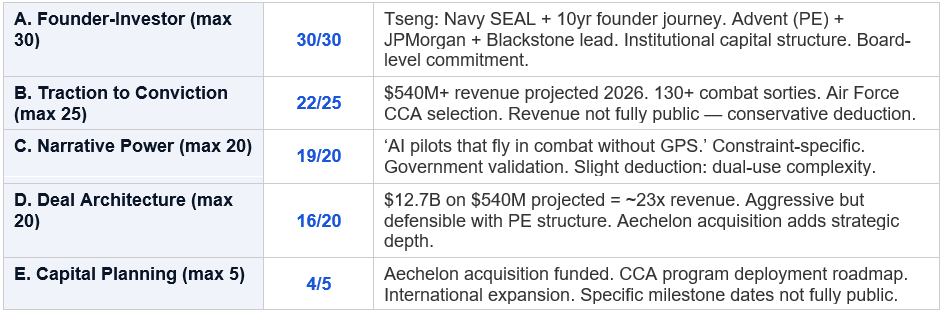
Fundability Lessons: Shield AI represents a new venture deal category - defense infrastructure financing. The investor profile (Advent, JPMorgan, Blackstone) looks more like a defense prime capital stack than a startup round. The Aechelon acquisition adds simulation capabilities - the same technology the Pentagon uses to validate autonomous systems before live flight.
The key lesson: at $500M+ scale, the most fundable proof is not a customer list. It is a formal government procurement selection backed by operational deployment data from active conflict zones.
Your Takeaway: If you build for government or enterprise customers, lead with procurement validation, not technology demonstrations. Shield AI’s $12.7B is priced off the Air Force CCA selection, not off a pitch deck. Identify the specific procurement program your product fits and position every investor conversation around that program.
The Founder Mistake to Avoid: Founders see Shield AI’s round and want to build ‘AI for defense.’ Wrong lesson. Shield AI’s edge is 130+ combat sorties of validated data in contested environments. You cannot replicate that with a prototype. The lesson is that operational deployment data in high-stakes environments creates a moat that no amount of engineering talent can overcome. If you cannot deploy in the actual operating environment, you cannot compete.
HARVEY
Legal AI / Vertical SaaS | Growth | $200M | $11.0B
EISEN FUNDABILITY SCORE: 88 / 100
Why this scored: Sequoia leading three consecutive rounds in the same company is the single strongest conviction signal in venture. $190M ARR, 100,000+ lawyers, 1,300 organizations, and a $3B valuation jump in three months. This is the clearest example of traction-to-conviction conversion in 2026.
The Setup: Founded in 2022 by former lawyer Winston Weinberg and former Google DeepMind researcher Gabe Pereyra, Harvey builds AI-powered legal workflow infrastructure. The platform runs 25,000+ custom agents handling contract analysis, due diligence, compliance, and litigation. Customers include most of the AmLaw 100, NBCUniversal, HSBC, and DLA Piper International.
The Numbers: $200M (March 25, 2026) | $11B valuation (up from $8B in December 2025, $5B in June 2025, $3B in February 2025) | Co-leads: GIC + Sequoia Capital | Co-investors: a16z, Coatue, Conviction Partners, Elad Gil, Evantic, Kleiner Perkins | $190M ARR | 100,000+ lawyers | 1,300 organizations | 60 countries | $1B+ total funding raised.
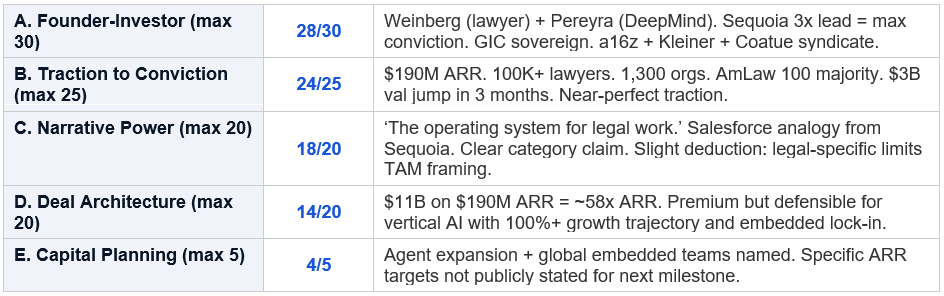
Fundability Lessons: Harvey’s embedded legal engineering model is the critical differentiator. The company deploys engineers directly inside client organizations to build and maintain custom agents. This creates switching costs that compound over time. The longer Harvey operates within a firm, the more custom agents there are, and the harder it becomes to replace them. Pat Grady at Sequoia compared Harvey to Salesforce during the cloud transition.
The key lesson: at $10B+, the moat is not the AI model. It is the embedded operational relationship.
Your Takeaway: If you are building vertical AI, your delivery model is your moat. Harvey’s embedded engineering teams create switching costs no API wrapper can replicate. Design your customer relationship around embedded delivery before you scale your product.
The Founder Mistake to Avoid: Founders see Harvey’s $11B and want to build ‘AI for [their industry].’ The mistake is assuming the AI model is the differentiator. Harvey’s edge is the 25,000 custom agents already running inside 1,300 organizations. That is operational lock-in, not technology leadership. Any competitor can match the model. No competitor can match 25,000 deployed agents.
HALTER
Agtech / Physical AI | Series E | $220M | $2.0B
EISEN FUNDABILITY SCORE: 78 / 100
Why this scored: The data flywheel thesis from robotics (Mind Robotics, March 9–15) now applies to agriculture. Halter’s 1 million+ GPS collars generate proprietary behavioral data from cattle herds that no competitor can replicate. Founders Fund leading at $2B validates the thesis expansion.
The Setup: Halter, originally from New Zealand, builds GPS-enabled ‘virtual fencing’ collars that use AI, GPS, and gentle audio cues to let ranchers herd cattle remotely from a smartphone. No physical fences required. The company has sold over 1 million collars and works with thousands of ranchers across the U.S., New Zealand, and Australia.
The Numbers: $220M Series E (March 24, 2026) | $2B valuation | Lead: Founders Fund | Co-investors: Blackbird, DCVC, Bond, Bessemer | 1M+ collars sold | Thousands of ranchers | U.S., NZ, AU expansion | Hiring hundreds of new staff.
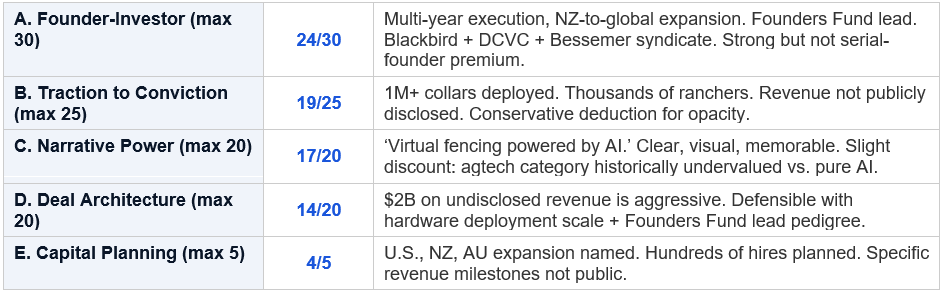
Fundability Lessons: Halter validates a principle first demonstrated by Mind Robotics two weeks earlier: hardware deployed at scale is not a product; it is a data-collection network. Each of Halter’s 1 million+ collars generates continuous behavioral data, including movement patterns, grazing optimization, and health signals, which feed back into the AI model. The more collars deployed, the smarter the system becomes for every rancher. That flywheel is identical to the one Rivian’s factory creates for Mind Robotics. Founders Fund leading at $2B confirms that the thesis generalizes across physical industries.
The key lesson: if you operate in a physical environment and can deploy proprietary hardware at scale, the data generated by that hardware is worth more than the hardware itself. Frame your fundraiser around the data asset and the improvement to the compounding model, not the device.
Your Takeaway: The data flywheel thesis is not limited to factories. Any physical environment where you deploy hardware that generates continuous proprietary data is a potential $2B+ company. Halter’s collars are the ranching equivalent of Mind Robotics’ factory sensors. Find your equivalent.
The Founder Mistake to Avoid: Founders see Halter and think, ‘I need to build hardware.’ Wrong. The hardware is the data collection mechanism. The value is the AI model trained on a million collars’ worth of behavioral data. The moat is the data, not the collar.
GRANOLA
AI Productivity / Enterprise | Series C | $125M | $1.5B
EISEN FUNDABILITY SCORE: 76 / 100
Why this scored: Meeting AI crossed from personal tool to enterprise infrastructure. Granola’s pivot from on-device transcription to a team collaboration platform, with customers like Asana, Vanta, and Mistral AI, earned a $1.5B valuation and total raised of $192M. Index Ventures leads with enterprise-grade conviction.
The Setup: Covers the origin as a privacy-first on-device transcription app, the deliberate pivot to enterprise with Spaces and API access, and how Asana/Vanta/Mistral AI adoption validated the personal-to-team conversion.
The Numbers: $125M Series C (March 25, 2026) | $1.5B valuation | Lead: Index Ventures (Danny Rimer) | Co-investors: Kleiner Perkins (Mamoon Hamid), Lightspeed, Spark, NFDG | $192M total raised | Customers: Asana, Vanta, Mistral AI | Enterprise API + Spaces (team collaboration).
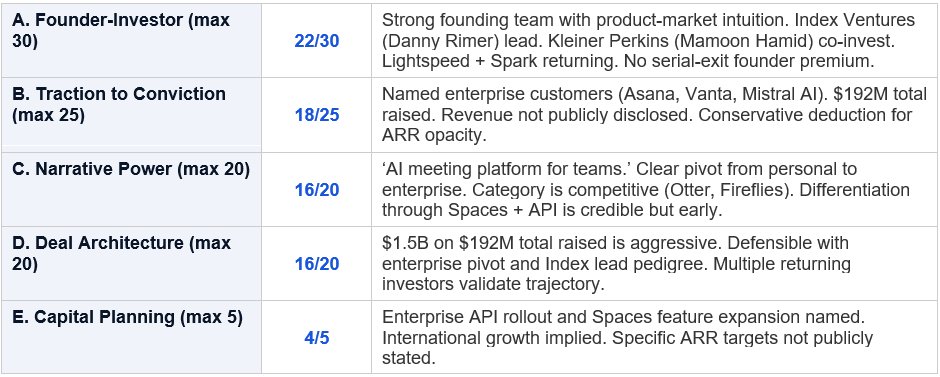
Fundability Lessons: Granola’s trajectory illustrates a repeatable playbook: start as a personal tool to build distribution, then pivot to enterprise to build revenue. The on-device meeting transcription app created organic adoption among individual knowledge workers. Once enough individuals within organizations were using Granola, the company launched Spaces (shared workspaces) and enterprise APIs, converting personal users into team buyers. Index Ventures' $1.5B lead confirms the conversion worked.
The key lesson: consumer-grade adoption is a wedge, not a business model. The business model is the enterprise contract that follows. If you are building a productivity tool, design the personal-to-team conversion path before you launch. Granola’s $1.5B valuation is based on the enterprise transition, not consumer traction.
Your Takeaway: Personal productivity tools hit a ceiling. Enterprise collaboration tools hit a flywheel. Granola’s pivot from ‘my meeting notes’ to ‘our team’s meeting intelligence’ is the same transition that took Slack from messaging app to enterprise platform. If your product is still positioned as a personal tool, you are leaving 90% of your TAM on the table.
The Founder Mistake to Avoid: Founders in AI productivity see Granola’s $1.5B and think the meeting AI market is huge. The market for meeting transcription is not huge. The market for enterprise workflow intelligence extracted from meetings is. Granola’s value is not in the transcript — it is in the structured data and action items that flow from it into team workflows.
QUALIFIED HEALTH
AI Healthcare / Enterprise | Series B | $125M | Undisclosed
EISEN FUNDABILITY SCORE: 73 / 100
Why this scored: NEA is leading a $125M Series B for a healthcare AI platform already deployed at Mercy, Emory, Jefferson Health, and the University of Texas system. The Anthology Fund (Menlo Ventures/Anthropic) participating signals infrastructure-grade AI capability. Healthcare AI rounds are getting larger as hospital systems move from pilots to production.
The Setup: Covers the Palo Alto-based enterprise AI platform model, the infrastructure layer positioning (not a single AI tool), production deployments at Mercy/Emory/Jefferson/UT, and the Anthology Fund (Menlo/Anthropic) signal on frontier AI integration.
The Numbers: $125M Series B (March 25, 2026) | Lead: NEA | Co-investors: Transformation Capital, GreatPoint Ventures, Cathay Innovation, Anthology Fund (Menlo/Anthropic) | Customers: Mercy, Emory, Jefferson Health, UT system | Platform: enterprise AI for clinical and administrative workflows.
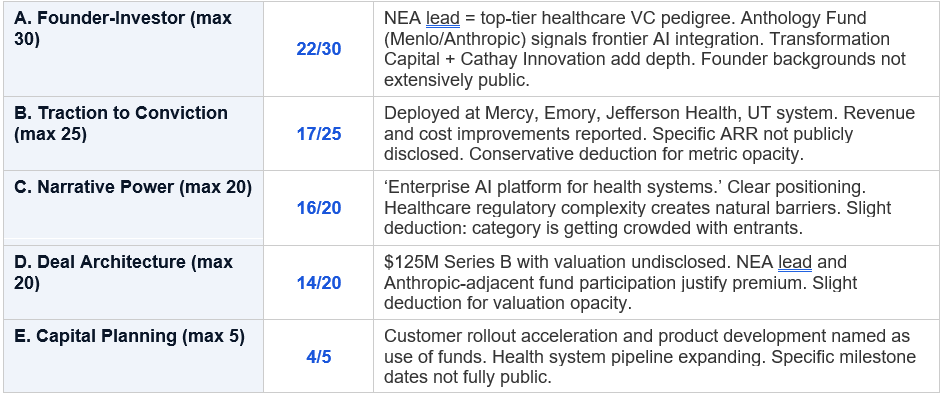
Fundability Lessons: Qualified Health demonstrates the ‘platform sale’ thesis in healthcare AI. The company is not selling a single AI tool. It is selling an enterprise AI platform that hospital systems use to deploy and scale AI across both clinical and administrative workflows. That platform positioning converts a single-product sale into an ongoing infrastructure contract. NEA leading at $125M confirms the thesis. The Anthology Fund (Menlo Ventures/Anthropic) participating adds a critical signal: Anthropic’s involvement suggests the platform is built on frontier AI capabilities rather than commoditized models.
The key lesson: in healthcare AI, the winning position is ‘enterprise platform that IT and clinical leadership deploy across the organization,’ not 'a point solution that a single department uses.’ Platform sales create budget authority at the C-suite level. Point solutions compete for departmental budgets.
Your Takeaway: Healthcare AI is bifurcating. Consumer health AI (chatbots, symptom checkers) is a crowded, low-barrier category. Enterprise health AI (deployed inside hospital systems for clinical and administrative workflows) is a high-barrier, high-retention category with $125M+ rounds. If you are building healthcare AI, pick a side. The enterprise side has fewer competitors and larger rounds.
The Founder Mistake to Avoid: Founders see Qualified Health’s $125M and think, ‘I should build an AI tool for hospitals.’ Wrong scope. Qualified Health is not a tool. It is a platform that hospital systems use to manage all their AI deployments. The difference is critical: a tool serves one workflow, a platform serves every workflow. Hospitals will consolidate their AI vendors around 2–3 enterprise platforms. If your healthcare AI product is a single-workflow tool, you are building for acquisition, not for scale.
THIS WEEK PLAYBOOK: 5 DAYS, 5 DELIVERABLES
This week’s data gave you 5 shifts. Here is how to translate them into actions that alter raises.
1. PROCUREMENT POSITIONING: ARE YOU SOLVING A NAMED REQUIREMENT?
Why this matters: Shield AI raised $2B because the Air Force selected Hivemind for a named procurement program. Not because AI autonomy is hot. Because the CCA program needed the solution.
Deliverable: Identify the specific government program, enterprise initiative, or industry standard your product addresses. Write one sentence: ‘[Program/Initiative] requires [capability]. We are the only production-validated solution.’ Test it on two people outside your sector.
Expected outcome: A procurement-anchored positioning statement.
Wrong: ‘We build AI for defense.’
Right: ‘The CCA program requires autonomous flight in GPS-denied environments. We are the only software validated through 130+ combat sorties.’
2. EMBEDDED DELIVERY DESIGN: HOW DEEP ARE YOU INSIDE YOUR CUSTOMER?
Why this matters: Harvey’s $11B valuation is built on embedded legal engineers inside client organizations, not on AI features. The delivery model is the moat. H
Deliverable: Design your ‘embedded delivery’ model. For your top 3 customers: (1) Who is your embedded point of contact? (2) How many custom configurations exist? (3) What would break if they switched? If the switching cost is low, your moat is weak.
Expected outcome: A switching-cost analysis that either validates your moat or reveals the gap.
3. PROOF STACK BUILD: EISEN FUNDABILITY SELF-SCORE.
Why this matters: Shield AI scored 91/100 and Harvey scored 88/100 this week. Both scores reflect specific, verifiable evidence across all five fundability dimensions. Most founders score 55–70 on honest self-assessment.
Deliverable: Score yourself. Find your 2 lowest scores. For each, write one concrete action that moves it 5+ points in 30 days.
Expected outcome: A clear picture of why your raise is not closing faster, and a specific 30-day sprint plan.
4. LP CAPITAL MAPPING: WHO HAS FRESH DRY POWDER?
Why this matters: Kleiner Perkins ($3.5B), Thrive ($10B), General Catalyst (~$10B), and Founders Fund ($6B) all have record amounts of fresh capital. The partners at these firms need to deploy. That creates urgency on their side, not just yours.
Deliverable: Build a ‘fresh capital’ target list. For each firm: (1) Recent fund size, (2) Named partners and their sector focus, (3) Last 3 deals they led. Match your company with the partner whose thesis best fits, not the firm with the biggest brand.
Expected outcome: A thesis-matched target list of 5–10 partners (not firms) who have fresh capital and sector alignment.
5. TRACTION PACKAGING: BUILD YOUR PROOF STACK SLIDE.
Why this matters: Harvey ($190M ARR), Juicebox (5,000 customers, 3x revenue YoY), Granola (Asana/Vanta as customers) - every funded AI application company this week led with traction, not narrative.
Deliverable: Build a single ‘Proof Stack’ slide with three rows: (1) Named customers + their outcomes, (2) Revenue trajectory with growth rate, (3) Retention or expansion metric (NRR, seat growth, engagement). If you cannot fill all three rows, that gap is your fundraising obstacle.
Expected outcome: A one-slide proof stack that replaces narrative with evidence.
LOOKING FORWARD: NEXT 1–3 WEEKS
SCENARIO 1: DEFENSE AI M&A ACCELERATES (HIGH PROBABILITY)
Evidence: Shield AI is acquiring Aechelon Technology as part of this round. Anduril’s Fury is in serial production at Arsenal-1. The Pentagon’s FY2026 budget requests $13.4B for autonomous weapons. When defense AI companies acquire simulation and testing infrastructure, they are preparing for production scale, not research.
What to watch: Shield AI’s IPO timeline (‘definitive path to going public’ per board member). Anduril’s next production contract.
What founders should do: If you build defense-adjacent technology, build your strategic acquirer list now. Defense primes and well-capitalized defense AI companies are actively acquiring capabilities.
SCENARIO 2: Q2 GROWTH-STAGE DEAL PACE ACCELERATES DRAMATICALLY (HIGH PROBABILITY)
Evidence: $30B+ in fresh LP commitments to four top-tier firms. Kleiner Perkins explicitly framed its $2.5B growth fund around pre-IPO positioning. Thrive, GC, and Founders Fund are all sitting on record dry powder simultaneously.
What to watch: Term sheet velocity for companies at $20M+ ARR. Any pre-emptive rounds (offers before the founder starts a process).
What founders should do: If you are at $10M+ ARR with 100%+ growth, raise in Q2. The competition for your deal will be the highest in two years.
SCENARIO 3: VERTICAL AI CONSOLIDATION BEGINS (MEDIUM-HIGH PROBABILITY)
Evidence: Harvey at $11B with $1B+ total funding. Legal AI, healthcare AI, and fintech AI each have well-capitalized leaders. Five well-funded vertical AI companies in a single category is consolidation math.
What to watch: Any acquisition rumors involving Harvey, Qualified Health, or similar vertical AI leaders. Enterprise vendor consolidation announcements.
What founders should do: If you are a smaller vertical AI company in a category with a $5B+ leader, build your strategic acquirer relationships now.
WILD CARD: REFLECTION AI $2.5B AT $25B — OPEN-SOURCE VS. CLOSED-SOURCE SHOWDOWN (MEDIUM)
Evidence: Bloomberg reports Reflection, an Nvidia-backed open-source AI company, is in talks to raise $2.5B at a $25B valuation. If confirmed, this would be the largest open-source AI round ever. The open-source vs. closed-source dynamic could reshape competitive positioning for every AI startup.
What founders should do: Watch this closely. If Reflection closes, it changes the competitive landscape for any company building on proprietary models. Open-source with enterprise support may become the dominant go-to-market for AI infrastructure.
THE BOTTOM LINE
The real insight from this week is not that defense AI raised $2B or that legal AI hit $11B. The real insight is that capital is now flowing to three distinct conviction profiles, and the proof requirements for each are non-negotiable.
Profile 1: Procurement-validated infrastructure. Shield AI ($2B, $12.7B): Air Force CCA selection + 130+ combat sorties. The proof is a government contract backed by operational deployment data. No demo, no pilot, no POC - actual combat data.
Profile 2: Embedded vertical platforms with compounding traction. Harvey ($200M, $11B): $190M ARR, Sequoia 3x lead, 25,000 deployed agents. The proof is that switching costs compound with every new agent and every embedded engineer.
Profile 3: Physical data flywheels at deployment scale. Halter ($220M, $2B): 1M+ collars generating proprietary behavioral data. The proof is hardware-at-scale generating data that no competitor can replicate.
Everything else is competing for the remaining conviction capital. And with $30B+ in fresh LP commitments, that remaining capital is larger than ever, but more selective than ever.
5 NEW RULES FOR FOUNDERS (EVIDENCE-BASED)
Rule 1: Procurement validation outweighs product demonstration. Shield AI’s $12.7B was priced off an Air Force selection, not a pitch deck. If your product solves a named government or enterprise requirement, lead with the requirement, not the technology.
Rule 2: Embedded delivery is the new moat for vertical AI. Harvey’s $11B is built on legal engineers inside client organizations, not on AI model superiority. Design your delivery model to create compounding switching costs.
Rule 3: Data flywheels work in every physical environment. Halter proved the Mind Robotics thesis applies to ranching. If you generate continuous proprietary data from physical operations at scale, that data is an investable asset.
Rule 4: The LP mega-cycle is a deployment signal, not a comfort signal. $30B+ in fresh commitments means growth-stage competition intensifies in Q2. If your proof stack is ready, raise now. If it is not, the same capital creates higher bars.
Rule 5: The AI application bar is now $10M+ ARR with named enterprise customers. Harvey, Granola, Juicebox, and Qualified Health all crossed this threshold. Below it, you are not in the funded conversation. Above it, multiple firms will compete for your deal.
Your competitors are reading the same data. The founders who act fast own the narrative.
RESEARCH METHODOLOGY
Data collection period: March 23–28, 2026 (Crunchbase March 21–27 coverage window, full overlap with report scope).
Verification standard: minimum 2 independent sources per featured deal; official press releases prioritized.
Eisen Fundability Scores are proprietary analytical estimates, not endorsements or investment advice.
All dollar amounts reflect announced figures at close. Research completion timestamp: March 29, 2026.
Total deals tracked: 19 (U.S., verified).
Excluded: Reflection AI $2.5B (unconfirmed, ‘in talks’ per Bloomberg). OpenAI $10B treated as a round extension, excluded from weekly totals.
DISCLAIMER: This report is for informational and strategic intelligence purposes only. It does not constitute investment advice. Eisen Fundability Scores are analytical frameworks, not financial recommendations. All data is sourced from publicly available information and primary company announcements.