

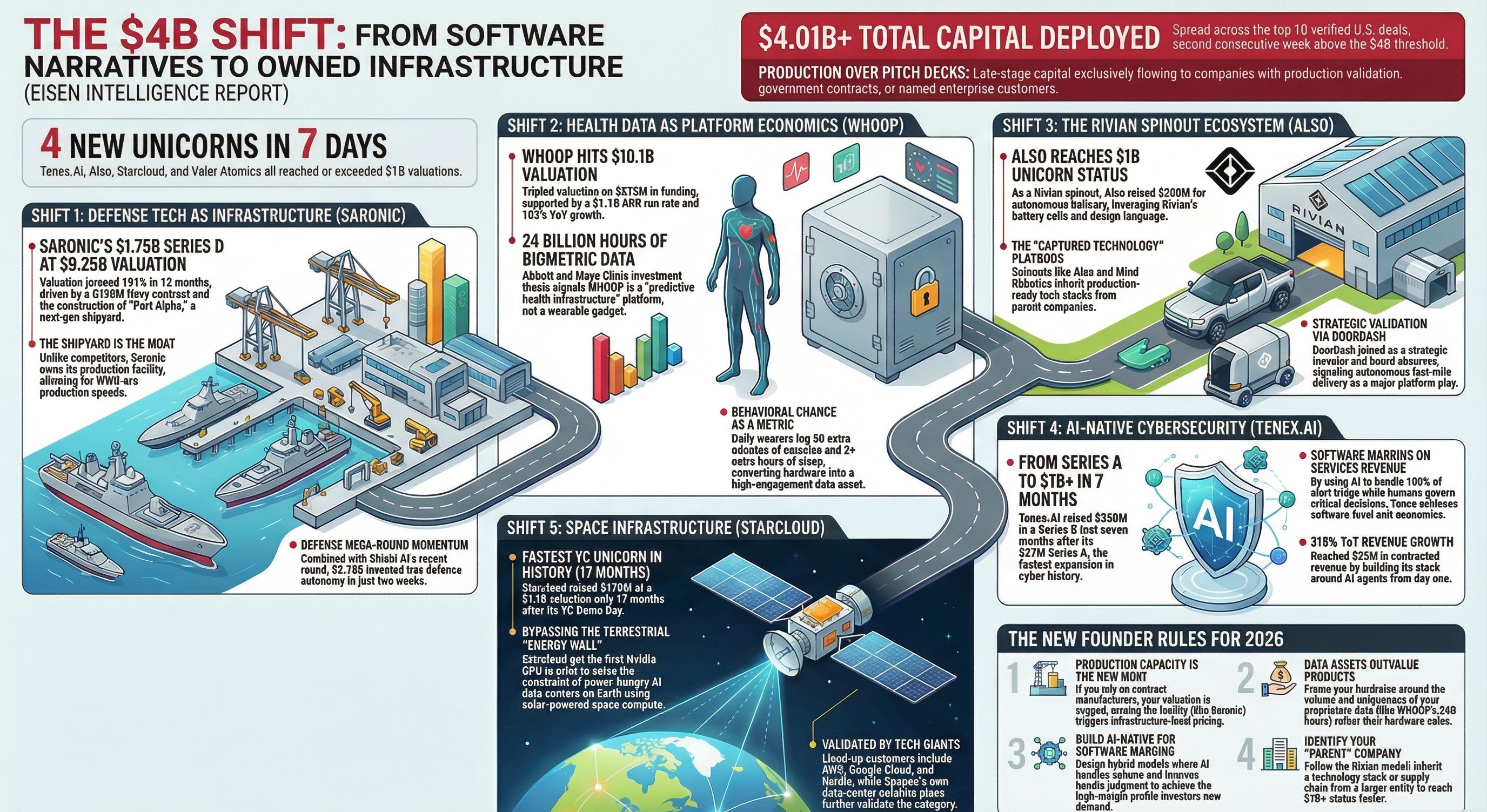
Ten deals. $4 billion. Defense tech mega-rounds are no longer an anomaly; it’s the new asset class.
In the week of March 30 - April 4, 2026, Saronic closed $1.75 billion at a $9.25 billion valuation to build autonomous ships at a pace the U.S. hasn’t seen since World War II. Kleiner Perkins led. Advent International, Bessemer, and a16z followed. One week after Shield AI raised $2 billion for autonomous drones, the same investor syndicate architecture is repeated: PE firms co-leading with top-tier VCs. Defense AI is no longer a venture category. It is infrastructure capital.
WHOOP tripled its valuation to $10.1 billion on $575 million in Series G funding, with Abbott, Mayo Clinic, QIA, and Mubadala as investors alongside Cristiano Ronaldo and LeBron James. A $1.1 billion ARR run rate, 2.5 million members, and 24 billion hours of biometric data make this a health platform story, not a wearable story. When sovereign wealth funds and healthcare institutions co-invest in the same round, the thesis is preventive health infrastructure.
Rivian’s third funded spinout in five months. Also raised $200 million at a $1 billion valuation, with DoorDash as a strategic investor in autonomous last-mile delivery. Mind Robotics ($500M), Also ($200M), and the parent Rivian are now a $15B+ ecosystem of vertically integrated physical AI companies sharing technology, talent, and manufacturing.
DEAL SCORECARD
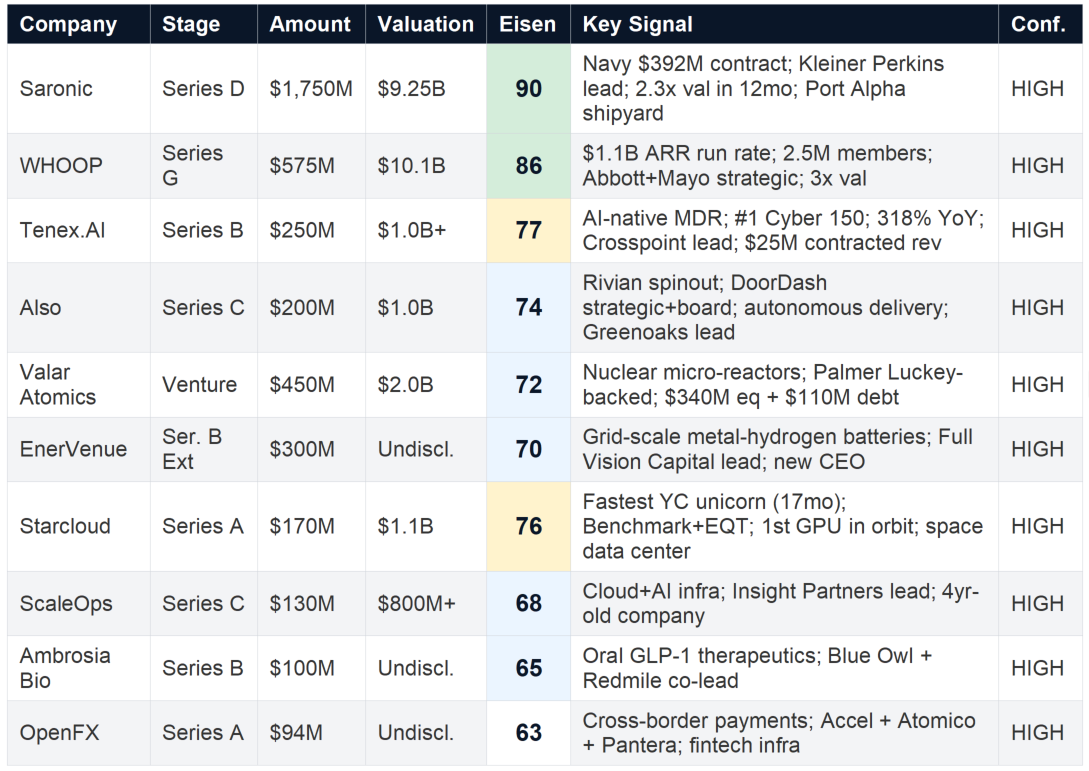
What the scorecard says at a glance
Saronic scores highest (90) because this is a production infrastructure investment. A $392 million Navy contract, Kleiner Perkins leading alongside Advent International and a16z, and a shipyard expansion plan modeled on WWII-era production rates.
WHOOP (86) scores on verified economics: $1.1 billion ARR run rate, 2.5 million subscribers, and a sovereign wealth and healthcare institution syndicate that signals platform, not product.
Starcloud (76) is the week’s wildcard: a 17-month-old company that put the first Nvidia GPU in orbit and convinced Benchmark to lead at $1.1 billion.
Tenex.AI (77) went from $27M Series A to $250M Series B in seven months, the fastest expansion in cybersecurity history, on $25M contracted revenue and 318% YoY growth.
WHAT CHANGED THIS WEEK: 5 MARKET SHIFTS
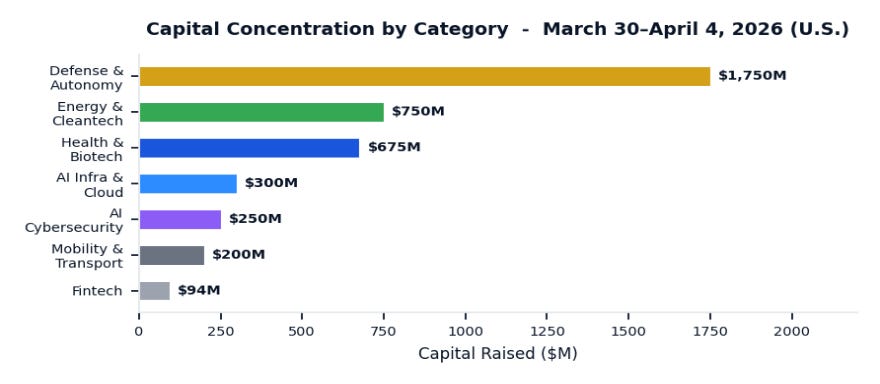
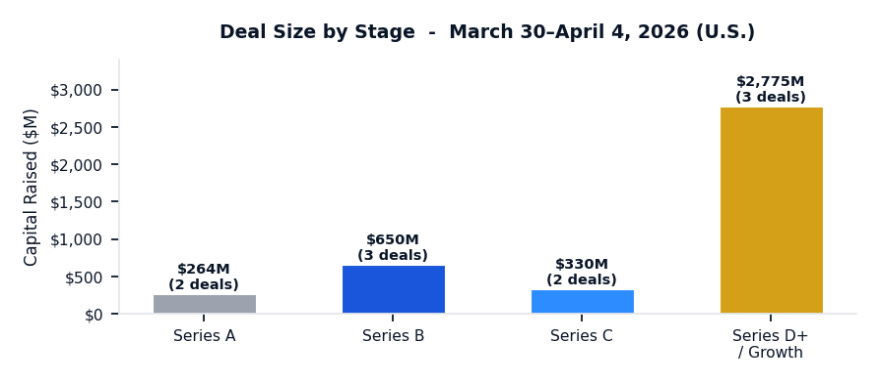
SHIFT #1: DEFENSE TECH IS NOW AN INFRASTRUCTURE ASSET CLASS - TWO CONSECUTIVE $1.5B+ WEEKS
PATTERN: Saronic raised $1.75B at $9.25B (Kleiner Perkins lead, Advent, Bessemer, a16z, March 31). Last week, Shield AI raised $2B at $12.7B (Advent + JPMorgan + Blackstone). Combined: $3.75B into defense autonomy in two consecutive weeks. Saronic’s valuation jumped 131% in 12 months (from $4B Series C). The catalyst: a $392M Navy production contract and DARPA Pulling Guard selection.
PERSPECTIVE: The investor architecture is the signal. Kleiner Perkins’ Ilya Fushman led Saronic, the same partner who sits on the boards of infrastructure companies in Kleiner’s $2.5B growth fund, which was raised just last week. Advent International appeared in both Shield AI and Saronic syndicates in consecutive weeks. When a PE firm co-invests with top-tier VCs in two defense rounds totaling $3.75B, they are building a defense portfolio, not making individual bets. Defense tech is being capitalized like defense primes were capitalized in the 1990s - as long-duration infrastructure assets.
FOUNDER BLINDSPOT: Founders see Saronic’s $9.25B and think “autonomous vehicles for the military.” Wrong frame. Saronic’s edge is that it owns the shipyard. The company is building Port Alpha, a next-generation production facility, alongside expanding its Louisiana site. It completed its first 180-foot Marauder hull in under six months. The moat is manufacturing capacity, not autonomy software. Any startup can write autonomy code. Almost none can build ships at scale in America.
PLAYBOOK: If you build defense technology, audit your production capacity story. Saronic, Shield AI, and Anduril all raised mega-rounds by demonstrating manufacturing infrastructure alongside technology. Write one slide that answers: “How many units can you produce per year, and what is the bottleneck?” If your answer is “we rely on a contract manufacturer,” your valuation ceiling is 3x lower than a vertically integrated competitor.
CONTRAST: In 2024, defense tech rounds topped out at $500M and were led by venture firms. In March 2026, two consecutive weeks produced rounds above $1.5B, led by PE firms (Advent, Blackstone), banks (JPMorgan), and growth VCs (Kleiner Perkins). The capital stack changed. The valuation methodology changed. Defense tech is underwritten like infrastructure.
What this means for your raise: If you build defense technology and own manufacturing capacity, lead with production rates. Institutional capital is pricing off manufacturing throughput, not technology demonstrations.
SHIFT #2: HEALTH DATA IS THE NEW PLATFORM ECONOMICS - WHOOP PROVES BIOMETRIC SUBSCRIPTIONS = $10B
PATTERN: WHOOP raised $575M at $10.1B (Collaborative Fund lead, March 31). Previous valuation: $3.6B. Subscribers: 2.5 million. ARR run rate: $1.1B (103% YoY). 24 billion hours of physiological data collected. Strategic investors: Abbott (diagnostics), Mayo Clinic (healthcare), QIA, Mubadala. Athlete investors: Cristiano Ronaldo, LeBron James, Rory McIlroy.
PERSPECTIVE: WHOOP’s investor syndicate tells the real story. When Abbott (the CGM and diagnostics company) and Mayo Clinic invest alongside sovereign wealth funds and elite athletes, the thesis is not “fitness tracking.” It is “predictive health infrastructure.” Abbott’s portfolio spans continuous glucose monitors, cardiac devices, and nutrition. Integration of Abbott’s diagnostic data with WHOOP’s 24 billion hours of biometric data would create the most comprehensive preventive health platform. The $10.1B valuation is a bet on that convergence, not on selling wristbands.
FOUNDER BLINDSPOT: Founders see WHOOP and think “consumer hardware.” Wrong category. WHOOP members open the app 8x per day, nearly 3x as often as comparable wearables. That engagement converts hardware into a data platform. Daily wearers log 90 extra minutes of exercise per week and 2+ extra hours of sleep. When a product measurably changes user behavior, it has crossed from tool to infrastructure. The hardware is a data collection mechanism. The value is the AI models trained on 24 billion hours of human biology.
PLAYBOOK: If you build a consumer subscription product, calculate your “data asset value.” How many hours/events/interactions have you collected? Is that data proprietary? Could it train a predictive model? WHOOP’s 24 billion hours of biometric data is its moat. Build a slide that shows your data volume, its uniqueness, and the predictive models it enables. That is your platform thesis.
CONTRAST: In 2024, wearable companies raised at 3–5x revenue. In March 2026, WHOOP raised at ~9x its $1.1B ARR run rate - but only because the syndicate signals a health platform thesis, not a hardware thesis. Abbott and Mayo Clinic do not invest in gadgets. They invest in health infrastructure.
What this means for your raise: If your product collects proprietary behavioral or biometric data at scale, that data is a platform thesis. Frame your fundraising around the data asset and the predictive models it enables, not the product form factor.
SHIFT #3: THE RIVIAN ECOSYSTEM IS NOW A $18B+ VENTURE LABORATORY
PATTERN: Also raised $200M Series C at $1B (Greenoaks lead, DoorDash strategic, March 31). This is the second Rivian spinout to reach unicorn status: Mind Robotics ($500M Series A at $2B, March 11) and now Also ($200M Series C at $1B, March 31). Total capital raised by Rivian spinouts alone: $700M+. DoorDash joining as a strategic investor and board observer signals autonomous delivery as the next platform play.
PERSPECTIVE: RJ Scaringe is running a venture studio inside a public company. Mind Robotics applies Rivian’s factory data to industrial robotics. Also applies Rivian’s battery cells, design language, and retail network to micromobility and autonomous delivery. Both share Eclipse as a common investor. Both leverage Rivian’s custom silicon and autonomy computer. This is not three separate companies. It is a vertically integrated platform ecosystem in which technology flows between entities, creating compounding advantages that no standalone startup can replicate.
FOUNDER BLINDSPOT: Founders see Rivian spinouts and think, “I need a parent company.” Wrong lesson. The lesson is captured, distributed, and shared through technology. Also, it doesn’t need to build its own battery chemistry, retail presence, or design capability. It inherits those from Rivian. If you are building a hardware company, identify the existing company whose technology stack, supply chain, or distribution you could leverage. That partnership is worth more than your seed round.
PLAYBOOK: Audit your value chain for “captured technology” opportunities. For each major component of your product: (1) Does a larger company already produce this at scale? (2) Would they benefit from a spinout or partnership? (3) Can you propose a relationship where their technology accelerates your product and your product creates a new market for their technology? Two “yes” answers = a spinout-style partnership thesis worth exploring before your next raise.
What this means for your raise: The Rivian model proves that captured technology + strategic distribution = premium multiples at pre-revenue. Identify your “Rivian” before your seed round.
SHIFT #4: AI CYBERSECURITY CREATED THE FASTEST UNICORN OF 2026
PATTERN: Tenex.AI raised $250M Series B at $1B+ (Crosspoint Capital lead, March 31). Previous round: $27M Series A (September 2025, also Crosspoint). The jump from $27M to $250M in seven months is among the fastest capital expansions in cybersecurity history. Contracted revenue: $25M. Growth: 318% YoY. Ranked #1 on the 2026 Cyber 150 by IT-Harvest. Founded in 2024 with prior backing from a16z.
PERSPECTIVE: Tenex built an AI-native from day one. The company didn’t retrofit AI onto an existing security platform - it built the entire detection, triage, investigation, and response stack around AI agents with human analysts governing decisions. As Crosspoint’s Zach Sivertson stated, enterprises are choosing AI-native over retrofitted solutions, and the growth validates that decision. The model delivers better gross margins than traditional software because AI handles volume while humans handle judgment. That economics flip - services with software margins - is what converted $25M in contracted revenue into a $1B+ valuation.
FOUNDER BLINDSPOT: Founders see Tenex and think “AI cybersecurity is hot.” The sharper lesson: Tenex raised $250M to hire more humans. In the AI era. On purpose. Their CEO, Eric Foster, said it explicitly: they are scaling human expertise alongside AI. The AI handles 100% of alert triage. Humans govern every decision. That hybrid model, where AI for speed, humans for judgment, is the investable thesis for any services industry where speed matters and mistakes are expensive.
PLAYBOOK: If you are building AI for any services industry (security, legal, healthcare, finance): design a hybrid model where AI processes 100% of volume and humans make 100% of critical decisions. Then calculate your unit economics as if you are a software company (AI-driven automation) delivering service outcomes (customer value). That margin profile is what gets $250M at $1B+ in under a year.
What this means for your raise: The AI-native services model, software margins on services revenue, is the fastest-growing category in cybersecurity. Build your economics story around that margin profile.
SHIFT #5: SPACE INFRASTRUCTURE CREATED THE FASTEST YC UNICORN IN HISTORY
PATTERN: Starcloud raised $170M Series A at $1.1B (Benchmark + EQT co-lead, March 30). Founded in January 2024. YC Demo Day was 17 months ago. First satellite (Starcloud-1) launched in November 2025 with an Nvidia H100 GPU - the first time an Nvidia GPU operated in orbit. First AI model trained in space. First Gemini inference run in orbit. Customers lined up: Crusoe, AWS, Google Cloud, Nvidia. SpaceX’s own 1M-satellite data center plan validates the category.
PERSPECTIVE: Benchmark’s Chetan Puttagunta called this the “early innings of a decades-long buildout.” That is infrastructure language, not startup language. The thesis: AI compute demand will exceed the capacity of the terrestrial power grid. By 2030, data centers will face an energy wall. Starcloud bypasses that constraint entirely with solar-powered computing in low Earth orbit. The $1.1B valuation on a $200M total raise is pricing in the optionality of that structural shift.
FOUNDER BLINDSPOT: Founders see “space data centers” and dismiss them as speculative. The counter-evidence: Starcloud launched an actual GPU into orbit, trained an actual AI model, and ran actual Gemini inference, all for $3M in pre-seed capital. SpaceX filed for 1 million data center satellites. Google launched Project Suncatcher. The category is validated by the largest tech players. The question is not “will this work?” It is “who will own the infrastructure layer when it does?”
What this means for your raise: If you solve an AI infrastructure constraint - power, cooling, networking, compute access - frame it as a structural constraint-removal play. The most fundable pitch names the physics constraint, not the percentage improvement.
THE DEALS THAT MATTER
SARONIC
Defense Tech / Maritime Autonomy │ Series D │ $1.75B │ $9.25B
EISEN SCORE 90 / 100
Why this scored: The highest score this week reflects the defense infrastructure investment thesis at its most evolved: a $392M Navy production contract, DARPA program selection, Kleiner Perkins leading with Advent and a16z, a 131% valuation jump in 12 months, and vertically integrated shipbuilding capacity. This is not a startup round. It is a recapitalization of the defense industrial base.
The Setup: Founded by Dino Mavrookas, Saronic designs and manufactures autonomous surface vessels ranging from the 24-foot Corsair to the 180-foot Marauder. The company owns its manufacturing. Its Louisiana shipyard is undergoing a $300M expansion. It completed the first Marauder hull in under six months. Saronic is building Port Alpha, a next-generation production facility designed for WWII-era production velocity. Headcount: 1,300+ employees across Austin, San Diego, DC, UK, and Australia.
The Numbers: $1.75B Series D (March 31, 2026) │ $9.25B post-money valuation (up from $4B in 2025, +131%) │ Lead: Kleiner Perkins (Ilya Fushman) │ Co-investors: Advent International, Bessemer, DFJ Growth, BAM Elevate, 8VC, a16z, Elad Gil, Franklin Templeton │ Total raised: $2.6B │ $392M Navy production contract │ DARPA Pulling Guard selection (Feb 2026) │ 6 autonomous vessel iterations │ 1,300+ employees
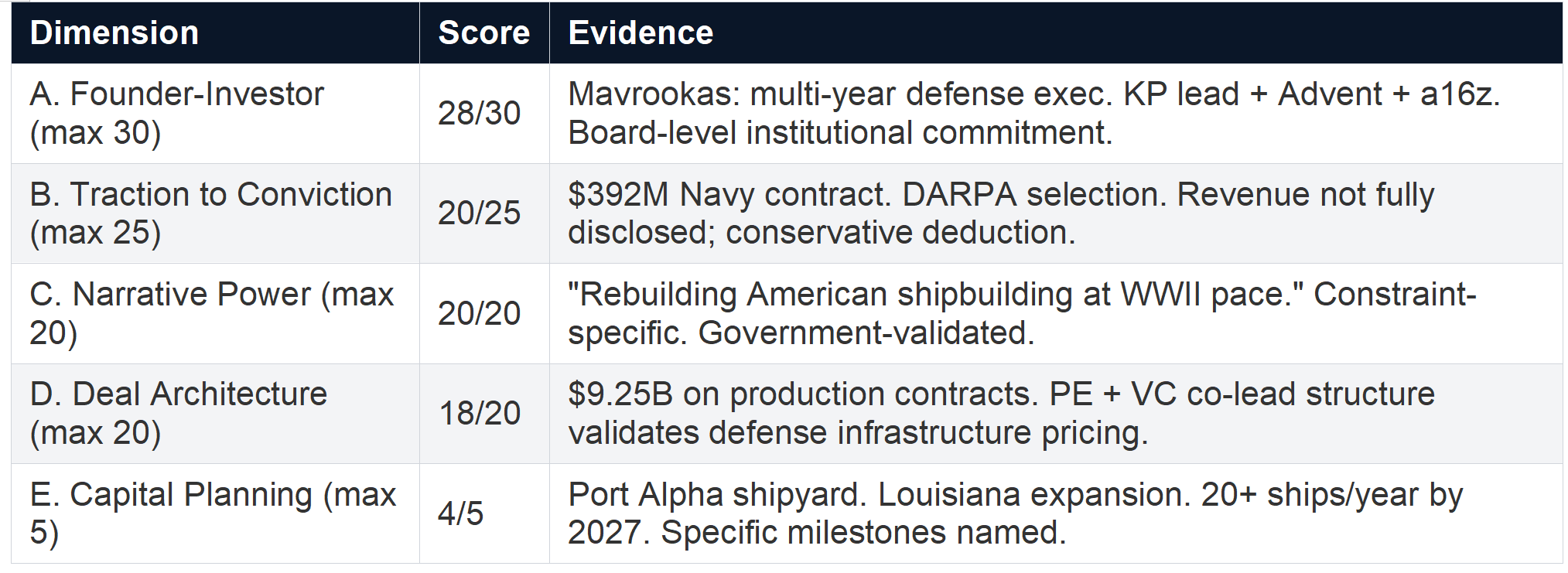
Fundability Lessons: Saronic’s round follows Shield AI ($2B, March 26) by five days. Two defense mega-rounds in one week, both featuring Advent International in the syndicate, both with government contract validation, both with vertically integrated manufacturing. The pattern is unmistakable: institutional capital is underwriting defense technology companies that own their production capacity. Kleiner Perkins’ Ilya Fushman stated that maritime dominance requires both technology and production capacity - and Saronic is building both. That dual thesis is why a company without disclosed revenue cleared $1.75B.
The key lesson: at $1B+ scale, the most powerful proof is not a customer list or a revenue figure. It is a government production contract combined with owned manufacturing infrastructure.
Your Takeaway: If you build defense or government technology, identify the specific production contract or procurement program your product serves. Then build or own the manufacturing capacity to deliver at scale. Saronic’s $9.25B is priced off the combination of the Navy contract and Port Alpha - not off a pitch deck about autonomy.
The Founder Mistake to Avoid: Founders see Saronic’s $1.75B and want to build “autonomous vehicles for the military.” Wrong lesson. Saronic’s edge is that it built a shipyard. The company can produce 20+ ships per year by 2027. No startup can replicate that manufacturing capacity in under three years. The moat is production scale, not autonomy software.
WHOOP
Health Data Platform / Wearables │ Series G │ $575M │ $10.1B
EISEN SCORE 86 / 100
Why this scored: The only consumer hardware company in recent memory to triple its valuation to $10.1B with sovereign wealth funds, a healthcare diagnostics leader, and a top medical institution co-investing. $1.1B ARR run rate (103% YoY), 2.5M members, 24 billion hours of physiological data, and cash flow positive in 2025. This is a platform economics story, not a gadget story.
The Numbers: $575M Series G (March 31, 2026) │ $10.1B post-money (nearly 3x from $3.6B) │ Lead: Collaborative Fund │ Strategics: Abbott, Mayo Clinic, QIA, Mubadala │ Athletes: Cristiano Ronaldo, LeBron James, Rory McIlroy │ $1.1B ARR run rate (103% YoY) │ 2.5M members │ 24B hours of physiological data │ Cash flow positive 2025 │ Hiring 600+ in 2026
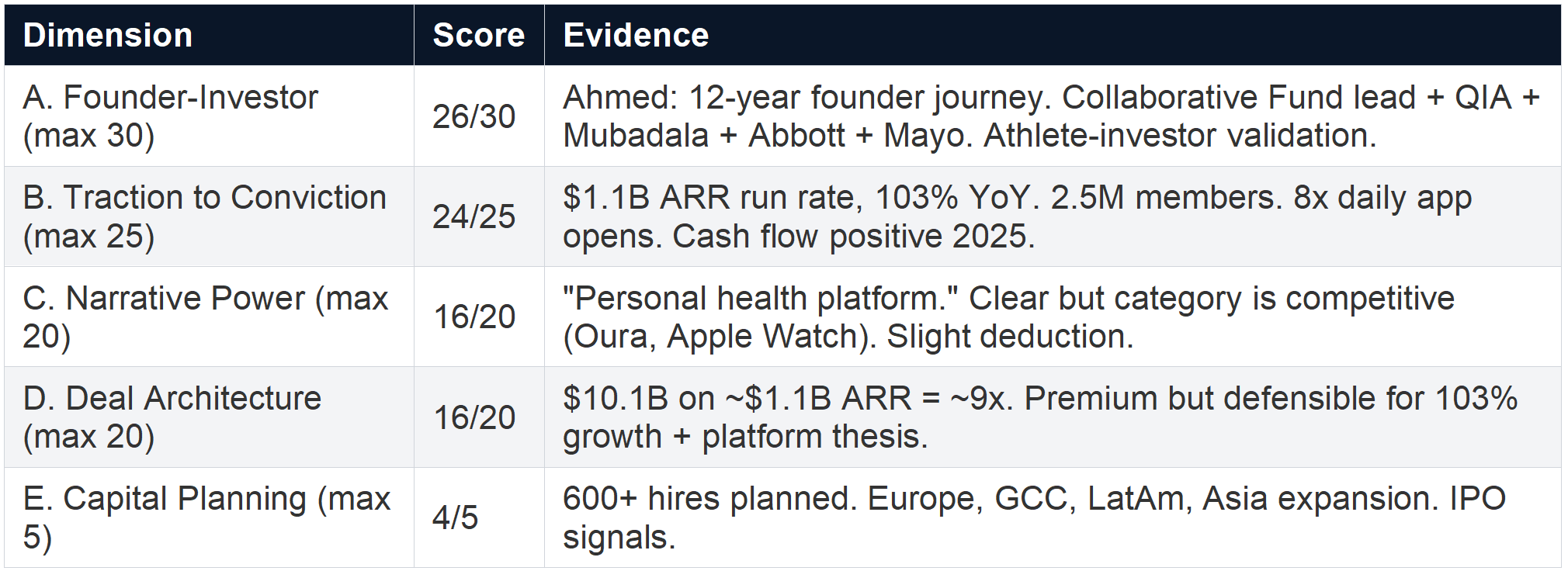
Fundability Lessons: WHOOP proves a principle that applies to any subscription product generating proprietary behavioral data: the data asset is worth more than the product. Abbott invested because WHOOP’s 24 billion hours of biometric data, combined with Abbott’s diagnostic capabilities, could create a preventive health platform. Mayo Clinic invested because the data could advance clinical research. The $10.1B valuation prices the convergence of consumer engagement, healthcare infrastructure, and AI-powered predictive models, not the hardware.
The Founder Mistake to Avoid: Founders see WHOOP’s $10.1B and want to build “health wearables.” Wrong lesson. WHOOP’s edge is 8x daily app engagement and 24 billion hours of proprietary data. The wristband is a sensor. The moat is behavioral change at scale: 90 extra minutes of exercise and 2+ extra hours of sleep per daily wearer. If your product does not measurably change user behavior, it is a gadget, not a platform.
THIS WEEK PLAYBOOK - 5 DAYS, 5 DELIVERABLES
This week’s data gave you 5 shifts. Here is how to translate them into actions that alter raises before Friday.
DAY 1 - PRODUCTION CAPACITY AUDIT: CAN YOU BUILD AT SCALE?
Why this matters: Saronic raised $1.75B and Shield AI raised $2B because they own manufacturing. Both companies build their own products in their own facilities. Investors at $500M+ are pricing production capacity as the primary risk factor.
Deliverable: Map your production or delivery capacity. Answer: (1) How many units/customers can you serve per quarter? (2) What is the bottleneck? (3) Do you control it or depend on a third party? If the bottleneck is controlled by someone else, your valuation ceiling is capped. Write a one-paragraph production capacity statement.
Wrong: “We have advanced technology.”
Right: “We can produce 20 units per year in our own facility, scaling to 100 by 2028.”
DAY 2 - DATA ASSET VALUATION: WHAT IS YOUR BIOMETRIC MOAT?
Why this matters: WHOOP’s $10.1B valuation is built on 24 billion hours of proprietary physiological data. Halter’s $2B is built on 1 million GPS collars of behavioral data. Mind Robotics’ $2B is built on Rivian’s factory data. The data asset is now the primary value driver.
Deliverable: Calculate your data asset: (1) Total data volume (hours, events, records), (2) Uniqueness score (can competitors replicate it?), (3) Predictive models it could train. Build a “Data Asset” slide for your deck. This replaces the “We use AI” slide that nobody believes anymore.
DAY 3 - PROOF STACK BUILD: EISEN SELF-SCORE
Why this matters: Saronic scored 90/100 and WHOOP scored 86/100 this week. Both reflect specific, verifiable evidence across all five dimensions. Most founders score 55–70 on honest self-assessment.
Deliverable: Score yourself on the 5 Eisen dimensions (max 100). If a metric is not publicly verifiable, do not assume it is strong. Find your 2 lowest scores. For each, write one concrete action that moves it 5+ points in the next 30 days.
DAY 4 - HYBRID MODEL DESIGN: AI FOR SPEED, HUMANS FOR JUDGMENT
Why this matters: Tenex raised $250M at $1B+ by building an AI-native services company with software margins. Harvey reached $11B with embedded engineers. The winning model is that AI handles 100% of volume, humans govern 100% of critical decisions. That economics profile - services value at software margins - is what creates unicorns in under a year.
Deliverable: Identify the highest-volume, lowest-judgment task in your customer’s workflow. Automate that with AI. Then identify the highest-stakes, highest-judgment task. Staff that with experts. Calculate the blended margin. If it exceeds 70% while delivering service outcomes, you have the Tenex model.
DAY 5 - CAPTURED TECHNOLOGY MAP: FIND YOUR RIVIAN
Why this matters: Rivian has now spun out Mind Robotics ($500M), Also ($200M), and likely more. Each spinout inherits battery technology, design capability, manufacturing know-how, and investor relationships. This model creates $1B+ companies faster than any standalone approach.
Deliverable: Identify 3 companies whose technology, supply chain, or distribution your product could leverage. For each: (1) What specific technology or capability would you inherit? (2) What new market does your product open for them? (3) What would the partnership structure look like? Draft a one-page partnership proposal for the strongest fit.
LOOKING FORWARD - NEXT 1–3 WEEKS
Scenario 1: Defense Tech IPO Window Opens (HIGH PROBABILITY)
Evidence: Shield AI announced a “definitive path to going public.” Saronic at $9.25B, with $2.6B in total raised. Anduril’s Arsenal-1 is in serial production. Combined: $3.75B into defense autonomy in two weeks, all with PE-grade capital stacks (Advent, JPMorgan, Blackstone, Kleiner Perkins). When PE firms lead defense rounds, they are underwriting to IPO, not to venture returns.
What founders should do: If you build defense tech and have ARR above $100M, start preparing for an IPO now. Goldman and JPMorgan are already placement agents in this space (Nscale). The window is opening in Q3–Q4 2026.
Scenario 2: Health Platform M&A Accelerates (MEDIUM-HIGH PROBABILITY)
Evidence: WHOOP at $10.1B with Abbott as a strategic investor. Abbott’s CGM business generates billions in annual revenue. Integration of WHOOP’s biometric data with Abbott’s diagnostics would create a dominant preventive health platform. Apple Watch, Google Fitbit, and Oura are all chasing the same thesis.
What founders should do: If you are building health data products, identify the 3 diagnostics or pharma companies that would benefit most from your data asset. Start those conversations now while your leverage is high.
Scenario 3: Q2 Growth Deployment Accelerates (HIGH PROBABILITY)
Evidence: Kleiner Perkins ($3.5B, last week). Thrive ($10B). GC (~$10B). Founders Fund ($6B). Combined $30B+ in fresh LP commitments. Kleiner’s Ilya Fushman led Saronic this week - the first major deployment from the new growth fund. Q2 is the deployment window.
What founders should do: If your proof stack is ready and you are at $10M+ ARR, raise in Q2. These funds are being deployed. Target the specific partner, not the firm.
Wild Card: Orbital Data Centers Become a Category (MEDIUM)
Evidence: Starcloud at $1.1B. SpaceX filing for 1 million data center satellites. Google Project Suncatcher. AWS and Google Cloud are already lined up as Starcloud customers. If Starship launches commercially in 2028–2029, space-based compute becomes cost-competitive with terrestrial. The question shifts from “if” to “who owns the infrastructure layer.”
THE BOTTOM LINE
The real insight from this week is not that defense tech raised $1.75B or that WHOOP hit $10B. The real insight is that capital is rewarding three profiles and applying the same valuation logic across all of them: owned infrastructure.
Profile 1: Production-validated defense infrastructure. Saronic ($1.75B, $9.25B): Navy contract + owned shipyard + WWII-pace production plan. The proof is a government contract combined with manufacturing capacity that no competitor can replicate.
Profile 2: Data-platform subscriptions with institutional validation. WHOOP ($575M, $10.1B): $1.1B ARR, 24B hours of biometric data, Abbott + Mayo Clinic investing. The proof is a data asset that converts a consumer product into health infrastructure.
Profile 3: AI-native services with software margins. Tenex.AI ($250M, $1B+): $25M contracted revenue, 318% YoY, AI handles volume, humans handle judgment. The proof is that AI-native operations deliver service value at software company economics.
Everything else is competing for the remaining conviction capital.
5 New Rules for Founders (Evidence-Based)
Rule 1: Production capacity is the new moat. Saronic and Shield AI both raised $1.5B+ because they own manufacturing. If you depend on contract manufacturers, your valuation ceiling is structurally lower.
Rule 2: Data assets outvalue products. WHOOP’s $10.1B valuation is based on 24 billion hours of biometric data, not wristband sales. If you collect proprietary data at scale, frame your fundraise around the data, not the product.
Rule 3: The Rivian spinout model is the fastest path to $1B. Also reached unicorn status by inheriting Rivian’s technology stack and adding DoorDash as a strategic partner. Find your parent company and your strategic customer before your seed round.
Rule 4: AI-native services with software margins are the fastest unicorn category. Tenex went from founding to $1B+ in under two years by building AI-first and hiring humans second. If you are retrofitting AI onto legacy architecture, you are already behind.
Rule 5: PE firms are the new mega-round leads for defense and infrastructure. Advent, Blackstone, JPMorgan, and Kleiner Perkins led $3.75B in defense rounds in two weeks. Traditional VCs are co-investors, not leads, at this scale. Target the right capital for your stage.
4 Key Actions
• Production Capacity Statement: Map your production or delivery capacity. Write a one-paragraph statement showing units/quarter and the bottleneck you control.
• Data Asset Slide: Calculate your proprietary data volume. Build a slide that shows volume, uniqueness, and the predictive model's potential.
• Eisen Self-Score: Score your company on all 5 dimensions. Find your 2 lowest. Commit to one action per dimension in 30 days.
• Captured Technology Map: Identify 3 companies whose tech stack you could leverage. Draft a partnership thesis for each.
Your competitors are reading the same data. The founders who act on Monday own the narrative by Friday.
Research Methodology
• Data collection period: March 28–April 3, 2026 (Crunchbase weekly coverage window, full overlap with report scope).
• Verification standard: minimum 2 independent sources per featured deal; official press releases prioritized.
• Eisen Fundability Scores are proprietary analytical estimates, not endorsements or investment advice.
• All dollar amounts reflect announced figures at close.
• Research completion timestamp: April 5, 2026.
• Total deals analyzed: 10 (U.S., verified). Deals excluded: 0 (all met dual-source standard).
DISCLAIMER: This report is for informational and strategic intelligence purposes only. It does not constitute investment advice. Eisen Fundability Scores are analytical frameworks, not financial recommendations. All data is sourced from publicly available information and primary company announcements.