

Playbook, Perspective, and Pattern for founders raising now. This report strips out the megarounds, the billion-dollar chip deals, and the public-market traffic so you can read the part of the market that actually prices your round.
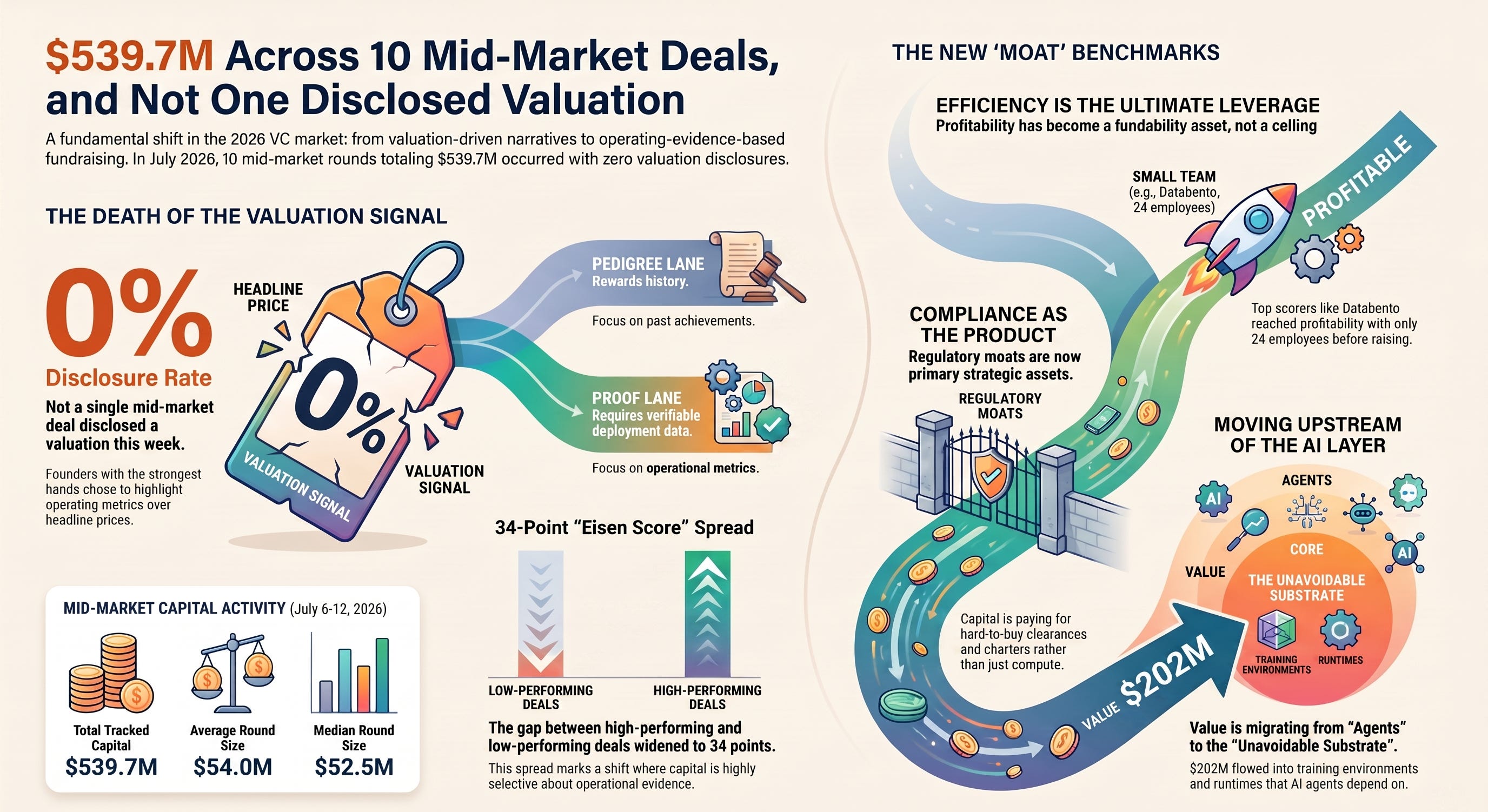
Ten mid-market rounds cleared this week, and not a single one put a valuation number. Not one. Last month, two in ten disclosed. This week, none did, and the companies with the strongest hands were the loudest about it. The founders who could have posted a headline mark chose to post a retention rate instead.
A market-data company that turned profitable with twenty-four people took a check that drew three times as much demand as it could absorb, and let the round close with no valuation on the record. A construction-finance company that has been profitable for two years raised the smallest institutional round on this list. A developer tool with fourteen employees and nine million monthly users declined to discuss revenue at all. Meanwhile, two rounds totaling seventy-five million dollars closed with no product usage of any kind.
Here is the consequence for Monday. The valuation slide is no longer the fundability signal, and it has not been replaced by a larger one. It has been replaced by a retention number, a headcount, and a gross-margin line. If your deck still opens by anchoring a price, you are answering a question the market stopped asking. Read every shift below through that lens.
The Week in One Sentence
Primary insight: With megarounds and public-market traffic removed, the mid-market repriced on operating evidence rather than on price. Capital paid for verifiable deployment, capital efficiency, and regulatory position, and it declined to mark any of it.
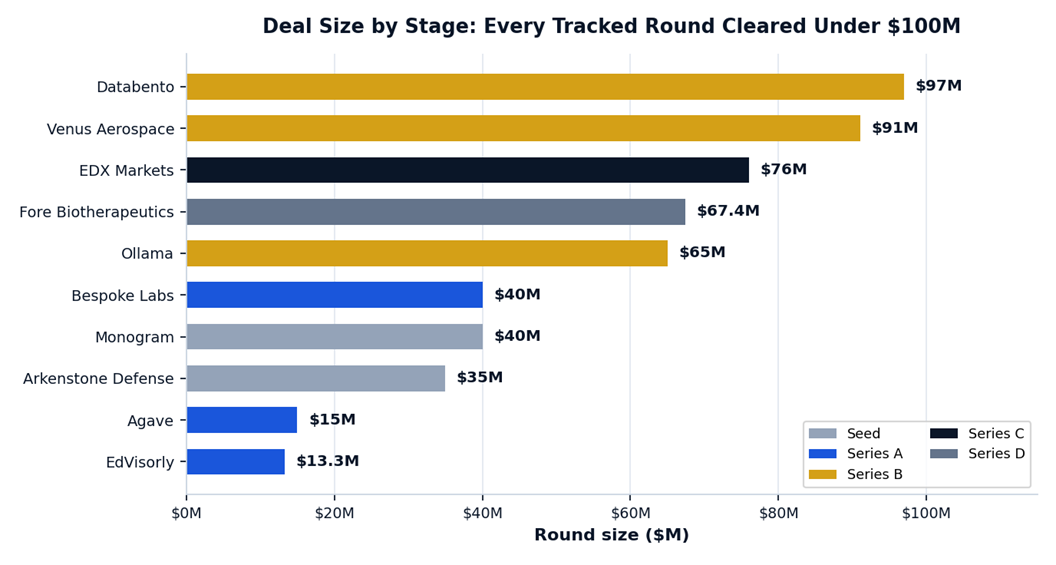
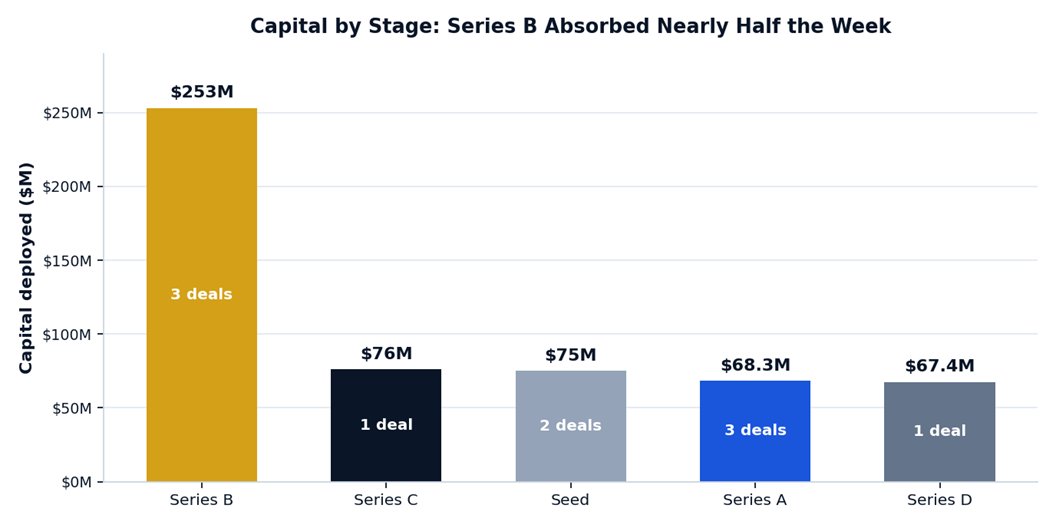
· Total tracked mid-market capital (10 verified rounds): $539.7M, every round under $100M.
· Average round size: $54.0M across the ten.
· Median round size: $52.5M, the midpoint between the $40M tier and Ollama at $65M.
· Disclosed valuations: zero of ten. Not one company in the tracked set put a valuation on the record, and two explicitly declined when asked.
· Largest tracked round: Databento, $97M Series B, a market-data platform that reached profitability with twenty-four employees. Note that Databento is in our NetworkVC’s portfolio.
· Highest Eisen Fundability Score: Databento at 84, one point short of the inevitability line, and the missing point is the price it would not name.
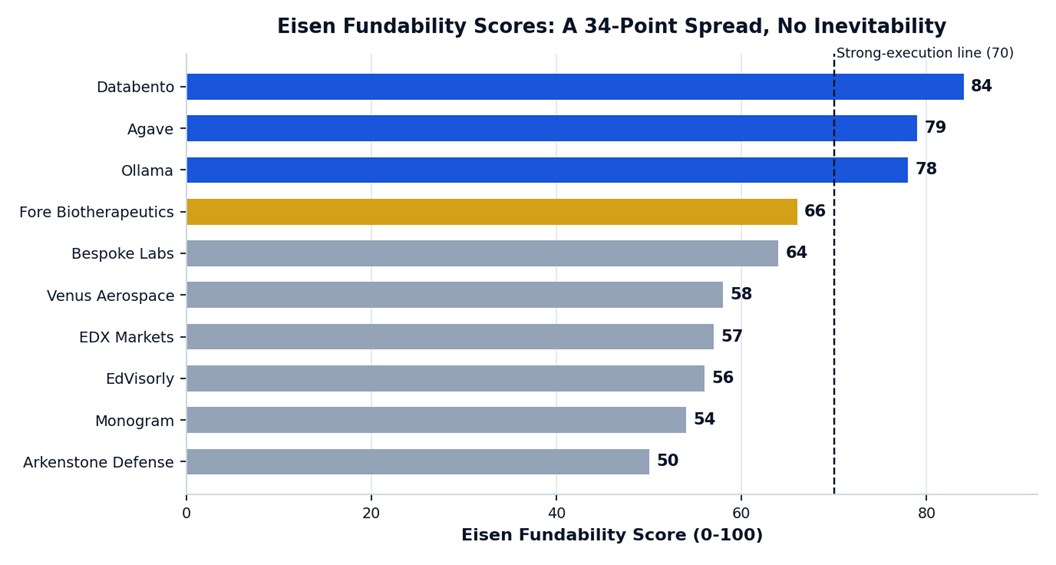
· Defining structural feature: an Eisen Score band of 50 to 84. That 34-point spread is the widest in this report series. Five weeks ago, the spread was 13 points. The mid-market did not tighten this week. It split.
Data Integrity Notes
All ten featured rounds were verified against a minimum of two independent primary sources, including company announcements, BusinessWire, PRNewswire, and at least one tier-one outlet per deal such as TechCrunch, Fortune, Crunchbase News, SpaceNews, or The Block. Resolutions and exclusions applied during this week’s fact-check:
· Editorial scope excludes giant rounds and public-market events by request. Removed from the tracked set: Keyfactor ($1B), SambaNova ($1B), Oratomic ($300M), LeapXpert ($180M), 8090 Solutions ($135M), Quaise Energy ($134M), Prime Intellect ($130M), Gauntlet ($125M), Beeline Medicines ($126.3M), Norm AI ($120M), and Taktile ($110M). Public-market traffic such as the Blue Origin financing and the SK Hynix listing is also out of scope.
· Geography. The tracked ten are U.S. headquartered. Non-U.S. rounds in the window (Proxima Fusion in Germany, QuantumDiamonds in Germany, Alchemab in the UK, Cyllene Therapeutics in France, Even Realities in China, Skello in France) are noted but excluded from the U.S. scorecard for comparability.
· Recirculation control. Three items surfaced in this week’s roundups but were announced earlier and are excluded from the tracked total. Luxonis ($14M Series A) was announced on July 2. TJM Labs ($75M Series B) was announced on July 2. Jump ($80M Series B) was originally announced in February 2026. Taktile was announced in late June and recirculated twice this week under two different close dates.
· Discrepancies resolved. TechCrunch reported the Venus Aerospace round as $90M; the company’s own PRNewswire release states $91M, and the release figure is used. Crunchbase attributes the Fore Biotherapeutics round to a single lead; the company releases three co-leads, and the release is used. One roundup placed Bespoke Labs in San Francisco and Prime Intellect in New York; company and Crunchbase records place them in Mountain View and San Francisco, respectively.
· Aggregator-only claims excluded. CarbonSix ($40M) and LinqAlpha ($22M) appeared in daily roundups without a company release, a lead investor of record, or a confirmed close date. Both are excluded rather than counted.
Deal Scorecard
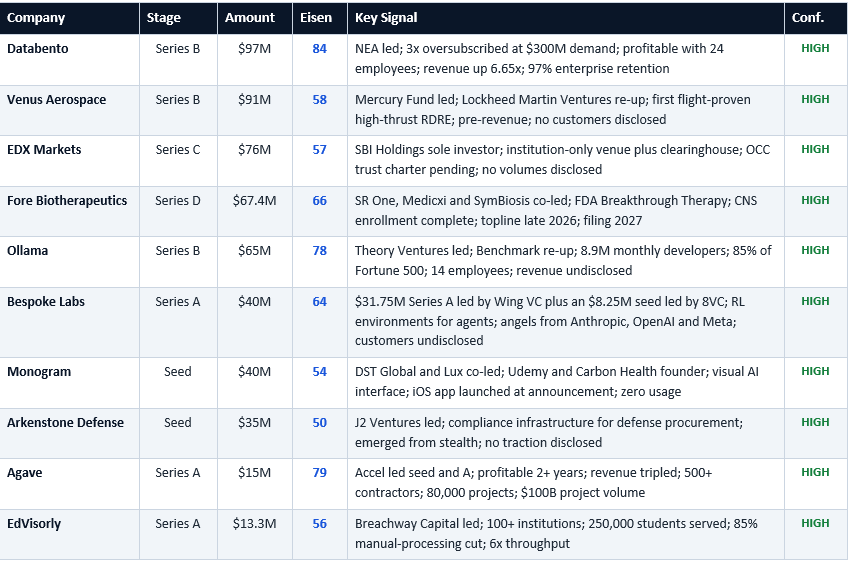
Eisen Fundability Scores are calculated across the 5Ps-weighted dimensions: Founder-Investor Dynamics (Process, 30%), Traction-to-Conviction Conversion (Proof, 25%), Narrative Power (Positioning, 20%), Deal Architecture (Packaging, 20%), and Capital Planning (Planning, 5%). Scores of 85 and above signal an inevitable outcome. Scores of 70 to 84 signal strong execution. Scores below 70 signal early-stage or the need for repositioning. Missing metrics are scored conservatively, and opacity is penalized rather than assumed strong.
What the Scorecard Says at a Glance
The band broke open. Five weeks ago, the mid-market cleared inside a 13-point Eisen band. This week it cleared inside 34 points, from 50 to 84. That is not noise. It is two different markets running on the same tape. One lane pays for operating evidence. The other pays for founder pedigree and category position before a single user exists. Both closed this week. Only one of them is available to you.
Check size told you almost nothing. The three highest-scoring companies raised $97M, $15M, and $ 65 M, respectively. The two lowest-scoring raised $40M and $ 35 M, respectively. Databento at 84 and Agave at 79 are separated by $82M in capital and four points of fundability. If you are benchmarking your raise against the size of someone else’s round, you are reading the wrong column.
Capital efficiency became a fundability asset, not an apology. Databento (84) is profitable, with 24 employees, and has barely tapped the $97M it raised. Agave (79) has been profitable for over two years and tripled revenue. Ollama (78) runs 8.9 million monthly developers on a team of 14. For three years, profitability at Series A or B read as insufficient ambition. This week, it read as an underwritten conviction, and the market paid for it without asking to see a mark.
The bottom of the band is where the lesson is. Venus Aerospace (58) and EDX Markets (57) took the second- and third-largest checks of the week and posted two of the weakest traction profiles in the tracked set. Neither is a bad company. Venus has a flight-proven engine and Lockheed re-upping. EDX has an institution-only clearinghouse and a national trust charter pending. But neither disclosed a single unit of commercial usage, and the scoreboard separates a fundable company from a fundable round. The gap is deployed proof.
What Changed This Week: 5 Market Shifts
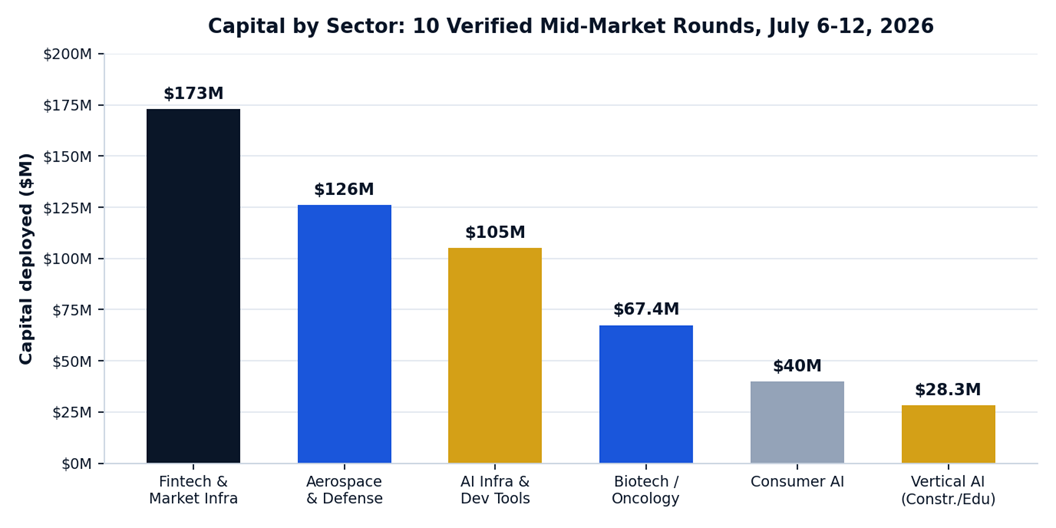
Each shift is verified against multiple primary sources and ranked by structural impact on founder fundraising, not by deal size. Every shift ends with what it means for your raise.
Shift 1: The Valuation Stopped Being the Signal
Pattern: Ten rounds closed, and zero disclosed a valuation. Databento raised $97M in a round, oversubscribed by $300M, and did not name a price. Ollama’s founder and its Benchmark board member both declined to discuss revenue or valuation on the record. EDX Markets’ CEO confirmed the round was equity and then declined the terms. Fore Biotherapeutics, Venus Aerospace, Bespoke Labs, Monogram, Arkenstone, Agave, and EdVisorly all announced without one. Five weeks ago, two of ten were disclosed. This week, none.
Perspective: A disclosed valuation is a claim about the future. A retention rate is a claim about the past that a diligence partner can verify in an afternoon. When markets are flooded with capital and climbing, price is the story. When the market is selecting hard, the price becomes the thing you have to defend at the next round, and the strongest companies decline to hand their competitors a benchmark. What replaced the valuation headline this week was an operating headline: 6.65x revenue growth, 97% enterprise retention, 24 employees, profitable. Those are the numbers that carried the week.
Founder Blindspot: Founders read valuation silence as weakness and rush to disclose. The companies that stayed silent this week were the ones with the strongest hands. Silence on price is only a weakness when you have nothing else to put in the headline. If your announcement includes a valuation but no usage figure, you have told investors that the only number you have is the one someone else gave you.
Playbook: Draft your funding announcement headline this week, before you have a round. Then delete the valuation and read what is left. If the sentence dies, your proof stack is the problem, not your pricing. Replace it with the single operating number a partner could verify without your help. Wrong approach: raised at a $X00M valuation. Right approach: revenue up 6.65x, 97% enterprise retention, and profitability at 24 people.
Contrast: In 2021, the valuation was in the press release. In June 2026, two of ten mid-market rounds were still led by one. In the week of July 6, none did, and the market did not punish them for it.
What this means for your raise: Stop optimizing your deck for the price you want and start optimizing it for the metric you can prove. The mark is now a negotiating position. The metric is the position that gets you into the negotiation.
Shift 2: Profitability Became a Fundability Asset, Not a Ceiling
Pattern: The three highest Eisen Scores of the week all belong to capital-efficient companies. Databento (84) reached profitability with 24 employees, grew revenue 6.65x year-over-year, has maintained 97% enterprise logo retention since inception, and drew more than $300M in demand for a $97M round it says it has barely spent. Agave (79) has been profitable for over two years, tripled revenue year-over-year, and raised $15M. Ollama (78) reaches 8.9 million monthly developers and is used by 85% of the Fortune 500, with a team of 14.
Perspective: For most of the last cycle, profitability at Series A or Series B was a negative signal. It meant you were not spending fast enough to win a land grab. That inverted this week. When capital is abundant but selectivity is high, the founder who does not need the money has the strongest position in the room, and investors know it. Databento’s round was oversubscribed threefold precisely because the company could walk. That is not a coincidence. It is the mechanism.
Founder Blindspot: Founders still believe burn signals ambition. In diligence this week, burn signaled dependency. The question a partner asked was not how fast are you growing. It was how fast you were growing and what it cost you. Growth without efficiency is now a liability, because it means the next round is not optional and the investor knows the term sheet is the only one you will get.
Playbook: Compute two numbers before your next partner meeting: net revenue per employee and months of runway at current burn, assuming no new capital. Put both on one slide next to your growth rate. If revenue per employee is below $150K, your growth story is a hiring story, and investors will discount it. Wrong approach: we need this round to hit our next milestone. Right approach: we do not need this round, and here is what we would do with it.
Contrast: In 2021, capital efficiency was a story you told when the growth story failed. In July 2026, it is the leverage that makes the round oversubscribed.
What this means for your raise: Optionality is the new fundability signal. Build a credible path to not raising, and the raise gets easier, faster, and better priced. Founders who need the round negotiate against it.
Shift 3: Compliance Stopped Being Overhead and Became the Product
Pattern: The regulatory build was what capital paid for, not the costs around it. Arkenstone Defense raised a $35M seed to sell nothing but the compliance, security, workforce, and operational infrastructure that keeps commercial technology companies from selling to the U.S. government. EDX Markets raised $76M, with a national trust bank charter pending with the OCC as its central strategic asset. Fore Biotherapeutics raised $67.4M against an FDA Breakthrough Therapy Designation and a completed enrollment cohort. Ollama’s pitch to the Fortune 500 is that inference runs on the customer’s own hardware, which is a data-residency argument, not a performance one.
Perspective: Model capability is converging and getting cheaper every quarter. What does not converge is a charter, a designation, a clearance, or an audit trail. Those take years; they cannot be bought with compute; and they create a moat that a better-funded competitor cannot circumvent. Arkenstone is the purest expression of the thesis: a company whose entire product is the regulatory barrier itself, sold as a service to everyone stuck behind it. J2 Ventures paid $35M for that before a single customer was disclosed.
Founder Blindspot: Founders treat compliance as a tax on the roadmap and staff it last. Investors treated it as the roadmap this week. The companies that deferred the regulated build are the ones that look most clonable in diligence, because everything else they have can be rebuilt in a quarter by a team with a bigger model and more GPUs.
Playbook: List every certification, charter, designation, clearance, or audit standard your buyer requires and mark which you hold, which you have applied for, and which you have ignored. The ignored column is your competitor’s entry path. Pick the one with the longest lead time and start it this quarter, then make it the use-of-funds headline. Wrong approach: compliance is a cost we are keeping light. Right approach: our SOC 2, our OCC filing, and our FedRAMP path give us an 18-month head start that no competitor can compress.
Contrast: In 2024, founders avoided regulated categories because the sales cycle was slow. In July 2026, the slow sales cycle is the moat, and the fast one is the commodity.
What this means for your raise: If a competitor could sell into your market next month with no additional approvals, you do not have a moat; you have a feature. Name the approval you are building and price the round around it.
Shift 4: Capital Moved Under the Agents, Not Into Them
Pattern: No agent company led the week. The capital went to the layer underneath them. Bespoke Labs raised $40M to build the reinforcement-learning environments that frontier labs use to train agents, with angels from Anthropic, OpenAI, and Meta on the cap table. Ollama raised $65M for the runtime where open models actually execute, now used by 85% of the Fortune 500. Databento raised $97M selling the market data that every quantitative system consumes before it makes a single decision. Together, that is $202M into infrastructure that agents depend on and cannot replace.
Perspective: When a category commoditizes at the application layer, value migrates to the input that every competitor must buy. This is the same structural logic that priced training data above robots and payment rails above payment apps. Bespoke’s investors are the labs’ own researchers, which is the tell: the people building the agents are personally funding the company that supplies their training environments. Ollama’s General Partner framed it exactly this way, arguing that the platform layer where AI runs is one of the most valuable positions in software.
Founder Blindspot: Founders build the visible agent because that is what the customer demos. Investors are paying for the unavoidable substrate underneath. The selection error is building the easy-to-copy thing instead of the hard-to-source one. If a frontier lab releases a better model next month and your product gets meaningfully worse relative to a competitor’s, you were never in the infrastructure business.
Playbook: Write down the three inputs your product cannot function without: the model, the data, the runtime, the rail, or the environment. For each one, answer whether you own it, buy it, or scrape it. If all three are bought, your moat lives upstream, and your strategy has to move there before your next round. Wrong approach: we build agents for X. Right approach: we own the layer that every agent in X has to route through.
Contrast: In late 2025, the agent application layer was the fundable story. In July 2026, the fundable story is the environment the agent trains in and the runtime it executes on.
What this means for your raise: If your product improves when the models improve, you are a wrapper. If your product is what the models need to improve, you are the infrastructure. The market repriced the difference this week.
Shift 5: The Pedigree Lane and the Proof Lane Are Now Two Separate Markets
Pattern: Two rounds closed this week with no disclosed traction of any kind. Monogram raised a $40M seed round co-led by DST Global and Lux Capital and launched its iOS app on the day of the announcement, with an angel roster that included Mistral’s CEO and Y Combinator’s president. Arkenstone Defense raised $35M in seed funding as it emerged from stealth. Combined, $75M cleared on founder history and category position with zero users. In the same week, Agave raised $15M with 500 contractors, 80,000 live projects, $100 billion in project volume, and two years of profitability.
Perspective: These are not the same market, and founders keep confusing them. The pedigree lane is open to a founder who has taken a company public, and it prices at the option value of that founder in a category that has not yet been won. It is narrow, it is closed to almost everyone reading this, and it is not the market you are raising in. The proof lane is open to anyone, with prices on verifiable deployment, and this week it produced both the highest score and the smallest round. Note the honest asymmetry: Monogram’s founder built Udemy, which merged with Coursera after a stock slide, and Carbon Health, which filed for bankruptcy in February. The lane opened anyway. That is what pedigree buys, and it does not transfer.
Founder Blindspot: Founders study the pedigree round and copy its deck. They see a $40M seed with no metrics and conclude that metrics are optional at seed. They are not optional. They were waived, and the waiver was underwritten by twenty years of founder history you do not have. Copying the artifact without the underwriting is the single most expensive mistake in early-stage fundraising.
Playbook: Score your round honestly on both lanes. If no founder on your team has a prior outcome a partner can name without looking it up, you are in the proof lane, and every hour you spend polishing narrative instead of generating deployment data is an hour spent raising in a market you cannot enter. Wrong approach: they raised on vision, so we will too. Right approach: they raised on history we do not have, so we will raise on evidence they do not need.
Contrast: In 2021, both lanes were open to everyone because capital was indiscriminate. In July 2026, the pedigree lane narrowed to a handful of names and the proof lane widened to everyone else, with a much higher bar.
What this means for your raise: Identify which lane you are actually in before you build the deck. Founders who pitch the pedigree lane without the pedigree spend 60 days learning why the answer is no.
The Deals That Matter: Top 5
Five deep dives across market infrastructure, construction finance, developer AI, defense propulsion, and consumer AI. Each is selected for a distinct playbook value, not deal size. Three are selected because they scored the highest. Two are selected because they scored low on the largest checks, which is the more useful lesson. All metrics are verified against two or more primary sources.
Databento
Market Data Infrastructure for Modern Finance | Series B | $97M | Valuation Undisclosed
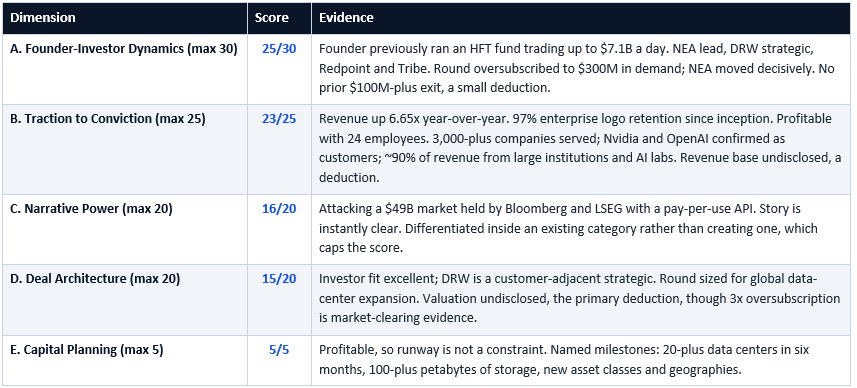
Eisen Fundability Score: 84 / 100
Why this scored: The highest score in this report series to date, and one point short of inevitability. The deduction is entirely about deal architecture: a company with this evidence could have named a price and chosen not to. Everything else is close to a clean sheet. Revenue up 6.65x year-over-year. Enterprise logo retention above 97% since inception. Profitable with 24 employees, ahead of schedule, without touching the prior round. A $97M raise that drew more than $300M of demand, and which the CEO says the company has barely spent.
The Setup: Christina Qi co-founded Domeyard, a high-frequency trading fund that, at its peak, traded up to $7.1 billion a day, then shut it down to tackle the underlying problem. She has described sending more than 100 emails over eleven months just to obtain market data from the largest provider on the planet, and receiving sample data on a thumb drive in the mail. Databento’s answer is a pay-as-you-go API for real-time and historical data across futures, options, and equities. The company colocates its hardware at exchanges, writes its own feed handlers, and owns the entire data stack end-to-end. Qi runs it from a farm in Utah.
The Numbers: $97M Series B led by New Enterprise Associates, with DRW Venture Capital, Redpoint Ventures, and Tribe Capital participating. Total funding is now approximately $127M. The round was oversubscribed, drawing more than $300M in demand. Revenue grew 6.65x year-over-year off an undisclosed base. Enterprise logo retention above 97% since inception. Profitable with 24 employees. The company operates a bare-metal footprint serving more than 20 petabytes of raw market data, with feed handlers written for more than 70 exchanges, and captures order-level data from 80-plus trading venues. More than 3,000 companies served, with 400-500 new sign-ups per day. Qi has said roughly 90% of revenue comes from large financial institutions and AI labs, and has confirmed Nvidia as both a paying customer and technology partner, with OpenAI also a customer. NEA’s Rick Yang joins the board; Danielle Lay joins as observer. Use of funds: expand to more than 20 data centers worldwide, add 100-plus petabytes of storage, and extend coverage into new asset classes and geographies. No valuation was made public.
Fundability Lessons: Databento is the template for evidence-based underwriting rather than narrative underwriting. Three moves built the 84-point case. First, reach profitability before the raise, which turns the round from a survival event into an acceleration choice and gives you term sheet leverage. Second, publish the two numbers a partner cannot argue with, growth multiple and retention rate, and let them do the pricing work the valuation slide used to do. Third, own the full stack in an unglamorous category, because a $49 billion market with two entrenched incumbents and a terrible developer experience is a better place to be number three than a crowded market with no incumbent at all.
Your Takeaway: The most fundable position in this market is one that doesn't need the round. Build to profitability at whatever scale you can reach, then raise from strength. Databento drew three times its target because the investors understood the company could walk away, and that understanding, not a pitch, is what produced the oversubscription.
The Founder Mistake to Avoid: Founders in infrastructure categories chase logos and headcount to look substantial. Databento scored 84 with 24 people. The mistake is confusing size with conviction. Every engineer you add before the unit economics work is a line item in your next diligence conversation that you will have to defend. Qi’s investors are telling her to spend more. She is not listening, and that is why the round cleared.
Agave
AI for Construction Financials | Series A | $15M | Valuation Undisclosed
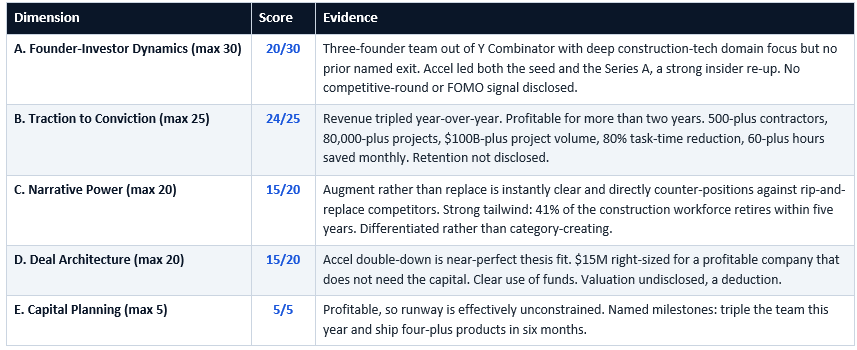
Eisen Fundability Score: 79 / 100
Why this scored: The smallest institutional round in the tracked set posted the second-highest score, and that inversion is the single most useful fact in this report. Agave has been profitable for over two years, tripled revenue year-over-year, and serves more than 500 general and specialty contractors. Its software runs across more than 80,000 construction projects representing more than $100 billion in project volume. Accel led both the seed and the Series A, which is an insider conviction signal that no first-time syndicate can manufacture.
The Setup: Founded in late 2021 by Tom Reno, John Zucchi, and Pooria Azimi, Agave chose the hardest possible integration problem and made it the moat. Construction accounting does not work like other accounting: every project is its own profit center, costs are tracked by job, phase, and cost code, and scope moves mid-build through change orders. The systems that handle this are decades old, run on-premises or on hosted servers, and were built without modern APIs. Agave spent four years building two-way connections into more than 14 ERP and project-management systems, including Procore and Autodesk Forma Build, and then layered AI on top of the systems contractors already run rather than asking them to replace anything.
The Numbers: $15M Series A led by Accel, which also led the seed, with continued participation from Y Combinator. Total funding above $20M since late 2021. Profitable for over two years. Revenue tripled year-over-year. More than 500 general and specialty contractors, ranging from $5M to more than $5B in annual revenue. More than 80,000 projects in the U.S. and Canada, representing more than $100 billion in project volume. Customers report over 80% reduction in time spent across thousands of tasks per month and savings of more than 60 hours per month on data entry, financial reporting, and cost reconciliation. Named customers include Evans General Contractors, Stacy Witbeck, Brinkman Construction, and Satterfield & Pontikes. Use of funds: triple the team this year and ship more than four new products in six months. Valuation not disclosed.
Fundability Lessons: Agave is the integration-moat template. First, pick the workflow whose data is trapped in systems nobody wants to touch, and spend the four years building the connectors, because that time is the barrier and it cannot be compressed with capital. Second, augment rather than replace, which collapses the sales cycle from a migration decision to a budget line. Third, get profitable, which is what led to a $15M round from Accel on Accel’s terms rather than from a stranger on the stranger’s terms.
Your Takeaway: Raise the smallest round that gets you to the next proof point, not the largest round the market will give you. Agave’s $15M against 500 customers and two years of profit is a far stronger fundability position than a $40M round against zero users, and the score reflects it. Dilution you do not take is the cheapest capital you will ever raise.
The Founder Mistake to Avoid: Founders pitch the AI and bury the integrations. Agave’s AI is not the moat. Four years of two-way ERP connectors are the moat, and the AI is what those connectors made possible. If your vertical AI story leads with the model, you are describing the part a competitor can rebuild in a quarter and hiding the part they cannot.
Ollama
Runtime and Platform Layer for Open Models | Series B | $65M | Valuation Undisclosed
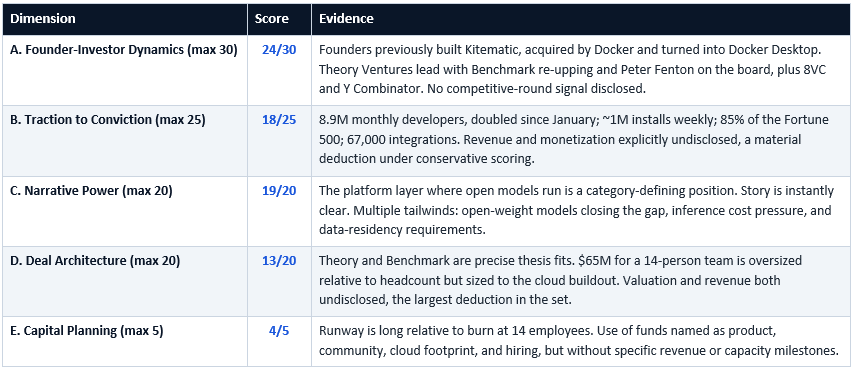
Eisen Fundability Score: 78 / 100
Why this scored: Ollama has the densest usage profile of the week and the thinnest commercial disclosure, and the score sits exactly where that tension lands. It reaches 8.9 million monthly active developers, has 14 employees, sits within 85% of the Fortune 500, including regulated government, healthcare, and finance customers, and adds close to a million new installs a week. It also declined to discuss revenue or valuation. That is a 19 out of 20 on narrative and an 18 out of 25 on traction, because usage at this density is not the same as revenue at any density.
The Setup: Jeffrey Morgan and Michael Chiang previously built Kitematic, which Docker acquired in 2015 and turned into Docker Desktop, now used by more than ten million developers. Ollama is the same move applied to AI: hide the messy setup and let a developer run an open-weight model locally with a single command, then scale into Ollama’s cloud without changing the API. The cloud bills by GPU time rather than per token. The company is a distribution partner for the major open-model labs and for Nvidia, AMD, Intel, and Qualcomm, which is what gives its users new models on day one.
The Numbers: $65M Series B led by Theory Ventures, with Benchmark, 8VC, Y Combinator, Pace Capital, 49 Palms, and GTMFund participating. Total funding $88M. Benchmark led the $15M Series A, and Peter Fenton sits on the board. 8.9 million monthly active developers, doubled since January. Roughly one million new installs per week. More than 67,000 community-built integrations. Present in 85% of Fortune 500 companies. 176,000 GitHub stars and nearly 17,000 forks. Fourteen employees. Revenue and valuation both explicitly declined. Use of funds: product and open-source community investment, cloud compute footprint, and key hires.
Fundability Lessons: Ollama is the distribution-before-monetization template, and it only works under a specific condition. First, own the default install path in a category the whole market is about to enter, because the runtime everyone reaches for first becomes the runtime everyone pays for later. Second, convert a free open-source project into a commercial layer without breaking the free one, which Ollama did by charging for compute that the laptop cannot provide rather than taxing the thing users already had. Third, understand that the condition for waiving revenue proof is category-defining distribution, not a promising trajectory. 8.9 million developers waive it. 89,000 does not.
Your Takeaway: If you are building open-source-led, your fundability turns on whether you own the default. Measure your position not in stars or downloads but in the percentage of a defined buyer universe where you are already installed. Ollama’s number is 85% of the Fortune 500. That single figure did more work in this round than any revenue disclosure could have.
The Founder Mistake to Avoid: Founders read this round as permission to raise on usage without revenue. It is not. Ollama’s usage is at a scale that makes monetization an execution question rather than a hypothesis, and its founders have already turned a developer tool into a Docker acquisition once. Copy the strategy, not the disclosure. If you cannot explain how you monetize, your usage number needs to be an order of magnitude higher than what you think is impressive.
Venus Aerospace
Rotating Detonation Rocket Engine Propulsion | Series B | $91M | Valuation Undisclosed
Eisen Fundability Score: 58 / 100
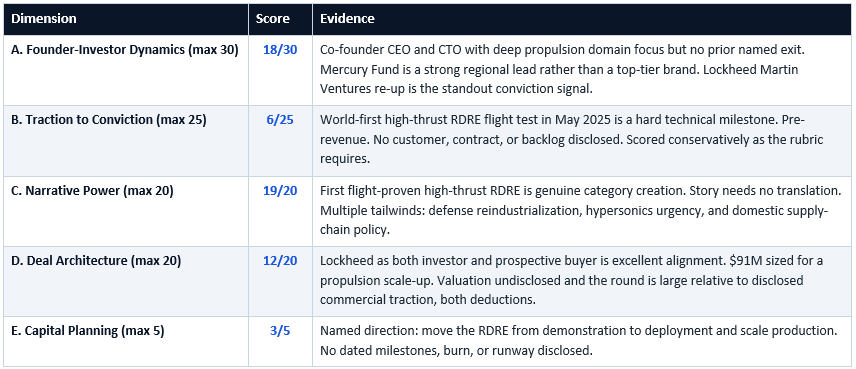
Why this matters: The second-largest check of the week yielded the fifth-lowest score, and that gap is the most instructive statistic on the scorecard. Venus has a genuine technical achievement: in May 2025, it completed what the company describes as the world’s first successful flight test of a high-thrust rotating detonation rocket engine. Lockheed Martin Ventures re-upped. The narrative score is 19 out of 20. The traction score is 6 out of 25 because no revenue, contract value, or named customer was disclosed. A big check from a strategic is validation. It is not proof.
The Setup: Founded in 2020 and headquartered in Houston, Venus is led by CEO Sassie Duggleby and CTO Andrew Duggleby. A rotating detonation rocket engine generates thrust from a continuous supersonic detonation wave rotating around the combustion chamber rather than from a conventional burn. The physics has been understood since the mid-twentieth century, but remained impractical until 3D printing and modern simulation made the geometry buildable. Venus claims roughly 15% greater efficiency than conventional alternatives, a reusable and throttleable engine built from 3D-printed components and standard materials, and a design intended for domestic manufacturing across munitions, launch vehicles, and orbital transfer.
The Numbers: $91M Series B led by Mercury Fund, with Lockheed Martin Ventures, MESH, PEAK6, Draper Associates, Starboard Star Venture Capital, and Green Sands Equity participating. Total funding approximately $197M. First flight test of the high-thrust RDRE completed in May 2025. Engine targeted at Mach 4-6 from a conventional runway, with roughly 15% greater efficiency. Lockheed Martin Ventures made its initial investment in November 2025 and re-upped here. Use of funds: move the RDRE from flight demonstration to deployment and scale production. No revenue, contract value, backlog, or named customer was disclosed. Valuation not disclosed.
Fundability Lessons: Venus is the strategic-validation template, and it comes with a warning label. First, a strategic re-up is the strongest possible signal in a category where the strategic is also the buyer, and Lockheed’s reinvestment did more for this round than any generalist could have. Second, a flight-proven first is a hard, dated, verifiable event, and in deep tech, that event is the closest thing to a revenue line. Third, understand precisely what the score is telling you: the round cleared on narrative and strategic conviction, and it will not clear again at Series C without contracts.
Your Takeaway: In deep tech, sequence your raise to a demonstrable technical event, not to your runway calendar. The flight test is the asset that drove this round's price. But do not mistake a large check for a fundability score. If your next raise depends on revenue and you spend this one building capability rather than converting the demonstration into a contract, you will find the Series C market considerably less generous.
The Founder Mistake to Avoid: Founders in hardware read a $91M round as validation that the proof bar does not apply to them. It applies later and harder. Venus’s traction score of 6 out of 25 is not a criticism of the company; it is a map of where the next eighteen months have to go: named customers, contract value, and a backlog a diligence team can verify. Every deep-tech company that skipped that step raised a great Series B and then stalled.
Monogram
Generative Visual Interface for Consumer AI | Seed | $40M | Valuation Undisclosed
Eisen Fundability Score: 54 / 100
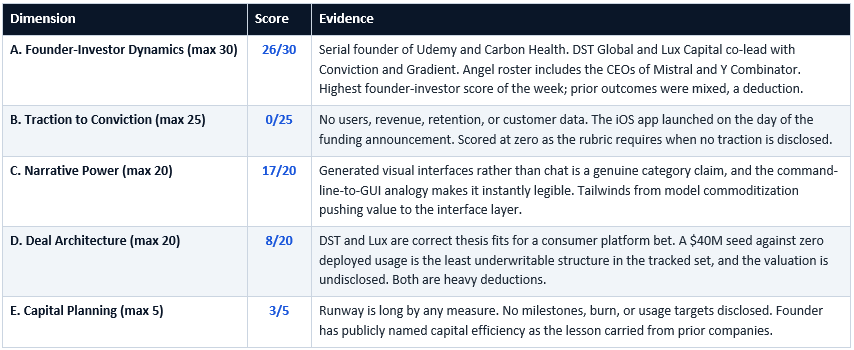
Why this matters: Monogram is the clearest picture of the pedigree lane this year, and it is included precisely because most founders cannot enter it. A $40M seed, co-led by DST Global and Lux Capital, closed for a consumer AI app that launched on the day of the announcement. Traction score: 0 out of 25. Founder-investor score: 26 out of 30, the highest in the tracked set. The round is entirely underwritten by Eren Bali, and the founder himself said he could raise this much because it is not his first company.
The Setup: Bali co-founded Udemy and Carbon Health. He is now building, with Edouard Tabet and Murat Akbal, a general-purpose iOS app that generates an entire interactive user interface on the fly in response to a query, rather than returning a wall of text. Ask for a trip plan, and you get a planner; ask for a recipe, and you get a recipe view. His thesis, drawn directly from watching doctors reject fully automated AI charting at Carbon Health, is that the chat box is the wrong interface for AI and that humans want a high-frequency visual loop, not a delegation.
The Numbers: $40M seed co-led by DST Global and Lux Capital, with Conviction, SOMA Capital, Gradient Ventures, e2vc, and Maxitech participating. Angels include Mistral CEO Arthur Mensch, Lyft co-founder Logan Green, Ramp co-CEO Karim Atiyeh, Y Combinator president Garry Tan, Trulia co-founder Pete Flint, and Oscar Health co-founder Mario Schlosser. First institutional round. Free iOS-only app, launched the day of the announcement. No users, revenue, retention, or valuation disclosed. The honest context matters: Udemy merged with Coursera after its stock fell to around $4.63, and Carbon Health filed for bankruptcy in February 2026. The round cleared anyway.
Fundability Lessons: Monogram teaches by contrast rather than by imitation. First, founder history is an underwriting instrument, and it is priced independently of its outcomes, an uncomfortable fact worth internalizing rather than resenting. Second, an oversized seed in a contested category is a strategic weapon, and Bali said so directly: you do not want to be underfunded once the competition heats up. Third, the honest read for everyone else is that this round was not available to you, and building a deck that imitates it will cost you a quarter.
Your Takeaway: Know which lane you are raising in. If a partner has to look up your prior company, you are in the proof lane, and the proof lane requires deployment data before the narrative earns a hearing. The correct response to a round like this is neither envy nor imitation. It is to generate the usage figure that makes your narrative unreadable on its own terms.
The Founder Mistake to Avoid: The single most expensive error in early-stage fundraising is copying the artifact without the underwriting. Founders will see a $40M pre-launch seed and conclude that a strong enough vision waives the metrics requirement. It does not waive it. It was waived here by twenty years of history and a cap table that includes the CEO of Mistral. Absent those, the same deck gets a polite pass and a request for usage data.
Fundraising Playbook: 5 Tactical Plans From This Week
Five plans, each producing a concrete output you can use immediately. No vague tasks. Each is built directly from this week’s verified signals.
1. The Metric Headline That Replaces Your Valuation (Positioning and Narrative)
Why this matters: None of the 10 rounds disclosed a valuation. The strongest companies replaced price with operating metrics: 6.65x revenue growth, 97% retention, 8.9 million monthly developers, 500 contractors, and two years of profit. The valuation headline is dead, and the metric headline took its place.
Deliverable: One sentence to headline your funding announcement if you were forbidden to name a valuation. It must contain a growth multiple or a retention figure, a unit of deployment, and nothing else. Test it by deleting the round size. If the sentence still lands, you have it.
Time estimate: 2 to 4 hours, finalized before your next partner meeting.
Expected outcome: A headline that survives the first diligence question. Partners stop asking what price you want and start asking how fast you can scale what you already have.
Reframe: Wrong approach: we are raising at a $200M valuation. Right approach: revenue up 6.65x, 97% enterprise retention, and profitability at 24 people.
2. The Efficiency Sheet (Traction and Metrics Packaging)
Why this matters: The three top-scoring companies this week are profitable or near it, with 24, 14, and small teams, respectively. Burn signaled dependency in diligence, not ambition. The founder who does not need the round gets the best terms in the room.
Deliverable: A single page with exactly five lines: net revenue per employee, gross margin, months of runway at current burn with no new capital, growth rate, and net revenue retention. Numbers only, no adjectives, no projections.
Time estimate: 3 to 5 hours. If you cannot fill all five, the missing line is your next two weeks, not another deck revision.
Expected outcome: Documented optionality. The moment an investor believes you can walk, your round becomes competitive, and competitive rounds price themselves.
Reframe: Wrong approach: we need this round to reach our next milestone. Right approach: we do not need this round, and here is exactly what we would do with it.
3. Eisen Self-Score and Lane Diagnosis (Readiness)
Why this matters: The Eisen band opened to 34 points this week because two different markets cleared on the same tape. Founders who misdiagnose which lane they are in spend sixty days raising in a market that is structurally closed to them.
Deliverable: Score your round across the five dimensions: founder-investor dynamics, traction-to-conviction, narrative power, deal architecture, and capital planning. Then answer one binary question: can a partner name a prior outcome from your team without looking it up? If not, you are in the proof lane. Identify your two lowest dimensions and write one concrete action to lift each.
Time estimate: 2 to 3 hours, repeated before each raise.
Expected outcome: A ranked list of your two weakest dimensions, a specific fix for each, and an honest read on which market you are actually raising in.
Reframe: Wrong approach: they raised on vision, so we will too. Right approach: they raised on history we do not have, so we will raise on evidence they do not need.
4. The Regulatory Moat Ledger (Deal Architecture and Defensibility)
Why this matters: Compliance was the product this week, not the overhead. A defense-compliance company raised $35M selling nothing but the regulatory barrier. A trading venue raised $76M with a national trust charter as the strategic centerpiece. A biotech raised $67.4M against a Breakthrough Therapy Designation.
Deliverable: A three-column ledger of every certification, charter, designation, clearance, or audit standard your buyer requires: hold, applied for, ignored. Rank the ignored column by lead time. Start the longest one this quarter and make it your use-of-funds headline.
Time estimate: 4 to 6 hours, refreshed each quarter.
Expected outcome: A defensibility statement tied to a fundable use of proceeds, so the round buys a barrier rather than runway.
Reframe: Wrong approach: compliance is a cost we are keeping light. Right approach: our certification path is an eighteen-month head start no competitor can compress with capital.
5. The Upstream Audit and Momentum Design (Conversion Mechanics)
Why this matters: Capital moved under the agents, not into them. $202M went to the environments, runtimes, and data feeds that agents depend on. Databento’s round drew three times its target because the buyers understood the company was an unavoidable input, not an optional application.
Deliverable: Name the three inputs your product cannot function without, and for each, mark own, buy, or scrape. Then design the follow-up cadence around whichever one you own: a 14-day sequence in which each touch delivers one new proof point for that input, not a status update. If you own none of the three, your strategy has to move upstream before the round opens.
Time estimate: 3 to 5 hours for the audit, 1 hour to build the cadence.
Expected outcome: A defensible upstream position and a follow-up rhythm that compounds conviction between meetings instead of decaying it.
Reframe: Wrong approach: checking in to see if you have any questions. Right approach: here is the retention cohort that closed since we last spoke, and here is what it changes.
Looking Forward: Next 1 to 3 Weeks
Three evidence-based scenarios and one wild card. Predictions are anchored to this week’s verified data, not speculation.
Scenario 1: Valuation Silence Spreads Down-Market (High Probability)
Evidence: Zero of ten mid-market rounds disclosed a valuation this week, against two of ten five weeks ago. Two companies declined explicitly when asked directly by reporters. The trend moved in one direction across every stage from seed through Series D.
What to watch: Series A and B announcements that lead with a retention rate, a growth multiple, or a headcount instead of a price. Watch whether the trade press starts treating valuation silence as a strength signal rather than as a red flag.
What founders should do: Rewrite your announcement template now. Build the version without valuation and see whether the operating figure carries the sentence. If it does not, you have found the gap in your proof stack, and you have found it before an investor did.
Scenario 2: The Efficiency Premium Widens (High Probability)
Evidence: The three highest-scoring companies of the week are profitable or run on tiny teams, and the largest of them was oversubscribed threefold. Meanwhile, two zero-traction rounds totaling $75M cleared only on founder pedigree, a lane closed to almost everyone.
What to watch: Round announcements that disclose headcount alongside revenue growth, a combination that was rare eighteen months ago. Watch for profitability language appearing in Series A press releases, which was almost unheard of during the last cycle.
What founders should do: Compute revenue per employee this week and compare it against your hiring plan. If your plan degrades the ratio, delay it. In this market, a smaller, more efficient company raises capital more easily than a larger, faster-burning one at the same revenue level.
Scenario 3: More Capital Flows Into Agent Infrastructure Than Into Agents (Medium-High Probability)
Evidence: $202M went into the layer underneath agents this week across training environments, open-model runtimes, and market data, with frontier-lab researchers personally on the cap table of the environments company. No agent application company led the mid-market.
What to watch: New rounds for reinforcement-learning environment companies, evaluation and benchmarking tooling, agent observability, and inference runtimes. Watch for frontier-lab employees appearing as angels, which is the clearest available signal of where the labs think the scarcity is.
What founders should do: Audit your position in the stack this week. If a better model makes your product better, you are downstream and replaceable. If a better model makes your product more necessary, you are upstream. Move before your next round, not after the term sheet stalls.
Wild Card: A Down Round Gets Disclosed and Resets the Silence (Medium Probability)
Evidence: When nobody discloses a price, there is no benchmark, and the first company forced to reveal a flat or down mark sets the comparable for an entire category. With ten consecutive undisclosed rounds in the mid-market, the information vacuum is now large enough that a single disclosure will carry disproportionate weight.
What founders should do: Do not let your valuation be set by someone else’s disclosure. Lock in the operating metrics that justify your own price now, so that when a comparable lands, you are arguing from evidence rather than from a peer’s misfortune. The founders who documented their unit economics before the reset keep their multiple. The ones who waited inherit somebody else’s.
The Bottom Line
The real insight is not the $539.7M total. It is that ten mid-market rounds cleared without a single disclosed valuation, and the market did not blink. The price stopped being the signal. What replaced it was operating evidence a partner can verify without your help. Three conviction profiles took the week.
Profile 1: The efficient operators. Databento (84), Agave (79), and Ollama (78) took the top three scores on capital efficiency and verifiable deployment. Databento is profitable with 24 employees and has grown revenue by 6.65x. Agave has been profitable for two years across 80,000 projects. Ollama reaches 8.9 million developers with a team of 14. None of them named a price. All three named a number that mattered more.
Profile 2: The regulatory positions. Arkenstone Defense (50), EDX Markets (57), and Fore Biotherapeutics (66) raised $178.4M between them on charters, designations, and clearances. The compliance work that founders defer is the barrier that capital paid for. It cannot be shortcut with a better model or a bigger round.
Profile 3: The pedigree exception. Monogram (54) raised $40M with zero users because its founder took the company public. That lane is real, it is narrow, and it is almost certainly closed to you. Study it so you stop imitating it.
Everything else competed for the residual. The message is unmistakable. Get efficient, get deployed, get the certification, or get out of the way of someone who has. The valuation slide is not coming back to save a thin proof stack.
5 New Rules for Founders
The metric is the headline, not the mark. If your announcement needs a valuation to be interesting, your proof stack is the problem. None of the 10 rounds disclosed a price this week, and the market did not care.
Profitability is leverage, not modesty. The three highest scores of the week belong to companies that did not need the money. The optional round is the one that gets oversubscribed.
Compliance is the product. A charter, a designation, or a clearance is a moat that a competitor cannot compress with capital. Name the one you are building and make it the use-of-funds headline.
Own what the agents need, not what the agents do. If a better model makes your product better, you are replaceable. If a better model makes your product more necessary, you are infrastructure.
Know your lane. The pedigree lane waives the metrics requirement. It is closed to almost everyone. Copying its deck without its underwriting is the most expensive quarter you will ever spend.
4 Monday Actions
Write the announcement without the valuation. Draft the headline you would publish if you were forbidden from naming a price. If it dies, you have found your gap.
Build the efficiency sheet. One page, five lines: revenue per employee, gross margin, runway with no new capital, growth rate, net revenue retention. Any blank line is your two-week priority.
Build the regulatory moat ledger. Three columns: hold, applied for, ignored. Rank the ignored column by lead time and start the longest one this quarter.
Run the upstream audit. Name the three inputs your product cannot function without. Mark owns, buys, or scrapes. If all three say buy, your strategy moves before your round does.
Your competitors are reading the same tape. The founders who led with evidence this week set the terms. Those who lead with a price negotiate against a benchmark that no one is willing to publish.
Research Methodology and Sources
Data collection period: July 6-12, 2026, with the bulk of verified primary disclosures clustered July 6 to July 9. Verification standard: a minimum of two independent primary sources per featured deal, with company announcements and regulated newswires prioritized as anchor sources and at least one tier-one outlet per deal for corroboration. Eisen Fundability Scores are proprietary analytical estimates, not endorsements or investment advice. All dollar figures reflect announced primary capital at close unless noted.
Core Capital Totals and What They Include
The $539.7M weekly total includes only the ten verified U.S. rounds in the scorecard, each independently confirmed at the stated amount and stage. Extension rounds (Fore Biotherapeutics, Series D-2) are included where they functioned as primary growth financings and are noted as such. No announced-but-unclosed round was counted. No aggregator-only figure was treated as fact without corroboration in a company release or tier-one outlet. Average round size of $54.0M and median round size of $52.5M were computed deterministically from the ten scorecard entries and reconciled against every chart in this report.
Anchor company and newswire sources reviewed for the featured deals include BusinessWire releases for Bespoke Labs, Agave, Arkenstone Defense, and Fore Biotherapeutics; PRNewswire releases for Venus Aerospace, EDX Markets, EdVisorly, and Databento; and company blog posts for Ollama, Monogram, Bespoke Labs, and Databento. Tier-one corroboration reviewed includes Fortune (Databento), TechCrunch (Ollama, Venus Aerospace), Crunchbase News (the July 4-10 top-ten roundup and the EdVisorly exclusive), SpaceNews (Venus Aerospace), The Block (EDX Markets), PitchBook (Monogram), and SiliconANGLE (Databento). Sector and macro context drew on the Tech Startups daily funding roundups for July 6 through July 9 and on Crunchbase market data referenced therein. Secondary corroboration drew on FinSMEs, citybiz, Pulse 2.0, Space.com, Utah Business, and Houston InnovationMap, each used only to confirm figures already anchored in a primary source.
Exclusions and Documented Rationale
· Giant rounds and public-market events, excluded by editorial scope: Keyfactor ($1B), SambaNova ($1B), Oratomic ($300M), LeapXpert ($180M), 8090 Solutions ($135M), Quaise Energy ($134M), Prime Intellect ($130M), Beeline Medicines ($126.3M), Gauntlet ($125M), Norm AI ($120M), Taktile ($110M), and the Blue Origin and SK Hynix public-market items.
· Non-U.S. rounds, excluded for scorecard comparability: Proxima Fusion (Germany, EUR 411M), Skello (France, EUR 200M), QuantumDiamonds (Germany, EUR 91M), Cyllene Therapeutics (France, EUR 33M), Alchemab Therapeutics (UK, GBP 25M), and Even Realities (China, $150M).
· Recirculated or prior-week, excluded from the tracked total: Luxonis ($14M Series A, announced July 2), TJM Labs ($75M Series B, announced July 2), Jump ($80M Series B, originally announced February 2026), and Taktile, which appeared in this week’s roundups under two conflicting close dates in late June.
· Insufficient verification, excluded: CarbonSix ($40M) and LinqAlpha ($22M) appeared in daily roundups without a company release, a confirmed lead investor of record, or a verifiable close date inside the window.
Research completion timestamp: July 12, 2026.
DISCLAIMER: This article is for informational and strategic intelligence purposes only. It does not constitute investment advice. The Eisen Fundability Score is a proprietary diagnostic within Fundables OS™, not a financial recommendation.
If this article was useful, share it with founders who are about to raise.
— Leon Eisen, 4x Founder, Venture Capitalist, and Creator of Fundables OS™