

Playbook, Perspective, and Pattern for founders raising now. This report deliberately strips out the megarounds and the public market traffic so you can read the part of the market that actually prices your round. Every figure below survived a second independent verification pass against primary sources.
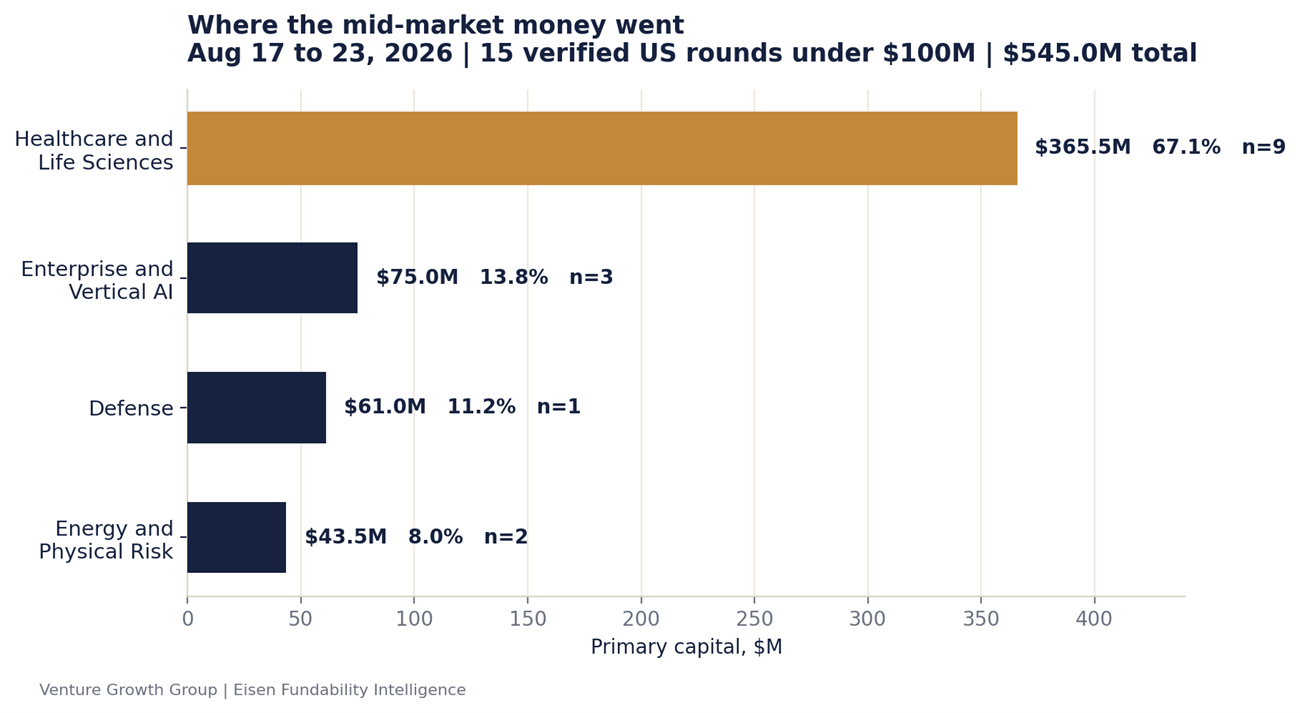
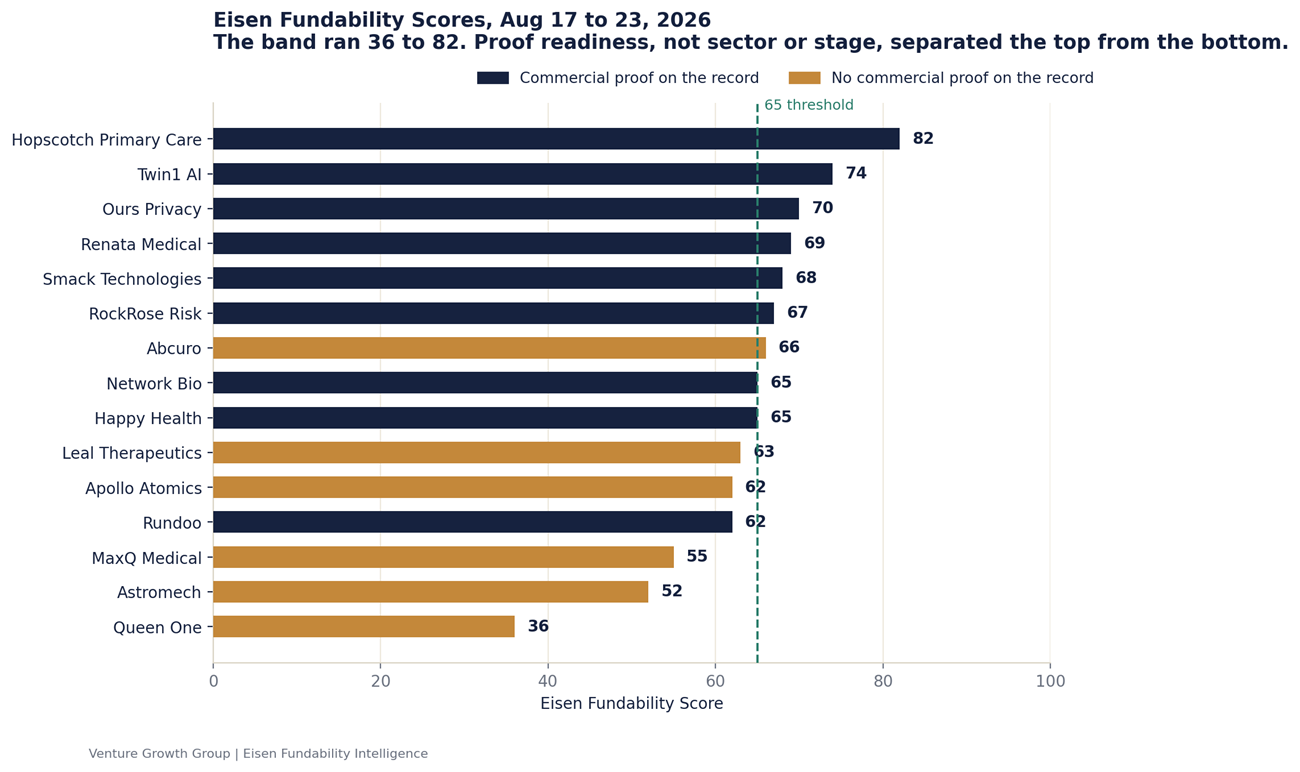
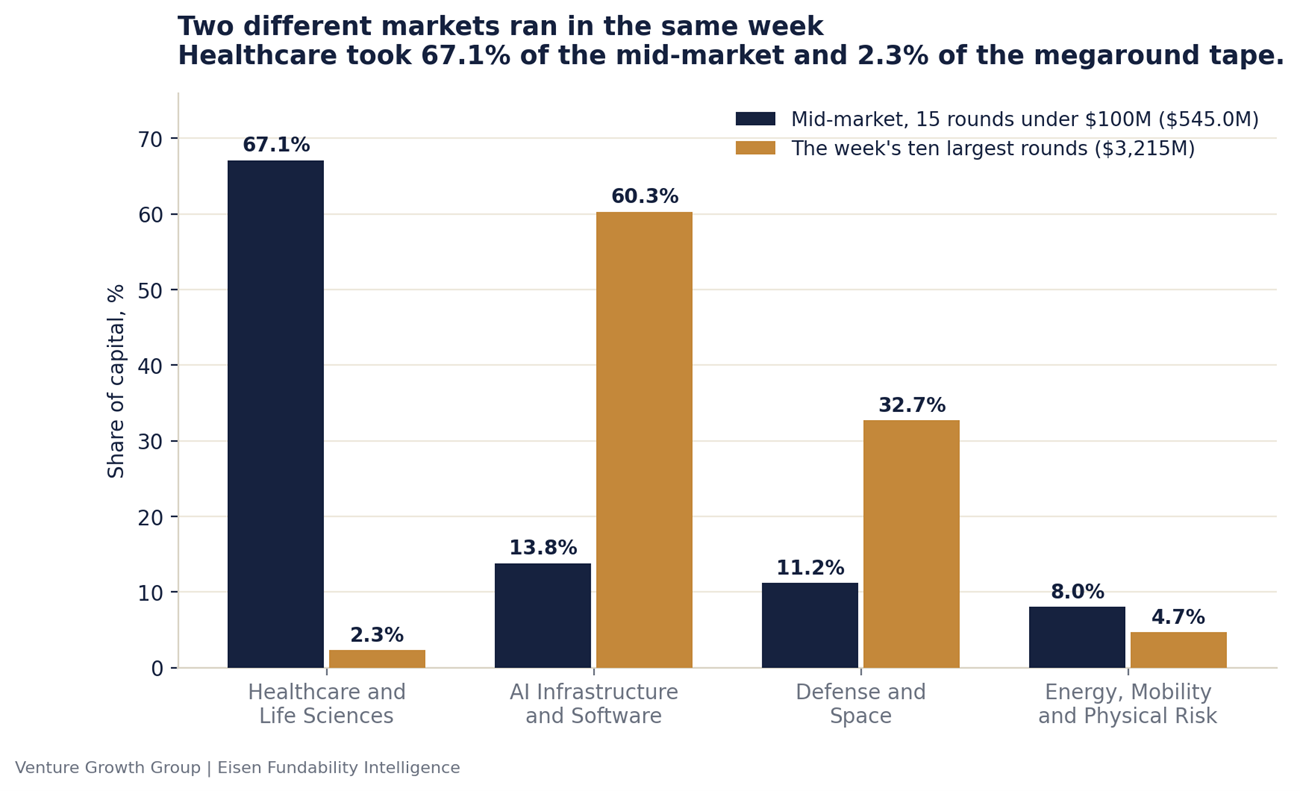
The week of August 17 to 23, 2026 produced two completely different markets, and almost nobody noticed. Above $100M, capital went to hypersonics, inference silicon, and satellites. Below $100M, where your round actually lives, 67.1% of the money went to healthcare and life sciences. Healthcare took 2.3% of the week’s ten largest rounds and 67.1% of the mid-market. Same week. Opposite conclusion.
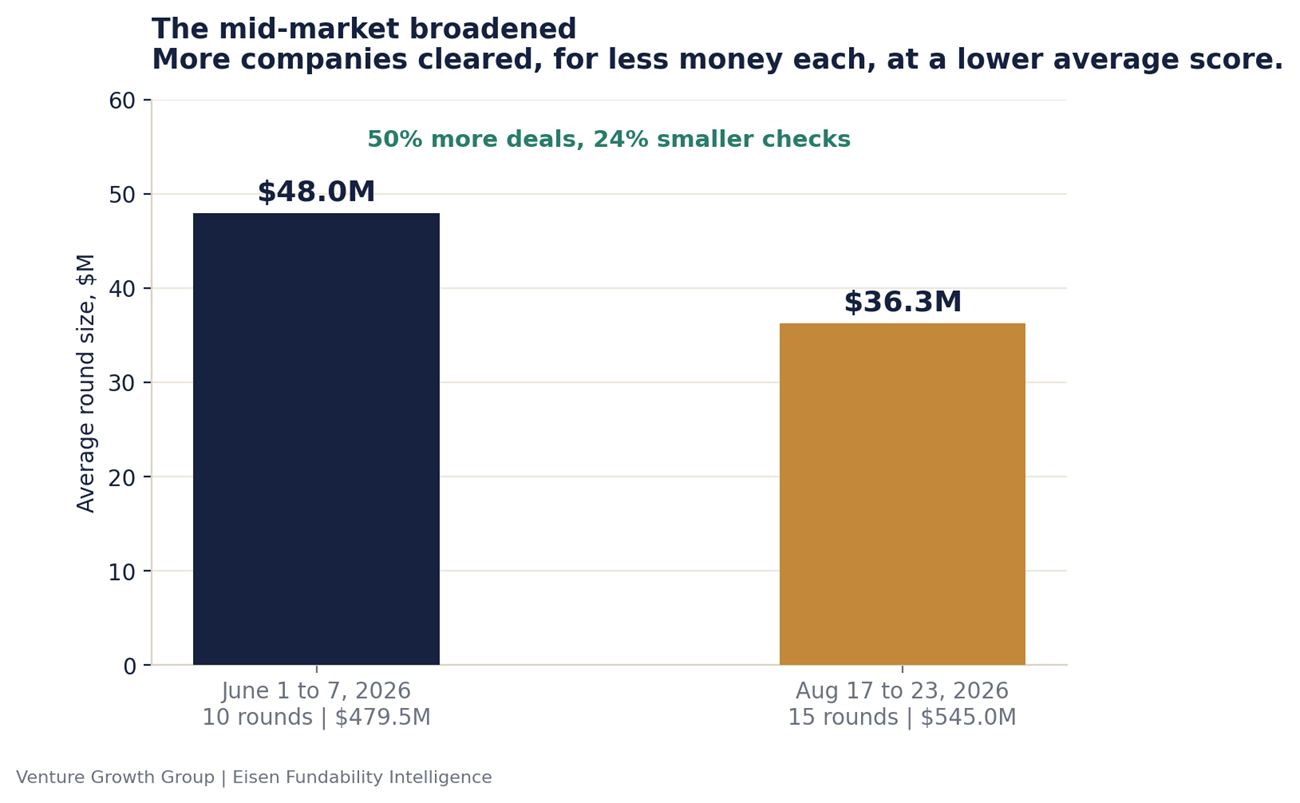
Fifteen verified rounds moved $545.0M. In June, this same mid-market moved $479.5M across ten rounds. That is 50% more deals at a 24% smaller average check. Capital broadened. And the moment it broadened, the Eisen Fundability Score band blew open, from a 13-point spread in June to a 46-point spread this week.
One variable explains that spread. The nine companies whose commercial proof was built and verifiable averaged 69.1. The six with none averaged 55.7. Same week, same investors, same capital. Thirteen points of fundability separated by whether the numbers already existed in defensible form while the round was live. Investors request that details be kept private in every process, so this is not an argument for publishing. It is an argument for having the answer before the question.
Here is the consequence. A partner will ask you for your numbers, separately and in their own time. The founders who send a defensible answer within 24 hours move to the front. The ones who need three weeks to assemble it are not being rejected. They are being outrun, in a market that just added five more companies asking for the same check. Read every shift below through that lens.
The Week in One Sentence
Primary insight. With megarounds and public market traffic removed, the mid-market broadened into healthcare and life sciences, and proof readiness replaced sector and stage as the variable that separated a fundable round from a funded one.
· Total tracked mid-market capital (15 verified rounds): $545.0M in new primary capital, every deal under $100M.
· Average round size: $36.3M across the fifteen.
· Median round size: $30.0M. The midpoint sits inside a two-way tie at $30.0M between Rundoo and Leal Therapeutics.
· Disclosed valuations: one of fifteen. Astromech at a company-stated $3.8B, against no disclosed revenue and no disclosed customers. That is a 93% opacity rate, up from 80% in June.
· Largest tracked round: Happy Health, $75M Series A, an FDA-cleared sleep apnea ring and at-home testing platform. It was also the smallest round on the week’s megaround list.
· Highest Eisen Fundability Score: Hopscotch Primary Care at 82, the highest this report series has recorded, and the only company in the set to disclose profitable operations.
· Lowest Eisen Fundability Score: Queen One at 36, a $25M round with no disclosed stage, no designated lead investor, and no operating metric.
· Defining structural feature: a 46-point score band against 13 points in June. Mean score fell from 72.3 to 63.7. More companies cleared, for less money each, at lower conviction.
Data Integrity Notes
All fifteen featured rounds were verified against at least two independent sources, then rechecked in a second independent verification pass against primary sources. Resolutions and exclusions applied:
· Editorial scope excludes giant rounds and public market events by request. Removed from the tracked set: Castelion ($800M equity plus $250M credit), Etched ($700M), Higgsfield ($400M), Groq ($350M), Wispr ($280M), Muon Space ($250M), Gravis Robotics ($200M), ALSO ($150M), Velaura AI ($110M) and Rillet ($100M). IPO and public market traffic, including the Anthropic offering coverage that ran on August 21, is out of scope. Those ten rounds are used only as a contrast set, sized at $3,215M.
· Date window control removed one deal. Trajectory ($40M Series A at a $300M post-money, led by Sequoia) circulated widely inside this window through aggregator republication on August 17 and 18. The announcement itself is dated August 11, 2026. It is marked as news-cycle resurfaced and excluded from all totals, charts, and scores in this issue. Sapiom ($35M Series A) is likewise dated August 6 in its primary source and excluded.
· Cumulative-versus-new capital removed two more. Sonic Fire Tech’s company release states the round closes out its seed financing at $15M, a cumulative figure that includes a $3.5M seed from October 2025, while some trade coverage reports $15M as new money. Channel Medsystems’ release is headlined as its Series C reaches $30M, led by an investor that has backed the company since 2021, with no new investor named. In both cases, the amount of new capital closed this week is not separately disclosed, so it is excluded from the totals rather than counted at its headline figure.
· Source discrepancy corrected. One trade outlet reported that Network Bio’s $30M co-development agreement is with NVIDIA. The company release describes two separate things: a $30M-plus co-development and licensing agreement with an unnamed Fortune 100 top-ten healthcare company, and a distinct technology collaboration with NVIDIA carrying no disclosed value. This report uses the primary source. An earlier draft of this issue carried the incorrect version.
· Unresolved item, flagged rather than smoothed over. Happy Health is labeled a Series A by the trade press and the weekly Megaround ranking, but the company raised a $60M Series A in August 2022, also led by ARCH. One major outlet reports total funding of $75M since 2019, with the round closing in 2025. New money versus cumulative restatement could not be resolved from primary sources. The round is retained on the strength of its August 18 announcement date and independent corroboration of the $75M figure, with MEDIUM confidence; no total amount raised is stated. Treat its contribution to the weekly total as the single largest uncertainty in this issue.
· Metric provenance. Hopscotch Primary Care’s headline metrics, Apollo Atomics’ criticality and letter-of-intent claims, and Abcuro’s subgroup result are all company-supplied. They are treated as verifiable rather than independently audited, and scored on that basis. Letters of intent are non-binding and are not scored as revenue.
· What this report can and cannot see. Scores reflect proof that was verifiable at announcement. Investors receive far more in a private data room, and a company that puts nothing on the record may have answered every question during diligence. The public record is therefore a proxy for whether the numbers existed in a defensible form while the round was running, not a measure of what a company knows about itself, nor a requirement to publish anything. Read every score below as fundability at the moment of announcement, not as a judgment of the business.
The Deal Scorecard
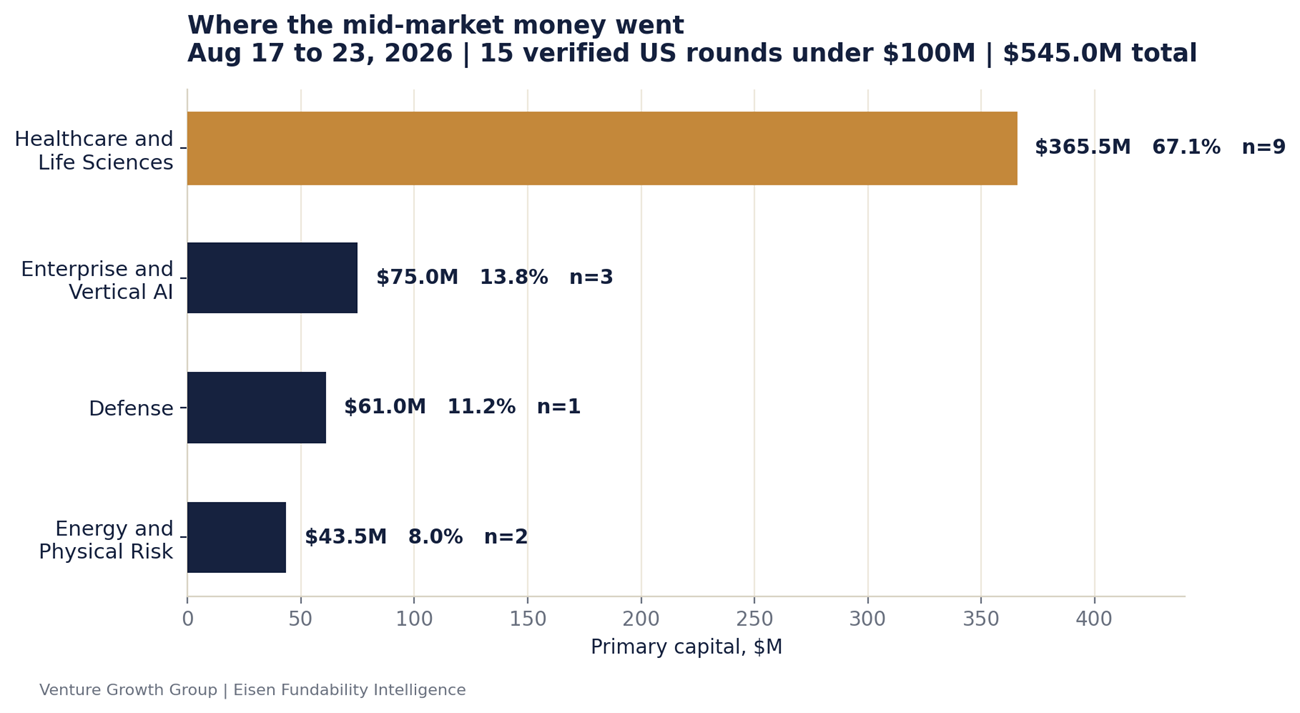
Eisen Fundability Scores are calculated across five weighted dimensions: Founder-Investor Dynamics (30), Traction-to-Conviction Conversion (25), Narrative Power (20), Deal Architecture (20), and Capital Planning (5). Scores of 85 and above signal an inevitable outcome. Scores of 70 to 84 signal strong execution. Scores below 70 signal early-stage or the need for repositioning. Missing metrics are scored conservatively, and opacity is penalized rather than assumed strong.
What the Scorecard Says at a Glance
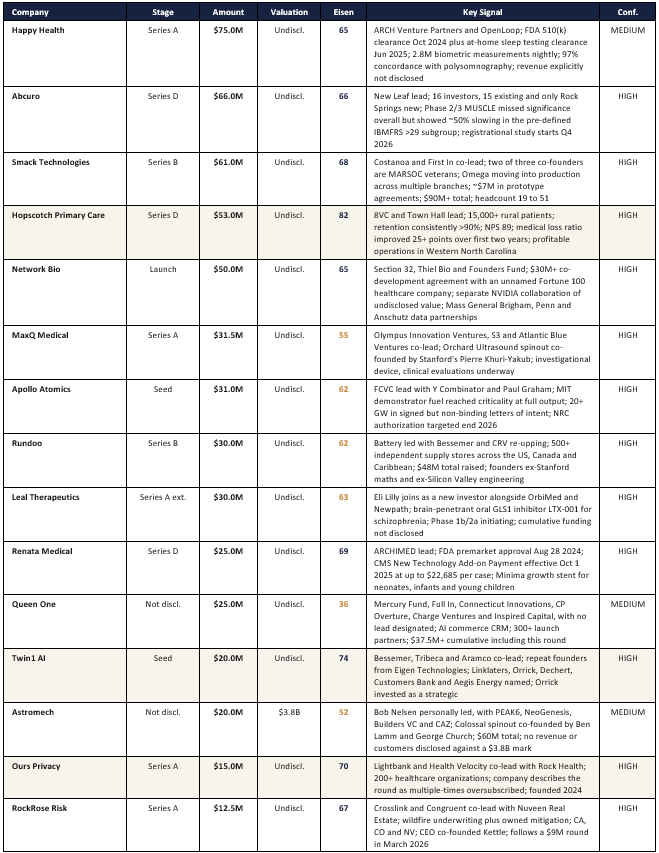
The band is the message, and this week the band broke. Scores ran from 36 to 82. That 46-point spread is more than three times the 13-point spread recorded in June, and the mean fell from 72.3 to 63.7. When a market widens like this, it is not getting pickier. It is getting less certain. More companies cleared at smaller checks, with wider quality dispersion underneath.
Proof readiness, not sector and not stage, drew the line. The nine companies whose commercial proof was built and verifiable averaged 69.1. The six with none averaged 55.7. The gap holds inside categories, not just across them. Two medtech companies sit 14 points apart: Renata Medical at 69 held a premarket approval and a reimbursement code worth up to $22,685 per case, while MaxQ Medical at 55 had an investigational device with clinical evaluations underway. Same category, same week, similar round size. Neither gap is about press strategy. One company had a funded payment pathway to point at, and the other did not.
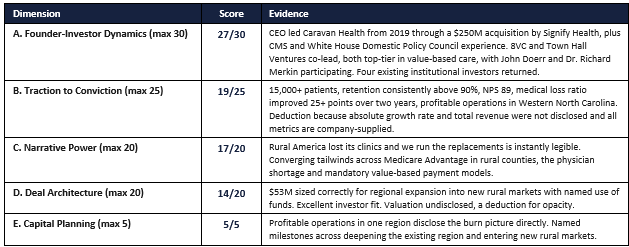
Hopscotch Primary Care (82) is the cleanest case in this report series. It did not lead with a famous investor or a valuation. It led with proof: 15,000 patients, consistently above 90 % retention, an NPS of 89, a medical loss ratio improved by more than 25 percentage points over a patient’s first two years, and profitable operations in Western North Carolina. Add a CEO who ran Caravan Health to a $250M acquisition and served at CMS and the White House Domestic Policy Council, and the round underwrites itself. One disclosure the release does not make: Gronniger is an advisor to Town Hall Ventures, which co-led this round.
The bottom of the band is not a bad-company list. Queen One (36), Astromech (52), and MaxQ Medical (55) all raised real money from real investors, and each of them will have answered detailed diligence questions that never reached the record. What the score measures is what a new investor could verify without asking. The scoreboard separates a fundable company from a fundable round, and this week the gap between the two was mostly a question of what was ready before anyone asked.
One deal proves the score is not a popularity contest. Astromech posted the highest founder and narrative marks in the set, a Colossal spinout co-founded by Ben Lamm and Harvard geneticist George Church, with Bob Nelsen leading, and a company-stated $3.8B valuation, and still landed second from bottom because it scored zero on traction to conviction and zero on valuation reasonableness. A $20M round at $3.8B is not a round. It is a mark. Twin1 AI (74), a seed, outscored eleven later-stage deals because it arrived with five named enterprise customers and one of them on the cap table.
What Changed This Week: Five Market Shifts
Each shift is verified against multiple sources and ranked by structural impact on founder fundraising, not by deal size. Every shift ends with what it means for your raise next week.
Shift 1: The Mid-Market Went Healthcare While the Tape Went Defense
Pattern, what happened. Nine of fifteen rounds and $365.5M of $545.0M, or 67.1% of tracked mid-market capital, went to healthcare and life sciences: Happy Health ($75M), Abcuro ($66M), Hopscotch ($53M), Network Bio ($50M), MaxQ Medical ($31.5M), Leal Therapeutics ($30M), Renata Medical ($25M), Astromech ($20M) and Ours Privacy ($15M). The week’s ten largest rounds went the other way: hypersonics, inference silicon, generative video, satellites, micromobility and ERP. Exactly one healthcare deal appeared on that list: Happy Health at $75M, and it was the smallest round. Healthcare took 2.3% of the megaround tape and 67.1% of the mid-market.
Perspective, what it means. These are two different underwriting engines running in the same week. Investors above $100M are buying capacity: compute, power, silicon, launch, and missiles. Scarcity prices those rounds. Below $100M, investors are buying a reimbursed clinical outcome, priced based on whether someone is contractually obliged to pay for it. Capacity underwriting rewards a credible claim on a scarce input. Reimbursement underwriting rewards a code, a clearance, and a payer.
Founder Blindspot, what most miss. Founders read the megaround headlines as a signal about their own category and adjust their narrative to match. A week that reads as defense and AI infrastructure on the front page was a healthcare week for every company raising under $100M. The tape above your round size tells you nothing about who will lead it.
Playbook, what to do. Rebuild your comparable set this week from rounds within 2x of your target size in your sector, from the last 90 days, and delete every comp outside that range. Then check which investors led those specific rounds. That list, not the headline list, is your process.
Contrast. In June, the mid-market spread across healthcare, energy, industrials, robotics data, fintech, and applied AI with no dominant sector. This week, one sector took more than two-thirds of the capital and nine of the fifteen deals in a category the headlines never mentioned.
What this means for your raise: Stop benchmarking your round against the news. Benchmark it against the eight to twelve rounds closest to your size and sector, and target the investors who actually led them.
Shift 2: Proof Readiness Became the Price, Not the Pitch
Pattern, what happened. The nine companies whose commercial proof was built and verifiable averaged an Eisen score of 69.1. The six with none averaged 55.7. Hopscotch had profitable operations in a region to point at and scored 82. Twin1 had five named enterprise customers at seed and scored 74. Ours Privacy had 200 healthcare organizations at its 2024 founding and scored 70. Queen One raised $25M with no stage, no lead, and no operating metric anywhere in its materials, and scored 36. Fourteen of fifteen rounds carried no valuation, a 93% opacity rate, up from 80% in June.
Perspective, what it means. Every investor asks for your numbers separately. That is what diligence is, and nothing here argues you should publish them instead. The question this gap answers is whether the answer exists in defensible form on the day they ask. When capital narrows, a partner will wait three weeks while you build the cohort analysis. When capital broadens, and this week it broadened by 50% in deal count, they move on to the company that already had it. Speed of proof, not volume of proof, separated this band.
Founder Blindspot, what most miss. Founders hear the word "disclosure" and think "press release," then argue about whether to publish. That was never the requirement. The requirement is that the numbers are assembled, reconciled, and defensible before the process opens. Most founders build the proof stack during diligence, under time pressure, off a partner’s question list. That is three weeks spent proving you can count, while a competitor spends them negotiating.
Playbook, what to do. Build three numbers now, before anyone asks: one usage number, one retention or expansion number, one economics number. Reconcile each against your own systems so a second query does not change the figure. Put them on slide two and hold a one-page backup with the work behind each. You are not publishing anything. You are removing the three weeks a request would otherwise cost you.
Contrast. June’s mid-market clustered inside 13 points because the market agreed on what it paid for. This week the band ran 46 points, and the divider was not category or stage. It was whether a company could answer the first hard question immediately.
What this means for your raise: Assume every investor is triaging. The founder who answers the numbers request in a day gets read first, priced first, and closed first. The one who needs three weeks gets delayed, and delay burns the runway you raised to protect.
Shift 3: Seed Outraised Series A
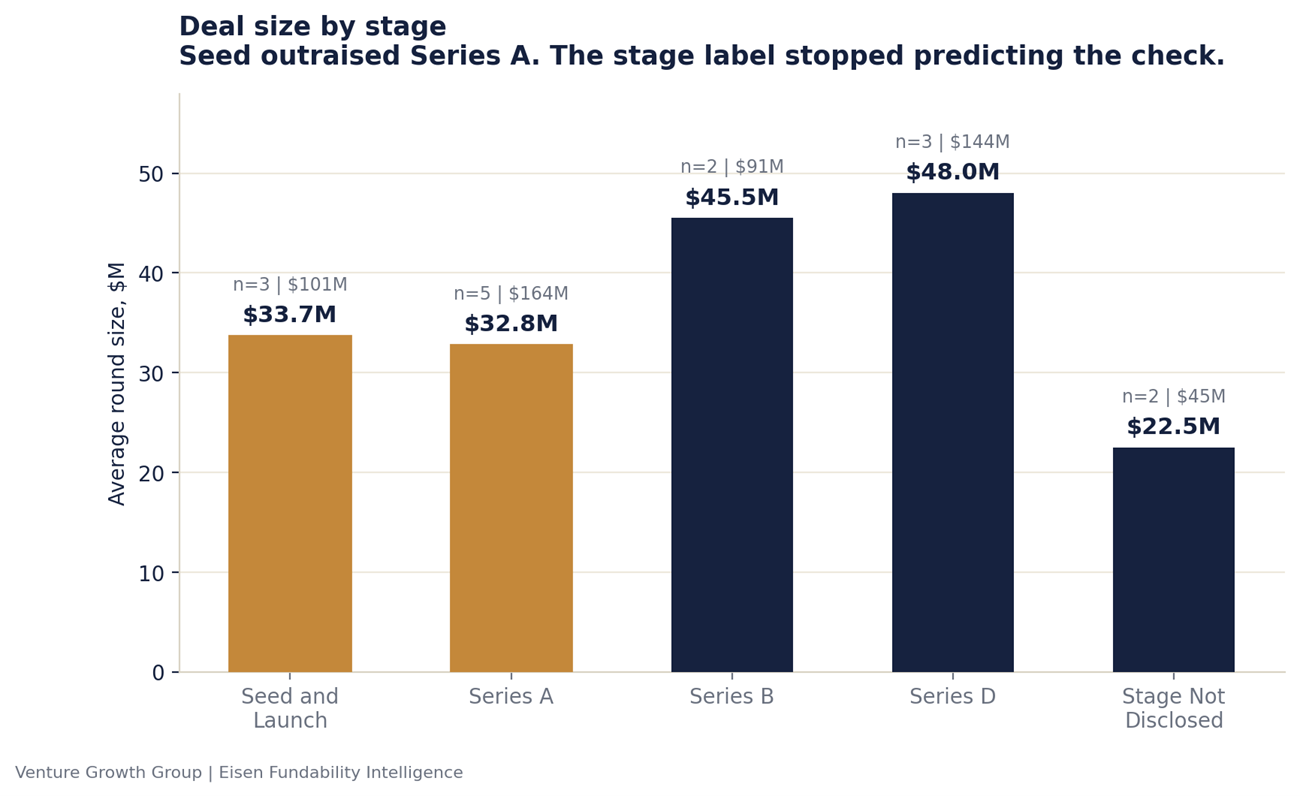
Pattern, what happened. Three seed and launch rounds averaged $33.7M. Five Series A rounds averaged $32.8M. Seed cleared above Series A this week, and Apollo Atomics’ $31M seed outsized three of the five Series A rounds outright. Every large seed carried a proof asset acquired before the round opened: Apollo’s reactor system demonstrator, built and tested inside MIT’s Department of Nuclear Science and Engineering, had fuel that reached criticality at full output, alongside more than 20 GW in signed letters of intent; Network Bio launched with $50M and a $30M-plus co-development and licensing agreement with a Fortune 100 healthcare company already signed; Twin1 came in with Linklaters, Orrick and Dechert as customers, one of them also writing a check, and a prior company behind the founding team.
Perspective, what it means. Seed is now a post-proof round for anything capital-intensive or regulated. The money is not buying the chance to find out whether the thing works. It is buying the scale-up of something that already does. That is why a $31M seed and a $31.5M Series A priced within half a million dollars of each other this week: the label described the cap table, not the risk.
Founder Blindspot, what most miss. Founders still sequence the raise as seed first, proof second. The seeds that cleared above $20M completely inverted that order. Every one of them held an asset at the moment of the raise that a competitor could not have bought that day. Note the counterweight: Apollo’s letters of intent are non-binding, and its criticality claim is company-supplied, which is why it scored 62 and not 75. A proof asset raises your ask. It does not replace revenue.
Playbook, what to do. Write down every asset you hold right now that a well-funded competitor could not acquire this week: a signed agreement, a clearance, a dataset, a named logo, a physical result. If the list is empty, you are raising a $2M seed with a $20M deck. Spend the next quarter buying one item onto that list instead of scheduling more meetings.
Contrast. June’s mid-market had no seed rounds in its top ten at all. Series A carried that week. This week, seed took $101M across three deals and priced above Series A.
What this means for your raise: Do not let the stage label set your ask. Let the asset set it. Price the round off what you already hold, and say what that is in the first thirty seconds.
Shift 4: Insiders Carried the Round, and Two Rounds Were Not Rounds
Pattern, what happened. Abcuro’s $66M Series D named sixteen investors, and fifteen of them were already on the cap table, with Rock Springs Capital the sole new name. Leal’s $30M was a Series A extension, a second close. Rundoo’s $30M Series B had Bessemer and CRV re-upping behind a new Battery lead. Hopscotch’s Series D brought aMoon, Citi Impact, Alumni Ventures and K2 HealthVentures back alongside its new leads. Two further announcements did not survive the integrity gate at all: Sonic Fire Tech’s release closes out its seed at a cumulative $15M rather than raising $15M new, and Channel Medsystems’ Series C reaches $30M from an investor that has backed it since 2021 with no new investor named.
Perspective, what it means. Existing investors are the fastest source of capital in a market where new leads need 60 days to underwrite, and this week they were doing most of the work. But an insider round without a new price-setter caps the outcome, and two of them were packaged as new rounds, even though the primary sources describe cumulative totals. Abcuro shows the version that works: it converted a Phase 2/3 study that missed its overall endpoint into a funded registrational program in a predefined subgroup, with a start date and a readout date, and secured 15 existing holders to underwrite it.
Founder Blindspot, what most miss. Founders treat an insider re-up as validation. It is a bridge until a new investor prices it. And when the announcement restates a cumulative total as though it were a fresh close, sophisticated investors notice before you finish the meeting. Two such announcements landed in a single week.
Playbook, what to do. Before you open the round, ask every existing investor for a written pro rata commitment with a number attached. Use that as your floor, then run a new-lead process against it. Attach the insider money to a specific, dated milestone in the announcement, as Abcuro attached its raise to a Q4 2026 study start and a second-half 2028 readout. And state new capital as new capital.
Contrast. June’s rounds were dominated by new leads taking board seats and setting price. This week, the majority of the capital came from people already on the cap table, and two announcements had to be excluded from the weekly total because new capital was never disclosed separately.
What this means for your raise: Secure the insider floor in writing first. Then go get the new lead. Never let the insider round be the whole round, and never announce a cumulative total as a close.
Shift 5: The Clearance Became the Traction Slide
Pattern, what happened. Renata Medical raised a $25M Series D on an FDA premarket approval granted August 28, 2024, and a CMS New Technology Add-on Payment effective October 1, 2025, worth up to $22,685 per case, not on disclosed revenue, and scored 69. Happy Health raised the largest mid-market round of the week, $75M, on two FDA clearances while explicitly declining to disclose revenue. Ours Privacy sold HIPAA compliance itself as the product to more than 200 healthcare organizations. RockRose Risk is acquiring tree-trimming and roofing companies so it can control the mitigation that makes a wildfire risk underwriteable at all. Abcuro’s entire raise is structured around the design of a registrational study.
Perspective, what it means. In regulated categories, the clearance and the reimbursement code are proof of revenue because they convert a product into a billable event. An investor underwriting Renata is not underwriting a stent. They are underwriting the fact that a hospital can bill up to $22,685 per case above the standard payment. The regulatory asset is not the cost of entering the market. It is the market access itself.
Founder Blindspot, what most miss. Founders, file regulatory milestones in the compliance appendix, and add a market size chart to the traction slide. The clearance is the traction slide. The gap between Renata at 69 and MaxQ at 55 is that one company had cleared and been assigned a payment pathway with a dollar figure, and the other had an investigational device with clinical evaluations underway.
Playbook, what to do. Rebuild your traction slide around the payment path: the clearance or license you hold, with its date; the code or contract vehicle that pays for it; the amount paid per unit or procedure; and the number of buyers already able to pay under it. If you are pre-clearance, put the specific filing date and the specific pathway on the slide instead of a market size.
Contrast. In June, the regulated build was framed as the moat, the thing a competitor could not clone in a quarter. This week it went one step further. The regulatory asset was the metric investors priced, serving as a proxy for revenue that had not yet arrived.
What this means for your raise: If you are in a regulated category, lead with the payment path rather than the product. The clearance plus the code is worth more on slide two this quarter than any revenue projection you can build.
The Deals That Matter, Top 5
Five deep dives across rural care delivery, enterprise AI, healthcare data infrastructure, pediatric medtech, and clinical-stage therapeutics. Four are the four highest-scoring rounds of the week. The fifth, Abcuro, is included because it is the most instructive deal in the set. All metrics are verified against two or more sources and re-checked in a second pass.
Hopscotch Primary Care
Tech-Enabled Rural Primary Care | Series D | $53M | Valuation Undisclosed
Eisen Fundability Score: 82 / 100
Why this scored. The highest score this report series has recorded, and it is not close. Hopscotch is the only company in the set to disclose profitable operations, and it also disclosed four other verifiable numbers. Everything a diligence team needs sits in the press release: 15,000 patients, retention consistently above 90%, an NPS of 89, a medical loss ratio improved by more than 25 percentage points across a patient’s first two years, and profitable operations in Western North Carolina. That is usage density, satisfaction, clinical economics, and unit economics in one paragraph. All five are company-supplied, and none is independently audited, which is normal at this stage. The competitive act is not that Hopscotch published them. It is that they existed, were reconciled, and were ready at the moment the round was running.
The Setup. Hopscotch was founded in 2021 to run primary care in rural communities that lost their clinics, and it operates twelve locations concentrated in Western North Carolina. CEO Tim Gronniger took over in November 2024. He led Caravan Health as CEO from 2019 through its acquisition by Signify Health in March 2022 for $250M, building it into the leading accountable care enabler for rural health systems. Before that, he was deputy chief of staff and director of delivery system reform at CMS, and served on the White House Domestic Policy Council and on Capitol Hill. He is, in other words, the person who helped write the payment model his own company now operates inside. Note one relationship the release does not disclose: Gronniger is an advisor to Town Hall Ventures, a co-lead of this round.
The Numbers. $53M Series D co-led by 8VC and Town Hall Ventures. Returning investors include aMoon Fund, Citi Impact Fund, Alumni Ventures, and K2 HealthVentures. New participants include the Autism Impact Fund, John Doerr, Dr. Richard Merkin, and the Leon Levine Foundation. More than 15,000 patients. Retention consistently above 90%. Net Promoter Score of 89. Medical loss ratio improved by more than 25 percentage points over the first two years of care. Profitable operations in Western North Carolina. Twelve clinical locations. Founded in 2021. Announced August 18, 2026, with a correction filed August 19 that changed only the spelling of Town Hall Ventures. Use of funds: deepen access in the existing region, enter additional rural markets, build clinical and technology infrastructure.
The Pattern. Hopscotch is the operator model in its purest form. It does not sell software into rural clinics. It is the clinic. That means every efficiency it creates lands in its own medical loss ratio rather than a customer’s, which is why it can disclose profitability at all. It also explains the score: the operator model converts product improvement directly into disclosable economics.
The Perspective. A 25-point improvement in the medical loss ratio is not a marketing claim. It is the single number a value-based care investor uses to model the entire business, because it determines whether the company keeps the shared savings. Hopscotch led with the number that does the underwriting, not the number that sounds impressive. Most founders lead with the opposite.
The Playbook. Identify the one metric your investor uses to build their model, not the one you use to build your roadmap. For value-based care, it is medical loss ratio. For consumption software, it is net revenue retention. For marketplaces, it is take rate against repeat rate. Put that number, and its trend, on the second slide. Everything else in your deck is supporting evidence for it.
The Founder Mistake to Avoid. Founders copy the language and claim they are the tech-enabled operator of their vertical while still selling a product into someone else’s P&L. Hopscotch scored 82 because it carries the patients, the clinicians, the payer contracts, and the downside risk. If you do not own the economics, you cannot produce them on demand, and a number you cannot produce on demand is worth nothing in a live process.
Twin1 AI
Digital AI Twins for Knowledge Workers | Seed | $20M | Valuation Undisclosed
Eisen Fundability Score: 74 / 100
Why this scored. A seed round that outscored eleven later-stage deals. Twin1 posted a perfect 30 out of 30 on Founder-Investor Dynamics, the only company in the set to do so, on a repeat founding team out of Eigen Technologies, three co-leads, and a syndicate deep enough that its own customer took equity. Then it backed the syndicate with five named enterprise logos at seed stage: Linklaters, Orrick, Dechert, Customers Bank and Aegis Energy.
The Setup. Twin1 builds a privacy-first platform that creates an individual digital twin for each professional, integrating with Slack, Teams, Outlook, Gmail, Drive and SharePoint, with six layers of governance control and a peer-to-peer coordination network between twins. The team is led by Dr. Lewis Z. Liu, who previously co-founded Eigen Technologies with Tom Cahn, Huiting Liu, and Dr. Jonathan Budd. Offices in San Mateo and London. The claim is that the platform automates 30% to 50% of the communications work knowledge workers do, which is a specific, testable assertion rather than a productivity slogan.
The Numbers. $20M seed round co-led by Bessemer Venture Partners, Tribeca Venture Partners, and Aramco Ventures, announced August 20, 2026. Participants include EJF Ventures, F-Prime, Lakestar, Notion Capital, Neo, AGI House Ventures, Tin Alley Ventures, and Orrick as a strategic investor. Angels include a Dawn Capital co-founder, a Wiz co-founder, and a former McKinsey senior partner. Named customers: Linklaters, Orrick, Dechert, Customers Bank, Aegis Energy. Stated automation of 30% to 50% of knowledge worker communications volume. Use of funds: team expansion in San Mateo and London, go-to-market, core technology. No revenue disclosed.
The Pattern. Twin1 is the clearest example this week of the post-proof seed. The round did not buy the chance to find out whether three global law firms would deploy the product. It bought the scale-up of a deployment that had already happened. That is why a seed round priced like a Series A and scored like one.
The Perspective. Orrick appears twice in the announcement, as a customer and as a strategic investor. That is the strongest single fundability signal available at seed: a buyer who has used the product putting money behind it. It converts a reference call into a cap table entry, and it removes the two questions that kill most seed enterprise rounds: whether the buyer is real and whether the buyer will stay.
The Playbook. Before your next raise, ask your three best customers whether they will invest, even in small amounts. You are not raising money from them. You are raising from them so the rest of your syndicate never has to take your word for the customer relationship. One customer on the cap table is worth more than ten reference calls.
The Founder Mistake to Avoid. Founders read this deal as proof that enterprise logos win seed rounds and go chase pilots with big names. Twin1’s logos were not pilots. They were deployments deep enough that one of the firms wrote a check. A named logo attached to an unpaid trial is a liability in diligence, because the first reference call exposes it.

Ours Privacy
HIPAA-Compliant Customer Data Platform | Series A | $15M | Valuation Undisclosed
Eisen Fundability Score: 70 / 100
Why this scored. The smallest round in the set and the third-highest score. Our Privacy scored 24 out of 30 on Founder-Investor Dynamics, on the back of a round that its own release calls "multiple times oversubscribed," which is the only explicit demand signal disclosed anywhere during the week. It backed that with 200 healthcare organizations as customers, having been founded in 2024, and a regulatory tailwind that does the selling for it.
The Setup. Ours Privacy sells a HIPAA-compliant customer data platform that lets healthcare marketers run growth programs without patient data ever entering their ad tools. The company was founded in 2024 by Jessica Holton, Adam Putterman, and Tyler Zey, who built the product after struggling to find a compliant way to run marketing and analytics at their own telehealth company, Ours Wellness. That origin matters: they are not outsiders selling to healthcare marketers; they were the customer. The wedge is narrow, and the buyer is under active enforcement pressure, which is close to the ideal starting position for a vertical infrastructure company.
The Numbers. $15M Series A co-led by Lightbank and Health Velocity Capital, announced August 19, 2026, with Rock Health, Lakehouse, TMV, Switch Ventures, Starfire Ventures, and GreyMatter participating. More than 200 healthcare organization customers spanning providers, payers, and digital health companies. Founded in 2024. Headquarters in Houston. Round described by the company as multiple-times oversubscribed; independent coverage says only oversubscribed. Use of funds: platform investment and adoption among enterprise healthcare organizations. Revenue not disclosed.
The Pattern. Ours Privacy is the compliance-as-product template. It does not sell a marketing tool that happens to be compliant. It sells the compliance, and the marketing capability is the delivery mechanism. That inversion is what turns a crowded category, customer data platforms, into a defensible one, because the buyer’s alternative is legal exposure rather than a competing vendor.
The Perspective. Health Velocity Capital’s limited partners are health systems and payers. That is not a brand on the cap table; it is a distribution channel, and in a $15M round it is worth more than a larger check from a generalist. The lesson generalizes: at small round sizes, the correct question is not which investor has the best name but which one shortens your sales cycle.
The Playbook. For every investor on your target list, write one sentence naming the specific customer they can introduce you to and the specific deal they did in your category. If you cannot write that sentence, cut the name. A 35-name list where every entry passes that test converts faster than a 120-name list built on fund size.
The Founder Mistake to Avoid. Founders in regulated categories position as the friendly modern alternative to the incumbent tool and compete on interface. Ours Privacy is positioned against the buyer’s legal exposure, not against a competitor’s feature list. If your compliance story is a checkbox on a comparison table rather than the reason the deal closes, you have built a feature inside someone else’s category.

Renata Medical
Pediatric Cardiovascular Devices | Series D | $25M | Valuation Undisclosed
Eisen Fundability Score: 69 / 100
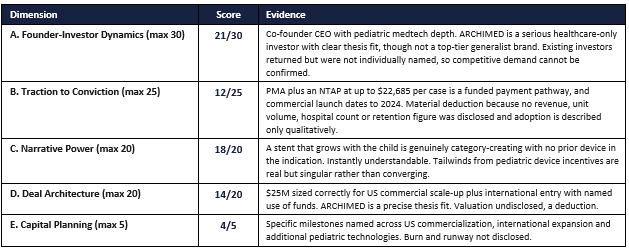
Why this scored. The purest example in the set of a round underwritten on a regulatory asset rather than revenue. Renata disclosed no ARR, no unit volume, and no revenue figure. What it disclosed was an FDA premarket approval granted August 28, 2024, and a CMS New Technology Add-on Payment effective October 1, 2025, worth up to $22,685 per case. ARCHIMED underwrote a purchase order that already has funding attached, and that scored 18 out of 20 on Narrative Power because the product is genuinely category-creating.
The Setup. Renata Medical, based in Newport Beach, California, and led by co-founder and CEO Dustin Armer, makes the Minima Stent System, the first balloon-expandable growth stent designed specifically for neonates, infants, and young children with pulmonary artery stenosis or coarctation of the aorta. A conventional stent placed in a newborn has to be surgically replaced as the child grows. Minima expands with the patient. The device previously held FDA Breakthrough Device designation and launched commercially in 2024.
The Numbers. A $25M Series D, led by ARCHIMED, a global healthcare-only investment firm, was announced on August 19, 2026, with existing investors participating but not individually named. FDA premarket approval was granted on August 28, 2024, a full PMA rather than a 510(k) clearance. CMS New Technology Add-on Payment announced August 12, 2025, for fiscal 2026, effective October 1, 2025, at a maximum of $22,685 per case. Company states adoption has exceeded internal expectations since commercial launch in 2024. No revenue, unit, or customer figure disclosed. Use of funds: accelerate US commercialization, expand internationally, develop additional pediatric cardiovascular technologies.
The Pattern. This is the reimbursement-first medtech round. Renata secured the payment mechanism a full year before it needed the revenue, and that mechanism is what was priced. An NTAP is Medicare paying an add-on above the standard diagnosis-related group payment, which means the hospital’s budget objection disappears before the sales call starts.
The Perspective. Investors in regulated hardware do not underwrite the device. They underwrite the moment money changes hands. A PMA says the device may be sold. An NTAP with a dollar amount indicates that a specific buyer has a specific funded line item. Those are two different assets, and only the second one closes rounds. Renata held both, and it is why a $25M Series D with zero disclosed revenue outscored a $75M Series A and a $50M launch financing.
The Playbook. Find the payment mechanism that already exists in your category and get named in it: an NTAP, a CPT code, a GSA schedule, an approved formulary, a state contract vehicle, a rebate program. Then put the per-unit or per-case dollar figure on your traction slide. If none exists, the specific pathway and filing date go on the slide instead. A founder who can name what a buyer gets paid to buy their product is describing revenue, not compliance.
The Founder Mistake to Avoid. Founders treat reimbursement as a post-launch commercial workstream that starts once the product is selling. Renata inverted that, and it is the entire reason this round priced. The trap is assuming a clearance alone is the milestone. A clearance without a payment pathway gives you permission to sell into a budget that does not exist yet, which is exactly the gap that separates Renata at 69 from MaxQ at 55.
Abcuro
Clinical-Stage Autoimmune Therapeutics | Series D | $66M | Valuation Undisclosed
Eisen Fundability Score: 66 / 100
Why this scored. Included as the most instructive deal of the week rather than the highest-scoring. Abcuro is the only company in the set that raised $66M after its lead program failed to meet its overall endpoint. The Phase 2/3 MUSCLE study of ulviprubart in inclusion body myositis did not achieve statistical significance and showed a trend toward slowing disease progression relative to placebo, with roughly a 50% slowing in a predefined subgroup of less severe patients. Abcuro recut that finding into a defined population, designed a potentially registrational study around it, and funded it with 16 investors, 15 of whom were already holders.
The Setup. Abcuro is a Newton, Massachusetts clinical-stage company led by CEO Alex Martin, developing ulviprubart, a first-in-class antibody targeting KLRG1, for inclusion body myositis, a progressive muscle-wasting disease with no approved therapy. The company did not restructure, pivot, or rebrand after the readout. It kept the asset, narrowed the population, named the next study, and put dates on it.
The Numbers. $66M Series D led by New Leaf Venture Partners, announced August 18, 2026. Fifteen existing investors participated, including abrdn, Bain Capital Life Sciences, Samsara BioCapital, Redmile Group, Mass General Brigham Ventures, RA Capital Management, Pontifax, Sanofi Ventures, Foresite Capital, NEA, Eurofarma Ventures, Kaitai Capital, and Soleus Capital, with Rock Springs Capital the sole new investor. The Phase 2/3 MUSCLE study did not achieve statistical significance overall and showed a trend toward slowing disease progression, with roughly a 50% slowing in the predefined subgroup scoring above 29 on the IBM functional rating scale. Potentially registrational study expected to start Q4 2026, top-line results anticipated in the second half of 2028. Pre-revenue.
The Pattern. Abcuro is the risk-recut template, and it is the most replicable move in this entire issue. The company did not argue that the trial was misread. It accepted the result, isolated the predefined population where the effect held, and repriced the program around that population using a dated study and a dated readout. Fifteen existing investors funded the narrower, more certain thing.
The Perspective. Investors do not fund optimism after a miss. They fund a smaller claim they can believe. The instinct after a bad result is to widen the story: more indications, more markets, more optionality. Abcuro did the opposite and narrowed it to the one population where the evidence held. A defensible smaller claim is fundable. An indefensible larger one is not, and the difference is worth $66M. Note that the subgroup was predefined rather than identified afterward, which makes it credible to regulators and diligence teams.
The Playbook. If a core assumption in your business broke this quarter, do not rewrite the narrative to route around it. Segment your data and find the cohort, channel, or customer type where the result actually held, and check whether you defined that cut in advance. Then rebuild the round around that cohort, with a named next milestone and a date, and take it to your existing investors first. They already carry the loss, and they are the fastest capital available to you.
The Founder Mistake to Avoid. Founders respond to a bad number by expanding the story. The market reads expansion after a miss as an inability to face the result. The second trap is subtler: presenting the 50% figure without the words did not achieve statistical significance next to it. A subgroup result quoted without its failed primary endpoint is the fastest way to lose a sophisticated investor in diligence.

The Fundraising Playbook, Five Tactical Plans
Five plans, each producing a concrete output you can use immediately. No vague tasks. Each is built directly from this week’s verified signals.
1. The Three Numbers, Ready Before the Ask (Positioning and Investor Framing)
Why this matters. Proof readiness was worth 13.4 points of Eisen score this week. The nine companies whose commercial proof was built and verifiable averaged 69.1, compared with 55.7 for the six with none, and the gap held within categories rather than only across them. Investors request this detail privately in every process, so the deliverable below is not a publication plan. It is a readiness plan.
Exact deliverable. Three numbers, assembled and reconciled before you open the round: one usage number (units, patients, stores, seats, transactions), one retention or expansion number, and one economics number (gross margin, medical loss ratio, contribution margin, payback). Each must be reconciled against your own systems so that a second query does not change the figure. Put them on slide two of the deck, keep a one-page backup carrying the working and the source query behind each, and set an internal standard that any investor request for detail is answered within 24 hours. What you make public is a separate decision and stays yours.
Expected outcome. You move from the 55.7 bucket to the 69.1 bucket without changing anything about the business. When the diligence request lands, you answer the same day rather than spending three weeks proving you can count.
The reframe. Wrong approach: build the proof stack during diligence, off the partner’s question list. Right approach: build it before the process opens, so the request costs you a day rather than a month.
2. The Payment Path Traction Slide (Proof and Metrics Packaging)
Why this matters. Renata Medical raised a $25M Series D with no disclosed revenue on an FDA premarket approval plus a CMS add-on payment worth up to $22,685 per case, and scored 69. MaxQ Medical raised $31.5M with an investigational device and clinical evaluations underway and scored 55. In regulated categories this week, the funded payment pathway was the traction.
Exact deliverable. Rebuild your traction slide around four lines: the clearance, license, or approval you hold with its date; the code, contract vehicle, or reimbursement pathway that pays for it; the amount paid per unit or procedure; and the number of buyers already able to pay under it. If you are pre-clearance, replace line one with the specific pathway and the specific filing date. Delete the market size chart from the traction slide entirely and move it to the appendix.
Expected outcome. An investor can model your revenue from the slide without asking you a question. That is the difference between a second meeting and a follow-up request.
The reframe. Wrong approach: regulatory milestones in the compliance appendix; market size on the traction slide. Right approach: the payment path on the traction slide, market size in the appendix.
3. Eisen Self-Score and Gap Diagnosis (Readiness)
Why this matters. This week’s scores ran 36 to 82, a 46-point band against 13 points in June, and the mean fell from 72.3 to 63.7. In a wide, uncertain band, knowing precisely which dimension is pricing you down matters more than it did when everyone clustered together.
Exact deliverable. Score your round across the five dimensions: Founder-Investor Dynamics (30), Traction to Conviction (25), Narrative Power (20), Deal Architecture (20), and Capital Planning (5). Score conservatively and penalize your own opacity the way an investor will, which means every undisclosed figure loses points rather than getting the benefit of the doubt. Identify your two lowest dimensions and write one concrete action for each, with a date.
Expected outcome. A ranked list of the two dimensions actually pricing your round down, so the next two weeks go to the gap instead of to another deck revision.
The reframe. Wrong approach: improve everything at once and assume missing data reads as neutral. Right approach: fix the lowest two dimensions and assume every blank scores zero.
4. The Insider Floor Before the Outside Process (Deal Architecture)
Why this matters. Insider participation appeared in at least six of fifteen rounds, and two further announcements had to be excluded from this issue’s totals because they restated cumulative figures rather than disclosing new capital. Abcuro funded $66M with fifteen of sixteen investors already on the cap table, attached to a dated registrational study, and scored 66 after a failed primary endpoint.
Exact deliverable. A written pro-rata commitment, with a dollar figure attached, from every existing investor, secured before you open the round. Then a target list of new leads cut to 35 names, where every name passes one test: you can write a sentence naming the specific deal they led in your category and the specific customer or validation they bring. Finally, one dated milestone the round funds, stated in the announcement, and new capital stated as new capital.
Expected outcome. A priced floor you control, a shorter and faster outside process, and an announcement that reads as conviction rather than maintenance.
The reframe. Wrong approach: treat the insider re-up as the win and announce the cumulative total. Right approach: treat it as the floor, attach it to a dated milestone, and go get the new lead who sets the price.
5. The Forcing Function Sentence (Momentum and Conversion)
Why this matters. RockRose is entering a wildfire season that has already burned more acreage than in all of 2025. Ours, Privacy, sells into active federal enforcement pressure and closed a round it describes as multiple-times oversubscribed. Apollo Atomics is selling into a data center power crunch with more than 20 GW of letters of intent already signed. Every fast close in this set had a deadline underneath it that belonged to the customer, not the founder.
Exact deliverable. One sentence naming the forcing function that makes your customer act this quarter rather than next year: a cost line that broke, a regulation with a date, a platform migration already committed, a contract renewal, a season. Then a 14-day follow-up cadence where each touch reports movement against that forcing function rather than movement in your own roadmap.
Expected outcome. Your process runs at the speed of your customer’s urgency, which is the only speed an investor believes. Each follow-up includes new external evidence rather than an internal update.
The reframe. Wrong approach: create urgency with a fake deadline on the round. Right approach: surface the real deadline that already exists in your customer’s world and report against it every two weeks.
Looking Forward, Next 1 to 3 Weeks
Three evidence-based scenarios and one wild card. Every prediction is anchored to this week’s verified data, not speculation.
Scenario 1: The Healthcare Mid-Market Stays Crowded (High Probability)
Evidence from this week. Nine of fifteen mid-market rounds and 67.1% of tracked capital went to healthcare and life sciences, spread across therapeutics, medtech, care delivery, biomedical AI, and healthcare data infrastructure. That is breadth, not a single hot subsector, which is the pattern that persists rather than spikes.
What to watch. Whether more healthcare rounds arrive with operating proof already assembled. Hopscotch had profitable operations in a region to point at and scored 82. Most founders will keep that detail inside diligence rather than in a release, which is reasonable. The signal to watch is how quickly companies in your category can respond to a metrics request, because that speed is now your benchmark.
What founders should do before others notice. If you are raising in healthcare within the next quarter, assume you are being read against a comparison set that includes a company with profitable operations, which it can evidence on request. Get one economics number reconciled and ready before you open, even if it covers a single region, site, or cohort.
Scenario 2: Seed Round Sizes Stay Detached From the Label (High Probability)
Evidence from this week. Three seeds averaged $33.7M against five Series A rounds at $32.8M, and every large seed carried a pre-existing proof asset: criticality reached at full output on an MIT-built demonstrator, a signed $30M-plus co-development agreement with a Fortune 100 healthcare company, three global law firms deployed with one of them investing. The mechanism is structural, not sentiment.
What to watch. Seed announcements that lead with an asset rather than a team: a signed agreement, a regulatory step, a physical result, a named customer. Watch particularly for seeds in capital-intensive categories closing above $25M, which is where the label detaches entirely from the risk profile.
What founders should do before others notice. Audit what you hold today that a competitor could not buy this week. If the list is empty, reset your ask to match the risk you are actually asking someone to take, and spend the quarter buying one item onto the list rather than running a process you will lose.
Scenario 3: Valuation Opacity Keeps Rising (Medium-High Probability)
Evidence from this week. Fourteen of fifteen rounds withheld valuation, a 93% opacity rate, up from 80% in June. The one company that disclosed was Astromech at a company-stated $3.8B with no revenue and no customers disclosed against it. That is not an example the rest of the market wants to follow, and it does nothing to encourage disclosure by companies with real but unspectacular numbers.
What to watch. Whether operating metric disclosure rises while valuation disclosure continues to fall. That combination, more numbers about the business and fewer about the price, is the signature of a market where founders are competing on proof and protecting on terms.
What founders should do before others notice. Separate the two decisions deliberately. Build operating proof so it can be produced within a day, and hold price until you have leverage. Founders who conflate the two build nothing until diligence forces it, and that is what put six companies in the 55.7 bucket this week.
Wild Card: A Second Failed Readout Gets Funded on a Recut (Medium Probability)
Evidence from this week. Abcuro raised $66M from sixteen investors after its Phase 2/3 missed statistical significance by isolating a pre-defined, less severe subgroup showing roughly 50% slowing and designing a registrational study around it, with a Q4 2026 start and a second-half 2028 readout. Fifteen of the sixteen investors were already holders. The template is now visible to every board in the sector.
What founders should do before others notice. If you are approaching a binary readout of any kind, clinical or commercial, pre-commit with your board to the subgroup analysis you will run if the primary result misses, and define the cut in advance so it is credible afterward. Identify now which existing investors would fund a narrower program. Deciding this before the result removes the two weeks of narrative drift that usually follows a miss, and those two weeks are where most recuts die.
The Bottom Line
The real insight is not the $545.0M total. It is that two markets ran in the same week and the loud one was irrelevant to you. Above $100M, capital chased capacity. Below $100M, where your round lives, capital chased proof of payment, and it paid a 13.4-point premium to the founders whose proof was already built when the process opened. Three conviction profiles took the week.
Profile 1: Operators who own the economics. Hopscotch Primary Care (82) runs the clinics, carries the payer contracts, and can therefore disclose profitable operations and a 25-point improvement in medical loss ratio. Ours Privacy (70) sells the compliance itself to 200 organizations rather than a tool that happens to be compliant. When you own the economics, you can produce them on demand, and that speed is what priced this week.
Profile 2: Post-proof seeds that arrived holding an asset. Twin1 AI (74) arrived at seed with three global law firms deployed, one of which is on the cap table. Apollo Atomics (62) arrived with fuel that had reached criticality on a demonstrator built inside MIT. Network Bio (65) launched with a $30M-plus co-development agreement already signed. None of these rounds bought the chance to find out. All three bought the scale-up of something already true, and seed outraised Series A because of it.
Profile 3: Regulated assets standing in for revenue. Renata Medical (69) raised on a premarket approval plus a reimbursement code worth up to $22,685 per case, with no revenue disclosed at all. Abcuro (66) funded a registrational study after a missed primary endpoint by narrowing to the predefined population in which the effect held. Happy Health (65) raised $75M on two FDA clearances while declining to disclose revenue. The clearance and the code did the work revenue usually does.
Everything else competed for the residual. Six companies raised real money with no commercial proof built into the record, and they averaged 55.7, compared with 69.1 for the rest. Every one of them will have answered questions in diligence that never became public, and none of them owed anyone a press release. The difference is that the top of the band had the answer ready before the question arrived. In a broadening market, the proof you can hand over the day it is asked for is the moat.
Five New Rules for Founders
Rule 1. Read the tape at your own round size. The headlines above $100M went to defense and silicon. The mid-market went 67.1% to healthcare. Build your comp set from rounds within 2x of your target, or you will optimize your pitch for a market you are not raising in.
Rule 2. Proof readiness is worth 13.4 points. Three reconciled numbers- one usage, one retention, one economics- separated 69.1 from 55.7 this week with nothing else about the underlying businesses changing. Investors will ask you for them privately. Have the answer before the question.
Rule 3. The stage label no longer sets the check. Seed outraised Series A, and every large seed held an asset before the round opened. Price your ask off what you already hold, not off the round name.
Rule 4. Insider money is a floor, not a round, and a cumulative total is not a close. Secure written pro-rata first, attach it to a dated milestone, then find the lead who sets the price. Two of this week’s announcements failed that test and were excluded from these totals.
Rule 5. In a regulated category, the clearance is the traction slide, and the reimbursement code is the revenue line. Renata raised $25M with no revenue disclosed because it could not disclose what a hospital is paid to use its product.
Four Monday Actions
1. Assemble the three numbers. One usage, one retention, one economics, each reconciled against your own systems. Slide two of the deck, plus a one-page backup carrying the work behind each, ready to send the day it is requested.
2. Rebuild the traction slide as a payment path. Clearance or license with its date, the code or contract vehicle that pays, the amount per unit, the number of buyers able to pay. Market size moves to the appendix.
3. Secure the insider floor in writing. Ask every existing investor for a pro rata commitment, including the dollar amount, before you open. Then attach the round to one dated milestone, and never let a cumulative total be described as a close.
4. Write the forcing function sentence. Name the deadline that belongs to your customer, not to you. If they could wait a year without consequence, fix that before you fix the deck.
Your competitors are reading the same tape, and most of them are reading the wrong half. The founders whose three numbers are already reconciled get read first, priced first, and closed first. The ones who start assembling when the request lands will spend three weeks proving they can count, while five other companies answer in a day.
Research Methodology and Sources
Data collection period: August 17 to 23, 2026, with verified primary disclosures clustered August 17 to 21. No verified US mid-market round was announced on August 22 or 23. Verification standard: a minimum of two independent sources per deal, with company press releases and regulated newswires (BusinessWire, PRNewswire, GlobeNewswire) prioritized as anchor sources, plus at least one independent outlet for corroboration. This issue was then put through a second, independent verification pass in which every company, amount, stage, investor, date, and reported metric was re-checked against primary sources by researchers who did not write the first draft. That pass removed three deals, corrected six attributions, and reversed one sourcing error. Its findings are documented in the Data Integrity Notes and the corrections log below. Eisen Fundability Scores are proprietary analytical estimates, not endorsements or investment advice. All dollar figures reflect the announced new primary capital at close unless noted otherwise.
Core Capital Totals and What They Include
The $545.0M weekly total includes only the fifteen verified US rounds in the scorecard, each independently confirmed at the stated amount and stage. Mid-market is defined for this issue as a US-headquartered priced round of new primary capital between $10M and $100M. Regulation A+ and other retail securities offerings are excluded because they are not priced venture rounds. Announcements that restate a cumulative total rather than disclosing new capital closed in the window are excluded. No aggregator-only figure was treated as fact without corroboration in a company release or an independent outlet. Arithmetic on the total, the average, the median, all stage and sector subtotals and every chart value was recomputed and reconciled after the second verification pass: the four sector subtotals ($365.5M, $75.0M, $61.0M and $43.5M) and the five stage subtotals ($101.0M, $164.0M, $91.0M, $144.0M and $45.0M) each sum to $545.0M across fifteen deals.
Deal Citations, Two or More Sources per Deal
· Happy Health, $75M Series A. Fierce Healthcare deal coverage dated August 18, 2026; MedCity News; Medical Device Network; VC News Daily round record; Crunchbase News weekly ranking for the week of August 15 to 21, 2026; FDA 510(k) database records K240236 (cleared October 8, 2024) and K242224 (cleared June 18, 2025); company clearance release of June 19, 2025 for the 97% polysomnography concordance figure. Business Insider coverage of August 18, 2026 conflicts on total raised and close date; see Data Integrity Notes.
· Abcuro, $66M Series D. BusinessWire company release dated August 18, 2026; BioSpace press release archive; Clinical Trials Arena; FinSMEs; citybiz.
· Smack Technologies, $61M Series B. PRNewswire company release dated August 18, 2026; Smack Technologies company journal post; The Next Web; Tectonic Defense; FinSMEs; company BusinessWire release of March 2, 2026 for the $32M prior financing and founder backgrounds.
· Hopscotch Primary Care, $53M Series D. PRNewswire company release dated August 18, 2026 with formal correction filed August 19, 2026; Pulse 2.0; Crain’s Chicago Business; FinSMEs; Hopscotch CEO announcement of November 13, 2024 and Town Hall Ventures partner biography for founder background; BusinessWire release of March 1, 2022 and Fierce Healthcare for the $250M Signify Health acquisition of Caravan Health.
· Network Bio, $50M launch financing. Company release dated August 19, 2026; Pharmaphorum; BusinessWire release of August 19, 2026 covering the separate NVIDIA collaboration; The Pharmaletter; Longevity.Technology. GenomeWeb coverage contains the NVIDIA conflation corrected in this issue.
· MaxQ Medical, $31.5M Series A. PRNewswire company release dated August 20, 2026; S3 Ventures investor announcement; Medical Device Network; Yahoo Finance syndication.
· Apollo Atomics, $31M Seed. PRNewswire company release dated August 20, 2026; Tech Startups; Tech Funding News; Interesting Engineering; Dealroom.
· Rundoo, $30M Series B. BusinessWire company release dated August 19, 2026; SiliconANGLE; Tech Startups; Hardware Retailing; Pulse 2.0.
· Leal Therapeutics, $30M Series A extension. PRNewswire company release dated August 17, 2026; BioSpace; Reuters via TradingView; Clinical Trials Arena; citybiz; company releases of October 30, 2024, and August 27, 2025, for prior financings.
· Renata Medical, $25M Series D. PRNewswire company release dated August 19, 2026; BioSpace; Pulse 2.0; Medical Device Network; Cardiac Interventions Today for the CMS NTAP approval; BusinessWire release of August 12, 2025 for the NTAP designation and per-case amount.
· Queen One, $25M. PRNewswire company release dated August 19, 2026; MarTech Cube; Pulse 2.0; TipRanks private company coverage; FinSMEs.
· Twin1 AI, $20M Seed. BusinessWire company release dated August 20, 2026; Twin1 company newsroom; CityBiz; FinancialContent.
· Astromech, $20M. Axios Pro Biotech Deals dated August 20, 2026; Yahoo Finance; Dallas Innovates; Tech Funding News; Dealroom; FinSMEs. Prior round context from Axios Pro of April 7, 2026.
· Ours Privacy, $15M Series A. PRNewswire company release dated August 19, 2026; Fierce Healthcare; Pulse 2.0; MarTech Cube; The SaaS News; FinSMEs.
· RockRose Risk, $12.5M Series A. Business Wire company release dated August 19, 2026; Insurance Business Magazine; Insurance Journal; FF News; Fintech Global; separate RockRose release for the McCloud Condominium savings figure in North Lake Tahoe, Nevada.
Research completion timestamp: August 23, 2026.
DISCLAIMER: This article is for informational and strategic intelligence purposes only. It does not constitute investment advice. The Eisen Fundability Score is a proprietary diagnostic within Fundables OS™, not a financial recommendation.
If this article was useful, share it with founders who are about to raise.
— Leon Eisen, 4x Founder, Venture Capitalist, and Creator of Fundables OS™