

Playbook, Perspective, and Pattern for Founders Raising Now
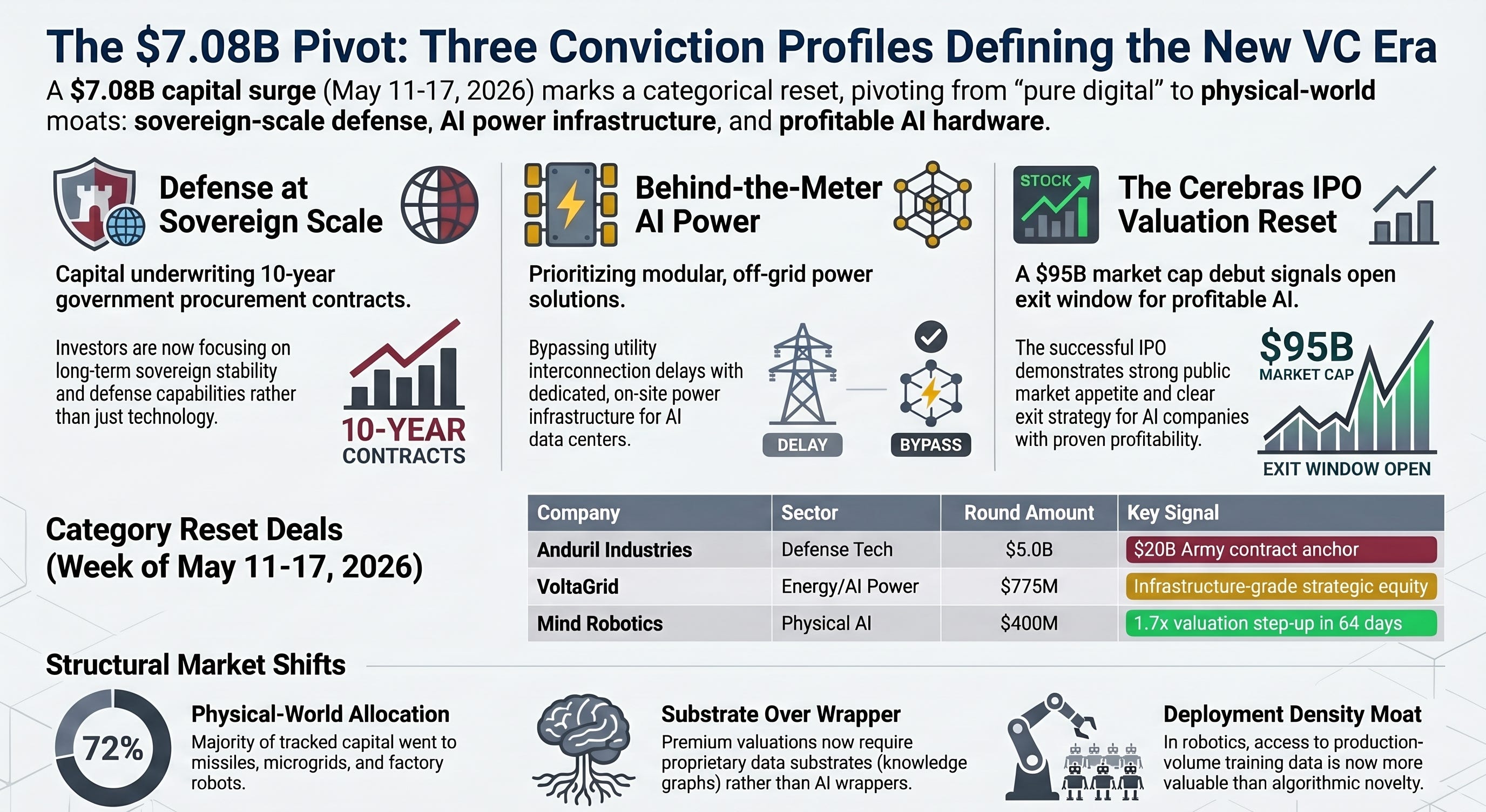
The week of May 11-17, 2026, was not a soft week. It was a category reset. Defense tech alone absorbed $5.1 billion of fresh primary capital. The AI power layer absorbed another $1.1 billion. Robotics absorbed $400 million at a 1.7x step-up just 64 days after a $500 million Series A. And on Thursday, Cerebras Systems opened on Nasdaq at $350, closed at $311, and reset the comp table for every private AI infrastructure company chasing an exit.
Total tracked U.S. capital across the top 10 verified rounds: approximately $7.08 billion, the highest weekly total Crunchbase has recorded outside of a frontier-lab megaround week. Roughly 72% of that capital went to companies building in the physical world: missiles, microgrids, factory robots, orbital data centers, autonomous warships. Software-only deals were the minority this week. Founders raising on pure digital narratives are no longer pitching into the same wallet.
The Anduril round is the structural signal. $5 billion at $61 billion doubles a valuation that itself doubled less than a year ago. Andreessen Horowitz and Thrive Capital are not underwriting a hardware company at sovereign-wealth-class multiples; they are underwriting a 10-year, $20 billion U.S. Army contract and a slot on the $185 billion Golden Dome missile defense system. Capital is paying for procurement, not technology.
For founders, the question is simple: is your raise stack on the physical-world side of this redistribution, or are you fighting for the shrinking software-only pool? Read this report with that lens. Every shift below tells you which side of the line your category is on, and the playbook spells out the exact move your raise needs this week.
THE WEEK IN ONE SENTENCE
Primary insight: Capital concentrated in physical-world, regulatory-anchored, and procurement-validated categories at scale, while the Cerebras IPO simultaneously reset every late-stage AI infrastructure valuation comp.
• Total tracked U.S. capital (top 10): $7.076 billion across 10 verified rounds
• Average deal size: $707.6 million (Anduril-weighted); excluding Anduril, average drops to $230.7 million
• Median deal size: $137.5 million (Create Medicines / Exaforce midpoint)
• Median disclosed valuation: $2.0 billion (Cowboy Space, with Anduril $61B and VoltaGrid $10B+ as outliers)
• Largest round: Anduril Industries, $5.0B Series H, $61B valuation
• Fastest follow-on: Mind Robotics raised $400M just 64 days after its $500M Series A
• Defining structural event: Cerebras IPO on May 14, $5.55B raised, +68% first-day pop, $95B market cap
Data Integrity Notes
All 10 deals were verified against a minimum of two independent primary sources, including Crunchbase News, company press releases, BusinessWire / GlobeNewswire / PRNewswire, and at least one secondary outlet (TechCrunch, Bloomberg, Fortune, Reuters, BioPharma Dive, SpaceNews) per deal. Discrepancies resolved during fact-check:
• VoltaGrid headline figure: Crunchbase lists $775M (primary capital only). The full transaction is a $1.0B strategic equity package: $775M primary + $225M secondary. This report uses $775M for weekly capital totals and notes the $1.0B aggregate where context requires.
• Mind Robotics valuation: Crunchbase weekly roundup did not include valuation. Wall Street Journal sourced $3.4B post-money; TechCrunch and Yahoo Finance confirmed. The report uses $3.4B.
• Exaforce valuation: $725M post-money confirmed by TechCrunch; not disclosed in Crunchbase summary.
• Cerebras: IPO, not venture round; included as the structural week signal but excluded from primary tracked capital totals.
• Excluded: Isomorphic Labs $2.1B Series B (UK-based, May 12); Helsing reported $1.2B (Germany-based, deal in progress, not closed); Astranis $455M (May 8, prior week per Crunchbase Megadeals); any secondary-only transactions.
DEAL SCORECARD
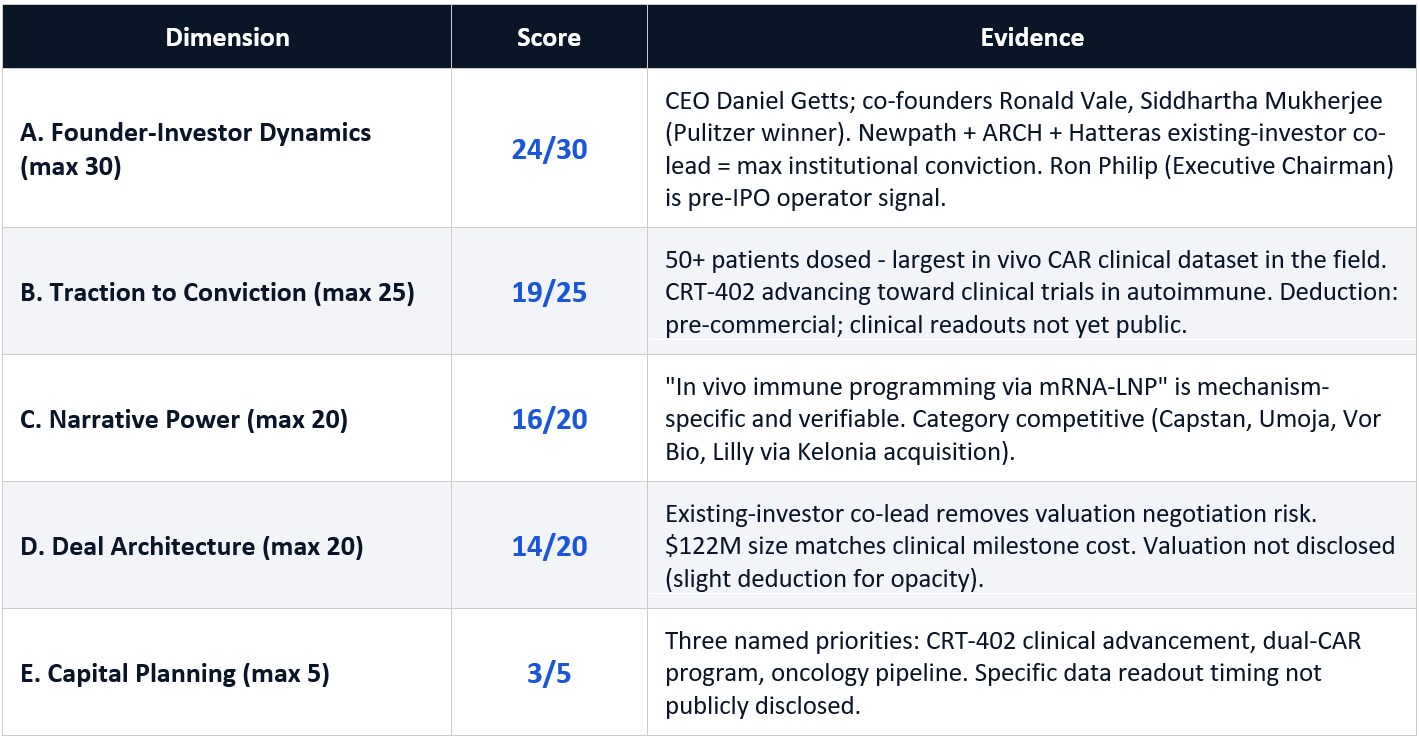
Eisen Fundability Scores are calculated across five dimensions: Founder-Investor Dynamics (30%), Traction-to-Conviction Conversion (25%), Narrative Power (20%), Deal Architecture (20%), and Capital Planning (5%). Scores 85+ = inevitable outcome; 70-84 = strong execution; below 70 = early-stage or repositioning needed.
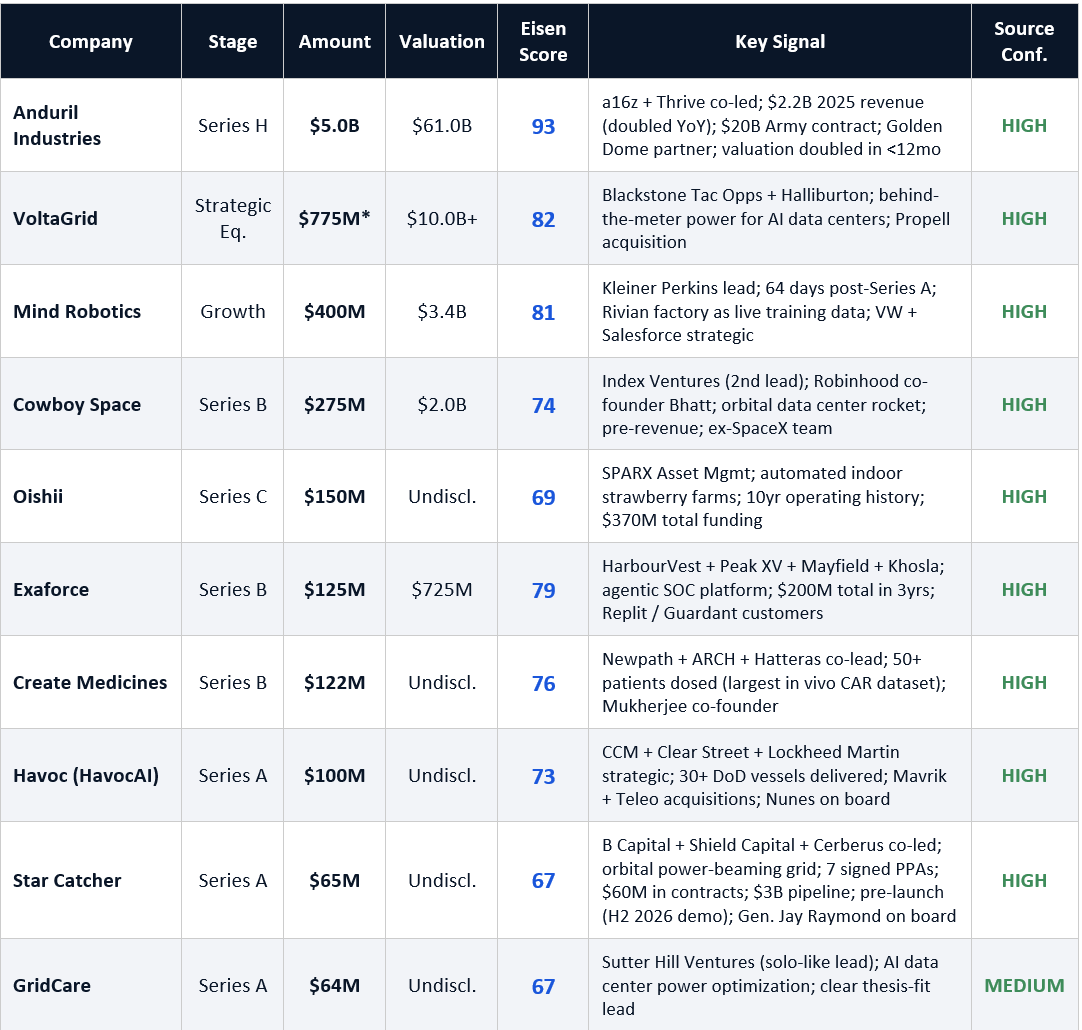
What the scorecard says at a glance
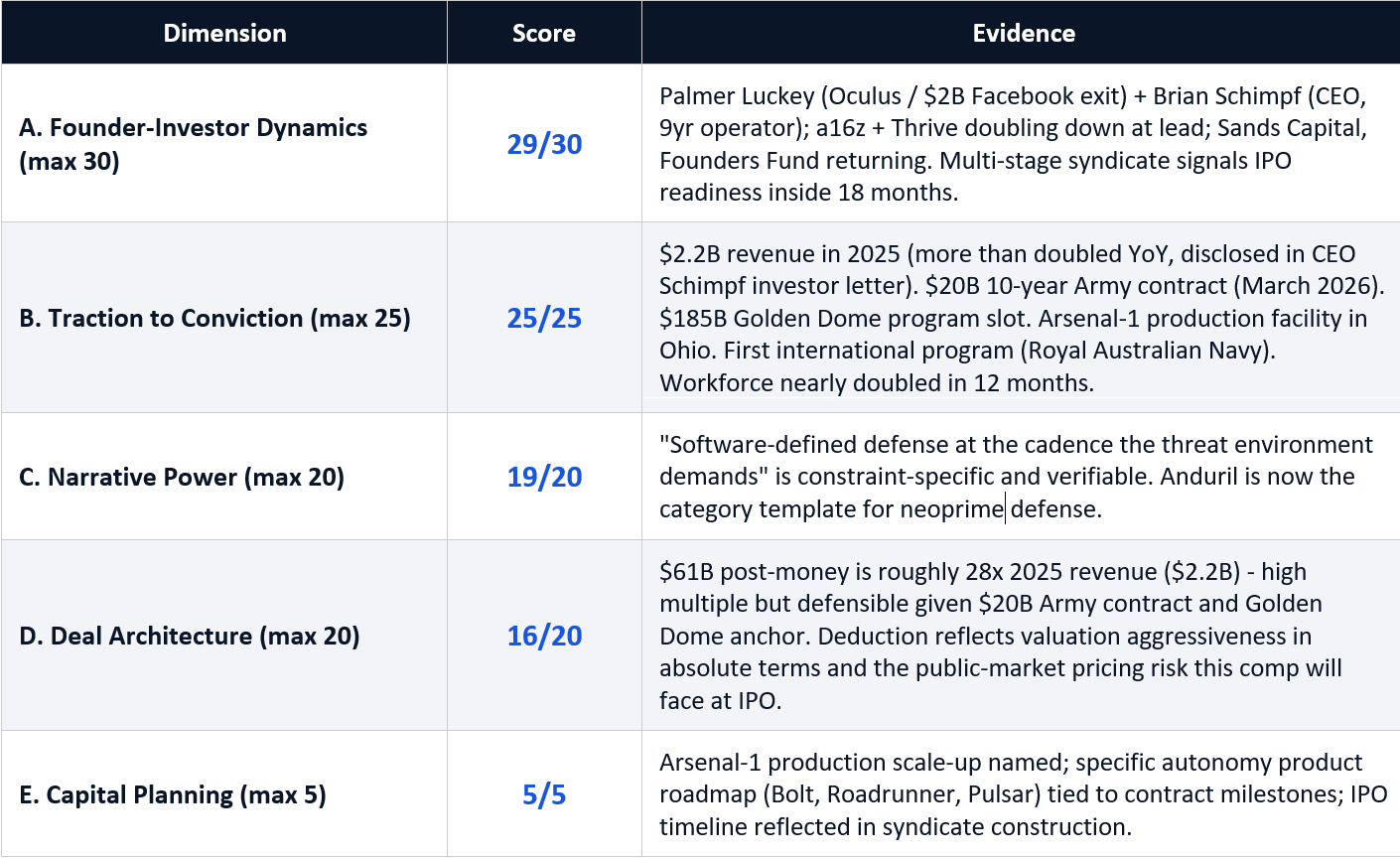
Anduril (93) is the highest score in any single weekly report since the framework was applied. Four deliberate moves converted to a 93-point case:
(1) $2.2B in disclosed 2025 revenue, more than doubled year-over-year per CEO Schimpf’s investor letter, removes the “growth narrative without numbers” risk that crossover funds typically discount;
(2) A $20B 10-year Army contract anchors the revenue model, eliminating commercial-validation risk;
(3) A top-tier multi-stage syndicate (a16z + Thrive at lead, with both firms doubling down) signals readiness for the public markets, mirroring the Cerebras setup;
(4) The Golden Dome program slot creates a multi-decade procurement chain that no software-only competitor can replicate.
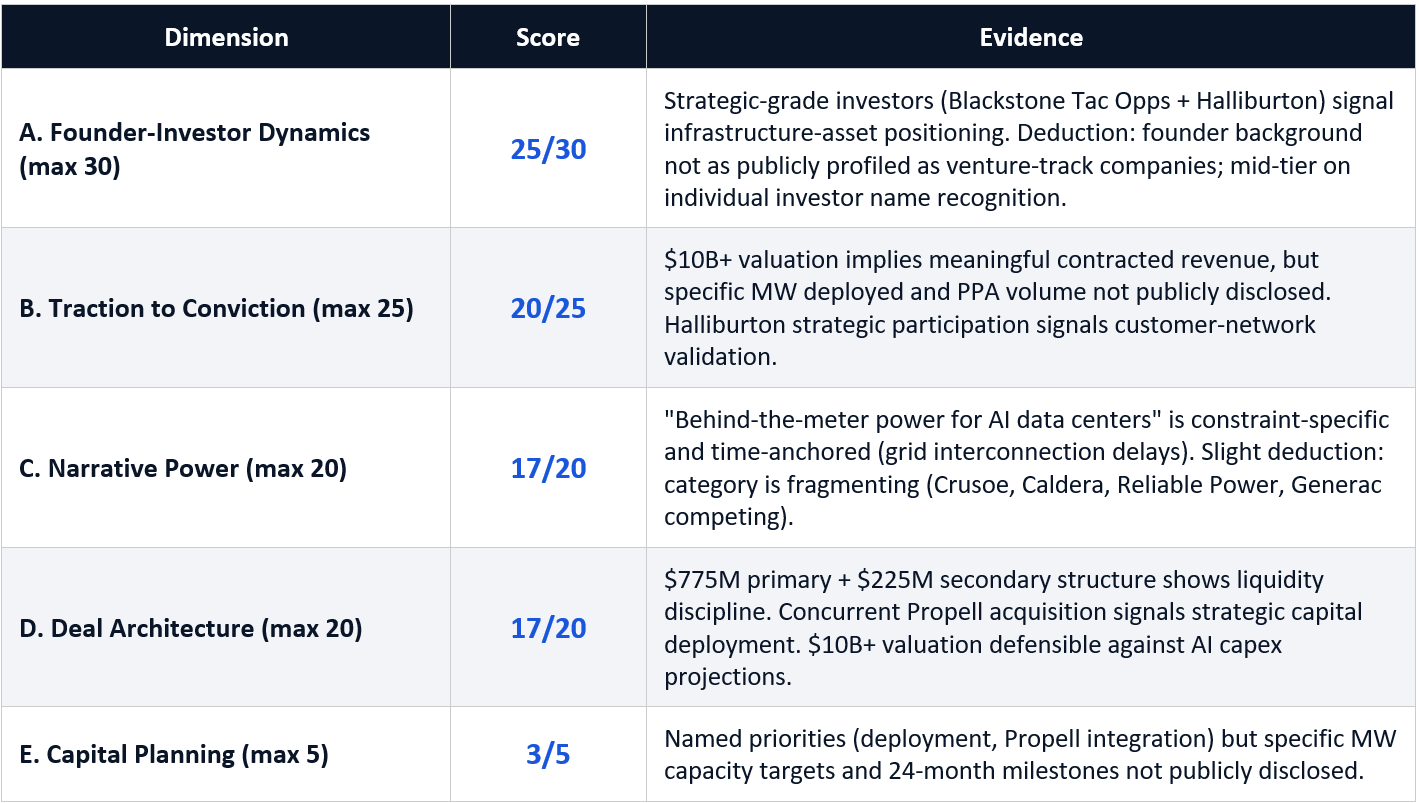
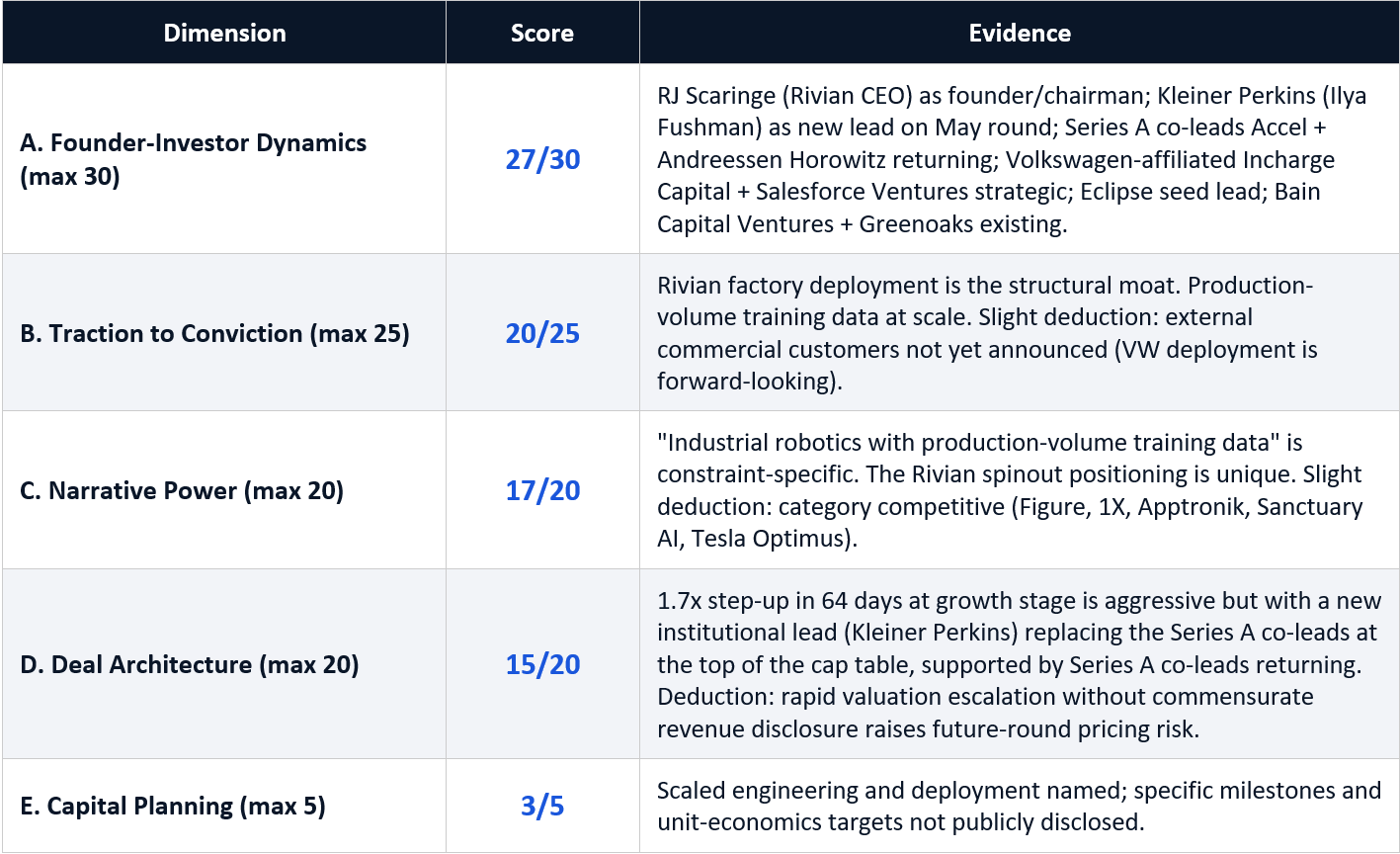
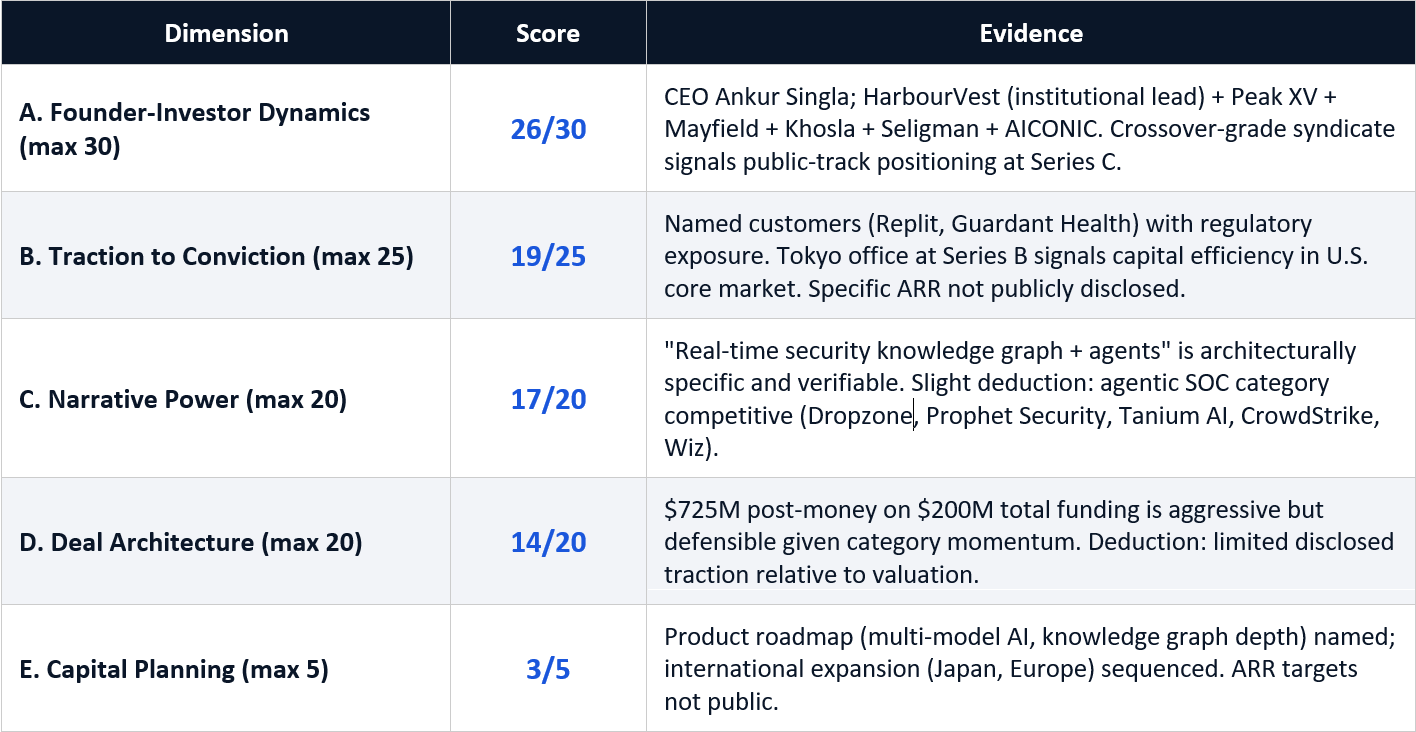
VoltaGrid (82) earns its score on its infrastructure-grade investor profile and AI/data center off-take economics. Mind Robotics (81) earns its score on velocity: a $400M round 64 days after a $500M Series A, both led by Kleiner Perkins, with Rivian factory access as a structural moat. Exaforce (79) is the surprise on the list - an enterprise SaaS Series B at $725M valuation on $200M total funding raised across three years, validating the agentic security operations category at a premium multiple.
The week’s median Eisen Score (74.5) is the highest on record for any report in this series: capital concentrated on documented commercial proof, procurement validation, or proprietary clinical data.
WHAT CHANGED THIS WEEK: 5 MARKET SHIFTS
Each shift below is verified against multiple primary sources. The shifts are ranked by structural impact on founder fundraising, not by deal size alone.

SHIFT 1: DEFENSE TECH BECAME A SOVEREIGN-CLASS ASSET. CAPITAL NOW WRITES TO PROCUREMENT, NOT TECHNOLOGY.
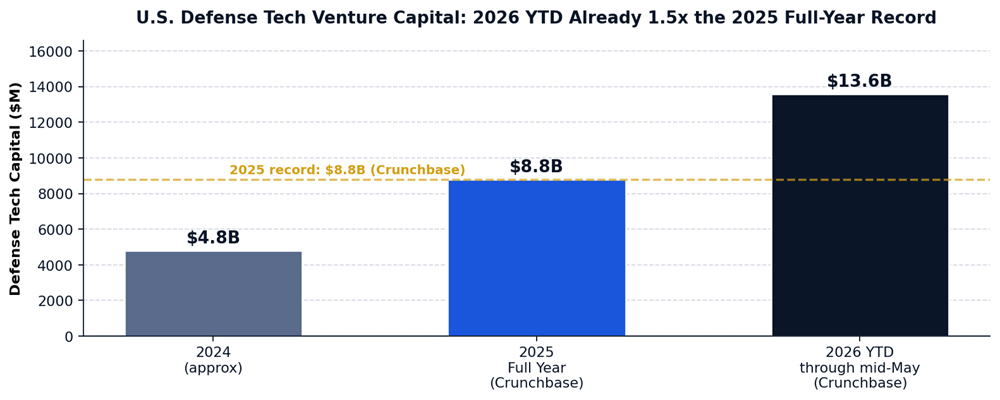
Pattern: Anduril raised $5B at $61B in a Series H led by a16z and Thrive Capital, doubling the $30.5B mark set less than a year ago and bringing total capital raised to $11.4B. Havoc (formerly HavocAI) added $100M Series A at the same week, bringing its total to $200M in 16 months. U.S. defense-related startups have now raised $13.6B in 2026 year-to-date through mid-May - 1.5x the full-year 2025 record of $8.8B. The category is no longer venture-funded; it is sovereign-funded.
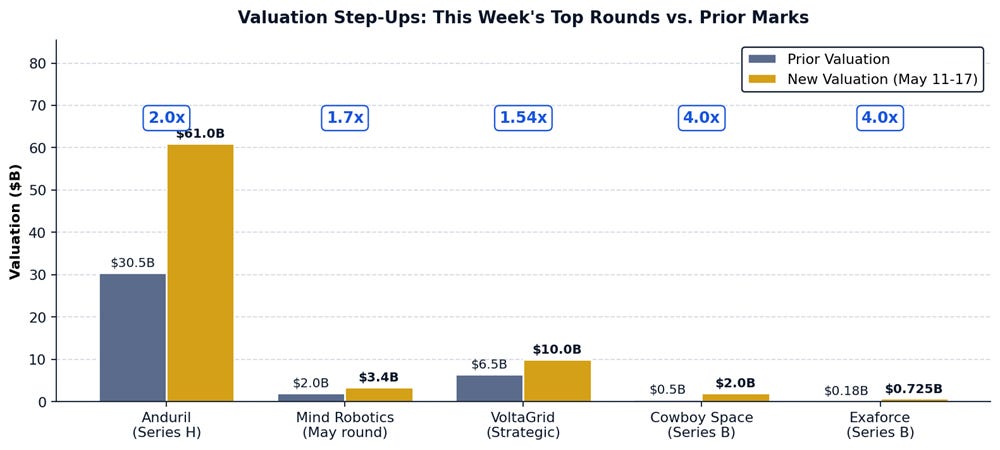
Perspective: a16z and Thrive are not underwriting Anduril at $61B on technology differentiation. They are underwriting (a) a $20B 10-year contract with the U.S. Army signed in March 2026, (b) a confirmed slot on the $185B Golden Dome missile defense system, and (c) a procurement architecture that lets the Trump administration’s $1.5T proposed defense budget flow through a single neoprime. CEO Brian Schimpf’s public statement is explicit: investors are betting on the agility of new-era industrial primes to absorb federal capital that legacy defense contractors cannot deploy fast enough. The thesis is industrial policy, not venture capital.
Founder Blindspot: Founders see Anduril’s $5B and think “defense is hot, I should add a dual-use angle.” Wrong frame. The investable insight is procurement architecture. Anduril’s round is funding a 10-year revenue commitment, not a technology runway. The capital that wrote this check sits with multi-stage growth funds, sovereign-adjacent LPs, and crossover funds preparing for an Anduril IPO inside 18 months. If you are pitching a dual-use angle without a named contract, a regulator-cleared certification path, or a procurement program slot, you are not pitching into this pool.
Playbook: If your technology has any defense-relevant application, the first slide of your deck this week is not your product. It is your procurement chain. Map the program of record, the contract vehicle (OTA, SBIR Phase III, IDIQ), the program manager, the operational customer, and the budget line. Without those five named, your defense angle is a marketing claim. Havoc’s $100M round closed on this exact template: three xTech competition wins ($6M in SBIR funding), 30+ vessels delivered to DoD, and former Congressman Devin Nunes on the board to anchor government relations. That is the structure capital is buying. If your raise does not have it, do not lead with defense.
Contrast: In 2025, defense tech raised $46.3B globally across nearly 1,900 deals - a roughly 900% growth in under a decade per PitchBook. The median check size was much smaller; large megarounds were rare. In May 2026, the modal megaround is $100M+ with crossover-grade syndicates, and the Anduril round alone accounts for more than 10% of full-year 2025 under Crunchbase’s narrower definition. The capital structure of the category has shifted from venture to growth-and-public-prep. Anduril was founded in 2017; the lifecycle from seed to a $61B valuation has compressed to roughly 9 years, and IPO is the next public conversation.
What this means for your raise: Defense is now a procurement-first category. If you have no named program, write your raise into a different category. If you do have one, make it the headline.
SHIFT 2: THE AI POWER LAYER OPENED A SEPARATE CAPITAL POOL. INFRASTRUCTURE FUNDS NOW WRITE WHERE VCS USED TO LEAD.
Pattern: VoltaGrid received $1.0B ($775M primary + $225M secondary) at a $10B+ valuation from Blackstone Tactical Opportunities and Halliburton. The same week, GridCare raised a $64M Series A led by Sutter Hill Ventures for AI-driven data center power efficiency, and Cowboy Space added a $275M Series B at a $2B valuation to build a rocket whose upper stage is the data center itself. Three deals across three financing structures (strategic equity, traditional Series A, Series B), $1.1B+ combined, all underwritten by one thesis: the binding constraint on AI is not compute; it is dispatchable, controllable, low-latency power.
Perspective: Blackstone Tactical Opportunities and Halliburton are infrastructure allocators, not venture firms. They write checks against off-take agreements, project finance timelines, and multi-decade revenue commitments. Blackstone’s strategic logic is hyperscaler power purchase agreements; Halliburton’s is supply chain integration through Propell, which VoltaGrid is acquiring in the same transaction. Sutter Hill Ventures’ check into GridCare follows a parallel logic at the venture layer: capital underwrites the structural bottleneck (grid interconnection delays, transmission congestion) that determines which AI workloads actually get built. The investors at this layer think in megawatts and decades, not ARR and quarters. Cowboy Space’s pitch to Index Ventures, IVP, Breakthrough Energy Ventures, and SAIC is the boldest version of this thesis: terrestrial energy and real estate cannot keep up with AI demand, so move the compute to orbit and let solar handle the power.
Founder Blindspot: Founders building anything in the AI power stack, see the VoltaGrid round, and assume traditional VCs will lead. Wrong assumption. Tactical Opportunities funds, energy strategics, and infrastructure debt providers now lead these rounds. The right investor for behind-the-meter power generation is Blackstone Tac Opps, not Sequoia. The right investors for orbital data centers are Breakthrough Energy and sovereign-aligned strategics, not a16z. Founders who run a traditional VC outreach process for an infrastructure-grade round burn 60 days and end up at the wrong capital pool. The selection error is the fundraising mistake.
Playbook: If your product solves a binding constraint between AI workloads and the physical power that runs them, segment your investor list into three pools before you open the round:
(1) infrastructure and tactical opportunities funds (Blackstone Tac Opps, Brookfield, KKR Infrastructure, Stonepeak);
(2) energy strategics with AI mandates (NEOM, Halliburton, ExxonMobil Ventures, ConocoPhillips, Constellation Energy);
(3) deep-tech venture with energy thesis (Breakthrough Energy Ventures, Lowercarbon, At One Ventures, MCJ Collective). Build a separate pitch deck for each pool. Infrastructure investors want a 20-year discounted cash flow model; venture investors want a TAM and unit economics. Same product, different pitches.
Contrast: Six months ago, the AI infrastructure megaround template was compute-and-networking (CoreWeave, Lambda, Crusoe). This week, the template is power generation and grid services (VoltaGrid, GridCare) and orbital alternatives to the grid altogether (Cowboy Space). The infrastructure chain has migrated downstream from chips and racks toward the power source.
What this means for your raise: If your TAM is downstream of AI compute (power, cooling, water, grid), your investor list is half-wrong by default. Rebuild it before you open the round.
SHIFT 3: PHYSICAL AI BACK-TO-BACK ROUNDS MEAN ARCHITECTURAL ACCESS BEATS ALGORITHMIC ELEGANCE.
Pattern: Mind Robotics raised $400M led by Kleiner Perkins at a $3.4B post-money, 64 days after closing a $500M Series A co-led by Accel and Andreessen Horowitz at $2B. The new round added Meritech Capital, Redpoint Ventures, SV Angel, Volkswagen-affiliated Incharge Capital, Salesforce Ventures, A-Star Capital, and Garuda Ventures alongside existing investors Accel, a16z, Eclipse, Prysm, Bain Capital Ventures, and Greenoaks. Total funding crossed $1B in roughly 6 months, from a company that was Rivian’s “Project Synapse” internal effort 18 months ago. Globally, physical AI startups have raised $37B+ year-to-date in 2026, already shattering the full-year record of $21B set in both 2025 and 2021.
Perspective: A new lead investor (Kleiner Perkins, Ilya Fushman) writing a $400M check at a 1.7x step-up just 64 days after the prior round is structurally stronger than the same firm doing a follow-on. The Series A co-leads (Accel and Andreessen Horowitz) returning in the new round alongside Kleiner Perkins signals existing investor conviction plus new institutional validation in the same window. The structural reason: Mind Robotics owns something no other physical AI startup can replicate at this stage - production-volume access to Rivian’s Normal, Illinois factory floor as a continuous training environment. Foundation models for industrial robotics require live, high-variation operational data.
Most physical AI competitors rely on simulation or limited pilot deployments. Mind Robotics trains on real automotive manufacturing tasks at real production volume, with Rivian executing the deployment as both customer and shareholder. The moat is the data flywheel that the architectural choice produces. Volkswagen-affiliated Incharge Capital joining as a co-investor signals the next wedge: if the model works in Rivian factories, it can port to VW’s industrial footprint, with Rivian as the validated reference. Capital is paying for the deployment architecture, not the algorithm.
Founder Blindspot: Founders see Mind Robotics raise $400M in 64 days and think “robotics is back.” Half right. The investable insight is access architecture. Mind Robotics has live production data at scale because RJ Scaringe (Rivian CEO, Mind chairman) chose to spin out internal robotics work as a standalone vehicle with the manufacturing footprint included. Competitors building general-purpose humanoid robotics on simulation data and limited pilots cannot replicate that flywheel without their own manufacturing partner. The mistake is competing on model architecture. The right question is: what production environment do you have continuous, ground-truthed, operator-validated training access to that your competitors do not?
Playbook: If you are building physical AI - robotics, manufacturing automation, embodied agents - audit your data access this week. Specifically: name the production environment (factory, warehouse, hospital, refinery), the data volume (operations per day), the variation it covers (task types, edge cases), and the contractual structure that gives you persistent access. If your training data comes primarily from simulation or limited pilot programs, your fundraising narrative is fighting the Mind Robotics comparison, which is the new bar. Before your next investor meeting, secure at least one production-volume operational partnership with a customer who will commit to sharing deployment data. That partnership is the moat. The model is downstream.
Contrast: In 2024 and 2025, humanoid robotics rounds were pitched on breakthroughs in model performance (Figure 1X, Apptronik). In May 2026, $400M went to a company that pitched factory access and a Series B in 64 days. The investor preference shifted from “novel architecture” to “deployment density.” The competitive moat for physical AI is now operational, not algorithmic.
What this means for your raise: If your physical AI deck leads with model benchmarks and not deployment access, rewrite it. The new lead slide is your data flywheel partner.
SHIFT 4: AGENTIC CYBERSECURITY HIT THE FIRST $700M+ VALUATION FRAME FOR AN SOC PLATFORM.
Pattern: Exaforce closed a $125M Series B at a $725M post-money valuation, just 12 months after a $75M Series A. Total funding: $200M across two rounds. The investor stack includes HarbourVest, Peak XV (formerly Sequoia India), Mayfield, Khosla Ventures, Seligman Ventures, and AICONIC. Named customers include Replit and Guardant Health. The company opened a Tokyo office in parallel with the financing announcement, signaling that Series B capital is funding international go-to-market expansion as much as product development.
Perspective: The agentic SOC category has been crowded for two years (Dropzone, Prophet Security, Tanium AI variants, CrowdStrike’s agentic features, Wiz’s threat detection extensions). Exaforce is the first to clear a unicorn-trajectory Series B with a sub-$1B valuation on $200M total funding. The structural reason: Exaforce built a real-time security knowledge graph that ingests telemetry without relying on traditional SIEM correlation rules. The platform claims 10x faster investigation cycles and a 90% reduction in manual triage. CEO Ankur Singla’s positioning - “the platform defenders actually work in, not just an AI layer on top of existing tools” - directly addresses the strategic risk for security buyers: that LLM-based agents will hallucinate on critical investigations. The valuation multiple reflects HarbourVest and Peak XV pricing a platform thesis rather than an agent feature, with crossover-grade syndicate construction.
Founder Blindspot: Founders building agentic AI products in any vertical see the Exaforce round and assume “agents are getting Series B premiums now.” Partially right, but the wrong takeaway. Exaforce did not price at $725M on agent capability. It is priced on a real-time knowledge graph that the agents query against - the same architectural pattern that Omni and AcuityMD demonstrated in April 2026. The agentic layer is the marketing wrapper. The substrate is the structured data and ontology that makes the agents reliable in regulated, high-stakes operational environments. Founders treating agents as the product rather than the data layer will struggle to clear the new bar.
Playbook: If you are building agentic AI for any enterprise vertical (security, finance, legal, healthcare, supply chain), separate your architecture into two slides for your next pitch.
Slide 1: the proprietary knowledge graph or ontology of the entities, relationships, and rules your domain operates on.
Slide 2: the agents that query against that graph.
Most agentic AI decks lead with the agent. The companies’ clearing premium multiples lead with the substrate. Run the test on your own deck: if a competitor with a better LLM could replicate your value in 90 days, you are pitching the wrapper. Pivot the deck before the next investor conversation.
Contrast: In 2024, the agentic security narrative was “AI replaces the SOC analyst.” That pitch attracted seed and Series A capital at modest multiples. In May 2026, the premium-multiple agentic security narrative is “real-time security knowledge graph that produces consistent reasoning across multi-step investigations.” The category language shifted from automation to reliability. So did the multiples.
What this means for your raise: Agentic positioning without a structured data substrate is no longer enough for Series B. Build the ontology slide before your next investor meeting.
SHIFT 5: THE CEREBRAS IPO RESETS EVERY LATE-STAGE AI INFRASTRUCTURE COMPANY. THE EXIT WINDOW REOPENED.
Pattern: Cerebras Systems priced its IPO at $185 on May 13 (well above the $150-160 raised range, itself raised from the original $115-125), opened on Nasdaq at $350 on May 14, and closed the first day at $311.07 with a market cap of approximately $95B. The offering raised $5.55B - the largest U.S. tech IPO since Uber’s 2019 debut. 2025 revenue: $510M, up 76% year-over-year. 2025 net income: $237.8M (a swing from ~$500M loss the prior year). Total private capital raised before IPO: $2.85B equity + $1.85B debt = $4.7B over the company’s decade-long private life.
Perspective: Cerebras’ IPO is the structural inflection point for the AI infrastructure category. Three things happened simultaneously in 48 hours: (1) a profitable, growth-stage AI company cleared CFIUS review and reopened the U.S. tech IPO market that had effectively been closed since 2022; (2) a private-to-public valuation step-up of roughly 17x ($5.6B private at peak vs. $95B first-day market cap implied) reset the comp set for every late-stage AI infrastructure company waiting to file; (3) retail demand pushed first-day trading 108% above the IPO price, signaling that the public market appetite for AI infrastructure exceeds what crossover funds had priced in. SpaceX, OpenAI, Anthropic, and several defense tech names (Anduril’s investors are now openly modeling an 18-month IPO window) are all watching the same data. The IPO market is open for AI infrastructure profitability, not just AI infrastructure narrative.
Founder Blindspot: Founders see Cerebras open at $350 and assume “AI is hot, raise faster, value higher.” Wrong reading. The investable insight is that Cerebras is priced on profitability and revenue scale ($510M in revenue, $237.8M in net income), not on narrative or model breakthroughs. The 17x step-up was a function of the company arriving at the public market with clean financials and the CFIUS overhang resolved. Founders trying to extrapolate the Cerebras pop to their own private valuation are missing the structural prerequisite: documented profitability or a credible path to it inside 24 months. Cerebras’ first IPO attempt failed in 2024 because Group 42 represented almost all of its revenue. The 2026 attempt succeeded because revenue diversified to include Amazon and OpenAI, and gross margins expanded meaningfully.
Playbook: If you are at $50M+ ARR with an AI infrastructure thesis, build your IPO-readiness narrative this quarter. Specifically: (1) revenue diversification - no single customer should exceed 25% of revenue, ideally less; (2) gross margin trajectory - public markets reward 60%+ for hardware-adjacent AI; (3) net income path - either profitable or projecting profitability inside 18 months on the existing capital base; (4) regulatory cleanliness - any foreign investor concentration (UAE, Saudi, China-adjacent) should be addressed pre-emptively; (5) crossover-fund syndicate participation in your last private round - this is the syndicate signature public markets expect. The Cerebras IPO did not pop because the technology was hot. It popped because the financials and the syndicate matched the public market expectation.
Contrast: Two months ago, the consensus view among venture capitalists was that the IPO window for AI infrastructure remained closed until 2027. On May 14, that view broke. Anduril’s defense tech peers (Saronic, Shield AI, True Anomaly, Sierra Space) are now plausible 2026-2027 IPO candidates. SpaceX is preparing a share sale. The exit math for every late-stage AI and defense tech company changed inside 48 hours.
What this means for your raise: Your raise narrative should now include an explicit IPO timeline (or M&A timeline) if you are Series B+. Public markets are open for documented profitability. Use the inflection or lose the multiple.
THE DEALS THAT MATTER: TOP 5
Five deep dives across defense tech, energy infrastructure, robotics, cybersecurity, and biotech, each selected for distinct playbook value, not just deal size.

ANDURIL INDUSTRIES
Defense Tech / Autonomous Systems & Software | Series H | $5.0B | $61.0B
EISEN FUNDABILITY SCORE: 93 / 100
Why this scored: The highest score in any report in this series reflects four converging proof points: $2.2B in 2025 revenue (more than doubled year-over-year per CEO Schimpf’s investor letter), a $20B 10-year Army contract anchoring decade-long demand, a slot on the $185B Golden Dome missile defense program, and a valuation that doubled in under 12 months on conviction from a16z and Thrive - both of whom doubled down rather than sat out. The capital structure (Series H, $11.4B total raised) and syndicate composition (multi-stage with crossover-fund participation) signal IPO readiness inside 18 months.
The Setup: Founded in 2017 by Palmer Luckey and four co-founders (CEO Brian Schimpf, Trae Stephens, Matt Grimm, and Joe Chen), Anduril builds autonomous defense systems organized around the Lattice operational software platform. Luckey previously founded Oculus VR, which Facebook acquired for approximately $2B in 2014. The company’s thesis from the start was that legacy defense primes (Lockheed Martin, Raytheon, Northrop Grumman) cannot ship software-defined autonomous systems at the cadence the modern operational environment demands. Nine years later, that thesis has been validated by Trump administration procurement priorities, the Golden Dome program, and Anduril’s direct displacement of legacy primes on several flagship programs, including the Army’s Next Generation Command and Control (NGC2) and the Air Force’s Collaborative Combat Aircraft initiative.
The Numbers: $5.0B Series H (May 13, 2026) | $61.0B post-money (vs. $30.5B in June 2025, more than 2x in <12 months) | Lead: Andreessen Horowitz and Thrive Capital co-leading; existing investors Founders Fund, Sands Capital, Counterpoint Global participating | Total raised to date: $11.4B | 2025 revenue: $2.2B (more than doubled YoY per CEO Schimpf investor letter) | $20B 10-year U.S. Army contract (March 2026) | Confirmed slot on $185B Golden Dome missile defense system | HQ: Costa Mesa, CA | Arsenal-1 production facility: high-rate manufacturing, Ohio | First international program: Royal Australian Navy.
Fundability Lessons: Anduril’s playbook is the textbook example of procurement-first fundability at scale. Three deliberate moves converted to the $61B mark:
(1) Anchor a multi-decade contract before raising the megaround - the $20B Army deal preceded the Series H by 60 days and gave the syndicate a 10-year revenue model to underwrite;
(2) Stack the syndicate with multi-stage growth funds (a16z, Thrive) rather than defense-specialist funds - this signals IPO-track positioning, not category-locked positioning;
(3) Convert program-of-record participation into category leadership - Golden Dome makes Anduril the de facto integrator for a generational defense initiative.
The key lesson: in regulated, procurement-driven categories, your fundability is determined by the contracts you have closed and the programs you sit on, not the technology you have built. Capital underwrites the chain of contracts that converts technology into revenue.
Your Takeaway: If your category is regulated or government-adjacent (defense, healthcare, energy, financial services, aviation), build your contract chain document before you build your pitch deck. List every named program, contract vehicle, agency relationship, and procurement officer who has touched your product. If your chain has fewer than three reinforcing nodes, your Series B will stall at the first diligence question on government concentration risk.
The Founder Mistake to Avoid: Founders see Anduril’s $61B mark and try to copy the surface-level positioning (”we are the Anduril of X”). The mistake is treating the defense angle as a marketing claim rather than an eight-year procurement build. Anduril spent five years on Lattice before the contracts came. Founders pitching “Anduril for healthcare” or “Anduril for energy” without the equivalent multi-year procurement work are pitching the wrapper, not the substrate.
VOLTAGRID
Behind-the-Meter Power Generation for AI Data Centers | Strategic Equity | $775M Primary ($1.0B Total) | $10.0B+
EISEN FUNDABILITY SCORE: 82 / 100
Why this scored: Blackstone Tactical Opportunities and Halliburton co-leading a $1.0B strategic equity package at $10B+ valuation is the structural signal: infrastructure-grade capital is now writing where venture capital used to lead in the AI power category. The $225M secondary purchase from existing investors creates partial liquidity, and the simultaneous acquisition of supplier Propell Energy Technology signals supply chain consolidation discipline.
The Setup: Houston-based VoltaGrid builds mobile, natural gas-powered generation modules for deployment behind the meter at data center sites, microgrid installations, and industrial facilities. The thesis: AI workloads cannot wait for utility-scale grid interconnection (typical timeline 3-7 years in queue), and hyperscaler capex commitments outpace what the existing transmission system can deliver. VoltaGrid’s modular generators ship within months, install in weeks, and lock in capacity at fixed costs against multi-year power purchase agreements.
The Numbers: $1.0B strategic equity transaction (May 11, 2026): $775M primary capital + $225M secondary purchase | $10B+ post-money valuation | Lead investors: Blackstone Tactical Opportunities, Halliburton | Use of proceeds: deployment of behind-the-meter generation for AI data centers, microgrids, industrial applications | Concurrent acquisition: Propell Energy Technology (key supplier) | HQ: Houston, TX | Closing target: mid-2026.
Fundability Lessons: VoltaGrid demonstrates the infrastructure-capital fundability template for the AI power layer. The structural moves:
(1) Frame the business as off-take-anchored infrastructure, not technology - Blackstone Tac Opps underwrites against multi-year revenue contracts, not unit economics;
(2) Pair the equity raise with vertical integration (Propell acquisition) - supply chain control is the moat at this layer, not pricing;
(3) Choose strategic co-investors with deployment networks (Halliburton’s industrial relationships) over name-brand VCs - the customer network is the value-add, not the brand.
The lesson: at infrastructure scale, your investor syndicate is your distribution channel.
Your Takeaway: If you build any infrastructure adjacent to AI compute (power, cooling, water, transmission, network interconnection), your investor list this quarter should include infrastructure and tactical opportunities funds, not just venture firms. Map each target investor against the deployment network they bring, not just the check size. The right $50M from Halliburton is worth more than $100M from a generalist VC.
The Founder Mistake to Avoid: Founders building infrastructure-adjacent businesses default to a traditional VC outreach process. The mistake costs 60-90 days and lands in the wrong capital pool. VoltaGrid’s round closed because Blackstone Tac Opps and Halliburton were the right pool from day one - the company did not run a traditional fundraise into Sand Hill Road and then pivot. Build your investor list around capital structure fit before you open the round.
MIND ROBOTICS
Industrial Robotics / Foundation Models for Manufacturing | Growth | $400M | $3.4B
EISEN FUNDABILITY SCORE: 81 / 100
Why this scored: Kleiner Perkins led the May round at a 1.7x step-up from the $2B Series A valuation set just 64 days earlier - a new institutional lead writing at higher pricing in roughly 9 weeks signals exceptional conviction, especially when the Series A co-leads (Accel + Andreessen Horowitz) returned for the follow-on rather than getting diluted. Volkswagen-affiliated Incharge Capital and Salesforce Ventures joining as new strategic co-investors signals industry-grade deployment confidence.
The Setup: Mind Robotics was spun out of Rivian Automotive in November 2025, originally operating internally under the code name “Project Synapse.” Headquartered in Palo Alto, California, with deployment access to Rivian’s Normal, Illinois factory. CEO and chairman RJ Scaringe (also Rivian CEO) created the company to build “robotics with human-like skills” for industrial manufacturing - foundation AI models, purpose-built robotic hardware, and deployment infrastructure - using Rivian’s factory as the live training environment. Most physical AI competitors rely on simulation data. Mind Robotics trains on real, high-variation manufacturing tasks at production volume, with Rivian acting as both customer and shareholder.
The Numbers: $400M financing (May 13, 2026) | $3.4B post-money (up 1.7x from $2.0B Series A in March 2026) | Lead: Kleiner Perkins (Ilya Fushman, partner) | New investors: Meritech Capital, Redpoint Ventures, SV Angel, Volkswagen-affiliated Incharge Capital, Salesforce Ventures, A-Star Capital, Garuda Ventures | Existing: Accel, Andreessen Horowitz (Series A co-leads), Eclipse, Prysm Capital, Bain Capital Ventures, Greenoaks | Total funding: >$1B in roughly six months since founding | Prior rounds: $115M seed (Eclipse, late 2025), $500M Series A co-led by Accel + a16z (March 11, 2026) | HQ: Palo Alto, CA; deployment in Rivian’s Normal, IL plant.
Fundability Lessons: Mind Robotics is the clearest example of architectural-access fundability in 2026. Three structural advantages converted to the $3.4B mark:
(1) Production-volume training data through Rivian’s factory - this cannot be replicated by competitors building on simulation or pilot programs;
(2) Strategic co-investor selection in the new round (Volkswagen-affiliated Incharge Capital opens the next deployment partner before the current one is fully validated; Salesforce Ventures opens the enterprise software distribution lane); (
3) Founder positioning - RJ Scaringe is the operating CEO of Rivian and chairman of Mind, which creates aligned incentives between the manufacturing partner and the technology spinout.
Equally telling: a new institutional lead (Kleiner Perkins) writing the second-largest round in the company’s short history at 1.7x the Series A valuation, with both Series A co-leads (Accel and a16z) returning rather than diluting. The Mind Robotics moat is the deployment architecture, not the algorithm.
The key lesson: in physical AI, the competitive advantage is operational access to production data at scale. The model is downstream. Founders pitching novel architectures without comparable deployment access are competing on the wrong axis.
Your Takeaway: If you are building physical AI - robotics, manufacturing automation, or embodied agents - audit your data access this week. Name your production environment, your operations-per-day volume, your task variation, and the contractual structure for persistent access. If your deck cannot answer those four questions specifically, your competitor with worse models but better deployment access wins the Series B.
The Founder Mistake to Avoid: Founders see Mind Robotics raise $900M in 64 days and assume “humanoid robotics is back; raise on a demo.” The mistake. The capital priced on Rivian’s factory access, not Mind’s model architecture. Demos at robotics conferences are now table stakes; without production-volume deployment data, they signal commodity capability rather than category leadership.
EXAFORCE
Agentic Security Operations / AI-Native SOC Platform | Series B | $125M | $725M
EISEN FUNDABILITY SCORE: 79 / 100
Why this scored: A $725M Series B valuation on $200M total funding raised across three years - one of the largest agentic security rounds on record - validates the category at premium pricing. The investor stack (HarbourVest, Peak XV, Mayfield, Khosla Ventures, Seligman, AICONIC) blends institutional capital with venture conviction. Named customers (Replit, Guardant Health) and the Tokyo office opening signal commercial proof plus international expansion readiness.
The Setup: Founded in 2023 in San Jose, CA, Exaforce builds an AI-native security operations platform around Exabots - autonomous AI agents that handle detection, triage, investigation, and response for cloud and SaaS environments. CEO Ankur Singla’s thesis: traditional SIEM-based SOCs cannot keep up with AI-driven attack velocity, and bolt-on LLM features on legacy platforms produce hallucinations on critical investigations. Exaforce’s architectural move: build a real-time security knowledge graph that ingests telemetry as it arrives, eliminating the need for SIEM correlation rules and manual query languages.
The Numbers: $125M Series B (May 12, 2026) | $725M post-money valuation | Investors: HarbourVest, Peak XV (formerly Sequoia India), Mayfield, Khosla Ventures, Seligman Ventures, AICONIC | Prior round: $75M Series A (May 2025) | Total funding: $200M across two rounds | CEO: Ankur Singla | HQ: San Jose, CA; Tokyo office opening | Named customers: Replit, Guardant Health | Claimed performance: 10x faster investigation, 90% manual task reduction.
Fundability Lessons: Exaforce demonstrates the agentic-substrate fundability template for vertical AI. Three structural choices converted to the $725M mark:
(1) Architect the data layer before the agents - the real-time knowledge graph is the moat, the Exabots are the interface;
(2) Sequence customer logos for trust signal (Replit and Guardant Health are both demanding security buyers with regulatory exposure - they validate the agents in high-stakes environments before mid-market adoption);
(3) International expansion (Tokyo) at Series B signals capital efficiency in the U.S. core market and positions the next round at a global scale narrative.
Your Takeaway: If you are building agentic AI for any regulated vertical (security, finance, legal, healthcare, supply chain), separate your architecture into two slides: the proprietary knowledge graph or ontology that your agents query against, and the agent interface itself. Investors at Series B and beyond price the substrate at 50x ARR multiples, the wrapper at 5-10x. Pick your layer before your pitch.
The Founder Mistake to Avoid: Founders see Exaforce and try to copy the agentic positioning (”we are the AI SOC for X” or “agentic AI for Y”). The mistake is treating the agent as the product. Exaforce’s knowledge graph is the result of 3 years of structured data engineering work. Founders pitching agentic features bolted on commodity LLMs without the underlying substrate are pitching the marketing claim, not the moat. Build the graph before the agents.
CREATE MEDICINES
Biotech / In Vivo Immune Programming for Autoimmune & Oncology | Series B | $122M | Undisclosed
EISEN FUNDABILITY SCORE: 76 / 100
Why this scored: The largest clinical dataset in the in vivo CAR field (50+ patients dosed) is the structural moat, not the technology platform. Co-leadership from existing investors Newpath Partners, ARCH Venture Partners, and Hatteras Venture Partners signals institutional conviction without requiring a new lead - the syndicate that already saw the books doubled down. Ron Philip’s arrival as Executive Chairman and the addition of Brian Cuneo (ARCH) and Tom Thomas (Newpath) to the board signal pre-IPO board construction.
The Setup: Originally launched in 2021 as Myeloid Therapeutics by cell therapy pioneers Ronald Vale, PhD, and Siddhartha Mukherjee, MD, PhD (Pulitzer Prize-winning author), Create Medicines rebranded in 2023 to reflect its expansion beyond myeloid-only therapies into a broader in vivo immune programming platform. The company’s differentiation: an mRNA-lipid nanoparticle (LNP) platform that delivers genetic instructions in vivo to reprogram T cells, NK cells, and myeloid cells, eliminating the manufacturing complexity that has historically constrained CAR-T scale.
The Numbers: $122M Series B (May 14, 2026) | Valuation: undisclosed | Co-leads: Newpath Partners, ARCH Venture Partners, Hatteras Venture Partners (all existing investors) | Plus: Alexandria Venture Investments, additional syndicate members | CEO: Daniel Getts, PhD | New Executive Chairman: Ron Philip (veteran biopharma operator) | Lead candidate: CRT-402 (CD19-targeted in vivo CAR-T for autoimmune disease) | Pipeline: dual CAR CD19 x BCMA, oncology programs | Clinical data: 50+ patients dosed across in vivo CAR programs - the largest clinical dataset in the field | HQ: Cambridge, MA.
Fundability Lessons: Create Medicines demonstrates the clinical-data-ownership fundability template for biotech in 2026. Three structural moves converted to a 76-point case:
(1) Dose patients at scale before raising the megaround - 50+ patients dosed is the moat that competitors cannot replicate without 2-3 years of clinical work;
(2) Sequence rebranding to reflect pipeline breadth - Myeloid Therapeutics signaled a narrow indication, Create Medicines signals platform breadth, and the rebrand preceded the Series B by 30+ months;
(3) Construct pre-IPO board architecture - Ron Philip as Executive Chairman is the operator signal investors expect 12-18 months before an S-1 filing. The clinical dataset is the asset; the board is the readiness signal.
Your Takeaway: If you are a clinical-stage biotech, your fundability at Series B and beyond is determined by the dataset you own, not the platform you have built. Investors price documented clinical reads, not preclinical promise. Sequence your clinical trial enrollment and your fundraising so that each round closes against a defined data readout that derisks the next stage. Your trial timeline is your raise timeline.
The Founder Mistake to Avoid: Founders see Create Medicines’ $122M and try to copy the “in vivo CAR” positioning. The mistake. The category is now competitive - Lilly acquired Kelonia in April 2026 to bolster in vivo cell therapy capabilities, and multiple platforms are now in the clinic. Create’s moat is not the in vivo CAR approach; it is the 50+ patient dataset. Founders entering the category in 2026 without comparable clinical depth are 24 months behind on the substrate.
FUNDRAISING PLAYBOOK: 5 TACTICAL PLANS BASED ON THIS WEEK’S SIGNALS
Five tactical plans, each producing a concrete output, that founders can use immediately. No vague tasks. No generic positioning.
1. PROCUREMENT CHAIN DOCUMENT (DEFENSE, REGULATED, GOV-ADJACENT)
Why this matters: Anduril’s $5B valuation is based on a $20B 10-year Army contract and a Golden Dome program slot, not on technology. Defense tech now requires named procurement chains before investor diligence, not after.
Deliverable: A one-page procurement chain document with five named nodes:
(1) Program of record - exact name, agency, budget line;
(2) Contract vehicle - OTA, SBIR Phase III, IDIQ, prime sub - and contract number if active;
(3) Program manager and operational customer - name, role, and your relationship history;
(4) Adjacent procurement paths - what other programs your technology qualifies for;
(5) Commercial transition path - how the operational data converts to civilian or international revenue.
Expected outcome: A document that converts a “defense angle” claim into a “procurement architecture” position. Investors at this scale need to underwrite the chain, not the technology.
Reframe: Wrong approach - “We have a dual-use angle.” Right approach - “Here is the named program, contract vehicle, program manager, adjacent procurement pathways, and the commercial transition data.”
2. INFRASTRUCTURE CAPITAL POOL MAP (POWER, GRID, COOLING, NETWORK)
Why this matters: VoltaGrid’s $1B priced from Blackstone Tactical Opportunities and Halliburton, not traditional VCs. Founders building AI-power-adjacent infrastructure who pitch into Sand Hill Road burn 60-90 days in the wrong pool.
Deliverable: A three-column investor map:
(1) Infrastructure and tactical opportunities funds (Blackstone Tac Opps, Brookfield, KKR Infrastructure, Stonepeak, EQT Infrastructure);
(2) Energy strategics with AI mandates (Halliburton, Constellation Energy, ExxonMobil Ventures, ConocoPhillips, NEOM);
(3) Deep-tech VCs with an energy thesis (Breakthrough Energy Ventures, Lowercarbon, MCJ Collective, At One Ventures). For each, name the specific partner, their most recent deal in your category, and the warm intro path.
Expected outcome: A 12-15 target investor list segmented by capital structure fit, with warm intro paths to each. Different pitch deck per pool.
Reframe: Wrong approach - “Let’s start with top-tier VCs and expand from there.” Right approach - “Our capital structure requires off-take-anchored underwriting; the right pool is infrastructure, not venture.”
3. DEPLOYMENT-ACCESS AUDIT (PHYSICAL AI, ROBOTICS, EMBODIED AGENTS)
Why this matters: Mind Robotics raised $900M in 64 days because Rivian factory access produces production-volume training data that competitors cannot replicate. Physical AI fundability now hinges on deployment architecture, not algorithm.
Deliverable: A two-page deployment-access audit:
(1) Production environment - factory, warehouse, hospital, refinery;
(2) Operations-per-day volume - throughput, task variation, edge case coverage;
(3) Contractual structure - exclusive vs. preferred, duration, data-sharing terms;
(4) Strategic alignment - is your deployment partner also a shareholder or revenue customer?
(5) Competitor gap - what does your competitor have to spend 18-24 months building to match this access?
Expected outcome: A defensible deployment-access claim that anchors your physical AI fundraise narrative ahead of the model conversation.
Reframe: Wrong approach - “Our model architecture is differentiated.” Right approach - “Here is the production environment we train on at scale, the access structure that secures it, and the 24-month head start it produces.”
4. ONTOLOGY SUBSTRATE SLIDE (AGENTIC AI, VERTICAL AI, ANY ENTERPRISE AI)
Why this matters: Exaforce cleared a $725M Series B because the real-time security knowledge graph is the moat - the Exabots are the interface, not the product. Premium-multiple agentic AI rounds price on the substrate, not the wrapper.
Deliverable: A single pitch slide titled “The Substrate Beneath the Agents.” Four elements:
(1) The proprietary knowledge graph or ontology - entities, relationships, business rules;
(2) Continuous enrichment - how customer usage deepens the substrate;
(3) Switching cost - what a competitor must replicate, and how long;
(4) Agent layer - the interface that converts substrate into outcomes. Build this slide before your next investor meeting.
Expected outcome: A defensible architecture story that converts agentic positioning from a feature claim to a structural moat. Required for any Series B+ pitch in 2026.
Reframe: Wrong approach - “Our agents are smarter / faster / cheaper.” Right approach - “Here is the proprietary structured-data substrate that makes our agents reliable in regulated environments.”
5. IPO-READINESS NARRATIVE (SERIES B AND BEYOND)
Why this matters: Cerebras’ May 14 IPO ($5.55B raised, +68% first-day pop, $95B market cap) reopened the AI infrastructure exit window. Late-stage companies without an IPO narrative now look incomplete to crossover-fund participation.
Deliverable: A five-part IPO-readiness narrative:
(1) Revenue diversification - no single customer >25% of revenue;
(2) Gross margin trajectory - 60%+ for hardware-adjacent AI, 70%+ for SaaS;
(3) Net income path - profitable or projecting inside 18 months;
(4) Regulatory cleanliness - foreign investor concentration addressed pre-emptively (CFIUS, ITAR, EAR);
(5) Crossover-fund syndicate - at least one institutional crossover investor (Fidelity, T. Rowe Price, Wellington, Franklin Templeton, Janus Henderson) in your last private round.
Expected outcome: A narrative that positions your Series B or C as the last private round before IPO. Crossover funds underwrite this trajectory specifically.
Reframe: Wrong approach - “We will think about IPO in 2028.” Right approach - “Our financial profile and syndicate composition support a 2027-2028 IPO window; here is the milestone calendar.”
LOOKING FORWARD: NEXT 1-3 WEEKS
SCENARIO 1: DEFENSE TECH IPO WINDOW OPENS BY Q4 2026 (HIGH PROBABILITY)
Evidence: Anduril’s $61B Series H, with crossover-fund participation, signals an IPO setup within 18 months. Cerebras’ $5.55B IPO on May 14 reopened the U.S. tech IPO market and absorbed retail demand at +68% premium. Defense tech 2026 YTD funding ($13.6B) is on track to double 2025’s $8.8B record. Saronic ($1.75B Series D, March 2026), Shield AI ($2B March 2026), Sierra Space ($550M March 2026), and True Anomaly ($600M April 2026) all sit at scale where an S-1 is plausible inside 12 months.
What to watch: Defense tech S-1 filings between July and October 2026. Crossover-fund participation in any Series D or later defense round. Senate Armed Services Committee FY2027 budget approval (defense budget proposed at $1.5T per the Trump administration). CFIUS clearance speed for defense tech foreign investment review.
What founders should do: If you are a defense tech company at Series C or later, prepare an IPO-readiness data room now. The window will be crowded - first movers post-Cerebras get the cleanest comps and the largest pop. If you are pre-Series B, accelerate procurement chain documentation; the bar will rise as later-stage comparables establish higher minimums.
SCENARIO 2: AI POWER LAYER ROUNDS ACCELERATE TO 2-3 PER WEEK (HIGH PROBABILITY)
Evidence: VoltaGrid $1B, GridCare $64M, Cowboy Space $275M all closed in the same week, with three distinct capital structures (strategic equity, traditional venture, growth-stage venture). Hyperscaler AI capex commitments for 2026 are projected at $650B+ (Crunchbase Q1 2026 report). Eclipse announced a $1.3B fund in April 2026, explicitly targeting physical AI, manufacturing, and defense. Blackstone Tactical Opportunities and Brookfield Infrastructure are actively building dedicated AI-powered generation portfolios.
What to watch: Behind-the-meter generation rounds in the $200M-1B range. Geothermal AI data center deals (Eavor, Fervo, Sage Geosystems). Grid-scale storage rounds tied to AI off-take. Modular nuclear deployment milestones (Blue Energy from April 2026 report, Valar Atomics, Oklo follow-on). Watch for $300M+ rounds in transmission and interconnection capacity startups.
What founders should do: If your business sits anywhere in the AI compute supply chain (power generation, grid services, cooling, water, transmission, network interconnection), build the infrastructure investor list this week. The right $100M from Blackstone Tac Opps is worth twice as much as $100M from a generalist VC because of the deployment network, customer access, and follow-on capital depth.
SCENARIO 3: PHYSICAL AI VALUATION COMPRESSION ON COMMODITY MODELS (MEDIUM-HIGH PROBABILITY)
Evidence: Mind Robotics’ $3.4B mark is anchored to Rivian factory access. Physical AI investors are increasingly explicit that they are pricing deployment density, not algorithmic innovation. Multiple humanoid robotics companies that pitched model breakthroughs in 2024-2025 are reportedly facing flat or down rounds in 2026. The category bifurcation is underway: deployment-anchored leaders earn premium multiples; simulation-trained competitors face compression.
What to watch: Series B and C rounds in physical AI without disclosed production-volume deployment data. Down rounds or extension rounds for humanoid robotics companies pitching on model architecture alone. New deployment partnership announcements between physical AI startups and industrial customers (manufacturing, logistics, mining, agriculture). Strategic acquisitions by industrial conglomerates (VW, Hyundai, Samsung) into physical AI.
What founders should do: If you are building physical AI without production-volume deployment, close at least one structural partnership before your next round. The window to close a deployment partnership before the funding gap widens is narrowing. Six months from now, the deployment-anchored leaders will be unreachable for partnership negotiation, and the capital gap will be irreversible.
WILD CARD: AGENTIC AI CATEGORY CORRECTION ON COMMODITY WRAPPERS (MEDIUM)
Evidence: Exaforce’s $725M Series B priced on a knowledge-graph substrate, not agent capability. The vertical AI rounds in April 2026 (Omni $1.5B, AcuityMD $955M) were priced on governed semantic layer ontologies, not LLM features. The premium-multiple bar is now explicitly architectural. Founders raising in late 2026 with an agentic positioning but no underlying data substrate may face multiple rounds of compression or extended diligence cycles.
What founders should do: If your product is an LLM wrapper with agentic features, audit your substrate this quarter. The deployment moat (Mind Robotics), procurement moat (Anduril), clinical data moat (Create Medicines), and ontology moat (Exaforce, Omni, AcuityMD) are now category prerequisites at Series B. The wrapper-only positioning will compress in the next 6-12 months. Build the substrate or position for acquisition by a substrate-owner.
THE BOTTOM LINE
The real insight from this week is not that defense raised $5B or that Cerebras IPO’d. The real insight is that capital is now systematically rewarding architectural moats over algorithmic positioning, and the public market reopened on the same logic. Three conviction profiles took $7.08B this week:
Profile 1: Procurement-anchored physical-world infrastructure. Anduril at $5B / $61B (US Army $20B contract, Golden Dome). Havoc at $100M ($200M total in 16 months, 30+ DoD vessels delivered). VoltaGrid at $1B / $10B+ (behind-the-meter AI power, Halliburton + Blackstone strategic). The proof is contract architecture and procurement chains, not technology demos.
Profile 2: Deployment-anchored physical AI. Mind Robotics at $400M / $3.4B (Rivian factory live training data, VW + Salesforce strategic, $900M raised in 64 days). Cowboy Space at $275M / $2B (vertically integrated rocket-plus-orbital-data-center architecture, NVIDIA module commitments). The proof is structural access to production data, not algorithmic novelty.
Profile 3: Substrate-anchored vertical AI. Exaforce at $125M / $725M (real-time security knowledge graph + agentic interface, Replit + Guardant Health). Create Medicines at $122M Series B (50+ patients dosed, largest in vivo CAR clinical dataset, Mukherjee co-founder, Ron Philip pre-IPO Executive Chairman). The proof is proprietary structured data depth, not AI feature breadth.
Everything else competed for the residual selectivity capital. The Cerebras IPO on May 14 - $5.55B raised, +68% first-day pop, $95B market cap - made all three profiles more valuable at once by reopening the exit window. The message is unmistakable: physical-world architecture beats narrative; deployment beats algorithm; substrate beats wrapper; and the IPO market is open for documented profitability.
5 NEW RULES FOR FOUNDERS (EVIDENCE-BASED)
Rule 1: Procurement is the moat in regulated categories. Anduril’s $61B valuation is based on a $20B Army contract and a Golden Dome slot, not on Lattice software. If your category touches government procurement (defense, healthcare, energy, financial regulation), your raise narrative must lead with contracts and programs of record, not technology.
Rule 2: Behind-the-meter beats grid-tied for AI workloads. The AI power layer has migrated from utility-scale generation to behind-the-meter modular generation that ships in months, not years. Founders building anything downstream of AI compute must address infrastructure-capital pools, not traditional VC.
Rule 3: Deployment density is the new physical AI moat. Mind Robotics earns $3.4B by receiving production-volume training data at scale from Rivian. Simulation-trained competitors with better algorithms are pricing 5-10x lower. If your physical AI deck does not lead with deployment access, rewrite it.
Rule 4: Substrate beats wrapper in agentic AI. Exaforce’s $725M Series B is priced on a real-time security knowledge graph, not Exabots. If a competitor with a better LLM could replicate your value in 90 days, you are pitching the wrapper. Build the substrate or compress multiple.
Rule 5: The AI IPO window is open for documented profitability. Cerebras’ May 14 IPO reset the late-stage AI infrastructure comp set. Crossover-fund participation in your Series B or C is the new signal of a prerequisite. Founders raising at Series B+ should include an explicit IPO timeline in their data room.
4 MONDAY ACTIONS
(1) Procurement Chain Document: If your category is regulated or government-adjacent, write the five-node chain (program of record, contract vehicle, program manager, adjacent procurement paths, commercial transition). One page.
(2) Infrastructure Capital Pool Map: If your business sits anywhere in the AI power, cooling, water, transmission, or grid stack, segment your investor list into three pools (infrastructure funds, energy strategics, deep-tech VCs). Different pitch deck per pool.
(3) Substrate Slide: If you are building agentic or vertical AI, draft a single pitch slide titled “The Substrate Beneath the Agents” - knowledge graph, continuous enrichment, switching cost, agent layer. Replace the agent feature slide in your current deck.
(4) Crossover Syndicate Map: If you are Series B or later, list three crossover or institutional investors (Fidelity, T. Rowe Price, Wellington, Franklin Templeton, Janus Henderson) whose participation would signal IPO-track positioning. Build the warm intro path to each this week.
RESEARCH METHODOLOGY
Data collection period: May 11-17, 2026 (Crunchbase weekly tracking window May 9-15 with full overlap on May 11-15). Verification standard: minimum two independent primary sources per featured deal, with company press releases prioritized as anchor source. Eisen Fundability Scores are proprietary analytical estimates, not endorsements or investment advice. All dollar amounts reflect announced primary capital at close.
Total deals tracked: 10 verified U.S. deals, $7.076B total primary capital. Cerebras Systems IPO ($5.55B raised May 14) included as a structural week signal but excluded from primary venture capital tracked totals. Excluded from primary tracking: Isomorphic Labs $2.1B (UK-based, May 12); Helsing $1.2B (Germany-based, deal in progress); Astranis $455M (closed prior week, May 8); VoltaGrid secondary purchase of $225M (counted separately). Research completion timestamp: May 18, 2026.
DISCLAIMER: This article is for informational and strategic intelligence purposes only. It does not constitute investment advice. The Eisen Fundability Score is a proprietary diagnostic within Fundables OS™, not a financial recommendation.
If this article was useful, share it with founders who are about to raise.
— Leon Eisen, 4x Founder, Venture Capitalist, and Creator of Fundables OS™