

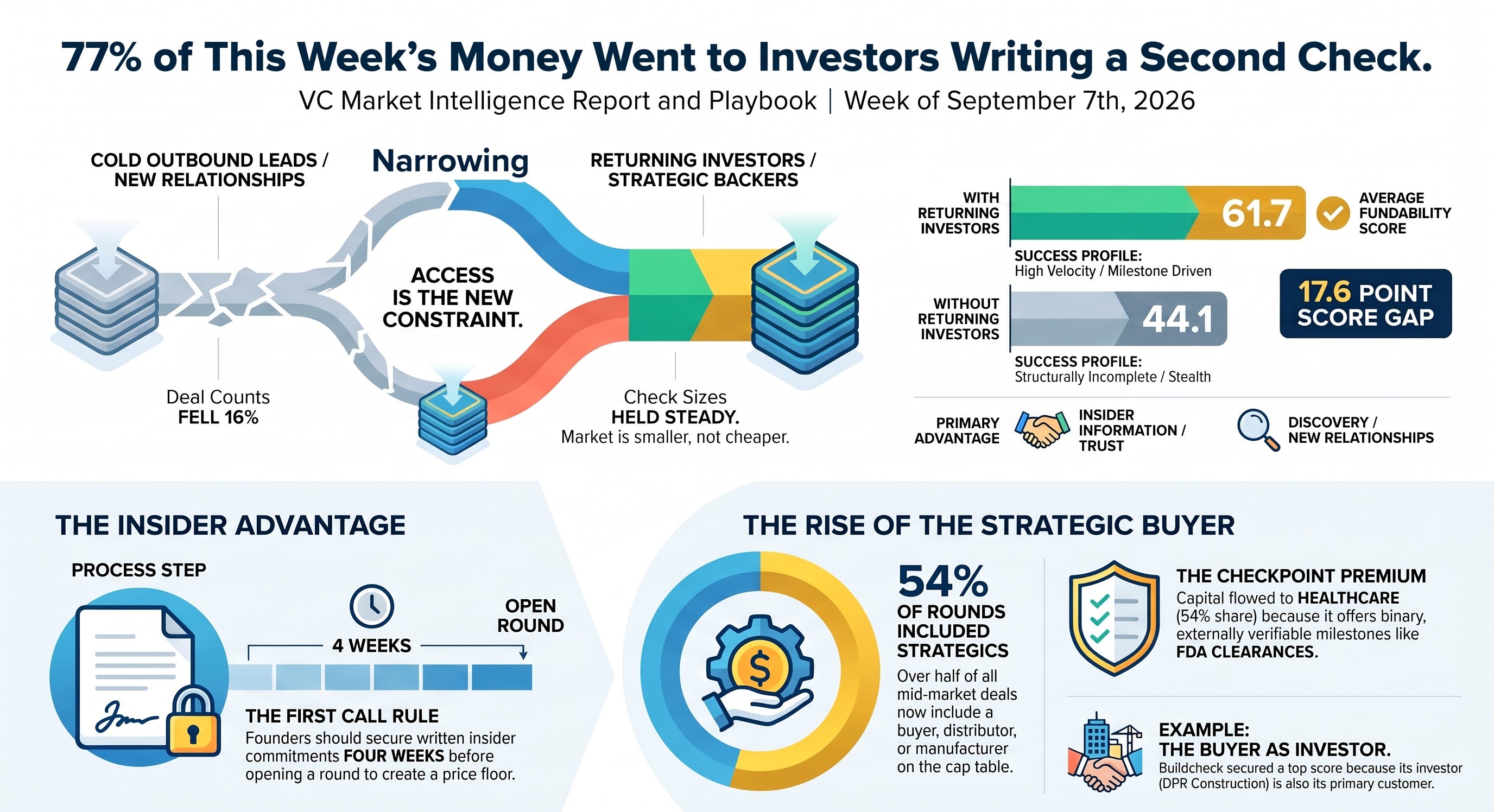
Playbook, Perspective, and Pattern for founders raising now. This report strips out giant rounds and public market traffic so you can read the part of the market that actually prices your round. Every figure below survived three independent verification passes against primary sources, the last of them adversarial.
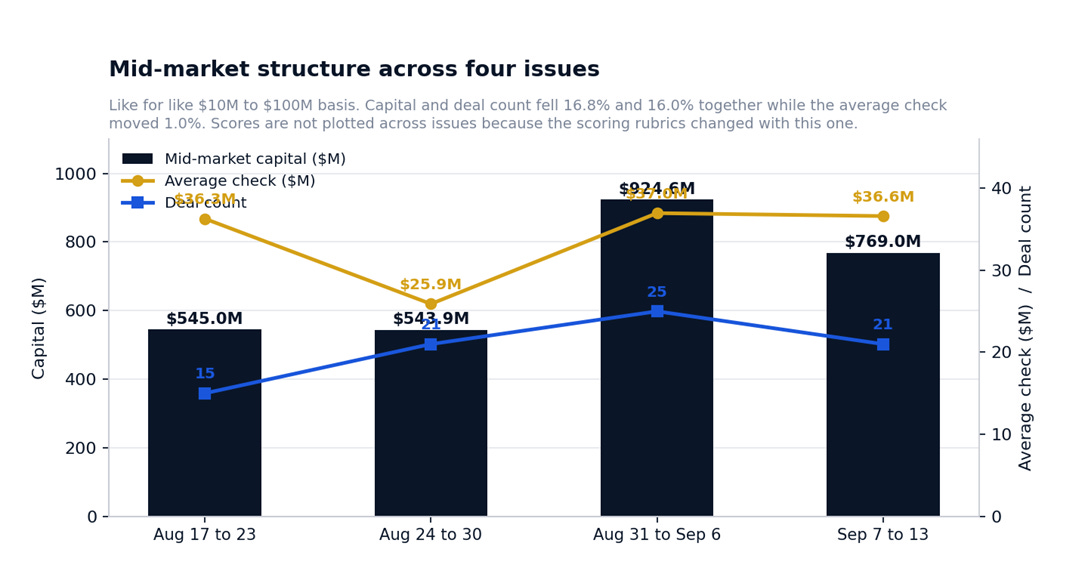
The mid-market gave back most of last week’s rebound. On a like-for-like basis against the same $10M to $100M band the last three issues tracked, capital fell from $924.6M to $769.0M, down 16.8%, and the deal count fell from twenty-five rounds to twenty-one, down 16.0%. Those two numbers moved in lockstep, which matters. The average check barely moved, from $36.98M to $36.62M, down 1.0%, and the median rose 7.7% from $32.5M to $35.0M.
That sequence is the opposite of what this series recorded two weeks ago. In the week of August 24, the pool stayed flat, and the claimants rose 40%, so every check got 29% smaller. This week the pool shrank, and the claimants shrank with it, so the check did not move. Fewer companies got funded. The ones that did got the same round they would have gotten a week ago.
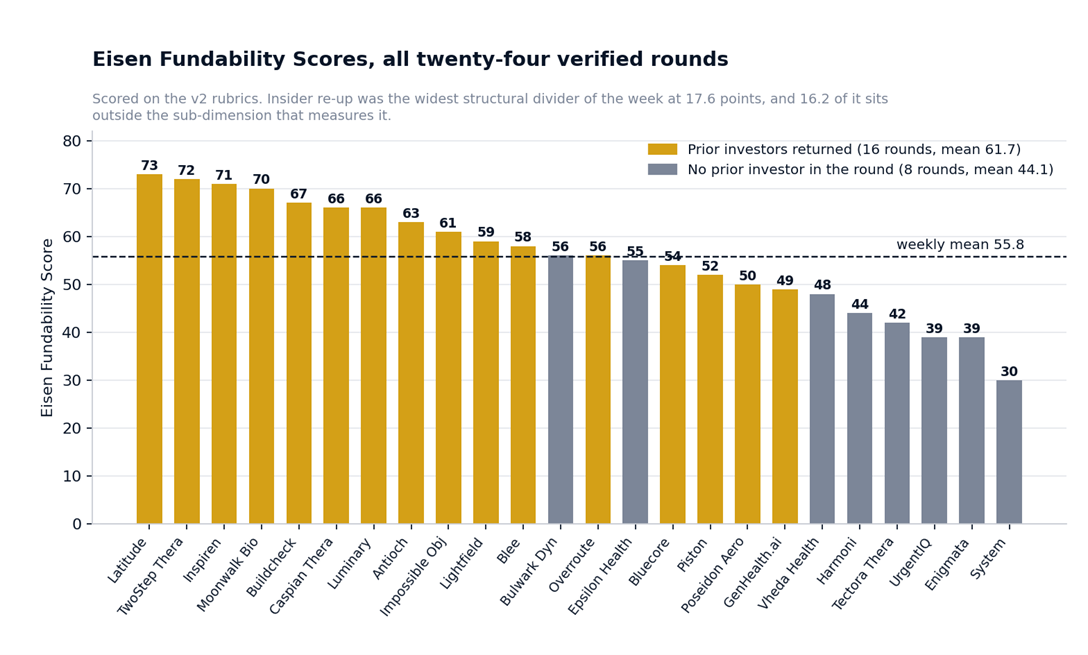
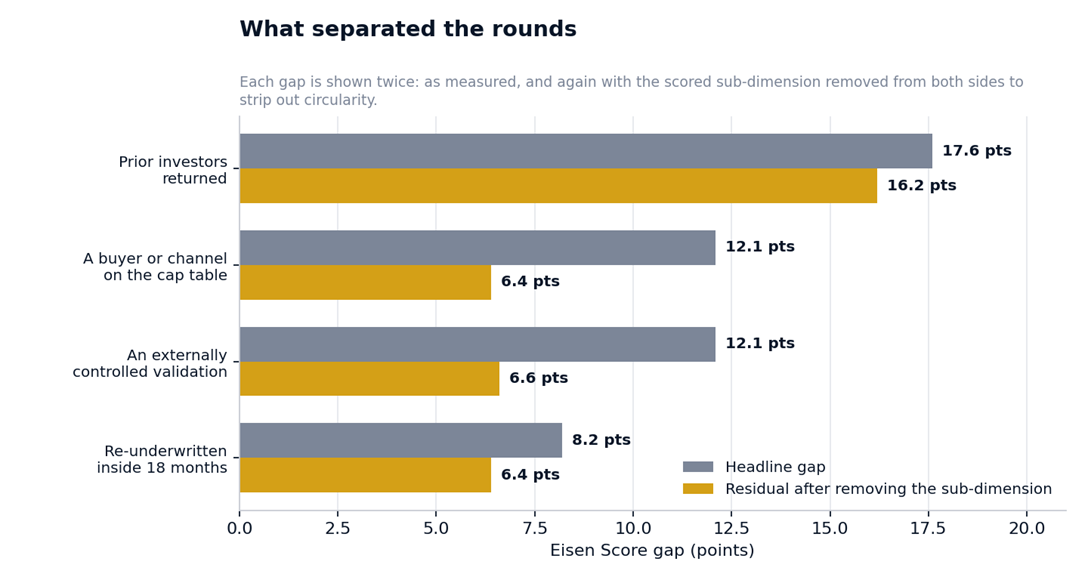
Now the number decided which companies got funded. Sixteen of twenty-four rounds had at least one investor from a prior round writing again. Those sixteen averaged 61.7. The eight rounds with no returning investor averaged 44.1. That is a 17.6-point gap, the widest structural divider this report has measured, and unlike most gaps that size it is almost entirely real: the sub-dimension scoring insider support is worth two points, so 16.2 of the 17.6 sits outside the thing measuring it.
The second number points the same direction from a different angle. Thirteen of twenty-four rounds carried strategic, corporate, or customer-side capital, or 54.2% of rounds and $485.3M of the week’s money. Last week that figure was eight of twenty-eight, or 28.6%. In seven days, the share of mid-market rounds funded in part by somebody who buys, distributes, or manufactures what the company sells nearly doubled.
Consequence for Monday. The queue got shorter, and the check did not, so the binding constraint this week is access, not price. And access is being granted disproportionately by people already in the building: your last round’s investors, and the corporates who already buy from you. Twenty-two of twenty-four rounds had a designated lead, and in two-thirds of them, somebody who had already underwritten this company once underwrote it again. This week’s money didn't come from the cold outbound list.
The Week in One Sentence
Primary insight. Mid-market capital and deal count fell 16.8% and 16.0% together, while the average check held flat, and the rounds that cleared were overwhelmingly the ones where somebody already inside the company’s orbit wrote the check again, whether that was a prior investor re-upping or a buyer joining the cap table.
· Total tracked mid-market capital, 24 verified rounds: $787.8M in new primary capital, every deal between $5M and $100M, every company US-headquartered.
· Like-for-like against prior issues: $769.0M across 21 rounds in the $10M to $100M band the last three issues used, against $924.6M across 25 rounds last week. Capital down 16.8%, deal count down 16.0%.
· Average round size: $32.83M across the full $5M to $100M set. On a like-for-like basis, $36.62M against $36.98M last week, down 1.0%.
· Median round size: $27.0M across the full set. On a like-for-like basis, $35.0M against $32.5M last week, up 7.7%.
· Largest tracked rounds: a tie at $70.0M between Inspiren, a Series C in senior living, and Moonwalk Biosciences, a Series B in obesity therapeutics. Smallest: Overroute at $5.5M.
· Rounds with a designated lead investor: 22 of 24, or 91.7%, against 24 of 28, or 85.7%, last week. Only System and Bulwark Dynamics closed without one.
· Rounds carrying strategic, corporate, or customer-side capital: 13 of 24, or 54.2%, moving $485.3M or 61.6% of the week’s capital, against 8 of 28, or 28.6%, last week.
· Rounds with at least one prior investor returning: 16 of 24, or 66.7%. Those sixteen averaged 61.7 against 44.1 for the eight without.
· Highest Eisen Fundability Score: Latitude at 73. Lowest: System at 30. A band of 43 points, with 7 of 24 rounds clearing 65.
· Defining structural feature: the top of the band is occupied by rounds nobody had to be sold on. All seven rounds clearing 65 carried a returning investor, and five also carried a buyer, channel, or manufacturer on the cap table.
· Framework note: this issue is the first scored on the v2 rubrics. Capital, deal count, check size, stage, sector, geography, and investor behavior remain directly comparable to prior issues. Scores do not, and this report includes no cross-issue score comparisons.
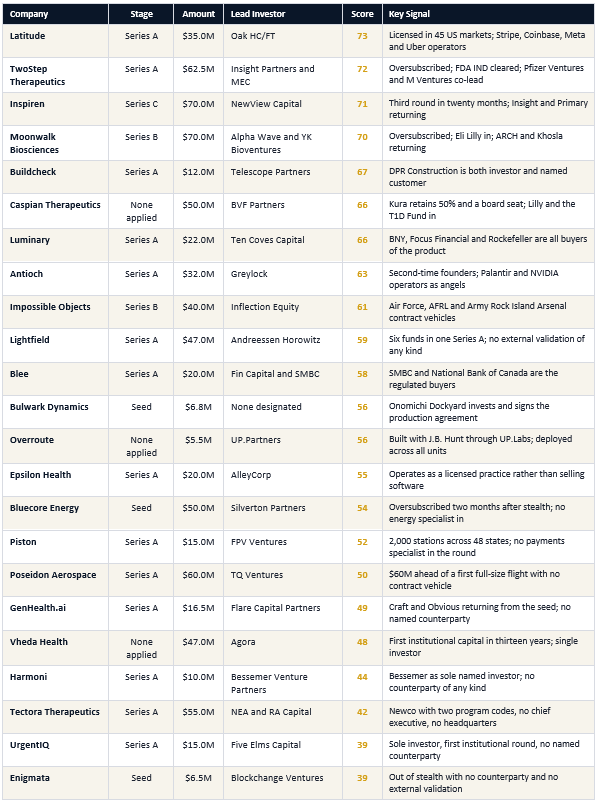
The Deal Scorecard
Eisen Fundability Scores are calculated across five weighted dimensions: Founder-Investor Dynamics (30), Traction-to-Conviction Conversion (25), Narrative Power (20), Deal Architecture (20), and Capital Planning (5). Scores of 85 and above signal an inevitable outcome. Scores of 75 to 84 signal solid fundamentals. Scores of 65 to 74 signal a good company with some gaps. Below 65 signals an early-stage or structurally incomplete company. This issue is scored on the v2 rubrics, in which Traction to Conviction measures what third parties have already underwritten.
What the Scorecard Says at a Glance
The top of the band belongs to rounds nobody had to be sold on. Latitude at 73 came with a seed syndicate re-upping into a round four times larger inside a year. TwoStep at 72 came with Stanford as a shareholder and Pfizer Ventures and M Ventures as co-leads. Inspiren at 71 is the third priced round in twenty months, with Insight Partners and Primary Venture Partners returning. Moonwalk at 70 has ARCH, Khosla, and Future Ventures returning, with Eli Lilly beside them. All seven rounds clearing 65 carried a returning investor, and five of the seven also carried a buyer, channel, or manufacturer on the cap table. Not one round reached the top of this band on new money alone. This is not a market-rewarding discovery. It is a market-rewarding continuity.
The strongest single position in the issue costs $12M and belongs to a construction software company. Buildcheck scored 18 of 20 on Deal Architecture, the highest mark on any dimension anywhere in the set, because WND Ventures is DPR Construction’s venture arm and DPR Construction is a named customer. The investor is the buyer. That collapses the two hardest questions in an enterprise Series A, whether the product works and whether anyone will pay for it, into one cap table entry a diligence team can confirm with a single call. It is the twentieth largest round of twenty-four, and it finished fifth.
The most expensive lesson in the scorecard costs $55M and sits at 42. Tectora Therapeutics raised a Series A co-founded by Schrödinger, New Enterprise Associates, and RA Capital Management, which is as strong an institutional trio as this issue contains, and scored 9 of 10 on Investor Quality accordingly. It then scored 0 of 10 on Founder Track Record because no chief executive, founder, or employee is named anywhere, 3 of 25 on Traction to Conviction because two preclinical program codes are the entire asset base, and 0 of 5 on Capital Planning because a newco has no prior round to be re-underwritten against. Elite investors do not carry a round on their own. They carry one dimension of five.
The floor is a structural story, not a quality story. System scored 30 on a $20.0M round with no stage, no designated lead, no headquarters, and seven investors, none of whom is identified as setting the price. UrgentIQ scored 39 on a sole-investor first institutional round with no counterparty of any kind in the record. Enigmata scored 39 emerging from stealth. These are real companies and the money is real. The score measures how much of the transaction a new investor could reconstruct; in all three cases, the answer is the amount and almost nothing structural.
Size and score remain uncorrelated for a fourth consecutive issue. Buildcheck at $12.0M outscored Poseidon Aerospace at $60.0M by seventeen points. Luminary at $22.0M outscored Tectora at $55.0M by twenty-four. Overroute at $5.5M outscored Vheda Health at $47.0M by eight. If you are calibrating your ask against what the biggest rounds got, you are calibrating against a variable that predicts nothing.
What Changed This Week: Five Market Shifts
We verify each shift against multiple sources and rank it by structural impact on founder fundraising, not deal size. Every shift ends with what it means for your raise next week.
Shift 1: The Queue Got Shorter, and the Check Did Not
Pattern, what happened. On a like-for-like $10M to $100M band, twenty-one verified rounds moved $769.0M against twenty-five rounds moving $924.6M the week before. Capital fell 16.8%, and deal count fell 16.0%, within a point of each other. Average check size fell 1.0%, from $36.98M to $36.62M. The median rose 7.7%, from $32.5M to $35.0M. Geography concentrated hard alongside it: California took $408.3M across ten of twenty-four rounds, or 51.8%, against 17.4% across six of twenty-eight last week.
Perspective, what it means. There are only two ways a capital pool can shrink. It can shrink per company, which is a repricing, or it can shrink by company count, which is a narrowing. Two weeks ago, this market repriced: flat capital across 40% more claimants cut every check 29%. This week it narrowed: capital and claimants fell together, and the check stayed the same size. Those two conditions demand opposite founder responses, and founders routinely apply the wrong one. In a repricing, you resize the ask. In a narrowing, the ask is fine, and the problem is getting into the shorter queue at all, because the same partners are writing the same checks to fewer companies.
Founder Blindspot, what most miss. Founders read a falling capital total as a signal to lower their number. Look at the median, which rose 7.7% in the same week the total fell 16.8%. The typical funded company got a larger round than the typical funded company a week earlier. If you cut your ask in response to the headline, you will be negotiating against a market that didn't cut anything, and you will hand back dilution you didn't have to give.
Playbook, what to do. Keep your number and change your qualification standard instead. Cut every name from your investor list where you cannot write one sentence naming a deal that firm led in your stage and category in the last ninety days. In a narrowing market, the constraint is not price; it is access to the specific partners still deploying, and a list built on brand rather than recent behavior takes three months to disprove. Then add back from the firms that actually led a mid-market round in these five days: Greylock, Oak HC/FT, Bessemer, FPV Ventures, Telescope Partners, Flare Capital, Five Elms, NewView Capital, Insight Partners, BVF Partners, Silverton Partners, AlleyCorp, Ten Coves Capital, Fin Capital, Inflection Equity, TQ Ventures, UP. Partners and Andreessen Horowitz.
Contrast. The week of August 24 held capital flat and added 40% more deals, cutting the average check by 28.7%. The week of August 31 reversed it, adding 70% more capital and 43% larger checks. This week did neither. It removed capital and companies in equal measure and left the price of a round untouched, which is the first week in this series where the round itself was stable.
What this means for your raise: The market did not get cheaper; it got smaller. Hold your ask, cut your list to the firms that actually wrote in your lane in the last ninety days, and spend the saved time on access rather than on price.
Shift 2: Healthcare Took More Than Half the Market
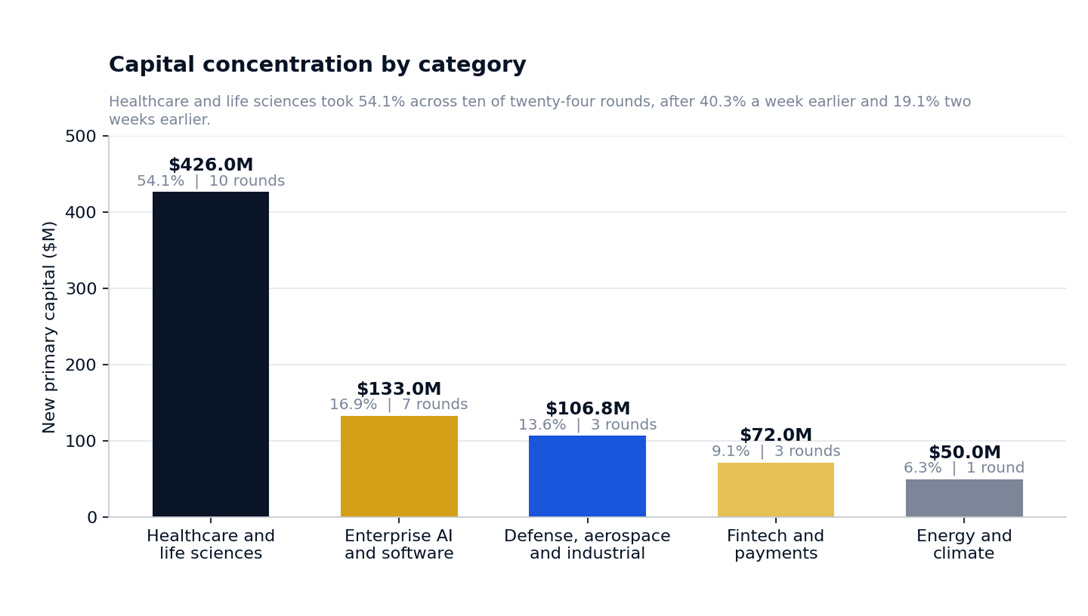
Pattern, what happened. Healthcare and life sciences took $426.0M across ten of twenty-four rounds, or 54.1% of the week’s mid-market capital. Last week, the sector took 40.3% across ten of twenty-eight rounds. Two weeks before that, it took 19.1% across five of twenty-one. The sector’s share has now risen for three consecutive issues and has nearly tripled from the August 24 trough. Inside the sector, the split runs $237.5M to therapeutics across four rounds and $188.5M to healthcare services and software across six. Enterprise AI and software took 16.9% across seven rounds, defense, aerospace, and industrial hardware 13.6% across three, fintech and payments 9.1% across three, and energy and climate 6.3% in a single round.
Perspective, what it means. Healthcare absorbing half a mid-market is a story about what can be underwritten quickly. Healthcare has the densest supply of externally controlled checkpoints. An FDA IND clearance is a dated, binary event owned by a regulator. A menin inhibitor selected for oral presentation at the European Association for the Study of Diabetes is a validation granted by a scientific body. A medical license, a payer contract, a CMS designation: all of these are facts a third party controls, which means an investment committee can verify them in an afternoon rather than a month. In a week when the market narrowed and partners had less time per company, capital flowed to the category where verification is cheapest.
Founder Blindspot, what most miss. Founders outside healthcare read this as a sector rotation and start hunting for a healthcare angle. Wrong lesson, and it costs a quarter to learn. The transferable move is structural, not thematic: these rounds cleared because they carried a checkpoint the company does not control. Impossible Objects proves it generalizes. It is not a healthcare company. It scored 9 of 10 on Independent Validation, the highest mark on that sub-dimension in the issue, on named Air Force, Air Force Research Laboratory, and Army Rock Island Arsenal relationships plus roughly $20M in government contracts and SBIR awards, and it cleared a $40M Series B from a lead most founders have never heard of.
Playbook, what to do. Write down every checkpoint in your business that a third party controls and could confirm without asking you: a certification, an audit, a regulatory clearance, a government contract vehicle, a state license, a published benchmark, a standards body listing. Count them. If the count is zero, every claim in your process depends on an investor taking your word for it, and in a narrowing market that is the slowest possible path. Then pick the one you can obtain fastest and start it this quarter, because these take two to four months and each one converts a claim into a fact somebody else owns.
Contrast. Last week healthcare’s 40.3% share arrived alongside a 70% rise in total capital, so every sector grew. This week, healthcare’s share rose again while the total fell 16.8%, meaning the sector grew in absolute terms as the market shrank around it. That is a genuine reallocation rather than a rising tide, and it is the second consecutive week the concentration has deepened.
What this means for your raise: Stop competing on category and start competing on verification speed. The question that decided this week was how much of your case an investment committee could confirm without you in the room.
Shift 3: Your Existing Investors Became the Signal
Pattern, what happened. Sixteen of twenty-four rounds carried at least one investor from a prior round. Those sixteen averaged 61.7 against 44.1 for the eight rounds with no returning investor, a 17.6-point gap and the widest structural divider in the issue. The Capital Planning sub-dimension scores insider support on a 2-point scale, so 16.2 of that 17.6 sits entirely outside the measure. Six rounds went further and were re-underwritten inside eighteen months at a larger size: Bluecore Energy, Lightfield, Latitude, Antioch, Buildcheck and Overroute. Those six averaged 62.0 against 53.8 for the other eighteen.
Perspective, what it means. An existing investor re-upping is the only signal in a funding announcement carrying information a new investor cannot get any other way. Every other party is underwriting from the outside. Your Series A lead has sat on your board, seen twelve months of monthly reporting, watched you miss a plan and recover, and watched how you behave when a key hire quits. When that person writes again, and writes larger, they are pricing information no diligence process can reproduce in six weeks. That is why the gap is 17.6 points and why it survives stripping the mechanical component almost intact: rounds with insider re-ups are not scoring higher because the framework hands them two points. They score higher across founder quality, syndicate strength, round construction, and velocity simultaneously because one underlying fact drives all of them.
Founder Blindspot, what most miss. Founders treat existing investors as a fallback to approach after the new-money process stalls, on the theory that going to insiders first signals weakness. This week’s data says the reverse, and the mechanism is simple: a new lead reads a round with no insider participation and asks one question, which is what the people who know this company best decided to do. No one has a good answer. Eight companies this week had to answer it, and they averaged 44.1. Note the asymmetry in effort too. Securing an insider commitment takes two conversations with people who already take your calls, versus a twelve-week process with people who don't.
Playbook, what to do. This is the highest leverage action in this issue. Before you open any process, go to every investor on your cap table with a board seat or a meaningful position and ask for a specific number in writing, not general support. Ask what they will put in at a price they consider fair, and ask whether they would lead if nobody else does. Do this four weeks before you plan to open, not after the first two passes. You are buying three things with those conversations: a floor under the round, a number to quote to new leads, and, if the answer is no, the single most valuable piece of diligence output available to you, delivered free and three months early. If the people who know you best will not re-up, fix that before you spend a quarter discovering it from strangers.
Contrast. Last week’s issue found four of twenty-eight rounds closing with no named institutional lead and treated the lead seat as the structural question. This week, the lead seat is close to universal at twenty-two of twenty-four, and the variable that separated the field moved one step further back: whether anybody who had already funded this company was willing to do it again.
What this means for your raise: Your existing cap table is not the backup plan. It is the first call; it is the cheapest diligence you will ever buy, and this week it was worth 17.6 points.
Shift 4: The Buyer Showed Up on the Cap Table
Pattern, what happened. Thirteen of twenty-four rounds carried strategic, corporate, or customer-side capital, or 54.2% of rounds and $485.3M, which is 61.6% of the week’s mid-market money. Last week that figure was eight of twenty-eight, or 28.6%. In eight of those thirteen, the investor is specifically a buyer, a distribution channel, or a manufacturer, and those eight averaged 63.9 against 51.8 for the other sixteen, a 12.1-point gap that holds at 6.4 after removing the sub-dimension scoring it. Buildcheck took money from DPR Construction’s venture arm while DPR is a named customer. Overroute was built with J.B. Hunt through UP. Labs and is deployed across all of J.B. Hunt’s business units. Luminary took money from BNY, Focus Financial Partners, and Rockefeller Capital Management, all of whom buy exactly what it sells. Bulwark Dynamics took money from Onomichi Dockyard and signed a serial production agreement with it in the same announcement. Moonwalk, TwoStep, Caspian, and Blee each carry a pharma or bank strategic.
Perspective, what it means. A financial investor is buying a claim about future demand. A strategic buyer has already tested that claim through its own procurement process, and the check is the receipt. That is why the structure compounds: it prices the round, it de-risks the top line, and it pre-clears the next twelve buyers in the pipeline, who no longer have to be the first mover in their peer group. In an enterprise sale with a nine-month cycle, that third effect is worth more than the capital. Bulwark Dynamics is the most extreme version this week. A $6.8M seed with no designated lead and a founder whose background is not on the public record scored 56, above rounds eight times its size, because the manufacturer that will build the vessels invested in the company that designed them.
Founder Blindspot, what most miss. Founders rank corporate money below venture money, assuming it is slower, more conditional, and a negative signal to the next round. This week, it was the second-strongest structural variable in the market. The real cost of strategic capital is not reputational; it is contractual: a right of first refusal on an acquisition, category exclusivity, or a channel lockout that shrinks your buyer universe permanently. Founders worry about the wrong risk and then sign the clause that creates the real one.
Playbook, what to do. Build a second target list this week, twelve names long, of corporates who either buy what you sell or sell to who you sell to. For each one, write the specific first customer they can deliver inside ninety days, and the name of the person who runs their venture arm. Then, before any of them offers, have counsel pre-draft your position on three clauses: right of first refusal on an acquisition, category exclusivity, and information rights that would let a strategic see your roadmap. Decide those positions in advance as policy, because deciding them under a live term sheet is how founders give away the buyer universe to close the round.
Contrast. Two weeks ago, nine of twenty-one rounds carried strategic money at 42.9%. Last week that fell to eight of twenty-eight (28.6%) as financial venture firms took back the lead seat. This week it jumped to thirteen of twenty-four at 54.2%, the highest share this series has recorded, and for the first time the strategics are not just participating. Onomichi Dockyard, UP. Partners and WND Ventures are structuring the companies they invest in.
What this means for your raise: Rank your investor list by which customer each name delivers, not by which name looks best in the announcement. And settle your exclusivity position before anyone offers, not after.
Shift 5: Series A Swallowed the Market
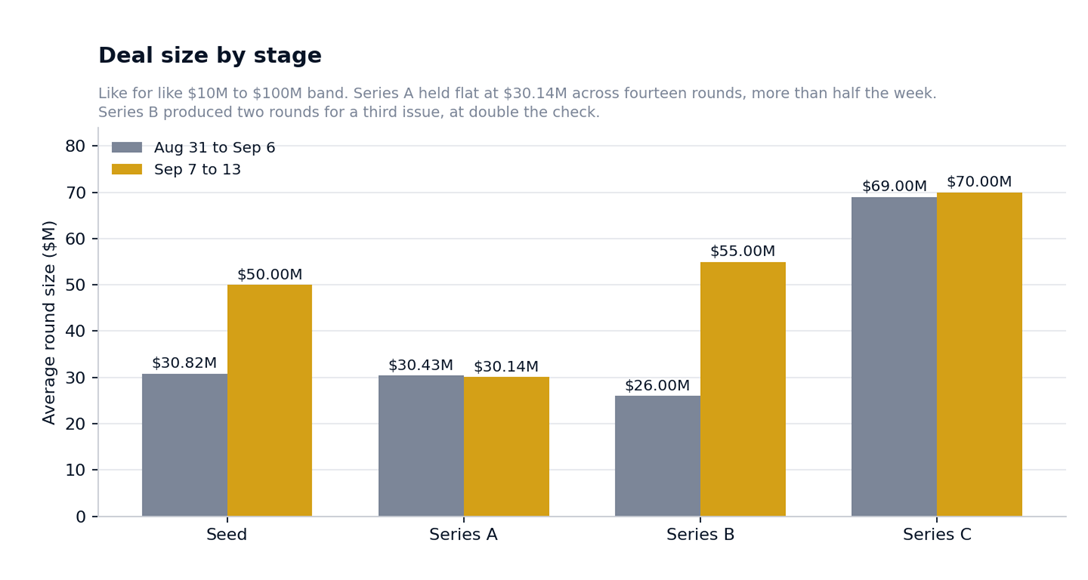
Pattern, what happened. Fourteen of twenty-four rounds were Series A, totaling $422.0M, or 53.6% of the week’s mid-market capital. Last week, seven of twenty-eight rounds were Series A, totaling $213.0M, or 22.6%. The deal count doubled, and the share more than doubled, while the average Series A check fell 0.9%, from $30.43M to $30.14M. Series B produced two rounds for a third consecutive issue, but the average check rose 111.5% from $26.00M to $55.00M on Moonwalk at $70.0M and Impossible Objects at $40.0M. Seed produced three rounds against six, and only one of them, Bluecore at $50.0M, fell inside the $10M to $100M band at all. Series C produced one round, Inspiren at $70.0M.
Perspective, what it means. A market that puts more than half its capital into one stage is telling you where its risk tolerance sits, and Series A is a very specific place. It is late enough that a team and a product exist and early enough that no repeatable unit economics are required. It is also the stage where an insider re-up is most available, because the seed investors are still close to the company and the round is small enough for them to move it. Ten of the fourteen Series A rounds this week carried a returning investor. Series B stayed at two rounds for a third week, which is now a pattern rather than a holiday effect, and both that cleared did so with a strategic attached and at more than double the price.
Founder Blindspot, what most miss. Founders at Series B have watched three consecutive weeks in which two rounds cleared out of twenty-one to twenty-eight, and keep reading the headline capital number instead of the lane number. Two of twenty-four is an 8.3% share of deals. What changed this week is that the two that cleared did so at a $55M average, up from $26M, and both carried a corporate strategic. Series B did not get easier. It got rarer, more expensive, and conditional on having a buyer or a pharma partner already committed.
Playbook, what to do. If you are twelve months or more from a Series B, spend one month instrumenting the three numbers that stage is priced on and nothing else: fully loaded customer acquisition cost, gross margin by product line, and the percentage of last year’s revenue base still present this year. Not a dashboard, three numbers with a defensible method behind each, ready to hand over within a week of being asked. If you are inside six months, make the honest call between an extension at your Series A price with existing investors and a tight process aimed only at firms that wrote a Series B in your category this quarter. No third path exists where a broad process works, because the lane is 8.3% of deals wide. And if you are raising a Series A, note that you are raising into the only stage in this market with real depth: fourteen rounds, more than half the capital, at a price that did not move.
Contrast. Last week, Series A was seven of twenty-eight rounds and 22.6% of capital, and the story was that seed and Series A had both reopened while Series B closed. This week, seed closed too, and Series A absorbed what seed and Series C gave up. The market has narrowed to a single funded stage plus exceptions.
What this means for your raise: If your round is a Series A, the depth is there, and the price did not move, so run it now. If it is a Series B, you are competing for one of roughly two slots a week, and the entry price has doubled.
The Deals That Matter: Top 5
Five deep dives across stablecoin settlement rails, oncology therapeutics, senior living AI, obesity therapeutics, and construction design review. These are the five highest-scoring rounds of the week. All facts are verified against two or more sources and re-checked in two further passes.
Latitude
Stablecoin Settlement into Local Payment Rails | Series A | $35.0M | Led by Oak HC/FT
Eisen Fundability Score: 73 / 100
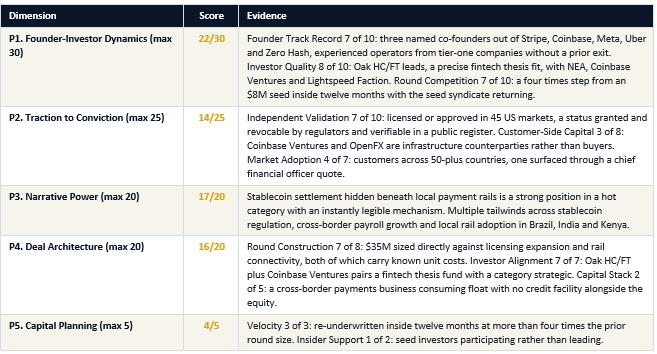
Why this scored. The highest score of the week and the only round in the issue that is strong on all five dimensions at once. Latitude carries the most precisely assembled founding team in the set, a precise thesis lead, a licensing position a regulator confirms rather than the company, a four-times step in round size in a year, and seed investors coming back. Nothing here is spectacular in isolation. Nothing is weak either, and in a five-dimensional framework, that is what wins.
The Setup. Latitude, headquartered in San Francisco, converts stablecoin settlement into local currency on local rails: Pix in Brazil, UPI in India, mobile money in Kenya. The recipient never touches a wallet and never knows a stablecoin was involved. Co-founders Cyril Mathew, Brian Wrightson, and Vivek Morzaria came out of Stripe, Coinbase, Meta, Uber, and Zero Hash, the most exactly matched founding team in the issue for the problem being solved: one half has built payment infrastructure and the other half has built crypto settlement, and the entire product is the seam between them. Customers are payroll platforms, marketplaces, fintechs, and wallets.
The Deal. $35.0M Series A led by Oak HC/FT, announced September 9, 2026, with NEA, Coinbase Ventures, Lightspeed Faction, OpenFX, and Wilson Sonsini participating. Total capital $43M including an $8M seed earlier in 2026, which makes this a four times step inside twelve months with seed investors returning. Licensed or approved to operate in 45 US markets. Customers across more than 50 countries. All equity, no credit facility.
The Pattern. This is the regulatory surface round. Latitude’s strongest asset is not a product claim; it is permission: licensed or approved in 45 US markets, a status granted by fifty separate regulators, revocable by them, and checkable by any investor who opens a state register. In cross-border payments, that is the actual barrier to entry. It takes years to accumulate; you can't buy it with a larger round, and a competitor with more volume and fewer licenses isn't ahead.
The Perspective. Look at what the licensing position does to the round’s construction. A company whose moat is regulatory approval has a use of funds legible at a glance: more licenses, more corridors, more local rail integrations, each with a known cost and a known timeline. That is why Round Construction scored 7 of 8. Compare it to Poseidon Aerospace, which raised $60M ahead of a first flight and scored 3 on the same sub-dimension. Same market, same week, opposite clarity about what the money buys. When your moat has a unit cost, your round has a defensible size.
The Playbook. If you operate in a licensed, certified, or accredited category, count your permissions against the total available. Money transmitter licenses held against fifty states. Payer contracts against the top twenty. Certifications against the full standard. Corridors live against corridors targeted. Then build your use of funds directly on that denominator, so the ask and the moat are the same sentence. If your category has no licensing regime, find the nearest equivalent: a standards body listing, a security certification, a prime contract vehicle. The asset you want is one a third party grants and can take away.
The Founder Mistake to Avoid. Founders with an exceptional team treat the resume as the round and let everything else arrive late. Latitude’s founders are from Stripe, Coinbase, Meta, Uber, and Zero Hash, and the team is worth 7 of 10, not 10 of 10, because none of them carries a prior exit. The 73 came from the team, the licenses, the step-up, the insider re-up, and the thesis fit. Five things. If your case rests on one of them, you are one skeptical partner away from a slow no.
TwoStep Therapeutics
Peptide-Drug Conjugates in Oncology | Series A | $62.5M | Co-led by Insight Partners and Medical Excellence Capital
Eisen Fundability Score: 72 / 100
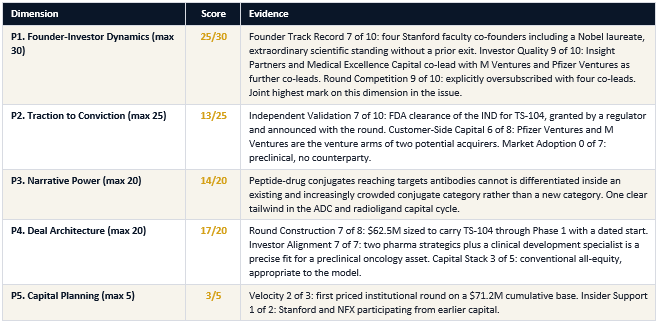
Why this scored. The joint strongest Founder-Investor Dynamics mark in the issue at 25 of 30, on four Stanford faculty founders including a Nobel laureate, four co-leads, and an explicitly oversubscribed round. It is also one of only five rounds in the week carrying an externally controlled validation, in this case an FDA clearance granted in the same announcement as the money.
The Setup. TwoStep Therapeutics, headquartered in San Carlos, California, builds peptide-drug conjugates designed to reach tumor targets antibodies cannot. Chief executive Caitlyn Miller founded the company with Jennifer Cochran, Carolyn Bertozzi, and Ronald Levy, all Stanford faculty, including Nobel laureate Carolyn Bertozzi. Stanford University itself is on the cap table. Lead program TS-104 couples a polyspecific integrin-binding peptide with an MMAE cytotoxic payload.
The Deal. $62.5M oversubscribed Series A co-led by Insight Partners and Medical Excellence Capital, announced September 9, 2026, with M Ventures and Pfizer Ventures as co-leads and NFX, 2048 Ventures, and Stanford University participating. Announced simultaneously with FDA clearance of the IND for TS-104. Phase 1 expected to begin later in 2026. Total capital raised: $71.2M.
The Pattern. This is the paired-announcement round, and the timing is the entire lesson. TwoStep did not announce a financing and then a clearance, or a clearance and then a financing. It announced both in one release, which means the round was structured so the IND landed inside the announcement window. That converts a funding release into a regulatory event, and a regulatory event is the one kind of news an investment committee can verify in a public database in under a minute.
The Perspective. Four co-leads is unusual, and it is worth understanding why it happened rather than treating it as a syndicate accident. Insight Partners brings capital scale, Medical Excellence Capital brings clinical development judgment, and M Ventures and Pfizer Ventures are the venture arms of two large pharmaceutical companies. Those last two are not financial investors. They are the acquirers, sitting on the cap table from the Series A, which means the exit conversation starts eighteen months before anyone needs it to. For a preclinical asset company, that structure is the closest thing to a de-risked path.
The Playbook. Time your next externally controlled milestone to land inside your financing window, and negotiate the announcement sequencing into the process rather than leaving it to your communications team. A clearance, a contract award, a certification, or a standards listing that arrives three weeks after your round closes is worth a fraction of the same event landing in the same release. Work backward: find the dated third-party event on your eighteen-month roadmap, then set your process to close within four weeks. This is deal architecture, not public relations, and it is why a preclinical company scored 72.
The Founder Mistake to Avoid. Founders see four co-leads and read it as overwhelming demand. Sometimes it is. It can also happen when no single firm will take the full position and the round is assembled from four partial commitments. The distinguishing fact here is the word oversubscribed alongside co-leads of that quality, not the count itself. If you find yourself with four co-leads and no oversubscription, you have a syndication problem wearing a validation costume, and the next round’s lead will read the cap table that way.
Inspiren
Physical AI for Senior Living | Series C | $70.0M | Led by NewView Capital
Eisen Fundability Score: 71 / 100
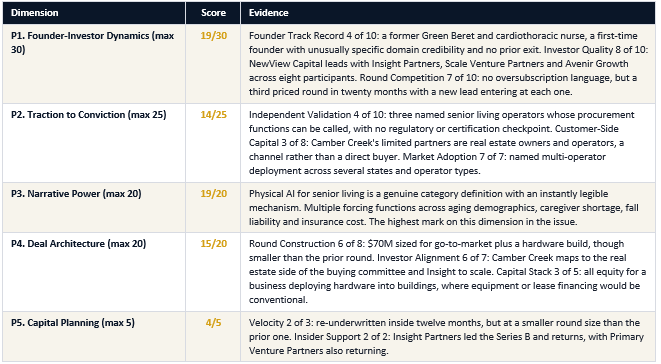
Why this scored. The highest Narrative Power mark in the issue at 19 of 20, and the clearest velocity story in the set: three priced rounds in twenty months with the Series B lead returning. Inspiren also has the deepest named-operator footprint of any healthcare services company this week, with three senior living operators whose procurement teams can be called by any investor running diligence.
The Setup. Inspiren, founded in 2016 and headquartered in New York, sells an ambient awareness platform combining sensors, AI, and clinical support to monitor residents, automate care documentation, predict falls, and respond to emergencies in assisted living communities. Founder and chief clinical officer Michael Wang is a former Green Beret who became a cardiothoracic nurse, and Alex Hejnosz is chief executive. That biography does real work in a category where the buyer is a director of nursing and the product has to survive a night shift.
The Deal. $70.0M Series C led by NewView Capital, announced September 10, 2026, with Insight Partners, Primary Venture Partners, Scale Venture Partners, Vintage Investment Partners, Lightbank, Avenir Growth Capital, Story Ventures and Camber Creek participating. Third priced round in twenty months, after a $35M Series A in early 2025 and a $100M Series B in September 2025. Total capital: $225M. Insight Partners led the Series B and returns here. Named operator relationships with Aegis Living, Clearwater Living, and Solera Senior Living.
The Pattern. This is the re-underwriting round, and the cadence is the signal. Three priced rounds in twenty months means Inspiren has been through institutional diligence three separate times in under two years, each time with a new lead taking the top of the round and the previous lead staying in. Each pass is an independent investment committee reaching the same conclusion with more information than the last. No single announcement can manufacture that. It accrues.
The Perspective. Camber Creek is the investor most founders will skip over, and it is the one worth studying. Camber Creek’s limited partners are real estate owners and operators, and senior living is a real estate business with a care operation inside it. That is a channel, not a logo. In a category where the purchase decision runs through property ownership as much as through clinical leadership, having the real estate capital side on your cap table shortens a sales cycle that otherwise requires convincing two separate constituencies independently. The lesson generalizes: in any category where the buyer and the budget holder are different people, find an investor whose limited partners are the budget holder.
The Playbook. Map your buying committee before you map your investor list. Write down every party who has to say yes for a sale to close: the operational user, the clinical or technical approver, the budget owner, and the party that owns the asset your product sits on. Then find one investor aligned to each constituency you do not already have covered, and rank your target list on that basis rather than on fund size. Inspiren has an institutional growth lead, a scale specialist, an early-stage believer, and a real estate channel on one cap table. That is not a party round. That is a buying committee mapped onto a syndicate.
The Founder Mistake to Avoid. Founders read a three-rounds-in-twenty-months cadence as proof that fast is good and go raise before they need to. Look at the sizes: $35M, then $100M, then $70M. The Series C is smaller than the Series B. A company raising faster than its milestones arrive eventually takes a round that does not step up in size, and the next investor reads that sequence exactly as written. Velocity is a signal when each round is bought on milestones. It is a warning when it is bought by a burn rate.
Moonwalk Biosciences
Adipose-Targeted RNAi for Obesity | Series B | $70.0M | Co-led by Alpha Wave and YK Bioventures
Eisen Fundability Score: 70 / 100
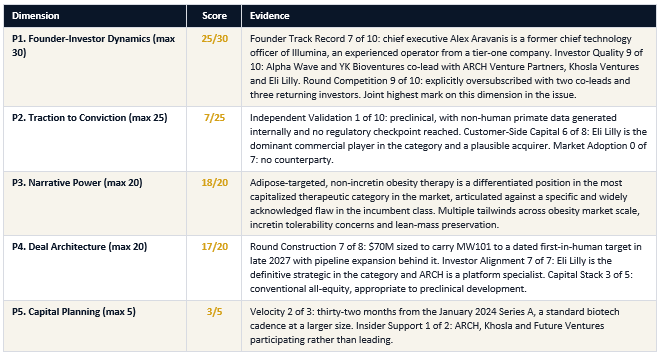
Why this scored. The joint strongest Founder-Investor Dynamics mark in the issue at 25 of 30, on a chief executive who ran technology at Illumina, two co-leads, an explicitly oversubscribed round, and three prior investors returning alongside Eli Lilly. It is one of three rounds in the issue to use the word oversubscribed and the only one where the dominant commercial player in the category is on the cap table.
The Setup. Moonwalk Biosciences, based in South San Francisco and San Diego, develops tissue-targeted siRNA medicines acting directly on fat tissue rather than through the incretin pathway GLP-1 drugs use. Chief executive and co-founder Alex Aravanis, a former chief technology officer of Illumina, built the company with Arash Jamshidi and Justin Valley. The positioning is a specific dissatisfaction with the incumbent class: incretins cause weight loss that includes lean muscle, and Moonwalk’s preclinical work targets fat mass while preserving lean mass, with non-human primate data supporting quarterly or twice-yearly dosing.
The Deal. $70.0M oversubscribed Series B co-led by Alpha Wave and YK Bioventures, announced September 8, 2026, with Eli Lilly and Company, Gaorong Ventures, ARCH Venture Partners, Khosla Ventures and Future Ventures participating. ARCH, Khosla, and Future Ventures all returned from the $57M Series A in January 2024. Total capital: $127M. Lead candidate MW101 expected to enter first-in-human studies in late 2027. Dr. Stephen Djedjos appointed senior vice president of clinical development alongside the round.
The Pattern. This is the incumbent-critique round backed by the incumbent. Moonwalk positioned not against other RNAi companies but against the world's best-selling drug class, on a specific defect patients and physicians already complain about. Then Eli Lilly, which owns a large share of that class, put money in. Read that as what it is: simultaneously a validation of the thesis and a hedge against it by the party with the most to lose if the thesis is right.
The Perspective. Three investors from the Series A returning into an oversubscribed Series B is the structural fact doing most of the work here, and it operates differently from the insider re-ups elsewhere in this issue. ARCH, Khosla, and Future Ventures have watched this platform through two and a half years of preclinical work. They have seen every experiment that did not work, which is information no new investor gets. When they write again into a round that is oversubscribed, they are competing for allocation against new money on the strength of what they know and the new money does not. That is the strongest form the signal takes.
The Playbook. If your existing investors are going to re-up, get them to commit before you open to new money, and then let the new money compete for what is left. The sequence matters more than founders think. Insiders committing after a new lead prices the round reads as support. Insiders committing first, so the round is partly filled before a new lead sees it, reads as competition, and it changes the price. Ask each existing investor for a specific number four weeks before you open, then use that number as the floor for new leads rather than the ask.
The Founder Mistake to Avoid. Founders take a strategic investor’s participation as endorsement and stop negotiating. Eli Lilly writing into a competitor in its own franchise is a hedge, and the attached terms decide whether it helps or constrains. Before taking strategic money from the company you are positioning against, have counsel write down your position on right of first refusal, category exclusivity, information rights, and board observation, because those terms determine whether the other eight potential acquirers can still bid in 2029.
Buildcheck
Vision-Based AI for Construction Drawing Review | Series A | $12.0M | Led by Telescope Partners
Eisen Fundability Score: 67 / 100
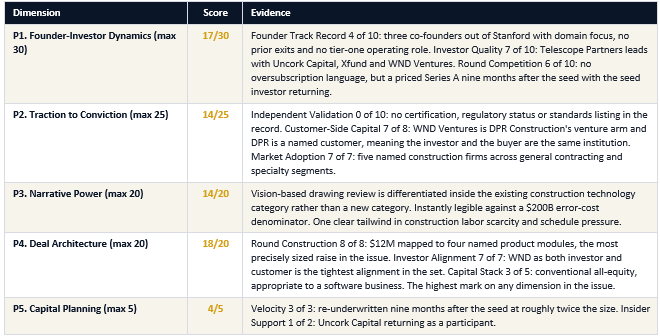
Why this scored. The highest Deal Architecture mark on any round in the issue at 18 of 20, in the twentieth largest round of twenty-four. Buildcheck scored 7 of 8 on Customer-Side Capital and 7 of 7 on Market Adoption because WND Ventures is DPR Construction’s venture arm and DPR Construction is a named customer, alongside four other named construction firms. The investor is the buyer, and the buyer brought four peers.
The Setup. Buildcheck, founded at Stanford and headquartered in San Francisco, runs vision-based AI over construction drawings to catch design errors before they reach the field. The problem is expensive and specific: design errors cost the construction industry more than $200B annually, and the review that would catch them still falls to a senior engineer reading sheets. Chief executive Alexander Michalatos co-founded the company with Andrei Molchynsky and chief technology officer Alex Gureiev.
The Deal. $12.0M Series A led by Telescope Partners, announced September 9, 2026, with WND Ventures, Uncork Capital, Salt VC and Xfund participating. Named customer relationships with DPR Construction, EllisDon, Power Construction Company, EMJ Construction, and IMC Construction. Total capital $18M including a $5.9M seed nine months earlier, with Uncork returning. Use of funds specified across four named product modules: Custom Checks, Diffs, Code Reviews, and Value Engineering.
The Pattern. This is the buyer-as-investor round in its purest form. The single cap table entry, WND Ventures, does three jobs at once. It prices part of the round. It confirms DPR ran the product through a real procurement process and chose to deepen the relationship with equity. And it gives every other general contractor in the pipeline permission to move, because a peer they respect has absorbed the first-mover risk. Four other named construction firms in the same announcement are what that permission looks like in practice.
The Perspective. Now look at the round size. $12.0M with four named product modules attached is the most precisely constructed raise in the issue, and precision is why it scored 8 of 8 on Round Construction against a set where most rounds scored 5 or 6. A $12M round with four named deliverables is a claim an investor can audit in twelve months. A $60M round to reach a first flight, which is what Poseidon raised, is not. Founders optimize for the largest number they can defend. The framework, and the market, reward the number that maps to something countable.
The Playbook. Ask your two best enterprise customers whether their organization has a venture arm, a strategic investment vehicle, or an innovation fund, and whether it would take a small position in your round. Most large contractors, health systems, utilities, banks, carriers, and retailers have one, and the check size they write is small enough that the ask is not awkward. You are not raising from them for the capital. You are raising so the next twelve buyers in your pipeline never have to be the first, and so the round has a party in it whose reference call is a procurement record, not an opinion.
The Founder Mistake to Avoid. Founders chase the strategic investor and forget that a venture arm and a purchase order are different things. WND Ventures investing means DPR’s innovation group approved a position. DPR Construction being a named customer means DPR’s operating business bought the product. Buildcheck has both, and the second is what makes the first worth something. If a corporate venture arm wants in but the operating business has not bought, you have an option on a relationship rather than a purchase, and the next round’s lead will find that out.
The Fundraising Playbook: Five Tactical Plans
Five plans, each producing a concrete artifact you can use immediately. No vague tasks. Each is built directly from this week’s verified signals.
1. The Buying Committee Map (Narrative and Investor Framing)
Why this matters. Thirteen of twenty-four rounds carried strategic, corporate, or customer-side capital, or 54.2% of rounds and 61.6% of the week’s capital, up from 28.6% of rounds last week. Inspiren has an institutional growth lead, a scale specialist, an early believer, and a real estate channel on one cap table. Buildcheck has the investor and the buyer as the same institution. These are not party rounds. They are buying committees mapped onto syndicates.
Exact deliverable. One page, two columns. Left column: every party who must say yes for a sale to close, meaning the operational user, the technical or clinical approver, the budget owner, and whoever owns the asset your product sits on. Right column: which investor on your target list is aligned to each of those constituencies, and what specifically they can unlock in ninety days. Any row with an empty right column is a gap in your syndicate, not a gap in your pitch.
Time estimate. Three hours to build the map, plus two calls with your best customer’s procurement contact to confirm you have the committee right rather than guessing at it.
Expected outcome. Your investor target list is ranked by what each name removes from your sales cycle, not by fund size. In a week when more than half the mid-market took money from someone with a commercial relationship, that ranking is the difference between a syndicate and a cap table that sells for you.
The reframe. Wrong approach: rank investors by brand and treat corporates as a fallback. Right approach: rank by which member of your buying committee each investor already controls.
2. Acquire One Externally Controlled Checkpoint (Proof Architecture)
Why this matters. Five of twenty-four rounds carried a checkpoint controlled and confirmed by an outside body, and those five averaged 65.4 against 53.3 for the other nineteen, a 12.1-point gap that holds at 6.6 after removing the sub-dimension. Impossible Objects scored 9 of 10 on that sub-dimension on Air Force, AFRL, and Army Rock Island Arsenal contract vehicles and cleared $40M from a lead most founders have never heard of. TwoStep announced an FDA clearance in the same release as the round. Latitude counts 45 US market licenses it does not grant itself.
Exact deliverable. A one-page inventory of every checkpoint in your business a third party controls and could confirm without asking you, in three columns: the checkpoint, the body that grants it, and whether you currently hold it. Certifications, audits, regulatory clearances, government contract vehicles, state licenses, standards body listings, published benchmarks, accreditations. Count the ones you hold. Then mark the single missing one you could obtain fastest and put a start date on it this quarter.
Time estimate. Three hours for the inventory. Two to four months to obtain the first missing checkpoint, which is exactly why the start date goes in this quarter rather than when you open a process.
Expected outcome. You stop asking an investment committee to take your word for your business's central claim. In a narrowing market where partners have less time per company, the proportion of your case a third party already owns is what determines how fast a decision can be made.
The reframe. Wrong approach: build a case an investor has to accept on trust. Right approach: count the facts about you somebody else already certifies, and go get one more.
3. Eisen Self-Score and Gap Diagnosis (Readiness)
Why this matters. The band ran 30 to 73 this week with a mean of 55.8 and seven of twenty-four rounds clearing 65. A 43-point spread means the market is discriminating sharply, and the discrimination is structural rather than narrative: Tectora raised $55M from NEA and RA Capital and scored 42 because four of five dimensions were thin. Buildcheck raised $12M and scored 67 because none of them were.
Exact deliverable. Score your round across the five dimensions on the v2 rubrics: Founder-Investor Dynamics (30), Traction to Conviction (25), Narrative Power (20), Deal Architecture (20), and Capital Planning (5). Then apply this week’s specific test. Above 65, and you are in the top third of what actually cleared, so run a parallel process with a deadline. Between 50 and 65, you are in the crowded middle where ten of twenty-four rounds sat, so you will be priced like them unless you fix your lowest dimension first. Below 50, your problem is structural: no lead, no returning investor, no external checkpoint, and no amount of process design fixes that.
Time estimate. Two to three hours, repeated before every raise.
Expected outcome. A decision about process design rather than a list of weaknesses. The score tells you whether to run a competitive process now or spend a repair sprint first, and running the wrong one costs a quarter.
The reframe. Wrong approach: score yourself, feel discouraged, revise the deck. Right approach: score yourself, identify your two lowest dimensions, and decide this week between a competitive process and a repair sprint.
4. Secure the Insider Commitment Before You Open (Deal Architecture)
Why this matters. This is the highest leverage plan in the issue. Sixteen of twenty-four rounds carried a returning investor and averaged 61.7 against 44.1 for the eight that did not, a 17.6-point gap, of which 16.2 sits outside the sub-dimension scoring it. Moonwalk’s oversubscribed Series B had three Series A investors competing for allocation. Inspiren’s Series C had the Series B lead returning. Six rounds were re-underwritten inside eighteen months at a larger size and averaged 62.0.
Exact deliverable. Two outputs, in this order. First, four weeks before you plan to open, go to every investor on your cap table with a board seat or a meaningful position and ask for a specific number in writing, plus a yes or no on whether they would lead if nobody else does. Not general support. A number and a lead answer. Second, build your new-money target list only after you have those answers, and quote the insider number as the floor rather than the ask. If any existing investor declines, ask one question and write down the answer: what would have to be true for you to write again. That answer is diligence output you would otherwise pay a quarter to obtain from strangers.
Time estimate. Two weeks of calendar for the conversations, four hours of preparation. Compare that to a twelve-week process with people who have never met you.
Expected outcome. You open with a floor under the round, a number to quote, and either a strong signal to lead with or the single most valuable piece of negative information available to you, three months early and free.
The reframe. Wrong approach: run the new-money process first and go to insiders if it stalls. Right approach: get the insider number in writing before you open, and let new money compete for what is left.
5. Pick Your Lane Before You Pick Your Letter (Momentum and Conversion)
Why this matters. Fourteen of twenty-four rounds were Series A, taking 53.6% of the week’s capital at an average check of $30.14M, flat for two weeks. Series B produced two rounds for a third consecutive issue, an 8.3% share of deals, at an average check that rose 111.5% to $55.00M, and both carried a corporate strategic. This market has one deep lane and two narrow ones.
Exact deliverable. Answer three questions in numbers, with a defensible method behind each, before you attach a letter to your round: fully loaded customer acquisition cost, lifetime value, and the percentage of last year’s revenue base still present this year. If all three are ready to hand over within a week of being asked, you are a Series B, and you should run a tight process against the small set of firms that actually wrote one this quarter. If they are not, you are a Series A regardless of what your last round was called, and you should run into the lane with fourteen slots a week and a price that has not moved. Then write one page naming the milestone the round buys and the date it lands.
Time estimate. Four hours with your finance lead on the three numbers, one hour on the milestone page. If the three numbers do not exist yet, one month to instrument them, which is the honest answer for most companies.
Expected outcome. You stop running a process the market does not have slots for. The most expensive mistake available right now is opening a Series B process into an 8.3% lane and discovering it in week nine, having repriced yourself on the way out.
The reframe. Wrong approach: raise the letter that comes after your last one. Right approach: raise the letter your three numbers can defend, and take the lane with depth.
Looking Forward: Next 1 to 3 Weeks
Three evidence-based scenarios and one wild card. Every prediction is anchored to this week’s verified data, not speculation.
Scenario 1: Series A Stays Deep and Everything Else Stays Thin (High Probability)
Evidence from this week. Series A took 53.6% of mid-market capital across fourteen of twenty-four rounds at an average check of $30.14M, against $30.43M last week, a move of less than one percent. Series B produced two rounds for a third consecutive issue. Mid-market seed fell from five rounds to one. Series C produced one. The market has concentrated into a single stage while the price at that stage sat still, which is what a stable equilibrium looks like rather than a transition.
What to watch. Whether Series A holds above ten rounds and $28M average in either of the next two issues. Two more weeks at that level makes it the reference price for the rest of 2026, and every Series A deck built on a $40M ask is misaligned. Separately, watch whether mid-market seed recovers above three rounds. A second week near one would mean the $10M-plus seed has effectively left this market, which would be the first stage this series has watched disappear rather than compress.
What founders should do before others notice. If you are raising a Series A in the next quarter, open it now rather than in January. The depth is there, the price has been stable for two weeks, and ten of this week’s fourteen Series A rounds carried a returning investor, which means the insider conversation is the one to start this month. If you are pre-seed or seed and planning a $10M-plus first institutional round, plan a smaller one and a faster Series A instead, because the stage you were aiming at produced one round in the entire mid-market this week.
Scenario 2: Strategic and Customer-Side Capital Keeps Rising (Medium-High Probability)
Evidence from this week. Strategic, corporate, or customer-side capital appeared in 13 of 24 rounds, or 54.2%, up from 28.6% last week and 42.9% two weeks ago. The trajectory isn't a clean line, but this week's level is the highest this series has recorded, and the composition changed as well: Onomichi Dockyard, UP Partners and WND Ventures are not passive participants; they are manufacturing, building, and buying from the companies they funded.
What to watch. Whether any of this week’s strategic rounds later disclose exclusivity terms, and whether corporate leads start appearing at Series B and later rather than concentrating at Series A and seed. The first tells you what the pattern costs. The second tells you it is deepening rather than being an early-stage convenience. Also watch for a second manufacturer-investor structure, because Bulwark Dynamics taking money from the shipyard that will build its vessels is either an anomaly or the start of a template for capital-intensive hardware.
What founders should do before others notice. Have the exclusivity conversation with counsel before a corporate offer, not after. Pre-draft your position on right of first refusal on an acquisition, category exclusivity, and channel lockout, and treat those as policy rather than as a negotiation you open under time pressure. The terms are far easier to hold as a stated position than as a reaction to a specific term sheet with a signing date attached.
Scenario 3: The Insider Gap Narrows as Founders Copy the Structure (Medium Probability)
Evidence from this week. The 17.6-point gap between rounds with and without a returning investor is the widest structural divider this report has measured, and 16.2 of it survives once you remove the mechanical component. Gaps that large attract imitation. Founders reading the same market will start sequencing insider commitments before opening, and the six rounds re-underwritten inside eighteen months at a larger size are the visible template.
What to watch. Whether the share of rounds with a returning investor rises above 70% in either of the next two issues, and whether the score gap between the two groups compresses when it does. If the share rises and the gap holds, insider support is a durable quality signal. If the share rises and the gap collapses, it was a scarcity effect, and the advantage will have moved somewhere else, most likely to the second-order question of whether the insider led or merely participated.
What founders should do before others notice. Move in the month the signal appears, not the quarter after. The window on any structural advantage in this series has been about three weeks between the pattern becoming visible and becoming standard. Get the insider number in writing now, while a round with insider support still stands out against a field where a third of companies had none.
Wild Card: The Manufacturer Becomes the Seed Investor (Medium Probability)
Evidence from this week. Bulwark Dynamics raised $6.8M with no designated lead and a founder whose background isn't in the public record, and scored 56, ahead of rounds eight times its size, because Onomichi Dockyard both invested and signed a memorandum of understanding for serial production of the vessels Bulwark designs. A shipyard founded in 1943 that delivers roughly 350,000 gross tons annually took an equity position in the company whose product it will build. Impossible Objects points the same way from the customer side, with roughly $20M in government contracts and SBIR awards functioning as non-dilutive capital alongside a $40M Series B.
What founders should do before others notice. If you build a physical product, your contract manufacturer is a capital source you have probably never approached as one. They carry the capacity risk, they benefit directly from your volume, and an equity position aligns them to a production ramp in a way a supply agreement does not. Approach the two manufacturers you would most want to build with and ask whether they invest at seed. The worst outcome is a manufacturing relationship on better terms. The best outcome is what Bulwark got, which is a production line and a cap table entry in the same announcement.
The Bottom Line
The real insight is not the $787.8M. It is that capital and deal count fell 16.8% and 16.0% together while the price of a round did not move at all, and that the shorter queue was filled overwhelmingly by people already in the building. Sixteen of twenty-four rounds carried a returning investor. Thirteen of twenty-four carried a strategic, corporate, or customer-side investor. Twenty-two of twenty-four had somebody willing to take the lead seat. That produced exactly three conviction profiles.
Profile 1: Companies whose existing investors wrote again. Latitude (73) had its seed syndicate return into a round four times larger within twelve months. Inspiren (71) had Insight Partners return after leading the Series B. Moonwalk (70) had ARCH, Khosla, and Future Ventures all return into an oversubscribed round. Buildcheck (67) had Uncork return nine months after the seed. Sixteen companies had a returning investor and averaged 61.7 against 44.1 for the eight that did not. The cheapest thing a founder can do to change their position costs two conversations with people who already take their calls.
Profile 2: Companies whose investor was also the buyer, the channel, or the manufacturer. Buildcheck (67) took money from DPR Construction’s venture arm while DPR is a named customer. Luminary (66) took money from BNY, Focus Financial Partners, and Rockefeller Capital Management, all of whom buy the product. Overroute (56) was built with J.B. Hunt through UP Labs and deployed across all of its business units. Bulwark Dynamics (56) took money from the shipyard that will build its vessels. Eight companies had this structure and averaged 63.9 against 51.8, and the gap holds at 6.4 after the mechanical component comes out.
Profile 3: Companies carrying a checkpoint somebody else controls. Impossible Objects (61) named Air Force, Air Force Research Laboratory, and Army Rock Island Arsenal contract vehicles, plus roughly $20M in government contracts and SBIR awards. TwoStep (72) announced an FDA IND clearance in the same release as the money. Latitude (73) counts licenses in 45 US markets granted by fifty separate regulators. Caspian (66) had preclinical data selected for oral presentation by a scientific body. Five companies carried this and averaged 65.4 against 53.3. None of these facts can be manufactured by a press release, which is precisely why they are worth something.
Everything else competed for the residual. Eight companies raised with no returning investor, and the three at the bottom of the band, System at 30, UrgentIQ at 39, and Enigmata at 39, share the same structural shape: a single investor or none designated, no counterparty of any kind in the record, and nothing an outside party has validated. These are real companies with real money from real investors. The score measures how much of the transaction a new investor could reconstruct; in those three cases, the answer is the amount and very little else.
Five New Rules for Founders
1. A shrinking market is not a cheaper market. Capital fell 16.8%, and deal count fell 16.0%, while the average check moved 1.0% and the median rose 7.7%. Hold your ask. Cut your investor list to the firms that actually led a round in your stage and category in the last ninety days.
2. Your existing cap table is the first call, not the fallback. Sixteen of twenty-four rounds carried a returning investor and averaged 61.7 against 44.1. Get a specific number in writing four weeks before you open, and a yes or no on leading.
3. Rank investors by which customer they deliver. Thirteen of twenty-four rounds carried strategic, corporate, or customer-side capital, moving 61.6% of the week’s money. The investor who is also the buyer prices the round and clears your pipeline in one check.
4. Count the facts you do not control. Five rounds carried an externally controlled checkpoint and averaged 65.4 against 53.3. Clearances, contract vehicles, licenses, certifications, standards listings. If your count is zero, every claim in your process runs on trust, and trust is slow.
5. Take the lane with depth in it. Series A was fourteen of twenty-four rounds and 53.6% of capital at a flat price. Series B was two rounds for a third straight week at double the check, and both carried a corporate strategic. Raise the letter your three numbers can defend.
Four Monday Actions
1. Call your existing investors. Ask each one with a board seat or a meaningful position for a specific number in writing and a yes or no on leading. Do it four weeks before you plan to open, not after the first two passes.
2. Build the buying committee map. Every party who must say yes for a sale to close, and which investor on your list already controls each one. Empty rows are syndicate gaps, not pitch gaps.
3. Inventory your externally controlled checkpoints. One page, three columns: the checkpoint, the body that grants it, whether you hold it. Pick the fastest missing one and put a start date on it this quarter.
4. Settle your strategic-capital terms before anyone offers. Right of first refusal on an acquisition, category exclusivity, channel lockout, information rights. Decide them as policy this week, not under a term sheet with a signing date.
Twenty-four companies cleared this week, and the shorter queue went to the ones nobody had to convince. Sixteen had an investor who had already funded them once. Thirteen had somebody on the cap table who buys what they sell. The founder who spends Monday calling the people already on their cap table, instead of the two hundred names on a list, is doing what separated this market by 17.6 points.
Research Methodology, Sources and Verification
Data collection period: September 7 to 13, 2026, with verified primary announcements clustered September 8 to 11. No verified US mid-market round was announced on September 7 (Labor Day) or on September 12 and 13, which fall on a Saturday and Sunday. Verification standard: a minimum of two independent sources per deal, with company press releases and regulated newswires (BusinessWire, PRNewswire, GlobeNewswire, AccessNewswire) prioritized as anchor sources, plus at least one independent outlet for corroboration. This issue then went through two further independent verification passes in which we rechecked every company, amount, stage, investor, date, headquarters, and third-party validation against primary sources; the second pass was adversarial and specifically designed to find errors in the first. Those passes removed nine deals, restated three headline amounts to new primary capital, and corrected six attributions. Eisen Fundability Scores are proprietary analytical estimates, not endorsements or investment advice. All dollar figures reflect announced new primary capital at close unless noted.
Core Capital Totals and What They Include
The $787.8M weekly total includes only the twenty-four verified US rounds in the scorecard, each independently confirmed at the stated amount. For this issue, mid-market is defined as a US-headquartered round of new primary capital between $5M and $100M, matching the band used in the August 31 issue. Because the two issues before that used a $10M to $100M band, every week-over-week comparison in this report is calculated on the $10M to $100M subset: twenty-one rounds totaling $769.0M at an average of $36.62M and a median of $35.0M, against twenty-five rounds totaling $924.6M at an average of $36.98M and a median of $32.5M in the prior issue. The three rounds below $10M, totaling $18.8M, are included in the scorecard, the scores and the sector and geography analysis but excluded from all week-over-week structural comparisons, including every stage average quoted in this issue.
Secondary share purchases, credit facilities, venture debt, convertible notes into listed companies, SAFE conversions from prior periods, previously closed tranches, non-dilutive grants and cumulative restatements are excluded from the counted amount even where a headline figure includes them. Announcements that do not separate new capital from cumulative totals are excluded entirely. We did not treat any aggregator-only figure as fact without corroboration in a company release or an independent outlet. Arithmetic on the total, the average, the median and every chart value was recomputed and reconciled after the adversarial pass: the five sector subtotals ($426.0M, $133.0M, $106.8M, $72.0M and $50.0M) and the five stage subtotals ($422.0M across fourteen Series A rounds, $122.5M across four rounds with no series letter, $110.0M across two Series B rounds, $70.0M in one Series C and $63.3M across three seed rounds) each sum to $787.8M across twenty-four deals.
Scoring calibration notes. Rounds with no designated lead are scored on the institutional quality actually present rather than at zero, which applied to Bulwark Dynamics; System is the only round scored at zero on Investor Quality because no party in it is identified as institutional or as setting the price. Founder Track Record is scored on the verifiable public record, meaning prior companies, exits, operating roles, and domain tenure, regardless of whether the funding release mentions any of it. Newly formed companies with no prior round score zero on the velocity component of Capital Planning by construction, which applied to Tectora Therapeutics and Caspian Therapeutics. Score bands are stated once, in Section 2, and are not restated with different cutoffs elsewhere.
Exclusions and Documented Rationale
· Giant rounds and public market events, excluded by editorial scope: The Boring Company ($3B), Cognition ($2B), Motive ($1.3B), Stoke Space ($1B), Suniva ($835M), Mach Industries ($600M), Harvey ($550M), Fab2 ($500M), Positron ($500M as ranked, $875M as announced), Celero Communications ($275M), Encoded Therapeutics ($275M), Cylake ($245M), Solstice Oncology ($225M), Rightway Healthcare ($155M), Forus ($150M), Ayar Labs ($150M), Split Pay ($125M), TAR ($120M), BrainChild Bio ($116M), Clay ($115M), Perry Weather ($110M) and Savvy Wealth ($100M, at the ceiling).
· Non-US rounds, excluded for scorecard comparability: Cymphony ($30M, New York and Tel Aviv), Euno ($23M, San Francisco and Tel Aviv), WINT ($36M, Israel), Implicity ($40M, France), The Exploration Company ($450M, Germany), Xapien ($56M, United Kingdom), CloudNC ($20M, United Kingdom), ARC Ride ($33.3M, Kenya), Swish ($24M, India), Graph AI ($13.3M, India), Provilac ($14M, India), Pixxel ($100M, India), Navana.ai ($4.2M, India), Safebox ($1.11M, India), Kinetix AI (over RMB500M, China), Yuedian Technology (tens of millions RMB, China), AIDIN Robotics (KRW16B, South Korea), nocall.ai (about 800M yen, Japan), Blue Farm (350M yen, Japan), 9lione (120M yen, Japan), EdTechX (amount not stated, Japan), Furo ($4M, Germany), Cato (6M euro, Italy), Ethris (30M euro, Germany), Jaipur Robotics (4.3M euro, Switzerland) and Jet Zero (A$30M, Australia).
· Outside the date window: Sapiom ($35M Series A, August 5 to 6) and Yellow Card ($40M strategic, August 4 to 5), both marked news-cycle resurfaced despite circulating inside this window through aggregator republication.
· Structural exclusions: Rogo Technologies (no amount stated by the company, approximate secondary-source figure only), Every Media ($16M, SEC filing reported by a single aggregator), Malayy ($10.1M, same), Catalyst Power ($15M revolving credit facility), Glucotrack ($11.5M convertible note into a listed company) and FAZE Security ($6M, US headquarters unverifiable).
· Below the mid-market floor: AlgoX2 ($4.5M), Concorda ($3.8M, Kildeer, Illinois), Viv ($2M) and Active Learning Sciences ($1.5M), each below the $5M threshold used in this issue. Verily’s investment from NVIDIA and the CU Healthcare Innovation Fund is excluded because no amount was stated. BrightPlan’s Series C is excluded on the same grounds.
Deal Citations, Two or More Sources per Deal
· Latitude, $35.0M Series A. Fortune exclusive dated September 9, 2026; citybiz; Pulse 2.0; The Defiant; Dealroom; The SaaS News. Led by Oak HC/FT, which several roundups omit. Rated HIGH.
· TwoStep Therapeutics, $62.5M Series A. Business Wire company release dated September 9, 2026, describing an oversubscribed round and simultaneous FDA IND clearance for TS-104; Endpoints News; Pharmaceutical Technology; Fierce Biotech fundraising tracker; AllSci for the Stanford spinout origin. Co-led by Insight Partners and Medical Excellence Capital, with M Ventures and Pfizer Ventures as co-leads. Rated HIGH.
· Inspiren, $70.0M Series C. PRNewswire company release dated September 10, 2026; Health Technology Net for the full release text and named operator relationships; MobiHealthNews; Forbes; AlleyWatch daily funding report of September 10, 2026; Insight Partners and PRNewswire for the September 2025 $100M Series B used in the velocity check. Rated HIGH.
· Moonwalk Biosciences, $70.0M Series B. BioSpace company release dated September 8, 2026, datelined South San Francisco and San Diego and describing the round as oversubscribed; PharmExec; BioPharm International; Tech Startups venture funding roundup of September 8, 2026; Fierce Biotech fundraising tracker; BioPharma Dive and Crunchbase for the Illumina background used in Founder Track Record. Rated HIGH.
· Buildcheck, $12.0M Series A. GlobeNewswire company release dated September 9, 2026, naming DPR Construction, EllisDon, Power Construction Company, EMJ Construction, and IMC Construction and confirming WND Ventures as DPR’s venture arm; Technology Magazine syndication; Yahoo Finance syndication; Daily Guardian; FinSMEs; VC News Daily. Rated HIGH.
· Caspian Therapeutics, $50.0M. GlobeNewswire release from Kura Oncology dated September 9, 2026; BioSpace syndication; The Manila Times syndication; StockTitan; Fierce Biotech fundraising tracker. No series letter is applied by Kura or by any outlet. Rated HIGH.
· Luminary, $22.0M Series A. PRNewswire company release dated September 10, 2026, read through Morningstar syndication; company resources page for the named customers and platform position; ThinkAdvisor; FinSMEs; The SaaS News; AlleyWatch daily funding report of September 10, 2026. Rated HIGH.
· Antioch, $32.0M Series A. AccessNewswire company release dated September 8, 2026, read through Yahoo Finance and Morningstar syndication; SiliconANGLE; The Next Web; AlleyWatch daily funding report of September 9, 2026; FinSMEs. Rated HIGH.
· Impossible Objects, $40.0M Series B. BusinessWire company release dated September 11, 2026, read through 01net and AOL syndication, naming the Air Force, Air Force Research Laboratory, Army Rock Island Arsenal, the National Institute for Aviation Research, and the Oregon Manufacturing Innovation Center; Start Midwest weekly funding report, which independently confirms Inflection Equity as lead and Northbrook, Illinois as the headquarters; WOWTALE; Interesting Engineering; 3D Printing Industry for prior funding history. Rated HIGH.
· Lightfield, $47.0M Series A. PRNewswire company release dated September 9, 2026; Andreessen Horowitz investment post; SiliconANGLE; FinSMEs; The SaaS News; VentureBeat for the founders’ Tome background used in Founder Track Record. Rated HIGH.
· Blee, $20.0M Series A. Company release dated September 8, 2026; FinSMEs; Corporate Compliance Insights; fintech.global; AlleyWatch daily funding report of September 8, 2026; Tech Startups roundup of September 8, 2026. Rated HIGH.
· Bulwark Dynamics, $6.8M Seed. BusinessWire company release dated September 9, 2026; Offshore Source, confirming the Onomichi Dockyard memorandum of understanding for serial production; Smart Maritime Network; Tectonic Defense exclusive; The AI Insider; Next Gen Defense. Four investors named with no designated lead. Rated HIGH.
· Overroute, $5.5M. Company stories page dated September 9, 2026; FreightWaves, which confirms the J.B. Hunt deployment across all business units and the UP.Labs origin; Arkansas Democrat-Gazette; Northwest Arkansas Democrat-Gazette; StockTitan via J.B. Hunt. Led by UP.Partners. No stage label applied. Rated HIGH.
· Epsilon Health, $20.0M Series A. Axios exclusive dated September 9, 2026, read through Techmeme; Fierce Healthcare fundraising tracker dated September 10, 2026 at $27.6M; company announcements page; PitchBook profile. Rated MEDIUM on the unreconciled amount conflict and the absent headquarters.
· Bluecore Energy, $50.0M Seed. TechCrunch dated September 8, 2026; World Nuclear News, which independently confirms the $50M is separate from the July pre-seed and that total capital is $60M; Axios dated September 8, 2026; ESG Today, whose expansion-of-the-pre-seed phrasing is the outlier and is not followed here; Tech Startups roundup of September 8, 2026. Rated HIGH on amount.
· Piston, $15.0M Series A. SiliconANGLE dated September 10, 2026; FinSMEs for the Cupertino headquarters; Entrackr; Retail Technology Innovation Hub; YourStory. Rated HIGH.
· Poseidon Aerospace, $60.0M Series A. TechCrunch exclusive dated September 8, 2026; company news page; Defense Daily; defense-blog; Tech Startups roundup of September 8, 2026. Rated HIGH.
· GenHealth.ai, $16.5M Series A. AccessNewswire company release dated September 8, 2026, read through Morningstar syndication; MobiHealthNews, which confirms Craft Ventures and Obvious Ventures co-led the 2023 seed and return here; MedCity News; Health Technology Net; The SaaS News. Rated HIGH.
· Vheda Health, $47.0M. AccessNewswire company release dated September 10, 2026; Health Technology Net; PR Inside syndication; Tech Startups roundup of September 10, 2026; FinSMEs. No series letter is applied. Rated HIGH.
· Harmoni, $10.0M Series A. PRNewswire company release dated September 9, 2026, datelined Akron, Ohio, and New York; FinSMEs; The SaaS News; VC News Daily; Start Midwest weekly funding report, which dates the round September 11. Bessemer Venture Partners is the only investor named. Rated HIGH.
· Tectora Therapeutics, $55.0M Series A. Schrodinger company release dated September 9, 2026, read through BioSpace; BioWorld dated September 10, 2026; Securities.io; allsci; Fierce Biotech fundraising tracker, which lists the round at $55M led by New Enterprise Associates. Rated MEDIUM because no headquarters, chief executive, or employee is named in any source.
· UrgentIQ, $15.0M Series A. PRNewswire company release dated September 11, 2026; citybiz; Health Technology Net; InfotechLead; The SaaS News. Five Elms Capital is the sole named investor. Rated HIGH.
· Enigmata, $6.5M Seed. PRNewswire company release dated September 10 to 11, 2026; FinSMEs; Tech Startups funding news of September 11, 2026 for the Nashville headquarters; InfotechLead; The SaaS News. Led by Blockchange Ventures. Rated HIGH.
· System, $20.0M. PRNewswire company release dated September 9, 2026; citybiz; Pulse 2.0; Athletech News; Beauty Independent. The company and any outlet do not state a stage label, lead investor, or headquarters. Rated MEDIUM.
Market Comparison Sources
Market comparison and contrast set: Crunchbase News weekly ranking of the ten largest funding rounds for the week of September 5 to 11, 2026, which lists The Boring Co. ($3B), Cognition ($2B), Motive ($1.3B), Stoke Space ($1B), Suniva ($835M), Mach Industries ($600M), Harvey ($550M), Fab2 ($500M), Positron ($500M), and Celero Communications ($275M). Tech Startups venture capital and startup funding roundups for September 7, 8, 9, 10, and 11, 2026. VC News Daily funding records for September 8 to 11, 2026, used as a candidate source and date-checked against primary releases in every case, since its posting dates lag primary announcements by two to five days. AlleyWatch daily funding reports for September 8, 9, and 10, 2026. FinSMEs USA listings for September 8-11, 2026. Fierce Healthcare and Fierce Biotech fundraising trackers for 2026. Start Midwest weekly funding report for the week ending September 11, 2026. Business Wire and PR Newswire funding newsrooms for September 9 to 12, 2026.
Prior-period structural comparisons are drawn from the preceding issues of this series and are limited to figures that do not depend on the scoring rubric. August 31 to September 6: twenty-eight verified US mid-market rounds totaling $943.6M, of which twenty-five rounds totaling $924.6M sat in the $10M to $100M band at an average of $36.98M and a median of $32.5M, with stage averages of $30.82M at seed, $30.43M at Series A, $26.00M at Series B and $69.00M at Series C, healthcare at 40.3%, California at 17.4%, four of twenty-eight rounds with no named lead and eight of twenty-eight carrying strategic capital. August 24 to 30: twenty-one rounds totaling $543.9M at an average of $25.9M and a median of $25.0M, healthcare at 19.1%, nine of twenty-one carrying strategic capital. August 17 to 23: fifteen rounds totaling $545.0M at an average of $36.3M.
Verification Notes
Twenty-one of the twenty-four featured rounds are rated HIGH source confidence, meaning each was confirmed by a company, investor, or regulated newswire source plus at least one independent outlet, with no unresolved discrepancy. Three are rated MEDIUM. Tectora Therapeutics is MEDIUM because no source names a headquarters, chief executive, or employee, and the company’s US domicile is inferred from its three co-founding institutions. System is MEDIUM because the company and any outlet state no stage, lead investor, or headquarters. Epsilon Health is MEDIUM because the originating exclusive and the company release differ by $ 7.6 M ($20M vs. $27.6M), and no source reconciles them. Every third-party validation credited in Traction to Conviction was checked against the granting body’s own record or against the announcement of the grant, not against a company characterization of it.
· Deals analyzed: 24 verified US mid-market rounds of new primary capital between $5M and $100M.
· Deals excluded: 22 giant rounds and public market events by editorial scope, 26 non-US rounds for comparability, 2 rounds outside the date window, 6 rounds on structural or verification grounds, and 6 rounds below the $5M floor or with no amount stated.
· Corrections applied across the verification passes: 9 deals removed, 3 headline amounts restated to new primary capital, 3 stage or attribution corrections, 3 geography corrections, and 3 source confidence ratings set to MEDIUM. All 24 rounds were rescored from zero on the v2 rubrics.
· Research completion timestamp: September 13, 2026, after a third verification pass, adversarial and directed at finding errors in the second.
Disclaimer: This report is for informational and strategic intelligence purposes only. It does not constitute investment advice. Eisen Fundability Scores are analytical frameworks, not financial recommendations. All data is sourced from publicly available information and primary company announcements. Powered by the Eisen Fundability Framework.
DISCLAIMER: This article is for informational and strategic intelligence purposes only. It does not constitute investment advice. The Eisen Fundability Score is a proprietary diagnostic within Fundables OS™, not a financial recommendation.
If this article was useful, share it with founders who are about to raise.
— Leon Eisen, 4x Founder, Venture Capitalist, and Creator of Fundables OS™