

Playbook, Perspective, and Pattern for Founders Raising Now
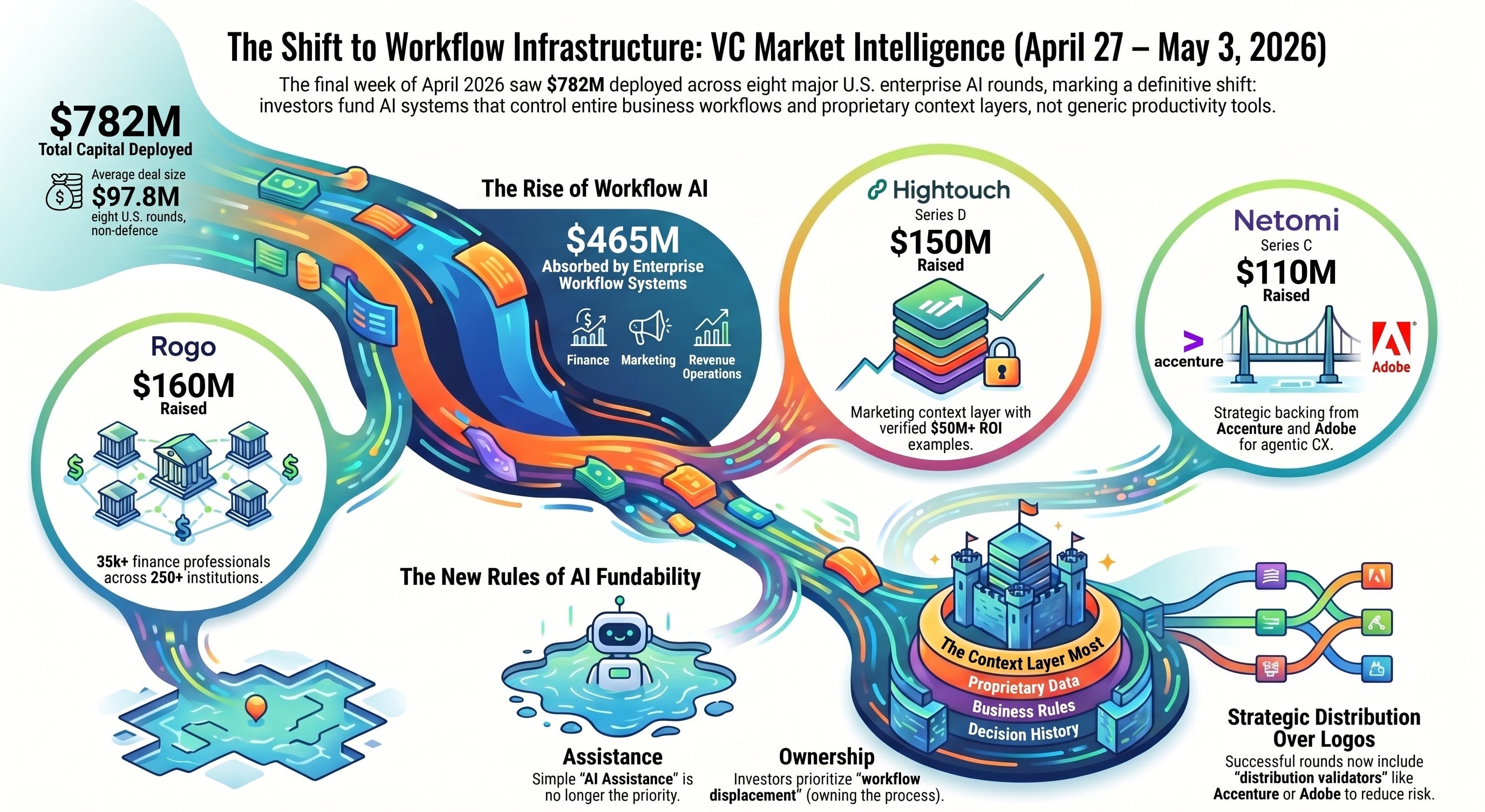
The week of April 27-May 3, 2026, showed a clear shift: investors are no longer funding “AI tools.” They are funding AI operating layers that own workflows, control context, embed in enterprise systems, and deliver measurable operational leverage.
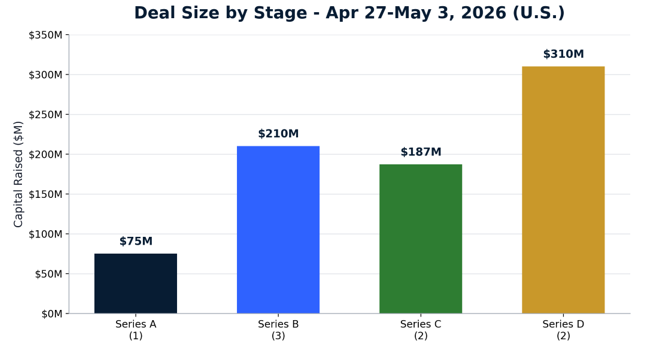
Core verified non-defense U.S. capital tracked: $782M across 8 newly announced rounds.
Average verified deal size: $97.8M.
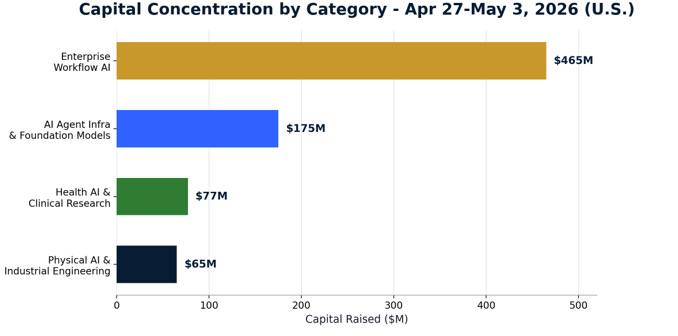
The real signal: $465M flowed into enterprise workflow AI across finance, marketing, customer experience, and revenue operations. Rogo raised $160M for finance AI, Hightouch raised $150M for agentic marketing, Netomi raised $110M for agentic customer experience, and Actively raised $45M for intelligence-led revenue.
Deal Scorecard
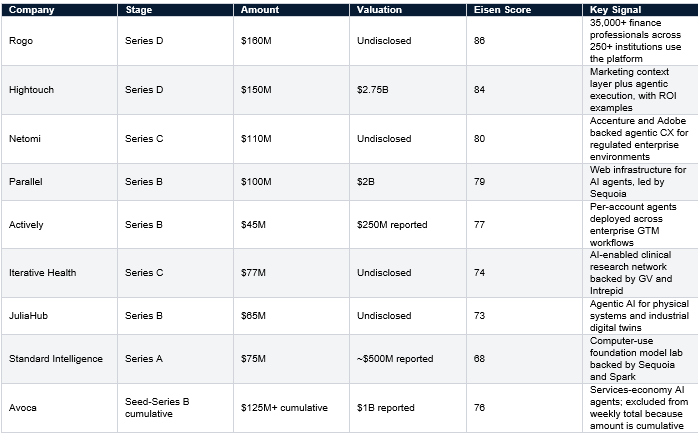
What the scorecard says at a glance: The best rounds this week were not “AI feature” rounds. They were workflow control rounds. Rogo owns financial workflows. Hightouch owns marketing context and execution. Netomi owns customer-experience deployment in complex enterprise environments. Actively owns account-level sales execution. The pattern is brutal for founders: if your AI product does not own the work before, during, and after the prompt, investors will price you like a feature.
What Changed This Week: 5 Market Shifts
SHIFT 1: Agents Became Operating Layers
Pattern: Four enterprise workflow AI companies raised $465M this week: Rogo in finance, Hightouch in marketing, Netomi in customer experience, and Actively in revenue operations. Rogo says 35,000+ professionals across 250+ institutions use its platform. Hightouch described a marketing context layer plus agentic execution. Netomi positioned itself as an enterprise-grade agentic CX platform for high-stakes environments. Actively raised for persistent account-level agents across GTM teams.
Perspective: Investors are moving from “AI assistant” to “AI operating system.” The difference is ownership. Assistants help a person complete work. Operating layers remember context, trigger action, route tasks, integrate with systems, and improve the workflow itself.
Founder Blindspot: Founders still pitch productivity. Investors are underwriting workflow displacement.
Playbook: Rewrite your investor narrative around the workflow you own. Map: trigger, context, execution, approval, system update, feedback loop. If you touch only one step, you are a tool. If you own four or more, you can pitch infrastructure.
Contrast: In 2024, “AI for X” was enough to get a meeting. In this week’s rounds, “AI for X” was not the pitch. “AI that runs X workflow” was.
What this means for your raise next week: Stop selling AI capability. Sell workflow ownership.
SHIFT 2: Context Layers Became the Moat
Pattern: Hightouch explicitly framed its next chapter around a marketing context layer covering customer attributes, behavior, channel performance, product SKUs, brand guidelines, and legal requirements. Actively framed its product around persistent account intelligence. Rogo emphasized proprietary integrations and domain expertise in finance. Avoca framed its advantage as a system-level understanding of contractor workflows.
Perspective: The model is not the moat. The context layer is. Investors are asking: what does your system know that a horizontal LLM cannot know? What data does it accumulate? What decisions does it improve over time?
Founder Blindspot: Many founders still say, “We use the best model.” That is not a defensible answer. Everyone can use the best model.
Playbook: Build a Context Layer Slide. Show the proprietary data you capture, the business rules you encode, the workflows you observe, and the decisions your system improves. Then show why this context compounds.
Contrast: Last year, vertical AI companies pitched task automation. This week, the strongest companies pitched institutional memory.
What this means for your raise next week: If you cannot explain your context layer, investors will assume you are a wrapper.
SHIFT 3: Strategic Distribution Replaced Passive Capital
Pattern: Netomi’s round included Accenture Ventures and Adobe Ventures, and Netomi also announced a global alliance with Accenture. Hightouch included TD7, the venture arm of The Trade Desk, alongside Goldman Sachs and Bain Capital Ventures. JuliaHub’s Series B included General Catalyst, AE Ventures, and former Snowflake CEO Bob Muglia, while the company highlighted industrial and simulation partnerships.
Perspective: The investor is no longer just a capital provider. In these rounds, investors are distribution validators, ecosystem bridges, and enterprise trust signals.
Founder Blindspot: Founders chase “top-tier logos” without asking what those investors unlock. A famous firm helps credibility. A strategic investor helps with route-to-market.
Playbook: Split your investor list into four buckets: capital, credibility, distribution, and category control. For every target investor, write the specific reason they should be in the round. If the answer is “brand,” your list is weak.
Contrast: In 2021, a hot round wanted the best logo. In 2026, a fundable round wants the right leverage.
What this means for your raise next week: Build your investor list around what risk each investor removes.
SHIFT 4: Physical and Regulated Bottlenecks Are Back
Pattern: JuliaHub raised $65M to bring agentic AI into industrial digital twins and physical systems design. Iterative Health raised $77M to expand an AI-enabled clinical research network, pointing to clinical trial enrollment and site execution bottlenecks as the core problems.
Perspective: Investors are paying for AI where the bottleneck is expensive. Industrial R&D cycles take months. Clinical trials miss enrollment targets. The value is not content generation. The value is cycle-time compression in systems where delay costs millions.
Founder Blindspot: Founders pitch AI speed in abstract terms. Investors want to know which expensive bottleneck gets removed.
Playbook: Build a Bottleneck Economics Slide. Show current cycle time, current cost, failure rate, your reduced cycle time, and dollar impact. The investor should see why your product moves from the software budget to the strategic budget.
Contrast: Consumer AI still fights for attention. Workflow AI inside expensive bottlenecks fights for budget.
What this means for your raise next week: Pitch the cost of delay, not the elegance of the AI.
SHIFT 5: Premium Valuations Require De-risked Proof
Pattern: Hightouch raised $150M at a $2.75B valuation. Parallel raised $100M at a $2B valuation. Avoca reportedly reached a $1B valuation while announcing more than $125M raised across Seed through Series B. Standard Intelligence raised $75M from Sequoia and Spark as a six-person research lab, but that round is the exception, not the median.
Perspective: There is still valuation appetite. But the logic changed. Hightouch has enterprise customers and ROI examples. Parallel has founder credibility, product momentum, and Sequoia conviction. Avoca has a services-economy workflow wedge. Standard Intelligence is a research-risk bet backed by elite AI investors.
Founder Blindspot: Founders see the valuation and copy the category. They should copy the proof architecture.
Playbook: Before you pitch valuation, build a proof stack: named customers, workflow ownership, ROI, context layer, investor-fit logic, and 18-month milestone plan.
Contrast: AI valuations did not collapse. Weak proof stopped clearing.
What this means for your raise next week: Your valuation argument is not a multiple. It is a risk-removal document.
The Deals That Matter
1. Rogo
AI for finance workflows | Series D | $160M
Eisen Fundability Score: 86 / 100
Why this scored high: Rogo combines high-value workflow ownership, deep vertical focus, elite investor quality, and strong usage proof across finance institutions.
The Setup: Rogo is purpose-built for financial services. The company says more than 35,000 professionals at 250+ institutions use it across origination, execution, advisory, and portfolio intelligence. The $160M Series D was led by Kleiner Perkins, with participation from Sequoia, Thrive, Khosla, J.P. Morgan Growth Equity Partners, BoxGroup, and others.
The Numbers: $160M Series D. More than $300M total funding. 35,000+ finance professionals. 250+ institutions.
The Pattern: Vertical AI wins when it owns the language, data, risk standards, and workflows of one high-value industry.
The Perspective: Rogo is not selling “faster research.” It is selling institutional workflow transformation.
The Playbook: If you serve a high-value vertical, identify the “daily operating table” your customer lives in. Own that table.
Founder Mistake to Avoid: Do not copy “AI for finance.” Copy the depth of workflow integration.
Eisen Fundability Score Breakdown:
Founder-Investor Dynamics 27/30
Traction-Conviction 22/25
Narrative Power 18/20
Deal Architecture 16/20
Capital Planning 3/5
2. Hightouch
Agentic marketing platform | Series D | $150M | $2.75B valuation
Eisen Fundability Score: 84 / 100
Why this scored high: Hightouch translated a composable CDP foundation into an agentic marketing infrastructure, with a clear context-layer thesis and verified enterprise customer examples.
The Setup: Hightouch raised $150M at a $2.75B valuation, led by Goldman Sachs and Bain Capital Ventures, with participation from Amplify Partners, ICONIQ, Sapphire, and TD7. It described its strategy as building a marketing context layer, agents for on-brand content, tools for real-time execution, and feedback loops.
The Numbers: $150M Series D. $2.75B valuation. The company lists 300+ integrations. Hightouch cited one customer example with 80% faster ad creative generation, around 10% reach expansion, 30%+ outperformance, and $50M+ incremental annual revenue from ads.
The Pattern: Marketing AI is moving from content generation to full-loop orchestration.
The Perspective: Hightouch is fundable because it owns context before generation and measurement after launch.
The Playbook: If you are building AI in marketing, sales, HR, finance, or support, stop pitching isolated tasks. Pitch the full loop.
Founder Mistake to Avoid: Do not say “we create content with AI.” Say what data, approvals, channels, and learning loops your system controls.
Eisen Fundability Score Breakdown:
Founder-Investor Dynamics 24/30
Traction-Conviction 23/25
Narrative Power 19/20
Deal Architecture 15/20
Capital Planning 3/5
3. Netomi
Agentic customer experience | Series C | $110M
Eisen Fundability Score: 80 / 100
Why this scored high: Netomi combined enterprise customers, regulated-environment positioning, and strategic distribution through Accenture and Adobe.
The Setup: Netomi raised $110M, led by Accenture Ventures, with participation from Adobe Ventures, WndrCo, SLW, NAVER Ventures, Metis Strategy, and Fin Capital. The company also announced a global alliance with Accenture.
The Numbers: $110M new funding. Customers named include Delta Air Lines, United Airlines, MetLife, Paramount, DraftKings, NBA, and Ingram Micro. Reuters reported the company has about 170 employees and raised the round to invest in customer deployments and R&D.
The Pattern: Customer service AI is separating into two markets: simple bot deflection and enterprise-grade agentic operations.
The Perspective: Netomi’s real signal is not the chatbot. It is deployable in complex enterprise environments.
The Playbook: If your AI touches customers, build a reliability proof stack: escalation rules, monitoring, compliance controls, integration depth, and error-handling metrics.
Founder Mistake to Avoid: Do not pitch automation rate without a trust architecture.
Eisen Fundability Score Breakdown:
Founder-Investor Dynamics 23/30
Traction-Conviction 20/25
Narrative Power 18/20
Deal Architecture 16/20
Capital Planning 3/5
4. Parallel
Web infrastructure for AI agents | Series B | $100M | $2B valuation
Eisen Fundability Score: 79 / 100
Why this scored high: Parallel has founder-market credibility, Sequoia-led financing, and a clear infrastructure thesis for AI agents.
The Setup: Parallel says it raised a $100M Series B at a $2B valuation led by Sequoia. WSJ reported that existing investors, including Kleiner Perkins, Index, and Khosla, participated, and that the company is building infrastructure for autonomous AI agents to search the web for complex tasks.
The Numbers: $100M Series B. $2B valuation. Around 50 employees were reported by WSJ.
The Pattern: AI agents need a new web layer. Search designed for humans does not fully match the needs of autonomous agents.
The Perspective: Parallel is fundable because it attacks an infrastructure dependency created by the agentic shift.
The Playbook: If you are building AI infrastructure, show which future behavior becomes impossible without you.
Founder Mistake to Avoid: Do not pitch infrastructure as “better tooling.” Pitch it as a dependency created by a platform shift.
Eisen Fundability Score Breakdown:
Founder-Investor Dynamics 28/30
Traction-Conviction 15/25
Narrative Power 19/20
Deal Architecture 14/20
Capital Planning 3/5
5. Iterative Health
AI-enabled clinical research network | Series C | $77M
Eisen Fundability Score: 74 / 100
Why this scored high: Iterative Health turns AI into operational throughput inside clinical research, where delay is measurable and expensive.
The Setup: Iterative Health closed a $77M Series C led by Intrepid Growth Partners and GV, with EDBI, a family office, Insight Partners, and Obvious Ventures participating. The company is expanding beyond gastroenterology and hepatology into cardiology and obesity.
The Numbers: $77M Series C. The company cites major clinical-trial bottlenecks, including more than half of research sites enrolling one or fewer patients per study and nearly 90% of U.S.-based trials failing to meet enrollment targets on time.
The Pattern: Health AI rounds clear when they target workflow bottlenecks, not abstract intelligence.
The Perspective: This is not an AI diagnostics story. It is a site execution and trial throughput story.
The Playbook: If you are in health AI, quantify the clinical or operational bottleneck. Then show how your system changes throughput.
Founder Mistake to Avoid: Do not pitch “AI for healthcare.” Pitch the specific failure point your system fixes.
Eisen Fundability Score Breakdown:
Founder-Investor Dynamics 21/30
Traction-Conviction 18/25
Narrative Power 16/20
Deal Architecture 16/20
Capital Planning 3/5.
Founder Playbook: 5 Tactical Plans for This Week
Plan 1: Rewrite the Narrative Around Workflow Ownership
Focus: Positioning.
Why this matters: The top rounds this week funded companies that own workflows, not features.
Deliverable: One slide titled: “The Workflow We Own.” Include trigger, context, execution, approval, update, and feedback loop.
Expected outcome: Investors stop asking “why won’t this be a feature?”
Reframe: Wrong: “We use AI to help teams.” Right: “We own the workflow from signal to outcome.”
Plan 2: Build the Context Layer Slide
Focus: Proof and moat.
Why this matters: Hightouch, Rogo, Actively, and Avoca all framed value in terms of context that compounds.
Deliverable: One page showing proprietary data, business rules, system integrations, feedback loops, and accumulated decision history.
Expected outcome: Your moat becomes visible.
Reframe: Wrong: “Our model is better.” Right: “Our context is hard to replicate.”
Plan 3: Self-Score Your Fundability
Focus: Eisen Score gap diagnosis.
Why this matters: This week penalized opacity. Missing metrics lowered fundability.
Deliverable: Score yourself across five dimensions: Founder-Investor Dynamics, Traction-Conviction, Narrative Power, Deal Architecture, and Capital Planning. Identify the lowest two.
Expected outcome: You know what to fix before investor meetings.
Reframe: Wrong: “We need a better deck.” Right: “We need to remove the two biggest investor risks.”
Plan 4: Rebuild the Investor List by Risk Removed
Focus: Deal architecture.
Why this matters: Strategic investors mattered this week. Accenture, Adobe, TD7, and industrial ecosystem investors were part of the conviction stack.
Deliverable: A 35-name target list with each investor tagged by the risk they remove: capital, credibility, distribution, category control, or enterprise trust.
Expected outcome: Better investor fit and fewer wasted meetings.
Reframe: Wrong: “Who invests in AI?” Right: “Who benefits if our workflow layer wins?”
Plan 5: Build a 14-Day Momentum Cadence
Focus: Follow-up, FOMO, and conversion.
Why this matters: Premium rounds move when investors see proof compounding during diligence.
Deliverable: A 14-day cadence with three investor updates: customer proof, product proof, and pipeline proof.
Expected outcome: Investors feel movement instead of waiting for the next meeting.
Reframe: Wrong: “Following up to check interest.” Right: “Showing proof that the opportunity is improving while they evaluate.”
Looking Forward: Next 1-3 Weeks
Scenario 1: Enterprise AI rounds keep clustering around workflow categories
Finance, marketing, customer experience, and revenue operations attracted the strongest non-defense capital this week. Expect more rounds in legal, accounting, procurement, HR, and compliance. Founders should watch for whether new rounds disclose ROI, ARR, or customer penetration. The winning pitch will be workflow ownership.
Scenario 2: Strategic investors become more important in AI rounds
Netomi had Accenture and Adobe. Hightouch had TD7. JuliaHub had industrial ecosystem validation. This will continue. Founders should build partner proof before opening the round. A strategic investor can compress diligence if the strategic logic is real.
Scenario 3: Physical AI becomes the next serious enterprise AI wedge
JuliaHub’s round shows that AI for physical systems is now investor-readable. The category is not consumer robotics hype. It is an engineering cycle compression. Founders in industrial AI should demonstrate time saved, reduced test cycles, and the elimination of system-level risk.
Wild Card: Research labs still get funded, but only with an elite signal
Standard Intelligence shows that the appetite for frontier research remains alive. But this is not a general founder lesson. It is an elite team, an elite investor, a high-conviction exception. Most founders should not copy this structure unless they have an equivalent technical signal.
The Bottom Line
The real insight this week is simple:
AI is no longer enough. Workflow ownership is the new bar for fundability.
Investors are not asking whether your startup uses AI. They are asking whether your system has sufficient context, execution, distribution, and proof to serve as the operating layer for a real business function.
5 New Rules for Founders
Workflow beats feature. If you do not own the full loop, you will be priced like a tool.
Context beats model. Your moat is what your system knows that a horizontal model cannot.
Distribution beats logo-hunting. The best investors remove a specific risk.
Bottleneck economics beat AI demos. Show the cost of delay and your measurable reduction.
Proof beats valuation logic. Your valuation is defended by risk removed, not by comps alone.
4 Monday Actions
Create your “Workflow We Own” slide.
Build your “Context Layer” slide.
Score your round using the Eisen Fundability framework.
Cut your investor list to 35 names, each matched to a specific risk they remove.
Your competitors are reading the same funding headlines. The founders who win will turn them into better fundraising architecture before the next meeting.
Sources & Data Verification
Data collection period: April 27-May 3, 2026.
Research completion timestamp: May 4, 2026.
Core included capital: $782M in newly announced, non-defense U.S. rounds validated through public sources.
Deals analyzed: Rogo, Hightouch, Netomi, Parallel, Actively, Iterative Health, JuliaHub, Standard Intelligence, Avoca.
Excluded from core capital total: Avoca’s $125M+ because the announcement describes cumulative Seed-through-Series-B funding, not a clean single-week raise.
Excluded from tactical playbook: defense and weapons-adjacent companies. I did not convert those rounds into a founder strategy or product-specific analysis.
Primary validation sources used: company announcements from Rogo, Hightouch, Netomi, Parallel, Avoca, Iterative Health, JuliaHub, Actively, and Standard Intelligence. Secondary validation used Reuters, WSJ, Fortune, TechCrunch, Forbes, Axios, SiliconAngle, and market coverage where available.
DISCLAIMER: This article is for informational and strategic intelligence purposes only. It does not constitute investment advice. The Eisen Fundability Score is a proprietary diagnostic within Fundables OS™, not a financial recommendation. Worked examples reference publicly disclosed rounds from the Eisen VC Market Intelligence Report. Valuations, ARR, and investor participation are sourced from primary company announcements and tier-one coverage.
If this article was useful, share it with founders who are about to raise.
— Leon Eisen, 4x Founder, Venture Capitalist, and Creator of Fundables OS™