

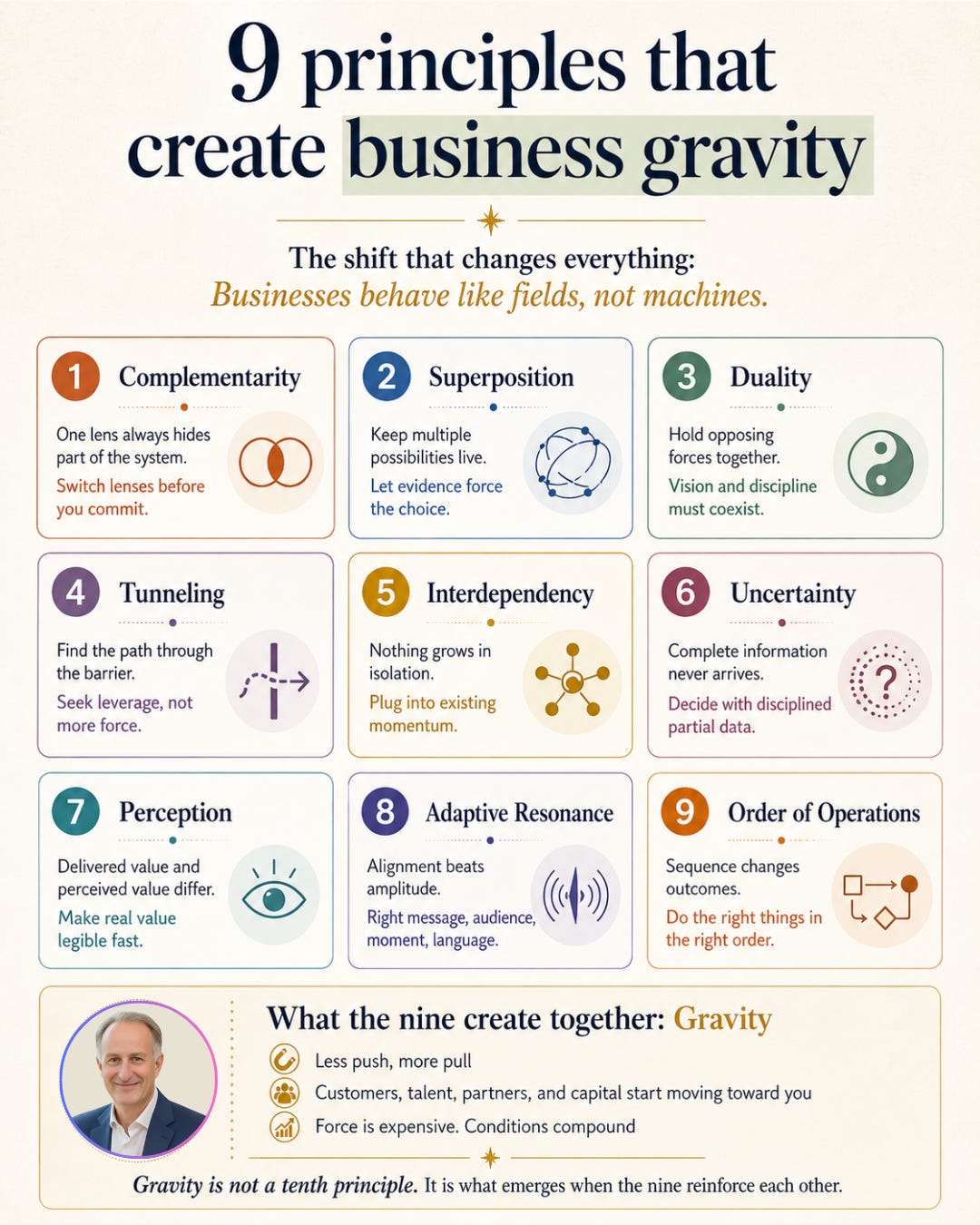
I was trained as a quantum physicist before I became a founder. Then I spent years running my company as if none of that training had happened.
I used linear logic. More features should produce more customers. More people should produce more speed. More meetings should produce more conviction. More information should produce more belief.
That logic almost destroyed the company.
The problem was not effort. The problem was the model. I was treating a business like a machine when a business behaves like a field. Machines respond to force. Fields respond to alignment, sequence, and interpretation.
Push harder on a machine, and it moves. Push harder on a field, and it distorts.
Quantum physics is the only discipline I know that takes non-linear systems seriously without pretending they are simple. So I went back to it, not as metaphor, but as a decision architecture.
Nine principles came out of it. I use them to decide what to build, who to hire, what to ignore, when to move, and when to hold. They are not inspiration. They are filters. Every meaningful decision I make passes through at least one of them.
Here they are.
1. Complementarity
One lens always hides part of the system.
In physics, light behaves as a wave in one experiment and a particle in another. Neither description is wrong. Neither is complete. You need both, and you cannot use both at once.
Businesses work the same way. Revenue growth tells you one truth. Retention tells you another. Unit economics tells you a third. Customer emotion tells you a fourth. Each is real. Each is partial.
Founders get into trouble when they fall in love with a single lens. Growth-obsessed founders miss decay. Metrics-obsessed founders miss why customers actually buy. Product-obsessed founders miss that nobody can find the product.
The decision rule: before I commit to any strategic call, I ask what becomes invisible when I look at this through the lens I am currently using. Then I deliberately switch lenses. If the picture holds up under three different views, it is probably real. If it only holds under one, I am looking at a story I want to believe.
Weaknesses rarely kill companies in isolation. Incoherence does. A company whose parts do not form a whole will be read as a company that does not know itself.
2. Superposition
Keep multiple possibilities live until the evidence forces a choice.
A quantum system can exist in multiple states simultaneously until it is measured. Measurement collapses it into one.
Founders collapse too early. They pick a segment before testing three. They commit to a channel before proving it. They anchor on one outcome and then spend a year defending it against the data.
Superposition is not indecision. Indecision has no exit condition. Superposition has one. You keep options open and define in advance what evidence will force the commitment.
The decision rule: for every open strategic question, I write the collapse condition first.
What has to be true before I choose.
What signal ends the exploration.
Then I hold the options without anxiety, because I know exactly what will end the ambiguity.
The strategic value is separate from the learning value. A founder with one option has no leverage in any negotiation, with investors, with partners, with acquirers, with candidates. Optionality is not indecisiveness. It is bargaining power that you built on purpose.
3. Duality
Hold the opposing force instead of choosing a side.
Business advice loves the binary. Vision or execution. Speed or quality. Growth or efficiency. Boldness or discipline.
Every one of those is a false choice at the level where real decisions get made. The strongest operators run both simultaneously and manage the tension rather than resolving it.
A founder who only has vision reads as unserious. A founder who only has discipline reads as small. The rare and valuable state is both at once: ambitious enough to be building something that matters, disciplined enough that the ambition does not destroy the company on the way.
The decision rule: when I catch myself framing a decision as either-or, I treat that framing as the problem, not the decision. I ask what it would take to hold both. Usually the answer exists, and it is harder. Usually it is also correct.
Tension is not a failure state. Tension is what a healthy system feels like from the inside.
4. Tunneling
Find the path through the barrier instead of hitting it harder.
A particle can pass through an energy barrier if it does not have enough energy to climb it. It does not go over. It goes through.
When founders hit resistance, the instinct is force. More spend. More headcount. More outreach. More features. More hours. The barrier does not move, and the company burns through capital to prove it.
Tunneling asks a different question: where is the smallest intervention that changes the behavior of the whole system?
The decision rule: when something is not working, I ban myself from the phrase “we need more.” I force the alternative question. What is the single point where a small input produces a disproportionate output? If I cannot find one, I do not scale the effort. I stop and look again.
This is about refusing to spend energy on the parts of the system that are not load-bearing. Capital that enters a system with no leverage point just disappears faster.
5. Interdependency
Nothing in a system grows in isolation.
Particles do not behave independently. Neither do companies. You sit inside a web of customers, platforms, partners, regulators, advisors, competitors, and communities, and that web has more energy in it than your team does.
Founders who optimize only internally are optimizing the smallest available surface. The bigger question is not how efficient your operation is. It is what your operation is connected to.
The decision rule: for any growth problem, I ask which existing system already contains the momentum I am trying to manufacture. An existing audience. An existing distribution channel. An existing workflow customers already run. An existing regulatory pathway. Then I ask how I connect to it.
Building in isolation is expensive and slow. Embedding in an ecosystem confers credibility, distribution, and trust that would take you years to accumulate on your own.
6. Uncertainty
You will never have complete information. Decide anyway, with discipline.
Uncertainty in quantum mechanics is not a measurement failure. It is structural. Some pairs of properties cannot both be known precisely. Ever.
Founders treat uncertainty as a temporary condition that more analysis will cure. It will not. The data will always be incomplete. Waiting for certainty is a decision, and usually a bad one, because you paid for the delay and got nothing for it.
And my skills enable me to sort uncertainty.
The decision rule: for every major decision, I separate the unknowns into four buckets:
Which uncertainties actually matter to the outcome.
Which can be cheaply tested.
Which can be reduced but not removed.
Which must simply be accepted.
Then I ask the question that governs speed: is this decision reversible? Reversible decisions get made fast on partial data. Irreversible ones earn the extra data.
Most leaders spend their analysis budget on the uncertainties that are easiest to measure rather than the ones that matter most. " Easy to measure" and "decision-relevant" are not in the same category.
7. Perception
Delivered value and perceived value are different quantities.
Observation changes the observed system. In business, this is the central fact of every market you will ever sell into.
Your product has real properties. Nobody experiences those properties directly. Customers, employees, partners, and investors experience your product through attention, prior expectations, context, incentives, values and principles, fear, and identity. What they perceive is what they act on. Not what is true.
This is where most technically strong founders lose. They assume that value, once created, announces itself. It does not. Value that cannot be recognized does not function as value.
The decision rule: for anything I build, I ask a second question after “is this good?” The second question is “will this be recognized as good, by whom, in what context, and how fast?” If the answer is that it takes forty minutes of explanation to appreciate, I have a perception problem, not a marketing problem, and I fix it at the design level.
Perception work is not spin. Spin creates a gap between reality and story, and that gap eventually closes. Perception work closes the gap in the other direction, by making real value legible.
8. Adaptive Resonance
Alignment beats amplitude.
A system absorbs energy efficiently at its resonant frequency and rejects it at every other frequency. You can push very hard at the wrong frequency and produce nothing.
Companies do this constantly. They push a message into a market that is not ready to receive it. They sell a product to a buyer who does not have the problem yet. They launch something correct at a moment when nobody cares.
Resonance happens when several things line up at once: the market is ready, the problem feels urgent, the product matches the shape of the need, the language matches how the buyer already talks, and the timing supports adoption. When those align, small effort produces large movement. When they do not, great effort produces noise.
The decision rule: before increasing volume on anything, I check alignment first: “Am I saying the right thing to the right audience at the right moment in their language?” If the answer is no, then more volume makes it worse because more people are learning to ignore me.
The failure mode here is subtle. A resonance failure looks exactly like an effort failure from the inside. Both feel like nothing is working. The wrong diagnosis leads you to spend more.
9. Order of Operations
The same actions in a different sequence produce different outcomes.
In quantum mechanics, some operations do not commute. Do A then B, and you get one result. Do B then A and you get another. Order is not a detail. Order is part of the physics.
This is the principle founders violate most and recognize least, because every individual action they took was correct. They just took them in the wrong order.
Scaling acquisition before retention is proven. Hiring salespeople before the founder has learned to sell. Approaching the best-fit partners before the positioning is finished. Negotiating price before creating any alternative. Every one of those is a right action performed at a wrong time, and the cost is not just delay. It is that you burned the one chance at a first impression, and you cannot re-sequence the past.
The decision rule: before I execute anything meaningful, I ask what must be true first, and then what must be true before that. I work backward until I hit something already true. That chain is the sequence. Then I refuse to skip steps, even when a later step looks more exciting than the one in front of me.
Sequence is the cheapest form of leverage available to a founder. It costs nothing but patience, and almost nobody uses it.
What the Nine Principles Produce Together
None of these principles works alone. That is the point.
Used individually, they are useful heuristics. Used together, they change the company's state. Customers start arriving through reputation rather than acquisition spend. Strong candidates start approaching you rather than the other way around. Partners start prioritizing you in their roadmap. Capital starts pursuing access rather than evaluating risk.
I call that state Gravity. It is what these 9 principles produce.
A company without gravity spends everything it has on pushing. Every customer is a fight, every hire is a sell, every partnership is a favor, every round is a slog. A company with gravity spends the same amount of energy and gets a pull rather than a push.
The difference is almost never talent, and it is almost never capital. It is whether the founder is running a machine model or a field model.
Most business advice will teach you to add force. The nine principles teach you to change the conditions.
Force is expensive, and it runs out. Conditions compound.
If this article was useful, share it with founders who are about to raise.
— Leon Eisen, 4x Founder, Venture Capitalist, and Creator of Fundables OS™