

Playbook, Perspective, and Pattern for founders raising now. This report strips out giant rounds and public market traffic so you can read the part of the market that actually prices your round. Every figure below survived three independent verification passes against primary sources, the last of them adversarial.
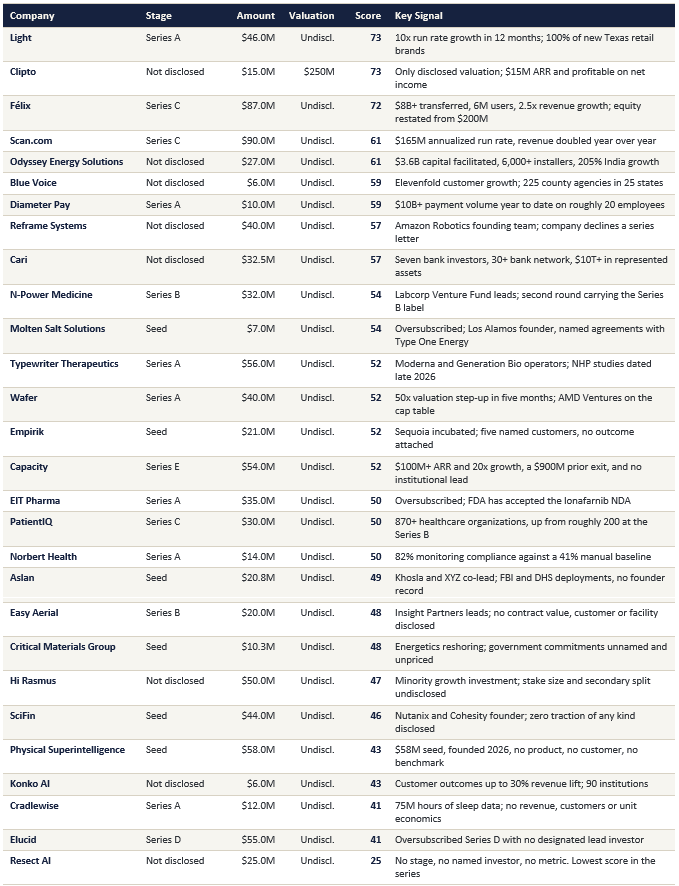
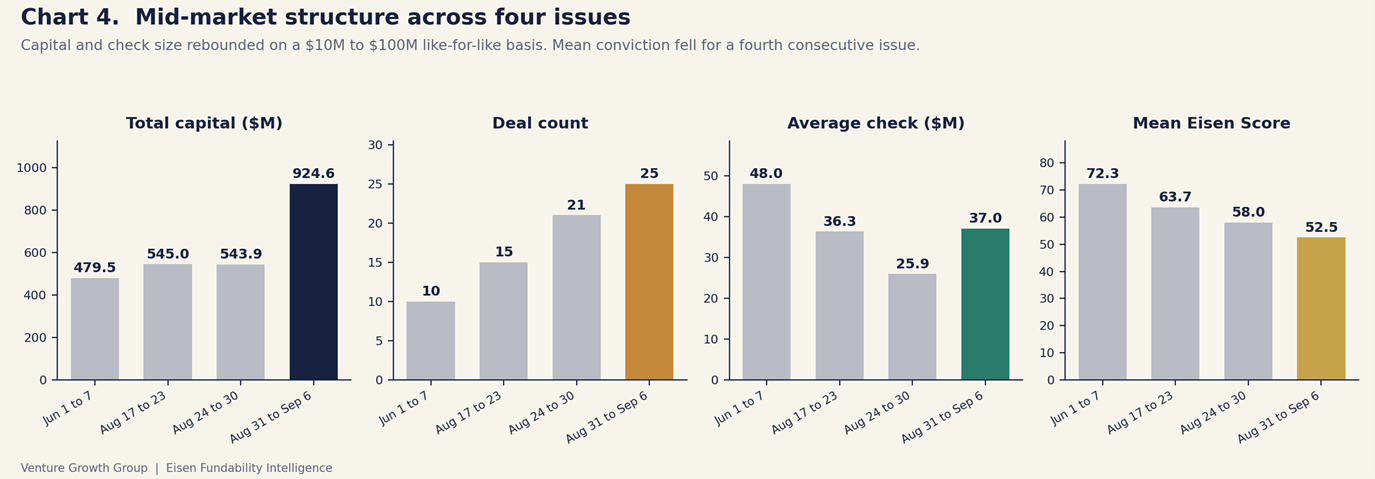
The mean Eisen Fundability Score fell to 52.5, down from 58.0, down from 63.7, down from 72.3 in June. That is a fourth consecutive decline, and it happened in the week the money came back. Three of twenty-eight rounds cleared 65. Last week five of twenty-one did. The share of well-scored rounds fell from 23.8% to 10.7% while the capital available to them rose 70%.
Something else broke open. The score band ran 42 to 70 last week. This week it runs 25 to 73, a 48-point spread and the widest this report series has recorded. The ceiling rose three points. The floor fell seventeen. Dispersion is back, and it is almost entirely a disclosure story.
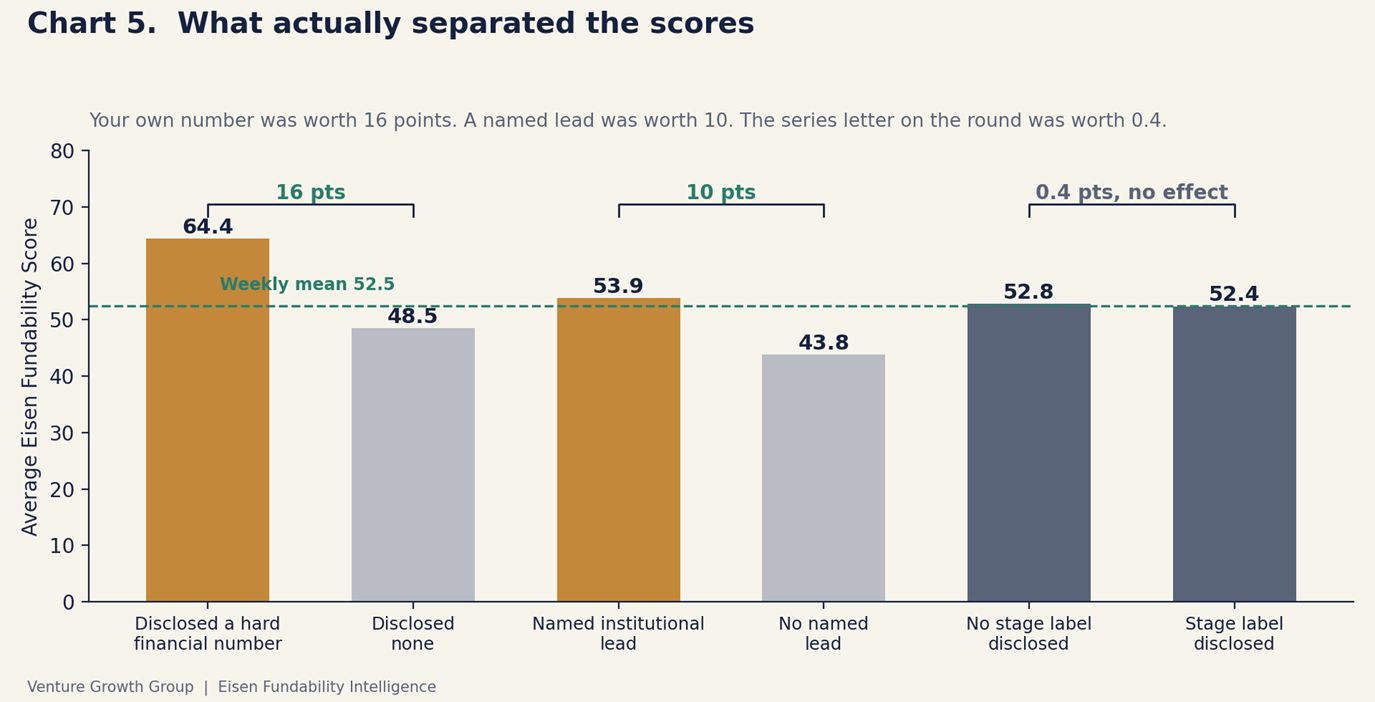
Seven of twenty-eight companies put a hard financial number about themselves on the record. Those seven averaged 64.4. The other twenty-one averaged 48.5. That is a 16-point premium for doing the one thing almost nobody did last week, when zero of twenty-one companies disclosed a revenue figure. This week, three did: Scan.com at a $165M annualized run rate; Capacity above $100M in ARR; and Clipto at $15M in ARR, profitable on a net income basis.
Consequence for Monday. The capital constraint eased, and the credibility constraint did not. There is 70% more money in the mid-market than there was a week ago, and it is being handed to a set of companies whose average conviction score is the lowest this series has measured. That gap is your opening. The founder who walks in with a growth rate, a denominator, and a named lead is competing against a field where the average company brought none of the three.
The Week in One Sentence
Primary insight. Mid-market capital rose 70%, and average check size rose 43% on a like-for-like basis, while mean conviction fell for a fourth consecutive issue and the score band blew out to its widest ever, because the money came back faster than the proof did and the market started paying a 16-point premium to the seven companies that put a real number on the record.
• Total tracked mid-market capital, 28 verified rounds: $943.6M in new primary capital, every deal between $5M and $100M, every company US-headquartered.
• Like-for-like against prior issues: $924.6M across 25 rounds in the $10M to $100M band the last three issues used, against $543.9M across 21 rounds last week. Capital up 70.0%, deal count up 19.0%.
• Average round size: $33.7M across the full $5M to $100M set. On a like-for-like basis, $37.0M against $25.9M last week, up 42.8%.
• Median round size: $31.0M across the full set. On a like-for-like basis, $32.5M against $25.0M last week, up 30.0%.
• Disclosed revenue or ARR figures: 3 of 28, against 0 of 21 last week. Scan.com at a $165M annualized run rate, Capacity above $100M in ARR, Clipto at $15M in ARR with disclosed net income profitability.
• Disclosed growth rates: 6 of 28, or 21.4%, against 1 of 21, or 4.8%, last week. A fourfold rise in one week.
• Disclosed valuations: 1 of 28. Clipto at $250M post-money. That is a 96.4% opacity rate, up from 95.2% last week, 93.3% the week before, and 80% in June. A fourth consecutive rise.
• Largest tracked round: Scan.com at $90.0M of new primary equity, restated down from a $220M headline that blends $130M in debt facilities.
• Highest Eisen Fundability Score: a tie at 73 between Light, a $46M Series A, and Clipto, a $15M round that was the twenty-first largest of the twenty-eight. The top of this market was not bought with size.
• Lowest Eisen Fundability Score: Resect AI at 25, a $25M round with no disclosed stage, no disclosed investor of any kind, no revenue, no customer, and no valuation. The lowest score this series has recorded by seventeen points.
• Defining structural feature: a 48-point score band against 28 points last week. The ceiling rose 3 points, and the floor fell 17 points. The market re-opened at the top and blew out at the bottom in the same week.
Data Integrity Notes
All twenty-eight featured rounds were verified against at least two independent sources, then rechecked in two further independent verification passes against primary sources. Those passes removed seven deals for date-window violations, removed four more for structural reasons, restated four headline amounts to new primary capital, corrected three stage labels, and corrected eleven attributions. Resolutions applied:
• Editorial scope excludes giant rounds and public market events by request. Removed from the tracked set and used only as a contrast set: Crusoe ($3B), Fluidstack ($1.5B), Wonderful ($550M), Higgsfield ($400M), Gimlet Labs ($300M), Upwind Security ($300M), David ($250M), Medici Brands ($250M), HiBob ($166M), Lyte AI ($165M), TabaPay ($155M), Thyme Care ($125M) and HiddenLayer ($100M). The week’s ten largest rounds totaled $6,061M against $1,512M the prior week, a fourfold rise driven almost entirely by two AI infrastructure deals, Crusoe and Fluidstack, which together account for $4.5B of it. HiddenLayer sits exactly at the $100M ceiling and also appears on the week’s top 10 list, so it is excluded on both counts.
• Four headline amounts were restated to new primary capital. Scan.com’s announcement totals $220M; the company's release separates $90M in Series C equity from $130M in debt facilities provided by VerisFi Capital and Atempo Growth, so $ 90 M is counted. Félix’s announcement carries $200M; the release separates $87M of Series C equity led by Andreessen Horowitz from a $113M credit facility from the General Catalyst Customer Value Fund, so $87.0M is counted. Odyssey Energy Solutions’ announcement carries $74M; the release and independent trade coverage separate $27M of equity from $47M of debt provided by British International Investment and three development finance institutions, so $27.0M is counted. Capacity’s headline reads over $50M; the company release body and two independent sources state over $54M, so $54.0M is counted.
• Date window control removed seven deals. Each circulated widely inside this window through aggregator republication against an earlier primary release: Smack Technologies ($61M Series B, company journal dated August 18), Deep Cogito ($43M Series A, BusinessWire August 26), CivilGrid ($26M Series A, August 28, already counted in the prior issue), RQD Clearing ($74M, August 28), Workweek ($17M Series B, Adweek August 27 to 28), Axle ($17.5M Series A, PRNewswire August 11) and SiteVue AI ($7.5M Seed, PRNewswire August 6). All seven are marked as news-cycle resurfaced and excluded from all totals, charts, and scores.
• Four further deals were excluded on structure. Chariot Claims ($9.46M) exists only as an SEC Form D filing, with no company announcement or media confirmation of terms, and its widely repeated founder attribution does not hold up under a check against the company’s own materials. Bolt’s raise of up to $27M is a pay-to-play bridge into a distressed company, is stated as a range rather than a closed amount, and is not a priced round. Helogen ($7.1M) is the sharpest catch of the verification passes: the only company document carrying the figure is a September 1 BusinessWire release about October orbital missions and an FDA pathway, which states that the company has raised $7.1 million to date, a cumulative past-tense figure rather than a newly closed round; no dedicated financing announcement exists from the company, from RRE Ventures or from Oceans, and no Form D is on file under the company name, so the single aggregator headline reading raises $7.1M is a repackaging of prior capital and is excluded. Emberos ($5.5M) announced an oversubscribed seed on September 3, but its SEC Form D shows $2,490,000 fully sold with a first sale dated July 2, 2026 and a filing dated August 7, 2026; the September release does not separate that pre-window tranche from new money, and the residual falls below this issue’s $5M floor, so the round is excluded under the same rule applied to every other blended announcement.
• Stage opacity is reported rather than filled in. Eight of twenty-eight rounds carry no stage label from the company: Hi Rasmus, Reframe Systems, Cari, Odyssey Energy Solutions, Resect AI, Clipto, Konko AI and Blue Voice. Reframe Systems is the sharpest case. The company release calls it additional venture-backed equity financing and declines to label it a Series letter, while one trade outlet assigns it as a Series B and three others decline to do so. No stage is asserted here, and each of the eight was penalized in Deal Architecture rather than assigned a stage by inference.
• Non-US rounds were excluded for scorecard comparability. Aitan ($41M, Ramat Gan), AIR Security ($50M across two seed tranches, forty employees in Israel with a New York commercial entity), Lasso Security ($30M, Tel Aviv and New York), Guardio ($40M, Tel Aviv), Huskeys ($27M, Israel), HubX ($75M, Turkey), Ultrahuman ($70M, India), WeRoad ($58M, Italy), Conveo ($50M, Belgium), HyImpulse (over €50M, Germany), Gridsight ($26M, Australia), Moment ($22M, Ghana), Enhance ($18.2M, UAE), iPremom (€15M, Spain), Octave.energy (€10M, Belgium), Sirdab ($10M, Saudi Arabia), Outlier Space (NZ$10.5M, New Zealand), Hivebotics ($6M, Singapore), Zeit AI (€5M, Germany), Backbone (€4M, Belgium) and NeuShen Therapeutics (over $80M, Shanghai and Boston). AIR Security is the closest call: three sources place its engineering base in Israel, and one places its headquarters in New York, so it is excluded and the conflict documented rather than resolved by assertion.
• Metric provenance. Every operating figure in this issue is company-supplied. Scan.com’s run rate, Capacity’s ARR and growth multiple, Clipto’s ARR and profitability, Light’s 10x run rate growth, Félix’s transaction volume, Norbert Health’s compliance figures, Konko AI’s customer outcomes and Blue Voice’s agency count are treated as verifiable rather than independently audited, and scored on that basis. Wafer’s reported post-money valuation above $200M comes from a single secondary outlet rather than the company and is not counted as a disclosed valuation. Reframe Systems’ claims of 3x faster delivery and 35% lower cost are company comparisons against traditional construction, not measured customer results, and are attributed rather than asserted.
• What this report can and cannot see. Scores reflect proof that was verifiable at announcement. Investors receive far more in a private data room, and a company that puts nothing on the record may have answered every question during diligence. The public record is a proxy for whether the numbers existed in a defensible form while the round was running, not a measure of what a company knows about itself, nor a requirement to publish anything.
The Deal Scorecard
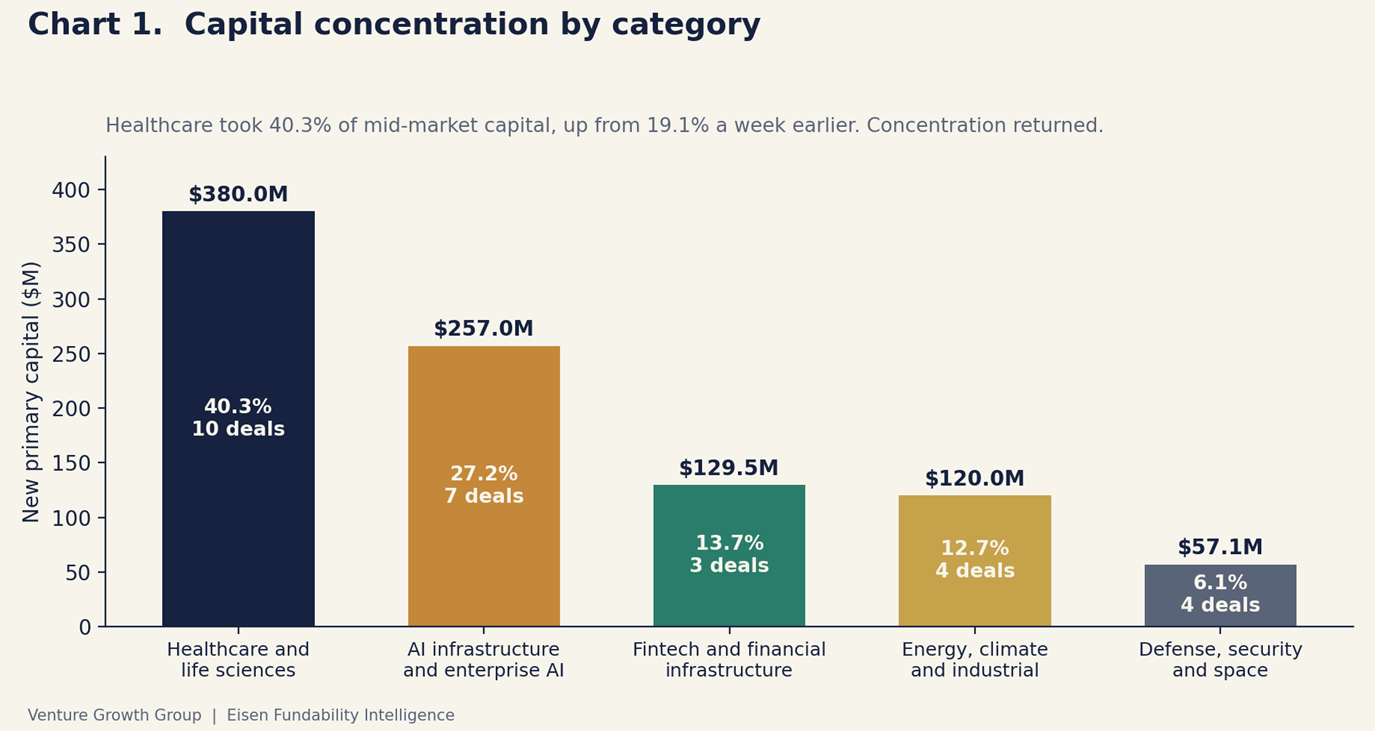
Eisen Fundability Scores are calculated across five weighted dimensions: Founder-Investor Dynamics (30), Traction-to-Conviction Conversion (25), Narrative Power (20), Deal Architecture (20), and Capital Planning (5). Scores of 85 and above signal an inevitable outcome. Scores of 75 to 84 signal solid fundamentals. Scores below 65 signal early-stage or missing elements. Missing metrics are scored conservatively, and opacity is penalized rather than assumed strong.
What the Scorecard Says at a Glance
The band tells you the market stopped agreeing with itself. June produced a 13-point band around a mean of 72.3, a market that agreed on what it paid for. Last week produced a 28-point band around 58.0, a market that had stopped paying a premium for anything. This week produced a 48-point band around 52.5. The ceiling went up, and the floor fell out at the same time. That is not a harder market or an easier one. It is a market that has stopped applying a common standard, which means the price you get now depends far more on what you brought than on what stage you are at.
Three companies cleared 65, and all three disclosed their own numbers. Light at 73 disclosed a 10x revenue growth run rate over 12 months. Clipto at 73 disclosed $15M in ARR, net income profitability, and the only valuation in the issue. Félix, at 72, disclosed $8B in cumulative transaction volume, 6 million users, and 2.5x year-over-year revenue growth. No other company in the set cleared 65, and the fourth-place finishers sat twelve points back at 61. The gap between third and fourth is the largest single break in the distribution, and it falls exactly where self-disclosure stops.
The most expensive lesson on the scorecard costs $54M and ranks 49th. Capacity crossed $100M in ARR, disclosed 20x revenue growth over three and a half years, named 20,000 customer organizations, ranked 432 on the Inc. 5000, and is run by a founder who co-founded Answers Corporation, acquired for roughly $900M in 2014. On traction, it scored 18 out of 25, the third-highest in the set, and its founder, David Karandish, co-founded Answers Corporation, which was acquired by Apax Partners in 2014 for roughly $900M, earning full marks on founder track record. It still finished tied for twelfth of twenty-eight and just below the weekly mean, because the only party named as a lead investor in the company’s own release is an individual, and no institutional investor is named anywhere in it. The strongest traction disclosure in the issue, plus a nine-figure founder exit, still landed 21 points below the top because nobody set the price. Whoever does that is a scoring dimension, not a formality.
The floor is a disclosure story, and it fell seventeen points. Resect AI raised $25M, disclosed no stage, named no investor of any kind beyond the phrase private equity investors, and put no revenue, customer, or valuation on the record. It scored 25. Cradlewise at 41 raised a $12M Series A with no revenue, no customer count, and no unit economics on the record. Elucid at 41 raised an oversubscribed $55M Series D round, with no investor taking the lead seat. These are real companies with real capital from real investors. What the score measures is what a new investor could verify without asking, and in these cases the answer was close to nothing.
Round size stopped predicting conviction. The three largest clean rounds of the week after restatements, Physical Superintelligence at $58M, Typewriter Therapeutics at $56M, and Elucid at $55M, averaged 45.3 against a weekly mean of 52.5. Clipto, the twenty-first largest of twenty-eight at $15M, tied for the highest score in the issue. If you are calibrating your ask against the biggest rounds, you are calibrating against the part of the distribution that scored below average.
What Changed This Week: Five Market Shifts
Each shift is verified against multiple sources and ranked by structural impact on founder fundraising, not by deal size. Every shift ends with what it means for your raise next week.
Shift 1: The Money Came Back, and the Bar Went Down
Pattern, what happened. On the like-for-like $10M to $100M band, twenty-five verified rounds moved $924.6M against twenty-one rounds moving $543.9M the week before. Capital rose 70.0%, deal count rose 19.0%, average check rose 42.8% from $25.9M to $37.0M, and the median rose 30.0% from $25.0M to $32.5M. Over the same seven days, the mean Eisen Fundability Score fell from 58.0 to 52.5, marking the fourth consecutive decline since 72.3 in June. Three of twenty-eight rounds cleared 65, or 10.7%, against five of twenty-one, or 23.8%, a week earlier.
Perspective, what it means. Two constraints govern a fundraise: how much capital is available and how much proof it demands. Founders treat them as a single constraint, but they are not. This week the capital constraint eased sharply, and the proof constraint did not tighten; it simply stopped being applied consistently. Partners who wrote a $25.9M check last week wrote a $37.0M check this week into a set of companies whose average conviction score is the lowest this series has measured. When more money chases a field with less proof in it, price dispersion widens, and the founder who supplies proof captures a disproportionate share of the widening.
Founder Blindspot, what most miss. Founders read a capital rebound as permission to relax and go raise. The arithmetic says the opposite. The number of rounds clearing 65 fell from five to three in absolute terms, even with seven more deals and 70% more money. Fewer companies separated themselves while more capital was available to reward separation. That is the single best set of conditions a well-prepared founder gets, and it is the set of conditions in which unprepared founders raise at bad prices and call it a win.
Playbook, what to do. Reopen your use of funds at 143% of the number you sized in August, because that is what the average check did. Then ask one question about the difference: does the extra capital buy a milestone that changes your next round’s price, or does it buy eighteen more months of the same plan? If it is the second, do not raise the larger number. Take the smaller round at a better price and keep the dilution.
Contrast. The last two issues tracked a market rationing capital across more claimants: average check down 24% into the week of August 17, then down a further 28.7% into the week of August 24. This week reversed both moves at once and overshot, landing 43% above last week and 2% above the week of August 17. What has not been reversed is the conviction, which has now been overturned in four consecutive issues.
What this means for your raise: The market that priced your round in August is not the market pricing it in September. Resize the ask upward and raise the proof standard at the same time, because the money moved and the bar did not.
Shift 2: The Series B Lane Closed
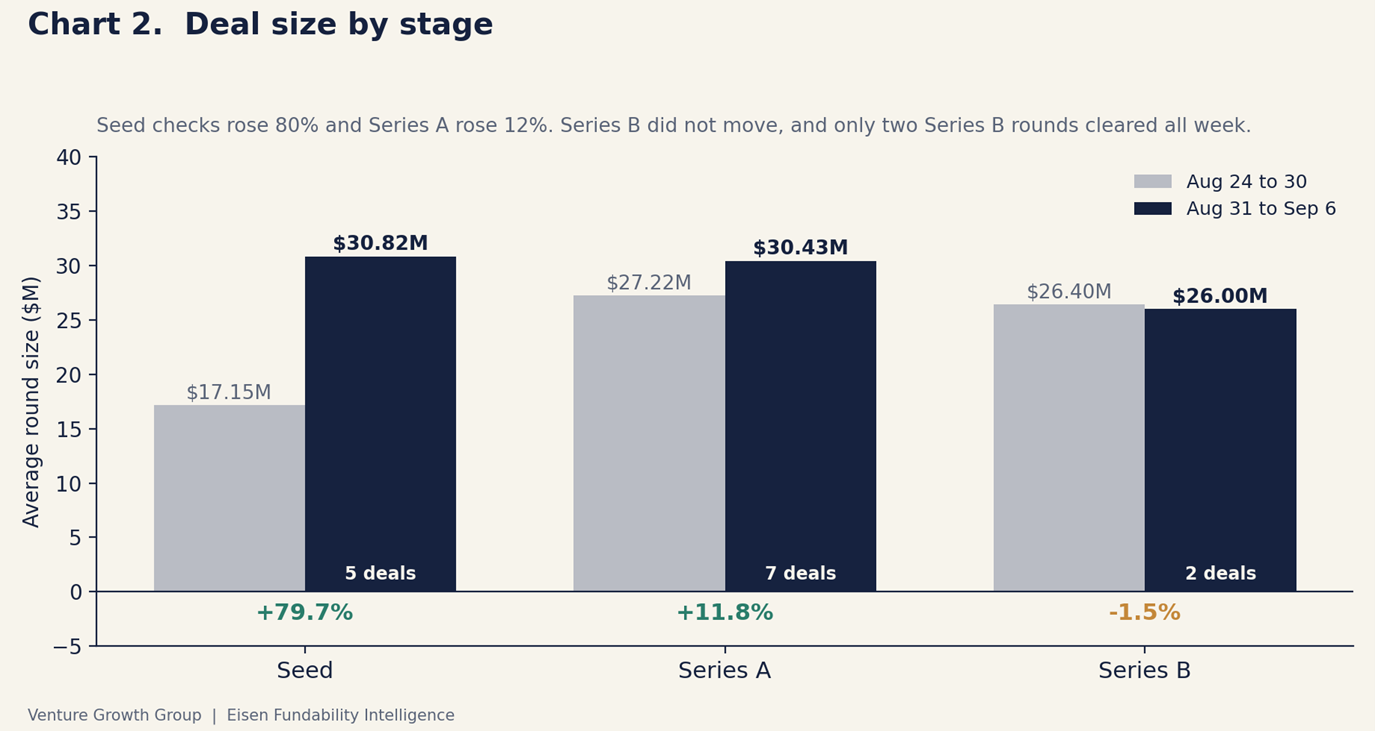
Pattern, what happened. Two of twenty-eight rounds were Series B, totaling $52.0M, or 5.5% of the week’s mid-market capital. Last week, five of twenty-one rounds were Series B, totaling $132.0M, or 24.3%. On the like-for-like $10M to $100M band the prior issues used, average Series B check size sat at $26.00M against $26.40M a week earlier, down 1.5%, the only stage that did not move. Seed rose 79.7% to $30.82M across five rounds, and Series A rose 11.8% to $30.43M across seven. Separately, eight of twenty-eight rounds, or 28.6%, carry no stage label from the company, compared with three of twenty-one, or 14.3%, last week.
Perspective, what it means. Capital returned to the two ends of the market, skipping the middle. Seed and Series A are priced on narrative, team, and early proof, and those are cheap for an investor to underwrite quickly when sentiment turns. Series B is priced on repeatable unit economics, and nothing about the underlying evidence base improved in seven days. So the money that was returned went where it could be deployed against the existing proof. The rise in unlabeled rounds is the same phenomenon from the other side: eight companies raised capital without accepting a stage designation, which happens when a company cannot meet the next letter’s bar and will not accept the previous one’s price. Note what that did not cost them, because it is the most useful number in this shift: the eight unlabeled rounds averaged 52.8, compared with 52.4 for the twenty labeled ones. The letter is cosmetic. What the letter is standing in for- a priced round with somebody accountable for the price- is not.
Founder Blindspot, what most miss. Founders at Series B read about a market-wide capital rebound and assume it will reach them. It did not reach them this week. Two rounds cleared in the entire mid-market. A founder who opens a Series B process now, on the strength of a headline market recovery, is walking into the thinnest lane in the market with the highest evidentiary bar, and the process will run long before anyone tells them why.
Playbook, what to do. If you are raising a Series B, stop calling it one until you can answer three questions in numbers: what does a customer cost to acquire, what do they pay over their life, and what percentage of last year’s revenue base is still there this year. If you cannot answer all three, run an extension at your Series A price with your existing investors and spend two quarters building the answers. An extension at a fair price beats a Series B process that dies in week nine and reprices you on the way out.
Contrast. Last week, Series B fell by 42% in average check size and still accounted for a quarter of mid-market capital across five rounds. This week, the check size held almost exactly flat, and the lane itself nearly vanished, from five rounds to two. The stage did not get cheaper. It got rarer.
What this means for your raise: Seed and Series A are open and paying more. Series B is not open. Pick the lane the market is actually funding and structure your round to fit it, rather than insisting on the letter you planned for in the spring.
Shift 3: Your Own Number Came Back as the Divider
Pattern, what happened. Seven of twenty-eight companies put a hard financial number about themselves on the record, either an absolute revenue figure or a growth rate. Those seven averaged 64.4 against 48.5 for the other twenty-one, a 16-point premium. Three disclosed absolute revenue: Scan.com at a $165M annualized run rate with revenue doubled year over year, Capacity above $100M in ARR with 20x growth over three and a half years, and Clipto at $15M in ARR with net income profitability. Six disclosed a growth rate against one of twenty-one last week. All three companies that cleared 65 are in that group of seven.
Perspective, what it means. Last week the divider was the customer’s number, because nobody would show their own and the buyer’s result was the only thing an investor could model. That was a scarcity effect, not a permanent shift in what investors want. The moment capital returned, the premium moved back to the primary evidence: what you earn and how fast it is growing. Investors were never indifferent to your revenue. They were pricing in its absence. A growth rate is worth more than a customer testimonial because it is the only figure that compounds, and an investor underwriting a five-year hold is buying the compounding, not the anecdote.
Founder Blindspot, what most miss. Founders think disclosure is a leverage question, that showing revenue early weakens their negotiating position. The data says the opposite in both directions. The seven who disclosed scored roughly 16 points higher, and the one company that disclosed a valuation, Clipto, is the smallest round in the top three and tied for the highest score. Withholding does not preserve leverage. It removes the basis on which anyone could pay you a premium, which is why 96.4% valuation opacity and a 52.5 mean arrived in the same week.
Playbook, what to do. This is the single highest-leverage action in this issue. Pick the one number in your business you have been withholding and decide this week whether you are withholding it because it is weak or because you were advised to. If it is weak, you have a business problem, and a raise will not fix it. If it is not weak, put it on the first five slides in this exact form: the metric, the current value, the value from 12 months ago, and the multiple between them. Light achieved 10x run-rate growth in 12 months. Félix did it at 2.5x year-over-year. Capacity did it at 20x in three and a half years. Three different businesses, one identical structure.
Contrast. Last week, the divider was proof of what the customer received, worth 8.6 points across five companies. This week it moved one step back inward to proof of what the company earns, and the premium nearly doubled to 16 points. The evidence bar did not rise. It moved from the buyer’s books to yours.
What this means for your raise: Your customer’s number gets you a meeting. Your own number gets you a price. In a week when only one of twenty-eight companies disclosed a valuation, the seven that disclosed a financial figure took every slot above 61.
Shift 4: Nobody Wanted the Lead Seat
Pattern, what happened. Four of twenty-eight rounds, or 14.3%, closed with no named institutional lead investor. Those four averaged 43.8 against 53.9 for the twenty-four with a named lead, a 10-point gap. Elucid raised an oversubscribed $55M Series D in which the release names existing participants and an unnamed publicly traded medtech strategic, and designates no lead. Cari raised $32.5M, funded entirely by seven banks, with no lead. Capacity raised $54M at $100M in ARR, with a founder carrying roughly $900M in prior exit, and only an individual named as the lead investor. Resect AI raised $25M, describing its backers only as private equity investors and naming none. Set that against the thing founders actually agonize over: the eight rounds carrying no stage label at all averaged 52.8, against 52.4 for the twenty that carried one. The series letter moved the score by 0.4 points. The absence of someone to set the price caused it to move by 10.
Perspective, what it means. A lead investor is not a label; it is a service. The lead does the diligence the syndicate free-rides on, sets the price, negotiates the terms, and takes the board seat that makes the price defensible to the next round. When no one takes that seat, three things follow: the price is set by nobody and therefore by the founder’s ask, the diligence is thinner than it looks, and the next investor has no anchor to underwrite against. That is why Capacity, with the best traction figures in the issue and a founder who sold his last company for roughly $900M, still finished tied for twelfth. And it is why the stage label turns out to be worth nothing: a Series B letter on a round nobody led tells the next investor less than a letterless round that one firm priced and took a seat on. Founders negotiate hard for the letter and accept the party round. They have it backward.
Founder Blindspot, what most miss. Founders treat a party round with no lead as a win, because it means no single investor dictated terms. It reads to the next investor as a round nobody was willing to underwrite. Every strong participant you name is also a partner who declined to lead, and a sophisticated Series B investor reads the cap table that way in about ninety seconds. A smaller signal points the same way and is worth naming with its own caveat: the three releases this week that used the word oversubscribed averaged 48.3 against 53.0 for the twenty-five that did not, 4.6 points lower. Three observations are not a finding; they are a direction: the word tends to appear where a number is missing.
Playbook, what to do. Before you take a second commitment, get one investor to say in writing that they will lead, set the price, and take the seat. If nobody will, that is diligence output, not a logistics problem, and you should treat the reluctance as information about your round rather than as an obstacle to route around. Then stop negotiating for the letter. The eight letterless rounds scored the same as the twenty lettered ones, so spend that leverage on the lead commitment and the price instead. And open your draft announcement: if the strongest thing in it is the word oversubscribed, the release is telling you what your deck is missing.
Contrast. Last week the story was strategic capital taking the lead seat that venture firms had vacated: two of twenty-one rounds led outright by a corporate, a third funded by strategics with no lead, and nine of twenty-one carrying strategic money. This week strategic capital retreated from the front. One of twenty-eight rounds was led outright by a corporate, Labcorp Venture Fund at N-Power Medicine, and eight of twenty-eight carried strategic money, down from 42.9% to 28.6%. Financial venture firms returned to the lead seat, and the rounds that could not secure one scored 10.0 points below those that did.
What this means for your raise: A named lead is worth 10 points, and the letter on your round is worth 0.4. Spend your leverage on the first and stop spending it on the second.
Shift 5: $102M Bought Two Companies With No Product
Pattern, what happened. Physical Superintelligence raised a $58M seed, and SciFin raised a $44M seed. Together, that is $102.0M, or 10.8% of the week’s mid-market capital, going to two companies that disclosed no revenue, no customers, no benchmarks, and no product in market. Physical Superintelligence was founded in 2026 and launched with the announcement. SciFin emerged from stealth. They scored 43 and 46, both below the mean of 52.5. Both were funded on pedigree: Breakthrough Energy Ventures led a research lab with a twenty-five-person team drawn from Harvard, MIT, Los Alamos, and Nvidia, and Mohit Aron, who co-founded Nutanix and founded Cohesity, raised the second-largest seed of the week with nothing else on the record. Meanwhile, the week’s geography dispersed: Massachusetts took $215.0M across five rounds, or 22.8%, outraising California at $164.0M across six rounds, or 17.4%, while ten states and the District of Columbia outside California, Massachusetts and New York took $524.6M, or 55.6%, across fourteen rounds.
Perspective, what it means. Pedigree is the only asset that prices instantly, which is why it gets the largest checks in the weeks when capital returns first, and evidence arrives later. But look at what pedigree actually bought. It bought size, not score. Both rounds landed below the weekly mean because a founder’s history answers whether the team can build but says nothing about whether anyone will pay. The geography number is the same lesson at market scale. Capital is dispersed across eleven jurisdictions because this week's underwriting is for a specific company, not the ecosystem it sits in, and a specific company can be anywhere. Boston outraising the Bay Area is not a story about Boston. It is a story about the Bay Area’s default premium no longer clearing on its own.
Founder Blindspot, what most miss. Founders without a marquee background read these two deals as proof the game is rigged and stop competing on the dimension where they can win. The scores say the game is open. Physical Superintelligence and SciFin sit at 43rd and 46th, below 23 and 22 other companies, respectively, several of which raised a tenth as much. Blue Voice raised $6M in Boston with a Harvard Law dropout, a former Google engineer, and a retired police deputy chief; disclosed elevenfold customer growth and 225 agencies; and scored 59. Pedigree buys check size. Evidence buys score, and score is what your next round is priced against.
Playbook, what to do. Write down the three facts an investor would need to believe to fund you if your resume were blank, then find the cheapest experiment that produces evidence for each one this quarter. If you do have a marquee background, do the inverse exercise: assume it is worth exactly one meeting and nothing else, and build the round on what happens after that meeting. And stop discounting your location. Fourteen of the twenty-eight rounds this week closed outside California, Massachusetts, and New York, accounting for 55.6% of the capital.
Contrast. Last week the largest and most confident checks went to companies with named customers and quantified outcomes, and the top of the band was a company that disclosed profitable operations. This week, the third- and ninth-largest rounds went to companies with no product at all, and both landed below the mean. The market widened enough to fund both kinds of story in the same week, at very different implied standards.
What this means for your raise: If you have pedigree, it will get you a larger round than your evidence supports and a worse score than your peers. If you do not, it costs you size and not standing. Build the evidence either way, because the score is what gets repriced next time.
Section 4: The Deals That Matter, Top 5
Five deep dives across embedded energy infrastructure, consumer AI, cross-border fintech, medical imaging networks, and emerging markets energy finance. These are the five highest-scoring rounds of the week. All metrics are company-supplied, verified against two or more sources, and re-checked in a second pass.
Light
Embedded Electricity Infrastructure | Series A | $46.0M | Valuation Undisclosed
Eisen Fundability Score: 73 / 100
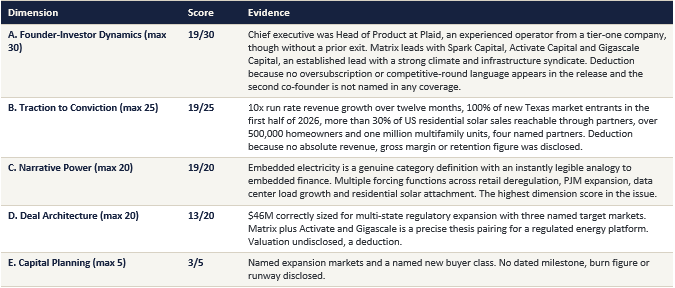
Why this scored. Tied for the highest score of the week, and it earned it on the most complete disclosure in the issue. Light put four different kinds of evidence on the record at once: a growth rate (10x run rate revenue growth in twelve months), a market share denominator (100% of new electricity brands entering the Texas market in the first half of 2026 launched on its platform, up from over 70% in 2025), a distribution number (partners reaching more than 30% of US residential solar sales) and a scale figure (over 500,000 homeowners and more than one million multifamily units). No other company in the set produced all four. Founder-Investor Dynamics scored 19 out of 30 on a Plaid product lead and a Matrix-led syndicate, and Narrative Power scored 19 out of 20, the highest single dimension score in the issue.
The Setup. Light, founded in 2023 and headquartered in Austin, sells the infrastructure that lets any company become an electricity provider without becoming a utility. Chief executive Baker Shogry was previously Head of Product at Plaid, which matters more than a typical resume line here, because Light is doing to electricity what Plaid did to bank data: turning a regulated, fragmented, integration-heavy category into an API that a product team can ship against in two weeks. The company is now moving from the deregulated Texas market into PJM, with New Jersey, Pennsylvania, and Illinois named, and is targeting hyperscale data center developers as a new buyer class.
The Numbers. $46.0M Series A led by Matrix, announced September 1, 2026, with Activate Capital, Spark Capital, Mischief, Gigascale Capital, MCJ, and BoxGroup participating. Run-rate revenue grew 10x over twelve months. 100% of new electricity brands entering the Texas market in the first half of 2026 launched on Light’s platform, against over 70% in 2025. Partner network reaches more than 30% of US residential solar sales. Over 500,000 homeowners served and more than one million multifamily units covered. New plan launches in roughly two weeks via API. Named partners include Palmetto, GoodLeap, Emporia, and Lunar Energy. 35 employees, with plans to double within a year. Cumulative funding roughly $60M. Absolute revenue, margins, and valuation not disclosed. Note that a widely repeated figure of a total capital base above $100M blends this equity round with a separate credit facility and is not the round size.
The Pattern. This is the market share round. Light never states its revenue and does not need to, because it states the share of a countable population it already holds: every new entrant in the largest deregulated retail electricity market in the country. That figure is verifiable by anyone who can list the new brands in Texas, and it converts an unknown company into a measurable position in about one sentence. Pair it with the 10x growth rate and an investor can size both the current business and its slope without a single company financial.
The Perspective. A growth multiple and a market share figure answer two different questions and only work together. 10x growth alone invites the obvious skeptical reading that the base was near zero. 100% of new entrants alone invites the second reading, that the population is small. Together, they foreclose both, because a company that captures every new entrant in a large market while growing 10x is, by definition, not operating at a trivial scale. This is the same defensive structure Yardstik used last week with growth plus retention, executed with different variables. Find the pair of figures that cannot both be flattering under a hostile reading, and disclose the pair.
The Playbook. Identify the population your product competes for, restrict it to new entries in a defined period and geography, and calculate what share of that population chose you. Not total market share, which you probably do not have and cannot verify. New-entrant share in a named market over a named period, which you might dominate and which anyone can check. Then state it alongside your growth multiple in the same sentence. That sentence is worth more than a slide of logos, because it is a claim about the market’s behavior rather than a claim about your sales team’s.
The Founder Mistake to Avoid. Founders copy the API-for-a-regulated-industry framing without the regulatory work underneath it. Light’s two-week plan launch is only possible because the company absorbed the licensing, settlement, and compliance burden that made it hard to enter the electricity market in the first place. The wedge is not the API. The wedge is being the entity that holds the regulatory position so the customer does not have to. If your integration layer sits on top of a burden your customer still carries, you have built a convenience, not infrastructure, and the pricing power will show it.
Clipto
AI Media Search and Local Memory Layer | Stage Not Disclosed | $15.0M | $250M Valuation
Eisen Fundability Score: 73 / 100
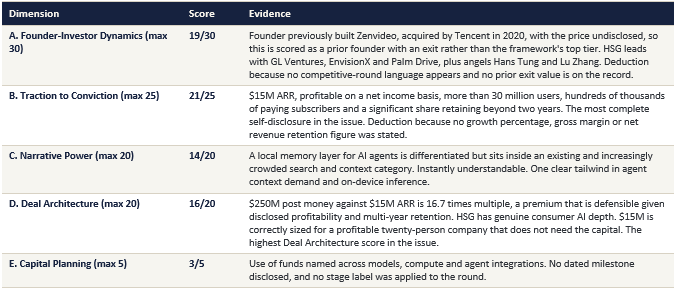
Why this scored. The twenty-first largest round of twenty-eight tied for the highest score, and it did so by being the only company in the issue that disclosed all three of the numbers everyone else withheld: revenue ($15M ARR), profitability (positive on a net income basis), and valuation ($250M post-money). It scored 21 out of 25 on Traction to Conviction, the highest in the set by three points, and 16 out of 20 on Deal Architecture, also the highest, because a disclosed valuation is the only way to score above 3 on Valuation Reasonableness in a week with 96.4% opacity.
The Setup. Clipto, founded in 2023 with teams in San Francisco, Singapore, and Hong Kong, indexes and searches the video, audio, and document files on a person’s machine and increasingly serves that index as a memory layer that AI agents can query. Founder Henry Kang previously built Zenvideo, which Tencent acquired in 2020 for an undisclosed price, and has a background in robotics research at Carnegie Mellon. The company reached $15M in ARR and net income profitability with roughly twenty employees, which is the fact that does most of the work in this round: the business proved it did not need the money before it raised it.
The Numbers. $15.0M led by HSG, announced August 31, 2026, at a $250M post-money valuation, with GL Ventures, EnvisionX Capital and Palm Drive Capital participating alongside angels Hans Tung and Lu Zhang. $15M ARR as of early 2026. Profitable on a net income basis. More than 30 million users since launch. Hundreds of thousands of paying subscribers. A significant share of subscribers have been retained for more than two years. Roughly 20 employees. Founded in 2023. No stage label of any kind is used by the company or any of its outlets. Growth rate not disclosed as a percentage.
The Pattern. This is the disclosure arbitrage round. In a week when twenty-seven of twenty-eight companies withheld their valuation, the one company that published it also published the two numbers that justify it, and the combination let an investor complete the entire underwriting from the press release: 16.7 times ARR for a profitable, capital-efficient business with multi-year retention. Every other company in the issue forced the investor to construct that ratio from the outside with a missing numerator, a missing denominator, or both.
The Perspective. Founders believe disclosing a valuation costs them negotiating room. In a market with 96.4% opacity, it does the opposite because it is the only way to be priced at all, rather than compared to a distribution. When nobody publishes a multiple, an investor prices you against the worst comparable they can imagine, and the absence of information is scored as risk, not as optionality. Clipto published a number that stands up to arithmetic, and the arithmetic did the persuading. Note also that profitability, not growth, is what makes the multiple defensible: the company disclosed no growth percentage at all and still tied for the top score, because a profitable business at $15M ARR does not need to explain its burn.
The Playbook. Find the slice of your business that is already profitable, even if it is one product line, one region, or one cohort, and reconcile the full economics of that slice this quarter: revenue, direct cost, allocated overhead, contribution. Then decide whether you can state it. You are not disclosing company profitability; you are disclosing that a defined unit of your business works without subsidy, which is the question an investor is trying to answer anyway. In a week where the mean score was 52.5, that single disclosure was worth more than $40M of additional round size.
The Founder Mistake to Avoid. Founders read this deal as permission to publish a valuation and go do it without the two numbers underneath. A valuation with no revenue attached is not a disclosure; it is a claim, and the first investor who divides it by an estimate of your revenue will arrive at a number you did not choose. Clipto’s $250M is credible only because $15M ARR and net income profitability are printed beside it. Publish the ratio or publish nothing.
Félix
Cross-Border Remittance and Stablecoin Rails | Series C | $87.0M new primary equity | Valuation Undisclosed
Eisen Fundability Score: 72 / 100
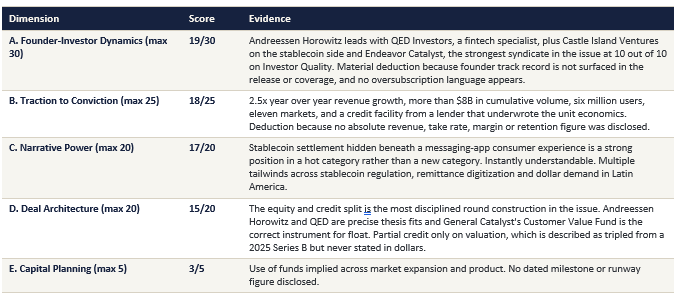
Why this scored. The strongest investor quality mark in the issue, 10 out of 10, on an Andreessen Horowitz lead with QED Investors, Castle Island Ventures and Endeavor Catalyst, paired with the largest disclosed volume figure of the week at more than $8B transferred. Félix also disclosed 2.5x year-over-year revenue growth and six million users across eleven markets. It is the only company in the set that combined a top-tier lead, a disclosed growth rate, and a nine-figure volume denominator.
The Setup. Félix, headquartered in Miami, moves money from the United States to Latin America over messaging apps, settling on stablecoin rails underneath a consumer experience that never mentions them. The company disclosed that its valuation tripled from its 2025 Series B, which was itself a $75M round, without stating either the old or new number in dollars. The structure of the raise is the part founders should study: $87M of new primary equity from Andreessen Horowitz to build the platform, and a separate $113M credit facility from the General Catalyst Customer Value Fund to fund the working capital that a remittance business consumes as it grows. Two different costs of capital for two different jobs.
The Numbers. $87.0M of new primary Series C equity led by Andreessen Horowitz, announced September 1, 2026, with QED Investors, Castle Island Ventures, Switch Ventures, Contour Venture Partners and Endeavor Catalyst participating, alongside a separate $113M credit facility from the General Catalyst Customer Value Fund. More than $8B in cumulative transaction volume processed. More than six million users. Eleven markets served. 2.5x revenue growth year over year. Valuation stated as tripled since the 2025 Series B, with no dollar figure disclosed. Headline announcement of $200M restated here to $87.0M of new primary equity.
The Pattern. This is the capital stack round, and it is the most replicable structural lesson in the issue. Félix did not raise $200M of equity. It raised the equity it needed for the parts of the business that carry equity risk and borrowed the rest against receivables that a lender can underwrite far more cheaply than a venture investor can. Every founder whose business consumes working capital as it scales, which includes every payments, lending, marketplace, inventory, and hardware company, is systematically over-raising equity to fund something a credit facility should be funding.
The Perspective. The reason this matters is dilution arithmetic, not sophistication. If Félix had raised $200M in equity at the same valuation, its founders and early employees would have owned materially less of a business whose additional $113M in funding was float, not product. Venture equity is the most expensive form of capital available and should be used only for the risk no lender will take: building something that does not yet exist. Working capital is not that risk. The moment your business has a predictable, collateralizable asset on its balance sheet, some portion of your raise stops being a venture question and becomes a credit question, and the two should be negotiated with different counterparties.
The Playbook. Split your use of funds into two columns this week. Column one is everything that funds an unproven outcome: engineering, new market entry, brand. Column two is everything that funds a predictable, recurring cash cycle: float, inventory, receivables, and customer acquisition with a known payback period under 12 months. Total column two. That is the number you should be raising as credit rather than equity, and it is almost certainly larger than you assumed. Then find one venture debt provider or one receivables lender and open the conversation before your equity round closes, not after, because the equity round is what makes the credit cheap.
The Founder Mistake to Avoid. Founders announce the blended number. Félix’s press coverage puts the round at $200M, and the market now files Félix under giant rounds rather than a disciplined $87M Series C. That is a reputational choice with a cost: the next investor who reads $200M and then sees your revenue will apply a multiple to the wrong numerator. If you raise blended capital, publish the split. The discipline is the story, and hiding it inside a bigger headline converts your best structural decision into a number that makes you look expensive.
Scan.com
Medical Imaging Network and API | Series C | $90.0M new primary equity | Valuation Undisclosed
Eisen Fundability Score: 61 / 100
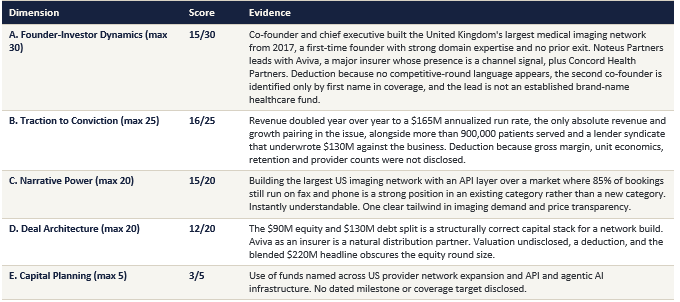
Why this scored. The largest tracked round of the week and the only company in the issue to disclose both an absolute revenue figure and the growth rate behind it: a $165M annualized run rate with revenue doubled year over year. That single pairing carried Traction to Conviction to 16 out of 25 in a set where twenty-three companies scored below 10 on the same dimension. It scores 61 rather than higher because the valuation is undisclosed, no margin or retention figure accompanies the run rate, and the founder record is thin on the public record.
The Setup. Scan.com launched in the United Kingdom in 2017, became the largest medical imaging network there, entered the United States in 2023, and is now raising to build the largest US imaging network. The problem statement is the most legible in the issue: roughly 600 million imaging scans happen annually in the United States, and about 85% of them are still booked by fax or phone. Co-founder and chief executive Charlie Bullock is building an API layer atop a market in which the incumbent booking technology predates the web. This round is datelined in Atlanta and is explicitly a US expansion raise, which is why it is included here, and the UK origin is flagged rather than resolved.
The Numbers. $90.0M Series C equity led by Noteus Partners, announced August 31, 2026, with Aviva, Concord Health Partners, YZR Capital and Oxford Capital participating, alongside $130M in debt facilities from VerisFi Capital and Atempo Growth for a $220M combined headline. Revenue doubled year over year to a $165M annualized run rate. More than 900,000 patients have used the platform. Addressable market cited at more than $100B in the United States. Approximately 600 million imaging scans annually in the United States, with roughly 85% still booked by fax or phone. Founded in 2017 in the United Kingdom; US operations since 2023. Gross margin, retention, customer counts, and valuation not disclosed.
The Pattern. This is the run-rate round, and the disclosure choice is deliberate and worth copying. Scan.com published an annualized run rate rather than trailing revenue, which is the more favorable framing for a fast-growing business, and then immediately constrained it by publishing the growth rate that produced it. A run rate without a growth rate invites the suspicion that it annualizes a single good month. A run rate that doubled year over year cannot be read that way. The company gave itself the flattering metric and then handed the reader the tool to check it.
The Perspective. Notice what Scan.com did not disclose: margins, retention, customer count, and valuation. It disclosed exactly two numbers, and both of them are about the top line. That is a defensible position for a marketplace scaling into a new geography, where gross margins are genuinely thin and disclosing them would invite the wrong comparison set. The lesson is that selective disclosure works when the numbers you select are the ones a skeptic would ask for first, and fails when they are the ones that happen to look best. Revenue and growth are the first two questions. Answering them buys you the right to hold the third.
The Playbook. Write your annualized run rate and the same figure from twelve months ago on one line, then calculate the multiple. If the multiple is greater than 2, publish both numbers and let the run rate stand. If it is below 1.5, do not publish the run rate at all, because publishing it invites the growth question you cannot answer, and you will spend the meeting on the defensive. Then separately, before you raise, ask your lender what portion of your growth capital they will fund against receivables. Scan.com raised 59% of its total capital as debt. Most founders in comparable businesses raise 0% debt and dilute for all of it.
The Founder Mistake to Avoid. Founders announce the blended figure and lose control of the story, exactly as Félix did. Scan.com’s $220M headline puts a company with a $165M run rate into the giant-round conversation, where it will be compared against businesses with three times its revenue. Worse, it obscures the actual achievement: a marketplace doubled revenue and financed the majority of its growth with debt rather than dilution. Lead with the equity number and the run rate. Put the debt facility in the second paragraph, where a lender-literate investor will find it and be impressed.
Odyssey Energy Solutions
Distributed Energy Finance and Procurement | Stage Not Disclosed | $27.0M new primary equity | Valuation Undisclosed
Eisen Fundability Score: 61 / 100
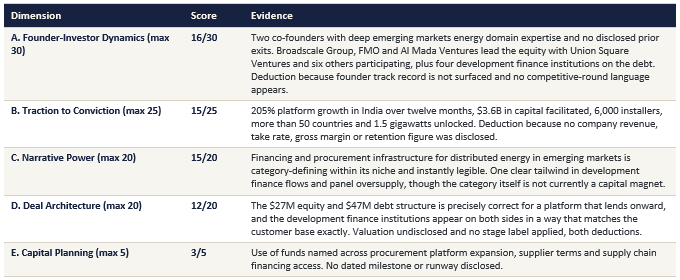
Why this scored. The third capital stack round in the top five and the clearest denominator disclosure of the week: $3.6B in capital facilitated to date across 6,000 solar installers in more than 50 countries, with 1.5 gigawatts of projects unlocked and 205% platform growth in India over twelve months. Odyssey scored 15 out of 25 on Traction to Conviction without disclosing a single company's financials, because it published the volume running through the platform instead.
The Setup. Odyssey Energy Solutions, headquartered in Boulder, is the financing and procurement infrastructure for distributed renewable energy in emerging markets. Co-founders Emily McAteer and Piyush Mathur built a platform that solves the problem nobody else in climate software will touch: a solar installer in Nigeria or India cannot access equipment financing at a price that makes a project viable, because no lender can underwrite them individually. Odyssey aggregates them. The round’s structure reflects exactly that business: $27M of equity from venture investors and development finance institutions, and $47M of debt from British International Investment and three other development finance vehicles, which will be lent on.
The Numbers. $27.0M of new primary equity, announced September 1, 2026, with Broadscale Group, FMO and Al Mada Ventures leading on the equity side and Union Square Ventures, Equal Ventures, Abstract Ventures, Twelve Below, FJ Labs, MCJ and Transition Ventures participating, alongside $47M of debt from British International Investment as lead, BIO, the Facility for Energy Inclusion via Cygnum Capital and the Energy Entrepreneurs Growth Fund via TripleJump, for a $74M combined headline. More than 6,000 solar installers and engineering firms on the platform. $3.6B in capital facilitated to date. Operating in more than 50 countries. 1.5 gigawatts of projects unlocked through the procurement platform since its 2024 launch. 205% platform growth in India over twelve months. Total capital raised to date: $94M. No stage label disclosed. Company revenue, take rate, and valuation not disclosed.
The Pattern. This is the flow-through denominator round. Odyssey’s own revenue is invisible, and its platform volume is enormous, and the company chose to publish the latter. $3.6B facilitated tells an investor the size of the pipe. 1.5 gigawatts tells them the physical output. 6,000 installers report the network density to them. 205% in India tells them the slope. Four countable numbers, none of which is a company financial, and together they let an investor size the business by applying any take rate assumption they like. That is a deliberate trade: you give up control of the margin assumption in exchange for never having to defend a revenue number.
The Perspective. The development finance institutions on both sides of this round are the part most founders will misread. FMO, British International Investment and BIO are not impact-flavored venture funds reaching for returns. They are the institutions whose mandate is to move capital into exactly the markets Odyssey serves, which makes them simultaneously the investor, the eventual source of the lending capital, and the credibility signal to every ministry and utility in the pipeline. Getting a DFI onto your cap table in an emerging markets business is worth more than the check, because it converts a regulatory conversation from a cold call into a warm introduction from an institution the regulator already answers to.
The Playbook. Calculate the total value of everything that flows through your product in a year: transactions, claims, gigawatt hours, tons, acres, prescriptions, whatever the unit is. Then calculate what percentage of your addressable version of that flow you handle. Publish both numbers. If your flow number is large and your percentage is small, you have a market size story. If your percentage is large and the flow is small, you have a dominance story. Either is underwritable. What is not underwritable is a customer count with no volume attached, which is what twenty-three companies in this issue brought.
The Founder Mistake to Avoid. Founders announce the blended $74M and let the market believe they raised $74M of equity. Odyssey raised $27M of equity, which is a very different company from one that raised $74M, and the difference will matter at the next round when a new investor benchmarks progress against capital deployed. Worse, in Odyssey’s case, the debt is not even corporate leverage; it is capital lent to customers, which makes the blended headline actively misleading about the company’s own balance sheet. If money you raise is going to be lent onward, say so in the first sentence, because it is a strength that reads as risk when it is discovered later.
The Fundraising Playbook, Five Tactical Plans
Five plans, each producing a concrete output you can use immediately. No vague tasks. Each is built directly from this week’s verified signals.
1. The One Number You Have Been Withholding (Narrative and Investor Framing)
Why this matters. Seven of twenty-eight companies put a hard financial number on themselves on the record, averaging 64.4 against 48.5 for the other twenty-one. That is a 16-point premium, nearly double the 8.6-point premium the customer’s number earned last week. All three companies that cleared 65 are in the group of seven, and no company that withheld everything got above 61.
Exact deliverable. One line, in this exact form: the metric, its value today, its value twelve months ago, and the multiple between them. Light published it as 10x run-rate growth in 12 months. Félix published it as 2.5x year-over-year. Scan.com published it as revenue doubled to a $165M annualized run rate. Capacity published it as 20x in three and a half years. Put that line on slide two. If the multiple is below 1.5, do not publish it and go fix the business instead, because publishing weak growth is worse than publishing nothing.
Time estimate. Two hours with your finance lead to reconcile the 12-month comparison with what your accounting system actually shows, plus 1 hour to rewrite the slide.
Expected outcome. You move from the 48.5 bucket to the 64.4 bucket without changing anything about the business. More importantly, you become priceable, which in a week with 96.4% valuation opacity means you are competing against a field the investor cannot price at all.
The reframe. Wrong approach: hold your revenue for the data room and lead with logos and vision. Right approach: lead with the number and its slope, and hold off on the margin details for the data room.
2. The Flow-Through Denominator (Proof and Metrics Packaging)
Why this matters. Odyssey Energy Solutions scored 61 without disclosing a single company's financials, by publishing $3.6B in capital facilitated across 6,000 installers in 50 countries with 1.5 gigawatts unlocked. Light scored 73 partly on holding 100% of new Texas market entrants. Félix scored 72 partly on $8B transferred. Three of the top five rounds were driven by volume rather than revenue.
Exact deliverable. One sentence naming the total value that flows through your product in a year and the addressable population it sits inside. Transactions, claims, gigawatt hours, patients, acres, prescriptions, seats, tons. Both numbers must be countable by a stranger who calls two people in your industry. Then hand the sentence to someone outside your company and ask them to state your market share back to you. If they cannot, the denominator is wrong, and you should rebuild it before the sentence goes in the deck.
Expected outcome. An investor can size your position without asking you for revenue, and can do so during the meeting rather than after. This is the substitute for a price conversation you are not ready to have, and it is what let three of this week’s top five clear without stating their earnings.
The reframe. Wrong approach: claim 500 customers and rapid growth. Right approach: state $3.6B facilitated across 6,000 installers in more than 50 countries.
3. Eisen Self-Score Against a Widening Band (Readiness Diagnosis)
Why this matters. The score band ran from 25 to 73 this week, compared with 42 to 70 last week. The mean fell to 52.5 while the ceiling rose to 73. Only three of twenty-eight rounds cleared 65, down from five of twenty-one, even as capital rose 70%. When dispersion widens, the return to being above average rises and the cost of being below it rises with it, because the market is no longer applying a common price.
Exact deliverable. Score your round across the five dimensions: Founder-Investor Dynamics (30), Traction to Conviction (25), Narrative Power (20), Deal Architecture (20), and Capital Planning (5). Penalize every blank as a zero, the way an investor does. Then apply this week’s specific test. Above 65, you are in the top tenth of those who actually cleared, and you should run a parallel process with a deadline. Between 50 and 65, you are in the crowded middle where fifteen of twenty-eight companies sat, and you will be priced like them. Below 50 and your problem is not the process; it is that a new investor cannot verify anything, and two weeks of disclosure work will move you more than two months of meetings.
Expected outcome. A decision about process design rather than a list of weaknesses. The score tells you whether to run a competitive process now or spend a repair sprint first, and running the wrong one costs a quarter.
The reframe. Wrong approach: score yourself, feel discouraged, and revise the deck. Right approach: score yourself, decide between a competitive process and a repair sprint, and commit to one this week.
4. Secure the Lead Seat Before the Syndicate (Deal Architecture)
Why this matters. Four of twenty-eight rounds closed with no named institutional lead and averaged 43.8 against 53.9 for the twenty-four that had one, a 10-point gap. Capacity crossed $100M in ARR, with a founder carrying a roughly $900M prior exit, yet still scored 52 because the only lead named in its release is an individual. Set against that, the eight rounds carrying no series letter averaged 52.8 against 52.4 for the twenty that did, a difference of 0.4 points. Founders spend their leverage on the wrong one of these two.
Exact deliverable. Two outputs. First, before you accept a second commitment, get one investor to confirm in writing that they will lead, set the price, and take the board seat. Track it as a binary gate in your pipeline, not a preference. Second, stop trading concessions for a series letter. It is worth 0.4 points, and the lead seat is worth 10, so if a firm will lead and price the round but will not call it the letter you wanted, take the lead. Then draft your announcement around three things: the amount, the lead’s name, and one number about the business. If you cannot fill the third slot, that gap is what your deck is missing, and you have found it before an investor did.
Time estimate. Six to eight hours rebuilding the target list around lead-capable funds, plus one hour on the announcement draft.
Expected outcome. A process in which someone is accountable for setting your price. Without one, the price defaults to your own ask, which the next round’s investor will discount because nobody underwrote it.
The reframe. Wrong approach: collect soft commitments and hope a lead emerges from the group. Right approach: treat the lead commitment as a gate that must clear before the second check is accepted.
5. Move Working Capital Off Your Cap Table (Capital Efficiency)
Why this matters. Three of the week’s top five rounds split equity from debt: Scan.com at $90M equity and $130M debt, Félix at $87M equity and $113M credit, Odyssey at $27M equity and $47M debt. Between them, they raised $290M of debt that most founders in comparable businesses would have raised as equity. Scan.com financed 59% of its total capital without dilution.
Exact deliverable. Split your use of funds into two columns. Column one funds unproven outcomes: engineering, new market entry, brand. Column two funds a predictable, repeating cash cycle: float, inventory, receivables, and any customer acquisition with a measured payback period under twelve months. Total column two. That number is your credit ask, not your equity ask. Then open one conversation with a venture debt provider or receivables lender before your equity round closes, because the equity round is what makes the credit cheap.
Expected outcome. You raise the equity you actually need and borrow the rest at a fraction of the cost. On a $50M plan with $20M of working capital, moving that $20M to credit is roughly a third of the permanent dilution you would otherwise incur.
The reframe. Wrong approach: raise one large equity round to cover everything and describe the total as momentum. Right approach: raise equity for the risk no lender will take, borrow the rest, and publish the split so the discipline is visible.
Looking Forward, Next 1 to 3 Weeks
Three evidence-based scenarios and one wild card. Every prediction is anchored to this week’s verified data, not speculation.
Scenario 1: Series A Holds Above $30M and Series B Stays Thin (High Probability)
Evidence from this week. On the like-for-like $10M to $100M band, Series A averaged $30.43M across seven rounds against $27.22M last week, up 11.8%, and seed averaged $30.82M across five rounds against $17.15M, up 79.7%. Series B averaged $26.00M against $26.40M, down 1.5%, and produced two rounds against five. Capital returned to the stages that price on narrative and early proof and skipped the stage that prices on repeatable unit economics.
What to watch. Whether the Series B count recovers above four rounds in either of the next two issues. Two consecutive weeks below four would confirm that the mid-market Series B has structurally thinned rather than paused for a holiday week. Also watch whether the eight unlabeled rounds in this issue are a one-week artifact or the start of a trend. Stage opacity has doubled in a week, from 14.3% to 28.6%, and it cost those companies nothing in score, which is the condition under which a norm actually changes.
What founders should do before others notice. If your Series B is six months out, spend one of those months instrumenting acquisition cost, lifetime value, and net revenue retention so the numbers exist in defensible form when the lane reopens. If it is two months out, consider an extension at your Series A price with existing investors instead, and reopen at the letter you can actually clear.
Scenario 2: Disclosure Rises and the Premium Compresses (Medium-High Probability)
Evidence from this week. Absolute revenue disclosure went from zero in 2021 to three in 2028 in one week. Growth rate disclosure went from one of twenty-one to six of twenty-eight. The premium for disclosing was 16 points. Premiums that large attract imitation, and the founders reading the same market signals will start publishing next month.
What to watch. Whether valuation opacity finally turns. It has now risen for four consecutive periods, from 80% in June to 93.3%, then 95.2%, then 96.4%. Opacity that high alongside rising revenue disclosure is an unstable combination, because a company willing to publish its ARR has already crossed the harder disclosure threshold. The first three or four companies to publish a valuation alongside a revenue multiple will reset the standard announcement format, and Clipto has already demonstrated this format.
What founders should do before others notice. Publish now, while the premium is still 16 points. The window for any disclosure advantage is the period between when the market starts rewarding it and when everybody does. Last week the customer’s number was worth 8.6 points; this week your own number is worth 16. Neither premium will survive broad adoption, and the founders who capture it are the ones who move in the month the signal appears rather than the quarter after.
Scenario 3: The Score Floor Stays Broken (Medium-High Probability)
Evidence from this week. The floor fell from 42 to 25 in one week. Resect AI raised $25M, naming no investor at all and describing its backers only as private equity investors. Elucid raised an oversubscribed $55M Series D with no designated lead. Cari raised $32.5M from seven banks, with no single bank in the lead seat. Four of twenty-eight rounds had no named institutional lead, against a prior issue whose lowest scorer at least named its sole investor. When capital returns quickly, the marginal deal at the bottom of the market gets funded on terms nobody has to explain.
What to watch. Whether any round in the next two issues scores below 25, and whether the share of rounds with no named lead stays near 15%. Both would indicate the bottom of the mid-market has permanently detached from the disclosure norms the top operates under, which changes what a mid-band score means. A 55 in a market with a 25 floor is a different signal than a 55 in a market with a 42 floor.
What founders should do before others notice. Do not read a falling floor as a falling bar. The floor fell because more unverifiable rounds cleared, not because standards dropped for anyone competing at a price. The gap between 25 and 73 is the entire opportunity: in a market this dispersed, moving from 50 to 65 changes your price more than it would in any market this series has measured.
Wild Card: A Credit Facility Becomes Standard Below $50M (Medium Probability)
Evidence from this week. Three of the top five rounds split equity from debt, and together they moved $290M of debt alongside $204M of equity. Scan.com financed 59% of its capital without dilution, and Odyssey financed 64%. Each of the three is a business with a predictable, collateralizable cash cycle, and none is unusual in that respect: payments, marketplaces, lending, inventory, and hardware companies all share this profile.
What founders should do before others notice. The structure appeared in headlines of $74M, $200M, and $220M this week, suggesting the lenders currently doing it are targeting larger companies. That is where the opportunity is. If your round is $15M to $40M and $5M to $12M of it funds a repeating cash cycle, you are almost certainly the first founder in your lender’s pipeline to ask for that structure at your size, and you will get better terms for being early than you will for being large. Open this month's conversation with your equity term sheet in hand before it's signed.
The Bottom Line
The real insight is not the $943.6M. It is that capital rose 70% and average check size rose 43% in the same week, which means conviction fell to 52.5, its fourth consecutive decline, and the score band blew out to 48 points. The market did not get more generous or more selective. It got less consistent, and inconsistency is a pricing opportunity for anyone who can supply what the average company did not. This week that produced exactly three conviction profiles.
Profile 1: Companies that published their own number. Light (73) disclosed 10x run rate revenue growth in twelve months and 100% of new Texas retail electricity entrants. Clipto (73) disclosed $15M in ARR, net income profitability, and the only valuation in the issue. Félix (72) disclosed $8B in cumulative volume and 2.5x year-over-year growth. Scan.com (61) disclosed a $165M annualized run rate with revenue doubled. All four sit in the top five. Seven companies published a hard financial figure, averaging 64.4, compared with 48.5 for the other twenty-one.
Profile 2: Companies that published a flow-through denominator. Odyssey Energy Solutions (61) published $3.6B in capital facilitated, 6,000 installers, 50 countries, and 1.5 gigawatts unlocked, without a single company financial. Diameter Pay (59) published more than $10B in payment volume year-to-date across roughly 20 employees. Cari (57) published a network of thirty-plus banks representing more than $10 trillion in assets. None of the three disclosed revenue. All three cleared the mean by at least six points, because a volume figure lets an investor build the model themselves.
Profile 3: Companies whose round was structured rather than simply raised. Scan.com split $90M of equity from $130M of debt. Félix split $87M of equity from a $113M credit facility. Odyssey split $27M of equity from $47M of onward lending capital. Together, they raised $290M in debt against $204M in equity, and all three landed in the top five. The counter-example is instructive: four rounds this week had no lead investor setting a price at all, and they averaged 43.8. Structure is not an afterthought applied to a round. It is the round.
Everything else competed for the residual. Twenty-one companies raised real money from real investors with no financial figure on the record and averaged 48.5. Two of them, Physical Superintelligence and SciFin, took $102.0M between them on pedigree alone and scored 43 and 46. Each of these companies answered diligence questions that never became public, and none of them owed anyone a press release. The difference is that the top of the band handed the investor a number that did the underwriting for them, in a week when the money was there to reward it, and almost nobody supplied it.
Five New Rules for Founders
Rule 1. A capital rebound is not a bar reduction. Capital rose 70.0%, and the mean score fell to 52.5. The number of rounds clearing 65 fell from five to three in a week, with seven more deals. More money and less proof is the best market a prepared founder gets and the worst one for everybody else.
Rule 2. Publish your own number before someone makes you defend its absence. Seven of twenty-eight did, averaging 64.4 against 48.5. The metric: the value today, the value twelve months ago, the multiple. One line, slide two.
Rule 3. Somebody has to set the price. Four rounds closed with no named institutional lead and averaged 43.8 against 53.9. Capacity crossed $100M in ARR alongside a nine-figure founder exit, yet still finished tied for twelfth out of twenty-eight without one. Get the lead commitment in writing before the second check.
Rule 4. Stop negotiating for the letter. The eight rounds that carried no series label at all averaged 52.8, against 52.4 for the twenty that carried one, a difference of 0.4 points, while a missing lead cost 10. Trade the letter for the lead every time.
Rule 5. Stop paying equity prices for working capital. Three of the top five rounds split equity from debt, moving $290M of debt against $204M of equity. Everything in your plan that funds a predictable, repeating cash cycle is a credit question, and you are diluting for it.
Four Monday Actions
1. Write the one line. Your metric, its value today, its value twelve months ago, the multiple. Reconcile it with your accounting system, then place it on slide two and move the vision slide to slide five.
2. Build your flow-through denominator. The total value moving through your product in a year and the addressable population it sits inside, both countable by a stranger. Hand the sentence to an outsider and ask them to state your market share back to you.
3. Make the lead commitment a gate. Before you accept a second commitment, get one investor to confirm in writing that they will lead, price, and take the seat. If nobody will, that is diligence output about your round, not a scheduling problem.
4. Split the use of funds into two columns. Unproven outcomes in one, predictable cash cycle in the other. Total the second column and open one credit conversation this month, before your equity term sheet signs.
Twenty-eight companies were cleared this week, and twenty-one of them are indistinguishable from one another in the public record. The mean round score was 52.5, and the money available to it rose by 70%. The founder who walks in Monday with one growth rate, one verifiable denominator, and one investor who will set the price is not competing against the top of this market. There were three companies at the top of this market. They are the fourth.
Research Methodology and Sources
Data collection period: August 31 to September 6, 2026, with verified primary disclosures clustered August 31 to September 4. No verified US mid-market round was announced on September 5 or 6, both of which fell on Saturdays ahead of the Labor Day holiday weekend. Verification standard: a minimum of two independent sources per deal, with company press releases and regulated newswires (BusinessWire, PRNewswire, GlobeNewswire) prioritized as anchor sources, plus at least one independent outlet for corroboration. This issue was then put through two further independent verification passes, in which every company, amount, stage, investor, date, headquarters, and reported metric was rechecked against primary sources, the second of which was adversarial and specifically designed to find errors in the first. Those passes removed eleven deals, restated four headline amounts to new primary capital, corrected three stage or lead attributions, and corrected eight geography or identity errors. Eisen Fundability Scores are proprietary analytical estimates, not endorsements or investment advice. All dollar figures reflect the announced new primary capital at close unless noted otherwise.
Core Capital Totals and What They Include
The $943.6M weekly total includes only the twenty-eight verified US rounds in the scorecard, each independently confirmed at the stated amount. Mid-market is defined for this issue as a US-headquartered round of new primary capital between $5M and $100M, a wider band than the $10M to $100M used in prior issues. Because that change breaks comparability, every week-over-week comparison in this report is calculated on the $10M to $100M subset: twenty-five rounds totaling $924.6M at an average of $36.98M and a median of $32.5M, against twenty-one rounds totaling $543.9M at an average of $25.9M and a median of $25.0M in the prior issue. The three rounds below $10M, totaling $19.0M, are included in the scorecard, the scores, and the sector and geography analysis, but are excluded from all week-over-week structural comparisons, including every stage average quoted in this issue.
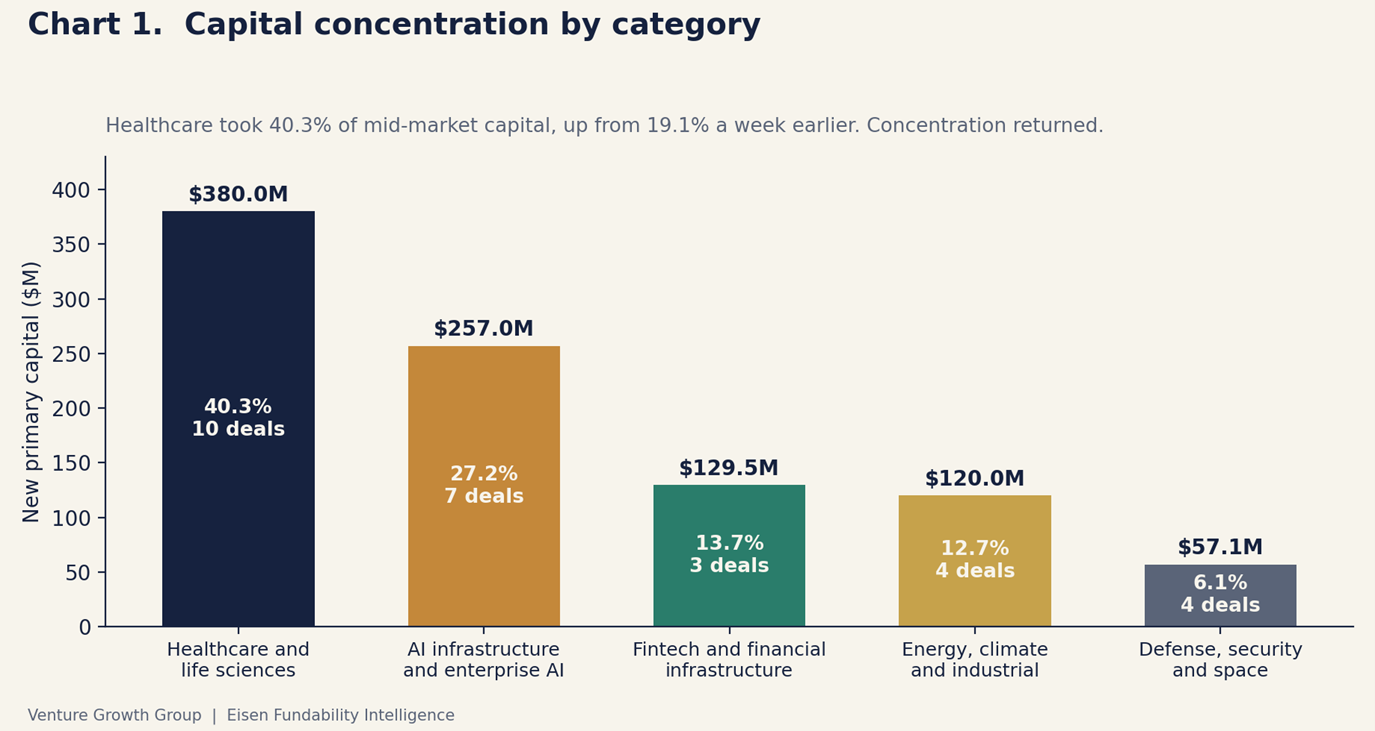
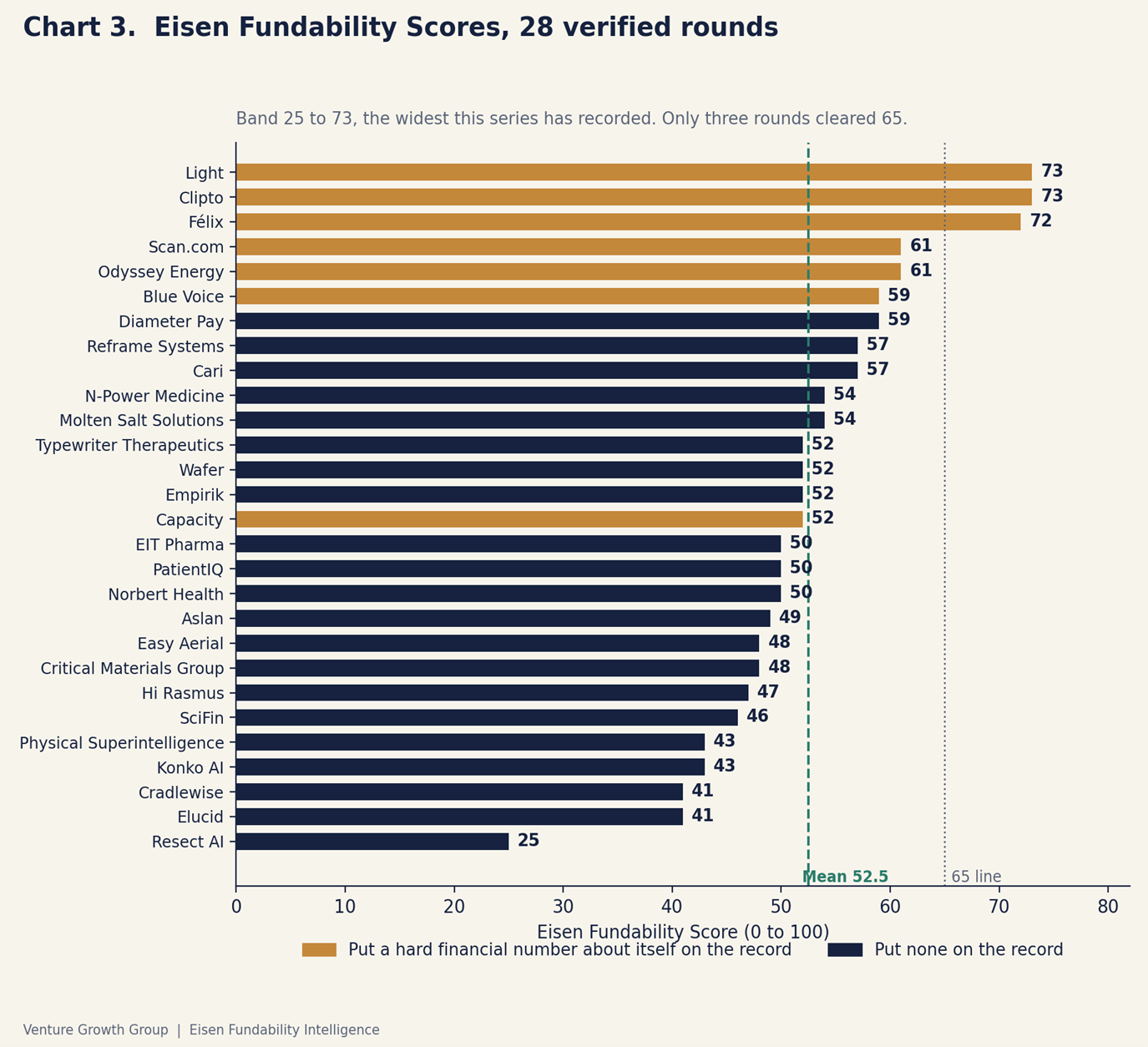
Secondary share purchases, credit facilities, venture debt, SAFE conversions from prior periods, previously closed tranches, non-dilutive grants and cumulative restatements are excluded from the counted amount even where a headline figure includes them. Announcements that do not separate new capital from cumulative totals are excluded entirely. No aggregator-only figure was treated as fact without corroboration in a company release or an independent outlet. Arithmetic on the total, the average, the median and every chart value was recomputed and reconciled after the second verification pass: the five sector subtotals ($380.0M, $257.0M, $129.5M, $120.0M and $57.1M) and the seven stage subtotals ($213.0M across seven Series A rounds, $207.0M across three Series C rounds, $201.5M across eight rounds with no disclosed stage, $161.1M across six seed rounds, $55.0M in one Series D, $54.0M in one Series E and $52.0M across two Series B rounds) each sum to $943.6M across twenty-eight deals.
Scoring calibration note. Undisclosed valuations are scored at 2 of 8 on Valuation Reasonableness rather than 0, matching the calibration used in the prior two issues of this series so that mean and band figures remain comparable across issues. Rounds with no disclosed stage were penalized in Round Construction. Rounds without a named institutional lead were capped at 4 out of 10 on Investor Quality. Founder track record is scored on the verifiable public record rather than on what a release chose to disclose, consistent with prior issues: Capacity’s David Karandish is credited with co-founding Answers Corporation, which Apax Partners acquired in 2014 for roughly $900M, even though the funding release mentions no prior exit. Where a founder background rests only on a low-authority bio aggregator, as with Félix’s co-founders, it is scored conservatively and not credited. Company-supplied metrics are scored as verifiable rather than independently audited.
Exclusions and Documented Rationale
• Giant rounds and public market events, excluded by editorial scope: Crusoe ($3B), Fluidstack ($1.5B), Wonderful ($550M), Higgsfield ($400M), Gimlet Labs ($300M), Upwind Security ($300M), David ($250M), Medici Brands ($250M), HiBob ($166M), Lyte AI ($165M), TabaPay ($155M), Thyme Care ($125M) and HiddenLayer ($100M). The week’s ten largest rounds totaled $6,061M against $1,512M for the prior week.
• Non-US rounds, excluded for scorecard comparability: Aitan ($41M, Israel), AIR Security ($50M, Israel and New York), Lasso Security ($30M, Israel and New York), Guardio ($40M, Israel), Huskeys ($27M, Israel), HubX ($75M, Turkey), Ultrahuman ($70M, India), WeRoad ($58M, Italy), Conveo ($50M, Belgium), HyImpulse (over €50M, Germany), Gridsight ($26M, Australia), Moment ($22M, Ghana), Enhance ($18.2M, UAE), iPremom (€15M, Spain), Octave.energy (€10M, Belgium), Sirdab ($10M, Saudi Arabia), Outlier Space (NZ$10.5M, New Zealand), Hivebotics ($6M, Singapore), Zeit AI (€5M, Germany), Backbone (€4M, Belgium), NeuShen Therapeutics (over $80M, Shanghai and Boston), Tripo AI (RMB 3B, China), PeopleX (¥5.45B, Japan), Metal ($4.5M, Pakistan), Meissner ($2.6M, Canada) and Plenti ($3M, Colombia).
• Outside the date window: Smack Technologies ($61M, August 18), Deep Cogito ($43M, August 26), CivilGrid ($26M, August 28), RQD Clearing ($74M, August 28), Workweek ($17M, August 27 to 28), Axle ($17.5M, August 11) and SiteVue AI ($7.5M, August 6).
• Structural exclusions: Chariot Claims ($9.46M, SEC Form D filing only), Bolt (up to $27M, distressed pay-to-play bridge stated as a range), Helogen ($7.1M, cumulative figure restated inside a non-financing release) and Emberos ($5.5M, prior tranche of $2.49M sold July 2 and filed August 7, not separated in the announcement).
• Unverifiable, single-source: Icon ($30M, reported by one aggregator with no corroboration and inconsistent with the company’s disclosed funding history) and Koxa ($8.7M, traceable to a 2022 press release ID).
• Below the mid-market floor: Elm AI ($3.84M) and Swissclear Global ($900K), both otherwise in window and US-based.
Deal Citations, Two or More Sources per Deal
• Scan.com, $90.0M Series C equity. BusinessWire company release dated August 31, 2026, headlined at $220M and separating the equity and debt components; company press page; Fierce Healthcare; HIT Consultant; MobiHealthNews. Rated HIGH on amount and metrics, with the dual-country headquarters flagged.
• Félix, $87.0M Series C equity. Company announcement dated September 1, 2026, read through Tech Startups and the September 1 and September 2 venture funding roundups; Andreessen Horowitz as named lead; QED Investors, Castle Island Ventures, Switch Ventures, Contour Venture Partners and Endeavor Catalyst named as participants; General Catalyst Customer Value Fund named as the source of the $113M credit component.
• Physical Superintelligence, $58.0M Seed. Company release dated September 1, 2026, distributed via Yahoo Finance; HPCwire; Siliconsnark, which independently notes that no pricing, efficiency benchmark, capital cost reduction, or live facility result has been disclosed.
• Typewriter Therapeutics, $56.0M Series A. PRNewswire company release; Endpoints News dated September 2, 2026; Pharma Journalist dated September 3, 2026; Pharmaceutical Technology; company site confirming the Cambridge, Massachusetts headquarters and a Tokyo office. Co-led by RA Capital Management and AN Venture Partners, with ANRI, Gemseki, and the SBI US Gateway Fund participating. Outlets differ by one day on the announcement date.
• Elucid, $55.0M Series D. BioSpace press release dated September 2, 2026, describing an oversubscribed Series D; HIT Consultant; MassDevice; Pulse 2.0. All four describe IAG Capital Partners and Elevage Medical Technologies as existing participants rather than leads, and the new anchor as an unnamed publicly traded medical device company.
• Capacity, over $54.0M Series E. PRNewswire company release dated September 2, 2026, headlined at over $50M with the body stating over $54M and naming Kathy Ireland as the lead investor; The SaaS News; Cultivation Capital, an existing investor, confirming over $54M; the company’s own PRNewswire release of June 18, 2026 for the $100M ARR milestone; public record for the 2014 Apax Partners acquisition of Answers Corporation, co-founded by David Karandish, at roughly $900M, a figure some profiles render as $950M. Release states $100M+ ARR as of June 2026, 20x growth in three and a half years, 20,000+ organizations, Inc. 5000 rank 432, and over $159M raised to date.
• Hi Rasmus, $50.0M. GlobeNewswire company release dated September 3, 2026, describing a strategic minority growth investment from Updata Partners with founders retaining majority ownership; Behavioral Health Business; Acuity, which notes that valuation, stake size, secondary composition, and post-closing board composition were all undisclosed.
• Light, $46.0M Series A. Company press release dated September 1, 2026; Axios exclusive dated September 1, 2026; Tech Startups; FinSMEs, which incorrectly states a Houston headquarters against four sources confirming Austin; company careers materials confirming Austin.
• SciFin, $44.0M Seed. BusinessWire company release dated September 1, 2026, read through Morningstar syndication; SiliconANGLE; Pulse 2.0 for the full syndicate; citybiz, which states explicitly that no customer count, revenue figure, or valuation was disclosed. Co-led by Altimeter and Madrona with Foundation Capital, S32, and Zetta Ventures. Founder Mohit Aron co-founded Nutanix and founded Cohesity.
• Wafer, $40.0M Series A. Company blog post dated September 1, 2026; Wilson Sonsini deal announcement confirming the $40M Series A; Pomegra for the reported post-money above $200M and the 50x step-up from an April 2026 $4M seed, which is a secondary-source figure and is not counted as a disclosed valuation.
• Reframe Systems, $40.0M. BusinessWire company release dated August 31, 2026, describing additional venture-backed equity financing with no series letter and confirming the prior $20M Series A of August 2025; HousingWire; The Robot Report and Coverager, both of which also decline a series letter; Dealroom, the one outlet assigning Series B; HUD PDR Edge for the Andover microfactory and Banker and Tradesman for the new Billerica headquarters lease.
• EIT Pharma, $35.0M Series A. PRNewswire company release dated August 31, 2026, describing an oversubscribed round led by Propel Bio Partners; BioSpace syndication; Pulse 2.0. FDA acceptance of the lonafarnib NDA is stated in the release.
• Cari, $32.5M first tranche. BusinessWire company release dated September 2, 2026, read through Morningstar syndication and headlined as the first tranche of an initial funding round backed entirely by banks; Ledger Insights for the $32.5M figure; CityBiz for the 30-plus bank network and $10T-plus in represented assets. Named bank investors: Glacier Bank, First Horizon, Huntington, KeyBank, M&T, Old National and SouthState.
• N-Power Medicine, $32.0M Series B. BusinessWire company release dated September 1, 2026, read through Morningstar syndication; Pulse 2.0; HIT Consultant; citybiz; FinSMEs; plus the company’s own BusinessWire release of July 1, 2024 announcing a prior Series B led by Merck Global Health Innovation Fund, used for the round-history check.
• PatientIQ, $30.0M Series C. Company press release dated September 3, 2026, and matching PRNewswire wire text; HIT Consultant; FinSMEs; The SaaS News. Metrics: 870+ healthcare organizations against roughly 200 at the 2022 Series B, 17 million patients, 70 million-plus outcomes, 20-plus specialties, 50-plus EHR integrations.
• Odyssey Energy Solutions, $27.0M equity. PRNewswire company release dated September 1, 2026; Latitude Media, which independently confirms the $27M equity and $47M debt split; Mercom Capital Group. Equity led by Broadscale Group, FMO, and Al Mada Ventures; debt led by British International Investment.
• Resect AI, $25.0M. PRNewswire company release dated September 3, 2026, which datelines Seattle, describes the backers only as private equity investors and cites an office in the greater Portland area; GeekWire, which reports the team is in Washougal, Washington, with a Seattle office planned; SiliconANGLE. Rated MEDIUM because no stage, no investor name, and no operating metric of any kind is disclosed.
• Empirik, $21.0M Seed. PRNewswire company release dated September 2, 2026, with the full syndicate and customer list; TechCrunch exclusive dated September 1, 2026, which confirms Sequoia incubated the company from 2023 and names a third co-founder, Sudheer Dhurjati; Dealroom; AI Weekly. Named customers per the release: Guardant Health, Avahi Systems, TCBPay, a Fortune 50 CPG company, and a Fortune 500 financial data services company.
• Aslan Protects, $20.8M Seed. Axios exclusive dated September 1, 2026, which names the FBI and Homeland Security Investigations and describes an agent running autonomously for 21 days; FinSMEs dated September 2, 2026, which supplies the seed label Axios does not use; 2048 Ventures confirming its own participation. No company release was located.
• Easy Aerial, $20.0M Series B. BusinessWire company release dated August 31, 2026, read through Morningstar and Yahoo Finance syndication, datelined New York with no borough or facility named; citybiz, whose headline reads Series A over a Series B body and which supplies the founder background the release omits; DroneXL and Brooklyn Eagle for the February 2026 non-renewal of the company’s Brooklyn Navy Yard lease, which is why no borough is asserted here.
• Clipto, $15.0M at $250M valuation. TechCrunch dated August 31, 2026, as the originating interview-based report; FinSMEs; Yahoo Finance syndication. No stage label is used by the company or any of its outlets. Metrics: $15M ARR, net income profitability, 30 million-plus users, hundreds of thousands of paying subscribers, roughly 20 employees.
• Norbert Health, $14.0M Series A. PRNewswire company release dated September 1, 2026; TipRanks; FinSMEs; AlleyWatch. Metrics: live in production since August 2025, 96% patient acceptance, 82% monitoring compliance against a roughly 41% manual baseline.
• Cradlewise, $12.0M Series A. Entrackr dated September 3, 2026; YourStory dated September 3, 2026; Business Standard; company about page confirming the Fremont, California headquarters and Pune manufacturing. Founding year conflicts between the company site (2017) and press coverage (2019) are not asserted.
• Critical Materials Group, $10.3M Seed. PRNewswire company release dated September 2, 2026; Morningstar syndication; Defense Daily; SiliconANGLE, whose headline misnames the company as Critical Munitions Group, but the body is correct.
• Diameter Pay, $10.0M Series A. PRNewswire company release dated September 3, 2026; The Block; PYMNTS; FinSMEs. Metrics: more than $10B in payment volume year-to-date 2026, 10,000-plus end users, roughly 20 employees, founded in 2023. The round closed between April and July 2026 and was first disclosed publicly on September 3, so it is treated as a first announcement rather than a resurfaced deal.
• Molten Salt Solutions, $7.0M Seed. PRNewswire company release dated August 31, 2026, describing an oversubscribed round led by Dolby Family Ventures; company site naming Dr. John Elling as founder and chief executive and the Los Alamos National Laboratory origin; Dealroom; FinSMEs. Commercial agreements named with Type One Energy, Gauss Fusion, and Fissionaire. A separate $3M pre-seed and more than $5M in non-dilutive grants are prior capital and are excluded from the counted amount.
• Konko AI, $6.0M. PRNewswire company release; CityBiz dated September 2 to 3, 2026, for the customer outcome figures; FinSMEs dated September 2, 2026; AIJourn. Rated MEDIUM because three sources name Michael Haddad as the second co-founder alongside chief executive Jean-Marc Goguikian, while CityBiz names Dr. Juliana Vallejo, and no company page resolves it.
• Blue Voice, $6.0M. TechCrunch dated August 31, 2026, as the originating interview-based report; FinSMEs dated September 1, 2026. Neither source applies a stage label. Metrics: 225 county agencies across 25 states, elevenfold customer growth over the past year.
Market Comparison Sources
Market comparison and contrast set: Crunchbase News weekly ranking of the ten largest funding rounds for the week of August 29 to September 4, 2026, which lists Crusoe ($3B), Fluidstack ($1.5B), Gimlet Labs ($300M), Upwind Security ($300M), David ($250M), HiBob ($166M), Lyte AI ($165M), TabaPay ($155M), Thyme Care ($125M) and HiddenLayer ($100M). Tech Startups venture capital and startup funding roundups for August 31, September 1, September 2, September 3, and September 4, 2026. VC News Daily funding records for September 1 to 4, 2026, used as a candidate source and date-checked against primary releases in every case, since its posting dates lag primary announcements by two to five days. AlleyWatch daily funding reports for September 1, 2, 3, and 4, 2026. Fierce Healthcare and Fierce Biotech fundraising trackers for 2026. Axios Pro deal coverage for the week of August 31, 2026.
Prior-period comparison figures for August 24 to 30, 2026 are drawn from the preceding issue of this report series, which tracked twenty-one verified US mid-market rounds totaling $543.9M at an average of $25.9M, a median of $25.0M and an Eisen score band of 42 to 70 with a mean of 58.0, and reported stage averages of $17.15M at seed, $27.22M at Series A and $26.40M at Series B. Comparison figures for August 17 to 23, 2026 are drawn from that issue, which tracked fifteen rounds totaling $545.0M at an average of $36.3M with a score band of 36 to 82 and a mean of 63.7. Comparison figures for June 1 to 7, 2026, are drawn from that issue, which tracked 10 rounds totaling $479.5M at an average of $48.0M, with a score band of 67 to 80 and a mean of 72.3.
Research completion timestamp: September 7, 2026, after a third verification pass, adversarial and directed at finding errors in the second.
DISCLAIMER: This article is for informational and strategic intelligence purposes only. It does not constitute investment advice. The Eisen Fundability Score is a proprietary diagnostic within Fundables OS™, not a financial recommendation.
If this article was useful, share it with founders who are about to raise.
— Leon Eisen, 4x Founder, Venture Capitalist, and Creator of Fundables OS™