

Playbook, Perspective, and Pattern for founders raising now. This report strips out the megarounds and the IPO traffic so you can read the part of the market that actually prices your round.
The week of June 22-28, 2026, had no megaround spectacle worth chasing, and that is exactly why it is useful. Set aside the billion-dollar inference round and the public-market noise. What is left is the market that prices your Series A and Series B: ten verified rounds, each at or below $100M, that together moved about $353M. Strip out the spectacle, and one rule survives in every deal that cleared. Capital paid for a disclosed number, not a pedigree.
A clinical AI company that saves Medicare close to $3M every week raised at the top of this week. A voice-agent testing company already running tens of millions of evaluations a month raised the same week. A network-automation company growing revenue 800% a year raised the same week. None of them led with a model. Each one led with a workflow it owned, and a number of diligence team members could verify it in an afternoon.
Here is the consequence for Monday. If your deck still leads with model capability, total addressable market, or a famous logo without a deployed number attached, you are pitching at a discount this week. The founders who sat at the top of the band led with proof. The founders who led with pedigree alone landed below 70. Read every shift below through that lens. Each one tells you what to put on slide one before your next investor meeting.
The Week in One Sentence
Primary insight: With the megarounds and IPO filings removed from view, the mid-market repriced on a single axis. Capital concentrated in the infrastructure of the agent economy and in regulated, reimbursed healthcare AI, and it paid for documented usage rather than narrative. The strongest scores went to companies that disclosed a revenue figure, a deployment count, or a peer-reviewed outcome. The weakest went to famous founders and hot categories that held the number.
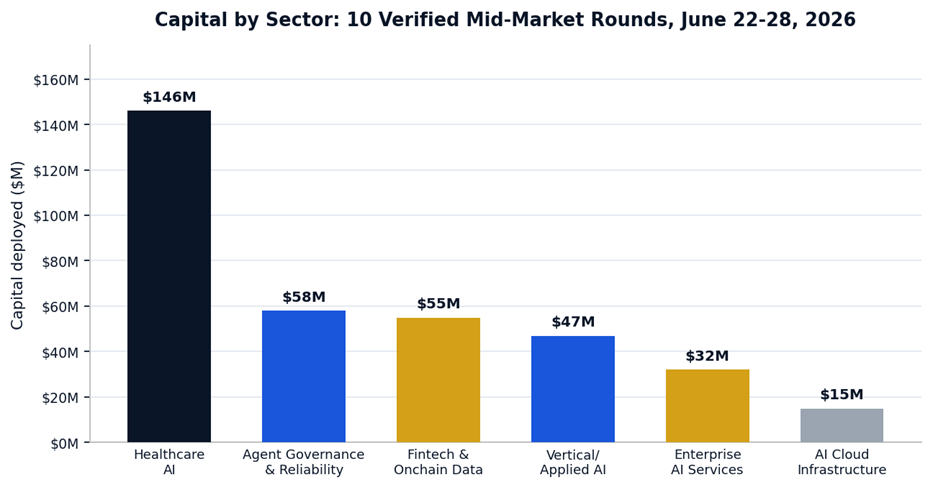
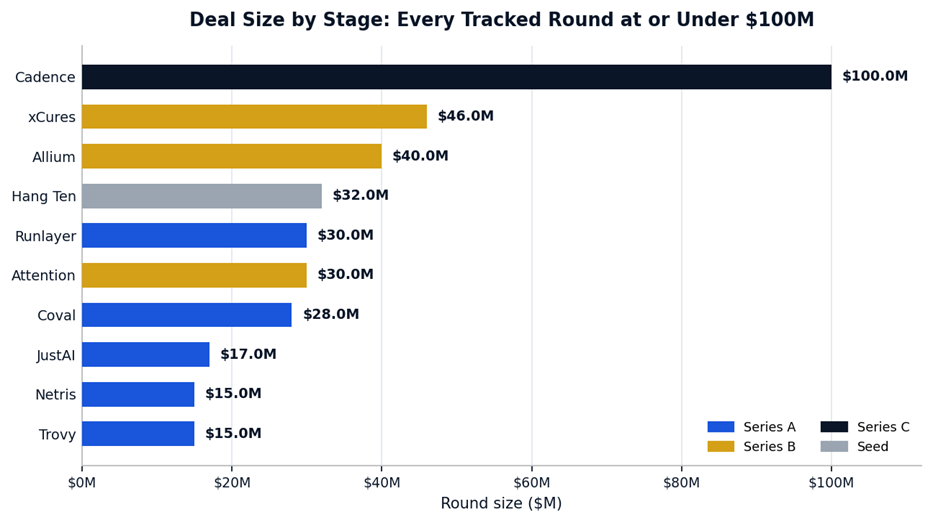
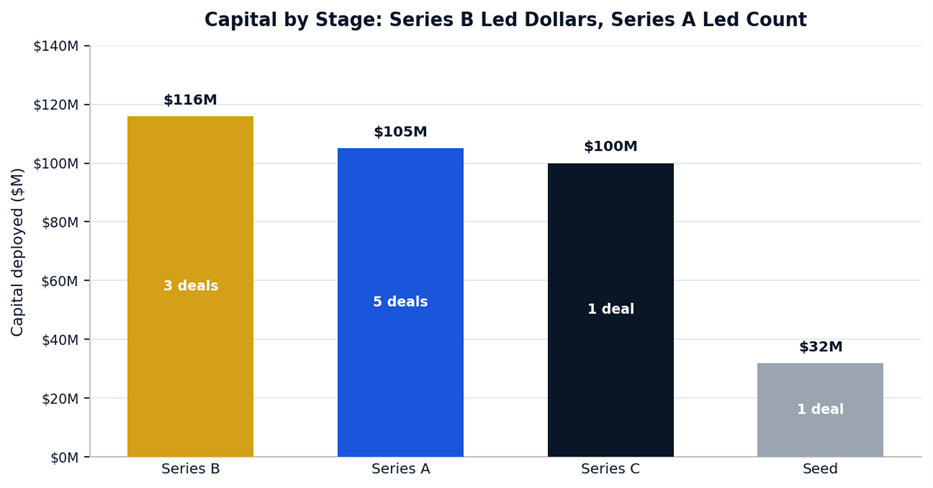
• Total tracked mid-market capital (10 verified rounds): approximately $353M, each round at or below $100M.
• Average round size: $35.3M across the ten.
• Median round size: $30M, the midpoint between Runlayer and Attention.
• Disclosed valuations: only two of ten. Cadence at $1.23B and xCures at $127M post-money. Eight rounds were not disclosed, which is itself a signal of how fast these deals closed.
• Largest tracked round: Cadence, $100M Series C, a clinical AI platform for chronic care at the $100M mid-market ceiling.
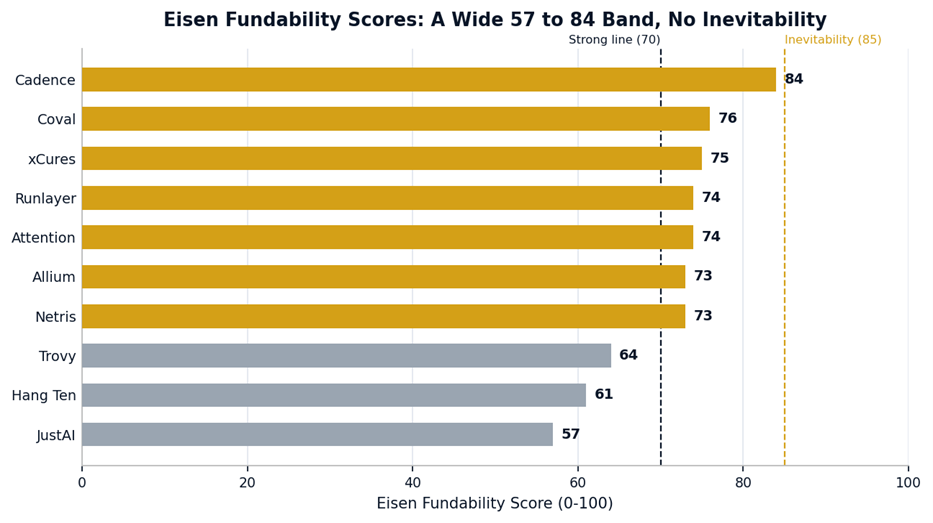
• Highest Eisen Fundability Score: Cadence at 84, the strongest deployed-proof profile in the series so far, and still short of inevitability.
• Defining structural feature: a wide Eisen Score band of 57 to 84. Disclosed revenue, not deal size or famous logos, separated the top of the band from the bottom.
Data Integrity Notes
All ten featured rounds were verified against at least two independent primary sources, including company press releases, BusinessWire, PRNewswire, and at least one tier-one outlet per deal, such as Fortune, TechCrunch, STAT, Crunchbase News, or SiliconANGLE. Resolutions and exclusions applied during this week's fact-check:
• Editorial scope this week excludes giant rounds and public-market events by request. Removed from the tracked set: Baseten ($1.5B Series F) and Peregrine Technologies ($250M Series D). IPO and public-raise traffic is also out of scope.
• Mid-market ceiling. Two strong U.S. healthcare and fintech AI rounds, Assort Health ($120M Series C) and Taktile ($110M Series C), are noted but excluded for exceeding the $100M ceiling. Cadence at exactly $100M is included as the largest tracked round, at the ceiling.
• Geography. The tracked ten are U.S.-headquartered. Non-U.S. rounds in the window (Superlight in the UK, TRIMTECH in England, TensorX in Ireland, Stark in Germany, CRED in India) are noted but excluded from the U.S. scorecard for comparability.
• Recirculation control. Three deals surfaced in this week's daily roundups but were announced the prior week and are excluded: Connie Health ($40M Series B, announced June 18), Copia Automation ($26M, announced June 16), and Limitless Labs ($20M Series A, announced June 16 and Tel Aviv headquartered).
• Valuation sourcing. Cadence at $1.23B is sourced to STAT. xCures at $127M post-money is sourced to Crunchbase News. JustAI is carried at MEDIUM confidence because its metrics were disclosed only through daily roundups, and its score reflects a penalty for that opacity.
Deal Scorecard
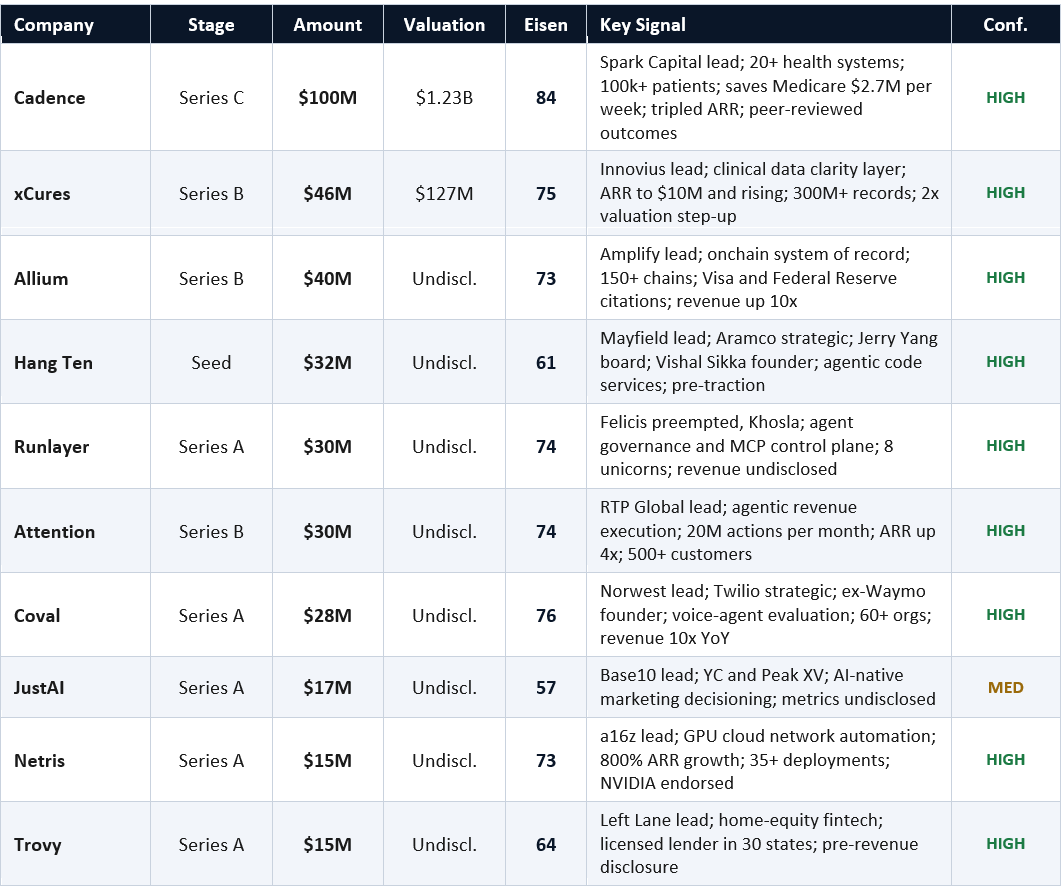
Eisen Fundability Scores are calculated across five weighted dimensions: Founder-Investor Dynamics (30%), Traction-to-Conviction Conversion (25%), Narrative Power (20%), Deal Architecture (20%), and Capital Planning (5%). Scores of 85 and above signal an inevitable outcome. Scores of 70 to 84 signal strong execution. Scores below 70 signal early-stage or the need for repositioning. Missing metrics are scored conservatively, and opacity is penalized rather than assumed strong.
What the Scorecard Says at a Glance
The spread is the message. Every deal cleared between 57 and 80, and the top of the band stopped at 84. That 27-point spread is wider than the 13-point band of three weeks ago, and the reason is instructive. Strip out deal size and famous logos, and one variable sorts the band almost perfectly: a disclosed number. Cadence, Coval, xCures, Runlayer, Attention, Allium, and Netris all led in revenue, growth multiple, deployment count, or peer-reviewed outcome, and all cleared 70. Trovy, Hang Ten, and JustAI led with a regulated license, a famous founder, or a hot category and withheld the number, and all landed below 70.
Cadence (84) is the cleanest case of the week and the most cautionary. It scored highest on deployed proof that a diligence team can verify: 100,000-plus active patients, 20-plus health systems, a peer-reviewed return of more than $3 to Medicare for every dollar spent, and roughly $2.7M in weekly Medicare savings. That is usage density, outcome data, and economic proof in one package. It still did not reach the 85 inevitability line, because the moat that powers its revenue, the monthly remote-monitoring billing model, is the one piece now under scrutiny from the federal health watchdog and from payers. The strongest proof of the week sits on top of the one unretired risk of the week.
Coval (76), xCures (75), Runlayer (74), and Attention (74) round out the top on the same logic. Each owns a layer of the agent economy and proves it with a number. Coval runs tens of millions of evaluations a month. xCures shows $10M in recurring revenue and a doubled valuation. Runlayer was preempted by elite capital on a wedge already inside eight unicorns. Attention runs 20M agent actions a month, with annual recurring revenue up fourfold. Different categories, identical underwriting test: what has already been deployed at scale.
The lower band is the warning. Hang Ten (61) carries a celebrated founder and a strategic on the cap table, but no disclosed traction. Trovy (64) carries a regulated lending license but has no disclosed volume. JustAI (57) carries a hot category and a strong syndicate but no public metrics. The scoreboard separates a fundable reputation from a fundable round, and the gap between the two this week was a single disclosed proof figure.
What Changed This Week: 5 Market Shifts
Each shift is verified against multiple primary sources and ranked by structural impact on founder fundraising, not by deal size. Every shift ends with what it means for your raise.
Shift 1: Healthcare AI Repriced on Reimbursement and Outcomes, Not Algorithms
Pattern: The two largest mid-market healthcare rounds this week led with money saved and outcomes proven, not with model architecture. Cadence raised $100M, showing a peer-reviewed return of more than three dollars to Medicare per dollar spent, a 27% reduction in hospital admissions, and roughly $2.7M in weekly Medicare savings across 100,000-plus patients. xCures raised $46M, showing $10M in recurring revenue and 300 million structured medical records. A larger healthcare AI round the same week, Assort Health at $120M, cleared just above the mid-market ceiling on the same logic. None of them led with a model.
Perspective: Investors now underwrite the reimbursement rail and the clinical evidence, not the algorithm. In regulated healthcare, the fundable unit is a billing code, a peer-reviewed outcome, and an electronic medical record integration. A model that is neither reimbursed nor validated is a science project. Cadence priced a $1.23B valuation because its outcomes are in peer-reviewed literature and its savings are paid by Medicare. That is why the same investors who discount a chatbot will pay growth multiples for a care model that books revenue through at-risk contracts.
Founder Blindspot: Founders in health AI still pitch the intelligence. Investors this week were scanning for the reimbursement path, the published outcome, and the system-of-record integration. There is a second trap hiding in the first. Cadence scored highest on proof, yet stopped short of inevitability because its billing model is under regulatory review. If your revenue depends on a billing mechanism, a regulator can question whether your moat and your risk are the same line item.
Playbook: Build a one-page reimbursement-and-evidence stack before your next health raise. Three lines: the billing code or contract that pays you, the peer-reviewed or audited outcome you moved, and the EMR or system of record you are integrated into. Then add a fourth line most founders skip: the regulatory exposure of the billing mechanism itself, and your plan if it changes. Lead with the outcome and the reimbursement, and name the regulatory risk before the investor does.
Contrast: A year ago, a health AI deck could open a Series A on model accuracy and a pilot. This week, it required a reimbursement path and a published outcome. The accuracy did not get a premium. The paid, proven outcome did.
What this means for your raise: If your health AI story leads with model performance rather than a reimbursed, evidenced outcome, you are pitching into a discount. Lead with who pays you and what you proved, and retire the billing-model risk in your own narrative.
Shift 2: The Agent-Reliability Layer Became Its Own Fundable Category
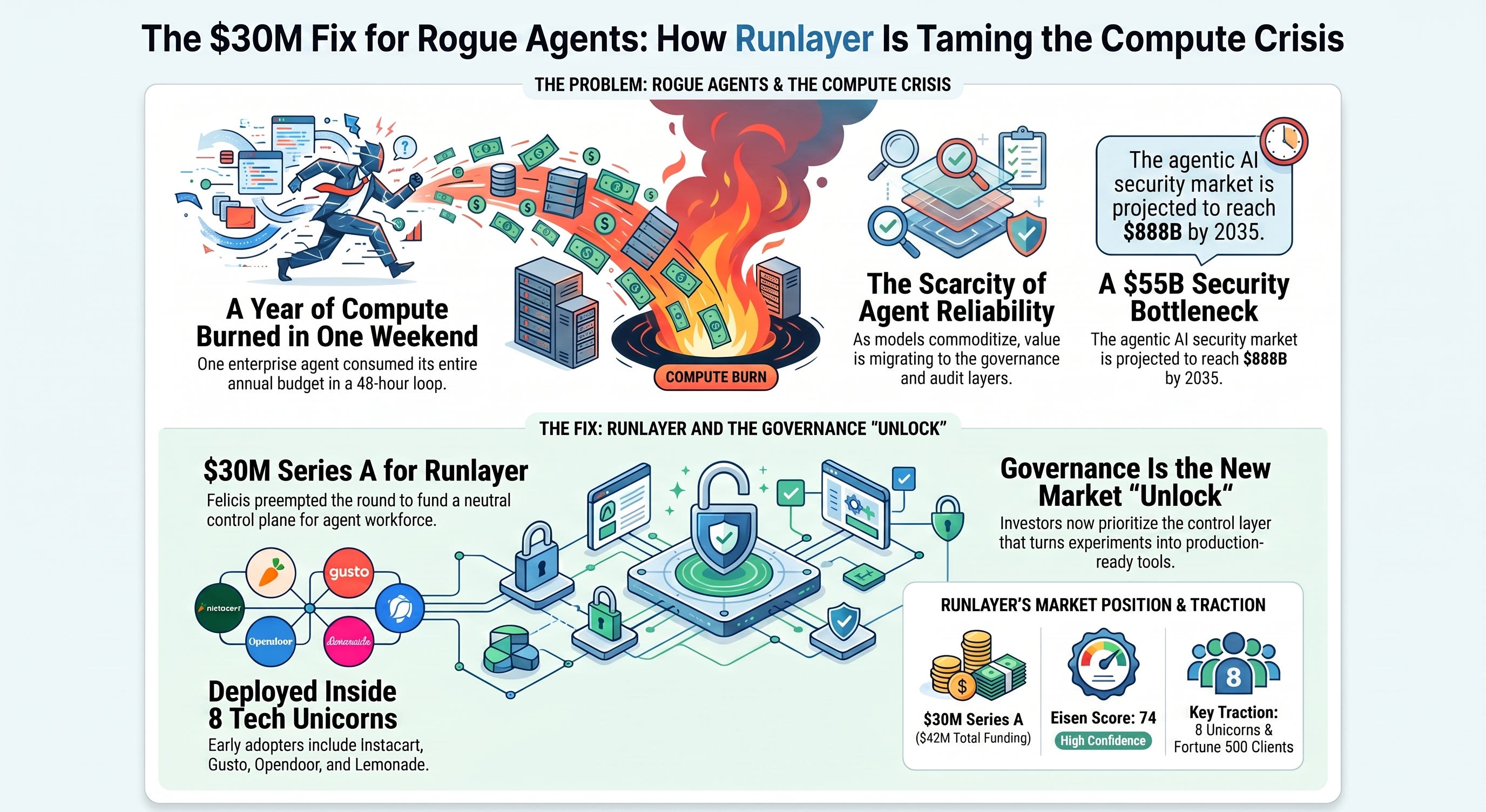
Pattern: Two of the week's strongest Series A rounds sold the proof that agents work, not the agents themselves. Coval raised $28M to evaluate voice agents, running tens of millions of simulated tests a month for 60-plus organizations, including Zoom, Deepgram, and Perplexity, and cutting manual quality assurance by up to 30x. Runlayer raised $30M for agent governance, a neutral control plane already in use at eight unicorns, including Instacart, Gusto, and Opendoor, after one customer discovered that an agent had burned its entire annual compute budget in a single weekend. Felicis preempted the Runlayer round, and a legendary investor reportedly wanted to buy every available dollar of it.
Perspective: When the application layer fills with agents, the scarce asset becomes the proof that those agents are safe to deploy. Foundation models and agent frameworks are becoming commoditized, so durable value migrates to the evaluation, observability, and governance layers that every production deployment must pass through. This is the picks-and-shovels move of the agent wave. The agent is the gold rush. The reliability layer sells the shovels, and it sells them to everyone in a rush at once.
Founder Blindspot: Founders race to build the visible agent because it is the part customers see. Investors increasingly pay for the unavoidable substrate beneath it: the simulation, the audit trail, and the policy enforcement that turn an experiment into production. The selection error is building the agent that a better model can replicate in a quarter, instead of the control layer, the whole category has to route through.
Playbook: Name the reliability question your category cannot answer yet. For voice agents, it is whether they hold up on real calls. For enterprise agents, it is whether they can be governed and audited. Then decide this quarter whether you own that proof layer, can own it, or are merely a buyer of it. If you are building the agent, ask whether the more defensible company is the one that proves the agent works.
Contrast: In 2024, the fundable agent story was the agent. In June 2026, the fundable story is the layer that lets an enterprise trust the agent in production. Governance repriced from a tax into the unlock.
What this means for your raise: If a better model could replicate your agent in 90 days, you are pitching the storefront. Find the evaluation, observability, or governance layer behind it and reframe the round around owning that.
Shift 3: Investors Bought the Specific Action, Not AI Software
Pattern: Capital paid for software that completes a defined action and ties itself to the outcome, not for generic AI. Attention raised $30M because it takes action rather than recording it: it drafts and sends the follow-up, updates the CRM, runs the next play, and then connects that play to revenue. It now runs more than 20 million agent actions a month with annual recurring revenue up fourfold and customers reporting a 40% lift in win rate. Cadence orchestrates a specific care action under supervision. JustAI automates a specific marketing decision. The fundable unit was a named action with a measurable result attached.
Perspective: Observation-only software cannot prove what it changed. Software that takes the action can close the loop, which is exactly what an investor underwrites: not the model that watches, but the system that acts and shows the delta. As one founder put it this week, if your tool only records and summarizes, it can never prove what it moved. The premium attaches to the closed loop because it is the only thing that converts a feature into measurable revenue.
Founder Blindspot: Founders describe a capability, AI for sales, AI for marketing, AI for support. Investors this week were scanning for the specific action the software completes and the outcome it can attribute to itself. A copilot that creates review work while claiming to remove it reads as a feature. An agent that completes the action and books the result reads as a company.
Playbook: Rewrite your one-line description from a capability into a completed action with an outcome. Move it from AI for X to we complete action Y, and we moved metric Z. Then add the proof that you can attribute the outcome to your own work, not to a coincidence. Put the action and the attributable result on slide one, and delete the model-architecture slide from the front of the deck.
Contrast: In 2024, a sales or marketing AI focused on summaries and time saved. In June 2026, the same category cleared on completed actions and attributed revenue. The bar moved from assistance to execution.
What this means for your raise: If your deck describes what your AI watches or suggests, investors will ask what it actually does. Lead with the action you complete and the outcome you can prove you caused, or expect a slower process.
Shift 4: The Data and Rails Layer Outpriced the Application
Pattern: Capital paid for the standardized substrate every competitor must route through, not the app on top. xCures owns the clean clinical data layer, structuring 300 million records from 550,000-plus sources and growing recurring revenue to $10M. Allium owns the on-chain system of record, standardizing data across 150-plus blockchains for Visa, Stripe, and Circle, with its data cited by the Federal Reserve, and revenue up more than tenfold since its Series A. Netris owns the network automation beneath GPU clouds, live across 35-plus clusters covering roughly a million GPUs, with revenue up 800% in a year. Each sits beneath a wave of applications that depend on it.
Perspective: When the application layer commoditizes, value accrues to the trusted substrate. The fundable position is the one Bloomberg holds in market data, and SWIFT holds in payments: the standardized source of truth everyone else is forced to reference. That is why a clinical data layer, a blockchain data layer, and a GPU networking layer all cleared in the same week. The application can be cloned. The cited, standardized, hard-to-rebuild data and rails layer cannot be cloned in a quarter.
Founder Blindspot: Founders build the visible application because it is the part customers pay for first. Investors increasingly pay for the unavoidable layer underneath, the data, the rail, or the automation that the visible products require. The selection error is building the easy-to-copy thing instead of the hard-to-source, expensive-to-trust one.
Playbook: Name the input in your category that every competitor must buy or build from someone. Clean data, a standardized rail, a measurement layer, and an automation substrate. Then decide this quarter whether you own it, can own it, or are merely a buyer of it. If you are a buyer, your moat lives upstream, and your strategy needs to move there before your next round. A citation from a regulator or Visa is worth more than another feature.
Contrast: In 2024, the fundable data story was the dashboard on top. In June 2026, the fundable story is the standardized source of truth that the dashboards depend on. The substrate was repriced above the storefront.
What this means for your raise: If a competitor with a better interface could replace you in 90 days, you are pitching the application. Find the data or rails layer behind it, get it cited by a name buyers trust, and reframe the round around owning that.
Shift 5: Disclosed Revenue, Not Pedigree, Priced the Round
Pattern: The score band split almost perfectly on one variable. Every deal above 70 led with a disclosed number. Cadence led with weekly Medicare savings and peer-reviewed outcomes. Coval led with tens of millions of monthly evaluations and tenfold revenue growth. Attention led with 20 million monthly actions and a fourfold increase in annual recurring revenue. Netris led with 800% revenue growth. Every deal below 70 withheld the number. Hang Ten led with a celebrated founder and disclosed no traction. Trovy led with a regulated license and disclosed no volume. JustAI led with a hot category and disclosed no metrics.
Perspective: Pedigree and category heat still open the meeting. They no longer price the round. In a week without megaround gravity, the discriminator between a 74 and a 61 was whether the company put a verifiable number on the table. The market is rewarding founders who show the receipts and discounting founders who ask investors to take the proof on faith, no matter how strong the resume or how hot the space.
Founder Blindspot: Strong founders with great backgrounds assume the pedigree carries the round. Investors this week treated an undisclosed metric as a missing metric and scored it conservatively. A famous name without a number reads as confidence without proof. A modest claim with a disclosed, retained number reads as a company.
Playbook: Before your next meeting, identify the one number you are tempted to keep private and decide whether withholding it costs you more than disclosing it. If your traction is strong, the disclosure is your edge. If your traction is thin, the next two weeks are about generating the number, not polishing the story. Either way, the round is priced on what you can show, not on who you are.
Contrast: In the 2021 cycle, a pedigree and a vision often cleared a round. In June 2026, the same pedigree without a disclosed proof number landed below the strong-execution line.
What this means for your raise: If your plan is to raise on your team and your market without a deployed number, expect to be scored on the gap. Put the number on the table or expect the discount that opacity now carries.
The Deals That Matter: Top 5
Five deep dives across clinical AI, voice-agent reliability, agent governance, clinical data infrastructure, and on-chain data rails. Each is selected for a distinct playbook value, not deal size. All metrics are verified against two or more primary sources.
Cadence
Clinical AI for Chronic Care | Series C | $100M | Valuation $1.23B
Eisen Fundability Score: 84 / 100
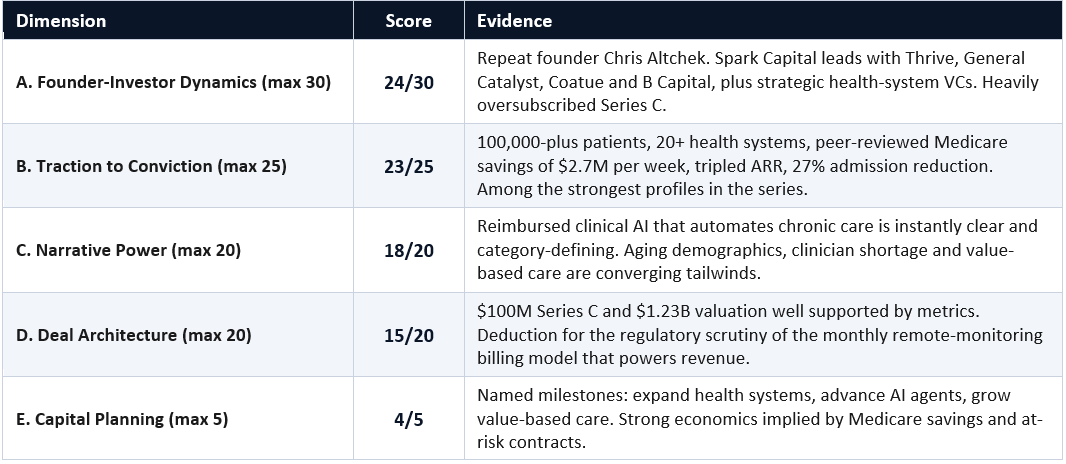
Why this scored: The highest score of the week, and of the series so far, reflects the strongest deployed-proof profile in the report. Cadence is not a model vendor selling into health systems. It is the care platform, rebuilt around supervised AI agents and reimbursed through billing infrastructure and at-risk contracts. The proof is verifiable in diligence: 100,000-plus active patients, more than 20 leading health systems, a peer-reviewed return of more than three dollars to Medicare for every dollar spent, roughly $2.7M in weekly Medicare savings, a 27% reduction in hospital admissions, and tripled annual recurring revenue in 2025. It stopped short of the 85 inevitability line for one reason: the billing model that powers the revenue is under regulatory and payer scrutiny.
The Setup: Led by Spark Capital, with Thrive Capital, General Catalyst, Coatue, and B Capital alongside strategic health-system investors Corewell Health Ventures, Memorial Hermann, and Duke Health, Cadence raised its $100M Series C at a $1.23B valuation. Founder and CEO Chris Altchek built a platform that takes on the routine, high-volume work of chronic care, monitoring patients between visits, surfacing risks, and coordinating action, so clinicians focus on the decisions that require them. The system is integrated directly into partner medical groups, electronic medical records, and clinical workflows, and it is governed by health-system clinical protocols. The thesis is blunt: the chronic disease crisis is a clinical labor problem, and the way to fix it is to automate care under close supervision and get paid for the outcome.
The Numbers: $100M Series C at a $1.23B valuation, bringing total funding to roughly $241M. More than 20 health systems, including new affiliations with Duke Health and Texas Health Resources. 100,000-plus active patients. Tripled annual recurring revenue in 2025. Roughly $2.7M in weekly Medicare savings, equal to about $1,302 per patient per year, and a peer-reviewed return of more than three dollars per dollar spent. Median response time to incoming vitals alerts is 3.5 minutes, with 55% resolved without human adjustment. A 230% increase in heart-failure patients on guideline-directed therapy and a 70% relative increase in blood-pressure control. Use of funds: expand across new health systems, advance the AI agents, and grow value-based care models.
Fundability Lessons: Cadence is the template for the reimbursed operator model. First, own the care and the revenue, so that AI improvements show up as your own economics rather than on a customer dashboard. Second, lead with peer-reviewed outcomes and Medicare savings, because clinical and payer buyers underwrite evidence, not features. Third, sequence the round to the proof: the published outcomes and the economic data are what enable Cadence to price a unicorn valuation for a $100M round.
Your Takeaway: If your category has a reimbursement path, model whether owning the workflow and billing the outcome produces better economics and a stronger moat than selling software into it. The fundable proof is the reimbursed, evidenced outcome you can show on patients or transactions you already serve, not the capability you could deliver.
The Founder Mistake to Avoid: Founders copy the operator label and lead with the proof, but ignore the fragility of the rail that pays them. Cadence scored 84, not 85, precisely because its monthly remote-monitoring billing model is under federal and payer review. The mistake is treating the reimbursement mechanism as a permanent moat rather than a risk to retire. Name the billing model exposure in your own narrative and show the plan if it changes before a diligence partner raises it for you.
Coval
Voice-Agent Evaluation Infrastructure | Series A | $28M | Valuation Undisclosed
Eisen Fundability Score: 76 / 100
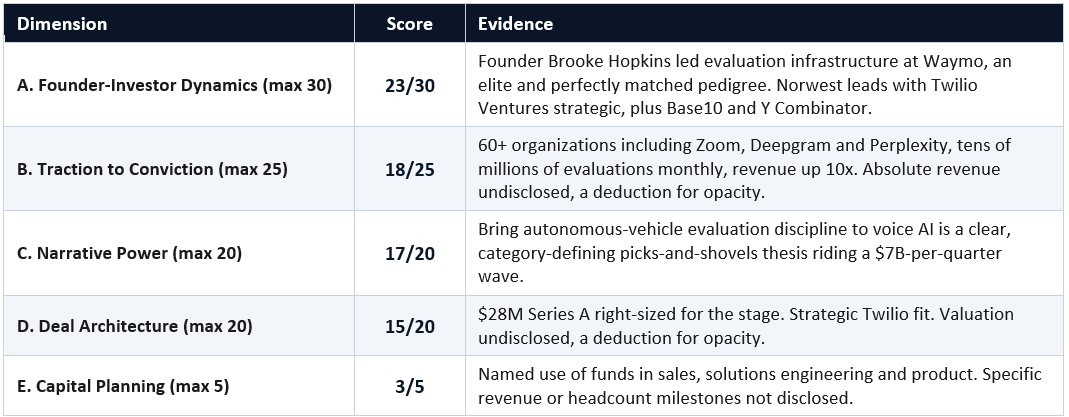
Why this scored: Coval is the cleanest reliability-layer case of the week. It does not build voice agents. It sells the proof that voice agents work, running tens of millions of simulated tests a month before any customer hears a call. The proof is adoption density, not a demo: 60-plus organizations, including Zoom, Deepgram, and Perplexity, revenue up tenfold year over year, and a manual quality-assurance reduction of up to thirtyfold. The score reflects an exceptional founder-market fit and strong adoption against an undisclosed valuation and an undisclosed absolute revenue figure.
The Setup: Founder and CEO Brooke Hopkins led evaluation job infrastructure at Waymo, where her team ran millions of simulated miles for every code change because a public-road failure was never an option. Coval brings that simulation-first discipline to voice AI. Led by Norwest, with Twilio Ventures as a strategic backer, plus Base10 and Y Combinator, the $28M Series A funds a platform that simulates thousands of difficult callers, monitors agents live in production, and automatically feeds failed calls back into testing. The thesis is that every company will run a voice agent the way it runs a website, and none of them can test it by hand at scale.
The Numbers: $28M Series A led by Norwest, with Twilio Ventures, Base10, and Y Combinator, bringing total funding to $31M since a 2024 launch. More than 60 organizations including Zoom, Deepgram, and Perplexity. Tens of millions of evaluations run per month. Revenue up tenfold year over year, though absolute revenue is undisclosed. The platform reduces manual quality assurance by up to 30-fold and speeds deployment by up to 10-fold. The broader voice AI market drew more than $7B in the first quarter of 2026 alone. Use of funds: expand sales and solutions engineering, deepen simulation, and add monitoring and human review.
Fundability Lessons: Coval is the transfer-the-discipline template. First, take a hard-won method from a high-stakes domain, autonomous-vehicle evaluation, and apply it to a new wave that needs the same rigor. Second, sell the proof layer, not the agent, so your fundability does not depend on winning the end market. Third, ground the pitch in adoption density, a partner can verify, the named logos, and the monthly evaluation volume, when absolute revenue is still early.
Your Takeaway: If a new category is racing toward production, ask what proof every deployment must pass before it can ship. If you can own that proof layer and show named adoption, you become unavoidable to everyone competing in the category, without having to win it yourself.
The Founder Mistake to Avoid: Founders in a hot category build the flashy agent and end up in a crowded, capital-intensive race. The mistake is competing in the gold rush instead of supplying the proof that the rush depends on. Coval scored on simulation volume and trusted logos, not on a louder model. If your category has a reliability bottleneck, owning it beats joining the crowd building on top of it.
Runlayer
AI Agent Governance and Control Plane | Series A | $30M | Valuation Undisclosed
Eisen Fundability Score: 74 / 100
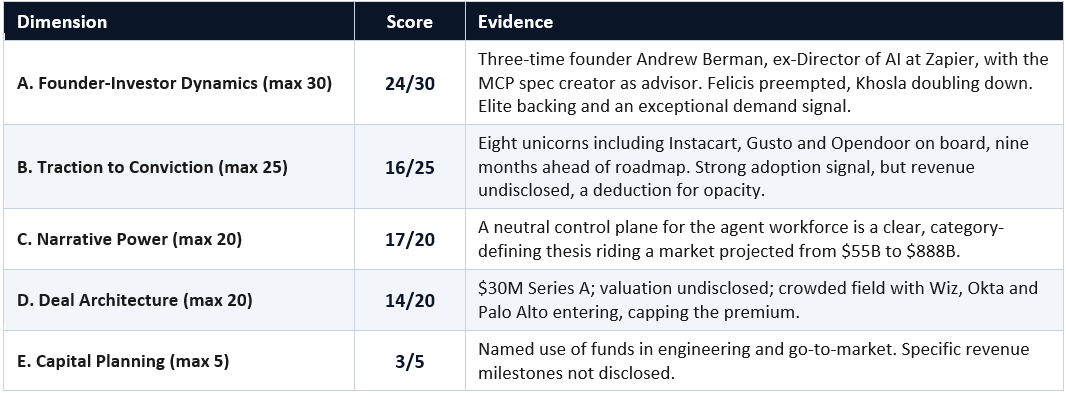
Why this scored: Runlayer is the governance-layer play of the week, and it carries the strongest demand signal in the report. It sells the neutral control plane that lets enterprises deploy AI agents without losing control: a sanctioned golden path with identity, permissions, audit logs, and policy enforcement on every agent action. The proof is the buyer roster and the capital conviction. Eight unicorns, including Instacart, Gusto, and Opendoor, were already on board, and Felicis preempted the round while a legendary investor reportedly wanted to buy every available dollar of it. The score reflects elite backing and a powerful wedge against an undisclosed revenue figure and a crowded competitive set.
The Setup: Runlayer is led by Andrew Berman, a three-time founder who built one of the first Model Context Protocol servers as Director of AI at Zapier and recruited the creator of the MCP specification as an advisor. The platform sits between employees and the agent ecosystem, supporting any AI client or agent while catching prompt injection, tool poisoning, data exfiltration, and shadow agents. The wedge is concrete: one customer discovered that an agent had burned through its entire annual compute budget in a single weekend while running in a loop. Felicis frames governance not as a tax but as the unlock, and describes Runlayer as a neutral cross-provider layer that no single platform can own.
The Numbers: $30M Series A led by Felicis with Khosla Ventures, bringing total funding to $42M after an $11M seed in November 2025 from the same two firms. Customers include Fortune 500s and high-growth companies such as Instacart, Gusto, Decagon, Opendoor, dbt Labs, AngelList, and Lemonade. Eight unicorns were on board at seed. The company reports it is nine months ahead of the roadmap it presented to investors. The agentic AI security market is valued at nearly $55B in 2026, with projections toward $888B by 2035. Revenue is undisclosed. Use of funds: expand engineering and go-to-market.
Fundability Lessons: Runlayer is the neutral control plane template. First, find the wedge that a hot, fast-moving standard leaves exposed, here, the security gaps in the rapid adoption of agent tooling. Second, sign sophisticated buyers fast, so the pitch is a unicorn roster and a preempted round, not a roadmap. Third, position as the Switzerland of the category, a neutral layer no single platform can own, which is what justified an elite firm buying as much of the round as it could.
Your Takeaway: When a new standard is adopted faster than it is secured, the governance and control layer becomes fundable only on demand. If you can be the neutral layer the whole category routes through, sophisticated early buyers will price your round before your revenue does. But know that the same demand attracts incumbents, so the buyer roster has to keep widening.
The Founder Mistake to Avoid: Founders in a hot infrastructure category raise on the size of the market and the logos and quietly skip the number. Runlayer earned its preempted round on a unicorn roster and a founder who built the standard, but its revenue remains undisclosed, which is exactly what capped the score at 74. The mistake is assuming the demand signal is a substitute for a disclosed metric. Even a preempted round scores higher when a real revenue figure sits behind the logos.
xCures
Clinical Data Infrastructure | Series B | $46M | Valuation $127M
Eisen Fundability Score: 75 / 100
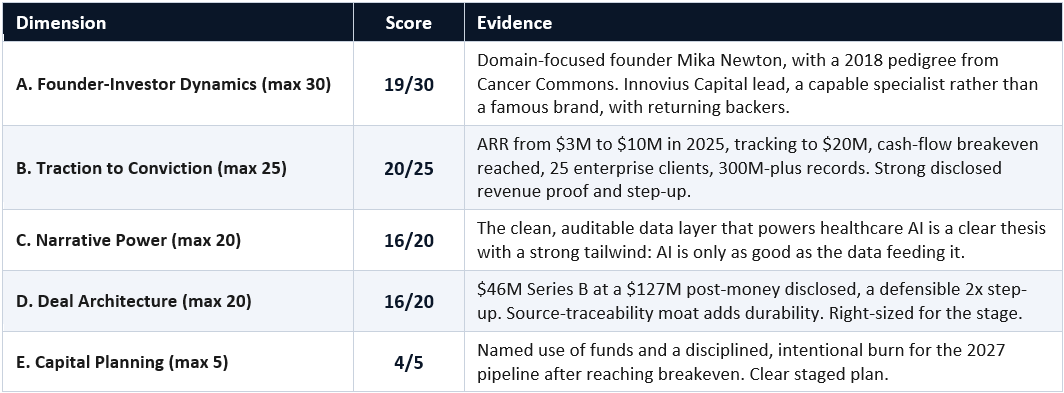
Why this scored: xCures is the data-layer play of the week, with the revenue to price it. It does not sell a clinical assistant. It sells the clean, auditable data substrate that every healthcare AI application needs, structuring fragmented medical records into decision-ready data. The proof is recurring revenue and a doubled valuation: annual recurring revenue grew from roughly $3M to $10M in 2025 and is tracking toward $20M, on a $127M post-money that is more than double the valuation of the prior Series A. The score reflects strong revenue proof and a defensible, auditable moat against a mid-tier lead and an early absolute scale.
The Setup: Founded in 2018 as a spinout from Cancer Commons and led by CEO Mika Newton, xCures built its Clinical Clarity Engine inside oncology, the most data-dense specialty in medicine, then expanded across all clinical domains. The platform locates, extracts, and normalizes messy data from thousands of incompatible sources, then enforces a strict source-traceability framework so every structured answer can be audited back to its origin. Led by Innovius Capital with iGrow, GKCC, and Spring Mountain Capital, the $46M Series B funds expansion of that clarity layer as the data foundation for healthcare AI.
The Numbers: $46M Series B led by Innovius Capital, bringing total funding to more than $76M at a $127M post-money valuation, more than double the valuation of the prior Series A. Annual recurring revenue grew from roughly $3M to $10M in 2025, tracking toward $20M in 2026, with cash-flow breakeven reached last year before an intentional burn phase. More than 300 million records processed across 550,000-plus sources. 25 enterprise clients, including Exact Sciences, Caris Life Sciences, and Novocure. Use of funds: accelerate product, expand the team, and broaden deployment across healthcare organizations.
Fundability Lessons: xCures is the auditable-substrate template. First, own the unglamorous data layer that every flashier application depends on, and then make it auditable to withstand regulatory scrutiny. Second, ground the pitch in recurring revenue and a clear step-up, the $3M to $10M growth, and the doubled valuation, so the data layer reads as a business, not a research project. Third, refuse the black box: the source-traceability moat is what lets a hospital trust the output and what a lightweight competitor cannot quickly replicate.
Your Takeaway: If your category has a data-quality bottleneck, ask whether owning the clean, auditable substrate is more defensible than building another application on top of dirty data. The fundable proof is recurring revenue plus a moat that a regulated buyer can verify, not the interface's elegance.
The Founder Mistake to Avoid: Founders chase the visible clinical application because it demos well, and end up dependent on a data layer they do not control. The mistake is building on the dirty data instead of owning the cleanup. xCures scored on revenue and an auditable moat, not on a flashy assistant. If your category has a trusted-data gap, owning it beats joining the crowd building applications that all need it.
Allium
Onchain Data Infrastructure for Institutions | Series B | $40M | Valuation Undisclosed
Eisen Fundability Score: 73 / 100
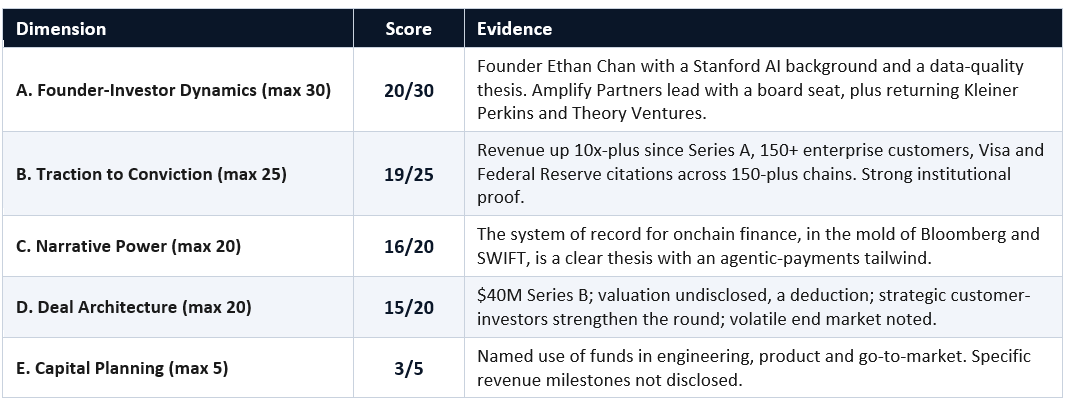
Why this scored: Allium is the system-of-record play of the week, and it survived a category shakeout to earn its round. It does not chase retail crypto. It standardizes and enriches blockchain data across 150-plus chains and sells it to institutions as the trusted source of truth for on-chain finance. The proof is the customer list and the revenue curve: Visa built its on-chain analytics dashboard on Allium, the Federal Reserve has cited its data, and revenue is up more than tenfold since the Series A. The score reflects strong institutional traction and a clear moat against an undisclosed valuation and a volatile end market.
The Setup: Founded in 2021 by CEO Ethan Chan, who studied AI at Stanford and learned that models live or die on data quality, and co-founder Cheng Han Lee, Allium turns chaotic on-chain data into queryable, finance-ready information. Led by Amplify Partners, with returning investors Kleiner Perkins and Theory Ventures, the $40M Series B funds the development of the data layer to enable institutional adoption of blockchain rails. The pitch is direct: global finance has Bloomberg for market data and SWIFT for payment messaging, but no shared, institutional-grade system of record for on-chain finance. Allium is building that source of truth.
The Numbers: $40M Series B led by Amplify Partners with Kleiner Perkins and Theory Ventures, bringing total funding to roughly $56M to $61M after a $16.5M Series A in 2024. Valuation undisclosed. Data standardized across 150-plus blockchains and more than four petabytes. Revenue has more than doubled since the Series A. More than 150 enterprise customers, including Visa, Stripe, Circle, and the Monetary Authority of Singapore, with data cited by the Federal Reserve and Stanford. The round closed as competitors consolidated under pressure. Use of funds: expand engineering, product, and go-to-market.
Fundability Lessons: Allium is the trusted source-of-truth template. First, pick the data layer that institutions cannot operate without and make it the cited reference; citations from the Federal Reserve and Visa carry more weight than any marketing claim. Second, survive a hype cycle by serving durable institutional contracts rather than retail momentum, which is exactly what kept Allium standing while crypto-native peers laid off staff. Third, frame the opportunity against an enduring analogy, Bloomberg and SWIFT, so investors price the category control, not the token cycle.
Your Takeaway: If your category has a fragmented data problem, the durable company becomes the standardized, cited source of truth for the institutions that must use it. Survive the hype by signing contracts that outlast it, and let a regulator or a household-name buyer validate your data for you.
The Founder Mistake to Avoid: Founders in a hype-driven category build for the loud, crypto-native audience and disappear when the cycle turns. The mistake is chasing momentum instead of institutional durability. Allium scored on Visa, the Federal Reserve, and a tenfold revenue curve, not on token enthusiasm. If your category runs in cycles, the fundable position is the boring, cited infrastructure that institutions keep paying for after the hype fades.
Fundraising Playbook: 5 Tactical Plans From This Week
Five plans, each producing a concrete output you can use immediately. No vague tasks. Each is built directly from this week's verified signals.
1. The Disclosed-Number Audit (Proof and Metrics Packaging)
Why this matters: The Eisen band split on one variable this week. Every deal above 70 disclosed a number; every deal below 70 withheld one. The market is scoring opacity as a missing metric.
Deliverable: A one-page proof sheet listing the single strongest number in each category you can defend: revenue or growth multiple, deployment or customer count, and outcome delta. Mark each as disclosed or withheld, and for every withheld number write the reason and the cost of keeping it private.
Time estimate: 2-3 hours, finalized before your next investor meeting.
Expected outcome: A clear view of where opacity is costing you score. If your numbers are strong, disclosure becomes your edge. If they are thin, you have identified the metric to build before you open the round.
Reframe: Wrong approach: keep the metrics private to preserve negotiating leverage. Right approach: lead with the disclosed number because, in this market, a withheld metric reads as weak.
2. The Action-and-Outcome One-Liner (Positioning and Narrative)
Why this matters: Attention, Cadence, and JustAI all cleared by completing a specific action and attributing the outcome. Standalone AI-for-X positioning was discounted this week.
Deliverable: A single sentence that replaces your pitch headline. Structure: we complete action Y and move metric Z. It must name the action your software actually performs and the result you can attribute to it, not a capability.
Time estimate: 2 to 4 hours, finalized before your next investor meeting.
Expected outcome: A headline that survives the first diligence question. Investors stop asking what your model can do and start asking how fast you can scale the action.
Reframe: Wrong approach: AI for revenue teams. Right approach: we sent the follow-up, updated the CRM, ran the next play, and lifted the win rate 40%.
3. The Reliability-Layer Map (Defensibility and Category Selection)
Why this matters: Coval and Runlayer cleared by owning the proof and governance layer of the Agent Wave rather than the agent. As applications commoditize, the reliability layer reprices above the app.
Deliverable: A one-page map of your category that names the substrate every competitor must route through: the data, the evaluation, the governance, or the rail. Mark whether you own it, can own it, or are merely a buyer of it, and what it would take to move upstream this quarter.
Time estimate: 3 to 5 hours, iterated against the question: what would a competitor with a better model still have to buy from someone?
Expected outcome: A defensibility statement anchored to an owned layer, so your round buys a moat rather than another feature.
Reframe: Wrong approach: our application is faster and better designed. Right approach: here is the proof, data, or governance layer every competitor depends on, and we own it.
4. Eisen Self-Score and Gap Diagnosis (Readiness)
Why this matters: This week's deals spread from 57 to 84. The gap between a fundable reputation and a fundable round was almost always a disclosed proof number or a defensible moat, the same two dimensions the score isolates.
Deliverable: Score your round across the five dimensions: founder-investor dynamics, traction to conviction, narrative power, deal architecture, and capital planning. Identify your lowest two dimensions and write one concrete action to lift each.
Time estimate: 2 to 3 hours, repeated before each raise.
Expected outcome: A ranked list of your two weakest dimensions, with a specific fix for each, so you can spend the next two weeks on the gap that is actually pricing your round down.
Reframe: Wrong approach: improve the pitch everywhere. Right approach: fix the lowest two scored dimensions and leave the rest alone.
5. The Reimbursement-and-Risk Stack (Regulated Categories)
Why this matters: Cadence posted the strongest proof of the week and still stopped at 84 because its billing model is under review. In regulated categories, the rail that pays you is both your moat and your risk.
Deliverable: A one-page stack with four lines: the billing code or contract that pays you, the audited or peer-reviewed outcome you moved, the system of record you integrate into, and the regulatory exposure of the billing mechanism, plus your plan if it changes.
Time estimate: 3 to 5 hours, updated each time the regulatory landscape changes.
Expected outcome: A defensibility statement that names your reimbursement moat and pre-empts the diligence question about its fragility, so a regulatory risk does not surface as a surprise mid-process.
Reframe: Wrong approach: our outcomes are strong, so the billing model is settled. Right approach: here is the outcome, here is who pays us, and here is exactly how we hold up if the billing mechanism changes.
Looking Forward: Next 1 to 3 Weeks
Three evidence-based scenarios and one wild card. Predictions are anchored to this week's verified data, not speculation.
Scenario 1: The Agent-Infrastructure Layer Keeps Pulling Capital (High Probability)
Evidence: Coval, Runlayer, and Netris all raised this week by selling the proof, governance, or networking layer beneath the agent and AI-compute wave. Capital is rotating toward the picks and shovels of the agent economy as applications commoditize.
What to watch: New rounds for agent evaluation, observability, governance, identity, and the data and networking layers that production agents depend on. Watch for strategics and platforms investing rather than building, the way Twilio Ventures backed Coval instead of shipping its own evaluator.
What founders should do: If you build anything in the agent stack, audit your position this week. Decide whether you own a proof, governance, or data layer that the whole category must route through, or are merely one more application. If you are an application, your moat lives in the layer beneath you, and your strategy needs to move there before your next round.
Scenario 2: Healthcare AI Keeps Pricing on Reimbursement and Evidence (High Probability)
Evidence: Cadence and xCures led the week's dollars by showing reimbursed savings, peer-reviewed outcomes, and a clean data layer. Two larger health AI rounds cleared just above the mid-market ceiling on the same logic. The proof bar in health is now economic and clinical, not technical.
What to watch: Health AI rounds that disclose a reimbursement path and a published or audited outcome in the announcement itself, rather than just an amount and a lead. Watch also for the regulatory thread: scrutiny of remote monitoring and AI billing models could quickly reprice the category.
What founders should do: If you plan to raise in health AI inside the next quarter, generate one more reimbursed cohort and one more outcome data point before you open the round. A single additional piece of economic or clinical proof is worth more right now than another model improvement.
Scenario 3: The Disclosure Premium Widens (Medium-High Probability)
Evidence: This week, the score band split cleanly on disclosure. Companies that put a number on the table cleared 70; companies that withheld one, however strong their pedigree, did not. The market is paying a premium for proof and discounting opacity.
What to watch: Announcements that lead with a deployment count, a revenue multiple, or an outcome figure in the headline, and a widening gap in process speed between founders who disclose and founders who do not. Watch for famous-founder rounds that stall when the metrics stay private.
What founders should do: Decide now which number you will disclose when you open your round. If your traction supports it, build the announcement around it. If it does not, treat the next two weeks as time to generate the figure, because pedigree alone is no longer pricing rounds at the top of the band.
Wild Card: Regulatory Scrutiny Reprices a Reimbursement-Dependent Category (Medium Probability)
Evidence: Cadence posted the strongest proof of the week yet, stopping at 84 because its core billing model is under review by the federal health watchdog and payers. The same scrutiny applies to a wide set of remote-monitoring and AI-billing businesses.
What founders should do: If your revenue depends on a billing mechanism that a regulator can question, treat that as a near-term risk to your next raise. Stress-test your model against a billing change, build the contingency, and name it in your narrative. The companies that pre-empt the regulatory question keep the multiple. The ones that get surprised by it negotiate against it.
The Bottom Line
The real insight is not the $353M total. It is that with the megarounds and IPO traffic removed, the market that actually prices your round revealed a single, consistent rule: capital paid for a disclosed number and an owned layer, not for narrative or pedigree. Three conviction profiles took the week.
Profile 1: Reimbursed operators. Cadence (84) owns the regulated care workflow and proves it with money saved and revenue booked. It runs the care, shows $2.7M in weekly Medicare savings, and tripled its recurring revenue in 2025. The proof is the reimbursed outcome, not the model.
Profile 2: Agent-economy infrastructure. Coval (76), Runlayer (74), Attention (74), and Netris (73) own the proof, governance, execution, or networking layer beneath the agent wave. Each is the substrate competitors must route through, and each is cleared on a disclosed deployment or revenue figure.
Profile 3: Trusted data rails. Allium (73) and xCures own the standardized source of truth that institutions and applications depend on. Allium is cited by Visa and the Federal Reserve. The proof is that the most demanding buyers reference them as the system of record.
Everything else competed for the residual. Hang Ten (61), Trovy (64), and JustAI (57) carried pedigree, a license, or a hot category but withheld their numbers, and the band placed them below the strong-execution line. The message is unmistakable. Own a reimbursed workflow, an agent-infrastructure layer, or a trusted data rail, and show the number. Anything short of that is a reputation competing for the leftover selectivity capital.
5 New Rules for Founders
Rule 1. Disclose the number. A withheld metric now reads as missing. Every deal above 70 this week led with a revenue figure, a deployment count, or a peer-reviewed outcome.
Rule 2. Sell the action, not the capability. Investors pay for software that completes a defined action and attributes the outcome, not for AI-for-X. Lead with what you do and what you moved.
Rule 3. Own the reliability layer. As agents commoditize, value shifts to the evaluation, governance, and data layers that every deployment must pass through. Own the proof, not the agent.
Rule 4. In health, lead with reimbursement and evidence. The fundable unit is a billing code, a peer-reviewed outcome, and an EMR integration. The model is not the moat. The paid, proven outcome is.
Rule 5. Name your most risk before the investor does. If the rail that pays you can be questioned by a regulator, that is your moat and your risk. Retire it in your own narrative.
4 Monday Actions
(1) Run the disclosed-number audit. List your strongest defensible numbers in revenue, deployment, and outcome. Mark each disclosed or withheld, and for every withheld one, write the cost of keeping it private.
(2) Rewrite your one-liner. Replace your pitch headline with: we complete action Y, and we moved metric Z. Name the action and the attributable result.
(3) Map your reliability layer. Name the proof, data, or governance layer every competitor must route through, and decide whether you own it or need to move upstream this quarter.
(4) Build the reimbursement-and-risk stack. If you are in a regulated category, write the billing code, the outcome, the system of record, and the regulatory exposure with your contingency plan.
Your competitors are reading the same tape. The founders who lead with a disclosed number this week own the conversation. The ones who lead with pedigree negotiate against the bar that just moved.
Research Methodology and Sources
Data collection period: June 22-28, 2026, with the bulk of verified primary disclosures clustered from June 23 to June 25. Verification standard: a minimum of two independent primary sources per featured deal, with company press releases and regulated newswires prioritized as anchor sources and at least one tier-one outlet per deal for corroboration. Eisen Fundability Scores are proprietary analytical estimates, not endorsements or investment advice. All dollar figures reflect announced primary capital at close unless noted.
Total deals tracked: 10 verified U.S. mid-market rounds, approximately $353M in combined primary capital, each round at or below $100M. Editorial scope for this issue excludes giant rounds and public-market events by request.
Core Capital Totals and What They Include
The $353M weekly total includes only the ten verified U.S. rounds in the scorecard, each independently confirmed at the stated amount and stage. Cadence at exactly $100M is included as the largest tracked round, at the mid-market ceiling. No announced-but-unclosed round was counted. No aggregator-only figure was treated as fact without corroboration in a company release or tier-one outlet.
Exclusions and Documented Rationale
• Giant rounds and public-market events, excluded by editorial scope: Baseten ($1.5B Series F), Peregrine Technologies ($250M Series D), and IPO and public-raise traffic.
• Above the mid-market ceiling, noted but excluded: Assort Health ($120M Series C, healthcare AI) and Taktile ($110M Series C, financial decision AI).
• Non-U.S. rounds, excluded for scorecard comparability: Superlight (UK), TRIMTECH Therapeutics (England), TensorX (Ireland), Stark (Germany), and CRED (India).
• Recirculated or prior-week: Connie Health ($40M Series B, announced June 18), Copia Automation ($26M, announced June 16), and Limitless Labs ($20M Series A, announced June 16 and Tel Aviv headquartered). Each surfaced in this week's daily roundups but belongs to the prior window.
Primary and Secondary Validation Sources
Anchor company and newswire sources reviewed for the featured deals include the BusinessWire releases for Cadence and Allium, the PRNewswire releases for Coval, xCures, Runlayer, Attention, and Trovy, and the company announcement for Hang Ten Systems. Tier-one corroboration reviewed includes STAT (Cadence valuation and billing-model scrutiny), Crunchbase News (xCures valuation), Fortune (Allium and Runlayer exclusives), TechCrunch (Netris and Hang Ten), SiliconANGLE and FierceHealthcare (Coval), and Morningstar and GlobeNewswire (Attention). Sector and macro context drew on the Tech Startups and VC News Daily daily funding roundups for June 23 to June 25. Secondary corroboration drew on citybiz, MobiHealthNews, HIT Consultant, FinSMEs, and additional trade outlets, each used only to confirm figures already anchored in a primary source.
Verification Notes
Nine of the ten featured rounds are rated HIGH source confidence, meaning each was confirmed by a company or lead-investor source plus at least one independent tier-one outlet. JustAI is rated MEDIUM because its metrics were disclosed only through daily funding roundups, and its score reflects a deduction for that opacity. Two valuation figures are flagged: Cadence at $1.23B is sourced to STAT, and xCures at $127M post-money is sourced to Crunchbase News. Three recirculated deals (Connie Health, Copia Automation, Limitless Labs) were identified as prior-week announcements and excluded. All internal figures in this report, including the weekly total, averages, median, chart values, and scorecard entries, were checked for arithmetic consistency before delivery.
Research completion timestamp: June 28, 2026.
DISCLAIMER: This article is for informational and strategic intelligence purposes only. It does not constitute investment advice. The Eisen Fundability Score is a proprietary diagnostic within Fundables OS™, not a financial recommendation.
If this article was useful, share it with founders who are about to raise.
— Leon Eisen, 4x Founder, Venture Capitalist, and Creator of Fundables OS™