


The Deck That Chose Inevitability Over Innovation
This isn’t a deck trying to win the “smartest model” contest. It’s trying to win the “new foundation for enterprise transformation” contest, and it succeeds through unusually disciplined brand, narrative, and proof choices.
Scribe’s public Series C deck (shared after raising $75M at a $1.3B valuation led by Redpoint) offers a masterclass in category repositioning. Some slides were redacted for public sharing, but what remains reveals a powerful strategic choice: deprioritize the expected elements (market sizing, competition slides, detailed business model) and instead create inevitability through clarity, enterprise proof, and data advantage.
What founders should study carefully is the belief-building slides and the category move.
Most investor decks follow the classic structure popularized by Sequoia: cover purpose, problem, solution, why now, market, competition, product, business model, team, and financials. Scribe intentionally breaks from this template because it’s playing a different game.
The Core Strategic Moves
Here’s what makes this deck work:
It leads with a category thesis, not features. “The Workflow AI platform” and “How work gets done” frames Scribe as an operating layer for enterprise transformation.
It sells “visibility” as the missing prerequisite for AI ROI. The centerpiece assertion, ”AI can’t fix what it can’t see,” transforms the pitch from “we automate tasks” to “we make AI adoption economically legible.”
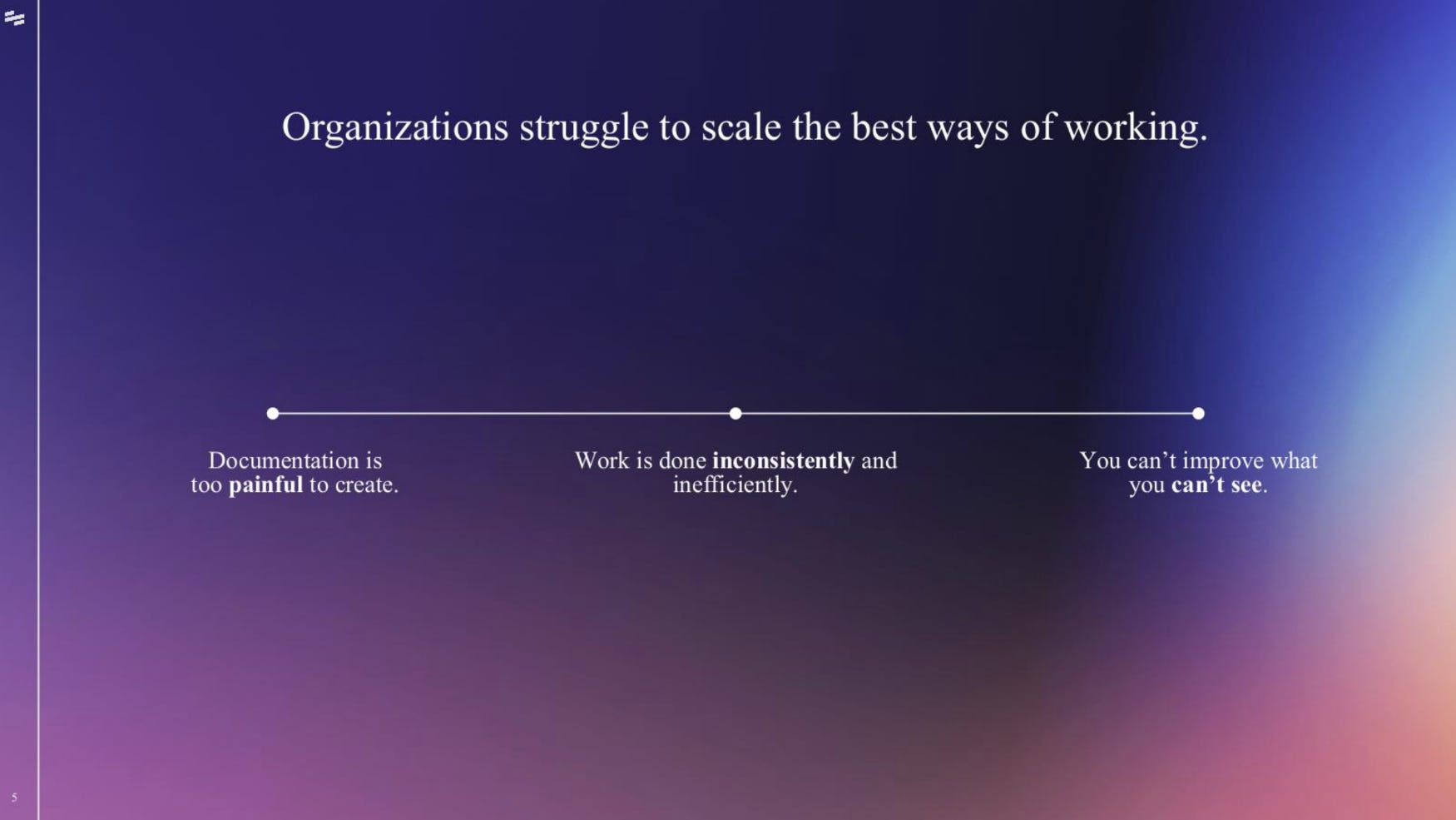
It compresses the problem into a causal chain. Instead of pages of market commentary, it uses three linked statements: documentation is painful, so work is inconsistent and inefficient, so you can’t improve what you can’t see.
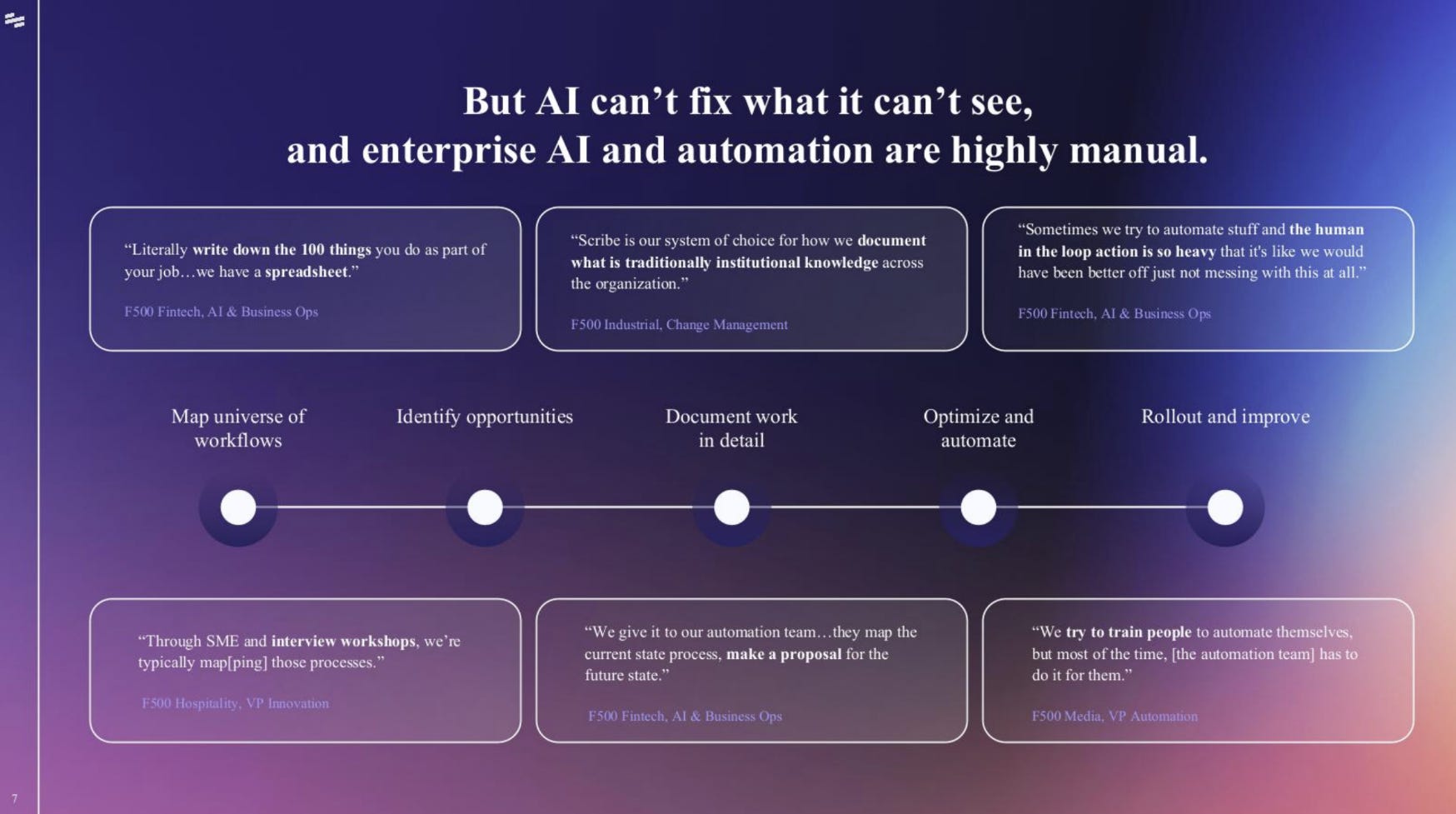
It foregrounds enterprise adoption as a manual reality. The deck depicts enterprise AI/automation as a stepwise, high-effort process (mapping workflows, identifying opportunities, documenting, optimizing, rolling out), not a magical agent story.
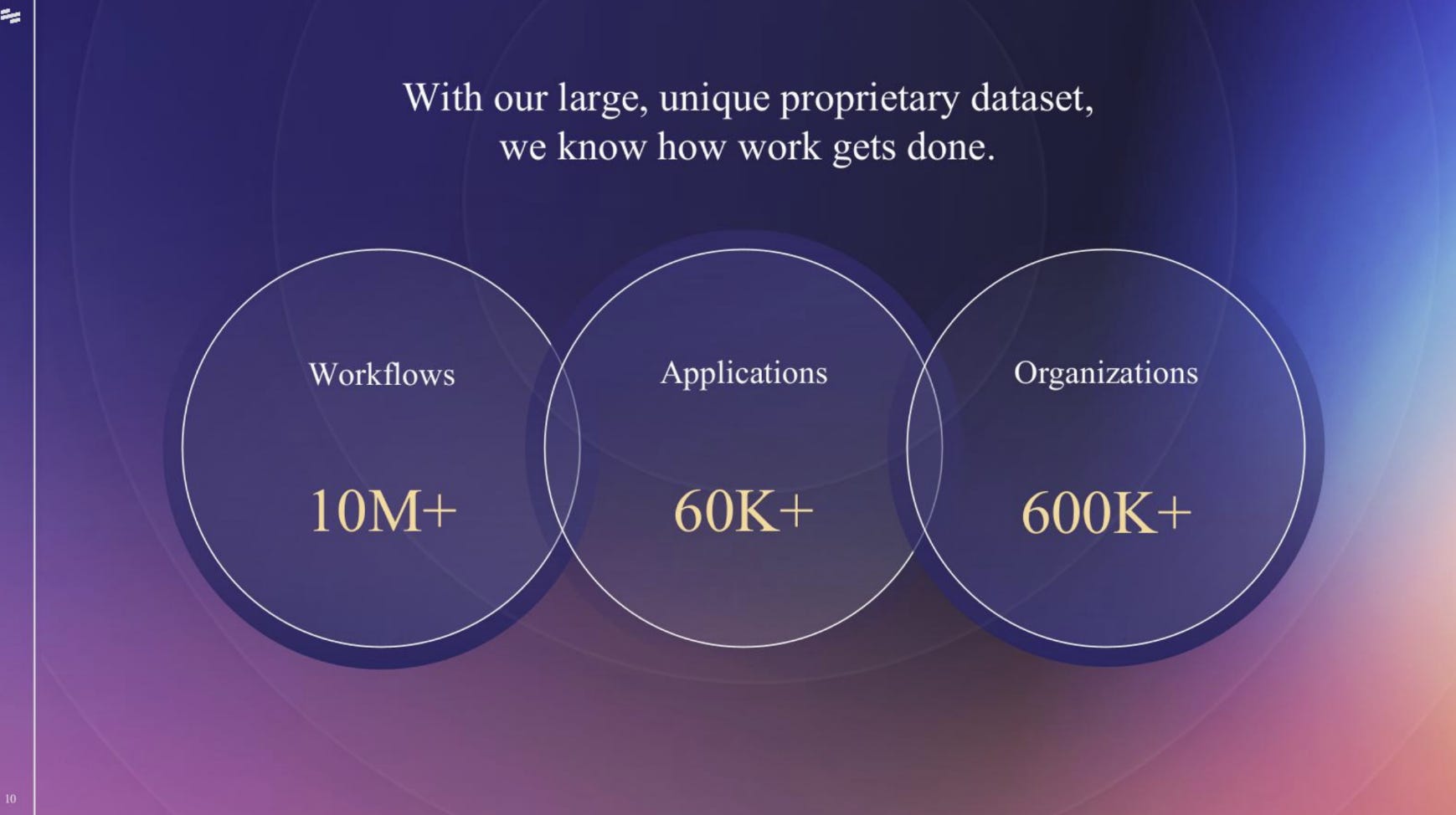
It expresses moat as asymmetric access to proprietary workflow data. The “10M+ workflows / 60K+ applications / 600K+ organizations” slide proves the value of what this company can see that others can’t.
The headline founder lesson: This is a category repositioning deck. It takes what most would call “SOP documentation” and reframes it as “Workflow AI,” a prerequisite layer for enterprise AI strategy. That move is supported by consistent language across all official materials (press releases, product pages), not just slides.
Narrative Map: Understanding Each Slide’s Job
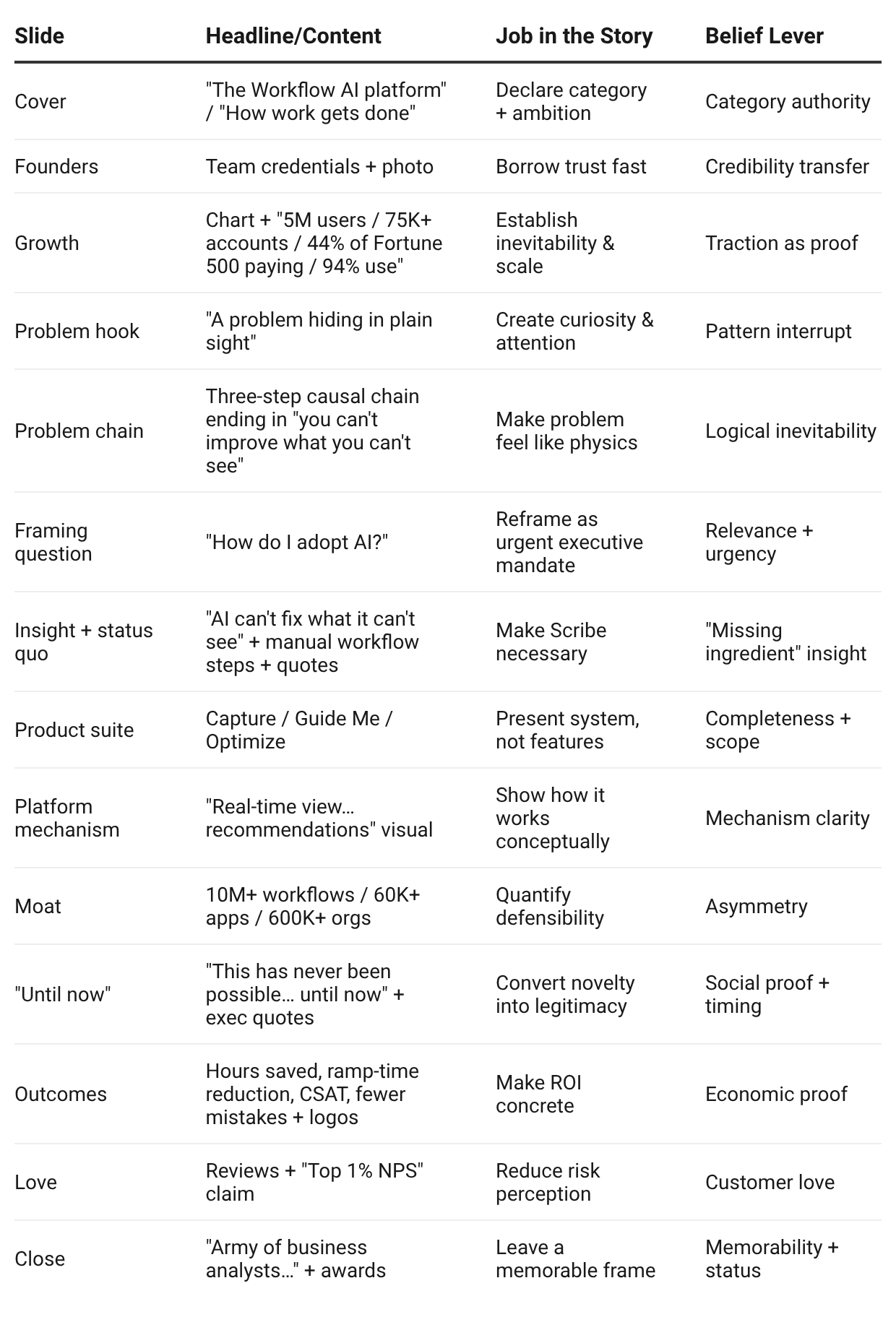
This narrative map helps founders benchmark their own decks by identifying each slide’s purpose, the belief it creates, and the proof it uses:
Benchmark Scorecard
This scorecard uses intentionally strict grading: a “5” means best-in-class for late-stage enterprise SaaS. Use this framework to audit your own deck.
Clarity: 4.5/5
Evidence: Category thesis is instantly legible (”Workflow AI platform”), and the problem compresses into a tight causal chain.
Founder takeaway: Clarity comes from short declarative sentences and one causal chain.
Differentiation: 4.0/5
Evidence: Differentiation is positioned as “visibility into real work” and a proprietary workflow dataset rather than “better AI.”
Founder takeaway: If your AI deck differentiates on “model quality,” expect skepticism. Differentiate on data, workflow position, and distribution instead.
Conviction: 4.5/5
Evidence: Conviction builds early through scale metrics (users/accounts/Fortune 500 penetration) and reinforces with outcomes and executive quotes.
Founder takeaway: Put your strongest proof before your product explanation if you can.
Moat: 3.5/5
Evidence: Strong dataset claim, but limited explanation of collection mechanics, defensibility, and why others can’t replicate. Public materials also show inconsistent numbers (”apps analyzed” varies between deck and press materials).
Founder takeaway: A data moat slide must answer: “why you can collect it,” “why it compounds,” and “why it’s hard to copy.”
Design: 4.5/5
Evidence: Consistent premium visual system with restrained gradients, large type, whitespace, and repetition of key words (”sight,” “AI,” “until now”).
Founder takeaway: Premium design isn’t decoration—it signals “enterprise platform,” not “tool.”
Sequencing: 4.5/5
Evidence: Tight sequence: thesis, trust, problem chain, AI mandate, insight/status quo, solution system, moat, outcomes, love, close.
Founder takeaway: The best decks feel inevitable because each slide answers the next question.
Slide-by-Slide Analysis and Lessons
Each analysis follows a four-part structure you can apply to any deck: job, what works, what breaks, and lesson.
Slide 1: Cover
Job: Name the category and set tone in under five seconds.
What works: “Workflow AI platform” + “How work gets done” is a category thesis, not a slogan. It’s broad enough to justify a platform but concrete enough to understand.
What breaks: The deck doesn’t define “Workflow AI” on the cover. It relies on later slides. Fine for warm intros, riskier for cold sends.
Lesson: Every deck needs a “company purpose” sentence that combines category + outcome, not “AI-powered X.” This should be one declarative sentence.
Slide 2: Founding Team
Job: Borrow credibility instantly.
What works: Credentials presented as trust logos and trajectory. Founders tied to recognizable companies and successful exits.
What breaks: The deck doesn’t tell the human reason behind the team. It shows strong resumes, but not “why we care about this problem.”
Lesson: If you have a strong background, show it fast. If you don’t, show proof you’re already strong in this market: customers, a real product, past wins, or a way to reach buyers faster than everyone else.

Slide 3: Growth & Penetration Metrics
Job: Establish inevitability. Prove the market is already pulling you.
What works: Right-rail metrics strategically separate adoption (”94% use”) from monetization (”44% paying”), implying a bottom-up wedge that converts to enterprise revenue.
What breaks: The growth chart’s unit is unlabeled (users? accounts? ARR?). Skeptics will discount it.
Lesson: A traction chart must answer three questions on-slide: What is the metric? What’s the time window? What’s driving growth?

Slide 4: Problem Hook
Job: Create attention and curiosity.
What works: The message is almost content-free, but that’s intentional. It causes readers to look for the hidden problem.
What breaks: Standalone hooks can feel like “marketing” if not followed by an immediate, concrete problem definition. This deck pays it off quickly, so it works.
Lesson: A “hook slide” is only justified if the next slide delivers specificity.

Slide 5: Causal Problem Chain
Job: Make the problem feel inevitable and structural, not anecdotal.
What works: The three-part causal chain ends with key framing: “You can’t improve what you can’t see.” This bridges from “documentation” to “visibility,” that’s the deck’s core category move.
What breaks: No costs attached (time wasted, dollars lost, risk exposure), which early-stage decks typically need.
Lesson: Replace “the market is huge” slides with causal chains. Add cost/impact if you don’t yet have enterprise-scale proof.
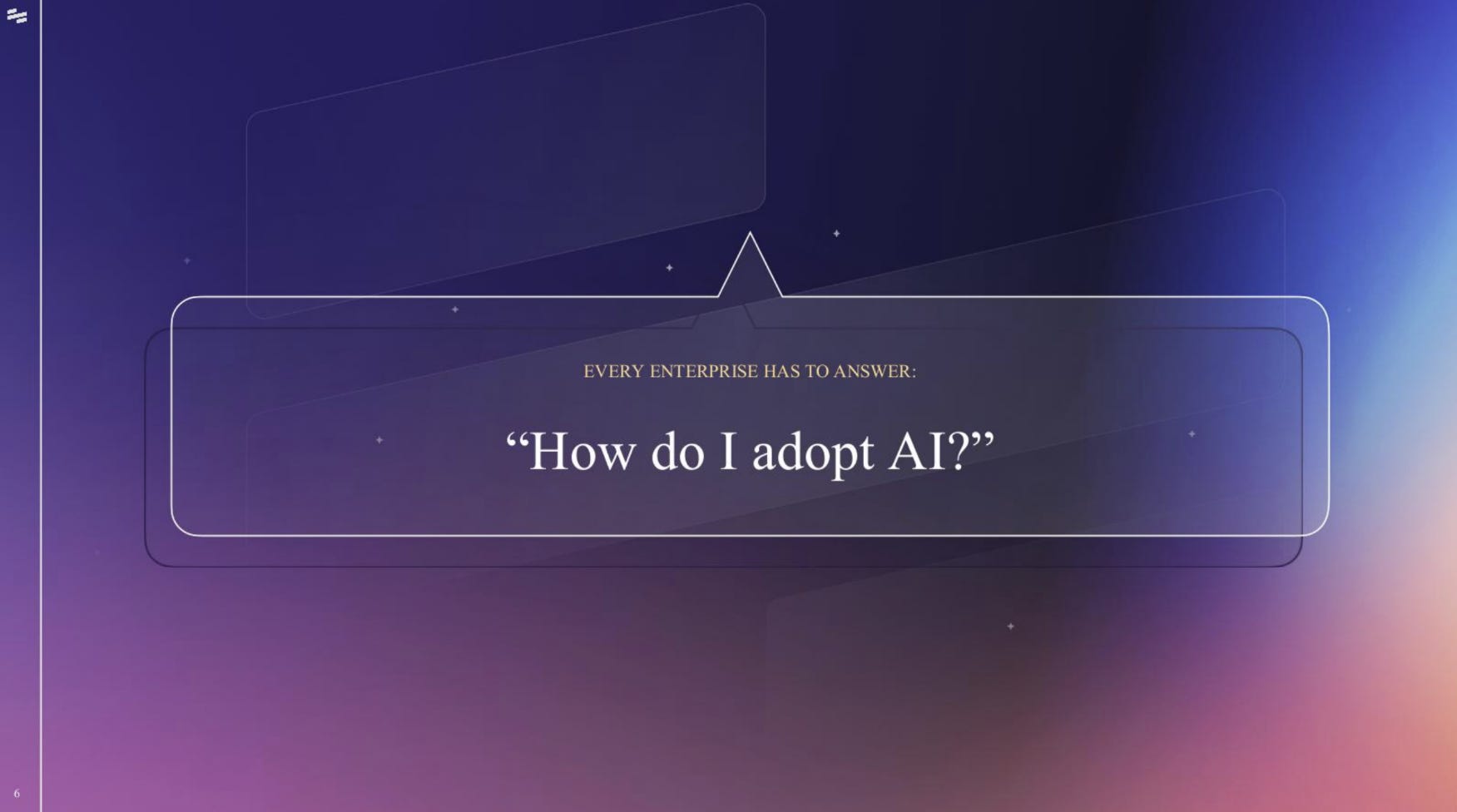
Slide 6: The Executive Question
Job: Reframe the problem as a board-level mandate around AI adoption.
What works: It transforms a workflow/documentation product into an “AI strategy” conversation, aligning with how budgets get allocated.
What breaks: The deck doesn’t quantify urgency (regulatory pressure, competitive threats, cost). Late-stage decks can lean on context; early-stage decks can’t.
Lesson: A single-question slide can be a powerful pivot when it matches the buyer’s language.
Slide 7: Core Insight + Enterprise Status Quo
Job: Deliver the “why now / why us” insight: AI adoption is manual because work is invisible; therefore, workflow visibility is a prerequisite.
What works: Visualizes a manual sequence (map to identify, document to optimize, and rollout) and overlays operator quotes, signaling deep empathy with enterprise reality.
What breaks: Quotes are anonymized (e.g., “F500…”), reducing verifiability. One named case study would strengthen trust.
Lesson: In AI decks, “we built an agent” is rarely enough. Show the precondition that makes your AI valuable: data, context, or workflow position.
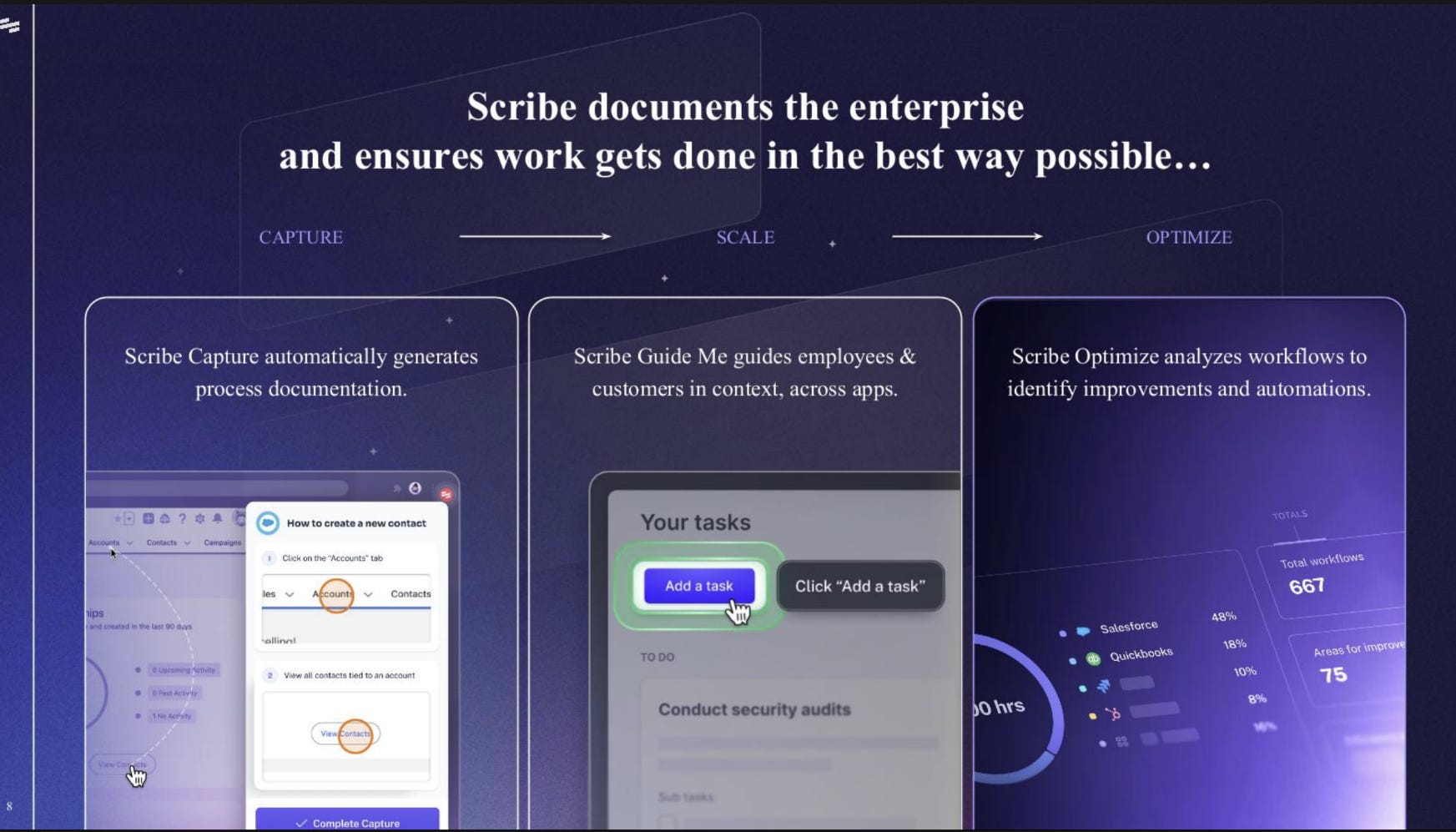
Slide 8: Product Suite as a System
Job: Show the product as an integrated platform (Capture, Scale, Optimize), not isolated features.
What works: Three modules imply an expansion path: start with Capture (easy adoption), then Guide/Scale, then Optimize (executive-level value).
What breaks: Multi-product slides can confuse early-stage investors (” What is the wedge?”). At Seed, you often need one flagship narrative.
Lesson: If you have multiple products, present them as a value chain with a clear starting point and upgrade path.
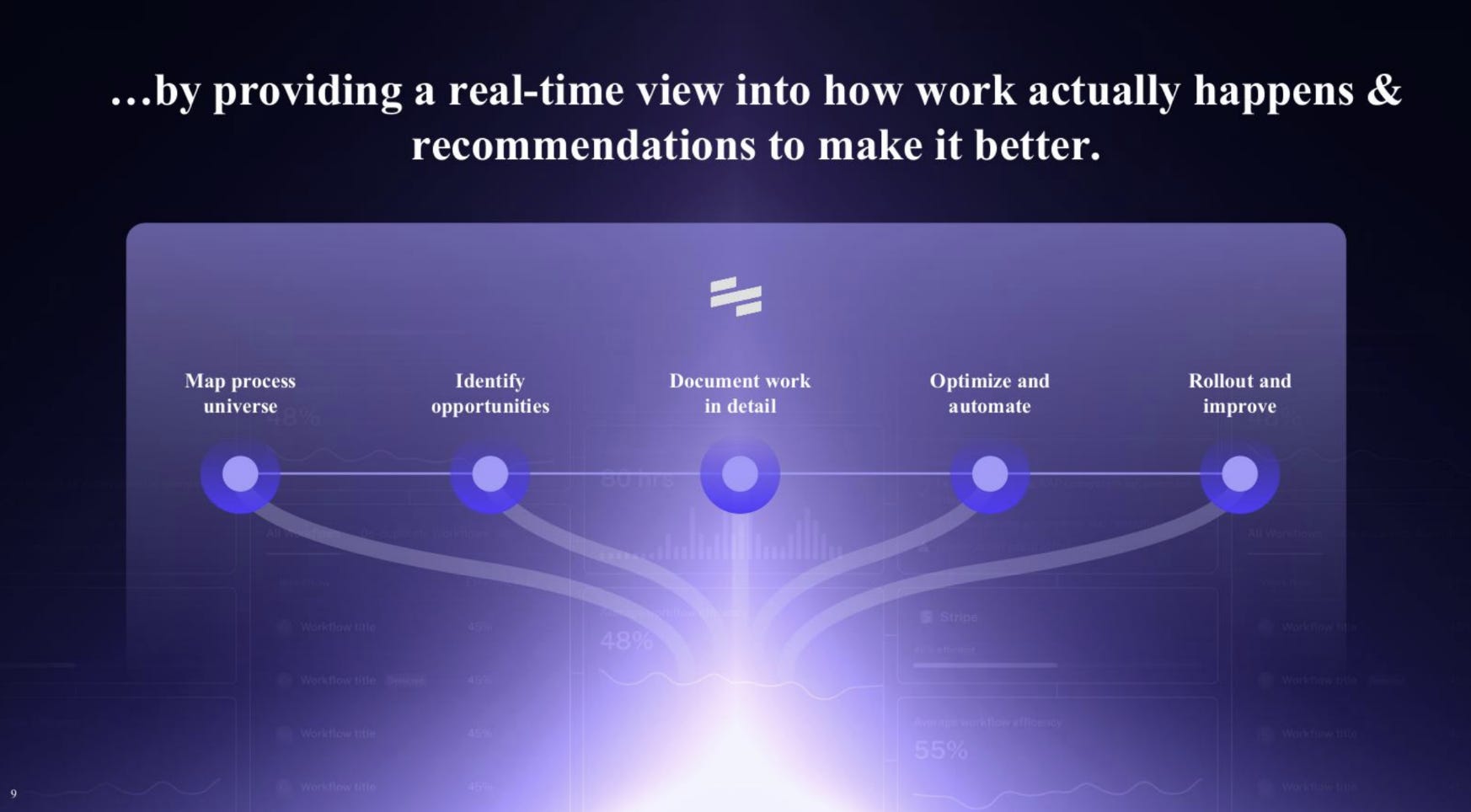
Slide 9: Real-Time View + Recommendations Mechanism
Job: Show the mechanism without deep technical detail: living workflow map, recommendations to improve/automate, rollout.
What works: “Real-time view” + “recommendations” frames Scribe as operational intelligence, not documentation.
What breaks: The slide is conceptual and risks feeling “hand-wavy” if you don’t already trust the company. This deck earns it by placing it after traction and before data moat.
Lesson: Abstract mechanism slides work best after credibility and before defensibility.
Slide 10: Data Moat
Job: Quantify defensibility and make it feel compounding.
What works: Three numbers imply compounding learning: workflows, applications, organizations. Instead of “we have proprietary AI,” it’s “we have proprietary operational reality.”
What breaks: Public materials may show inconsistent numbers. Deck shows “60K+ applications”; official press materials cite ~40K. This can trigger diligence questions when inconsistencies appear across collateral.
Lesson: A moat slide must be internally consistent across the deck, website, and PR. Define the metric precisely (”integrations,” “apps observed,” “apps captured”) and footnote it.
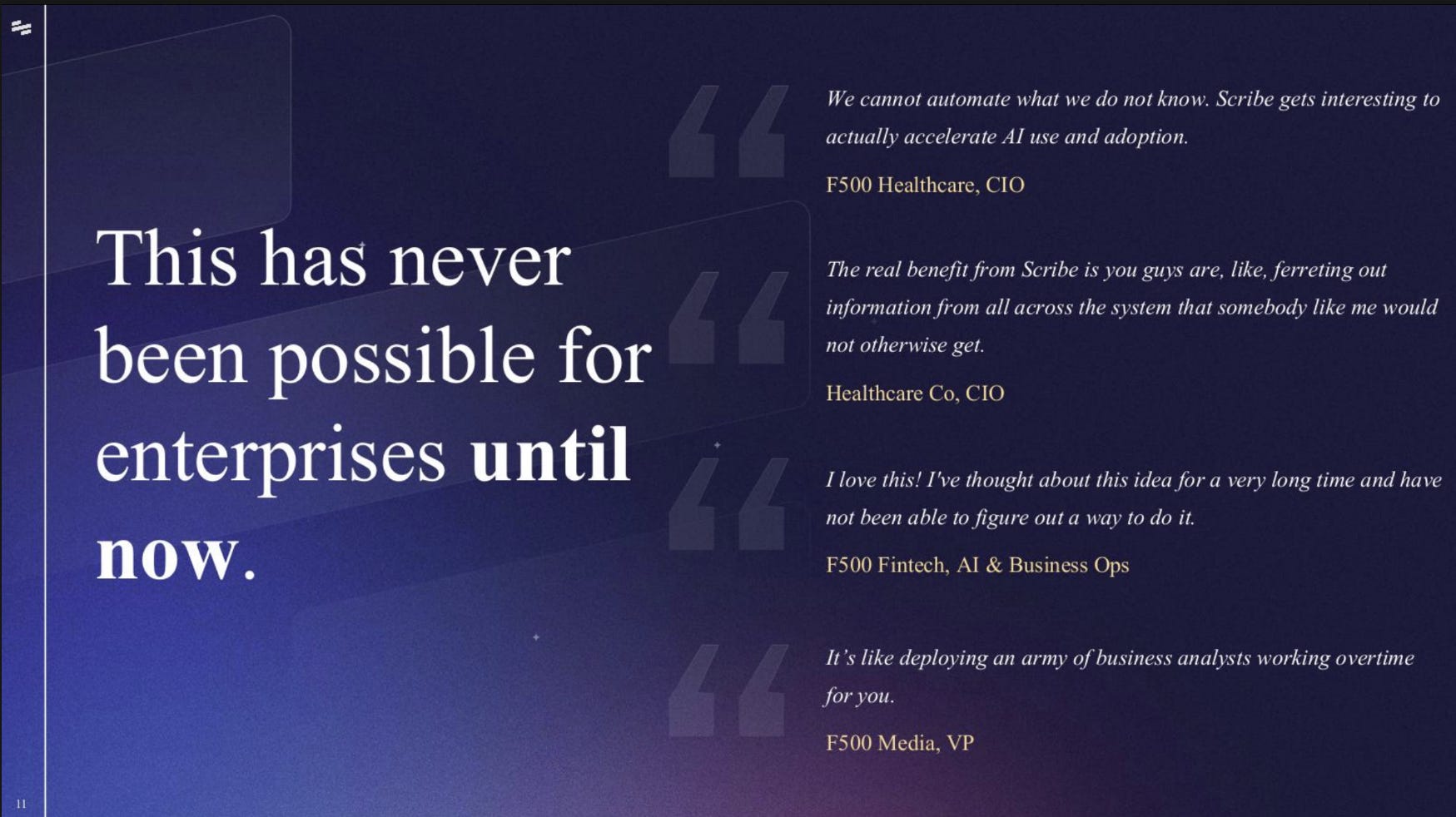
Slide 11: “Until Now” & Executive Quotes
Job: Convert novelty into legitimacy: “This is new, and serious people validate it.”
What works: “Until now” is powerful because it implies a structural shift. Quotes make readers feel “smart operators agree this is foundational.”
What breaks: Without named customers or quantified case studies, “until now” can read as marketing. The next slide partially fixes this with outcome metrics.
Lesson: If you use “until now,” follow immediately with measurable outcomes.
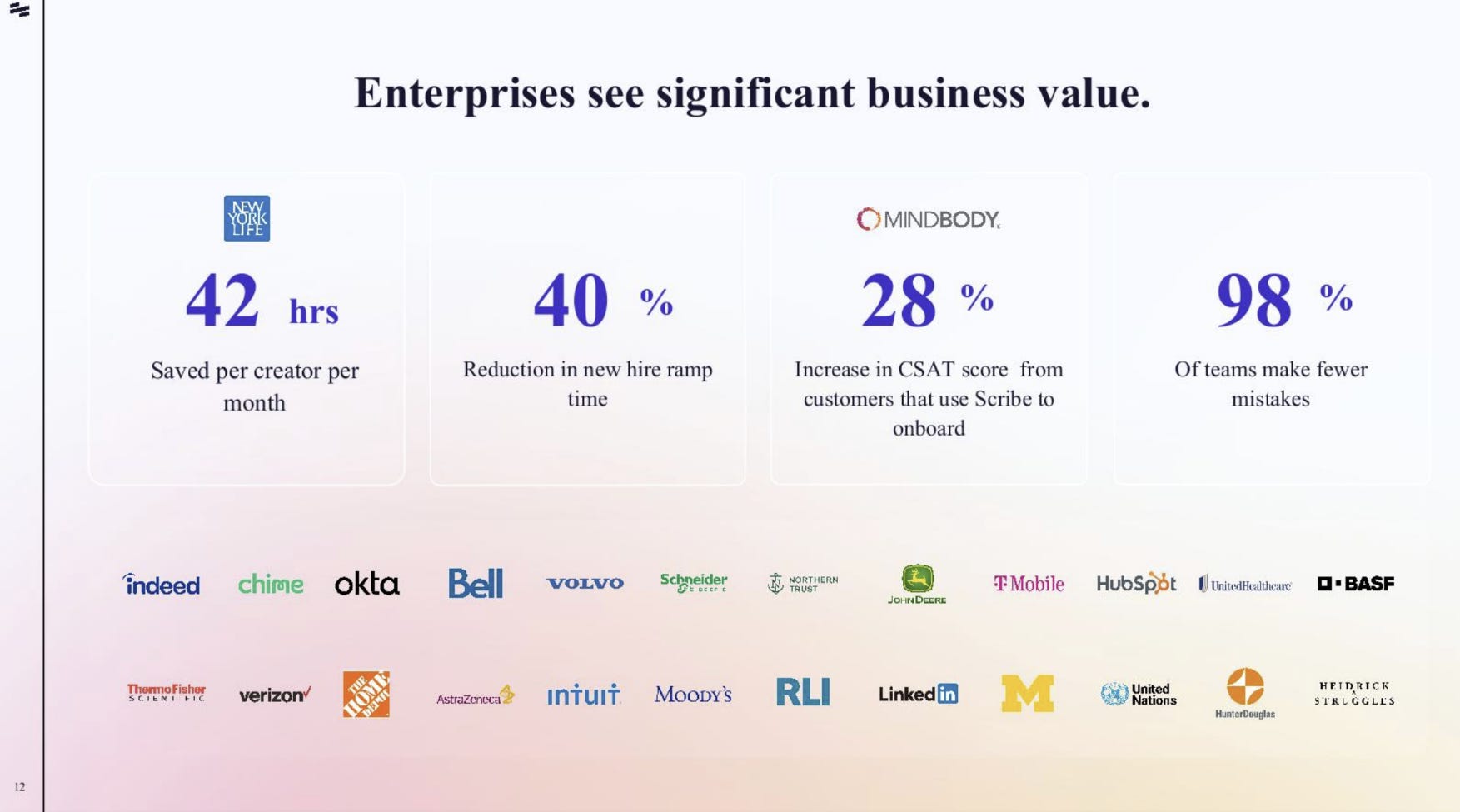
Slide 12: Outcomes & Logos
Job: Prove ROI in business terms, not features.
What works: Tight set of outcomes (hours saved, ramp-time reduction, CSAT lift, fewer mistakes) that map to budgets across enablement, operations, support, and compliance.
What breaks: Doesn’t show methodology (sample size, time window, baseline). Acceptable in a meeting if you can answer verbally; riskier when shared asynchronously.
Lesson: Outcome metrics become 2x more credible with one footnote: “Based on N customers, measured over X weeks, compared to baseline Y.”
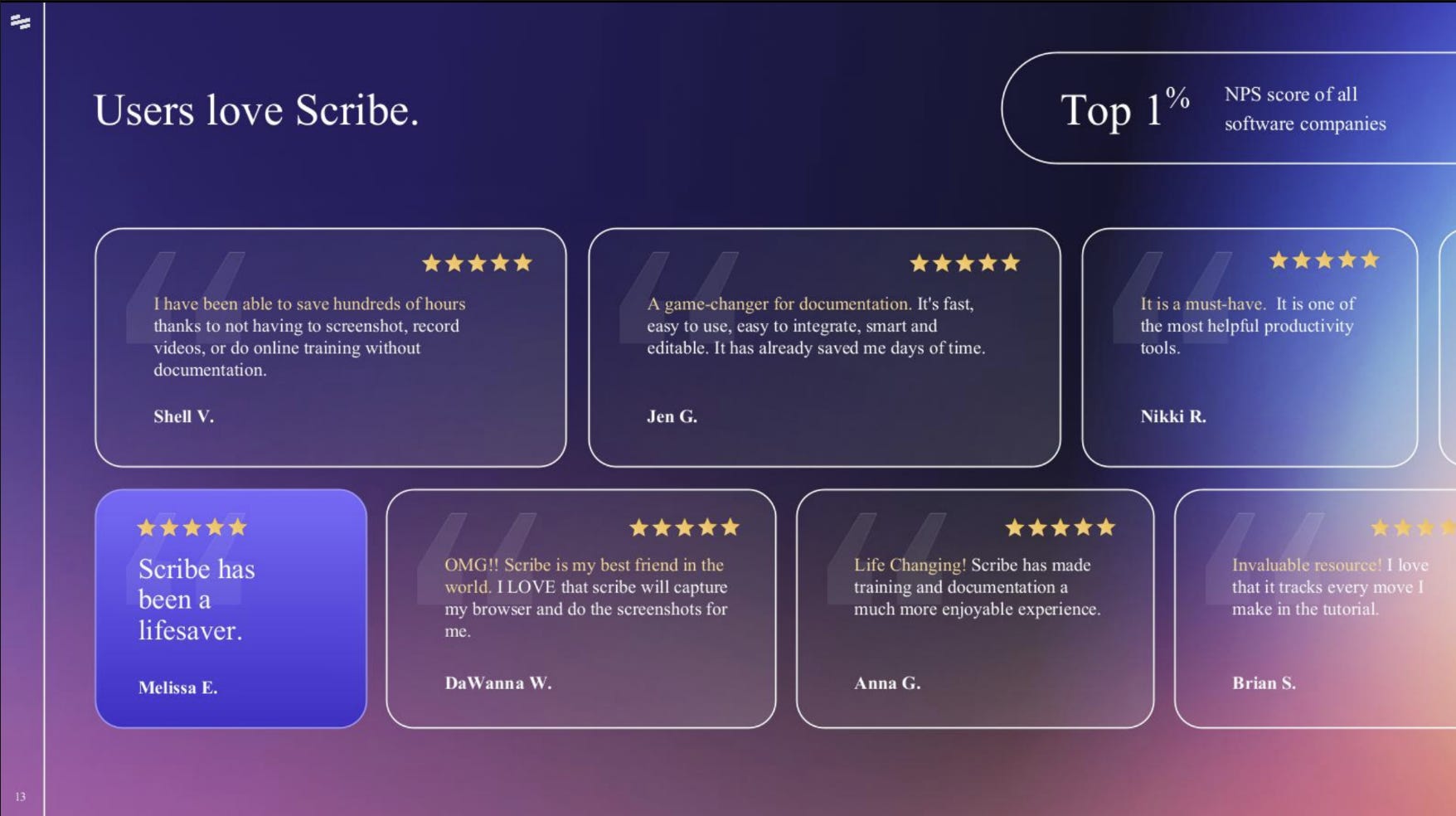
Slide 13: Reviews & NPS Claim
Job: Reduce perceived product risk (”people genuinely love this”).
What works: Looks like a review wall with star ratings and short quotes, signaling organic adoption and daily utility.
What breaks: “Top 1% NPS score of all software companies” lacks a citation. NPS is only interpretable when benchmarked against a survey method.
Lesson: If you cite a benchmark (”top 1%”), add source + methodology or change to something self-contained (”NPS = X across Y respondents”).
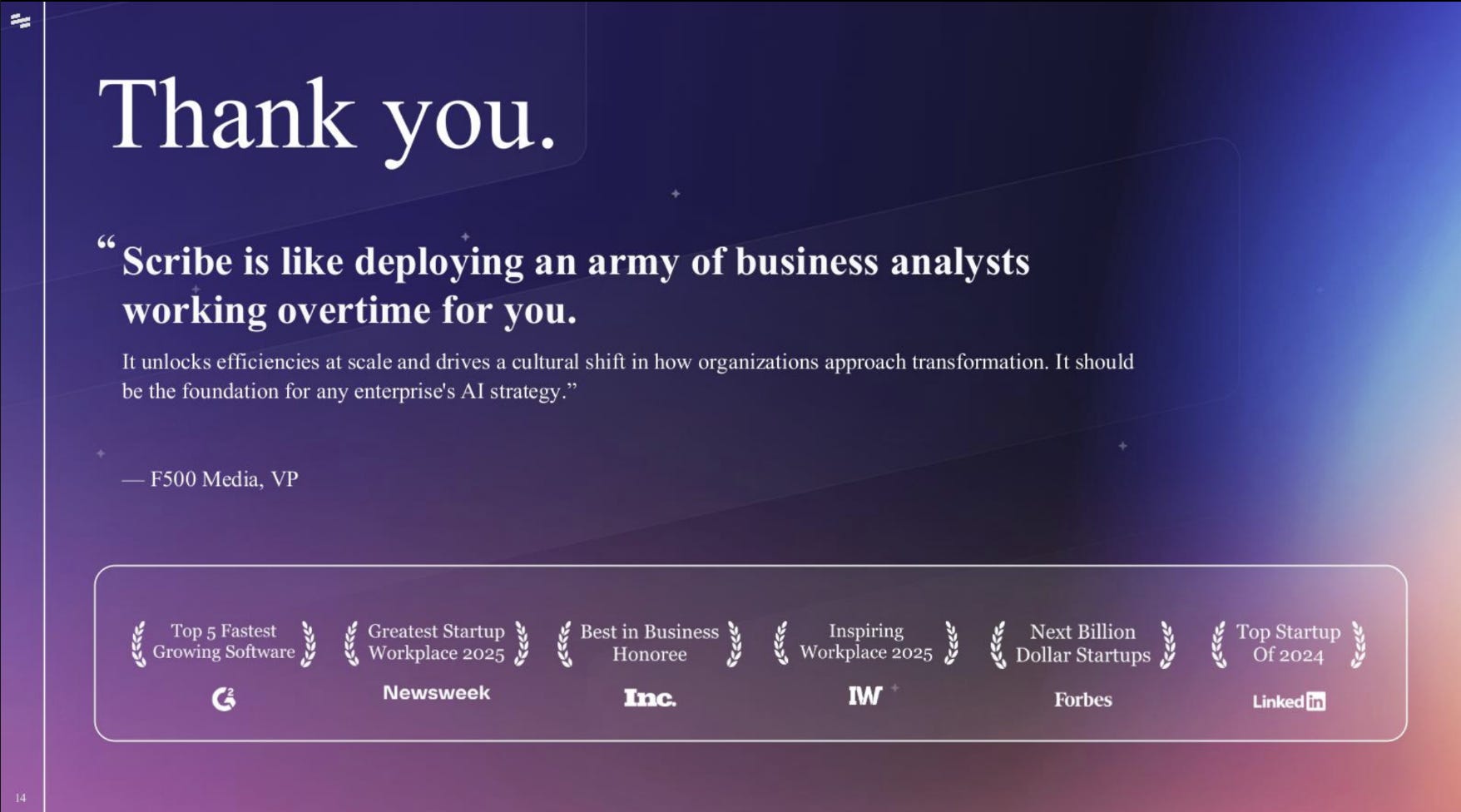
Slide 14: Memorable Frame & Validation
Job: Leave the investor with a sticky metaphor and credibility stack.
What works: “Army of business analysts” metaphor compresses the value proposition into a single image. Awards row adds third-party prestige.
What breaks: Awards can look like fluff if they aren’t recognized. Naming one or two with context (”ranked X in Y”) helps.
Lesson: Your last slide should not be “Thanks.” It should be the sentence you want repeated in a partner meeting.
Proof and Trust Audit
Where Proof Is Strongest
The deck is unusually proof-dense for its length. Within the first three slides, it establishes category + founder credibility + tangible scale, then returns to proof at the end through data moat and outcomes.
This aligns with Scribe’s official narrative: Optimize turns workflow data into measurable ROI, while Capture creates self-writing documentation with screenshots and text.
Trust Signals Used (and Their Verifiability)
Quantified adoption and penetration: “5M users,” “75K+ accounts,” “44% of Fortune 500 paying,” “94% use.” Strong signals but depend on definitions (what counts as “use,” “account,” or “paying”).
Dataset as defensibility: “10M+ workflows / 60K+ applications / 600K+ organizations.” Powerful, but diligence will ask about the collection method, freshness, and whether this data is truly proprietary and compounding.
Outcome metrics: Time saved, ramp time, CSAT, error reduction. Strong but needs methodology to become “institutional-grade.”
Operator quotes: Persuasive but anonymized. Consider upgrading one quote to a named customer with role + company if allowed.
NPS: Defined metric (promoters minus detractors), but “top 1%” should be sourced to avoid skepticism.
Trust Signals in Official Materials (Worth Learning From)
Scribe’s support documentation emphasizes enterprise readiness: security controls, data encryption, SOC 2 Type II audits, domain whitelisting (”does not capture outside approved domains”), and control over what gets saved/shared.
The support portal also describes how generative features handle data when using LLM APIs (e.g., not allowing training on customer data and data processing/retention constraints), a material trust issue for enterprise AI products.
Founder insight: These trust primitives exist even if the pitch deck only hints at them. Build the trust infrastructure, then let it show through subtly.
Positioning and Category Design
Scribe’s core positioning: “Workflow AI” is the missing foundational layer for enterprises trying to extract ROI from AI and automation.
The same category language is reinforced across official channels:
Workflow AI = visibility into how work gets done + ability to capture and optimize workflows
Optimize = “the foundation for your enterprise AI strategy” + making workflows visible and measurable
Founder-usable category design template:
Old frame: “Documentation/SOP tool” (useful but non-strategic)
New frame: “Workflow AI platform” (strategic foundation for transformation budgets)
Why that frame holds: Enterprises want AI mandates fulfilled, but cannot prioritize automation without visibility into real workflows (currently relying on interviews, workshops, consultants)
Design and Copy Patterns Worth Benchmarking
Founders can adapt these patterns (not copy the exact words):
Single emphasized word as concept anchor (”sight,” “AI,” “until now”). This reduces cognitive load and builds recall.
Causal chain copywriting: Three short statements connected by inevitability.
Ellipsis bridging across slides (”…ensures work gets done…” then “…by providing a real-time view…”). Creates continuity and makes the deck feel like one sentence rather than 14 isolated slides.
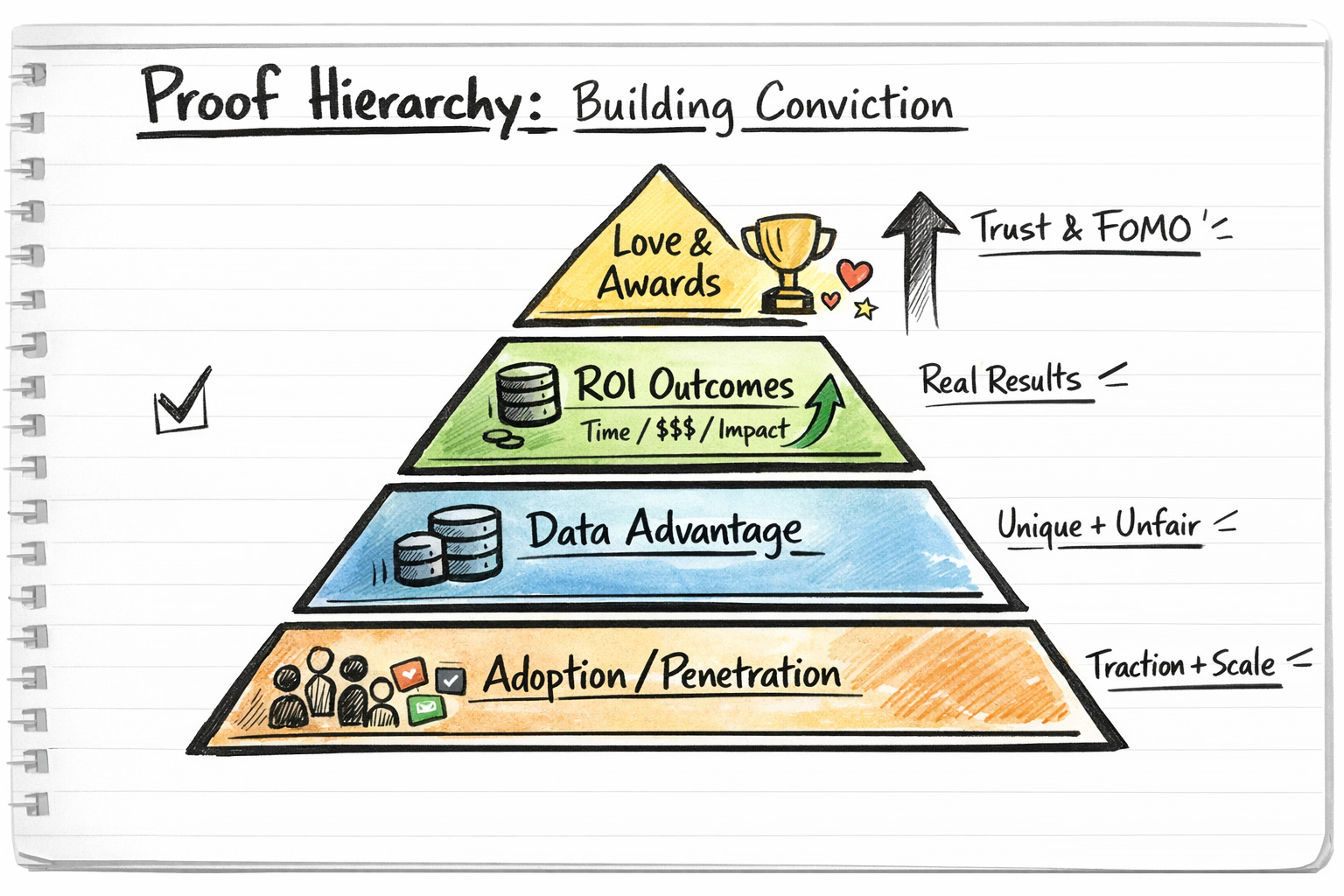
Proof hierarchy: Adoption/penetration, data advantage, ROI outcomes, love/awards. This is a reliable template for building conviction.
Founder Adaptation Guide
This deck is a benchmark—but you must adapt it by stage. The key is to preserve its belief sequence while restoring the “missing nodes” that early-stage investors require.
How to Adapt to Seed/Series A
Keep: Category thesis, problem chain, “why now” insight, mechanism, proof (even if your proof is smaller)
Add explicitly (usually required earlier):
Market definition and market potential
Competition/alternatives
Business model
Credible GTM plan
Reduce: Multi-product breadth unless you can explain the wedge. If you’re early, emphasize “start here, expand later.”
Action Plan: Apply This to Your Deck
These are concrete edits you can copy immediately:
Rewrite your cover slide as “category + outcome.” If your title is “AI-powered X,” rewrite it to “The [category] platform for [outcome].” Use one sentence.
Add a three-link causal chain problem slide. Force yourself into three short statements that end in a “missing ingredient” line (Scribe’s is visibility).
Insert a single “buyer question” slide that matches what your champion says internally (e.g., “How do we adopt AI safely?” or “Where do agents actually save money?”).
Replace your generic “market trend” slide with a “status quo is manual” slide. E.g., show the real enterprise workflow today (tools, spreadsheets, consultants) and why it fails.
Label your traction charts with units. Each graph must specify the metric, unit, cohort, and time window. Otherwise, investors discount it.
Separate adoption from monetization in your traction metrics. If you have both usage and paying signals, place them side by side to imply a conversion engine (bottom-up to enterprise).
Create a defensibility slide that uses numerical terms rather than adjectives. If you claim a “data moat,” quantify the data and explain why it compounds. Ensure the metric is consistent across deck/website/PR.
Upgrade one proof point to “audit-ready.” Pick one outcome metric and add methodology on-slide (N, baseline, window). This single footnote often raises credibility across the whole deck.
Fix benchmarking claims (especially NPS) with sources. If you say “top 1%,” cite the benchmark source and survey method, or replace with your raw number and sample size.
Close with a single repeatable metaphor + third-party validation. Your last slide should be the sentence a partner repeats. Awards help, but only if they’re recognizable or contextualized.
Reusable Mini-Template for Analyzing Any AI Startup Deck
Use this structure to self-audit or benchmark against any deck:
Identify the category claim
Map slide-by-slide jobs (what belief is each slide trying to create?)
Score: Clarity / Differentiation / Conviction / Moat / Design / Sequencing (1-5 scale)
Audit-proof and trust signals (quantified adoption, dataset claims, outcomes, quotes, third-party validation)
Produce a stage-specific adaptation plan
Conclusion: Scribe’s deck works because it doesn’t try to win on features or AI sophistication. It wins by making enterprise transformation feel inevitable and by making Scribe the obvious missing piece. That’s a playbook worth studying, adapting, and applying to your own fundraising story.