

Playbook, Perspective, and Pattern for founders raising now. This report strips out the mega-rounds and the public-market traffic, so you can read the part of the market that actually prices your Series A and Series B.
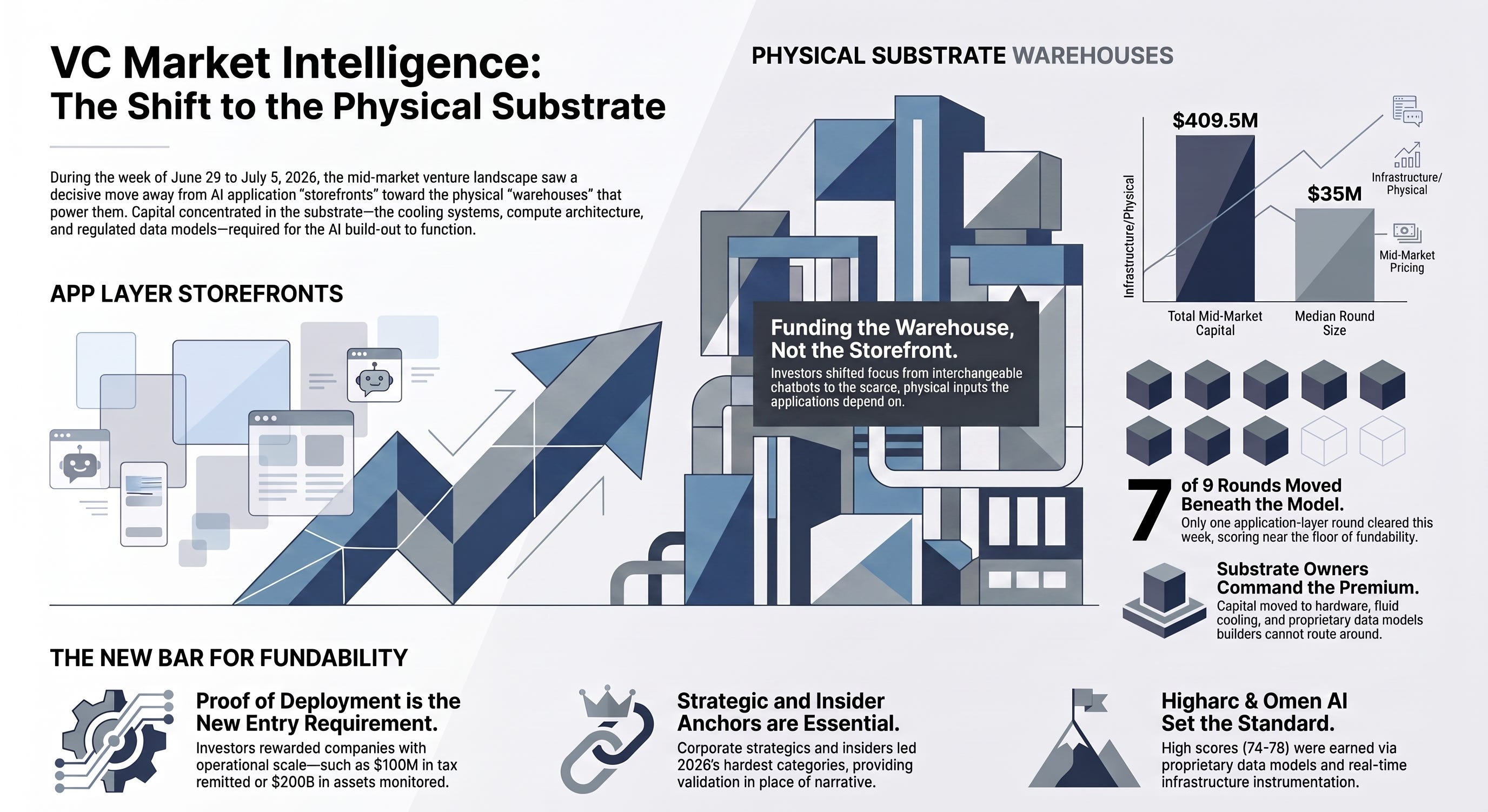
The holiday-shortened week of June 29 to July 5, 2026, was quiet at the top and loud underneath. Set aside the billion-dollar energy and cloud headlines and the public-market noise. What is left is the market that prices your round: nine verified rounds, every one under $100M, that together moved about $409.5M. Strip out the spectacle, and one pattern organizes the entire week. Capital did not chase another chatbot. It bought the layer beneath the model: the data-center coolant loop, the GPU architecture, the factory robot, the construction data, the tax engine. The money went where the AI build-out has to route.
A data-center company that already monitors coolant across $200B in installed assets raised at the front of this week. A tax platform that already remits roughly $100M in sales tax a year raised the same week. A homebuilding company whose builders standardize on its spatial data model raised the same week. None of them led with a model. Each one led with a physical or regulated layer it owns and a number it has already moved.
Here is the consequence for Monday. If your deck still sells a model on top of infrastructure everyone can rent, you are pitching the storefront in a week that funded the warehouse. The founders who owned the substrate underneath the application. Read every shift below through that lens. Each one tells you what to put on slide one before your next investor meeting.
The Week in One Sentence
Primary insight: With the megarounds and public-market filings removed from view, the mid-market repriced on a single axis this week. Capital concentrated in the physical and infrastructure layer beneath AI, the data-center hardware, the compute architecture, the regulated workflow, and the proprietary data asset, and it paid for deployed usage rather than narrative. In a truncated holiday week, volume fell, but the proof bar held.
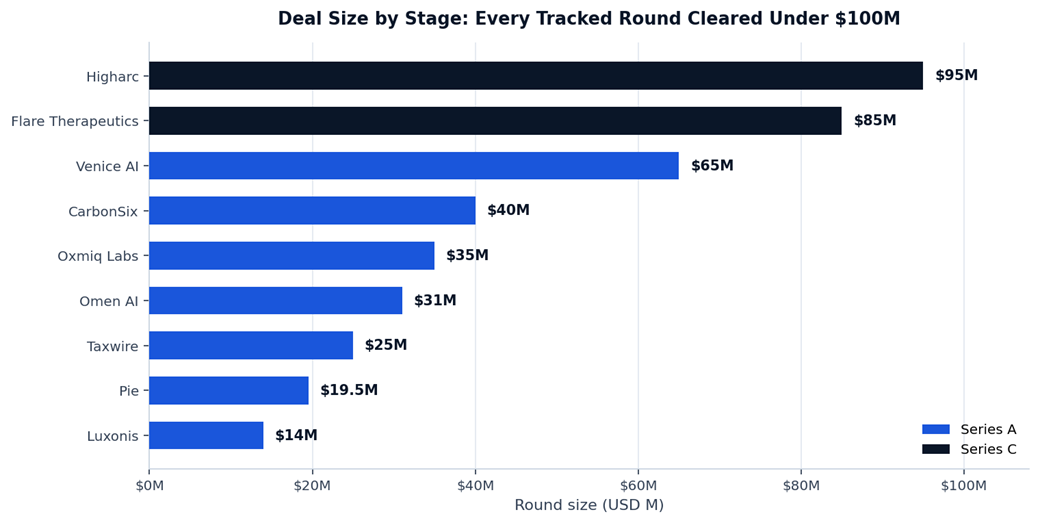
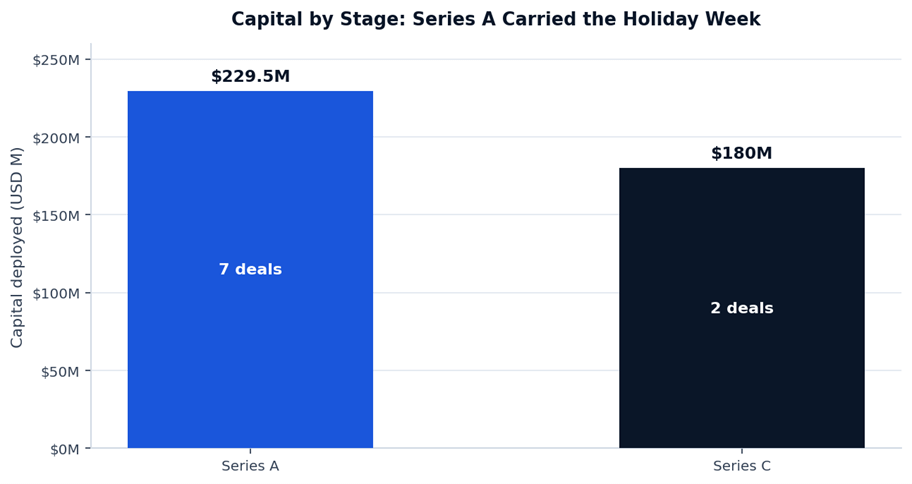
▪ Total tracked mid-market capital (9 verified rounds): approximately $409.5M, all under $100M per deal.
▪ Average round size: $45.5M across the nine.
▪ Median round size: $35M, the Oxmiq Labs round at the midpoint of the set.
▪ Disclosed valuations: only one of nine. Venice AI is at $1B, backed by disclosed profitability and more than $70M in annualized revenue. Eight rounds were undisclosed, which in a fast, insider-heavy holiday week is itself a signal of how quickly these deals closed.
▪ Largest tracked round: Higharc, $95M Series C, a homebuilding AI platform expanding into the building-materials supply chain.
▪ Highest Eisen Fundability Score: Higharc at 78, on the strongest deployed-proof and owned-data profile of the week.
▪ Defining structural feature: a tight Eisen Score band of 67 to 78. No deal reached inevitability, and the cluster shows the market is unusually consistent about what it now pays for beneath the model.
Recearch Methodology and Data Integrity
All nine featured rounds were verified against at least two independent primary sources, including company press releases, PRNewswire, BusinessWire, GlobeNewswire, and at least one tier-one outlet per deal, such as TechCrunch, Fortune, Reuters, SiliconANGLE, Crunchbase News, or DataCenterDynamics. Resolutions and exclusions applied during this week's fact-check:
▪ Editorial scope. Editorial scope this week excludes giant rounds and public-market events by request. Removed from the tracked set: Joulent ($1.75B), Together AI ($800M), LeapXpert ($180M), Celea Therapeutics ($180M), 8090 Solutions ($135M), and Beeline Medicines ($126M Series A extension). Under-$100M is the ceiling for this issue, so Twelve Labs ($100M Series B) and Premier Lacrosse League ($100M Series E) sit at the line and are excluded for comparability.
▪ Geography. The tracked nine are U.S. headquartered. Non-U.S. rounds in the window, including Quantum Systems (Germany, $1.2B), Qolab (Canada, $54.2M), Stathera (Canada, $55M), and Dominion Dynamics (Canada, $100M), are noted but excluded from the U.S. scorecard.
▪ Recirculation control. Several rounds surfaced in daily roundups this week, but they were closed or had already been announced earlier, so they are excluded. Probook ($40M, a16z and Sequoia) was announced on June 23 and only recirculated in a July 1 roundup, so it falls within the prior window. Scotch ($20M Series A) was announced on June 4. Lycia Therapeutics ($75M Series D) closed June 25. ThinkLabs AI ($28M) and Glimpse ($35M) both announced in the spring. Hang Ten Systems ($32M) was a June 24 seed. Apothekary ($16M) was raised in tranches across 2025 and early 2026. All are excluded from the tracked total.
▪ Stage and surfacing. 10Beauty issued a formal $23.5M financing release on July 1 with a new 850-machine deployment milestone, but the same figure circulated in trade coverage in late May and early June, so it is treated as recirculated and excluded from the total. Queue ($12.6M) is a seed round and falls below the priced-venture scope of this scorecard, which tracks Series A and later.
▪ Valuation and metric sourcing. Venice AI at $1B is the only disclosed valuation, sourced from the company release, TechCrunch, and GeekWire. Venice also discloses that it is profitable with more than $70M in annualized revenue, so its score is not penalized for opacity on those points. Eight of nine rounds did not disclose valuation, so those scores reflect a penalty for opacity rather than an assumption of strength. CarbonSix and Omen AI cite commercial traction without naming customers or breaking out revenue, so their traction scores are held conservatively.
▪ Application-layer inclusion. Pie ($19.5M Series A, NYC, Lightspeed-led, June 30) is the only application-layer round in the featured set. It is included because it is a clean, dual-source-verified, in-window U.S. mid-market round, and it is instructive precisely as the contrast: the app-layer deal was among the smaller checks and scored in the lower tier of the band.
Deal Scorecard
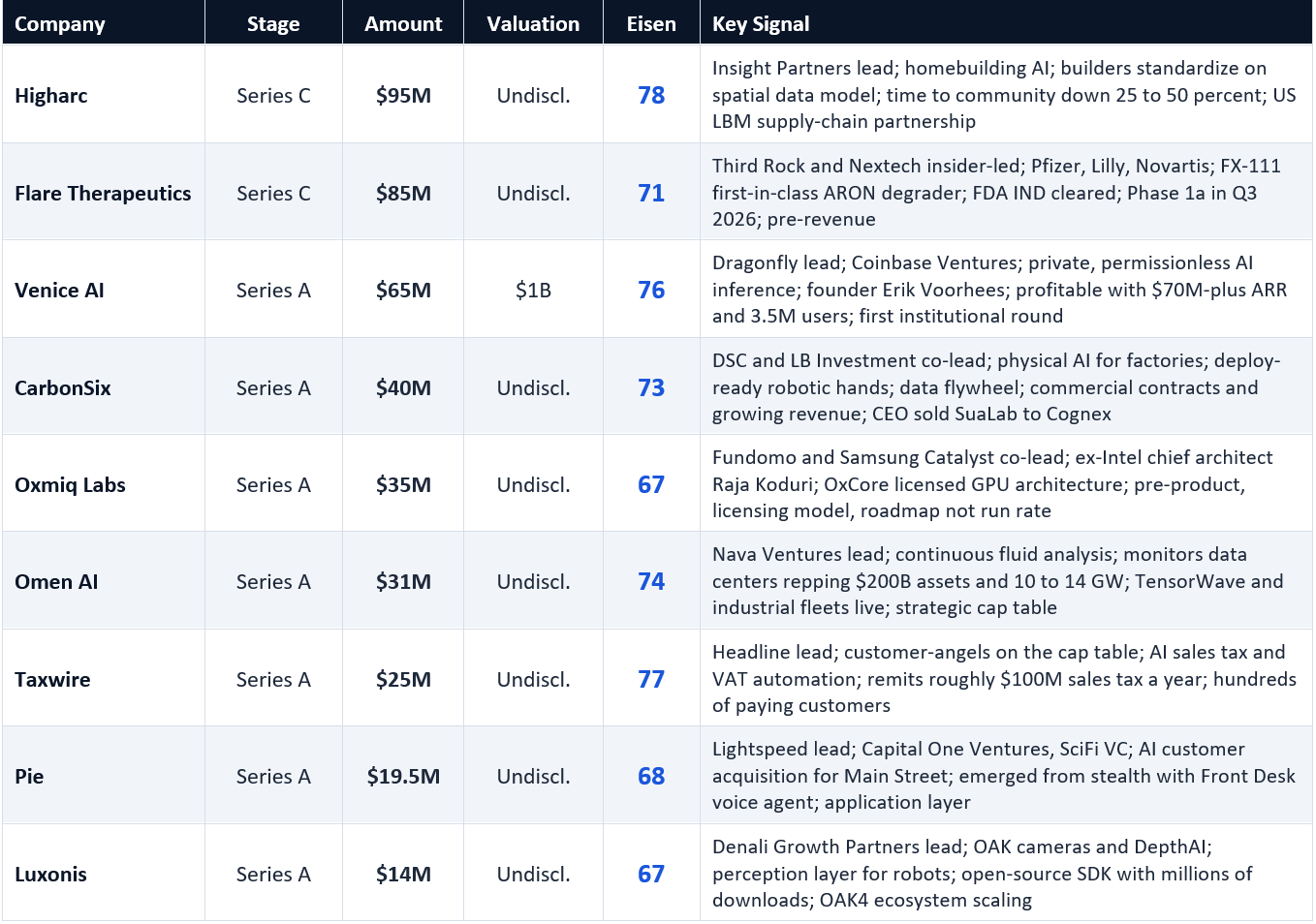
Eisen Fundability Scores are calculated across the 5Ps-weighted dimensions: Founder-Investor Dynamics (Process, 30%), Traction-to-Conviction Conversion (Proof, 25%), Narrative Power (Positioning, 20%), Deal Architecture (Packaging, 20%), and Capital Planning (Planning, 5%). Scores of 85 and above signal an inevitable outcome. Scores of 70 to 84 signal strong execution. Scores below 70 signal early-stage or the need for repositioning. Missing metrics are scored conservatively, and opacity is penalized rather than assumed strong.
What the Scorecard Says at a Glance
The band is the message. Every deal cleared between 67 and 78. That 11-point spread is among the tightest in this report series, and it sits below the prior mid-market issue. Remove the megarounds and the public-market traffic, and the market becomes remarkably consistent about what it rewards this quarter: a physical or regulated layer the buyer cannot route around, deployed at scale, with a number already moved. No deal reached the 85 inevitability line, because inevitability now requires the proof these companies have, plus the scale they are still building toward.
Higharc (78) is the cleanest case of the week. It scored highest not on a famous logo or a disclosed valuation, but on deployed proof a diligence team can verify: leading builders standardizing on the platform, product-development timelines compressed from months to weeks, time to community opening cut 25 to 50 percent, and margins up 10 to 15 percent, all anchored by a spatial data model that competitors cannot regenerate quickly. The US LBM partnership extends the owned data layer from builders into the building-materials supply chain, which is where the moat compounds.
Taxwire (77) and Venice AI (76) round out the top three on the same logic in different languages. Taxwire shows roughly $100M in sales tax remitted annually across hundreds of paying customers, so the agent is performing the regulated work, not assisting with it. Venice, the one disclosed valuation in the set, backs its $1B mark with rare proof for a first institutional round: profitability, more than $70M in annualized revenue, and 3.5M users. Different categories, identical underwriting test: real revenue and real deployment, not a narrative on rented infrastructure.
The lower band is instructive too. Oxmiq Labs (67), Luxonis (67), and Pie (68) anchor the floor for three different reasons. Oxmiq is a pre-product GPU-architecture licensing bet led by an elite chip founder, so its proof is a roadmap rather than a run rate. Luxonis is a strong perception-layer business positioned as a component that caps the premium. Pie is the one application-layer round in the set, a just-out-of-stealth SMB growth platform whose traction is real but early and self-reported. The scoreboard separates a fundable company from a fundable round, and the gap between the two this week was deployed proof plus a moat you can verify.
What Changed This Week: 5 Market Shifts
Each shift is verified against multiple primary sources and ranked by structural impact on founder fundraising, not by deal size. Every shift ends with what it means for your raise.
Shift 1: Capital Moved Under the Application Layer to the Physical Substrate
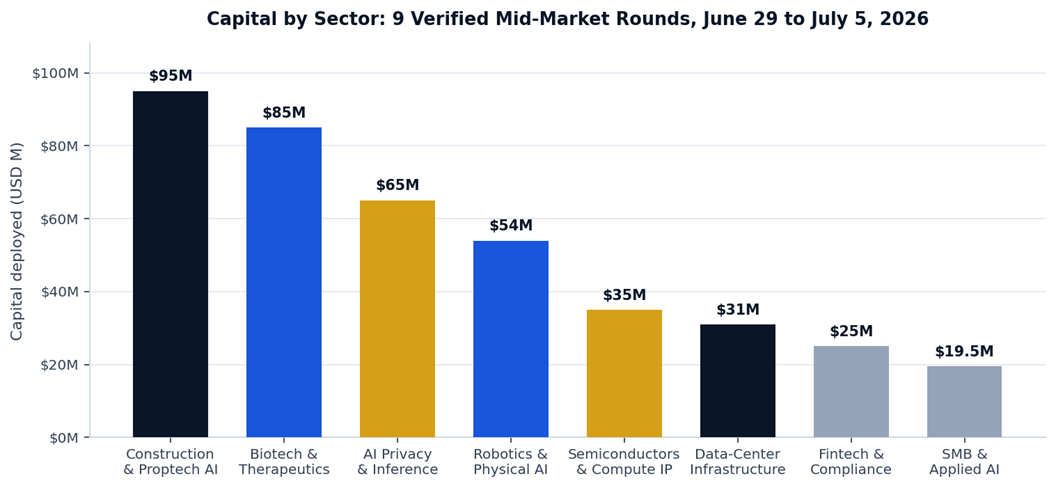
Pattern: Seven of this week’s nine rounds funded the layer beneath the model rather than an app on top of it. Omen AI offers continuous fluid analysis for coolant loops in liquid-cooled AI data centers. Oxmiq Labs licenses a GPU architecture meant to cut the cost of custom AI silicon. CarbonSix deploys physical AI and robotic hands onto factory floors. Luxonis builds the perception layer that robots see through. Higharc owns the spatial data model that homebuilding runs on. None of them led with a chatbot. The one pure application-layer round, Pie’s $19.5M for SMB customer acquisition, was among the smallest checks of the week and scored near the floor of the band.
Perspective: When the application layer commoditizes, value accrues to the scarce input the application cannot function without. This week, the scarce inputs were physical: coolant chemistry, GPU design, factory manipulation, machine vision, and construction data. Foundation models get cheaper and more interchangeable every quarter, so the durable value migrates to whoever owns the hardware, the substrate, and the data the model runs on. Investors underwrote the plumbing, not the prompt.
Founder Blindspot: Founders build the visible application because it is the part customers see and can demo well. Investors this week paid for the unavoidable layer underneath it, the sensor, the silicon, the manipulator, the data model that every competitor must buy or rebuild. The selection error is building the easy-to-copy surface instead of the hard-to-source substrate.
Playbook: Name the physical or infrastructure layer in your category that every competitor must route through. Compute, cooling, sensing, regulated data, a system of record. Then decide this quarter whether you own it, can own it, or are merely renting it. If you are a renter, your moat lives one layer down, and your strategy needs to move there before your next round.
Contrast: A year ago, an AI application with a slick interface opened a Series A conversation. This week, the capital moved a layer down, to the companies that the applications depend on. The picks-and-shovels layer is repriced above the storefront.
What this means for your raise: If a competitor with a better model could rebuild your product on the same rented infrastructure in 90 days, you are pitching the storefront. Find the physical or infrastructure layer behind it and reframe the round around owning that.
Shift 2: Proof of Deployment Held the Bar Even in a Quiet Week
Pattern: Volume fell over the July 4 holiday week, but every round that cleared led with deployed, measured usage rather than a demo. Omen AI: coverage of data centers representing $200B in assets and 10 to 14 GW of capacity. Taxwire: roughly $100M in sales tax remitted per year across hundreds of paying customers. Higharc: leading builders are standardizing on the platform with timelines cut in half. CarbonSix: robotic skills trained and deployed in under a day with commercial contracts in place. The proof was operational, not aspirational.
Perspective: In a week without megaround gravity, the discriminator between a yes and a maybe was documented usage at scale. Fewer companies were raised, and the ones that were were ones a partner could diligence in an afternoon: real deployments, real remittances, real customers already routing volume through the product. A quiet week does not lower the bar. It removes the cover that a hot narrative provides in a busy one.
Founder Blindspot: Founders assume a slow week is a forgiving week, that a thinner deal environment means investors relax the traction bar. The opposite is true. With fewer deals to react to, partners spend more time per company and scrutinize usage claims more closely. A large market with no proof reads as a science project. A smaller claim with dense, retained usage reads as a company.
Playbook: Build a one-page proof stack before your next meeting. Four lines only: units deployed, usage volume per period, the measurable outcome you changed, and your retention or expansion figure. If you cannot fill all four, your next two weeks should focus on generating the missing line rather than polishing the deck. Wrong approach: a roadmap slide of what the product will do. Right approach: a usage table of what it already does.
Contrast: In a busy 2024 week, a strong narrative could carry a thin metric into a first meeting. In this quiet 2026 week, the narrative brought nothing. Only the deployment did.
What this means for your raise: A story-only Series A deck gets delayed, not declined, in a quiet week, which is worse, because the delay burns runway while volume stays low. Put the deployment proof on page one, or expect to be asked for it before the second meeting.
Shift 3: Strategic and Corporate Capital Anchored the Physical Rounds
Pattern: Where the hardware, the supply chain, or the regulated risk was hard to underwrite, a strategic or corporate investor showed up on the cap table. Samsung Catalyst and MediaTek backed Oxmiq in chip architecture. Executives from Mann and Hummel, Johnson Controls, GM, and Bridgestone backed Omen AI in industrial fluid systems. US LBM anchored Higharc as a supply-chain partner. DSC, LB Investment, and Korea Development Bank backed CarbonSix in manufacturing. These are not passive checks. They are channel and validation.
Perspective: In hard categories, the right capital arrives with distribution and a reference customer, not just a wire. A strategic on the cap table is a channel into a factory, a foundry relationship, a supply-chain partner, or a signal that a large industrial buyer has already validated the technology. That is why physically complex companies closed quickly this week: the strategic could underwrite the specific risk and shorten the path to the next deployment.
Founder Blindspot: Founders in hardware and infrastructure still default to a generalist venture process. The cost is weeks spent educating investors who cannot price the physical risk, only to end in a soft pass. The selection error is the fundraising mistake. The wrong pool is more expensive than the wrong deck.
Playbook: Segment your target list this week by who brings channel or validation in your exact category, not by brand or fund size. For each name, write the specific deal they did in your space and the warm path to them. Lead outreach with the strategics and corporates who can underwrite your hardest physical risk. The right $20M from a domain strategist outperforms a larger check from a generalist who needs to be taught the category.
Contrast: In the 2021 cycle, generalist enthusiasm funded almost every hardware story. This week, a physical-layer round needed a strategic or corporate anchor before generalists would follow.
What this means for your raise: If your category is hardware, regulated, or supply-chain-heavy, the first three names on your list should be strategics or corporates that touch your buyer. Build that pool before you open the round, not after the generalists stall.
Shift 4: Insider-Led Rounds Became the Quiet-Week Conviction Signal
Pattern: Several of this week’s rounds were led or defined by investors who already knew the numbers cold. Flare Therapeutics closed an $85M Series C led by its existing backers, Third Rock and Nextech, an explicitly insider-led round. CarbonSix reported that every one of its seed investors, Foothill, Storm, Zeitgeist, Xquared, and CarbonBlack, fully participated in the follow-on. Higharc’s new lead, Insight, sat on top of a deep existing syndicate that re-upped, including Fifth Wall, Spark, and Lux. Taxwire’s raise was led by Headline and supplemented by hundreds of angels who are themselves customers. The common thread is conviction from people who already watch the usage, not from a new outside lead competing in the open market.
Perspective: An insider-led round is a two-sided signal. On the strong side, the investors with the best information, a front-row seat to deployment and retention, chose to double down rather than wait. On the cautious side, the absence of a new external lead means the round was not completed in the open market, so the price and terms carry less external validation. In a quiet week, the strong side dominates: existing investors moved because the proof was in front of them.
Founder Blindspot: Founders read an insider round as a fallback, a sign they could not attract a new lead. In a week like this one, it is often the opposite: the people closest to the usage data moved first because they did not need to be convinced. The mistake is discounting your own insiders, who are the clearest read on whether your proof is real.
Playbook: Before you open a new round, run an insider check. Ask each existing investor whether they would lead or anchor at the new stage, and listen to the answer. If your insiders will not re-up, that is diligence telling you the proof is thin. If they will, sequence them as the anchor and use that conviction to pull in a new name, rather than starting cold with generalists.
Contrast: In a frothy market, a new marquee lead is the status signal. In this quiet week, the existing investor writing the biggest follow-on check was the signal that mattered.
What this means for your raise: If you are raising into a thin week, your existing cap table is your fastest path to a credible round. Convert their proximity to your proof into an anchor commitment before you spend two months courting new leads.
Shift 5: Undisclosed Valuations and the Verified Moat Priced the Round
Pattern: Eight of nine rounds did not disclose a valuation, and the one that did, Venice AI at $1B, could disclose it precisely because the number was earned: profitability and more than $70M in annualized revenue underneath the mark. Everywhere else, the strongest scores are attached to a barrier a competitor cannot clone in a quarter. Higharc carries a proprietary spatial data model and a supply-chain partner. Omen AI carries deployed sensors across $200B in monitored assets. Taxwire carries multi-jurisdiction regulated compliance and live remittance. The moat and the proof priced the round, not the markup.
Perspective: Model commoditization pushed defensibility away from disclosed valuation and toward the verifiable moat: regulated compliance, deployed hardware, a proprietary data asset. A valuation can be inflated in a hot week. A tax engine remitting $100M a year, a sensor network across $200B in assets, or a spatial data model builders depend on cannot be conjured. Investors are treating that hard, unglamorous work as the moat rather than as a cost to be minimized, and they are declining to reward a headline number that outruns it.
Founder Blindspot: Founders lead with their desired valuation, treating the moat as an afterthought. Investors this week did the reverse: they underwrote the barrier first and let the price follow. Even the one company that disclosed a $1B mark led with proof, its revenue and profitability, and let the valuation sit on top of that. The number followed the moat, not the other way around.
Playbook: Run the 90-day clone test on your own company. Ask what a well-funded competitor could replicate in a single quarter. If the answer is most of it, your moat is the regulatory, data, or physical work you have not done yet. Name the one barrier you can build in the next two quarters that would fail that test, and make it your use-of-funds headline instead of your target valuation.
Contrast: The 2021 cycle prized the disclosed markup and the up-round headline. This week’s market prized the slow, hard, verifiable moat and largely declined to disclose price at all.
What this means for your raise: If your pitch leads with the valuation you want rather than the barrier you own, expect a discount. Lead with the moat a diligence team can verify, and let the price follow the proof.
The Deals That Matter: Top 5
Five deep dives across data-center infrastructure, homebuilding AI, fintech, semiconductors, and biotech. Each is selected for a distinct playbook value, not deal size. All metrics are verified against two or more primary sources.
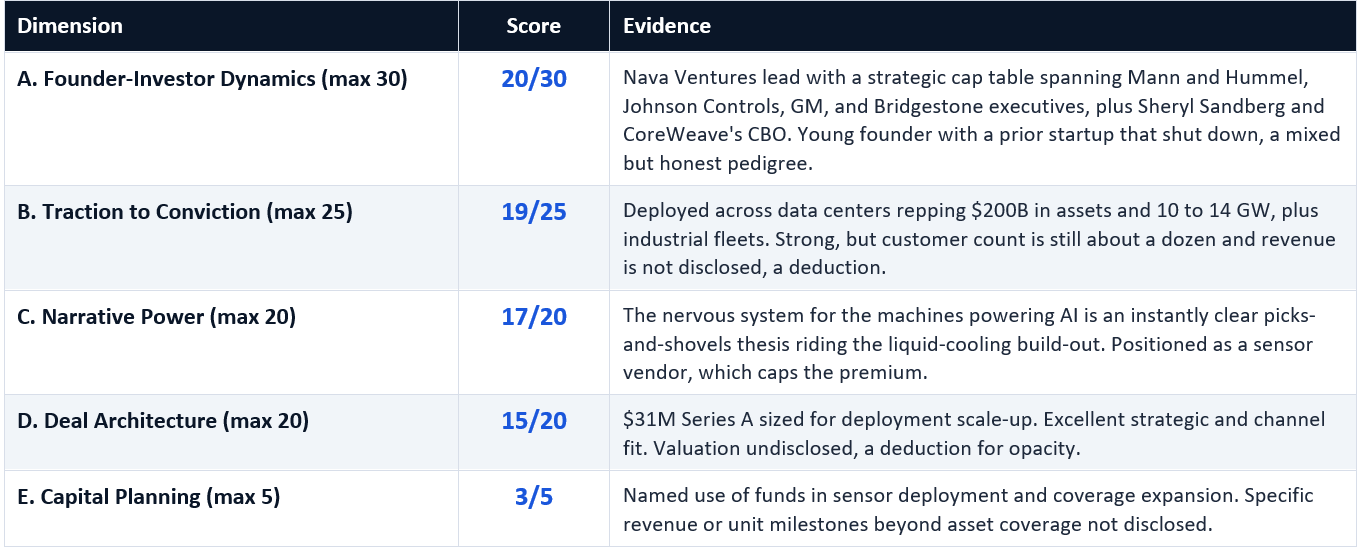
Omen AI
Continuous Fluid Intelligence for AI Data Centers | Series A | $31M | Valuation Undisclosed
Eisen Fundability Score: 74 / 100
Why this scored: Omen AI is the clearest scarce-input play of the week, and the one that anchors this issue. It sells continuous, real-time analysis of the coolant running through liquid-cooled AI data centers, the physical layer that every hyperscale GPU rack now depends on and that most operators still monitor by mailing samples to a lab. The proof is deployed, not theoretical: sensors covering data centers that represent $200B in assets and 10-14 GW of capacity. The score reflects strong deployment against a still young customer count, an undisclosed valuation, and revenue that is not broken out.
The Setup: San Francisco-based Omen AI, founded in 2024 and led by CEO Zach Laberge, builds an inline spectrometer that sits in a machine’s fluid loop and reads more than 21 elemental signatures in real time. As operators thin the coolant with more water to increase heat absorption and run chips harder, bacterial growth and metal wear become invisible risks that can force a five- to six-hour rack flush, costing millions in downtime. Omen turns the fluid running critical machines into a continuous health signal, replacing the lab-and-wait process the industry has used for decades. The Series A was led by Nava Ventures.
The Numbers: $31M Series A led by Nava Ventures, bringing total funding to $41.5M since 2024. Participation from CRV, Vanderbilt University, Mann and Hummel, LMNT Ventures, Borusan Ventures, Starhill Holdings, and Hard Launch Capital, plus personal investment from Sheryl Sandberg, CoreWeave’s chief business officer, and executives at Bridgestone, GM, and Johnson Controls. Coverage of data centers representing $200B in assets and 10 to 14 GW of capacity, roughly a dozen data-center customers including AMD-focused cloud provider TensorWave, plus industrial fleet operators such as Carolina CAT. Use of funds: scale sensor deployment across data-center and industrial customers.
The Pattern: Omen is the sell-the-shovel signal of the week. Capital is moving to the instrumentation layer of the AI build-out, the physical systems every data center must keep running, rather than to another model that sits on top of them. Deployment across $200B in monitored assets, not a demo, is what converted conviction.
The Perspective: In any category racing toward an application-layer gold rush, ask what the miners must keep running to sustain it. If you can instrument the physical layer everyone else depends on and show real deployment, your fundability does not depend on winning the end market. It depends on becoming the sensor that the end market cannot operate without.
The Playbook: First, find the physical bottleneck that every AI data center must manage and that no one has instrumented, here the coolant loop, and own the real-time signal. Second, prove it with deployed scale, the $200B in monitored assets, so the pitch is a live network rather than a prototype. Third, stack a cap table of industrial strategics, Mann and Hummel, Johnson Controls, and GM, who double as channels into the exact buyers you need next.
The Founder Mistake to Avoid: Founders chase visible AI applications while ignoring the physical layer that supports them. The mistake is building another dashboard on rented infrastructure instead of instrumenting the infrastructure itself. Omen scored on deployed coverage of real assets, not on a slide about market size. If your category has a physical bottleneck, owning the signal that runs through it beats joining the crowd building on top of it.
Higharc
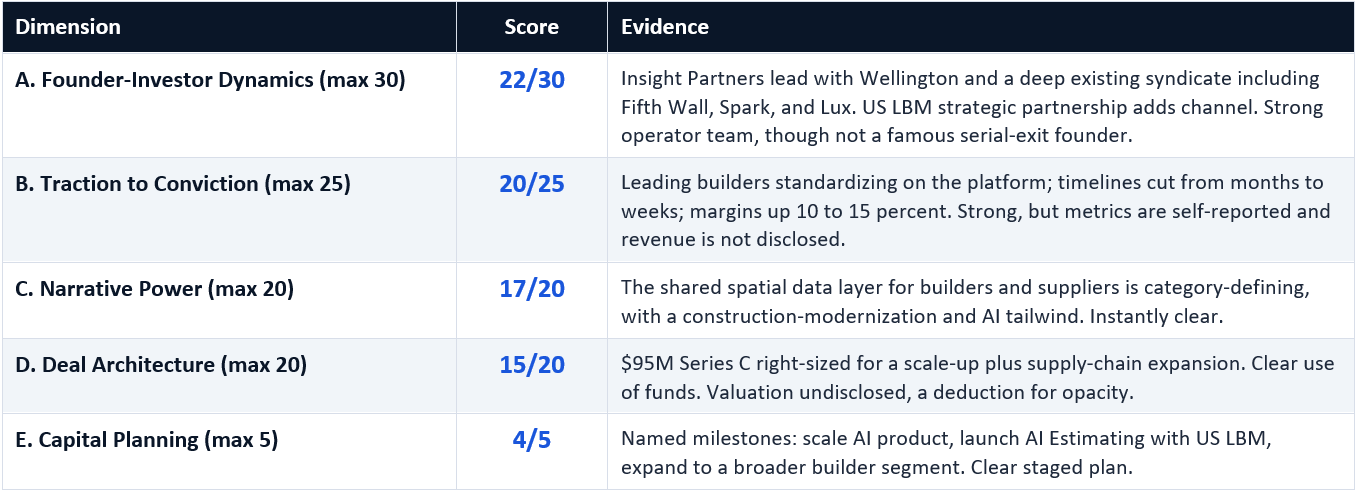
Homebuilding AI and Spatial Data Platform | Series C | $95M | Valuation Undisclosed
Eisen Fundability Score: 78 / 100
Why this scored: The highest score of the week reflects the strongest deployed-proof and owned-data profile in the report. Higharc is not a design tool selling into homebuilders. It is the spatial data model that homebuilding runs on, from floor plan to construction document to shoppable 3D home, and now into the materials supply chain. The proof is verifiable in diligence: leading builders standardizing on the platform, timelines compressed from months to weeks, and a new supply chain partnership that turns the same data model into the input distributors use to price materials.
The Setup: Durham, North Carolina-based Higharc, led by CEO and co-founder Marc Minor, generates homes as 3D spatial data rather than a stack of PDFs and CAD files. Its AutoTranslate AI turns any floor plan image into a structured 3D model that feeds design, estimating, and sales within a single connected system, replacing the patchwork of disconnected point tools most production builders use today. Alongside the raise, Higharc announced an AI Estimating product for building-materials distributors, with US LBM, the largest private distributor in the country, as its first partner.
The Numbers: $95M Series C led by Insight Partners, with Wellington Management and existing investors Fifth Wall, Spark Capital, Lux Capital, SE Ventures, Simpson Strong-Tie, PSP Partners, and others, bringing total funding to more than $170M. Customer-reported results include product-development timelines cut from months or years to weeks or days, time to community opening down 25 to 50 percent, and margins up 10 to 15 percent. These figures are self-reported and not independently audited. Use of funds: scale AI product development and extend the platform across builders and suppliers.
The Pattern: Higharc is the owned-data-layer signal. The round rewards a company that turned an unstructured category, home construction, into a proprietary 3D data model that builders standardize on, then extended that same model down the supply chain to US LBM. Investors underwrote the data asset and the deployment, not the interface.
The Perspective: If your category runs on unstructured documents, model whether owning the structured data layer produces a stronger moat than selling software on top of the mess. The fundable proof is the outcome metric you can show on real deployments, plus a data asset that gets harder to displace with every customer you add.
The Playbook: First, represent your category as structured, proprietary data, here a home as a 3D spatial database, so the moat is a data model competitors cannot regenerate, rather than a feature they can copy. Second, lead with hard operating outcomes, timelines, and margins, because production buyers underwrite results, not interfaces. Third, extend the same data model into an adjacent workflow, from builders to distributors, so each new use compounds the moat instead of diluting it.
The Founder Mistake to Avoid: Founders sell another tool into a fragmented market and call it a platform. The mistake is shipping an interface when the durable value is the underlying data model. Higharc scored on builders standardizing on its spatial data and on a supply-chain partner adopting the same model, not on the elegance of its front end. If your story leads with the UI, move the data asset and the deployments to the front.
Taxwire
Execution AI for Sales Tax and Global VAT | Series A | $25M | Valuation Undisclosed
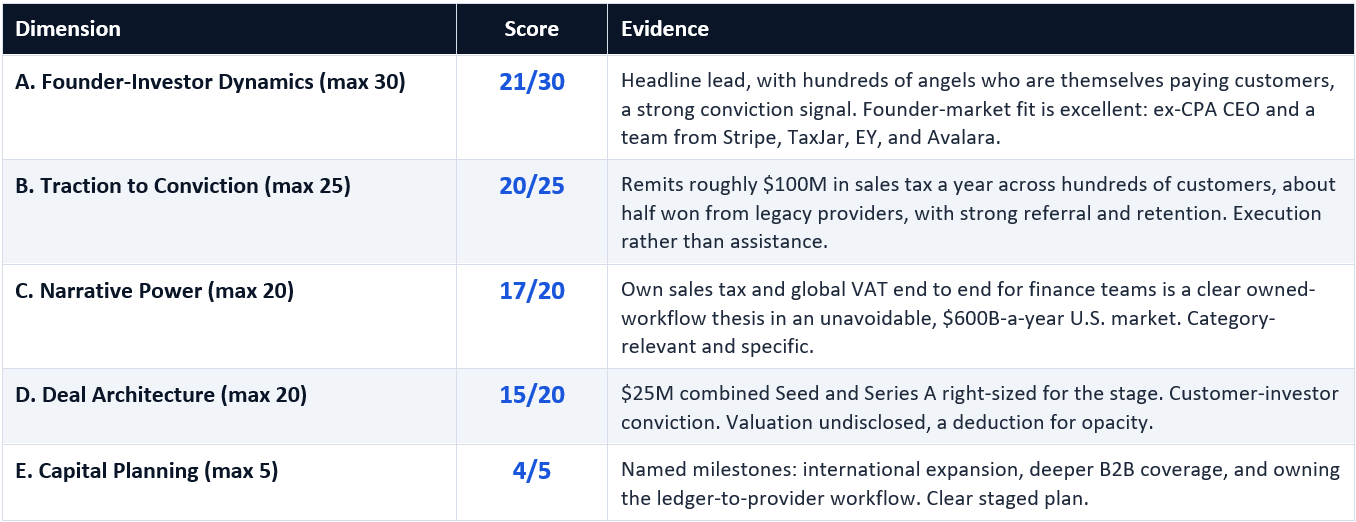
Eisen Fundability Score: 77 / 100
Why this scored: Taxwire is the cleanest execution-AI case of the week. The platform does the regulated work rather than advising on it: it monitors nexus, registers, calculates tax at checkout, files, and remits across more than 22,000 U.S. jurisdictions and 100-plus countries. The proof is recurring revenue and live remittance, not a demo, with roughly $100M in sales tax remitted every year across hundreds of paying customers. The score reflects strong deployment and customer-investor conviction against an undisclosed valuation and a still-expanding footprint.
The Setup: New York-based Taxwire, led by co-founders Andrew Rea (CEO) and Steven Schmatz (CTO), pairs an AI-native tax engine with a team of tax experts who take direct accountability for the outcome. Rea is a former CPA who used legacy tools like Avalara and TaxJar and saw the gaps; the team pulls veterans from Stripe, TaxJar, Fonoa, EY, and Avalara alongside former state tax auditors. The wedge is mid-market finance teams, roughly $20M to $500M in revenue, that carry real complexity with lean teams and cannot afford a sales tax mistake.
The Numbers: $25M across a combined Seed and Series A led by Headline, with Vinyl, Recall Capital, Nomo Ventures, Analog Ventures, XYZ VC, and hundreds of angels, many of whom are CFOs, controllers, and founders who are already Taxwire customers. Taxwire remits roughly $100M in sales tax a year, serves hundreds of paying customers including Coder, Omni, Middesk, and Honeystack, and reports that about half of new customers arrive from leaving a legacy provider. Use of funds: expand international coverage, go deeper across B2B industries, and own the workflow between the general ledger and the tax provider.
The Pattern: Taxwire is the do-the-regulated-work signal. The round rewards an agent that takes accountability for an unavoidable, high-liability workflow and remits real money through it, and it comes with a distinct conviction marker: the angels filling out the round are the customers who already trust it in production.
The Perspective: If you build vertical or agentic AI, frame your value as regulated work completed and liability removed, and attach a volume-run number. The market this week paid for agents who execute within an unavoidable workflow and show receipts for dollars actually processed. When your own customers write checks, that is the cleanest third-party signal that the execution is real.
The Playbook: First, own an unavoidable, regulated end-to-end workflow, so the value is liability removal rather than time saved. Second, ground the pitch in live remittance and recurring revenue, the $100M figure, because execution AI is judged on volume actually run, not usage logs. Third, turn your best customers into investors or references: a cap table of paying users is a conviction signal a new lead cannot fake.
The Founder Mistake to Avoid: Founders pitch an agent that assists as if it were autonomous. The mistake is selling a copilot that creates review work while claiming to remove liability. Taxwire scored because it takes accountability for the filing and remits real money end-to-end. An agent that still needs a human to check every output is a feature, not a system of record.
Oxmiq Labs
Licensed GPU Architecture for AI Silicon | Series A | $35M | Valuation Undisclosed
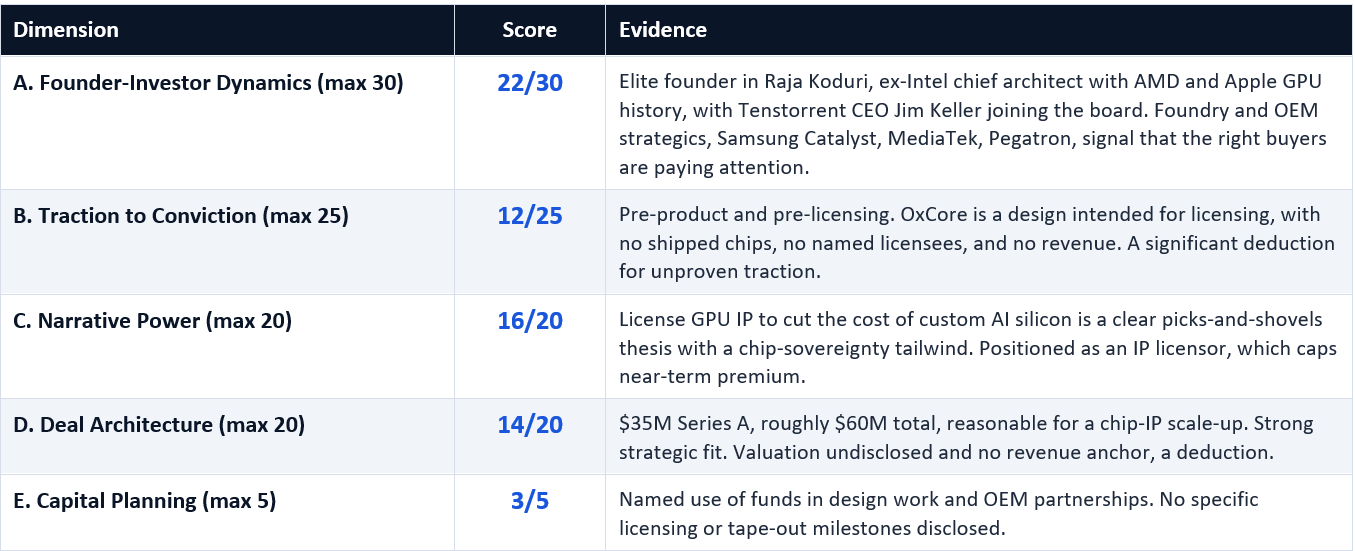
Eisen Fundability Score: 67 / 100
Why this scored: Oxmiq is the scarce-input play with the sharpest founder and the thinnest proof, and the tension between the two is the lesson. It has designed a GPU architecture, OxCore, that it intends to license rather than manufacture, aiming to cut the cost of custom AI silicon and loosen a single vendor’s grip on AI acceleration. The score reflects an elite founder and strategic chip backers against a product that is a roadmap, not a run rate: no shipped chips, no licensees disclosed, no revenue.
The Setup: Campbell, California-based Oxmiq was founded by Raja Koduri, the former chief architect at Intel with prior GPU leadership at AMD and Apple. Rather than build and sell chips, Oxmiq plans to license an open GPU architecture to data-center and PC vendors, a business model that depends on landing OEM and foundry partners. The pitch is that surging demand for AI compute has created room for an alternative architecture that buyers can license rather than pay a premium for proprietary silicon.
The Numbers: $35M Series A co-led by Fundomo and Samsung Catalyst Fund, bringing total funding to roughly $60M, with participation from MediaTek, AM Intelligence Labs, Pegatron, CDIB-TEN Investment, Darwin Ventures, and Morgan Creek Digital. The investor mix of foundry and OEM strategics, Samsung, MediaTek, and Pegatron, is the strongest signal in the deal. Use of funds: accelerate chip-design work and build licensing partnerships with OEMs. No product shipping, no licensees, and no revenue disclosed.
The Pattern: Oxmiq is the pre-product, scarce-input bet and a cautionary tale. The round shows the market will fund the compute-IP layer beneath AI on founder pedigree and strategic backing alone, before a chip ships, when the input is scarce enough. The score shows the ceiling on that move: absent deployment, pedigree caps out in the high 60s, because pedigree is not proof.
The Perspective: If you are pre-product in a scarce-input category, your fundability rests on two things you can build now: a founder or team the market already trusts, and strategic backers who are also your future buyers. Land those, and you can raise on a roadmap. Lack them, and you will be asked for a run rate you do not yet have.
The Playbook: First, if you carry an elite, category-defining pedigree, use it: an architecture and a track record can raise a Series A before there is a shipping product when the market is starved for the input. Second, recruit foundry and OEM strategics who double as future buyers, so their presence substitutes for revenue proof. Third, be honest that this is the exception: name the deployment milestone that converts pedigree into a run rate, and make it the next round’s gate.
The Founder Mistake to Avoid: Founders without an elite pedigree copy the pre-product playbook and pitch architecture with no shipping proof and no strategic buyers. The mistake is assuming the roadmap alone raises the round. Oxmiq cleared on a rare founder-plus-foundry and OEM strategies. Absent both, a pre-product chip story reads as a science project, not a company.
Flare Therapeutics
Clinical-Stage Precision Oncology | Series C | $85M | Valuation Undisclosed
Eisen Fundability Score: 71 / 100
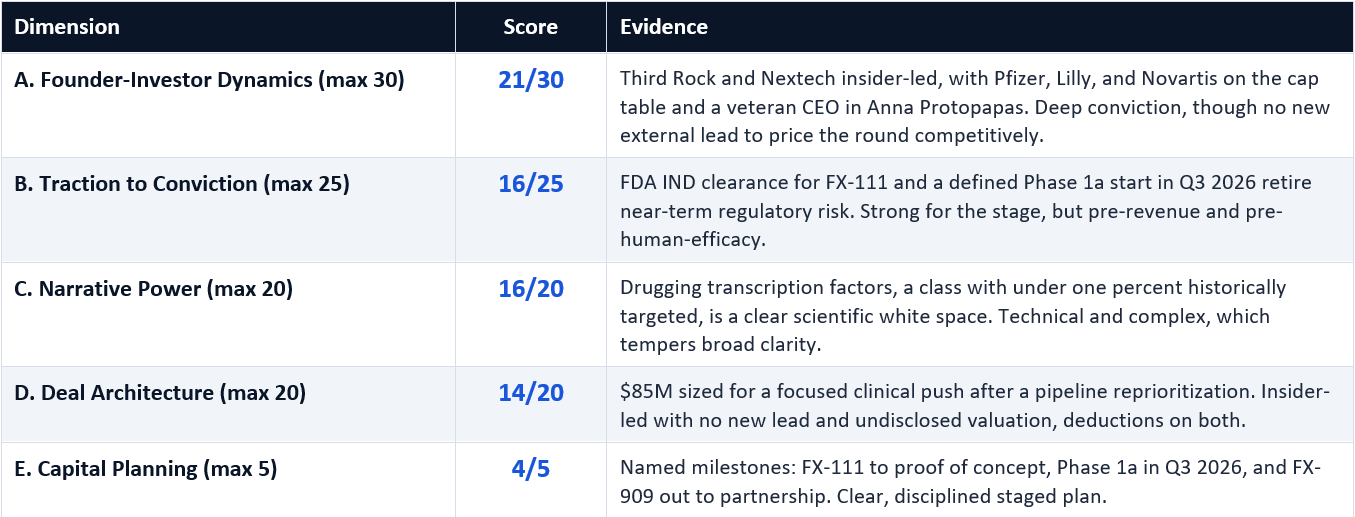
Why this scored: Flare carries a strong retired-risk profile in a hard category. It targets transcription factors, historically among the least druggable protein classes, and its Series C is built around a concrete, evaluable plan rather than a platform diagram. The score reflects elite specialist conviction and a clear regulatory step against a program that remains pre-revenue and has not yet produced human efficacy data.
The Setup: Cambridge, Massachusetts-based Flare Therapeutics develops precision medicines targeting transcription factors, fewer than 1% of which have been successfully drugged. Alongside the raise, Flare completed a pipeline review and named veteran biotech executive Anna Protopapas, formerly CEO of Mersana and president of Takeda’s Millennium unit, as chief executive. The company will concentrate resources on FX-111, a first-in-class degrader targeting the transcriptionally active, hormone-bound androgen receptor in prostate cancer.
The Numbers: $85M insider-led Series C led by existing investors Third Rock Ventures and Nextech Invest, with Pfizer Ventures, Boxer Capital, GordonMD, Invus, Casdin Capital, Eli Lilly, Novartis, Agent Capital, and Eventide. FX-111 has received FDA IND clearance, with clinical development expected to begin in the third quarter of 2026. A second asset, FX-909, will advance through an external partnership rather than internal development. Use of funds: advance FX-111 to proof of concept and progress the preclinical ARON RIPTAC program.
The Pattern: Flare is the clinical-sequencing signal. The round rewards a company that retired a specific, high-uncertainty risk, secured IND clearance, and defined a Phase 1a start before raising, and paired it with a disciplined pipeline cut and a veteran CEO. In a hard category, existing specialist investors led rather than waited, which is a conviction marker in its own right.
The Perspective: If you are clinical or deep-tech, sequence your fundraise to your data and your regulatory milestones, not your calendar. Each round should close against a defined readout that retires the next stage of risk. Your trial timeline is your raise timeline, and the most fundable moment is immediately after a milestone that de-risks the program.
The Playbook: First, retire the highest-uncertainty risk before raising the big round, here securing IND clearance and a clear Phase 1a start, so the capital funds a defined next readout. Second, choose specialist leads who can underwrite the science directly, Third Rock and Nextech, rather than generalists who would discount it. Third, cut the pipeline to the asset with the nearest de-risking event, and let focus, not breadth, carry the narrative.
The Founder Mistake to Avoid: Founders in hard science pitch the platform’s breadth rather than the next retirement risk. The mistake is selling optionality when investors are buying a specific de-risking event. Flare scored on IND clearance and a focused FX-111 plan, not on the size of its target class. A program without a near-term readout is pitching its thesis without the evidence that prices it.
Fundraising Playbook: 5 Tactical Plans From This Week
Five plans, each producing a concrete output you can use immediately. No vague tasks. Each is built directly from this week’s verified signals.
1. The Layer-Ownership One-Liner (Positioning and Narrative)
Why this matters: Omen AI, Higharc, Oxmiq, and CarbonSix all cleared by owning a physical or infrastructure layer beneath the model and leading with it. Application-only positioning on rented infrastructure was discounted this week.
Deliverable: A single sentence that replaces your current pitch headline. Structure: we own the layer that every X depends on, and it is already running Y. It must name the substrate you own and a verified number, not a capability on top of someone else’s stack.
Time estimate: 2 to 4 hours, finalized before your next investor meeting.
Expected outcome: A headline that survives the first diligence question. Investors stop asking what your model does and start asking how much of the layer beneath it you own.
Reframe: Wrong approach: AI for data centers. Right approach: we monitor the coolant across $200B in installed data-center assets in real time, and we catch failures before a flush.
2. The One-Page Proof Stack (Traction and Metrics Packaging)
Why this matters: In a quiet holiday week, every featured round led with deployed usage. Proof of deployment held the Series A and Series B bar even as volume fell.
Deliverable: A one-page proof stack with exactly four lines: units or assets deployed, usage or volume run per period, the measurable outcome you changed, and retention or expansion. Numbers only, no adjectives.
Time estimate: 3 to 5 hours. If you cannot fill all four lines, the next two weeks are about generating the missing line, not polishing the deck.
Expected outcome: A single artifact that converts a story-only deck into an evidence-led one, moving your raise from delayed to advancing in a market where a slow week gives narrative no cover.
Reframe: Wrong approach: a roadmap slide of what the product will do. Right approach: a usage table of what it already runs, at what volume, with what result.
3. Eisen Self-Score and Gap Diagnosis (Readiness)
Why this matters: This week’s deals clustered between 67 and 78. The gap between a fundable company and a fundable round was almost always deployed proof or a verifiable moat, the same two dimensions the score isolates.
Deliverable: Score your round across the five dimensions: founder-investor dynamics, traction to conviction, narrative power, deal architecture, and capital planning. Identify your lowest two dimensions and write one concrete action to lift each.
Time estimate: 2 to 3 hours, repeated before each raise.
Expected outcome: A ranked list of your two weakest dimensions, with a specific fix for each, so you can spend the next two weeks on the gap that is actually pricing your round down.
Reframe: Wrong approach: improve the pitch everywhere. Right approach: fix the lowest two scored dimensions and leave the rest alone.
4. The Strategic and Insider Capital Map (Investor Targeting)
Why this matters: In hard categories this week, strategics and corporates anchored the rounds: Samsung and MediaTek in chips; Mann and Hummel and Johnson Controls in industrial; US LBM in construction; and insiders led where the proof was clearest at Flare, Taxwire, and CarbonSix.
Deliverable: A target list in two tiers. Tier one: the strategics and corporates who touch your buyer and can underwrite your physical or regulated risk, with the specific deal each did and the warm path. Tier two: an insider check, each existing investor’s answer to whether they would anchor the next round.
Time estimate: 6 to 10 hours of research, refreshed each quarter.
Expected outcome: A ranked list ordered by ability to price your core risk plus a read on which insiders will re-up, so you can anchor the round before courting cold generalists.
Reframe: Wrong approach: start with famous generalists and expand. Right approach: start with the strategist who can validate your risk and the insider who already believes the proof.
5. The 90-Day Clone Test and Moat Build (Defensibility)
Why this matters: Undisclosed valuations dominated this week and the verifiable moat priced the round. Even the one $1B disclosed valuation cleared on proof, its revenue and profitability, rather than on the markup alone.
Deliverable: Run the 90-day clone test. Write down what a well-funded competitor could replicate in one quarter on the same rented infrastructure. Then name the single regulatory, data, or physical barrier you can build in the next two quarters that would fail that test, and make it your use-of-funds headline instead of your target valuation.
Time estimate: 3 to 5 hours, iterated against the question: what would a competitor with a better model need to replicate this?
Expected outcome: A defensibility statement tied to a fundable use of proceeds, so your round buys a moat rather than a markup.
Reframe: Wrong approach: our software is faster, and we want a $1B valuation. Right approach: here is the regulated, deployed, or physical barrier we own that a competitor cannot shortcut, and here is what this round builds next.
Looking Forward: Next 1 to 3 Weeks
Three evidence-based scenarios and one wild card. Predictions are anchored to this week’s verified data, not speculation.
Scenario 1: The Physical-Layer Rotation Continues (High Probability)
Evidence: Seven of nine rounds this week funded the layer beneath the model: coolant sensing, GPU architecture, factory robotics, machine vision, construction data, and regulated tax rails. The pattern sits inside a broader H1 2026 in which record capital flowed into AI infrastructure rather than consumer apps.
What to watch: New rounds for data-center physical infrastructure, power and cooling, compute IP, and industrial and construction data layers. Watch for strategic and corporate leads writing earlier checks to secure supply and channel, as Samsung, MediaTek, and US LBM did this week.
What founders should do: If you build anything in physical AI or AI infrastructure, audit your position this week. Decide whether you own a physical or data layer the application cannot route around, or are renting one. If you are renting, your strategy needs to move one layer down before your next round.
Scenario 2: The Proof Bar Holds Through the Summer Slowdown (High Probability)
Evidence: Volume fell over the holiday week, yet every round that cleared led with deployed usage, and the score band stayed tight at 66 to 78. Quiet weeks removed narrative cover rather than lowering the bar.
What to watch: Series A and B rounds that disclose deployment metrics in the announcement, assets covered, volume run, customers live, rather than just the amount and lead. Watch for the deployment figure to migrate into the headline, the way Omen led with monitored assets and Taxwire with remittance.
What founders should do: If you plan to raise inside the next quarter, generate one more month of deployment data before you open the round. In a thin summer market, a single additional cohort of live usage is worth more than another deck revision.
Scenario 3: Strategic and Insider Capital Leads More Hard-Category Rounds (Medium-High Probability)
Evidence: This week, strategics and corporates anchored the physical rounds, and insiders led where the proof was clearest, at Flare, Taxwire, and CarbonSix. New-lead competition was scarce in a quiet week.
What to watch: Hard-category rounds where a corporate strategist or a returning insider takes the lead and generalists appear only as participants. Watch for foundry, industrial, and supply-chain corporates writing venture checks to lock in future supply.
What founders should do: If your category is hardware, regulated, or supply-chain heavy, build the strategic pool now and run an insider check before you open. Put the corporates who touch your buyer and the insiders who will re-up at the top of your list before you talk to a single generalist.
Wild Card: Application-Layer Compression for Model-Only AI Claims (Medium Probability)
Evidence: This week, the capital moved a layer down, and application-only positioning on rented infrastructure earned no premium. Companies still selling a model or an interface on top of commodity compute, without an owned layer beneath, may face extended diligence or softer multiples as the bar resets toward the substrate.
What founders should do: If your positioning leans on a model or an app without an owned physical, regulated, or data layer beneath it, treat that as a near-term risk. Identify the layer you can own, or the deployment you can prove, before the compression reaches your stage. The companies that move down the stack before the bar moves keep the multiple. The ones that wait negotiate against it.
The Bottom Line
The real insight is not the $409.5M total. It is that with the megarounds and public-market traffic removed, the market that actually prices your round revealed a single, consistent rule this week: capital paid for the layer beneath the model and for deployment you can verify, not for narrative or model capability on top of rented infrastructure. Three conviction profiles took the week.
Profile 1: Infrastructure and scarce-input owners. Omen AI (74), Oxmiq Labs (67), and Luxonis (67) own the layer the AI build-out depends on. Omen owns the coolant signal inside data centers, Oxmiq owns a GPU architecture, and Luxonis owns the perception layer. The proof is that the applications above them cannot function without the layer beneath.
Profile 2: Owned-workflow and proven-revenue operators. Higharc (78), Taxwire (77), and Venice AI (76) own a workflow or a platform and lead with a moved number. Higharc owns the spatial data model builders standardize on; Taxwire owns the sales tax and VAT workflow it remits $100M a year through; and Venice owns a profitable private AI platform with more than $70M in annualized revenue that funds its own compute. The proof is the operation and its economics, not the interface.
Profile 3: Physical and clinical builders. CarbonSix (73) and Flare Therapeutics (71) own a barrier that a competitor cannot clone in a quarter. CarbonSix owns deploy-ready factory robotics with a data flywheel, and Flare owns a retired regulatory step with FDA IND clearance. The proof is the slow, hard work already done.
The application layer competed for the residual. The lone pure application-layer round, Pie (68), was among the smallest checks of the week and scored at the floor of the band. The message is unmistakable. Own the layer beneath the model, own the regulated workflow, or own the physical barrier, and show the deployment. Anything short of that is an application competing for leftover selectivity capital in a week when the capital moved down the stack.
5 New Rules for Founders
Rule 1. Own the layer beneath the model. When the application commoditizes, value moves to the compute, the cooling, the data, and the regulated workflow everyone else must route through. Find your category’s substrate and own it.
Rule 2. Proof of deployment is the bar, even in a quiet week. Assets covered, volume run, outcome moved, retention. A slow week removes narrative cover; it does not lower the bar.
Rule 3. Match capital to category. In hard categories, a strategic or corporate that can validate your physical or regulated risk beats a larger generalist check. The wrong pool costs more than the wrong deck.
Rule 4. Read your insiders as diligence. When existing investors re-up or lead, the people closest to your usage data are pricing your proof. When they will not, listen.
Rule 5. Build the moat that fails the 90-day clone test. If a competitor could rebuild you on the same rented infrastructure in a quarter, your moat is the regulated, data, or physical work you have not done yet. Make it the use-of-funds headline, not the valuation.
4 Monday Actions
(1) Rewrite your one-liner. Replace your pitch headline with: we own the layer that every X depends on, and it is already running Y. Name the substrate and a verified number.
(2) Build the proof stack. One page, four lines: assets or units deployed, volume run, outcome moved, retention. If a line is empty, that is your two-week priority.
(3) Map strategies and check your insiders. List the corporates who touch your buyer and can validate your risk, then ask each existing investor whether they would anchor the next round.
(4) Run the 90-day clone test. Write what a competitor could copy in a quarter on rented infrastructure, then name the one moat you will build next and make it your use-of-funds headline.
Your competitors are reading the same tape. The founders who lead with an owned layer and deployed proof this week own the conversation. The ones who lead with a model on rented infrastructure negotiate against a bar that just moved down the stack.
Research completion timestamp: July 5, 2026.
DISCLAIMER: This article is for informational and strategic intelligence purposes only. It does not constitute investment advice. The Eisen Fundability Score is a proprietary diagnostic within Fundables OS™, not a financial recommendation.
If this article was useful, share it with founders who are about to raise.
— Leon Eisen, 4x Founder, Venture Capitalist, and Creator of Fundables OS™