

Playbook, Perspective, and Pattern for founders raising now. This report strips out giant rounds and public market traffic so you can read the part of the market that actually prices your round. Every figure below was verified against at least two independent sources and re-checked in an adversarial pass directed at date windows, amount composition, and headquarters. This is the second issue scored on the v2 rubrics, making it the first week in this series where scores can be compared across issues on a consistent framework.
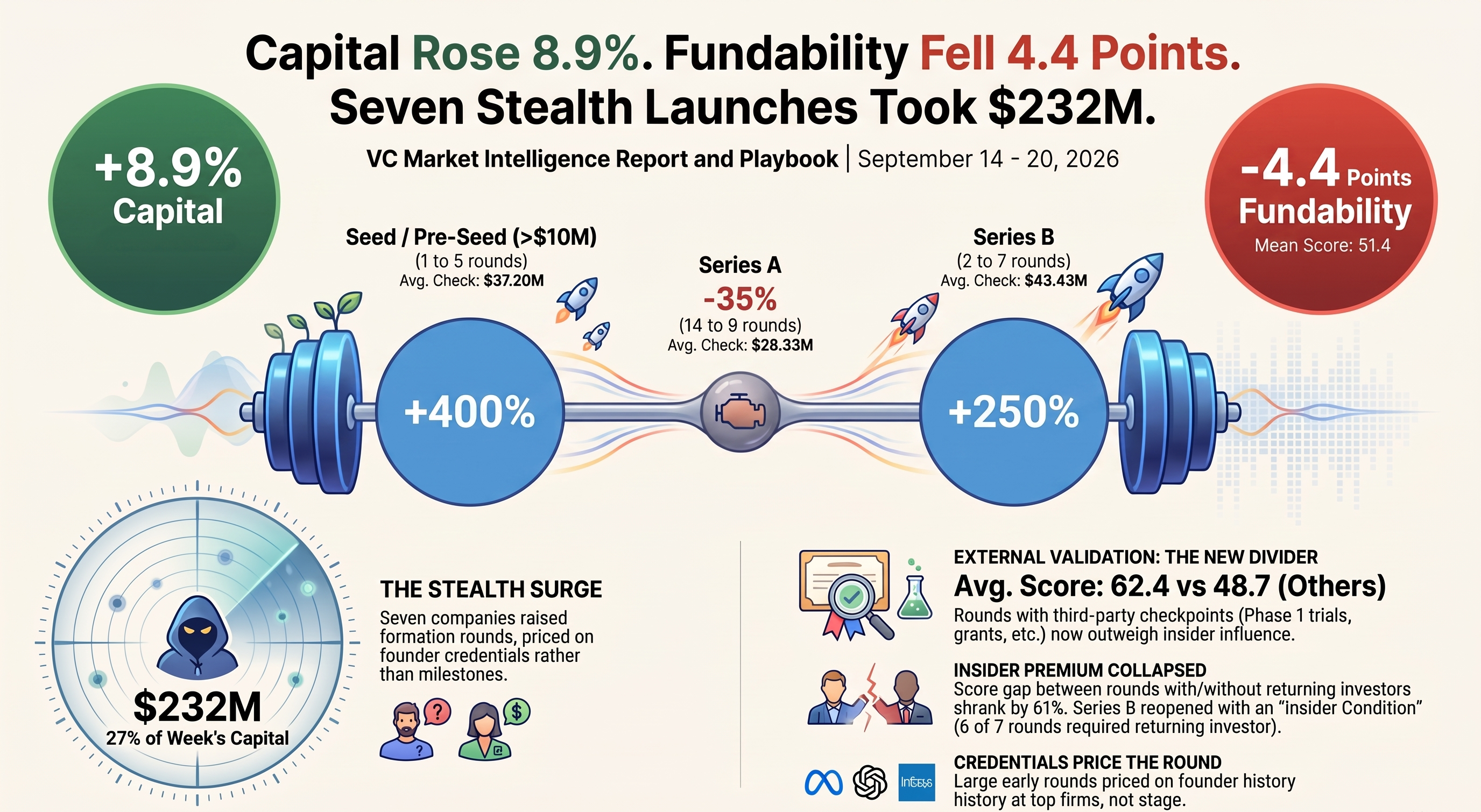
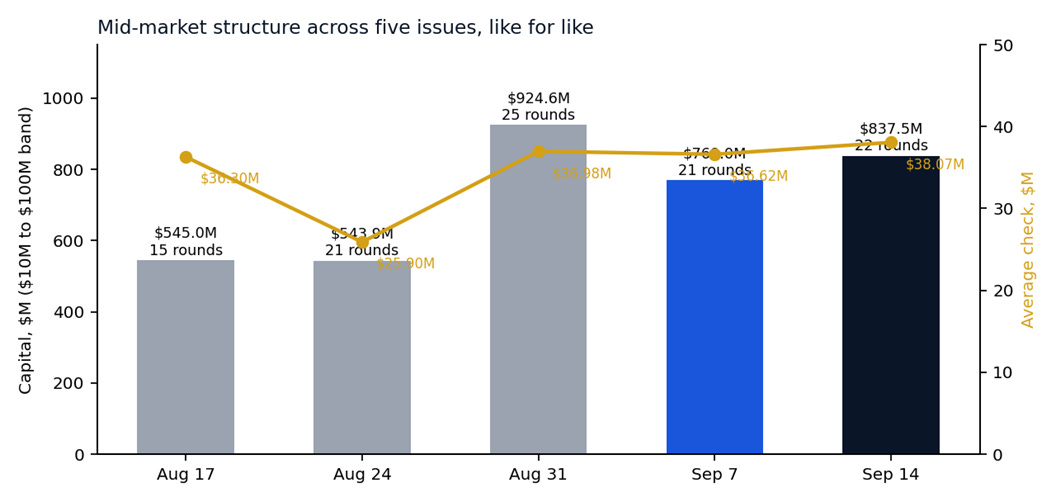
The mid-market grew and got weaker doing it. In a like-for-like $10M to $100M band, twenty-two verified rounds moved $837.5M, up from twenty-one rounds and $769.0M a week earlier. Capital rose 8.9%. Deal count rose 4.8%. The average check rose 4.0% to $38.07M, and the median rose 10.0% to $38.5M. Every size metric went up.
The quality metric went down. On the same v2 rubric used last week, the mean Eisen Fundability Score fell from 55.8 to 51.4. Last week, seven rounds cleared 65. This week, three did. More money bought less proof.
The gap has one source. Seven companies came out of stealth or took their first institutional check this week and together raised $232.0M, 26.9% of the week’s capital, at an average score of 46.6 against 53.3 for everyone else. Last week the market paid for continuity. This week it paid for formation, and a formation round carries the least that any third party has already underwritten.
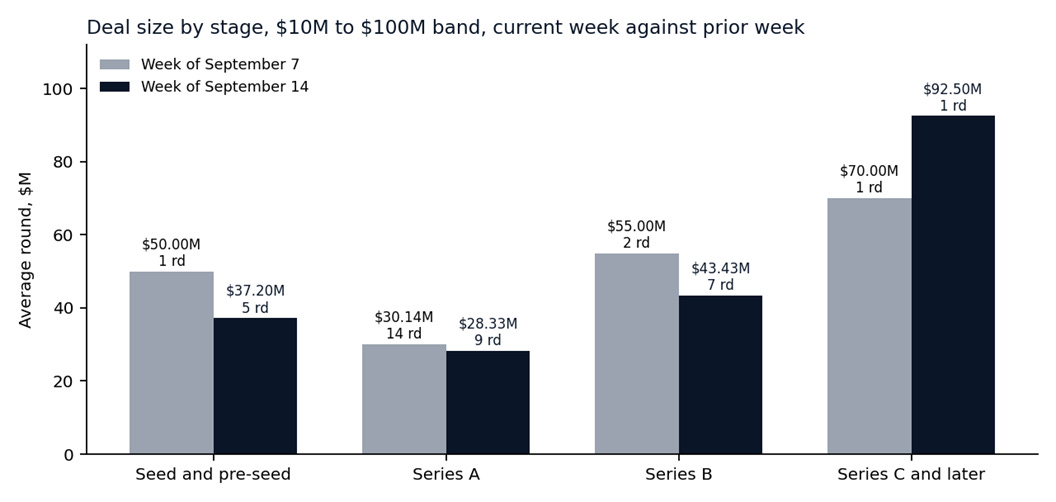
Consequence for Monday. The door widened at both ends of the stage ladder: seed and pre-seed rounds above $10M went from one to five, and Series B went from two to seven. But the variable that decided who scored well moved. The returning investor premium shrank from 17.6 points to 6.8. The five rounds carrying a checkpoint an outside body controls averaged 62.4 against 48.7. If you open a round this quarter, the first question is no longer who already backed you. It is what somebody outside your company has already confirmed.
The Week in One Sentence
Primary insight. Mid-market capital rose 8.9% while the average fundability score fell 4.4 points, because a quarter of the money went to seven companies nobody had funded at scale before, and the rounds that scored highest carried a checkpoint an outside body controls rather than simply a returning investor.
Total tracked mid-market capital, 25 verified rounds: $861.7M in new primary capital, every deal between $5M and $100M, every company US-headquartered.
Like-for-like against the prior issue: $837.5M across 22 rounds in the $10M to $100M band, against $769.0M across 21 rounds. Capital up 8.9%, deal count up 4.8%.
Average round size: $34.47M across the full set. On a like-for-like basis, $38.07M against $36.62M, up 4.0%.
Median round size: $37.0M across the full set. On a like-for-like basis, $38.5M against $35.0M, up 10.0%.
Largest tracked round: Circle Pharma, a $92.5M Series E in oncology. Smallest: Gaia Dynamics at $7.0M.
Rounds with a designated lead investor: 21 of 25, or 84.0%, against 22 of 24, or 91.7%, last week. RegCell, Pave Finance, Ferry Health and Ravel closed without one.
Rounds carrying strategic, corporate or customer-side capital: 7 of 25, or 28.0%, moving $336.5M or 39.1% of capital, against 13 of 24, or 54.2%, last week.
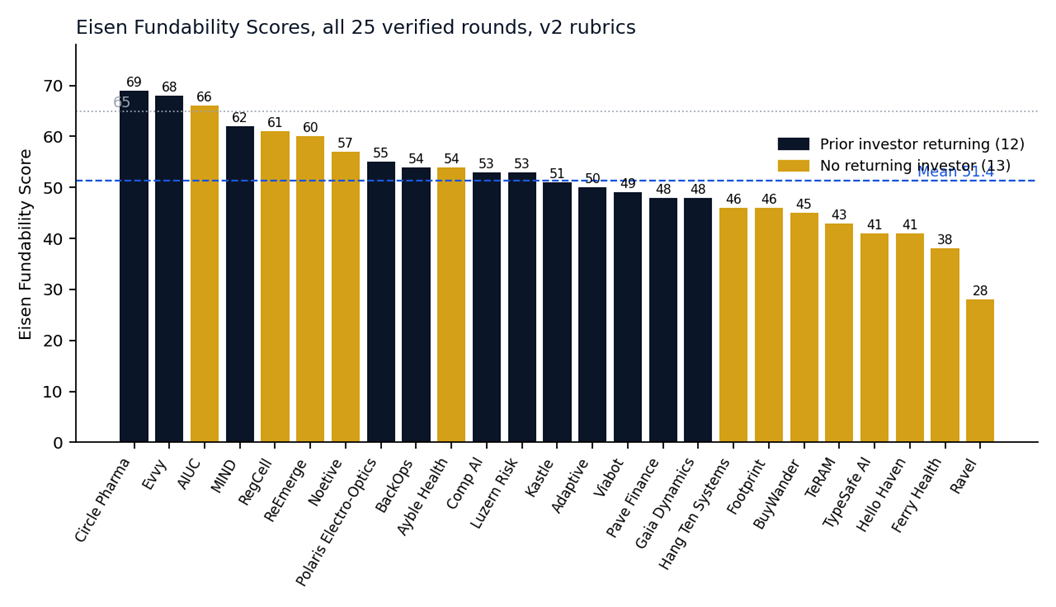
Rounds with at least one prior investor returning: 12 of 25, or 48.0%, against 16 of 24 last week. Those twelve averaged 55.0 against 48.2 for the thirteen without.
Highest Eisen Fundability Score: Circle Pharma at 69. Lowest: Ravel at 28. A 41-point band, with 3 of 25 rounds clearing 65 and a mean of 51.4 against 55.8 last week.
Defining structural feature: the stage ladder widened at both ends and hollowed in the middle. Five seed and pre-seed rounds above $10M against one, seven Series B rounds against two, and Series A, last week’s only deep lane, down from fourteen rounds to nine.
Framework note: this is the second issue on the v2 rubrics. Scores are directly comparable to the September 13 issue and to no issue before it. Capital, deal count, check size, stage, sector, geography, and investor behavior remain comparable across the full series.
The Deal Scorecard
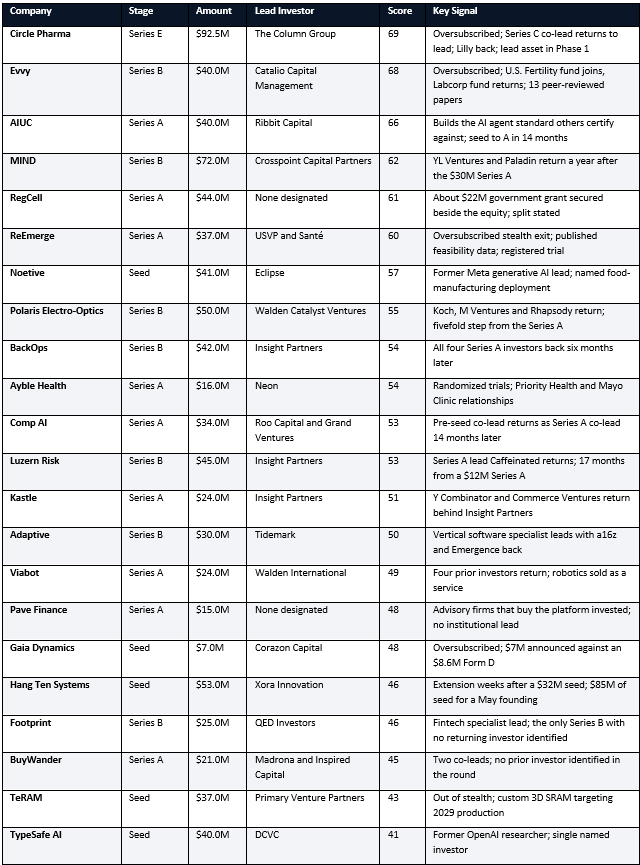
Eisen Fundability Scores are calculated across five weighted dimensions: Founder-Investor Dynamics (30), Traction-to-Conviction Conversion (25), Narrative Power (20), Deal Architecture (20), and Capital Planning (5). Scores of 90 and above signal an inevitable, market-defining outcome. Scores of 85 to 89 signal extremely strong execution. Scores of 75 to 84 signal solid fundamentals. Scores of 65 to 74 signal a good company with some gaps. Below 65 signals early-stage or structurally incomplete. Traction to Conviction measures only what third parties have already underwritten.

What the Scorecard Says at a Glance
The top of the band is a proof story, not a continuity story. Circle Pharma at 69 has a lead program in Phase 1 and was the Series C co-lead in an oversubscribed round. Evvy at 68 carries peer-reviewed research and a lab strategy coming back. AIUC at 66 is the only top-three round with no returning investor, and it got there by building the standard that named AI companies already certify against. All five rounds carrying an externally controlled checkpoint finished in the top ten. Last week’s top was bought by people already in the building. This week’s was bought by facts somebody else owns.
The strongest single position costs $16M. Ayble Health scored 14 of 25 on Traction to Conviction, the highest mark on that dimension in the issue, with more than fifteen published studies, including randomized controlled trials, a payer partnership with Priority Health, and a care model with Mayo Clinic. That is three separate institutions a diligence team can call without asking the company. It is the twentieth largest round of twenty-five, and it finished tied for ninth.
The most expensive lesson costs $53M and sits at 46. Hang Ten Systems raised a seed extension led by Temasek’s Xora weeks after a $32M seed, taking seed capital to $85M for a company founded in May. The founder is a former chief executive of Infosys, and the round scored 21 of 30 on Founder-Investor Dynamics, joint second in the issue. Deal Architecture scored 9 of 20 because $85M of seed is materially oversized for the stage, and Capital Planning scored 0 because an extension weeks after the first close is not a re-underwriting. A resume and a check size do not substitute for a structure.
The floor is a formation story. Ravel at 28 closed an oversubscribed $8.2M seed with no investor identified in any source reviewed, which leaves no lead, no alignment, and no insider to score. Ferry Health at 38 has a16z and Index on the cap table, with neither designated to set the price. Hello Haven and TypeSafe AI, both at 41, each took a large first check from a single fund. The money is real, and the founders are credible. The score measures how much of the transaction a new investor could reconstruct; for these four, that is the amount and the names.
Size and score remain uncorrelated for a fifth consecutive issue. Ayble Health at $16.0M outscored Hang Ten Systems at $53.0M by eight points. ReEmerge at $37.0M outscored TypeSafe AI at $40.0M by nineteen. Evvy at $40.0M outscored MIND at $72.0M by six. Calibrating your ask against the biggest rounds of the week calibrates against a variable that predicts nothing.
What Changed This Week: Five Market Shifts
Each shift is verified against multiple sources and ranked by structural impact on founder fundraising, not by deal size. Every shift ends with what it means for your raise next week.
Formation Capital Came Back
Pattern, what happened. Seven companies emerged from stealth or took their first institutional round: Noetive at $41.0M, TypeSafe AI at $40.0M, TeRAM at $37.0M, ReEmerge at $37.0M, Hello Haven at $15.0M and Ferry Health at $9.0M, plus Hang Ten Systems adding $53.0M to a seed that closed weeks earlier. Together, $232.0M, or 26.9% of the week’s capital. They averaged $ 46.6 M against $ 53.3 M for the other eighteen rounds. Seed and pre-seed rounds above $10M went from one last week to five, averaging $37.20M.
Perspective, what it means. A formation round is underwritten on the team and the thesis, because that is all that exists yet. The investors writing these checks are buying an option on a category before a competitor gets funded, and most of them bought it with a precise thesis: Eclipse on industrial software, DCVC on deep technology, U.S. Venture Partners and Santé on medtech, Primary Venture Partners on memory silicon. The money is rational. It is also the least verifiable money in the market, and that is why the average score fell in a week when capital rose.
Founder Blindspot, what most miss. Founders read a $41M seed as the new seed price. It is not a price for the stage. It is a price for a credential. Three of the four largest formation rounds were led by founders from Infosys’ chief executive seat, Meta’s generative AI leadership, and OpenAI’s research team, and the pre-seed was written by Mayfield into the co-founders of Rubicon Project, a company Mayfield also backed that went public in 2014. A first-time founder who anchors on these numbers opens three to five times too high and spends the process being repriced.
Playbook, what to do. Before you set a seed number, write the single fact about your founding team a partner could verify in one call that would make a large seed rational: a prior exit, a senior role at the category leader, or a published body of work. If you cannot write that sentence, size the round to your next dated milestone and let the milestone carry the Series A.
Contrast. Last week one seed round above $10M cleared in the entire mid-market, and this report flagged the risk that the $10M-plus seed was leaving the market. Seven days later it came back fivefold, concentrated in AI infrastructure, industrial AI and neurotechnology.
What this means for your raise: Large seed rounds are open, and they are priced on a credential. If yours is not in the first line of your deck, raise to a milestone, not to the headline.
Series B Reopened, and Insiders Walked Through First
Pattern, what happened. Seven Series B rounds cleared, totaling $304.0M, or 35.3% of the week’s capital, after exactly two Series B rounds in each of the three prior issues. The average Series B check fell 21.0%, from $55.00M to $43.43M. Six of seven carried a returning investor. Four of seven, MIND, Polaris Electro-Optics, BackOps, and Luzern Risk, were re-underwritten within eighteen months at a larger size. BackOps closed $42.0M six months after a $26M Series A with all four Series A investors back in the round.
Perspective, what it means. Series B is the first round priced on repeatability, and the prior investor has watched twelve to eighteen months of it. That is why the re-up matters most here. Six of seven is no coincidence: the lane reopened for companies whose last-round investors came back first. The one Series B without a returning investor, Footprint, scored 46, the lowest in the stage. The leads were specialists by stage or category: Crosspoint on security, Catalio on precision medicine, Walden Catalyst on semiconductors, Tidemark on vertical software, QED on fintech, and Insight Partners, a growth-stage specialist, twice. Insight led three rounds in the week across Series A and B.
Founder Blindspot, what most miss. Founders read that Series B is open and schedule a broad process. The lane opened for a specific kind of lead, not for everyone. Every one of the seven was led by a firm with a defined stage or category focus.
Playbook, what to do. If you are within six months of a Series B, get your Series A lead’s participation in writing before the first external meeting. Then build a target list of no more than fifteen firms that led a Series B in your category this quarter. This week’s seven leads are a starting list if your category matches one of theirs.
Contrast. Last week this report concluded that Series B had become rarer, more expensive, and conditional on a corporate strategy. This week it became more frequent and a fifth cheaper, and only three of seven carried corporate capital. The strategic condition dropped. The insider condition did not.
What this means for your raise: Series B is a live lane again at about $43M. It opened for companies whose last investors came back. Secure yours before you open.
The Insider Premium Collapsed and Validation Replaced It
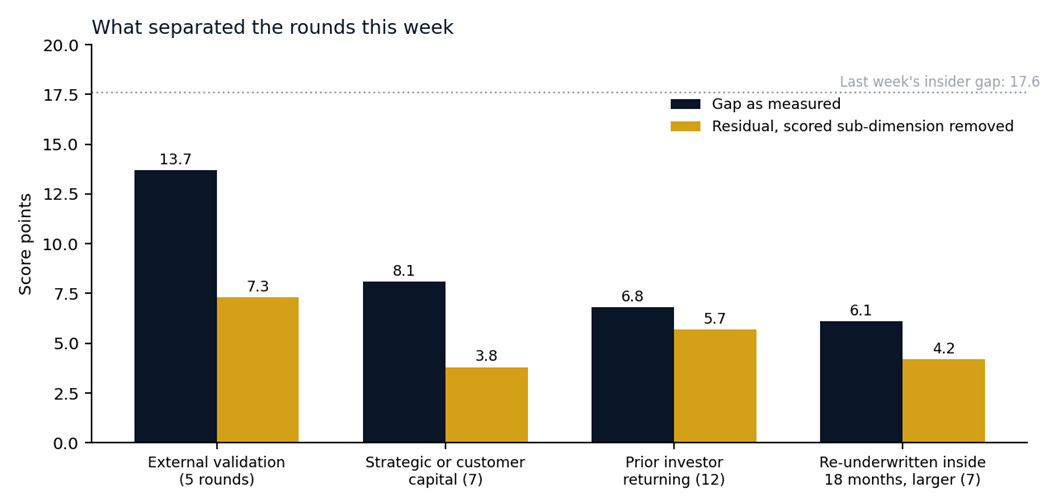
Pattern, what happened. Twelve of twenty-five rounds carried a returning investor, or 48.0%, down from 66.7%. Those twelve averaged 55.0 against 48.2, a 6.8-point gap that shrinks to 5.7 after removing the Insider Support sub-dimension, from 17.6 to 16.2 last week. Among Series A and later rounds only, the eleven with a returning investor averaged 55.6 and the six without averaged 55.3. Meanwhile, the five rounds carrying a checkpoint controlled by an outside body averaged 62.4 against 48.7, a 13.7-point gap that holds at 7.3 after removing Independent Validation. That is the widest structural divider this week.
Perspective, what it means. Part of last week’s insider premium was composition: the rounds with insiders were also later-stage rounds with more of everything. This week, seven formation rounds could not have insiders by construction, so the comparison that matters is within Series A and later, and there the premium disappeared. What survived is the one signal no insider can manufacture: a checkpoint owned by a regulator, a journal, a trial registry or a government agency. Circle Pharma’s Phase 1 program, Evvy’s peer-reviewed research, RegCell’s government grant, ReEmerge’s published feasibility study and registered trial, and Ayble Health’s randomized trials.
Founder Blindspot, what most miss. Founders who acted on last week’s issue will spend this month securing insider commitments and stop there. Keep doing it. It is still worth 5.7 residual points across the set, and it still decided Series B. But an insider tells a new lead that the people who know you best are in. It does not tell the lead anything a third party has confirmed. At Series A and later this week, only the second kind of fact moved the score.
Playbook, what to do. Pair every insider conversation with one externally controlled checkpoint on a dated path. Write three things: the checkpoint, the body that grants it, and the date it can land inside your process window. If your category has no regulator, the fastest options are a security attestation, a peer-reviewed or preprint result with a named academic collaborator, a government grant, or a published standard you certify against.
Contrast. Last week the insider gap was the widest structural divider this report had measured. Last week’s third scenario said to watch whether the gap compressed as founders copied the structure. It compressed, but the share of rounds with insiders fell rather than rose, which says the premium was partly a mix effect rather than imitation.
What this means for your raise: Your insider is table stakes. Proof owned by someone else is what separated the field.
Healthcare Gave Back Half Its Share and Kept All the Proof
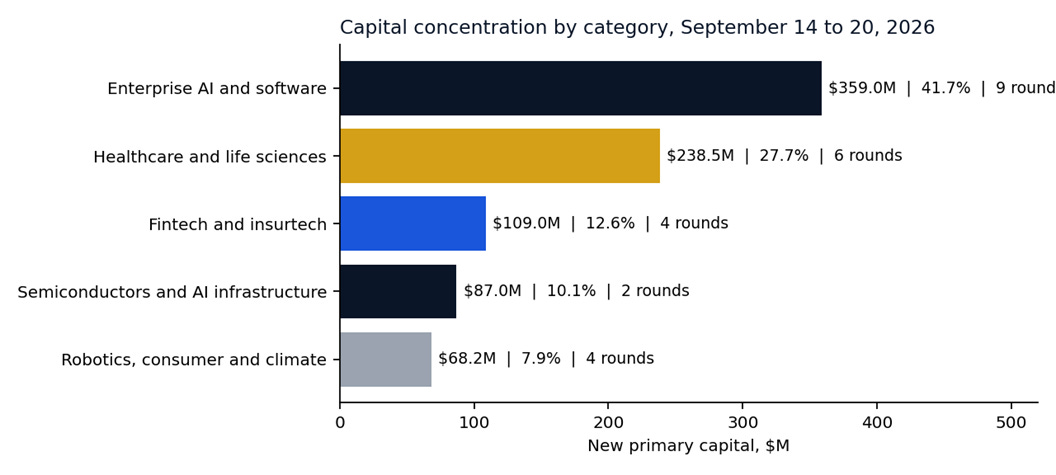
Pattern, what happened. Healthcare and life sciences took $238.5M across six rounds, or 27.7% of mid-market capital, after 54.1% last week and 40.3% two weeks ago, ending a three-issue climb. Enterprise AI and software took $359.0M across nine rounds, or 41.7%, up from 16.9%. Fintech and insurtech took 12.6% across four rounds, semiconductors and AI infrastructure 10.1% across two, and robotics, consumer and climate 7.9% across four. All five rounds carrying an externally controlled checkpoint were healthcare. The six healthcare rounds averaged 58.3, compared with 49.3 for the other nineteen.
Perspective, what it means. Healthcare’s share fell because fewer healthcare rounds cleared- six this week against ten last week- not because the quality of the rounds that cleared fell. The category still supplies external checkpoints by default: an IND, a trial registration, a peer-reviewed paper, a government grant. Enterprise AI took the capital, and its average was 53.0 across nine rounds. Only three of the nine carried a named counterparty an investor could call. The money moved to software. The proof did not move with it.
Founder Blindspot, what most miss. Enterprise AI founders read 41.7% as a green light. Look at what it bought: two formation rounds, five re-ups, one seed extension, and one standard-setter. It rewarded founders with credentials and companies with returning investors. It did not reward a category claim on its own.
Playbook, what to do. If you sell software, borrow healthcare’s structure. Identify the one institution in your buyer’s world that certifies, audits, or publishes, and get your product through it this quarter. AIUC is this week’s proof that software can build the checkpoint itself: it wrote the AIUC-1 standard and got named AI companies to certify against it.
Contrast. Total mid-market capital rose 8.9% while healthcare’s absolute capital fell from $426.0M to $238.5M. Last week was a genuine reallocation into healthcare. This week reversed it in one move.
What this means for your raise: If you are in software, you now compete on the dimension healthcare founders get for free. Build or borrow a checkpoint.
The Buyer Left the Cap Table
Pattern, what happened. Strategic, corporate or customer-side capital appeared in seven of twenty-five rounds, or 28.0%, moving $336.5M or 39.1% of capital, against thirteen of twenty-four and 61.6% of capital last week. The seven: Circle Pharma with Eli Lilly, Evvy with the Labcorp venture fund and U.S. Fertility’s innovation fund, Polaris Electro-Optics with M Ventures and Koch Disruptive Technologies, BackOps with Gradient Ventures, Hang Ten Systems with Aramco Ventures, RegCell with Mitsui Chemicals and LG Technology Ventures, and Pave Finance with the advisory firms that buy its platform. The gap was 8.1 points and holds at 3.8 after removing Customer-Side Capital, up from 12.1 and 6.4 last week.
Perspective, what it means. Last week’s strongest structures attached a commercial relationship to the check: a customer’s venture arm buying, a shipyard signing a production agreement. This week’s strategics were mostly corporate venture arms participating, which the rubric scores at 3 of 8, not 6 or 8. That is why the residual collapsed. A corporate logo without a commercial link is a weak signal, and the framework priced it that way.
Founder Blindspot, what most miss. Founders count any corporate venture participation as a customer investment. Pave Finance and Evvy show the real version. At Pave, advisory firms, the buyers of the platform, wrote into the Series A, which is why a round with no institutional lead still scored 6 of 8 on Customer-Side Capital. At Evvy, a physician-led fertility network that is also its research partner invested through its innovation fund, exactly where the company is expanding next.
Playbook, what to do. When a corporate venture arm offers, ask for the commercial link in the same conversation: a paid pilot, a supply agreement, or a distribution commitment from the operating business. If the operating business will not attach anything, price the check as financial capital and keep your exclusivity and first refusal terms clean.
Contrast. Across four issues, the strategic share ran 42.9%, 28.6%, 54.2%, and now 28.0%. That is volatility, not a trend. What held all four weeks is that buyer-investor structures with a commercial agreement attached scored highest.
What this means for your raise: Take corporate money when it brings a customer. Otherwise, it is financial capital with strings.
The Deals That Matter: Top 5
Five deep dives across oncology therapeutics, women’s health diagnostics, AI agent assurance, data security, and cell therapy. These are the week's five highest-scoring rounds. All facts are verified against two or more sources.
Circle Pharma
Oral Macrocycles Against Cyclins | Series E | $92.5M | Led by The Column Group
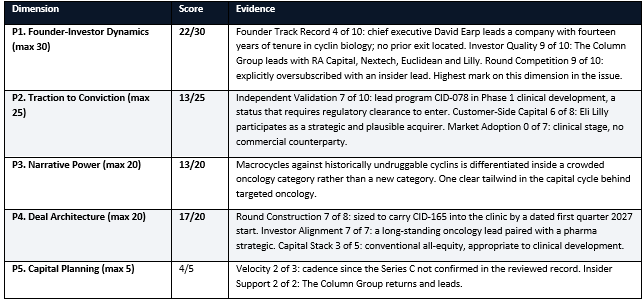
Eisen Fundability Score: 69 / 100
Why this scored. The highest score of the week and the highest Founder-Investor Dynamics mark at 22 of 30. Its Series C co-lead returns to lead an oversubscribed round; Eli Lilly is back beside it, and the program sits in Phase 1, a clinical stage that requires regulatory clearance before dosing patients.
The Setup. Circle Pharma, headquartered in South San Francisco and founded in 2012 with seed funding from Pfizer, builds orally available macrocyclic drugs against cyclins, cell-cycle regulators long considered undruggable by conventional small molecules. Chief executive David Earp leads a pipeline headed by CID-078, a cyclin A/B RxL inhibitor in Phase 1 for advanced solid tumors, and CID-165, a cyclin D1 RxL inhibitor for ER-positive breast cancer targeted to enter the clinic in the first quarter of 2027.
The Deal. $92.5M oversubscribed Series E led by The Column Group, announced September 15, 2026, with Nextech Invest, RA Capital Management, Euclidean Capital and Eli Lilly and Company participating. The Column Group and Nextech co-led the $66M Series C, where Euclidean and Lilly first entered. All equity.
The Pattern. This is the patient insider round. Fourteen years and five lettered rounds in, the Series C co-lead is back in the seat setting the price. That is the strongest form the returning investor signal takes, because the insider is leading rather than following.
The Perspective. Healthcare’s share of capital halved this week, and a $92.5M Series E still cleared oversubscribed. Nearly every dollar came from people who had already underwritten the company. The Column Group has seen every failed experiment. Lilly is a strategic sitting next to one of its own therapeutic franchises. A new lead would need months to rebuild that conviction. Here it was priced from inside, and the outside money competed for the remainder.
The Playbook. If you have a long-standing lead, ask them to lead again rather than participate, and ask before you market the round. An insider who leads turns a raise into a pricing conversation with people who already believe. Then let new money fill the oversubscription instead of setting the terms.
The Founder Mistake to Avoid. Founders assume a long funding history reads as maturity. It can just as easily read as a company that needed five rounds to reach the clinic. What makes Circle’s history an asset is the milestone attached to it: a Phase 1 program and a second program with a dated clinical start. Longevity without milestones reads as burn
Evvy
Microbiome Diagnostics for Women’s Health | Series B | $40.0M | Led by Catalio Capital Management
Eisen Fundability Score: 68 / 100
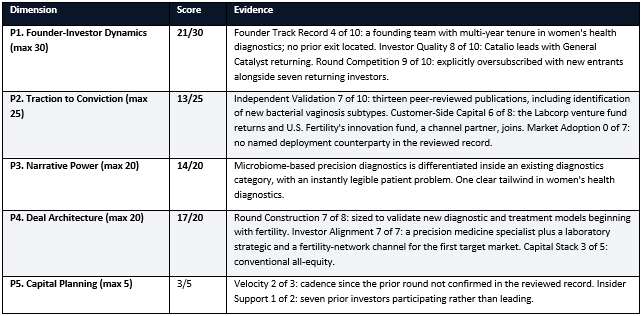
Why this scored. Joint second on Founder-Investor Dynamics at 21 of 30 on an explicitly oversubscribed round with seven returning investors, and one of five rounds in the issue carrying an externally controlled validation, in this case thirteen peer-reviewed publications that journals, not the company, control.
The Setup. Evvy, headquartered in New York, runs a vaginal microbiome diagnostics platform that combines metagenomic sequencing, clinical interpretation and a machine-learning system called EvvyAI. Its work has produced thirteen peer-reviewed publications, including the identification of new bacterial vaginosis subtypes. Founded in 2021 by Priyanka Jain, Laine Bruzek and Pita Navarro, the company is taking the platform into clinical validation of new diagnostic and care models, starting with fertility and IVF.
The Deal. $40.0M oversubscribed Series B led by Catalio Capital Management, announced September 15, 2026, with U.S. Fertility Innovation Fund, Rethink Impact, Muse Capital and Alumni Ventures as new investors and LabCorp Venture Fund, General Catalyst, Left Lane Capital, BBG Ventures, Amboy Street Ventures, Ingeborg and Foreground Capital returning. Total raised nearly $60M across three rounds. All equity.
The Pattern. This is the proprietary dataset round. The asset is a clinically linked dataset that grows with every patient served, and part of it has already been examined outside the company in peer-reviewed form.
The Perspective. Look at the two strategics. A national laboratory company’s venture arm came back, which says the party that runs testing at scale chose to stay in. And U.S. Fertility, a physician-led fertility network that is already Evvy’s research partner, came in through its innovation fund, which puts the channel for the next market on the cap table before the company enters it. Pair that with peer-reviewed output and a precision medicine specialist in the lead seat, and the round is legible on independent axes, none of which depends on the company’s own description.
The Playbook. If your product generates data, publish from it with a named academic collaborator before you raise. A peer-reviewed paper converts your dataset from a claim into a fact a journal owns, and it is the cheapest externally controlled checkpoint available to a data-driven company. Start the manuscript two quarters before the process opens.
The Founder Mistake to Avoid. Founders with proprietary data treat secrecy as the moat and keep everything inside. Evvy’s data became fundable because some of it left the building in reviewed form. A dataset nobody outside has examined is an assertion.
AIUC
Audit, Certification and Insurance for AI Agents | Series A | $40.0M | Led by Ribbit Capital
Eisen Fundability Score: 66 / 100
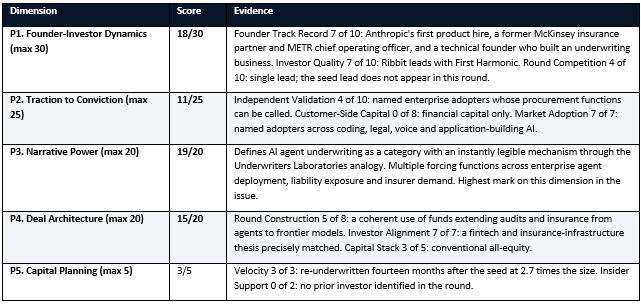
Why this scored. The highest Narrative Power mark in the issue at 19 of 20 and the only top-three round with no returning investor. AIUC was re-underwritten fourteen months after its seed at 2.7 times the size, and its external position is unusual: it does not hold a checkpoint; it issues one.
The Setup. The Artificial Intelligence Underwriting Company, headquartered in San Francisco, sells AIUC-1, an audit and certification standard for AI agents modeled on SOC 2 that runs roughly 5,000 adversarial scenarios per audit, developed with the law firm Orrick and input from more than 250 Fortune 1000 security chiefs, with insurance coverage tied to audit results. Co-founder Rune Kvist was Anthropic’s first product hire; co-founder Rajiv Dattani was a partner in McKinsey’s insurance practice and chief operating officer of METR; chief technology officer Brandon Wang previously founded a consumer underwriting business. Named adopters include Cursor, Lovable, Harvey and ElevenLabs.
The Deal. $40.0M Series A led by Ribbit Capital with First Harmonic participating, announced September 15, 2026. Total raised $55M including a $15M seed led by NFDG in July 2025. All equity.
The Pattern. This is the standard-setter round. The company is building the checkpoint that other companies need to clear, which is the most durable position in any category where trust is the bottleneck.
The Perspective. Ribbit in the lead seat is the thesis tell. A fintech specialist leading an AI company means the round was underwritten as insurance infrastructure, a business with a known shape: a standard, a testing regime, and a priced risk. Underwriters Laboratories compounded for a century because every new buyer required the mark. A standard with named adopters is a network asset, and that is why Narrative Power scored 19.
The Playbook. If your category lacks a trusted checkpoint, ask whether you should build it. Start with five design partners who will publicly certify against your standard, recruit one institution outside the company to co-author it, and price something off the result. Adoption is the proof. The document is not.
The Founder Mistake to Avoid. Founders copy the category claim without the adopters. A standard nobody certifies against is a PDF. What made AIUC-1 fundable is named AI companies on it, an outside law firm and security chiefs behind it, and an insurance product priced off the audit.
MIND
AI-Native Data Loss Prevention | Series B | $72.0M | Led by Crosspoint Capital Partners
Eisen Fundability Score: 62 / 100
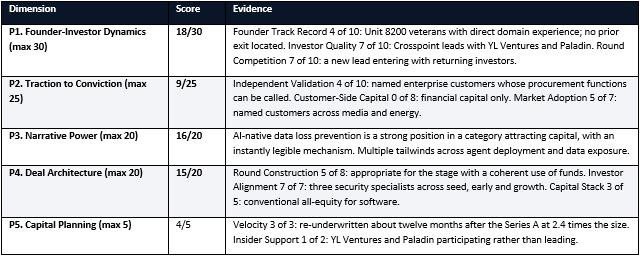
Why this scored. The largest Series B of the week and its clearest velocity story: a $30M Series A to a $72M Series B in about a year, with existing backers YL Ventures and Paladin returning behind a cybersecurity specialist lead. MIND also carries named enterprise customers in two unrelated industries.
The Setup. MIND, headquartered in Seattle and founded by veterans of Israel’s Unit 8200, sells AI-native data loss prevention that monitors how sensitive information moves across people, applications, and increasingly autonomous AI systems. Named customers include Crunchyroll and Sungrow Power Supply. The product sits exactly where agent deployment creates new data paths that existing controls were not built to see.
The Deal. $72.0M Series B led by Crosspoint Capital Partners, announced September 17, 2026, with existing investors YL Ventures and Paladin Capital Group participating. Total raised: $112M. Series A of $30M closed roughly a year earlier. All equity. Headquarters is listed as Seattle in the company release dateline and independent coverage.
The Pattern. This is the agentic security round. Every autonomous agent a company deploys is a new identity with access to data, and the budget line to govern that is being created right now.
The Perspective. Crosspoint is a cybersecurity specialist, and YL Ventures and Paladin are existing security investors who have watched the product in production. When the specialist takes the lead one year after the Series A and the existing backers stay in, the round is a category bet reinforced by the people with the most information. The 2.4x step-in round size is the market pricing that information.
The Playbook. Anchor your round to the budget line the AI wave creates, not to AI itself. MIND’s story fits in one sentence: companies deploying agents must control what those agents can move. Find the control your buyer is forced to add because of AI adoption and put it in the first line of the deck.
The Founder Mistake to Avoid. Security founders chase logo counts over reference-grade accounts. Two named customers in media and energy do more work than twenty anonymous ones, because a diligence team can call them. Name fewer, deeper accounts, and make sure each will take the call.
RegCell
Epigenetically Reprogrammed Regulatory T Cells | Series A | $44.0M equity plus grant | No designated lead
Eisen Fundability Score: 61 / 100
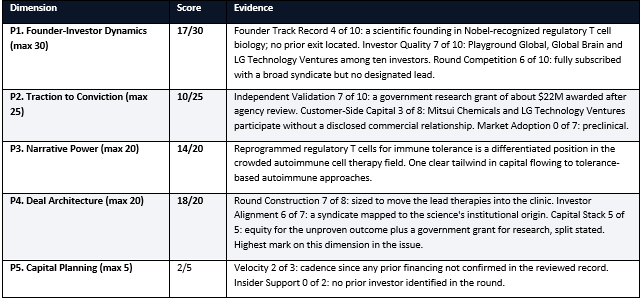
Why this scored. The highest Deal Architecture mark in the issue at 18 of 20, on the only round this week whose capital stack pairs equity with non-dilutive government funding and states the split. The grant is also an externally controlled validation: a government agency ran its own review before committing.
The Setup. RegCell, headquartered in Emeryville, California per its release dateline, is developing epigenetically reprogrammed regulatory T cells to restore immune tolerance in autoimmune disease. The company is built on the Nobel-recognized science of regulatory T cells and is using this financing to move its therapies into the clinic.
The Deal. $66M in total: a $44.0M fully subscribed Series A plus a grant of about $22M from Japan’s Agency for Medical Research and Development, announced September 15, 2026. Investors include Playground Global, Global Brain, Mitsui Chemicals, LG Technology Ventures, Alumni Ventures, Medical Incubator Japan, Fast Track Initiative, The University of Tokyo Edge Capital Partners, Osaka University Venture Capital and Kyoto iCAP. The reviewed sources do not designate a lead. Total new equity: $ 44.0 M.
The Pattern. This is the blended stack done right. Equity funds the unproven clinical outcome, the grant funds research, and the two are announced side by side with the amounts separated.
The Perspective. The grant does two jobs. It extends runway without dilution, and it is a checkpoint the company does not control. The syndicate maps the science’s origin: three Japanese university-linked funds, including those of Kyoto University and Osaka University, where the foundational regulatory T cell work was done, two corporate investors, and a US deep technology investor. The weakness is the empty lead seat. Ten investors and no one identified as setting the price is why Round Competition scored 6, not 9.
The Playbook. List every non-dilutive program your science qualifies for, from SBIR and STTR to ARPA-H, NIH, Department of Defense programs and national agencies abroad, and structure the round so the grant and the equity close together with the split stated. Then name one investor to lead. A blended stack with a lead is the strongest architecture available to a preclinical company.
The Founder Mistake to Avoid. Founders announce the blended total as the round size. RegCell’s figures separate a $44M Series A from the grant, which is why this report credits both correctly. Blend them, and a diligence team discounts both numbers and starts asking what else is blended.
The Fundraising Playbook: Five Tactical Plans
Five plans, each producing a concrete artifact you can use immediately. Each is built directly from this week’s verified signals.
Name the Credential Your Round Is Priced On (Narrative and Investor Framing)
Why this matters. Seven formation rounds took $232.0M, 26.9% of the week’s capital. Three of the four largest rounds were led by founders from Infosys, Meta, and OpenAI, and the week’s only pre-seed went to the co-founders of Rubicon Project, which went public in 2014. Large early rounds are open, and they price a credential rather than a stage.
Exact deliverable. One sentence at the top of your deck that states the single verifiable fact about your founding team that makes this round size rational, followed by the name of one person outside the company who will confirm it on a call. If that sentence doesn't exist, use a second slide to size the round to your next dated milestone instead.
Time estimate. Ninety minutes for the sentence. One call to line up the reference.
Expected outcome. Your ask matches what the market prices you at. You stop opening at a formation-round number without a formation-round credential, and you skip the four weeks of repricing that follow.
The reframe. Wrong approach: anchor your seed on this week’s largest rounds. Right approach: anchor it on the credential you can prove or on the milestone the money buys.
Acquire One Externally Controlled Checkpoint Before You Open (Proof Architecture)
Why this matters. Five rounds carried a checkpoint an outside body controls, and they averaged 62.4 against 48.7, a gap that holds at 7.3 after removing the sub-dimension that scores it. All five finished in the top ten. At Series A and later, a returning investor was worth 0.3 points this week.
Exact deliverable. A three-column table: the checkpoint, the body that grants it, and the earliest date it can land. Include regulatory steps, trial registrations, peer-reviewed or preprint results with a named academic collaborator, government grants, security attestations, and standards you can certify against. Mark the fastest one and start it this week.
Time estimate. Three hours for the table. Two to four months for most checkpoints, which is why the start date goes in now rather than when you open.
Expected outcome. The central claim in your process becomes a fact somebody else owns. An investment committee can confirm it without you in the room, which is what separated the top of the band this week.
The reframe. Wrong approach: build a case an investor must accept on trust. Right approach: count the facts a third party already certifies about you, then get one more.
Eisen Self-Score, Now With a Benchmark (Readiness)
Why this matters. This is the first week the v2 score can be compared across issues. The mean fell from 55.8 to 51.4 while capital rose. Three of twenty-five rounds cleared 65, eleven sat between 50 and 65, and eleven sat below 50.
Exact deliverable. Score your round across the five dimensions on the v2 rubrics. Above 65 puts you in the top three of twenty-five this week: run a competitive process with a deadline. Between 50 and 65 puts you in the crowded middle: fix your lowest dimension before you open. Below 50 means the problem is structural, meaning no lead, no returning investor, no external checkpoint, and no process design fixes that. Write the two lowest dimensions and one action for each.
Time estimate. Two to three hours, repeated before every raise.
Expected outcome. A decision this week between a competitive process now and a repair sprint first, rather than one discovered in week nine.
The reframe. Wrong approach: score yourself, feel discouraged, and rewrite the deck. Right approach: score yourself, name the two lowest dimensions, and pick process or repair today.
Lock the Insider, Then Target Only Stage Specialists (Deal Architecture)
Why this matters. Seven Series B rounds cleared after three weeks, down from two. Six of seven carried a returning investor, and every lead had a defined stage or category focus. Insight Partners alone led three rounds in the week.
Exact deliverable. Two outputs in order. First, a written commitment from your last round’s lead: a specific amount and a yes or no on leading if nobody else does. Second, a target list capped at fifteen firms, each with the round it led in your stage and category this quarter written next to its name. Cut every firm where you cannot write that line.
Time estimate. Two weeks on the calendar for the insider conversation. Four hours for the list.
Expected outcome. You open with a floor under the round and a list of partners who are actively writing checks in your lane, instead of a brand list that takes a quarter to disprove.
The reframe. Wrong approach: run a broad process and go to insiders if it stalls. Right approach: secure the insider first and pitch only the specialists who led your stage this quarter.
Sequence the Round Around the Checkpoint Date (Momentum and Conversion)
Why this matters. The rounds that scored highest this week put an outside fact next to the money: a Phase 1 program, a registered trial, a government grant, a published result, a standard with named adopters. Momentum came from the checkpoint, not from the calendar.
Exact deliverable. A one-page process plan with three dates: the checkpoint landing date, the day you open to new money, and the target close, with the open date no more than four weeks before the checkpoint lands. Add a fourteen-day follow-up cadence in which every touchpoint carries a dated update on that checkpoint.
Time estimate. One hour for the plan. The cadence runs itself once the dates exist.
Expected outcome. Every follow-up carries new, verifiable information, and investors waiting for proof receive it during the process rather than after it closes.
The reframe. Wrong approach: open when the deck is ready and follow up with enthusiasm. Right approach: open four weeks before the checkpoint lands and follow up with the checkpoint.
Looking Forward: Next 1 to 3 Weeks
Three evidence-based scenarios and one wild card. Every projection is anchored to this week’s verified data.
First, last week’s calls. Last issue projected that Series A would stay deep while everything else stayed thin. Wrong: Series A fell from fourteen rounds to nine while seed and Series B surged. It projected that strategic capital would keep rising. Wrong: its share halved. It projected that the insider gap would narrow as founders copied the structure. Half right: the gap narrowed, but because of composition rather than imitation. The forecasts below are built with that record in view.
The Barbell Holds: Formation Rounds and Series B Stay Wide (Medium-High Probability)
Evidence from this week. Five seed and pre-seed rounds above $10M at $37.20M average, seven Series B rounds at $43.43M, and Series A down to nine rounds and 29.6% of capital against 53.6% a week earlier. Both ends of the ladder were led by specialists with a precise thesis, which is what a durable lane looks like rather than a one-week spike.
What to watch. Whether Series B holds at four or more rounds in either of the next two issues. Two more weeks at that level means the three-week drought was a pause, not a closure. Separately, watch whether Series A recovers above twelve rounds. If it stays near nine, the market is thinnest in the middle of the ladder.
What founders should do before others notice. If you are a Series B candidate with a returning lead, move this month while specialists are actively writing. If you are raising a Series A without a credential or a checkpoint, expect a thinner field than last week and build the checkpoint first.
External Validation Becomes the Divider at Every Stage (Medium Probability)
Evidence from this week. Five rounds carrying an externally controlled checkpoint averaged 62.4 against 48.7, a 7.3-point residual, while the insider premium at Series A and later fell to 0.3 points. All five were healthcare, where checkpoints come by default.
What to watch. Whether a checkpoint-carrying round appears outside healthcare in the next two issues: a certification, a government contract vehicle, a published benchmark. If it does and it scores near the top, the divider is structural rather than sectoral. If it does not, this week’s gap was a healthcare composition effect.
What founders should do before others notice. Start the checkpoint now. Most take two to four months, so founders who start this week will have one in hand when the pattern becomes consensus.
Rate Pressure Narrows the Formation Lane First (Medium Probability)
Evidence from this week. The Federal Reserve raised its benchmark rate by 25 basis points on September 16 to a 3.75% to 4.00% range, its first increase since 2023. Formation rounds are the longest-duration bets in venture: no revenue to discount, only a team and a thesis. This week they took 26.9% of capital at the lowest average score of any cohort.
What to watch. Whether the count of seed and pre-seed rounds above $10M falls back below three in the next two issues while Series B holds. That combination would mean investors are shortening duration by moving capital toward companies with operating history.
What founders should do before others notice. If you are planning a large first round on a credential, close inside the next six weeks rather than next quarter. If the lane narrows, it narrows at the top of the check sizes first.
Wild Card: The Standard-Setter Becomes a Category (Low to Medium Probability)
Evidence from this week. AIUC raised $40.0M to issue the checkpoint rather than hold one, scored the week’s highest Narrative Power, and did it with a fintech specialist in the lead seat, naming AI companies already certified against its standard.
What founders should do before others notice. If buyers in your category keep asking the same trust question, the company that answers it for everyone may be worth more than the company that answers it for itself. Test it cheaply: publish a draft standard with three design partners and see who asks to certify.
The Bottom Line
The real insight is not the $861.7M. It is that capital rose 8.9% while the average fundability score fell 4.4 points on a constant rubric, because a quarter of the money went to companies nobody had funded at scale before, and because the signal that decided last week, a returning investor, stopped separating the field at Series A and later. Instead, what separated it was a fact somebody outside the company controls. That produced three conviction profiles.
Profile 1: Companies carrying proof someone else owns. Circle Pharma (69) has a Phase 1 program. Evvy (68) has thirteen peer-reviewed publications. RegCell (61) has a government grant. ReEmerge (60) has a published feasibility study and a registered trial. Ayble Health (54) has randomized controlled trials and payer and health system relationships. Five rounds, averaging 62.4 against 48.7.
Profile 2: Companies whose investors came back into a larger round fast. MIND (62) went from a $30M Series A to $72M in about a year. Polaris Electro-Optics (55) stepped up fivefold from its Series A. BackOps (54) raised again six months after its Series A with all four backers in. Luzern Risk (53) and Comp AI (53) did the same inside eighteen months. Seven rounds re-underwritten inside eighteen months at a larger size averaged 55.9 against 49.7.
Profile 3: Founders priced on a credential. Noetive (57), Hang Ten Systems (46), TypeSafe AI (41), and Hello Haven (41) raised on who the founders are. Seven formation rounds took $232.0M at an average of 46.6. The credential opened the round. It did not carry the score.
Everything else competed for the residual. Thirteen rounds had no returning investor, and the floor, Ravel at 28 and Ferry Health at 38, shares one shape: no designated lead and nothing in the transaction a new investor could reconstruct beyond the amount and the names.
Five New Rules for Founders
1. A rising market is not a validating market. Capital rose 8.9% while the mean score fell from 55.8 to 51.4. Price your round on your proof, not on the week’s headline total.
2. A big seed prices a credential, not a stage. Seven formation rounds took $232.0M, and three of the four largest went to founders out of Infosys, Meta, and OpenAI. Without that line in your deck, raise to a milestone.
3. Your insider is table stakes. The returning investor gap fell from 17.6 points to 6.8, and to 0.3 at Series A and later. Secure the insider, then give the next lead something the insider cannot.
4. Own one fact someone else certifies. Five rounds carrying an externally controlled checkpoint averaged 62.4 against 48.7, with a 7.3-point residual. Every one finished in the top ten.
5. Series B is open to companies whose last investors come back. Seven Series B rounds cleared, six with a returning investor, averaging $43.43M; every one led by a firm with a defined stage or category focus.
Four Monday Actions
1. Write your checkpoint line. One outside body, one checkpoint, one date it can land inside your process window. Start the fastest one this week.
2. Call your last round’s lead. Ask for a specific number in writing and a yes or no on leading before the first external meeting.
3. Name your credential or resize your seed. One verifiable sentence at the top of the deck, or a round sized to the next dated milestone.
4. Cut your target list to fifteen specialists. Write beside each name the round it led in your stage and category this quarter, or it comes off the list.
The market opened wider this week and asked for less proof on the way in. The founders who will close first next quarter are the ones who treat that as a window, not a standard: they walk in with an insider already committed and one fact on the table that somebody outside their company owns. You can start building that fact on Monday.
Research Methodology, Sources and Verification
Data Collection Period and Verification Standard
Data collection period: September 14 to 20, 2026, with verified primary announcements clustered September 14 to 17. In the sources reviewed, items first appearing on Friday, September 18, were repostings of earlier announcements or failed verification, and research was completed on Saturday, September 19, so any weekend announcement will be assessed in the next issue. Verification standard: a minimum of two independent sources per deal, anchored on company releases and regulated newswire copies (BusinessWire, PRNewswire, GlobeNewswire), read directly or through syndication and dated newswire summaries, plus at least one independent outlet. The issue was built in three passes: a collection pass across daily funding roundups and trackers; a verification pass against primary and independent sources for every company, amount, stage, lead, date, and headquarters; and an adversarial pass focused on date windows, amount composition, and headquarters conflicts. Eisen Fundability Scores are proprietary analytical estimates, not endorsements or investment advice.
Core Capital Totals and What They Include
The $861.7M weekly total includes only the twenty-five verified US rounds in the scorecard. Mid-market is defined as a US-headquartered round of new primary capital between $5M and $100M, matching the prior two issues. Because issues before August 31 used a $10M to $100M band, every week-over-week structural comparison is calculated on the $10M to $100M subset: twenty-two rounds totaling $837.5M at an average of $38.07M and a median of $38.5M, against twenty-one rounds totaling $769.0M at an average of $36.62M and a median of $35.0M. The three rounds below $10M, Ferry Health, Ravel and Gaia Dynamics, totaling $24.2M, are included in the scorecard, scores, sector and geography analysis but excluded from every week-over-week structural comparison, including every stage average.
Credit facilities, venture debt, secondary purchases, convertible notes into listed companies, prior tranches, cumulative restatements and non-dilutive grants are excluded from counted amounts. Four amounts were restated or qualified. RegCell’s $66M headline includes a grant of about $22M from Japan’s Agency for Medical Research and Development, so $44.0M of Series A equity is counted, and the grant is credited only as independent validation. Hang Ten Systems’ $85M of cumulative seed capital includes a $32M seed closed weeks earlier, so only the $53.0M extension is counted. Pave Finance announced more than $15M and is counted at $15.0M. Gaia Dynamics announced a $7M seed, while an SEC Form D filed the same day reports $8,585,054 sold to six investors; no source reconciles the difference, so we count the announced $7.0M and rate the round MEDIUM.
We recomputed the arithmetic after the adversarial pass. The five sector subtotals ($359.0M enterprise AI and software across nine rounds, $238.5M healthcare and life sciences across six, $109.0M fintech and insurtech across four, $87.0M semiconductors and AI infrastructure across two, and $68.2M robotics, consumer and climate across four) and the five stage subtotals ($304.0M across seven Series B rounds, $255.0M across nine Series A rounds, $195.2M across seven seed rounds, $92.5M in one Series E and $15.0M in one pre-seed) each sum to $861.7M across twenty-five deals. Geography: California $503.5M across thirteen rounds (58.4%), New York $155.0M across five, Washington $101.2M across three, and Minnesota, Florida, Massachusetts, and Utah one round each.
Scoring Calibration Notes
All twenty-five rounds were scored on the v2 rubrics published with the September 13 issue, so scores are directly comparable to that issue. Founder Track Record is scored from the public record located during the research window: 10 for a prior exit above $100M, 7 for a senior operating or research role at a tier-one company, 4 for direct domain experience including multi-year tenure building in the category, and 0 where no relevant background was located for a newly emerged company. Round-to-Round Velocity is scored 2 where prior institutional rounds exist, but their dates could not be confirmed; 0 for newly formed companies and for extensions, which applied to Hang Ten Systems. Rounds with no designated lead are scored on the institutional quality actually present; Ravel is the only round scored 0 on Investor Quality because no investor is identified in any reviewed source. No score reflects any operating metric a company published about itself. Where a finding rests on a scored input, the sub-dimension is removed from both sides, and the residual is published: returning investor 6.8 and 5.7, external validation 13.7 and 7.3, strategic capital 8.1 and 3.8, velocity 6.1 and 4.2. The Deal Scorecard states score bands once.
Deal Citations, Two or More Sources per Deal
Circle Pharma, $92.5M Series E. BusinessWire company release dated September 15, 2026; Fierce Biotech fundraising tracker entry dated September 16; Pulse 2.0; prior BusinessWire releases for the South San Francisco headquarters and the Phase 1 status of CID-078; Alliance of Chief Executives syndication of the Series C release. Rated HIGH.
Evvy, $40.0M Series B. BusinessWire company release dated September 15, 2026; Fortune exclusive dated September 15; Fierce Healthcare; Pulse 2.0; Beauty Independent; and the U.S. Fertility Innovation Fund. Flywheel Ventures appears among returning investors in two outlets but not in the company-sourced lists, so it is not counted. Rated HIGH.
AIUC, $40.0M Series A. TechCrunch report of September 15, 2026, read through Runtimewire and aggregator summaries; Insurtech Insights; Coverager; Crypto Briefing; FourWeekMBA for the seed timeline. Rated HIGH.
MIND, $72.0M Series B. PR Newswire company release dated September 17, 2026; read through VC News Daily; The Wall Street Journal as cited by Tech Startups; Tech Startups roundup of September 17. Rated HIGH.
RegCell, $44.0M Series A. BusinessWire company release dated September 15, 2026; Fierce Biotech fundraising tracker; VC News Daily, which carries the Emeryville dateline. Rated HIGH.
ReEmerge, $37.0M Series A. PRNewswire company release dated September 15, 2026, read through Yahoo Finance syndication and Runtimewire; allsci; Tech Startups roundup of September 15. Rated HIGH.
Noetive, $41.0M Seed. PRNewswire company releases read through VC News Daily, which carries the San Francisco dateline; The Wall Street Journal as cited by Tech Startups; Tech Startups roundups of September 16. Rated HIGH.
Polaris Electro-Optics, $50.0M Series B. BusinessWire company release dated September 15, 2026, datelined Carlsbad, California, and read through 01net, Photonics Online, and NewsBreak syndication, naming Walden Catalyst Ventures as lead and Andy Kau joining the board; Raptor Group post on Socratic Partners’ participation; Tech Startups roundup of September 15; Preqin, CB Insights, and M Ventures for the $10M Series A of 2025. The company reports completed Telcordia reliability testing and independently verified modulation speed; neither is confirmable against the testing body’s own record, so neither is credited in Independent Validation. Rated HIGH.
BackOps, $42.0M Series B. PRNewswire company release read through VC News Daily; Pulse 2.0; Packaging World and Pharmaceutical Commerce for the March 2026 $26M Series A. Rated HIGH.
Ayble Health, $16.0M Series A. PRNewswire company releases read through VC News Daily and The SaaS News, as summarized by Digg, for lead attribution. Rated MEDIUM because a single secondary source attributes the lead.
Comp AI, $34.0M Series A. Pulse 2.0; The Next Web; TechCrunch, as summarized by Runtimewire, for the pre-seed history; VC News Daily. Rated HIGH.
Luzern Risk, $45.0M Series B. Axios Pro exclusive dated September 17, 2026; BusinessWire release read through VC News Daily; Captive Review and Captive International for the April 2025 $12M Series A. Rated HIGH.
Kastle, $24.0M Series A. PRNewswire company releases read through VC News Daily; Tech Startups roundup of September 17. Rated HIGH.
Adaptive, $30.0M Series B. Company release dated September 17, 2026, published by Construction Dive, naming Emergence Capital, Andreessen Horowitz, Pathlight, Definition, and 3KVC as existing investors; International Accounting Bulletin; CB Insights for the $19M Series A of July 2024. Rated HIGH.
Viabot, $24.0M Series A. Company announcement read through VC News Daily; Tech Startups roundup of September 17. Rated HIGH.
Pave Finance, $15.0M Series A. WealthManagement.com dated September 14, 2026; InvestmentNews dated September 15; fintech.global; AlleyWatch daily funding report of September 14. Rated MEDIUM because no institutional investor is named.
Gaia Dynamics, $7.0M Seed. Pulse 2.0; PRNewswire release read through VC News Daily; SEC Form D as reported by Runtimewire. Rated MEDIUM on the unreconciled amount.
Hang Ten Systems, $53.0M Seed extension. BusinessWire release read through VC News Daily, which carries the Menlo Park dateline; TechCrunch as cited by Tech Startups. Rated HIGH.
Footprint, $25.0M Series B. PRNewswire company release read through VC News Daily, which names QED Investors as lead; Tech Startups roundup of September 16. Rated HIGH.
TeRAM, $37.0M Seed. BusinessWire company release dated September 15, 2026, read through Yahoo Finance, Morningstar, and AOL syndication, which names founder and chief executive Charlie Cheng and identifies Primary Venture Partners as lead investor; Semiconductor Digest; Tech Startups roundup of September 15, which described four co-leads and is not followed here. Rated HIGH.
BuyWander, $21.0M Series A. BusinessWire company releases read through VC News Daily; Tech Startups roundup of September 15. Rated HIGH.
TypeSafe AI, $40.0M Seed. BusinessWire company release dated September 15, 2026; Tech Startups roundups of September 15 and 16. Rated HIGH.
Hello Haven, $15.0M Pre-seed. PRNewswire company releases read through VC News Daily; Tech Startups roundup of September 17; Magnite corporate history and Rubicon Project investor relations for the founders’ prior company, its 2014 IPO and Mayfield’s earlier investment in it. Rated HIGH.
Ferry Health, $9.0M Seed. PRNewswire company releases read through VC News Daily; Tech Startups roundup of September 16. Rated HIGH.
Ravel, $8.2M Seed. Company announcement read through VC News Daily; Tech Startups roundup of September 17 citing GeekWire and Dealroom. Rated MEDIUM because no investor is identified in any reviewed source.
Market Comparison Sources
Contrast set: Crunchbase News weekly ranking of the ten largest US rounds for September 12 to 18, 2026: Temporal Technologies ($550M), Impulse Space ($308M extension), Ridgeline ($250M), Cornelis Networks ($205M), Factory ($200M), Profound ($180M), Arcee AI ($150M, reported), Nex ($150M, equity and debt), Mazama Energy ($135M) and Sling Therapeutics ($123M). Those ten totaled $2,251M against $10,560M for the prior week’s ten, a 78.7% fall. Crusoe’s $3.9B Series F was formally announced during the week after earlier reporting. Other sources: Tech Startups daily funding roundups for September 15, 16, 17 and 18; VC News Daily records for September 16 to 18, date-checked against primary releases because its posting dates lag announcements by two to five days; AlleyWatch daily and weekly funding reports of September 14; Fierce Biotech and Fierce Healthcare fundraising trackers; Axios Pro; Pulse 2.0. The September 16 rate decision is sourced to Databoks and same-day Tech Startups coverage.
Prior-period comparisons use only figures that do not depend on a scoring rubric, except the mean score, band, and count above 65, which are comparable only to the September 13 issue. September 7 to 13: twenty-four rounds totaling $787.8M, of which twenty-one totaling $769.0M sat in the $10M to $100M band at an average of $36.62M and a median of $35.0M; stage averages of $50.0M at seed, $30.14M at Series A, $55.00M at Series B and $70.0M at Series C; healthcare at 54.1%; thirteen of twenty-four carrying strategic capital; sixteen of twenty-four with a returning investor; a mean score of 55.8 with seven of twenty-four clearing 65. August 31 to September 6: twenty-five rounds totaling $924.6M at an average of $36.98M. August 24 to 30: twenty-one rounds totaling $543.9M at $25.9M. August 17 to 23: fifteen rounds totaling $545.0M at $36.3M.
Exclusions and Documented Rationale
Giant rounds and rounds at or above the $100M ceiling, excluded by editorial scope and used only as contrast: Crusoe ($3.9B), Temporal Technologies ($550M), Impulse Space ($308M), Ridgeline ($250M), Cornelis Networks ($205M), Factory ($200M), Profound ($180M), Arcee AI (at least $150M, no company-stated amount), Nex (more than $150M blending equity and a credit facility), Mazama Energy ($135M), Sling Therapeutics ($123M), CADDi ($114M) and Delos Data (more than $100M).
Non-US rounds, excluded for scorecard comparability: EUCLYD (more than 200M euro, Netherlands), Open Cosmos (300M euro, United Kingdom), Jack & Jill ($40M, United Kingdom), Integral (18M euro, Germany), Arcos (5.5M euro, Germany), ETFBOOK ($13M, Switzerland), Circuits Integrated Hellas (undisclosed, Greece), Qubot (about $13.8M, China), ENCOS (more than RMB300M, China), Yincheng Intelligence (about RMB100M, China), Kangwei Vision (about RMB100M, China), Nutshell Therapeutics (tens of millions of dollars, China), DeepKernel (tens of millions of RMB, China), EVAS Intelligence (nearly RMB2B, China), Zhongke Guosheng (RMB600M, China), Starroad (more than $10M, Hong Kong), dtcpay ($25M cumulative Series A, Singapore), Yoom (700M yen, Japan) and Ocean (undisclosed, Japan).
Outside the date window, marked news-cycle resurfaced: Highstock ($30M Series A led by Andreessen Horowitz), which circulated on September 14 through a daily funding report but was published by trade coverage on September 11; UrgentIQ ($15M Series A), announced September 11 and scored in the prior issue; Rogo (about $30M, no company-stated amount), excluded in the prior issue and recirculated on September 14; and Ayar Labs ($150M), listed in the prior issue’s contrast set. VC News Daily also reposted The Boring Company, Cognition, Motive, Suniva, and Fab2 on September 18; all five belong to the prior week.
Structural and verification exclusions: Rune ($40M Series A), because only one independent report could be located inside the research window, so the round is excluded rather than counted on a single source; Rapta ($8M), single source with no stage or lead confirmed; Veridion ($20M Series A), because the only US location in the record is a Wilmington, Delaware dateline and US operating headquarters could not be verified; Robigo (Series A, no amount stated).
At or below the $5M floor: Aristotle ($5.0M seed) and CreatorFi ($5.0M), each sitting exactly at the floor and excluded on the same ground that excluded Savvy Wealth at the $100M ceiling in the prior issue.
Geography and date notes. Polaris Electro-Optics’ own release places its headquarters in Carlsbad, California, with operations in Boulder, Colorado; several data providers list Broomfield, Colorado. The company’s statement governs, and the round is counted in California. MIND is counted in Seattle per its release dateline and independent coverage. TeRAM’s financing closed September 10 and was announced September 15; the report counts announcements, so it is included. Circle Pharma’s release is dated September 15, and Fierce Biotech’s tracker dates the round September 16.
Verification Notes
Twenty-one of the twenty-five featured rounds are rated HIGH source confidence, meaning each was confirmed by a company, investor, or regulated newswire source plus at least one independent outlet with no unresolved discrepancy. Four are rated MEDIUM: Ayble Health for a lead attributed by a single secondary source, Gaia Dynamics for the unreconciled gap between its announced seed and its Form D, Pave Finance because no institutional investor is named, and Ravel because no investor is identified. We checked every third-party validation credited in Traction to Conviction against the announcement of the grant, trial, publication, or clinical status rather than against a company characterization of it.
Deals analyzed: 25 verified US mid-market rounds of new primary capital between $5M and $100M. Deals excluded: 13 giant or ceiling rounds, 19 non-US rounds, 4 rounds outside the date window plus 5 reposted prior-week giant rounds, 4 rounds on structural or verification grounds, and 2 rounds at the $5M floor.
Research completion timestamp: September 19, 2026, after the adversarial pass.
DISCLAIMER: This article is for informational and strategic intelligence purposes only. It does not constitute investment advice. The Eisen Fundability Score is a proprietary diagnostic within Fundables OS™, not a financial recommendation.
If this article was useful, share it with founders who are about to raise.
— Leon Eisen, 4x Founder, Venture Capitalist, and Creator of Fundables OS™