

Three years ago, building an AI startup required infrastructure, a team, and a year of runway. That world is gone.
Today, a single founder with a laptop, a coding assistant, and 30 days of focused work can:
Discover a real, painful, paying problem.
Engineer the result manually before writing a line of product code.
Build a working prototype in days, not quarters.
Validate willingness-to-pay with real money.
Launch into a defined distribution channel.
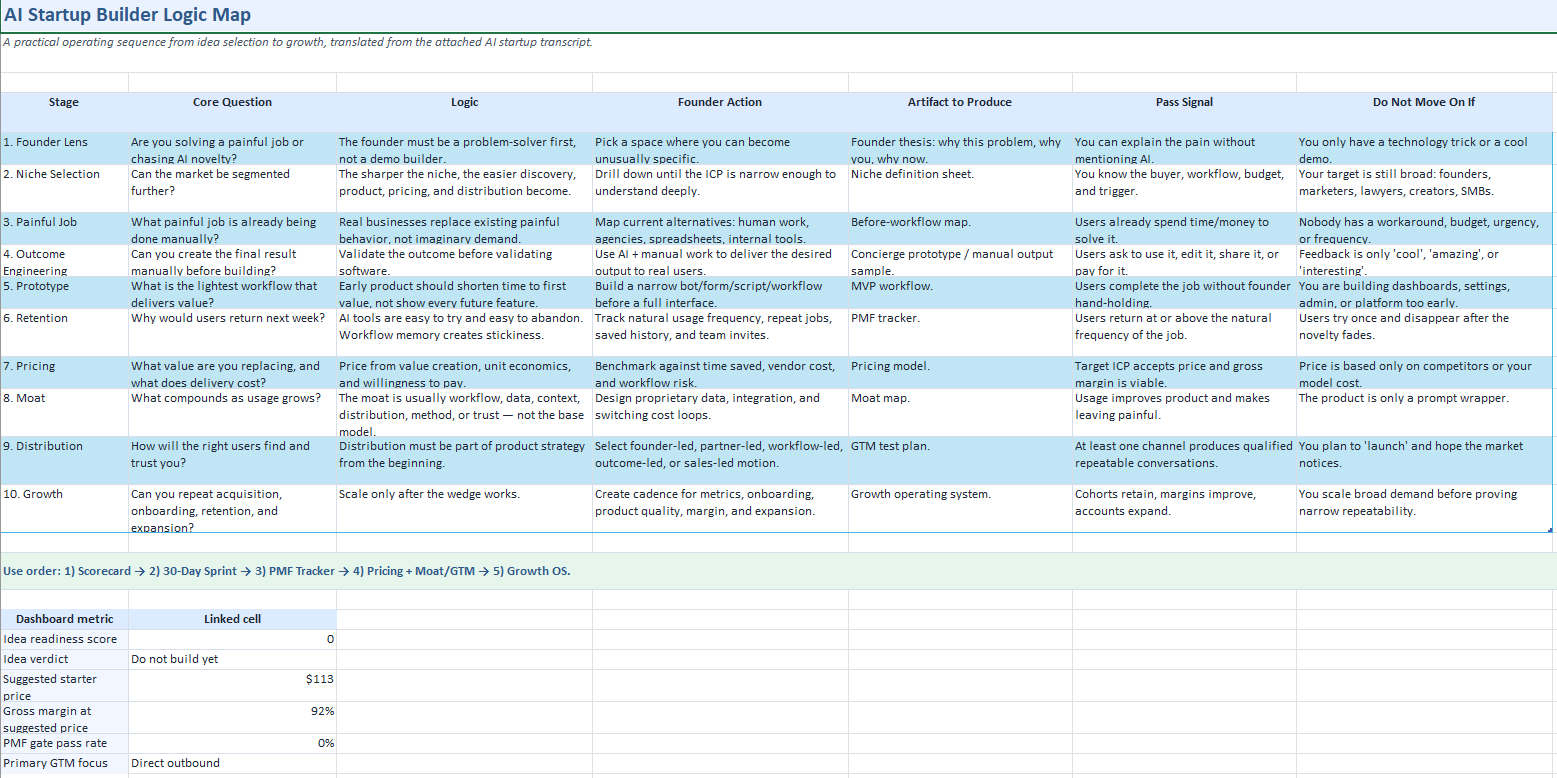
Use the AI Startup Builder Workbook, a practical Excel system for turning an AI idea into a real business for 30 days: niche selection, pain validation, ICP mapping, interview tracking, MVP signals, pricing, moat, and growth. Download it here:

The cost is no longer capital. The cost is clarity, discipline, and ruthless segmentation.
This is also the brutal news. Because the entry barrier has collapsed, every market already has 20 to 50 AI tools. Saying “I’m building the ChatGPT of X” is no longer a wedge. It is wallpaper.
The founders who win in 2026 do four boring things:
They pick a problem nobody glamorous wants to solve.
They engineer the outcome by hand before they engineer the product.
They predict what the foundation models will release next and build outside that line.
They treat AI as a thinking partner, not just a tool.
This guide is the 30-day, $0 sequence to do all four. Idea to growth.
PART 1 - THE MINDSET (DAY 0)
Before the work, the operating principles. Skip these, and the 30-day plan fails.
Principle 1: Build a Real Business, Not a Cool Demo.
A demo dazzles. A business converts. Most AI founders confuse the two and spend six months polishing a screenshot they will never sell.
The signal that you have a business, not a demo:
Customers ask for your pricing tier without prompting.
Customers complain when you rate-limit them.
Customers describe your product to other people in their own words.
The signal that you have a demo, not a business:
Everyone says, “This is amazing,” and nobody enters a credit card.
Your retention is down, not return.
You cannot describe what you do in ten words.
Wrong: “I built an AI tool that summarizes meeting notes with semantic search.”
Right: “I turn one-hour calls into shareable highlights your team actually opens.”
Principle 2: Passion Belongs to Problem-Solving, Not to the Problem.
You do not need to love insurance, logistics, or dental clinics to build the AI workflow that replaces slow manual work with faster, cleaner, revenue-generating execution.
What you need is the passion to be a problem solver. To be a builder. To be a game changer.
Pair that emotional passion with rational conviction about a specific painful job-to-be-done. The emotion gets you through the dark months. The rationality gets you to a customer.
Principle 3: Discipline is the Only Compounding Asset.
Every successful founder you admire built their habits in their twenties, not their thirties. Sleep, exercise, focus blocks, alignment to mission. These are not productivity hacks. They are the operating system that lets you switch context every five minutes for a decade without burning out.
If you are reading this in your twenties, your discipline now is your runway later.
If you are reading this in your thirties or forties, build the smallest version of the habit today. The system compounds more slowly, but it still compounds.
Principle 4: Use AI as a Thinking Partner From Day 1.
For every critical decision in the next 30 days, run it through AI before you commit, as a senior advisor with a quick response.
The format that works:
Drop in 5 to 20 paragraphs of context. Industry, customer, constraint, what you tried, what you saw.
Ask one specific question, not a vague one.
Push back. Disagree. Force it to interrogate its own assumptions.
Run 20+ rounds before you take the answer.
End-of-month ritual: ask the model “what were my biggest decisions this month, what did I get wrong, and what would you have advised three months ago that I ignored?” The memory features in AI tools are now powerful enough that this works.
It looks like you are building with a co-founder who never sleeps and never gets bored.
PART 2 - THE IDEA HUNT (DAYS 1 TO 7)
The first week has one job: find a problem worth 30 days of your life.
Most founders spend zero days here and lose a year to it later. Do not skip.
Days 1 to 2: The Three Filters
Run every candidate idea through three sequential filters. Drop anything that fails any of them.
Filter 1: The Niche Test.
Most “niches” are categories in disguise. Drill until you cannot drill further.
“AI for healthcare” is not a niche.
“AI for clinics” is not a niche.
“AI for dental clinics” is not a niche.
“AI workflow for independent dental clinics that process 50+ insurance claims per day and still manage approvals through phone calls, PDFs, and spreadsheets” is starting to look like a niche.
The test: can you name 50 real companies in your niche? Can you name the specific software, tool, or workflow each of them uses today? If not, drill again.
Filter 2: The Boring Test.
The cool industries are 10x to 100x more competitive. Glamour attracts capital, talent, and copycats. Avoid.
The boring industries have:
No conference circuit you have heard of.
Customers who answer their own phones.
Workflows held together by spreadsheets, screenshots, and one person who knows the system.
Vendors who have not updated their UI since 2014.
Boring is where the 30-day, $0 founder wins.
Filter 3: The Service Test.
In your niche, is there an existing service that someone is paying for today? Agencies, freelancers, internal tools, hacky workarounds, painful manual workflows?
If yes, you have a market. AI SaaS is the most reliable starting point in 2026. You are not creating demand. You are converting it.
If nobody is paying for any version of the work today, the problem is not painful enough. Move on.
Days 3 to 5: Two Problem Categories to Avoid
Some problems look fundable but are death traps. Cut them now.
Trap 1: You are a feature within the incumbent’s existing workflow, targeting its existing ICP.
Example: building an AI note-taker for video calls. Zoom and Google Meet have the same ICP, workflow, and distribution. They will ship the feature. They will bundle it. You will lose.
The test: if Microsoft, Google, Salesforce, Zoom, or HubSpot can ship your product as a checkbox in their next release, you do not have a startup. You have a feature that is either awaiting acquisition or extinguishment.
Trap 2: You are a thin wrapper that the next foundation model release will eat.
Be AGI-pilled. Predict what GPT, Claude, and Gemini will release in the next 6 to 12 months.
If today the model does the job 80% of the time, the next release will do it 99% of the time. If your entire product is “we wrote a clever prompt that makes the 80% feel like 95%,” you are renting your moat from OpenAI.
The test: In the next foundation model release, does your product become more valuable or less valuable?
More valuable: you own a vertical workflow, a proprietary data flywheel, a new category, a captured distribution channel, or a deep integration into a regulated industry. Better models make your product better.
Less valuable: you are a UI on top of a prompt. Better models make your product redundant.
Build for the first column. Walk away from the second.
Days 6 to 7 - Distribution-First Idea Validation
Two years ago, distribution was an afterthought. In 2026, it is the first question, not the last.
For every surviving candidate idea, write down:
Where do my customers already gather? (Reddit subforum? LinkedIn? Industry Slack? Trade publication? Discord? Local meetup?)
What content do they already consume?
Who do they already trust?
Can I reach 100 of them this week without paying for ads?
If you cannot answer those four questions, you do not have an idea you can launch with $0. Either find a different idea, or do the homework until you can answer them.
Wrong: “I will figure out distribution after I build.”
Right: “I will only build something I can already distribute.”
Output of Week 1
By Day 7, you should have a single written document that contains:
The niche is so segmented that you cannot segment further.
The specific painful job-to-be-done.
The current alternatives (named: agencies, tools, manual processes, freelance markets).
The reason this problem becomes more valuable, not less, in the next foundation model release.
The specific distribution channel you can use to reach the first 100 customers in Week 4 without spending a dollar.
If any of those five are vague, do not move to Week 2. Go back and drill.
PART 3 - VALIDATION (DAYS 8 TO 14)
Most founders fail because they skipped it.
The principle: engineer the result before you engineer the product.
Days 8 to 9: Manually Produce the Outcome
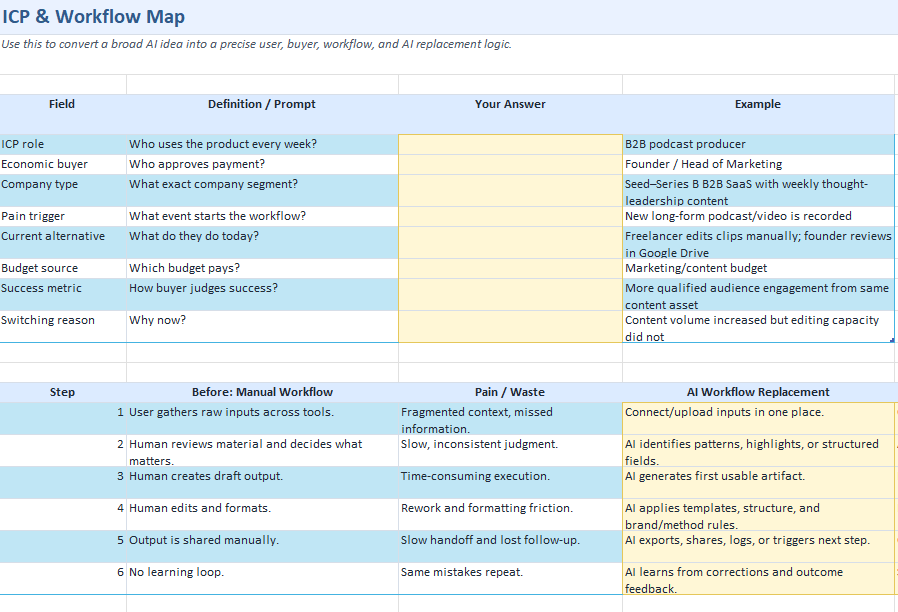
Whatever your product would deliver, produce it by hand, end-to-end, for at least five real people in your target ICP.
Example: if you are building a video clip AI, first test the clipping idea before starting prototype or MVP development. Take customer videos, manually edit the clips using available AI tools, and email the finished outputs to potential customers.
If that hand-edited clip got over 60% positive feedback, the product has a real demand curve. Before writing a single line of UI.
Your version:
If you are building an AI legal-doc summarizer for solo lawyers, write five summaries by hand and email them to five solo lawyers.
If you are building an AI-driven inventory tool for indie retailers, manually produce one week of inventory recommendations in a Google Doc for five retailers.
If you are building an AI tutoring platform for AP Calculus, hand-tutor five students for one session and capture what worked.
The signal you are looking for:
60% or more of recipients say they want to keep using the output.
They tell you what to tweak in their own words.
They ask, “When can I get more of this?”
If you do not see that signal, your idea is not ready. Iterate the hand-delivered outcome, not the product.
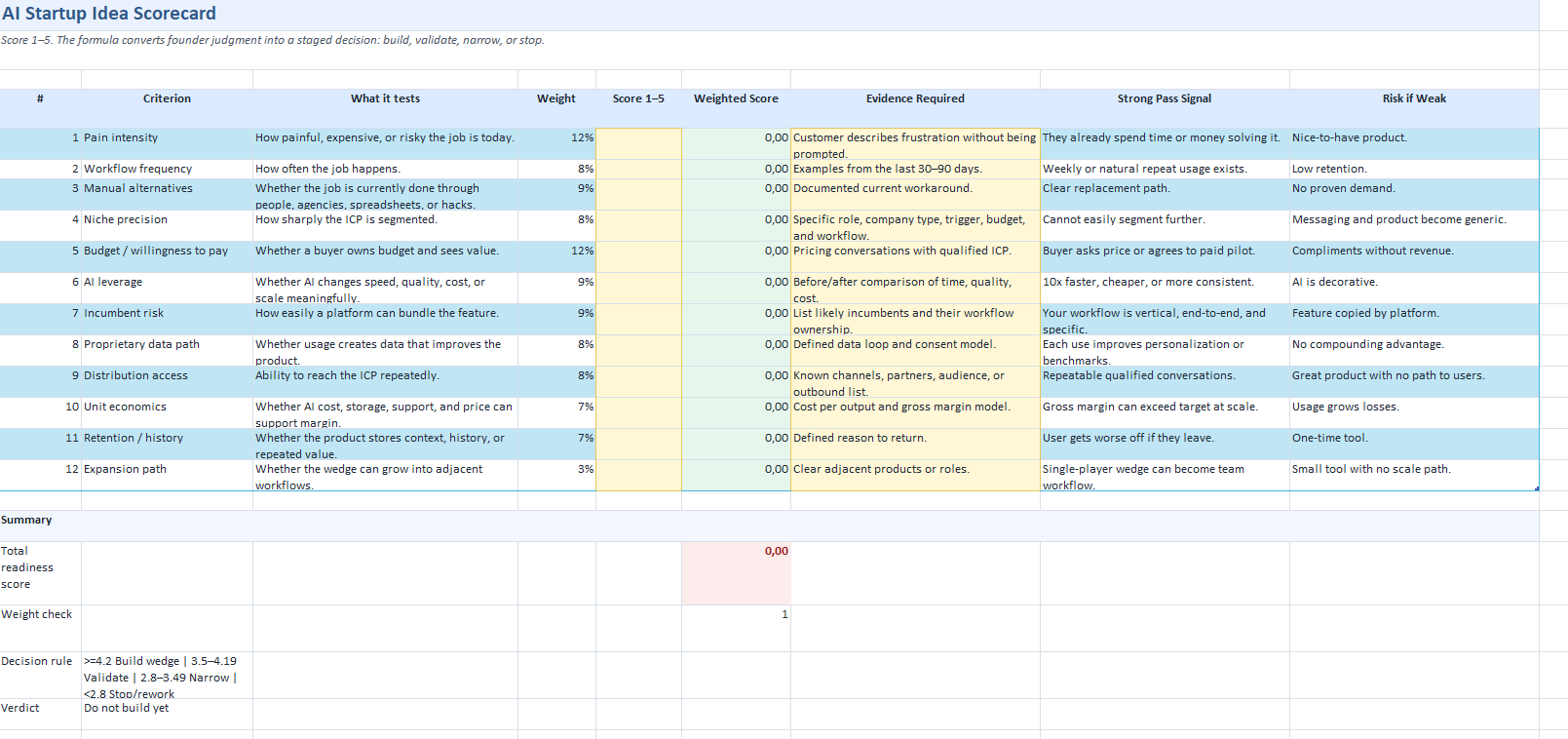
Use the AI Startup Builder Workbook, a practical Excel system for turning an AI idea into a real business for 30 days: niche selection, pain validation, ICP mapping, interview tracking, MVP signals, pricing, moat, and growth. Download it here:
Days 10 to 11: Customer Interviews That Actually Move Decisions
Do not run 200 surface-level interviews. Run 20 to 30 deep ones, designed for representativeness.
The structure:
Mix 4 buyer personas across 3 to 5 industries, 2 to 3 geographies, and varied company sizes.
30-minute calls, not 10-minute surveys.
80% of the time, you are asking, not pitching.
The four questions that always produce a signal:
Walk me through the last time you tried to solve [problem]. What did you do?
What is the cost when this problem is not solved? (Time, money, relationships, customers, sleep.)
What have you already tried, and why did it stop working?
If I put a working solution in front of you tomorrow that did exactly [X], what would you pay per month, and would you sign up before Friday?
The fourth question is the most important. Pricing answers without commitment are noise. You want a yes-and-pay or a no-thanks, here's why.
Days 12 to 13: Define Your ICP With Cruel Specificity
Your ICP is not “small business owners.” That is a market, not a profile.
Specifications that count as an ICP:
Role and seniority of the buyer.
Company size band (employees AND revenue).
Industry sub-vertical.
Geography.
Trigger an event that makes them buy this month, not next quarter.
Existing tools they already pay for.
Where do they spend time online?
If you cannot describe your ICP in a paragraph that another founder could use to find ten of them fast, your ICP is too vague.
Day 14: The Painful “Real Business” Test
Before you start building, run this checklist on what you have learned:
Are you replacing a tedious or human-heavy workflow with measurable hours saved or dollars made? (If no, stop.)
Can the customer describe the value in ten words? (If no, your messaging is not ready.)
Did at least three customers ask “what does this cost?” without you bringing it up first? (If no, the demand is not real.)
Did anyone offer to pay before the product existed? (If yes, you have a business. If no, you have an experiment.)
You only build in Week 3 if you cleared these four bars in Week 2.
PART 4 - BUILD (DAYS 15 TO 22)
Eight days. No design system. No marketing site. No App Store. No CI/CD pipeline.
The goal is to ship the smallest thing that can deliver the validated outcome to a real customer for real money.
Days 15 to 16: Pick the Lowest-Friction Surface
Do not start with a polished web app. The 2026 fastest-to-launch surfaces, in order of friction:
A Discord bot or a Slack bot. Zero UI. Customers already live there. You ship in days.
A simple form plus an email reply. The user submits a request. You (or your agent) deliver the output. No app required.
A spreadsheet plug-in or browser extension. Lives where the work already happens.
A bare-bones web page with a single text input and a single output. No login, no dashboard. One workflow, one result.
Whichever surface you pick, the rule is the same: the surface should disappear so the value can show.
If you are wireframing dashboards in Week 3, you are doing the wrong work.
Days 17 to 19: Build With Coding Assistants
The coding tool stack in 2026 is mature enough that a non-technical founder can ship a real prototype in days. A technical founder can ship in hours.
Heavy users converge on a small set of tools. Cursor is the dominant choice for founders with engineering instincts because it integrates into a real IDE. Lovable, v0, Bolt, and Replit Agent serve the non-technical end of the spectrum. Pick the one that matches your starting skill, not the one with the loudest marketing.
The rules of building fast:
One workflow only. No “we should also support [adjacent feature].”
Ship every day, even if it is broken.
Hardcode where you can. Generalize only when a second customer demands it.
No new dependencies after Day 19.
No design system before Day 26.
Day 20 to 22: Own the Workflow, Not the Prompt
This is the single most important architectural decision in the whole 30 days.
A “thin wrapper” product looks like this: the user types a request, you call the LLM with a prompt, and you return the answer. The next foundation model release does the same thing for free, in-app, with better quality.
A real product looks like this: you own the entire workflow end to end. AI is one of many components. You also own:
Proprietary data that the model cannot access (customer history, vertical-specific datasets, integration outputs).
A specific sequence of steps that solves a vertical business problem (intake, validation, generation, review, delivery, follow-up).
Integrations into the customer’s existing systems (CRM, billing, communication).
A trust layer (audit logs, approvals, compliance, governance).
Design the system so that AI is part of the workflow, not the whole thing. The wrapper dies in the next model release. The workflow compounds.
Wrong: Prompt engineering as the moat.
Right: Workflow ownership and proprietary data as the moat.
What “Done” Looks Like on Day 22
By Day 22:
A real customer can submit a real input.
Your product produces a real output that solves the validated problem.
The output is good enough that the same customers from Week 2 say, “Yes, send me more.”
The product is hosted on a stable platform capable of handling 100 users.
It does not need a logo. It does not need a settings page. It does not need analytics dashboards. It needs to deliver value.
PART 5 - PRICING (DAYS 23 TO 25)
Pricing is a science, not an art, and it is the area where most $0 founders self-sabotage by either underpricing out of fear or overpricing out of ego.
The pricing playbook has three pillars. Use all three.
Pillar 1: Anchor on Value Creation
Your price has nothing to do with your costs. It has to do with what the customer was paying or losing before you arrived.
Run the math:
What does the customer do today to solve this problem?
How long does it take?
What does that time cost (their hourly rate, or the freelancer/agency/vendor invoice)?
What does their alternative cost in dollars?
Example: a professional editor takes 30 to 60 minutes to produce a viral-ready one-minute clip and charges $25 to $50 per clip. That is the value benchmark. The product price has to fall somewhere within that range, ideally well below it for adoption and well above your unit cost.
Find your version of the $25-to-$50-per-clip benchmark. Write it down before you set a price.
Pillar 2: Verify Unit Economics
Revenue minus unit cost has to be positive at scale. Two cost categories will surprise you:
Inference cost. Real today, expected to fall over time. Model your pricing based on today’s costs, not tomorrow’s.
Storage cost. Often invisible in Year 1, often a quarter or more of your COGS by Year 3. Especially if you handle video, audio, or large file types. Forecast it now.
If your gross margin is below 40% at projected scale, your pricing or product architecture is wrong. Fix it before launch.
Pillar 3: Run the Pricing Experiment
Do not pick one price and pray. Pick three and test.
Sent thousands of pricing surveys and repeatedly tweaked the structure. Steal the principle:
Survey at least 50 of your hand-validated customers from Week 2.
Test three price points and three packaging structures (tier-by-feature, tier-by-usage, tier-by-seat).
For each: ask “Would you sign up at this price today?” not “Does this seem fair?”
Two structural rules that hold across most AI products in 2026:
Usage-based pricing beats seat-based pricing for solo and prosumer customers. Seats anchor people to a feeling of “we already have one license.” Usage rewards expansion.
You will say no to 70% of early users. This is correct. Build for your ICP, not for the loudest 70% who want a free tier you cannot afford. Saying no to non-ICP customers is the most underrated discipline of the early stage.
What “Pricing Done” Looks Like on Day 25
One headline price. Maybe two tiers, no more.
A clear measurable unit (clips, runs, transactions, queries, seats - one of them).
A 7-day free trial or a money-back guarantee, no longer a free tier.
Three customers who already said they will pay this exact price the day you turn it on.
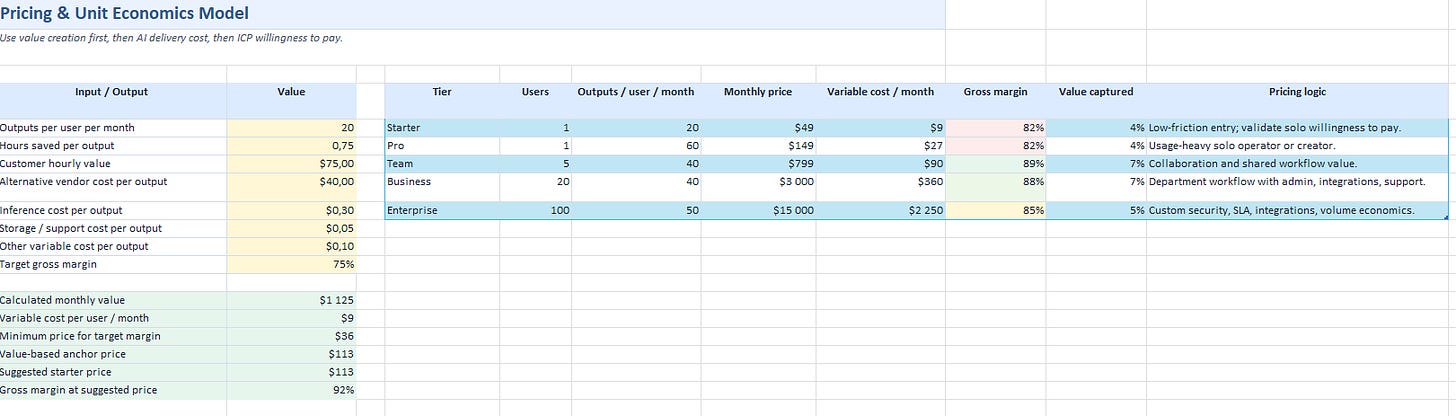
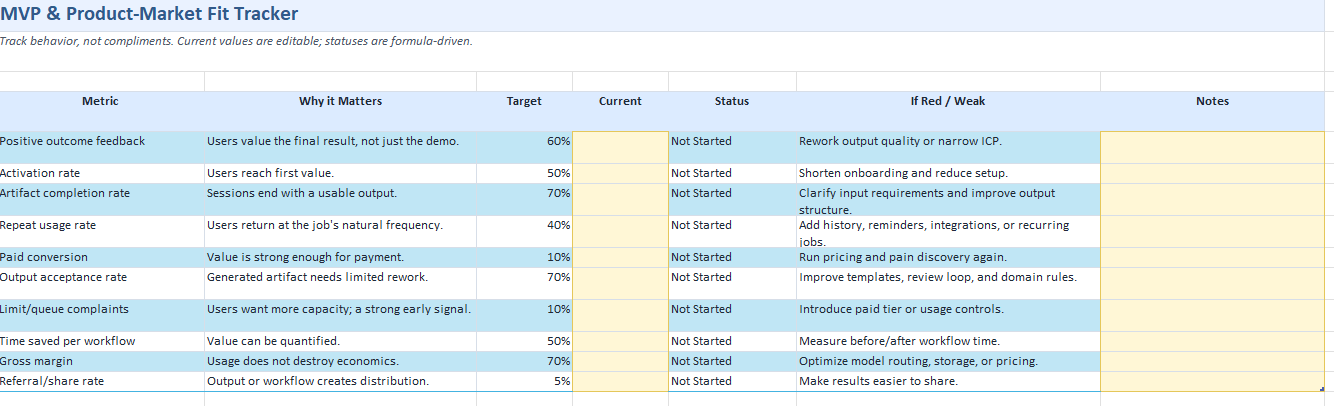
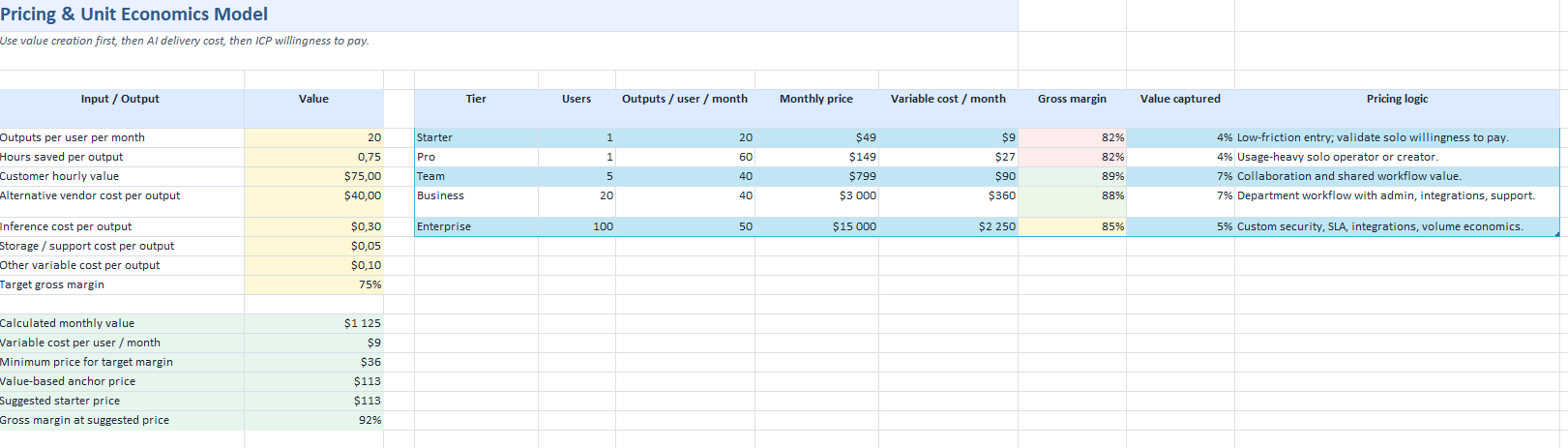
Pricing & Unit Economics Model.
PART 6 - LAUNCH AND DISTRIBUTION (DAYS 26 TO 30)
You did not skip Days 6 to 7, which means you already know where your first 100 customers live. Now you go where they are.
Days 26: Pre-Launch Warmth
Reach out to every person who participated in your Week 2 customer interviews and your Week 5 pricing survey. They are your warmest cohort.
Send a single message, customer by customer, in the channel they prefer (email, WhatsApp, LinkedIn, Discord DM):
“You helped me figure this out. It is now ready. Here is the link, the price, and the discount for being early. Want in?”
The conversion rate from a warm-cohort outreach like this should be 20% or higher. If it is below 10%, your product or your pricing is off. Fix before the public launch.
Days 27 to 28: The One-Channel Launch
Do not launch on Product Hunt, Twitter, LinkedIn, Reddit, Hacker News, and TikTok at the same time. You will dilute every channel and learn nothing.
Pick the one channel where your ICP actually lives. Concentrate every story, post, demo, and DM there for 48 hours.
The minimum content set:
One narrative-driven post explaining the problem and your specific take. Not a feature list. A constraint statement.
One short demo video that shows the before and after. Under 60 seconds.
Three customer stories from your Week 2 cohort. Real names, real outcomes, real quotes.
One DM template for direct outreach to the next 100 ICP customers.
Constraint language beats feature language every time:
Wrong: “We use AI to make it 5x faster to edit videos.” Right: “Most creators sit on three hours of footage per week they will never publish, because editing one viral clip takes a full afternoon. We turn that footage into ten ready-to-post clips in eight minutes.”
Day 29: The Retention Read
The day after launch is when you find out if you have a product or a moment.
Look at three signals, not one:
Quantitative: Daily active vs weekly active. If your tool’s natural use case is once a week, weekly retention is the right metric, not daily. Set the right denominator before you panic.
Qualitative: What are users saying in your Discord, your DMs, your support email? Are they complaining about specific limits (a great signal) or asking what your product is for (a terrible signal)?
Frequency: Are people coming back without you nudging them? Three returns in seven days, unprompted, is an early product-market fit signal.
The product-market-fit moment is when users start complaining about queue limits and quotas. That complaint is gold. It means the value is real, and you are now their bottleneck.
Day 30: The Founder’s Decision Day
By the end of Day 30, you have one of three outcomes. Be honest.
Outcome A: Real signal. You have at least 10 paying customers, at least one of them on a recurring plan, retention above 40% week-on-week, and at least three customers who gave you unprompted referrals. Double down. Spend Days 31 to 60 deepening the workflow, expanding distribution, and saying no to non-ICP requests.
Outcome B: Mixed signal. Some users love it, but retention is shaky, and pricing conversion from your warm list is below 10%. Iterate. The product or the wedge is wrong, but the problem is real. Stay in this niche, change the angle.
Outcome C: No signal. Nobody pays. Few come back. Nobody refers. Do not romanticize this. Kill the project, take the lessons, restart from Day 1 in a different niche. Most great founders kill three projects before the one that compounds.
Do not confuse stubbornness with conviction. Conviction is rational. Stubbornness is emotional.
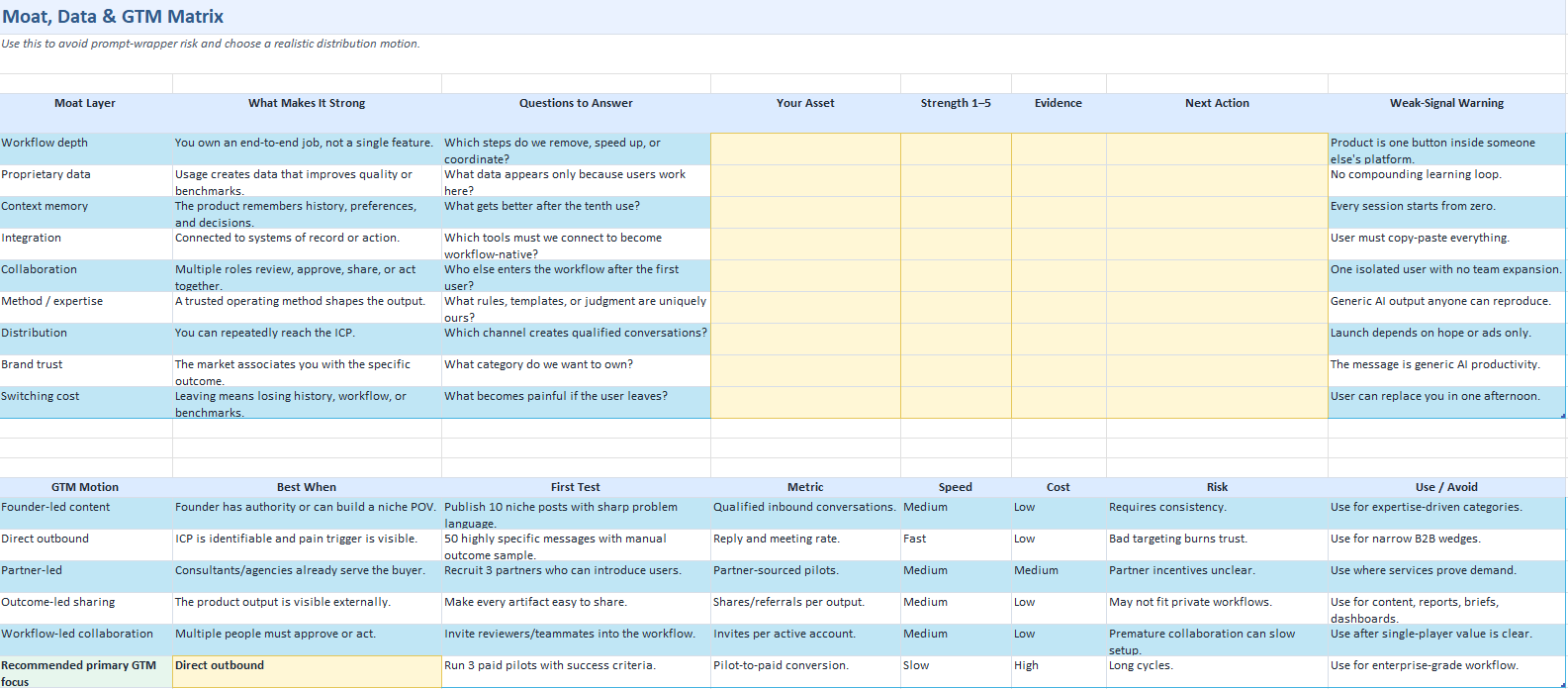
PART 7 - BEYOND DAY 30: GROWTH PRINCIPLES
If you cleared Outcome A, the next 90 days are about scale. Five principles separate the founders who go from $0 to $1M in ARR from those who plateau at $50K and quit.
Principle 1: Quantitative and Qualitative Data are Both Required.
In the early stage, the qualitative signal is often louder than the chart. People asking “where do I get more of this?” in your Discord is more predictive than your retention curve, because the curve has too few data points to be trusted.
Read your community, your support inbox, and your churn calls every single week. Do not delegate this for at least the first six months.
Principle 2: Every Product Decision is a Market Segmentation Decision.
Every feature you ship attracts one segment and slightly repels another. There is no universal feature.
Before you ship anything: write down which segment of your ICP this feature is for, and which segment will not care or will be slightly worse off. If the answer is “everyone,” you are deceiving yourself.
Principle 3: Multi-Agent Workflows are the Next Moat.
Single-agent products will be commoditized by foundation models. Multi-agent systems, where one director agent orchestrates many specialist agents, are where the durable value is moving.
Example. The user does not edit a video. The user gives the director agent an idea, a script, or a link, and the director agent coordinates a team of sub-agents (script writer, scene writer, designer, voice generator, asset researcher) to deliver a finished video end-to-end.
Apply this to your category. Where can a director agent coordinate three to nine specialist agents to do a job that today requires three to nine human roles? That is the architecture of a 2027 product.
Principle 4: Standing out is now an Imagination Problem, not a Skills Problem.
In 2016, you stood out by being willing to edit your own videos at 2 AM. Effort was the moat.
In 2026, AI does the editing. Effort is no longer scarce. Imagination, taste, narrative, and uniqueness are the new moat. Spend the same hours you would have spent in production tools on what makes you uniquely you: the angle, the voice, the audience-specific insight, the original framing.
The founders who win in attention-driven categories are not the most polished. They are the most distinctive.
Principle 5: Memory and Reflection are now Part of the Product.
The new generation of foundation models remembers. Use that for yourself first.
Once a month, ask the model:
What were my biggest decisions this month?
Which decisions am I likely to regret in 90 days?
What pattern am I repeating from earlier months?
What would you advise me on, if you could rewind 90 days?
Then build the same memory into your product where the user benefits. The features that matter to users are those that remember context across sessions and surface it intelligently. If your product treats every interaction as a blank slate, you are leaving the most defensible feature of 2026 on the table.
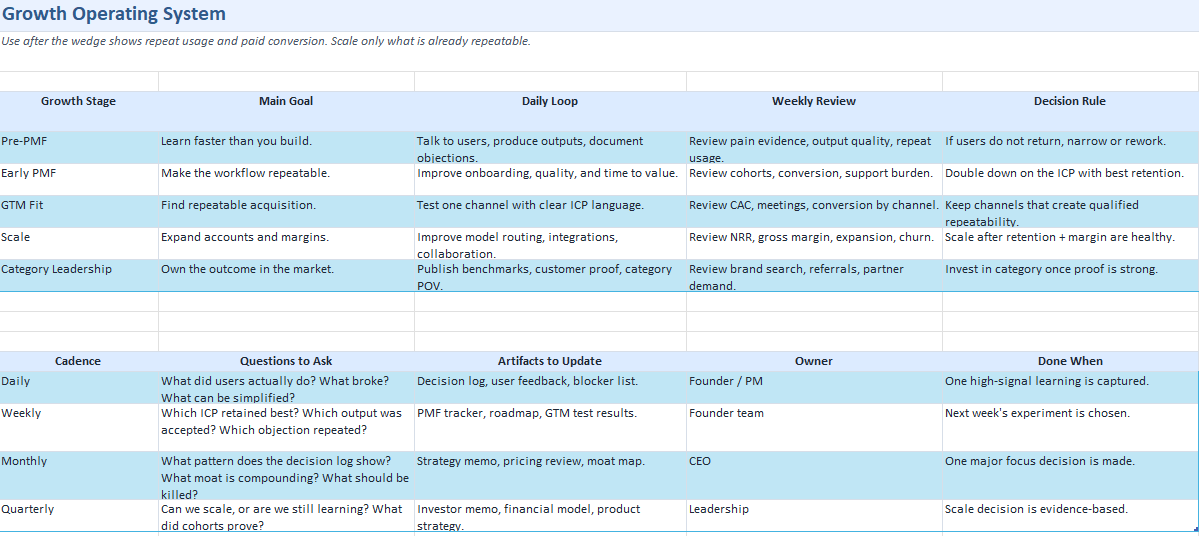
PART 8 - THE FOUNDER YOU BECOME
Tools change every quarter. Markets change every year. The founder operating system that compounds across decades looks the same regardless of era.
The Discipline Layer
Cristiano Ronaldo and LeBron James are still elite athletes in their forties because they were maniacally disciplined in their twenties. The reverse is not possible. You cannot install discipline in your forties. The window closes.
For a founder, the daily non-negotiables look like:
Sleep on a fixed schedule. Sleep is a product input, not a personal preference.
One block of 90+ minutes of uninterrupted focus per day, minimum.
Movement every day. Not for fitness. For cognition.
A weekly review of what worked and what did not. Written, not just thought.
If your twenties or early thirties feel chaotic and boundary-less, you are not building the substrate that lets you ship for the next 20 years.
The Saying-No Layer
The most successful founders share one trait: they say no to almost everything.
Priscilla Chan, when asked about balance, said her life is work and family. Parties do not exist. That is not a tragedy; that is a decision. Whether you make the same decision is up to you, but the principle is universal: every yes is a tax on your most important yes.
In the 30-day plan, you will have opportunities to take on side projects, consult, attend conferences, mentor, advise, and podcast. Almost all of them are noise. Say no until the product ships and the first 10 customers pay.
The Thinking-Partner Layer
Use AI as your senior advisor every day. Document your decisions, your reasoning, and your second-guessing. Run them through ChatGPT or Gemini before you commit. Push back on the model’s first answer. Force it to defend its claims.
Five questions to run on yourself, monthly, with a model that has memory:
What is the biggest mistake I have made in the past 6 months?
What is one thing you would suggest I change about how I make decisions?
If you could rewind three months, what would you tell me?
What pattern am I repeating that is costing me velocity?
Where am I spending time that does not compound?
These are the questions a great mentor would ask. The model is now good enough to ask them on demand.
Use the AI Startup Builder Workbook, a practical Excel system for turning an AI idea into a real business for 30 days: niche selection, pain validation, ICP mapping, interview tracking, MVP signals, pricing, moat, and growth. Download it here:
THE FOUNDER MEMORY TEST
If you remember nothing else from this guide tomorrow, remember these seven sentences. They are the entire 30-day operating system.
Build a real business, not a cool demo.
Passion belongs to problem-solving, not to the problem itself.
Drill the niche until it cannot be drilled further. Then drill once more.
Engineer the result by hand before you engineer the product.
Own the workflow end-to-end. The wrapper dies in the next model release.
Anchor pricing to value created, not to costs.
Discipline is the only compounding asset, and the window to install it is now.
The 30 days are not a plan. They are a forcing function. They strip away the things you would have done in three years (raise capital, hire a team, build a brand, pick the wrong niche, pivot late, raise again) and replace them with the things that actually move the needle in 2026 (segment ruthlessly, validate with real money, ship a workflow, find your channel, and read the signal honestly).
You do not need permission. You do not need capital. You do not need a co-founder.
You need 30 days, $0, and the discipline to follow the sequence.
Start on Monday.
If this article was useful, share it with founders who are about to raise.
— Leon Eisen, 4x Founder, Venture Capitalist, and Creator of Fundables OS™