

Forty-eight deals closed this week. $6.05 billion deployed. Four new unicorns minted in seven days. And the biggest private fundraise in human history, OpenAI’s pending $100B+ round at an $850B+ valuation, is sitting in final paperwork.
Strip away the noise, and the signal is unmistakable: venture capital has made a definitive choice. It is not funding AI applications this week. It is funding the roads, the power grid, the electrical transformers, the chip foundries, and the reliability plumbing that AI runs on. Infrastructure is the new enterprise SaaS. Energy is AI’s shadow stack. And founders who haven’t yet positioned themselves inside one of these themes are facing a headwind.
If you’re on the fundraising trail right now, this week changed your playbook, whether you’ve processed it or not. Here’s what shifted, what it means for your raise, and what you do.
Market Shift #1: Infrastructure Ate the Application Layer
The data is unambiguous. When you map this week’s $6.05 billion against the sector, one number dominates everything else: AI and AI infrastructure captured 56% of all capital deployed, which is 3.36 billion in a single week. Compare that to AI applications, which captured roughly 16%. The ratio is 3.5:1 in favor of the pipes over the products.
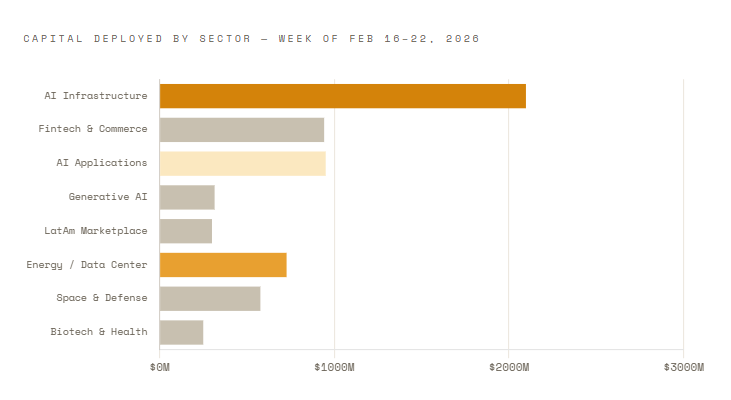
It’s a specific, structural bet. Investors are backing the companies that every AI application will eventually depend on. Temporal Technologies raised $300M at a $5 billion valuation to run the orchestration layer for AI agents, the tool that ensures a multi-step AI workflow doesn’t break when one step fails. OpenAI, Netflix, and JPMorgan are already paying customers. World Labs raised $1 billion to build spatial AI world models that will power robotics, 3D design, and autonomous systems for the next decade. ChipAgents raised $74M to deploy AI agents that design better chips, which is AI eating its own supply chain.
“If your company is built on top of AI without building any of the AI stack, the window to differentiate is closing. Infrastructure investors are writing checks before the demand curve peaks.”
The companies getting funded at the infrastructure layer all share one narrative posture: they are not AI-powered products. They are the substrate that enables AI-powered products. That’s the framing shift. And it’s working at every stage — from Braintrust’s $80M Series B for AI observability, to SurrealDB’s $23M for an AI-native database, to Portkey’s $15M for AI agent developer tooling.
What this means for your raise: If you’re pitching an AI application without infrastructure defensibility, you are in a crowd of thousands. The question investors are asking is: “What breaks if we remove this company from the AI stack?” If the answer is “just one customer’s experience,” your fundability score drops significantly. If the answer is “the workflows of 20M developers,” you’re Temporal.
Market Shift #2: Energy Is AI’s Invisible Bottleneck And Investors Know It
The second most striking pattern this week doesn’t appear on any AI deal list. It sits in a category called “Energy & Data Center Infrastructure.” And it raised $727 million in seven days across five deals, averaging $145M per deal. That’s a larger average check than the AI application deals with this week.
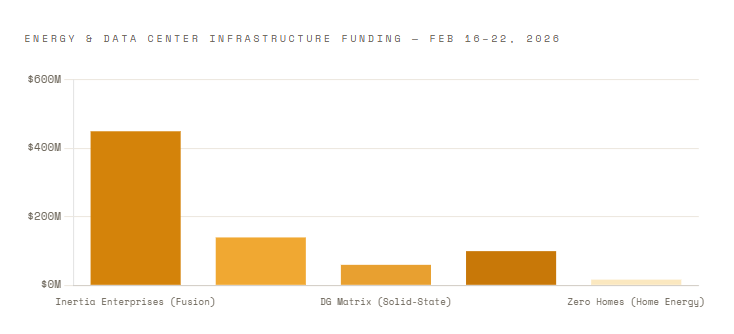
Inertia Enterprises, founded by Twilio co-founder Jeff Lawson and the scientist who led fusion ignition at the National Ignition Facility, announced $450 million in a Series A on February 11, just days before this reporting window. One of the largest Series A rounds ever recorded for fusion energy. The thesis is explicit: AI data centers will consume 9% of U.S. electricity by 2030, and the current grid cannot support that load. Inertia is building laser-based inertial confinement fusion plants to power AI compute at scale.
Heron Power, led by former Tesla SVP Drew Baglino and backed by Andreessen Horowitz and Breakthrough Energy Ventures, raised $140 million for power transformer technology. Its pitch is simple: moving renewable energy into data centers requires faster, denser, more efficient transformers. DG Matrix raised $60 million, oversubscribed, for solid-state transformers that convert distributed solar directly into data center power. The company noted that 90% of its current demand comes from AI data centers.
OpenAI told investors during the February fundraising process that its infrastructure spending target is $600 billion by 2030. That number doesn’t just represent chips and software. It represents power, cooling, land, cables, and the entire physical layer beneath the model layer. The energy companies funded this week are not adjacent to the AI trade. They are the AI trade, expressed in a different industrial form.
What this means for your raise: Energy and physical infrastructure are no longer niche areas of climate tech. They are AI-enabling technology. If you’re building anything that touches data center power, grid efficiency, cooling, or physical compute delivery, reframe your pitch as an AI infrastructure pitch. The LP and investor appetite are there. Language is what most founders in this space lack.
Market Shift #3: The Pedigree Premium Is Back At a New Extreme
The most alarming number from this research period doesn't describe a company's growth rate. It describes a company's age. Recursive Intelligence was founded in late 2025 and announced its Series A on January 26 - approximately two months after launch. The round valued the company at $4 billion. At two months old. We include it here because it is the defining pedigree-premium data point of the current market cycle, announced just weeks before this issue.
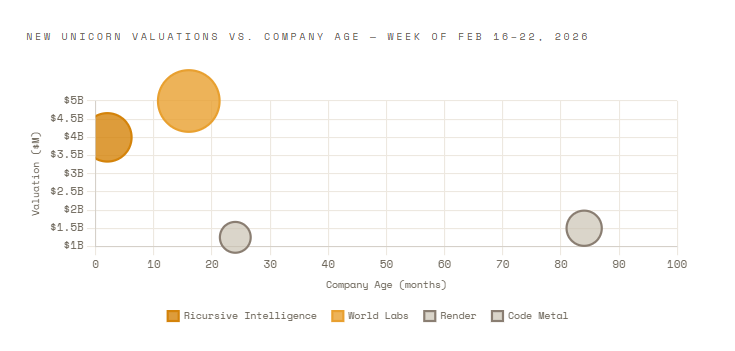
Recursive Intelligence was co-founded by Anna Goldie and Azalia Mirhoseini, the Google DeepMind researchers who created AlphaChip, the AI system that now designs Google’s TPU neural network chips faster and more efficiently than human engineers. Their prior work is the product. The company raised $300 million from Lightspeed Venture Partners without shipping a single commercial product, because Lightspeed was effectively buying the founders’ demonstrated capability to build something that doesn’t yet exist at commercial scale.
The same logic explains World Labs. Fei-Fei Li, Stanford AI Lab director, creator of ImageNet, former Google Cloud Chief Scientist, raised $1 billion in 16 months from founding, with Autodesk contributing $200 million in strategic investment. Autodesk doesn’t make speculative bets. They invested because Fei-Fei Li’s credibility on spatial AI is functionally equivalent to proven traction.
Code Metal is a different version of the same story. Peter Morales, the CEO, brought in Ryan Aytay, the former CEO of Tableau, as President and COO. Code Metal is profitable at Series B, serves the U.S. Air Force, L3Harris, and RTX, and was described as the fastest-growing defense tech company by revenue in its sector. Salesforce Ventures led the round. Every element of that sentence triggers conviction: profitable, defense pedigree, a named ex-CEO with enterprise credibility running the commercial side.
What this means for your raise: Pedigree accelerates the timeline to capital, but it doesn’t replace metrics. Every one of the pedigree-led companies this week also had either demonstrable technology, paying enterprise customers, or oversubscribed demand signals.
Pedigree opened the door. Proof kept it open. If you don’t have a Fei-Fei Li-level name, you need the proof first.
Market Shift #4: The Barbell Is Widening. Middle Stage Is Getting Squeezed.
The week's stage distribution reveals a structural imbalance that every Series A or Series B founder needs to understand. Seventeen of 48 deals were $100M or larger, growth and late-stage rounds that consumed 82% of total capital. Seed and early-stage rounds under $25M accounted for 11 deals but only 4% of the capital deployed.
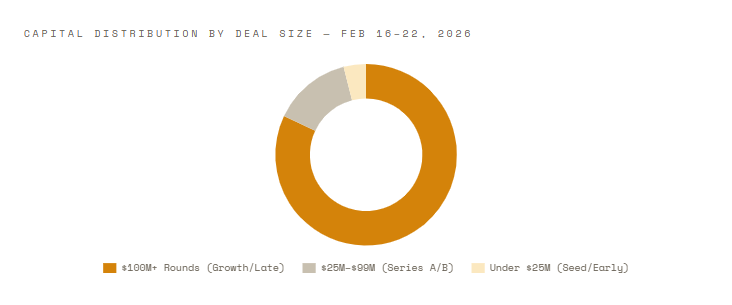
The barbell pattern isn’t new, but it is intensifying. Top-tier investors are doubling down on established winners. Andreessen Horowitz led three separate deals this week: Temporal ($300M), Heron Power ($140M), and Kavak ($300M). Battery Ventures closed a $3.25 billion fund in 4 months, with 80% of the capital from returning LPs. Thrive Capital is raising $10 billion. Capital is abundant, but it is concentrated at the top.
At the seed end, the story is different. Certivo raised $4M for AI supply chain compliance. Grotto AI raised $10M for AI-driven property vacancy optimization. QuadSci raised $8M for customer intelligence. These rounds closed on the strength of sharp category positioning and clear founding team credentials. The middle, the $15M to $50M Series A and B space, is where the squeeze is most acute. Investors at this stage are demanding proof of traction that rivals what a late-stage company showed five years ago.
VulnCheck is the benchmark at Series B this week: 557% enterprise ARR growth, 500 million records analyzed, and In-Q-Tel co-investment signaling defense validation. Ownwell showed 1 million+ appeals processed at an 86% success rate before raising $50M. These are conversion metrics that would have qualified companies for Series C or D in 2021. Today, they are the bar for Series B.
What this means for your raise: If you’re between $5M and $30M ARR and raising a Series B, you are in the hardest part of the current market. The metrics bar has shifted up 40-60% from two years ago. You need to demonstrate not just growth but also repeatability, unit economics, and, ideally, a clear path to profitability. An exceptional growth without a margin story is no longer sufficient.
Deals That Matter: Four Rounds. Four Fundability Lessons.
Temporal Technologies (Eisen Fundability Score is 91/100)
Series D · $300M · $5B Valuation · Led by a16z · AI Orchestration / Agent Infrastructure.
Temporal is the invisible backbone of modern AI. When an AI agent executes a multi-step task like search, analyze, write, send, verify, and one step fails, Temporal is the layer that retries it, logs it, and ensures the outcome is durable. This is not a novel product concept. It is an established enterprise infrastructure with compounding switching costs.
The numbers disclosed are stunning: 380% year-over-year revenue growth, 9.1 trillion lifetime workflow executions, and 20 million monthly installs with weekly active usage growing 350% in the past year. OpenAI, Netflix, and JPMorgan are paying customers. The founders built workflow orchestration systems at Uber and Microsoft before starting Temporal. They have lived it at scale.

Fundability Lesson: Infrastructure products with durable switching costs and disclosed operational metrics at scale are the highest-conviction investment category in the current market. The 9.1 trillion executions number is proof of irreversibility. Build the metric that proves you cannot be removed without catastrophic disruption.
Code Metal (Eisen Fundability Score is 88/100)
Series B · $125M · $1.25B Valuation · Led by Salesforce Ventures · AI Code Translation / Defense
Code Metal translates high-level languages like Python, MATLAB, and C++ into hardware-specific targets (Rust, CUDA, VHDL) while mathematically verifying that the translated code behaves identically to the original. That proof-of-correctness is the product. In normal software shops, a translation error is an annoying bug. For the U.S. Air Force, L3Harris, and RTX, it can be catastrophic. Code Metal is the only tool that converts and then proves. The U.S. Air Force is a customer. L3Harris, RTX, and Toshiba are customers. The company is profitable and has positive cash flow. They raised $125M in Series B funding at a valuation of $1.25B.
That last sentence deserves its own line - profitable. Code Metal is successful because it built into a category where the buyer (DoD) doesn’t price-shop and where switching costs are measured in decades of technical debt. Ryan Aytay joining as President adds the enterprise GTM credibility that typically separates companies that can close seven-figure contracts from those that cannot.

Fundability Lesson: Profitability at Series B is the ultimate objection-killer in 2026. It removes the “what if they run out of money” risk that VCs carry mentally on every deal. If you can reach cash flow breakeven before raising, even briefly, it restructures every investor conversation from “can they survive” to “how fast can they grow with our capital.”
Render (Eisen Fundability Score is 85/100)
Series C Extension · $100M · $1.5B Valuation · Led by Georgian · AI Developer Cloud
Render is where developers deploy applications after they’re built. It competes with AWS, Heroku, and Fly.io by being simpler, faster, and purpose-built for the AI-native development cycle. The growth metric tells the story: 4.5 million developers on the platform, 250,000 new signups per month, and OpenAI’s Codex running on Render’s infrastructure.
The Codex is the proof point that converts “developer cloud” from a commodity pitch into an infrastructure lock-in story. When the most-used AI coding tool in the world relies on your platform for deployment, your growth is algorithmically linked to the growth of AI development itself. Georgian’s investment reflects conviction in that correlation.

Fundability Lesson: One high-profile strategic customer that publicly validates your platform is worth more than ten anonymous enterprise references. Render’s fundraise was anchored by its relationship with OpenAI. Find your OpenAI, the brand-name customer whose usage validates your entire category thesis, and make that relationship central to your narrative.
What to Do With This Intelligence.
Reframe Your Infrastructure Story.
It’s been proven that “AI-powered” is not a differentiator. “AI infrastructure” is the fundable category. Audit your pitch: Does your company remove itself from the AI stack if deleted? If not, can you reframe what you enable the underlying workflows, the data layer, the reliability mechanism, rather than the surface feature?
Write a one-paragraph version of your pitch that answers: “What breaks across the market if our company disappears tomorrow?”
Map your customer dependencies - are there any OpenAI-equivalent anchors you’re underselling?
Calculate Your Eisen Fundability Score
The gap between founders who get funded and those who don’t is usually not the product. It’s the fundability readiness across five dimensions. Score yourself on the framework from this week’s analysis: Founder-Investor Dynamics (30), Traction-Conviction (25), Narrative Power (20), Deal Architecture (20), Capital Planning (5). Any dimension below 60% of its maximum is a red flag that an investor will find before you do.
Score each dimension. Where you’re weakest is where you spend the most time this week.
Build Your Irreversibility Metric
Temporal’s 9.1 trillion executions. Render’s 4.5 million developers. Ownwell’s 1 million appeals. Every deal that scored 85+ this week had an operational metric that communicated switching costs beyond just growth. This is different from ARR. It’s proof that your customers cannot easily leave. Identify yours and build a system to track and disclose it.
Define the metric that best captures “cost to remove us”: data records, workflow executions, users onboarded, and integrations live.
Add it to your data room as a permanent fixture. Update it weekly.
Map Your Investor Fit Against This Week’s Signals
a16z backed three deals this week across AI orchestration, clean energy, and the LatAm marketplace. Battery closed $3.25B. Thrive is raising $10B. These firms are telling you their theses through their deal flow. Build a firm-by-firm thesis map and score your company against each one before you pitch. Cold pitching a firm whose portfolio signals they don’t want your category wastes everyone’s time.
For your top 10 target investors, pull their three most recent portfolio companies and identify the pattern. Does your company fit it?
Pressure-Test Your Traction Narrative
The Series B bar moved this week. VulnCheck’s 557% enterprise ARR growth in its Series B sets a new benchmark. Before you walk into a Series B meeting, stress-test your narrative against what actually closed this week. If your growth rate is 80% year-over-year, you need an extraordinary story on gross margin, switching cost, or market timing to compensate. Find that story now, not in the room.
Run a “red team” session: have someone argue why your growth rate isn’t good enough. Then build the counter-argument.
Add one new proof point to your deck this week: a customer quote, a product milestone, a new metric that wasn’t there last week.
What To Watch Next 1–3 Weeks: Three Predictions Based On What This Week Revealed.
The OpenAI Close Will Trigger a Secondary Funding Wave
When the $100B+ round finalizes, likely by the end of February, it will function as the loudest possible signal to LPs sitting on the sideline that AI is not a bubble. Expect two to three major AI infrastructure rounds to announce within 10 days of the OpenAI close, as companies time their announcements to ride the sentiment wave. If you’re in final diligence, push to close in that window.
Energy + AI Convergence Rounds Will Accelerate
DG Matrix oversubscribed at $60M. Heron Power raised $140M with an a16z co-lead. Inertia closed $450M the week prior. Three separate announcements, one unmistakable pattern. Watch for a Kleiner Perkins, Sequoia, or General Catalyst energy-for-AI thesis articulation in the next 30 days. When a top-three VC firm publicly frames it as a category, the deal flow behind it will double.
Mid-Market Crunch Will Force Down-Round Conversations
The barbell intensified this week. Capital at the top ($100M+) and seed ($4M–$15M) flowed relatively freely. The $20M–$60M Series A/B middle is where companies are dying quietly. Over the next 30–60 days, expect a wave of bridge rounds and recaps from 2022-vintage startups that raised at peak valuations and have not grown into their marks. If you’re in this cohort, start that conversation now rather than when the runway is under 90 days.
Conclusion: The new rules of fundability derived from $6 billion of evidence.
AI infrastructure and energy infrastructure are a single investment thesis. Position inside it or explain why you don’t need to.
Pedigree accelerates capital at an extreme rate in 2026, but it substitutes for traction only at the earliest stages. Past a seed, you need both.
Profitability at Series B is no longer aspirational. It is the highest-conviction de-risking signal a company can send. Build toward it intentionally.
The Series B traction bar has shifted. 100% YoY growth is not differentiated. 380% is Temporal. 557% is VulnCheck. Know where you stand relative to what actually closed.
The irreversibility metric, the number that proves your customers cannot leave without catastrophic cost, is the most underused fundability tool founders have. Build it. Disclose it.
About This Analysis
This weekly market intelligence report analyzes fundability dynamics using the proprietary Eisen Fundability Score framework developed through 20+ years in the startup ecosystem and validated across 100+ startups. All data sourced from verified public sources with a minimum of two independent confirmations per deal. Eisen Fundability Scores are part of Fundables OS and reflect a multidimensional assessment of deal probability based on historical patterns and disclosed metrics.