

Executive Summary
As a four-time founder turned venture capitalist, I’ve always been curious about the people on the other side of the table, who they were before they started writing checks, and whether the path they took says anything about the bets they make. The folklore is tidy: top school, MBA, a few years in banking or consulting, then a seat at a fund. But that story never matched the partners I actually pitched, sat beside on cap tables, or eventually joined. Most of the sharpest ones had built something first, and many had failed before succeeding. So I went looking for the real profile of the modern general partner, not the caricature, and coded what the public record actually shows. The answer surprised me, and it reframes how founders should read the room when they raise.
Ask most people what a venture capitalist looks like, and they will describe a banker with an MBA. The best public data tell a more interesting story. Formal business training is common but not universal, and classic founder experience has historically been rarer in legacy U.S. institutional VC than the mythology implies.
The most defensible synthesis is this: the older U.S. professional-VC archetype remains MBA- and finance-heavy, but the visible modern GP class globally is increasingly founder/operator-heavy, especially in founder-led ecosystems and early-stage funds.
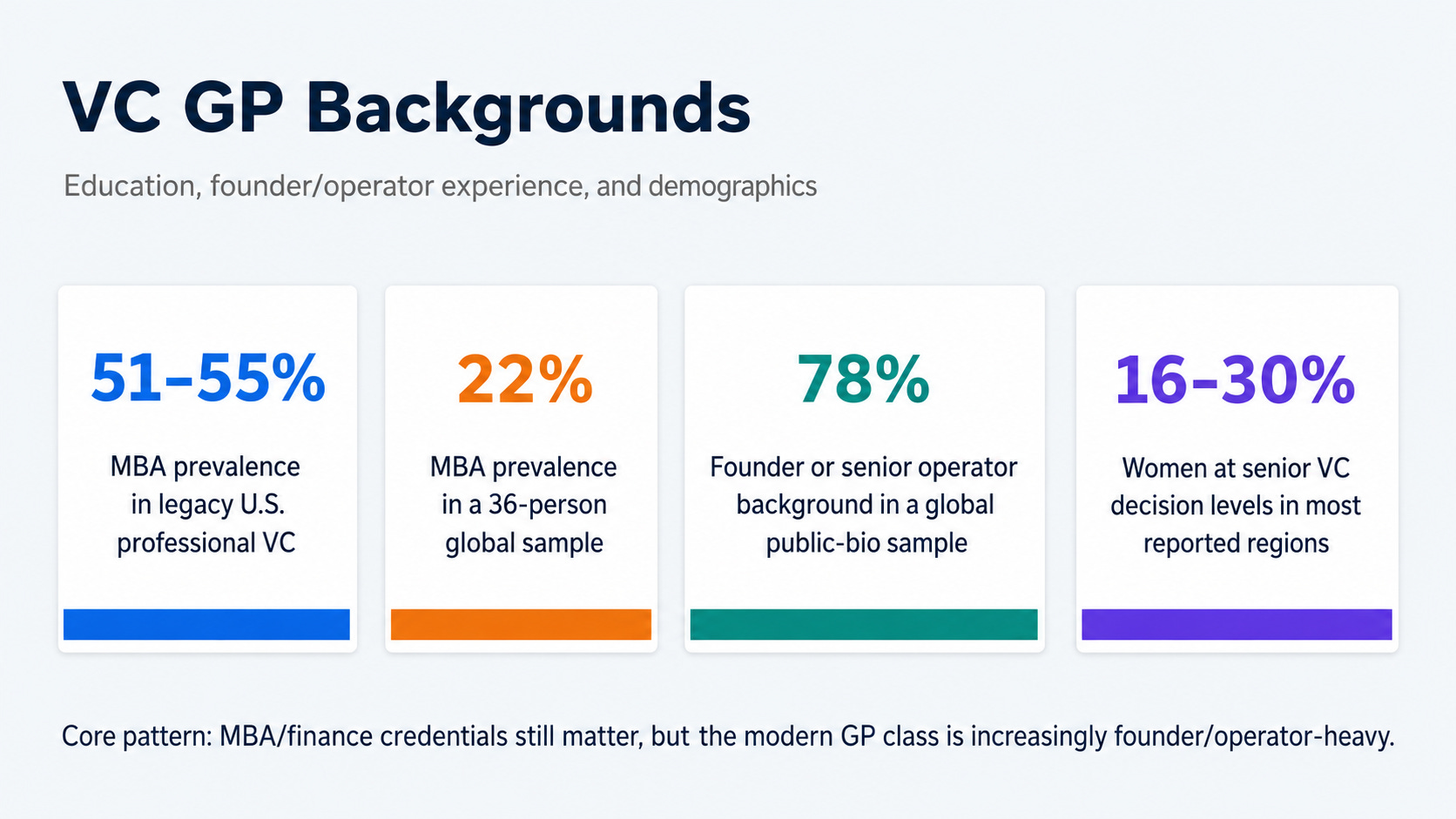
A current, illustrative, global public-bio sample of 36 people coded for this report showed 22% with an MBA, 44% with formal business/finance/management education, and 78% with founder or senior operator experience. This is not a full industry census; it is a directional benchmark based on prominent public biographies.
Demographically, women remain underrepresented at senior decision-making levels in nearly every region with credible published data: around 20% of U.S. investment partners, 16% of European GPs, 20.8% of Israeli partners, 22% of Latin American VC partner count, and 30% of partners in Africa-focused VC funds.
There is no single dominant GP template anymore. Modern VC leadership is increasingly a blend of business-trained investors, ex-bankers/consultants, repeat founders, and former product and C-suite operators. The mix changes meaningfully by geography, fund stage, and fund culture.
What is inside
Core Findings
Methodology and Evidence Base
What The Larger Datasets Show
How I Built This
Education: Business Training Still Matters
Prior Careers: The Operator Era
Stage: The Higher You Climb, The More Finance You Find
A Regional Tour
Representative Coded Profiles
Demographics and Diversity Benchmarks
Strategic Implications
Limitations and Bias
Sources
Core Findings
Finding 1: MBA-heavy VC is real, but mostly a legacy/institutional benchmark. NBER- and Crunchbase-style professional VC benchmarks place the prevalence of MBAs at around 51-55% among U.S./Canadian professional investment partners. That is a strong signal, not a universal rule.
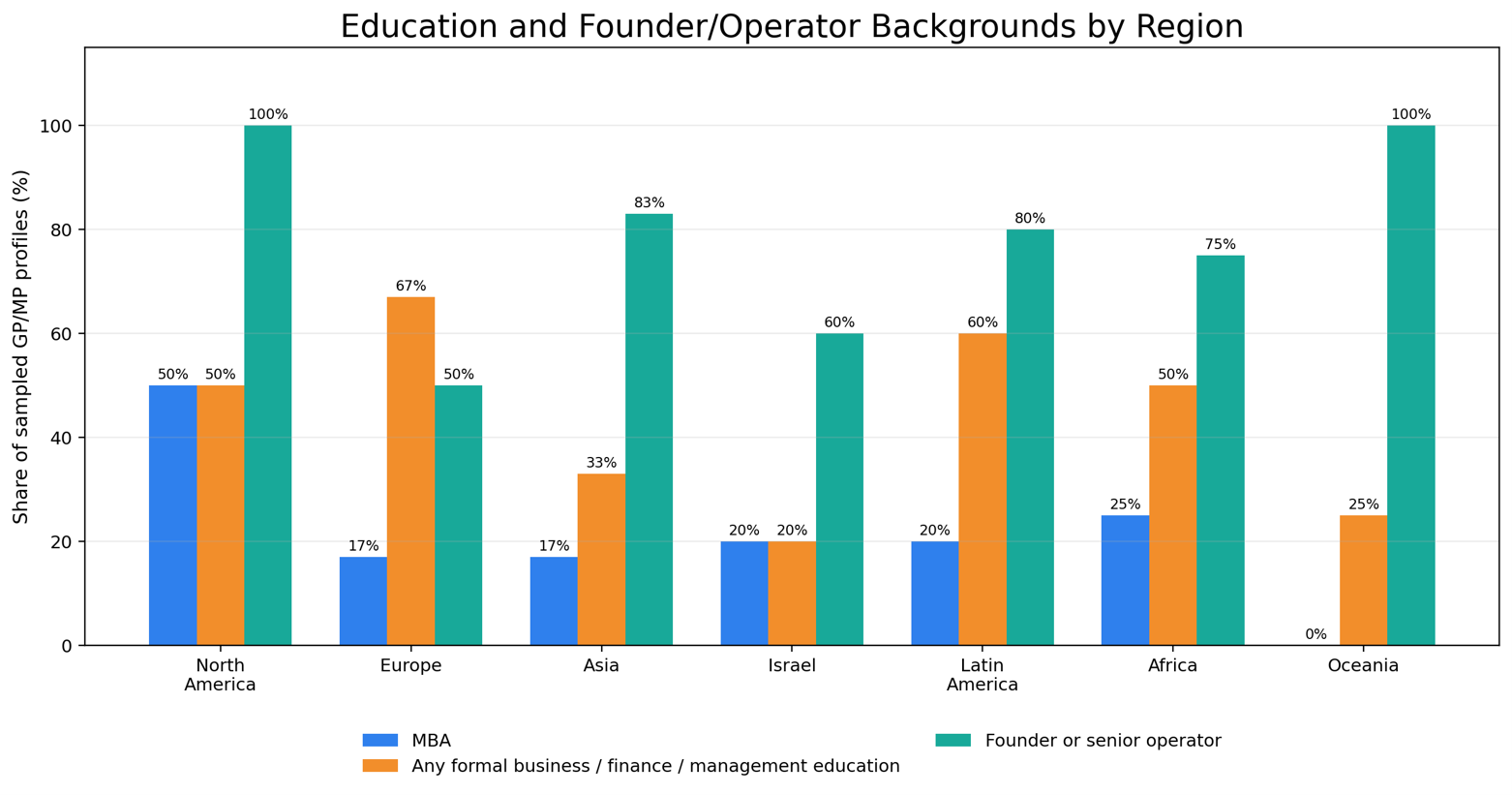
Finding 2: Public senior VC profiles now emphasize operating credibility. In the 36-person global sample, 78% had experience as a founder or senior operator. The operator signal was particularly visible in Oceania, North America, Asia, Latin America, and Africa.
Finding 3: Geography matters. Europe and Latin America showed higher shares of formal business education in the sample, while Israel and Oceania appeared more founder- or operator-led. Asia was mixed, reflecting very different China, India, Southeast Asia, and regional fund models.
Finding 4: Fund stage changes the background mix. Growth and multi-stage funds are more likely to include business education, finance, capital markets, and governance skills; seed/early funds more heavily reward founder empathy and product/operator judgment.
Finding 5: Senior VC remains demographically narrow. Women are still a minority at the decision-making level across the reported regions. Race, ethnicity, and socioeconomic background data are much less complete outside the U.S. and UK.
Methodology and Evidence Base
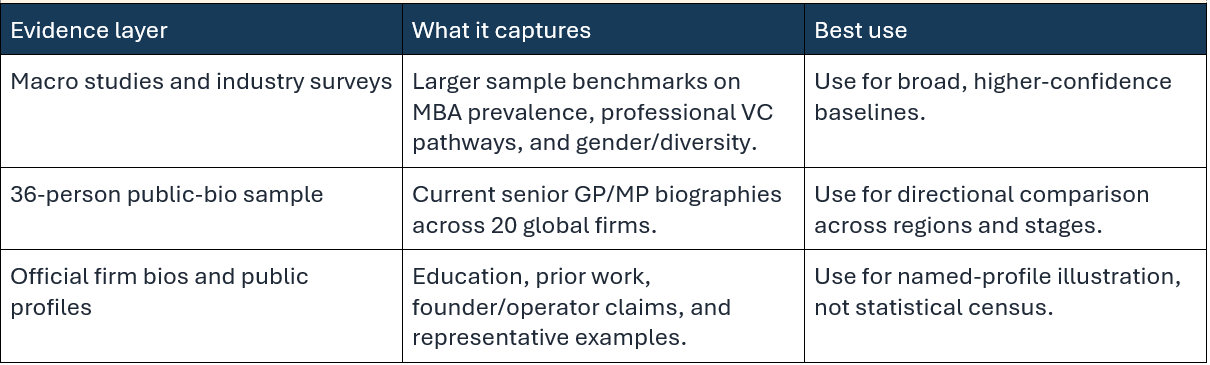
This report uses two layers of evidence. First, it uses macro benchmarks from venture-industry surveys, academic work, and regional diversity reports. Second, it uses an illustrative public-bio sample of 36 named GP- or Managing Partner-level investors at 20 firms across North America, Europe, Asia, Israel, Latin America, Africa, and Oceania.
The sampled firms included Sequoia Capital, Andreessen Horowitz, Bessemer Venture Partners, Atomico, Accel, Balderton Capital, East Ventures, Qiming Venture Partners, Monk’s Hill Ventures, Aleph, Pitango, Viola Ventures, Kaszek Ventures, Monashees, Canary, Knife Capital, Norrsken22, Blackbird, AirTree, and Square Peg.
Coding definitions were conservative. MBA means a clearly identified MBA. Formal business education means an MBA or an explicitly business-, finance-, commerce-, or management-oriented degree. Founder/operator means the person founded a startup or held a clearly senior operating role before VC. I did not infer race or ethnicity from names or photos.
Important limitation: The public-bio sample is directional. It is current, global, English-biased, and skewed toward prominent firms whose biographies are polished and often founder-story-rich. It should not be read as a full census of all VC partners.
What The Larger Datasets Show
A hand-coded sample of 36 people is texture, not proof. So it matters that two much larger datasets have converged on the same story.
The most important comes from Stanford’s Ilya Strebulaev and Blake Jackson, who tracked 3,971 senior U.S. venture investors from 1996 to 2025. The share of those holding an MBA fell from 44% of those entering in the early 2000s to about 31% of the 2025 cohort, the lowest level in the data.
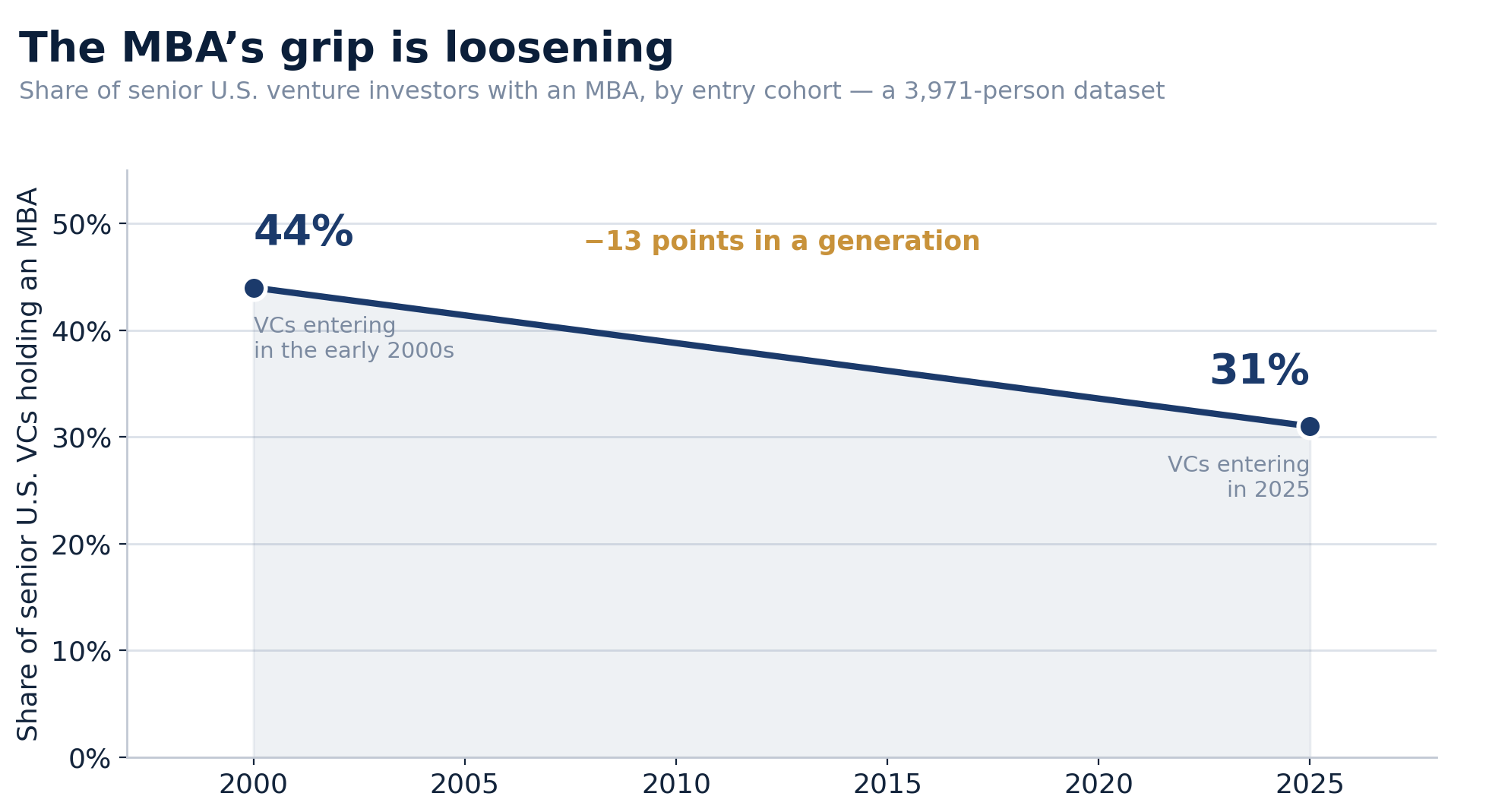
The driver is structural. Venture has pushed into AI, hardware, and deep tech, where technical and operating experience outweighs a business-school credential, and where the half-life of relevant skill is short. Recruiters told TechCrunch and PitchBook that firms increasingly scan talent from companies like OpenAI and SpaceX rather than elite MBA programs, with “less appetite for MBAs currently.” You can see the same instinct in the rise of explicitly operator-led funds whose partners and LPs are drawn from operators at AWS, Snowflake, Rippling, and OpenAI — built to sell founders on hands-on help, not just capital.
But there is a nuance worth holding onto, because it cuts against a lazy reading. Business training hasn’t vanished, and at the top, it still pays. A separate Crunchbase analysis of about 4,500 partners shows the credential base remains deep: 73% hold a graduate degree, 51% an MBA, and 16% an MD, PhD, or other doctorate. And Strebulaev’s performance work finds that VCs from a select group of elite MBA programs still average meaningfully more successful investments than their peers. The MBA is fading as a filter, not as an edge.
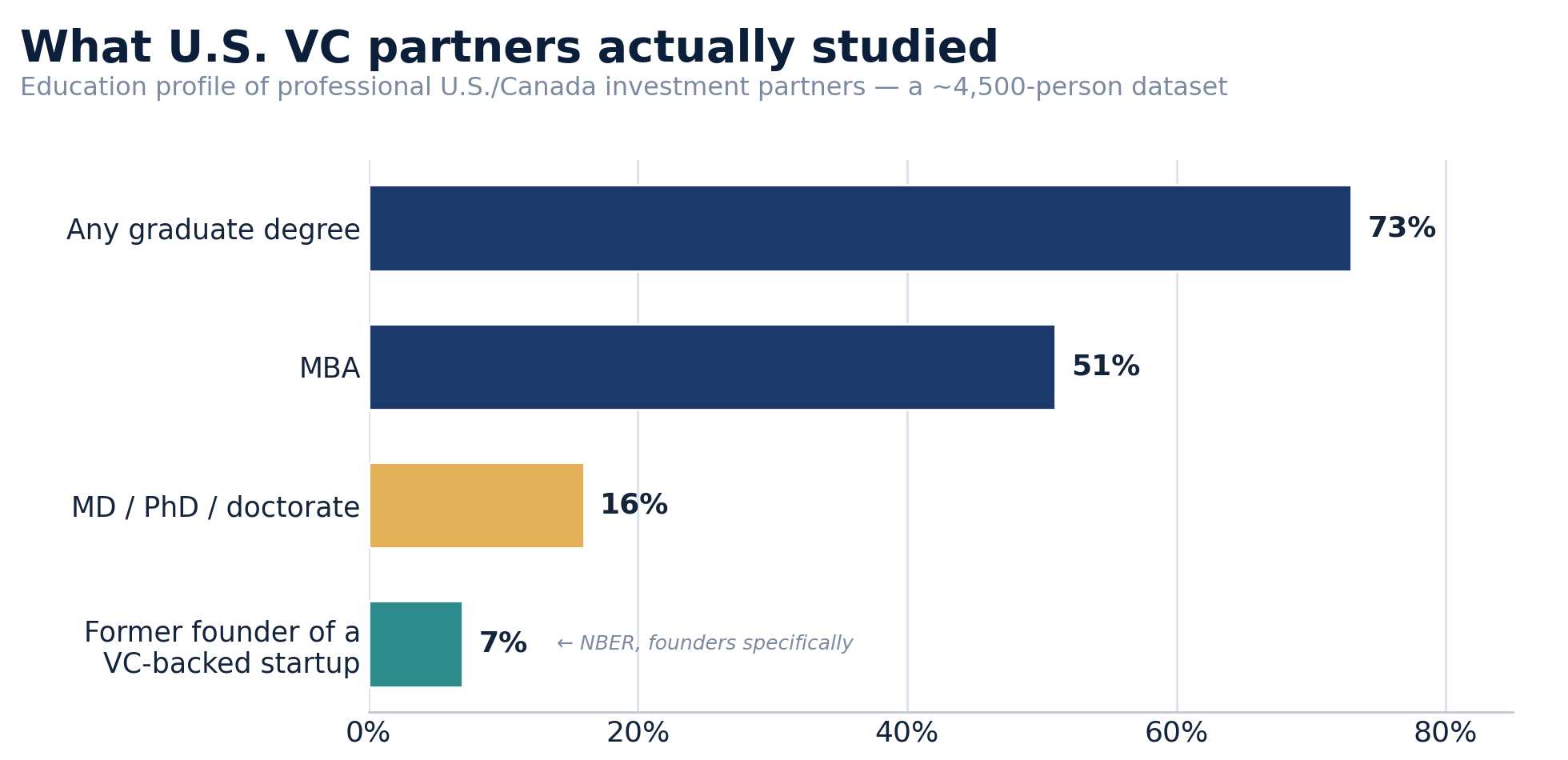
These macro numbers are U.S.-heavy. Treat them as the floor, and the 36-person global sample that follows as the texture, directional evidence for how the picture shifts outside North America, where bios lean even more operator.
The credential still opens doors; the operating story increasingly wins the seat. Don't assume a partner's MBA means they think like a financier, many of today's check-writers are builders first, and they price teams accordingly.
How I Built This
The report rests on two layers of evidence.
The first is macro benchmarking from the strongest available sources: the Stanford GSB human-capital work, Crunchbase’s education analysis, the NBER founder-VC paper, the NVCA/Venture Forward U.S. survey, Diversity VC‘s UK Equity Record, the BVCA/Level 20 report, European Women in VC, PitchBook’s All In reports, the Israel Innovation Authority, LAVCA, IFC, and AVCA.
The second is an illustrative public-bio sample of 36 named senior investors at 20 firms — Sequoia, a16z, Bessemer, Atomico, Accel, Balderton, East Ventures, Qiming, Monk’s Hill, Aleph, Pitango, Viola, Kaszek, Monashees, Canary, Knife Capital, Norrsken22, Blackbird, AirTree, and Square Peg — coded consistently from official bios, team pages, and reputable profiles.
The coding was conservative. MBA means a clearly identified MBA. Formal business education means an MBA or an explicitly business/finance/management degree. Founder/operator means the person founded a startup or held a clearly senior operating role before VC. I did not infer race or ethnicity from names or photos.
One caveat applies to the regional and stage tables below: with only four to six people per region, each individual moves a region's share by 17–25 points. Read those splits as directional signal layered on top of the large-sample macro data, never as precise population rates.
Education: Business Training Still Matters, But It Doesn’t Define The Job
In the 36-person global sample, MBA-only prevalence is 22%, and formal business education of any kind is 44% — both below the U.S. macro benchmark. The gap is mostly in regional composition. The sample includes many partners from ecosystems where the strongest feeders are engineering, product, and operating leadership, especially Asia, Israel, and Oceania, while Europe stays relatively business-school-forward, consistent with its reliance on finance, consulting, and cross-border scaling talent.
It helps to be precise about what business training actually buys at the senior level. It is most valuable where the work is capital-markets-shaped: board governance, follow-on strategy, M&A, IPO readiness, and capital structure. That is why, as we’ll see, its prevalence climbs with stage. What it does not reliably buy is the product-and-founder empathy pattern recognition that early-stage bets turn on — which is exactly where operator backgrounds dominate.
The chart below also fixes a common misread. The education bar and the operator bar measure the same people independently — they are not slices of a 100% whole, and MBA (navy) sits inside total business education (navy + gold).
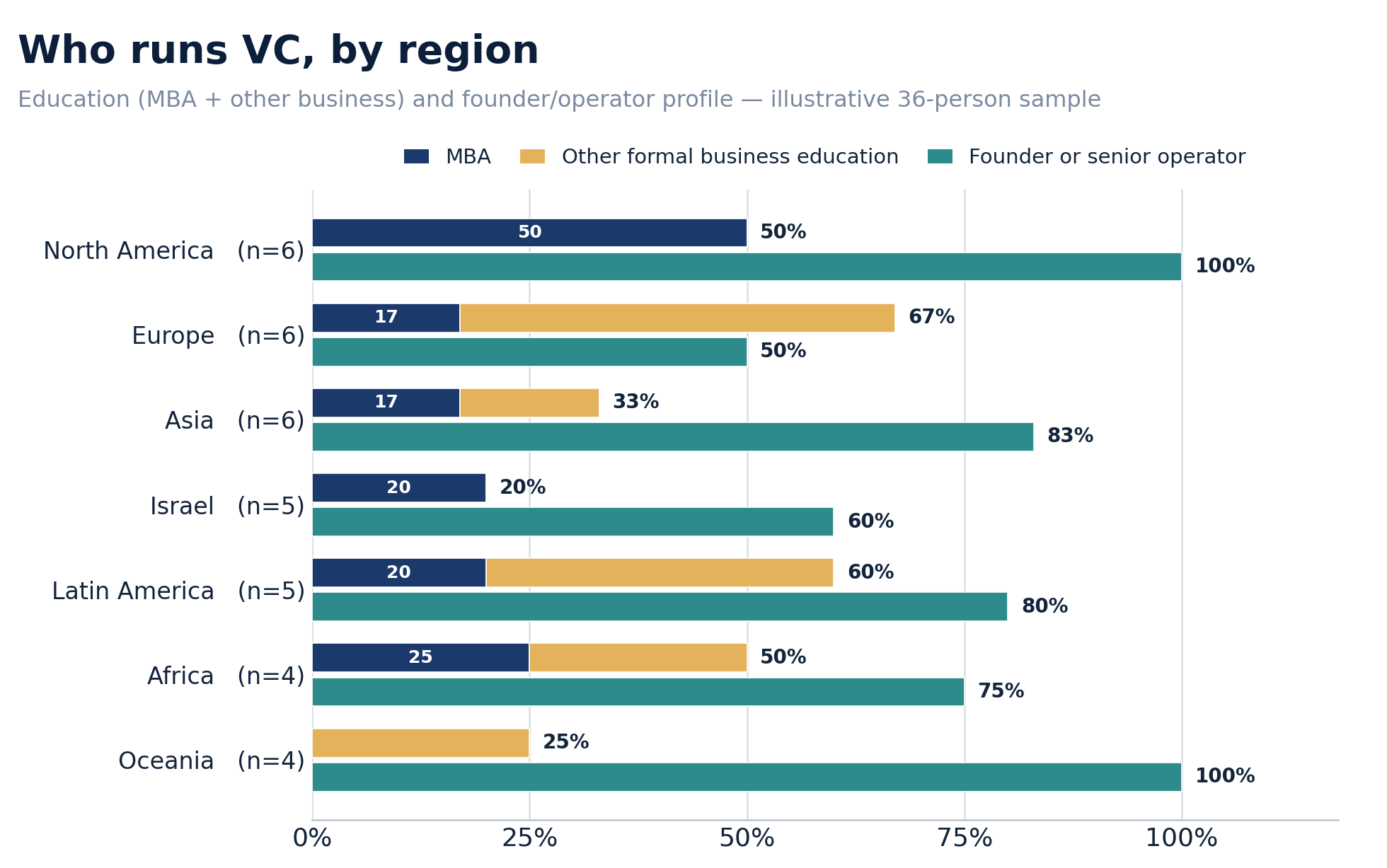
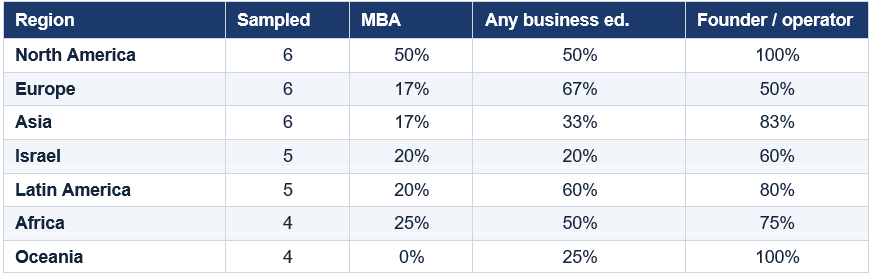
Region-by-region detail, with the same numbers in table form: Read these as minimum observable public-bio shares, not population estimates.
One more education fact is worth a founder’s attention because it shapes who gets funded: Strebulaev finds that about a third of VC deals involve a founder and an investor who attended the same university, with the effect strongest at the most-networked schools. Education isn’t just a credential on a partner’s bio — it’s a channel for deal flow.
Match the credential to the work. Pitch an early-stage partner on product and founder insight; bring a growth partner a clean capital plan and governance story. And don’t underrate school and operator networks because shared ties still route a large share of deals.
Prior Careers: The Operator Era
If the education story is “business training still matters,” the career story is sharper: modern senior VC is heavily populated by people who built or ran things first. In the global sample, 78% had been founders or clearly senior operators, and the macro trend points in the same direction as firms chase technical and go-to-market credibility in an AI- and hardware-heavy deal environment.
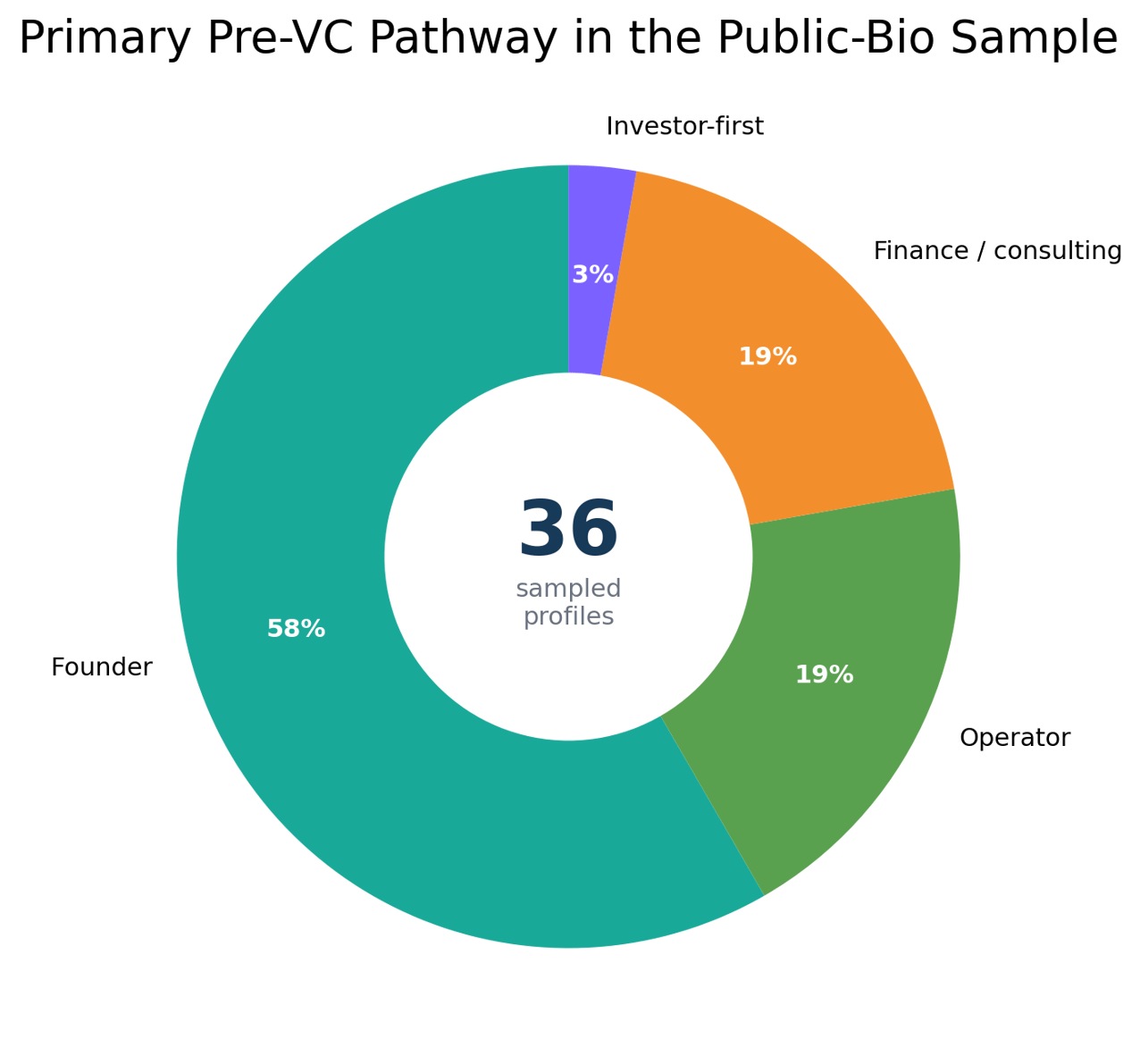
What operators bring is specific, and it changes how they behave on a cap table. They tend to index on team quality and traction signal over deck polish; they pattern-match from having shipped product and missed payroll; and a growing cohort of operator-led funds now competes explicitly on post-investment help — go-to-market introductions, hiring, pricing — sometimes deliberately declining board seats in favor of on-demand support. The pitch to founders is no longer “we have capital,” but “we’ve done your job and can shorten your learning curve.”
Two routes, therefore, dominate the modern pipeline. The founder/operator route, founders, ex-CTOs, CFOs, PMs, and CEOs, is most visible at early-stage and founder-centric firms. The business-education-plus-finance route —MBA, banking, consulting, prior VC/PE—remains prominent in institutional and growth contexts.
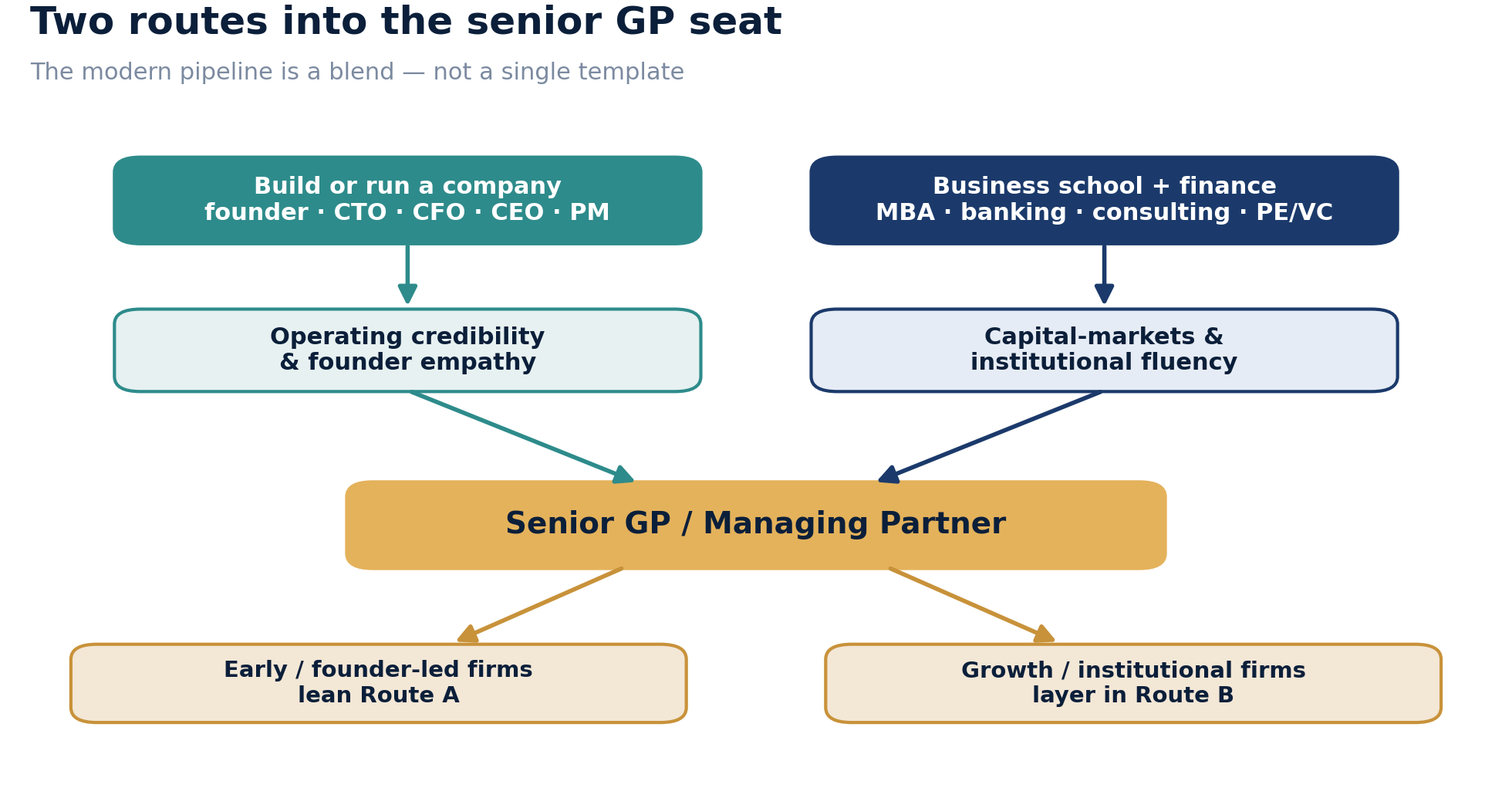
When you need building help and not just a check, target operator-led firms — they reward team and traction over narrative polish, and many offer hands-on support without taking control. When you need institutional muscle for a later round, the finance-route partners earn their keep.
Stage: The Higher You Climb, The More Finance You Find
Stage focus changes the desirable GP background. Seed and early-stage funds are more likely to reward founder empathy, product intuition, customer discovery, and first-principles company-building judgment. Growth and multi-stage funds still value operators, but they also require stronger fluency in capital markets, scaling metrics, governance, M&A, and IPO readiness.
In the coded sample, growth- and late-oriented firms had higher shares of formal business education than seed- and early-oriented firms. Multi-stage firms were too sparse in the sample for a precise estimate, but the sampled profiles combined both business training and operator credibility.
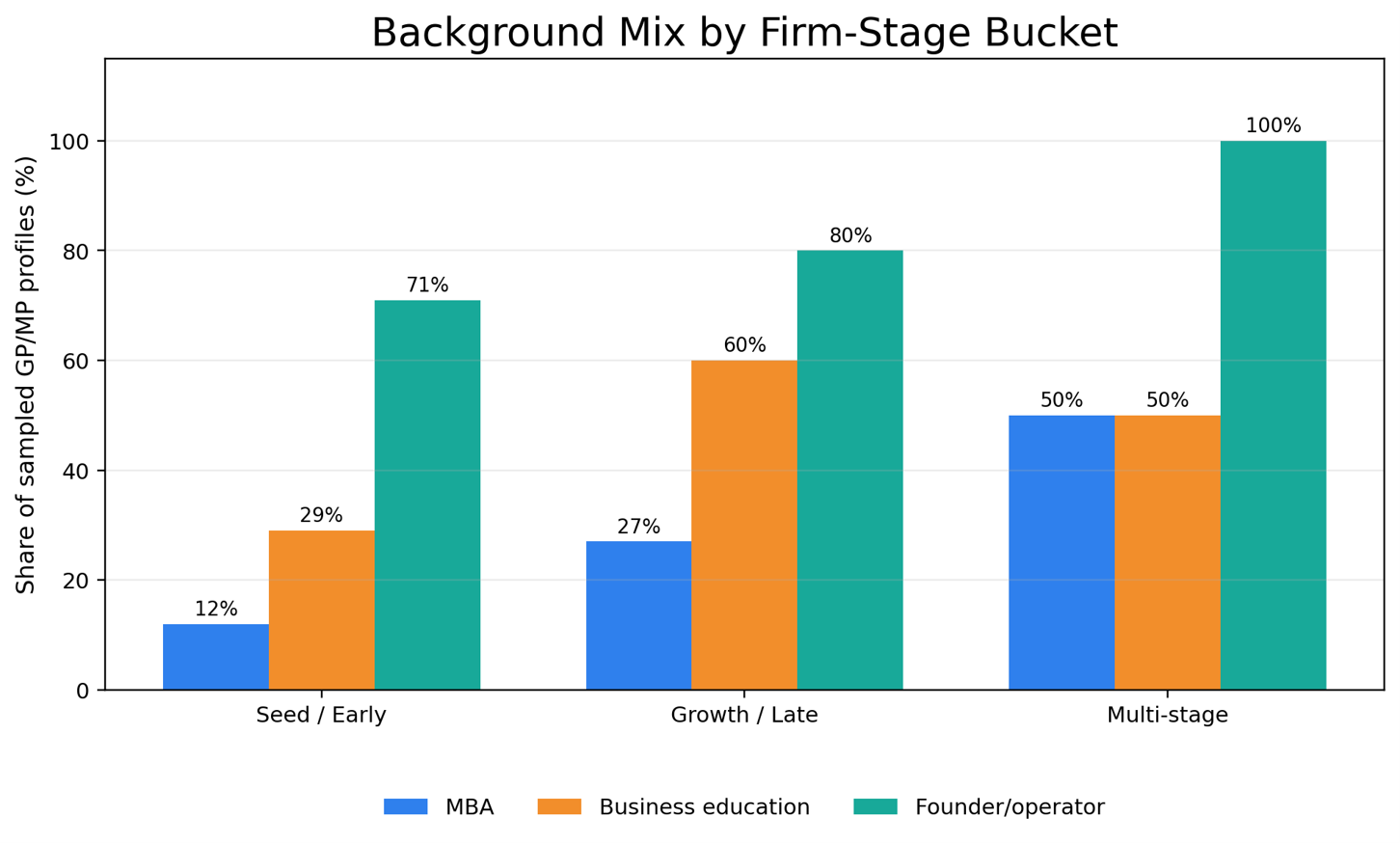
The logic is the work itself. At seed, the bet is on a team and a product insight, so founder empathy is a scarce skill. At growth and beyond, the value-add shifts to board governance, M&A, follow-on rounds, and IPO readiness, the capital-markets terrain where finance and MBA backgrounds earn their place.
Calibrate your raise to the room. At seed, sell the team and the wedge. By growth, bring metrics, a capital plan, and a governance story, the partner across the table is increasingly fluent in exactly those things.
A regional tour
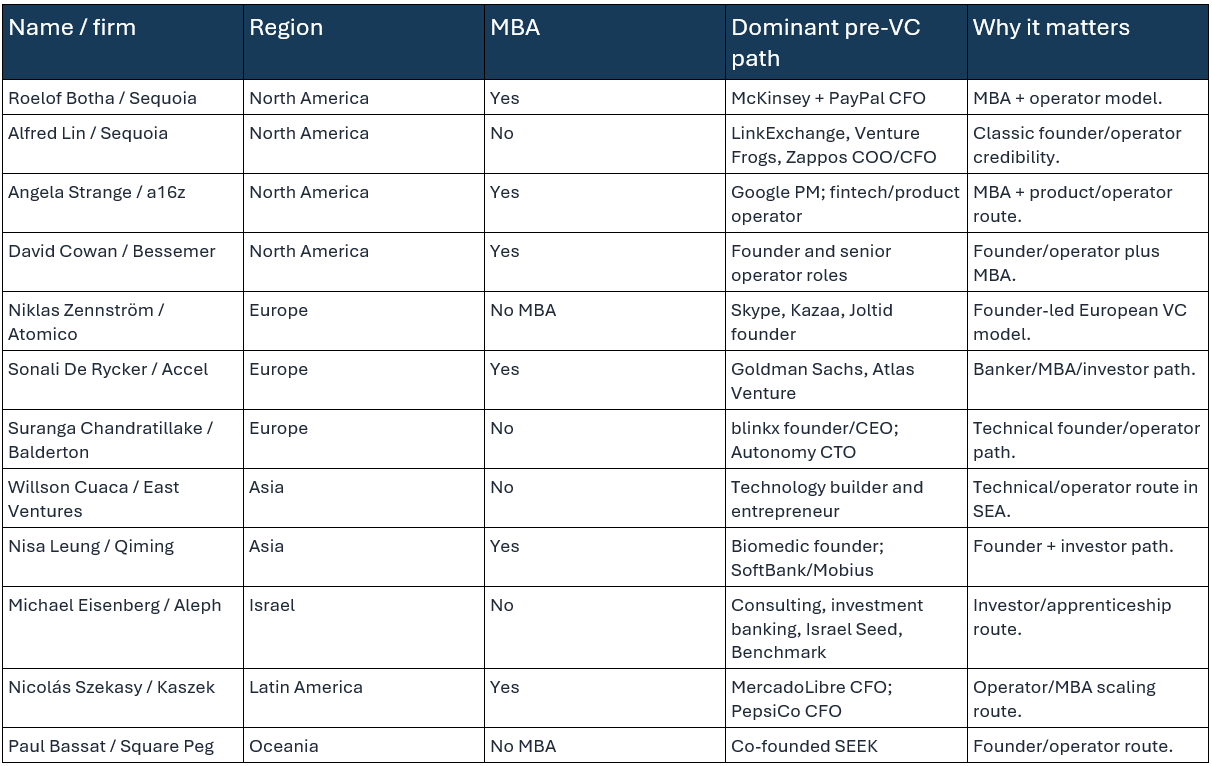
North America remains the clearest home of the MBA-heavy archetype — yet marquee bios are full of operating credentials. Sequoia’s Roelof Botha came through McKinsey and PayPal with a Stanford MBA; a16z’s Angela Strange pairs one with a Google background; Bessemer’s David Cowan holds an HBS MBA alongside founder and C-level roles. The macro data and the bios only look contradictory until you realize the same people often carry both.
Europe is more mixed — founder-operators such as Niklas Zennström sit alongside classic finance trajectories like Sonali De Rycker (Goldman, Atlas). That blend explains a high business-education share with a middling operator share, and reflects the region’s reliance on cross-border scaling and institutional capital.
Asia tilts strongly toward operators, especially in Southeast Asia. East Ventures foregrounds technology-building; Qiming retains a finance component in healthcare and China tech. Because the cleanest demographic data cover Southeast Asia rather than the whole continent, treat the Asian region as directional.
Israel is shaped by serial entrepreneurship and venture apprenticeship. Michael Eisenberg‘s path ran through banking, Israel Seed, and Benchmark before Aleph; Eden Shochat anchors the founder-led side. It’s a small, tightly networked elite, which can look more homogeneous than larger regions.
Latin America is bifurcated between MercadoLibre/Nubank operator alumni and finance-trained scalers like Nicolás Szekasy (Stanford MBA, CFO/IPO). The elite is unusually shaped by a few iconic company-building networks that now seed the next generation of funds.
Africa and Oceania are the most visibly founder/operator-led; both ecosystems reward building scarce local category leaders, and credibility flows from having built one. In Oceania, the route is especially pronounced at Square Peg and Blackbird.
Geography should change your pitch. North America and growth-stage Europe still reward the finance-fluent narrative; Asia, Israel, Africa, and Oceania reward the builder narrative. Lead with the version of your story that the local ecosystem is wired to recognize.
Representative Coded Profiles
This table is not a ranking. It shows examples in which public sources clearly disclosed both education and prior career pathways.
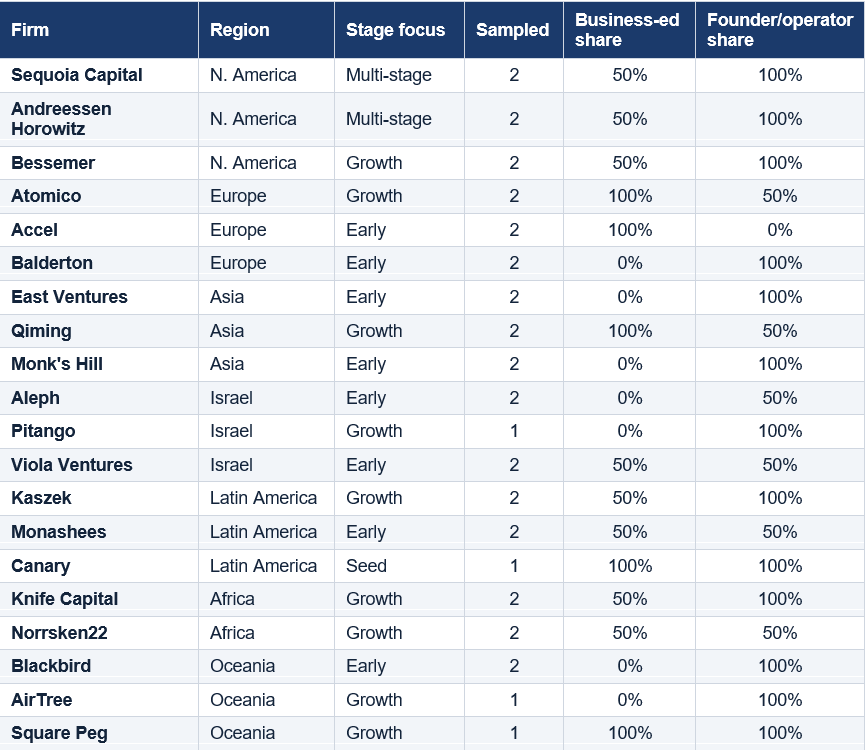
The 20-firm sample frame
Shares are over the one or two sampled bios per firm — a signal of the senior talent each firm makes visible, not a full-firm census.
Demographics and Diversity Benchmarks
The strongest demographic evidence is still U.S.- and UK-led. In the U.S., the 2024 VC Human Capital Survey reported that women accounted for roughly 20% of investment partners and 29% of all investment professionals. Europe-wide data from European Women in VC reported that women held 16% of general partner roles, with women-led funds controlling less than 10% of AUM.
Israel Innovation Authority data found women were 20.8% of partners in the 53 largest and most active VC funds, and around 40% of active funds had no female partner. Latin America data from Endeavor/Bloomberg Línea reported that women accounted for 22% of the VC partner count. IFC highlighted 30% women partners in Africa-focused VC funds. Southeast Asian private-capital reports placed women at around 1 in 5 among decision-makers.
Race, ethnicity, and socioeconomic data are much less complete globally. The UK has comparatively strong socioeconomic reporting; the U.S. has more race/ethnicity reporting. In many other markets, the data are too sparse or sensitive to code from public biographies.
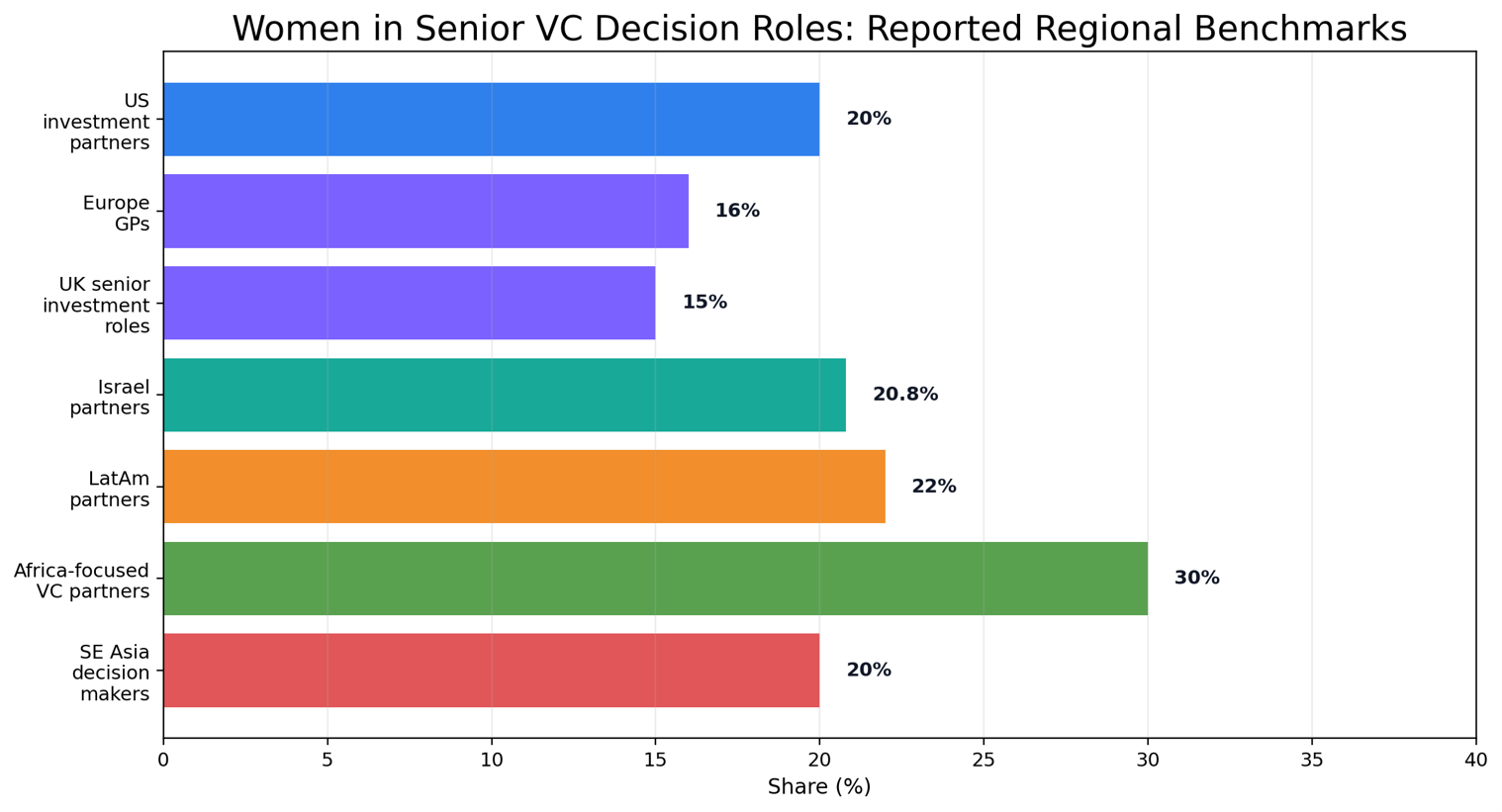
Other regions point the same way: Latin America ~22% of partners (Endeavor); Africa 30% of partners and 38% of investment professionals (IFC/AVCA — relatively strong by global standards); Southeast Asia about one in five decision-makers; and Oceania ~12% of senior roles.
Here is why this is more than an equity story. Women-led startups have been shown to generate roughly twice the revenue per dollar invested (BCG), yet capture only about 2% of VC funding in Europe and the U.S., and female founders are markedly more likely to be funded when a woman sits on the investment side. A homogeneous GP class, therefore, systematically underprices a proven pipeline. As EWVC’s Kinga Stanislawska puts it, “Diversity is no longer a moral argument, it is a performance strategy.” At current rates, parity in funding is estimated to arrive around 2065.
The homogeneity at the top is a pricing inefficiency, not just a fairness problem. For LPs and allocators, the underfunded female-led pipeline is alpha left on the table; for founders, the gender of the room still measurably affects your odds — route accordingly.
Strategic Implications
For VC firms hiring: The strongest teams will not be built from a single archetype. A high-performing GP bench should combine financial and investment discipline, founder empathy, operator pattern recognition, capital markets knowledge, and networks.
For emerging managers: An ex-founder manager should not over-rely on founder empathy alone. LPs still need underwriting discipline, portfolio construction, reserves strategy, and evidence of access. An MBA/finance manager should show operator-level understanding of how companies actually break.
For founders fundraising, Founder targeting should match the investor background. A former operator may care more about execution and product truth; a finance/MBA or growth investor may scrutinize metrics, governance, market structure, and capital efficiency.
For LP diligence: LPs should look beyond school pedigree. Prior founder/operator experience can improve judgment on product, team, and market risk, while finance and investing backgrounds can improve fund construction, downside discipline, and scaling decisions.
For positioning: The VC market is moving from credential-only authority toward proof-of-judgment authority. The strongest senior investors can translate both capital and company-building experience into better selection and better board decisions.
Practical conclusion: MBA/finance pathways still matter, especially in North America and growth investing. But the modern public GP archetype is increasingly “investor plus builder,” not only “financial professional.”
Limitations and Bias
There is no single open, globally standardized, person-level census of VC partner education, age, prior work history, gender, race/ethnicity, and socioeconomic background. This report, therefore, combines macro surveys with public-bio coding.
Public biographies are marketing assets. They tend to foreground founder empathy, operator credibility, and marquee company-building stories. That can overstate founder/operator pathways relative to less visible finance, consulting, corporate, or investing work.
Education can be underreported. Some biographies omit degrees, older MBAs, or non-U.S. credentials. Therefore, MBA and business-education shares in the public-bio sample should be treated as minimum observable shares.
The stage analysis is directional. Many modern VC firms call themselves multi-stage even when their culture, portfolio, and check size are weighted toward a narrower stage.
The bottom line
▸ There is no single template for the modern GP anymore. The credentialed financier and the scarred operator now sit in the same partner meetings, and increasingly, in the same person.
▸ The MBA is fading as a filter but still pays as an edge; operating experience is the rising currency, especially early and outside North America.
▸ For founders: read the room, stage, geography, and a partner’s pre-VC chapter all predict what story will land. For allocators: the field’s persistent homogeneity is both a risk and an unpriced opportunity.
Sources and Reference Links
Selected source links used in the research. The document converts web citation tokens into normal reference links.
1. NBER working paper on founder VCs and professional VCs: https://www.nber.org/system/files/working_papers/w29907/w29907.pdf
2. Venture Forward / NVCA VC Human Capital Survey, 5th Edition: https://ventureforward.org/wp-content/uploads/2025/06/VC-Human-Capital-Survey-5th-Edition-Results_FINAL.pdf
3. Diversity VC UK Equity Record 2023: https://diversity.vc/wp-content/uploads/2023/12/The-Equity-Record-UK-2023.pdf
4. European Women in VC report: https://www.eiturbanmobility.eu/wp-content/uploads/2023/09/IDC_EWVC_eBook_2023_FINALnon_.pdf
5. Israel Innovation Authority - Women entrepreneurs and VCs: https://innovationisrael.org.il/en/report/women-entrepreneurs-and-vcs/
6. Israel Innovation Authority 2025 women in high-tech status report: https://innovationisrael.org.il/en/press_release/women-in-high-tech-2025-status-report/
7. Bloomberg Línea / Endeavor - Women in Latin America VC partner count: https://www.bloomberglinea.com/english/women-make-up-just-22-of-latin-america-vc-fund-partner-count/
8. IFC - Expanding opportunities for women via PE/VC: https://www.ifc.org/en/insights-reports/2025/expanding-opportunities-for-women-via-private-equity-venture-capital
9. DealStreetAsia - Women in private capital Southeast Asia 2025: https://www.dealstreetasia.com/reports/women-in-private-capital-southeast-asia-2025
10. Sequoia Capital - Roelof Botha profile: https://sequoiacap.com/people/roelof-botha/
11. Bessemer Venture Partners - David Cowan profile: https://www.bvp.com/team/david-cowan
12. Atomico - Niklas Zennström profile: https://atomico.com/team/niklas-zennstrom
13. East Ventures - Taiga Matsuyama profile: https://east.vc/team/taiga-matsuyama
14. Qiming Venture Partners - Duane Kuang profile: https://www.qimingvc.com/en/team/duane-kuang
15. Square Peg - Paul Bassat profile: https://www.squarepeg.vc/people/paul-bassat
16. Norrsken22 team / firm profile: https://www.norrsken22.com/
If this article was useful, share it with founders who are about to raise.
— Leon Eisen, 4x Founder, Venture Capitalist, and Creator of Fundables OS™