

Playbook, Perspective and Pattern for founders raising now. This report strips out giant rounds and public market traffic so you can read the part of the market that actually prices your round. Every figure below was checked against at least two independent sources across three verification passes, the last of them adversarial.
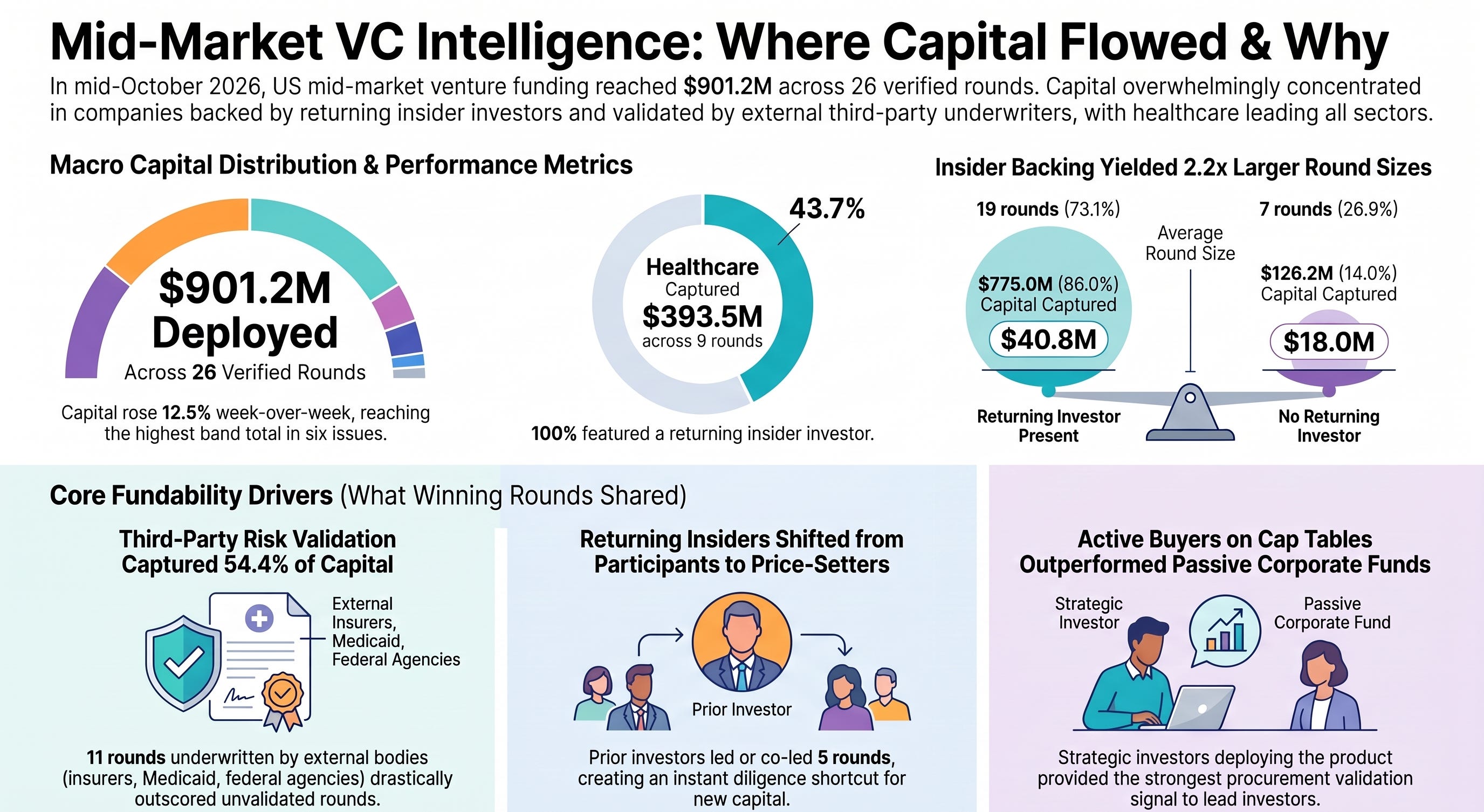
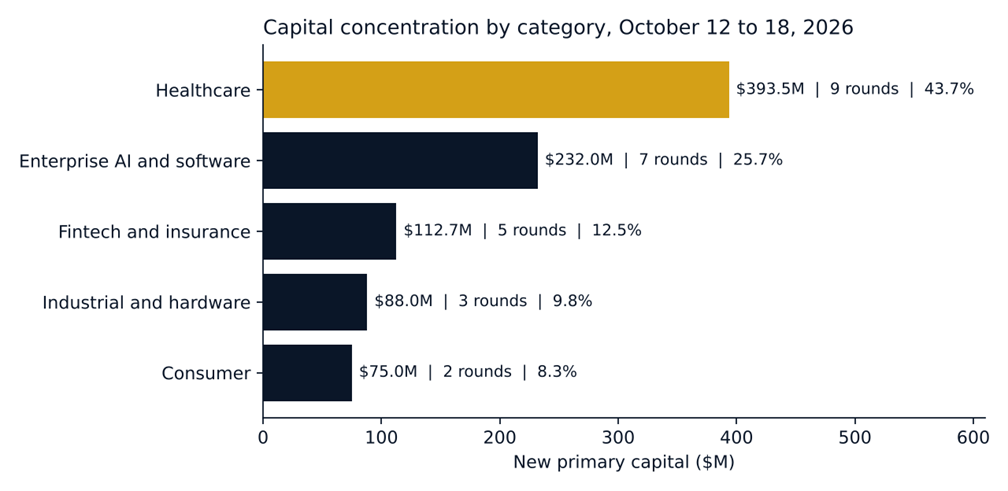
Healthcare took $393.5M of the $901.2M that cleared the US mid-market this week. That is 43.7% of the capital, up from 23.1% one week earlier. Nine healthcare rounds closed. Every one of the nine had a prior investor writing again.
That is the shift. Capital did not chase healthcare as a category. It followed people who had already seen the inside of a company and came back with a bigger check. Across all 26 verified rounds, 19 carried a returning investor, and those 19 took 86.0% of the dollars. The seven rounds without one averaged $18.0M. The nineteen with one averaged $40.8M.
The second pattern sits underneath the first. The rounds where an outside party had already underwritten something- a rating agency, a reinsurer, a state Medicaid program, a government-funded deployment, a named enterprise buyer- took 54.4% of the capital from 42.3% of the deals. Investors priced in conviction that someone else had already paid for.
For founders, the consequence is blunt. The fastest path to a term sheet this quarter runs through two groups you already know: the investors on your cap table and the counterparties who have already bet money or reputation on you. If neither group is in your process, you are raising toward the $18.0M average, not the $40.8M one.
The Week in One Sentence
Primary insight. Band capital reached its highest level in six issues, concentrating in rounds where an insider or an outside underwriter had already said yes, and healthcare met both tests most often.
· Total capital deployed. $901.2M in new primary capital across 26 verified US rounds between $5M and $100M, up 12.5% from $800.9M across 22.
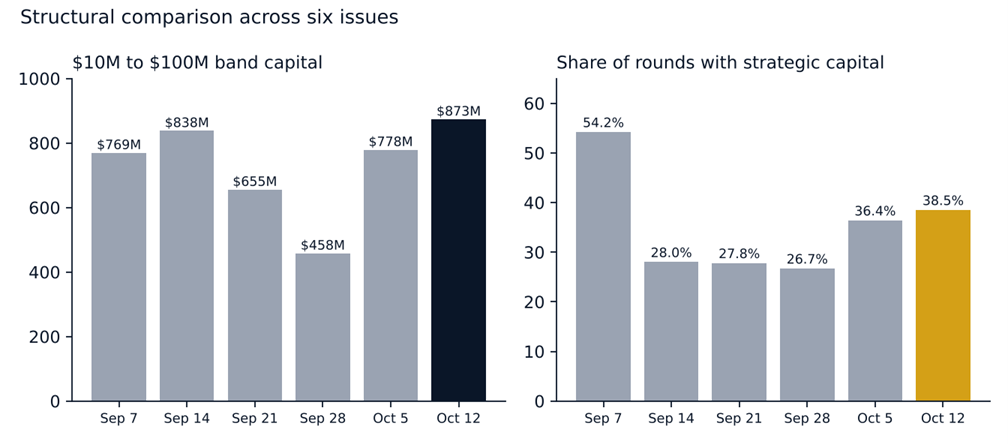
· Against prior issues. In the $10M to $100M band, this series has tracked 22 rounds and $873.0M since September, up from 19 rounds and $778.5M last week. Capital up 12.1%, deal count up 15.8%. The highest band total in six issues.
· Average round size. $34.66M across the full set, down 4.8% from $36.40M. On the $10M to $100M band, $39.68M against $40.97M, down 3.1%.
· Median round size. $24.0M across the full set, down 20.0% from $30.0M. On the $10M to $100M band, $29.5M against $30.0M, down 1.7%.
· Largest tracked round. Estuary Biotherapeutics at $93.0M, a Series A. Smallest: Zaria Systems at $5.2M, a seed.
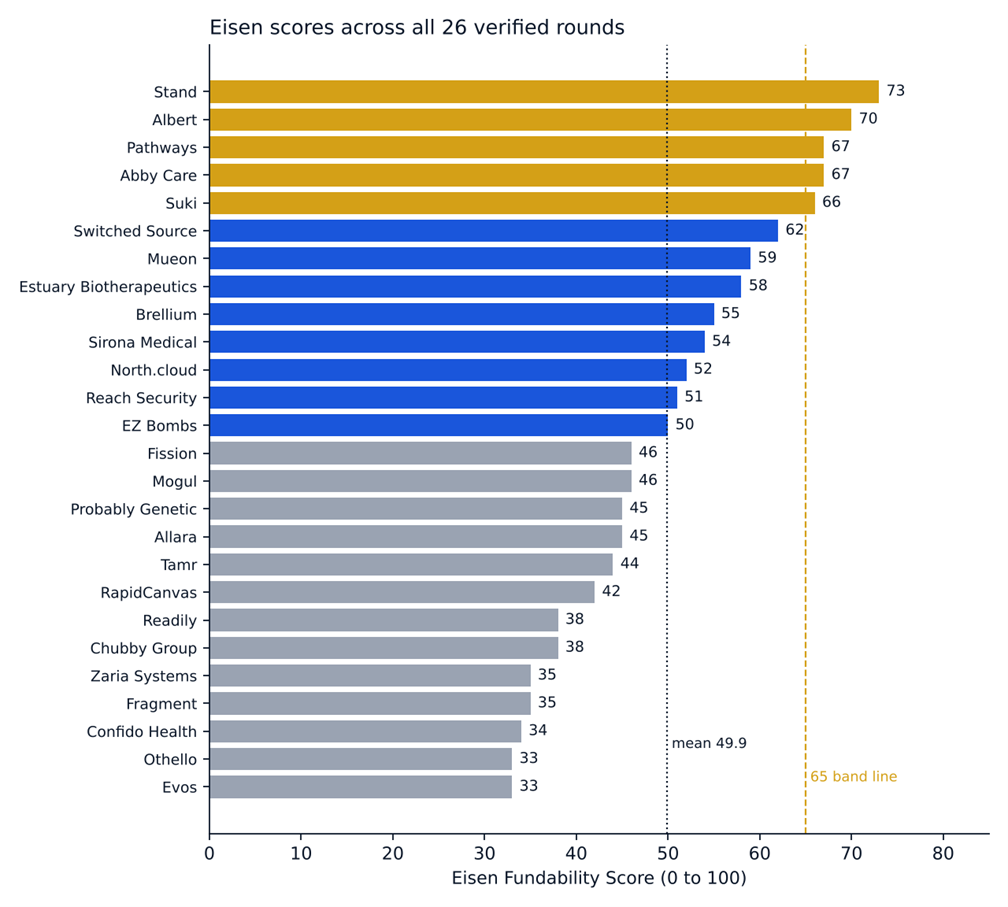
· Highest Eisen score. Stands at 73. Lowest: Evos and Othello at 33. A band of 40 points. Five of 26 rounds cleared 65 and none reached 75. Mean 49.9, median 48.
· Named institutional lead. 25 of 26 rounds (96.2%), up from 19 of 22 (86.4%) last week. Only Othello closed without a designated lead in its anchor sources.
· Strategic or customer-side capital. 10 of 26 rounds, or 38.5%, carried $497.0M, or 55.1% of the week’s capital, versus 8 of 22 (36.4%) and 40.3% last week.
· Returning investors. 19 of 26 rounds, or 73.1%, carried at least one investor from a prior round, against 13 of 22, or 59.1%, last week. Five were led or co-led by a prior investor.
The Deal Scorecard
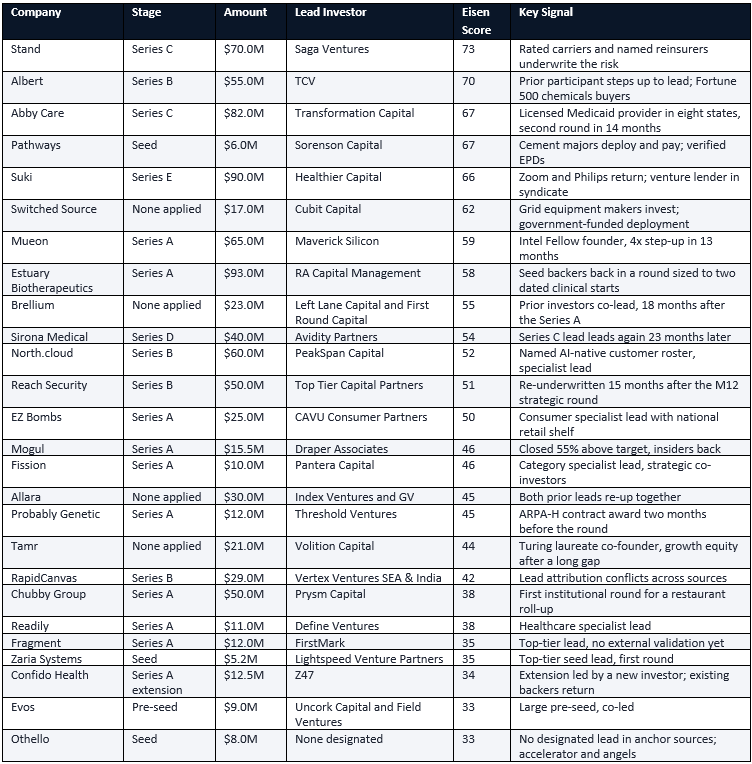
Eisen Fundability Scores run across five dimensions: Founder-Investor Dynamics (30), Traction to Conviction Conversion (25), Narrative Power (20), Deal Architecture (20) and Capital Planning (5). Scores of 90 to 100 signal an inevitable, market-defining outcome. 85 to 89 signals extremely strong execution. 75 to 84 signals solid fundamentals. 65 to 74 signals a good company with some gaps. Below 65 signals an early-stage or structurally incomplete round.
What the scorecard says at a glance
Read the top of the table and the bottom of the table separately. The top five scores belong to rounds where something outside the company had already been committed: rated insurance carriers and named reinsurers at Stand, a prior participant stepping into the lead at Albert, state Medicaid provider status at Abby Care, a cement major deploying the product at Pathways, and distribution partners writing again at Suki. The bottom of the table is not weak companies. It is first institutional rounds, pre-seed and seed checks, and extensions, where nobody outside the founding team and the lead had put anything on the line yet.
The second read is concentration. The three largest rounds took $265.0M, or 29.4% of the week. Nine rounds of $50M or more totaled $615.0M. California held 11 rounds and $558.2M, or 61.9% of capital, with an average round of $50.75M. New York held 9 rounds and $170.5M, averaging $18.94M. New York produced the deal count. California produced dollars.
The third read is the lead seat. Only one round, Othello, closed without a designated lead. Every other round had a firm willing to price it. That is a tighter market than it looks: lead discipline rose while the median check fell.
What Changed This Week
Five shifts, ranked by structural impact on founder fundraising rather than by deal size. Each is built on verified deal records and ends with what it means for your raise.
1. Healthcare Rounds Ran on Insiders
Pattern, what happened. Healthcare closed nine rounds for $393.5M, 43.7% of the week, against three rounds and 23.1% the prior week. Healthcare rounds averaged $43.72M against $29.86M for everything else. All nine carried a prior investor: Khosla, Thrive and Sequoia back at Abby Care, Venrock, Flare, Hedosophia, Philips Ventures and Zoom Ventures back at Suki, 4BIO and GV back at Estuary, Avidity leading Sirona Medical again, Index and GV co-leading Allara again, and Left Lane and First Round returning to co-lead Brellium. Three of the week’s five insider-led rounds were healthcare.
Perspective, what it means. This is not a quality premium. Healthcare averaged 51.3 against 49.2 for the rest of the field, and five of the nine carried no externally controlled validation in the record. What healthcare had was continuity. Investors who have sat on a clinical software, women’s health or radiology board know the reimbursement cycle and the sales cycle from inside. They underwrite the next round on information a new investor cannot get from a deck. New leads followed because the insiders had already absorbed the information risk.
Founder Blindspot, what most miss. Founders read 43.7% as “healthcare is hot” and pitch the category. The capital did not go to the category. It went to companies whose existing investors were willing to be counted again. A healthcare company with a disengaged cap table gets nothing from this week.
Playbook, what to do. Before you contact a single new investor, hold a 30-minute call with each existing investor and ask one question: will you take your pro rata, and will you say so in writing to the new lead? Collect the answers before you build the target list.
Contrast. Last week enterprise AI and software led with $245.9M across eight rounds and healthcare took $185.0M across three. This week healthcare took more than enterprise AI and software, which fell to $232.0M across seven.
What this means for your raise: In regulated categories, insider support is the price of entry, not a bonus.
2. The Participant Became the Price-Setter
Pattern, what happened. 19 of 26 rounds carried a returning investor, 73.1%, up from 13 of 22, or 59.1%. Those 19 took $775.0M, 86.0% of the week. The 7 rounds without a returning investor averaged $18.03M against $40.79M. Five rounds were led or co-led by a prior investor: TCV at Albert, Avidity Partners at Sirona Medical, Index Ventures and GV at Allara, Left Lane Capital and First Round Capital at Brellium, and Draper Associates at Mogul. Last week, only one of thirteen insider rounds had a prior investor in the lead seat.
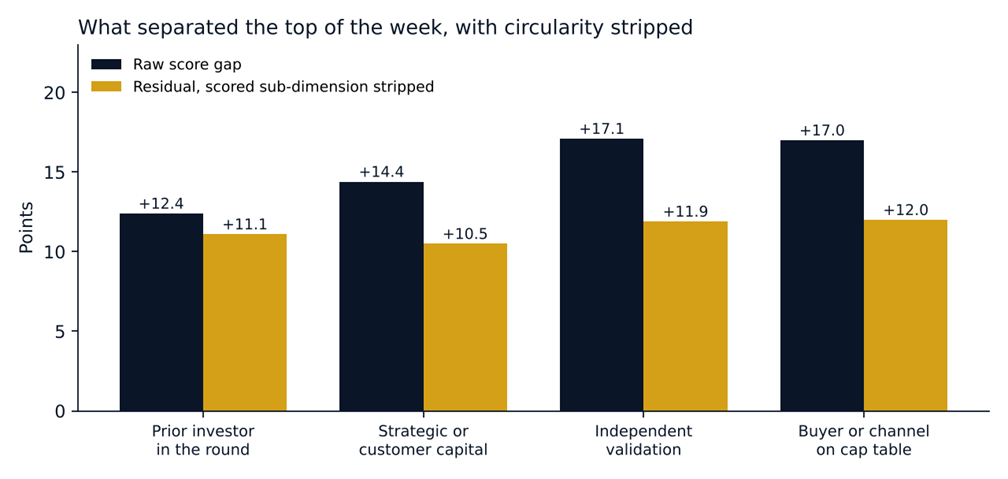
Perspective, what it means. A returning investor is the only party in a process who has seen the board deck, the bank statements and the founder under pressure. When that investor writes again, every new investor reads it as a diligence shortcut. When that investor sets the price, it removes the question every new investor asks: what do the people who already know you think? Rounds with a returning investor scored 53.3 against 40.9, a 12.4-point gap. The Insider Support sub-dimension is worth two points; remove it from both groups and 11.1 points remain. The returning rounds were better constructed across the other four dimensions, not just credited for the re-up.
Founder Blindspot, what most miss. Founders treat the insider check as a formality to collect at the end, and they treat the prior lead as the only insider who could lead again. This week, two of the five insider leads, TCV at Albert and Draper Associates at Mogul, had only participated in the prior round. The minority holder with the most conviction is often the next lead.
Playbook, what to do. Rank every investor on your cap table by fund size and category conviction. Give the top two the same monthly reporting you give your lead, and ask them six months before your raise whether they want the lead seat. Convert any yes into a written, sized commitment conditional on terms.
Contrast. The share of rounds with a returning investor rose 14.0 points week over week, and insider-led rounds rose from one to five. Insider support moved from a premium signal to a baseline, and the finer signal moved to who leads.
What this means for your raise: Your last investor is your first reference. Your quietest minority investor may be your next lead.
3. Third Parties Underwrote the Top
Pattern, what happened. 11 of 26 rounds carried an externally controlled validation. Those 11 took $490.0M, 54.4% of the week, and averaged $44.55M against $27.41M for the 15 without one. Four rounds earned the significant validation tier: Stand, through rated carriers and a named reinsurance panel; Abby Care, through operating as a Medicaid provider across eight states; Switched Source, through a five-year, $99M Department of Energy grid program project; and Probably Genetic, through an ARPA-H diagnostics contract of up to $10M. Those four averaged an Eisen score of 61.8, compared with 47.8.
Perspective, what it means. Investors paid for risk this week that someone else had already priced in. A reinsurer that takes a share of the book has run its own model with its own capital. A state Medicaid program that pays a provider has credentialed it. A federal grid program that funds a five-year deployment has diligenced the hardware. A federal health research agency that awards a diagnostics contract has reviewed the method. Each is checkable with one call, and the company cannot influence it. Rounds with any independent validation scored 59.8 against 42.7. Strip the Independent Validation sub-dimension, and the residual is 11.9 points. The validated companies were stronger on founders, deal architecture and capital planning as well.
Founder Blindspot, what most miss. Founders outside medtech assume independent validation means an FDA clearance and decide it does not apply to them. This week the validators were two insurance rating agencies, five reinsurers, Medicaid programs in eight states, a federal grid program and a federal health research agency. Every category has a counterparty that underwrites risk for a living.
Playbook, what to do. Name the one external body in your category whose sign-off a skeptical investor would trust more than your deck. Write down what it takes to get that sign-off, who owns it inside your company and the date you could have it.
Contrast. Last week, nine rounds carried at least one external validation, and the strongest of them were defense contract vehicles. This week the validators moved into insurance, Medicaid, utilities and federal health research, and three of the four significant-tier rounds sat in the top six scores.
What this means for your raise: One validation a stranger can confirm beats ten claims only you can confirm.
4. Buyers Moved Onto Cap Tables
Pattern, what happened. Strategic or customer-side capital appeared in 10 of 26 rounds (38.5%), holding $497.0M (55.1%) of the week, up from 40.3% the prior week. Three rounds had a buyer, distributor or manufacturer on the cap table: Suki, with Zoom Ventures and Philips Ventures returning while Zoom ships Suki inside its own telehealth product; Switched Source, with ABB, Southwire and Southern States, all of which sell into utility procurement; and Pathways, with Heidelberg Materials and Titan, both of which run the product in their own plants. Those three averaged 65.0 against 48.0. Strip Customer-Side Capital from the score and 12.0 points remain. The seven rounds with a corporate venture arm and no stated commercial tie, among them Intel Capital, Applied Ventures, M12, IQT, Hitachi Ventures, CVS Health Ventures, Biogen New Ventures and Circle Ventures, averaged 56.1. No customer led a round this week.
Perspective, what it means. A financial investor is buying a forecast of demand. A buyer that invests has already tested that forecast through its own procurement, so its check is a receipt. That is why deploying buyers outscored brand-name corporate arms. Intel Capital on a cap table says a powerful company wants exposure. Heidelberg Materials on Pathways’ cap table says a cement producer intends to keep using the product across three continents.
Founder Blindspot, what most miss. Founders chase the biggest corporate brand for the round. The signal is not the brand. It is whether the corporate uses the product. Founders also miss the cost: a buyer on the cap table can ask for a right of first refusal, category exclusivity or information rights that narrow your exit and your customer base for good.
Playbook, what to do. List your three largest customers and three largest channel partners. For each, find the person who runs their venture or strategic investment function, and ask your internal champion for the introduction, framed around their own deployment rather than your round. Before any of them offers, agree your position on first refusal, exclusivity and information rights with counsel.
Contrast. Strategic share of rounds rose for a second consecutive week, from 26.7% two weeks ago to 36.4% and now 38.5%. Strategic share of capital rose from 40.3% to 55.1%. Last week, three rounds had a buyer or channel on the cap table, and one of them was led by its channel owner. This week three rounds had one and none was led by it.
What this means for your raise: A customer on the cap table is the shortest diligence call a lead will ever make. Rank corporate investors by the customer they bring, not by the logo.
5. The Pedigree Seed Lane Closed and Late Stage Reopened
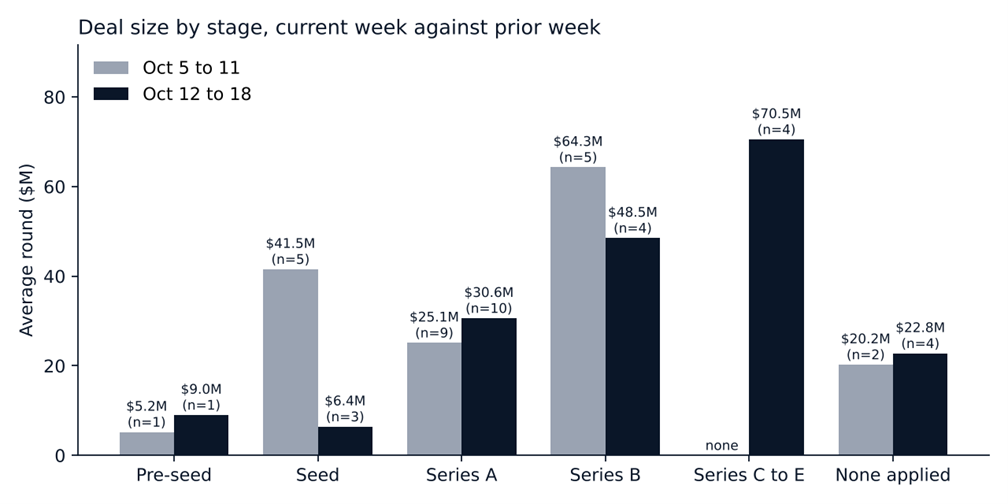
Pattern, what happened. Seed and pre-seed produced 4 rounds totaling $28.2M, averaging $7.05M. The prior week produced 6 such rounds totaling $212.9M, averaging $35.48M, driven by large seed checks to pedigreed teams. Seed alone averaged $6.4M this week against $41.54M. At the other end, Series C, D, and E produced 4 rounds for $282.0M, 31.3% of the week, after producing none the prior week, and those four averaged 65.0. Series A deepened to 10 rounds averaging $30.6M, up from $25.11M on 9 rounds, with a median of only $14.0M. Series B thinned to 4 rounds averaging $48.5M, down from $64.3M on 5.
Perspective, what it means. Capital moved up the stack to companies with operating history and an insider base. The four late-stage rounds, Abby Care, Stand, Sirona Medical and Suki, all had a prior investor writing again and averaged $70.5M. The large seed check to a famous team was absent. The seed rounds that did close were sized to a first milestone: $5.2M, $6.0M, $8.0M and a $9.0M pre-seed. Series A split in two: a handful of large rounds above $50M and a long tail near the $14.0M median.
Founder Blindspot, what most miss. Seed founders see a $41.54M prior-week average and size their raise to it. That number was a handful of pedigree outliers. This week’s seed market priced to milestones, and the top-five seed round was $6.0M, with a deploying buyer on the cap table. The other two seeds, without one, scored 33 and 35.
Playbook, what to do. Rebuild your seed ask from the bottom up. Name the one milestone that makes the Series A inevitable, cost it, add nine months of runway, and stop there. If you are at Series B, open growth-fund conversations now while the late-stage lane is visibly open, and bring your insiders’ commitments with you.
Contrast. Seed averaged $41.54M on 5 rounds the prior week and $6.4M on 3 rounds this week. Late stage went from zero rounds to four.
What this means for your raise: At seed, size to a milestone. At Series C and beyond, the round goes to the company whose insiders write first.
The Deals That Matter
Five deep dives across catastrophe insurance, chemistry AI, home care, industrial carbon data and clinical AI. These are the week's five highest-scoring rounds. All facts are verified against two or more sources and re-checked in a second pass.
Stand
Catastrophe-Risk Home Insurance | Series C | $70.0M | Led by Saga Ventures
Eisen Fundability Score: 73 / 100
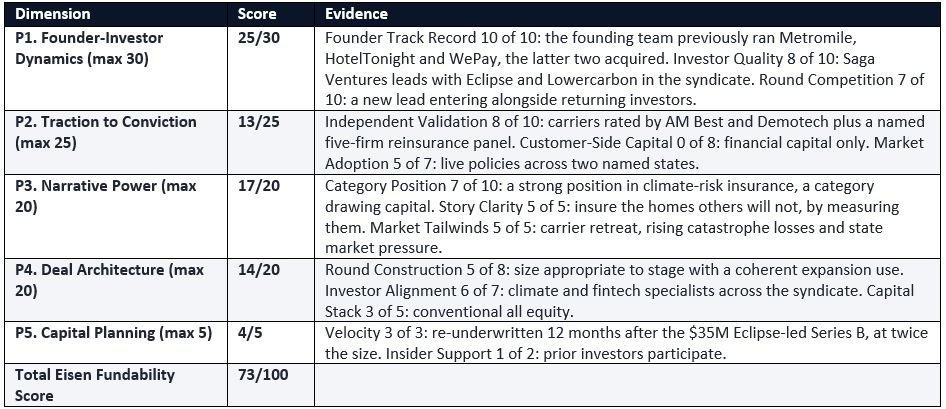
Why this scored. The highest score of the week, on the only round that combined a serial-exit founding team, a third-party underwriting stack of rated carriers and a named reinsurance panel, and a re-underwrite twelve months after the last round at twice the size. It lost points in one place above all, customer-side capital, and still finished first.
The Setup. Stand, headquartered in San Francisco and founded in 2024, insures homes in areas where traditional carriers have pulled back. It uses remote sensing and property-level modeling of wind, heat and ember exposure to price risk and recommend specific resilience upgrades. Chief executive Dan Preston previously ran Metromile. The founding team also includes Jason Mueller, who led product at Policygenius, Sam Shank, former chief executive of HotelTonight, and Bill Clerico, former chief executive of WePay. The buyers are homeowners in high-risk geographies, starting with California and Florida.
The Deal. $70.0M Series C led by Saga Ventures, announced October 15, 2026, with Lowercarbon, Eclipse, Equal Ventures, Inspired Capital, Neotribe and Jackson Square Ventures participating. All equity. The $35M Series B, led by Eclipse, was announced in October 2025. Policies are issued by Concert Specialty Insurance Company, rated A minus by AM Best, in California, and by Stand Insurance Exchange, rated A by Demotech, in Florida. The reinsurance panel includes Arch, RenaissanceRe, Hannover, Nephila and Hiscox. Stand added Drew Saad, former chief underwriting officer at PURE Insurance, as president of property and casualty, and Tony Landi, formerly of Nephila, as chief financial officer.
The Pattern. This is the underwritten-risk round. In insurance, the real diligence happens before the venture round. A rating agency rates the carrier. A reinsurer takes a share of the losses. Two rating agencies and five reinsurers had already underwritten part of Stand before the venture lead priced the round, each with its own model and its own capital.
The Perspective. Founders in any regulated or risk-bearing category should ask who in their value chain already prices risk for a living. That party’s participation is a stronger signal than any internal model. Stand did not ask investors to trust its model. It showed them the counterparties who had already bet on it.
The Playbook. Map your value chain for risk-bearing counterparties: insurers, reinsurers, lenders, sureties, rating agencies, auditors. Pick one whose participation you can secure before your next round and work backward from what it requires.
The Founder Mistake to Avoid. Copying the team, not the structure. A serial-founder roster earned Stand a full founder score, but the score leader was built by the underwriting stack. A strong team without external underwriters lands in the middle of this week’s table.
Founder lesson. Bring the counterparty that already prices your risk into the room before the venture investor arrives.
Founder trap. Leading with the model. Investors discount internal models. They do not discount a reinsurer’s signature.
Albert
Chemistry-Native AI for Industrial R&D | Series B | $55.0M | Led by TCV
Eisen Fundability Score: 70 / 100
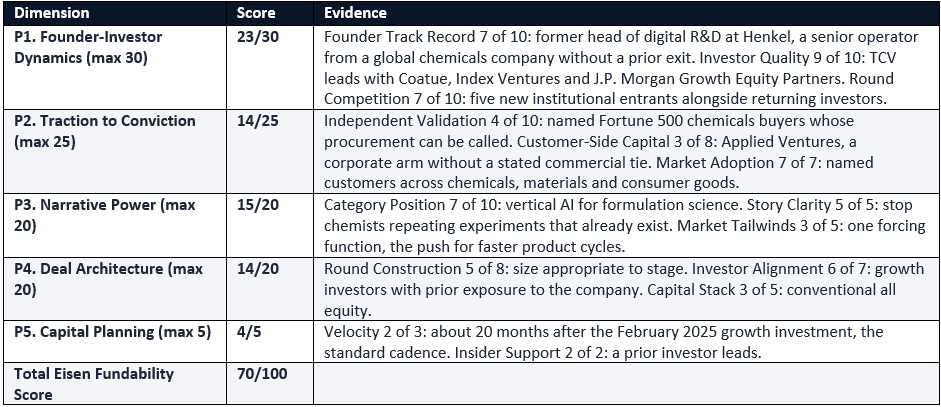
Why this scored. The strongest insider-led round of the week. A participant in the Series A stepped up to lead the Series B, the founder came out of a buyer’s own R&D organization, and the named customer list spans chemicals, materials and consumer goods. Its Founder-Investor Dynamics mark of 23 of 30 is second only to Stand’s in the issue.
The Setup. Albert, headquartered in Oakland, California, builds software and models for formulation chemists, trained on roughly 15 million chemical structures and the public chemical patent record. Chief executive Nick Talken co-founded the company in 2022 after serving as head of digital R&D at Henkel, where the company first built the product internally and then spun it out. Named customers include BASF, Henkel, Clorox, Kenvue, AkzoNobel, Avient, Chemours and Nouryon.
The Deal. $55.0M Series B led by TCV, announced October 13, 2026, with new investors Delta-v Capital, Socium Ventures, HighSage Ventures, Coral Capital and Legion VC, and existing investors Coatue, J.P. Morgan Growth Equity Partners, Index Ventures and Applied Ventures. All equity. TCV participated in the $22.5M Series A led by Coatue in December 2024 and now leads. The most recent prior financing was a $20M growth investment led by J.P. Morgan in February 2025.
The Pattern. This is the insider step-up round. The strongest signal in venture is a participant becoming a lead. TCV spent nearly two years as a minority investor and then chose to set the price. Every new investor in the syndicate inherited that diligence.
The Perspective. Treat every minority investor in your last round as a potential next lead. They have the information advantage, and their decision to lead removes the question every new investor asks. Applied Ventures, the venture arm of Applied Materials, is on the cap table without a stated commercial tie, which is why customer-side capital scored 3, not 6.
The Playbook. Identify the minority investor in your last round with the largest fund and the deepest category conviction. Give it the same monthly data you give the lead, and ask it six months before your raise whether it wants the lead seat.
The Founder Mistake to Avoid. Waiting for the prior lead to lead again. Prior leads often cap their exposure. The step-up from participant to lead compresses a process.
Founder lesson. Your next lead may already be a minority holder on your cap table. Cultivate it like a lead.
Founder trap. Over-crediting the logo wall. The customer list matters, but an insider decided the round by choosing to price it.
Abby Care
Paid Family Caregiving Through Medicaid | Series C | $82.0M | Led by Transformation Capital
Eisen Fundability Score: 67 / 100
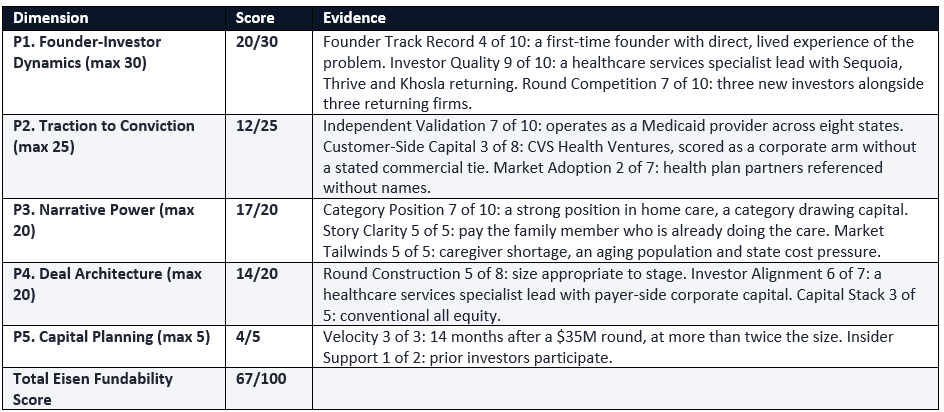
Why this scored. Operating as a Medicaid provider across eight states is external validation a new investor can confirm with state agencies, and the round arrived 14 months after the last one at more than twice the size. The founder is a first-time founder, which held P1 to 20 of 30, and the rest of the record carried it into the top three.
The Setup. Abby Care, headquartered in San Francisco, trains family members to become certified caregivers, employs them, pays them weekly and supports them with registered nurse care managers. It operates as a Medicaid provider, works with health plans to arrange home care for people with disabilities and complex needs, and is active in eight states. Founder and chief executive Havi Nguyen grew up handling Medicaid paperwork for her own family.
The Deal. $82.0M Series C led by Transformation Capital, announced October 15, 2026, with new investors CVS Health Ventures, Frist Cressey Ventures and Pivotal Ventures, and existing investors Khosla Ventures, Thrive Capital and Sequoia Capital. All equity. The prior round, $35M, was announced in August 2025.
The Pattern. This is the licensed-provider round. Medicaid participation across eight states means eight sets of state reviewers have looked at the company’s operations, credentialing and billing. It is a moat a competitor needs years to replicate, and an investor needs only a phone call to confirm.
The Perspective. In reimbursement-driven categories, the license is the product. The investor does not need to believe the founder’s projections. It needs to believe the payer will keep paying, and state participation is the evidence. CVS Health Ventures joining matters, but it scored as a corporate arm because no commercial agreement is attached in the record.
The Playbook. List every license, enrollment, accreditation and payer contract your category requires. Rank them by how long a competitor would need to obtain them. Make the top one the milestone your next round funds.
The Founder Mistake to Avoid. Treating licensure as back-office compliance. In this category, investors are pricing the asset.
Founder lesson. A license a regulator controls is the hardest proof to fake and the easiest to check.
Founder trap. Expanding to a ninth state before the first eight are operating cleanly. The participation is only valuable if it holds.
Pathways
Verified Environmental Data for Building Materials | Seed | $6.0M | Led by Sorenson Capital
Eisen Fundability Score: 67 / 100
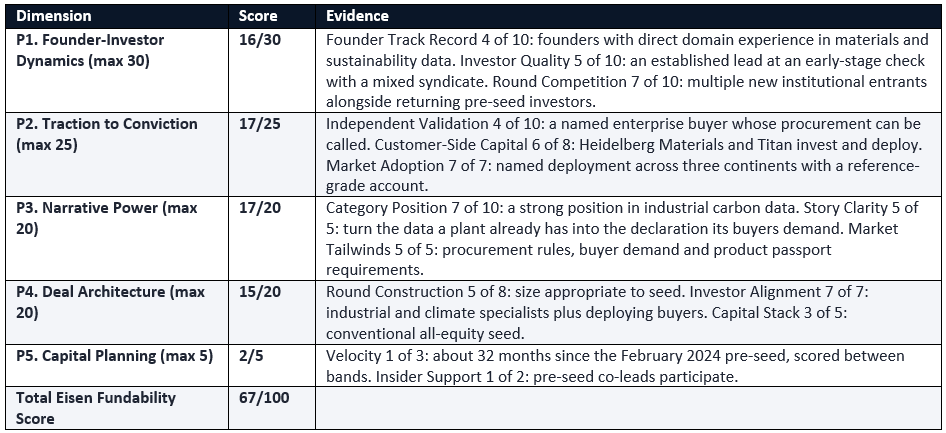
Why this scored. The only seed round in the top five and the second smallest round in the set. Two building materials manufacturers invested and deploy the product in their own operations, earning 17 of 25 on Traction to Conviction, tied with Suki for the highest mark in that dimension.
The Setup. Pathways, headquartered in New York and launched in 2023 by Leise Sandeman and Alexander Cooper, turns manufacturers’ operational data into environmental product declarations, the independently verified documents that report a building material’s environmental impact. The product also shows manufacturers which materials and processes drive emissions and lets them model alternatives before changing production. The buyers are cement, aggregates and building materials producers.
The Deal. $6.0M Seed led by Sorenson Capital, announced October 13, 2026, with Pi Labs, Zacua Ventures, Blue Lion, Positive Ventures and Great Wave, plus strategic investors Titan Ventures and Heidelberg Materials. All equity. Pi Labs and Zacua co-led the $2.5M pre-seed in February 2024. Heidelberg Materials is also Pathways’ largest customer, with a contract spanning sites in North America, Europe and Australia, and both strategic investors use the platform in their own operations.
The Pattern. This is the buyer-backed seed. A buyer on the cap table that also deploys is the strongest possible signal at seed. It answers the question no seed investor can answer from outside: will a large, conservative manufacturer actually change its process for this product?
The Perspective. At seed, a single reference-grade customer that also invests is worth more than a long list of pilots. It is a procurement decision and an investment decision made by the same organization. That is why a $6.0M seed outscored 21 larger rounds.
The Playbook. Ask your largest pilot customer for two things in the same meeting: a multi-site expansion and a strategic allocation in your round. If the champion cannot secure the second, the first tells you how deep the commitment runs.
The Founder Mistake to Avoid. Taking strategic money from a company that does not use the product. A passive corporate check scores 3 of 8 on customer-side capital. A deploying buyer scores 6. The difference is the deployment.
Founder lesson. At seed, one buyer who deploys and invests outweighs a dozen pilots.
Founder trap. Announcing the corporate name without the deployment. Investors check whether the corporation uses the product.
Suki
Ambient Clinical AI | Series E | $90.0M | Led by Healthier Capital
Eisen Fundability Score: 66 / 100
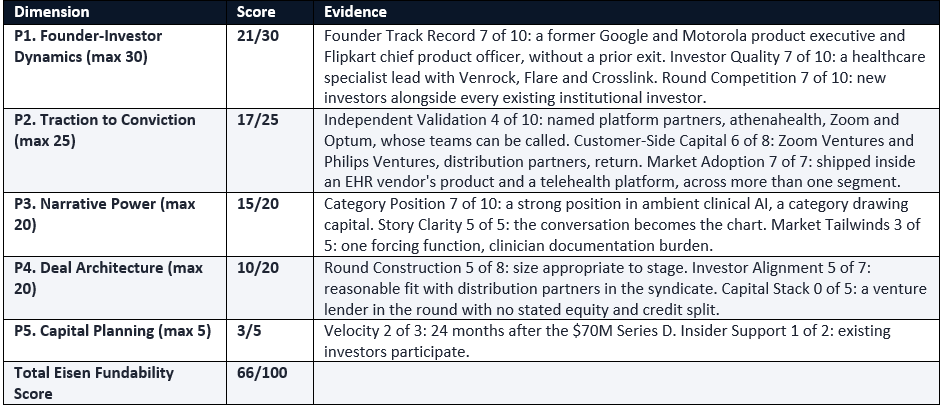
Why this scored. The second largest round of the week and the only late-stage round with distribution partners on the cap table. Zoom Ventures and Philips Ventures wrote again, and athenahealth and Zoom both ship Suki inside their own products. It lost the most points of any top-five round on deal architecture because a venture lender in the syndicate left the equity-and-credit split unresolved.
The Setup. Suki, headquartered in Redwood City, California, turns clinical conversations into documentation, coding support, order staging and other workflow output. Founder and chief executive Punit Soni is a former product executive at Google and Motorola and was chief product officer at Flipkart. Suki integrates with Epic, Oracle Health, athenahealth and MEDITECH. athenahealth’s Ambient Notes and Zoom’s telehealth ambient documentation are both powered by Suki, and Optum is a named partner.
The Deal. $90.0M Series E led by Healthier Capital, announced October 13, 2026, with new investors Crosslink Capital and Hercules Capital and all existing institutional investors returning, including Venrock, Flare Capital Partners, Hedosophia, Philips Ventures and Zoom Ventures. Aman Mahajan of Healthier Capital joins the board. Hercules Capital is a venture lender, and no source separates equity from credit. The $70M Series D was announced in October 2024.
The Pattern. This is the distribution-partner round. When the products clinicians already use, an EHR and a video platform, ship your feature under their own name, their distribution underwrites your adoption. Zoom writing again as an investor confirms the partnership is a strategy, not a pilot.
The Perspective. A full insider re-up into a Series E is a strong signal. So is a new specialist lead taking the board seat. What a lead will still ask is how much of the $90M is equity. Capital stack design scored 0 because the record cannot answer that.
The Playbook. If a platform ships your product inside its own, ask its venture arm into your next round, and state the equity and debt split in the announcement so a reader never has to guess.
The Founder Mistake to Avoid. Letting a blended headline stand. A round that mixes venture debt into the number reads larger and diligences slower. State the split.
Founder lesson. Get the platform that ships your product to invest in it, and say so plainly.
Founder trap. Treating a larger blended headline as a stronger signal. Diligence starts by taking it apart.
The Fundraising Playbook
Five plans, each producing a concrete artifact you can use this week. Each is built directly from this week’s verified signals.
1. The Underwriter-First Narrative (Narrative and Investor Framing)
Focus. Reframe your category claim around who has already underwritten you.
Why this matters. All five rounds clearing 65 opened with external counterparties or insiders, not internal projections. Rounds with independent validation averaged $44.55M against $27.41M.
Exact deliverable. A one-page narrative and a rewritten deck headline. The headline is a risk-reduction claim that names the strongest external commitment you hold, followed by the category claim and the one sentence that makes your company must-understand. Example structure: “Two rating agencies and five reinsurers already carry our risk. We insure the homes others will not.”
Time estimate. Four hours, plus one hour testing it with an investor you trust.
Expected outcome. A first meeting that starts with a fact the investor can confirm, not a claim the investor must believe.
The reframe. Wrong approach: “We are building the AI platform for X.” Right approach: “Heidelberg Materials deploys us in its own plants and invested in this round.”
2. Obtain One Externally Controlled Fact (Proof Architecture)
Focus. Acquire one validation that someone other than you grants and records.
Why this matters. Four rounds earned the significant validation tier and averaged 61.8 against 47.8; with the sub-dimension stripped, 8.0 points remain. Across all eleven rounds with any validation, the residual is 11.9.
Exact deliverable. A three-column inventory: every validation a third party could grant you in the next two quarters, the body that grants it, and the earliest date it could land. Insurance ratings and reinsurance treaties, state Medicaid participation, FDA clearances, federal research contracts, government grid programs, SOC 2 or ISO certification, or a reference-grade customer that also invests. Pick the fastest one, assign an owner and file this week.
Time estimate. Three hours for the inventory. Two to six months to obtain the first validation, which is why the filing date matters more than the announcement date.
Expected outcome. You open your process with a fact a partner can confirm without you.
The reframe. Wrong approach: collecting more pilot logos. Right approach: converting one pilot into a deployment with a procurement contact the lead can call.
3. Eisen Self-Score and Gap Diagnosis (Readiness)
Focus. Score your round on the five dimensions and decide between a process now and a repair sprint first.
Why this matters. The board ran from 33 to 73 with a mean of 49.9. Traction to Conviction averaged 5.6 of 25, the weakest dimension relative to its maximum. Ten rounds scored zero on it and still closed, but they averaged $16.42M against $46.06M for the sixteen that scored above zero.
Exact deliverable. A one-page score: Founder-Investor Dynamics (30), Traction to Conviction (25), Narrative Power (20), Deal Architecture (20), Capital Planning (5), with an evidence line for each sub-dimension. Score only what a stranger could confirm. Circle your two lowest dimensions. Above 65, run a parallel process with a hard deadline. Between 50 and 65, spend four to six weeks repairing the lowest dimension first. Below 50, the gap is structural, meaning no lead, no returning investor or no external validation, and a better deck will not close it.
Expected outcome. A decision about process design, made before the first meeting rather than after the tenth pass.
The reframe. Wrong approach: scoring yourself on what your deck says. Right approach: scoring yourself only on what a stranger could confirm, then fixing the two lowest dimensions first.
4. The Insider Lead and the Target List (Deal Architecture and Investor Targeting)
Focus. Lock the insider position, secure a price-setter and target only firms that lead at your stage.
Why this matters. 25 of 26 rounds had a named lead. 19 of 26 had a returning investor, and those rounds took 86.0% of the capital. Five rounds had a prior investor lead, against one a week earlier.
Exact deliverable. Three items. First, a written insider commitment: a number from each existing investor, conditional on terms, and a yes or no on leading. Second, a target list cut from 120 names to 35, each annotated with a round the firm led at your stage in the last 90 days, including the firms that led this week: RA Capital Management, Healthier Capital, Transformation Capital, Saga Ventures, Maverick Silicon, PeakSpan Capital, TCV, Top Tier Capital Partners, Prysm Capital, Avidity Partners, Index Ventures, GV, Vertex Ventures SEA and India, CAVU Consumer Partners, Left Lane Capital, First Round Capital, Volition Capital, Cubit Capital, Draper Associates, Z47, Threshold Ventures, FirstMark, Define Ventures, Pantera Capital, Uncork Capital, Field Ventures, Sorenson Capital and Lightspeed Venture Partners. Third, split your use of funds into unproven-outcome and predictable-cash-cycle columns and total the second; that total is the debt conversation, and stating the split avoids the blended headline that cost Suki its capital stack score.
Time estimate. Two weeks of calendar for the insider conversations, one day for the list, one hour with counsel on first refusal, exclusivity and information rights.
Expected outcome. A process that opens with insider support in hand and a short list of firms that actually lead at your stage.
The reframe. Wrong approach: accepting a second commitment before anyone has agreed to lead. Right approach: getting one investor to confirm in writing that it will lead, price the round and take the seat before you accept a second check.
5. The Milestone-Timed Process (Momentum and Conversion)
Focus. Design a process where insiders and counterparties create the momentum.
Why this matters. Six rounds this week closed within 18 months of the last one, at a larger size, and each had a returning investor. They averaged 59.5 against 47.0; with velocity stripped, 10.1 points remain.
Exact deliverable. A 14-day follow-up cadence tied to dated milestones. Day 0: open with the insider commitment letter and the validation already in hand. Day 3: send every active firm one dated progress note. Day 7: first lead meetings close out and customer reference calls are scheduled. Day 10: second note with a named customer or partner development. Day 14: term sheet deadline. Every touch carries a fact, never a check-in.
Time estimate. Three hours to design, two weeks to execute.
Expected outcome. Competition builds on evidence, not pressure, and the deadline forces a decision.
The reframe. Wrong approach: following up with “checking in.” Right approach: following up with “our second plant went live this week, and here is the plant manager’s number.”
Looking Forward
Three evidence-based scenarios and one wild card for the next one to three weeks. Each is anchored to this week’s verified data.
Scenario 1: Healthcare Concentration Holds Through Year-End (High Probability)
Why this is likely. All nine healthcare rounds this week had returning investors, three of the five insider-led rounds were healthcare, and the sector’s share rose from 23.1% to 43.7% in one week. Insiders defending positions ahead of year-end marks tend to keep writing.
What founders should watch. Whether new healthcare leads keep appearing alongside insiders, or whether rounds tilt to insider-only. A second week above 35% with new leads confirms the trend.
What founders should do before others notice. Lock insider commitments now, before year-end allocation decisions are made.
Scenario 2: Late Stage Keeps Absorbing Mid-Market Capital (Medium-High Probability)
Why this is likely. Series C to E produced four rounds and $282.0M after producing none the prior week, all four with returning investors, and they averaged 65.0.
What founders should watch. The count of Series C and later rounds in the band next week. Two or more confirms the trend.
What founders should do before others notice. Series B founders should open conversations with growth funds now, while the late-stage lane is visibly open, and bring insider commitments to the first meeting.
Scenario 3: The Insider Lead Becomes the Standard (Medium Probability)
Why this is likely. Insider-led rounds rose from 1 of 13 to 5 of 19 in one week. When returning investors make up 73.1% of rounds, the market looks for a finer signal, and the lead seat is it.
What founders should watch. Whether insider-led rounds hold at three or more next week, and whether the score gap between insider-led and insider-participating rounds widens.
What founders should do before others notice. Ask your largest existing investor this month whether it would lead your next round if no new firm does. A yes is the strongest signal you can carry. A no tells you what to fix before you open.
Wild Card: A Buyer Takes the Lead Seat (Medium Probability)
Evidence from this week. Three rounds had a buyer, distributor or manufacturer on the cap table and averaged 65.0, but none was led by one. Grid equipment makers, a cement producer and a video platform are all writing checks into companies they buy from or distribute. Last week a channel owner led a Series B.
What founders should do before others notice. Ask your largest customer whether it would lead, not just participate. Prepare your exclusivity position first, because a buyer lead will ask for one.
The Bottom Line
The real insight is not the $901.2M. It is that the capital went to companies where someone with information or money at stake had already said yes. Nineteen of 26 rounds carried a returning investor and took 86.0% of the dollars. Eleven carried a fact an outside body controls and took 54.4%. Five had a prior investor take the lead. That produced three conviction profiles.
Profile 1: Companies whose risk is already underwritten. Stand (73) carries rated carriers and a five-firm reinsurance panel. Abby Care (67) operates as a Medicaid provider across eight states. Switched Source (62) is inside a five-year, $99M Department of Energy grid program project. Probably Genetic (45) holds an ARPA-H contract of up to $10M. Eleven rounds had at least one external validation and averaged 59.8 against 42.7, and 11.9 points of that gap survive removal of the sub-dimension.
Profile 2: Companies whose insiders set the price. Albert (70) had TCV step up from participant to lead. Brellium (55) had returning investors Left Lane and First Round co-lead. Sirona Medical (54) had its Series C lead return as lead. Allara (45) had Index Ventures and GV co-lead again. Mogul (46) had Draper Associates lead after participating in its seed. Nineteen rounds had a returning investor and averaged 53.3, up from 40.9.
Profile 3: Companies whose buyer wrote a check. Pathways (67) took money from Heidelberg Materials and Titan, which run its product. Suki (66) had Zoom and Philips write again while Zoom ships it. Switched Source (62) took money from ABB, Southwire and Southern States, which sell into the same utility procurement offices. These three averaged 65.0, and 12.0 points of their 17.0-point gap survived removing the sub-dimension.
Everything else competed for the residual. Seven rounds raised with no returning investor and averaged $18.03M. The bottom of the board, Evos and Othello at 33, Confido Health at 34, Fragment and Zaria Systems at 35, share one shape: an early or extension round with no counterparty in the record and nothing an outside party has validated. The money is real. The proof is still to come, and the next investor will ask for it.
Five New Rules for Founders
1. Bring an underwriter, not a narrator. Rounds with independent validation took 54.4% of capital from 42.3% of deals.
2. Your last investor is your first reference. Rounds with returning investors took 86.0% of capital, and five were led by an insider.
3. Put a buyer on the cap table only if it deploys. Buyer-backed rounds outscored the field by 12.0 points after stripping the credit; corporate arms with no commercial tie averaged 56.1.
4. Size seed to a milestone, not a pedigree. Seed averaged $6.4M this week, and the only top-five seed was $6.0M with a deploying buyer.
5. Name the lead before you raise. 25 of 26 rounds had one.
Four Actions
1. Call every existing investor and ask for a written commitment conditional on terms, plus a yes or no on leading.
2. Name the one external body whose sign-off would convince a skeptical investor, and set a date to obtain it.
3. Ask your largest customer whether it has a strategic investment budget, who controls it, and whether it would lead.
4. Cut your target list to 35 firms that led a round at your stage in the last 90 days.
Twenty-six companies cleared this week, and the money followed the people who already knew them. Nineteen had an investor who had funded them before. Eleven had a fact somebody else controls. You cannot manufacture either by Friday, but you can start both on Monday, with two calls to people who already take yours.
Research Methodology, Sources and Verification
Data collection period and verification standard
Data collection period: October 12 to 18, 2026. Verified primary announcements cluster between October 13 and October 16. No verified US mid-market round in the set was announced on October 12, a federal holiday, or on October 17 and 18, a Saturday and Sunday. Verification standard: at least two independent sources per deal, with a company release, investor post, filing or regulated newswire (PR Newswire, Business Wire, GlobeNewswire) as the anchor where one exists, plus at least one independent outlet. Three passes were run: a primary collection pass, an independent second pass against alternative sources, and a third pass on October 19 that re-checked every amount, stage, lead, date, headquarters, prior round and validation and was directed at finding errors in the first two. All arithmetic was recomputed after the final pass. Eisen Fundability Scores are proprietary analytical estimates, not endorsements or investment advice.
Core capital totals and what they include
The $901.2M weekly total includes only the 26 verified US rounds in the scorecard, each counted at new primary capital at close. Mid-market is defined as a US-headquartered round between $5M and $100M. Because earlier issues in this series used a $10M to $100M band, week-over-week comparisons are also calculated on that subset: 22 rounds totaling $873.0M at an average of $39.68M and a median of $29.5M, against 19 rounds totaling $778.5M at an average of $40.97M and a median of $30.0M in the prior issue. Full-set comparisons use the prior issue’s 22 rounds totaling $800.9M at an average of $36.40M and a median of $30.0M.
Excluded from counted amounts: credit facilities and venture debt where separable, secondary purchases, previously closed rounds announced alongside new ones, SAFE conversions, non-dilutive grants and cumulative totals. Two restatements follow from this rule. Estuary Biotherapeutics launched with $103M, comprising a $93M Series A led by RA Capital Management and a previously closed $10M seed co-led by GV and 4BIO Capital; $93.0M is counted. Confido Health’s $12.5M extension brings its Series A to $22.5M; $12.5M is counted. Reach Security (”more than $50 million”) and Switched Source (”more than $17 million”) are counted at their stated floors.
Stage subtotals: Series A $306.0M across ten rounds including one extension; Series B $194.0M across four; Series C $152.0M across two; no series letter $91.0M across four; Series E $90.0M across one; Series D $40.0M across one; Seed $19.2M across three; Pre-seed $9.0M across one. Sector subtotals: Healthcare $393.5M across nine; Enterprise AI and software $232.0M across seven; Fintech and insurance $112.7M across five; Industrial and hardware $88.0M across three; Consumer $75.0M across two. Geography: California $558.2M across eleven rounds, New York $170.5M across nine, Oregon $65.0M, Texas $29.0M, Florida $25.0M, Massachusetts $21.0M, Illinois $17.0M and the District of Columbia $15.5M across one each. Each set sums to $901.2M across 26 rounds.
Scoring calibration notes
All rounds are scored on the v2 rubrics in the project framework. Founder Track Record is scored on the verifiable public record of prior companies, exits, operating roles and domain tenure, and is scored 0 where no relevant background was locatable. Intermediate values were used where evidence fell between bands: Investor Quality 5, 8 and 9; Independent Validation 8; Investor Alignment 5 and 6. Round-to-round velocity of 30 to 36 months scored 1, between the 18 to 30 month band (2) and the more than 36 month band (0). Prior round dates confirmed by only one source were not credited for velocity. A corporate venture arm without a stated commercial relationship was scored 3 on Customer-Side Capital. Facts available only from aggregators were not credited. The round with no designated lead, Othello, is scored on the institutional quality present rather than at zero.
Circularity control. Where a finding rests on a dimension that is itself a scored input, the sub-dimension is removed from both sides and the residual is published alongside the headline. Returning investor: 12.4 points as measured, 11.1 with Insider Support removed. Strategic or customer-side capital: 14.4 and 10.5. Buyer, distributor or manufacturer on the cap table: 17.0 and 12.0. Any independent validation: 17.1 and 11.9. Significant validation tier: 14.0 and 8.0. Re-underwritten within 18 months at a larger size: 12.5 and 10.1.
Deal citations
Stand, $70.0M Series C. PR Newswire company release dated October 15, 2026; Fortune; Coverager; The SaaS News; Pulse 2.0; Intelligent Insurer for the October 2025 Series B. Rated HIGH.
Albert, $55.0M Series B. Business Wire company release dated October 13, 2026; CHEManager; Tech Startups; The SaaS News; VC News Daily; TechCrunch and Homebrew for the prior rounds. Rated HIGH.
Abby Care, $82.0M Series C. Fortune dated October 15, 2026; Fierce Healthcare fundraising tracker; Fundz; Runtime Wire; Axios for the August 2025 round. Rated HIGH.
Pathways, $6.0M Seed. AlleyWatch daily funding report dated October 13, 2026; Dealroom; Startups Magazine; Inforcapital; Axios for the February 2024 pre-seed. Rated HIGH.
Suki, $90.0M Series E. Fierce Healthcare, Healthcare Dive and MobiHealthNews dated October 13, 2026; Axios and Inc. for the lead attribution; AI Weekly. Rated MEDIUM on the unresolved equity and credit split.
Switched Source, $17.0M. Business Wire company release and Pulse 2.0 dated October 13, 2026; VC News Daily; Fortune Term Sheet. Rated HIGH.
Mueon, $65.0M Series A. PR Newswire company release dated October 15, 2026; SiliconANGLE; Startup Researcher; Intel Capital for the September 2025 seed. Rated HIGH.
Estuary Biotherapeutics, $93.0M Series A. Company release dated October 16, 2026; Fierce Biotech; BioPharma Dive; BioPharm International; Crunchbase News. Rated HIGH.
Brellium, $23.0M. AlleyWatch dated October 13, 2026; The SaaS News; Tech Startups. Rated MEDIUM.
Sirona Medical, $40.0M Series D. PR Newswire company release via BioSpace dated October 15, 2026; AuntMinnie; Pulse 2.0; AuntMinnie and Radiology Business for the November 2024 Series C. Rated HIGH.
North.cloud, $60.0M Series B. PR Newswire company release dated October 15, 2026; Pulse 2.0; Unite.AI; Pulse 2.0 and TMCnet for the July 2025 Series A. Rated HIGH.
Reach Security, $50.0M Series B. GlobeNewswire company release dated October 13, 2026; Pulse 2.0; The SaaS News; SecurityWeek and FinTech Global for the July 2025 M12 round. Rated HIGH.
EZ Bombs, $25.0M Series A. Just Food dated October 15, 2026; Startup Researcher; Ventureburn. Rated HIGH.
Mogul, $15.5M Series A. PR Newswire company release dated October 13, 2026; Crowdfund Insider; Dealroom; VC News Daily; Crowdfund Insider for the November 2023 seed. Rated HIGH.
Fission, $10.0M Series A. PR Newswire company release dated October 15, 2026; Fortune; The SaaS News; VC News Daily. Rated HIGH.
Allara, $30.0M. AlleyWatch and FemTech Insider dated October 13, 2026; Fierce Healthcare; TechCrunch for the January 2025 Series B. Rated HIGH.
Probably Genetic, $12.0M Series A. Fierce Healthcare dated October 14, 2026; CB Insights; for the ARPA-H award, the company release dated August 31, 2026, GenomeWeb and Unite.AI. Rated MEDIUM.
Tamr, $21.0M. PR Newswire company release dated October 14, 2026; Dealroom; Fundz. Rated HIGH.
RapidCanvas, $29.0M Series B. Company release via The Tech Outlook dated October 16, 2026; The Next Web; DealStreetAsia; AI Weekly. Rated MEDIUM.
Chubby Group, $50.0M Series A. PR Newswire company release dated October 15, 2026; VC News Daily; Inforcapital. Rated HIGH.
Readily, $11.0M Series A. Fierce Healthcare dated October 14, 2026; MobiHealthNews; The SaaS News. Rated HIGH.
Fragment, $12.0M Series A. AlleyWatch and The SaaS News dated October 14, 2026; FF News; Dealroom. Rated HIGH.
Zaria Systems, $5.2M Seed. VC News Daily dated October 14, 2026; company announcement. Rated HIGH.
Confido Health, $12.5M Series A extension. Fierce Healthcare and AlleyWatch dated October 14, 2026; DealStreetAsia. Rated HIGH.
Evos, $9.0M Pre-seed. Pulse 2.0 dated October 14, 2026; AlleyWatch; The SaaS News; VC News Daily. Rated HIGH.
Othello, $8.0M Seed. AlleyWatch and VC News Daily dated October 14, 2026; The SaaS News; Traded. Rated MEDIUM.
Market comparison sources
Crunchbase News, the week’s 10 biggest funding rounds, published October 16, 2026, totaling $1,655M: Modal Labs ($750M), Icon ($200M), Soufflé Therapeutics ($135M), Estuary Biotherapeutics ($103M as listed), Labelbox ($100M), Suki ($90M), Abby Care ($82M), Stand ($70M), Mueon ($65M) and North.cloud ($60M). Six of the ten sit inside this report’s band. Ramp’s $1.85B round, announced October 15, is used as contrast only. VC News Daily funding records, used as a candidate source and date-checked against primary releases because its posting dates lag by one to five days. AlleyWatch daily New York funding reports, The SaaS News, Pulse 2.0, Dealroom news and the Fierce Healthcare fundraising tracker for October 12 to 16, 2026.
Prior-period comparisons are drawn from the final published figures of earlier issues in this series. The $10M to $100M band ran 21 rounds and $769.0M in the week of September 7, 22 rounds and $837.5M in the week of September 14, 17 rounds and $655.0M in the week of September 21, 11 rounds and $457.5M in the week of September 28, and 19 rounds and $778.5M in the week of October 5. Strategic participation shares as published: 54.2%, 28.0%, 27.8%, 26.7% and 36.4%. The October 5 issue’s stage averages ($5.2M pre-seed, $41.54M seed, $25.11M Series A, $64.3M Series B, $20.25M no series letter), sector figures, designated leads (19 of 22), returning investors (13 of 22) and insider-led rounds (one) are used for week-over-week contrast.
Verification notes
Twenty-one of 26 rounds are rated HIGH source confidence: a company, investor, filing or regulated newswire source plus at least one independent outlet, with no unresolved conflict affecting the round. Five are rated MEDIUM. Suki: Hercules Capital, a venture lender, is in the syndicate and the equity and credit split could not be isolated across sources, so Capital Stack Design was scored 0; Healthier Capital is named as lead by Axios, Inc. and AI Weekly and listed as a new investor by Fierce Healthcare. RapidCanvas: the company releases names Vertex Ventures SEA and India as lead, while one outlet reports Hitachi Ventures as co-lead; the release is used. Brellium: the round carries no series letter, and the prior round is described as a combined seed and Series A in one source and as a Series A in another. Probably Genetic: the round rests on one independent outlet plus a data provider; the ARPA-H award is credited after confirmation in the company release, GenomeWeb and Fierce Healthcare. Othello: the anchor sources designate no lead while one outlet names two, and the round overlaps a $6.85M Form D filed in August by its parent, Cicero, Inc.; it is counted once, at the $8.0M announced. Confido Health states that its extension was completed in February 2026; it was first announced on October 14 and is counted in this week. Every third-party validation credited under Independent Validation was checked against the announcement of the award, rating or deployment rather than a company characterization of it.
Exclusions and documented rationale
News-cycle resurfaced, excluded from every total, chart and score. Vitalize, $31M, announced October 6. Navra, $19M, announced October 6. Fortem, $50M, announced September 30. TriGemX, $94M, announced October 1. Elorian, a $55M seed, was announced in April 2026 and recirculated this week. VC News Daily listed several rounds on October 14, including Vinci, Arena, TypeSafe, Atomic Machines, Voltus, and Ledgebrook, announced October 6 to 9 and belonging to the prior issue.
Non-US or dual headquarters, excluded for scorecard comparability. Harmonic Security (San Francisco and London), Duvo (New York and London), Clueso (California and Bengaluru), Causa Prima (Madrid and Munich), Pluto Security (Israel), Scarlet (United Kingdom), OMass Therapeutics (United Kingdom), Salience (United Kingdom), Skeleton (Estonia), Dougs (France), Epyr (France), CarbonFarm (France), Scimplify (India), Mesa (India), GreenCell (India), Ubitium (Germany), 1KOMMA5 (Germany), Scanntech (Uruguay), and Astribot, Yanchao, Sankai, Yisheng, Jinghua, Machxin, Yuangui, Velotric, SUNMMIO and Yundie (China).
Structural exclusions. Labelbox, a $ 100M+ headline that includes a credit facility, with new equity not isolable and the round at the band ceiling. Prolific Machines, a $50M Series B2 initial closing. Origin, a $20M cumulative figure. Scuba, $34M combining pre-seed and seed. Aatmunn, an up-to figure of $8M. Sensydia, an initial closing of $6M or more. Sonilo, headquarters not verified. DATA Network, $30M not verified across two sources.
Single anchor source this pass. Forgepoint ($9.8M), Swamp Club ($7M), Otter Health ($8M) and Allswell ($7M).
Below the floor. Leela ($4.6M) and Collective X Health ($3.2M).
Above the ceiling, contrast set only. Ramp ($1.85B), Modal Labs ($750M), Icon ($200M) and Soufflé Therapeutics ($135M).
Deals analyzed and excluded
Deals analyzed: 26 verified US mid-market rounds of new primary capital between $5M and $100M. Deals excluded: 5 resurfaced from earlier weeks, 28 non-US or dual-headquarters rounds, 8 on structural or verification grounds, 4 on a single anchor source, 2 below the $5M floor and 4 above the $100M ceiling. Second-pass changes: three scores corrected (Probably Genetic from 38 to 45 on its confirmed ARPA-H award, Reach Security from 48 to 51 on its July 2025 M12 round, Fission from 45 to 46 on returning investors), two confidence ratings changed (Fragment to HIGH, Othello to MEDIUM), and no amount, stage, lead, date or headquarters changed.
Research completion
Research completed October 19, 2026, after a third verification pass, adversarial and directed at finding errors in the second.
DISCLAIMER: This article is for informational and strategic intelligence purposes only. It does not constitute investment advice. The Eisen Fundability Score is a proprietary diagnostic within Fundables OS™, not a financial recommendation.
If this article was useful, share it with founders who are about to raise.
— Leon Eisen, Venture Partner @NetworkVC · 4x founder · Capital and Growth Strategic Partner · Bestselling Author of Invisible Game: The Secrets of the Term Sheet Magnet.