

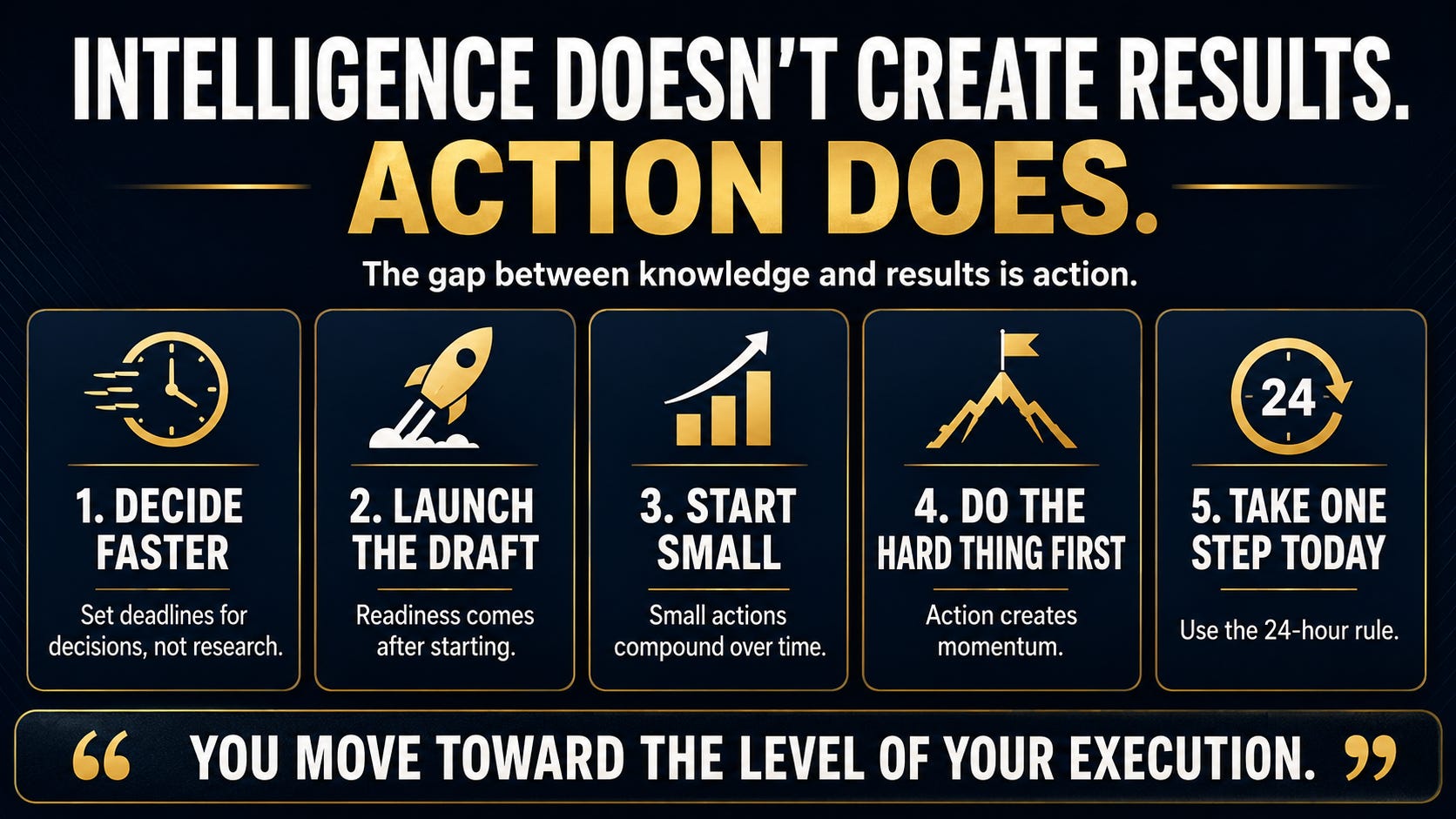
Intelligence helps you understand the world. Action gives the world a reason to respond. The gap between the two explains why some of the smartest people achieve far less than they should.
My doctorate is in quantum physics. I spent years learning how to analyze complex systems, identify hidden variables, challenge assumptions, and think several steps ahead.
Today, I work in venture capital. And one of the most uncomfortable things I have learned is that intelligence alone has surprisingly little power in the real world.
The smartest founder rarely wins simply because they are the smartest. The person with the most sophisticated analysis does not automatically build the largest company.
A founder who has read every book, studied every competitor, and examined every strategic possibility can still lose to someone whose first product was unimpressive, whose original plan was incomplete, and whose understanding of the market was far less developed.
Why?
Because the second founder entered reality earlier.
They spoke with customers, made offers, heard objections, changed the product, recruited people, asked for money, and survived rejection. They accumulated information that could never have been found in a report.
While one person became more informed, the other became more effective.
This is the uncomfortable divide between knowledge and results. Intelligence helps you see possibilities, but action forces you to choose one.
Intelligence identifies risks, while action reveals which risks are real. Intelligence produces explanations, while action produces consequences.
And consequences are where learning, progress, wealth, reputation, and freedom begin.
The Dangerous Story Intelligent People Are Taught
Many intelligent people grow up absorbing the same promise: study harder, learn more, think deeper, become more qualified, and eventually the world will recognize your value.
This promise works reasonably well inside structured systems. At school, the questions are predefined, the teacher knows the correct answers, the assignments have deadlines, and good work receives a grade.
The real world operates differently.
The market rarely gives you a clearly defined question. Customers do not care how difficult your work was, and investors do not reward the amount of research behind your company.
Opportunities also do not wait until you feel prepared. The real world rewards value that has been made visible, and making value visible requires movement.
You can understand entrepreneurship without building a company. You can understand investing without investing, sales without asking anyone to buy, and leadership without making a difficult decision.
You can even understand fundraising without asking an investor for capital.
In every case, your understanding may feel sophisticated while remaining commercially powerless.
The problem is that intelligence becomes a mechanism for delaying exposure to reality.
Trap One: The Research Cage
The research cage begins innocently.
You discover an opportunity. It may be a business idea, an investment, a new market, a career move, or a valuable skill.
Because you are responsible, you decide to investigate before acting. You read articles, watch interviews, compare models, study competitors, examine pricing, analyze possible risks, build spreadsheets, and consult experts.
This is sensible.
Then you discover another approach. You compare it with the first one, improve your plan, notice a weakness, gather more information, identify another risk, and begin investigating that too.
Weeks become months. Months become years.
The research still feels productive because your knowledge is expanding. Your notes are becoming more detailed, and your strategic vocabulary is improving.
Yet nothing exists outside your head.
No customer has paid. No product has been tested. No investment has been made. No offer has been presented.
No decision has produced a consequence.
Research has quietly changed from a tool into a hiding place.
The intelligent mind is especially vulnerable because it can always produce another legitimate question. There is always another article, expert, scenario, benchmark, or strategic angle worth considering.
This makes hesitation feel responsible. Fear begins wearing the clothes of intellectual discipline.
The rule
Stop setting deadlines for completing research. Set deadlines for making decisions.
Ask yourself:
Would one additional piece of information materially change my decision?
When the honest answer is no, further research has stopped protecting you. It is protecting you from the discomfort of choosing.
You will rarely feel completely ready before starting. Readiness is usually created by action rather than discovered before it.
Trap Two: Protecting Your Dignity
Intelligent and accomplished people carry an invisible burden: they must continue appearing intelligent and accomplished.
That makes certain activities feel beneath them. Selling, contacting strangers, asking for introductions, following up after receiving no response, beginning with a small client, or performing repetitive work may feel inconsistent with their identity.
Making an imperfect presentation feels risky. Admitting that you do not know feels even worse.
These activities threaten the identity of being the person who already understands. So intelligent people sometimes wait for opportunities that match their status, education, or potential.
Someone else accepts the uncomfortable assignment.
That person speaks with hundreds of strangers, hears rejection, makes mistakes, and slowly learns how people decide. They discover what creates trust, which words communicate value, and how to continue after hearing no.
At first, they look less impressive. A few years later, they possess skills that move markets, teams, customers, and capital.
They have learned persuasion.
Persuasion influences nearly every economic outcome. It helps you attract customers, recruit talent, negotiate agreements, raise capital, build partnerships, and lead people through uncertainty.
The skill frequently develops through work that intelligent people initially consider undignified.
The founder who refuses to sell protects their ego while weakening their company. The advisor who refuses to promote their work protects their image while remaining invisible.
The executive who avoids uncomfortable conversations protects temporary harmony while allowing deeper problems to grow.
The rule
Do something every week that makes your ego uncomfortable.
Ask directly. Make the call. Contact the person. Present the offer. Hear the rejection.
Begin before you look experienced.
The skill your pride refuses to learn may be the skill that eventually buys your freedom.
Trap Three: The Perfect-Plan Illusion
Perfectionism is presented as a commitment to quality. In entrepreneurship, it can become a sophisticated form of avoidance.
You have an important idea, so you want to execute it professionally. You develop the strategy, study competitors, design the brand, refine the positioning, build financial projections, and write the product requirements.
You improve the presentation and reconsider the pricing. Every time you approach launch, you notice another weakness.
So you improve the plan again.
Meanwhile, someone else releases an awkward version.
Their website is basic, their positioning is unclear, the product has limitations, and their pricing may be wrong.
But customers can see it.
That changes everything.
Customers ask questions the founder never anticipated. They ignore features the founder considered essential and request capabilities that were absent from the roadmap.
Some refuse to buy. Others reveal a completely different reason for buying.
The imperfect product begins collecting perfect information. Your perfect plan continues collecting assumptions.
This is why a functioning, imperfect business usually defeats a beautifully designed business that never enters the market.
Planning answers the questions you can imagine. Participation reveals the questions you did not know existed.
The market provides information through behavior. People pay, ignore, complain, return, refer, cancel, negotiate, and compare.
Those actions are more valuable than polite opinions.
The rule
Do not launch a masterpiece. Launch a draft that one real person can experience.
Reduce the idea until it can touch the market this week.
Ask whether someone will pay, which problem feels urgent enough to solve now, what must be true for the customer to continue, and which assumption could destroy the business.
Then identify the smallest test that exposes that assumption.
Your logo can wait. Your assumptions cannot.
Trap Four: The Neutrality Disease
Intelligence allows you to see multiple sides of an issue. This is valuable until it prevents you from choosing one.
You understand your partner’s motivation, the employee’s frustration, the investor’s concern, the customer’s limitations, and your own emotional reaction.
Every perspective appears reasonable. Every decision contains risk.
So you wait.
You call the waiting patience, diplomacy, or strategic thinking. Meanwhile, the unresolved problem grows.
A weak employee continues damaging performance. A misaligned partnership becomes more expensive. A product direction remains unclear.
A customer relationship deteriorates. An investment opportunity disappears.
A wrong decision made early can often be corrected. A decision that is never made cannot teach you anything.
This matters especially in startups because uncertainty never disappears. Leadership requires making commitments before every variable is known.
Founders are frequently searching for certainty when the real requirement is direction.
Your team does not need a leader who can describe every possible future. It needs a leader who can select the next move, explain the reasoning, observe the result, and adjust quickly.
The rule
When several options appear reasonable, choose the one that creates the most useful evidence.
Commit, observe, and correct.
Decisiveness does not guarantee that you will be right. It guarantees that reality will finally have something to respond to.
Trap Five: Interrupting Compounding
People usually associate compounding with investments, but its influence is much wider.
Skills compound. Relationships compound. Trust, reputation, distribution, customer knowledge, content, and operational experience all compound.
A founder who spends five years speaking with customers develops an instinct that cannot be downloaded in a weekend.
An investor who builds trusted relationships over twenty years sees opportunities that remain invisible to newcomers.
A writer who publishes consistently develops a body of work, an audience, and intellectual authority. A business that learns from thousands of customer interactions accumulates an advantage that a new competitor cannot instantly reproduce.
The greatest cost of waiting is therefore larger than the immediate opportunity you miss.
You interrupt the process through which small actions become disproportionate advantages.
Three years of delay does not simply move the same result three years into the future. It removes three years of accumulated learning, capital, relationships, and momentum.
Time is not a neutral container. Time multiplies whatever you repeatedly place inside it.
The earlier you begin, the longer reality can work with you.
The rule
Start smaller than your ambition, but earlier than your comfort prefers.
A small action repeated for years can outperform an extraordinary action taken once.
Consistency gives time something to multiply.
Redirect Your Intelligence
The answer is not to become less intelligent. It is also not to stop reading, analyzing, or thinking deeply.
Intelligence is a powerful engine. The question is where you point it.
Many capable people direct their intelligence toward understanding why action should be delayed. They predict every possible failure, detect every weakness, compare every alternative, and explain why the market is unfair.
They identify why someone else’s success cannot be replicated.
The analysis may be accurate. The result remains inactivity.
Redirect the same intelligence toward movement.
Instead of asking what else you should understand, ask what the next action is.
Instead of trying to remove all uncertainty, decide which uncertainty should be tested first.
Instead of asking how to avoid making the wrong decision, ask how quickly you can detect and correct one.
Instead of waiting for the perfect opportunity, choose the available opportunity that can teach you the most.
Use intelligence to design better experiments rather than defend hesitation.
That is the shift from intelligence as observation to intelligence as execution.
Four Tools for Turning Thought Into Movement
1. Use the 24-hour rule
For any meaningful decision you have been postponing, take one measurable action within the next 24 hours.
The action does not need to complete the goal. It only needs to break inertia.
Send one email, contact one customer, publish one page, ask for one introduction, book one meeting, or present one offer.
Movement changes your relationship with the problem. It converts an abstract idea into a sequence of real decisions.
2. Reduce the size of the next step
When a task feels overwhelming, people often try to create more motivation. A better solution is to break the task down.
Do not “build the company.” Interview one customer.
Do not “raise the round.” Identify five suitable investors.
Do not “create the course.” Write the promise of the first module.
Do not “launch the newsletter.” Publish the first useful idea.
Continue shrinking the step until avoidance becomes more difficult than completion.
3. Do the emotionally difficult task first
People often start the day with easy work because it creates a sense of progress.
Messages are answered, documents are organized, and minor tasks disappear. The day feels productive, but the important, uncomfortable task remains untouched.
Reverse the sequence.
Begin with the activity carrying the greatest emotional resistance and strategic value.
Call the customer. Address the conflict. Ask for the decision. Send the proposal. Discuss the price.
Your resistance often points directly toward the work capable of changing your situation.
4. Make commitment visible
Private intentions are easy to renegotiate. Visible commitments create consequences.
Set a launch date, tell your team, invite the customers, schedule the presentation, or announce the deliverable.
Create a financial or reputational cost for withdrawal.
You do not need unlimited discipline when your environment makes movement easier than retreat.
The Founder’s Test
Founders tell me they need more clarity.
Sometimes they do. More often, clarity is waiting on the other side of a conversation they have been avoiding.
It may be the customer interview they have not scheduled, the offer they have not presented, the price they have not tested, or the investor question they have not answered directly.
It may be the team decision they have postponed or the product assumption they have protected from the market.
There is a simple test:
What would you do this week if learning were more important than looking intelligent?
That question exposes a great deal. It shifts the objective from protecting your identity to improving your company.
The strongest founders I meet are rarely reckless. They think deeply, investigate carefully, and understand risk.
But when the decision point arrives, they decide.
They accept that the first answer may be incomplete. They trust their capacity to learn, correct, and continue.
Their confidence does not come from believing that every move will work. It comes from knowing that movement will produce the information required for the next move.
You Do Not Need More Inspiration
Inspiration creates a temporary emotional high. Then ordinary life returns.
The inbox fills, meetings begin, urgent tasks consume the day, and the important decision moves back into the future.
The useful question is therefore not whether this article inspired you.
The useful question is:
Which action will exist because you read it?
There is probably one decision already sitting in your mind.
It may be a business you keep studying, a customer you need to contact, a conversation you continue rehearsing, or an offer you have not presented.
It may be a price you are afraid to name or a project you keep preparing to begin.
Do not convert that decision into another research project. Convert it into one visible action today.
Your future will rarely be determined by the most impressive idea you understood. It will be determined by the actions you repeated long enough for them to compound.
You do not rise automatically to the level of your intelligence.
You move toward the level of your execution.
One Question for You
What is one decision you already understand well enough, but still have not acted on?
Write it down. Then define the smallest action that would move it into reality within the next 24 hours.
Not the complete plan. Not the final result.
The next move.
Subscribe to Fundables
I write about the hidden mechanics behind startup execution, fundability, investor psychology, strategic growth, and the decisions that separate promising companies from investable ones.
Subscribe to receive practical frameworks for building stronger companies, communicating value, and moving from potential to evidence.
Share this article with a founder, executive, or investor whose intelligence may have become a reason to wait.
If this article was useful, share it with founders who are about to raise.
— Leon Eisen, 4x Founder, Venture Capitalist, and Creator of Fundables OS™