

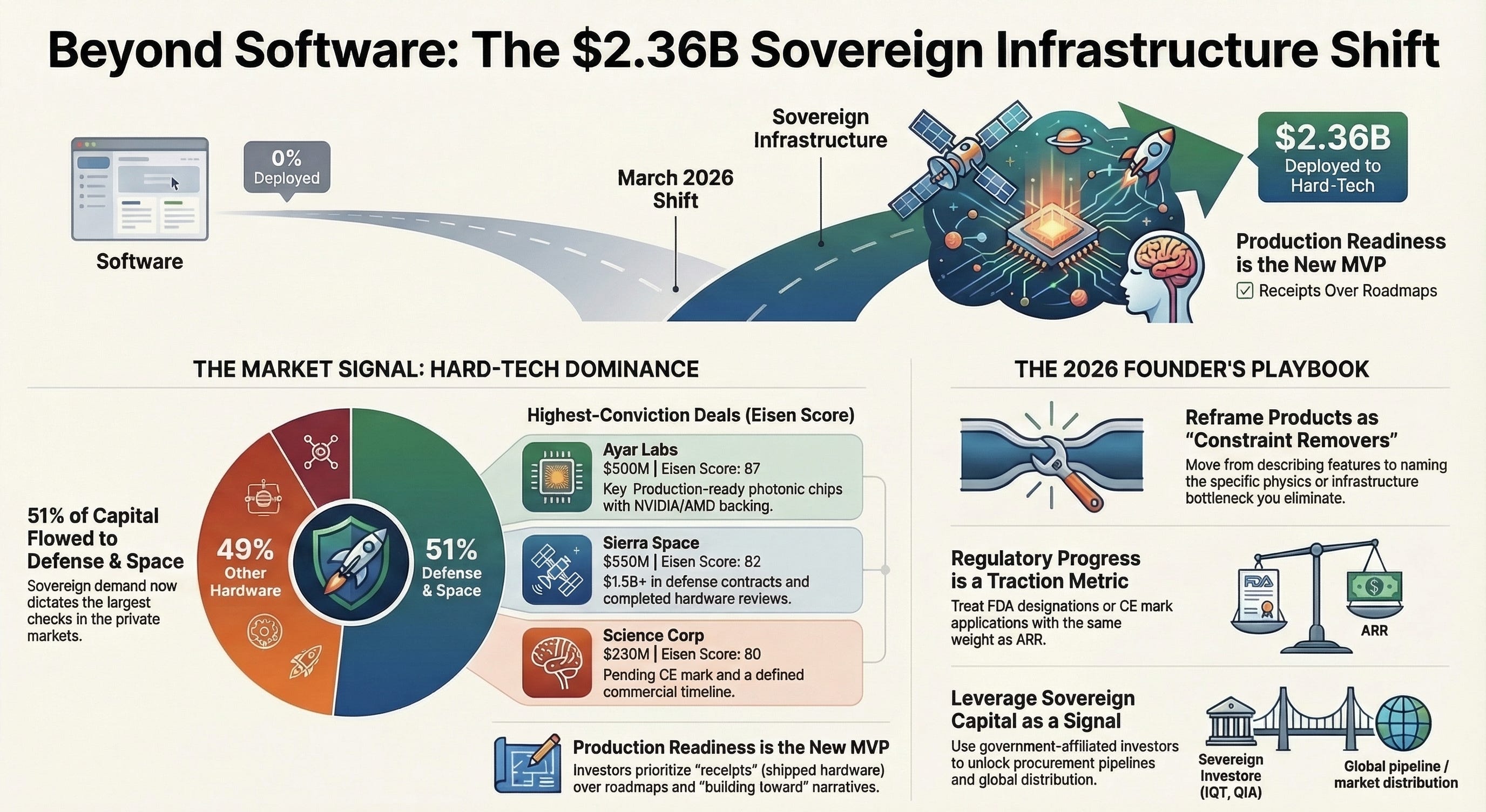
Three leading deals. $1.55 billion. Zero pure software.
In the week of March 2–8, 2026, the top three funding rounds by size went to a space and defense tech company, a commercial space station builder, and a photonic interconnect chip maker. Not one dollar of that went to a SaaS dashboard, an AI wrapper, or a B2B productivity app.
That is the signal. Not because software is dead. Because capital is now pricing a different kind of readiness - sovereign infrastructure. The kind that requires contracts with the Department of Defense, hardware that ships into orbit, and photonic chips that replace copper inside the most power-constrained environment in human history.
Meanwhile, the week’s fourth-largest deal, a $230 million oversubscribed Series C for Science Corp, was led by Lightspeed and Khosla for a brain-computer interface company that expects to be first to market in Europe by mid-2026. CE mark pending. FDA discussions active. Not a promise. A timeline.
What does this mean for your raise? Two things. First, proof standards have moved from “we are building toward” to “we are shipping into.” Second, the market is paying premium multiples for de-risked execution in hard-tech categories, not for category leadership in software verticals where there is no ceiling on competitors.
The Week In One Sentence
Capital concentrated in sovereign infrastructure and physical-layer technology, with $2.36B+ deployed across verified deals, led by three rounds of $500M or more, all in hard-tech categories, none in pure software.

Deals Scorecard
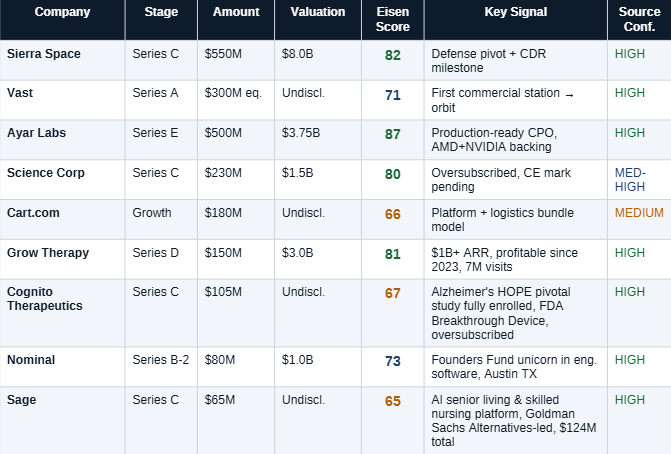
What the Scorecard Says at a Glance
The scorecard tells a story about the conviction tier. Ayar Labs, at a score of 87, and Sierra Space, at 82, are funded because both companies have crossed the most important threshold in today’s market: proof of production readiness. Ayar has a working CPO chip with NVIDIA and AMD already in the syndicate. Sierra Space completed Critical Design Review for two national security satellite programs in 2025. These are not roadmaps. These are receipts.
Science Corp’s score of 80 reflects similar logic: an oversubscribed round with a CE mark timeline, not just a clinical hypothesis. At the other end, Cart.com at 66 and Sage at 65 are funded but at lower valuations, primarily because unit economics and growth metrics were not publicly disclosed, and their market positions remain competitive.
What Changed This Week: 5 Market Shifts
Capital Concentration by Category

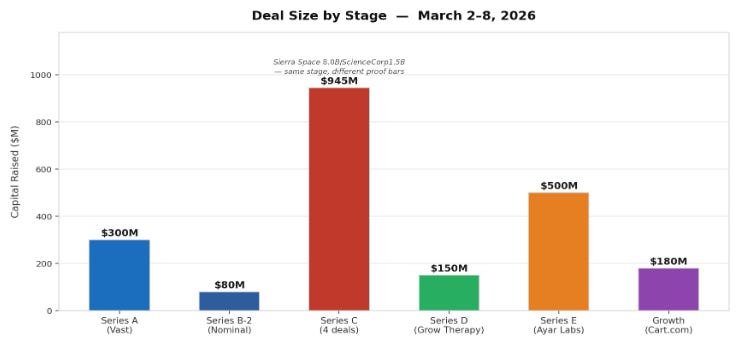
Deal Size by Stage
Shift #1: The ‘Infrastructure Premium’ Has Jumped Categories
PATTERN: What Happened
Sierra Space ($550M, Series C, $8B val) and Vast ($500M total, Series A) both announced on March 5. Combined: $1.35B into commercial space and defense tech in a single day. Sierra Space disclosed $1.19B in DoD contracts. Vast’s backers include IQT (CIA-affiliated strategic), Qatar Investment Authority, and Mitsui, sovereign and institutional capital aligned in the same week.
PERSPECTIVE: What It Means
VCs are not betting on space as a consumer opportunity. They are betting on it as a sovereign asset class, one that requires regulatory access, government contract qualification, and physical infrastructure that takes years to build. These are the same VCs that are not betting on space as a consumer opportunity. They are betting on it as a sovereign asset class, one that requires regulatory access, government contract qualification, and physical infrastructure that takes years to build. This is the same investor logic behind nuclear fusion bets: the moat is the hardware and the government relationship, not the software layer.
FOUNDER BLINDSPOT: What Most Miss
Founders see these rounds and think, “Defense is hot, let me pivot toward DoD language.” That is the wrong read. These companies have 5 years of manufacturing milestones and existing contracts. You cannot narrative-hack your way into sovereign infrastructure conviction. The proof bar is physical: hardware shipped, CDR completed, satellites in orbit.
PLAYBOOK: What To Do
If you are in a category that can credibly serve sovereign demand (energy infrastructure, compute hardware, communications, biotech for government), document your government partnership readiness now, not as a future option, but as a current proof point. A letter of intent with a federal agency counts more than 10 pilot SaaS customers at this stage.
CONTRAST
In 2024, defense-tech rounds were viewed as a niche. In Q1 2026, they are among the highest-conviction rounds in the market, proof bar equivalent to late-stage software: multi-year contracts, CDR milestones, and operational hardware in the field.
What this means for your raise: If you can’t answer ‘what would break if our product disappeared tomorrow for a paying enterprise customer,’ you’re not infrastructure. If no one’s production environment depends on you, your valuation will reflect it. Build toward necessity, not preference.
Shift #2: First-To-Market premium
PATTERN: What Happened
Science Corp raised an oversubscribed $230M Series C at $1.5B valuation (founded 2021, $490M total). The round included Lightspeed, Khosla, YC, and IQT. The specific trigger: CE mark application submitted to the EU, approval expected mid-2026. Science would become the first BCI (Brain-Computer Interface) company to have a commercial product on the market.
PERSPECTIVE: What It Means
The round did not fund research. It funded commercialization. The investor logic: if you can be first to market in a category that requires 10+ years of regulatory navigation, the premium is enormous. “First BCI to market” is the equivalent of “first mover in a regulatory-gated category,” the kind of position that justifies a 3x step-up from seed to Series C in 4 years.
FOUNDER BLINDSPOT: What Most Miss
Founders in regulated categories often wait for full FDA approval before raising growth capital. Science Corp shows the opposite: you can raise $230M at $1.5B, with a pending CE mark and active FDA discussions. If you are in a regulated category and you have a credible regulatory timeline, that timeline is your traction proof.
PLAYBOOK: What To Do
If you are building in a regulated category (medical, fintech, energy, defense), create a Regulatory Milestone Map: a one-page document that shows your regulatory pathway, current status, approvals received, and approvals pending, with an expected timeline. This is your proof stack equivalent in regulated markets. Put it in your data room before your next raise.
CONTRAST
12 months ago, BCI rounds were pre-revenue research plays. This week’s Science Corp round is a commercialization bet with a named product, a named market (EU late-stage macular degeneration patients), and a named timeline (mid-2026 CE mark). Specificity converted investor skepticism into $230M.
What this means for your raise next week: If you are in a regulated sector, quantify your regulatory milestones the same way a software company quantifies ARR. Investors in 2026 treat regulatory progress for pharma and first-to-market companies as a traction metric.
Shift #3: Mental Health - Market penetration Over Pilots
PATTERN: What Happened
Grow Therapy raised $150M Series D led by TCV and Goldman Sachs Growth Equity at a confirmed $3.0B valuation. The company has crossed $1B in annual revenue, facilitated 7M visits in 2025, operates with 26,000 providers, and has been profitable since 2023. TCV and Goldman Sachs Growth led because penetration metrics showed the raise was warranted.
PERSPECTIVE: What It Means
The healthcare funding playbook has bifurcated. Early-stage health AI rounds remain hypothesis-based. But growth-stage rounds (Series D and above) now require market penetration metrics: provider density in key markets, patient retention rates, and documented cost savings versus traditional pathways.
FOUNDER BLINDSPOT: What Most Miss
Founders in healthcare often confuse “we have pilots with 5 health systems” as proof equivalent to “we have 10,000 active patients and 90% monthly retention.” They are not the same. A pilot is a question mark with a logo attached. Retention and penetration data are a conviction multiplier.
PLAYBOOK: What To Do
If you are a health platform founder approaching Series A and B, shift your proof narrative from “we have partnerships” to “we have penetration.” Quantify:
Patients/providers on the platform.
Month-over-month retention.
Revenue per patient vs. industry benchmark.
Build a “penetration page” in your deck that shows market share, retention curves, and cohort economics.
CONTRAST
In 2023, mental health platform rounds cleared on “we are solving an access crisis” narratives. In 2026, TCV-led rounds require demonstrated market penetration: density, retention, and unit economics at scale.
What this means for your raise: Replace the word “pilots” in your deck with actual penetration metrics. If you do not have them, this week’s task is to build the retention and cohort economics framework before your next fundraising meeting.
Shift #4: Sovereign Capital As Syndicate Signal
PATTERN: What Happened
Three of the week’s top five rounds included sovereign wealth or quasi-sovereign capital: Qatar Investment Authority (QIA) participated in both Vast ($300M Series A) and Ayar Labs ($500M Series E). IQT (CIA venture arm) participated in Science Corp and Vast. Same sovereign entities, three different sectors, same week.
PERSPECTIVE: What It Means
QIA and IQT are not dumb money. When the same sovereign entities appear in multiple rounds in the same week across different sectors, it signals a shared geopolitical thesis: the US and its allies are funding the physical and digital infrastructure layer that will define competitive advantage in the 2030s.
FOUNDER BLINDSPOT: What Most Miss
Founders see “QIA” or “sovereign fund” in a cap table and think “validation.” That is partly right. But the more important signal is that QIA in your cap table opens doors to Middle Eastern and Asian government customers, defense partnerships, and sovereign procurement pipelines. Founders who treat sovereign investors as passive financial participants are underutilizing their most powerful business-development asset.
PLAYBOOK: What To Do
If a sovereign fund or strategic government-affiliated investor is interested in your company, ask two questions in parallel: (1) How does this investment open government procurement relationships for us? and (2) Which portfolio companies should we be talking to? Treat sovereign capital not just as validation — treat it as a distribution channel into government and institutional customers.
CONTRAST
In 2021–2023, sovereign funds played in late-stage liquidity rounds. In 2026, they are writing either Series A or Series E checks alongside strategic investors, accelerating sovereign capital into earlier-stage hard-tech bets.
What this means for your raise: Audit your investor outreach list: are you targeting sovereign funds and quasi-sovereign investors (IQT, QIA, NIF, ADIA) for your round? If your category has national security or critical infrastructure relevance, you should be.
What Selected Deal One Teach You
Grow Therapy: The Template Every SaaS Founder Should Copy Right Now
Eisen Fundability Score: 91/100
The Setup: Mental health platform connecting patients to 26,000 licensed therapists and psychiatrists covered by insurance. Founded in 2020. New York. Series D led by TCV and Goldman Sachs Alternatives at a $3B valuation.
The Numbers:
• $1B+ annual revenue — confirmed by CEO Jake Cooper [Bloomberg, Crain’s NY, March 3, 2026]
• 7 million therapy visits facilitated in 2025; 10 million lifetime [PRNewswire, March 3, 2026]
• NPS score of 85; 80% of patients see measurable symptom improvement within 30 days [Fierce Healthcare, March 3, 2026]
• Profitable since 2023; AI clinical notes reduced provider documentation time by 70% [Crain’s NY, March 4, 2026]
• $328M total raised; 220M Americans covered through health plan partnerships [PRNewswire, March 3, 2026]
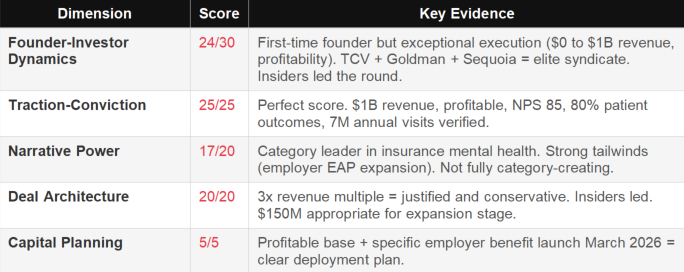
The Fundability Lesson: Grow Therapy’s score of 91 reflects the rarest deal structure in growth equity, a category leader that is profitable, growing, and just opened a second growth vector (employer benefits). They raised to expand into a channel that could double their TAM. That’s how you command premium multiples at scale: the capital fuels expansion, not survival. The existential questions are already answered.
Your takeaway: If you’re approaching profitability, don’t wait until you need capital to raise. Raise from a position of strength - profitable companies raise at better multiples, better terms, and with better investors than companies that raised before proving unit economics. Grow’s 3x revenue multiple in a year when growth-stage SaaS is struggling to clear 5x ARR says everything.
Nominal: What Happens When Founders Fund Comes to You
Eisen Fundability Score: 86/100
The Setup: Connected testing and operations platform for hardware engineering teams. Founded in 2022. Austin/LA. Series B-2 Acceleration Round at $1B valuation, led by Founders Fund. Raised $155M in 10 months (September 2025 Series B led by Sequoia + this round).
The Numbers:
• 7x revenue growth year-over-year [GlobeNewswire, March 5, 2026]
• 4 of the 5 largest U.S. defense contractors as customers [TechCrunch, March 5, 2026]
• Grew from 43 to 135 employees in under 10 months [GlobeNewswire, March 5, 2026]
• 60+ customers running mission-critical hardware programs [GlobeNewswire, March 5, 2026]
• Founders Fund investment sourced by Anduril engineers recommending the product independently [GlobeNewswire, March 5, 2026]
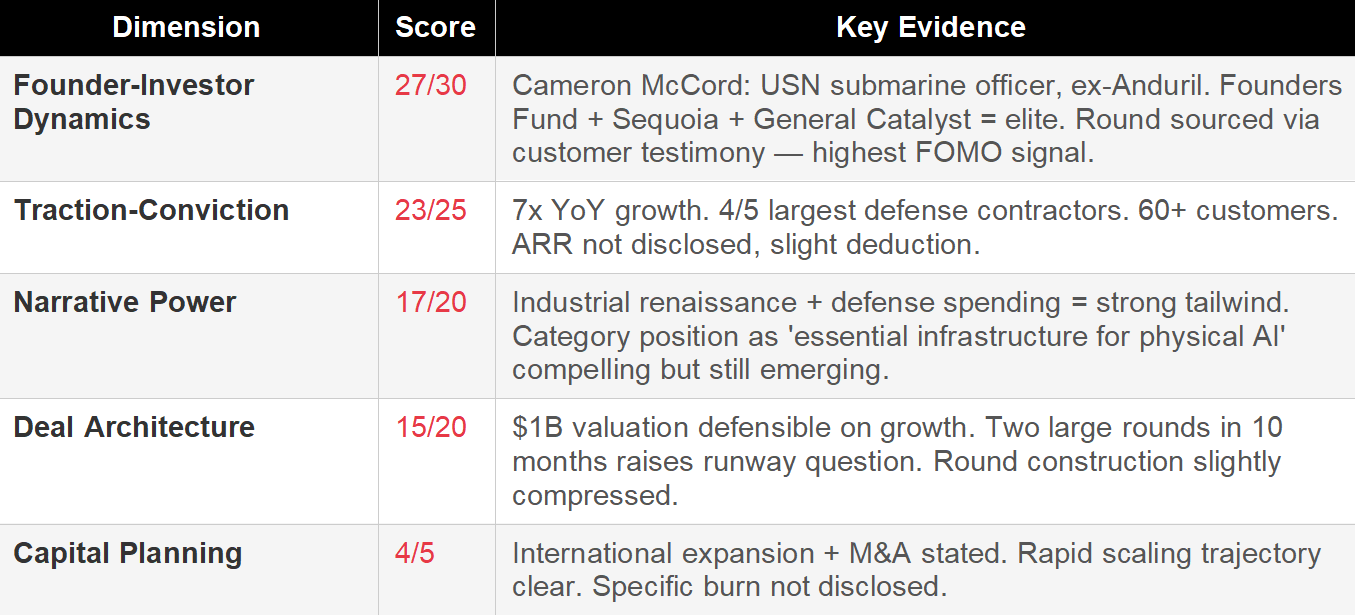
The Fundability Lesson: CEO Cameron McCord says he wasn’t looking for funding when Founders Fund reached out. That’s not a humble brag — that’s the signal. When investors come to you, you negotiate from a position of strength. Trae Stephens (Founders Fund partner and Anduril co-founder) said the decision was driven by unsolicited recommendations from Anduril’s entire engineering team. Multiple portfolio companies independently named Nominal as essential infrastructure. That’s the highest possible product-market fit signal: your customers are also your investors’ portfolio companies, and they’re recommending you without being asked.
Your takeaway: The most efficient fundraising of the week happened with no pitch deck. Build a product your customers talk about without being asked. Track the companies in your top investors’ portfolios and make sure their teams are using you. One Anduril engineer recommending Nominal to their board is worth more than 50 cold outreach emails to Founders Fund.
Science Corp.: How to Win the Regulatory Race with Capital
Eisen Fundability Score: 91/100
The Setup: A brain-computer interface company focused on retinal implants (PRIMA) and brain-computer interfaces. Alameda, CA. Founded in 2021. Led by Max Hodak, co-founder and former president of Neuralink. Series C, oversubscribed, $1.5B valuation.
The Numbers:
• $490M total raised since founding in 2021 [massdevice.com, March 5, 2026]
• 47+ patients in PRIMA retinal implant trials — some regained ability to read large print [TechCrunch, March 5, 2026]
• CE mark application filed; European approval expected mid-2026 [TechCrunch, March 5, 2026]
• FDA Breakthrough Device Designation already secured [massdevice.com, March 5, 2026]
• Round oversubscribed; IQT (In-Q-Tel, the U.S. Intelligence Community’s strategic investment arm) participated [Crunchbase, March 5, 2026]
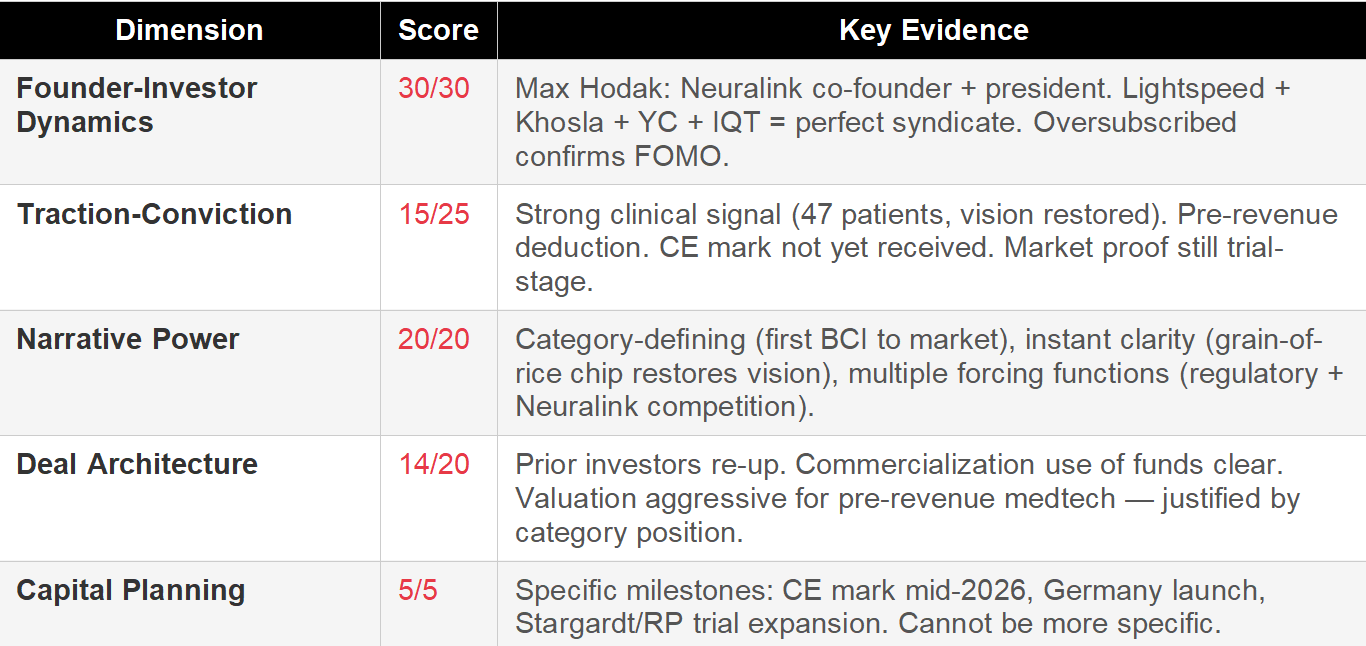
The Fundability Lesson: Science Corp. scored 84, not 91 like Grow Therapy, because it’s pre-revenue with a $1.5B valuation, which is rich for a medtech company that hasn’t cleared regulators. But the ceiling is extraordinarily high:
First-to-market BCI + Neuralink co-founder + oversubscribed round + government intelligence backing = irreplaceable narrative.
They’re fundraising on a specific timeline. And not on a promise, on its a regulatory pathway on a spreadsheet.
Your takeaway: If you’re pre-revenue in a regulated space, your capital planning section is your fundability. Get specific: which approval, which market, which date, which revenue model. Science Corp didn’t say ‘we’re working toward FDA approval.’ They said ‘CE mark application filed, approval expected Q2 2026, Germany launch follows.’ That specificity turns regulatory risk from a blocker to a timeline.
What To Do This Week
Audit Your Investor Dynamics Score
Old approach: Reach out to top-tier VCs and hope for a meeting.
New approach: Map who in your potential investor pool has portfolio companies that are your customers, then activate that connection first.
1. List your top 20 customers. Identify which are VC-backed (use Crunchbase).
2. Cross-reference their investors with your target investor list. Find the overlap.
3. Ask 3 customers to introduce you to their lead investors this week, not as a pitch, as a product conversation.
4. Target: At least one Founders-Fund-style ‘investor comes to you’ moment by your next round launch.
❌ Wrong: ‘I’m raising a Series A and would love to connect with your investment team.’
✅ Right: ‘Three of your portfolio companies are our customers. Their teams use us daily. Would love to share what we’re seeing across [portfolio company X], [Y], and [Z].’
Reframe Your Economics Story
Question to answer: If Grow Therapy’s $3B valuation is built on a 3x revenue multiple, what is your current multiple, and what would it need to be to command premium terms?
1. Calculate your current ARR and implied valuation at 3x, 5x, and 10x multiples.
2. Identify which multiple is reasonable for your category by finding 3 comparable deals from the last 6 months.
3. If you’re profitable (even at a small scale): add ‘Path to profitability’ or ‘Currently profitable’ as a hero metric on your deck cover slide. Not buried in the appendix.
Output: Updated deck slide with clear unit economics positioning.
Calculate Your Weekly Eisen Score
Use the same framework applied to this week’s deals. Score yourself honestly:
• Founder-Investor Dynamics (30 pts): Track record + investor quality + round competition signal
• Traction-Conviction (25 pts): Growth trajectory + business model validation + market proof
• Narrative Power (20 pts): Category position + story clarity + tailwinds
• Deal Architecture (20 pts): Valuation reasonableness + investor alignment + round construction
• Capital Planning (5 pts): Runway + milestone clarity
85+: Launch your round now. Momentum is on your side; delay costs you.
70–84: One more traction milestone before launching. Identify the lowest-hanging fruit that moves your Traction-Conviction score by 5+ points.
Below 70: Don’t launch a broad process. Run a quiet round with 3–5 strategic investors whose portfolios align with your customers. Build to 70+ before going wide.
Identify Your Strategic Investor Anchors
Ayar Labs’ round was co-led by the investors who are also its customers. Nominal was funded by a VC whose portfolio company was already paying them. This is the new fundraising architecture.
1. List every Fortune 500 / category leader company that you’ve had a conversation with, demo’d to, or that uses your product.
2. Research whether they have a corporate venture arm (CVC). 72% of Fortune 500 companies have active CVC programs.
3. Draft a one-paragraph ‘strategic rationale’ for why each would invest — not why you’re a great company, but what strategic value they get from having you in their portfolio and them on your cap table.
4. Warm one CVC outreach through a mutual this week.
Output: CVC target list + outreach rationales + first introduction requested.
Build Your Forcing Function Timeline
Science Corp. is pre-revenue at $1.5B because it has a specific, credible market-entry date. If you don’t have a forcing function timeline, a series of external milestones that create urgency, you’re raising without narrative momentum.
1. Map every external milestone in your category: regulatory decisions, contract awards, competitive product launches, and industry conference dates.
2. Build a 12-month timeline that shows 3–5 forcing functions that will change your market position.
3. Anchor your fundraising close date to the most compelling forcing function — ‘we want to close before [X event] so we can [specific action].’
Output: Forcing function timeline slide for your deck + round close target date.
Looking Forward: What to Watch the Next 1–3 Weeks
Scenario 1: AI Infrastructure Bottleneck Rounds Accelerate
Ayar Labs’ $500M was driven by a single technical constraint: copper interconnects cannot efficiently support AI clusters beyond ~1,000 GPUs. NVIDIA confirmed this by investing in both Ayar and its photonics suppliers (Coherent and Lumentum), which received $4B from NVIDIA the day before Ayar announced. Watch for: optical interconnect competitors (Lightmatter, Celestial AI acquired by Marvell for $3.25B) and power delivery startups for data centers to raise in the next 30 days.
Your response: If you’re in any layer of the AI infrastructure stack, get your updated deck ready. This window opens and closes as the category fills up.
Scenario 2: Commercial Space Consolidation Wave
Sierra Space ($8B) and Vast ($500M, Series A) both raised this week. Post-ISS transition is forcing the government to contract commercial space infrastructure — and there are only 5–6 companies with the manufacturing scale to fulfill those contracts. Watch for: Blue Origin’s commercial station program to announce anchor tenants, Axiom Space funding activity, and SDA Tranche 3 contract awards in the next 60 days.
Your positioning: If you build software, services, or enabling technology for space, NOW is the time to convert every contract pilot into a full customer with disclosed metrics. These large primes will need their supply chains funded — and VCs will follow the primes.
Scenario 3: Mental Health + Primary Care Convergence Becomes Fundable
Grow Therapy is betting $150M that employers will shift mental health benefits from EAPs (Employee Assistance Programs) to integrated insurance coverage. They launched the employer product in March 2026. If early employer adoption data is strong and early indicators from partnerships with Kaiser Permanente and Circle Medical suggest it will be expected to see a wave of Series B/C raises in adjacent spaces: digital primary care, behavioral health integration, and chronic disease management.
Your watch list: Spring Health, Headspace, Lyra Health. If any of these announce new rounds in the next 30 days, the employer mental health channel is confirmed as a fundable narrative. Position your company in that wave.
Wild Cards
Anthropic $30B (Feb 12) and OpenAI $110B (Feb 27): Both closed in the two weeks immediately before this analysis period, not during it, but their gravitational pull defined this week’s fundraising conversations. Anthropic’s $30B Series G at $380B is now the third-largest private raise in history (behind OpenAI’s $110B and OpenAI’s own $41B from March 2025). Two consecutive AI mega-rounds, combined with $140B in capital, will pull investor attention toward the AI application layer throughout March/April. Founders building on these models should expect increased inbound, increased competition for term sheets, and compressed decision timelines.
Nominal 10-Month Re-Raise: The most revealing data point of the week. A company raised $75M in September and $80M in March, with the same investors staying in, and Founders Fund joining. This pace of capital deployment into a single company signals the defense-tech industrials category is in acceleration mode. If Nominal files for another round before September 2026, the category is in full bubble territory.
The Bottom Line: Your Next Move
This week wasn’t about $2.61B changing hands. It was about the market revealing the five criteria that now separate fundable companies from everyone else.
1. Physical irreplaceability commands infrastructure premiums. Software that can be substituted in 90 days doesn’t. Build toward dependency, not preference.
2. Profitability is now a fundraising asset. Grow Therapy’s profitable unit economics got it a lower revenue multiple and better terms than any growth-at-all-costs competitor could achieve right now.
3. Strategic co-investors replace tier-1 solo lead signals. NVIDIA in your round is worth more narrative weight than most standalone VCs. Map your customer base to the corporate venture universe.
4. Specific milestones beat vision decks. Science Corp’s CE mark date and Germany launch plan closed a $230M oversubscribed round for a pre-revenue company. Replace ‘our goal is to’ with ‘by [specific date], we will [specific milestone] because [regulatory/infrastructure event is confirmed].’
5. The round that comes to you closes fastest. Nominal didn’t pitch Founders Fund. Build products that make engineers evangelize you to their investors.
Research Methodology
Data collection period:
March 2–8, 2026 (primary announcements confirmed within window)
Verification standard: minimum 2 independent sources per featured deal
Deal window: Feb 28–March 6 per Crunchbase tracking (covers March 2–8 report scope)
All dollar amounts reflect announced figures at close
Eisen Fundability Scores are proprietary analytical estimates, not endorsements or investment advice
Research completion timestamp: March 8, 2026
Total deals analyzed: 9 (verified).