

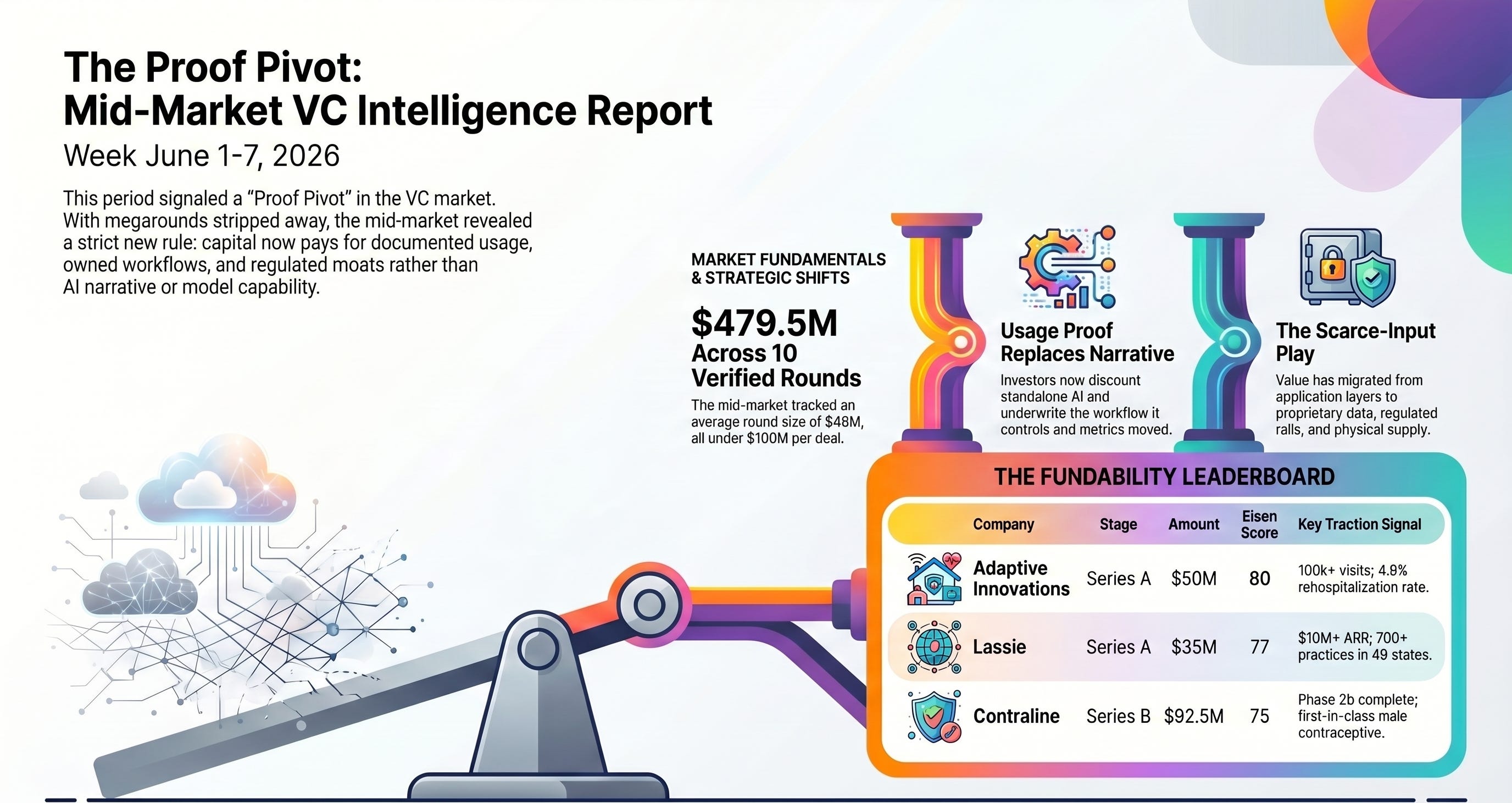
Playbook, Perspective, and Pattern for founders raising now. This report deliberately strips out the megarounds and the IPO traffic so you can read the part of the market that actually prices your round.
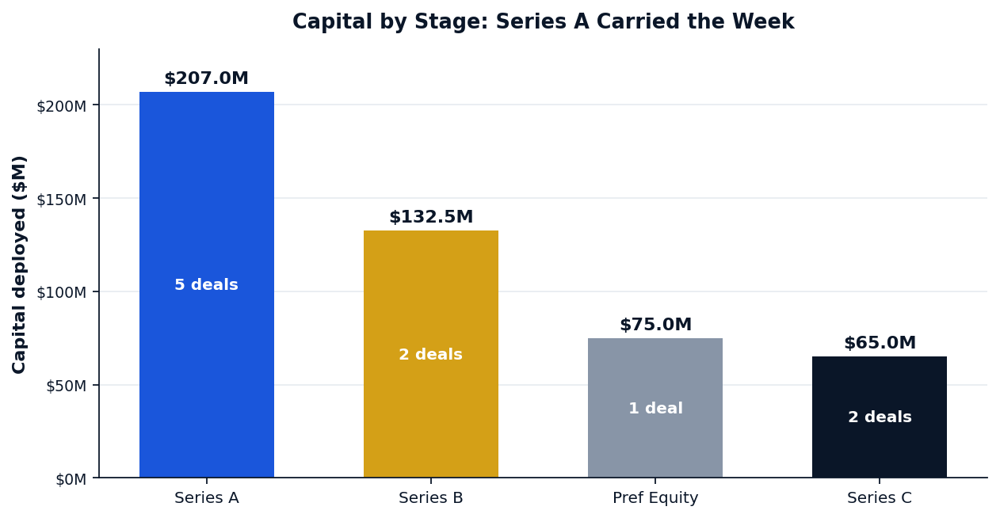
The week of June 1-7, 2026, had no megaround drama worth chasing, and that is exactly why it matters. Set aside the half-billion-dollar space and defense headlines and the public-market noise. What is left is the market that prices your Series A and Series B: ten verified rounds, every one under $100M, that together moved about $480M. Strip out the spectacle, and one rule survives in every deal that cleared. Capital paid for proof of usage, not proof of concept.
A home-health company that has run more than 100,000 visits raised at the top of this week. A practice-automation company that already books more than $10M in recurring revenue raised capital the same week. A robotics data company, quoting a $100M run rate on signed contracts, raised the same week. None of them pitched an AI product. Each one pitched a workflow they own and the number they have already moved.
Here is the consequence. If your deck still leads with model capability, total addressable market, or the phrase "AI-native" without an attached usage figure, you are pitching at a discount this week. The founders who succeeded led with deployed proof. Read every shift below through that lens. Each one tells you what to put on slide one before your next investor meeting.
The Week in One Sentence
Primary insight: With the megarounds and IPO filings removed from view, the mid-market repriced on a single axis. Capital is concentrated in AI embedded within a regulated workflow, a physical bottleneck, or a proprietary data asset, and is paid for documented usage rather than narrative.
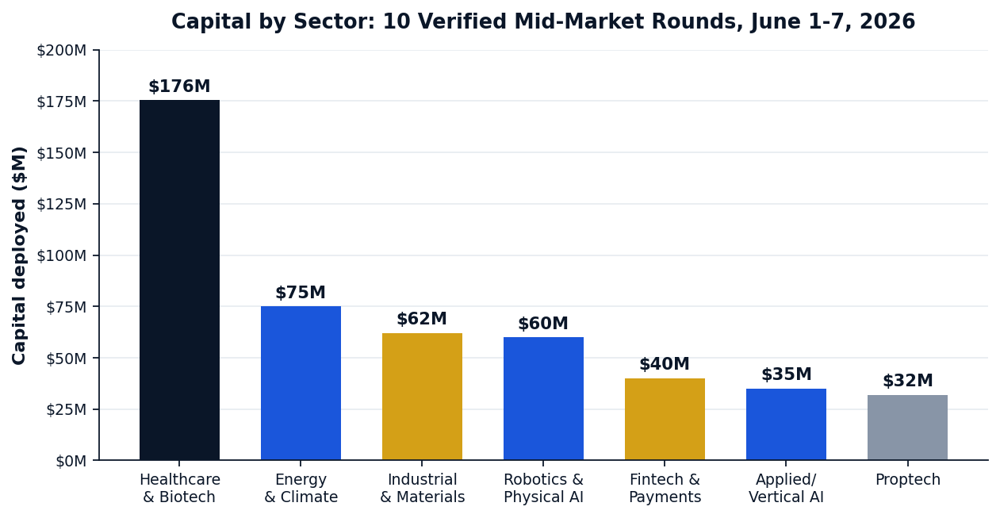
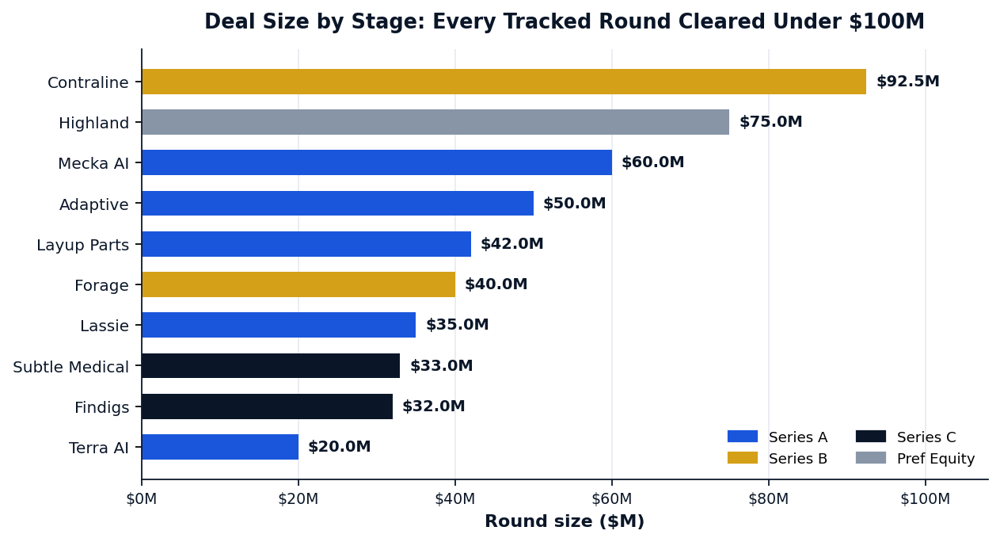
• Total tracked mid-market capital (10 verified rounds): approximately $479.5M, all under $100M per deal.
• Average round size: $48.0M across the ten.
• Median round size: $41M, the midpoint between Forage and Layup Parts.
• Disclosed valuations: only two of ten. Forage at $225M and Lassie reported near $250M. Eight rounds were not disclosed, which is itself a signal of how fast these deals closed.
• Largest tracked round: Contraline, $92.5M Series B, a clinical-stage male contraceptive that finished Phase 2b.
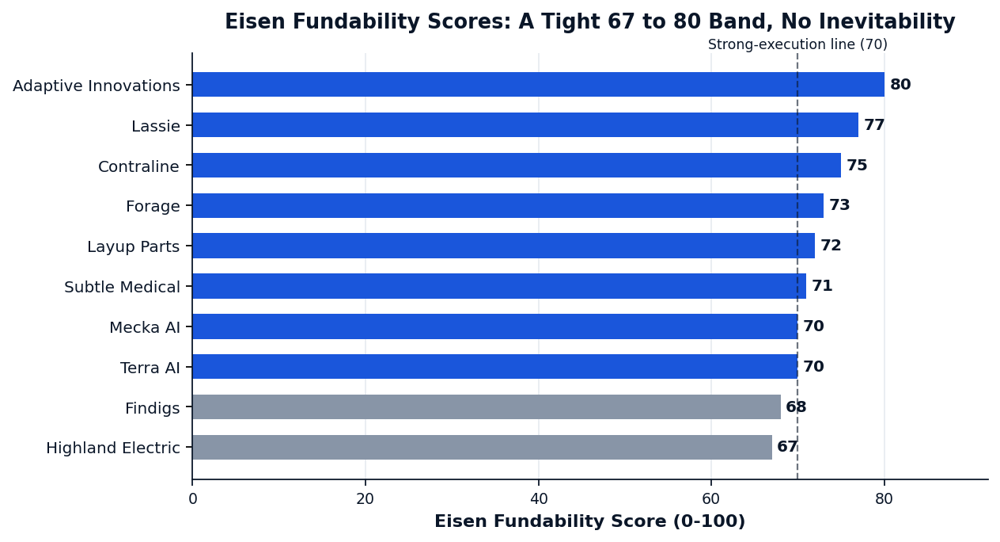
• Highest Eisen Fundability Score: Adaptive Innovations at 80, on the strongest deployed-proof profile of the week.
• Defining structural feature: a tight Eisen Score band of 67 to 80. No deal reached inevitability, and the cluster shows the market is unusually consistent about what it now pays for.
Data Integrity Notes
All ten featured rounds were verified against a minimum of two independent primary sources, including company press releases, BusinessWire, PRNewswire, and at least one tier-one outlet per deal, such as TechCrunch, Fortune, Reuters, the Wall Street Journal, Axios, or Endpoints News. Resolutions and exclusions applied during this week's fact-check:
• Editorial scope this week excludes giant rounds and public-market events by request. Removed from the tracked set: Impulse Space ($500M), Mach Industries ($300M), DriveNets ($410M), Tripo AI (near $200M), Maxwell Power ($750M commitment), AlphaSense ($350M), Coralogix ($200M), and Oxford Quantum Circuits (about $350M). IPO and public-raise traffic, such as the Anthropic confidential filing and the Alphabet stock raise, is also out of scope.
• Geography. The tracked ten are U.S.-headquartered. Non-U.S. rounds in the window (Unastella in South Korea, Paypercut in Bulgaria, Uncover in Brazil, Apoha across the UK and U.S.) are noted but excluded from the U.S. scorecard for comparability.
• Recirculation control. Focused Energy ($240M) was reported during the window, but according to its own coverage, it was announced the prior week, so it is excluded. Waypoint Bio ($20M Series A) surfaced in two daily roundups and is counted once.
• Valuation sourcing. Forage at $225M is sourced to the Wall Street Journal. Lassie, near $250M, is a single reported figure and is marked as reported, not confirmed. Mecka AI declined to disclose its valuation, so its score reflects a penalty for that opacity.
Deal Scorecard
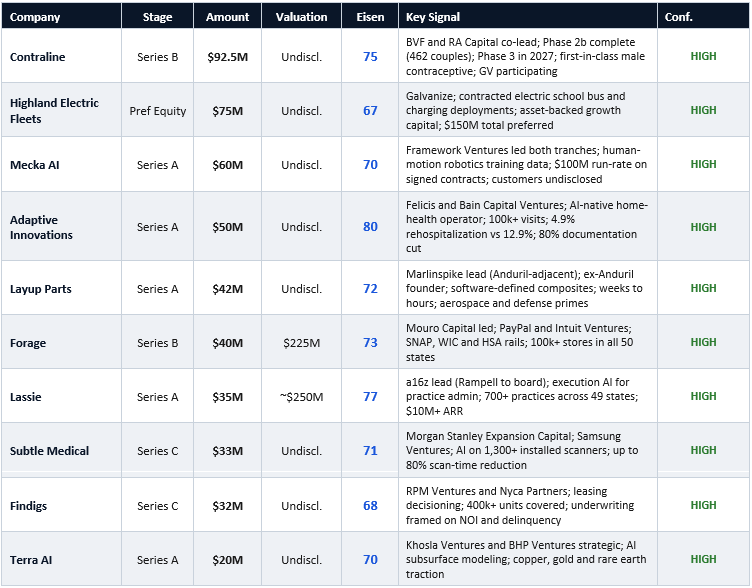
Eisen Fundability Scores are calculated across five weighted dimensions: Founder-Investor Dynamics (30%), Traction-to-Conviction Conversion (25%), Narrative Power (20%), Deal Architecture (20%), and Capital Planning (5%). Scores of 85 and above signal an inevitable outcome. Scores of 70 to 84 signal strong execution. Scores below 70 signal early-stage or the need for repositioning. Missing metrics are scored conservatively, and opacity is penalized rather than assumed strong.
What the Scorecard Says at a Glance
The band is the message. Every deal was cleared between 67 and 80. That 13-point spread is the tightest in this report series; last week, the spread was 26 points. Remove the megarounds and the procurement-anchored outliers, and the market becomes remarkably consistent about what it rewards: deployed usage, an owned workflow, and a barrier a competitor cannot clone in a quarter. No deal reached the 85 inevitability line, because inevitability now requires the proof these companies have, plus the scale they are still building toward.
Adaptive Innovations (80) is the cleanest case of the week. It scored highest not on a famous lead investor or a disclosed valuation, but on deployed proof a diligence team can verify: more than 100,000 home visits, a 4.9% rehospitalization rate against a 12.9% industry average, an 80% cut in clinician documentation time, and profitable delivery to the 40% of patients legacy providers turn away. That is usage density, outcome data, and unit economics in one package.
Lassie (77) and Contraline (75) round out the top three on the same logic in different languages. Lassie shows $10M-plus in recurring revenue across 700-plus practices, so the agent is doing the work, not assisting it. Contraline shows a completed Phase 2b across 462 couples, so the clinical risk that usually stalls a male contraceptive is already retired. Different categories, identical underwriting test: what has already been proven at scale.
The lower band is instructive, too. Highland Electric Fleets (67) and Findigs (68) are sound businesses, but Highland is asset-backed growth capital rather than a venture-priced equity round, and Findigs sells into a strong but crowded application layer. The scoreboard separates a fundable company from a fundable round, and the gap between the two is usually deployed proof plus a defensible moat.
What Changed This Week: 5 Market Shifts
Each shift is verified against multiple primary sources and ranked by structural impact on founder fundraising, not by deal size. Every shift ends with what it means for your raise.
Shift 1: AI Stopped Being the Product and Became the Operating Layer
Pattern: Five of this week’s strongest rounds embedded AI inside an operation rather than selling it as a product. Adaptive Innovations runs AI inside home-health operations and has delivered more than 100,000 visits. Lassie has AI execute insurance and billing work inside more than 700 practices and books over $10M in recurring revenue. Subtle Medical runs AI on more than 1,300 installed scanners. Findigs runs AI-driven leasing decisions across hundreds of thousands of units. Terra AI runs AI against subsurface exploration data. None of them led with a model.
Perspective: Investors now discount a standalone AI capability and underwrite the workflow it sits inside. The fundable unit is no longer the model. It is the operation you own plus the metric you have already moved. Foundation models are getting cheaper and more interchangeable every quarter, so the durable value migrates to whoever owns the regulated process, the system of record, and the outcome the buyer pays for.
Founder Blindspot: Founders still believe that adding AI makes them fundable. It does not. A diligence partner this week was not asking how good the model is. They were asking how many units are deployed, what the outcome delta is, and whether usage retains. If your story is AI plus a category name, you have described a feature, not a company.
Playbook: Rewrite your one-line description. Move it from AI for X to "we own the workflow that does X," and move the key metric from A to B. For Adaptive, that line is documentation time down 80% and rehospitalization at 4.9%. For Lassie, it is 250,000 labor hours removed across 700 practices. Put your equivalent on slide one and delete the model-architecture slide from the front of the deck.
Contrast: A year ago, the label AI-native was enough to open a Series A conversation. This week, it required deployed proof attached to the label. The phrase did not get a premium. The usage behind it did.
What this means for your raise: If your deck leads with capability rather than deployed usage, you are pitching at a discount. Lead with the operation and the metric, or expect a slower process.
Shift 2: Proof of Usage Replaced Proof of Concept as the Series A and B Bar
Pattern: Every featured round led with deployed, measured usage rather than a demo. Adaptive: 100,000-plus visits and a hard outcome number. Lassie: 700+ practices and $ 10M+ ARR. Subtle Medical: 1,300-plus scanners live. Forage: more than 100,000 stores across all 50 states. Contraline: a completed Phase 2b enrolling 462 couples. The proof is operational, not aspirational.
Perspective: In a week without megaround gravity, the discriminator between a yes and a maybe is documented usage at scale. The market read this quarter is consistent: early-stage capital remains abundant, but seed and Series A deal counts have fallen even as dollars have risen, meaning fewer companies are clearing for larger checks. The companies clearing are those with usage density that a partner can verify in an afternoon.
Founder Blindspot: Founders over-index on total addressable market and model sophistication. Investors this week were scanning for the opposite: units deployed, volume per unit, outcome delta, and retention. A large market with no proof of usage reads like a science project. A smaller claim with dense, retained usage reads as a company.
Playbook: Build a one-page proof stack before your next meeting. Four lines only: units deployed, usage volume per period, the measurable outcome you changed, and your retention or expansion figure. If you cannot fill all four, your next two weeks should focus on generating the missing line rather than refining the pitch. Wrong approach: a roadmap slide promising what the product will do. Right approach: a usage table showing what it already does.
Contrast: In 2023 and 2024, a Series A often cleared on the team, plus narrative, plus a credible plan. In June 2026, the same stage cleared on deployed usage with an outcome attached. The bar moved from intent to evidence.
What this means for your raise: A story-only Series A deck gets delayed, not declined, which is worse, because the delay burns runway. Put the deployed proof on page one, or expect to be asked for it before the second meeting.
Shift 3: The Scarce-Input Play Beat the Application Play
Pattern: Capital paid for the input that every competitor must buy, not the app on top. Mecka AI sells robotics training data captured from human motion and quotes a $100M run rate on signed contracts. Layup Parts compresses composite-part production from weeks to hours and supplies aerospace and defense primes. Forage owns regulated payment rails for SNAP, WIC, and HSA across 100,000-plus stores. Each one sits underneath a wave of application companies that have to route through it.
Perspective: When the application layer commoditizes, value accrues to the scarce input. Framework Ventures, a firm best known for crypto, led the Mecka round and called it the fastest-growing revenue company it has backed because privileged training data is the new scarce asset in robotics, much like liquidity was in crypto. Founders Fund and Lux backed Layup because composite supply is a physical chokepoint that aerospace and defense cannot meet demand for quickly enough. The thesis is identical across categories: own the bottleneck, not the demo.
Founder Blindspot: Founders build the visible application because it is the part that customers see. Investors increasingly pay for the unavoidable substrate underneath it, the data, the supply, or the rail that the visible products depend on. The selection error is building the easy-to-copy thing instead of the hard-to-source one.
Playbook: Name the input in your category that every competitor must buy from someone. Training data, regulated rails, scarce materials, a measurement layer, a system of record. Then decide this quarter whether you own it, can own it, or are merely a buyer. If you are a buyer, your moat lives upstream, and your strategy needs to move there before your next round.
Contrast: In 2024, the fundable robotics and AI story was the end application. In 2026, the fundable story is the supplier that the application cannot function without. The picks-and-shovels layer repriced above the storefront.
What this means for your raise: If a competitor with a better model could replicate your product in 90 days, you are pitching the storefront. Find the scarce input behind it and reframe the round around owning that.
Shift 4: Specialist and Strategic Capital Outbid Generalists on Hard Categories
Pattern: Where the science, regulation, or hardware was hard to underwrite, a domain specialist or a strategist led or co-led. BVF Partners and RA Capital, two of the sharpest life-science investors, co-led Contraline. Optum Ventures backed Adaptive in health. BHP Ventures put strategic capital into Terra AI in the minerals sector. Marlinspike, already in Anduril, led Layup in defense supply, with Cerberus, founded by a former In-Q-Tel chief, alongside. PayPal Ventures and Intuit Ventures backed Forage in payments. Samsung Ventures backed Subtle in imaging.
Perspective: In hard categories, the right capital arrives with distribution and validation, not just a wire. A strategic on the cap table is a channel, a regulatory reference, or a customer signal. That is why a clinically complex biotech and a defense-grade manufacturer both closed quickly: the lead investor could underwrite the specific risk, and the co-investors shortened the path to the next customer or the next regulatory step.
Founder Blindspot: Founders in hard categories still default to a generalist venture process. The cost is 60 days spent educating investors who cannot price the core risk, ending in a soft pass. The selection error is the fundraising mistake. The wrong pool is more expensive than the wrong deck.
Playbook: Segment your target list this week by who brings channel or validation in your exact category, not by brand or fund size. For each name, write the specific deal they did in your space and the warm path to them. Lead outreach with the specialists and strategics who can underwrite your hardest risk. The right $20M from a domain strategic outperforms a larger check from a generalist who needs to be taught the category.
Contrast: In the 2021 cycle, generalist enthusiasm funded almost everything. In 2026, a hard-category round needs a specialist or strategic anchor before generalists will follow.
What this means for your raise: If your category is clinical, regulated, or hardware-heavy, the first three names on your list should be specialists or strategics. Build that pool before you open the round, not after the generalists stall.
Shift 5: Regulated and Physical Moats Repriced Above Pure Software
Pattern: The strongest scores this week are tied to regulatory or physical barriers that a competitor cannot replicate within a quarter. Contraline carries a clinical and FDA path. Forage carries SNAP and WIC compliance. Adaptive carries payor and Medicare integration. Highland carries a contracted, asset-backed fleet deployment. Layup carries an aerospace-grade composite qualification. The moat is the slow, hard, regulated work, not the interface.
Perspective: Model commoditization pushed defensibility away from software margins and toward regulation, hardware, and deployment. A feature can be copied in weeks. A completed Phase 2b, a payor contract, a qualified aerospace supply line, or a system live on 1,300 scanners cannot. Investors are now treating that hard, unglamorous work as the moat rather than as a cost to be minimized.
Founder Blindspot: Founders treat compliance and hardware as overhead to keep light. Investors treat them as a durable barrier. The companies that underinvested in the regulated build are the ones that look most cloneable in diligence.
Playbook: Run the 90-day clone test on your own company. Ask what a well-funded competitor could replicate in a single quarter. If the answer is most of it, your moat is the regulatory or physical work you have not done yet. Name the one barrier you can build in the next two quarters that would fail that test, and make it the use-of-funds headline in your raise.
Contrast: The 2020 and 2021 cycle prized speed and software gross margins. The June 2026 market prizes the slow, hard, regulated build that competitors cannot shortcut.
What this means for your raise: If your defensibility is speed or design, name the regulatory or physical moat you are building next. That barrier, not your feature set, is what now prices the round.
The Deals That Matter: Top 5
Five deep dives across home health, advanced manufacturing, biotech, vertical AI, and robotics data. Each is selected for a distinct playbook value, not deal size. All metrics are verified against two or more primary sources.
Adaptive Innovations
AI-Native Home Healthcare Operator | Series A | $50M | Valuation Undisclosed
Eisen Fundability Score: 80 / 100
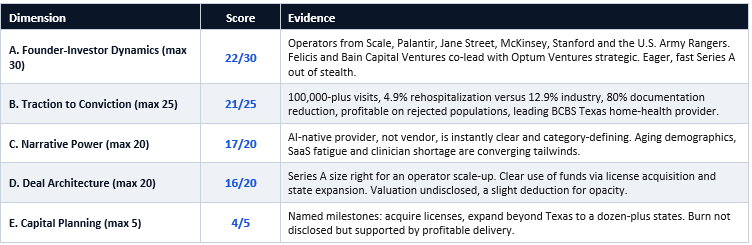
Why this scored: The highest score of the week reflects the strongest deployed-proof profile in the report. Adaptive is not a software vendor selling into home health. It is the provider, rebuilt around an AI operating layer. The proof is verifiable in diligence: 100,000-plus visits, every major Texas hospital system referring, a 4.9% rehospitalization rate against a 12.9% industry average, an 80% reduction in clinician documentation time, and profitable delivery to the 40% of patients legacy agencies reject.
The Setup: Co-led by Felicis and Bain Capital Ventures, with Optum Ventures participating, Adaptive emerged from stealth in 2026 after launching in 2025. Co-CEOs Alex Wendland and Logan Stinson, CTO Ryan Tolsma, and COO Hunter Stinson built an automated layer that handles intake, scheduling, charting, and compliance billing so clinicians spend time on care, not coordination. The team pulls engineers from Scale, Palantir, and Jane Street alongside operators from McKinsey, Harvard, Stanford, and the U.S. Army Rangers. The thesis is blunt: you cannot fix a broken system from the outside by selling it another dashboard, so Adaptive owns both the workflow and the service line.
The Numbers: $50M Series A plus a previously undisclosed $10M seed, for a total of $60M. Led by Felicis and Bain Capital Ventures. 200 clinicians, roughly 400 total employees, with 300 in Texas. 100,000-plus visits delivered. 500-plus referring organizations. Rehospitalization at 4.9% versus a 12.9% industry average. Documentation time down 80%. Leading provider for Blue Cross Blue Shield Texas home-health patients. Use of funds: acquire small-cap home-health businesses for their licenses and expand to more than a dozen states.
Fundability Lessons: Adaptive is the template for the operator model that beats the vendor model. Three moves built the 80-point case. First, own the workflow and the revenue, so the AI improvement shows up as your own unit economics rather than a customer’s. Second, lead with hard outcome data, the 4.9% rehospitalization number, because clinical and payor buyers underwrite outcomes, not features. Third, prove you can profitably serve the population that everyone else rejects, thereby converting a margin story into a defensibility story.
Your Takeaway: If your category has an operator path, model whether owning the operation produces better unit economics and a stronger moat than selling software into it. The fundable proof is the outcome metric you can show on patients, units, or transactions you already serve, not the capability you could deliver.
The Founder Mistake to Avoid: Founders copy the surface and claim to be the AI-native operator in their vertical, then keep selling software. The mistake is claiming the operator model without taking on the operational risk. Adaptive scored 80 because it actually delivers care, manages payor relationships, and owns outcome data. The label without the operation is the wrapper, not the substrate.
Layup Parts
Software-Defined Composite Manufacturing | Series A | $42M | Valuation Undisclosed
Eisen Fundability Score: 72 / 100
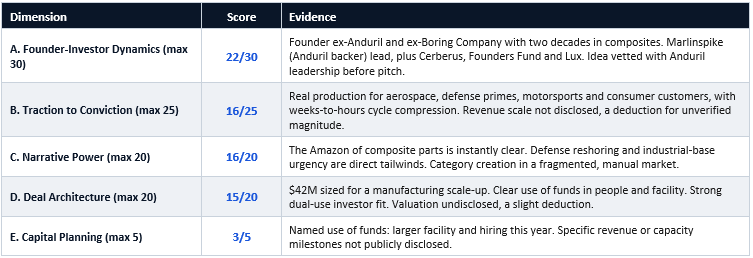
Why this scored: The layup is the clearest physical bottleneck play of the week. An ex-Anduril and ex-Boring Company founder is compressing custom composite-part production from weeks to hours, and the lead investor is Marlinspike, already an Anduril backer, with Founders Fund and Lux returning. Aerospace and defense, including primes, are the biggest business lines. The score reflects a strong founder and syndicate against traction that is real but not yet disclosed at a revenue scale.
The Setup: Founder Zack Eakin spent two decades in motorsports composites and worked at Anduril and The Boring Company before launching Layup in 2024. Co-founders Hanno Kappen and Elisa Suarez also came from The Boring Company. Eakin reportedly tested the idea with Palmer Luckey and took storytelling advice from Anduril leadership before pitching. The product, built on a proprietary software layer the company calls MatrixOS with a customer-facing FiberPortal, lets buyers upload a design and receive parts on a timeline measured in hours rather than weeks.
The Numbers: $42M Series A led by Marlinspike, with Cerberus Ventures, Pinegrove Venture Partners, Founders Fund, and Lux Capital participating, following a $9M seed in 2024. Roughly 60 employees. Production cycle cut from weeks to hours in some cases. Customers span motorsports, automotive design, consumer products, aerospace, and defense, with aerospace and defense the largest lines, including both startups and traditional primes. Use of funds: hiring and a larger facility this year.
Fundability Lessons: Layup shows the dual-use manufacturing template. First, pick a physical chokepoint that the defense industrial base cannot source fast enough, then attack it with software rather than more labor. Second, stack a syndicate that underwrites dual-use supply, Marlinspike and Cerberus, so the round is priced by investors who know procurement. Third, make the speed claim concrete and verifiable, from weeks to hours, so the value proposition needs no translation.
Your Takeaway: If you compress a physical or industrial bottleneck, lead with the cycle-time delta and the customer mix that proves it matters. Speed against an unglamorous, hard-to-source process is a stronger fundability claim in 2026 than a software margin claim, because buyers are urgent and substitutes are slow.
The Founder Mistake to Avoid: Founders pitch the software platform and bury the physical proof. The mistake is selling the dashboard when investors are buying the supply. Layup scored on weeks-to-hours output and primes as customers, not on the elegance of MatrixOS. If your industrial story leads with the interface, move the throughput and the customer roster to the front.
Contraline
Clinical-Stage Male Contraceptive | Series B | $92.5M | Valuation Undisclosed
Eisen Fundability Score: 75 / 100
Why this scored: Contraline carries the strongest retired-risk profile of the week. The clinical risk that usually stalls a male contraceptive raise is already behind it: NES/T completed a global Phase 2b enrolling 462 couples with encouraging efficacy, reversibility, and tolerability. Two of the sharpest life-science investors, BVF Partners and RA Capital, co-led, with GV participating. The score reflects elite-specialist conviction against a program that is proven through Phase 2b but remains pre-revenue.
The Setup: Charlottesville-based Contraline, led by co-founder and CEO Kevin Eisenfrats, is developing NES/T Gel, a once-daily topical hormonal contraceptive that combines the progestin segesterone acetate with testosterone to suppress sperm production while maintaining physiological testosterone. Male contraception has been a large theoretical market with no approved pharmacologic option for decades. Contraline’s case is that the clinical data, the addressable population, and the cultural moment have finally aligned to justify a late-stage push.
The Numbers: $92.5M Series B co-led by BVF Partners and RA Capital Management, with GV, Lumira Ventures, Invus, and others. NES/T completed a global Phase 2b enrolling 462 couples. Phase 3 is anticipated in 2027. Survey data cited by the company suggest more than 40M men in the U.S. would consider a novel male contraceptive. A BVF partner joins the board. Use of funds: advance NES/T through Phase 3, plus regulatory and manufacturing readiness.
Fundability Lessons: Contraline is the clinical-sequencing template. First, retire the highest-uncertainty risk before raising the big round. The completed Phase 2b is the asset that enables the company to price a $92.5M Series B. Second, choose specialist leads who can underwrite the clinical risk directly, such as BVF and RA Capital, rather than generalists who would discount it. Third, frame a decades-old category as a reset rather than an incremental entry, so the narrative matches the scale of the opportunity.
Your Takeaway: If you are clinical or deep-tech, sequence your fundraise to your data, not your calendar. Each round should close against a defined readout that retires the next stage of risk. Your trial timeline is your raise timeline, and the most fundable moment is immediately after a positive read.
The Founder Mistake to Avoid: Founders entering an empty category copy the positioning without the clinical depth. The mistake is pitching the category reset before retiring the clinical risk. Contraline scored on a completed Phase 2b across 462 couples. A program two years behind on data is pitching its thesis without the evidence to back it up.

Lassie
Execution AI for Small-Business Administration | Series A | $35M | Reported near $250M
Eisen Fundability Score: 77 / 100
Why this scored: Lassie is the cleanest execution of the AI case of the week. The agent performs the work rather than recommending it: it logs in to insurance portals, pulls reimbursements, reconciles them, updates the system of record, and verifies funds. The proof is recurring revenue, not a demo, with more than $10M ARR across 700-plus practices, and Andreessen Horowitz led with a board seat. The score reflects strong revenue proof and an elite syndicate against a still-early footprint and an aggressive reported multiple.
The Setup: Founded by Steijn Pelle, an early product manager at Robinhood and Coinbase, and Frederic Renken, the first product hire at Superhuman, Lassie began in dental and primary-care practices. The founders spent months processing claims by hand inside a practice before writing code, which is why the agent operates inside the real workflow rather than on top of it. The vision extends beyond healthcare to small-business operations broadly, but the wedge is the regulated, high-value administrative work that practices cannot avoid.
The Numbers: $35M Series A led by Andreessen Horowitz, with a16z general partner Alex Rampell joining the board, plus angels including the founders of Plaid, Wise, Superhuman, and Reforge. Total funding $47M. More than 700 practices across 49 states. Over 250,000 hours of labor are delivered annually. More than $10M in annualized revenue. Growth is largely referral-driven. Reported valuation near $250M, marked as reported rather than confirmed.
Fundability Lessons: Lassie is the do-the-work template. First, sell completed outcomes, not assistance, so the value is labor removed rather than time saved. Second, ground the pitch in recurring revenue, the $10M ARR figure, because execution AI is judged on dollars booked, not usage logs. Third, earn referral-driven growth by working inside the customer’s real process, which is the clearest signal of product-market fit a Series A investor can see.
Your Takeaway: If you build vertical or agentic AI, frame your value as a before-and-after in labor hours, payment timing, or completed transactions, and attach a recurring-revenue number. The market this week paid a premium for agents who perform the work and show the receipts in ARR.
The Founder Mistake to Avoid: Founders pitch an agent who assists as autonomous. The mistake is selling a copilot that creates review work while claiming to remove it. Lassie scored because it executes end-to-end and books revenue for it. An agent that still needs a human to check every output is a feature, and it will not be clear at this multiple.

Mecka AI
Robotics Training-Data Infrastructure | Series A and Follow-On | $60M | Valuation Undisclosed
Eisen Fundability Score: 70 / 100
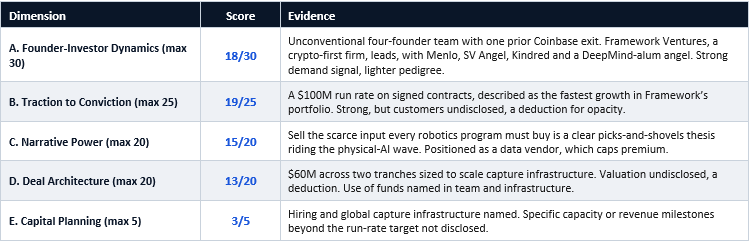
Why this scored: Mecka is the scarce-input play of the week. It sells the human-motion training data that physical-AI models need, the thing every robotics program must buy from someone. The headline proof is a $100M run rate on already-signed contracts, which Framework Ventures called the fastest growth in its portfolio. The score reflects exceptional demand against an unconventional team, an undisclosed valuation, and undisclosed customers, all of which warrant conservative treatment.
The Setup: New York-based Mecka, led by co-founder and CEO Josh Gao, captures hand gestures, gaits, and full-body motion using custom body sensors and iPhones, then sells structured datasets to robotics labs and programs. The four co-founders are not from the usual deep-learning pipeline. Gao and a co-founder previously sold a restaurant-payments startup, another sold a company to Coinbase, and a fourth made his money flipping sneakers. The bet is that privileged training data, not the robot or the model, is the scarce layer in embodied AI.
The Numbers: $60M total across two previously unannounced tranches, a $25M Series A closed in November 2025, and a $35M follow-on. Led by Framework Ventures, with Menlo Ventures, SV Angel, Kindred Ventures, and angel Ted Xiao, a former Google DeepMind researcher. About 40 employees. A projected $100M annual run rate based on signed contracts, with customers undisclosed. Valuation not disclosed. Use of funds: expand data-engineering and research teams and scale global data capture.
Fundability Lessons: Mecka is the sell-the-shovel template. First, identify the input that every competitor in a hot category must buy: privileged, non-scrapable motion data. Second, convert that into signed contracts fast, so the pitch is a run rate, not a roadmap. Third, accept that an unconventional team can clear a Series A when the revenue proof is undeniable, because investors underwrite the contracts before the resumes.
Your Takeaway: In any category racing toward an application-layer gold rush, ask what the miners must buy. If you can own that input and book contracts for it, your fundability does not depend on winning the end market. It depends on becoming unavoidable to everyone competing in it.
The Founder Mistake to Avoid: Founders chase the visible robot or the flashy model, only to end up in a crowded, capital-intensive race. The mistake is competing in the gold rush instead of supplying it. Mecka scored a $100M run rate by selling the data others need. If your category has a scarce input, owning it beats joining the crowd building on top of it.
Fundraising Playbook: 5 Tactical Plans From This Week
Five plans, each producing a concrete output you can use immediately. No vague tasks. Each is built directly from this week’s verified signals.
1. The Workflow-Ownership One-Liner (Positioning and Narrative)
Why this matters: Adaptive, Lassie, Subtle, and Findigs all cleared by embedding AI inside an owned workflow and leading with a moved metric. Standalone AI positioning was discounted this week.
Deliverable: A single sentence that replaces your current pitch headline. Structure: we own the workflow that does X, and we moved the key metric from A to B. It must name the operation and a verified number, not a capability.
Time estimate: 2 to 4 hours, finalized before your next investor meeting.
Expected outcome: A headline that survives the first diligence question. Investors stop asking how good your model is and start asking how fast you can scale the operation.
Reframe: Wrong approach: AI for home health. Right approach: we run home-health visits and cut documentation time 80% while holding rehospitalization at 4.9%.
2. The One-Page Proof Stack (Traction and Metrics Packaging)
Why this matters: Every featured round led with deployed usage. Proof of usage replaced proof of concept as the Series A and B bar this week.
Deliverable: A one-page proof stack with exactly four lines: units deployed, usage volume per period, the measurable outcome you changed, and retention or expansion. Numbers only, no adjectives.
Time estimate: 3 to 5 hours. If you cannot fill all four lines, the next two weeks should focus on generating the missing line rather than polishing the deck.
Expected outcome: A single artifact that converts a story-only deck into an evidence-led one, moving your raise from delayed to advancing.
Reframe: Wrong approach: a roadmap slide of what the product will do. Right approach: a usage table of what it already does, at what volume, with what result.
3. Eisen Self-Score and Gap Diagnosis (Readiness)
Why this matters: This week’s deals clustered between 67 and 80. The gap between a fundable company and a fundable round was almost always deployed proof or a defensible moat, the same two dimensions the score isolates.
Deliverable: Score your round across the five dimensions: founder-investor dynamics, traction-to-conviction, narrative power, deal architecture, and capital planning. Identify your lowest two dimensions and write one concrete action to lift each.
Time estimate: 2 to 3 hours, repeated before each raise.
Expected outcome: A ranked list of your two weakest dimensions and a specific fix for each, so you spend the next two weeks on the gap that is actually pricing your round down.
Reframe: Wrong approach: improve the pitch everywhere. Right approach: fix the lowest two scored dimensions and leave the rest alone.
4. The Specialist and Strategic Capital Map (Investor Targeting)
Why this matters: In hard categories this week, specialists and strategics led: BVF and RA Capital in biotech, BHP in minerals, Marlinspike and Cerberus in defense supply, PayPal and Intuit in payments. Generalist processes stalled.
Deliverable: A target list segmented by who brings channel or validation in your exact category. For each name, write the specific deal they did in your space and the warm intro path. Lead with the specialists and strategics who can underwrite your hardest risk.
Time estimate: 6 to 10 hours of research, refreshed each quarter.
Expected outcome: A 12 to 15-name list ordered by ability to price your core risk, not by brand. Fewer educational meetings, faster conviction.
Reframe: Wrong approach: start with the famous generalists and expand. Right approach: start with the specialist or strategist who can underwrite the risk that scares everyone else.
5. The 90-Day Clone Test and Moat Build (Defensibility and Momentum)
Why this matters: Regulated and physical moats repriced above pure software this week. Contraline’s Phase 2b, Forage’s compliance, and Layup’s aerospace qualification are barriers a competitor cannot clone in a quarter.
Deliverable: Run the 90-day clone test. Write down what a well-funded competitor could replicate in one quarter. Then name the single regulatory, data, or physical barrier you can build in the next two quarters that would fail that test, and make it your use-of-funds headline.
Time estimate: 3 to 5 hours, iterated against the question: what would a competitor with a better model need to replicate this?
Expected outcome: A defensibility statement tied to a fundable use of proceeds, so your round buys a moat rather than a runway.
Reframe: Wrong approach: our software is faster and better designed. Right approach: Here is the regulatory or physical barrier we are building that a competitor cannot shortcut.
Looking Forward: Next 1 to 3 Weeks
Three evidence-based scenarios and one wild card. Predictions are anchored to this week’s verified data, not speculation.
Scenario 1: The Mid-Market Proof Bar Keeps Rising (High Probability)
Evidence: Every featured round this week led with deployed usage, and the market read for the quarter shows seed and Series A deal counts falling while dollars rise. Fewer companies are clearing larger checks with stronger proof.
What to watch: Series A and B rounds that disclose usage metrics in the announcement rather than just the amount and lead. Watch for the proof figure to migrate into the headline, as Adaptive led with rehospitalization and Lassie led with ARR.
What founders should do: If you plan to raise inside the next quarter, generate one more month of usage data before you open the round. A single additional cohort of deployed proof is worth more right now than another revision of the investor deck.
Scenario 2: Specialist and Strategic Capital Leads More Hard-Category Rounds (High Probability)
Evidence: This week, specialists or strategics led or co-led in biotech, minerals, defense supply, payments, and imaging. Generalists increasingly followed rather than led where the core risk was technical or regulated.
What to watch: Hard-category rounds in which a corporate strategist or domain specialist takes the lead role, with generalist names appearing only as participants. Watch for strategics writing earlier checks to secure the channel and supply.
What founders should do: If your category is clinical, regulated, or hardware-heavy, build the specialist and strategic pool now. Put three names that can underwrite your hardest risk at the top of your list before you talk to a single generalist.
Scenario 3: Robotics and Physical-AI Data-Layer Rounds Multiply (Medium-High Probability)
Evidence: Mecka raised $60M by selling robotics training data at a $100M run rate, and it sits within a broader rotation toward the picks-and-shovels layer of robotics. Capital is moving toward the scarce input rather than the end robot.
What to watch: New rounds for human-motion datasets, teleoperation-data companies, simulation-to-real data pipelines, and robotics evaluation tooling. Watch for crossover from data-savvy investors who recognize the supply-side thesis.
What founders should do: If you build anything in physical AI, audit your data position this week. Decide whether you own a proprietary, non-scrapable data source or are dependent on buying one. If you are a buyer, your strategy needs to move upstream before your next round.
Wild Card: Applied-AI Valuation Compression for Usage-Light AI-Native Claims (Medium Probability)
Evidence: This week, the AI-native label earned no premium on its own. The premium is attached to deployed usage. Companies still pitching the label without the usage may face extended diligence or softer multiples as the bar resets.
What founders should do: If your positioning leans on AI-native without a deployed usage figure, treat that as a near-term risk. Generate the usage proof or reposition around an owned workflow before the compression reaches your stage. The companies that act before the bar moves keep the multiple. The ones that wait negotiate against it.
The Bottom Line
The real insight is not the $480M total. It is that with the megarounds and IPO traffic removed, the market that actually prices your round revealed a single, consistent rule: capital paid for proof of usage and an owned moat, not for narrative or model capability. Three conviction profiles took the week.
Profile 1: Workflow operators. Adaptive Innovations (80) and Lassie (77) own the operation and lead with a moved metric. Adaptive runs the home-health visits and shows a rehospitalization rate of 4.9%. Lassie executes practice admin and shows $ 10M+ in ARR. The proof is the operation and its outcome, not the model.
Profile 2: Scarce-input suppliers. Mecka AI (70), Layup Parts (72), and Forage (73) own the unavoidable substrate. Mecka owns robotics training data, Layup owns composite supply speed, and Forage owns regulated payment rails. The proof is that competitors must route through them.
Profile 3: Regulated and clinical builders. Contraline (75), Subtle Medical (71), and Terra AI (70) own a barrier that a competitor cannot clone in a quarter. Contraline has completed Phase 2b, Subtle is live on 1,300-plus scanners, and Terra has strategic validation from BHP. The proof is the slow, hard work already done.
Everything else competed for the residual. The message is unmistakable. Own the workflow, supply the scarce input, or build the regulated moat, and show the usage. Anything short of that is a feature competing for the leftover selectivity capital.
5 New Rules for Founders
Rule 1. AI is the operating layer, not the product. Lead with the workflow you own and the metric you moved, not the model. The label AI-native earns no premium on its own this week.
Rule 2. Proof of usage is the new Series A bar. Units deployed, volume, outcome delta, and retention. A story-only deck gets delayed, not declined, and the delay burns your runway.
Rule 3. Own the scarce input. When the application layer commoditizes, value moves to the data, the rail, or the supply that everyone else must buy. Find your category’s scarce input and own it.
Rule 4. Match capital to category. In hard categories, a specialist or strategist who can underwrite your core risk beats a larger generalist check. The wrong pool costs more than the wrong deck.
Rule 5. Build the moat that fails the 90-day clone test. If a competitor could replicate you in a quarter, your moat is the regulatory, data, or physical work you have not done yet. Make it the use-of-funds headline.
4 Monday Actions
(1) Rewrite your one-liner. Replace your pitch headline with: "We own the workflow that does X, and we moved the metric from A to B." Name the operation and include a verified number.
(2) Build the proof stack. One page, four lines: units deployed, usage volume, outcome delta, retention. If a line is empty, that is your two-week priority.
(3) Re-segment your investor list. Put the three specialists or strategics who can underwrite your hardest risk at the top. Write the specific deal each did in your category, along with the warm path.
(4) Run the 90-day clone test. Write what a competitor could copy in a quarter, then name the one moat you will build next and make it your use-of-funds headline.
Your competitors are reading the same tape. The founders who lead with proof this week own the conversation. The ones who lead with narrative negotiate against the bar that just moved.
Research Methodology
Data collection period: June 1-7, 2026, with the bulk of verified primary disclosures clustered from June 1 to June 3. Verification standard: a minimum of two independent primary sources per featured deal, with company press releases and regulated newswires prioritized as anchor sources and at least one tier-one outlet per deal for corroboration. Eisen Fundability Scores are proprietary analytical estimates, not endorsements or investment advice. All dollar figures reflect announced primary capital at close unless noted.
Total deals tracked: 10 verified U.S. mid-market rounds, approximately $479.5M in combined primary capital, every round under $100M. Editorial scope for this issue excludes giant rounds and public-market events by request.
Research completion timestamp: June 7, 2026.
DISCLAIMER: This article is for informational and strategic intelligence purposes only. It does not constitute investment advice. The Eisen Fundability Score is a proprietary diagnostic within Fundables OS™, not a financial recommendation.
If this article was useful, share it with founders who are about to raise.
— Leon Eisen, 4x Founder, Venture Capitalist, and Creator of Fundables OS™