

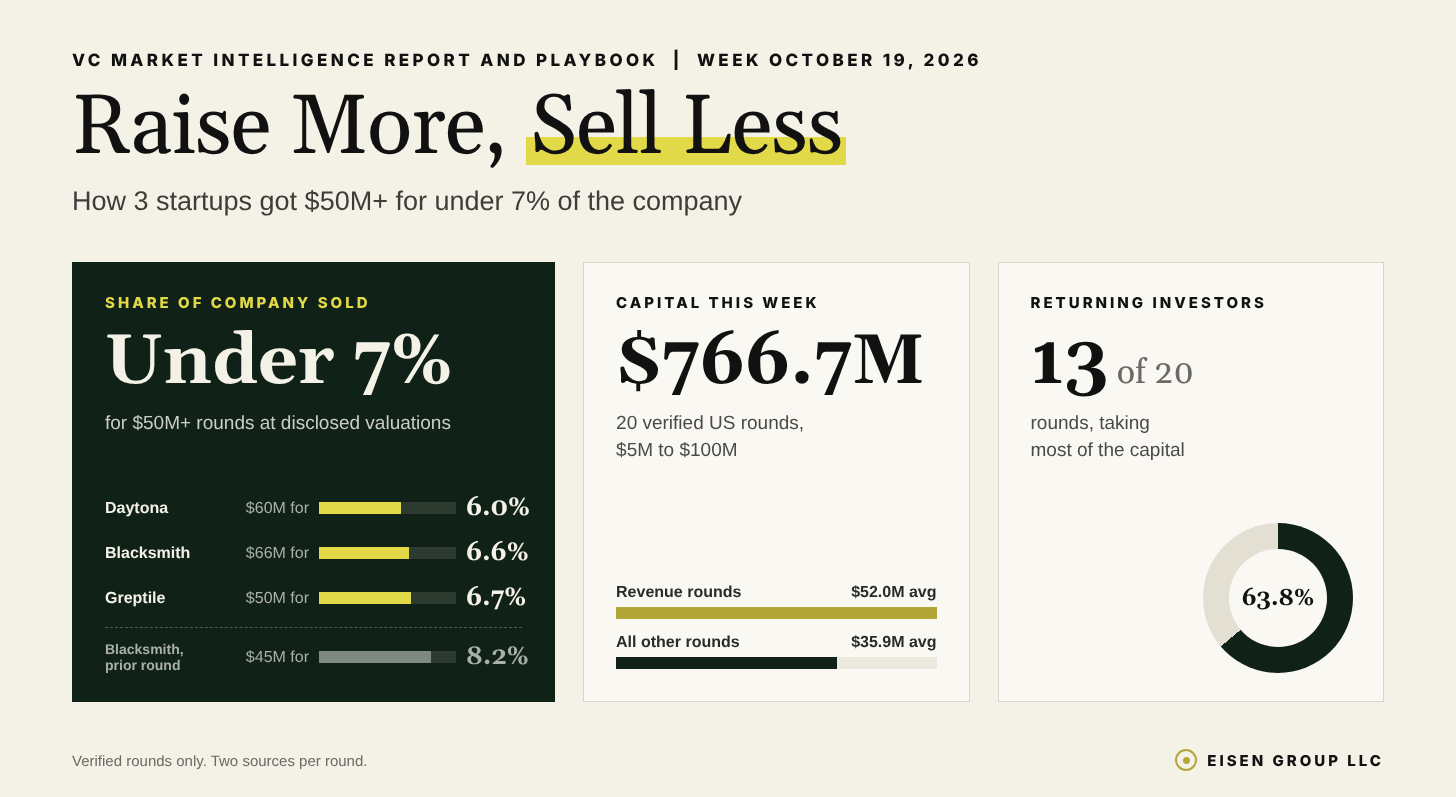
Playbook, Perspective and Pattern for founders raising now. This report strips out giant rounds and public market traffic so you can read the part of the market that actually prices your round. Every round below was checked against at least two independent sources. A second pass removed rounds that had resurfaced from earlier weeks, and a third pass re-checked prior rounds, returning investors and disclosed valuations.
On August 12, Blacksmith announced a $45.0M Series B at a $550M post-money valuation. The company says it closed that round in March. On October 21 it announced a $66.0M Series C at a $1B valuation. That is 47% more money for a smaller slice of the company: about 6.6% if the $1B is post-money, or about 6.2% if it is pre-money, versus about 8.2% in the Series B. Between the March close and the October announcement, the company reported annual recurring revenue up 17x since January, more than 10,000 companies on the platform (up from more than 6,000 when the Series B was announced), and largest customers each spending over $1M a year.
That is the result of the week: revenue evidence between rounds can let a founder raise more money while selling a smaller share of the company.
You know this moment. You’re sitting with a term sheet. The amount looks right. Then you do the one calculation that matters to you personally: the amount divided by the post-money valuation. That number is what this round costs you in ownership.
Most founders try to lower it in the negotiation. They push on the price, run a process, look for a second term sheet. That helps when it works. The two founders at the top of this week’s board had built their leverage months before the term sheet arrived. They did it in the business, by building revenue an investor could check.
Three of 20 verified rounds disclosed a valuation this week: Blacksmith and Daytona at $1B, and Greptile at $750M. At post-money, each sold under 7% of the company: Daytona about 6.0% for $60.0M, Blacksmith about 6.6% for $66.0M and Greptile about 6.7% for $50.0M. Each put traction an investor can check on the record. Two published revenue growth numbers: Blacksmith and Daytona reported their revenue run rate up about 25 times between January and September, and average monthly net revenue retention of about 135%. Greptile published usage instead, reporting that more than 1% of all pull requests opened on GitHub are reviewed every day, and kept its revenue private. A third revenue disclosure came from Tolan, with double-digit-million ARR. The three rounds with revenue figures raised $156.0M, 20.3% of the week’s capital from 15% of the deals, and averaged $52.0M, compared with $35.9M for everything else. Daytona and Blacksmith finished first and second on the scorecard.
Valuation, ownership and what you keep. A $1B headline and founder wealth are different numbers. The headline is what the company is worth at this round’s price. Founder ownership is the share you still hold after every round so far. What you can actually realize at an exit is that share after future dilution, after liquidation preferences paid to investors first, after any debt, and only if the company reaches the exit. Selling less per round protects the middle number, and the difference compounds across several rounds. Illustrative: four rounds at 8% dilution each leave a founder with about 71.6% of the stake they started with; four rounds at 6% leave about 78.1%.
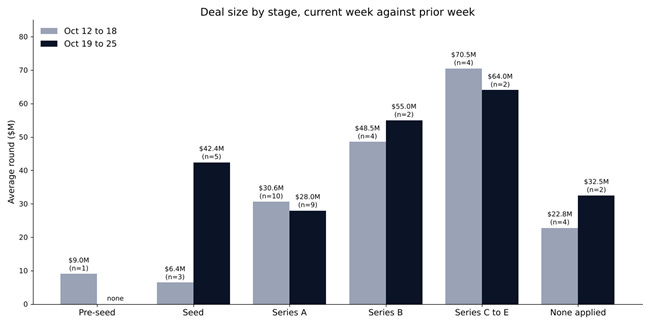
The rest of the week moved in two other directions. Returning investors fell to 13 of 20 rounds from 19 of 26, and their share of capital fell to 63.8% from 86.0%. And the large seed check came back: five seed rounds averaged $42.4M, against $6.4M a week earlier, led by a $90.0M seed for a team of former Nvidia researchers.
Consequence for Monday. Before you set the size of your next round, calculate what it costs you in ownership at today’s evidence, and what it would cost after one more quarter of revenue you can document. The founders at the top of this week’s board had done that work before the term sheet arrived.
The Week in One Sentence
Primary insight. Band capital fell from its six-issue high, but all three disclosed prices went to companies with traction on the record, and each sold under 7% of itself, while the seed market swung back to large bets on teams with no revenue on the record yet.
• Total capital deployed. $766.7M in new primary capital across 20 verified US rounds between $5M and $100M, down 14.9% from $901.2M across 26.
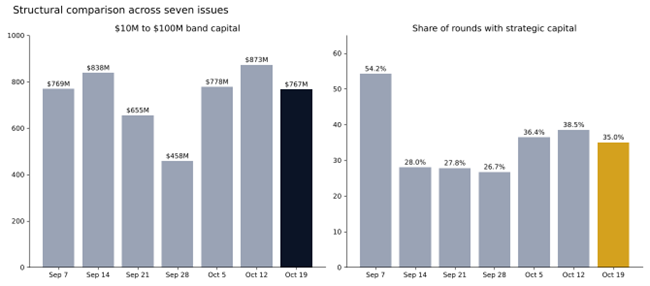
• Against prior issues. Every verified round this week sits inside the $10M to $100M band this series has tracked since September: 20 rounds and $766.7M against 22 rounds and $873.0M last week. Capital down 12.2%, deal count down 9.1%.
• Average round size. $38.34M across the full set, up 10.6% from $34.66M.
• Median round size. $34.5M, up 43.8% from $24.0M. Fewer small rounds cleared verification this week.
• Largest tracked round. Dream Labs at $90.0M, a seed. Smallest: IMIO at $12.0M, also a seed.
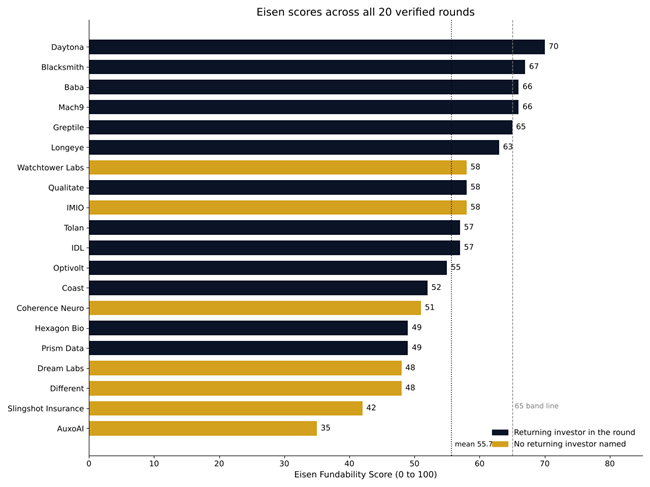
• Highest Eisen score. Daytona at 70. Lowest: AuxoAI at 35. A band of 35 points. Five of 20 rounds cleared 65 and none reached 75. Mean 55.7, median 57.0.
• Named institutional lead. 20 of 20 rounds, against 25 of 26 last week.
• Strategic or customer-side capital. 7 of 20 rounds (35.0%), carrying $242.0M (31.6%) of the week’s capital, vs. 10 of 26 (38.5%) and 55.1% of capital last week.
• Returning investors. 13 of 20 rounds, or 65.0%, named at least one investor from a prior round, against 19 of 26, or 73.1%, last week. Four were led by a prior investor, against five.
• Valuations on the record. 3 of 20: Blacksmith and Daytona at $1B, Greptile at $750M. Two came with revenue growth figures, one with usage figures.
The Deal Scorecard
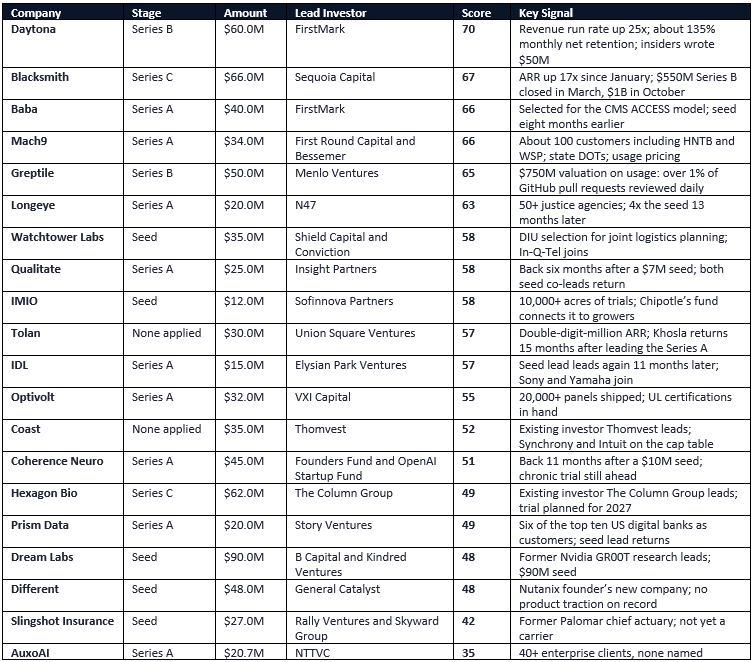
Eisen Fundability Scores run across five dimensions: Founder-Investor Dynamics (30), Traction to Conviction Conversion (25), Narrative Power (20), Deal Architecture (20) and Capital Planning (5). Scores of 90 to 100 signal an inevitable, market-defining outcome. 85 to 89 signals extremely strong execution. 75 to 84 signals solid fundamentals. 65 to 74 signals a good company with some gaps. Below 65 signals an early-stage or structurally incomplete round.
What the scorecard says at a glance
The top of the board belongs to rounds that put verifiable traction on the record. Daytona at 70 and Blacksmith at 67 reported revenue growth and named customers including Anthropic, OpenAI, Nvidia, Ashby, and LangChain. Baba at 66 was selected by the Centers for Medicare and Medicaid Services for its ten-year ACCESS model. Mach9 at 66 names engineering firms and state transportation departments as users. Greptile at 65 names Nvidia and Coinbase. All five had a returning investor, and four came back within 13 months of their last round at a larger size.
The biggest checks were not the strongest rounds. Dream Labs raised the largest round of the week, a $90.0M seed, and scored 48. Different raised $48.0M at seed on the strength of a founder who built Nutanix and co-founded ThoughtSpot, and scored 48. Both earned full marks or close to it on the team. Both scored near zero on proof, and a first round has no history to credit on capital planning. These are bets on people, and the score measures how much of the round a stranger could check today.
Size and score barely moved together this week. The correlation between round size and score across 20 rounds was 0.13, against 0.64 in the prior issue. The five rounds of $50M or more averaged 59.8. The fifteen below $50M averaged 54.3. Last week the large rounds were late-stage re-underwrites. This week, two of the five large rounds were seed rounds.
The floor is about missing evidence. AuxoAI scored 35 with 40 enterprise clients and none named, no prior round on the record and no returning investor. Slingshot Insurance scored 42: a strong actuarial founder, but its first customer is run by a co-founder and it has yet to secure a carrier. Real money, real companies. The score measures how much of the transaction an outsider can reconstruct.
What Changed This Week
Five shifts, ranked by structural impact on founder fundraising rather than by deal size. Each is built on verified deal records and ends with what it means for your raise.
Shift 1: The Week’s Three Disclosed Prices Came With Traction on the Record
Pattern, what happened. Three rounds disclosed revenue figures: Blacksmith (ARR up 17x since January, in the tens of millions), Daytona (run rate up about 25x from January to September, about 135% average monthly net revenue retention) and Tolan (double-digit-million ARR and 250,000+ active users). They took $156.0M, 20.3% of the week, and averaged $52.0M, compared with $35.92M for the other seventeen. Three rounds disclosed a valuation: Blacksmith and Daytona at $1B, and Greptile at $750M. At post-money, Daytona sold about 6.0% of the company for $60M, Blacksmith about 6.6% for $66M (up from about 8.2% for $45M in its Series B), and Greptile about 6.7% for $50M. Two of the three priced rounds reported revenue growth; Greptile reported a GitHub usage share and kept revenue private.
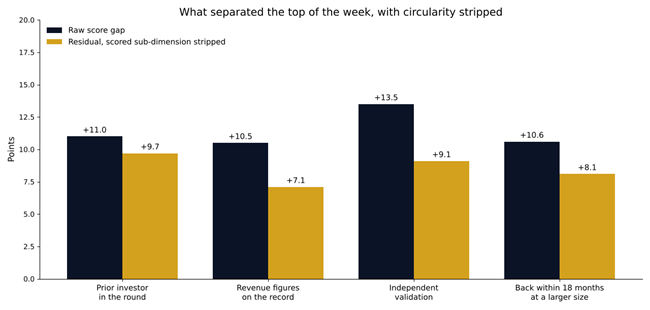
Perspective, what it means. An investor setting a price is pricing a range of outcomes. Revenue that grows month after month from customers who stay and spend more narrows that range, and a narrower range lets an investor pay more per share and still expect a return. More per share means fewer shares for each dollar raised. Usage at platform scale can do the same work when it connects to spend an investor can verify, as Greptile did. The three revenue rounds scored 64.7 against 54.1; strip the Market Adoption sub-dimension, where revenue is credited, and 7.1 points remain. They were also stronger on investors, narrative, and velocity. Outside the scored set, the same pattern showed up at seed: MARC, a New York and Dublin proptech that told Commercial Observer it was profitable at the start of the year, set out to raise $2M to $3M and closed $5M quickly.
Founder Blindspot, what most miss. Founders treat valuation as a negotiation that happens in the term sheet. The negotiation moves the price at the margin. Months of documented traction before the first meeting can set much of the price. A company that puts nothing checkable on the record is asking the investor to price uncertainty, and the investor will. Revenue is the strongest exhibit; this week Greptile showed that usage at platform scale can stand in for it.
Playbook, what to do. Divide your planned raise by the post-money valuation you can defend today. Then write the revenue line that would let you defend a higher one, and divide again. If your runway reaches that line with room to spare, the evidence may be worth waiting for.
Contrast. Last week, third parties who had underwritten the company built the top of the board. This week, the company’s own traction built it: revenue at Daytona and Blacksmith, and usage at Greptile, published with enough detail for an investor to check.
What this means for your raise: Equity sold after the revenue is on the record can cost you less of the company.
Shift 2: Fewer Insiders Came Back, and They Came Back Bigger
Pattern, what happened. 13 of 20 rounds named a returning investor, 65.0%, down from 19 of 26, or 73.1%. Those 13 took $489.0M, 63.8% of the week, down from 86.0%. Four rounds were led by a prior investor: FirstMark at Daytona, Thomvest at Coast, Elysian Park Ventures at IDL and The Column Group at Hexagon Bio, against five last week. The largest insider commitment of the week came at Daytona, where about $50M of the $60M came from existing investors.
Perspective, what it means. The returning investor is still the strongest signal on the board. Rounds with one scored 59.5 against 48.6, an 11.0-point gap; remove the Insider Support sub-dimension and 9.7 points remain. The composition of the week changed. Four of the seven rounds without a named returning investor were new companies raising their first institutional round, with no prior investor to return. The insider share fell when the seed lane reopened, and companies with insiders kept leaning on them.
Founder Blindspot, what most miss. Founders read a heavy insider round as weakness, a sign that no new investor wanted in. At Daytona, the insiders put up five-sixths of a round that priced the company at $1B, with strategic investors Qualcomm Ventures, Samsung Next and Okta Ventures joining. Insiders who see the monthly numbers can write the largest check when the numbers are strong.
Playbook, what to do. Send every existing investor the same monthly revenue and retention report you would send a new lead. Three months before you raise, ask each one for a number, conditional on terms, and ask your largest whether it would lead.
Contrast. Insider-led rounds fell from five to four, and the insider share of capital fell 22.2 points. Last week four late-stage re-underwrites, all with insiders, lifted the share; this week two late-stage rounds closed.
What this means for your raise: The investor who already reads your numbers can be your largest check, if the numbers earn it.
Shift 3: The Pedigree Seed Lane Reopened
Pattern, what happened. Five seed rounds closed for $212.0M, averaging $42.4M, up from three seeds averaging $6.4M a week earlier. Dream Labs raised $90.0M led by B Capital and Kindred Ventures, founded by former leaders of Nvidia’s GR00T robotics research program. Different raised $48.0M led by General Catalyst, founded by Ajeet Singh of Nutanix and ThoughtSpot. Watchtower Labs raised $35.0M led by Shield Capital and Conviction. Slingshot Insurance raised $27.0M. Coherence Neuro raised $45.0M, which the company labels a Series A and some coverage calls a seed; it is counted at the company’s label and outside the five seeds.
Perspective, what it means. These rounds price the founders and the category. The five seeds averaged 50.8 on the Eisen score and 5.8/25 on Traction-to-Conviction Conversion. None scored on Capital Planning: none had a prior round on the record that could be credited. Two of them carried real outside proof: the Defense Innovation Unit selected Watchtower in January 2026 for its Joint Sustainment Decision Tool program, and IMIO, the smallest seed at $12.0M, ran trials across more than 10,000 acres and has about 100 customers. Watchtower and IMIO tied as the highest-scoring seeds at 58, IMIO on a check one-seventh the size of Dream Labs’.
Founder Blindspot, what most miss. A $90M seed sets a bar, not a benchmark. The next investor will divide that $90M by what the company has built by Series A. Founders without a famous research pedigree who size their seed to this week’s average are raising toward a number set by a handful of outliers.
Playbook, what to do. Size your seed from the bottom up. Name the one milestone that would make a Series A investor price you on evidence rather than on team, cost it, add nine months of runway, and stop.
Contrast. Seed averaged $41.54M on five rounds two weeks ago, $6.4M on three rounds last week and $42.4M on five this week. The lane opens and closes with the supply of pedigreed teams, not with the market as a whole.
What this means for your raise: At seed, a famous team can raise on the team. Everyone else raises on the first fact a stranger can check.
Shift 4: Public Buyers Became the Validators
Pattern, what happened. Nine rounds carried independent validation a stranger could check: named customers whose procurement can be called, a certification body or a government program. They took $349.0M, 45.5% of the week. Validators became increasingly public: the Centers for Medicare and Medicaid Services selected Baba for its ACCESS model; the Defense Innovation Unit selected Watchtower Labs for its Joint Sustainment Decision Tool program; more than 50 justice agencies run Longeye; state departments of transportation use Mach9; UL certified Optivolt’s panel electronics.
Perspective, what it means. A government buyer runs its own diligence before it signs, and its decision is public. Rounds with any independent validation scored 63.1 against 49.6, a 13.5-point gap; strip the Independent Validation sub-dimension and 9.1 points remain. The two rounds in the significant tier, Baba and Watchtower, averaged 62.0 against 55.0. Both are young companies, and both carry a federal decision that no deck can manufacture.
Founder Blindspot, what most miss. Founders outside defense and healthcare assume government validation is out of reach. This week, the public validators included state transportation departments buying engineering software and local justice agencies buying an investigative tool. Every category sells to some public body, and public bodies document what they buy.
Playbook, what to do. Name the one public program, agency or certification in your category whose decision a skeptical investor would trust more than your deck. Write down what it requires, who owns it inside your company and the date you could have it.
Contrast. Last week the validators were insurers, reinsurers and Medicaid programs. This week they moved to federal pilots, state agencies and product certification, and all six of the highest scores carried validation a stranger could check, three of them from a public body.
What this means for your raise: A public buyer’s signature is the shortest diligence call your lead will ever make.
Shift 5: The Fastest Return Was the Strongest Signal
Pattern, what happened. Nine rounds came back within 18 months of the company’s last round at a larger size: Qualitate six months after its seed, Blacksmith about seven months after its Series B closed, Daytona and Baba eight months after theirs, Coherence Neuro and IDL about 11 months after their seeds, Greptile and Longeye 13 months after their last rounds, and Tolan 15 months after its Series A. They took $351.0M, 45.8% of the week.
Perspective, what it means. A fast return at a larger size tells the next investor that the last round bought something measurable. The nine fast-return rounds averaged 61.6 against 50.9; strip the Velocity sub-dimension and 8.1 points remain. They were stronger across the framework, and four are in the top five.
Founder Blindspot, what most miss. Founders think speed between rounds comes from the market. In this week’s data, it came from evidence that landed between the rounds: revenue growth at Blacksmith and Daytona, a federal program selection at Baba, adoption across 50+ justice agencies at Longeye.
Playbook, what to do. At the close of your current round, write the two facts your next investor will need to see. Staff and spend against those two facts first, and report them monthly to your board.
Contrast. Last week six rounds came back within 18 months at a larger size and averaged 59.5. This week, nine did, averaging 61.6.
What this means for your raise: Your next round starts the day this one closes, and its price depends on what you can show by then.
The Deals That Matter
Five deep dives across agent infrastructure, developer tools, Medicare care coordination, civil engineering software and AI code review. These are the week's five highest-scoring rounds. All facts are verified against two or more sources.
Daytona
Cloud Infrastructure for AI Agents | Series B | $60.0M | Led by FirstMark
Eisen Fundability Score: 70 / 100
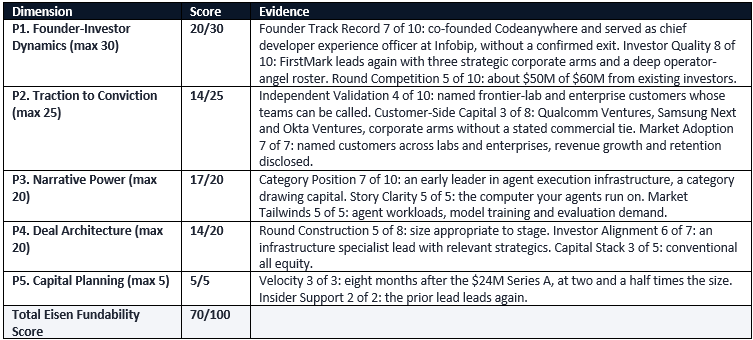
Why this scored. The highest score of the week, on the round that combined revenue growth on the record, a retention figure that gives the growth weight, named frontier-lab customers and a returning lead eight months after the Series A. It lost points on round competition: insiders wrote most of the check.
The Setup. Daytona, headquartered in San Francisco, rents isolated cloud sandboxes where AI agents write and run code, browse and operate software. It says it can configure a sandbox in 60 milliseconds by pre-staging snapshots on server drives. Chief executive Ivan Burazin co-founded Codeanywhere in 2009, founded the Shift developer conference and served as chief developer experience officer at Infobip; Vedran Jukić and Goran Draganić co-founded Daytona with him. Customers named in coverage include Anthropic, OpenAI, Nvidia, Cursor, Cognition, Meta and Cohere. Snorkel has provisioned more than one million sandboxes on the platform.
The Deal. $60.0M Series B led by FirstMark, announced October 20, 2026, at a $1B valuation, bringing total funding to about $91M. About $50M came from existing investors. Qualcomm Ventures, Samsung Next and Okta Ventures joined as strategic investors, alongside individual investors including Patrick Collison, Tobi Lütke, Aravind Srinivas, Adam D’Angelo, Eric Yuan and Olivier Pomel. FirstMark also led the $24M Series A in February 2026. The company reports its revenue run rate grew about 25 times between January and September, averaging 50.9% monthly growth, with average monthly net revenue retention of about 135%. It has not disclosed absolute revenue.
The Pattern. This is the revenue-priced insider round. The investors closest to the monthly numbers wrote five-sixths of the check, and the round valued the company at $1B, just eight months after its Series A.
The Perspective. A growth multiple without a base can sit on a small number. The retention figure is what makes Daytona’s growth credible: existing customers expanding month after month is evidence a new investor can test in diligence. Founders reporting fast growth should publish the retention behind it, or expect the investor to discount it.
The Playbook. Build a one-page revenue exhibit: monthly revenue for the last twelve months, net revenue retention by month, and the five largest customers with what each spends now against when they started. Send it to your existing investors before you send it to anyone new.
The Founder Mistake to Avoid. Leading with the growth multiple alone. A multiple without the base and the retention invites the first question every skeptical investor asks.
Founder lesson. Publish the retention behind the growth. It turns a big multiple into a number an investor can price.
Founder trap. Treating an insider-heavy round as a weakness to hide. Here it was the strongest evidence in the room.
Blacksmith
Infrastructure for Building and Testing Code | Series C | $66.0M | Led by Sequoia Capital
Eisen Fundability Score: 67 / 100
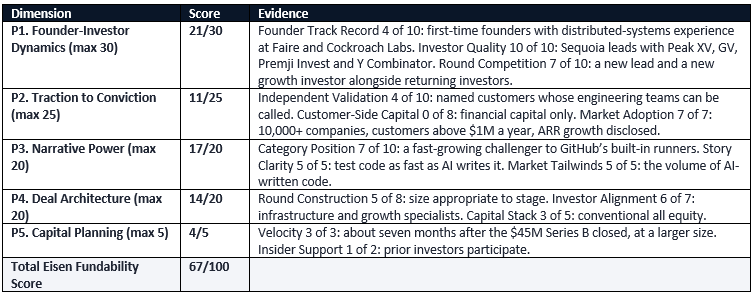
Why this scored. The clearest ownership story of the week: a company that raised 47% more money than in its Series B while selling a smaller share, on revenue growth it put on the record. It lost points on the founders’ track record, a first company, and on customer-side capital.
The Setup. Blacksmith, headquartered in San Francisco and founded in January 2024, runs continuous integration jobs, the automated builds and tests code must pass before it ships- on its own servers in data centers it operates worldwide. It came out of Y Combinator’s Winter 2024 batch. Co-founders Aditya Jayaprakash, chief executive Aayush Shah, and Aditya Maru met at the University of Waterloo and previously built distributed systems at Faire and Cockroach Labs. More than 10,000 companies use the platform, including Ashby, Granola, Handshake, Supabase, and LangChain, up from more than 6,000 when the Series B was announced in August; weekly CI jobs have grown from 5 million to more than 90 million since January.
The Deal. $66.0M Series C led by Sequoia Capital, announced October 21, 2026, at a $1B valuation, with Premji Invest joining existing investors Peak XV Partners, GV and Y Combinator. All equity, bringing total funding to about $125M. The company says the $45M Series B, led by Peak XV Partners at a $550M post-money valuation, closed in March 2026 and was announced on August 12, 2026. GV led a $10M Series A announced in September 2025. The Series C close date was not disclosed. The company says ARR grew 17 times since January to the tens of millions, and its largest customers each spend more than $1M a year.
The Pattern. This is the repriced fast return. Three rounds announced in thirteen months, each larger than the last, with the valuation nearly doubling between the Series B close in March and the Series C announcement in October, about seven months.
The Perspective. Dilution per round fell while round size rose: about 8.2% of the company in the Series B and about 6.6% in the Series C, at post-money valuations. At the two headline valuations, the new investor paid nearly twice the Series B price, so each dollar cost the founders fewer shares. What they realize at an exit still depends on preferences, future rounds and reaching the exit.
The Playbook. Track dilution per round as a metric your board sees, next to burn and revenue. Before each raise, model the round at today’s evidence and again after your next documented revenue milestone, and decide the timing on the difference.
The Founder Mistake to Avoid. Raising again quickly on market appetite alone, without new evidence. Blacksmith’s speed worked on the strength of ARR, customers and usage that all moved between rounds.
Founder lesson. Measure each round by the share of the company it costs, not only by the dollars it brings.
Founder trap. Celebrating the valuation headline. The ownership line is the one that compounds.
Baba
AI-Supported Care Advocacy for Medicare | Series A | $40.0M | Led by FirstMark
Eisen Fundability Score: 66 / 100
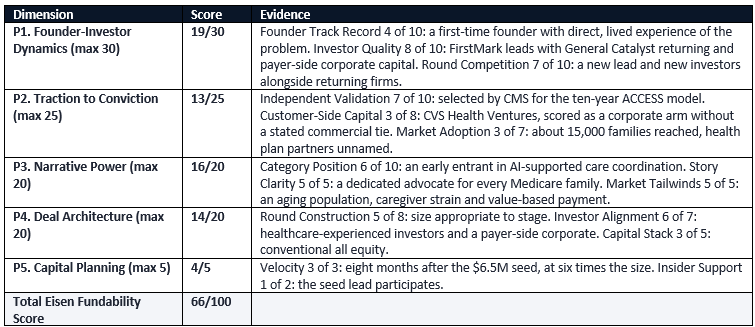
Why this scored. The strongest outside validation of the week: a federal program selection less than two years after founding, plus a return to market eight months after the seed at six times the size. It lost points on founder track record and market adoption, with health plan partners left unnamed.
The Setup. Baba, headquartered in New York and founded in 2025, pairs people on Medicare and their family caregivers with a dedicated human advocate, a nurse, social worker or community health worker supported by AI tools, who handles appointments, transportation, paperwork and benefits questions. The service is covered by insurance. General Catalyst says Baba reached about 15,000 families in under a year; the company says it has served under 1% of Medicare’s roughly 70 million members. Founder Connor Sweeney trained in synthetic biology and entered healthcare after building a speech therapy tool for his grandmother after her stroke. The Centers for Medicare and Medicaid Services selected Baba for its ten-year ACCESS model.
The Deal. $40.0M Series A led by FirstMark, announced October 20, 2026, with new investors CVS Health Ventures and Valtruis and returning investors General Catalyst, Genius Ventures and Ground Up Ventures. All equity. General Catalyst led the $6.5M seed in February 2026.
The Pattern. This is the public-validator round. A federal agency’s selection did the diligence a new lead would otherwise have had to do, and the seed lead came back alongside it.
The Perspective. In regulated healthcare, a payer or program decision carries more weight than any growth chart. Baba’s next step on the board is market adoption: named health plan partners and documented outcomes would move it further than more families served.
The Playbook. List every public program in your category that selects, certifies or pays vendors: CMS models, state Medicaid contracts, federal pilots. Pick one with a decision date inside your runway and apply this quarter.
The Founder Mistake to Avoid. Hiding the program selection on slide fourteen. Lead with the decision a stranger can confirm.
Founder lesson. One public decision a stranger can confirm can carry a young company further than a year of growth slides.
Founder trap. Treating a program selection as the finish line. The next investor will ask what it produced.
Mach9
AI-Native CAD Software for Civil Engineering | Series A | $34.0M | Co-led by First Round Capital and Bessemer Venture Partners
Eisen Fundability Score: 66 / 100
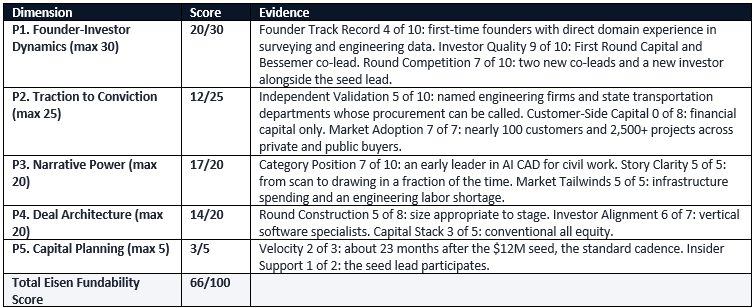
Why this scored. It was named enterprise and public-sector users, uses usage-based pricing that mirrors how customers bill, and has two top-tier co-leads, with the seed lead continuing. It lost points on customer-side capital and on velocity, at 23 months since the seed.
The Setup. Mach9, headquartered in Pittsburgh, was founded in 2021 as Mach9 Robotics to build inspection hardware for civil engineers, then dropped the hardware and the word Robotics to build AI software that turns survey scans into engineering drawings. Co-founder Alex Baikovitz says the software produces drafts up to ten times faster and at a fifth of the cost of conventional workflows. Nearly 100 customers have used it on more than 2,500 projects; named users include Langan, Olsson, HNTB and WSP, along with several state departments of transportation. Pricing is usage-based, per mile of road or acre surveyed.
The Deal. $34.0M Series A co-led by First Round Capital and Bessemer Venture Partners, announced October 21, 2026, with Prudence joining and Quiet Capital continuing. All equity, bringing total funding to $49M. Quiet Capital led the $12M seed in November 2024.
The Pattern. This pivot found its buyer. The company changed what it sold, and the evidence arrived in the form of named engineering firms and state agencies using the new product.
The Perspective. Usage-based pricing that matches how customers bill their own clients can make revenue easier for an investor to forecast, since spend rises with the customer’s own workload. A pivot can strengthen a fundraise when the new product quickly generates named users.
The Playbook. If your pricing differs from how your customers earn money, test a version that mirrors it with your three largest accounts this quarter, and track whether spend per account rises with their volume.
The Founder Mistake to Avoid. Defending the original product to protect the story. Mach9’s round was built on what customers adopted after the pivot.
Founder lesson. Price based on what your customer earns, and your revenue becomes easier to forecast.
Founder trap. Treating a pivot as a story to explain away. Investors priced the named users it produced.
Greptile
AI Code Review and Validation | Series B | $50.0M | Led by Menlo Ventures
Eisen Fundability Score: 65 / 100
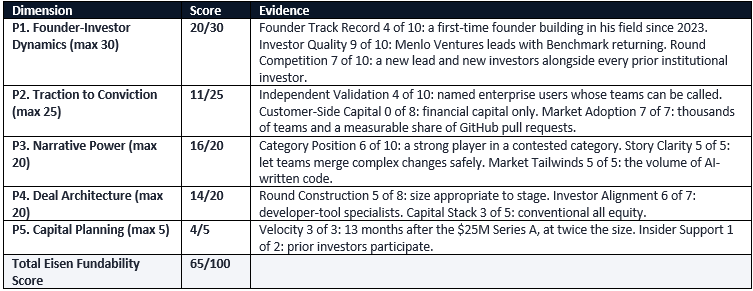
Why this scored. Usage at platform scale with named enterprise users, a new lead and every prior institutional investor returning, and a return to market 13 months after the Series A at twice the size. It lost points on founder track record and on customer-side capital, and it competes with well-funded rivals.
The Setup. Greptile, headquartered in San Francisco, builds AI agents that review and test code changes before they merge. It says it reviews more than 1% of all pull requests opened on GitHub each day, for thousands of engineering teams including Nvidia, Coinbase, Decagon and Vanta. Founder Daksh Gupta started the company after graduating from Georgia Tech in 2023, and it went through Y Combinator’s Winter 2024 batch. Rivals include CodeRabbit and Graphite.
The Deal. Menlo Ventures led a $50.0M Series B, announced October 19, 2026, at a $750M valuation, with Jump Trading, Wing, Operator Collective, Benchmark, Y Combinator, Browder Capital, and Initialized Capital participating. All equity. Benchmark led the $25M Series A in September 2025. Revenue was not disclosed.
The Pattern. This is the usage-priced return. The company put a usage share of the world’s largest code platform on the record instead of revenue, and published its price next to it.
The Perspective. At $750M, Greptile sold about 6.7% of the company for $50M at post-money, close to Daytona’s and Blacksmith’s dilution, while keeping revenue private. Usage at this scale is strong evidence of adoption, and it leaves the revenue question to diligence. Daytona and Blacksmith answered that question in public; Greptile answered it with usage. Both paths reached similar dilution this week.
The Playbook. Choose the one usage metric that best predicts revenue in your business, and report it every month in the same format, so the trend is visible to investors before you raise.
The Founder Mistake to Avoid. Reporting a usage number with no link to revenue. The next investor will ask what each review is worth.
Founder lesson. A usage metric earns its place when it connects to revenue the investor can see.
Founder trap. Assuming adoption speaks for itself in a crowded category. Usage carries a price only when the investor can connect it to spend.
The Fundraising Playbook
Five plans, each producing a concrete artifact you can use this week. Each is built directly from this week’s verified signals.
Plan 1: The Revenue-First Narrative (Narrative and Investor Framing)
Focus. Open your story with the revenue evidence an investor can check, then the category.
Why this matters. The three rounds that disclosed revenue figures averaged $52.0M against $35.92M, and two of the week’s three disclosed valuations came with revenue growth attached.
Exact deliverable. A rewritten deck headline and a one-page revenue exhibit. The headline states one checkable revenue fact, then the category claim. The exhibit shows monthly revenue for 12 months, net revenue retention, and your five largest customers, with current spend vs. starting spend.
Time estimate. Four hours, plus one hour testing it with an investor you trust.
Expected outcome. A first meeting that starts with a number the investor can verify instead of a forecast the investor must believe.
The reframe. Wrong approach: “We are building the agent infrastructure layer.” Right approach: “Revenue up 25 times this year, with existing customers spending more every month.”
Plan 2: Obtain One Public Validator (Proof Architecture)
Focus. Secure one decision by a public body that a stranger can confirm.
Why this matters. Rounds with independent validation scored 63.1 vs. 49.6, and 9.1 points remain after removing the sub-dimension. This week’s validators were CMS, the Defense Innovation Unit, state transportation departments, justice agencies and UL.
Exact deliverable. A three-column inventory: every public program, agency contract or certification you could obtain in the next two quarters, the body that grants it, and the earliest date it could land. Pick the fastest one, assign an owner and file this week.
Time estimate. Three hours for the inventory. Two to six months to obtain the first decision.
Expected outcome. You open your process with a fact a partner can confirm without you.
The reframe. Wrong approach: adding more pilot logos to the deck. Right approach: converting one public pilot into a documented award with a program contact the lead can call.
Plan 3: Eisen Self-Score and Gap Diagnosis (Readiness)
Focus. Score your round on the five dimensions and decide between a process now and a repair sprint first.
Why this matters. The board ran from 35 to 70 with a mean of 55.7. Traction to Conviction Conversion averaged 7.5 of 25, the weakest dimension relative to its maximum. The five seeds averaged 5.8.
Exact deliverable. A one-page score: Founder-Investor Dynamics (30), Traction to Conviction (25), Narrative Power (20), Deal Architecture (20), Capital Planning (5), with an evidence line for each sub-dimension. Score only what a stranger could confirm. Circle your two lowest dimensions. Above 65, run a parallel process with a hard deadline. Between 50 and 65, spend four to six weeks repairing the lowest dimension first. Below 50, the gap is structural, and a better deck will not close it.
Time estimate. Two to three hours, repeated before every raise.
Expected outcome. A decision about process design, made before the first meeting rather than after the tenth pass.
The reframe. Wrong approach: scoring yourself on what your deck says. Right approach: scoring yourself on what a stranger could confirm, then fixing the two lowest dimensions first.
Plan 4: The Insider Number and the Target List (Deal Architecture and Investor Targeting)
Focus. Lock the insider position and target only firms that lead at your stage.
Why this matters. Rounds with a returning investor scored 59.5 vs. 48.6, and 9.7 points remain after removing the sub-dimension. At Daytona, insiders wrote about $50M of a $60M round.
Exact deliverable. Two items. First, a written number from each existing investor, conditional on terms, and a yes-or-no on leading. Second, a target list cut to 35 firms, each annotated with a round it led at your stage in the last 90 days, including this week’s leads: Sequoia Capital, The Column Group, FirstMark, Menlo Ventures, General Catalyst, Founders Fund, the OpenAI Startup Fund, Thomvest, Shield Capital, Conviction, First Round Capital, Bessemer Venture Partners, VXI Capital, Union Square Ventures, Rally Ventures, Skyward Group, Insight Partners, NTTVC, N47, Story Ventures, Elysian Park Ventures, Sofinnova Partners, B Capital and Kindred Ventures. FirstMark led two rounds this week and one last week.
Time estimate. Two weeks of calendar for the insider conversations, one day for the list.
Expected outcome. A process that opens with insider support in hand and a short list of firms that actually lead at your stage.
The reframe. Wrong approach: asking insiders for their pro rata at the end of the process. Right approach: asking them for a number and a lead decision before the first new meeting.
Plan 5: The Dilution-at-Milestone Decision (Capital Planning and Timing)
Focus. Decide when to raise by comparing the ownership cost now against the cost after your next documented revenue milestone.
Why this matters. Blacksmith raised 47% more money in its Series C than in its Series B and sold a smaller share of the company. Nine rounds came back within 18 months at a larger size and averaged 61.6 against 50.9.
Exact deliverable. A one-page model. Row one: planned raise divided by the post-money valuation you can defend today. Row two: the same raise divided by the valuation your next revenue milestone could support. Row three: months of runway left when the milestone lands. Illustrative example, not a forecast: a $5M raise at a $20M post-money costs 25% of the company; at a $30M post-money after two more quarters of retained revenue, it costs about 16.7%, a gap of about 8 points. If row three shows less than six months of cushion, raise on today’s evidence.
Time estimate. Two hours to build, fifteen minutes to update monthly.
Expected outcome. A timing decision based on the ownership you keep, not on how the market feels this week.
The reframe. Wrong approach: “We’ll raise when the market is good.” Right approach: “We’ll raise the week our revenue exhibit can support the price we need.”
Looking Forward
Three evidence-based scenarios and one wild card for the next one to three weeks. Each is anchored to this week’s verified data.
Scenario 1: Revenue Disclosure Spreads in AI Infrastructure (Medium-High Probability)
Why this is likely. All three disclosed valuations this week went to developer and infrastructure companies, and two included revenue growth figures. Companies competing for the same investors tend to match each other’s disclosure.
What founders should watch. Whether next week’s infrastructure rounds publish a valuation with revenue multiples, retention or customer spend. Two or more confirms the trend.
What founders should do before others notice. Build the revenue exhibit now, so you can publish when your numbers support it.
Scenario 2: Pedigree Seeds Keep Pulling Large Checks (Medium Probability)
Why this is likely. Seed swung from $6.4M to $42.4M in one week on five rounds, three of them $35M or larger, all led by top-tier firms backing research or repeat founders.
What founders should watch. Whether next week’s seed average stays above $20M, and whether the large seeds keep going to research pedigrees.
What founders should do before others notice. If you lack that pedigree, size your seed to one milestone and bring the first fact a stranger can check.
Scenario 3: Public Validators Move Into More Categories (Medium Probability)
Why this is likely. This week’s validators spanned a federal health program, a defense pilot, state transportation departments, local justice agencies and a product certification, across five different categories.
What founders should watch. New rounds citing a federal, state or municipal award in categories outside defense and healthcare.
What founders should do before others notice. File for the one public program in your category with a decision date inside your runway.
Wild Card: Insider-Only Rounds Rise Into Year-End (Medium Probability)
Evidence from this week. Insiders wrote about $50M of Daytona’s $60M, and FORT Robotics, outside the scored set, announced about $20M in commitments entirely from existing investors. Insiders defending positions ahead of year-end marks can keep writing large checks without a new price-setter.
What founders should do before others notice. Ask your insiders now what they would put in without a new lead, and on what terms.
The Bottom Line
The real insight sits beneath the $766.7M. The three companies that published a price all put traction on the record, and each sold under 7% of itself to raise $50M or more. Three rounds disclosed revenue figures and took 20.3% of the capital. Nine rounds carried a validation a stranger could check. Nine came back within 18 months at a larger size. That produced three investor-conversion profiles.
Profile 1: Companies with revenue on the record. Daytona (70) disclosed revenue growth of about 25 times and about 135% monthly net retention. Blacksmith (67) disclosed ARR up 17x and sold about 6.6% of the company for $66M, versus about 8.2% for $45M in a Series B that closed in March. Tolan (57) disclosed double-digit-million ARR. These three averaged 64.7 against 54.1. Greptile (65), the third disclosed price, sits with them on dilution with usage instead of revenue.
Profile 2: Companies a public buyer had already chosen. CMS selected Baba (66) for the ACCESS model. Mach9 (66) counts state transportation departments among its users. Longeye (63) runs in 50+ justice agencies. The Defense Innovation Unit selected Watchtower Labs (58). Rounds with any independent validation averaged 63.1 against 49.6, and the gap remained 9.1 points after removing the sub-dimension.
Profile 3: Companies that came back fast with something new. Qualitate (58) returned six months after its seed with both seed co-leads back. IDL (57) had its seed lead lead again eleven months later. Tolan (57) returned 15 months after its Series A with Khosla Ventures back. Greptile (65) and Longeye (63) returned 13 months after their last rounds, at twice and four times the size, respectively. The nine fast-return rounds averaged 61.6, up from 50.9.
Everything else competed on the team. The five seeds averaged $42.4M and scored 50.8. Dream Labs and Different, at 48 each, raised $138.0M between them on founders and research with no customer evidence on the record yet. The money is real. The proof is still to come, and the next investor will ask for it.
Three New Rules for Founders
1. Put checkable traction on the record before you set the price. All three valuations disclosed this week included it: two with revenue growth and one with usage.
2. Measure every round by the share of the company it costs. Blacksmith raised 47% more than in its Series B and sold less.
3. Publish retention with the growth. A multiple without a base invites a discount; Daytona’s 135% monthly retention gave its growth weight.
Your Monday Decision
Before you set your next round size, divide the amount by the post-money valuation you can defend today. Then write down the revenue evidence that would let you defend a higher valuation (monthly revenue, retention, the paying customers who renewed) and divide the same amount by that valuation. If your runway reaches that milestone with at least six months to spare, the evidence may be worth waiting for. If it falls short, raise on today’s evidence and spend the round building the exhibit for the next one.
Twenty companies cleared this week. The three that published a price had put their traction on the record first, and each sold under 7% of the company for $50M or more. Revenue evidence built before the round can let you raise more and sell less of the company you built.
Want to see where your company stands before investors decide for you? The free Eisen Fundability Score shows Seed and Series A founders where their investor conversion breaks: score.fundablecircle.com. Paid subscribers: Wednesday’s Discovery takes one finding from this report and investigates it in depth.
Research Methodology, Sources and Verification
Data collection period and verification standard
Data collection period: October 19 to 25, 2026. Verified primary announcements cluster between October 19 and October 23. Verification standard: at least two independent sources per deal, with a company release, investor post, filing or regulated newswire (PR Newswire, Business Wire, GlobeNewswire) as the anchor where one exists, plus at least one independent outlet. A second pass checked every announcement date against the prior issue and the original release, which removed three rounds that had resurfaced from earlier weeks. All arithmetic was recomputed after the final pass. Eisen Fundability Scores are proprietary analytical estimates, not endorsements or investment advice.
Core capital totals and what they include
The $766.7M weekly total includes only the 20 verified US rounds in the scorecard, each counted at new primary capital at close. Mid-market is defined as a US-headquartered round between $5M and $100M. Every verified round this week fell inside the $10M to $100M band, so the full set and the band subset are identical: 20 rounds totaling $766.7M at an average of $38.34M and a median of $34.5M, against 22 rounds totaling $873.0M at an average of $39.68M and a median of $29.5M on the band in the prior issue. Full-set comparisons use the prior issue’s 26 rounds totaling $901.2M at an average of $34.66M and a median of $24.0M.
Excluded from counted amounts: credit facilities and venture debt where separable, secondary purchases, previously closed rounds announced alongside new ones, SAFE conversions, non-dilutive grants, public-equity commitments and cumulative totals.
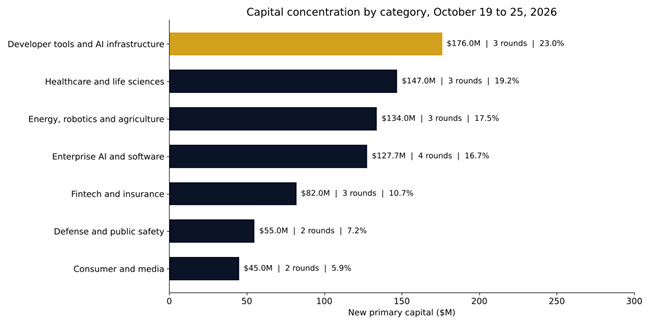
Stage subtotals: Series A $251.7M across nine; Seed $212.0M across five; Series C $128.0M across two; Series B $110.0M across two; no series letter $65.0M across two. Sector subtotals: Developer tools and AI infrastructure $176.0M across three; Healthcare and life sciences $147.0M across three; Energy, robotics and agriculture $134.0M across three; Enterprise AI and software $127.7M across four; Fintech and insurance $82.0M across three; Defense and public safety $55.0M across two; Consumer and media $45.0M across two. Geography: California $508.7M across eleven rounds, New York $120.0M across four, Washington $35.0M, Pennsylvania $34.0M, Oregon $30.0M, Minnesota $27.0M and Illinois $12.0M across one each. Each set sums to $766.7M across 20 rounds.
Scoring calibration notes
All rounds are scored on the same rubric as prior issues. Founder Track Record is scored on the verifiable public record of prior companies, exits, operating roles and domain tenure, and is scored 0 where no relevant background was locatable (AuxoAI, Coast and Prism Data this week). Intermediate values were used where evidence fell between bands: Founder Track Record 9 for a founder with one acquisition (Tolan); Independent Validation 5 for UL certification and for named public-sector users; Customer-Side Capital 4 for a corporate fund that connects the company to buyers without a stated purchase (IMIO), and 5 for a financing partner that serves the company’s customers (Coast). Round-to-round velocity of 30 to 36 months was scored 1. Velocity is measured from the prior round’s close, as disclosed by the company (Blacksmith’s Series B closed in March 2026 and was announced in August); otherwise, it is measured from the announcement. Prior round dates confirmed by only one source were not credited for velocity. Round Competition 5 was used for a syndicate made up entirely of existing investors (Hexagon Bio) and for a seed co-led by the firm that incubated the company (Watchtower Labs). Revenue figures are company-reported and credited under Market Adoption, not Independent Validation.
Circularity control. Where a finding rests on a dimension that is itself a scored input, the sub-dimension is removed from both sides and the residual is published alongside the headline. Returning investor: 11.0 points as measured, 9.7 with Insider Support removed. Insider-led: 1.6 and 0.2. Revenue figures on the record: 10.5 and 7.1 with Market Adoption removed. Any independent validation: 13.5 and 9.1. Significant validation tier: 7.0 and 2.0. Strategic or customer-side capital: 4.9 and 1.4. Back within 18 months at a larger size: 10.6 and 8.1.
Dilution arithmetic
Round amount divided by valuation. Blacksmith’s $550M Series B valuation is reported as post-money, so its Series B dilution is about 8.2%. The other announcements did not state pre-money or post-money, so we show both cases: Blacksmith Series C 6.6% post-money or 6.2% pre-money; Daytona Series B 6.0% or 5.7%; Greptile Series B 6.7% or 6.3%. Tolan’s valuation appears only as a PitchBook estimate and stays out of the disclosed count. The figures ignore option pool changes, secondary sales and any other instruments in the round.
Deal citations
Daytona, $60.0M Series B. Fortune via AI Weekly; Dealroom; Tech.eu; Tech Funding News; TradedVC, dated October 20, 2026. Rated HIGH.
Blacksmith, $66.0M Series C. Fortune via AI Weekly; Dealroom; Inc42; AI Chat Daily, dated October 21, 2026; PR Newswire company release dated August 12, 2026 and Inc42 for the Series B and its March close; Pulse 2.0 for the September 2025 Series A. Rated HIGH.
Baba, $40.0M Series A. GlobeNewswire company release via The SaaS News dated October 20, 2026; Fierce Healthcare; Runtime Wire; TradedVC; General Catalyst for the founder background and families reached. Rated HIGH.
Mach9, $34.0M Series A. TechCrunch dated October 21, 2026; Bessemer Venture Partners; Let’s Data Science; Seedtable for the November 2024 seed. Rated HIGH.
Greptile, $50.0M Series B. Company announcement dated October 19, 2026, stating the $750M valuation, as reported by Runtime Wire and TradedVC; Menlo Ventures post; Polsinelli deal announcement; Seedtable and TechCrunch for the 2025 Series A. Rated HIGH.
Longeye, $20.0M Series A. Business Wire company release dated October 21, 2026; Startup Researcher; Let’s Data Science; Fundz; Business Wire for the September 2025 seed. Rated HIGH.
Qualitate, $25.0M Series A. FinSMEs dated October 21, 2026; The SaaS News; TradedVC; AlleyWatch for the April 2026 seed. Rated HIGH.
IMIO, $12.0M Seed. Business Wire company release dated October 20, 2026; AgFunderNews; AgNavigator; Seedtable. Rated HIGH.
IDL, $15.0M Series A. Business Wire company release dated October 21, 2026; Business Wire newsroom; company site for the November 2025 seed. Rated HIGH.
Watchtower Labs, $35.0M Seed. Company release via Yahoo Finance dated October 21, 2026; FinSMEs; citybiz; Runtime Wire; Fundz. Rated HIGH.
Optivolt, $32.0M Series A. Dealroom dated October 21, 2026; Startup Researcher; citybiz via Now.Solar; CB Insights for the 2022 seed. Rated HIGH.
Tolan, $30.0M. Runtime Wire dated October 19, 2026; NewsBytes; VC News Daily; startups.gallery for the lead; Dealroom for the July 2025 Series A led by Khosla Ventures. Rated MEDIUM on the lead attribution and the undisclosed stage.
Coast, $35.0M. Company blog via startups.gallery and VC News Daily, dated October 22, 2026; TechCrunch for the July 2024 Series B. Rated MEDIUM on the founder background not locatable.
Hexagon Bio, $62.0M Series C. GlobeNewswire company release dated October 23, 2026; Dealroom; VC News Daily; BioSpace for the February 2023 Series B and its existing investors. Rated HIGH.
Dream Labs, $90.0M Seed. SiliconANGLE dated October 19, 2026; Dealroom; citybiz. Rated HIGH.
Coherence Neuro, $45.0M Series A. Wired via AI Weekly; AI Chat Daily dated October 21, 2026; Gadget Review; MassDevice and Crypto Briefing for the November 2025 seed. Rated MEDIUM on the stage label conflict.
Different, $48.0M Seed. SaaS News and Pulse 2.0 (October 20, 2026); Fundz; Inc42; and BW Disrupt for the founder background. Rated HIGH.
Prism Data, $20.0M Series A. VC News Daily; Fundz dated October 19, 2026; VC News Daily for the October 2023 seed led by Obvious Ventures. Rated MEDIUM on two secondary sources.
Slingshot Insurance, $27.0M Seed. Crunchbase News exclusive dated October 22, 2026; PR Newswire company release; FinSMEs; VC News Daily. Rated HIGH.
AuxoAI, $20.7M Series A. Dealroom dated October 20, 2026; VC News Daily; Inc42; Tech Funding News. Rated HIGH.
Market comparison sources
Crunchbase News, the week’s ten biggest funding rounds, published October 23, 2026, topped by Tenstorrent’s $1.5B Series E and Flapping Airplanes’ $1B Series A; a third-party tally of that list puts every round above $160M, so none sits inside this report’s band. VC News Daily funding records, used as a candidate source and date-checked against primary releases, lag by one to five days. startups.gallery, Dealroom news, Fundz, The SaaS News and FinSMEs for October 19 to 23, 2026.
Prior-period comparisons are drawn from the final published figures of earlier issues in this series: band capital of $769.0M, $837.5M, $655.0M, $457.5M, $778.5M and $873.0M for the weeks of September 7 through October 12; strategic participation shares of 54.2%, 28.0%, 27.8%, 26.7%, 36.4% and 38.5%; and the October 12 issue’s stage averages, returning investors (19 of 26), insider-led rounds (five) and designated leads (25 of 26).
Verification notes
Sixteen of 20 rounds are rated HIGH source confidence and four MEDIUM. Coherence Neuro calls its round a Series A; Wired calls it a seed; the company’s label is used. Tolan’s round carries no series letter and its lead is attributed by one aggregator; Union Square Ventures is listed. Daytona’s headquarters is San Francisco in Fortune and New York in The Recursive and TradedVC; it is listed as San Francisco and is US-headquartered either way. Watchtower’s release is datelined Seattle while one database lists Burlingame, California. Blacksmith’s Series B closed in March 2026 and was announced in August; it did not disclose its Series C close date. Daytona’s retention figure comes from company statements reported by Startup Researcher and TradedVC. Coast’s founder background was not locatable and is scored 0 under the standing rule. Revenue, retention and customer figures in this report are company-reported and not independently audited. Daytona did not disclose absolute revenue.
Exclusions and documented rationale
News-cycle resurfaced, excluded from every total, chart and score. Allara, $30M, counted in the October 12 issue and re-listed by VC News Daily on October 21. Sharp Performance, $18M Series A, announced October 15. CarbonAI, $12M, announced October 15. Fragment, $12M Series A, announced October 14 and counted last week.
Non-US, dual headquarters or headquarters not verified. MARC, $5M seed (New York and Dublin), cited in Shift 1 for context only. Azoma, $11.2M Series A (London and Toronto). Pennant, $5M seed (headquarters not verified).
Structural exclusions. FORT Robotics, about $20M in commitments from existing investors, half of it a public-equity commitment tied to its pending SPAC merger. Formic, $50M combining a Series B and debt financing in an undisclosed split, on a single anchor source. Helicon, $16.5M seed, emerged in September 2026.
Single anchor source this pass. WILDE ($40M), CapitalOS ($21.9M), BioStack ($9.5M), Thrive Therapies ($7.7M), PreScalar ($7M), Rosie ($7M across two rounds) and BOB ($5.5M).
Above the ceiling, contrast set only. Tenstorrent ($1.5B), Flapping Airplanes ($1B), Xona ($250M), Warp Sciences ($215M), Whop ($200M), Eka Robotics ($150M), Tractian ($130M) and Town ($108M).
Deals analyzed and excluded
Deals analyzed: 20 verified US mid-market rounds of new primary capital between $5M and $100M. Deals excluded: 4 resurfaced from earlier weeks, 3 non-US, dual-headquarters or unverified-headquarters rounds, 3 on structural grounds, 7 on a single anchor source and 8 above the $100M ceiling. Second-pass changes: three rounds removed as resurfaced (Allara, Sharp Performance, CarbonAI), two founder records added (Blacksmith from 0 to 4 and Baba from 0 to 4 on located backgrounds), and Baba’s Market Adoption raised from 2 to 3 on the families-reached figure. Third-pass changes: Blacksmith’s Series B timing corrected to a March close and August announcement; Greptile’s $750M valuation added as disclosed; returning investors added at Tolan (Khosla Ventures), Prism Data (Obvious Ventures and Core Innovation Capital) and Hexagon Bio (The Column Group, now counted as insider-led); Coherence Neuro credited for velocity on its November 2025 seed; In-Q-Tel added at Watchtower Labs as strategic capital. Scores changed: Tolan 53 to 57, Coherence Neuro 48 to 51, Watchtower Labs 56 to 58, Prism Data 47 to 49, Hexagon Bio 50 to 49.
Research completion
Research completed October 25, 2026, after a third verification pass directed at prior rounds, returning investors and disclosed valuations.
DISCLAIMER: This article is for informational and strategic intelligence purposes only. It is no substitute for investment advice. The Eisen Fundability Score is a proprietary diagnostic within Fundables OS™, not a financial recommendation.
If this article was useful, share it with founders who are about to raise.
Leon Eisen, 4x Founder, venture partner at Network VC, and Author of Invisible Game: The Secrets of the Term Sheet Magnet.