

Playbook, Perspective and Pattern for founders raising now. This report strips out giant rounds and public market traffic so you can read the part of the market that actually prices your round. Every figure below was checked against at least two independent sources across repeated verification passes, the last of them adversarial.
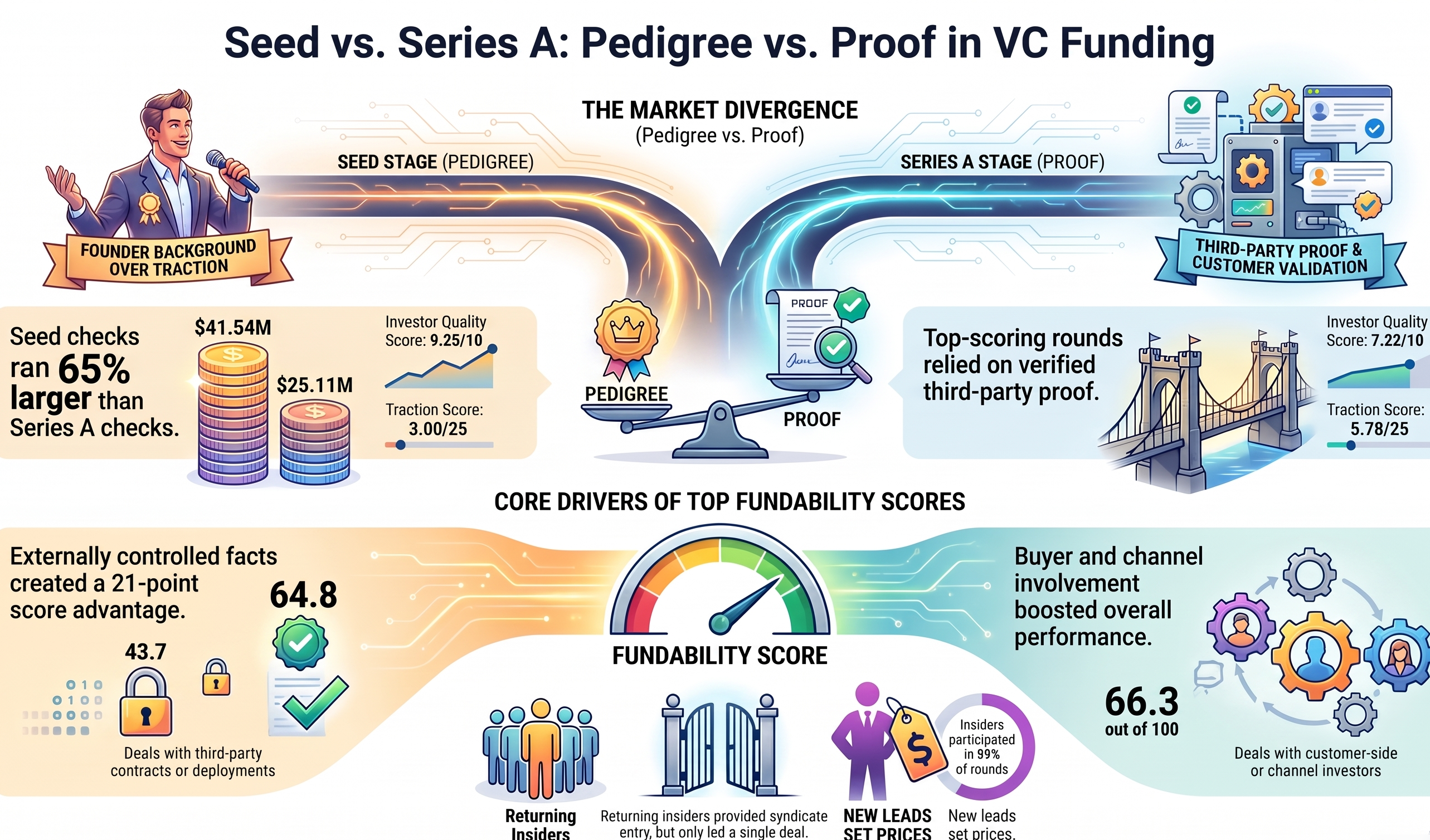
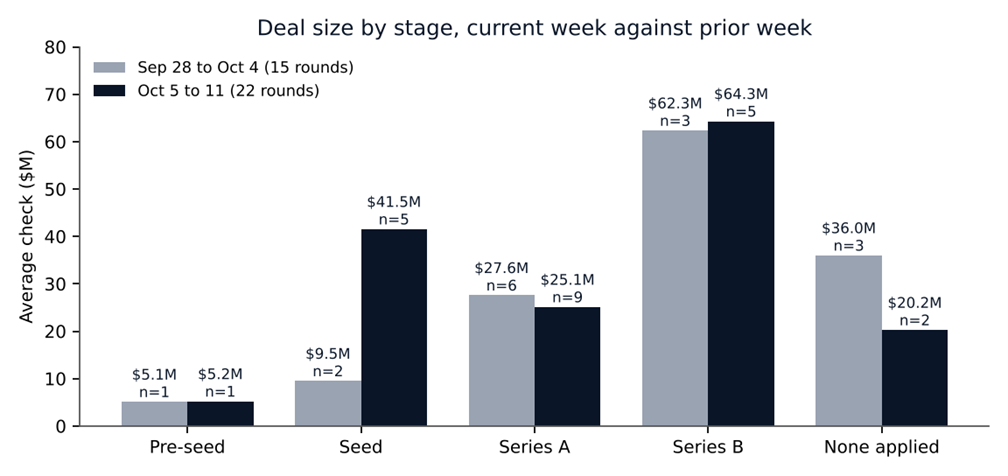
This week the average seed round in the US mid-market was $41.54M. The average Series A was $25.11M. Seed checks ran 65% larger than the next stage. Seven days earlier, the average seed round in the same set was $9.50M across two rounds. Five seed rounds were announced this week and three of them were $50M or more.
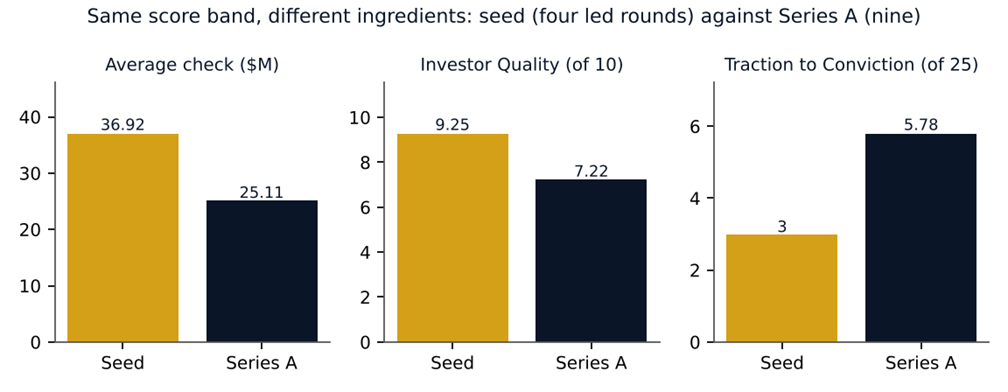
That would be a story about exuberance if the bigger checks had bought more of what this report measures. They did not. Take out the one seed round with no investor named anywhere in the record and the four remaining seeds averaged 9.25 of 10 on Investor Quality against 7.22 for the nine Series A rounds. On Traction to Conviction, the dimension that scores what outside parties have already underwritten, the same four seeds averaged 3.0 of 25. The Series A rounds averaged 5.78. The overall scores landed within 1.3 points of each other. Same band, opposite ingredients.
So two different markets cleared in the same five days. At seed, capital priced the people: the founders’ last employer and the firm writing the check. At Series A and beyond, capital priced the paper: a government contract vehicle, a buyer on the cap table, a named deployment somebody else can confirm. The five highest scores of the week all belong to Series A, Series B or unlettered rounds, and every one of those five carried a validation that a government body or a named customer controls.
Consequence for Monday. If you're going to price your round on pedigree, you already know it, and you don't need this report. Everyone else is in the second market. In that market, the check is smaller, the process takes the same amount of time, and a partner moves on a fact you don't control. Find out this week how many of those you hold.
The Week in One Sentence
Primary insight. Seed checks outgrew Series A checks because top-tier firms paid for founder pedigree in very young companies, while every one of the five rounds clearing 65 carried both third-party proof and an investor from a prior round.
· Total capital deployed. $800.9M in new primary capital across 22 verified US rounds between $5M and $100M.
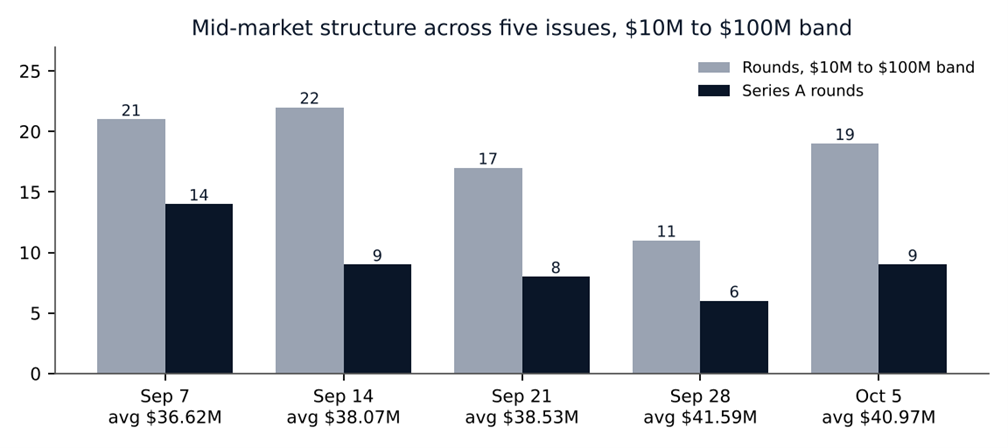
· Against prior issues. In the $10M to $100M band, this series has tracked 19 rounds and $778.5M since September, versus 11 rounds and $457.5M last week. Capital up 70.2%, deal count up 72.7%.
· Average round size. $36.40M across the full set, up 12.7% from $32.31M. On the $10M to $100M band, $40.97M against $41.59M, down 1.5%.
· Median round size. $30.0M across the full set, up 36.4% from $22.0M. On the $10M to $100M band, $30.0M against $38.0M, down 21.1%.
· Largest tracked round. Nous Research at $90.0M, a Series B. Smallest: Zeroset at $5.2M, a pre-seed.
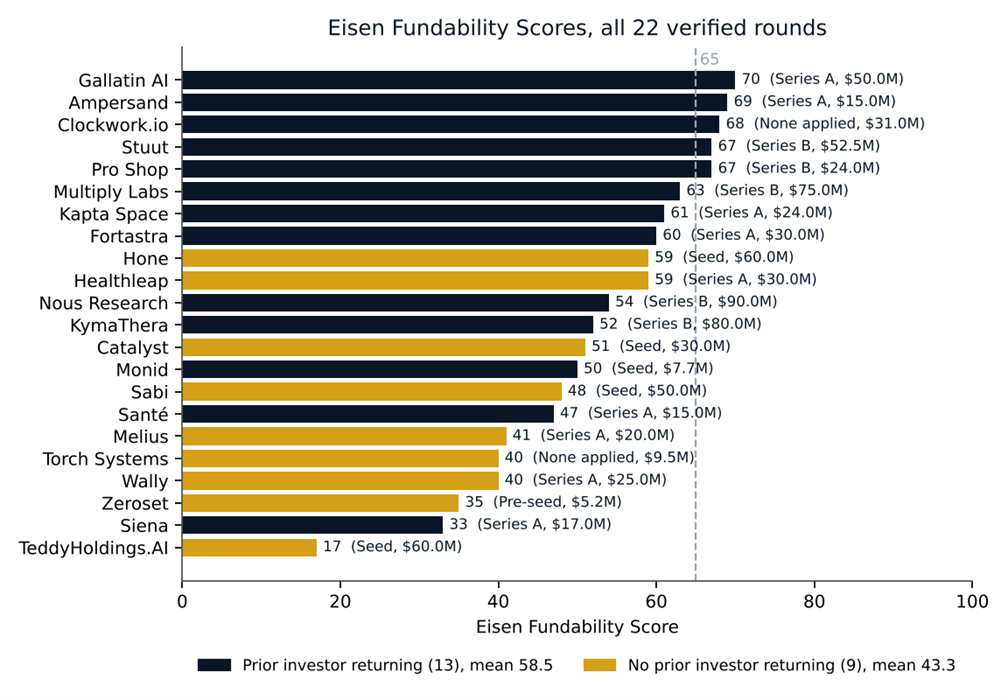
· Highest Eisen score. Gallatin AI at 70. Lowest: TeddyHoldings.AI at 17. Five of 22 rounds cleared 65. Mean 52.3, median 53.0.
· Named institutional lead. 19 of 22 rounds (86.4%), up from 14 of 15 (93.3%) last week.
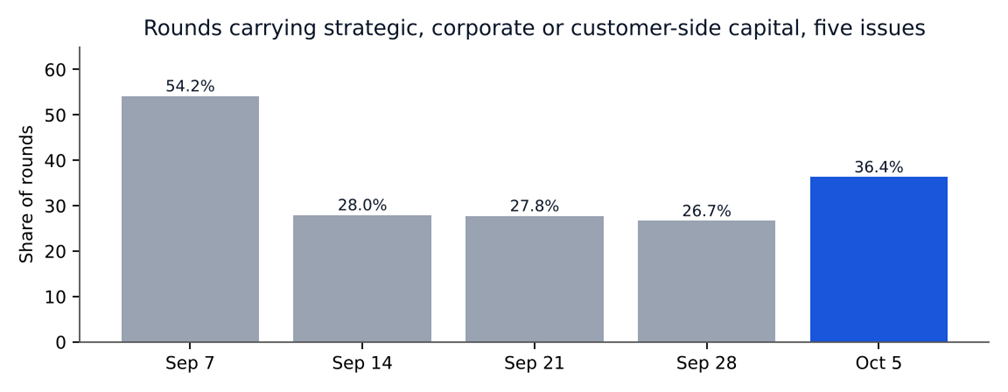
· Strategic or customer-side capital. 8 of 22 rounds (36.4%) carried $322.7M (40.3%) of the week’s capital, up from 4 of 15 (26.7%) last week.
· Returning investors. 13 of 22 rounds, or 59.1%, carried at least one investor from a prior round, against 7 of 15, or 46.7%, last week.
The Deal Scorecard
Eisen Fundability Scores run across five dimensions: Founder-Investor Dynamics (30), Traction to Conviction Conversion (25), Narrative Power (20), Deal Architecture (20) and Capital Planning (5). Scores of 90 to 100 signal an inevitable, market-defining outcome. 85 to 89 signals extremely strong execution. 75 to 84 signals solid fundamentals. 65 to 74 signals a good company with some gaps. Below 65 signals an early-stage or structurally incomplete round.
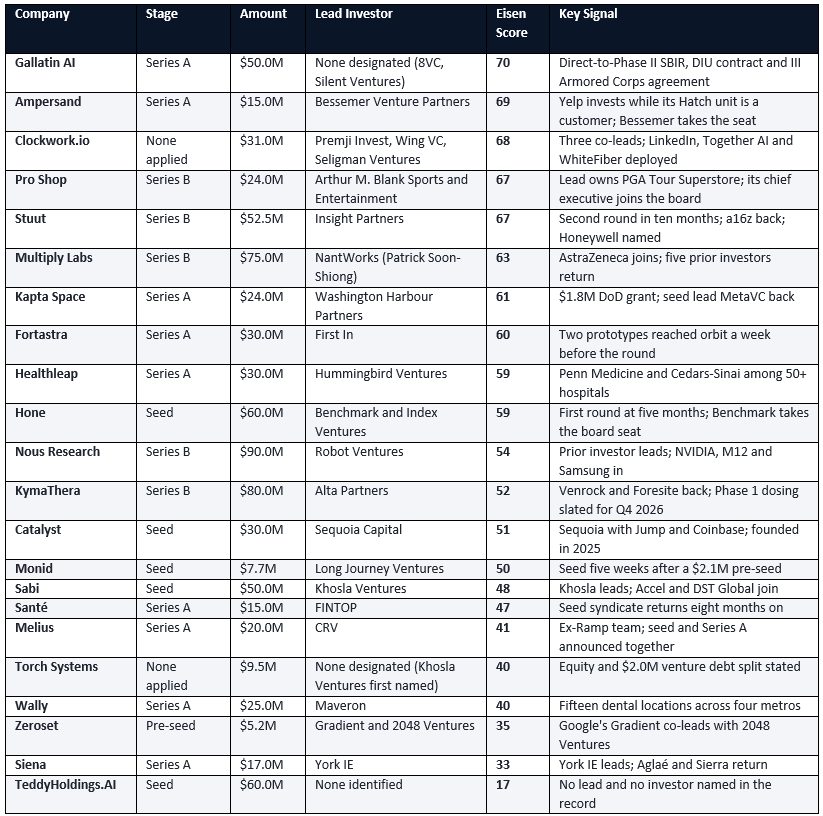
Amounts reflect new primary capital at close. Healthleap is counted at its $30.0M Series A; the $8.0M seed announced alongside it closed earlier and is excluded. Torch Systems is counted at $9.5M of equity; its $2.0M venture debt facility is excluded. Melius is counted at its $20.0M Series A. Stage labels are reported as each company applies them.
What the scorecard says at a glance
The top of the board is a Series A and B board. Gallatin AI at 70, Ampersand at 69, Clockwork.io at 68, Pro Shop and Stuut at 67. Five rounds cleared 65; each had a prior investor writing again, and each carried a third-party validation. Not one seed round made the top eight.
The highest score went to a round with no designated lead. Gallatin AI raised $50.0M from new and existing investors including 8VC and Silent Ventures, and no source names a price-setter. It still finished first on the highest Independent Validation mark in the set: a Direct-to-Phase II SBIR award through the Army Applications Laboratory, a Defense Innovation Unit contract and an agreement with III Armored Corps. Proof carried around the syndicate didn't structure.
The cheapest top-three round cost $15.0M. Ampersand is tied for the smallest Series A of nine and scored 69 because Yelp sits on its cap table while a Yelp company is a customer. A buyer that also invests settles the two hardest Series A questions with one reference call.
The floor is about missing structure. TeddyHoldings.AI raised a $60.0M seed with no lead and no investor identified anywhere in the record, and scored 17. Siena scored 33 on a $17.0M Series A with zero on Traction to Conviction. Zeroset scored 35 on a pre-seed.
Size and score barely moved together. The correlation between round size and score across the 22 rounds was 0.16. The eight rounds of $50M or more averaged 53.8. The fourteen below $50M averaged 51.5.
What Changed This Week
Four shifts, ranked by structural impact on founder fundraising rather than by deal size. Each is built on verified deal records and ends with what it means for your raise.
Shift 1: The Seed Round Outgrew Series A
Pattern, what happened. Five seed rounds raised $207.7M, averaging $41.54M and with a median of $50.0M. Nine Series A rounds raised $226.0M, averaging $25.11M and with a median of $24.0M. Three seeds reached $50M or more: Hone at $60.0M behind Benchmark and Index Ventures, Sabi at $50.0M behind Khosla Ventures, and TeddyHoldings.AI at $60.0M with no lead. Catalyst added $30.0M behind Sequoia Capital. Last week the same full set produced two seed rounds averaging $9.50M.
Perspective, what it means. A seed check above $30M is not a seed check in the old sense. It is a bet on a team large enough to skip the proof stage, written by firms that can afford to be wrong on the company and right on the people. That is why the four led seeds averaged 9.25 of 10 on Investor Quality, above every stage average in the set, and 3.0 of 25 on Traction to Conviction. Investors were underwriting what these founders had done somewhere else, not what these companies had done.
Founder Blindspot, what most miss. Founders read a $50M seed as evidence that the round size ceiling has lifted for everyone. It has lifted for a very small group with a very specific credential: a recent role at a company those investors already know. Strip TeddyHoldings.AI out, and the four led seeds averaged 52.0, versus 53.3 for Series A. The checks were 47% larger and the score was slightly lower. If you do not carry the credential, a seed process pitched at that size will spend three months proving you do not.
Playbook, what to do. Write one sentence that names the specific prior result your lead investor would be underwriting if they backed you on pedigree alone. A shipped product at scale, a team you built, a company that was acquired. If you cannot write it with a name and a date, size your round to the next proof point.
Contrast. Last week the full set carried two seed rounds averaging $9.50M. This week seed took 25.9% of capital against 28.2% for Series A, and the average seed check rose more than fourfold.
What this means for your raise: A large seed is a pedigree instrument. If your case rests on what your company has done, raise the round that the proof supports, and expect investors to read the proof.
Shift 2: Proof Someone Else Holds Topped the Board
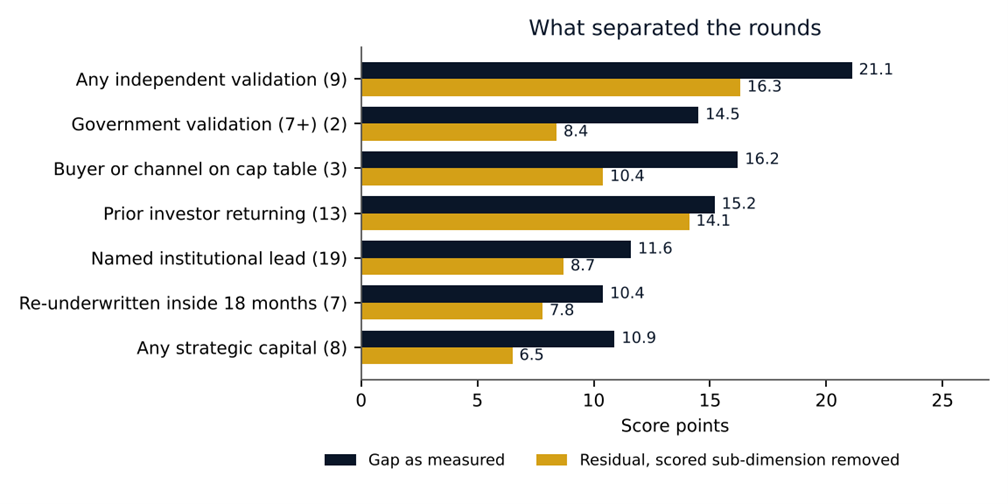
Pattern, what happened. Nine rounds carried at least one validation that a party outside the company controls: a government award, a named enterprise customer, a named hospital or platform deployment. Those nine averaged 64.8 against 43.7 for the thirteen without, a 21.1-point gap. Remove the Independent Validation sub-dimension from both sides and 16.3 points remain. Two of the nine carried government-grade validation. Gallatin AI holds a Direct-to-Phase II SBIR award, a Defense Innovation Unit contract for US Army Europe and Africa, and an agreement with III Armored Corps. Kapta Space holds a $1.8M Department of Defense grant. Those two averaged 65.5 and took $74.0M, or 9.2% of capital.
Perspective, what it means. A government contract or a named customer is the hardest form of proof to manufacture. Someone outside the company ran a competition or a procurement, committed budget, and left a record. An investment committee can confirm it without the company in the room. That is why these rounds also scored well on everything around the validation: experienced operators, specialist investors and prior investors back.
Founder Blindspot, what most miss. Founders confuse achievement with validation. Fortastra put two prototype spacecraft in orbit on October 1, a week before announcing its Series A, and still scored zero on Independent Validation because a launch is the company’s own milestone, not a third-party confirmation. It finished eighth on the strength of its team, investors and round construction. Eight rounds scored zero on all of Traction to Conviction, and together they raised $259.2M.
Playbook, what to do. List every external body that could grant you something checkable within two quarters: a contract vehicle, a clearance, a certification, a standards listing, a named reference account with a procurement function. Pick the fastest one and file for it this week.
Contrast. Last week semiconductors, robotics and defense took $116.0M as one category. This week defense, space and industrial took $113.5M across four rounds, almost the same capital, and placed three rounds in the top eight.
What this means for your raise: Count the facts about your company that somebody else certifies. Nine rounds this week had at least one and averaged 64.8. Thirteen had none and averaged 43.7.
Shift 3: More Insiders Came Back. Almost None Led.
Pattern, what happened. Thirteen of 22 rounds carried at least one investor from a prior round, against 7 of 15 last week. Those thirteen took $511.2M, or 63.8% of the week’s capital. They averaged 58.5 against 43.3 for the nine without, a 15.2-point gap. The Insider Support sub-dimension is worth two points; remove it and 14.1 points remain. Remove both Capital Planning items and 12.1 points remain. Seven rounds were re-underwritten within eighteen months at a larger size: Gallatin AI, Clockwork.io, Stuut, Fortastra, Nous Research, Monid and Santé. Monid raised its seed five weeks after a $2.1M pre-seed. Those seven averaged 59.4 against 49.0.
Perspective, what it means. A returning investor is the only party in a round who has seen the company from inside. That is why the gap survives with the mechanical scoring removed. But look at who led. Of the thirteen rounds with a returning investor, only Nous Research had a prior backer take the lead, with Robot Ventures leading its $90.0M Series B. In the other twelve, the insider followed a new price-setter.
Founder Blindspot, what most miss. Founders treat insider participation as the finish line. This week, it showed up in most rounds. What separated the field was whether a new firm was willing to set the price on top of it. Gallatin AI had its seed lead back and no one designated to lead; it scored 5 of 10 on Round Competition. Stuut had its Series A lead, Andreessen Horowitz, back and Insight Partners leading; it scored 7.
Playbook, what to do. Get your insiders’ number in writing four weeks before you open, then use it as the floor in front of new leads rather than as the round.
Contrast. Last week seven of fifteen rounds had an insider back, and they took 68.6% of capital. This week the share of rounds rose to 59.1% while the capital share slipped to 63.8%. Insiders spread across more rounds, and the new money still decided the price.
What this means for your raise: Your existing investors get you into the room. A new lead willing to price the round is what gets you out of it.
Shift 4: The Buyer Bought In
Pattern, what happened. Eight of 22 rounds carried strategic, corporate or customer-side capital, or 36.4%, up from 26.7% last week. In three of them, the investor buys, distributes, or produces in the company’s market. Arthur M. Blank Sports and Entertainment, which owns PGA Tour Superstore, led Pro Shop’s $24.0M Series B and put the Superstore chief executive on the board, with the PGA Tour returning. Yelp joined Ampersand’s $15.0M Series A while Hatch, a Yelp company, is a customer. AstraZeneca joined Multiply Labs’ $75.0M Series B as a maker of the biologic medicines Multiply’s robots are built to produce, though the two have not stated a commercial agreement. Those three averaged 66.3 against 50.1. With the scored sub-dimension removed, 10.4 points of the 16.2-point gap remain. The five rounds carrying corporate venture arms without a stated commercial tie, among them e& Capital, Microsoft’s M12, NVIDIA, Samsung, Coinbase and Google’s Gradient, averaged 55.0. Across all eight rounds, the gap was 10.9, and 6.5 after removal.
Perspective, what it means. A financial investor is buying a forecast of demand. An investing buyer has already tested that forecast through its own procurement, so its check is a receipt. A corporate venture arm with no commercial tie says a powerful company wants exposure. A channel owner on the board says the product will reach the shelf.
Founder Blindspot, what most miss. Founders rank corporate venture arms by logo. This week the logo mattered less than the commercial relationship behind it: 55.0 for the five rounds with a corporate venture arm and no stated tie, 66.3 for the three with a buyer or channel. The cost is in the terms: first refusal, exclusivity and information rights can narrow your exit for good.
Playbook, what to do. List your three largest customers and three largest channel partners. For each, find the person who runs their venture or strategic investment function. Settle your exclusivity position with counsel before the first meeting.
Contrast. Strategic participation has run at 54.2%, 28.0%, 27.8% and 26.7% of rounds over the last four issues. This week’s 36.4% is the first rise in a month, and a channel owner took both the lead seat and the board seat in the same round.
What this means for your raise: Rank investors by the customer they can deliver, not the logo they add. And settle your exclusivity position before anyone offers.
The Deals That Matter
Five deep dives across military logistics software, AI integration infrastructure, AI cluster infrastructure, golf media and enterprise AI agents. Four come from the week's top five scores. The fifth, Hone, is the most instructive seed round in the set. All facts are verified against two or more sources.
Gallatin AI
Military Logistics Software | Series A | $50.0M | No designated lead; 8VC and Silent Ventures
Eisen Fundability Score: 70 / 100
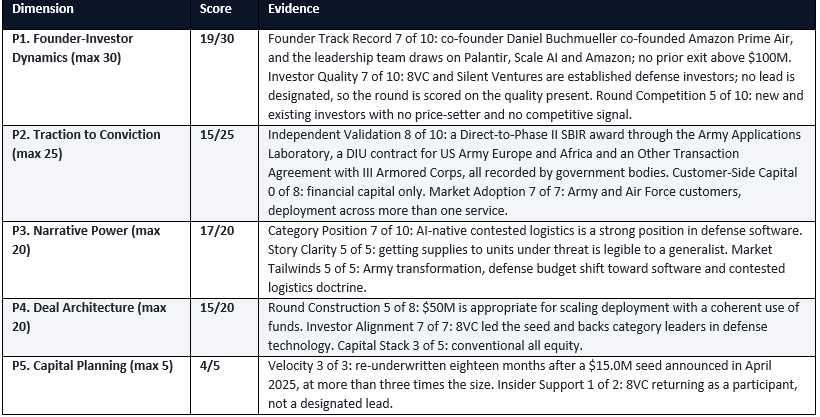
Why this scored. The highest score of the week, on a Traction to Conviction mark of 15 of 25 that only Pro Shop beat: three government-controlled awards, active users in two military services, and a round more than three times the size of the seed eighteen months later. It lost points in one place above all, the lead seat, and still finished first.
The Setup. Gallatin AI, based in El Segundo, California, builds AI-native logistics software for the US military. Its platform, Navigator, supports sustainment decisions in contested logistics, meaning how fuel, parts and munitions reach units when supply lines are under threat. Woody Glier is chief executive. Co-founder Daniel Buchmueller previously co-founded Amazon Prime Air, and the leadership team draws on Palantir, Scale AI and Amazon. The customers are Army and Air Force units.
The Deal. $50.0M Series A announced October 8, 2026, backed by new and existing investors including 8VC and Silent Ventures. No source names a lead. 8VC led the $15.0M seed announced in April 2025, so this round arrived eighteen months later at more than three times the size. Axios puts total capital at $70M, all equity. Third-party milestones: a Direct-to-Phase II SBIR award under the Army Applications Laboratory’s PORTAL program in March 2026, an Other Transaction Agreement with III Armored Corps in June 2026, and a Defense Innovation Unit contract for US Army Europe and Africa in July 2026.
The Pattern. This is the proof-carried round. In a week where the largest seed checks went to résumés, the top score went to a company whose central claims are recorded by contracting offices.
The Perspective. Look at what the missing lead cost. Gallatin AI scored 5 of 10 on Round Competition because nobody set the price. Every other dimension was strong. That tells you how much work the validation was doing: a round with no price-setter still outscored rounds led by Bessemer, Insight and Sequoia. A Series B lead will start diligence by asking who priced this one.
The Playbook. If you sell to government, map every contract vehicle you hold or can enter: SBIR and STTR phases, Direct-to-Phase II, Other Transaction Authority agreements, DIU commercial solutions openings. Then get one investor to commit in writing to lead, price and take the seat before you accept the second commitment.
The Founder Mistake to Avoid. Founders copy the validation and skip the structure. A round assembled from strong participants with nobody leading gets a good close and a hard next round, because the next investor has no prior price-setter to benchmark against or call.
Ampersand
Integration Infrastructure for AI Agents | Series A | $15.0M | Led by Bessemer Venture Partners
Eisen Fundability Score: 69 / 100
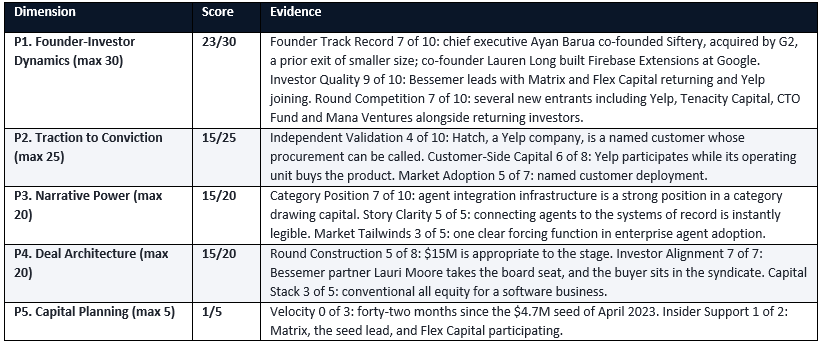
Why this scored. The tightest investor alignment in the set at a $15.0M check. Bessemer leads with its partner joining the board, Matrix and Flex Capital return, and Yelp invests while a Yelp company buys the product. It is the only Series A in the set with a buyer on the cap table.
The Setup. Ampersand, based in San Francisco, provides integration infrastructure that connects AI agents to the enterprise software stack: the CRMs, ERPs and systems of record agents need to read from and write to. Chief executive Ayan Barua previously co-founded Siftery, which G2 acquired, and then served as vice president of engineering at G2. Co-founder Lauren Long built Firebase Extensions at Google. Its customers are companies whose AI agents need to act inside enterprise systems.
The Deal. $15.0M Series A announced October 6, 2026, led by Bessemer Venture Partners, with partner Lauri Moore joining the board. Matrix and Flex Capital return. Yelp, Tenacity Capital, CTO Fund and Mana Ventures join. Hatch, which Yelp agreed to acquire in January 2026, is a named customer. The prior round was a $4.7M seed led by Matrix in April 2023. All equity.
The Pattern. This is the buyer-in-the-syndicate round. Yelp’s participation alongside Hatch’s customer relationship means the investor and the operating business confirmed the same product through two different processes.
The Perspective. Notice what Ampersand did not score. Velocity was 0 of 3 because forty-two months separate the seed and the Series A. In a framework that rewards speed, the company still finished second.
The Playbook. If one of your customers belongs to a larger group, find out whether the parent has a venture or strategic investment function. A small check from the parent turns a customer reference into a cap table fact.
The Founder Mistake to Avoid. Founders take any corporate check from a customer’s parent without separating the investing arm from the operating business. The investment approval and the operating unit’s purchase are two different decisions. Ampersand has both.
Clockwork.io
AI Cluster Infrastructure Software | No series letter | $31.0M | Co-led by Premji Invest, Wing VC and Seligman Ventures
Eisen Fundability Score: 68 / 100
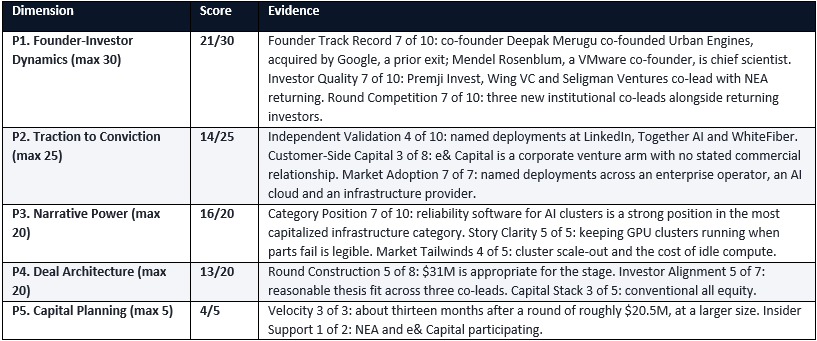
Why this scored. A co-founder with a prior acquisition by Google, three co-leads, returning investors, named deployments across three customer types and a round re-underwritten about thirteen months after the last one at a larger size. Strong on every dimension, spectacular on none.
The Setup. Clockwork.io, based in Palo Alto, builds a fault-tolerance software layer that keeps large AI training and inference clusters running when hardware or network links fail. Its founders are Stanford professor Balaji Prabhakar, Yilong Geng, whose Stanford research produced the Huygens clock-synchronization technology behind the platform, and Deepak Merugu, who previously co-founded Urban Engines, acquired by Google. Mendel Rosenblum, a VMware co-founder, is chief scientist. Suresh Vasudevan, formerly chief executive of Nimble Storage and Sysdig, is chief executive. LinkedIn, Together AI and WhiteFiber are named deployments.
The Deal. $31.0M announced October 6, 2026, co-led by Premji Invest, Wing VC and Seligman Ventures, with NEA and e& Capital, the venture arm of the telecom group e&, returning. The company applies no series letter. A round of roughly $20.5M was recorded in September 2025, and NEA led a $21M Series A in March 2022. Total capital $73M.
The Pattern. This is the infrastructure re-underwriting round. AI cluster software sells to a small number of very large buyers, so each named deployment carries weight. LinkedIn is an enterprise operator, Together AI is an AI cloud, WhiteFiber is an infrastructure provider.
The Perspective. Three co-leads can mean overwhelming demand or a round nobody would take whole. Here, two facts point to demand: the round came about thirteen months after the last one and it was larger.
The Playbook. Map your named deployments by customer segment, not by logo size. If all your references are in one segment, a new lead will discount them as one data point. Pick the adjacent segment where you could land a reference account inside two quarters and assign an owner to it this week.
The Founder Mistake to Avoid. Founders with a prior exit treat the exit as the case. Clockwork.io scored 7 of 10 on Founder Track Record, not 10, because the top mark requires a verified exit above $100M. The round cleared on the team, plus the deployments, plus the velocity.
Pro Shop
Golf Media and Entertainment | Series B | $24.0M | Led by Arthur M. Blank Sports and Entertainment
Eisen Fundability Score: 67 / 100
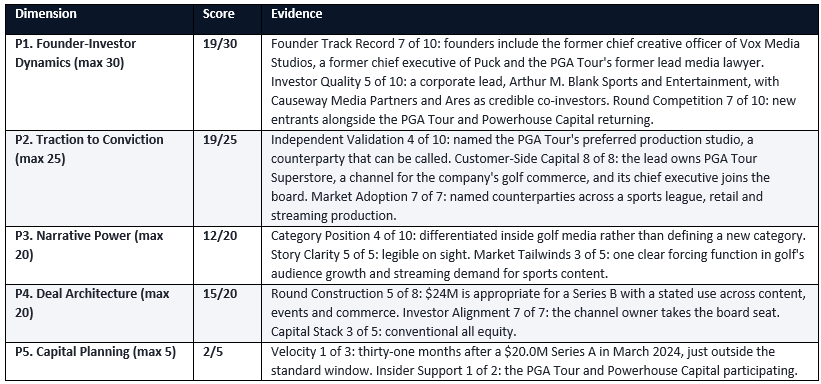
Why this scored. The highest Traction to Conviction mark in the set at 19 of 25. The lead investor owns a retail channel for the company’s commerce business and placed that channel’s chief executive on the board. The PGA Tour has returned as an investor and named Pro Shop Studios its preferred production studio.
The Setup. Pro Shop, based in Ponte Vedra Beach, Florida, is a golf media, entertainment and commerce company. Its founders are Chad Mumm, formerly chief creative officer of Vox Media Studios and an executive producer of Netflix’s Full Swing; Joe Purzycki, formerly chief executive of Puck; David Miller, formerly the PGA Tour’s lead media lawyer; and Mark Olsen.
The Deal. $24.0M Series B announced October 5, 2026, led by Arthur M. Blank Sports and Entertainment, with Troy Rice, chief executive of PGA Tour Superstore, an AMBSE company, joining the board. Causeway Media Partners and the Ares Sports, Media and Entertainment funds join. The PGA Tour and Powerhouse Capital, which led the Series A, return. The prior round was a $20.0M Series A in March 2024. All equity.
The Pattern. This is the channel-led round. AMBSE is not a venture firm, and the rubric marks Investor Quality down for that: 5 of 10. But the same structure earns the maximum on Customer-Side Capital, because the lead owns the retail channel through which Pro Shop’s golf commerce reaches buyers.
The Perspective. Founders tend to see a corporate lead as a weaker signal than a venture lead, and on pure investor brand, they are right. What they miss is that a channel owner taking the board seat converts a distribution plan into a governance fact.
The Playbook. List the three companies that control how your product reaches customers: retailers, marketplaces, platforms, distributors. For each, find out whether it has an investment arm or a holding company that does. Where distribution is the bottleneck, a channel lead can be worth more than a brand-name venture firm.
The Founder Mistake to Avoid. Founders take channel money without channel terms. Before a distributor leads your round, decide your position on exclusivity, most-favored-nation pricing and rights of first refusal.
Hone
Autonomous Enterprise AI Agents | Seed | $60.0M | Led by Benchmark, co-led by Index Ventures
Eisen Fundability Score: 59 / 100
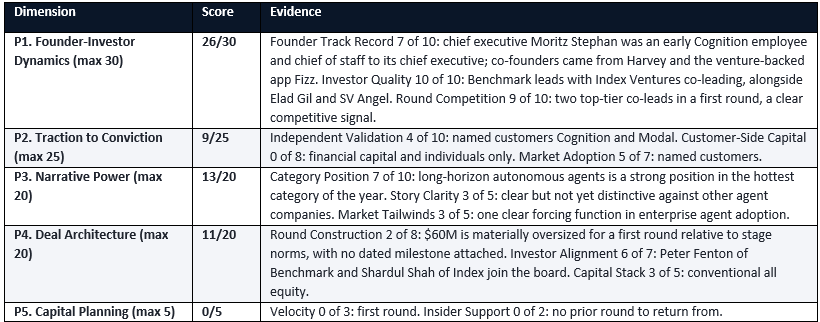
Why this scored. The strongest Founder-Investor Dynamics mark in the set at 26 of 30 and the weakest Capital Planning score possible at 0 of 5. Hone is the clearest example of the pedigree market: two top-tier co-leads, a founder from one of the most closely watched AI companies, and a company reported to be five months old.
The Setup. Hone, based in San Francisco, builds what it calls Engines: AI agents that take ownership of a business goal over weeks rather than completing one task at a time. Chief executive Moritz Stephan was one of Cognition’s first employees and became chief of staff to its chief executive. Co-founder Oliver Brady was an early engineer at Harvey, and co-founder Carlo Kobe is a Thiel Fellow who started the app Fizz. Named customers include Cognition and Modal.
The Deal. $60.0M seed announced October 8, 2026, led by Benchmark, with Index Ventures co-leading. Elad Gil, Hanabi, Definition, Diffusion and SV Angel participate, and Cognition chief executive Scott Wu invested personally. Peter Fenton of Benchmark and Shardul Shah of Index join the board. This is the company’s first round. All equity.
The Pattern. This is the pedigree round at full size. Two firms famous for selectivity co-led a first round in a company with two named customers, one of them the founder’s previous employer.
The Perspective. The score shows where the risk sits. Round Construction scored 2 of 8 because $60.0M is materially oversized for a company that has not yet set a milestone the round is built to reach. Capital Planning scored zero because there is no prior round to re-underwrite. The investors have taken the proof risk onto their own balance sheet, and the Series A investor will ask for it back.
The Playbook. If you have the pedigree for a round like this, use the size to buy proof quickly. Name the two milestones that would let a Series A investor underwrite the company rather than the team, put dates on them, and size the hiring plan to hit both inside eighteen months.
The Founder Mistake to Avoid. Founders without the credential copy the size. A $60M seed works when the investor is underwriting someone they've already watched succeed. Without that, the same ask turns into a slow no from twenty firms.
The Fundraising Playbook
Five plans, each producing a concrete artifact you can use this week. Each is built directly from this week’s verified signals.
Plan 1: The Pedigree or Proof Decision (Narrative and Investor Framing)
Focus. Decide which market your round clears in before you write a word of the deck.
Why this matters. The four led seed rounds averaged 9.25 on Investor Quality and 3.0 of 25 on Traction to Conviction. The nine Series A rounds averaged 7.22 and 5.78. The two groups landed 1.3 points apart overall on opposite ingredients.
Exact deliverable. One headline sentence for your deck, written as a risk-reduction claim. If you are in the pedigree market, it names the prior result your investor is underwriting: the product you shipped, the team you scaled, the company that was acquired. If you are in the proof market, it names the fact a third party controls: the contract, the clearance, the named deployment. Then cut every slide that argues for the other market.
Time estimate. Two hours to draft, one hour with an investor you trust to test it.
Expected outcome. A partner understands in one sentence why backing you is lower risk than it looks, and the rest of the deck supports that sentence instead of hedging between two stories.
The reframe. Wrong approach: pitch the vision and hope the credential carries it. Right approach: name the single fact that reduces the investor’s risk, and build the deck around it.
Plan 2: Obtain One Externally Controlled Fact (Proof Architecture)
Focus. Acquire one validation that someone other than you grants and records.
Why this matters. Nine rounds with at least one independent validation averaged 64.8. Thirteen without averaged 43.7. With the sub-dimension removed, 16.3 points of the 21.1-point gap remain. The two rounds with government-grade validation averaged 65.5. Eight rounds scored zero across all of Traction to Conviction.
Exact deliverable. A three-column inventory: every validation a third party could grant you in the next two quarters, the body that grants it, and the earliest date it could land. Contract vehicles, clearances, certifications, standards listings, reference-grade customer accounts with a procurement function. Pick the fastest one, assign an owner and file this week.
Time estimate. Three hours for the inventory. It takes two to four months to get the first validation, which is why the filing date matters more than the announcement date.
Expected outcome. You open your process with a fact a partner can confirm without you.
The reframe. Wrong approach: treat your own milestones as proof. Right approach: obtain one fact somebody else certifies, then raise after it lands.
Plan 3: Eisen Self-Score and Gap Diagnosis (Readiness)
Focus. Score your round on the five dimensions and decide between a process now and a repair sprint first.
Why this matters. The board ran from 17 to 70 with a mean of 52.3. Five rounds cleared 65 and every one had a prior investor back. The three led seed rounds of $30M or more scored between 48 and 59.
Exact deliverable. A one-page score: Founder-Investor Dynamics (30), Traction to Conviction (25), Narrative Power (20), Deal Architecture (20), Capital Planning (5). Circle your two lowest dimensions. If you score above 65, run a parallel process with a hard deadline. If you score 50 to 65, spend four to six weeks repairing the lowest dimension first. Below 50, the gap is structural, meaning no lead, no returning investor or no external validation, and a better deck will not close it.
Expected outcome. A decision about process design, made before the first meeting rather than after the tenth pass.
The reframe. Wrong approach: score yourself, feel discouraged, rewrite the deck. Right approach: find your two lowest dimensions and decide this week whether to raise now or repair first.
Plan 4: The Lead Seat and the Buyer List (Deal Architecture and Investor Targeting)
Focus. Secure a price-setter and rank investors by what they deliver.
Why this matters. Thirteen of 22 rounds had an insider back, but only one had a prior investor lead. Gallatin AI scored 5 of 10 on Round Competition because no one set the price. Three rounds with a buyer or channel on the cap table averaged 66.3, and with the sub-dimension removed 10.4 points of the gap remain.
Exact deliverable. Three items. First, cut your target list to 35 names where you can cite a round each firm led at your stage in the last 90 days, and add the firms that led this week: Bessemer, Insight Partners, Arthur M. Blank Sports and Entertainment, Premji Invest, Wing VC, Seligman Ventures, First In, NantWorks, Washington Harbour Partners, Hummingbird Ventures, Benchmark, Index Ventures, Robot Ventures, Alta Partners, Long Journey Ventures, Khosla Ventures, FINTOP, Sequoia Capital, CRV, Maveron, Gradient, 2048 Ventures and York IE. Second, a buyer list of six names: your three largest customers and three largest channels, each with the person who runs their investment function. Third, split your use of funds into two columns, unproven outcomes and predictable cash cycles, and total the second. That total is the part a lender could finance instead of equity.
Time estimate. One day for the lists. One hour with counsel to pre-draft positions on first refusal, exclusivity and information rights.
Expected outcome. You get one investor to confirm in writing that they will lead, price the round and take the seat before you accept a second commitment, and you know which corporate checks bring a customer.
The reframe. Wrong approach: collect commitments and hope a lead emerges. Right approach: secure the lead first, then let insiders and buyers fill the round behind the price.
Plan 5: The Milestone-Timed Process (Momentum and Conversion)
Focus. Run a short process that opens after your next validation lands and creates competition through dated milestones.
Why this matters. Seven rounds were re-underwritten within eighteen months at a larger size and averaged 59.4 against 49.0. Fortastra announced its Series A one week after its first spacecraft reached orbit. Monid raised its seed five weeks after its pre-seed.
Exact deliverable. A 14-day follow-up cadence tied to dated milestones. Day 0: open with the validation already in hand. Day 3: send every active firm one dated progress note. Day 7: second note with a named customer or partner development. Day 10: insider commitment confirmed in writing. Day 14: term sheet deadline.
Time estimate. Four hours to build the calendar and draft the notes, plus the discipline to hold the deadline.
Expected outcome. Investors see the company moving between meetings, the process stays short enough to create urgency, and the deadline forces a decision.
The reframe. Wrong approach: open the process and follow up when someone asks. Right approach: time the open to your validation and give every investor a new dated fact every few days.
Looking Forward
Three evidence-based scenarios and one wild card for the next one to three weeks. Each is anchored to this week’s verified data.
Scenario 1: Pedigree Seeds Keep Clearing Above $30M (High Probability)
Why this is likely. Three of five seed rounds this week were led by Benchmark and Index, Khosla or Sequoia, at $30.0M to $60.0M. Last week the full set carried two seeds averaging $9.50M.
What founders should watch. Whether two or more seed rounds above $30M appear in the next issue, and whether their founders again come from a short list of AI labs and agent companies. If they do, the large seed is a durable lane for that profile, not a market-wide change.
What founders should do before others notice. If you do not carry that credential, size your seed to your next proof point and close it fast while top-tier attention is on the pedigree lane. If you do, raise now: the firms competing for you this month may not be competing in the next.
Scenario 2: Defense and Space Keep Outscoring Their Capital Share (Medium-High Probability)
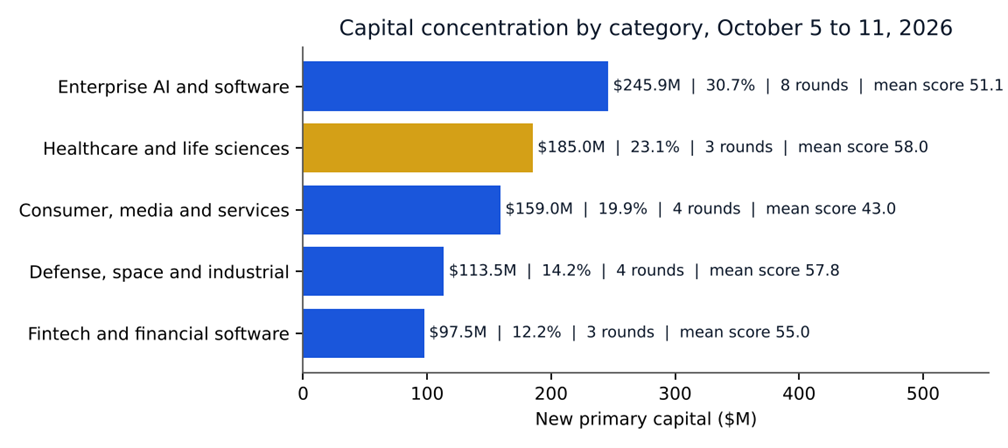
Why this is likely. Defense, space and industrial averaged 57.8 against 52.3 for the whole set while taking 14.2% of capital. The two rounds with government-grade validation averaged 65.5 and took 9.2%. Specialist firms such as 8VC, First In, Washington Harbor Partners and Bison Ventures were active in the same week.
What founders should watch. Whether the next issue shows a defense or space round above $50M with a named lead, and whether generalist firms appear in these syndicates.
What founders should do before others notice. If you sell to government, file for the next contract vehicle now. If you do not, build the equivalent: the procurement-grade reference account or certification that does for your category what a DIU contract does for defense.
Scenario 3: The Insider Lead Becomes the Differentiator (Medium Probability)
Why this is likely. Returning investors appeared in 59.1% of rounds, up from 46.7% last week. When a signal becomes that common, the market looks for a finer one. Only one of thirteen insider rounds this week had a prior investor in the lead seat.
What founders should watch. Whether the share of rounds with a returning investor holds above half and whether the score gap narrows. If the share stays high and the gap compresses, the edge will shift to whether an insider leads.
What founders should do before others notice. Ask your largest existing investor this month whether they would lead your next round if no new firm does.
Wild Card: Channel Owners Take the Lead Seat (Medium Probability)
Evidence from this week. Arthur M. Blank Sports and Entertainment led Pro Shop’s Series B and seated the chief executive of PGA Tour Superstore on the board. Yelp joined Ampersand while a Yelp company is a customer. AstraZeneca joined Multiply Labs. Three rounds with a buyer or channel averaged 66.3, the highest of any group measured in this report.
What founders should do before others notice. Identify the holding company or corporate parent behind your most important distribution channel and approach its investment function before a competitor does. Prepare your exclusivity position first, because a channel lead will ask for one.
The Bottom Line
The real insight is not the $800.9M. It is that two markets cleared in the same week on different evidence. Top-tier firms paid more for seed rounds than the market paid for Series A, and they paid for people. Everyone else got funded on facts somebody else had already confirmed. The five rounds clearing 65 all had a prior investor back, all five carried a third-party validation, and two had a buyer or channel on the cap table. That produced three conviction profiles.
Profile 1: Companies whose proof is held by a third party. Gallatin AI (70) holds a Direct-to-Phase II SBIR award, a III Armored Corps agreement and a DIU contract. Clockwork.io (68) is deployed at LinkedIn, Together AI and WhiteFiber. Kapta Space (61) holds a Department of Defense grant. Healthleap (59) runs in more than 50 hospitals, including Penn Medicine and Cedars-Sinai. Nine rounds had at least one external validation and averaged 64.8 against 43.7.
Profile 2: Companies whose buyer or channel wrote a check. Ampersand (69) took money from Yelp while a Yelp company is a customer. Pro Shop (67) was led by the PGA Tour Superstore owner. Multiply Labs (63) added AstraZeneca. These three averaged 66.3, and 10.4 points of their 16.2-point gap survive removal of the scored sub-dimension.
Profile 3: Companies whose founders were the asset. Hone (59) raised $60.0M behind Benchmark and Index in its first round. Catalyst (51) raised $30.0M behind Sequoia. Sabi (48) raised $50.0M behind Khosla. These rounds scored 10 of 10 on Investor Quality and between 0 and 9 of 25 on Traction to Conviction. The capital is real. The proof is still to come, and the next investor will ask for it.
Five New Rules for Founders
1. Know which market you are in. The four led seeds were 47% larger than the average Series A and scored 1.3 points lower. Pedigree buys size. Proof buys score.
2. Own one fact you do not control. Nine rounds with external validation averaged 64.8 against 43.7 for thirteen without, and 16.3 points of that gap survive removal of the sub-dimension.
3. Insiders get you in; a lead gets you priced. Thirteen of 22 rounds had an insider back, and only one had an insider leading. Secure a price-setter before a second commitment.
4. Rank corporate investors by the customer they bring. Three rounds with a buyer or channel averaged 66.3. Five with a corporate venture arm and no stated commercial tie averaged 55.0.
5. Time the round to the milestone. Seven rounds re-underwritten within eighteen months averaged 59.4 against 49.0. Open after the validation lands, not before.
Four Actions
1. Write the one sentence that says which market you are raising in, and name the prior result or the third-party fact it rests on.
2. Build the validation inventory: every fact a third party could grant you in two quarters, the granting body and the earliest date. File for the fastest one.
3. Ask your largest existing investor for a number in writing and a yes or no on leading if no new firm steps in.
4. List your three largest customers and three largest channels with the person who runs each one’s investment function, and agree your exclusivity position with counsel before you call.
Twenty-two companies cleared this week, and the board split along a single line: whether the case rested on a person or on a fact someone else controls. You cannot change your résumé by Friday. You can start the contract, the certification or the customer reference that changes what an investor reads about you, and you can start it on Monday.
Research Methodology, Sources and Verification
Data collection period and verification standard
Data collection period: October 5 to 11, 2026. Verified primary announcements cluster between October 5 and October 9. No verified US mid-market round was announced on October 10 or 11, a Saturday and Sunday. Verification standard: at least two independent sources per deal, with a company release, investor post, filing or regulated newswire (PR Newswire, Business Wire, GlobeNewswire) as the anchor where one exists, plus at least one independent outlet. We ran passes independently, and the last was adversarial, aimed at finding errors in the one before it. All arithmetic was recomputed from the final deal record. Eisen Fundability Scores are proprietary analytical estimates, not endorsements or investment advice.
Core capital totals and what they include
The $800.9M weekly total includes only the 22 verified US rounds in the scorecard, each counted at new primary capital at close. Mid-market is defined as a US-headquartered round between $5M and $100M. Because earlier issues in this series used a $10M to $100M band, week-over-week comparisons are also calculated on that subset: 19 rounds totaling $778.5M at an average of $40.97M and a median of $30.0M, against 11 rounds totaling $457.5M at an average of $41.59M and a median of $38.0M in the prior issue. Full-set comparisons use the prior issue’s 15 rounds totaling $484.6M at an average of $32.31M and a median of $22.0M.
Excluded from counted amounts: credit facilities and venture debt, secondary purchases, previously closed rounds announced alongside new ones, SAFE conversions, non-dilutive grants and cumulative totals. Three restatements follow from this rule. Healthleap announced $38M across an $8M seed co-led by Sequoia and First Round and a $30M Series A led by Hummingbird Ventures; the seed is a previously closed round and only the $30.0M Series A is counted. Torch Systems announced $11.5M comprising $9.5M of equity and $2.0M of venture debt from First Citizens Bank; $9.5M is counted. Melius announced $25M comprising a $20M Series A led by CRV and a $5M seed led by General Catalyst; $20.0M is counted.
Stage subtotals: Series B $321.5M across five rounds; Series A $226.0M across nine; Seed $207.7M across five; no series letter $40.5M across two; Pre-seed $5.2M across one. Sector subtotals: Enterprise AI and software $245.9M across eight; Healthcare and life sciences $185.0M across three; Consumer, media and services $159.0M across four; Defense, space and industrial $113.5M across four; Fintech and financial software $97.5M across three. Geography: California $473.4M across 13 rounds, New York $279.5M across seven, Florida $24.0M and Washington $24.0M across one each. Each set sums to $800.9M across 22 rounds.
Scoring calibration notes
All rounds are scored on the v2 rubrics in the project framework. Founder Track Record is scored on the verifiable public record of prior companies, exits, operating roles and domain tenure. Rounds with no designated lead are scored on the institutional quality actually present rather than at zero, consistent with prior issues; this applied to Gallatin AI and Torch Systems, and the absence of a price-setter is reflected in Round Competition. TeddyHoldings.AI scores zero on Investor Quality because no investor of any kind is identified. Rounds with no verifiable prior round or returning investor in the record score zero on both Capital Planning items, which applied to Hone, Sabi, Catalyst, Healthleap, Zeroset, Torch Systems, Wally, Melius and TeddyHoldings.AI. Pro Shop’s 31-month interval falls between the standard and late bands and scores 1 on velocity. Corporate venture arms are scored 3 on Customer-Side Capital unless a commercial relationship is stated; a buyer, channel or strategic buyer participating scores 6; a channel owner leading scores 8. Independent Validation credits only awards, grants, contracts and named customers or deployments that a party outside the company controls; launches, memoranda of understanding and contracts described only by the company are not credited.
Circularity control. Where a finding rests on a scored input, the sub-dimension is removed from both sides and the residual is published alongside the headline. Returning investor: 15.2 measured, 14.1 without Insider Support, 12.1 without both Capital Planning items. Any independent validation: 21.1 and 16.3. Government-grade validation: 14.5 and 8.4, on two rounds. Buyer or channel on the cap table: 16.2 and 10.4. Any strategic capital: 10.9 and 6.5. Named institutional lead: 11.6 and 8.7. Re-underwritten within eighteen months: 10.4 and 7.8. The seed against Series A comparison was tested the same way: with TeddyHoldings.AI removed and Capital Planning stripped from both sides, the four led seeds average 51.0 against 51.4 for Series A, so the score difference between the stages is negligible and the central finding rests on composition and check size, not on the total score. Score bands are stated once, in The Deal Scorecard.
Deal citations
Gallatin AI, $50.0M Series A. PR Newswire company release and Axios exclusive dated October 8, 2026; SiliconANGLE; Defense Daily; Pulse 2.0; runtimewire. Seed terms from FreightWaves dated April 8, 2025, which calls the round both pre-seed and seed. Validations from TechEdge AI (Direct-to-Phase II SBIR through the Army Applications Laboratory, March 16, 2026), Soldier Systems (III Armored Corps Other Transaction Agreement, June 11, 2026) and AJOT (DIU Joint Sustainment Decision Tool contract, July 15, 2026). No source names a lead. Pulse 2.0 and SiliconANGLE date the seed to 2024 against the April 2025 announcement; Axios gives total capital of $70M against $65M implied by the two rounds. Rated HIGH on the round itself.
Ampersand, $15.0M Series A. PR Newswire company release dated October 6, 2026; Pulse 2.0; The SaaS News; Startup Researcher. Seed terms from TechCrunch dated April 13, 2023. Yelp’s agreement to acquire Hatch from Pulse 2.0 dated January 22, 2026. Rated HIGH.
Clockwork.io, $31.0M. Company release dated October 6, 2026, read through HPCwire; The SaaS News; TechFundingNews; Pulse 2.0; runtimewire. Series A terms from Venture Capital Journal dated March 17, 2022. The September 2025 round appears only in data aggregators at $20.5M to $20.6M. One aggregator labels this round a Series C; the company applies no letter and none is used. Rated HIGH.
Pro Shop, $24.0M Series B. PR Newswire company release dated October 5, 2026; MediaPost; The SaaS News; EssentiallySports; VC News Daily. Series A terms and founder backgrounds from the PGA Tour’s announcement dated March 7, 2024. Rated HIGH.
Stuut, $52.5M Series B. Insight Partners investment post; Pulse 2.0; The Next Web; AlleyWatch; VC News Daily. Series A terms from Fortune dated November 20, 2025. Rated HIGH.
Multiply Labs, $75.0M Series B. MobiHealthNews; Pharma Manufacturing; The AI Insider; Axios; VC News Daily. No source describes AstraZeneca as a customer. Rated HIGH.
Kapta Space, $24.0M Series A. GeekWire dated October 9, 2026; company release reported by VC News Daily; Dealroom. Seed terms from Techleap. The company release reports multiple classified moving-target-indication contracts; these cannot be confirmed independently and are not credited. Rated HIGH.
Fortastra, $30.0M Series A. Payload dated October 8, 2026; Raksha Anirveda; runtimewire; VC News Daily. Seed terms from Payload dated December 11, 2025. A Space Force award reported in an earlier pass could not be confirmed and is not used; RTX Ventures participation appears in a single source and is not counted. Rated HIGH.
Healthleap, $30.0M Series A. TechCrunch; MobiHealthNews; Fierce Healthcare; Tech Startups dated October 7, 2026; citybiz. Rated HIGH.
Hone, $60.0M Seed. Bloomberg report dated October 8, 2026; FinSMEs; Trending Topics; runtimewire. The five-month company age appears in a single outlet and is reported as such. Rated HIGH.
Nous Research, $90.0M Series B. The Wall Street Journal and TechCrunch reports dated October 7, 2026; Dealroom; Tech Startups. Robot Ventures is identified as a prior backer by The Block. Headquarters is variously given as New York, Austin and Saratoga, all US. Rated MEDIUM on the headquarters conflict and reliance on reported rather than company-stated terms.
KymaThera, $80.0M Series B. PR Newswire company release dated October 6, 2026; Pulse 2.0; Dealroom; Pharmacally. The chief executive’s twenty years at Pfizer are from a Business Wire release dated July 8, 2020. Rated HIGH.
Catalyst, $30.0M Seed. Fortune exclusive dated October 8, 2026; Pulse 2.0; Crypto Briefing; CryptoRank. The company calls the round a seed and one aggregator a Series A; the company’s label is used. Rated MEDIUM on the stage conflict.
Monid, $7.7M Seed. Dealroom dated October 6, 2026; Forkast; Crypto Briefing; Tech Startups dated October 7, 2026. Rated HIGH.
Sabi, $50.0M Seed. Company release dated October 9, 2026; Forbes; AI Weekly; VC News Daily. VC News Daily places the company in San Francisco and AI Weekly in Palo Alto, both California. Rated HIGH.
Santé, $15.0M Series A. PR Newswire company release dated October 6, 2026; AlleyWatch; VC News Daily; Tech Startups. Seed terms from Axios Pro and Pulse 2.0, February 2026. Rated HIGH.
Melius, $20.0M Series A. TechCrunch dated October 6, 2026; Dealroom; The SaaS News; Fundz. No source confirms General Catalyst, the seed lead, in the Series A, so no returning investor is credited. Rated HIGH.
Wally, $25.0M Series A. AlleyWatch; Becker’s Dental Review; Pulse 2.0; VC News Daily; runtimewire. No source describes Bling Capital or any other participant as a returning investor, so none is credited. Rated HIGH.
Torch Systems, $9.5M equity. Company release reported by VC News Daily; Pulse 2.0; Unite.AI; Startup Researcher. Khosla Ventures is named first among equity investors and no source designates a lead. Rated HIGH.
Zeroset, $5.2M Pre-seed. Pulse 2.0; FinSMEs; runtimewire; Signalbase. Co-led by Gradient and 2048 Ventures. Rated HIGH.
Siena, $17.0M Series A. Business Wire company release dated October 6, 2026; The SaaS News; VC News Daily; Fundz. Rated HIGH.
TeddyHoldings.AI, $60.0M Seed. Pulse 2.0; VC News Daily; Fundz; ValueAdd VC. No investor is named in any source. Rated MEDIUM.
Market comparison sources
VC News Daily funding records for October 5 to 10, 2026, used as a candidate source and date-checked against primary releases. Tech Startups daily funding roundups for October 6 to 9, 2026. AlleyWatch daily New York funding reports for October 6 to 8, 2026. FinSMEs US listings for October 5 to 9, 2026. The SaaS News, Pulse 2.0 and Dealroom news for October 5 to 9, 2026. Prior-period comparisons are drawn from the final published figures of earlier issues in this series and limited to figures that do not depend on the scoring rubric: the $10M to $100M band ran 21 rounds and $769.0M in the week of September 7, 22 rounds and $837.5M in the week of September 14, 17 rounds and $655.0M in the week of September 21, and 11 rounds and $457.5M in the week of September 28. The September 28 issue’s final figures for designated leads (14 of 15), returning investors (7 of 15, 68.6% of capital) and strategic capital (4 of 15) are used. Strategic participation shares are as published in each issue.
Contrast set above the $100M ceiling, drawn from the same feeds, used for context only and not summed or scored: Oratomic ($475M Series B), Oxide ($445M Series D), Vinci ($250M), Voltus ($225M Series D), GMI Cloud ($223M equity alongside a $445M credit facility), Arena ($200M Series B), Type One Energy ($200M Series B), Valon ($150M Series D), Matchpoint ($150M Series B), MMI ($125M Series D), Capitolis ($120M Series E) and General Medicine ($120M Series B). Parallel Systems ($100M) sits at the ceiling and is excluded on that ground.
Verification notes
Nineteen of the 22 featured rounds are rated HIGH source confidence: a company, investor, filing or regulated newswire source plus at least one independent outlet, with no unresolved conflict affecting the round. Three are rated MEDIUM: Nous Research, Catalyst and TeddyHoldings.AI, for the reasons stated in the citations. Every third-party validation credited under Independent Validation was checked against the announcement of the award, grant or deployment rather than a company characterization of it.
The final pass re-checked every amount, stage, lead, syndicate, prior round, founder background and validation against its sources. Amounts, stages, leads and the deal set did not change. Seven scores did. Fortastra fell from 67 to 60 and Kapta Space from 62 to 61, because a Space Force award could not be confirmed and classified contracts described only by the company are not credited. Pro Shop fell from 68 to 67 on a Series A dated March 2024. Melius and Wally each fell one point because we couldn't confirm any returning investors. Catalyst rose from 47 to 51 once we located its founders’ prior company and Worldcoin tenure. Founder descriptions for Gallatin AI, Ampersand, Clockwork.io, Pro Shop and Hone were corrected to what the sources state.
Deals analyzed and excluded
Deals analyzed: 22 verified US rounds of new primary capital between $5M and $100M.
Non-US or US headquarters not verifiable, excluded for scorecard comparability: Mecka (Toronto and New York), Rein Security (New York and Tel Aviv), Vocca (Paris and New York), MintNeuro (United Kingdom), pubX (headquarters not verifiable), OneByZero (Singapore), Pandektes (Denmark), Fleuret AI (France), Celaid (Japan), Spiko (United Kingdom and France), RougeTx (Netherlands), Hadrian (Netherlands), WhiteLab Genomics (France), Procuros (Germany), Cleavr (France), calliora (Germany), Garuda (India), Quanfluence (India), byteXL (India), Sunfox (India), Cori Clinical (United Kingdom), Desible.ai (India), Universal Quantum (United Kingdom), TrueLayer (United Kingdom), Helical Fusion (Japan), UniSieve (Switzerland), Verso (France), Golbriak (Estonia), IMMIX (United Kingdom), BloomX (Israel), THE PHAGE (Japan), Ocean (Japan), Scanntech (Uruguay and Brazil), Phantom GI (Israel), Manus (Singapore) and Konsileo (United Kingdom).
Outside the date window, marked news-cycle resurfaced: Beyond Reach Labs ($10M, closed July 2026) and Elio Mortgage ($5.1M, covered in the September 28 issue).
Structural or verification exclusions: Aventra ($17.5M, includes a Western Alliance Bank facility and equity cannot be isolated), Rebel Audio (targets a $10M close, not closed), Outro ($7M across pre-seed and seed with no split or dates), At Home Harmony (about $5M in a single outlet against a $4.75M filing, floor not confirmed), Reactor (about $15M, amount inferred by outlets), Clasp ($13.2M, filing only), True, PreciseDx and Negosh (filing-only records with no company announcement confirming terms), Exthymic (up to $25M, not a closed amount), Umia (token sale), and Primitive Labs and Factory (no amount stated).
Giant rounds by editorial scope: the twelve rounds listed in the contrast set and Parallel Systems at the ceiling.
Below the $5M floor: Peppermint ($4.7M), Hilt ($4.2M), Agentiq ($4M), Guardrail (about $3M) and Eden AI ($1.5M).
Research completion timestamp: October 12, 2026, after a further verification pass, adversarial and directed at finding errors in the one before it.
DISCLAIMER: This article is for informational and strategic intelligence purposes only. It does not constitute investment advice. The Eisen Fundability Score is a proprietary diagnostic within Fundables OS™, not a financial recommendation.
If this article was useful, share it with founders who are about to raise.
— Leon Eisen, 4x Founder, Venture Capitalist, Author of Invisible Game: The Secrets of the Term Sheet Magnet.