

Playbook, Perspective and Pattern for founders raising now. This report strips out giant rounds and public market traffic so you can read the part of the market that actually prices your round. Every round below was checked against at least two independent sources; a second pass removed rounds that had resurfaced from earlier weeks; a third pass checked valuations, prior rounds, and returning investors; and a fourth pass rechecked every investor list against the original announcements.
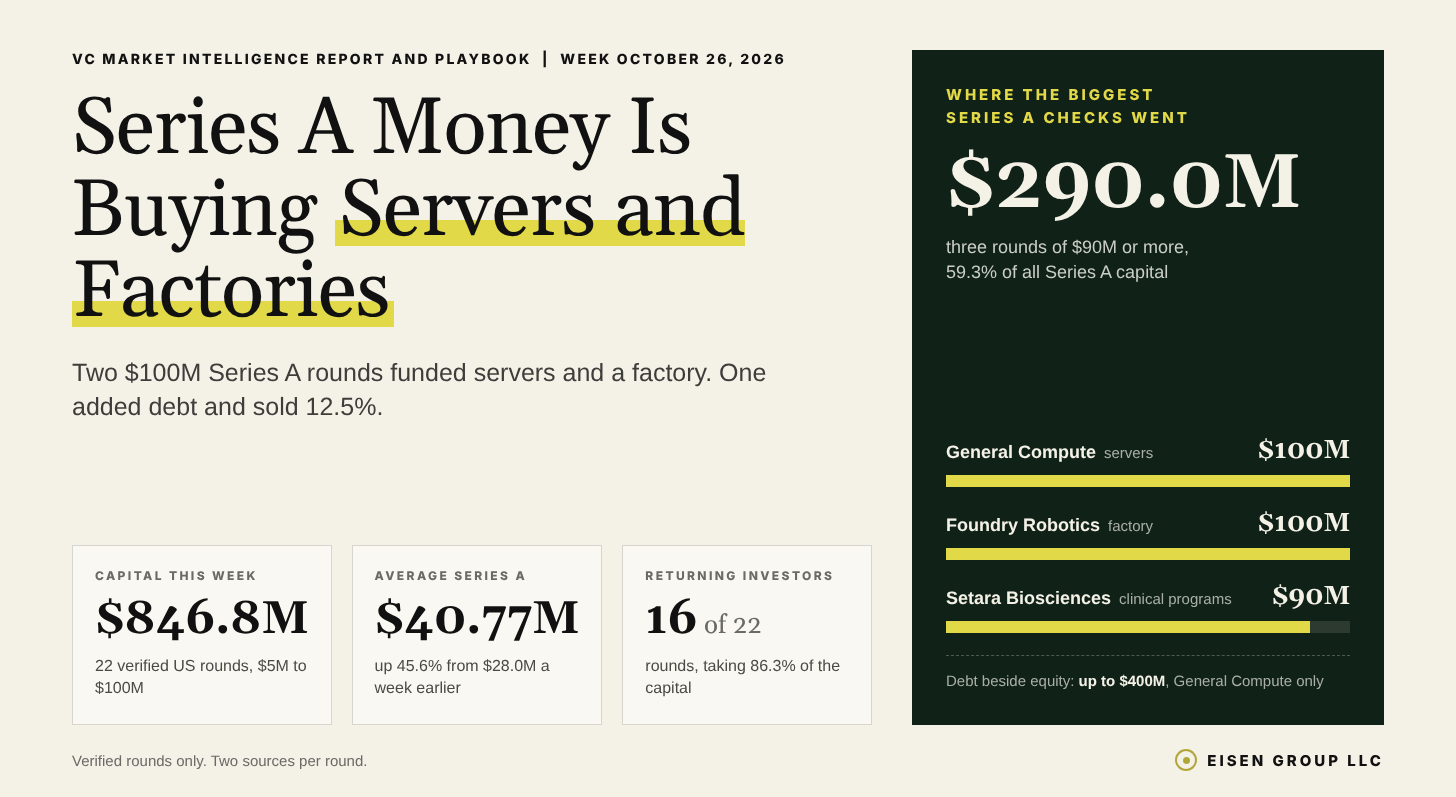
General Compute raised a $100.0M Series A on October 27 at an $800M post-money valuation, selling 12.5% of the company. Three months earlier, it had arranged a committed debt facility of up to $400M from Upper90 to buy the inference servers its cloud runs on. TechCrunch reported that a single customer deal worth $100M in annual recurring revenue preceded the round.
That is the result of the week: funding equipment with debt instead of equity can let a founder keep more of the company when contracted revenue can repay the debt.
You know this moment. You have built the plan, and the plan needs hardware, servers or a production line. You add it to the operating budget; the total becomes your round size, and you divide it by the best valuation you can get. That's the share of your company you are about to sell.
The usual move is to shrink that answer by pushing the price up. General Compute also shrank the number on top: a lender committed to carry the servers, and equity paid for the rest.
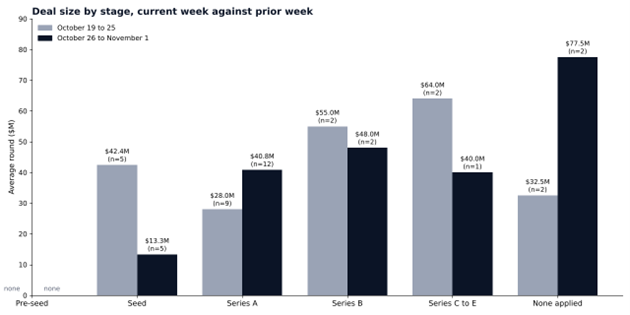
Twelve Series A rounds averaged $40.77M, up 45.6% from $28.0M a week earlier, and three of them, at $90.0M or more, took $290.0M, 59.3% of all Series A capital: General Compute for inference capacity, Foundry Robotics for a 130,000 square foot factory, and Setara Biosciences for clinical programs. Only General Compute disclosed debt besides its equity. American Advanced Materials, a $12.5M seed, said it plans a separate project-financing round for the titanium plant it is designing, so the seed pays for the team and the engineering. Foundry Robotics raised $100.0M of equity for its factory buildout and disclosed no debt.
Valuation, ownership and what you keep. Three numbers sit inside every round. The headline valuation is what the company is worth at this round’s price: $800M for General Compute. Founder ownership is the share the founders still hold after every round so far: its seed sold about 25% at a $60M post-money valuation and this round sold 12.5%, so the founders keep about 65.6% of the stake they held before the seed, before option pools and a June SAFE whose size was not disclosed. What a founder can realize at an exit is that share after future dilution, after liquidation preferences, and after the debt that lenders collect before any shareholder, and only if the company reaches an exit. For example, assuming investors would have paid the same $700M pre-money for a larger round: raising the $400M as equity too would have meant selling about 41.7% of the company in this round instead of 12.5%, leaving the founders about 43.8% of their pre-seed stake instead of 65.6%. The debt costs interest, carries covenants and stays due if the anchor customer leaves.
The rest of the week moved in three directions. Returning investors took 86.3% of the capital, up from 63.8%, while only two rounds were led by an insider. Seed shrank from a $42.4M average to $13.3M. And four companies disclosed a price, from Wabi at $1.25B with no revenue disclosed to General Compute at $800M with the strongest revenue evidence of the week.
Consequence for Monday. Split your use of funds into two columns before you set a round size: what can secure a loan (equipment, inventory, contracted receivables) and everything else. Price the first column with a lender, and divide only the second by your post-money valuation.
The Week in One Sentence
Primary insight. Mid-market capital rose to $846.8M as the largest Series A rounds went to companies buying chips, factories and clinical trials, and the one that paired its equity with a committed debt facility sold 12.5% of the company for $100.0M.
• Total capital deployed. $846.8M in new primary capital across 22 verified US rounds between $5M and $100M, up 10.4% from $766.7M across 20.
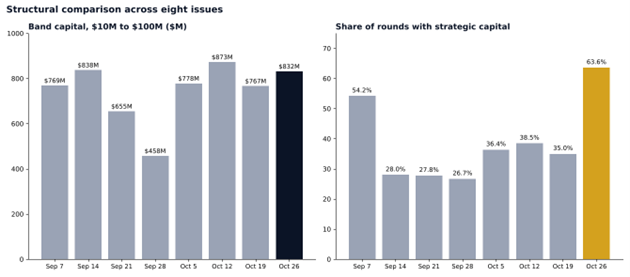
• Against prior issues. Within the $10M to $100M band, this series has tracked since September: 20 rounds and $831.8M, up from 20 rounds and $766.7M last week. Capital up 8.5%, deal count flat.
• Average round size. $38.49M across the full set, up 0.4% from $38.34M.
• Median round size. $29.3M, down 15.2% from $34.5M. Five rounds of $12.5M or less pulled the median down, while three $100.0M rounds kept the average up.
• Largest tracked round. Three rounds tied at $100.0M: Hex (no series letter applied), General Compute (Series A) and Foundry Robotics (Series A). Smallest: Northstar Security at $7.0M, a seed.
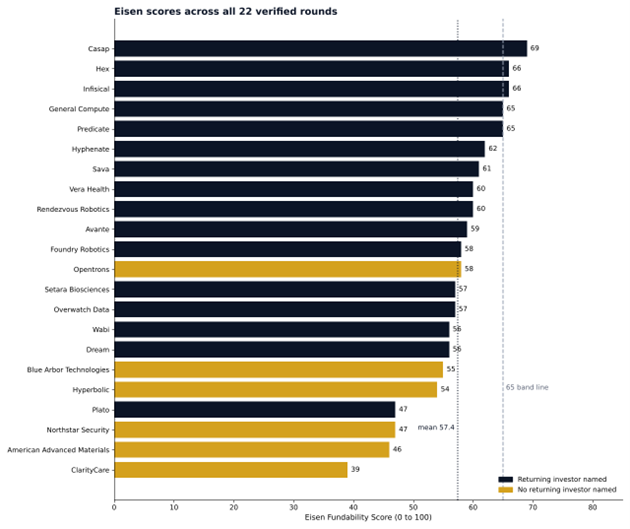
• Highest Eisen score. Casap scored 69 and ClarityCare scored lowest at 39, a band of 30 points. Five of 22 rounds cleared 65 and none reached 75; the mean was 57.4 and the median 58.0.
• Named institutional lead. 21 of 22 rounds, against 20 of 20 last week. Setara Biosciences named no lead.
• Strategic or customer-side capital. 14 of 22 rounds, or 63.6%, carrying $509.0M, or 60.1% of the week’s capital, up from 35.0% of rounds last week. Eleven of 22 if Google’s Gradient Ventures is set aside.
• Returning investors. 16 of 22 rounds, or 72.7%, named at least one investor from a prior round, against 13 of 20 last week. Two were led by a prior investor, against four.
• Valuations on the record. 4 of 22: Wabi at $1.25B, Hex at $1.2B, General Compute at $800M post-money and Infisical at $600M. The share of the company sold ran from 4.4% to 12.5%.
The Deal Scorecard
Eisen Fundability Scores run across five dimensions: Founder-Investor Dynamics (30), Traction to Conviction Conversion (25), Narrative Power (20), Deal Architecture (20) and Capital Planning (5). Scores of 90 to 100 signal an inevitable, market-defining outcome. 85 to 89 signals extremely strong execution. 75 to 84 signals solid fundamentals. 65 to 74 signals a good company with some gaps. Below 65 signals an early stage or structurally incomplete round.
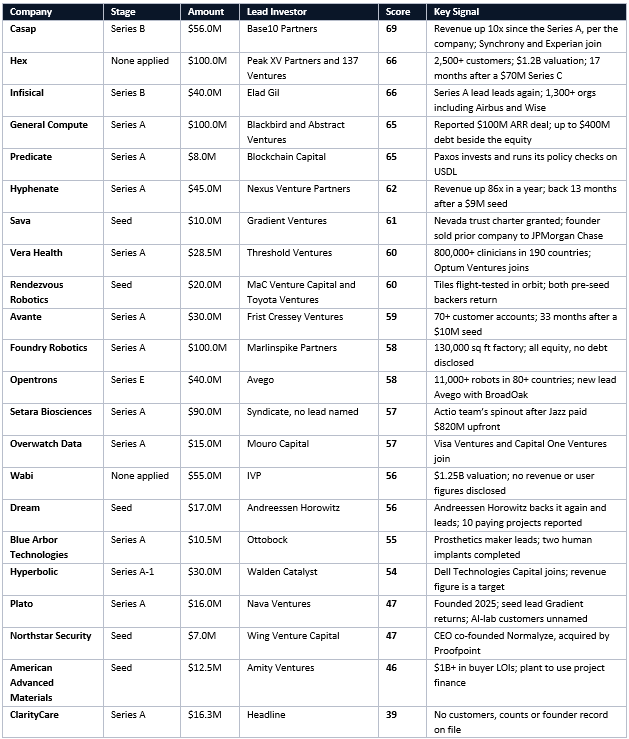
Amounts reflect new primary capital at close. Stage labels are reported as each company applies them: Hex and Wabi applied no series letter (Hex’s counsel, Cooley, and trackers describe Hex’s round as a Series D; trackers list Wabi as a Series A), and Hyperbolic’s Series A-1 is counted under Series A. Blue Arbor’s $10.5M Series A includes a $5M investment from Ottobock first announced on February 26, 2026.
What the scorecard says at a glance
The top of the board belongs to rounds where an investor from the last round came back and something outside the deck could be checked. Casap at 69, Hex and Infisical at 66, and General Compute and Predicate at 65, all named returning investors. Four of the five returned within 17 months of their last round, at a larger size. Casap says its revenue grew tenfold since its Series A and that more than 100 financial institutions use it, Hex names more than 2,500 customers, Infisical more than 1,300 organizations including Airbus and Wise, General Compute a customer deal TechCrunch put at $100M a year, and Predicate a named partner, Paxos, that invested and runs its compliance checks in production.
The largest round tied to the most evidence and the most dilution. General Compute disclosed its revenue and sold 12.5% of the company; Wabi, with no revenue or users disclosed, sold 4.4% at a higher price. The difference sits in the numerator: General Compute needed $100.0M of equity even after lining up debt, while Wabi needed $55.0M for software.
Size and score moved together more than last week. The correlation between round size and score across 22 rounds was 0.45, against 0.15 in the prior issue. The six rounds of $50M or more averaged 61.8. The sixteen below $50M averaged 55.8.
The floor is about missing evidence. ClarityCare scored 39 with no named customers, no counts and no founder record locatable in the sources reviewed. American Advanced Materials scored 46 and holds letters of intent rather than contracts. Plato and Northstar Security scored 47: Plato’s customers are unnamed AI labs, and Northstar’s founder sold his last company to Proofpoint but names no customers yet. The score measures how much of the transaction an outsider can reconstruct.
What Changed This Week
Five shifts, ranked by structural impact on founder fundraising rather than by deal size. Each is built on verified deal records and ends with what it means for your raise.
Shift 1: Asset-Heavy Companies Raised the Largest Series A Rounds, and One Split the Bill With Debt
Pattern, what happened. The twelve Series A rounds averaged $40.77M, up from $28.0M a week earlier. Three of them took $290.0M: General Compute and Foundry Robotics at $100.0M each and Setara Biosciences at $90.0M. Each pays for capacity: inference servers, a 130,000-square-foot factory, and a clinical pipeline. General Compute paired its $100.0M of equity, priced at $800M post-money, with a committed facility of up to $400M from Upper90 arranged in July. American Advanced Materials raised a $12.5M seed and said it plans separate project financing to build and run its titanium sponge plant.
Perspective, what it means. The share of a company a round costs equals the equity raised divided by the post-money valuation. Founders work on the bottom of that fraction; a capital plan can also change the top. A lender can fund an asset when the asset holds value or when a signed contract can repay the loan, and General Compute’s reported $100M annual customer deal gives a lender that second kind of comfort. For example, with the same $700M pre-money, $500M of equity would have sold about 41.7% of the company; $100M sold 12.5%. Debt carries interest and covenants and ranks ahead of every shareholder at an exit, so it shifts risk onto the company rather than removing it.
Founder Blindspot, what most miss. Founders assume debt is for companies with years of revenue. Asset lenders underwrite the asset and the contract that pays for it. General Compute was founded in 2025 and arranged its facility before its Series A. It could show the lender a customer deal reported at $100M a year.
Playbook, what to do. List every line in your plan that buys something with resale value or a signed buyer: servers, machines, inventory, receivables. Take that list to two asset lenders and one equipment lessor this month and ask what share they would fund and on what terms.
Contrast. Last week the founders who sold the least of their companies did it on the bottom of the fraction, with revenue evidence that raised the price. This week the clearest case did it on the top, by reducing how much equity the plan required.
What this means for your raise: Divide only the part of your plan a lender cannot carry by your valuation.
Shift 2: Returning Investors Took 86.3% of the Capital, but Only Two Led
Pattern, what happened. 16 of 22 rounds, 72.7%, named an investor from a prior round. Those 16 took $730.5M, 86.3% of the week, up from 63.8% a week earlier, and averaged $45.66M against $19.38M for the other six. Within Series A alone the gap held: $48.06M across nine rounds with a returning investor against $18.93M across three without. Two rounds were insider-led: Elad Gil, who led Infisical’s Series A, led its Series B, and Andreessen Horowitz, which first invested in Dream more than a year ago, led its $17.0M seed. In fourteen rounds a new lead set the terms while prior investors came back beside it.
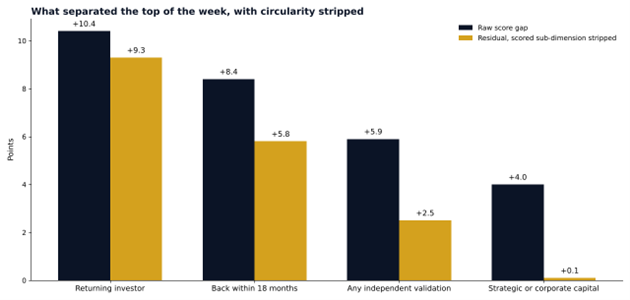
Perspective, what it means. Rounds with a returning investor scored 60.2 against 49.8, a 10.4 point gap; strip the Insider Support sub-dimension and 9.3 points remain. An owner who has seen the monthly numbers and invests again gives a new lead a check no outsider can run. Part of the gap comes from stage: two of the six rounds without a named returning investor were seeds. The Series A comparison removes most of that effect, and the size gap there was about 2.5x.
Founder Blindspot, what most miss. Founders run the process for the new lead and ask existing investors for their pro rata at the end. This week new leads priced fourteen rounds, and in each of them an existing owner put in more money beside the new lead, a fact the lead could weigh before setting the price.
Playbook, what to do. Before the first new meeting, ask each existing investor two questions in writing: how much it would put in at a price set by a new lead, and whether it would take more than its pro rata.
Contrast. Insider-led rounds fell from four to two, while the capital share behind returning investors rose 22.5 points. Two weeks ago, 19 of 26 rounds carried a returning investor and took 86.0% of capital.
What this means for your raise: The investor who already owns part of your company is the first check a new lead asks about.
Shift 3: The Seed Lane Shrank Back to Milestone Size
Pattern, what happened. Five seed rounds closed for $66.5M, averaging $13.30M, versus five seeds averaging $42.4M a week earlier. The largest was Rendezvous Robotics at $20.0M, co-led by MaC Venture Capital and Toyota Ventures. Dream raised $17.0M led by Andreessen Horowitz, an earlier investor; American Advanced Materials $12.5M led by Amity Ventures; Sava $10.0M led by Gradient Ventures; and Northstar Security $7.0M led by Wing Venture Capital.
Perspective, what it means. The seeds averaged 54.0 on the Eisen score and 6.0 of 25 on Traction-to-Conviction Conversion. The two highest seeds carried proof a stranger could check: Sava at 61 holds a trust charter granted by Nevada, and Rendezvous at 60 has flight-tested its tiles in orbit and came back 13 months after a $3M pre-seed, with Aurelia Foundry and ATX Venture Partners investing again. Pedigree alone carried less: Northstar’s chief executive co-founded Normalyze, which Proofpoint acquired, and the round scored 47 with no customers named. Three of the five were tied to a named milestone: a 2028 demonstration mission, a commercial plant design and a chartered trust company.
Founder Blindspot, what most miss. The same lane that wrote five checks averaging $42.4M wrote five averaging $13.3M seven days later. A seed sized to the outliers buys a valuation the next investor has to grow into.
Playbook, what to do. Write the single dated milestone your seed must buy: a charter, a flight test, a signed contract. Cut every budget line that leaves that milestone unchanged, then add nine months of runway.
Contrast. Seed averaged $41.54M on October 5, $6.4M on October 12, $42.4M on October 19 and $13.3M this week. The lane swings with the supply of famous teams.
What this means for your raise: At seed, the round size should match the next fact you can prove.
Shift 4: Four Prices on the Record, and the Cheapest Equity Went to the Least Evidence
Pattern, what happened. Four of 22 rounds disclosed a valuation, against three a week earlier. Wabi raised $55.0M at $1.25B and sold about 4.4% of the company, or 4.2% if the valuation was pre-money. Infisical raised $40.0M at $600M, about 6.7% or 6.3%. Hex raised $100.0M at $1.2B, about 8.3% or 7.7%. General Compute raised $100.0M at $800M post-money, 12.5%. All four returned within 17 months of their last round, with a prior investor in the new one.
Perspective, what it means. A price reflects the range of outcomes an investor is buying; the share sold also reflects how much money the plan needs. Wabi disclosed no revenue, retention or user figures; its founder built Replika, and the price rests on her and on the category. General Compute disclosed the strongest revenue evidence of the week and sold the most, since its plan needs servers. The four priced rounds averaged 63.3 on the score against 56.1 for the rest; valuation disclosure carries no score of its own, so no sub-dimension is stripped. None of the four disclosed liquidation preferences, so what founders can realize at an exit stays unknown.
Founder Blindspot, what most miss. Founders compare valuation headlines across companies. Two companies at the same headline can sell different shares, and the one selling less per round can leave its founders with more at an exit.
Playbook, what to do. Before you negotiate, compute your round’s dilution both ways, amount divided by post-money and amount divided by pre-money plus amount, and write both numbers on the term sheet you are comparing.
Contrast. Last week all three valuations on the record ($1B, $1B and $750M) came with revenue growth or usage at scale. This week the highest price came with neither disclosed.
What this means for your raise: A headline valuation tells you the price; only your share and your debt tell you what you keep.
Shift 5: Corporate Money Joined Most Rounds, but Only Deploying Buyers Added Evidence
Pattern, what happened. 14 of 22 rounds, 63.6%, carried a corporate or strategic investor, against 35.0% last week, and they took $509.0M, 60.1% of the week. Set aside Google’s Gradient Ventures and 11 of 22 remain. Only one buyer led: Ottobock, the prosthetics maker, led Blue Arbor’s $10.5M Series A. Paxos invested in Predicate and already runs Predicate’s policy checks on its USDL stablecoin. Synchrony and Experian joined Casap; Visa Ventures and Capital One Ventures joined Overwatch Data; Optum Ventures joined Vera Health.
Perspective, what it means. Rounds with strategic capital scored 58.9 against 54.9, a 4.0 point gap; strip the Customer-Side Capital sub-dimension and 0.1 points remain. The three rounds where a buyer or channel partner sits on the cap table (Blue Arbor, Predicate, Casap) scored 63.0 against 56.5; strip the sub-dimension and 2.0 points remain. A corporate name alone added almost nothing the rest of the framework could detect; a buyer that deploys the product adds evidence, as Paxos’s own published integration shows.
Founder Blindspot, what most miss. Founders treat a corporate venture check as a customer signal. The venture arm and the buying division can be different people with different budgets.
Playbook, what to do. When a corporate investor offers a check, ask in the same conversation for a paid pilot or purchase order from the business unit that would use your product, with a named owner and a start date.
Contrast. The strategic share nearly doubled from 35.0% to 63.6%, and the score difference it explains fell to almost nothing once you remove its own sub-dimension.
What this means for your raise: A corporate investor helps your raise when it also buys, sells or runs your product.
The Deals That Matter
Five deep dives across payment disputes, data analytics, secrets security, AI inference infrastructure and digital asset compliance. These are the week's five highest-scoring rounds. All facts are verified against two or more sources.
Casap
AI Dispute and Fraud Automation for Banks | Series B | $56.0M | Led by Base10 Partners
Eisen Fundability Score: 69 / 100
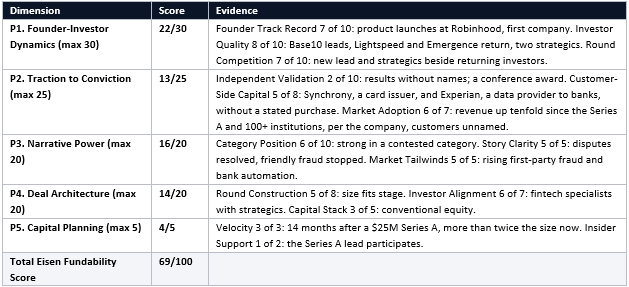
Why this scored. Company-stated revenue growth, a new lead, two strategic investors from its industry, three prior investors returning and a return 14 months after the Series A. It lost points on validation, where bank customers went unnamed.
The Setup. Casap, headquartered in New York and founded in 2023, automates card disputes, chargebacks and first-party fraud detection for banks, card issuers and credit unions. Chief executive Shanthi Shanmugam spent about six years at Robinhood, where her company biography says she launched products including crypto; co-founder Saisi Peters worked with her at Facebook. The company says revenue has grown tenfold since its Series A, that more than 100 financial institutions use it, and that it has cut fraud losses by up to 51% and achieved a 97% chargeback win rate.
The Deal. $56.0M Series B led by Base10 Partners, announced October 28, 2026, with Experian and Synchrony as strategic investors and Emergence Capital, Lightspeed Venture Partners and Primary returning, for about $90M in total funding. The company described the round as oversubscribed. Emergence led the $25M Series A in August 2025; Lightspeed led an $8.5M seed. No valuation disclosed.
The Pattern. This is the industry-funded follow-on. A card issuer and a credit data company joined the cap table of a vendor that handles disputes for institutions like them.
The Perspective. In financial services, a vendor’s sales run through risk and compliance reviews. A strategic investor that serves the same banks can shorten the process when it makes introductions, and a founder can test that by asking for introductions in writing.
The Playbook. List three companies that already sell to your customers: data providers, networks, processors. Ask each for a referral agreement before you ask for an investment.
The Founder Mistake to Avoid. Keeping customers anonymous by default. One named institution that takes a diligence call can outweigh a performance percentage.
Hex
Data Analytics for People and AI Agents | None applied | $100.0M | Co-led by Peak XV Partners and 137 Ventures
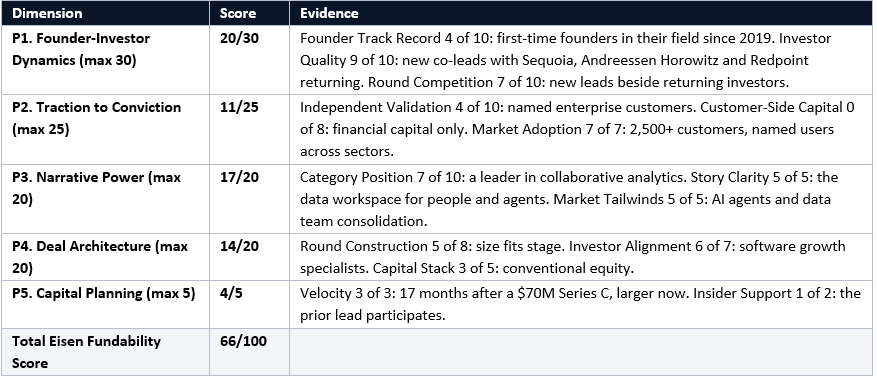
Eisen Fundability Score: 66 / 100
Why this scored. The broadest customer base on the board, a stated valuation, most prior investors back and a return 17 months after the Series C. It lost points on customer-side capital and on founder track record, a first company.
The Setup. Hex, headquartered in San Francisco and founded in 2019 by Barry McCardel, its chief executive, with Caitlin Colgrove and Glen Takahashi, builds a workspace where data teams query, analyze and share data. The company says more than 2,500 customers use it; coverage of its 2025 round named Reddit, HubSpot, Cisco, Figma, Anthropic and the NBA. With the round, it launched Hex 4.0, a rewrite built around AI agents, in private beta.
The Deal. $100.0M co-led by Peak XV Partners and 137 Ventures, announced October 27, 2026, at a $1.2B valuation, with Amplify, Avra, Andreessen Horowitz, Next Legacy, Redpoint, Sequoia and Zero Prime. Avra led the $70M Series C in May 2025 with most of the same firms. No series letter applied; revenue not disclosed.
The Pattern. This is the re-rated incumbent round. A company founded in 2019 rebuilt its product for a new kind of user, and the investors who had watched it for years came back beside two new leads.
The Perspective. At $1.2B the round cost about 8.3% of the company, or 7.7% if the valuation was pre-money. A secondary source puts the 2025 valuation at $400M; that aggregator record is left out of this report’s count. A company that keeps revenue private asks investors to price the customer base, and 2,500 customers with named enterprise users is a base a lead can call.
The Playbook. If your product is about to change shape, raise against the customers you already have. Lead the deck with your ten largest accounts, their tenure and their spend trend, before the demo.
The Founder Mistake to Avoid. Pitching the rewrite as a fresh start. Hex’s price rests on customers who stayed.
Founder lesson. Customers who stayed through a product change prove a new lead price.
Founder trap. Celebrating a headline before you know the preferences behind it.
Infisical
Secrets and Access Security for Software and AI Agents | Series B | $40.0M | Led by Elad Gil
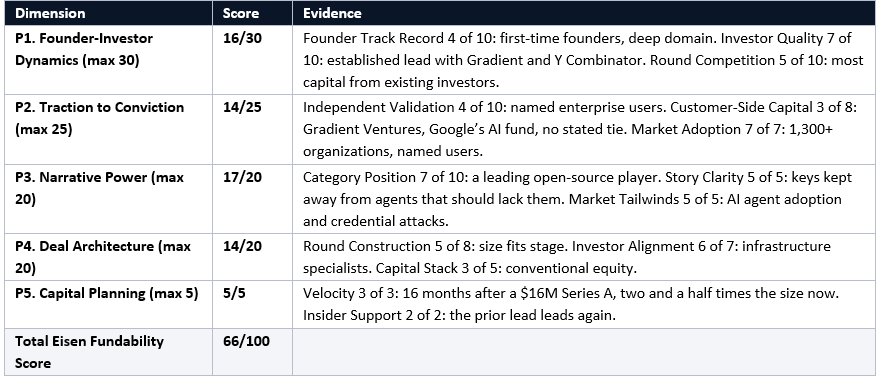
Eisen Fundability Score: 66 / 100
Why this scored. One of the week’s two insider-led rounds, named enterprise users, a disclosed valuation and a return 16 months after the Series A. It lost points on round competition, with no new institutional investor named, and on founder track record.
The Setup. Infisical, headquartered in San Francisco and founded in 2022 by its chief executive, Vlad Matsiiako, along with Tony Dang and Maidul Islam, builds open-source software that stores and controls the keys and credentials software uses to access other systems. It came out of Y Combinator. The company says more than 1,300 organizations use it, including Airbus, Hugging Face, OpenRouter and Wise, and it is extending the product to AI agents.
The Deal. $40.0M Series B led by Elad Gil, announced October 27, 2026, at a $600M valuation, with Gradient and Y Combinator, bringing total funding to nearly $60M. Elad Gil led the $16M Series A in June 2025. All equity.
The Pattern. This is the same-lead re-up. The investor who set the Series A price set the Series B price 16 months later.
The Perspective. At $600M the round cost about 6.7% of the company, or 6.3% if pre-money. An insider-led round skips the outside price check, trading a second opinion on value for speed. Named enterprise users and open-source adoption let a later investor test the price against usage.
The Playbook. If your lead wants to lead again, ask it to set the price against a written outside reference, a comparable round or a term sheet you obtained, and record that reference in the board minutes.
The Founder Mistake to Avoid. Accepting an insider price untested. The fastest close can also be the cheapest.
Founder lesson. A prior lead leading again is strong evidence; an outside price reference makes it stronger.
Founder trap. Mistaking a fast insider round for a market-tested valuation.
General Compute
AI Inference Cloud on Non-Nvidia Chips | Series A | $100.0M | Co-led by Blackbird and Abstract Ventures
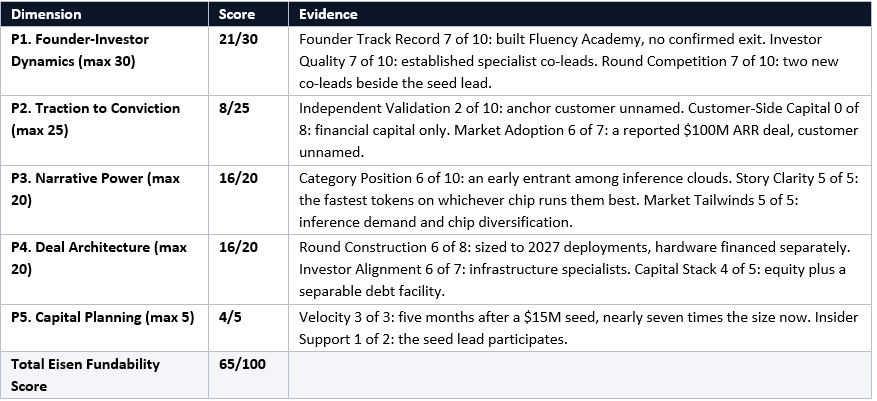
Eisen Fundability Score: 65 / 100
Why this scored. Disclosed revenue evidence, a capital stack that keeps equity for what only equity can fund, the seed lead returning and a return five months after the seed. It lost points on validation, where the anchor customer went unnamed, and on customer-side capital.
The Setup. General Compute, headquartered in San Francisco according to its announcement coverage, was founded in 2025 by Finn Puklowski, its chief executive, who previously built the language-learning company Fluency Academy, and Jason Goodison, its chief technology officer. It runs a cloud for AI inference on chips from Cerebras, SambaNova and Positron alongside GPUs and supplies bare-metal servers to inference clouds. It rents data center space and repurposes former bitcoin-mining sites, and says its first major deployments go live in the first quarter of 2027.
The Deal. $100.0M Series A co-led by Blackbird and Abstract Ventures, announced October 27, 2026, at an $800M post-money valuation, with Fuse Venture Partners and Village Global. The $15M seed in May 2026, led by FUSE at $60M post-money, included Village Global. In July the company announced a committed debt facility of up to $400M from Upper90 to buy chips. TechCrunch reported a customer deal worth $100M in annual recurring revenue before the round; Blackbird describes $190M in annual contracted revenue being signed. The customer was not named.
The Pattern. This is the split-stack round. Equity paid for the company and debt for the hardware.
The Perspective. The founders sold about 25% at seed and 12.5% now, keeping about 65.6% of their starting stake before option pools and a June SAFE of undisclosed size. The debt lowers the ownership cost of growth and raises the stakes of execution: lenders are repaid first, so a lost customer or idle chips would hit the equity. The valuation rose about 13 times in five months on one unnamed contract.
The Playbook. If your business buys hardware, sign the customer contract before you seek the debt. Show a lender the contract, the hardware cost and the payback months, and ask what share of the hardware it would finance.
The Founder Mistake to Avoid. Borrowing against expected demand. General Compute’s facility sits beside a contract a lender can read.
Founder lesson. The cheapest dollar for hardware can be a lender’s, when a contract can repay it.
Founder trap. Treating committed debt as free money. It ranks ahead of you at every exit.
Predicate
Compliance Controls for Onchain Finance | Series A | $8.0M | Led by Blockchain Capital
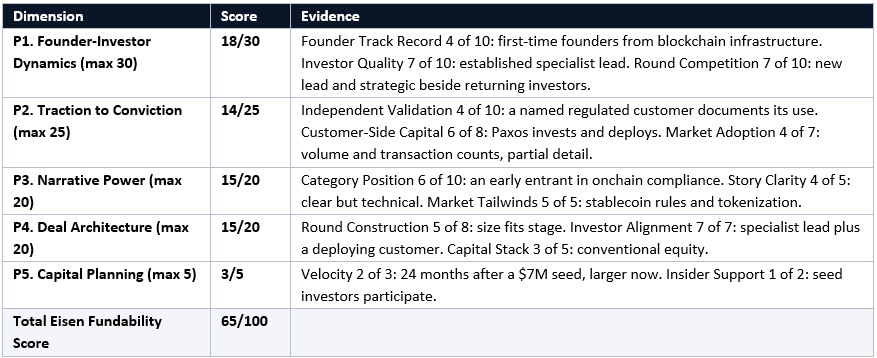
Eisen Fundability Score: 65 / 100
Why this scored. A customer that invested and runs the product in production, a specialist lead, both seed investors back and published usage figures. It lost points on velocity, 24 months after the seed, and on founder track record.
The Setup. Predicate, headquartered in New York and founded in 2023 by Nikhil Raghuveera, its chief executive, and Jesse Sawa, both alumni of the Celo blockchain project, lets digital asset issuers enforce compliance rules before a transaction executes. The company reports screening more than $1B in volume and blocking more than 100,000 transactions. Paxos International uses Predicate to enforce anti-money-laundering and location rules for its USDL stablecoin on Uniswap, according to Paxos.
The Deal. $8.0M Series A led by Blockchain Capital, announced October 27, 2026, with Paxos, 1kx and Tribe Capital, bringing total funding to $15M. 1kx and Tribe backed the $7M seed announced in October 2024. Blockchain Capital told Axios Pro it had known the founders for years and waited for evidence the market was ready. No valuation disclosed.
The Pattern. This is the customer-proven Series A. The lead waited for production use, and the customer joined the round.
The Perspective. The second smallest round of the week tied for fourth on the board, since a regulated customer’s production use is a fact any lead can confirm on that customer’s own site.
The Playbook. Ask your first production customer to describe the integration in its own published words, a post, a case study or a release, before you start your Series A process.
The Founder Mistake to Avoid. Raising before the reference customer goes live. Blockchain Capital waited for exactly that.
Founder lesson. A customer’s own published description of your product is diligence the lead can do without you.
Founder trap. Sizing the round to market appetite instead of to the evidence you can show.
The Fundraising Playbook
Five plans, each producing a concrete artifact you can use this week. Each is built directly from this week’s verified signals.
Plan 1: Separate the Company Story From the Asset Story (Narrative and Investor Framing)
Focus. Pitch equity investors on the company and lenders on the assets, in two documents.
Why this matters. The three largest Series A rounds, $290.0M together, pay for capacity. Only General Compute disclosed a lender besides its equity, and it sold 12.5% for $100.0M.
Exact deliverable. Two one-page summaries. Equity page: market, team, evidence, and the milestone the round buys. Asset page: each asset, its cost, its resale or contract value, and the months until its cash flow repays it.
Expected outcome. An equity raise sized to what only equity can fund, with a lender conversation running in parallel.
The reframe. Wrong approach: one round size covering every line of the plan. Right approach: equity for what only owners will fund, credit for what an asset or contract can repay.
Plan 2: Turn Letters of Intent Into Contracts (Proof Architecture)
Focus. Convert one customer commitment into a signed contract with a price, a term and a start date.
Why this matters. General Compute’s facility sits beside a customer deal reported at $100M a year. American Advanced Materials holds letters of intent it values at over $1B and scored 2 of 7 on Market Adoption, since letters carry no binding price.
Exact deliverable. A contract tracker: customer, stage (letter, pilot, signed), price, term, next step and date. Pick the one closest to signature and assign an owner this week.
Expected outcome. A document a lead investor and a lender can both underwrite.
The reframe. Wrong approach: totaling letters of intent on the traction slide. Right approach: one signed contract, with price and term, on the first slide.
Plan 3: Eisen Self-Score and Gap Diagnosis (Readiness)
Focus. Score your round on the five dimensions and choose between a process now and a repair sprint first.
Why this matters. The board ran from 39 to 69 with a mean of 57.4. Traction to Conviction Conversion averaged 7.9 of 25, the weakest dimension relative to its maximum; the five seeds averaged 6.0.
Exact deliverable. A one-page score across Founder-Investor Dynamics (30), Traction to Conviction (25), Narrative Power (20), Deal Architecture (20) and Capital Planning (5), with an evidence line per sub-dimension and only what a stranger could confirm. Circle the two lowest dimensions. Above 65, run a parallel process with a hard deadline. Between 50 and 65, spend four to six weeks repairing the lowest dimension first. Below 50, the gap is structural, and a better deck will leave it in place.
Expected outcome. A process decision made before the first meeting, not after the tenth pass.
The reframe. Wrong approach: scoring what your deck says. Right approach: scoring what a stranger could confirm, then fixing the two lowest dimensions.
Plan 4: The Insider Number and the Target List (Deal Architecture and Investor Targeting)
Focus. Lock your existing investors’ numbers, then approach only firms that lead at your stage.
Why this matters. Rounds with a returning investor took 86.3% of capital and averaged $45.66M against $19.38M; 9.3 points of their score advantage survive removal of the sub-dimension.
Exact deliverable. First, a written number from each existing investor at a price set by a new lead, and a yes or no on more than pro rata. Second, a list of 35 firms, each with a round it led at your stage in the last 90 days, including this week’s leads: Peak XV Partners, 137 Ventures, Blackbird, Abstract Ventures, Marlinspike Partners, Base10 Partners, IVP, Nexus Venture Partners, Elad Gil, Avego, Frist Cressey Ventures, Walden Catalyst, Threshold Ventures, MaC Venture Capital, Toyota Ventures, Andreessen Horowitz, Headline, Nava Ventures, Mouro Capital, Amity Ventures, Ottobock, Gradient Ventures, Blockchain Capital and Wing Venture Capital.
Expected outcome. A process that starts with insider numbers in hand and a short list of leading firms.
The reframe. Wrong approach: asking insiders for pro rata after the term sheet. Right approach: asking for a number before the first new meeting.
Plan 5: The Two-Column Capital Plan (Capital Planning and Timing)
Focus. Decide how much equity to raise by separating what a lender can carry from what only equity can fund.
Why this matters. General Compute raised $100.0M of equity at $800M post-money, alongside a facility of up to $400M. The share a round costs depends as much on the equity amount as on the price.
Exact deliverable. A one-page model. Column one: assets and contracted receivables, with the share a lender quoted. Column two: everything else. Row one: column two divided by the post-money you can defend. Row two: the whole plan divided by the same valuation. Row three: annual debt service on column one against contracted revenue. Illustrative example, not a forecast: a $30M plan with $12M of equipment at a $90M post-money costs 33.3% of the company as all equity; financing the equipment and raising $18M of equity costs 20.0%, before interest and covenants. If contracted revenue falls short of the annual debt service with room to spare, raise equity for the gap.
Expected outcome. A round size set by the plan’s structure rather than by the largest check on offer.
The reframe. Wrong approach: “We need $30M.” Right approach: “We need $18M of equity and $12M of equipment financing.”
Looking Forward
Three evidence-based scenarios and one wild card for the next one to three weeks. Each is anchored to this week’s verified data.
Scenario 1: More Asset-Heavy Rounds Disclose Debt Beside Equity (Medium Probability)
Why this is likely. Three of this week’s twelve Series A rounds pay for physical or clinical capacity, and two companies, General Compute and American Advanced Materials, have described separate debt or project financing for their assets.
What founders should watch. Whether next week’s rounds above $50M in compute, manufacturing or energy disclose a debt facility, equipment financing or project finance. Two or more confirms the pattern.
What founders should do before others notice. Get one asset lender’s term sheet for your equipment line before you set your equity round size.
Scenario 2: Seed Stays Below $20M on Average (Medium-High Probability)
Why this is likely. Seed fell from $42.4M to $13.3M in one week, and the series average has swung between $6.4M and $42.4M across four issues.
What founders should watch. Whether next week’s seed average stays under $20M with at least three seed rounds verified.
What founders should do before others notice. Size your seed to one dated milestone and show the first fact a stranger can check.
Scenario 3: Returning Investors Keep Taking Most of the Capital (Medium Probability)
Why this is likely. Returning investors took 86.0% of capital two weeks ago, 63.8% last week and 86.3% this week, and fourteen of this week’s sixteen returning-investor rounds were priced by a new lead.
What founders should watch. Whether rounds with a returning investor take more than 75% of next week’s capital.
What founders should do before others notice. Get written commitments from your existing investors before your first new meeting.
Wild Card: Corporate Investors Move From Participating to Leading (Medium-Low Probability)
Evidence from this week. Ottobock led Blue Arbor’s Series A and Toyota Ventures co-led Rendezvous Robotics’ seed, while corporate or strategic capital appeared in 14 of 22 rounds.
What founders should do before others notice. Ask your most engaged corporate partner what it would take for the business unit, not only the venture arm, to lead your next round.
The Bottom Line
The real insight sits beneath the $846.8M. The largest Series A rounds of the week paid for capacity, from inference servers to a factory and clinical programs, and the one that financed its hardware with debt sold 12.5% of the company for $100.0M. Three Series A rounds of $90M or more took 59.3% of Series A capital, returning investors took 86.3% of the week, and the four priced rounds sold from 4.4% to 12.5% of their companies. That produced three investor-conversion profiles.
Profile 1: Companies whose existing investors came back. Casap (69), Hex (66), Infisical (66), General Compute (65) and Predicate (65) all named a returning investor, as did eleven more rounds. The sixteen averaged 60.2 against 49.8 and $45.66M against $19.38M, and 9.3 points of the score gap remain after removing the sub-dimension.
Profile 2: Companies that came back fast with a price. Hex returned 17 months after its Series C at $1.2B, Infisical 16 months after its Series A at $600M, Wabi (56) 12 months after its pre-seed at $1.25B, and General Compute five months after its seed at $800M. The eight fast-return rounds averaged 62.8 against 54.4, and 5.8 points after removing the Velocity sub-dimension.
Profile 3: Companies a buyer or regulator had already backed. Blue Arbor (55) is led by Ottobock, which makes the prostheses its system controls. Predicate counts Paxos as an investor and production customer. Sava (61) holds a Nevada trust charter. The three rounds with a buyer or channel partner on the cap table (Blue Arbor, Predicate and Casap) averaged 63.0 against 56.5.
Everything else competed on the team. The five seeds averaged $13.3M and 54.0 on the score. Dream (56), Northstar Security (47) and American Advanced Materials (46) raised $36.5M between them on founders from Palantir and Normalyze and, at American Advanced Materials, on a plant still to be designed, with customer evidence yet to be published. The money is in the bank; the contracts are still to come, and they are what the next lead can ask to see.
Three New Rules for Founders
1. Price the asset with a lender before you price the company with an investor. General Compute arranged up to $400M of debt before raising $100.0M of equity.
2. Sign the contract before you borrow against it. General Compute’s facility sits beside a customer deal reported at $100M a year; American Advanced Materials still holds letters of intent.
3. Count the debt when you count what you keep. Lenders are repaid before shareholders, and whatever General Compute draws on its facility of up to $400M ranks ahead of every share.
Your Monday Decision
Before you set your next round size, split your plan into what can secure a loan and everything else. Divide the whole plan by the post-money valuation you can defend, then divide only the second column by the same valuation, and write the difference in ownership next to the annual cost of financing the first column. If contracted revenue covers that annual cost with room to spare, ask a lender for a term sheet before you ask an investor. If it falls short, raise equity on today’s plan and use the round to sign the contracts that would let a lender carry the next one.
Twenty-two companies cleared this week. The one that sold the largest share of the company also had the clearest revenue on the record, and on this week’s illustrative math it would have sold far more without its lender. Funding equipment with debt instead of equity can let a founder keep more of the company, when contracted revenue can repay the debt.
The free Eisen Fundability Score shows Seed and Series A founders where their investor conversion breaks, before investors decide it for them. Paid subscribers: Wednesday’s Discovery takes one finding from this report and investigates it in depth.
Research Methodology, Sources and Verification
Data collection period and verification standard
Data collection period: October 26 to November 1, 2026. Verified primary announcements cluster between October 27 and October 30; no in-scope announcement was found for October 31 or November 1. Verification standard: at least two independent sources per deal, with a company release, investor post, filing or regulated newswire (PR Newswire, Business Wire, GlobeNewswire) as the anchor where one exists, plus at least one independent outlet. A second pass checked every announcement date against the prior issue and the original release, which removed seven rounds that had resurfaced from earlier weeks. A third pass swept valuations, compared prior-round investor lists name by name with the current round, and searched for earlier rounds before crediting velocity. A fourth pass on November 2 compared every round’s participant list with its prior rounds again and confirmed prior-round dates with a second source. We recomputed all arithmetic after the final pass. Eisen Fundability Scores are proprietary analytical estimates within Fundables OS, not endorsements or investment advice.
Core capital totals and what they include
The $846.8M weekly total includes only the 22 verified US rounds in the scorecard, each counted at new primary capital at close. Mid-market is defined as a US-headquartered round between $5M and $100M. The full set totals $846.8M across 22 rounds, with an average of $38.49M and a median of $29.3M, versus 20 rounds totaling $766.7M in the prior issue, with an average of $38.34M and a median of $ 34.5 M. The $10M to $100M band holds 20 rounds and $831.8M; Predicate ($8.0M) and Northstar Security ($7.0M) sit below it.
Excluded from counted amounts: credit facilities and venture debt where separable (including General Compute’s facility of up to $400M), secondary purchases, previously closed rounds announced alongside new ones, SAFE conversions, non-dilutive grants, public-equity commitments and cumulative totals.
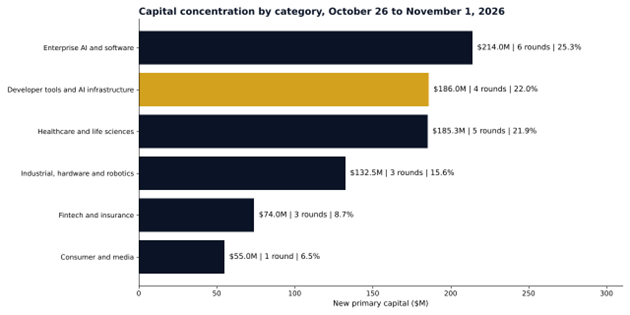
Stage subtotals: Series A (including Series A-1) $489.3M across twelve; no series letter $155.0M across two; Series B $96.0M across two; Seed $66.5M across five; Series E $40.0M across one. Sector subtotals: Enterprise AI and software $214.0M across six; Developer tools and AI infrastructure $186.0M across four; Healthcare and life sciences $185.3M across five; Industrial, hardware and robotics $132.5M across three; Fintech and insurance $74.0M across three; Consumer and media $55.0M across one; Energy, climate and agriculture and Defense and public safety none. Geography: California $612.3M across thirteen rounds, New York $174.0M across six, Washington $30.0M, Colorado $20.0M and Michigan $10.5M across one each. Each set sums to $846.8M across 22 rounds.
Scoring calibration notes
All rounds are scored on the same rubric as prior issues. Founder Track Record is scored 0 where no relevant background was locatable (ClarityCare, Plato and American Advanced Materials); 9 for a founder with one prior company acquired (Northstar Security, Sava) and for the Actio team behind Setara; 7 for senior operators and prior founders without a confirmed exit, including Casap and General Compute. Intermediate values: Independent Validation 7 for a state trust charter (Sava) and 4 for a clinical-stage program (Setara), in-orbit flight tests (Rendezvous) and human implants in feasibility testing (Blue Arbor); Customer-Side Capital 4 for corporate funds whose parents buy in the category without a stated purchase (Optum Ventures, Visa Ventures, Capital One Ventures), 5 for Synchrony and Experian at Casap, 6 for Paxos at Predicate and 8 for Ottobock at Blue Arbor; Capital Stack 4 for equity paired with a separable committed debt facility (General Compute). Gradient Ventures, Google’s AI fund, is counted as a corporate venture arm with no stated commercial tie and scored 3. Velocity of 30 to 36 months scored 1 (Avante). Insider Support scored 2 where a prior investor leads (Infisical, Dream). Prior round dates confirmed by only one source were not credited for velocity (Vera Health, ClarityCare, Sava, Overwatch Data, Plato, Foundry Robotics, Blue Arbor). Revenue figures and company-stated revenue growth rates are company-reported or press-reported and credited under Market Adoption (Casap 6 for tenfold growth since its Series A).
Circularity control
Where a finding rests on a dimension that is itself a scored input, the sub-dimension is removed from both sides and the residual is published alongside the headline. Returning investor: 10.4 points as measured, 9.3 with Insider Support removed. Revenue evidence on the record (three rounds): 9.2 and 6.0 with Market Adoption removed. Any independent validation: 5.9 and 2.5. Significant validation tier (one round): 3.8 and minus 1.3. Strategic or customer-side capital: 4.0 and 0.1. Buyer or channel partner on the cap table (Customer-Side Capital of 5 or more): 6.5 and 2.0. Back within 18 months at a larger size (eight rounds): 8.4 and 5.8. Valuation disclosure carries no score of its own; the priced rounds averaged 63.3 against 56.1.
Dilution arithmetic
Round amount divided by valuation. Where announcements did not state whether valuations were pre-money or post-money, both cases are shown: Wabi 4.4% post-money or 4.2% pre-money; Infisical 6.7% or 6.3%; Hex 8.3% or 7.7%. General Compute’s $800M valuation was reported as post-money: 12.5%. General Compute’s seed: $15M at a $60M post-money valuation, 25.0%. Founder retention after both rounds: 75.0% times 87.5%, about 65.6%. The illustrative all-equity case assumes the same $700M pre-money: $500M divided by $1.2B, about 41.7%, and 75.0% times 58.3%, about 43.8%. The figures ignore option pool changes, the June 2026 SAFE, secondary sales, liquidation preferences and any other instruments.
Deal citations
Hex, $100.0M. Runtime Wire on the chief executive’s post, October 27, 2026; TradedVC; Startup Researcher; The SaaS News for the 2025 Series C. MEDIUM: stage label.
Casap, $56.0M Series B. TradedVC and VC News Daily, October 28, 2026; Value Add VC citing Fortune; Pulse 2.0 for the Series A; company announcement for revenue growth and institution count. MEDIUM: headquarters conflict.
Infisical, $40.0M Series B. SecurityWeek; Unite.AI; The SaaS News, October 27, 2026; Fortune for the Series A. HIGH.
General Compute, $100.0M Series A. TechCrunch, October 27, 2026; WebWire company release; DatacenterDynamics; SiliconANGLE for the debt facility. MEDIUM: customer deal press-reported; headquarters conflict.
Predicate, $8.0M Series A. Axios Pro, October 27, 2026; AlleyWatch; CryptoRank; Paxos; Fortune for the seed. HIGH.
Sava, $10.0M Seed. Axios Pro and Runtime Wire, October 28, 2026; Fundz; Tekedia Capital release. HIGH.
Opentrons, $40.0M Series E. Company release via VC Access Online and Tech Startups, October 29, 2026; CB Insights and VCBacked for the December 2025 round. HIGH. SoftBank Vision Fund and Khosla Ventures are named only as existing investors, without stated participation, and are not counted as returning.
Vera Health, $28.5M Series A. Tech.eu, Fierce Healthcare and MobiHealthNews, October 27, 2026; company release. HIGH.
Hyphenate, $45.0M Series A. FinTech Global, October 27, 2026; AlleyWatch; TradedVC. HIGH.
Avante, $30.0M Series A. citybiz and Fundz, October 27, 2026; GeekWire. HIGH.
Rendezvous Robotics, $20.0M Seed. Payload and Manufacturing.net, October 28, 2026; company release; Pulse 2.0 for the pre-seed. HIGH.
Foundry Robotics, $100.0M Series A. Runtime Wire and Startup Researcher, October 28, 2026; Ventureburn; The Information. HIGH.
Setara Biosciences, $90.0M Series A. Business Wire release, October 30, 2026; Fierce Biotech; Axios Pro. MEDIUM: no named lead; Jazz consideration.
Overwatch Data, $15.0M Series A. AlleyWatch, October 27, 2026; The SaaS News; FinTech Global. HIGH.
Wabi, $55.0M. Bloomberg, October 29, 2026; company release; VC News Daily; TechCrunch for the pre-seed. MEDIUM: stage label.
Blue Arbor Technologies, $10.5M Series A. Business Wire release, October 28, 2026; BioSpace; MassDevice for the February tranche. MEDIUM: February tranche.
Hyperbolic, $30.0M Series A-1. Business Insider via Let’s Data Science; AI Funding Tracker, October 27, 2026; The Block for the 2024 Series A. MEDIUM: headquarters conflict.
Dream, $17.0M Seed. TechCrunch via Mezha; Emergent; company release, October 29, 2026. HIGH.
Northstar Security, $7.0M Seed. SiliconANGLE and Runtime Wire, October 28, 2026; TradedVC. MEDIUM: chief executive attribution.
Plato, $16.0M Series A. PR Newswire via RootData; The Next Web, October 28, 2026. HIGH.
American Advanced Materials, $12.5M Seed. PR Newswire release, October 28, 2026; Briefs; Startup Researcher. HIGH.
ClarityCare, $16.3M Series A. FinSMEs; The SaaS News; Fundz, October 27, 2026. MEDIUM: two secondary sources.
Market comparison sources
Crunchbase News, the week’s ten biggest funding rounds, published October 30, 2026, topped by Re:Build at $2.1B and Kalshi at $1B; three rounds inside this report’s band tie at $100M on that list (General Compute, Foundry Robotics and Hex). VC News Daily funding records, used as a candidate source and date-checked against primary releases. startups.gallery, VC Access Online, AlleyWatch, Tech Startups, Fierce Biotech, Fierce Healthcare, FinTech Global, The SaaS News and FinSMEs for October 26 to 30, 2026.
Prior-period comparisons are drawn from the final published figures of earlier issues in this series: band capital of $769.0M, $837.5M, $655.0M, $457.5M, $778.5M, $873.0M and $766.7M for the weeks of September 7 through October 19; strategic participation shares of 54.2%, 28.0%, 27.8%, 26.7%, 36.4%, 38.5% and 35.0%; and the October 19 issue’s stage averages, returning investors (13 of 20, 63.8% of capital), insider-led rounds (four), named leads (20 of 20), valuations disclosed (three) and mean score (55.7).
Verification notes
Thirteen of 22 rounds are rated HIGH source confidence and nine MEDIUM. Hex and Wabi applied no series letter; Hex’s counsel, Cooley, and trackers call Hex’s round a Series D, trackers label Wabi’s a Series A, and the companies’ own announcements are used. Casap, General Compute, Hyperbolic and Northstar Security carry conflicting headquarters or leadership records, all inside the United States; the city named in the company’s announcement coverage is used. General Compute’s $100M ARR customer deal is press-reported and its customer unnamed. Blue Arbor’s Series A total includes Ottobock’s $5M first announced on February 26, 2026. Setara named no lead; the release lists its current investors and Jazz Pharmaceuticals as a new shareholder through the Actio acquisition, without separating cash from other consideration. Revenue, retention, usage and customer figures in this report are company-reported or press-reported and not independently audited.
Exclusions and documented rationale
News-cycle resurfaced, excluded from every total, chart and score. Watchtower Labs, $35M seed, counted in the October 19 issue and re-listed by VC News Daily on October 26. Coherence Neuro, $45M Series A, counted October 19 and re-listed October 26. Maxinsights, $30M seed, announced October 22. Kivo Health, $10M Series A, first reported by Axios Pro on October 23. ZAP Surgical, $36M, announced October 19. Catalyst, $30M seed, announced October 8. Xona, $250M Series D, above the ceiling and listed in the October 19 contrast set.
Non-US, dual headquarters or headquarters not verified. Nevis, $70M Series B (London and New York). Bites, $40M Series A (Tel Aviv and New York). Easol, $30M Series A extension (London). Mave, $28M Series A (Tel Aviv, announced October 22). Braid, $38M Series A (Netherlands). Simplismart, $14M Series B (Bengaluru). Spicenet, $5M Series A (British Virgin Islands). Rocker, $12.85M (headquarters not verified).
Structural exclusions. Broccoli, $52M across a Series A announced in July 2026 and a new Series B with an amount not stated separately. Fragment, $56M across a seed and a Series A in an undisclosed split. Collective, a $100M package combining a Series B and a non-equity growth facility, with the $40M equity figure resting on one source.
Single anchor source this pass. Midstream Health ($20M), Skoka ($21.5M), TrashLab ($12M), Ozlo ($22M), Neuron Industries ($10M), ShareWillow ($8.5M), Crux Labs ($6M) and Nagare Labs ($5M).
Below the floor. Mostest ($4M), Offe Market ($3M), Wrapped Health ($2.1M), EDGE Sound Research ($2M) and Omabit ($2M).
Above the ceiling, contrast set only. Re:Build ($2.1B), Kalshi ($1B), Bedrock Robotics ($600M), Upwind ($400M), Dren Bio ($350M), Arda Industries ($232M), Warhound ($200M), Group14 Technologies ($169M Series D extension), Firehawk Defense ($150M or more), Serval ($150M) and Dulo ($130M).
Deals analyzed and excluded
Deals analyzed: 22 verified US mid-market rounds of new primary capital between $5M and $100M. Deals excluded: 7 resurfaced from earlier weeks, 8 non-US, dual-headquarters or unverified-headquarters rounds, 3 on structural grounds, 8 on a single anchor source, 5 below the $5M floor and 11 above the $100M ceiling. Second-pass changes: four rounds removed as announced in earlier weeks (Maxinsights, Kivo Health, ZAP Surgical, Catalyst) and two removed as counted in the prior issue (Watchtower Labs, Coherence Neuro). Third-pass changes: returning investors added at Hex (Avra, the Series C lead), General Compute (FUSE, the seed lead) and Predicate (1kx and Tribe Capital), and Blue Arbor’s February tranche identified. Fourth-pass changes: returning investors added at Rendezvous Robotics (Aurelia Foundry and ATX Venture Partners, both in the 2025 pre-seed), Dream (Andreessen Horowitz, which now leads, making the round insider-led) and Plato (Gradient Ventures, the seed lead), and removed at Opentrons, whose release names SoftBank Vision Fund and Khosla Ventures only as existing investors; velocity credited at Hyphenate once a second source confirmed its $9M seed about 13 months earlier; Casap’s company-stated tenfold revenue growth credited under Market Adoption.
Research completion
Research completed November 1, 2026, after a third verification pass directed at valuations, prior rounds and returning investors.
DISCLAIMER: This article is for informational and strategic intelligence purposes only. It is no substitute for investment advice. The Eisen Fundability Score is a proprietary diagnostic within Fundables OS™, not a financial recommendation.
If this article was useful, share it with founders who are about to raise.
Leon Eisen, 4x Founder, venture partner at Network VC, and Author of Invisible Game: The Secrets of the Term Sheet Magnet.