

The Death of the Old Unicorn Dream
For a decade, founders worshiped at the altar of unicorns. Billion-dollar valuations. Hyper-growth. Blitzscaling. Burn cash to dominate markets.
That playbook is dead.
The new economy doesn’t reward flash; it rewards survival. And in survival, cockroaches beat unicorns every time.
Why? Because while unicorns need perfect conditions to thrive, cockroaches survive nuclear winters.
Unicorns are mythical creatures - rare, beautiful, and entirely dependent on a specific ecosystem to survive. They need abundant capital, patient investors, stable markets, and perfect timing. Remove any of those elements, and they collapse. We’ve seen it happen over and over: WeWork, Pear Therapeutics, Builder.ai. Billion-dollar valuations vaporized overnight when conditions shifted.
Cockroaches, on the other hand, have survived for 300 million years. They’ve outlasted dinosaurs, ice ages, and mass extinctions. They adapt. They’re efficient. They thrive on scraps when food is abundant and go into survival mode when it’s scarce. They don’t need perfect conditions. They make any condition work.
The tech-driven transformation of 2023-2026 has created a brutal new reality: adapt continuously or die slowly. The companies winning today aren’t the ones with the biggest war chests or splashiest launches. They’re the ones that can pivot weekly, integrate AI ruthlessly, and stay cash-efficient while everyone else burns through Series B funding.
This isn’t theory. The data is crystal clear. And if you’re still running your company like it’s 2019, you’re already extinct. You just don’t know it yet.
The Numbers Don’t Lie: AI Ate the World
In 2022, half of all companies were “experimenting” with AI. In 2025, up to 80% of early-stage SaaS startups are utilizing AI tools for their operations. AI companies captured nearly 50% of global startup funding, with $202.3 billion invested across AI infrastructure, foundation labs, and applications. That’s a tectonic shift.
Three-quarters of executives now expect AI to bring “significant or disruptive change” to their industries. If you’re not integrating AI into your core operations right now, you’re already behind.
But here’s what most people miss: this isn’t just about having an AI strategy. It’s about AI becoming your strategy.
Even if you are using AI as a productivity tool, you are far behind. The companies winning are those where AI is the product, the competitive moat, and the fundamental business model.
In certain sectors, AI adoption is existential. Boston Consulting Group found that fintech, software, and banking firms have the highest concentration of advanced AI capabilities. They’re rebuilding their entire operations around it.
The financial impact is real. Companies using generative AI report both cost reductions and revenue gains across functions like software development, marketing and sales, and supply chain management. We’re talking about 30-50% gains in coding productivity, 40-60% faster content creation, and supply chain optimizations previously impossible with traditional analytics.
But here’s where it gets interesting: the funding followed the adaptors, not the dreamers. What’s driving this? Simple economics. VCs aren’t stupid. They’re following the returns. Young AI companies are showing unit economics that traditional SaaS companies took 5-7 years to achieve. They’re reaching profitability faster. They’re scaling with smaller teams. They’re delivering margins that would make traditional software companies jealous. And the billion-dollar solopreneur isn’t a myth anymore.
The trend is clear: the market isn’t chasing unicorns right now. It’s backing cockroaches - teams that survive, adapt fast, and integrate the tools that actually move the needle.
And if you’re thinking about “waiting until things calm down,” here’s the reality: the companies raising today are building a compounding lead. They’re your extinction event in 18 months.
The Great Divide: Who’s Thriving and Who’s Dying
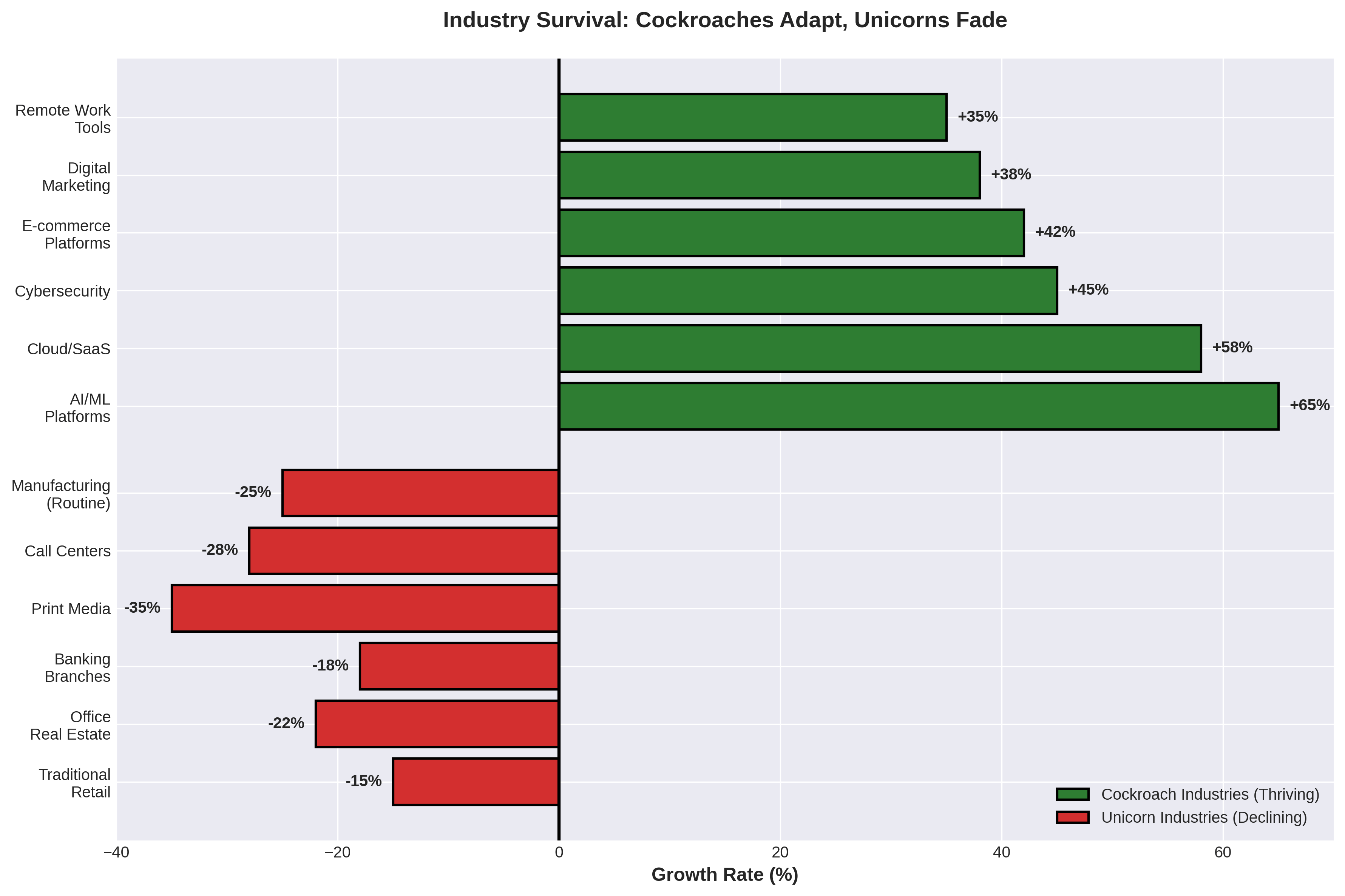
The new economy has created clear winners and losers. The great divide is clear: industries that embraced digital transformation are thriving with double-digit growth, while those clinging to pre-2020 models are contracting rapidly. Let's break down what's actually working:
Cloud/SaaS: The Infrastructure of Everything
The cloud market is growing 25%+ annually and on track to hit $400 billion in 2025. But the real story is the penetration. North America now accounts for almost 60% of global cloud spend, with enterprises migrating workloads faster than anyone predicted.
E-commerce now captures 16% of U.S. retail sales (up from 11% in 2019), while traditional retail stores continue to close. Remote work tools serve 28% of the U.S. workforce (triple 2019 levels), while banking branches and call centers shed 25-30% of positions due to automation. The pattern is unmistakable: adaptability, not industry category, determines survival.
For startups, this creates an enormous opportunity. Cloud-native SaaS applications that would have taken years to build can now be shipped in months. Multi-cloud management tools are exploding as enterprises fear vendor lock-in. Niche infrastructure services that solve specific problems (compliance, security, cost optimization) are raising Series A rounds that would have seemed insane five years ago.
AI/ML Platforms: The New Operating System
We’ve covered the adoption numbers, but let’s talk about what this means in practice. 65% of organizations using generative AI regularly means AI is no longer a nice-to-have.
Companies are using AI for:
Software development (GitHub Copilot is writing 40% of code at some companies)
Customer service (AI chatbots handling 70%+ of routine inquiries)
Marketing (generative content creation, personalization at scale)
Sales (AI-powered lead scoring, email generation, call analysis)
Operations (predictive maintenance, supply chain optimization)
HR (resume screening, interview analysis, performance prediction)
The companies are thriving because they are building businesses around AI. AI-powered coding assistants, industry-specific AI solutions, and AI infrastructure tools. Every category is seeing explosive growth.
Cybersecurity: The Tax on Digital Transformation
As everything digitizes, security becomes essential infrastructure. The cybersecurity market is growing at 12-15% annually, but that undersells the reality. Enterprise security budgets are growing 20-30% year-over-year as companies realize that a single breach can destroy years of value.
The opportunities here are AI-powered security that can detect threats humans never could, zero-trust architectures for remote work, and compliance automation for increasingly complex regulations.
E-commerce Platforms: The Permanent Shift
E-commerce now accounts for 16% of all U.S. retail sales. That might not sound dramatic until you realize the numbers were 6% in 2010 and 11% in 2019. The pandemic accelerated a trend that was already unstoppable.
But the real story isn’t Amazon vs. Walmart. It’s the thousands of direct-to-consumer brands that exist purely because e-commerce infrastructure became cheap and accessible. Shopify, WooCommerce, and similar platforms created a generation of entrepreneurs who could start a retail business with $5,000 instead of $500,000.
The cockroach plays here: build the infrastructure that powers e-commerce. Payment processing, inventory management, logistics optimization, customer data platforms, and marketing automation. Every e-commerce company needs these tools, and they’re willing to pay for the ones that work.
Remote Work Tools: The New Normal
28% of U.S. employees are now working remotely, triple the 2019 rate. Despite aggressive return-to-office mandates from companies like Amazon and Google, the data is clear: remote work is here to stay.
Why? Because the productivity gains are real. Companies discovered they could hire better talent, reduce real estate costs, and maintain (or increase) output with distributed teams. Employees discovered they could work from anywhere, eliminate commutes, and achieve better work-life balance.
The opportunities in remote work tools are massive: video conferencing, collaboration software, project management, virtual office platforms, async communication tools, productivity monitoring, and team culture solutions. Every traditional office function needs a digital equivalent.
Unicorn Industries (Clinging to the Past)
Now let’s look at what’s dying and why:
Traditional Retail: The Slow Death
Store closures are accelerating. Foot traffic is collapsing. The companies that survive are those that figured out omnichannel using physical stores as showrooms and fulfillment centers rather than as the primary sales channel.
The ones dying? Those who bet on “back to normal.” They invested in new store locations, traditional marketing, and inventory management systems built for a world where people browsed in person. They’re hemorrhaging cash and blaming “economic conditions” when the reality is simple: consumers have permanently shifted behavior.
Office Real Estate: The Vacancy Crisis
Office vacancy rates hit all-time highs in 2024 despite return-to-office mandates. Five years after the pandemic, vacancy rates continue climbing.
Companies are renegotiating leases for 30-50% less space. Some are abandoning offices entirely. The “collaboration requires in-person” argument is losing to the “we saved $2M in rent and productivity went up” reality.
The commercial real estate sector is facing a crisis that will take a decade to unwind. Billions in property value are evaporating. Banks holding commercial mortgages are quietly panicking. This is a fundamental reset.
Banking Branches: Digital Wins
Physical bank branches are closing at accelerating rates. Why? Because mobile banking works better. Customers can deposit checks, transfer money, pay bills, and manage investments from their phone faster than they could drive to a branch, park, wait in line, and talk to a teller.
The surviving banks are those treating branches as relationship centers for complex transactions (mortgages, business banking, wealth management) rather than as transaction centers. The ones dying are fighting to keep every branch open while hemorrhaging customers to digital-first competitors.
Print Media: The Final Chapter
Print advertising revenue is in freefall. Subscription numbers are collapsing. The transition to digital isn’t saving companies that waited too long. Digital advertising rates are 1/10th those of print, and the competition is every website on the internet.
The newspapers that survive will be small, hyper-local operations or digital-first brands that happened to have a print legacy. Everything else is on borrowed time.
Call Centers: Automated Away
AI is eliminating 28% of call center positions. But that number is misleading because it suggests 72% are safe. They’re not. The first wave of automation replaced simple, routine calls. The second wave (happening now) is replacing complex problem-solving.
AI can now run customer service that used to need a human: it keeps context, clicks through messy systems, and makes decent calls. Look at Salesforce: with AI in Service Cloud, much of “agent work” becomes automated, such as answers, actions, follow-ups, without a person doing every step.
What survives are the roles that need real human empathy. And even those are getting grouped into smaller, highly trained specialist teams.
The Pattern
Look at the pattern. Cockroach industries embraced technology. Unicorn industries waited for “things to go back to normal.”
Spoiler: They’re not going back.
The companies that died kept saying, “AI is a bubble. Once things return to normal...” They cut costs to preserve old models rather than invest in new ones. They treated symptoms rather than addressing the causes.
Which one are you?
The Job Market Tells the Same Story
Want to know which skills matter? Follow the hiring trends.
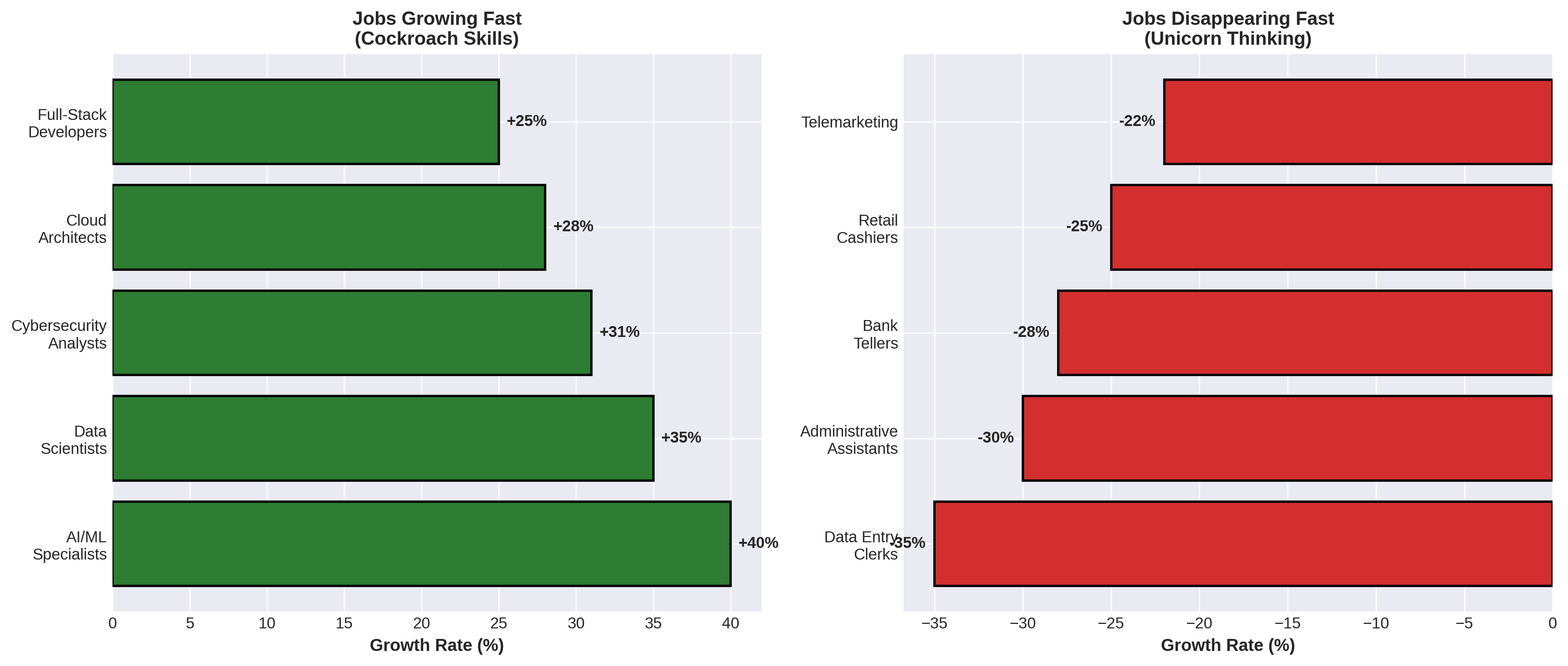
Fastest-Growing Jobs (Cockroach Skills)
The Bureau of Labor Statistics and World Economic Forum data paint a clear picture:
AI/ML Specialists: +40% Growth
These aren’t just data scientists. This category includes AI engineers, machine learning researchers, prompt engineers, AI ethics specialists, and AI product managers. The demand is so high that companies are hiring people with 1-2 years of experience into senior roles.
Why the explosion? Because every company needs AI expertise, but almost none have it in-house. The “buy vs. build” decision is complicated when there’s nobody to buy and no time to build. Companies are paying 2-3x market rates for anyone who can demonstrate real AI capability.
Data Scientists: +35% Growth
Despite predictions that AI would eliminate data science, demand is accelerating. Why? Because AI creates more data problems, not fewer. Companies drowning in data from AI systems need people who can make sense of it, design experiments, and translate insights into decisions.
The data scientists thriving aren’t the ones doing statistical analysis; those jobs are being automated. The ones winning are translating business problems into data problems, designing measurement frameworks, and communicating insights to non-technical stakeholders.
Cybersecurity Analysts: +31% Growth
Every cyberattack makes this role more critical. Companies are realizing that security is a permanent operating expense. The median security team is growing 20%+ annually.
The skills that matter: threat detection, incident response, security architecture, and compliance management. The market is especially hot for people who understand both security and AI - how to secure AI systems and how to use AI for security.
Cloud Architects: +28% Growth
As companies migrate to cloud infrastructure, they need architects who can design systems that are scalable, secure, cost-effective, and resilient. This isn’t just knowing AWS—it’s understanding distributed systems, microservices, infrastructure-as-code, and cloud economics.
The cloud architects commanding premium salaries are the ones who can reduce cloud spend by 40% while improving performance. They’re worth their weight in gold because cloud costs are now one of the top three expenses at most tech companies.
Full-Stack Developers: +25% Growth
The AI revolution hasn’t killed coding jobs—it’s changed what coding means. Developers who can work with AI tools to 10x their output are in massive demand. Companies want people who can ship product fast, not people who write perfect code slowly.
The developers thriving are the ones who treat AI like a junior developer—using it to generate boilerplate, debug issues, and explore solutions while they focus on architecture, product decisions, and solving novel problems.
Fastest-Declining Jobs (Unicorn Thinking)
Now the painful part:
Data Entry Clerks: -35%
AI can extract data from documents, PDFs, images, and handwriting with 99%+ accuracy. The job of manually entering data is obsolete. The only data entry jobs surviving are in highly regulated industries where humans are legally required, and those are being lobbied out of existence.
Administrative Assistants: -30%
AI assistants can schedule meetings, book travel, manage calendars, draft emails, prepare presentations, and handle routine correspondence. The $50,000 executive assistant is being replaced by a $20/month AI subscription.
The surviving assistants are the ones doing high-touch relationship management, complex problem-solving, and acting as true chiefs of staff. But those roles require skills that 90% of administrative assistants don’t have.
Bank Tellers: -28%
ATMs handled the simple transactions decades ago. Mobile banking is now handling everything else. The remaining teller jobs are being consolidated into relationship banker roles that require sales skills, financial product knowledge, and customer service expertise that most tellers weren’t hired for. So if you’re still walking into a bank “to see a teller,” you’re already visiting a job that’s being redesigned out from under you.
Retail Cashiers: -25%
Self-checkout, mobile payments, and grab-and-go technology are rapidly eliminating cashier positions. Amazon Go stores have no cashiers. Walmart is replacing 10 cashiers with 2 self-checkout supervisors.
The retail jobs that are surviving require product knowledge, customer service, and problem-solving. But those are different skills from those required in traditional cashier roles.
Telemarketing: -22%
AI can make phone calls, handle objections, qualify leads, and schedule appointments better than humans. The cold calling industry is being automated at an accelerating rate. The only sales roles surviving are those that require genuine relationship-building and complex deal navigation.
The Math
The World Economic Forum predicts 92 million new jobs will be created by 2030 in tech-driven fields, while 83 million traditional roles disappear. Do the math: there’s a net gain of 9 million jobs, but only if you have cockroach skills.
If you have unicorn skills, you’re competing for 83 million disappearing jobs with everyone else who didn’t adapt. If you have cockroach skills, you’re competing for 92 million new jobs with a much smaller pool of qualified candidates.
The income gap is staggering. The median AI specialist makes $150,000+. The median salary for a data entry clerk is $35,000. That gap is widening, not narrowing.
The question isn’t whether to adapt. It’s how fast.
The Digital Economy Is Already Here
While everyone debates “the future of work,” the present is screaming at us.
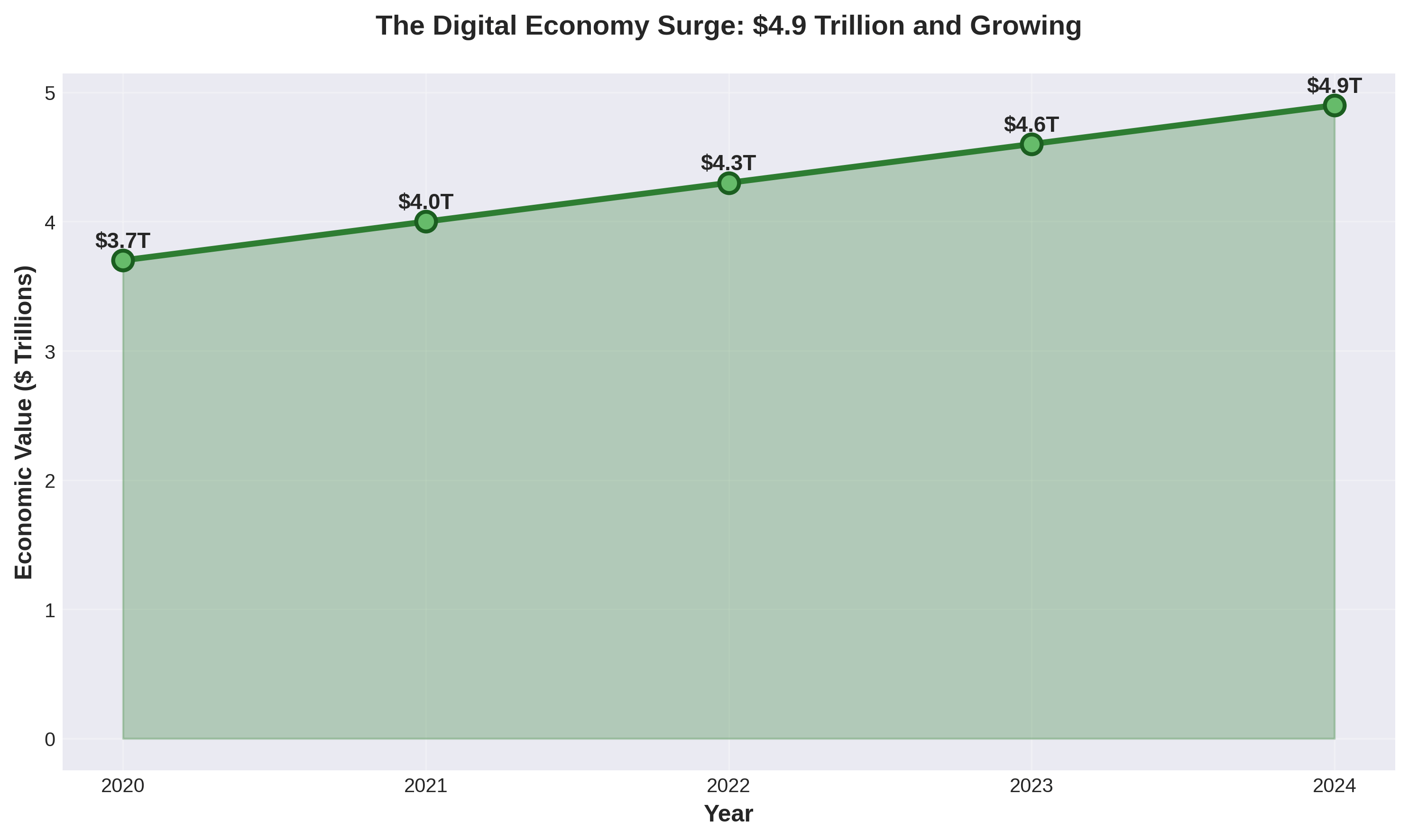
The U.S. digital economy hit $4.9 trillion in 2024, that’s 12.4% of total GDP and growing faster than any other sector. Digital creators alone are driving the fastest growth, adding jobs at rates that dwarf traditional employment.
But let’s unpack what this actually means.
The Scale of Transformation
$4.9 trillion is larger than Germany's entire GDP. The digital economy is now bigger than manufacturing, retail, and agriculture combined. And it’s growing at 15-20% annually, while traditional sectors are growing at 2-3%.
Five years ago, the digital economy was $3.7 trillion. That’s $1.2 trillion in new economic value created in half a decade. To put that in perspective, the entire U.S. defense budget is $850 billion annually. We’re creating more economic value digitally every 3-4 years than the entire U.S. military spends in a year.
Where the Value Lives
Nearly 70% of the digital economy is concentrated in four key segments:
E-commerce platforms and digital marketplaces
Cloud computing and SaaS
Digital advertising and marketing
Creator economy and social media
Each of these segments is creating entirely new job categories. Five years ago, “TikTok marketing specialist” wasn’t a job. Now it’s a $80,000+ role at major brands. “No-code developer” didn’t exist. Now it’s a legitimate career path with its own bootcamps and certifications.
The Creator Economy Explosion
The creator economy is particularly instructive. Individual creators with audiences of 10,000-100,000 followers are building million-dollar businesses. They’re entrepreneurs with lower overhead and faster scaling than traditional businesses.
A single creator with 50,000 engaged followers can generate $500,000-$2M annually through:
Sponsorships: $5,000-$50,000 per partnership
Digital products: Courses, templates, guides
Community/membership: $10-100/month per member
Affiliate revenue: 10-30% commission on recommendations
Consulting/services: $200-500/hour
Traditional businesses need office space, employees, inventory, and infrastructure. Creators need a laptop and an internet connection. The efficiency is staggering.
The Employment Impact
The digital economy now supports 17.4 million jobs directly - nearly 10% of total U.S. employment. But indirect employment is even larger. Every digital business creates 3-5 supporting jobs in adjacent industries.
An AI startup with 50 employees creates demand for:
Cloud infrastructure providers
Cybersecurity consultants
Marketing agencies
Sales development firms
HR and recruiting services
Legal and accounting firms
Design and branding agencies
This multiplier effect means the digital economy is driving employment growth across the entire economy, even in “traditional” sectors.
Why This Matters for Founders
This isn’t coming. It’s here. And it’s separating the cockroaches from the unicorns with surgical precision.
If your business model doesn’t acknowledge that 12.4% of GDP is digital and growing, you’re planning for a world that no longer exists. If your go-to-market strategy doesn’t account for digital-first customers, you’re targeting a shrinking market. If your operations aren’t built for remote work and digital collaboration, you’re competing with one hand tied behind your back.
The companies that win are the ones treating digital as the default and physical as optional. They’re building for the $4.9 trillion economy that exists, not the $35 trillion economy they wish still dominated.
Why Cockroaches Win: The New Survival Framework
Stop thinking like a unicorn. Start thinking like a cockroach.
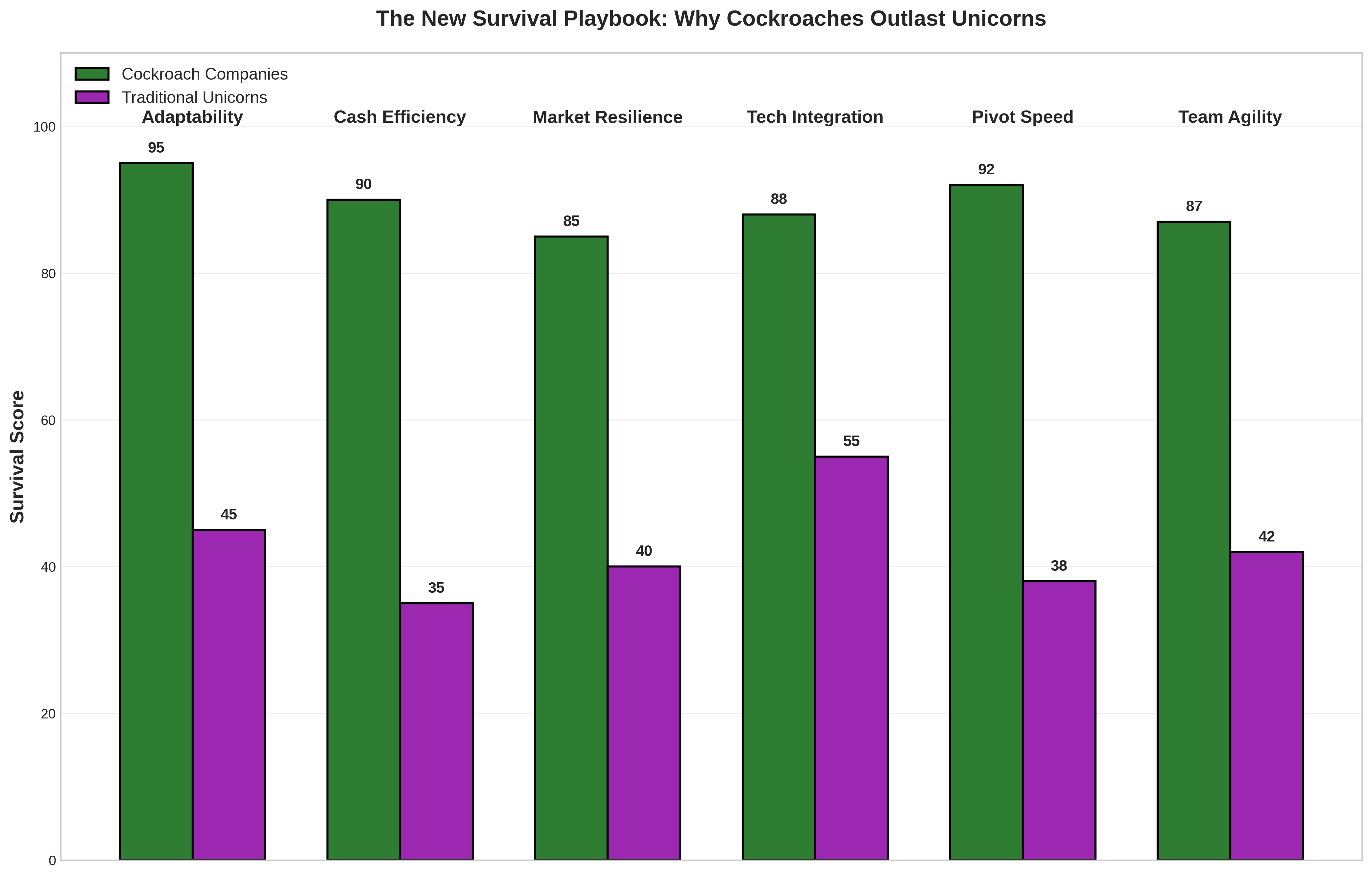
The chart shows differences in survival characteristics, but let’s break down what that means in practice.
What Unicorns Optimize For
Valuation Over Profitability
Unicorns raise money at higher valuations and use growth metrics to justify those valuations. They optimize for the next funding round, not sustainable unit economics. Revenue growth is the goal, even if every dollar of revenue costs $1.50 to acquire.
This works in abundant capital environments. It fails catastrophically when capital becomes scarce. We saw this in 2022-2023, when interest rates rose, and VCs became more conservative. Companies that were “killing it” suddenly couldn’t raise their next round and imploded within months.
Growth Over Efficiency
Blitzscaling means growing as fast as possible, consequences be damned. Hire aggressively, spend on marketing, subsidize customer acquisition, and expand geographically before achieving product-market fit in your home market.
This works when you’re in a winner-take-all market and capital is infinite. It fails when markets are fragmented, capital is constrained, or competitors figure out efficient growth paths.
Headlines Over Unit Economics
Unicorns optimize for PR. Big partnerships, celebrity investors, product launches, and award wins. The press cycle becomes the scoreboard, rather than customer satisfaction or profitability.
This creates a culture that values appearance over substance. Teams spend more time preparing for TechCrunch coverage than fixing customer pain points.
Fundraising Over Revenue
The unicorn's ultimate metric is “how much did we raise” at a valuation exceeding 100x revenue, rather than “how much revenue do we generate.” Founders brag about series letters (Series B, Series C) instead of revenue milestones ($1M ARR, $10M ARR).
This creates perverse incentives. The best fundraisers get celebrated even if their businesses are fundamentally broken. The profitable companies growing steadily get ignored because they’re “not venture scale.”
Perfect Execution Over Rapid Iteration
Unicorns plan for 18 months, execute for 12 months, then plan again. They invest heavily in “getting it right” before launch. They hire consultants to validate the strategy. They design elaborate org structures before they have product-market fit.
This works when you have infinite time, and the market is stable. It fails when markets shift monthly, and competitors ship weekly.
What Cockroaches Optimize For
Cash Efficiency: Unit Economics from Day One
Cockroaches obsess over unit economics. Every customer acquisition should pay back in 6-12 months. Every dollar spent should generate $3-5 in return. Revenue should grow faster than costs, always.
This creates a culture of discipline. Marketing experiments are ruthlessly killed if they don’t deliver ROI. Products that customers won’t pay for get cut, regardless of how elegant they are. Headcount grows only when revenue justifies it.
The result? Cockroach companies can survive indefinitely on modest revenue. They don’t need the next funding round to make payroll. They have options, not obligations.
Rapid Adaptation: Pivot Weekly, Not Yearly
Cockroaches treat everything as a hypothesis. Product positioning? Hypothesis. Pricing strategy? Hypothesis. Target customer? Hypothesis. They test weekly and pivot when data suggests it.
This requires a different organizational structure. Teams need authority to experiment without approval. Metrics need to be clear enough that everyone can evaluate what’s working. Culture needs to reward learning over being right.
The result? Cockroach companies find product-market fit faster. They avoid expensive mistakes. They capitalize on opportunities that unicorns miss because they’re too slow to pivot.
Tech Integration: AI and Automation as Core, Not Extras
Cockroaches rebuild their entire business around what’s possible with AI. They don’t add automation to existing processes; they design new processes that are built for automation.
This means:
Customer service is AI-first, human-escalation secondary
Content creation uses AI for first drafts, humans for refinement
Code gets written by AI, reviewed by humans
Data analysis is automated, and humans interpret results
Marketing campaigns are generated by AI, and humans provide the strategy
The result? Cockroach companies operate with 1/5th the headcount of traditional companies at the same revenue scale. Their margins are higher. Their scaling is faster. Their competitive moat is technology, not team size.
Market Resilience: Multiple Revenue Streams
Cockroaches never depend on a single revenue source. They build multiple products, serve multiple customer segments, and maintain multiple go-to-market channels.
You can think about this as a lack of focus, but it’s anti-fragility. When one revenue stream gets disrupted, others compensate. When one customer segment faces budget cuts, others grow. When one channel becomes expensive, others provide alternatives.
The result? Cockroach companies survive market disruptions that kill focused competitors. They grow through recessions. They capitalize on shifts that destroy single-product companies.
Team Agility: Small, Skilled Teams Over Large Headcount
Cockroaches build small teams of exceptional people instead of large teams of ordinary people. They pay top-10 % salaries to attract top-5 % talent. They use AI and automation to scale without hiring.
A traditional SaaS company might have:
20-person engineering team
15-person sales team
10-person customer success team
8-person marketing team
5-person operations team
A cockroach company at the same revenue might have:
5-person engineering team (using AI coding tools)
3-person sales team (AI handles qualification and demos)
2-person customer success (AI handles tier 1 support)
2-person marketing (AI generates content, humans provide strategy)
1-person operations (everything is automated)
Same revenue. 1/4 of the headcount. 3x the margins.
Continuous Learning: Experiment Weekly, Fail Fast
Cockroaches treat every week as a learning opportunity. They run experiments constantly. They measure religiously. They kill failures quickly and double down on successes.
This requires infrastructure:
A/B testing is built into every product decision
Weekly reviews of key metrics
Clear definitions of success/failure
Authority to kill experiments without politics
A culture that celebrates learning over being right
The result? Cockroach companies improve 2-3% weekly compounding. Over a year, that’s 3-4x improvement. Over three years, it’s a 30-50x improvement. Continuous small improvements compound into massive competitive advantages.
The Difference
The difference? Cockroaches survive 99% of extinction events. Unicorns need perfect weather.
Cockroaches are antifragile. They get stronger from volatility, randomness, and stress. When markets crash, they gain market share. When capital dries up, they acquire distressed competitors. When regulations change, they adapt faster than incumbents.
Unicorns are fragile. They break under stress. Market downturns force layoffs. Capital scarcity forces fire sales. Regulatory changes force pivots that are executed too slowly.
Which one do you want to be?
2026 Tactics: What to Do This Quarter
Stop planning 18-month strategies. The world is moving too fast. Here’s your 90-day cockroach playbook:
Week 1-4: AI Integration Audit
Most founders think they’re using AI. They’re not. They’re dabbling. Here’s how to actually integrate it:
Step 1: Identify Your Three Most Time-Consuming Processes
Not the processes you think should be automated. The processes that actually consume the most human hours weekly. Common culprits:
Customer support response drafting
Content creation for marketing
Code review and debugging
Data analysis and reporting
Sales outreach and follow-up
Meeting notes and action item tracking
Step 2: Test AI Tools on Each
Don’t research for weeks. Pick tools and test them:
Customer support: ChatGPT, Claude, Intercom AI
Content creation: ChatGPT, Jasper, Copy.ai, NotebookLM
Code: GitHub Copilot, Amazon CodeWhisperer, Cursor
Data analysis: Claude with Python, ChatGPT with data analysis
Sales: Lavender, Smartlead, Clay
Meeting notes: Otter.ai, Fireflies, Grain
Give each tool a 1-week trial. Assign someone to use it daily. Measure time saved and quality compared to manual work.
Step 3: Measure Time Saved and Quality Improvement
Create a simple scorecard:
Time saved: What used to take X hours now takes Y hours
Quality: Rate output quality 1-10 vs. manual work
Adoption: What % of the team is actually using it daily
ROI: Cost of tool vs. value of time saved
Be brutally honest. If quality drops but time savings are massive, that’s a decision point. If quality is the same but time savings are marginal, kill it.
Step 4: Kill or Scale Each Experiment
After one week, make a binary decision:
Scale: Make it mandatory for the entire team, train everyone, measure adoption
Kill: Stop using it immediately, document why it failed, and move on
No “maybe” or “let’s give it another month.” Speed matters more than perfection. You’ll learn more from 12 one-week experiments than one twelve-week pilot program.
Week 5-8: Cash Efficiency Review
This is where most founders discover their business is broken. Here’s the systematic approach:
Step 1: Calculate Unit Economics on Every Product/Service
For each revenue stream, calculate:
CAC (Customer Acquisition Cost): Total sales + marketing spend / new customers
LTV (Lifetime Value): Average revenue per customer × average retention months × gross margin
Payback Period: How many months until CAC is recovered
LTV/CAC Ratio: How much value you get per dollar of acquisition cost
Healthy benchmarks:
LTV/CAC ratio > 3:1
Payback period < 12 months
Gross margin > 70% (SaaS) or > 40% (services)
Most founders discover they have products with 1.5:1 LTV/CAC and 24-month payback periods. Those products are value destroyers, not value creators.
Step 2: Cut Anything with Negative Margins That Won’t Flip in 60 Days
This is painful but essential. If a product or customer segment has negative gross margins and there’s no clear path to positive margins in two months, kill it.
Common excuses to avoid:
“But it brings in other customers” (prove it with data)
“We need it for completeness” (no, you don’t)
“Customers expect it” (they’ll survive)
“It’ll be profitable at scale” (scale won’t fix broken economics)
The goal: focus resources on the 20% of products generating 80% of profit.
Step 3: Automate Anything Costing More Than $5/Hour in Labor
Calculate the fully-loaded cost of human labor:
Salary + benefits + overhead + management time
Usually 1.5-2x salary, depending on company size
Now look at repetitive tasks. If something takes 10 hours weekly and costs $50/hour in labor, that’s $26,000 annually. If you can automate it for $5,000 in development time and $500 annually in tool costs, that’s a 5-month payback. Do it immediately.
Common automation opportunities:
Data entry and transfer between systems
Report generation and distribution
Customer onboarding workflows
Invoice generation and follow-up
Meeting scheduling and coordination
Social media posting and engagement
Step 4: Review Monthly, Not Quarterly
Unit economics change fast. Review every 30 days:
What changed in CAC this month?
What changed in retention/churn?
What changed in gross margin?
Which experiments improved economics?
Which should we kill?
Quarterly reviews are too slow. By the time you identify a problem, you’ve lost three months. Monthly reviews let you course-correct 12 times per year instead of 4.
Week 9-12: Skill Stack Refresh
This is about you personally, not your company. Your skills now have a half-life of 18-24 months. Here’s how to stay relevant:
Step 1: Block 5 Hours/Week for Learning (Non-Negotiable)
Put it on your calendar. Treat it like a board meeting. If you wouldn’t cancel a meeting with your biggest investor, don’t cancel your learning time.
Split it:
2 hours: Reading long-form analysis (newsletters, reports, case studies)
2 hours: Hands-on experimentation (new tools, techniques, processes)
1 hour: Synthesis and application (writing insights, planning implementations)
Step 2: Focus on High-Leverage Skills
Not all skills are equal. Focus on the skills with 10-100x ROI:
AI Prompting: This is the new literacy. Learn to:
Structure prompts for complex outputs
Chain prompts for multi-step workflows
Iterate prompts based on output quality
Use system prompts and custom instructions
Evaluate AI outputs critically
Resources: OpenAI docs, Claude.ai guides, prompt engineering courses on Maven
No-Code Automation: Learn to build without developers:
Zapier/Make for workflow automation
Airtable for database applications
Webflow for website building
Retool for internal tools
n8n for complex workflows
Resources: YouTube tutorials, tool documentation, community forums
Data Analysis: Learn to make decisions with data:
SQL for database queries
Python basics for data manipulation
Excel/Sheets advanced functions
Visualization tools (Tableau, Metabase)
Statistical thinking (correlation, causation, significance)
Resources: Mode Analytics SQL tutorials, Khan Academy statistics, DataCamp
Step 3: Ship One New Micro-Skill Weekly
Don’t just learn, apply. Each week, identify one small skill and use it to create something:
Week 1: Learn prompt chaining, use it to generate a marketing campaign
Week 2: Learn Zapier, automate your CRM data entry
Week 3: Learn SQL basics, pull your own analytics report
Week 4: Learn basic Python, analyze customer data
The goal isn’t mastery. It’s momentum. Small wins compound.
Step 4: Track What Compounds, Double Down
After 12 weeks, evaluate:
Which skills did you use multiple times?
Which created measurable value?
Which felt like superpowers?
Which were wasted time?
Double down on the ones that compound. If prompt engineering saved you 10 hours in Week 1 and 20 hours in Week 12, that’s compounding. Keep investing.
If no-code tools seemed cool but you never used them again, stop learning new ones.
The Rule: Nothing Is Sacred
If a process existed 12 months ago and you haven’t questioned it, you’re thinking like a unicorn.
Everything should be re-evaluated:
How we acquire customers
How do we onboard them
How we build a product
How we provide support
How we make decisions
How we communicate internally
The companies that survive are the ones that question everything quarterly and change everything that doesn’t defend itself with data.
5-10 Year Trends: Where the Next Cockroaches Win
Short-term tactics keep you alive. Long-term positioning makes you unstoppable.
Massive Opportunities (2026-2035)
These are the categories where cockroaches will build billion-dollar companies:
1. AI-First Business Models
Not “we use AI” but ” we ARE AI.” Companies where AI is the product, not a feature.
What this looks like:
AI Research Assistants: Companies like Elicit and Consensus that help researchers find, analyze, and synthesize papers
AI Code Generators: Beyond Copilot—tools that generate entire applications from specifications
AI Educators: Personalized tutoring at scale, adapting to each student in real-time
AI Healthcare Diagnostics: Tools that analyze medical images, symptoms, and data better than human doctors
AI Legal Researchers: Tools that analyze case law, contracts, and regulations instantly
The opportunity: traditional services that cost $100-500/hour being delivered by AI at $10-50/month.
The moat: proprietary data, specialized fine-tuning, vertical integration, and distribution.
The timeline: These companies are being built now. The winners will emerge by 2027-2028.
2. Automation-as-a-Service
Sell the robots, not the labor. RPA, workflow automation, intelligent agents.
What this looks like:
Sales Automation Platforms: Tools that handle prospecting, outreach, follow-up, and qualification end-to-end
Customer Service Automation: AI that handles tier 1, tier 2, and increasingly tier 3 support
Finance Automation: Tools that handle invoicing, collections, reconciliation, and reporting
HR Automation: Recruiting, onboarding, performance management, and offboarding workflows
Operations Automation: Supply chain, inventory, logistics, and fulfillment orchestration
The opportunity: $50-100B market as companies replace labor with software.
The moat: Integration depth, workflow libraries, industry-specific solutions.
The timeline: Early leaders emerging now, consolidation by 2028-2030.
3. Digital Infrastructure
Cloud tools, cybersecurity, remote work platforms—picks and shovels for the digital gold rush.
What this looks like:
Developer Tools: Infrastructure that makes building software 10x faster
Security Platforms: Tools that protect increasingly distributed, AI-powered systems
Collaboration Software: The next evolution beyond Zoom and Slack
Data Infrastructure: Tools for storing, processing, and analyzing petabyte-scale data
AI Infrastructure: Platforms for training, deploying, and monitoring AI models
The opportunity: Every digital business needs infrastructure. The market is $500B+ and growing.
The moat: Network effects, switching costs, ecosystem lock-in.
The timeline: Massive category, continuous evolution, opportunities for decades.
4. Creator Economy Platforms
70% of the digital economy’s growth is driven by creators. Build the infrastructure they need.
What this looks like:
Creator Commerce: Tools for selling digital products, memberships, and services
Creator Analytics: Platforms that help creators understand and grow their audience
Creator Finance: Tools for managing revenue, taxes, and business operations
Creator Collaboration: Platforms connecting creators with brands, agencies, and each other
Creator Education: Courses, communities, and coaching for building creator businesses
The opportunity: 50+ million creators globally, growing 20%+ annually, collectively earning $100B+.
The moat: Creator relationships, platform integrations, data insights.
The timeline: Early platforms maturing, room for vertical-specific solutions for decades.
5. Hybrid Workforce Tools
Remote work isn’t going away. 28% remote rate is permanent. Build for it.
What this looks like:
Async Collaboration: Tools optimized for distributed teams working across time zones
Virtual Office Platforms: Replacing physical presence with persistent digital spaces
Productivity Monitoring: Measuring output instead of presence (controversial but inevitable)
Team Culture Tools: Building connection and culture without physical proximity
Hybrid Meeting Tech: Making mixed in-person/remote meetings actually work
The opportunity: 40+ million remote workers globally, all needing better tools.
The moat: Behavioral lock-in, data insights, integration ecosystems.
The timeline: First-generation tools exist, with massive room for improvement.
Dying Business Models (Avoid These)
Don’t build these companies, no matter how tempting:
1. Anything Requiring Physical Presence Without Digital Integration
Pure physical retail, pure physical services, location-dependent businesses with no digital component - all dying.
Why: Customers expect digital options. If you can’t deliver your value digitally, someone will build a digital alternative that’s cheaper, faster, and more convenient.
2. Labor-Intensive Services That Could Be Automated
Call centers, data entry, basic bookkeeping, routine legal work, simple customer service -all being automated.
Why: AI can deliver 80% of the quality at 10% of the cost. Customers will accept slightly lower quality for 90% cost reduction.
3. Traditional Retail Without E-commerce Dominance
Physical stores as the primary channel, inventory-heavy models, location-dependent revenue -all dying.
Why: E-commerce is 16% and growing. Physical retail is 84% and shrinking. The math is inevitable.
4. Any B2B Without API-First Architecture
Software sold through sales calls, deployed on-premise, integrated manually, paid annually -all dying.
Why: Modern companies expect self-service trials, cloud deployment, instant integration, and monthly payment. If you can’t deliver that, someone else will.
The Magnitude
McKinsey estimates AI alone could add $13 trillion to global economic output by 2030. That’s not going to incumbents protecting old business models. It’s going to be cockroaches who build AI-native companies today.
$13 trillion is approximately:
The entire GDP of China
15x the market cap of Apple
65% of U.S. GDP
That value will be distributed across thousands of companies in hundreds of categories. The companies capturing that value are being built right now, in 2026.
The question: Are you building one of them?
The Complacency Trap: Why Smart Founders Still Die
Here’s the brutal truth: knowing this isn’t enough.
Every founder I’ve met in the past year can recite the stats. They know AI matters. They know automation is coming. They know digital is dominant.
Then they spend 90% of their time on the same activities they did in 2023.
Why This Happens
Mental Inertia
Your brain is wired to repeat what worked. You raised your Series A with a specific pitch. That pitch is now your identity. Changing it feels like admitting you were wrong.
You built your product roadmap 12 months ago. Abandoning it feels like wasting effort. So you keep executing on a roadmap designed for a world that no longer exists.
You hired a team for specific functions. Reorganizing feels like admitting you hired the wrong person. So you keep an org structure designed for yesterday’s priorities.
This is normal. This is human. This is also fatal.
Operational Inertia
Your company is optimized for last quarter’s playbook. Your systems, processes, and tools all reinforce how you currently work.
Your CRM is built around your current sales process. Changing your sales process means changing your CRM, retraining your team, and disrupting deals in progress.
Your product is built on certain technical assumptions. Rebuilding with different assumptions means technical debt, migration risks, and delayed features.
Your team has certain skills. Pivoting to new approaches means either retraining (slow) or replacing (painful).
So you keep doing what you’re doing, even though you know it’s not optimal.
Social Inertia
Your board wants to see “consistency.” Pivoting quarterly looks unfocused. Changing strategy looks weak. So you commit to annual plans and defend them even when data suggests they’re wrong.
Your team wants stability. They joined to work on specific problems with specific approaches. Constant change creates anxiety and attrition.
Your customers expect continuity. Changing your product direction creates confusion and churn risk.
So you resist change to maintain social harmony, even though the market demands it.
The Result
You know what you should do. You don’t do it. Then you wonder why faster-moving competitors are eating your lunch.
This is the complacency trap. It’s not that you don’t know better. It’s that you can’t execute on what you know because of inertia.
The Solution
The founders surviving 2026 aren’t smarter. They’re systematically anti-complacent. They’ve built complacency-killing routines into their weekly operating rhythm.
They assume they’re wrong until proven right. They treat last quarter’s decisions as hypotheses to be tested, not strategies to be defended. They reward people for changing their minds based on data, not for being consistent.
Most importantly, they’ve made it easier to disrupt themselves than to be disrupted by competitors.
The Weekly Cockroach Routine
Want to build the anti-complacency muscle? Make these non-negotiable:
Monday Morning (30 min): The Threat Scan
What Technology Emerged Last Week That Could Kill Us?
Subscribe to:
TechCrunch daily newsletter
The Verge
Hacker News top posts
AI newsletters (The Batch, Import AI, The Algorithm)
Relevant YouTube channels
Every Monday, scan for:
New AI capabilities that could automate your value prop
New tools that could make your product obsolete
New platforms that could disintermediate you
New regulations that could restrict you
Document three threats. For each one, answer:
How likely is this to impact us? (1-10)
How severe would the impact be? (1-10)
What would we do if this accelerated?
Don’t just worry, plan. What would you do if GPT-5 could do your product’s core function? If a competitor launched a free version? If a platform integrated your feature natively?
What Competitor Made a Move We Didn’t See Coming?
Track all competitors weekly:
Product launches and updates
Pricing changes
Marketing campaigns
Hiring announcements
Funding news
Ask:
What does this tell us about their strategy?
What are they seeing that we’re not?
Should we respond, or is this a distraction?
The goal isn’t paranoia. It’s informed decision-making. Most competitive moves aren’t worth responding to. But the ones worth responding to require quick action.
What Assumption From Last Month No Longer Holds?
Review your core assumptions:
“Our customers primarily care about X.”
“The market is moving toward Y.”
“Our competitive advantage is .Z”
“We need to be strong at .A”
Ask:
What evidence challenged this assumption this month?
What would we do differently if this assumption is wrong?
How would we test whether it’s still valid?
Write down one assumption to actively test this month.
Wednesday Afternoon (1 Hour): The Experiment
Test One New AI Tool, Automation, or Process Improvement
This is where learning becomes action. Every Wednesday, run a real experiment:
Week 1: “Can AI write our social media posts at an acceptable quality?”
Spend 1 hour generating a week’s worth of posts
Compare to human-written posts
Measure engagement over the next week
Decide: adopt, iterate, or kill
Week 2: “Can we automate customer onboarding emails?”
Build a Zapier/Make workflow
Test with 10 new customers
Measure completion rates vs. the manual process
Decide: adopt, iterate, or kill
Week 3: “Can AI handle tier 1 customer support?”
Set up an AI chatbot on the website
Monitor conversations for a week
Measure resolution rate and satisfaction
Decide: adopt, iterate, or kill
Ship It Internally, Measure It, Kill or Scale It
The keyword: ship. Don’t plan, don’t pilot, don’t discuss. Just do it.
You’ll learn more from a messy implementation than a perfect plan. Most experiments fail. That’s fine—you learn faster from failures than successes.
Measure specific metrics:
Time saved (hours per week)
Quality change (1-10 rating)
Cost change ($ difference)
Team adoption (% using it)
After one week, decide:
Scale: Make it company-wide, create documentation, and train everyone
Iterate: One more week with specific improvements
Kill: Document what failed, share learnings, move on
No Approval Needed, Just Test and Report
This is critical. If experiments require approval, you’ll run 4 per year instead of 52. The whole point is velocity.
Give everyone authority to:
Spend up to $100 on tools
Test with real customers (with safety rails)
Change internal processes
Report results to the team
The rule: report what you learn, don’t ask permission to learn it.
Friday Morning (45 Min): The Learning Block
Read One In-Depth Analysis of Your Industry
Not headlines, analysis. Long-form pieces that help you understand what’s actually happening:
Where to find it:
Industry analyst reports (Gartner, Forrester, McKinsey)
Deep-dive newsletters in your space
Academic papers on arXiv or SSRN
Long-form journalism (The Atlantic, Wired, The Economist)
What to look for:
Trends you’re seeing but haven’t articulated
Counter-narratives to conventional wisdom
Data that surprises you
Frameworks that reframe how you think
Watch One Talk From a Founder in a Different Space
Cross-pollination creates innovation. The best insights come from adjacent industries:
YC Startup School talks
a16z podcast
Lenny’s Podcast
How I Built This
Acquired podcast
Venture Growth With Leon Eisen Podcast
Focus on founders solving different problems with similar dynamics: marketplaces, SaaS, consumer apps, and infrastructure.
Ask:
What did they try that we haven’t?
What worked for them might work for us.
What failed for them that we should avoid?
Write Down Three Insights and One Action
Don’t just consume—synthesize. After reading and watching, write:
Insight 1: [What you learned]
Insight 2: [What surprised you]
Insight 3: [What challenged your assumptions]
Action: [One thing you’ll do differently this week]
Share it with your team. The act of writing clarifies thinking. The act of sharing creates accountability.
Monthly (2 Hours): The Business Model Challenge
Question One Core Assumption About How You Make Money
Every month, attack one fundamental assumption:
Month 1: “Do we need a sales team, or could we be product-led?”
Research product-led companies at our scale
Calculate the cost difference
Prototype self-serve flow
Test with 10 prospects
Month 2: “Should we charge by seat, usage, or value delivered?”
Analyze customer economics under each model
Survey customers on their preferences
Model revenue under each scenario
Test with the new customer cohort
Month 3: “Do we need to own the full stack, or should we be middleware?”
Map the value chain
Identify where we add most value
Prototype is partnering with the platform for other parts
Calculate the margin difference
The goal isn’t to actually change your business model monthly. It’s to continuously test whether your current model is optimal.
If You Were Competing Against Yourself, How Would You Win?
This is strategy consulting 101, but most founders don’t do it.
Sit down and genuinely try to destroy your own company:
What would you build?
How would you position it?
What would you price it at?
How would you go to market?
Usually, you’ll identify:
Weaknesses you’re ignoring
Opportunities you’re missing
Pivots you should make
Moats you should build
Then ask: Should we build this ourselves before someone else does?
What Would You Do If Your Runway Were 3 Months?
This question cuts through all the BS.
If you had 90 days of cash, you would:
Cut everything not directly generate revenue
Automate everything possible
Focus obsessively on conversion and retention
Ship faster, test more, iterate constantly
Why aren’t you doing that now?
Most companies have 12-24 months of runway and act like they have infinite time. They should have 12-24 months of runway and act like they have 3 months.
The urgency is real. Your competitors are moving fast. Markets are shifting. Technology is evolving. Every month you operate sub-optimally is a month you’re losing ground.
The Question
And in this environment, the question isn’t “Can I build a unicorn?”
The question is: “Can I survive long enough to become one?”
Because the unicorns of the next decade won’t be the flashiest companies of 2025. They’ll be the cockroaches that survived long enough to dominate.
Think about it:
Amazon was a cockroach for 10 years before becoming a unicorn
Facebook was profitable before it raised serious VC money
Mailchimp bootstrapped for 20 years before selling for $12B
Atlassian was profitable and barely raised any money before the IPO
The companies that last are the ones that survive first and scale second.
Your Path Forward
Stop chasing unicorns.
Stop optimizing for valuation over profitability. Stop prioritizing growth over efficiency. Stop planning 18-month strategies for markets that shift monthly. Stop hiring before you have revenue to justify it. Stop spending on marketing with negative ROI because “it builds brand.”
Start hunting cockroaches.
Start optimizing for cash efficiency and unit economics. Start pivoting weekly based on data. Start using AI and automation to scale without headcount. Start building multiple revenue streams for resilience. Start questioning every assumption monthly.
Your survival depends on it.
Not in a theoretical way. In a very literal way.
The companies that embrace cockroach thinking will still be here in five years, building category-defining businesses with 10-person teams and 70% margins.
The companies that cling to unicorn thinking will be case studies in TechCrunch articles about “what went wrong.”
Which one will you be?
The choice is yours. But the clock is ticking. And in the new economy, the cockroaches eat the unicorns for breakfast.
Key Takeaways
The Shift:
72% of companies now use AI actively (up from 50% in 2022)
AI startups raised $131.5B in 2024 (+52% YoY)
Non-AI startups saw funding drop 10%
Digital economy hit $4.9T, 12.4% of U.S. GDP
50% of all VC funding now goes to AI companies
65% of organizations use generative AI regularly
The Winners:
Cloud/SaaS growing 25%+ annually toward $400B
AI/ML platforms are seeing 40%+ job growth
Cybersecurity, e-commerce, and remote work tools are all expanding
Creator economy adding jobs faster than traditional employment
Companies with AI-first business models are raising at premium valuations
The Losers:
Traditional retail is seeing accelerating store closures
Office real estate is at an all-time high vacancy rate
Banking branches, print media, call centers contracting 25-35%
Administrative jobs are declining 30%+ as AI automates them
Any business model betting on “return to normal.”
The Playbook:
Optimize for cash efficiency over growth at any cost
Integrate AI into core operations, not as add-on features
Pivot weekly based on data, not yearly based on plans
Build systematic anti-complacency routines (threat scans, experiments, learning)
Question every assumption monthly through business model challenges
Ship experiments weekly, test fast, kill fast, scale fast
The Timeline:
90-day tactical sprints replace annual planning cycles
Weekly experiments replace quarterly initiatives
Monthly business model challenges replace annual strategy reviews
Skill refreshes every 6 months, not every 18 months
Continuous adaptation, not periodic transformation
The Opportunities (2026-2035):
AI-first business models where AI is the product ($13T value creation potential)
Automation-as-a-Service replacing labor-intensive workflows
Digital infrastructure for the creator economy (50M+ creators globally)
Hybrid workforce tools for permanent remote work (28% of workforce)
Vertical-specific solutions in every industry are being rebuilt with AI
The Mindset Shift:
From unicorn thinking (valuation, growth, headlines) to cockroach thinking (survival, efficiency, adaptation)
From optimizing for best-case to optimizing for worst-case
From planning for stability to thriving in chaos
From protecting old business models to building new ones
From waiting for “return to normal” to accepting permanent change
The new economy isn’t coming. It’s here. And it’s cockroach-friendly.
Stop chasing unicorns. Start hunting cockroaches. Build a company that can survive nuclear winter. Because in the new economy, that’s the only way to build a company that matters.