

Playbook, Perspective, and Pattern for founders raising now. This report strips out the megarounds and the public-market traffic so you can read the part of the market that actually prices your round.
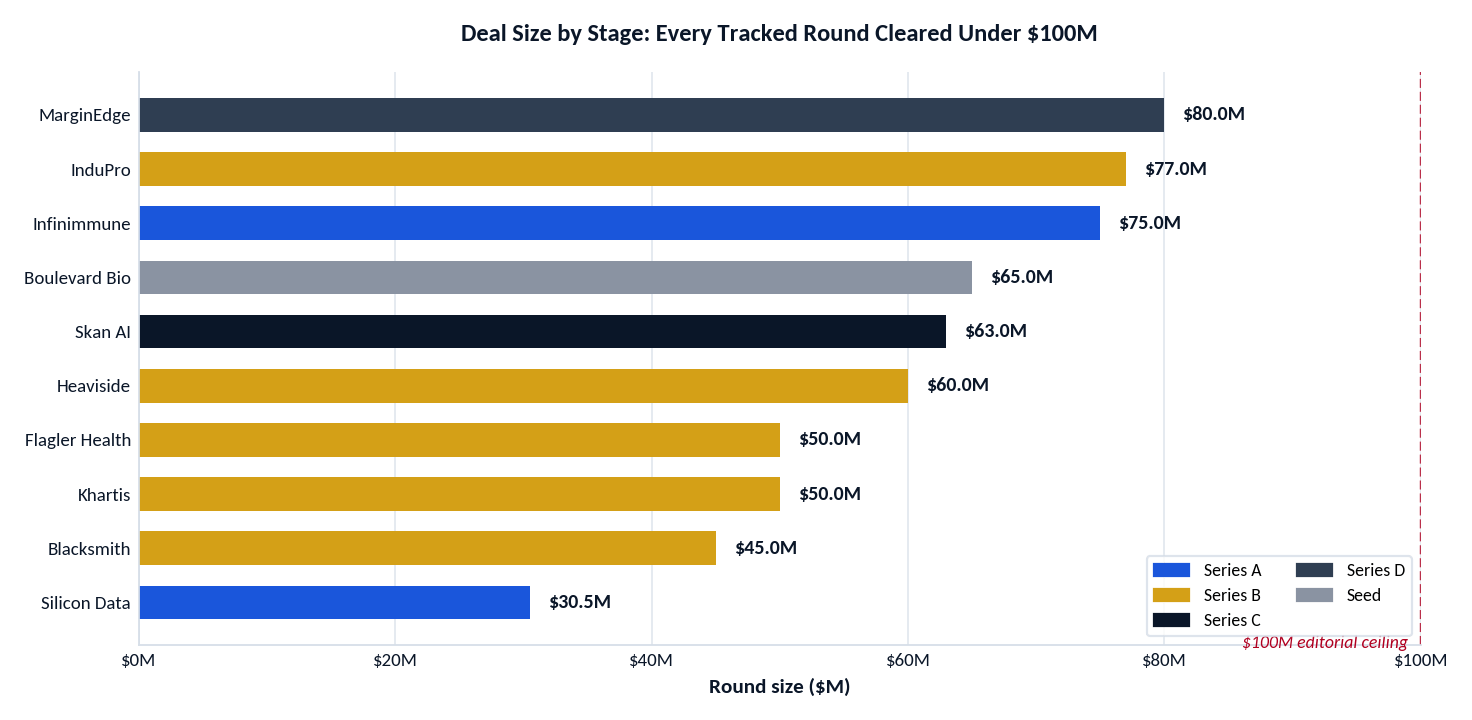
Six of the ten mid-market rounds tracked this week carried a corporate balance sheet on the cap table, and in two of them the corporate held the lead or co-lead seat. That is no longer a late-stage phenomenon. A pharmaceutical venture arm co-led a Series A for a company whose lead antibody targets the same pathway as its own blockbuster. An enterprise hardware maker co-led a Series C after leading the B. A derivatives exchange and a chip manufacturer wrote into the first institutional round of a two-year-old data company. Across the ten scored rounds, $595.5M moved, with every deal under $100M.
The old sequencing rule said to take financial money first and strategic money last, because a corporate on the cap table signals to buyers, constrains your exit, and slows your process. That rule assumed strategics arrive after the risk is gone. This week they arrived while the risk was still there, and they paid for the seat.
Look at what sits behind those seats and the logic gets sharper. Two companies in the tracked set had already signed commercial collaborations with the same pharmaceutical groups that then invested, totaling roughly $950M and $838M in potential upfront and milestone payments. Combined, that is close to $1.8B of contracted optionality sitting behind $152M of equity. The corporate did not turn up as a validator. It turned up as a counterparty that had already run the diligence and paid for the answer.
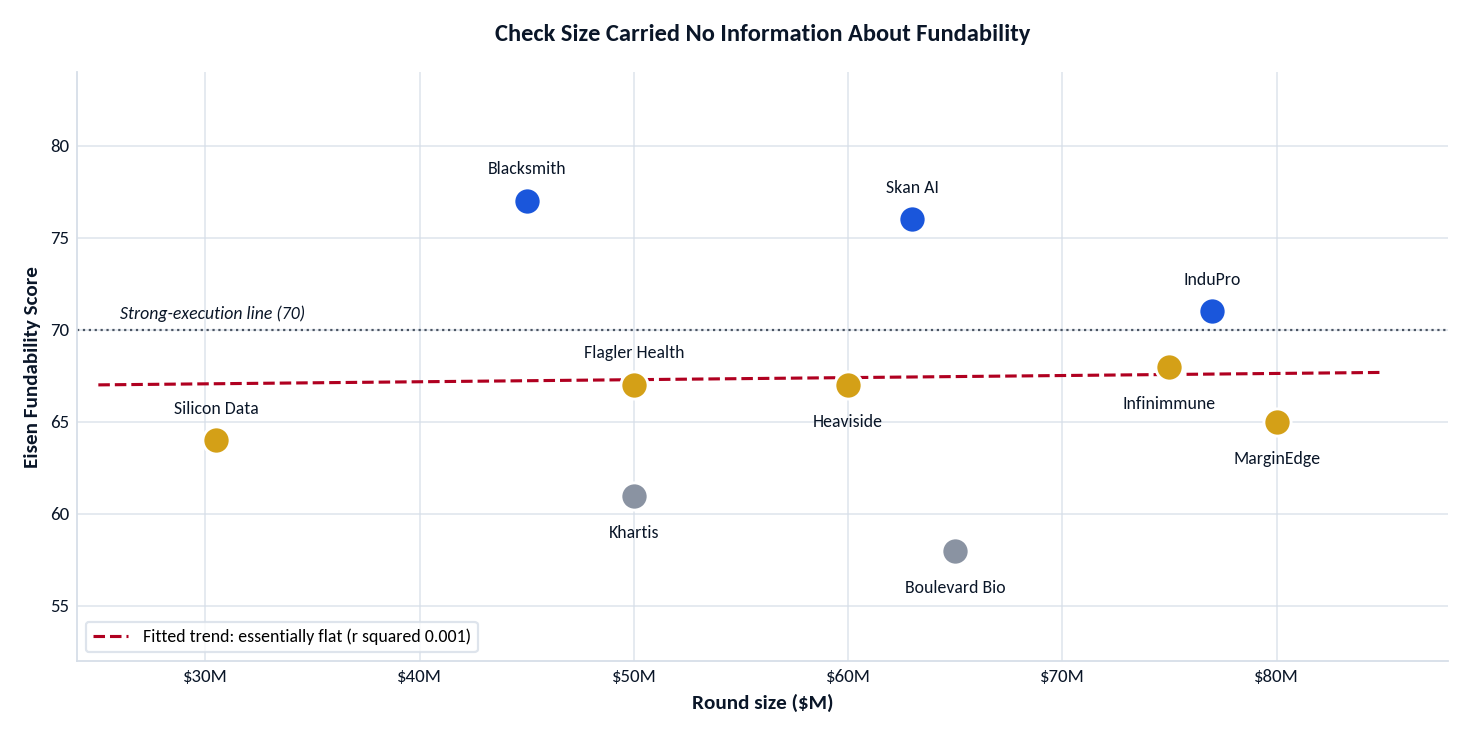
Here is the second thing the tape did, and it runs counter to a reflex almost every founder has. Check size told you nothing about fundability. Fit a line through the data on round size and Eisen Fundability Score (EFS) across the ten, and it is flat. The largest round of the week sits mid-table at 65. The highest score belongs to a company that raised barely half as much. The lowest belongs to the fourth-largest round. The number in the headline and the strength of the position underneath it are statistically unrelated.
The consequence for Monday is specific. If you are running a generalist process because you believe strategics are a later problem, you are competing for the smaller pool. And if you are benchmarking your raise against the biggest headline in your sector, you are benchmarking against noise. Read every shift below through those two lenses.
The Week in One Sentence
Primary insight: With the megarounds and the public-market traffic removed, mid-market capital concentrated around two things: evidence that cannot be reversed, and investors who are also buyers. Corporate and strategic money moved down-stage into Series A and B, and round size carried no signal about the strength of the position underneath it.
▪ Total tracked mid-market capital (10 scored rounds): $595.5M, every round under $100M.
▪ Average round size: $59.55M across the ten.
▪ Median round size: $61.5M, the midpoint between Heaviside Industries and Skan AI.
▪ Disclosed valuations: two of ten. Blacksmith at $550M and Heaviside Industries at $600M. Eight rounds were undisclosed, and each one incurred a score deduction for opacity.
▪ Largest tracked round: MarginEdge, $80M Series D, a restaurant operations and finance platform running across more than 13,000 restaurants.
▪ Highest Eisen Fundability Score: Blacksmith at 77, on a disclosed price, a disclosed customer curve, and a usage series a partner can verify in an afternoon.
▪ Strategic participation rate: six of ten rounds included a corporate or strategic balance-sheet investor. Both Series A rounds in the tracked set did, and in two of the six, the corporate already held a signed commercial agreement with the company.
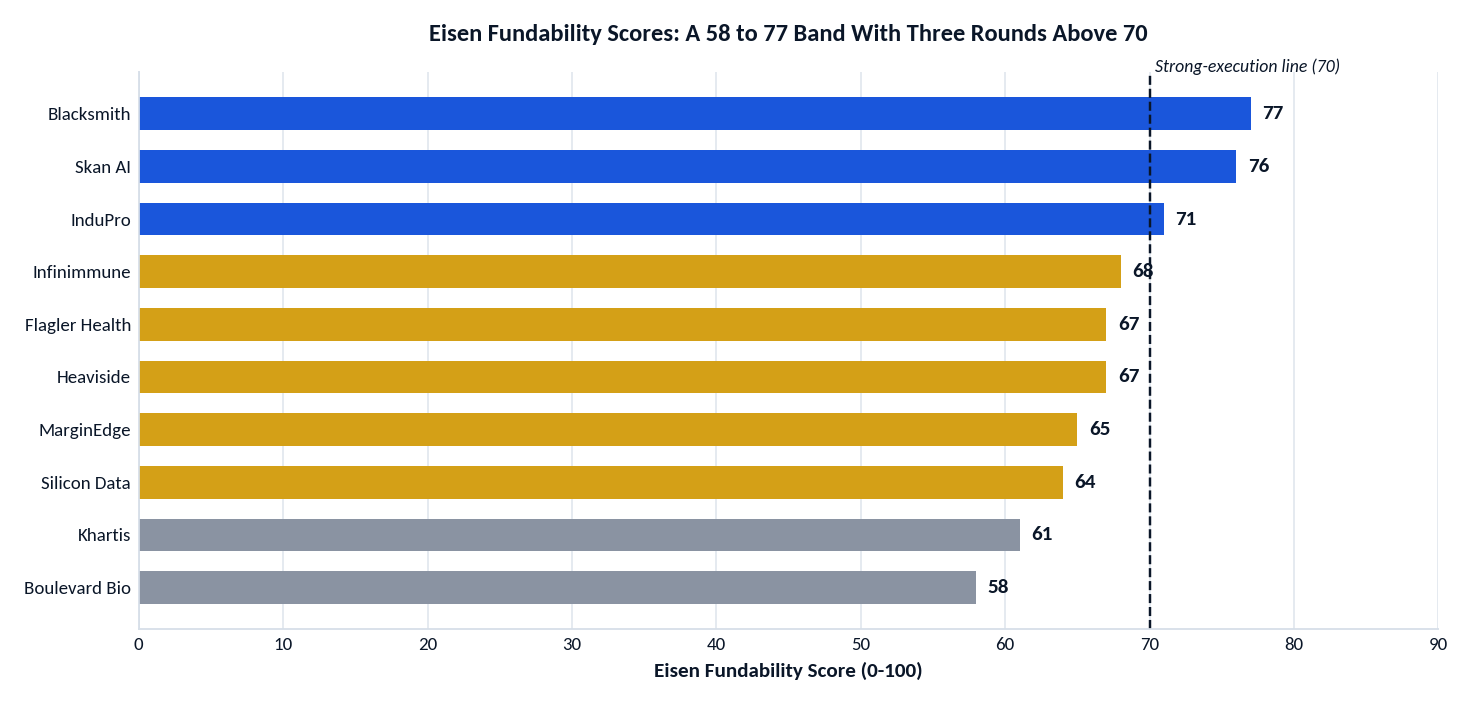
▪ Defining structural feature: an Eisen Score band of 58 to 77 with three rounds clearing 70, and no measurable relationship between check size and score.
Deal Scorecard
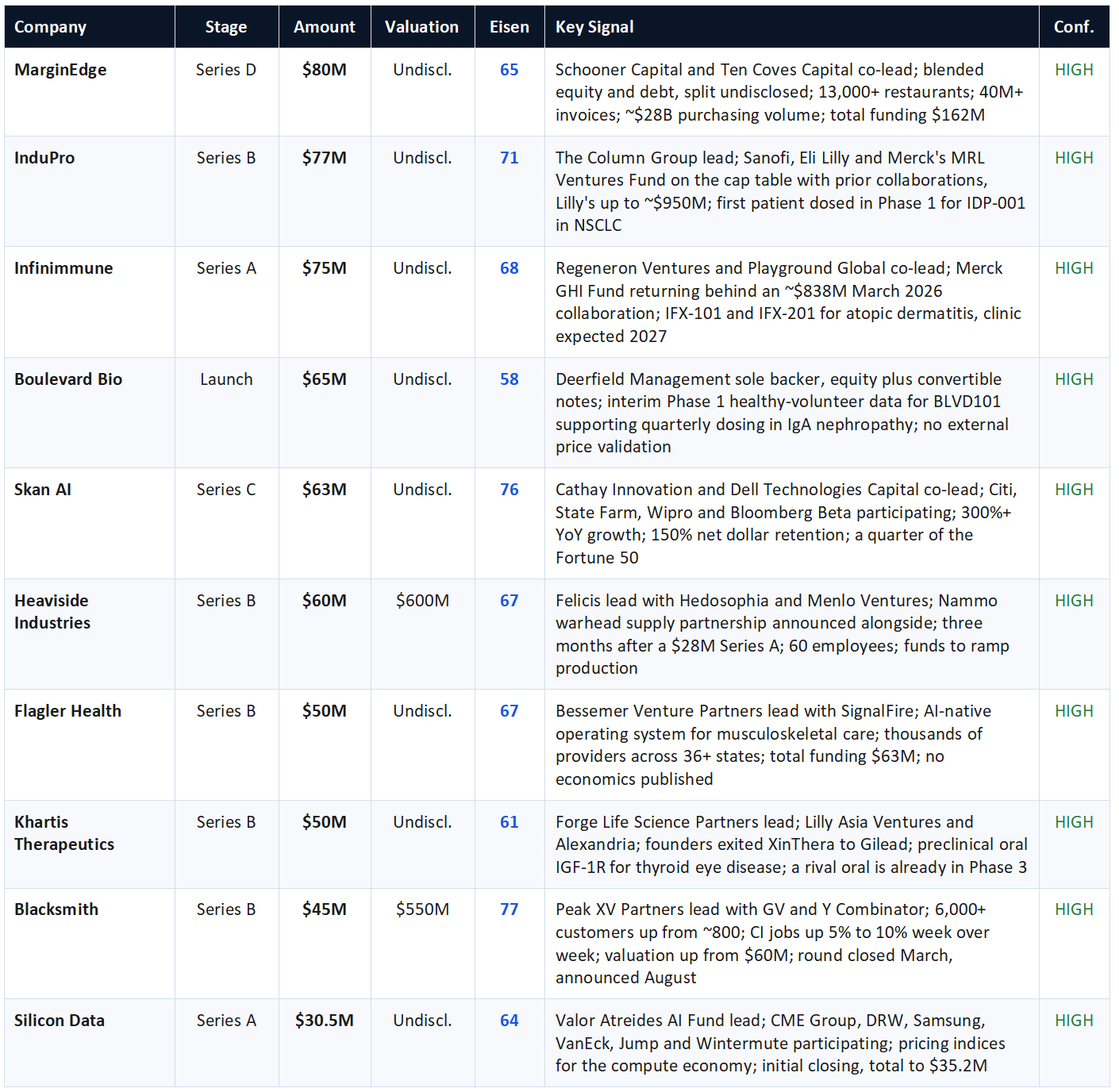
Eisen Fundability Scores are calculated across 5Ps: Process or Founder-Investor Dynamics (30 percent), Proof or Traction-to-Conviction Conversion (25 %), Positioning pr Narrative Power (20 %), Packaging or Deal Architecture (20 %), and Planning or Capital Planning (5 %). Scores of 85 and above signal an inevitable outcome. Scores of 70 to 84 signal strong execution. Scores below 70 signal early stage or a need for repositioning. Missing metrics are scored conservatively, and opacity is penalized rather than assumed strong.
What the Scorecard Says at a Glance
The score band is tight, and the slope is nonexistent. Scores ran from 58 to 77, and three of ten cleared the 70 strong-execution line. What makes the week instructive is what the scores do not track. Regress score against round size, and the line is flat. The four largest rounds average 65.5. The four smallest average 67.25. That gap is a rounding error, not a pattern. Founders treat the biggest number in their category as the bar. This week the biggest number was not even correlated with the bar.
Blacksmith (77) and Skan AI (76) sit at the top, and they got there the same way. Both published operating series rather than operating adjectives. Blacksmith disclosed a customer count that moved from roughly 800 to more than 6,000 in under a year, a continuous integration workload growing 5 to 10 percent week over week, and a price. Skan AI disclosed growth above 300 percent year over year, net dollar retention at 150 percent, and penetration of a quarter of the Fortune 50. Neither is the biggest round in the set. Both are the most verifiable.
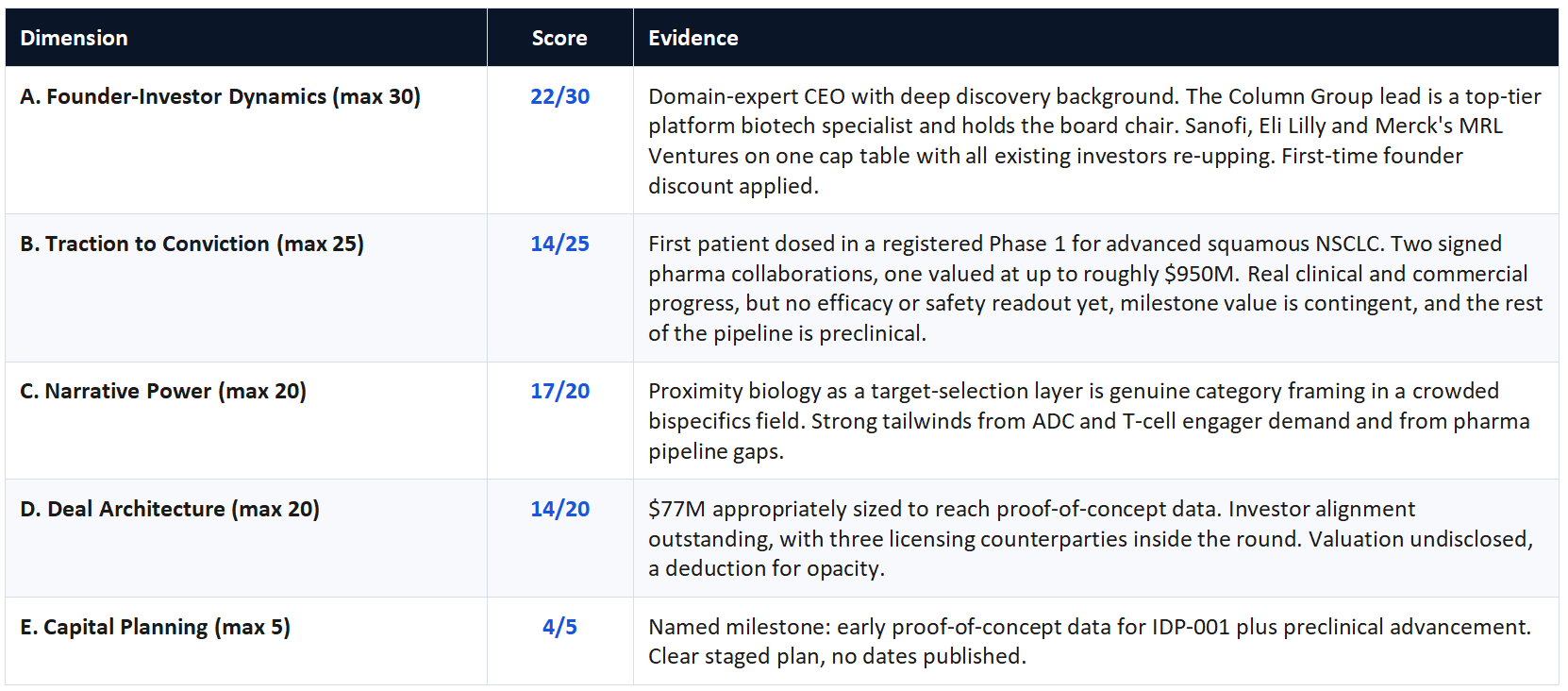
InduPro (71) is the only clinical-stage company above the line, and the reason is contractual rather than scientific. Sanofi and Eli Lilly did not simply invest. Both had already signed collaboration agreements with the company, Lilly’s valued at up to roughly $950M, and Merck’s therapeutics venture fund was an existing shareholder. Three pharmaceutical diligence teams reached the same conclusion about the platform before the round opened, and the first patient was dosed in the Phase 1 study as the financing closed. That is proof an outside investor can check without a microscope.
Boulevard Bio (58) is the instructive floor, and the reason is structural rather than scientific. The science is real. Interim Phase 1 healthy-volunteer data show strong IgA suppression, supporting a quarterly dosing interval and representing a genuine differentiation claim against competing dual BAFF and APRIL agents. The structure is what scores. A $65M launch financing from a single firm that invented the molecule, incubated the company, and chairs the board, delivered partly as convertible notes, has no external price discovery and no syndicate tension. A large number, priced by a single counterparty, tells a later investor almost nothing.
Khartis Therapeutics (61) shows what a contested category claim costs. The team is strong, having exited XinThera to Gilead in 2023, and the syndicate is deep. The lead program is described as the first oral, selective IGF-1R inhibitor for thyroid eye disease and remains preclinical, while a competitor’s oral IGF-1R candidate is already recruiting for a confirmatory Phase 3 in the same indication. A first-in-class claim that a diligence analyst can falsify in a single search costs more in narrative power than it gains.
What Changed This Week: 5 Market Shifts
Each shift is verified against multiple sources and ranked by structural impact on founder fundraising, not by deal size. Every shift ends with what it means for your raise.
Shift 1: The Buyer Took the Lead Seat, and Took It Early
Pattern: Six of ten tracked rounds carried a corporate or strategic balance-sheet investor, and two of those corporates led or co-led. Regeneron Ventures co-led Infinimmune’s $75M Series A alongside Playground Global, with Merck Global Health Innovation Fund returning. Dell Technologies Capital co-led Skan AI’s $63M Series C after leading the B, joined by Citi Ventures, State Farm Ventures and Wipro Ventures. InduPro’s $77M Series B put Sanofi, Eli Lilly, and Merck’s MRL Ventures Fund on a single cap table. Khartis drew Lilly Asia Ventures and Alexandria Venture Investments. Silicon Data’s first institutional round drew CME Group, DRW, Samsung, VanEck, Jump Trading and Wintermute. Both of the week’s Series A rounds carried corporate money.
The detail that matters: In two of these rounds, the corporate investor was already a paying commercial partner. Eli Lilly signed a collaboration with InduPro in January 2026 valued at up to roughly $950M, and Sanofi signed one in December 2025; both then invested in the Series B. Merck signed an antibody discovery collaboration with Infinimmune in March 2026 worth up to roughly $838M, then returned in the Series A. Close to $1.8B of contracted optionality sits behind $152M of equity across those two deals. The commercial agreement came first, and the equity followed, which is the reverse of the order most founders assume.
Perspective: Strategic investors used to arrive after the risk was gone, which is why founders learned to sequence them last. That logic held when the corporate’s edge was capital. It does not hold when the corporate’s edge is knowing whether the thing works. Regeneron can underwrite an antibody discovery platform faster than a generalist can schedule the diligence call, and did so even though one of Infinimmune’s two lead antibodies targets IL-13, the same pathway as Regeneron’s own multibillion-dollar eczema franchise. CME can price a compute index because it already runs the reference-rate business. Dell can validate a work-observation layer because its own field teams deploy into the same accounts. When the hardest question in your deal is a domain question, the buyer is the cheapest underwriter in the market, and buyers have started paying for the seat rather than waiting to be offered it.
Founder Blindspot: Founders treat strategic capital as a signaling risk and defer it to Series C. The risk they are actually managing is a term-sheet risk that largely no longer exists: right of first refusal and exclusivity provisions are negotiable and were not present in the structures visible this week. Meanwhile, the cost of deferring is real and immediate. You spend sixty days teaching a generalist your category while a strategic who already knows it funds your competitor.
Playbook: Build a strategic map before you build your generalist list. Write down the five corporations that would most plausibly acquire you, then find their venture arm, the partner who covers your category, and the portfolio company closest to your thesis. Approach two of them in the first week of your process, not the last. Ask for a technical diligence session rather than a term sheet. A strategic that runs your diligence and passes gives you a free failure report. A strategic that runs your diligence and invests gives you a lead who cannot be talked out of the category.
Contrast: A year ago the tape showed strategics writing participation checks behind a financial lead in later rounds. This week, two of them held the pen at Series A and Series C, and four more sat inside rounds at Series A and B. The corporate moved from follower to underwriter.
What this means for your raise: if your hardest risk is technical, clinical, or regulatory, the first three names on your list should be corporate venture arms rather than funds. Build that pool before you open the round.
Shift 2: Check Size Carried No Information About Fundability
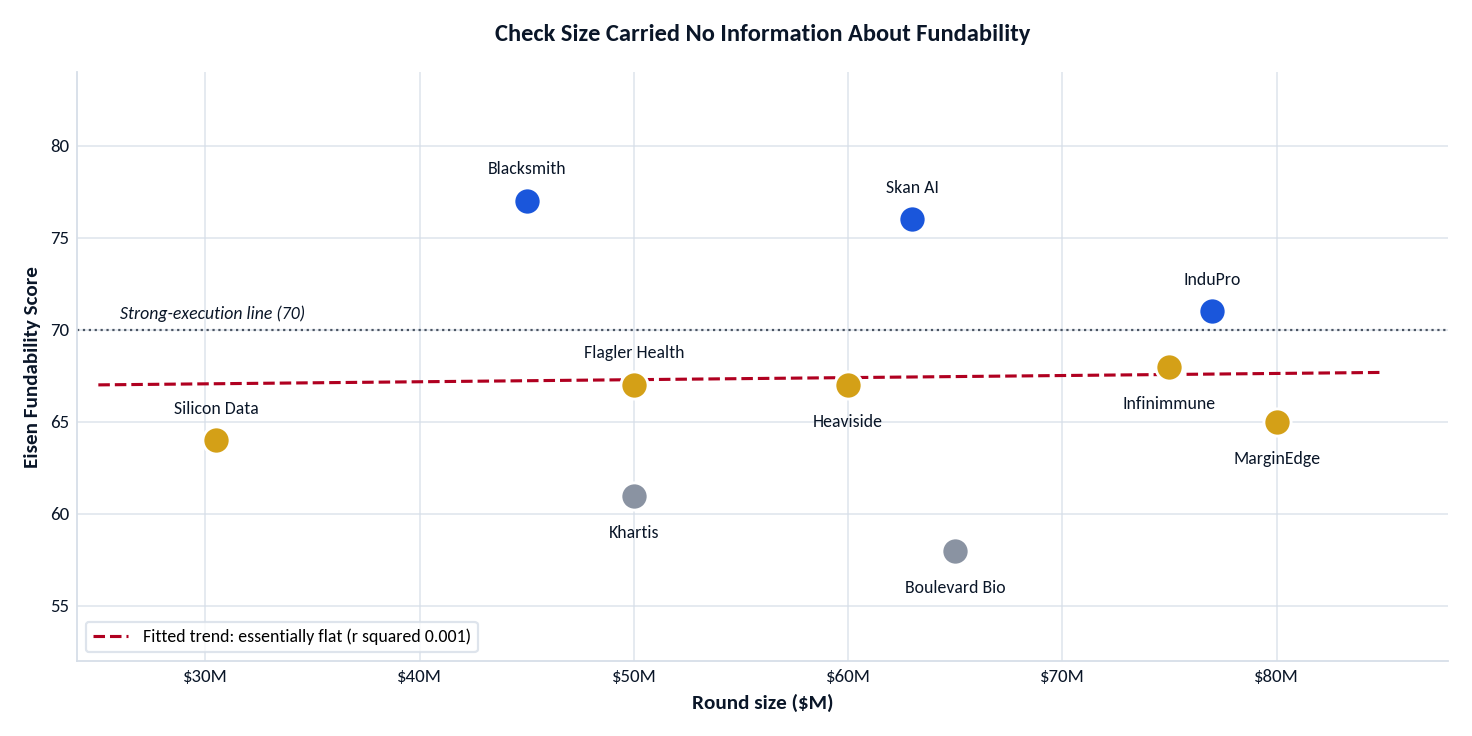
Pattern: The four largest rounds of the week averaged 65.5 on the Eisen Fundability Score. The four smallest averaged 67.25. A regression of score on round size across all ten produces a fitted slope of plus 0.011 points per million dollars, with an R-squared of 0.001, which is statistical noise. MarginEdge raised the most, $80M, and scored 65, mid-table. Boulevard Bio raised the fourth-largest round, $65M, and scored the lowest at 58. Blacksmith raised $45M and achieved the highest score of 77. Silicon Data raised the smallest round in the set, $30.5M, and outscored three companies that raised more than twice as much.
Perspective: Round size indicates what the next 18 months will cost. Fundability measures how little has to be believed on faith. Those are different questions, and this week the data says they are independent. A $75M Series A for an antibody company still two years from the clinic is neither stronger nor weaker than a $45M Series B for a company with 6,000 paying accounts. It is a different cost structure, walking toward a different kind of evidence. The reason founders find this counterintuitive is that they read round size as a verdict investors passed on the company. It is not. It is an estimate of the plan's cost.
Founder Blindspot: Founders benchmark against the biggest number in their sector and read it as the bar. It is not the bar. It is the burn. Anchoring your ask to a capital-intensive comparable in a different risk class is the fastest way to raise a round you cannot justify at the next milestone, because you will have set a price against someone else’s cost structure rather than your own proof. The corollary is more useful, and almost nobody uses it: a smaller round is not a weaker signal. Across these ten, it was not a signal at all.
Playbook: Size your round off your next proof point, not off your sector’s headline. Write the single piece of evidence that would make your next round obvious. Cost it out with a 40 percent buffer. That number is your raise. If the answer is materially smaller than the comparables you have been quoting, that is a strength you should say out loud in the meeting. Capital efficiency against a defined readout is a fundability argument, and almost nobody makes it explicitly.
Contrast: In the 2021 cycle, a bigger round was itself the signal, and founders competed to announce the largest number. In this week’s tape, the largest number sat mid-table in terms of score and disclosed neither a valuation nor an equity split. The signal did not reverse. It disappeared.
What this means for your raise: stop quoting the biggest round in your category as your benchmark. Quote the round that bought the clearest next milestone, and show that you have costed yours.
Shift 3: The Validation Layer Outpriced the Generation Layer
Pattern: Three of the week’s ten rounds, $138.5M in total, went to companies that measure, verify, or price what AI produces rather than produce it. Blacksmith raised $45M to run the builds and tests that gate code before it ships, with continuous integration volume growing 5 to 10 percent week over week as coding agents multiply pull requests. Skan AI raised $63M to build a context graph of how work actually happens, so agents have ground truth to act against, citing a finding that only about 8% of enterprises have agents in production. Silicon Data raised $30.5M to build pricing indices, performance benchmarks, and forward curves for the compute economy. None of the three sells a model.
Perspective: Generation got cheap, so the constraint moved downstream. When an agent writes ten times the code, the bottleneck is the pipeline that proves the code is safe. When an enterprise deploys agents, the bottleneck is understanding the process before automating it. When compute becomes a traded input, the bottleneck is a reference price everyone trusts. Each of these is a measurement business, and measurement businesses have a property investors like: their revenue scales with the volume of activity in the category rather than with their share of it. Blacksmith wins whether Claude Code or Codex writes the pull request.
Founder Blindspot: Founders assume the money is in producing the intelligence. The defensible position is often in verifying it. Founders also assume the verification layer is a feature that the platform will absorb. That is the real risk in this category, and it deserves an honest answer rather than a dismissal, but it is a competitive question, not a market-size question, and this week the market paid for the category anyway.
Playbook: Write one sentence describing what becomes unverifiable at scale in your category when an agent does the work. Then decide whether you own the measurement of it. If you sell generation, add a verifiable output your buyer can audit and include it in the release, because it turns a capability claim into a verifiable one. If you sell measurement, publish the volume curve rather than the customer logo wall, the way this week’s two highest scorers did.
Contrast: Two years ago the fundable AI story was the model or the application built on it. This week, the highest-scoring rounds in the set both sold the instrument that tells you whether the output is correct. The referee repriced above the player.
What this means for your raise: if an agent could produce your output, the fundable position is measuring the output, not producing it faster. Name the measurement you own.
Shift 4: The Headline Number Stopped Describing the Round
Pattern: Four of the ten scored rounds carried a structural qualifier that the headline number does not convey. MarginEdge’s $80M blends Series D equity and debt, with the split undisclosed. Silicon Data’s $30.5M is an initial closing rather than a final close. Blacksmith’s $45M was raised in March and announced in August, so the growth figures published alongside it describe a company that already had the capital. Boulevard Bio’s $65M came as equity plus convertible notes from a single firm that invented the molecule and incubated the company, so no external price was set. Outside the scored ten, it gets starker. A $35M announcement on August 10 was $25M in federally backed debt and $10M in equity, a 70/30 split in favor of the non-venture-capital component. Two further rounds carried prior-week primary release dates while appearing in this week’s feeds.
Perspective: The headline number is a marketing artifact, and the market has learned to shape it. Adding debt makes the number bigger without diluting. Announcing an initial close makes momentum look complete. Delaying an announcement lets you attach five extra months of growth to a round priced on older figures. None of these is dishonest. All of them mean that a founder benchmarking against a headline is benchmarking against a construction, not a transaction. The number your investor actually underwrites is priced equity against a valuation, and that was disclosed in one round out of ten this week.
Founder Blindspot: Founders read a competitor’s announcement as a comparable and adjust their own ask. Almost nobody asks the four questions that would make the comparison valid: how much of that was equity, when it priced, who set the price, and whether that was the whole round. Getting the comparable wrong is not a rounding error. It sets your anchor and your dilution expectation for the entire process.
Playbook: Build a comparables file with four columns and refuse to use any deal that cannot fill all four: equity amount, close date, lead investor, and whether the close was full or partial. Most press releases will fail two of the four, which is the point. Use the deals that survive. Then consciously decide how you will construct your own announcement, because the same tools are available to you, and choosing to publish a clean equity number with a price is now a differentiating signal rather than the default.
Contrast: In earlier cycles, the announcement described the transaction. This week the announcement was an instrument in its own right, timed and structured to shape a comparison. The release became part of the deal architecture.
What this means for your raise: audit your three anchor comparables this week for equity, date, lead, and completeness. At least one of them will not survive it.
Shift 5: Biology and Software Were Held to Opposite Evidence Standards
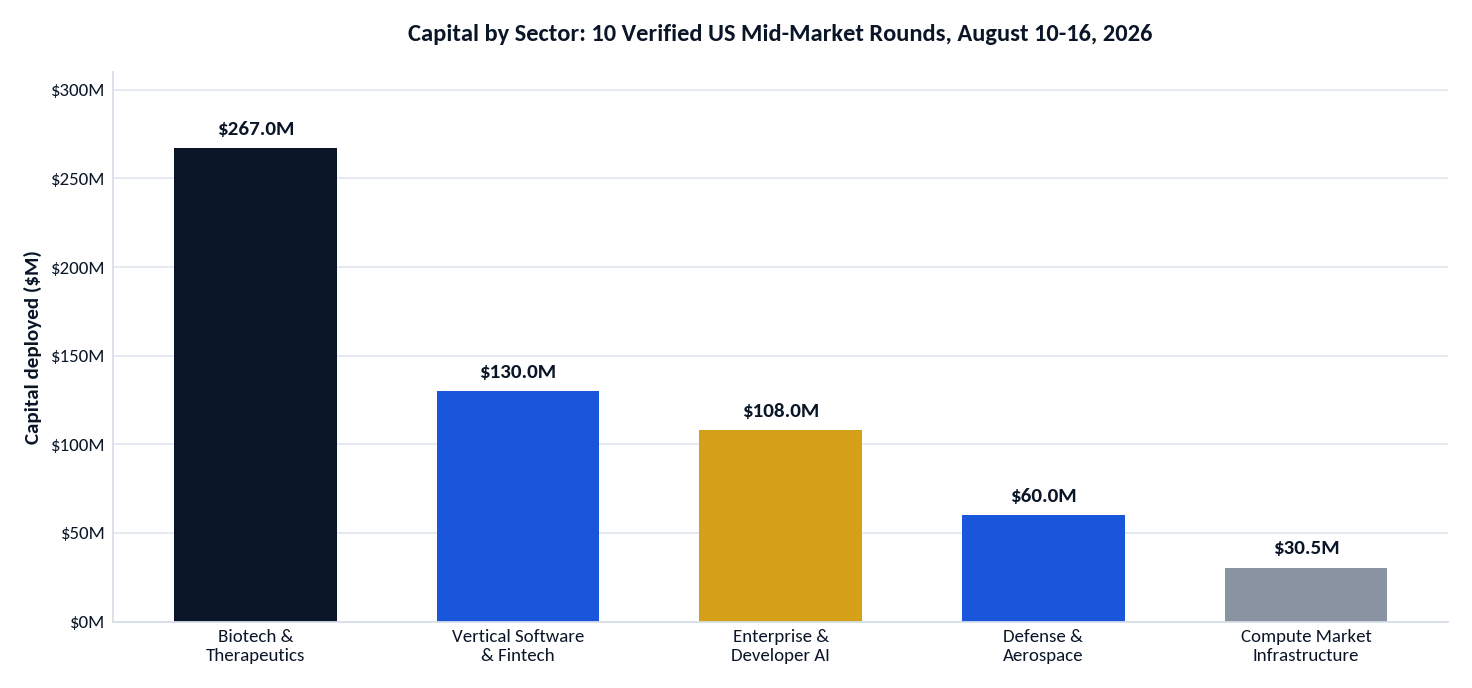
Pattern: The four biotech rounds took $267M, 44.8 percent of tracked mid-market capital, and not one of them disclosed revenue, a customer, or a valuation. What two of them disclosed instead was human data: InduPro dosed the first patient in its Phase 1 study as the round closed, and Boulevard Bio published interim Phase 1 healthy-volunteer results supporting a quarterly dosing interval. Two others disclosed pharma collaboration values instead, up to roughly $950M and $838M. The four software and vertical-platform rounds took $238M, and every one published a commercial metric: 13,000 restaurants and $28B of purchasing volume at MarginEdge, 6,000 customers and a weekly growth rate at Blacksmith, 300 percent growth and 150 percent net dollar retention at Skan AI, thousands of providers across 36 states at Flagler Health. Two completely different evidence currencies, both accepted.
Perspective: The two categories are being underwritten against different clocks. Biological evidence is close to permanent. A first patient dosed in a registered Phase 1 does not decay; a pharmacodynamic readout showing target suppression remains true; and a mechanism already validated by an approved drug remains a fact. Commercial evidence is perishable. A 300 percent growth rate is a statement about the last twelve months and an assumption about the next twelve. That is why the biotech rounds could be large while disclosing no commercial data at all, and why the software rounds had to publish numbers to clear a comparable bar. Investors were not being inconsistent. They were pricing how quickly each kind of proof expires.
Founder Blindspot: Software founders believe revenue is the strongest form of proof and stop there. Revenue is the most legible form of proof, which is not the same thing. The strongest form of evidence is that a competitor cannot erode it and time cannot degrade it: a regulatory clearance, a qualified supply position, a signed counterparty agreement, a dataset that cannot be recreated, a switching cost written into a system of record. The three rounds that cleared 70 this week each held at least one of those alongside their growth figures. The rounds carrying scope claims and nothing durable did not clear it.
Playbook: Split your proof into two lists on one page. Perishable proof: growth rate, pipeline, logos, usage this quarter. Permanent proof: clearances, certifications, proprietary data you own outright, integrations that would take a year to rip out, contracted backlog. Count the second list. If it is empty, your next two roadmap quarters should focus on filling it, and your use-of-funds headline should say so explicitly.
Contrast: The prevailing frame all year has been that proof of usage beats proof of concept. This week refined it. The currency is durability, not usage. Companies with only commercial data had to publish far more of it to reach the conviction that a first dosing event or a signed pharma collaboration bought outright.
What this means for your raise: your growth rate has an expiry date, and your investor knows it. Name the one piece of evidence in your business that does not expire, and make it the center of the deck.
The Deals That Matter: Top 5
Five deep dives across developer infrastructure, enterprise AI, oncology, market infrastructure, and vertical healthcare. Each is selected for distinct playbook value, not deal size. All metrics are verified against two or more sources.
Blacksmith
Continuous Integration and Code Validation Cloud | Series B | $45M | $550M Valuation
Eisen Fundability Score: 77 / 100
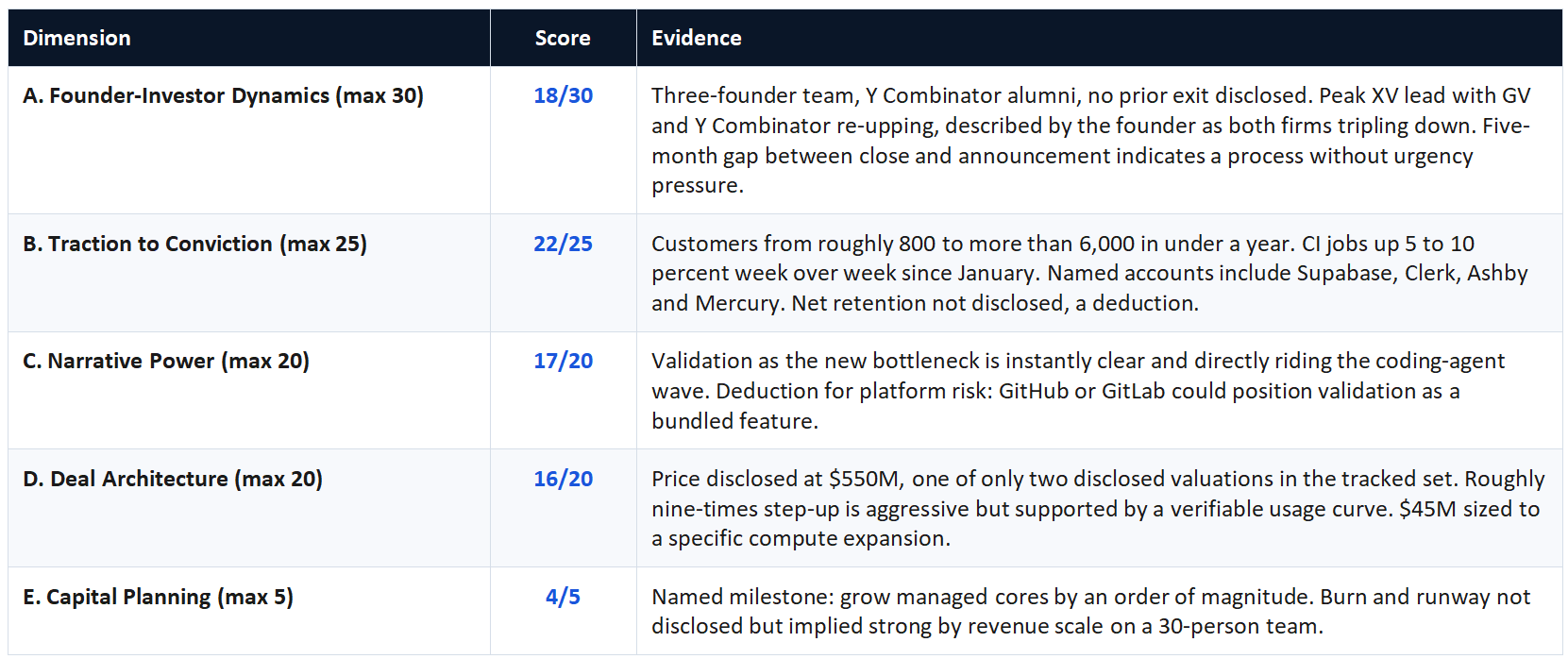
Why this scored: The highest score of the week, and the only round in the set that published both a price and a verifiable usage series. Blacksmith disclosed a customer count that moved from roughly 800 to more than 6,000 in under a year, continuous integration job volume growing 5 to 10 percent week over week since January, named accounts including Supabase, Clerk, Ashby and Mercury, and a $550M valuation against a $60M mark less than twelve months earlier. Every one of those is checkable. The deductions are for a five-month announcement lag and for a category that a platform incumbent could plausibly bundle.
The Setup: Founded in 2024 by Aditya Jayaprakash, Aayush Shah and Aditya Maru, Blacksmith runs GitHub Actions workloads on purpose-built compute with optimized caching and storage, and has added Codesmith, an agent that diagnoses continuous integration failures and fixes them autonomously before merge. The thesis is a bottleneck migration. Coding agents made writing software cheap and fast. Every line an agent writes still has to be built, tested, and reviewed before it ships, and that half of the pipeline did not get cheaper. Blacksmith sells the second half.
The Numbers: $45M Series B led by Peak XV Partners with existing investors GV and Y Combinator participating, at a $550M valuation, bringing total funding to $58.5M. More than 6,000 companies on the platform, up from roughly 800 at the Series A announcement in September 2025. Continuous integration jobs have been growing 5 to 10 percent week over week since the start of 2026. The prior Series A was $10M at a $60M valuation. Use of funds: expand the managed compute footprint from hundreds of thousands of cores by an order of magnitude.
The Pattern: This is the validation layer repricing above the generation layer. Blacksmith’s revenue scales with how much code the industry writes, not with which tool writes it. That is a position with the volume dynamics of an index business and the margins of infrastructure software.
The Perspective: The step-up is roughly 9x in under a year, which reads as aggressive until you look at what is underneath it. A customer count that moves 7.5 times and a weekly workload curve give a lead investor an underwriting series rather than a story. Peak XV is not paying for a thesis about AI coding. It is paying for a slope it can extrapolate. That is the difference between a premium mark that holds and one that gets reset.
The Playbook: Publish the derivative, not just the level. Almost every founder publishes a level: customers, revenue, seats. Blacksmith published a rate of change with a defined period attached, week over week since a named date. A rate with a period is falsifiable, and falsifiable claims convert faster than impressive ones. Find the one metric in your business where the weekly or monthly rate is your strongest fact and lead with it in that exact form.
The Founder Mistake to Avoid: Founders copy the step-up rather than the disclosure. A nine-times mark is the output of a verifiable curve, not an input to negotiation. Arriving with the multiple and without the series gets you a slower process and a structured term sheet. Note also the announcement lag: this round was priced in March using March data and published in August using August data. If you use it as a comparable, use the March figures.
Skan AI
Enterprise Work Context Graph for AI Agents | Series C | $63M | Valuation Undisclosed
Eisen Fundability Score: 76 / 100
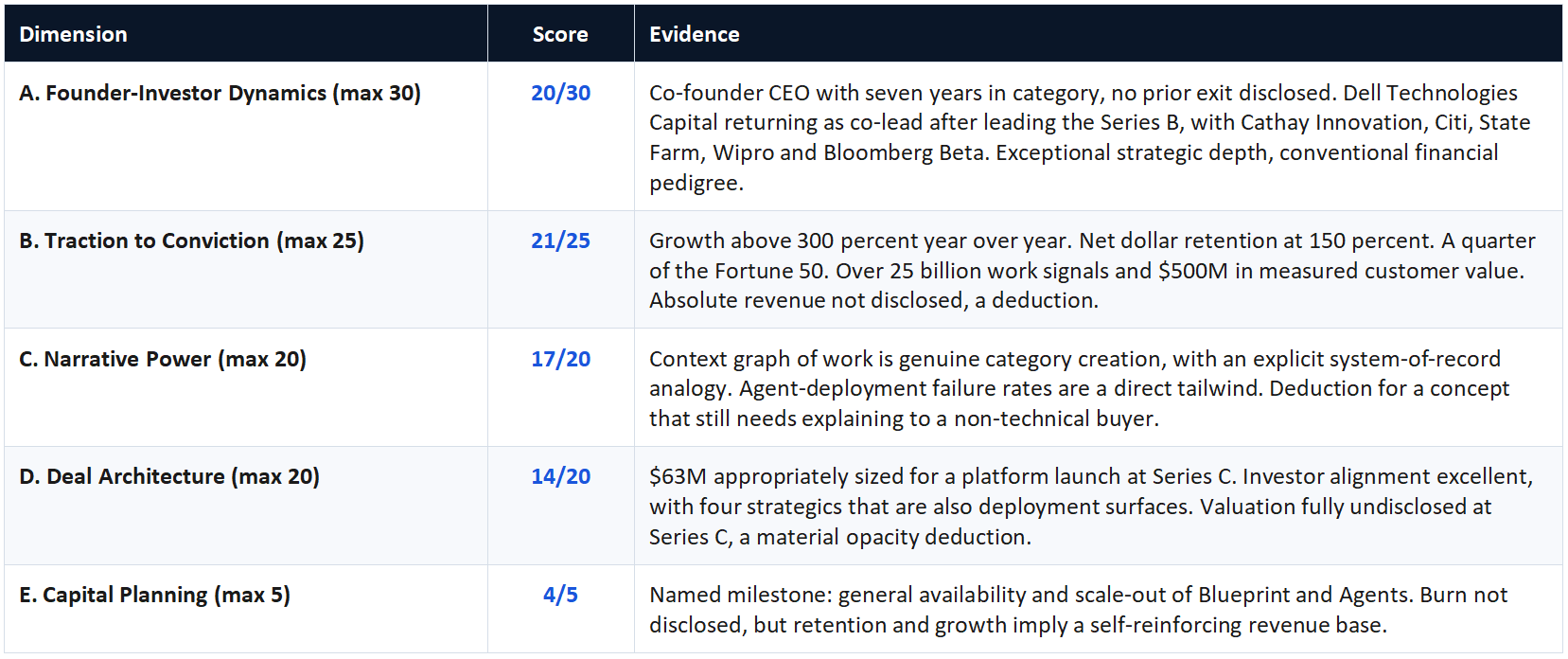
Why this scored: Skan AI is the clearest case this week of a company whose investors are also its distribution. Dell Technologies Capital co-led after leading the Series B, and Citi Ventures, State Farm Ventures, Wipro Ventures, and Bloomberg Beta all sit alongside. The commercial evidence is dense: growth above 300 percent year over year, net dollar retention averaging 150 percent, a quarter of the Fortune 50 running on the platform, more than 25 billion work signals processed, and more than $500M in measured customer value. The deduction is a fully undisclosed valuation at Series C, which is a meaningful opacity penalty at that stage.
The Setup: Founded seven years ago and led by co-founder and CEO Avinash Misra, Skan AI deploys observation technology on employee desktops that watches how work moves across applications, including the spreadsheet, the customer record, the email client, and the legacy mainframe, then abstracts those observations into a living model of the underlying process. The funding landed alongside general availability of Skan AI Blueprint and Skan AI Agents, which turn that model into deployed automation. The founder’s framing is that everyone is building a better car, and the larger opportunity lies in the navigation system.
The Numbers: $63M Series C co-led by Cathay Innovation and Dell Technologies Capital, with Citi Ventures, Bloomberg Beta, State Farm Ventures and Wipro Ventures participating, bringing total funding to roughly $120M. Growth above 300 percent year over year. Average net dollar retention of 150 percent. A quarter of the Fortune 50 as customers. More than 25 billion work signals processed and more than $500M in measured customer value generated. Cited market context: roughly eight percent of enterprises have agents in production.
The Pattern: This is the strategic-as-lead shift in its purest form. Dell, Citi, State Farm, and Wipro are not passive capital. They are the systems integrator, the bank, the insurer, and the outsourcer, whose own operations constitute the deployment surface. The cap table is a channel.
The Perspective: Net dollar retention of 150 percent is the number doing the work here, and it is worth understanding why. A 300 percent growth rate can be bought. Retention at 150 percent means existing customers expanded by half again without being sold to, which is the only commercial metric that is close to unfakeable. Pair that with an eight percent production-deployment rate across the enterprise market and the investment case writes itself: the category is barely started, and this company already compounds inside its accounts.
The Playbook: Lead with the expansion number, not the growth number. If you have net dollar retention above 120 percent, that single figure is worth more in a first meeting than your entire pipeline slide, because it answers the question every partner asks privately: does this get bigger without more sales spend? If you do not know your net dollar retention, calculate it this week. It is the most underused figure in mid-market fundraising.
The Founder Mistake to Avoid: Founders in this category sell observation technology and let buyers infer its value. Skan sold a measured outcome, more than $500M in customer value, and used the observation layer as the mechanism rather than the pitch. Selling the sensor, rather than the decision it enables, is the fastest way to be procured as tooling and priced as such.
InduPro
Proximity-Guided Bispecific Oncology and Autoimmune Therapeutics | Series B | $77M | Valuation Undisclosed
Eisen Fundability Score: 71 / 100
Why this scored: The highest-scoring clinical-stage company of the week and the clearest example anywhere in the set of a cap table doing commercial work. Three pharmaceutical balance sheets sit in this round: Sanofi, Eli Lilly, and Merck’s MRL Ventures Fund, alongside a lead from The Column Group, one of the sharpest platform biotech specialists. Two of those three had already signed collaboration agreements with the company before investing. The first patient was dosed in the Phase 1 study as the financing closed. The score is capped only by the lack of an efficacy readout and an undisclosed valuation.
The Setup: InduPro, led by CEO Prakash Raman, operates from Seattle with an additional office in Cambridge, Massachusetts. Its proximity-labeling platform maps the spatial arrangement of proteins on the cell surface at high resolution, then uses that map to select co-target pairs specific to a given disease biology. The output is a pipeline of bispecific antibodies, antibody-drug conjugates, and T-cell engagers. The underlying bet is that, in bispecifics, the binding constraint is target selection rather than molecular engineering, and that a map of protein neighborhoods is the asset that resolves it.
The Numbers: $77M Series B led by The Column Group, with existing investors Vida Ventures, MRL Ventures Fund (the therapeutics venture fund of Merck), Emerson Collective advised by Yosemite, and Euclidean Capital participating, joined by new investors Solasta Ventures, Sanofi, and Eli Lilly and Company. Follows an $85M Series A closed in June 2024 and co-led by The Column Group and Vida Ventures. Lead program IDP-001 is a bispecific antibody-drug conjugate co-targeting EGFR and CDCP1, designated TAPA-E1, with the first patient dosed in a Phase 1 study enrolling adults with advanced squamous non-small cell lung cancer and other solid tumors. Prior commercial agreements: Sanofi in December 2025 on a preclinical bispecific PD-1 agonist program for autoimmune disease, and Eli Lilly in January 2026 on a bispecific and multispecific oncology collaboration valued at up to approximately $950M. Use of funds: Phase 1 development and early proof-of-concept data for IDP-001 plus advancement of the preclinical pipeline. Valuation not disclosed.
The Pattern: Three potential acquirers or licensing counterparties funding the same Series B is a structural signal that outruns any individual investor’s conviction. Two of them had already paid for access to the platform under signed agreements. The equity followed the commercial relationship, not the other way round.
The Perspective: There is a competitive-tension question within a cap table like this, and it deserves to be stated rather than glossed over. Three pharma investors can, in principle, chill a future auction. In practice, at Series B with a first-in-human asset, the far larger risk is that no strategic understands your platform when the licensing conversation eventually opens. InduPro traded a theoretical exit constraint for three parallel channels into business development and roughly $950M of contracted milestone optionality with one of them, and priced a $77M round on an asset that had not yet dosed a patient when the terms were agreed. That is the trade, and this week’s tape says the market approves of it.
The Playbook: Sell before you raise, then let the buyer invest. Write down the three organizations most likely to license or acquire your asset. Approach them first as commercial counterparties rather than as investors, because a signed collaboration is a priced, third-party validation of your technology that no pitch deck can manufacture. Then open the round. InduPro ran that sequence twice before this Series B, which is why three pharma names appear on the cap table rather than on a future-partnerships slide.
The Founder Mistake to Avoid: Platform founders pitch the platform. Investors underwrite the lead asset. InduPro raised on IDP-001 entering the clinic, with the platform as the reason to believe in what comes after it. A platform story with no human assets and no signed counterparty is a research program asking for a Series B price, and it will be scored as such.
Silicon Data
Pricing Indices and Benchmarks for the Compute Economy | Series A Initial Closing | $30.5M | Valuation Undisclosed
Eisen Fundability Score: 64 / 100
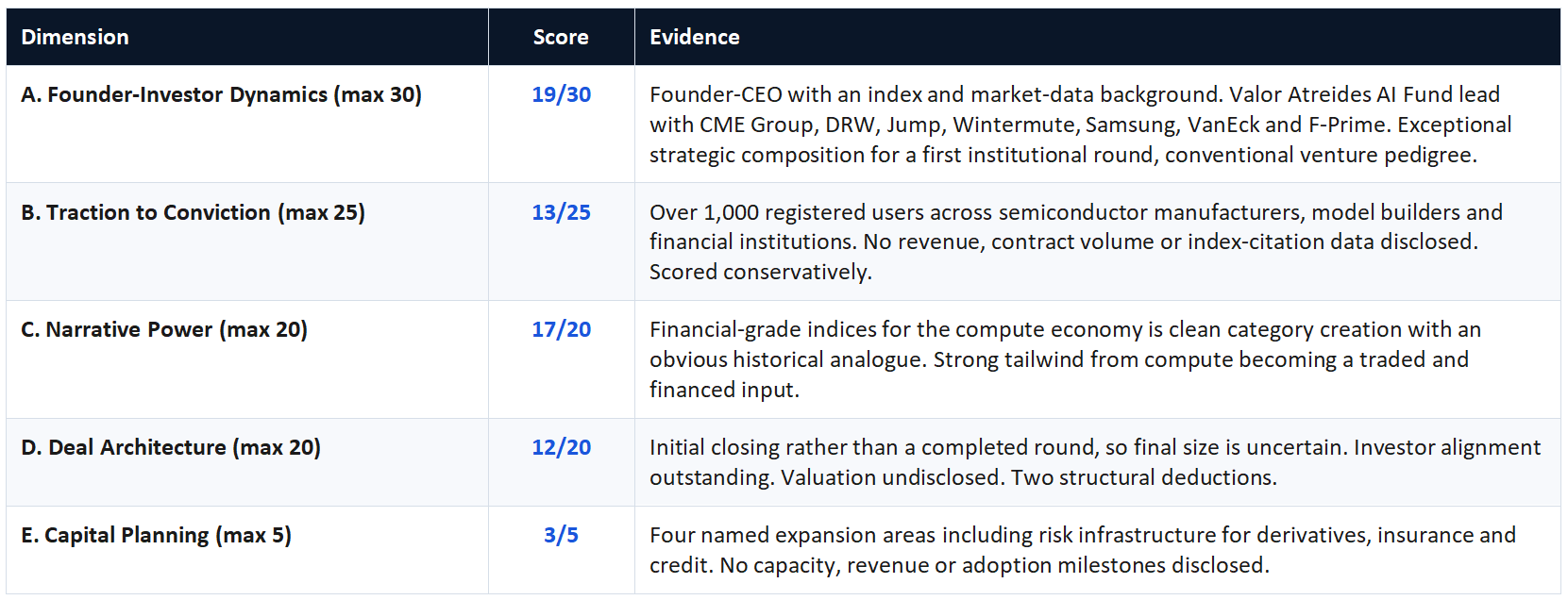
Why this scored: The smallest round in the tracked set and the most strategically dense cap table relative to size. CME Group, DRW, Jump Trading, Wintermute, VanEck, Samsung, and F-Prime all participated in a first institutional round led by the Valor Atreides AI Fund. Those names are not diversified financial investors. They are the exact institutions that would trade, clear, or hedge a compute benchmark. The score is held back by thin commercial disclosure and by the round being an initial close rather than a completed one.
The Setup: New York-based Silicon Data, led by CEO Carmen Li, publishes pricing indices, performance benchmarks, forward curves, and institutional market data for compute. The product set covers GPUs and large language models through a benchmark called SiliconMark, as well as market intelligence and alternative datasets. The company’s stated expansion path spans four areas: benchmark pricing, performance measurement, institutional and alternative data, and risk infrastructure for derivatives, insurance, and credit markets.
The Numbers: $30.5M initial closing of a Series A led by Valor Atreides AI Fund, with CME Group, DRW, F-Prime, Samsung, VanEck, Further, Jump, Tectonic, Wintermute, Breed, Hack, Blank VC, Sancus Ventures, and SoGal Ventures participating, bringing total funding to $35.2M. More than 1,000 registered users. Customers span semiconductor manufacturers, AI model builders, and financial institutions. Revenue and valuation not disclosed.
The Pattern: When an input becomes tradable, someone has to publish the reference price, and the institutions that would use that price fund the company that publishes it. This is the same shape as the early history of every commodity benchmark, compressed into a two-year-old company.
The Perspective: A benchmark business has an unusual fundability property: its value is adoption, and its investors can grant adoption. CME on the cap table is not capital; it is the possibility of a settled contract. That is why a $30.5M round with no disclosed revenue outscored three companies that raised more than twice as much. The honest counterweight is that benchmark businesses take years to become load-bearing; 1,000 registered users is a shallow number, and an initial close means the round is not finished. Conviction is high, and evidence is early.
The Playbook: If your product only becomes valuable when the market agrees to use it, your fundraise is an adoption exercise, not a capital exercise. Identify the five institutions whose adoption would make your standard the default. Offer them investment access explicitly as part of the commercial conversation. Founders systematically underuse this because it feels like mixing sales and finance. In standard-setting categories, it is the strategy.
The Founder Mistake to Avoid: Founders in reference-data businesses report registered users because it is the number that grows fastest. Registered users are not adoption. The figure that will determine the next round's price is the number of contracts, settlements, or procurement decisions that cite the index. Start counting that now, because whoever asks the question at your Series B will not accept the user count as an answer.
Flagler Health
AI-Native Operating System for Musculoskeletal Care | Series B | $50M | Valuation Undisclosed
Eisen Fundability Score: 67 / 100
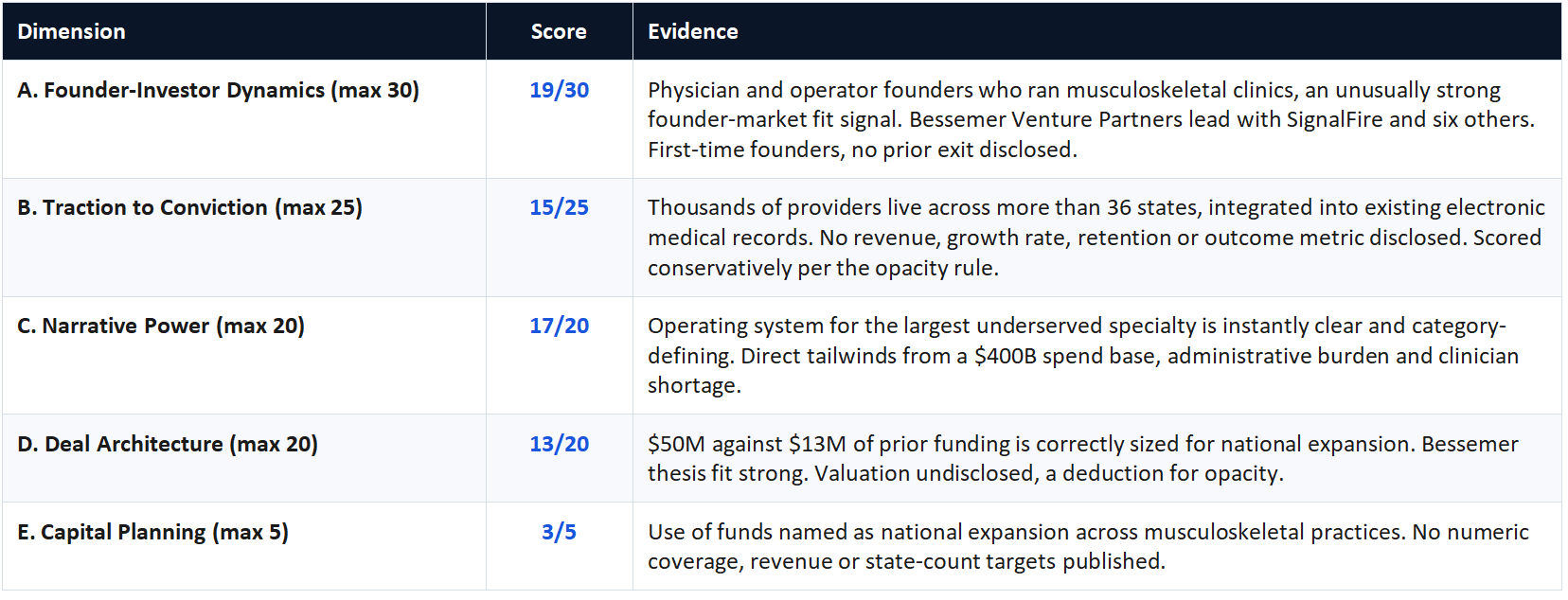
Why this scored: Flagler is the week’s clearest vertical-depth case and the clearest illustration of what opacity costs. The company has thousands of providers live across more than 36 states, physician founders who ran the clinics they now sell into, and a lead from Bessemer Venture Partners with SignalFire alongside. It sits three points below the strong-execution line for one reason: no commercial figures were published. No revenue, no retention, no outcome delta, no valuation. The deployment is real and unquantified.
The Setup: New York-based Flagler Health was founded in 2023 by physicians and healthcare operators, with Dr. Leon Anijar as chief medical officer, Albert Katz as chief executive, and Will Hu as chief technology officer. The platform integrates directly into providers’ existing electronic medical records and coordinates the full patient lifecycle: triage, care management, billing, and patient communications. The strategic choice that defines the company is refusal to broaden. Musculoskeletal care is the largest and most under-spent specialty, and the company is deepening its presence within it rather than expanding across specialties.
The Numbers: $50M Series B led by Bessemer Venture Partners with participation from SignalFire, Alumni Ventures, Streamlined, 186 Ventures, Proof VC, Tribeca Venture Partners, and Offscript, bringing total funding to $63M. Thousands of providers across more than 36 states. Musculoskeletal conditions affect more than half of US adults and account for more than $400B in annual healthcare spend. Use of funds: national expansion across US musculoskeletal practices. Revenue, retention, and valuation not disclosed.
The Pattern: This is the vertical operator model without the operator economics on display. A $13M Series A grew to a $50M Series B in a specialty that most horizontal platforms treat as a module, and a tier-one lead underwrote the depth.
The Perspective: The single most valuable asset Flagler has is the one it did not quantify. Physician founders who ran musculoskeletal clinics know which codes get denied, which handoffs break, and which workflow the electronic record cannot handle, and that knowledge is why the platform sits inside the existing record rather than replacing it. Bessemer is underwriting founder-market fit converted into product architecture. That is a legitimate and durable thesis. It also carries a cost: with no published economics, the next round will be priced on figures the company has so far chosen to keep private, and by then a competitor may have published theirs.
The Playbook: Pick the deepest specialty you can defend and refuse the adjacent one for two more years. Then publish one number from inside it. Flagler’s $50M is a depth bet, and the depth is credible. The single change that would move this profile above 70 is a disclosed operating figure: denial rate reduction, days in accounts receivable, provider retention, or throughput per clinician. One verifiable number converts a depth story into a priced position.
The Founder Mistake to Avoid: Founders in narrow verticals believe their restraint is the whole argument, and treat operating figures as competitive information to withhold. Restraint gets you the meeting. A number gets you the price. Flagler scored 67 rather than 72 because everything it published described scope rather than result, and scope is not evidence.
Fundraising Playbook: 5 Tactical Plans From This Week
Five plans, each producing a concrete output you can use immediately. No vague tasks. Each is built directly from this week’s verified signals.
1. The Strategic-First Target Map (Investor Targeting)
Why this matters: Six of ten tracked rounds carried a corporate balance sheet, and two corporates held the lead or co-lead seat. Both Series A rounds in the set carried strategic money, and in two rounds the corporate had already signed commercial agreements worth roughly $950M and $838M before investing. Strategics are no longer a Series C phenomenon.
Deliverable: A two-column map. Left column: the five organizations most likely to acquire or license you within four years. Right column: whether each has a venture arm, the partner who covers your category, the most recent deal they did adjacent to you, and a warm path. Any row you cannot complete is a research task, not a reason to skip the name.
Expected outcome: Two strategic conversations opened in week one of your process instead of month three. Either they underwrite your hardest risk or they hand you a free diligence failure report while you still have runway to fix it.
Reframe: Wrong approach: raise from funds now and talk to strategics at Series C. Right approach: put two corporate venture arms in your first five meetings, because they can price the risk that scares the funds.
2. The Perishable and Permanent Proof Split (Traction Packaging)
Why this matters: Biology took 44.8 percent of tracked capital while disclosing nothing, and software had to publish operating series to reach the same conviction. The difference lies in how quickly the proof expires.
Deliverable: One page, two lists. Perishable proof: growth rate, pipeline, logos, current-quarter usage. Permanent proof: regulatory clearances, certifications, proprietary data you own outright, contracted backlog, integrations that would take a year to remove, qualified supply positions. Count the second list.
Expected outcome: A defensibility statement that survives the question every partner asks on the second call: what happens to this business if your growth rate halves.
Reframe: Wrong approach: our revenue is growing 200 percent. Right approach: our revenue is growing 200 percent, and here are the three assets a competitor cannot replicate even if they match that rate.
3. The Four-Column Comparables File (Deal Architecture)
Why this matters: Four of the ten scored rounds carried a structural qualifier the headline number hides: a blended equity and debt package, an initial rather than final close, a five-month announcement lag, and a single incubating investor pricing the round alone with part of it in convertible notes. Outside the ten, a $35M announcement was seventy percent federally backed debt, and two further rounds in the week’s feeds carried prior-week release dates.
Deliverable: A comparables file with four mandatory columns: equity amount, price date, lead investor, and whether the close was full or partial. Discard any deal that cannot fill all four. Rebuild your ask from what remains.
Expected outcome: An anchor you can defend line by line when a partner challenges it, and a dilution expectation set against real transactions rather than press constructions.
Reframe: Wrong approach: our comparable raised $80M, so we are asking for $40M. Right approach: our comparable raised an undisclosed $80M equity split priced five months before the announcement, so it is not comparable.
4. The Rate-With-a-Period Disclosure (Narrative and Positioning)
Why this matters: The two software rounds that cleared 70 both published a rate of change with a defined period attached rather than a static level. Every round that published only scope or only a customer count scored below the line.
Deliverable: One sentence in this exact structure: metric, rate, period, start date. For example, continuous integration jobs grew 5 to 10 percent week over week since January, or net dollar retention averaged 150 percent across the last four quarters. It must be falsifiable and go on slide one.
Expected outcome: A claim a partner can check in an afternoon, which is the single fastest accelerant available to a mid-market process.
Reframe: Wrong approach: we serve thousands of providers across 36 states. Right approach: provider count grew from X to Y between March and August and net revenue retention held at Z.
5. The Milestone-Sized Ask (Capital Planning)
Why this matters: Check size and Eisen Score had no measurable relationship this week. The largest round scored mid-table, and the highest score went to a round barely half its size. Round size prices a plan, not a position.
Deliverable: Three lines. Line one: the single piece of evidence that would make your next round obvious. Line two: the fully loaded cost of producing it, plus 40 percent. Line three: the resulting raise, stated as a range with the milestone named. If your number is smaller than the comparables you have been quoting, say so in the meeting as a strength.
Expected outcome: A use-of-funds argument that buys a milestone rather than a runway, and a defensible answer to the only question that matters about round size: what does this money prove?
Reframe: Wrong approach: we are raising $30M because that is the market rate for our stage. Right approach: we are raising $18M because that funds the readout that makes the next round competitive, with a 40% buffer.
Looking Forward: Next 1 to 3 Weeks
Three evidence-based scenarios and one wild card. Predictions are anchored to this week’s verified data, not speculation.
Scenario 1: More Corporate Venture Arms Take Lead Seats at Series A and B (High Probability)
Evidence: Regeneron Ventures co-led a $75M Series A for a company whose lead antibody targets the same pathway as its own franchise. Dell Technologies Capital co-led a $63M Series C after leading the B. Sanofi, Eli Lilly, and Merck’s MRL Ventures shared one Series B cap table, two of them behind collaborations already signed. CME Group, DRW and Samsung entered a first institutional round. Six of ten tracked rounds carried a corporate balance sheet.
What to watch: Announcements in which the corporate venture arm is listed first in the investor list rather than in the participation clause. Watch also for corporates taking board seats rather than observer seats, which is the signal that separates a strategic option from a strategic investment.
What founders should do: Build the strategic map this week. If your category is clinical, regulated, hardware-heavy, or sells to a small number of large institutions, include two corporate venture arms in your first five meetings.
Scenario 2: Verification and Measurement Rounds Multiply (High Probability)
Evidence: Three of the week’s ten rounds, $138.5M, went to companies that measure, verify, or price AI output rather than produce it, and the two highest-scoring rounds in the set are both in that group. The underlying driver is documented: coding agents multiply pull requests, and only about eight percent of enterprises have agents in production.
What to watch: New rounds for evaluation infrastructure, agent observability, model output auditing, process-mining adjacent platforms, and benchmark or index businesses in compute and data. Watch for financial-market participants appearing in the syndicates, as they did this week.
What founders should do: If you build generation tooling, add one auditable output that your buyer can verify independently, and include it in your next announcement. If you build measurement, publish the volume curve now, before three funded competitors publish theirs.
Scenario 3: Clinical-Stage Rounds Keep Clearing Without Disclosure (Medium-High Probability)
Evidence: Four biotech rounds took $267M this week and not one disclosed a valuation. All four were funded on the strength of stage, mechanism, and counterparty rather than any commercial data. Two were carried by pharmaceutical investors who had already signed collaborations with the company, and two published human data instead of revenue.
What to watch: Whether pharma venture arms continue to lead rather than participate, and whether Series A rounds above $70M continue to close pre-clinically. If pharma steps back to participation-only, mid-market biotech round sizes will compress quickly because generalists will not carry the underwriting load at these sizes.
What founders should do: If you are clinical, sequence to readouts rather than to the calendar, and target the venture arm of your eventual licensing counterparty before you approach generalist life-science funds.
Wild Card: A Disclosure Correction in the Mid-Market (Medium Probability)
Evidence: Two valuations were disclosed in ten rounds, and the round that disclosed the clearest one scored highest. Four of ten rounds carried a structural qualifier the headline number obscured. That combination creates an opening: in a market where eight of ten companies publish no price at all, publishing one is a cheap form of differentiation.
What founders should do: If your round is well-priced relative to your metrics, consider disclosing the valuation and equity split. In a week where two companies in ten did, the disclosure itself reads as confidence, and it makes your deal the reference point every founder in your category quotes for the next quarter. If your round is not well-priced against your metrics, the silence is telling your next investor something anyway.
The Bottom Line
The real insight is not the $595.5M. It is that two things moved at once, and they point the same direction. Strategic capital came down-stage into Series A and B, and check size stopped carrying any information about fundability at all. Both say the market is paying for reduced uncertainty rather than for scale, and both say the people best placed to reduce uncertainty in your category are the ones who already operate in it. Three conviction profiles took the week.
Profile 1: Verifiable operators. Blacksmith (77) and Skan AI (76) published rates of change with periods attached, and they are the two highest scores in the set. Blacksmith disclosed a price, a customer curve, and a weekly workload rate. Skan AI disclosed 150 percent net dollar retention and growth above 300 percent. The proof is a series, not a snapshot.
Profile 2: Strategically underwritten science. InduPro (71) and Infinimmune (68) raised $152M between them with no revenue, no customers, and no disclosed price, behind roughly $1.8B in signed pharma collaboration value and cap tables that included the companies that would eventually buy the asset. Khartis (61) has the same shape but without the signed counterparty and scores 10 points lower. The proof is who ran the diligence and what they paid for it.
Profile 3: Deep verticals without published economics. MarginEdge (65), Flagler Health (67), and Heaviside Industries (67) all have genuine deployment: 13,000 restaurants and $28B of purchasing volume, thousands of providers across 36 states, existing customer commitments in defense, and a warhead supply partnership. All three sit below 70 because scope was published and results were not. The proof exists and was not shown.
Everything else competed for the residual. The message is unmistakable. Put a buyer on your cap table, publish a rate rather than a level, and hold at least one asset that does not expire. Anything short of that is asking a generalist to take the uncertainty at face value, and this week they did not.
5 New Rules for Founders
1. Strategic capital is a first call, not a last resort. When your hardest risk is a domain risk, the buyer is the cheapest underwriter in the market. Six of ten rounds this week had one on the cap table, and the strongest of those sold to the corporate before taking its money.
2. A bigger number is not a stronger position, and it is not a weaker one either. Round size measures the cost of the next eighteen months. Fundability measures how little has to be believed. Across these ten, the two were statistically unrelated.
3. Publish a rate with a period, not a level. Both software rounds above 70 did. A falsifiable claim converts faster than an impressive one, and scope is not evidence.
4. Own one piece of proof that does not expire. Growth rates decay, and clearances do not. Count your permanent-proof list. If it is empty, that is your next two quarters.
5. The headline is a construction, not a transaction. Equity amount, price date, lead, and full or partial close. Any comparable missing one of the four is not a comparable.
4 Monday Actions
1. Build the strategic map. Five likely acquirers, their venture arms, the covering partner, their most recent adjacent deal, and a warm path. Two of them go into your first five meetings.
2. Split your proof into perishable and permanent. One page, two lists. If the permanent list is empty, that is your roadmap for the next two quarters and your use-of-funds headline.
3. Rewrite one claim as a rate with a period. Metric, rate, period, start date. Put it on slide one and delete the scope claim it replaces.
4. Audit your three anchor comparables for equity, date, lead and completeness. Discard the ones that fail, and resize your ask based on what survives.
Your competitors are reading the same tape. The founders who put a buyer in the room and a rate on slide one own the conversation. The ones quoting the biggest headline in their sector are negotiating against someone else’s burn rate.
Research Methodology and Sources
Data collection period: August 10 to 16, 2026, with the bulk of verified primary disclosures clustered from August 11 to August 13. Verification standard: a minimum of two independent sources per scored deal, with company releases and regulated newswires prioritized as anchor sources and at least one independent outlet per deal for corroboration. Eisen Fundability Scores are proprietary analytical estimates, not endorsements or investment advice. All dollar figures reflect announced primary capital unless noted otherwise.
Total deals tracked: 10 scored US mid-market rounds totaling $595.5M in announced primary capital; every round under $100M; selected as the 10 largest verified US rounds within the window. A further 17 verified US rounds under the scoring threshold totaled $277.9M, bringing full verified US mid-market activity to $873.4M across 27 rounds. Editorial scope for this issue excludes giant rounds and public-market events by request.
Core Capital Totals and What They Include
The $595.5M scored total includes only the ten rounds in the scorecard, each independently confirmed at the stated amount and stage. Stage subtotals reconcile as follows: Series B, five rounds, $282.0M; Series A, two rounds, $105.5M; Series D, one round, $80.0M; seed and launch financing, one round, $65.0M; Series C, one round, $63.0M. Sector subtotals reconcile as follows: biotech and therapeutics, four rounds, $267.0M; vertical software and fintech, two rounds, $130.0M; enterprise and developer AI, two rounds, $108.0M; defense and aerospace, one round, $60.0M; compute market infrastructure, one round, $30.5M. Both subtotal sets sum to $595.5M. No announced-but-unclosed round was counted, and no aggregator figure was treated as fact without corroboration in a company release, a regulated newswire, or an independent outlet.
Exclusions and Documented Rationale
▪ Giant rounds and public-market events, excluded by editorial scope: Databricks, River AI, Form Energy, Whatnot, Global AI, Neros Technologies, Sonablate, CodeRabbit, Point2 Technology, Expedition Therapeutics, Bridge to Life, Orange EV, PointsKash, Valar Atomics and Base Power.
▪ Prior-week primary release dates, excluded as recirculation: Obsidian Security ($85M Series D, primary release August 4) and Vedanta Biosciences ($60M, primary release August 6). Both appeared in daily funding feeds dated August 11. Accepting either on the feed date would have overstated the weekly total by $145M.
▪ Non-dilutive or blended structures, excluded from the scored set: Plantible Foods, whose $35M comprised $25M of debt through a federal USDA lending program plus $10M of equity; Vedanta Biosciences, which combined $20M of BARDA contract funding with $40M of equity already funded across two prior quarters; Princeton Critical Minerals, which blended equity with grant funding; Orange EV, a $100M credit facility; Global AI, $441M in debt; and Curio, a US Department of Energy ARPA-E award.
▪ Non-US rounds, excluded for scorecard comparability: Firmus (Australia), Lovable (Sweden), Yulu (India), Yuno (Colombia), Pathway (reported variously as Warsaw and Palo Alto), NdotLight (South Korea), Millow (Sweden), AMDB Security Pro (France), and Quarkitech (India). Mindgard is excluded as a dual-headquartered company, headquartered in London and Boston.
▪ Undisclosed amounts, excluded for lack of a verifiable figure: Vetspire (Battery Ventures growth investment), Notable Systems (XiFin strategic investment), Fazeshift (Amex Ventures investment), Edge Focus, Chatham Financial, Alta Smiles, Digital Prime Technologies, and CardVault by Tom Brady.
Primary and Secondary Validation Sources
Anchor company and newswire sources reviewed for the scored deals include the PRNewswire releases for Skan AI, Blacksmith and Boulevard Bio, the GlobeNewswire release for MarginEdge, and the BusinessWire releases for Flagler Health, InduPro, Infinimmune, Khartis Therapeutics and Heaviside Industries, alongside the Skan AI and Dell Technologies Capital company announcements and the Silicon Data announcement. Independent corroboration reviewed includes TechCrunch and VentureBeat (Blacksmith and Skan AI), Wilson Sonsini transaction confirmation and Dealroom (Flagler Health), Virginia Business, CityBiz and Restaurant Technology News (MarginEdge), Defense Daily and Dealroom (Heaviside), Fierce Biotech, BioSpace, BioPharm International and The Pharmaletter (InduPro, Infinimmune, Boulevard Bio and Khartis), and FinSMEs and VC News Daily across the full tracked set, plus Tech Startups daily funding roundups for August 10 through 14. Crunchbase weekly aggregation for the August 8 to 14 period was used only to confirm the megaround scope, not for mid-market figures.
Research completion timestamp: August 16, 2026.
DISCLAIMER: This article is for informational and strategic intelligence purposes only. It does not constitute investment advice. The Eisen Fundability Score is a proprietary diagnostic within Fundables OS™, not a financial recommendation.
If this article was useful, share it with founders who are about to raise.
— Leon Eisen, 4x Founder, Venture Capitalist, and Creator of Fundables OS™