

Smart people keep drawing straight lines through a curved world. The reason has little to do with math, and it shapes how founders plan and pitch their next round.
In 1980, America's largest phone company asked one of the world's most respected consulting firms a simple question.
How many Americans will have a mobile phone subscription by the year 2000?
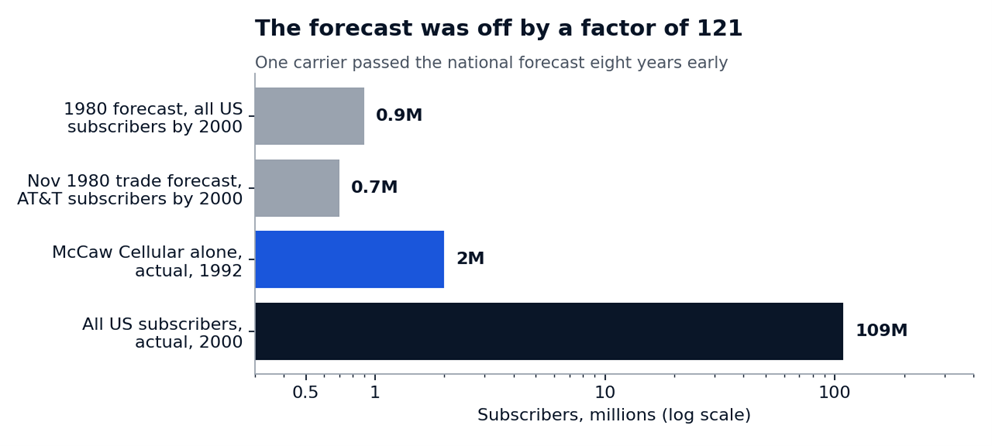
The answer came back: about 900,000.
In 2000, there were 109 million.
The forecast missed by a factor of 121. Careful, expensive people made it with good data and every reason to get it right.
And the company believed it. It treated mobile as a niche and stepped back. Between 1992 and 1994, it paid more than fifteen billion dollars to buy its way back in.
This story usually gets told as a joke about consultants. I went looking for why it happened, and it stopped being funny. The first two explanations I found sounded right, but both fell apart when I tested them. What sat underneath is something I now see in almost every plan a founder shows me.
It wasn’t bad luck
The usual defense goes like this. The technology was new, the future is unknowable, nobody could have known.
It sounds fair. So I checked whether it holds.
If the future were simply unpredictable, forecasting errors would scatter. Some plans would come in high, some low, and across enough plans the misses would roughly cancel out.
They don’t cancel.
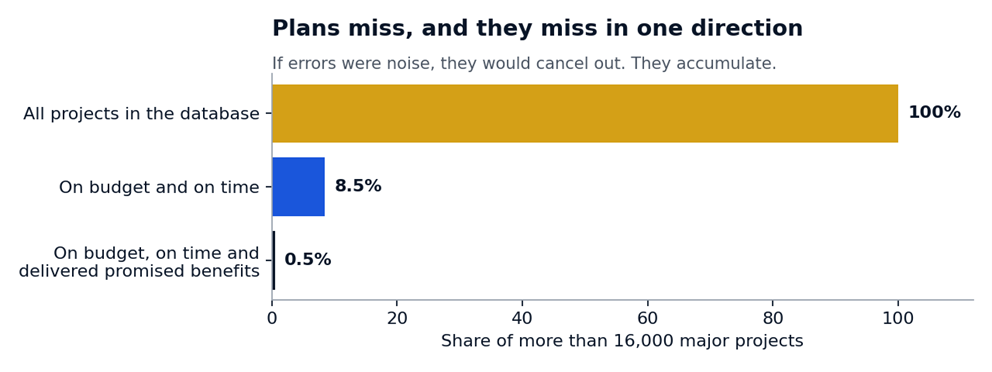
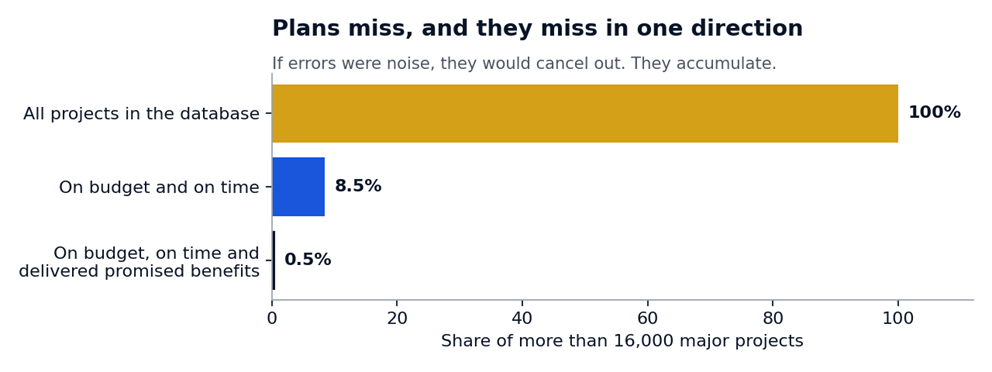
Bent Flyvbjerg at Oxford has built a database of more than 16,000 major projects: bridges, IT systems, rail lines, buildings, energy plants. Only 8.5% came in on budget and on time. Only 0.5% came in on budget, on time, and delivered the benefits they promised.
Ninety-nine and a half percent missed on something. And the misses point the same way, over and over.
The mobile forecast wasn’t a lone mistake either. A trade magazine published its own forecast that same November and projected about 700,000 AT&T subscribers by 2000. Two forecasters, working separately, landed in nearly the same place, and both landed more than 100 million away from the truth.
When independent errors agree, they share a method.
Luck doesn’t explain that. Something systematic was bending every forecast the same way.
It wasn’t bad math
The second explanation comes from behavioral economics, and it is a good one.
