

Most founders confuse the investor list with the investor strategy. The list is a logistics document. The strategy is a ranked, evidence-backed brief that scores every target across four dimensions: Fund fit, Partner fit, Deal fit, and Network fit. The first one signals desperation. The second signals readiness.
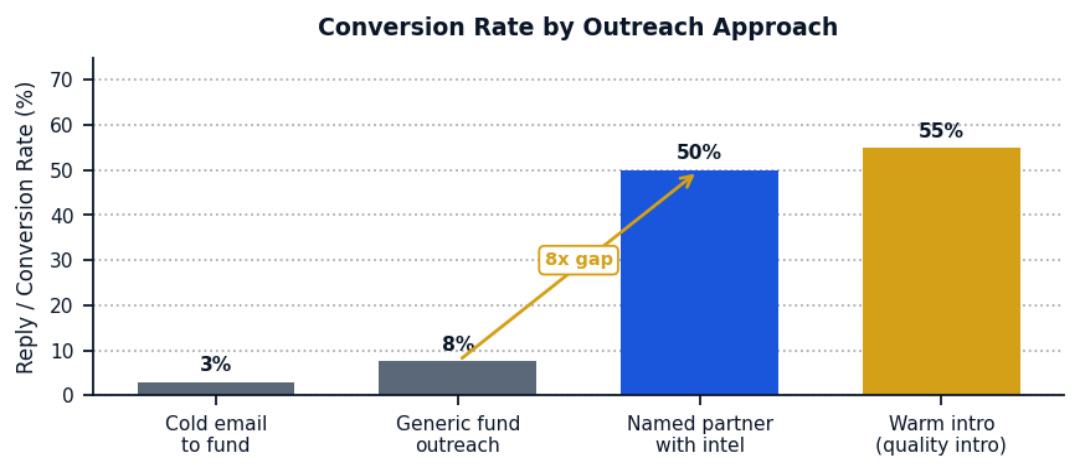
Generic fund outreach converts at 5-10 percent. Named-partner outreach grounded in partner-level intelligence converts at 40-60 percent - an 8x performance gap [1]. Warm introductions from existing investors and portfolio founders convert at 10-15x the rate of cold emails, which sit at 2-4% [2][13]. Cold cycles average six months. Warm-intro cycles close in three [12]. The gap is not effort. It is intelligent packaging.
This is the same mechanic top-tier VCs use against you. When a partner takes a deal to their Investment Committee, they bring a 5 to 15-page IC memo - the synthesized case for funding, written for partners who never met the founder [6][8]. Committees almost never overrule a strong memo. Most members walk into the room with their decision already made [7]. The memo is the verdict.
Founders need the inverse: a 2-Page IC Brief, written per target investor, used first to rank a 200-name list down to 35 selectable targets, then to arm the eventual partner-champion with everything they need to win their own committee. This article explains how the Brief is structured, what scoring it uses, and why founders who run this process raise faster, with higher conviction, and with less waste.
THE BRIEF IN ONE SENTENCE
Founders who treat the investor list as the deliverable raise on the investor’s terms. Founders who treat the 2-Page IC Brief as the deliverable raise on their own.

WHAT MOST FOUNDERS GET WRONG
The List Is Not the Strategy
The default founder workflow is dangerous because it appears to be work. Build a 200-name spreadsheet. Filter by stage and sector. Send a templated cold email. Track reply rates. Iterate.
This produces single-digit reply rates and almost no conviction at the partner level. The mechanism: investors do not buy companies; partners buy companies. And partners do not buy from a stranger reading their fund’s homepage. They buy from a founder who knows their last three deals, the partner’s prior operating role, and is aligned with the specific portfolio thesis [1].
The reason this matters is simple. Even when a generic email lands a meeting, the partner walks in with no internal narrative. They will spend 30 minutes on diligence, then either pass quietly or, if interested, start the work the founder should have done themselves: build the case for funding [8]. That work takes weeks. During those weeks, the founder is in limbo, the round loses momentum, and the deal often dies of indifference.
The 2-Page IC Brief inverts this. By the time the partner takes the meeting, the founder has already mapped why this firm, why this partner, why this quarter, and why this syndicate. The partner’s job becomes ratification, not construction. The work compresses from weeks to days.
THE FOUR DIMENSIONS OF THE IC BRIEF SCORES
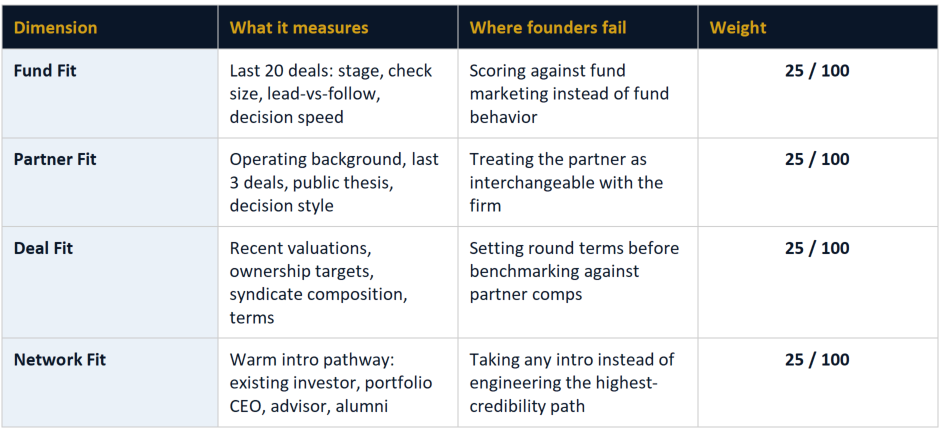
The IC Brief enforces a four-layer evaluation, each scored on a 25-point scale (100 total). The four layers are sequential. Each layer answers a different question. Skipping a layer breaks the brief [1].
Dimension 1: Fund Fit (0-25)
Pattern. The fund’s actual investment behavior over its last 20 deals, not its marketing materials, not its public thesis. Stage focus, check-size range, portfolio construction, lead-vs-follow behavior, decision-making architecture [1].
Perspective. A fund’s stated thesis is a hypothesis. Its last 20 investments are the evidence. When a fund says it invests at Series A but has done 15 of its last 20 deals at Seed, that is a Seed fund pretending to be a Series A fund [15]. Founders who match against the marketing waste meetings; founders who match against the data win them.
Founder Blindspot. Most founders score Fund Fit by reading the website. The website is what the fund wants the world to think. The behavior is what the fund actually does. The two diverge in a meaningful share of cases [15].
Playbook. For each target fund, document four behaviors: last 12 months of new investments by stage, average and median check size, lead vs follow ratio, and decision timeline from first meeting to term sheet. If you cannot find this data publicly, the fund is too opaque to underwrite. Move it down a tier.
Contrast. Founders who do this work eliminate 30-40 percent of their list before they send a single email. Most names on the original spreadsheet are not, in fact, fits.
Dimension 2: Partner Fit (0-25)
Pattern. The individual partner’s professional background, investment pattern, communication style, and personal motivation. Funds follow the partner's opinion [1].
Perspective. A partner with operating experience in your sector underwrites differently than a generalist. A partner trying to build a rising-star reputation will champion deals their senior partners might not, if you give them ammunition. A partner who has done six deals in your category in 24 months has pattern recognition you can leverage. A partner whose last deal failed in your category will be biased against your story unless you address that risk explicitly.
Founder Blindspot. The biggest miss is treating the partner as interchangeable with the firm. Most founders pitch the same deck to every partner at every fund. The 8x conversion gap between generic outreach and named-partner outreach is about the conversation that follows [1].
Playbook. For each target partner, build a one-paragraph profile: prior operating role, last three investments, the public thesis they have published or spoken about in the last six months, and decision speed. If the partner has not published anything publicly in the past 12 months, downgrade the priority. They may be on their way out of the firm.
Contrast. Named-partner outreach with this profile in hand converts at 40-60 percent. The same email sent to “team@fund.com” converts at 5-10 percent [1].
Dimension 3: Deal Fit (0-25)
Pattern. Recent deal architecture. Valuation ranges, term-sheet patterns, syndicate composition, and timeline behavior on the partner’s last 10-15 deals. This is the layer that determines whether your round structure is even pitchable to this fund [1][9].
Perspective. A fund that wrote four $5 million Series A leads in the last quarter has a model that requires that check size to deploy capital. Pitching them a $1.5 million seed is asking them to break their model. Pitching them a $20 million round at unicorn pre-money is asking them to take ownership levels their LPs do not want. Founders who price their round outside the partner’s recent comp set do not get a counteroffer - they get a pass.
Founder Blindspot. Most founders set their round terms in isolation, then look for fits. The order is wrong. The right order is: rank investors by Deal Fit first, then construct the round to match the best-fit cluster. The round is downstream of the target list, not upstream.
Playbook. For your top 30 target partners, document the valuation range, lead check size, and ownership target on their last five deals. Aggregate. Build your round structure (target raise, pre-money valuation, lead allocation, follow-on) within the densest fit zone. This is deal architecture, not negotiation.
Contrast. Founders who reverse-engineer a round structure from Deal Fit data raise inside expected market parameters. Founders who do not get told their round is “outside what we normally do,” which is fund-speak for the partner not wanting to take it to committee.
Dimension 4: Network Fit (0-25)
Pattern. The warm-introduction pathway. Who in the founder’s existing network has a credible relationship with the target partner? The quality of warm introductions is hierarchical: existing investors first, portfolio founders second, mutual advisors and customers third, alumni and weak ties last [2].
Perspective. An introduction from a partner’s current portfolio CEO carries more conviction than an intro from a board observer at an unrelated fund. The reason: the portfolio CEO has capital, time, and reputation at risk if they vouch for a low-quality founder. The board observer has none. Investors discount intros by the credibility of the source [2].
Founder Blindspot. Most founders have access to 200-plus warm pathways through second and third-degree connections that they do not see [2]. The pathway audit is a 90-minute exercise that converts a list of “I do not know anyone there” into “I have three credible paths.”
Playbook. For each Tier 1 target, identify three intro paths ranked by credibility. Activate the strongest one available. Time the activation to coincide with a momentum signal: a customer win, a press hit, a product launch. The intro carries more conviction when the founder has news, not just an ask.
Contrast. Warm intros close rounds in three months versus six for cold cycles [12]. The 90 minutes spent on the pathway audit pay back as 90 days of saved process time.
THE 2-PAGE IC BRIEF: ARCHITECTURE
The two-page brief is enough. The constraint is the discipline. A founder who cannot fit the case in two pages either does not have enough intelligence or is using narrative to cover gaps. Both are disqualifying. The Brief is not the VC’s IC memo, which runs 5 to 15 pages and serves a different function (committee approval) [6][8]. The Brief is the founder’s pre-emptive synthesis: dense, structured argument compressed for selection [11].
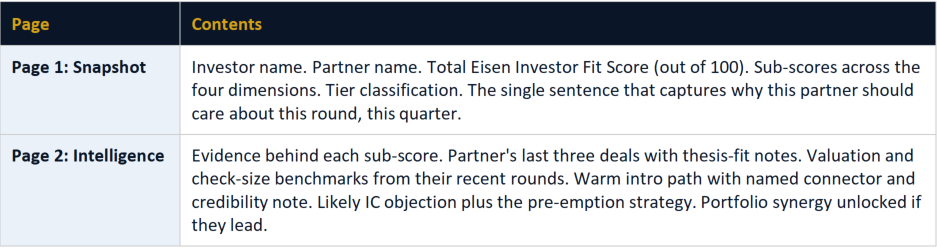
FROM 200 NAMES TO 5 DREAM PARTNERS
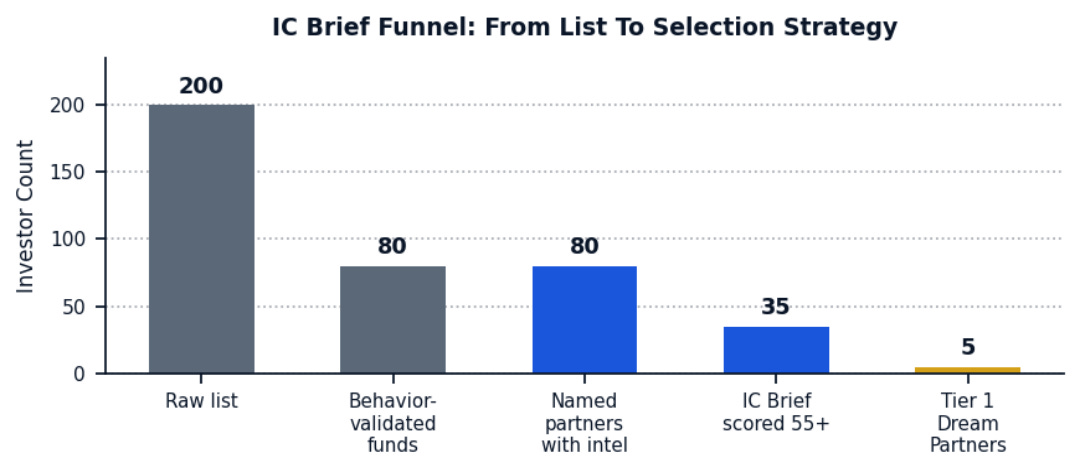
The IC Brief is a forcing function. Each of the four dimensions either produces enough intelligence to score or does not. Partners who do not clear 55 of 100 do not belong in your active process. The funnel below shows the typical compression: from a raw list to behaviorally validated funds to named-partner targets with intel to Brief-scored 55+ targets to the 5 Tier 1 Dream Partners who earn 60 percent of fundraising time [1].
Tier Allocation: Where Founder Time Actually Goes
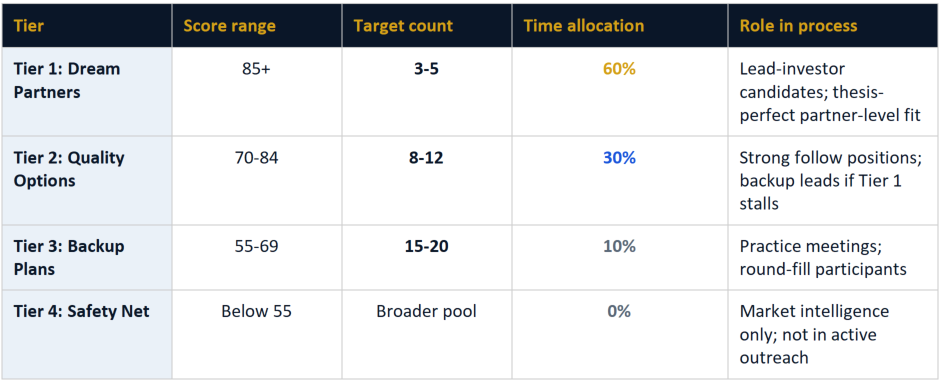
The 60/30/10/0 time allocation is the second filter the IC Brief enforces. A founder who spends equal time on every name on a 200-investor list is doing logistics, not strategy. A founder who spends 60 percent of fundraising time on five named partners is running a selection process [1].
THE HIDDEN MULTIPLIER: IC ENABLEMENT
Here is the part most founders miss. The partner you pitch is not the decision-maker. The partner is your internal salesperson [1]. The decision happens in a room you will never enter, where the partner has 15 to 30 minutes to convince three to seven other partners that this deal is worth their fund’s capital and their personal political capital [7].
The currency of that room is the IC memo, which is 5-15 pages, written by the partner and distilling everything they know about your company [6][8]. The 2-Page IC Brief you wrote is the source document for their IC memo. Every dimension you scored, every piece of intelligence you packaged, every objection you pre-empted, and it all flows into the partner’s memo. Founders who do not provide this material force the partner to build the case from scratch, delaying the IC presentation by weeks and weakening conviction by half [10].
The IC-Enablement Framework is straightforward: pre-empt likely committee objections in your follow-up materials; provide shareable, IC-ready evidence (one-page proof stack, customer reference list, financial summary); make customer references available within 48 hours of any partner request; arm the partner with competitive market analysis they can lift directly into their memo; define the milestones that will reduce committee execution risk [1][7].
Your Brief is not for you. It is for the partner who will write the memo that your committee will read in a room you will never enter.
THE PLAYBOOK: 5 ACTIONS, 5 DELIVERABLES
1. The List Audit: 200 Names to 80
Why this matters. Most investor lists are 60 percent noise. The first filter eliminates funds whose actual behavior does not match your stage, sector, or check size [1][15].
Deliverable. Take your existing investor list. For each fund, verify three behaviors from public sources: the last five new investments, the average check size, and the lead-vs-follow ratio. Eliminate any fund whose behavior contradicts the marketing.
Expected outcome. A 60-80 name list of behaviorally-validated funds.
2. The Partner Mapping: 80 Funds to 80 Named Partners
Why this matters. The 8x conversion gap between named-partner and generic outreach is the single highest-leverage move in the process [1].
Deliverable. For each fund on the validated list, identify the specific partner whose recent deals best match your category. Document their last three investments, prior operating role, and most recent public statement on their thesis.
Expected outcome. A list of 80 named partners with thesis-fit notes.
3. The Four-Dimension Score: 80 Partners to 35 Targets
Why this matters. The 2-Page IC Brief is the forcing function. It either reveals enough intelligence to score, or it does not. Partners who do not score above 55 do not belong in your active process.
Deliverable. Build the 2-Page IC Brief for each of the 80 named partners. Score each on Fund Fit, Partner Fit, Deal Fit, and Network Fit. Total to 100. Tier-segment the survivors.
Expected outcome. A ranked list of 35 partners with scores 55+, segmented into Tier 1 (3-5), Tier 2 (8-12), Tier 3 (15-20).
Wrong: “We are targeting top-tier VCs in our space.”
Right: “We are targeting [Partner A] at [Fund X] (score 88, Tier 1), [Partner B] at [Fund Y] (score 84, Tier 1), and three other named partners with documented fit on all four dimensions.”
4. The Warm Path Audit: 35 Targets to 35 Pathways
Why this matters. 200-plus warm pathways exist in most founder networks - through second and third-degree connections. Most founders see fewer than 10 of them [2]. The 90-minute audit converts the network into leverage.
Deliverable. For each Tier 1 and Tier 2 target, identify three intro paths ranked by credibility (existing investor, portfolio founder, mutual advisor, or customer, alumni). Activate the strongest available.
Expected outcome. Warm intro paths confirmed for at least 80 percent of Tier 1 and 60 percent of Tier 2 targets [1].
5. The IC Enablement Kit: Arm Your Champion
Why this matters. The partner’s IC memo is the deciding artifact. A founder who provides IC-ready evidence packaged for committee circulation moves their deal from “interesting” to “approved” in days, not weeks [6][8][11].
Deliverable. Build a shareable folder containing: one-page proof stack (named customers with measurable outcomes, retention metric, growth rate, regulatory or procurement milestone); customer reference list with availability windows; financial summary defensible under IC pressure-testing; competitive analysis the partner can lift directly into their memo; objection pre-emption page covering the three risks the committee is most likely to raise [1][9][10].
Expected outcome. A complete IC enablement kit ready to send within 24 hours of any partner committing to take the deal internally.
LOOKING FORWARD: THREE SCENARIOS
Scenario 1: AI-Augmented Investor Intelligence Becomes Table Stakes
Evidence. AI research tools now produce partner-level intelligence in hours that previously took weeks [1]. Founders using these tools build 80-partner IC Briefs in a long weekend. Funds are responding by requiring a more sophisticated thesis-match in initial outreach.
What founders should do. Treat AI-augmented research as a prerequisite, not an advantage. The advantage is moving to the next layer: pattern recognition across what the AI surfaces.
Scenario 2: Syndicate-First Fundraising Displaces Lead-First
Evidence. Recent rounds increasingly close on syndicate composition rather than lead alone. Ray Therapeutics April 2026: Janus Henderson leads with four crossover funds (Adage, Franklin Templeton, Invus, Marshall Wace) signaling IPO preparation. Omni April 2026: ICONIQ lead with Theory Ventures, First Round Capital, Redpoint Ventures, and GV. Founders structuring rounds with the right syndicate signal stage maturity that single-lead rounds cannot match.
What founders should do. The IC Brief should rank not only individual fits but also syndicate fits. Which Tier 1 lead pairs with which Tier 2 follow to create the right signal for the round you want?
Scenario 3: Cold Outreach Reply Rates Keep Falling (HIGH PROBABILITY)
Evidence. Cold email reply rates now sit at 2-4 percent across recent industry surveys [2][13]. Inbox saturation, AI-detection tools, and partner triage workflows continue to compress the channel.
What founders should do. Treat cold outreach as a fallback for Tier 3 and Tier 4 only. Tier 1 and Tier 2 contacts must be warm. If your Tier 1 list has any partner you cannot warm-intro to within 30 days, the warm-path audit is incomplete, not the partner unreachable.
Wild Card: Partners Start Sharing Their Own IC Memos With Founders
If a partner shares their draft IC memo with the founder pre-committee (rare, but increasing among power-law masters [7]), that is the strongest possible signal of conviction. The founder’s job at that moment is to provide additional evidence for the partner to include in the memo, not to negotiate terms. Terms come later.
THE BOTTOM LINE
The investor list is not the strategy. The 2-Page IC Brief is the strategy. The list, by itself, is just a spreadsheet of people who might say no.
Five New Rules For Founders Building Their Investor Selection Strategy
Rule 1: The fund’s behavior matters more than the fund’s marketing. Score Fund Fit on the last 20 investments, not the website.
Rule 2: Named partners convert at 8x the rate of generic firm outreach. There is no excuse for sending a deck to “team@fund.com.”
Rule 3: Round architecture is downstream of Deal Fit, not upstream. Reverse-engineer your round terms from the best-fit partner cluster, then pitch.
Rule 4: Network Fit is the highest-leverage dimension. Warm intros from existing investors and portfolio founders convert at 10-15x the rate of cold outreach. The 90-minute pathway audit pays back as 90 days of saved cycle time.
Rule 5: The partner is your internal salesperson, not the decision-maker. Your IC Brief is the source document for their IC memo. Arm them.
The founders who run the IC Brief process raise faster, at higher conviction, with less waste. Selection beats outreach. The list is logistics. The Brief is a strategy.
SOURCES & READING
Eisen, Leon. “Invisible Game: The Secrets of Term Sheet Magnet.” (in press).
The Four Layers of Investor Intelligence (Fund/Partner/Deal/Network); Four-Tier Segmentation; Partner-vs-IC dynamic; Named Partner Research Strategy; 8x conversion finding.
10-15x conversion gap: warm vs. cold; 200+ pathway estimate; credibility hierarchy for warm intros.
7.5% best-case conversion across 40-60 VC outreach; founder pipeline math.
Cold-outreach pillar framework; fundability thresholds.
Tier system practice (Dream / Strategic / Practice); 1-in-10 warm-intro to term-sheet ratio.
IC memo definition; founder-vs-VC memo distinction; structure and section breakdown.
IC dynamics; partners enter the room with minds made up; the memo is the verdict.
Memo writing process; timing; “every piece of material designed for what the IC reads.”
IC stage descriptions; partner deal-team dynamics; pressure-testing patterns.
Memo length: ~2-month average completion; red-team critique structure.
Published IC memo examples (LinkedIn 2007 Series C, Twitch, LifeLock, Pinterest); demonstrates the structure and decision logic of professional VC memos.
Sales-cycle compression: 6 months cold vs 3 months warm.
Cold reply rate trend: 40-50% warm intro response benchmark.
Fund tier categorization; unicorn-conversion-weighted ranking methodology.
The gap between stated thesis and actual investment behavior.
Disclaimer: This article is for strategic intelligence and educational purposes only. It does not constitute investment, legal, or tax advice. All conversion benchmarks are industry-aggregate estimates, not guarantees. The 2-Page IC Brief framework is a proprietary analytical lens, not a financing solution. Powered by the Eisen Fundability Framework.
If this article was useful, share it with founders who are about to raise.
— Leon Eisen, 4x Founder, Venture Capitalist, and Creator of Fundables OS™