

Most founders walk into investor meetings without knowing their own fundability momentum.
They know their ARR. They know their burn. They know their deck. What they do not know is that a sophisticated investor underwrites the entire company in the first 15 minutes of the meeting.
The 5Ps Eisen Fundability Score was built to close that gap. It is the diagnostic at the center of Fundables OS™, and it measures the five weighted forces that actually determine whether capital flows toward a founder or past them:
Process, Proof, Positioning, Packaging, and Planning.
The shift this score measures is not cosmetic. Most fundraising advice helps founders raise more money. The 5Ps measure something different: whether the founder has crossed the threshold from doing fundraising to being fundable. A founder who is doing fundraising asks investors for conviction. A founder who is fundable already has it, and investors feel the difference the moment they walk into the room.
This article walks you through the calculation step by step. By the end, you will have a number. That number will not close your round. But it will tell you, precisely, which of the 5Ps is costing you term sheets and what to fix in the next 30 days.

The 5Ps at a Glance
Five forces. One hundred points. Each P is weighted by how strongly it predicts whether a round closes rather than by how much founders talk about it. The weights below are empirical, derived from hundreds of deals where the gap between fundable and unfundable was traceable to a specific P.
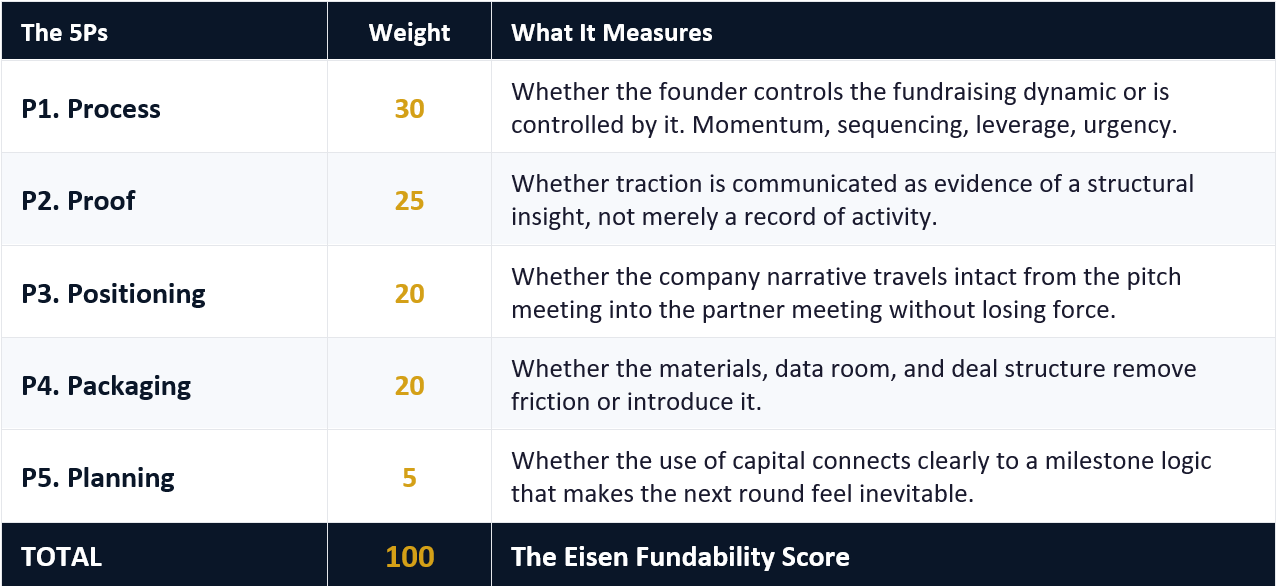
A note on weighting. Process carries the heaviest weight because it is the one the founders spend the least time on and the one that determines whether any of the other Ps matter. Planning is the lightest because when the first four Ps are strong, planning sophistication is assumed; when the first four are weak, planning sophistication does not save the deal.
The 5Ps, Explained
P1. Process (30 points max)
Three sub-criteria, ten points each. A weak founder enters fundraising, hoping investors will make the decision. A strong founder designs the conditions under which investors are more likely to decide. That is Process. It is the P that determines whether the round builds momentum or leaks it.
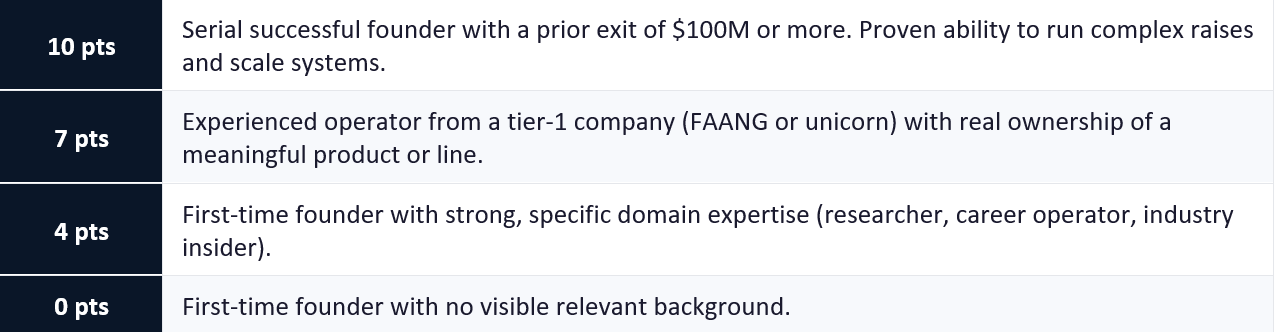
P1a. Founder Track Record (0-10 points)
P1b. Investor Quality (0-10 points)

P1c. Round Momentum & FOMO (0-10 points)


P2. Proof (25 points max)
Three sub-criteria. A positive impression is created by clearly presented, impressive metrics. Conviction is produced by a story in which the metrics are evidence of a structural insight, a theory of the business that the traction validates. Proof is the P that converts traction into conviction.
P2a. Growth Trajectory (0-10 points)

P2b. Business Model Validation (0-8 points)

P2c. Market Proof Points (0-7 points)


P3. Positioning (20 points max)
Three sub-criteria. A well-framed fundraising narrative that is understandable and transferable. It must move from the founder’s mouth into the investor’s mind, and from the investor’s mind into the partner meeting, without losing force. A great company with weak Positioning feels forgettable. A strong company with powerful Positioning is easier to believe in, easier to repeat, and easier to back.
P3a. Category Position (0-10 points)

P3b. Story Clarity & Transferability (0-5 points)

P3c. Market Tailwinds (0-5 points)

P4. Packaging (20 points max)
Three sub-criteria. Investors react to friction more than they react to upside. Strong Packaging removes that friction. A poorly packaged company leaks trust. A well-packaged company compounds it. This is the P founders under-index on.
P4a. Valuation Reasonableness (0-8 points)

P4b. Investor Alignment (0-7 points)

P4c. Round Construction & Use of Funds (0-5 points)

P5. Planning (5 points max)
Two sub-criteria. The lightest P but a high-signal one. Planning is how founders demonstrate that capital is not merely fuel to survive but a strategic instrument to cross clear milestones and reduce the next layer of risk. Weak founders talk about raising money as if money itself solves the problem. Strong founders show exactly what the capital unlocks.
P5a. Runway & Milestone-Backed Sizing (0-3 points)

P5b. Milestone Clarity (0-2 points)

How to Interpret Your Score
A number alone is diagnostic, not predictive. Two companies with the same total can have very different fundability profiles depending on which of the 5Ps is strong. The bands below describe what each range typically looks like in a real round.
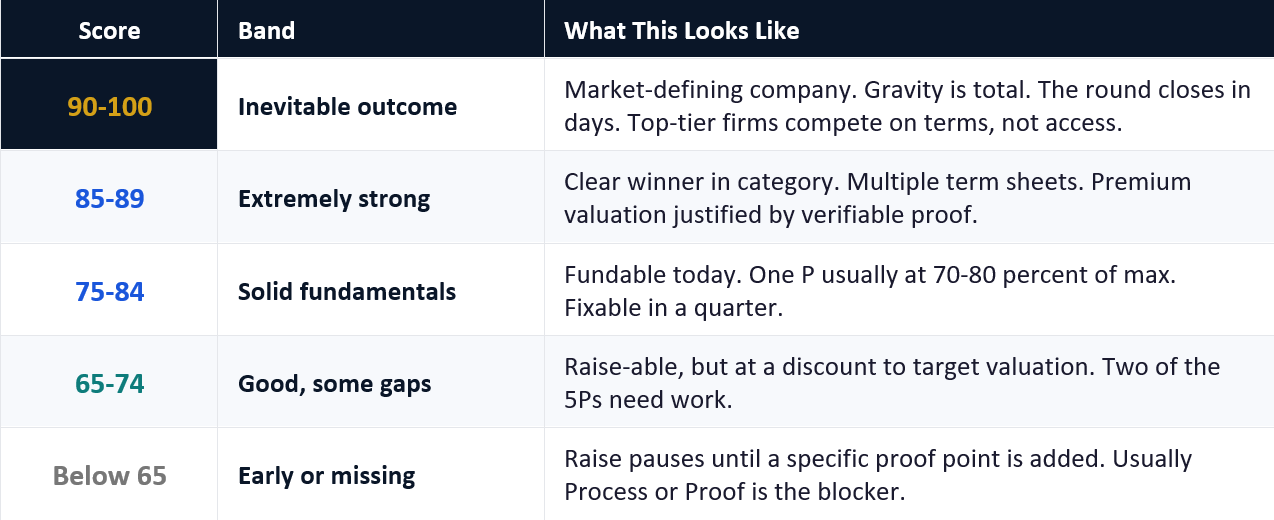
The honesty test: Most founders score themselves 75-85 on a first pass. When the same score is recalculated against only publicly verifiable evidence, the average drops to 58-68. If a metric is not externally proven, score it conservatively.
Worked Example: Harvey Scored 88/100
On March 25, 2026, Harvey (legal AI) closed $200M at an $11B valuation co-led by GIC and Sequoia Capital. The Eisen Fundability Score was 88/100. Here is exactly how that number was built across the 5Ps.
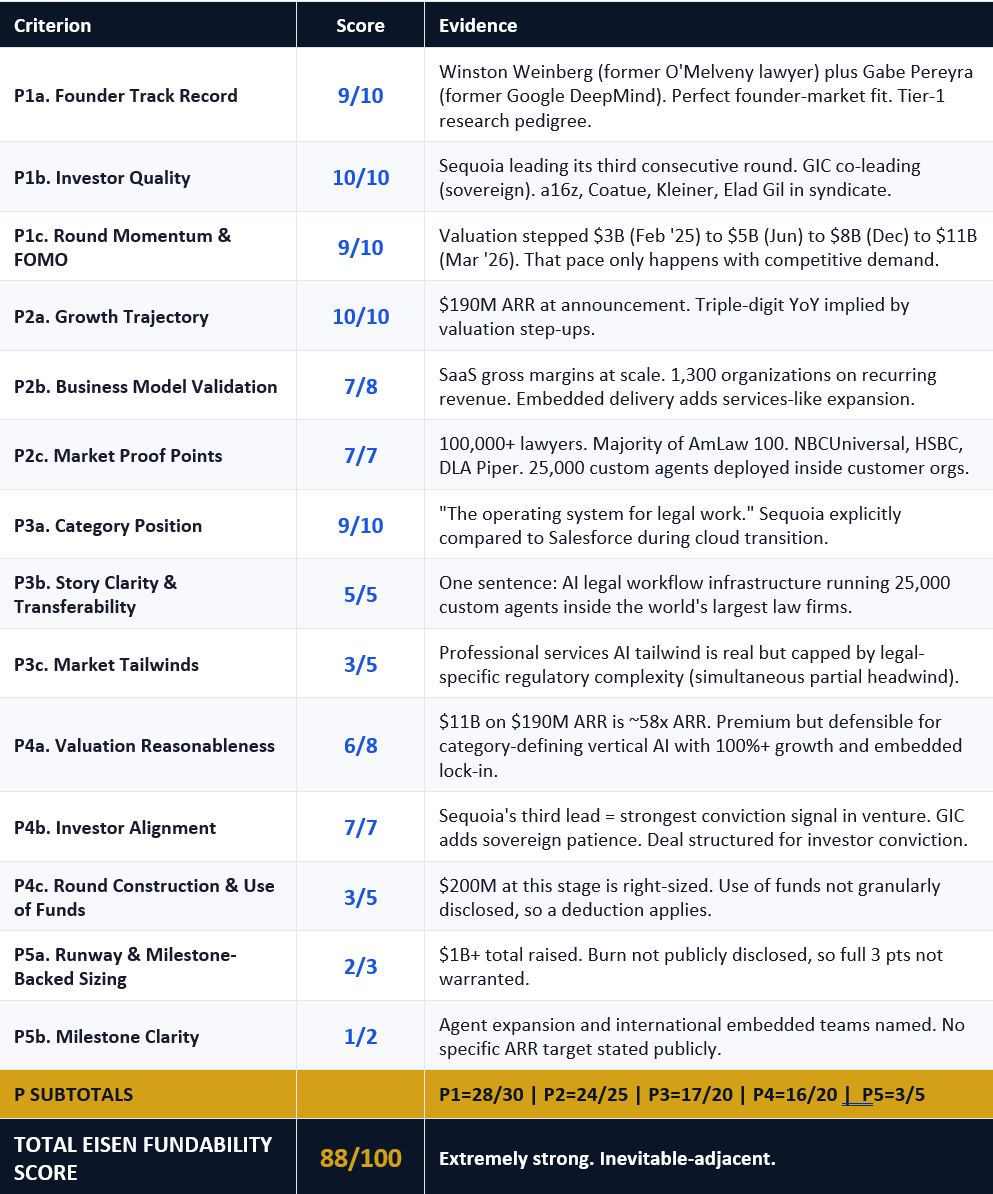
Why Harvey did not hit 90. The deductions were specific: valuation at 58x ARR (P4a = 6/8), non-disclosed burn metrics (P5a = 2/3), general-not-specific milestone language (P5b = 1/2), and regulatory complexity capping tailwinds (P3c = 3/5). This is the pattern at 85-89: a company with near-perfect Process and Proof, and a small set of Packaging and Planning gaps.
What the founders can copy. Two moves drove the score: (1) embedded delivery that creates compounding switching costs (P2 Proof), and (2) a lead-investor relationship that re-upped three times in 13 months (P1 Process). Both are replicable. Neither requires a better model.
The Self-Score Worksheet
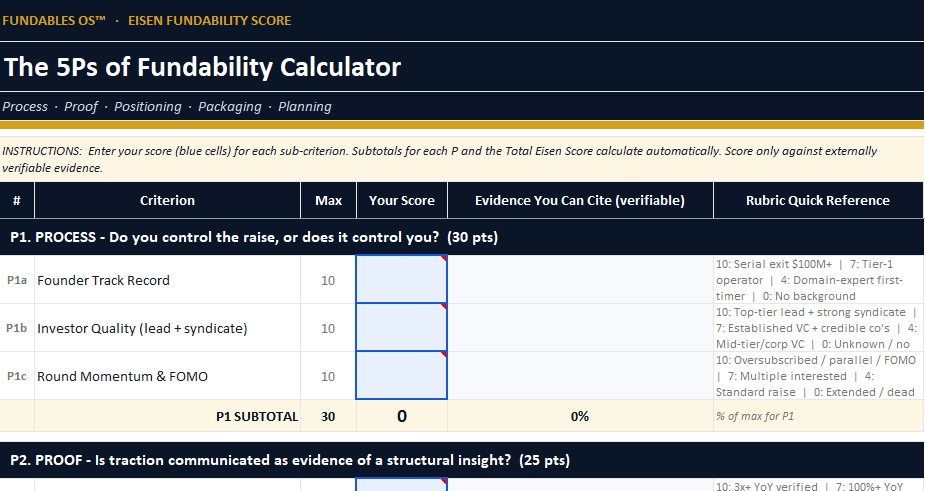
Download and use the worksheet presented below to score your own startup across the 5Ps. Give yourself 20 minutes. Score each sub-criterion against only the evidence an investor could independently verify - no internal projections, no “we expect to,” no “we are about to.”
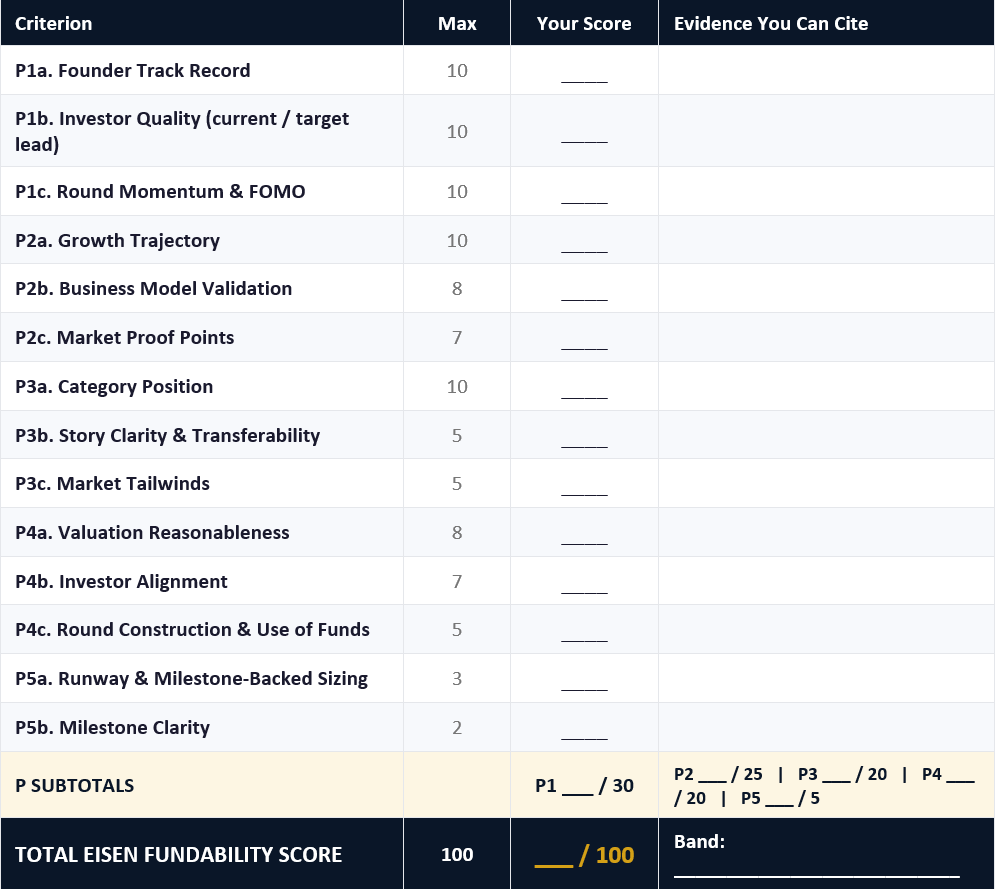
Download the EFS worksheet:

Common Mistakes When Self-Scoring
1. Scoring intent as evidence.
Near-term plans, pilot conversations in progress, and “warm” investor relationships are not scoring inputs. If a VC cannot verify it from outside your company, it is zero points.
2. Confusing category heat with Category Position (P3a).
Being “an AI company” does not earn 10 points. Defining a new category - or dominating an existing one so that third parties repeat your framing back to you - earns 10. Everything else is 4 or 7.
3. Over-rewarding yourself on Investor Quality (P1b).
Past angels, small funds, and family-office participation do not move P1b. This is a function of the lead on your current or target round, not your historical cap table.
4. Under-scoring Process (P1) because it feels like a soft signal.
Process is 30 points. It is the largest single P and the most common source of the fundability gap. If your round is not oversubscribed, parallel, and time-compressed, Process is costing you capital - and you should score it honestly.
5. Scoring once and moving on.
The score is a diagnostic tool. Re-score every 30 days. The goal is not the number; it is the trajectory. Three re-scores in 90 days tell you whether your sprint is working.
Your 30-Day Sprint After Self-Scoring
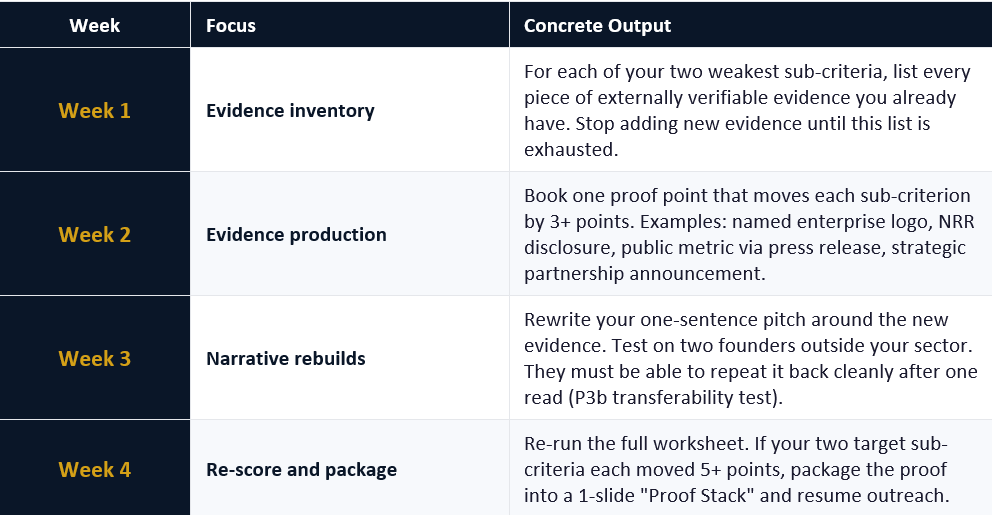
A score is a starting position, not an outcome. The sprint below is how funded founders convert a diagnostic into gravity. Pick your two lowest-scoring sub-criteria (across any of the 5Ps) and run this loop against each.
The Bottom Line
The Eisen Fundability Score was not built to predict outcomes. It was built to make fundraising an operational problem instead of an emotional one. Every term sheet is, in the end, underwritten against the 5Ps, whether the investor calls them by those names or not.
Founders who self-score monthly raise faster than founders who do not, because the score itself helps, but because the act of scoring forces an honest, evidence-only audit of the round across all five forces. That audit reveals which of the 5Ps is actually blocking the close, and those gaps are almost always closeable in 30 days.
Three rules to take with you:
(1) Score only on externally verifiable evidence,
(2) Re-score every 30 days against the same rubric,
(3) Spend the next sprint on your two weakest sub-criteria, not your three strongest.
Investors will fund what is verifiable. Everything else is a pitch.
Remember: You are not raising capital. You are becoming the kind of founder that capital cannot afford to ignore.
DISCLAIMER: This article is for informational and strategic intelligence purposes only. It does not constitute investment advice. The Eisen Fundability Score is a proprietary diagnostic within Fundables OS™, not a financial recommendation. Worked examples reference publicly disclosed rounds from the Eisen VC Market Intelligence Report. Valuations, ARR, and investor participation are sourced from primary company announcements and tier-one coverage.