

Most founders think fundraising breaks at the deck.
It usually breaks much earlier.
It breaks in the invisible places:
It breaks in the process that no one controls.
It breaks in the traction that no one knows how to translate.
It breaks in the story that sounds fine in the room, but dies in the partner meeting.
It breaks in the mess behind the scenes.
It breaks in the use of capital that feels hopeful rather than strategic.
That is why two founders can walk into investor meetings with similar products, similar markets, and similar revenue, yet get completely different reactions.
One gets polite interest.
The other creates momentum.
One gets “stay in touch.”
The other gets pulled forward.
Most people explain this gap in terms of charisma, network, timing, or luck.
Those factors matter.
But they are not the full answer.
The deeper answer is that one company is perceived as more fundable than the other.
Not interesting.
Not promising.
Not impressive on paper.
True fundable.
That word matters because it changes how you think about the real job.
The founder's job is to create conviction inside the investor’s mind and inside the investor’s firm.
That is a different discipline.
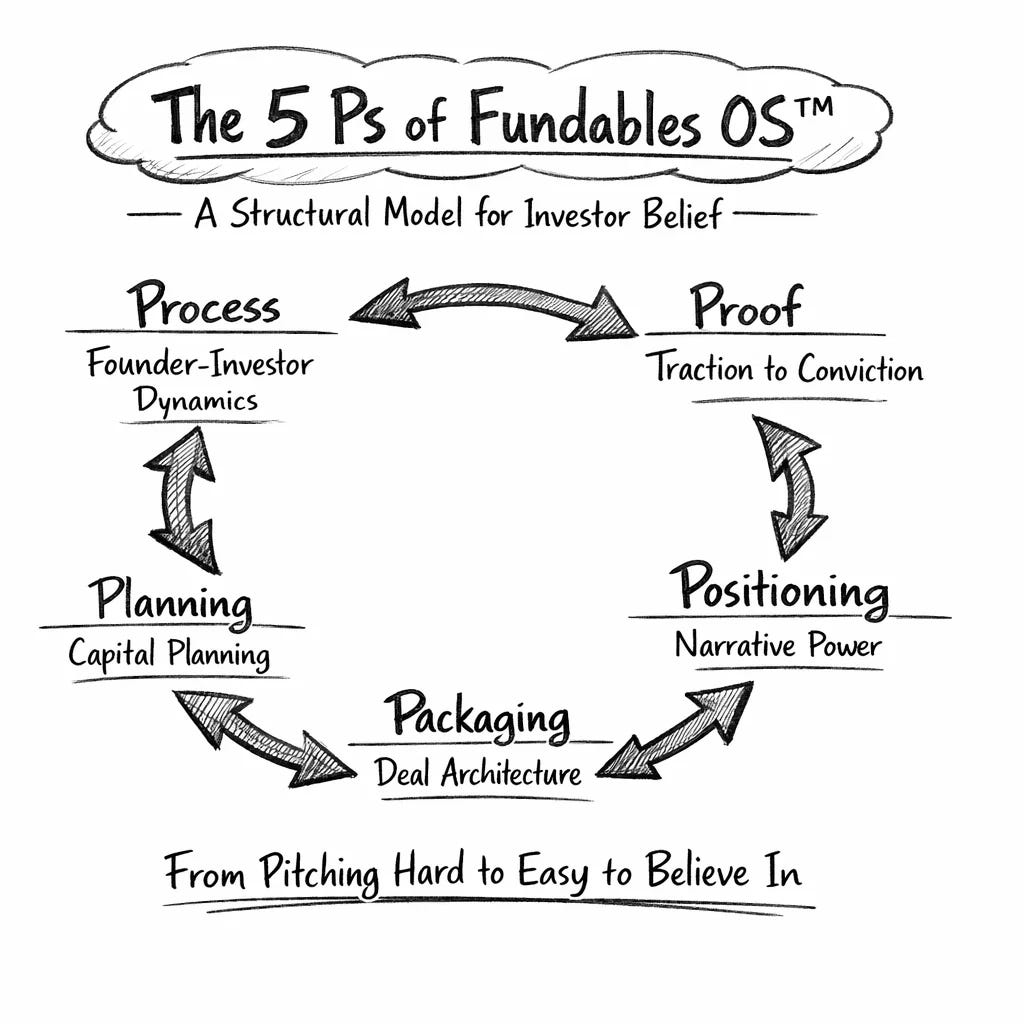
And that is exactly why I built The 5Ps of Fundables OS™, a structural model for how investor belief gets built.
The 5Ps are the five forces that shape whether your company merely enters investor conversations or actually advances through them.
They are:
Process
Proof
Positioning
Packaging
Planning
Together, they explain why some startups keep pitching harder while others become structurally easy to believe in.
The fundraising mistake most founders do not know they are making
Founders often think fundraising is about getting one meeting right.
Then the next. Then the next.
That view sounds reasonable. It is also incomplete.
Fundraising is not a chain of isolated presentations. It is a system of signals.
Every part of your company is teaching the investor something:
Your follow-up speed teaches them how you operate.
Your metrics teach them how it’s real.
Your narrative teaches them whether others will understand you.
Your materials teach them whether diligence will be painful.
Your capital plan teaches them whether this round is strategic or reactive.
Investors are not only judging what you say.
They are judging the structure behind what you say.
That is why founders so often feel confused after meetings:
The conversation felt strong.
The investor was engaged.
The questions were thoughtful.
The founder thought, " We are close.”
Then nothing happens.
Or worse, something happens very slowly.
A request. A delay. Another request. A soft follow-up. A vague maybe. Then the process quietly dies.
Most founders misread this.
They think the investor changed their mind.
Very often, the investor never fully formed a conviction in the first place.
That is the point of the 5Ps.
They help you build the conditions that make conviction more likely.
Fundraising is not a persuasion trick. It is a conviction system.
When founders understand that, they stop obsessing over the surface and start strengthening the infrastructure underneath.
That is when everything changes.
1. Process
Control the dynamic before the dynamic controls you
The first P is Process.
This is the most underestimated part of fundraising because it looks operational from the outside. Many founders treat it like logistics. Calendar management. Follow-up emails. Intro tracking. Investor pipeline hygiene.
That is too shallow.
In Fundables OS™, Process means something much more important:
your ability to control the founder-investor dynamic.
That includes timing, sequencing, leverage, meeting progression, responsiveness, pressure, momentum, and how well you run multiple conversations in parallel.
Weak founders let fundraising happen to them. Strong founders design the experience.
That difference is enormous.
A weak process looks like this:
The founder reaches out randomly.
Some meetings happen this week, others three weeks later.
One investor requests materials and receives them 4 days later.
Another wants customer references and gets them after a long internal scramble.
A third hears that “we are just getting started with the round,” so there is no urgency.
Everything feels open-ended.
Nothing feels time-sensitive.
Momentum never compounds.
Then the founder says, “Investors are slow.”
No. The process was weak.
A strong process does the opposite:
It creates flow.
It compresses decision windows.
It keeps conversations warm.
It reduces dead space.
It turns follow-up into forward movement.
Process is where real fundraising leverage begins.
When investors sense that a founder is running a disciplined process, they begin to read the company differently. The company feels more serious. More in demand. More coordinated. More likely to attract others.
And that creates a subtle but powerful psychological shift.
The investor is no longer only asking, “Do I like this company?”
They are also asking, “Can I afford to move too slowly on this?”
That is why process control matters so much.
Because fundraising is about managing comparative urgency. You build credible momentum.
The founder who controls the process controls how the opportunity is perceived.
This is why I place Process first in the framework.
Before the story spreads, before the data persuades, before the term sheet appears, someone has to hold the system together.
That someone is the founder.
2. Proof
Make belief feel earned
The second P is Proof.
This is where traction becomes conviction.
Most founders show numbers. Few know how to turn those numbers into evidence.
That distinction is one of the biggest differences between “interesting startup” and “fundable company.”
Investors do not back numbers because they are large. They back evidence because it reduces uncertainty.
That means your job is to interpret and frame traction so the investor can evaluate the risk.
A founder says:
“We grew 20% month over month.”
Fine.
But what should the investor conclude from that?
Was the growth efficient?
Was it repeatable?
Was it driven by one founder-led channel or by something that scales?
Are customers staying?
Are they expanding?
Are they referring?
Is usage deepening?
Is the product becoming part of a workflow, or is it just being tested?
Proof lives in those questions.
That is why I do not treat traction as a vanity display.
In Fundables OS™, Proof is an architecture for evidence.
It is the structured body of signals that tells the investor:
Demand is real
Customer pain is meaningful
Adoption is not random
growth has logic
The product is earning its place
The business is learning fast
Risk is going down
That last point matters most.
Every serious investor is trying to answer one invisible question:
Is this company reducing risk fast enough to justify the upside?
Proof is how you answer that without saying it directly.
This includes:
customer behavior, retention, expansion, quality of pipeline, win patterns, references, gross margin logic, usage depth, speed of learning, repeatability of distribution, and evidence that the company’s wedge is becoming stronger over time.
Founders think passion creates investor confidence.
It does not.
Passion may win attention.
Proof wins belief.
And real fundraising begins when belief becomes defensible.
Because that is what investors need inside their firms. They need something they can carry into internal discussions. Something they can explain. Something they can defend under pressure.
That is what good Proof does.
It makes confidence feel rational.
The round moves faster when your ambition is supported by evidence instead of energy alone.
Without Proof, even a strong founder can sound speculative.
With Proof, the same founder starts to sound inevitable.
That is a very different room.
3. Positioning
Build a story that survives after you leave the room
The third P is Positioning.
This is where many founders are most overconfident.
They think they have a strong narrative because they can clearly explain their company.
But fundraising narratives are not tested inside your presentation.
They are tested after the meeting.
They are tested when the investor has to explain your company to someone else.
That is where weak stories fall apart.
In Fundables OS™, Positioning focuses on making the company easy to understand, easy to remember, and easy to repeat with force.
That matters because investors do not invest alone.
They discuss. They summarize. They advocate. They defend. They compare.
If your story only works when you tell it, then your narrative is weaker than you think.
Strong Positioning means your company can travel:
It can move from the meeting to the Monday partner discussion.
It can move from one associate to one partner.
It can move from one investor to another.
It can move through the network without losing shape.
That is what narrative power really is.
Not storytelling theater - transferable meaning.
A strong positioning system answers six silent questions fast:
Why now?
Why this market?
Why this wedge?
Why this team?
Why can this become large?
Why will this matter enough to win?
Founders fail here in one of two ways.
They either explain too much, which makes the story heavy and fragile.
Or they explain too little, which makes the story generic and forgettable.
Positioning solves both problems:
It gives the business a sharp identity.
It helps the market feel timely.
It makes the wedge feel specific.
It explains what you are really displacing.
It shows why the company is not just another version of an existing category.
This is why Positioning has real fundraising force.
Because investors fund what they can understand and retell.
Confused stories die. Generic stories blur. Sharp stories spread.
A fundraising story is only strong when it still works in a room you are not in.
That is why Positioning matters so much inside Fundables OS™. Founders need a company that can replicate belief beyond the founder’s own voice.
4. Packaging
Remove friction before friction removes momentum
The fourth P is Packaging.
This word is often misunderstood.
Packaging is not cosmetics.
It is not a pitch deck decoration.
It is not font choices and visual polish.
In Fundables OS™, Packaging refers to the professional structure around the company that makes it easier for investors to move forward.
This includes:
The deck
The data room
Financial materials
Legal readiness
The logic of the round
Clarity of ownership and governance
Coherence between story, metrics, and documents
The founder’s ability to answer diligence questions without chaos
Why does this matter so much?
Because investors react to both upside and friction.
A startup can be exciting and still feel exhausting.
The deck may be strong, but the data room is incomplete.
The metrics look good, but definitions shift between conversations.
The cap table raises questions.
The legal setup feels messy.
The use of funds is vague.
The founder promises to send materials “tomorrow” and sends them a week later.
None of these issues alone may kill the deal.
But together they create drag.
And drag is deadly in fundraising.
Investors rarely announce, “Your company creates too much friction for me.”
They simply slow down.
That is why Packaging matters.
Good Packaging does not create conviction by itself, but it protects conviction from erosion.
It tells the investor:
This founder is organized.
This company respects the process.
This round is being run professionally.
Diligence will not become a headache.
The business may still be early, but it is not sloppy.
That last part matters more than many founders realize.
Early-stage investing already contains enough uncertainty.
Do not add unnecessary uncertainty through poor execution.
Packaging is where many companies quietly leak trust.
And trust is not only lost through bad numbers or weak markets. It is also lost through inconsistency, lateness, confusion, and structural amateurism.
Well-packaged companies are easier to say yes to and underwrite.
Many rounds do not fail because the friction is too high.
That is why Packaging belongs in the 5Ps. It is strategic.
5. Planning
Show that this capital creates a future, not just an 18-month runway
The fifth P is Planning.
This is the smallest weight in the framework, but it acts like a multiplier.
Planning tells the investor whether the founder understands what this round is really for.
Weak founders talk about raising capital as if money itself is progress, and this round is a milestone.
Strong founders show exactly how capital changes the company.
That difference is everything.
Investors are not funding your liabilities. They are funding your next phase.
So the real question is not:
“How much money do you need?”
The real question is:
“What does this capital make true?”
Planning is where founders demonstrate that they understand milestones, sequencing, resource allocation, next-round logic, and what must be de-risked before the company reaches the next valuation step.
That means a real capital plan answers questions like:
What milestones will this round unlock?
Which risks will be reduced?
What becomes measurable after deployment?
What must be true before the next raise?
How does this use of funds support a stronger next narrative?
It is strategic architecture, not a spreadsheet.
A founder who says, “We need 18 months of runway to hire and grow,” sounds ordinary.
A founder who says, “This round gets us from initial commercial proof to repeatable enterprise expansion across three customer segments, with target payback below X months and retention above Y by the time we enter the next financing conversation,” sounds different.
Instead of asking for money. founders are presenting a controlled path to value creation.
Planning creates maturity. It tells the investor the company is not drifting from round to round. It is moving with intent.
And investors care deeply about that because they are always underwriting forward, not backward (think about lag indicators vs. lead ones).
They are asking whether your next company state is believable.
Capital becomes attractive when it is tied to milestone clarity, not survival language.
That is why Planning matters inside Fundables OS™. It makes the future legible.
Why the 5Ps work as a system together
Each of these forces matters on its own.
But the real power lies in their working as a system.
Process creates momentum.
Proof justifies momentum.
Positioning makes momentum understandable.
Packaging makes momentum easy to diligence.
Planning gives momentum a destination.
That is why I do not teach these as separate fundraising tips.
I teach them as operating layers.
Most founders do not fail because of a single catastrophic weakness. They fail from misalignment across several invisible layers:
The process is loose.
The traction is real but under-translated.
The story is decent but not repeatable.
The materials are good enough, but not tight enough.
The use of funds sounds reasonable but not compelling.
Nothing looks terrible. But nothing compounds.
And that is exactly the problem. Fundraising is a compounding game.
When all 5Ps align, the company begins to produce a very different signal:
The founder looks in control.
The business feels increasingly real.
The story travels.
The diligence burden drops.
The future feels designed.
That is when a startup stops feeling like a hopeful bet and becomes an investable opportunity.
What Fundables OS™ is really designed to do
Fundables OS™ doesn’t help founders appear more fundable.
It is built to create an identity for a fundable startup.
That is an important distinction.
Because the market is already full of founders trying to look polished.
Better slide design. Better buzzwords. Better theater.
That may help on the edges.
But it does not solve the real problem.
The real problem is that many startups are trying to raise capital before they have built the internal system that creates sustained investor confidence.
That is what the 5Ps solve.
They give founders a way to diagnose where conviction is breaking.
Where the system is weak.
That is a much more valuable question.
Once you know that, you stop chasing random fixes.
You stop guessing.
You start strengthening the exact layer that is holding the company back.
That is how fundraising becomes less emotional and more engineered.
That is how founders stop interpreting every investor reaction as a mystery.
And that is how companies begin to create the kind of trust, pressure, and clarity that good investors actually respond to.
Final thought
Do not push harder on a weak structure
Many founders do the worst possible thing when fundraising gets hard. They push harder on the visible layer:
More meetings.
More outreach.
More deck edits.
More talking.
Sometimes the right move is the opposite. Stop performing. Diagnose the structure underneath.
Ask yourself:
Is my Process creating urgency?
Is my Proof turning traction into belief?
Is my Positioning strong enough to travel without me?
Is my Packaging removing friction or creating it?
Is my Planning making the next stage feel credible?
Fundraising gets easier when the business stops asking investors for confidence it has not yet earned. That is the core idea behind the 5Ps of Fundables OS™.
Not fundraising as performance. Fundraising as architecture.
And founders who learn that stop sounding like they need money. They start looking like the kind of company money wants to follow. They create a fundable identity.