

Playbook, Perspective, and Pattern for Founders Raising Now
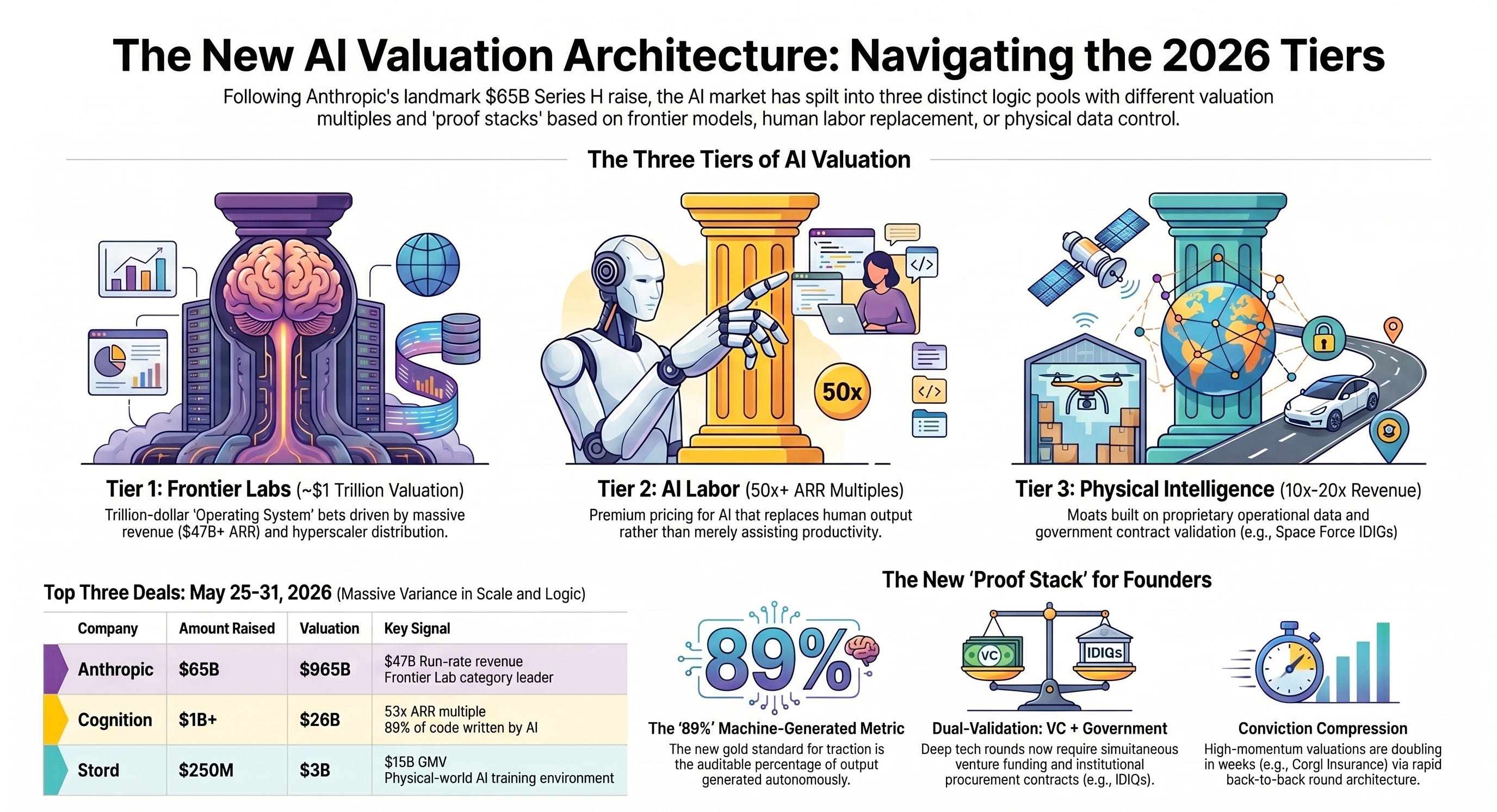
Anthropic raised $65 billion in a single Series H this week. That one check represents 97% of all capital in the top 10 rounds. After it, the largest deal on the board was Cognition at $1 billion on $492 million in annualized revenue, 13x its ARR from twelve months ago. Together, those two data points define a new pricing architecture for the AI era: frontier labs trade near trillion-dollar valuations, and AI labor that visibly replaces human output commands 50x revenue multiples. Everything else competes in a different pool.
The $965 billion post-money valuation surpasses OpenAI, which raised $110 billion at $852 billion just three months ago. Altimeter Capital, Dragoneer, Greenoaks, and Sequoia led. Capital Group, Coatue, D1 Capital Partners, GIC, Iconiq, and XN co-led. Amazon committed $5 billion as part of $15 billion in hyperscaler commitments baked into the round. Anthropic disclosed that its run-rate revenue exceeded $47 billion in May 2026. The implied ARR multiple is approximately 20x. That is not irrational pricing for a category leader in frontier AI with compounding enterprise distribution and a compute moat. It is a rational bet on the revenue trajectory.
The structural consequence for every other founder in the market: the capital pool above $500 million now operates on a different logic than the pool below it. The Anthropic-scale investors write trillion-dollar tickets against 10-year institutional theses. Cognition-scale investors write unicorn-to-decacorn tickets against AI labor-replacement metrics, specifically ARR growth velocity and the percentage of output now machine-generated. Stord, Observable Space, Corgi, and the rest of the board compete for what remains. Understand which pool you are in before you open your round. This report tells you the rules for each.
Five shifts from this week changed the terms of your raise. Read what changed, understand the underlying investor logic, and execute the corresponding playbook action before your next investor meeting.
THE WEEK AT A GLANCE
Capital deployed a new valuation ceiling this week: $965 billion for the frontier AI leader, 53x ARR for the AI labor category winner, and government contract validation as the required proof stack for deep tech.
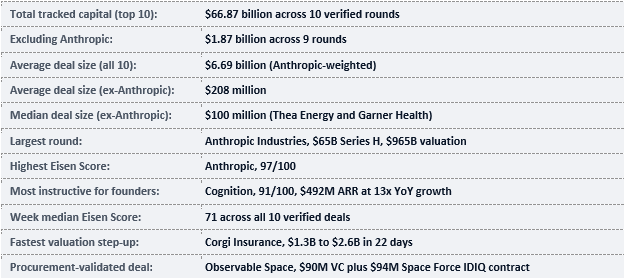
Table 1: The week at a glance
DEAL SCORECARD
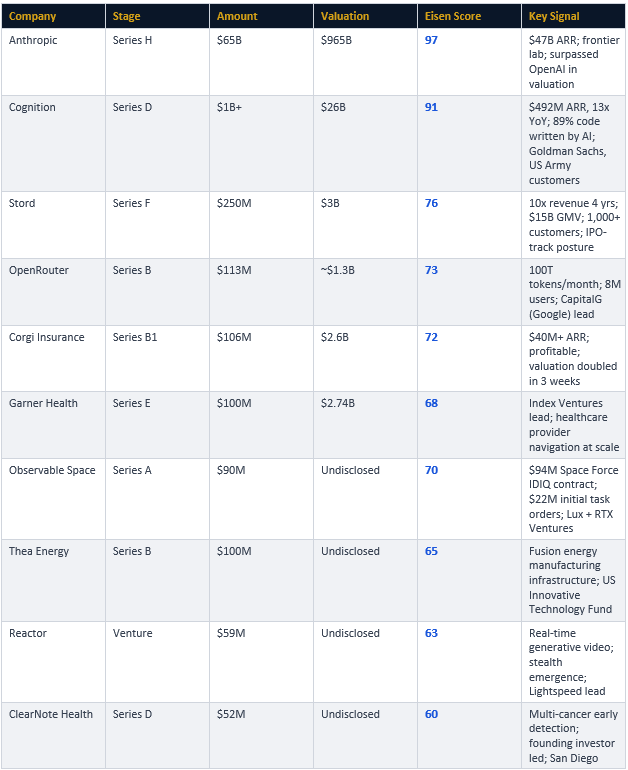
Table 2: Deal Scorecard
Three structural signals dominate this scorecard. First, the two highest-scoring deals (Anthropic at 97 and Cognition at 91) are both in the AI software and AI services layers. Neither builds hardware. Both compete on who controls the output layer of AI-driven work. Second, the deals scoring between 65 and 76 all share one common architecture: documented traction in a physical-world category combined with government or institutional off-take validation. Stord has $15 billion in GMV. Observable Space has a signed IDIQ contract. Third, the deals scoring below 65 are either stealth-emergence rounds (Reactor) or single-source capital events (ClearNote Health), in which independent evidence of commercial traction was not disclosed in primary sources. Score conservatively on opacity. Investors do.
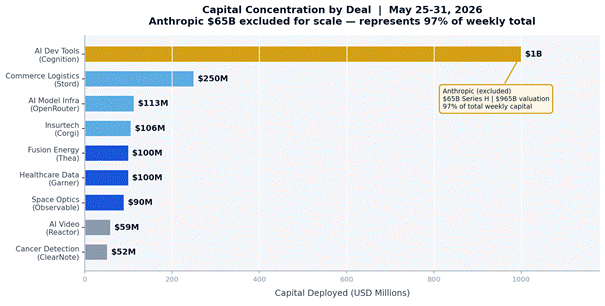
Figure 1: Capital concentration by deal, May 25 to 31, 2026. Anthropic ($65B) represents 97% of the weekly total. The remaining 9 deals total $1.87 billion.
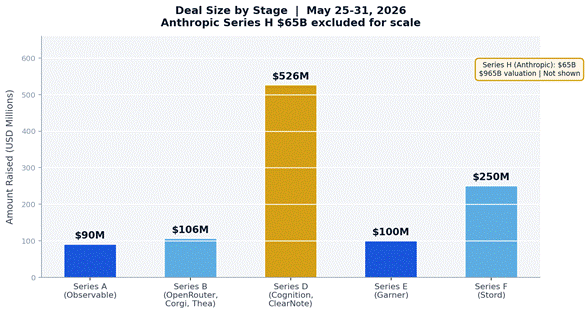
Figure 2: Deal size by stage group, May 25 to 31, 2026. Series B group median = $106M. Series D group includes Cognition ($1B) and ClearNote ($52M), shown here as a group median of $526M.
WHAT CHANGED THIS WEEK: FIVE MARKET SHIFTS
SHIFT 1: FRONTIER LABS CROSSED THE TRILLION-DOLLAR VALUATION LINE
PATTERN: Anthropic raised $65 billion at a $965 billion post-money valuation, surpassing OpenAI ($852 billion, February 2026) in valuation in under three months. The syndicate includes sovereign-adjacent capital (GIC), crossover funds (Altimeter, Dragoneer, Coatue), growth equity (Sequoia, Greenoaks), and hyperscaler commitments ($15 billion from Amazon and Google, previously committed). The combined Series G and Series H raised a total of $95 billion in roughly 90 days. Run-rate revenue crossed $47 billion.
PERSPECTIVE: The investor logic is not a bet that Anthropic will outperform OpenAI on model benchmarks over the next six months. The logic is a bet that AI will become the next operating system layer. Sequoia, Dragoneer, and Coatue are writing growth equity tickets, not venture tickets. They are underwriting a revenue base, a distribution moat (Claude Code, Claude for Enterprise, Cowork), and a regulatory posture that positions Anthropic as the “responsible AI” choice for regulated buyers (banking, healthcare, government). The $47 billion run-rate is the evidence. The $965 billion valuation is the market pricing in continued compounding.
FOUNDER BLINDSPOT: Founders see a $965 billion valuation and assume they should pitch their AI company at a 20x ARR multiple because Anthropic does. Wrong frame. Anthropic has $47 billion in run-rate revenue, hyperscaler distribution, and Sequoia at the table. If your ARR is $5 million, then Anthropic is not the relevant comp. The relevant comp is what the $100M Series B market is pricing for your category. That bar is 10x-15x ARR for AI-native vertical SaaS, not 20x. Founders pitching Frontier Labs multiples on Series A metrics are mispricing their own pitch.
PLAYBOOK: If you are building an AI product, do not anchor your valuation pitch to frontier lab comps. Instead, identify your category. Find the last two Series B deals in your vertical. Get their ARR and valuation from public sources. Calculate the multiple. Then benchmark your own ARR against that multiple. If you exceed the growth rate benchmark, you can argue for a premium. If you do not, arguing Anthropic comps in a pitch is a credibility risk, not a valuation win.
CONTRAST: Six months ago, the largest AI round was a venture check into a lab with research traction and limited commercialization. Today, Anthropic is priced at a $47 billion run rate, and the investors are crossover funds, not seed-stage VCs. The capital structure of frontier AI has fully migrated from research betting to enterprise software underwriting. Founders pitching frontier AI without revenue will struggle to clear institutional conviction.
WHAT THIS MEANS FOR YOUR RAISE: Frontier AI is now an enterprise software category with hyperscaler distribution requirements. If you are pre-revenue and building in this category, your investor is not Altimeter or Coatue. Your investor is a seed fund betting that your research will become a product. Know which game you are in.
SHIFT 2: AI LABOR COMMANDS 53X ARR. THE SaaS MULTIPLE IS NOW OBSOLETE FOR THIS CATEGORY
PATTERN: Cognition raised $1 billion at a $26 billion valuation, representing a 2.5x step-up from its $10.2 billion round just eight months earlier (September 2025). The company disclosed $492 million in annualized revenue, up from $37 million twelve months ago, a 13x growth rate. Enterprise usage of Devin (the AI software engineer) has grown 10x since January 2026. The company claims 89% of all code committed internally is now written by Devin. Customers include Goldman Sachs, Citi, Mercedes-Benz, the US Army, and the US Navy. Total funding crosses $2.5 billion.
PERSPECTIVE: The 53x ARR multiple is not irrational. It is the market pricing the difference between AI that assists human labor and AI that replaces it. Traditional enterprise SaaS is priced on ARR because every contract requires a human to use the product. The contract renews when the human is happy. Cognition’s product, at scale, eliminates the human-in-the-loop entirely from code creation. If that thesis holds, Devin is not a productivity tool. It is a labor category replacement. The market is pricing that distinction at 53x rather than 10x. Lux Capital and General Catalyst wrote the check on that reasoning, not on quarter-over-quarter SaaS metrics.
FOUNDER BLINDSPOT: Founders building “AI-powered” products see the 53x multiple and try to adopt “AI labor” language without the underlying proof. Cognition earns its multiple by showing 89% of its own code committed by AI, a single data point that removes all abstraction from the pitch. The proof is not a customer testimonial. It is an operational statistic that makes the value proposition undeniable. Founders who claim labor replacement without an equivalent self-referential data point are pitching a narrative, not proof. Investors at the growth stage know the difference.
PLAYBOOK: Build your “89%” before your next pitch. Identify one internal operation that your product already handles end-to-end. Measure the output. Calculate what percentage of that output now requires zero human generation, only human review. That number, specific and auditable, is worth more in a pitch than a TAM slide. If your product cannot yet produce that number, your next 90 days of product development should be designed to make it measurable.
CONTRAST: In 2024, AI coding tools were pitched as developer productivity boosters at 10x-15x ARR multiples. In May 2026, the category leader cleared 53x on evidence of autonomous output at scale. The multiple premium is not category hype. It is documented proof that AI output replaces a prior human cost. The distinction between “assists” and “replaces” is now worth approximately $40 billion in valuation difference.
WHAT THIS MEANS FOR YOUR RAISE: The new standard for premium valuation in AI is evidence that your product replaces a measurable unit of human labor output. If your product merely improves it, your multiple is capped at the SaaS benchmark for your vertical. Know which category you are actually in before you open your round.
SHIFT 3: PHYSICAL INTELLIGENCE CLEARED CAPITAL AT THREE STAGES SIMULTANEOUSLY
PATTERN: Three deals across three stages and three verticals all underwrote the same underlying thesis this week. Stord ($250 million, Series F) is applying agentic AI and robotics to commerce fulfillment at $15 billion in gross merchandise volume across 1,000-plus customers. Observable Space ($90 million, Series A) applies AI-driven optical and laser systems to space domain awareness. Reactor ($59 million, venture stage) builds real-time generative AI video for creators and developers. All three convert physical-world data or constraints into AI-powered output. Total: $399 million across three stages.
PERSPECTIVE: Physical intelligence is different from “AI applied to an industry.” Physical intelligence companies own the data flywheel that cannot be replicated by a model fine-tune. Stord’s competitive moat is not its fulfillment software. It is the 200-person engineering team embedded in a live operational network of 100 facilities, generating training data that cloud-only competitors cannot access. Observable Space’s moat is not its telescope design. It is its manufacturing capability for full-stack optical systems that the Space Force has already contracted. Reactor’s moat is its real-time generation speed, which no current model can replicate at consumer-grade latency. In each case, the physical constraint produces a proprietary data layer that fuels the AI advantage.
FOUNDER BLINDSPOT: Founders see physical intelligence rounds and conclude that adding a robotics or hardware component to a software pitch makes it fundable. Wrong conclusion. The investable insight is the data access architecture, not the hardware itself. Stord earns its $3 billion valuation by building a network that generates live operational data at scale. A software company that licenses data from Stord does not earn that multiple. The hardware or physical operation is not the asset. The data access it creates is the asset.
PLAYBOOK: Audit your physical data access this week. Ask specifically: what operational environment generates proprietary data that your product trains on or improves? Who controls that environment? What is your contractual or structural access to that data? If your training data comes primarily from public sources or simulations, you are a software company operating within a physical AI framework. If you own or have exclusive access to operational data from a real-world environment, articulate that access explicitly in your pitch. The slide that describes your data flywheel architecture is worth more than your TAM slide.
CONTRAST: In 2024, physical AI was a robotics category story. Capital concentrated in humanoid robots and autonomous vehicles, primarily on claims about model performance. In May 2026, $399 million across three physical intelligence deals was not underwritten on model capability. It was underwritten by operational access, data density, and the structural moats created. The category narrative has shifted from “our model is better” to “our access is irreplaceable.”
WHAT THIS MEANS FOR YOUR RAISE: Physical intelligence capital in 2026 pays for data flywheel architecture, not hardware novelty. If your physical AI pitch leads with the hardware or the model, rewrite it. Lead with the data access structure and the operational environment you control.
SHIFT 4: GOVERNMENT CONTRACT PLUS VENTURE CAPITAL IS THE NEW DUAL-VALIDATION PROOF STACK
PATTERN: Observable Space announced both its $90 million Series A and its $94 million Space Force IDIQ contract on the same day (May 28, 2026). The IDIQ, awarded through the Pentagon’s Accelerate the Procurement and Fielding of Innovative Technologies program, funds initial task orders of $22 million for optical telescopes used in space domain awareness. RTX Ventures (Raytheon Technologies’ venture arm) co-led the financing alongside Lux Capital, Upfront Ventures, Detroit Venture Partners, and Island Green Capital. The company is one year old, founded from the merger of PlaneWave Instruments and OurSky in February 2025.
PERSPECTIVE: RTX Ventures does not co-lead a VC round for strategic goodwill. It co-leads because Raytheon is a defense prime that benefits from partnering with an optical systems supplier that has a validated Space Force contract. The $94 million IDIQ creates a predictable revenue stream that reduces Observable Space’s commercial risk, thereby reducing RTX’s acquisition risk. The dual announcement is deliberate: the government contract makes the venture round more fundable, and the venture capital makes the government contract more executable. This is the template from the Anduril and Havoc rounds last week applied at the Series A stage.
FOUNDER BLINDSPOT: Founders building deep tech in defense, space, or critical infrastructure see Observable Space and assume they need a Space Force contract before they can raise a Series A from Lux Capital. Wrong sequence. The contract and the Series A were developed simultaneously, not sequentially. Observable Space raised its seed and angel capital first, built its first products, qualified through the APFIT program, and then ran the government contracting and VC fundraising processes in parallel. Founders who wait for a contract before approaching VCs burn 18 months. Founders who run both processes concurrently close both in the same week.
PLAYBOOK: If your technology has any defense, space, or national security application, identify the relevant procurement vehicle this week. Look for OTA (Other Transaction Authority) agreements, SBIR Phase II and III vehicles, IDIQ frameworks, and the specific program offices that manage your domain. Then begin both tracks simultaneously: approach mission-aligned VCs and engage with the relevant program offices. The dual announcement creates more capital velocity than either track alone. Observable Space closed $184 million in total capitalization in a single press release.
CONTRAST: Six months ago, the standard proof stack for a deep tech Series A was technical validation, pilot customers, and strong founders. In May 2026, the premium proof stack is a government contract plus a strategic investor co-lead. At one year of age, Observable Space combined both. That is the new bar for deep-tech categories that touch national security, space, or critical infrastructure.
WHAT THIS MEANS FOR YOUR RAISE: Government contract plus strategic defense investor co-lead is now the premium proof stack for deep tech Series A and B rounds. If you have one but not the other, your round will clear at a discount. Run both processes simultaneously and announce them together.
SHIFT 5: CONVICTION COMPRESSION: VALUATIONS ARE DOUBLING IN WEEKS, NOT QUARTERS
PATTERN: Corgi Insurance raised $106 million at a $2.6 billion valuation on May 28, exactly 22 days after announcing a $160 million Series B at a $1.3 billion valuation on May 6. The same investors (Kindred Ventures, Leblon Capital, Quadri Ventures) participated in both rounds. TCV, known for backing Netflix, Spotify, and Zillow, led the B1 as a new institutional entrant. Cognition went from $10.2 billion (September 2025) to $26 billion (May 2026) in eight months. Stord doubled from $1.5 billion to $3 billion in under twelve months. Three distinct speed patterns emerging: re-up at premium (Corgi), new lead at step-up (Cognition), insider doubling (Stord).
PERSPECTIVE: The 21-day doubling is not explained by fundamentals alone. Corgi’s $40 million in ARR and one month of profitability do not, on arithmetic grounds, justify a 2x valuation step in three weeks. The explanation is capital flow pressure. When TCV identifies a category and moves, competing funds that missed the Series B face a binary choice: take the B1 at a higher price or lose the position entirely. Corgi is running a manufactured scarcity dynamic: quick back-to-back raises that force competing funds to pay a premium or exit the deal. This is not manipulation. It is a sophisticated, round architecture designed to maximize valuation velocity in a market where conviction is cheap and time is scarce.
FOUNDER BLINDSPOT: Founders see Corgi’s 21-day doubling and want to replicate it. The risk is attempting the same architecture without the underlying conviction signal. Corgi’s B1 worked because TCV, a verifiable tier-one growth fund, took the lead. Without a credible new institutional entrant at the B1, the same strategy looks like valuation manipulation rather than conviction compression. The ingredient that makes back-to-back rounds work is not the timing. It is the quality of the new lead investor. If your prospective B1 lead is a lesser-known fund than your B lead, you will destroy credibility rather than build it.
PLAYBOOK: If you are approaching your next round and the market has moved in your favor since your last close, consider whether your round architecture should be a standard raise or a structured two-step with a top-tier new lead at the second close. The conditions for the second approach are: you have a tier-one fund that wants in but missed your prior round, your metrics have accelerated materially over the past 60 to 90 days, and your current investors are willing to re-up. If all three conditions hold, the back-to-back round with a premium step-up is a legitimate structure. If anyone is missing, raise a standard round.
CONTRAST: In 2024 and 2025, back-to-back rounds were unusual enough to generate skepticism in the press. In May 2026, they appear in the Crunchbase top 10 for standard deal types. The market has normalized rapid refinancing as proof of commercial momentum rather than a red flag of dilution urgency.
WHAT THIS MEANS FOR YOUR RAISE: Conviction compression rewards founders who run around architecture, not just fundraising. If your metrics have accelerated since your last close and you have a top-tier fund waiting to lead, the back-to-back structure with a premium step-up is now a legitimate strategy. It requires a new institutional lead, not just existing investors re-upping.
VISUAL SUMMARY: EISEN SCORES AND VALUATION STEP-UPS
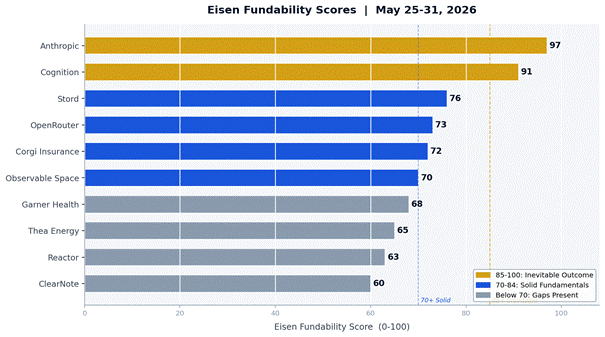
Figure 3: Eisen Fundability Scores for all 10 verified deals, May 25 to 31, 2026. Gold bars exceed 85 (Inevitable). Blue bars range from 70 to 84 (Solid Fundamentals). Gray bars fall below 70 (Gaps Present).
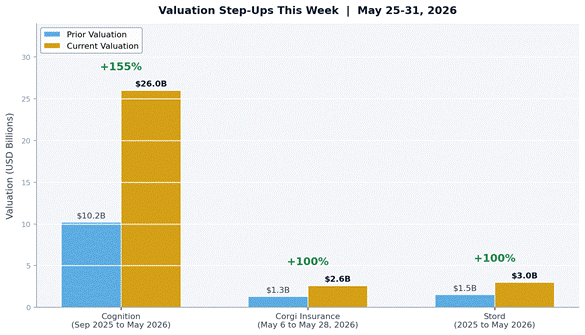
Figure 4: Valuation step-ups for three deals with prior-round comparables available, May 25 to 31, 2026. Cognition, Corgi Insurance, and Stord all doubled or surpassed 2x in their most recent financing.
5 DEALS THAT MATTER
ANTHROPIC
Eisen Fundability Score: 97/100 | Maximum across all five dimensions. The only category where a near-perfect score is arithmetically justified.
THE SETUP: Anthropic was founded in 2021 by Dario Amodei, Daniela Amodei, and a core team from OpenAI’s safety research group. This Series H, announced May 28, 2026, is the third round in 2026 alone. The $65 billion raise comes 105 days after a $30 billion Series G at a $380 billion valuation. The company has now raised approximately $144 billion in total since its inception.
THE NUMBERS: $65B raised. $965B post-money valuation. $47B revenue run rate as of May 2026. $15B in hyperscaler commitments embedded in the round ($5B from Amazon confirmed). Leads: Altimeter Capital, Dragoneer, Greenoaks, Sequoia. Co-leads: Capital Group, Coatue, D1 Capital Partners, GIC, Iconiq, XN.
THE PATTERN: Every major crossover and growth equity fund that missed the OpenAI round at $840B had a second entry point this week. The Anthropic $65B is not just a financing event. It is a repricing of the ceiling of the frontier AI category. Every late-stage AI company operating in Anthropic’s shadow now has a public valuation benchmark.
THE PERSPECTIVE: Sequoia, Dragoneer, and Altimeter are not venture investors making a technology bet. They are growth equity investors making a distribution bet. Their thesis is that Anthropic’s Claude products (Claude.ai, Claude Code, the API, Cowork) are becoming the enterprise operating system for AI-assisted work, and that $47B in run-rate revenue is early evidence of a multi-trillion-dollar platform. The 20x ARR multiple on that revenue base is not aggressive. It is consistent with how Salesforce priced at scale, or how Microsoft priced Azure to achieve category leadership.
THE PLAYBOOK: If you are pitching an AI product, immediately separate your story from the frontier-lab category. Do not allow investors to compare you to Anthropic. Instead, identify the narrow vertical where your product is the category leader, name the relevant ARR multiple for that vertical (typically 10x to 15x for AI-native vertical SaaS), and anchor your valuation pitch to that specific benchmark. Avoid the frontier lab comp entirely unless your revenue trajectory is within the same order of magnitude.
FOUNDER MISTAKE TO AVOID: Founders who cite Anthropic’s 20x ARR multiple to justify their own early-stage premium valuation. Anthropic earns that multiple on $47 billion in revenue with Sequoia at the cap table. At $5 million ARR, you are not a comp. The benchmark that kills credibility fastest in a growth-stage pitch is citing a frontier lab to justify a seed-stage multiple.
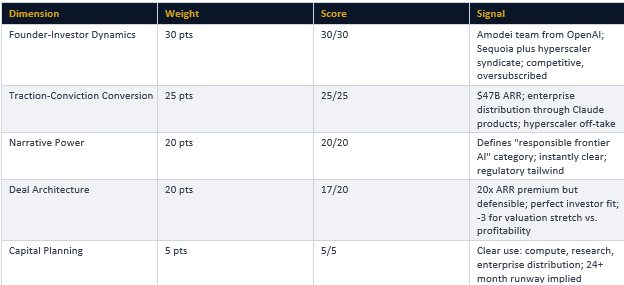
Table 3: Anthropic Eisen Fundability Score breakdown
LEON’S TAKE: A CONTRARIAN READ ON THE $965 BILLION VALUATION
The following is editorial opinion, not verified deal analysis. It represents my reading. I may be wrong.
$47 billion in run-rate revenue is a real number. I am not disputing the arithmetic. I am disputing whether the economics behind it are as durable as the headline implies.
Anthropic runs the most capable and most expensive models in production. Claude at the frontier consumes tokens at a cost structure that very few customers can sustain at real scale without heavy subsidization. A significant portion of the $47 billion ARR traces back to hyperscaler commitments, enterprise pilot contracts closed through aggressive outreach, and API pricing that does not yet reflect Anthropic’s true compute cost. That is not fraud. It is a marketing-and-distribution machine running at full intensity. The question is whether the intensity is structurally repeatable or a concentrated push ahead of an IPO.
The user base concentration problem is real. The $47 billion is not broadly distributed across millions of self-sufficient paying customers. It is heavily weighted toward a small number of large institutional commitments. Amazon alone committed $5 billion. If two or three of the top-tier enterprise accounts reduce usage, renegotiate pricing, or shift to cheaper open-weight models as those models improve, the revenue trajectory reverses fast. Broad consumer revenue through Claude.ai subscriptions is growing, but is not driving the headline number. What looks like mass-market adoption is largely concentrated enterprise pipeline sustained by marketing investment and a safety-first positioning premium that is real today but not guaranteed tomorrow.
On the IPO: I expect a significant decline in the stock price after the offering. The pattern is established. Uber, Lyft, Rivian, and WeWork were all priced at valuations that reflected private-market enthusiasm rather than public-market earnings discipline. Anthropic at $965 billion will face the same test. Public investors will demand a path to profitability. The compute cost structure of frontier AI models makes that path longer and more uncertain than a $965 billion valuation implies. The $47 billion ARR at 20x is the ceiling that growth equity funds will pay for a late private round. The public market will price it on a blend of revenue multiple and margin trajectory. Those are not the same number.
I may be wrong. If Anthropic’s compute costs compress faster than expected, if enterprise retention proves sticky at scale, and if the IPO is timed to a quarter of exceptional metrics, the stock could hold or rally. The bull case is not irrational. The $47 billion run-rate is real, and the growth trajectory is real. But the risk that this is the peak intensity of a pre-IPO marketing and capital cycle, rather than the baseline of a self-sustaining flywheel, is also real. I want founders reading this to hold both possibilities in mind at once, because the market will eventually price in the correct one.
COGNITION
AI Software Development
Eisen Fundability Score: 91/100 | Near-perfect traction proof combined with a category-defining narrative. Minor deduction on founder track record (first-time, no prior exit) and valuation premium sustainability.
THE SETUP: Cognition was founded in 2023 by Scott Wu and a team of competitive programming champions. The company launched Devin, the first publicly available AI software engineer, in March 2024. It acquired Windsurf (formerly Codeium) earlier in 2026, adding an IDE with millions of developer users to its cloud-native agent platform. This Series D was announced on May 27, 2026.
THE NUMBERS: $1B+ raised at $26B post-money ($25B pre-money). Prior round: $400M at $10.2B, September 2025 (2.5x step-up in 8 months). $492M ARR (May 2026) vs. $37M ARR (May 2025): 13x annual growth. 89% of all code committed at Cognition is now written by Devin. Enterprise usage has increased 10x since January 2026. Leads: Lux Capital, General Catalyst, 8VC. Participants: Founders Fund, Ribbit Capital, Atreides, Layer Global, Elad Gil, and Bain Capital Ventures.
THE PATTERN: Cognition’s round is the definitive pricing event for the AI labor category. The 53x ARR multiple at $26B is not driven by excitement about coding agents. It is driven by a single, verifiable, self-referential metric: 89% of committed code is AI-generated. When the product team proves that its AI replaces its engineers at 89% of the output, the labor-replacement thesis is no longer a projection. It is a current-state operational reality. Investors priced that reality at a 5x premium to SaaS category leaders.
THE PERSPECTIVE: Lux Capital’s investment thesis is not that Cognition is the best coding agent. It is that autonomous software creation becomes a commodity layer in enterprise IT within 36 months, and Cognition, with Devin plus Windsurf, has the distribution (IDE users) and the proof (89% self-use rate) to be the platform that captures that transition. At $492M ARR growing 13x, the company is tracking toward a $2B ARR benchmark that would make the $26B valuation defensible at 13x to 15x next-round multiples.
THE PLAYBOOK: Build your “89% equivalent” before your next investor meeting. Identify one specific output of your product that your company uses internally to replace a prior human generation. Measure it. Calculate the percentage. Present it as your most important proof point, not as a case study but as a current operational statistic. If you cannot yet produce that number, design your next 90 days of internal operations to generate it.
FOUNDER MISTAKE TO AVOID: Copying Cognition’s framing (”autonomous” plus “replace engineers”) without the underlying proof. Every AI coding startup that calls itself “autonomous” now competes against the $26B benchmark. Without a self-referential operational metric (not a customer quote, not a benchmark test, but a live production output percentage), the autonomous framing accelerates investor skepticism rather than conviction. If you cannot specify the percentage of your output that is machine-generated today, do not use "auto” in your pitch.
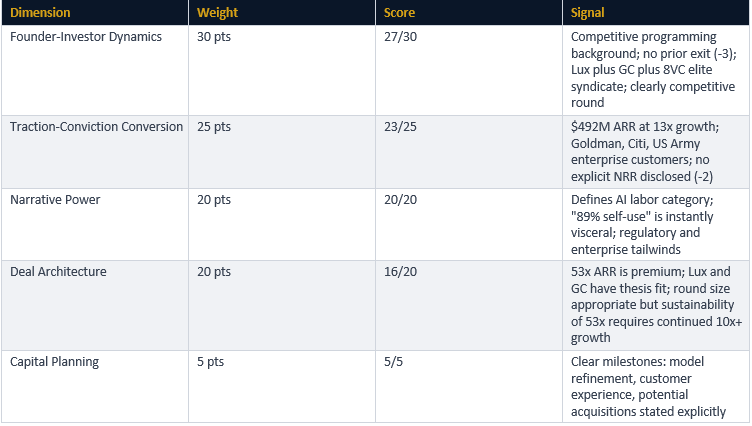
Table 4: Cognition Eisen Fundability Score breakdown
STORD
Commerce Logistics and Physical AI
Eisen Fundability Score: 76/100 | Solid fundamentals across all dimensions. Deductions on founder track record (no prior exits) and narrative clarity (physical AI commerce is a less universally understood category than pure-play AI).
THE SETUP: Stord was founded in 2015 by Sean Henry and Jacob Boudreau while undergraduates at Georgia Tech. The company reached unicorn status in 2021, survived the 2022 to 2024 VC funding winter, and re-emerged as an AI-native logistics platform. The Series F was announced on May 26, 2026, alongside the launch of Stord Labs, a dedicated physical AI and robotics development environment in Atlanta.
THE NUMBERS: $250M raised at $3B post-money (2x step-up from $1.5B in 2025). Total raised: $775M+. $15B annual GMV across 1,000+ customers. Revenue 10x growth over 4 years; software business tripled in 2025; new bookings doubled QoQ in Q1 2026. 8 acquisitions completed, each exceeding targets. 4,000+ employees, 200+ in engineering. Nearly 100 fulfillment facilities. Lead: Strike Capital. Participants: Kleiner Perkins, Founders Fund, Franklin Templeton, Baillie Gifford, G Squared, Bond, Lux.
THE PATTERN: Stord’s $3 billion valuation positions it as the commerce infrastructure alternative to Amazon’s fulfillment network for independent brands. The launch of Stord Labs, alongside the raise, is a strategic signal: this is not a logistics company using AI. It is building an AI training environment that uses live fulfillment operations at $15B in GMV to generate proprietary training data for physical AI and robotics. The announcement positions Stord for an IPO track in which the valuation argument is platform-layer software multiples, not logistics-operator multiples.
THE PERSPECTIVE: Strike Capital’s thesis, articulated in the announcement, is that “agentic purchasing will increasingly favor platforms where software and physical operations are deeply integrated.” That thesis predicts a world where AI agents handle purchasing decisions autonomously and route them to fulfillment platforms that provide reliable physical execution. Stord owns the physical execution layer for independent brands. The AI-native distribution channels reward reliable execution. Stord is positioned as the physical operating system for the future of agentic commerce.
THE PLAYBOOK: If you are building in any physical-world category (logistics, manufacturing, retail, agriculture), identify the operating data your platform generates that no cloud-native competitor can replicate. Quantify it: GMV processed, operations per day, facilities managed, SKUs handled. Build your AI narrative around that data access, not around your model architecture. Investors at the Series F stage are valuing platform lock-in and a data moat, not algorithmic novelty.
FOUNDER MISTAKE TO AVOID: Building a “physical AI” pitch that leads with the AI capabilities rather than the operational data access. Stord’s fundability is not a function of the sophistication of its AI models. It is the $15B in live GMV that generates the training environment. Founders who pitch the model without naming the operational environment that produces the data are selling the wrong asset.
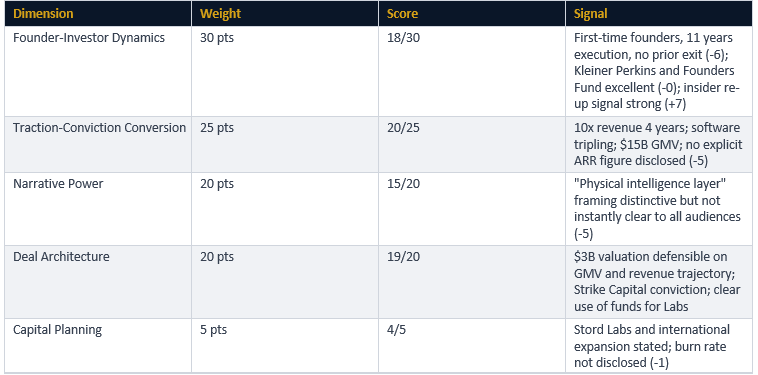
Table 5: Stord Eisen Fundability Score breakdown
OBSERVABLE SPACE
Space Technology and Optical Systems
Eisen Fundability Score: 70/100 | Strong narrative and government proof stack for a one-year-old company. Deductions for early-stage traction (limited commercial revenue disclosed) and undisclosed VC valuation.
THE SETUP: Observable Space was founded in February 2025 from the merger of PlaneWave Instruments (telescope manufacturer) and OurSky (space data applications). CEO Dan Roelker is a former SpaceX vice president. The company’s Series A and Space Force IDIQ contracts were announced simultaneously on May 28, 2026, making this the second consecutive week (after Anduril and Havoc) in which a defense-tech company announced dual VC and government procurement validation in a single press release.
THE NUMBERS: $90M Series A closed. $94M Space Force IDIQ contract (sole-sourced through APFIT program). $22M in initial task orders funded under the IDIQ. Lead: Lux Capital. Co-leads: Upfront Ventures, Detroit Venture Partners, Island Green Capital, RTX Ventures. Total: $184M in capital access announced simultaneously. Founded 15 months before the round.
THE PATTERN: The dual-announcement template (VC round plus government contract, in a single press release) is establishing itself as the standard proof stack for defense and space tech Series A and B rounds. Observable Space is one year old and has cleared $184 million in combined capitalization. The Space Force award through the APFIT program signals that the company passed a DoD procurement qualification process, which functions as an independent technical validation that no venture investor can replicate.
THE PERSPECTIVE: RTX Ventures (Raytheon Technologies) does not co-lead a VC round to support a startup’s growth. It co-leads because Raytheon evaluates Observable Space as either a supplier or acquisition candidate. The $94M IDIQ reduces Observable Space’s commercial risk and Raytheon’s due diligence cost. The Lux Capital lead provides the technology credibility and growth-stage financial infrastructure. The two investors serve different strategic functions, and their co-investment is more fundability-reinforcing than either alone.
THE PLAYBOOK: If your technology has any defense or space application, run government contract qualification and VC fundraising simultaneously. Identify the specific APFIT, OTA, or SBIR vehicle relevant to your category. Submit your qualification materials while you build your investor pipeline. The government award, when announced alongside the VC close, multiplies your perceived de-risking beyond what either alone delivers. Observable Space announced $184 million in a single week because both tracks were developed concurrently.
FOUNDER MISTAKE TO AVOID: Waiting for a government contract before approaching top-tier VCs. The standard advice is to de-risk your company before raising. In defense and space tech, the de-risking is the contract, but the contract requires credibility that top-tier VCs provide. Observable Space built its technical credibility with early investor support first, qualified for APFIT, and then ran both tracks to a simultaneous close. The sequence is VC credibility first, contract second, then announce both together.
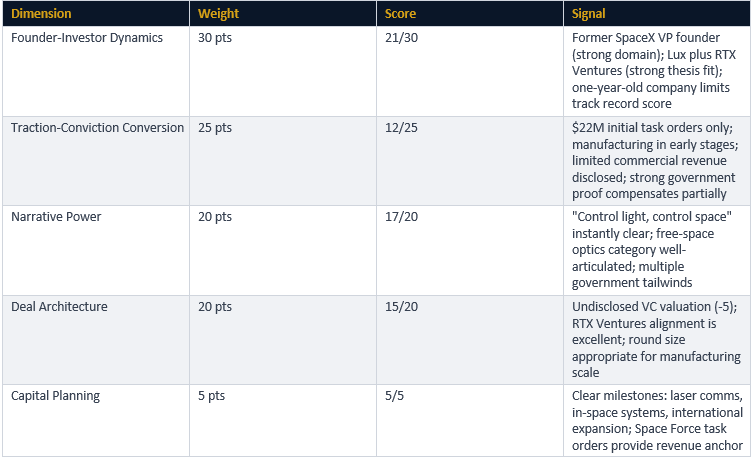
Table 6: Observable Space Eisen Fundability Score breakdown
CORGI INSURANCE
AI-Native Commercial Insurance | San Francisco, CA
Eisen Fundability Score: 72/100 | Strong traction signal and proof of profitability. Significant deduction on deal architecture: a 2x valuation step in 22 days with overlapping investors raises structural questions that reduce investor-fit and valuation-reasonableness scores.
THE SETUP: Corgi was founded by Nico Laqua as an AI-native, full-stack commercial insurance carrier, initially focused on startup insurance (tech, cyber, general liability). The company raised $108 million in a combined seed and Series A in January 2026, followed by a $160 million Series B at a $1.3 billion valuation on May 6, 2026. The Series B1, valued at $2.6 billion, was announced on May 28, exactly 21 days later. The company disclosed profitability for April 2026 and ARR of $40 million or more.
THE NUMBERS: $106M Series B1 at $2.6B post-money. Prior Series B: $160M at $1.3B, May 6, 2026. Total funding: $378M across four rounds in under 18 months. $40M+ ARR; profitable last month (April 2026). Lead: TCV. Participants: Prime Capital, Zone 2 Ventures, Oliver Jung, Leblon Capital, Kindred Ventures, Quadri Ventures, Nordstar, and others.
THE PATTERN: The 21-day valuation doubling is the week’s most structurally unusual event. Corgi is running a deliberate round architecture: rapid sequential financing that creates manufactured scarcity and forces competing funds to pay a premium or lose the position. TCV’s entry as a credible new institutional lead at the B1 is what legitimizes the step-up. Without a verifiable new tier-one lead, the same architecture collapses.
THE PERSPECTIVE: TCV has backed Netflix, Spotify, and Zillow. Its entry into Corgi signals that the firm has identified commercial insurance infrastructure as a category in which AI-native platforms can achieve platform economics comparable to those of fintech infrastructure companies. The Corgi thesis is that AI underwriting at scale produces loss ratios that traditional carriers cannot match, which creates margin expansion as the platform grows. TCV is pricing the eventual margin advantage, not the current $40M ARR.
THE PLAYBOOK: If your company is experiencing strong demand pull since your last round close, assess the conditions for a structured back-to-back financing before defaulting to a standard raise. The required conditions: a verifiable new tier-one institutional lead willing to come in at a premium, material metric acceleration since the last close, and current investor willingness to re-up. If all three conditions hold, the back-to-back structure compresses your valuation step-up into weeks rather than quarters. If anyone fails, raise a standard round. The Corgi approach works because TCV is real and the profitability disclosure is real. Without both, it is a credibility risk.
FOUNDER MISTAKE TO AVOID: Attempting the Corgi rapid refinancing template with a lesser-known new lead. The 2x step-up in 22 days is credible because TCV is the new entrant. If your B1 lead is a fund that most growth investors do not recognize immediately, the press and your existing investors will interpret the rapid refinancing as a demand signal problem, not a momentum signal. Tier-one lead or no back-to-back raise.
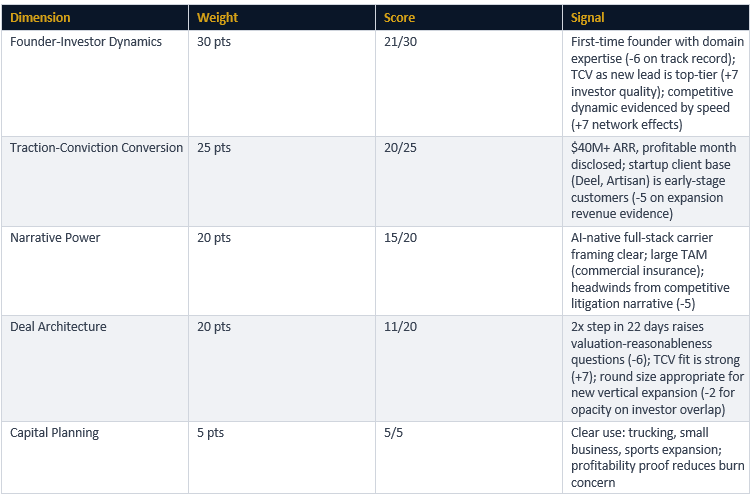
Table 7: Corgi Eisen Fundability Score breakdown
FUNDRAISING PLAYBOOK: FIVE ACTIONS THIS WEEK
Every plan below is derived directly from evidence in this week’s deals. No generic advice. Each action produces a concrete output that founders can use in their next investor meeting.
PLAN 1: NARRATIVE AND VALUATION ANCHOR RESET
Why This Matters: Anthropic’s $965B and Cognition’s $26B have distorted every AI founder’s valuation intuition. Most founders are now unconsciously anchoring their pitches to comps that are 10x to 50x out of category. The founders who walk into Monday’s meetings with the correct category comp will stand out immediately.
Exact Deliverable: Pull the last three publicly announced funding rounds in your specific vertical (not “AI” broadly, but your specific category: AI for healthcare operations, AI for legal document review, AI for construction estimating, etc.). Record the ARR and valuation for each. Calculate the ARR multiple. Build a one-paragraph valuation rationale that anchors to your category multiple, not to Anthropic or Cognition. Use this paragraph as your valuation anchor in your next investor conversation.
Expected Outcome: You walk into your next investor meeting with a defensible, category-specific valuation rationale that prevents the investor from anchoring you to a frontier lab multiple or discounting you against one. Investors who ask about valuation will receive a specific, evidence-based answer rather than an aspiration.
Wrong Approach: Citing Anthropic or Cognition as valuation comps without matching revenue scale.
Right Approach: Name three category-specific deals, calculate their ARR multiples, and present your valuation as a function of your position relative to the category benchmark.
PLAN 2: PROOF STACK: THE MACHINE-GENERATED OUTPUT METRIC
Why This Matters: Cognition’s 89% self-generated code metric is the highest-conviction proof point in this week’s deals. It requires no customer testimony, no third-party validation, and no benchmark comparison. It is a live operational statistic that eliminates all abstraction from the value proposition. Most founders do not have an equivalent metric. Building one within the next 30 days sets you apart from 90% of AI pitches.
Exact Deliverable: Identify one internal workflow that your product currently handles end-to-end within your company's operations. Measure the output volume over the past 30 days. Calculate what percentage of that output was generated by your product versus by a human. Write a single sentence: “X% of our internal [operation type] is now generated by our AI, with human review only.” Bring this statistic to your next investor meeting as the opening of your traction section.
Time Estimate: 3 hours of measurement plus 30 days of operational tracking to generate the statistic
Expected Outcome: A self-referential proof point demonstrating that your product works at the highest possible level of conviction: your own company depends on it for real operational output.
Wrong Approach: Using a customer quote or an NPS score as your primary proof point.
Right Approach: Use an internal operational output percentage. Your product, running on your own operations, with measurable output, is stated as a current-state fact.
PLAN 3: EISEN SCORE SELF-AUDIT AND GAP DIAGNOSIS
Why This Matters: Observable Space earned a 70 despite being one year old because the Space Force contract compensated for limited commercial revenue. The audit shows where government proof offsets missing commercial proof, and where it does not. Running this analysis on your own deal helps you identify your lowest-scoring dimension before an investor does.
Exact Deliverable: Score your current round against all five Eisen dimensions using publicly available information about your own company. Be conservative: if data is not disclosed in your current materials, score the dimension at its lowest bracket. Identify your two lowest-scoring dimensions. Write one specific action for each dimension that would increase its score before your next major investor meeting. This becomes your 90-day de-risking checklist.
Expected Outcome: You identify your two largest fundability gaps before an investor meeting rather than during one. Each gap becomes a targeted pre-raise action rather than an improvised answer to a tough due diligence question.
Wrong Approach: Optimistically scoring your own company based on internal knowledge that investors do not have access to.
Right Approach: Score only on information that is currently disclosed and verifiable by an outside investor from your existing materials. The gap between your internal knowledge and your disclosed proof stack is your risk.
PLAN 4: INVESTOR LIST ARCHITECTURE: POOL SEGMENTATION
Why This Matters: The week showed three distinct capital pools operating with different logic: frontier-lab growth equity (Altimeter, Sequoia at Anthropic scale), AI labor and software growth (Lux, General Catalyst at Cognition scale), and physical world infrastructure (Strike Capital, Kleiner Perkins at Stord scale). Sending the same pitch to all three pools is the single most common investor list error in current market conditions.
Exact Deliverable: Segment your current investor list into three pools based on the investment thesis, not the fund name or AUM. Label each investor as frontier AI growth equity, vertical AI, AI labor, or physical world and infrastructure. Then rewrite your executive summary with three different opening paragraphs, one for each pool. The core metrics are identical. The framing of what problem you solve and what category you lead changes by pool. Send pool-specific materials.
Expected Outcome: Your investor outreach converts at a materially higher rate because each investor receives a pitch framed in their specific investment language rather than a generic AI pitch.
Wrong Approach: Sending one pitch deck to every fund on your list.
Right Approach: Build three versions of your opening paragraph. The product and metrics are the same. The problem framing and category positioning change to match each capital pool’s investment logic.
PLAN 5: MOMENTUM DESIGN: THE BACK-TO-BACK ROUND CONDITIONS AUDIT
Why This Matters: Corgi’s 21-day doubling is the most structurally instructive event for founders approaching the end of their current capital cycle. The conditions that made it possible are specific and rare. Knowing whether your company meets those conditions before you begin your next raise determines whether a standard process or a structured two-step process is the right architecture.
Exact Deliverable: Answer four questions honestly before beginning your next round process. First: Is there a verifiable tier-one fund that missed your last round and has expressed interest in leading your next? Second: have your metrics accelerated materially since your last close (at a minimum 50% improvement in your primary proof metric)? Third: are your current lead investors willing to re-up at a premium step-up? Fourth: can you disclose a milestone (profitability, contract, partnership) that gives a new lead public credibility for entering at a premium? If yes to all four, design a back-to-back structure. If no one runs a standard raise.
Expected Outcome: You enter your next raise using the correct process architecture, rather than discovering mid-raise that a back-to-back structure is not credible for your specific situation.
Wrong Approach: Attempting a rapid refinancing round without a verifiable new tier-one lead or without a material milestone disclosure.
Right Approach: The back-to-back structure is valid when all four conditions hold. It is a credibility risk when even one fails. Audit the conditions first, then choose the architecture.
LOOKING FORWARD: NEXT ONE TO THREE WEEKS
Scenario 1: Anthropic’s $965B Triggers a Late-Stage AI Rerating Wave (High Probability)
Evidence: Every major crossover fund that has not established a position in a frontier AI or AI labor company will face pressure from LPs after the Anthropic announcement. The Cognition $1B round proves that AI labor at $492M ARR clears at 53x. Both data points make the portfolio construction of every uninvested growth fund look incomplete. Watch for Series D and Series E rounds in AI-native vertical companies at ARR multiples above historical category norms as funds rush to establish positions. What to do: If you are at $10M-plus ARR in an AI-native vertical and have strong growth, the window for a premium-multiple raise is open now. Begin investor conversations this week, not in 90 days.
Scenario 2: The Physical AI Category Attracts Dedicated Fund Formation (Medium Probability)
Evidence: Stord, Observable Space, and Reactor represent three stages and three verticals of physical AI investment in a single week. The Cognition round proved AI labor pricing. The Stord round proved physical AI infrastructure pricing at $3B. Three or more physical AI rounds in a single week is a category signal that dedicated fund formation typically follows within one to two quarters. Watch for: Announcements of physical AI or intelligence-focused vehicles from existing firms (Lux, Kleiner) or new fund formations targeting the physical AI layer specifically. What to do: If you are building physical AI in any vertical, request meetings with the GPs at the funds that led these three deals within the next 30 days. Early category recognition by fund managers creates term sheet advantages that disappear once the category is fully mapped.
Scenario 3: The Government Plus VC Dual-Announcement Template Becomes Standard (High Probability)
Evidence: Two consecutive weeks (Anduril-Havoc, Observable Space) have produced dual VC-plus-government-contract announcements. The template delivers measurably more press coverage, investor FOMO, and valuation leverage than a VC round announced on its own. Founders in deep-tech categories will adopt this template aggressively over the next 60 to 90 days. Watch for: A material increase in coordinated press releases that include both a VC close and a government contract announcement in the same release. What to do: If you have a government contract in the pipeline or qualification, align your contract close timeline to your VC close timeline now. The press leverage of the combined announcement is worth the process complexity.
Wild Card 1: Cognition’s 53x Multiple Triggers Competitive Rerating in Adjacent Categories
If Cursor (Anysphere), GitHub Copilot, or another enterprise coding platform announces a round in the next 30 days, the Cognition multiple will force every investor to assess whether their existing portfolio coding-tool positions are undervalued. A rerating cascade in developer AI could unlock premium rounds for founders in adjacent developer-productivity categories who have not yet opened their rounds. Watch for any enterprise coding or developer AI announcement that includes an ARR figure.
Wild Card 2: Anthropic IPO Timeline Signaling
Anthropic’s Series H at $965B is structurally similar to Anduril’s Series H at $61B, the round that Anduril investors said publicly positions them for an 18-month IPO window. If Anthropic’s investors make similar public statements or SEC filings emerge, expect the late-stage AI valuation multiple to compress as public-market comparisons replace private-market speculation. Watch for Anthropic investor statements on the IPO timeline in the press and for earnings calls from Amazon and Google that discuss Anthropic's position and valuation.
THE BOTTOM LINE
THE REAL INSIGHT
This week did not just deploy $67 billion. It established three pricing tiers that will govern every AI fundraiser for the next 12 to 18 months. Tier one: frontier labs at trillion-dollar valuations, underwritten by growth equity on revenue scale and distribution moat. Tier two: AI labor companies at 50x-plus ARR multiples, underwritten on the percentage of human output that AI now replaces. Tier three: physical-world AI and infrastructure at 10x to 20x revenue, underwritten by operational data access and government validation. If you do not know which tier you are in, you will pitch into the wrong capital pool and get priced incorrectly. Know your tier before you open your round.
FIVE NEW RULES FOR FOUNDERS
• Rule 1: Your valuation anchor is your category multiple, not the frontier lab comp. Cite the last three deals in your specific vertical. Calculate the ARR multiple. Pitch from that benchmark.
• Rule 2: The single most powerful proof point is a machine-generated output percentage from your own operations. Build your “89%” before your next pitch. Customer testimonials are no longer sufficient for premium multiples.
• Rule 3: If you build in defense, space, or national security, run government contract qualification and VC fundraising simultaneously. Announce both together. The combined capitalization compounds press leverage beyond what either track delivers alone.
• Rule 4: Physical AI is fundable at every stage if you can name the operational environment you own or have exclusive access to. The data flywheel architecture slide is now worth more than the TAM slide.
• Rule 5: Capital pool segmentation is now a required step before outreach. Frontier AI growth equity, AI labor growth, and physical world infrastructure funds operate on different theses. The same deck for all three pools is a conversion-rate problem.
FOUR ACTIONS
• Action 1: Pull the last three Series B rounds in your specific vertical. Calculate the ARR multiple. Rewrite your valuation rationale paragraph to anchor to that multiple by the end of the day on Monday.
• Action 2: Identify one internal operation your product handles end-to-end. Measure the output volume. Calculate the machine-generated percentage. Write the one-sentence statistic. Add it to your traction deck section.
• Action 3: Audit your investor list against the three capital pools described above. Label each fund. Write three opening paragraphs, one per pool. Send pool-specific materials beginning Tuesday.
• Action 4: Run the back-to-back round conditions audit. Answer all four conditions honestly. Choose your round architecture based on the results, not on what sounded good at the last board meeting.
The founders who move on these four actions have a structural advantage over every competitor who reads this report and does nothing. The window on the Cognition-tier multiple is open today. It will narrow as more AI labor companies disclose 13x ARR growth figures. Act before your competitors do.
RESEARCH METHODOLOGY
Data collection period: May 25 to 31, 2026
Primary source window: Crunchbase News top 10 (May 23 to 29) plus individual company press releases (May 26 to 29)
Report completed: June 1, 2026
Deals analyzed: 10 verified
Deals excluded: 0 (all top 10 confirmed within date window and dual-sourced)
Source confidence levels: High (official press release or filing): Anthropic, Cognition, Stord, Corgi, Observable Space. Medium (top-tier media with clear sourcing): OpenRouter, Garner Health, Thea Energy. Low: none in the top 10.
Fact-check pass: No material discrepancies found beyond Crunchbase summary limitations for OpenRouter valuation (not disclosed).
DISCLAIMER: This article is for informational and strategic intelligence purposes only. It does not constitute investment advice. The Eisen Fundability Score is a proprietary diagnostic within Fundables OS™, not a financial recommendation.
If this article was useful, share it with founders who are about to raise.
— Leon Eisen, 4x Founder, Venture Capitalist, and Creator of Fundables OS™