

Playbook, Perspective, and Pattern for founders raising now. This report strips out the giant rounds and the public-market traffic so you can read the part of the market that actually prices your round.
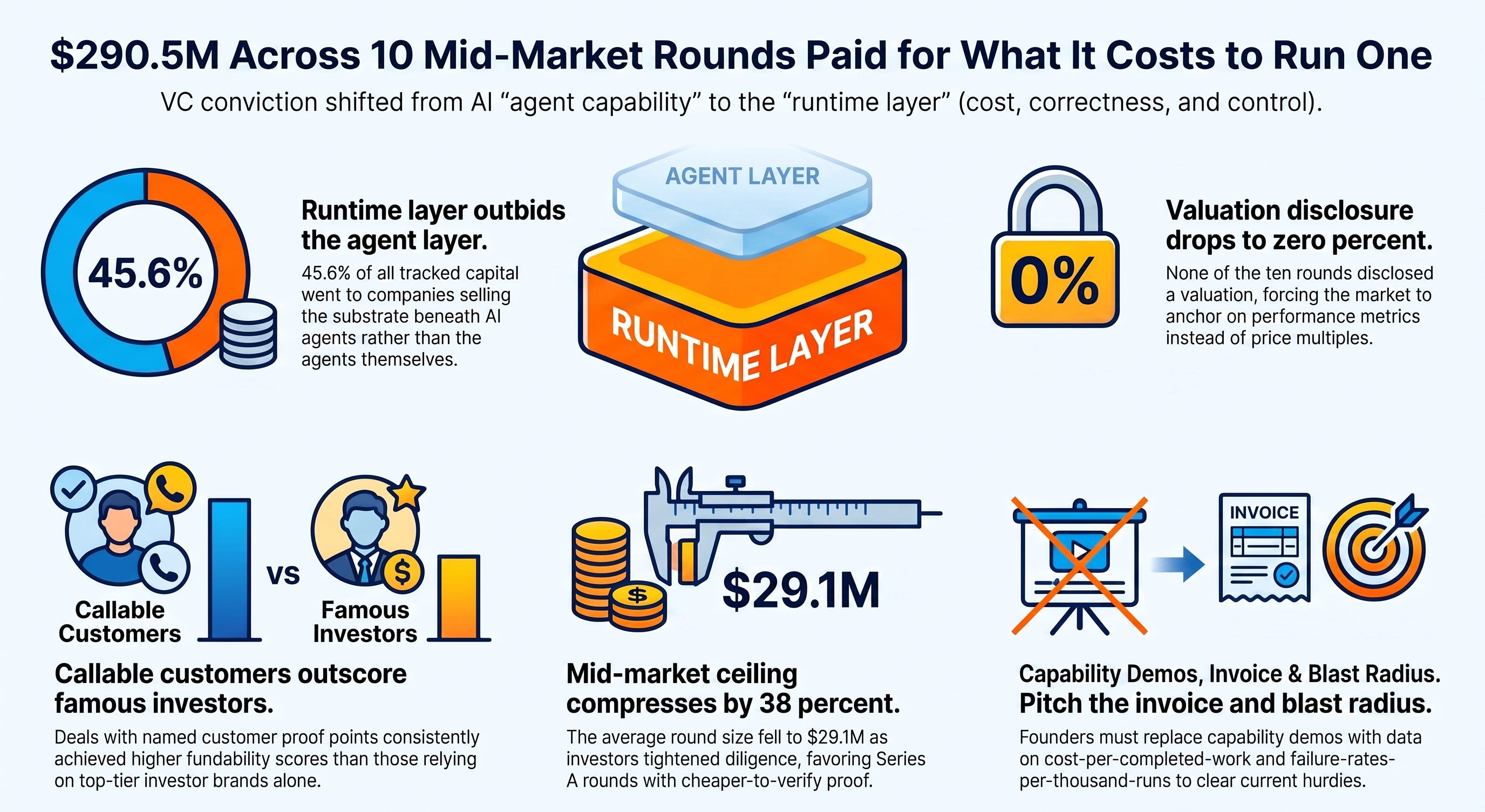
Ten mid-market rounds cleared this week, and not one of them disclosed a valuation. That is the first clean sweep of opacity this report series has recorded. Ten companies, $290.5M in verified primary capital, every round under $100M, and zero priced numbers put in front of the market.
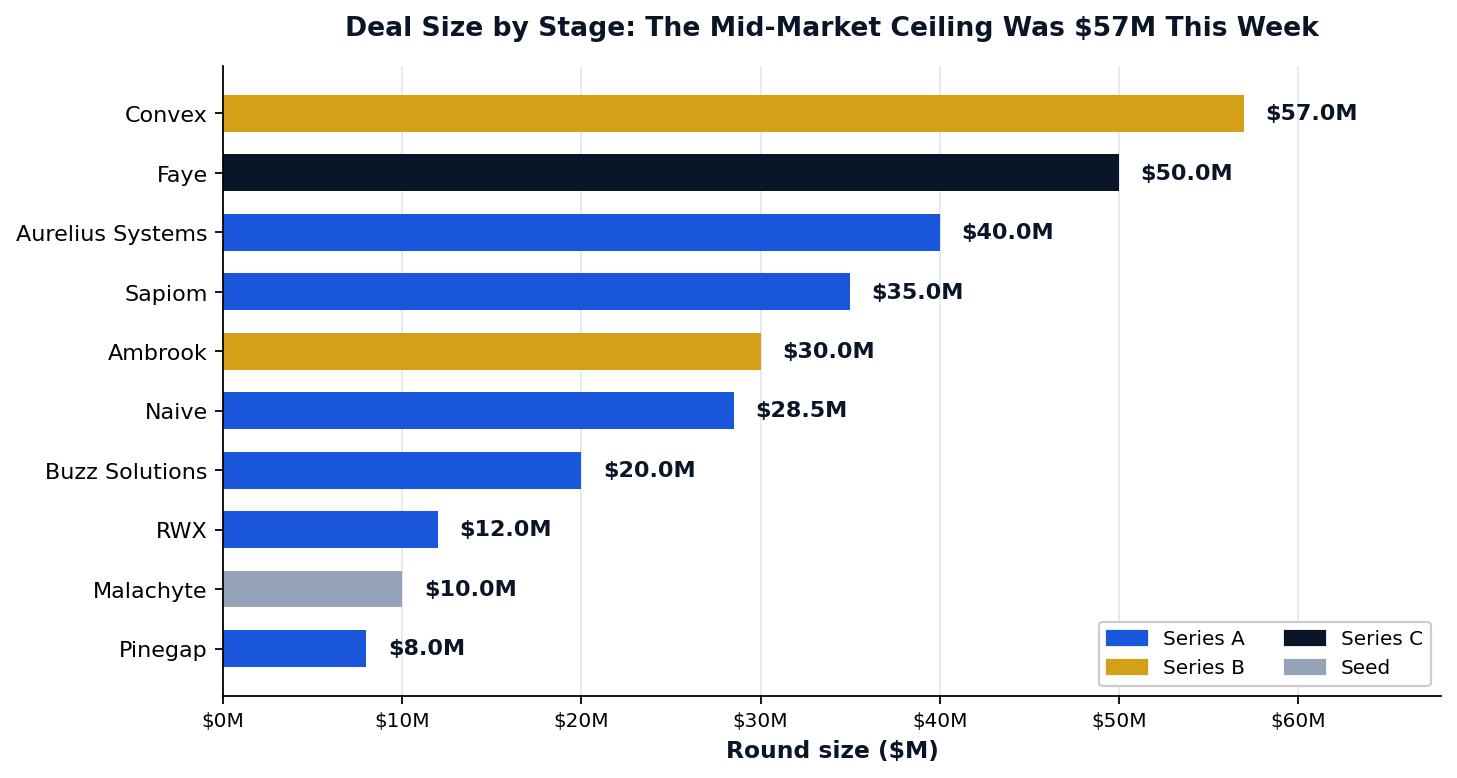
Strip out the spectacle and a second pattern is sharper still. The largest mid-market round of the week was $57M. The average was $29.1M. Nine weeks ago this report tracked ten rounds averaging $48.0M with a $92.5M top. The ceiling did not drift. It dropped.
What did the clear tell you where conviction moved? A backend company that measured how often AI-written code silently corrupts data raised the biggest round. A routing company that cut one customer’s inference bill by 75 percent raised eleven months after founding. A build-and-test company founded by an operator with two prior exits raised to fix code validation. A grid-inspection company with three named utilities and 400 percent revenue growth raised an oversubscribed Series A. None of them sold an agent. Every one of them sold what happens under the hood of an agent: the bill, the failure rate, the audit trail.
Here is the consequence. If your pitch is that your agent works, you are describing a demo that a coding model can now produce in an afternoon. The founders who cleared this week priced the thing that survives the demo. Read every shift below through that lens.
The Week in One Sentence
Primary insight: With the giant rounds and public-market events removed from view, the mid-market repriced one layer down the stack. Capital concentrated in the runtime beneath AI agents, the cost, correctness, and control layer, and it paid at a compressed ceiling with total valuation opacity.
• Total tracked mid-market capital (10 verified rounds): approximately $290.5M, every round under $100M.
• Average round size: $29.1M across the ten.
• Median round size: $29.25M, the midpoint between Ambrook and Naïve.
• Disclosed valuations: zero of ten. One reported figure, Faye near $500M, came from a single outlet and is marked reported rather than confirmed. One company, Pinegap, disclosed a step-up of more than three times its seed without naming a number.
• Largest tracked round: Convex, $57M Series B, an application backend built for software written by AI agents.
• Highest Eisen Fundability Score: Faye at 79, the only company in the set with disclosed revenue at scale and a stated position near profitability.
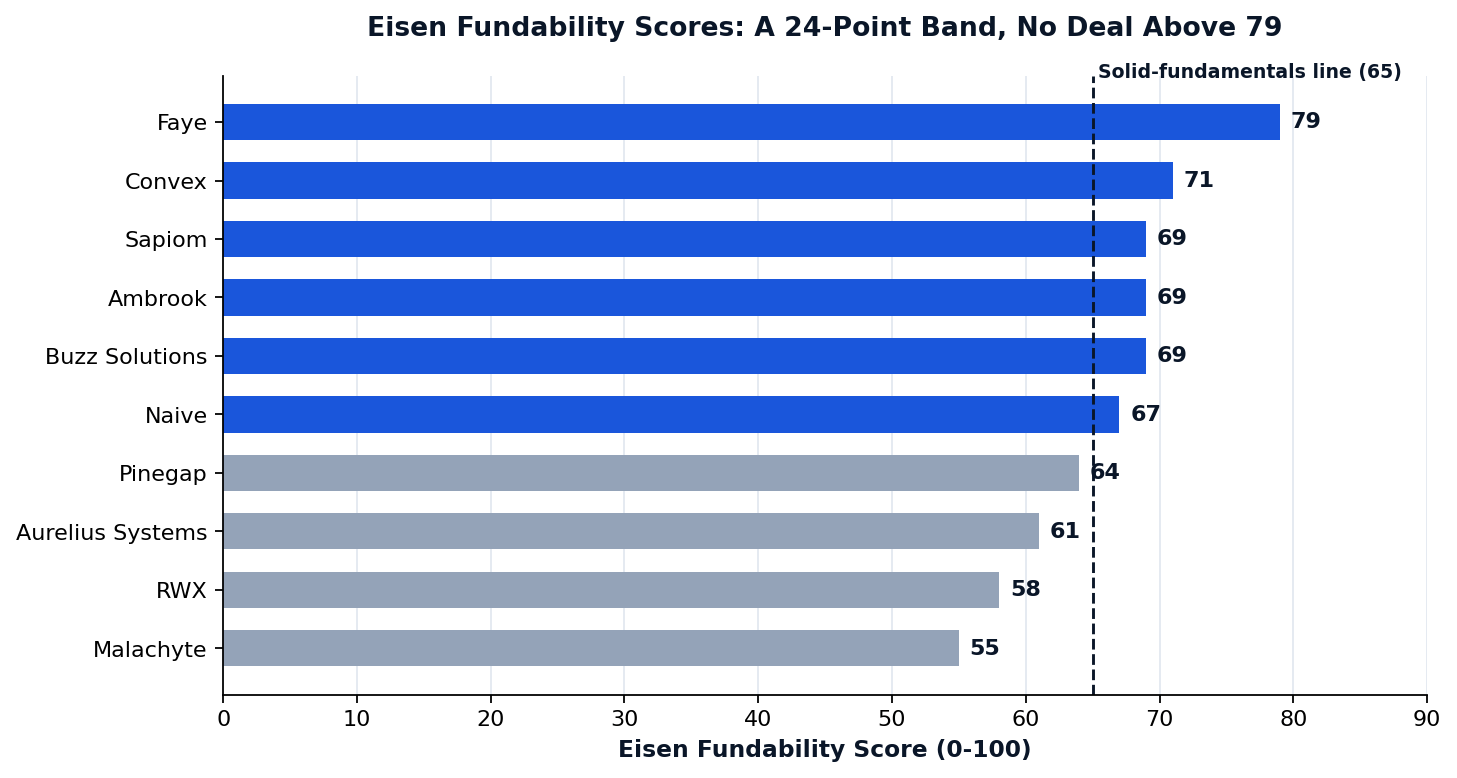
• Defining structural feature: a wide Eisen Score band of 55 to 79. No deal reached the 85 inevitability line, and the 24-point spread is the widest this report series has recorded.
Deal Scorecard
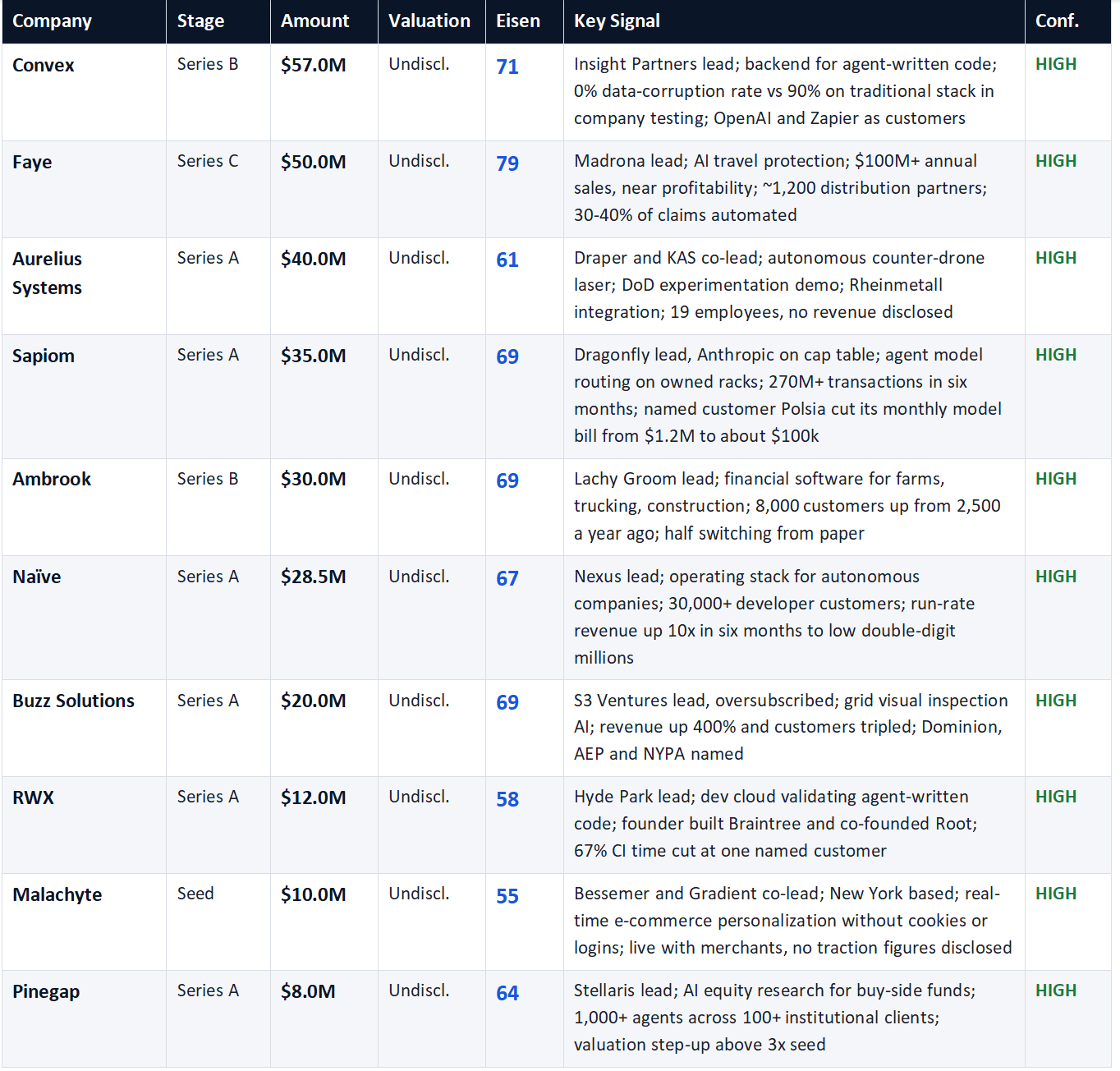
Eisen Fundability Scores are calculated across five weighted dimensions: Founder-Investor Dynamics (30%), Traction-to-Conviction Conversion (25%), Narrative Power (20%), Deal Architecture (20%), and Capital Planning (5%). Scores of 85 and above signal an inevitable outcome. Scores of 75 to 84 signal solid fundamentals. Scores of 65 to 74 signal a good company with gaps. Scores below 65 signal an early stage or missing elements. Missing metrics are scored conservatively, and opacity is penalized rather than assumed strong.
What the Scorecard Says at a Glance
The band is the message, and this week it broke open. Deals cleared between 55 and 79. That 24-point spread is the widest in this report series, against a 13-point spread nine weeks ago. The market did not become more consistent about what it pays for. It became more willing to write a small check on narrative alone while reserving the larger ones for evidence. Read the band as a pricing map: the seven deals scoring 64 and above all disclosed a customer count or usage volume, and the three below disclosed the lowest among the rounds in the set.
Faye (79) is the cleanest case of the week. It scored highest not on a famous lead or a category-defining story, but on the only complete commercial picture in the set: more than $100M in annual revenue, a stated position near profitability, roughly 1,200 distribution partners generating about 75 percent of revenue, and 30 to 40 percent of claims already resolved by automation against a stated target above 50 percent by year-end. The founder also publicly said that the company could have raised more but chose not to. Restraint backed by revenue is a fundability signal, not a modesty signal.
Convex (71), Ambrook (69), and Buzz Solutions (69) cluster on the same logic in three different languages. Convex published a failure-rate comparison: 90 percent of AI-built apps silently corrupt data on a traditional backend, compared to zero percent on its own, and named OpenAI and Zapier as customers. Ambrook showed 8,000 customers, up from 2,500 a year earlier. Buzz showed 400 percent revenue growth, a tripled customer count, and three named utilities. Different categories, identical underwriting test: a number a diligence team can call a customer and confirm.
The lower band is where the lesson lives. Malachyte (55), RWX (58), and Aurelius (61) are not weak companies. RWX has a founder who built Braintree and co-founded Root, and named one customer with a 67 percent improvement. Aurelius has a demonstrated system and a defense-industrial partner. Malachyte has two strong co-leads. What they share is that none disclosed revenue, and none published a usage volume that a partner could use to size the business. The scoreboard separates a fundable company from a fundable round, and this week the gap between the two was almost entirely a matter of disclosed proof.
What Changed This Week: 5 Market Shifts
Each shift is verified against multiple primary sources and ranked by structural impact on founder fundraising, not by deal size. Every shift ends with what it means for your raise.
Shift 1: The Runtime Layer Outbid the Agent Layer
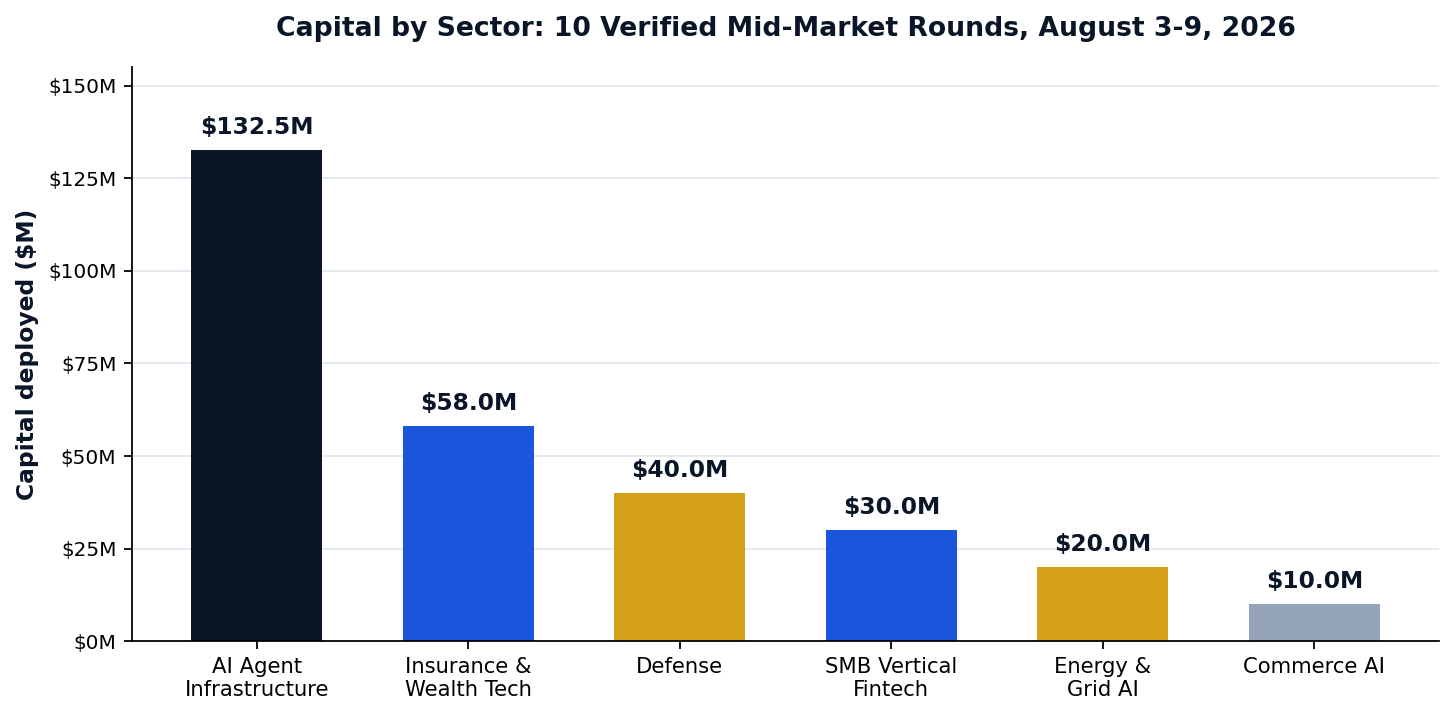
Pattern: Four of ten rounds, $132.5M and 45.6 percent of tracked capital, went to companies selling the substrate underneath AI agents rather than the agents themselves. Convex sells a backend in which agent-written code cannot silently corrupt data, and has published a comparison to prove it. Sapiom routes each model call to the cheapest capable model and has processed more than 270 million transactions in six months. Naïve provisions: incorporation, cards, compute, memory, and governance so an agent can run a business. RWX validates the code agents write, cutting continuous integration time 67 percent at one named customer. Not one of the four sold an agent.
Perspective: When a coding model can produce a working agent in an afternoon, the agent stops being the asset. What remains scarce is everything the demo does not show: what it costs per run, how often it fails, and who can prove what it did. Investors this week underwrote the invoice and the blast radius. Three of these four companies quantified a failure or cost delta in the announcement itself. That is not marketing. That is the diligence answer moved to the front of the pitch.
Founder Blindspot: Founders still pitch what their agent can do. The buyer stopped asking that question. A CTO evaluating agents in August 2026 is asking what happens on the thousandth run, and a CFO is asking what the thousandth run costs. If your deck answers neither, you are selling a capability into a market that has already commoditized capability.
Playbook: Write two numbers on slide one: your cost per unit of completed work, and your failure rate per thousand runs. Convex chose 90 percent against zero percent. Sapiom chose 75 percent cost reduction. RWX chose 67 percent less validation time. Pick your equivalent, compare it to the status quo your buyer uses today, and put the comparison in the announcement, not the appendix.
Contrast: Nine weeks ago the fundable AI story in this market was the owned workflow and the outcome it moved. This week the fundable story dropped one layer, to the runtime the workflow executes on. The workflow thesis did not die. It got a floor underneath it that is now being priced separately.
What this means for your raise: If your differentiation is that your agent works, you are pitching a demo. Price the cost and the failure rate, or expect the round to be sized against a commodity.
Shift 2: Valuation Disclosure Went to Zero
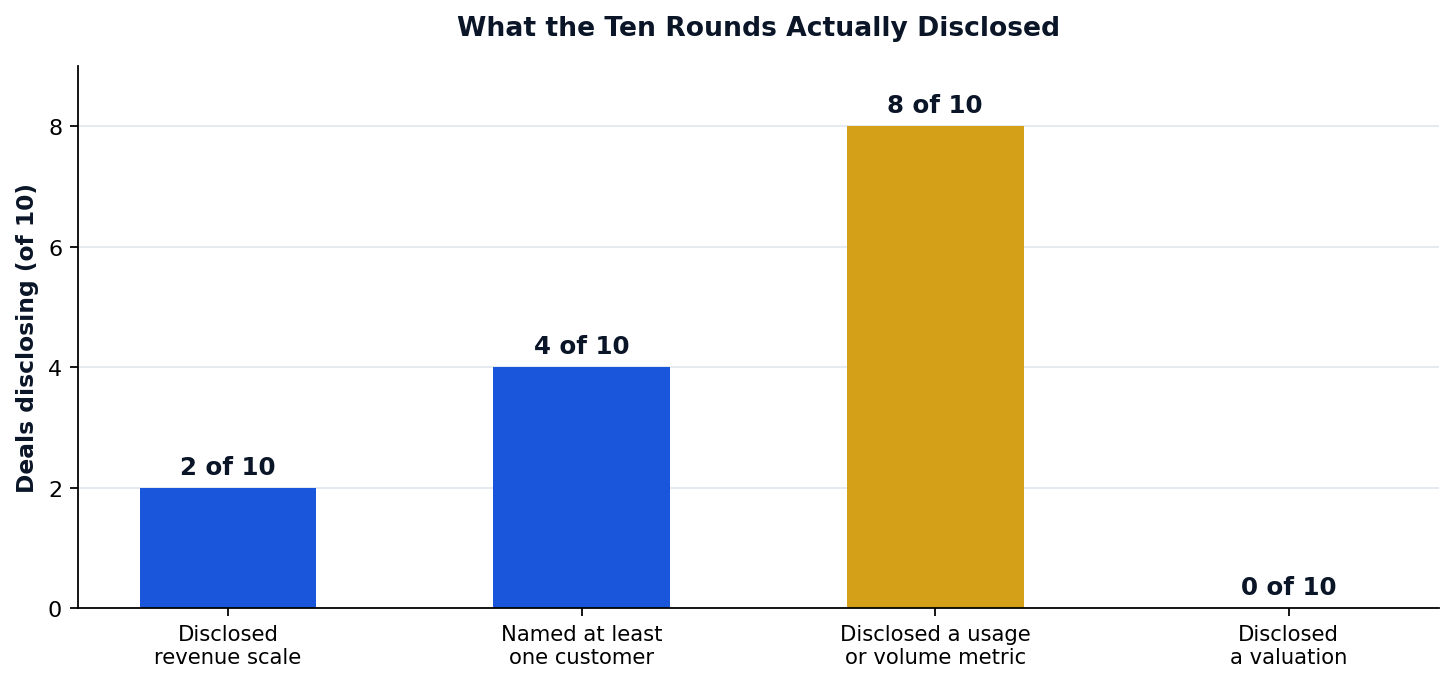
Pattern: Not one of the ten rounds disclosed a valuation at announcement. One figure circulated, a reported number near $500M for Faye, and it appeared in a single outlet without company confirmation. One company, Pinegap, disclosed the shape of its step-up, more than three times its $2.5M seed, while explicitly declining to give the figure. Nine weeks ago, two of ten rounds in this report disclosed valuations. This week the number is zero.
Perspective: A full sweep is not a coincidence. It is a market where the founder and the lead have arrived at the same preference: leave the number unanchored. For the founder, an undisclosed valuation avoids setting a public bar the next round must clear. For the lead, it avoids marking a comparable that competitors can price against. The cost lands on everyone else, because the mid-market comp set for the week now contains no prices at all.
Founder Blindspot: Founders read an undisclosed valuation as a strength signal, as though the number were too good to share. Diligence reads it the other way. In this scoring framework, each of the ten deals incurred a deduction for deal architecture opacity. When nobody discloses, the founder who does discloses into an empty field and owns the anchor.
Playbook: Decide before your first partner meeting what you will disclose and hold the line. The rule that worked this week: disclose the metric, withhold the multiple. Buzz disclosed 400 percent revenue growth and no valuation. Ambrook disclosed a customer count that tripled and no valuation. Pinegap disclosed a step-up shape and no figure. Each gave the market something to underwrite without giving it a price to argue with.
Contrast: In the 2021 cycle, the valuation was the headline and the metric was the footnote. In August 2026, the metric is the headline, and the valuation is entirely absent. That inversion tells you which number the market now believes is load-bearing.
What this means for your raise: You have no public comps this week. Build your ask based on your own metrics and burn rate, not on a headline multiple no one has published.
Shift 3: The Mid-Market Ceiling Compressed While Series A Held
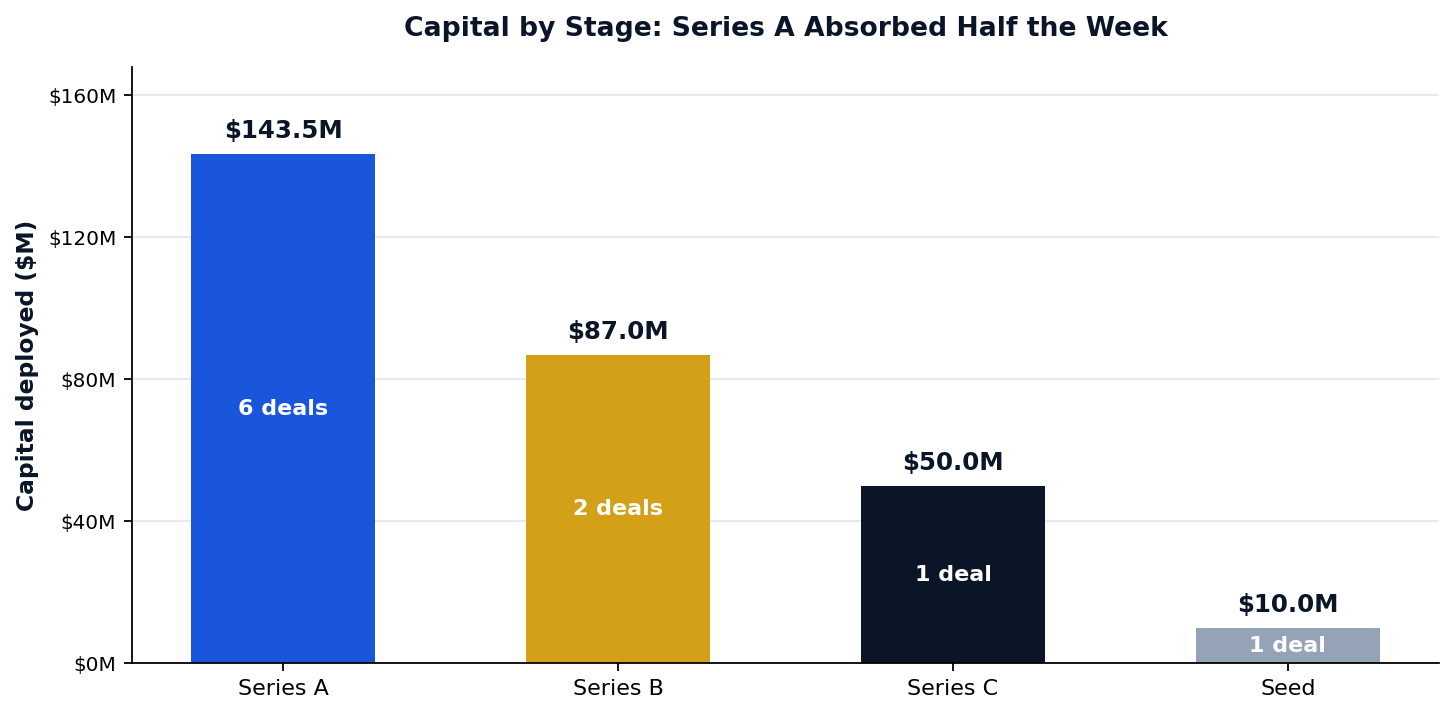
Pattern: The largest mid-market round of the week was $57M. The average was $29.1M and the median $29.25M. Six of ten rounds were Series A, absorbing $143.5M or 49.4 percent of tracked capital at an average of $23.9M. Nine weeks ago, this report tracked ten rounds averaging $48.0M with a $92.5M top and a $41M median. The ceiling fell by 38 percent and the average by 39 percent.
Perspective: Compression at the top of the mid-market and stability at Series A point to the same underwriting logic. Series A is the stage where proof is cheapest to verify: a partner can call three customers and read a usage table in an afternoon. Series B and C require a diligence exercise on unit economics and retention that fewer companies in this set could support. The two rounds that cleared above $50M were the two with either named enterprise customers or disclosed revenue at scale.
Founder Blindspot: Founders benchmark their ask against whatever crossed their feeds, and this week the feed was dominated by financings far outside the range that would price a Series A or B. Anchoring on those numbers produces an ask the mid-market will not meet, and an ask the market will not meet reads as a judgment problem rather than an ambition problem.
Playbook: Rebuild your comp set from rounds in your stage, your sector, and the last 60 days, and cap it at rounds under $100M. Then size your ask to 18 to 24 months against your actual burn and name the milestone the money buys. Faye raised $50M and said publicly it could have raised more. Pinegap raised $8M against a tripled valuation. Both sized to a milestone rather than to a market mood.
Contrast: The June reading of this market showed a tight scoring band and a high ceiling, which is the signature of a market that agrees on what it is buying. August shows a wide band and a low ceiling, which is the signature of a market still writing checks but no longer agreeing on price.
What this means for your raise: The current ceiling for a mid-market round is well under $60M. Size the ask to the milestone, and be ready to defend why the number is not larger.
Shift 4: The Named Customer Outscored the Named Investor
Pattern: The seven deals scoring 64 and above all named customers or disclosed a verifiable customer count. Buzz named Dominion Energy, American Electric Power, and the New York Power Authority. Convex named OpenAI, Tripadvisor, Solana, and Zapier. Faye disclosed roughly 1,200 distribution partners. Pinegap disclosed more than 100 institutional clients running over 1,000 agents. Sapiom named Polsia and published what that customer’s bill fell from and to. The bottom of the band inverted the profile: strong investor names, thin customer disclosure. Malachyte was co-led by Bessemer and Gradient and disclosed no traction figures. Aurelius raised with Draper, General Catalyst, and a defense strategic while naming a demonstration and an integration partner but no buying customer. RWX is the instructive middle case, naming one customer and a 67 percent improvement, which lifted its traction score above Malachyte’s but was not enough to carry a round on a single reference.
Perspective: A logo on your cap table is a claim about the future. A logo on your customer list is evidence about the present. Diligence teams can only call one of them. This week the market paid for the callable one, and the pattern held across defense, energy, fintech, and infrastructure, which means it is not a sector effect.
Founder Blindspot: Founders spend the fundraise optimizing the investor list and treat customer references as a late-stage diligence chore. The sequencing is backward. The reference list is what converts the meeting; the investor list only determines who takes it. A founder with three cleared customer references and a mid-tier lead outperformed a founder with a top-tier lead and no cleared customer references.
Playbook: Before you open the round, get written clearance from three customers to be named publicly and a fourth to take a reference call. For each, write the single number that customer would confirm on the phone. If you cannot get three, that is your two-week priority, and it outranks every deck revision on your list.
Contrast: The 2021 cycle rewarded the syndicate photograph. August 2026 rewarded the customer roster. Sapiom is the cleanest illustration: a solo founder with no prior exit scored 69, four points above a defense company with a far more decorated cap table, because one customer let its numbers be published by name.
What this means for your raise: Three named customers, each with one confirmed number, will move your round further this quarter than one additional brand-name investor on your target list.
Shift 5: A Third of the Week’s Coverage Was an Echo
Pattern: Six rounds appearing in this window’s funding coverage had been announced the prior week and were excluded from the tracked set: two on July 29, two on July 30, one on July 31, and one in the week of July 25. Together they carry $199M. Had they been counted, the week would have read as $489.5M across sixteen rounds rather than $290.5M across ten, an overstatement of 68 percent. Verification against the original company release or wire dateline, not the roundup, was the only thing that separated them.
Perspective: Funding aggregators re-run prior-week rounds on slow news days, and a Monday roundup is the highest-risk artifact in the entire tape. This is not a criticism of the outlets; it is a description of how the feed works. The practical consequence is that a founder benchmarking against the weekly tape is benchmarking against a number that double-counts.
Founder Blindspot: Founders build their comp set and their sense of market temperature from roundups, then set an ask against an inflated picture of activity. The error compounds: the false density suggests capital is easier to access than it is, which results in a slower process and a longer runway burn than the founder budgeted for.
Playbook: For every comparable you rely on, open the company press release or the wire item and record the dateline, not the article date. Build the comp set from those datelines. It takes about 20 minutes for ten deals, and it is the cheapest correction available to your fundraising plan.
Contrast: Signal density this week was materially lower than the feed implied. In a week where the mid-market ceiling was already compressed, the gap between apparent and actual activity is the difference between planning a six-week process and a twelve-week one.
What this means for your raise: Verify the deadline on every comparable before you set your ask. The tape you are pricing against is partly a rerun.
The Deals That Matter: Top 5
Five deep dives across insurance technology, developer infrastructure, vertical fintech, energy AI, and agent runtime. Each is selected for a distinct playbook value, not deal size. All metrics are verified against two or more primary sources.
Faye
AI Travel Protection Platform | Series C | $50.0M | Valuation Undisclosed
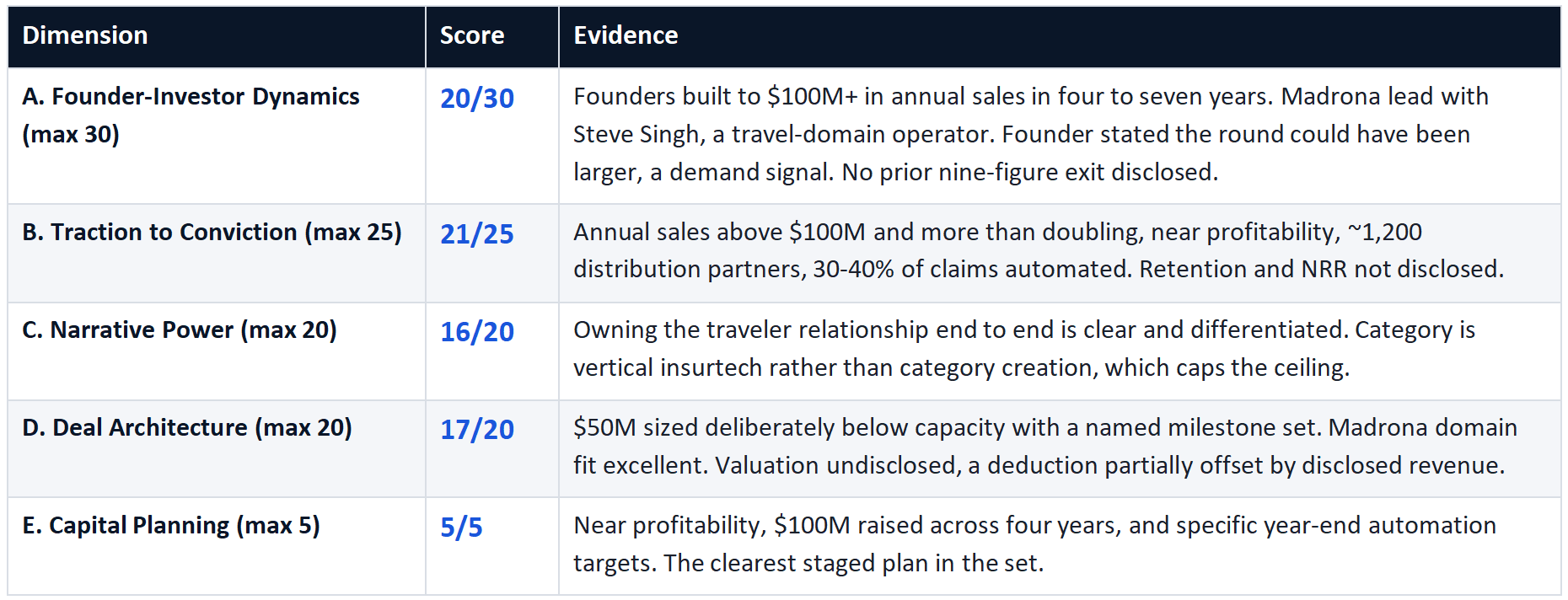
Eisen Fundability Score: 79 / 100
Why this scored: The highest score of the week reflects the only complete commercial picture in the set. Faye is the sole company that disclosed revenue at scale, stated a position near profitability, and quantified the operational metric its capital is meant to move. Everything a diligence team would ask for was in the announcement: annual sales above $100M, roughly 1,200 distribution partners, about 75 percent of revenue from partnerships, and 30 to 40 percent of claims already resolved automatically against a stated target above 50 percent by year-end.
The Setup: Led by Madrona with participation from BRM and existing backers Portage, F2 Venture Capital, Viola Ventures, and Lumir Ventures, Faye sells app-based travel protection with claims paid into a built-in wallet, bundled with telemedicine, eSIM data, lounge access, and concierge support. Founded by Elad Schaffer and Daniel Green, the company moved its United States headquarters to the Richmond area in 2025. Madrona managing director Steve Singh, who spent his career building in the travel industry, led the round. The strategic bet is not on better pricing risk. It is about owning the traveler relationship end-to-end so that distribution partners cannot disintermediate the brand.
The Numbers: $50M Series C bringing total funding to $100M. More than $100M in annual sales, a figure the company has also described as annual revenue, with the split between premium volume and net revenue not disclosed. Digital-first travel protection revenue has reportedly more than doubled over the past year. Approximately 1,200 distribution partners generating about 75 percent of revenue. Between 30 and 40 percent of claims resolved by automation today, targeting more than half by year-end with 75 percent of the remainder closed on first touch. All denial decisions deliberately retained by humans. Valuation undisclosed; a figure near $500M was reported by a single outlet and is not confirmed. Use of funds: international expansion, airline, cruise and online-travel-agency distribution, and further automation of underwriting and claims.
Fundability Lessons: Faye is the disclosed-economics template. Three moves built the 79-point case. First, lead with revenue and proximity to profitability, because in a week where nobody priced a valuation, revenue is the only anchor left. Second, quantify the operational metric the round is meant to move, in this case the share of claims resolved autonomously, so the use of funds is measurable rather than directional. Third, keep the irreversible decisions with humans and say so, which turns a regulatory and fraud objection into a stated design choice.
Your Takeaway: If you have revenue, disclose it, and disclose the operating ratio your round is buying. In an opaque week, the founder who publishes a real number sets the anchor for the whole category. Raising less than you could, and saying why, reads as capital discipline rather than weak demand when the revenue is there to back it.
The Founder Mistake to Avoid: Founders withhold actual revenue for fear a competitor might see it. The mistake is treating disclosure as a competitive leak rather than a pricing tool. Faye scored 79 because a partner could compute the multiple, the growth rate, and the burn implication from the announcement alone. A company that withholds revenue is asking the market to price it on faith, at a time when faith got the lowest scores in the band.
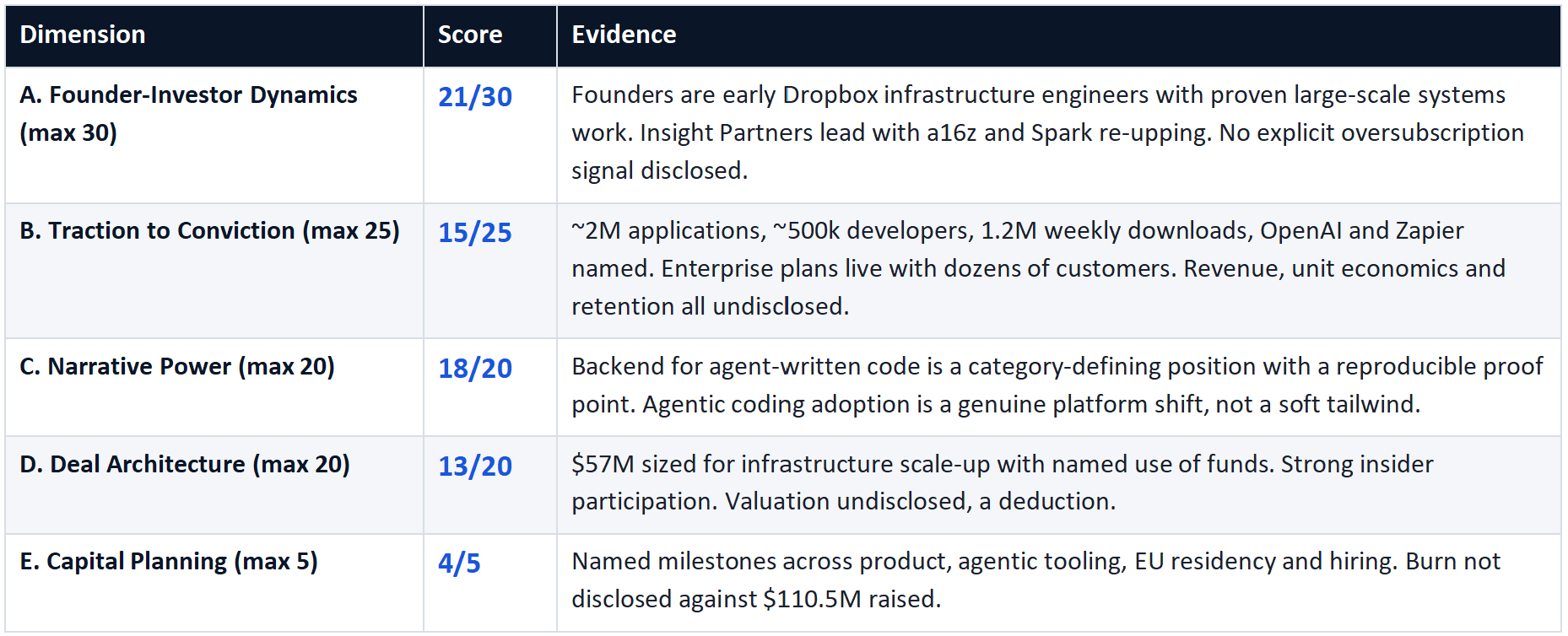
Convex
Application Backend for Agent-Written Software | Series B | $57.0M | Valuation Undisclosed
Eisen Fundability Score: 71 / 100
Why this scored: Convex ran the largest mid-market round of the week on the sharpest proof artifact in the set: a published failure-rate comparison. In the company’s own testing, 90 percent of AI-built applications on a traditional database silently corrupted data in real-world use, compared to a 0 percent failure rate on Convex. That single number converts an abstract reliability claim into a testable assertion, and it is paired with named customers including OpenAI, Tripadvisor, Solana, Zapier, and Reducto. The score remains below the top band due to the lack of disclosed revenue or retention.
The Setup: Founded in 2021 by early Dropbox infrastructure engineers including CEO Jamie Turner and CTO James Cowling, who previously built storage systems serving hundreds of millions of users, Convex packages a database, server functions, real-time sync, search, file storage, auth, and a retrieval component into a single TypeScript environment with ACID transactions and end-to-end type safety. The thesis is that as the cost of writing code approaches zero, the value of correct abstractions rises sharply, because an agent will reach for the first thing that works, and on most backends the first thing that works is quietly wrong.
The Numbers: $57M Series B led by Insight Partners, with Etna Labs and existing investors a16z and Spark Capital, plus angel investor Justin Kan. Total funding: $110.5M per the company release, compared with roughly $80M reported by one aggregator; the company figure is used. Nearly 2 million applications built on the platform by close to 500,000 developers, with more than 1.2 million weekly package downloads. Enterprise plans launched with dozens of companies on them, and European data residency live. Revenue undisclosed. Use of funds: core product, agentic development tooling, and hiring at the San Francisco headquarters.
Fundability Lessons: Convex is the failure-rate template. Three moves built the 71-point case. First, define the category by the mistake your competitor makes rather than the feature you have, which is why the 90 percent figure does more work than any architecture slide could. Second, name customers whose engineering standards are themselves a credential, because OpenAI as a customer is a technical reference and not just a logo. Third, publish the usage denominator, 2 million applications and 500,000 developers, so a partner can size the funnel even without revenue.
Your Takeaway: If you sell infrastructure, run the test that makes the incumbent fail and publish both numbers. A comparison your buyer can reproduce is worth more than any benchmark you control. The strongest version of this claim quantifies a silent failure, the kind a buyer has already experienced but never measured.
The Founder Mistake to Avoid: Founders lead with architecture and hope the buyer infers reliability. The mistake is in describing how the system works rather than what happens when it does not. Convex scored on a corruption rate, not on its type system. If your infrastructure pitch opens with a diagram, move the failure comparison to the front.
Ambrook
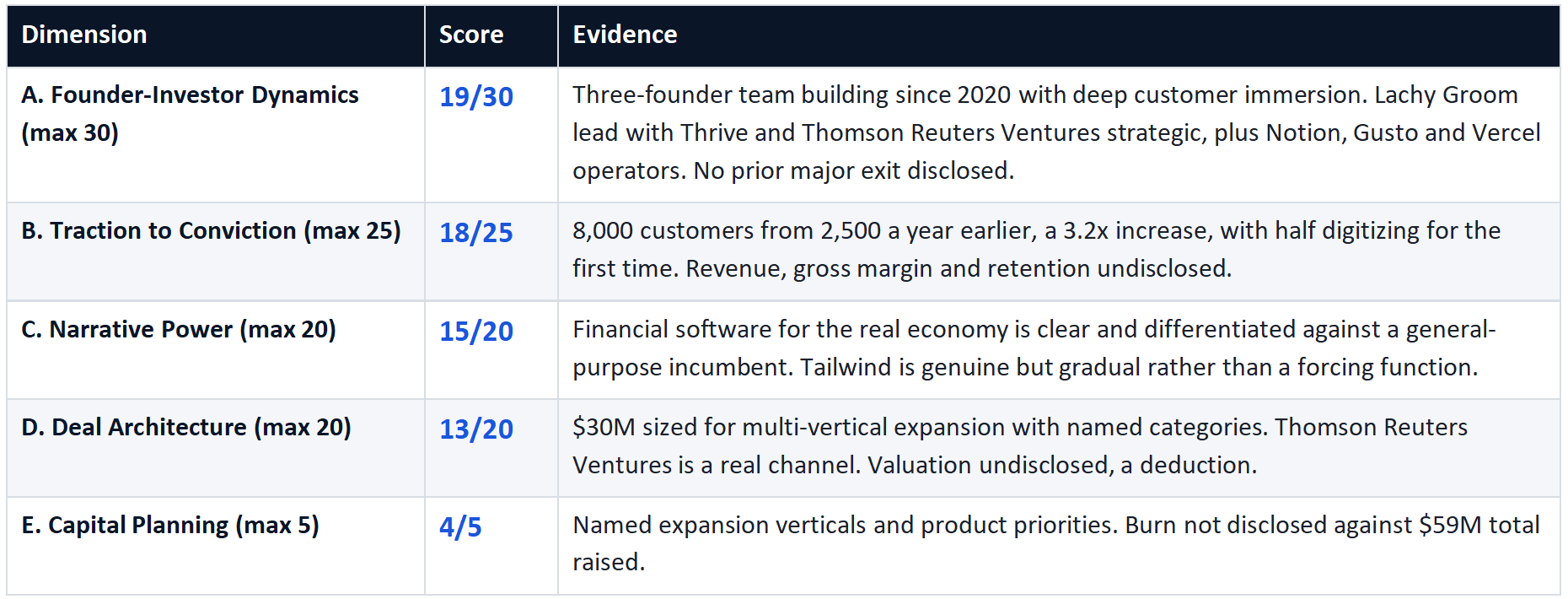
Financial Software for the Real Economy | Series B | $30.0M | Valuation Undisclosed
Eisen Fundability Score: 69 / 100
Why this scored: Ambrook posted the cleanest growth multiple in the set: 8,000 business customers against 2,500 a year earlier, a 3.2 times increase, with half of customers moving to it directly from paper or spreadsheets. That second figure is the one that matters, because a customer digitizing for the first time is structurally harder to displace than one switching between two software products. The score is held down by undisclosed revenue and a real but slow-moving tailwind.
The Setup: Founded in 2020 by Mackenzie Burnett, Dan Schlosser, and Jeff Anders, Ambrook builds accounting, payments, and cash management for businesses that own physical assets and run on irregular billing: family farms, trucking companies, general contractors, and property managers. These operators frequently manage more than a dozen accounts across multiple entities and banks without a finance team. The round was led by solo capitalist Lachy Groom with Thomson Reuters Ventures, Thrive Capital, Field Ventures, and Cameron Ventures, plus the co-founders of Notion and Gusto and the chief executive of Vercel.
The Numbers: $30M Series B bringing total funding to $59M. More than 8,000 business customers, up from 2,500 a year earlier. Half of customers are digitizing financial operations for the first time. Expansion underway from agriculture into trucking, construction, and property management. Revenue and unit economics undisclosed. Headquarters listed as Denver in the company release. Use of funds: product development across the four verticals, AI capabilities, and integrated payments and cash management.
Fundability Lessons: Ambrook is the switching-cost template. Three moves built the 69-point case. First, report growth as a ratio against a named prior-period base, because 8,000 from 2,500 is a claim a partner can model and 8,000 alone is a claim they cannot. Second, disclose the composition of that growth, not just the size, since half the customers arriving from paper describes a moat rather than a market share shift. Third, bring a strategic partner whose distribution matches the category, in this case Thomson Reuters Ventures in tax and accounting.
Your Takeaway: Report your growth as a ratio with both endpoints, and then describe where the new customers came from. A customer with no prior software is a different asset than one you won from a competitor, and investors price the difference. If most of your growth is displacement, expect questions about why the incumbent will not simply respond.
The Founder Mistake to Avoid: Founders publish a single current-period number and assume readers will infer the trajectory. The mistake is reporting a level when the market is underwriting a rate. Ambrook scored on the delta between two dated figures. If your traction slide shows one number with no prior-period comparison, a partner will assume the comparison is unflattering.
Buzz Solutions
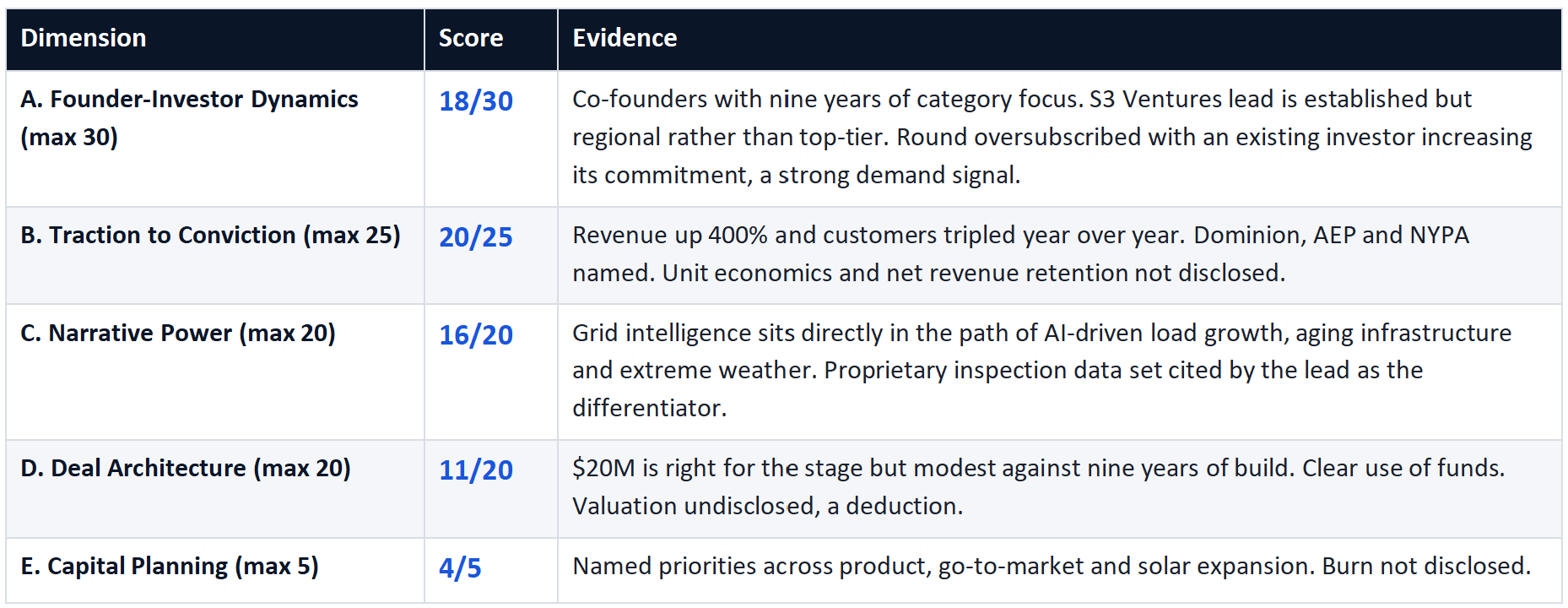
Grid Visual Inspection AI | Series A | $20.0M | Valuation Undisclosed
Eisen Fundability Score: 69 / 100
Why this scored: Buzz posted the densest proof stack in the set relative to round size: revenue up 400 percent, customer count tripled, three named utilities, and an oversubscribed round with an existing investor increasing its commitment. It is also the longest-tenured company in the set, founded in 2017, which makes a $20M Series A a deliberate choice rather than a ceiling. The score is held down by a regional lead and a modest round size against nine years of company building.
The Setup: Co-founded by chief executive Kaitlyn Albertoli and chief technology officer Vikhyat Chaudhry, the Palo Alto company sells PowerAI, a visual inspection and orchestration layer that turns drone and field imagery of transmission lines, substations, and utility-scale solar into prioritized maintenance and risk decisions. S3 Ventures led with follow-on from GoPoint Ventures and existing backers HearstLab and Blackhorn Ventures. The S3 partner leading the deal said the firm spoke directly with Buzz customers and cited a proprietary data set as the differentiator.
The Numbers: $20M oversubscribed Series A. Revenue grew 400 percent, and customer count tripled over the past year. Named utility customers include Dominion Energy, American Electric Power, and the New York Power Authority. Platform expanded from transmission and distribution into utility-scale solar inspection. Founded 2017. Valuation undisclosed. Use of funds: product innovation, go-to-market expansion, and deeper deployments across the existing utility base.
Fundability Lessons: Buzz is the reference-diligence template. Three moves built the 69-point case. First, name customers a partner can actually reach, because the lead investor said publicly that customer conversations were what separated Buzz from alternatives. Second, pair a growth rate with a customer count so the revenue increase is visibly driven by new logos rather than by price increases on a static base. Third, take a right-sized round after a long build, because an oversubscribed $20M reads as discipline where an unfilled $40M would have read as a stall.
Your Takeaway: Your customer references are not a diligence formality; they are the product being sold to the lead. Prepare them first. If a partner can call three utilities, hospitals, or banks and hear the same number you put on your slide, the round moves at the speed of those calls rather than your follow-ups.
The Founder Mistake to Avoid: Founders with long build times inflate the ask to signal that the wait was worth it. The mistake is treating round size as a proxy for progress. Buzz raised $20M nine years in, and it read as conviction because the round was oversubscribed and an existing backer increased its position. An undersubscribed larger round would have told the opposite story about the same company.
Sapiom
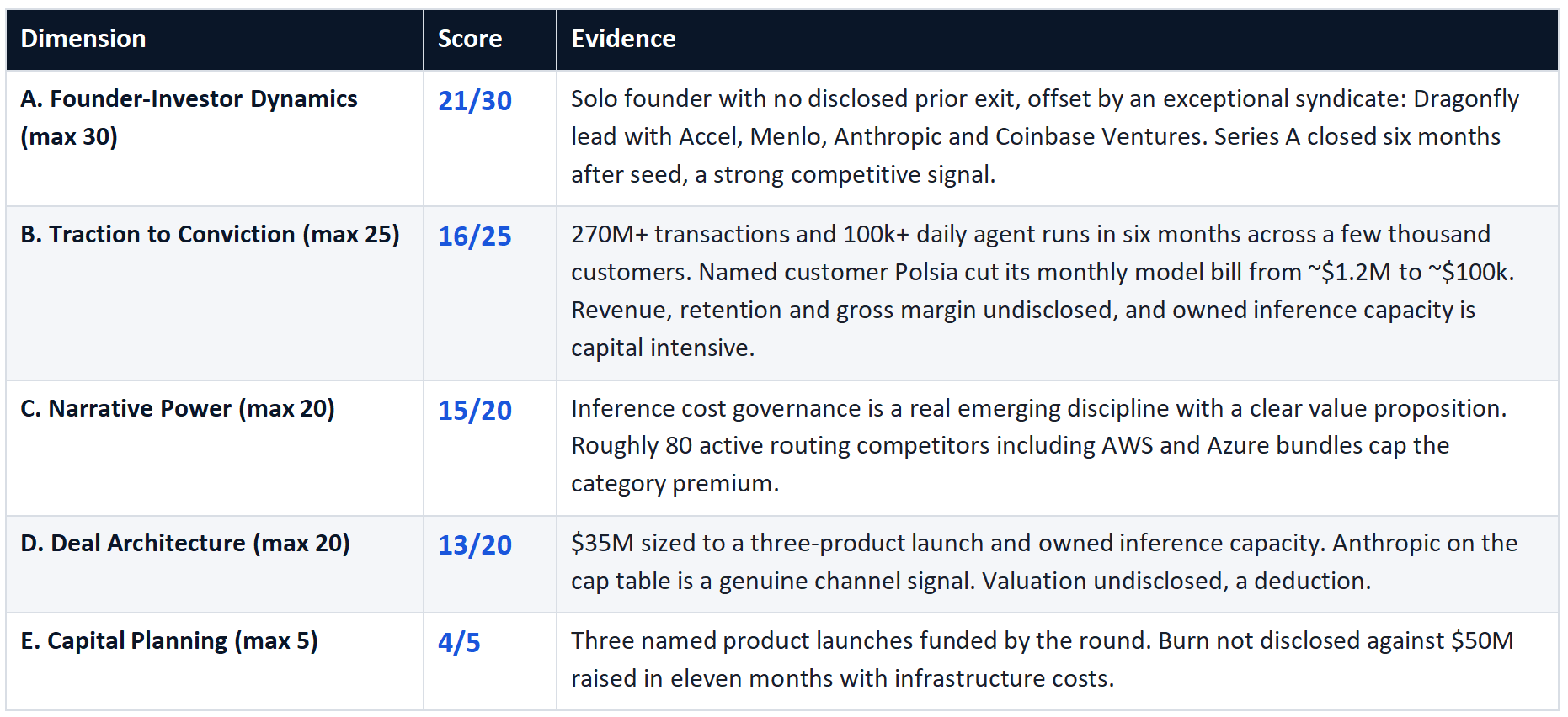
AI Agent Runtime and Model Routing | Series A | $35.0M | Valuation Undisclosed
Eisen Fundability Score: 69 / 100
Why this scored: Sapiom raised a $35M Series A 11 months after founding and 6 months after a $15M seed, on a platform that had been live for 6 months. The velocity is the story: 270 million transactions processed and more than 100,000 agent runs a day in half a year, a few thousand customers, and Anthropic on the cap table. Crucially, the headline proof point has a name attached. AI startup Polsia cut its monthly model bill from about $1.2M to roughly $100,000 after moving to Sapiom. The score is capped by a crowded competitive field, roughly 80 active routing competitors including bundled offerings from the major clouds, and by undisclosed revenue and margins on a capital-intensive owned-infrastructure model.
The Setup: Founded in San Francisco in 2025 by Ilan Zerbib, Sapiom sits between AI agents and the models they call. Its Router directs each call to the cheapest capable model and enforces a budget before money is spent, Agent Studio provides a local build-and-test environment, and Runtime supplies managed production infrastructure with access controls and step-level visibility. The company operates its own inference capacity. Dragonfly led with Accel, Gradient, Coinbase Ventures, Operator Collective, Formus Capital, and VanEck Ventures, with existing backers Okta Ventures, Menlo Ventures, Anthropic, and Array Ventures joining. Dragonfly framed the problem in a line worth stealing: agents are becoming employees with no manager and no budget.
The Numbers: $35M Series A bringing total funding to $50M in eleven months. More than 270 million transactions processed since launching six months earlier, supporting over 100,000 agent runs per day, across a few thousand customers. Named customer Polsia, an AI startup running agent swarms, saw projected revenue climb from $100,000 to $10M in a year while its monthly model bill reached about $1.2M; after Sapiom’s routing evaluations, that bill fell to roughly $100,000. Note that the company states this saving in two different ways in its own materials: the press release describes a 75 percent reduction in inference costs, while the company blog and the exclusive interview describe the $ 1.2M-to-$100,000 move, which is closer to a tenfold cut. Both are company-sourced, and the discrepancy is unresolved; the specific dollar figures are used here. Revenue and margins undisclosed. Valuation undisclosed. Use of funds: launching Router, Agent Studio, and Runtime, and scaling inference infrastructure.
Fundability Lessons: Sapiom is the momentum-design template. Three moves built the 65-point case. First, ship into the constraint that breaks first, which in agentic deployment is cost rather than capability, so the pitch lands on a line item a buyer already regrets. Second, add the customer whose revenue you reduce to your cap table, because Anthropic’s participation turns the most obvious strategic objection into validation. Third, compress the seed-to-Series-A interval to six months by generating a volume metric fast, because in a crowded category velocity is the only differentiator a partner can verify quickly.
Your Takeaway: In a commoditizing category, the fundable asset is the rate at which you accumulate verifiable volume. Pick the one metric that compounds weekly, publish it with a start date, and raise against the slope. Then get one customer cleared to be named with real dollar figures, because a named $1.2M to $100,000 is evidence where an anonymous percentage is only a claim. State that saving one way and one way only, since two versions of the same number in your own materials is the first thing a diligence team will find.
The Founder Mistake to Avoid: Founders in crowded categories argue differentiation on architecture. The mistake is competing on design when the buyer is comparing invoices. Sapiom scored on transactions processed, a named customer, and a dollar delta, not on routing logic. Where it did lose points was self-inflicted: publishing the same saving as both 75 percent and a roughly tenfold cut across its own press release and blog. Pick one number and repeat it everywhere.
Fundraising Playbook: 5 Tactical Plans
Five plans, each producing a concrete output you can use immediately. No vague tasks. Each is built directly from this week’s verified signals.
1. The Cost-and-Failure Headline (Positioning and Narrative)
Why this matters: Convex, Sapiom, and RWX all cleared by quantifying what happens after the demo. Convex published a 90 percent-to-zero percent corruption comparison, Sapiom a 75 percent cost reduction, and RWX a 67 percent cut in validation time. Agent capability alone was not priced this week.
Deliverable: A single sentence replacing your pitch headline, containing two numbers: what a unit of completed work costs on your system, and how often it fails, each stated against the status quo your buyer runs today.
Time estimate: 3-5 hours, finalized before your next investor meeting.
Expected outcome: A headline that survives the first diligence question. Partners stop asking whether it works and start asking how fast you can deploy it.
Reframe: Wrong approach: our agent automates claims processing. Right approach: we resolve 40 percent of claims without a human touch at one-third the cost per claim, and we publish the error rate.
2. The Three-Reference Pack (Traction and Proof Packaging)
Why this matters: The four highest-scoring deals named customers or disclosed a verifiable client count. Buzz named three utilities and its lead investor said customer calls were the deciding factor. The bottom of the band had strong investors and no callable customers.
Deliverable: Written clearance from three customers to be named publicly, plus a fourth who will take a reference call. For each, one sentence stating the number that customer will confirm on the phone.
Time estimate: 6 to 10 hours across two weeks, including the asks and the confirmations.
Expected outcome: A round that moves at the speed of reference calls rather than the speed of follow-up emails. If you cannot get three, you have found the real gap in your raise.
Reframe: Wrong approach: references gathered after term sheet interest. Right approach: references cleared before the first partner meeting and offered unprompted.
3. The Verified Comp Set (Ask Sizing and Market Calibration)
Why this matters: Six rounds in this window’s coverage had been announced the prior week, carrying $199M that would have overstated the week by 68 percent. Meanwhile, the actual mid-market ceiling was $57M, down from $92.5M nine weeks earlier.
Deliverable: A ten-row comp table for your stage and sector from the last 60 days. For each row: company, amount, stage, the wire or company-release dateline, and the source URL. Exclude anything above $100M and anything you cannot date to a primary release.
Time estimate: 2 to 3 hours, refreshed monthly while you are raising.
Expected outcome: An ask anchored to what actually cleared, and a defensible answer when a partner asks why that number.
Reframe: Wrong approach: size the ask from the rounds that crossed your feed. Right approach: size the ask from rounds you have dated to a primary source in your stage and sector.
4. The Disclosure Decision (Deal Architecture)
Why this matters: None of the 10 rounds disclosed a valuation, and each incurred a scoring deduction for not doing so. The companies that scored highest disclosed something else instead: Faye disclosed revenue, Buzz disclosed a growth rate, Ambrook disclosed a customer ratio, and Pinegap disclosed a step-up shape.
Deliverable: A one-page disclosure policy listing exactly what goes in the announcement and what does not, decided before you take a term sheet. Rule of thumb from this week: disclose the metric, withhold the multiple.
Time estimate: 2 hours, agreed with your lead before the announcement is drafted.
Expected outcome: An announcement a partner can underwrite without a call, and no public price bar your next round has to clear.
Reframe: Wrong approach: withhold everything and let the market assume strength. Right approach: withhold the price and publish the proof.
5. The Slope Metric (Momentum Design and Conversion)
Why this matters: Sapiom raised a $35M Series A six months after its seed by generating 270 million transactions in half a year. Ambrook raised on 8,000 customers from 2,500. Both sold a rate of change, not a level.
Deliverable: Identify the single metric in your business that compounds weekly. Instrument it, publish it internally with a start date, and build a 14-day investor follow-up cadence where each touch carries the new value of that one number and nothing else.
Time estimate: 4 to 6 hours to instrument, then 15 minutes per follow-up.
Expected outcome: Follow-ups that create urgency rather than ask for attention. A partner watching a number move is running your process for you.
Reframe: Wrong approach: checking in to see if you had a chance to review the deck. Right approach: we crossed 400,000 agent runs a day this morning, up from 310,000 when we met.
Looking Forward: Next 1 to 3 Weeks
Three evidence-based scenarios and one wild card. Predictions are anchored to this week’s verified data, not speculation.
Scenario 1: Agent Runtime Rounds Keep Clearing (High Probability)
Evidence: Four of ten rounds and 45.6 percent of tracked mid-market capital went to the cost, correctness, and control layer beneath agents. Three of the four quantified a cost or failure delta in the announcement itself.
What to watch: New rounds for inference cost governance, agent observability, permissioning and audit trails, evaluation tooling, and agent-safe data stores. Watch for announcements that lead with a cost or error figure rather than a capability claim.
What founders should do: If you build anything agentic, instrument cost per completed task and failure rate per thousand runs this week. Those two numbers are becoming the price tag on your category.
Scenario 2: Valuation Opacity Persists Through the Quarter (High Probability)
Evidence: Zero of ten rounds disclosed a valuation, against two of ten nine weeks earlier. Even the one reported figure came from a single outlet without company confirmation, and one company disclosed a step-up shape while explicitly declining the number.
What to watch: Whether any mid-market round publishes a priced valuation in the next three weeks, and whether reporters begin substituting revenue multiples for absent valuations. A single disclosed price would break the pattern and become the category anchor.
What founders should do: Assume you will get no public comps. Build your ask around your own burn and milestones, and decide now which of your metrics you will include in the announcement in place of a price.
Scenario 3: Series A Stays the Center of Gravity (Medium-High Probability)
Evidence: Six of ten rounds were Series A, absorbing 49.4 percent of tracked capital at an average of $23.9M. The two largest rounds in the set were the two with either disclosed revenue at scale or named enterprise customers, suggesting later stages now require proof this cohort mostly has not published.
What to watch: Whether Series B and C rounds in the mid-market start disclosing net revenue retention and gross margin. That would signal the later-stage bar has formalized rather than simply tightened.
What founders should do: If you are approaching a Series B, build the retention and margin disclosure now, before you need it. The companies that cleared above $50M this week were the ones who already had it ready.
Wild Card: Narrative-Only Seeds Reprice Downward (Medium Probability)
Evidence: The bottom of this week’s band, scores of 55 to 61, consists entirely of companies with strong investors, strong stories, and no disclosed revenue. They still raised, but at an average of $20.7M across three rounds, compared with $32.6M across the seven deals scoring 64 and above.
What founders should do: If your positioning rests on category language rather than a disclosed number, treat that as a near-term risk to your round size, not just your valuation. Generate one publishable usage figure before you open, or expect to clear at the bottom of the range. The founders who act before the bar formalizes keep the size. The ones who wait negotiate against it.
The Bottom Line
The real insight is not the $290.5M total. It is that with the giant rounds and public-market traffic removed, the market that actually prices your round paid for one thing: a number a diligence team can verify by making a phone call. Not a category, not a cap table, not a capability. Three conviction profiles took the week.
Profile 1: Disclosed economics. Faye (79), Ambrook (69), and Naïve (67) published revenue or a growth ratio with both endpoints. Faye disclosed more than $100M in annual sales and a position near profitability. Ambrook disclosed 8,000 customers, up from 2,500, and where half of them came from. Naïve disclosed a tenfold increase in run-rate revenue in six months. The proof is a number with a date attached.
Profile 2: Quantified failure and cost. Convex (71), Sapiom (69), and RWX (58) each measured what breaks and what it costs. Convex published a corruption rate, Sapiom an inference saving, RWX a validation-time cut. The proof is a comparison the buyer can reproduce.
Profile 3: Callable customers. Buzz Solutions (69) and Pinegap (64) named the institutions using them. Buzz named three utilities, and its lead cited customer calls as the deciding factor. Pinegap disclosed more than 100 institutional clients running over 1,000 agents. The proof is that a partner can dial it.
Everything else competed for the residual. The message is unmistakable. Publish the number, name the customer, or measure the failure. Anything short of that raised this week, but it raised at the bottom of the band and at two-thirds the size.
5 New Rules for Founders
1. The agent is not the asset. Price what it costs to run and how often it fails, because a coding model can produce the capability itself in an afternoon.
2. Disclose the metric, withhold the multiple. Nobody published a valuation this week, so the founder who publishes a real number owns the category's anchor.
3. A callable customer beats a famous investor. Diligence can only phone one of them, and this week it phoned the customer.
4. Report the rate, not the level. Growth stated as a ratio between two dated figures is modelable. A single current number is not.
5. Date every comparable to a primary release. A third of this week’s coverage was a rerun, and an ask built on it would have been 68 percent too confident.
4 Monday Actions
1. Instrument two numbers. Cost per completed unit of work and failure rate per thousand runs. Put both on slide one against the status quo your buyer runs today.
2. Clear three references. Written permission from three customers to be named, plus one who will take a call, each with the single number they will confirm.
3. Rebuild your comp set. Ten rounds, your stage and sector, last 60 days, each dated to a wire or company release. Exclude anything above $100M.
4. Write your disclosure policy. One page, decided before the term sheet, naming exactly what goes in the announcement and what stays out.
Your competitors are reading the same tape, and a third of it is a rerun. The founders who publish one verifiable number this week own the anchor in a market that priced nothing. The ones who wait will negotiate against whoever went first.
Research Methodology and Sources
Data collection period: August 3-9, 2026, with verified primary disclosures clustered from August 4 to August 6. Verification standard: a minimum of two independent primary sources per featured deal, with company press releases and regulated newswires prioritized as anchor sources and at least one tier-one or specialist outlet per deal for corroboration. Eisen Fundability Scores are proprietary analytical estimates, not endorsements or investment advice. All dollar figures reflect announced primary capital at close unless noted.
Total deals tracked: 10 verified U.S. mid-market rounds, approximately $290.5M in combined primary capital, every round under $100M. Editorial scope for this issue excludes giant rounds and public-market events by standing request.
Core Capital Totals and What They Include
The $290.5M weekly total includes only the ten verified U.S. rounds in the scorecard, each independently confirmed at the stated amount and stage. No announced-but-unclosed round was counted. No aggregator-only figure was treated as fact without corroboration in a company release or wire item. Average round size of $29.05M and median of $29.25M are computed on those ten rounds. Sector totals ($132.5M agent infrastructure, $58.0M insurance and wealth technology, $40.0M defense, $30.0M SMB vertical fintech, $20.0M energy and grid AI, $10.0M commerce AI) and stage totals ($143.5M Series A across six rounds, $87.0M Series B across two, $50.0M Series C across one, $10.0M seed across one) each reconcile to $290.5M.
Exclusions and Documented Rationale
• Prior-week rounds, excluded for date-window integrity: Freehand ($75M, company release dated July 29), P-1 AI ($50M, GlobeNewswire July 29), Ellis ($10M, BusinessWire July 30), Assured ($19M, GlobeNewswire July 30), Balance Theory ($19M, BusinessWire July 31), Fluxco ($26M, carried in energy deal coverage for the week of July 25). Combined value excluded: $199M.
• Previously funded or non-dilutive capital, excluded: Vedanta Biosciences ($60M announced August 5, comprising $40M of equity funded in roughly $18M and $22M tranches during the first and second quarters of 2026, plus $20M of non-dilutive funding under an existing BARDA contract). Neither component closed in the window, and the BARDA portion is not venture primary capital.
• Giant rounds and public-market events, excluded by editorial scope: all financings at or above $100M in the window, together with reported but unclosed items including one legal-AI raise described as in talks and one data-center raise described as reportedly raising.
• Non-U.S. rounds, excluded for scorecard comparability: QuantHealth ($45M Series B, BusinessWire dateline Tel Aviv), Ore Energy ($43M Series A, Amsterdam), Omilia ($67M Series B, Athens), OLIGO Security ($60M, Tel Aviv), and additional non-U.S. rounds in the window.
• Below-threshold and undisclosed-amount rounds: seed and pre-seed rounds under $8M were noted but not scored, and strategic investments of undisclosed size were excluded because no amount could be verified.
Primary and Secondary Validation Sources
Anchor company and newswire sources reviewed for the featured deals include the PRNewswire release and company blog post for Convex, the PRNewswire release for Faye, the BusinessWire release and company newsroom post for Aurelius Systems, the BusinessWire release and company blog for Sapiom, the company announcement for Ambrook, the company press release for Naïve, the EIN Presswire company release for Buzz Solutions, and the BusinessWire release for RWX. Tier-one and specialist corroboration reviewed includes Axios Pro and Skift (Faye), TechCrunch and SiliconANGLE (Naïve), Defense Daily and Dealroom (Aurelius Systems), Upstarts Media (Ambrook), VentureBeat (RWX), This Week in Fintech and Dealroom (Pinegap), Unite.AI and Dealroom (Buzz Solutions), and Dealroom and citybiz (Convex). Secondary corroboration drew on FinSMEs, Pulse 2.0, AlleyWatch, and additional trade outlets, each used only to confirm figures already anchored in a primary source. Prior-week exclusions were dated against GlobeNewswire, BusinessWire, company releases, and Axios Pro climate deal coverage.
Verification Notes
All ten featured rounds are rated HIGH source confidence, meaning each was confirmed by a company or lead-investor source plus at least one independent outlet. No valuation figure in this issue is treated as confirmed. The reported figure near $500M for Faye appeared in a single outlet without company confirmation and is marked reported rather than confirmed; it is not used in any calculation. Three source conflicts were resolved in favor of the company or wire record: Convex total funding at $110.5M rather than roughly $80M, the Sapiom customer saving at 75 percent rather than tenfold, and the Aurelius investor as Hanwha Asset Management Venture Fund per a BusinessWire correcting release rather than Hanwha Defense USA per the original. Two conflicts remain unresolved and are disclosed rather than silently decided: the Malachyte headquarters listing and the Faye founding year. All internal figures in this report, including the weekly total, average, median, chart values, sector and stage subtotals, and scorecard entries, were checked for arithmetic consistency before delivery.
Research completion timestamp: August 9, 2026.
DISCLAIMER: This article is for informational and strategic intelligence purposes only. It does not constitute investment advice. The Eisen Fundability Score is a proprietary diagnostic within Fundables OS™, not a financial recommendation.
If this article was useful, share it with founders who are about to raise.
— Leon Eisen, 4x Founder, Venture Capitalist, and Creator of Fundables OS™