

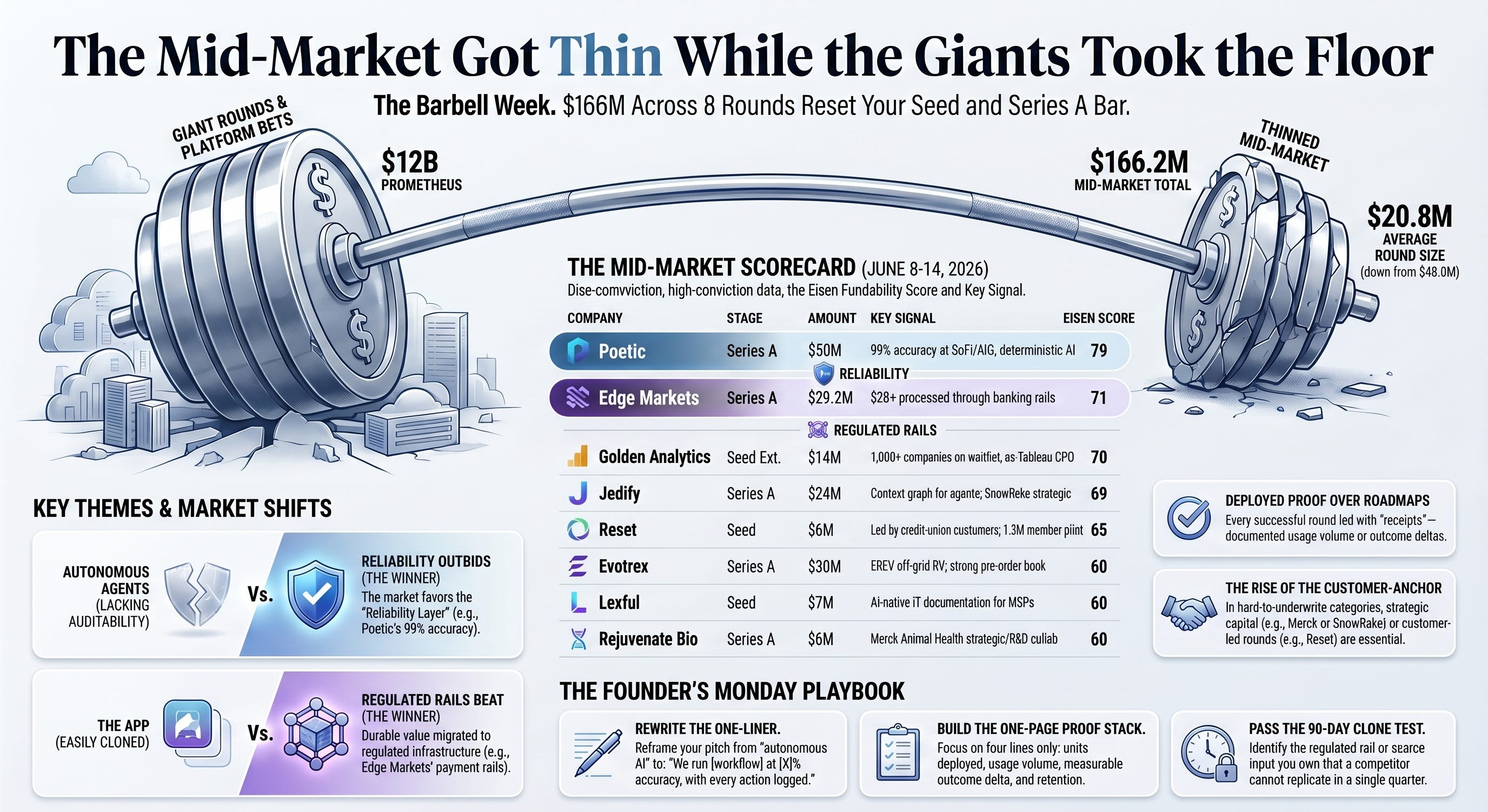
Playbook, Perspective, and Pattern for founders raising now. This report deliberately strips out the giant rounds and the IPO traffic so you can read the part of the market that actually prices your round.
Contents
Verified mid-market intelligence for the week of June 8-14, 2026. Read the shifts first if you are raising now, the deep dives if you are benchmarking, and the playbook if you have a meeting this week.
1. The Week in One Sentence: Primary insight, the 8-deal totals, and the data integrity gate.
2. Deal Scorecard: All 8 verified rounds, Eisen scores, and what the scorecard says at a glance.
3. What Changed This Week: Pattern, Perspective, Blindspot, and Playbook for each.
Shift 1: The mid-market thinned as capital barbelled to the top.
Shift 2: The reliability layer repriced above autonomous agents.
Shift 3: Proof of usage still prices the seed and Series A.
Shift 4: Strategic and customer capital anchored the hard rounds.
Shift 5: The regulated rail and the scarce input still beat the app.
4. The 5 Deals That Matter: Full breakdowns with founder lesson and founder trap.
5. Fundraising Playbook: Concrete deliverables you can use before your next meeting.
6. Next 1 to 3 Weeks: Three evidence-based scenarios and one wild card.
7. The Bottom Line: The real insight, 5 new rules, and 4 Monday actions.
8. Research Methodology and Sources: Verification standard, exclusions, and source list.
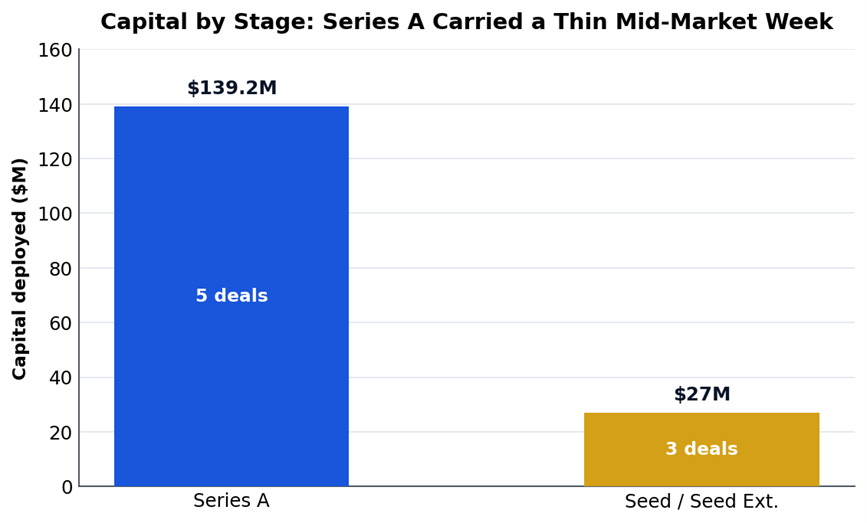
The week of June 8-14, 2026, was a barbell, and the barbell is the lesson. Capital did not slow down. It split. The top end swallowed almost everything in sight: a twelve-figure engineering-AI round, a humanoid-robotics round north of a billion, multiple rounds at three hundred to six hundred million for compute, security, fusion, and creative AI. Strip those out, and the public-market traffic with them, and the part of the market that actually prices a seed or a Series A got quiet and small. Eight verified US rounds cleared under $100M this week. Together, they moved about $166M. That is the thinnest tracked mid-market total in this report series, and it is the whole story.
A company automating regulated back-office work raised this week a number it had already achieved: 99% accuracy on processes that a Fortune 500 lender and a global insurer had failed to automate for decades. A company selling banking rails for prediction markets has already raised $2 billion. A company rebuilding business intelligence raised with a thousand companies in line and a customer analyzing more than a trillion dollars in investments. None of them led with a model. Each led with a number it had already put on the board.
Here is the consequence for Monday. The proof bar did not fall this week. It moved up and out of reach. The strongest deployed proof migrated into the giant rounds that this report excludes, which means the sub-$100M lane is now earlier, smaller, and more selective. If you are raising in that lane, you are competing for a narrower slice of attention against founders who lead with usage. Read every shift below through that lens. Each one tells you what to put on slide one before the lane narrows again.
The Week in One Sentence
Primary insight: With the giant rounds and IPO filings removed from view, the US mid-market did not just reprice. It shrank. Capital concentrated at the very top of the market and in a handful of small, proof-led seed and Series A rounds, and it paid for documented usage and a reliable, auditable layer rather than for autonomous-but-approximate AI.
• Total tracked mid-market capital (8 verified rounds): approximately $166.2M, every round under $100M, the smallest tracked total in this report series.
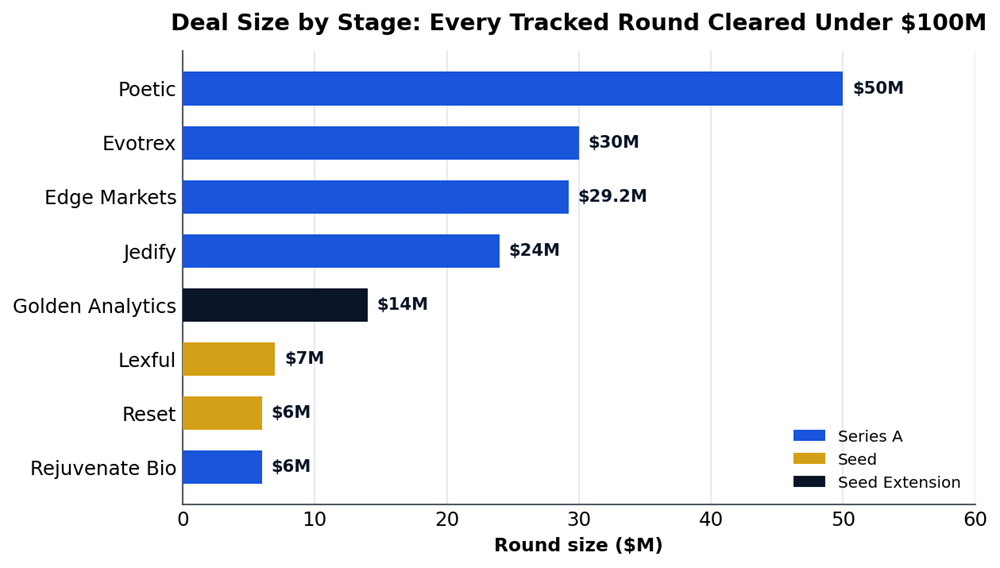
• Average round size: $20.8M across the eight, down from $48.0M the prior week.
• Median round size: $19.0M, the midpoint between Jedify and Golden Analytics.
• Disclosed valuations: only one of eight. Poetic at $500M. Seven rounds did not disclose, a signal that this tier is early and pricing is held close.
• Largest tracked round: Poetic, $50M Series A, deterministic AI for high-stakes enterprise workflows, valued at $500M.
• Highest Eisen Fundability Score: Poetic at 79, on named-customer deployed proof that a diligence team can verify in an afternoon.
• Defining structural feature: an Eisen Score band of 60 to 80, wider and lower than last week’s 67 to 80. No deal reached inevitability, and the center of gravity dropped because the strongest mid-market proof was pulled up into excluded giant rounds.
Data Integrity Notes
All eight featured rounds were verified against a minimum of two independent primary sources, including company press releases, BusinessWire, PRNewswire, GlobeNewswire, and at least one tier-one or specialist outlet per deal, such as TechCrunch, Bloomberg, Benzinga, GeekWire, and CTech. Resolutions and exclusions applied during this week's fact-check:
• Editorial scope this week excludes giant rounds and public-market events. Removed from the tracked set: Prometheus ($12B), NEURA Robotics ($1.4B), Cyera ($600M), Helion Energy ($465M), NinjaOne ($400M), Generalist AI ($400M), Suno ($400M), Digital Asset ($355M), TensorWave ($350M), PhysicsX ($300M), and Standard Bots ($200M). IPO and public-raise traffic in the window, including the SpaceX listing and chatter about OpenAI and Anthropic filings, is also out of scope.
• Geography. The tracked eight are US-headquartered. Israeli-founded rounds operating partly from the US (PointFive at $60M, dated by the company from London and Tel Aviv; A Security at $37M, an Israeli-founded firm with New York operations) and a Tel Aviv round (Aryon Security at $29M) are noted but excluded from the US scorecard for comparability, consistent with the prior issue. Non-US rounds in the window (ICEYE in Finland, Skyfora in Finland, THEKER in Spain, Rem3dy in the UK, Companion.energy in Belgium, nesto and KOHO in Canada, Capsa AI and NewOrbit in the UK) are also excluded.
• Recirculation control. Goldenrod Therapeutics ($6.5M seed) surfaced in the June 8 roundups, but its BusinessWire release is dated June 4, inside the prior week, so it is excluded. Rejuvenate Bio ($6M) carries a June 8 deadline and June 9 to 11 coverage and is included on that basis, with a note that its BusinessWire URL slug encodes a June 2 draft date.
• Valuation sourcing. Poetic at $500M is sourced to the company's PRNewswire release and corroborated by Bloomberg and Benzinga. All other tracked rounds did not disclose valuation, and their scores reflect a penalty for that opacity rather than an assumption of strength.
Deal Scorecard
Eisen Fundability Scores are calculated across the 5Ps-weighted dimensions: Founder-Investor Dynamics (Process, 30%), Traction-to-Conviction Conversion (Proof, 25%), Narrative Power (Positioning, 20%), Deal Architecture (Packaging, 20%), and Capital Planning (Planning, 5%). Scores of 85 and above signal an inevitable outcome. Scores of 70 to 84 signal strong execution. Scores below 70 signal early-stage or the need for repositioning. Missing metrics are scored conservatively, and opacity is penalized rather than assumed strong.
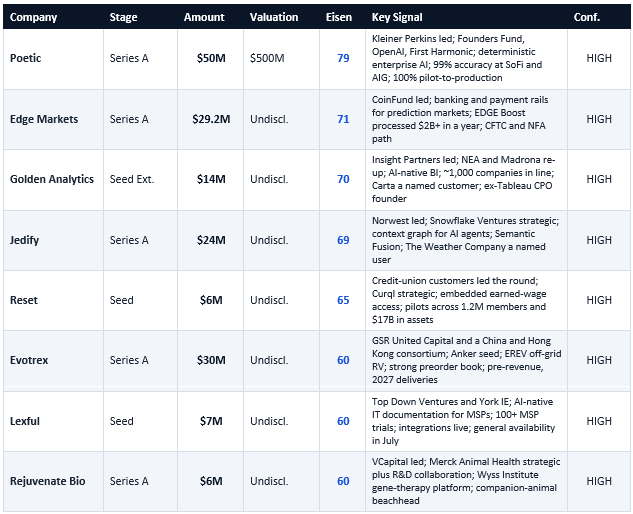
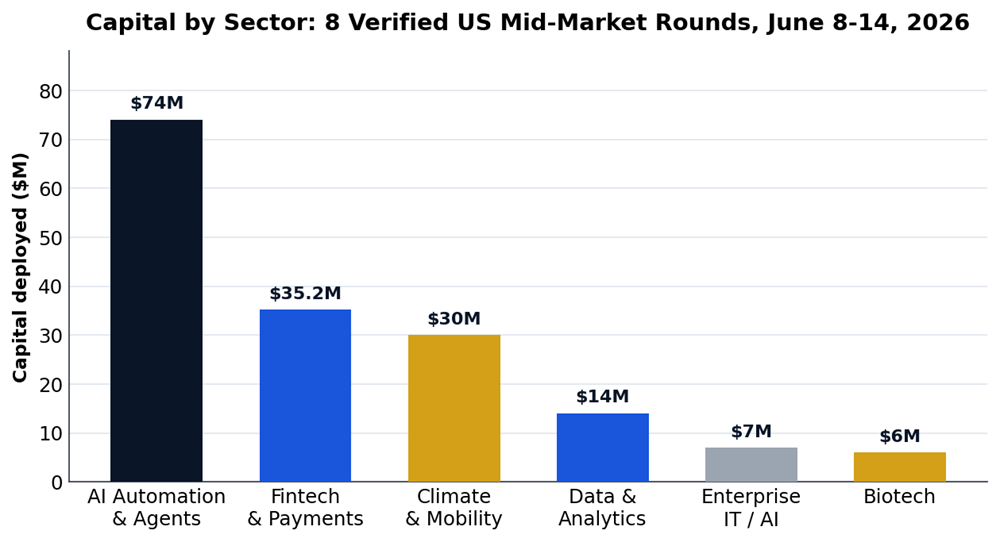
What the Scorecard Says at a Glance
The thinness is the message. Eight rounds, $166M, an average under $21M. A week earlier, the same lane cleared $480M across 10 rounds, averaging $ 48 M per round. Nothing about founder quality collapsed in seven days. The capital moved. The biggest, most profitable companies took giant rounds that sit above this report’s scope, and what was left in the sub-$100M tier was earlier and smaller. The band slid to 60-80 and dropped its center because the deals carrying the most deployed proof were pulled up and out.
Poetic (79) is the cleanest case of the week. It scored highest not on a disclosed valuation alone but on deployed proof a diligence team can verify: ninety-nine percent accuracy executing fraud investigations end-to-end at SoFi within five weeks, ninety-nine percent on a complex multi-hour process at AIG, and a one hundred percent pilot-to-production conversion rate. That is named-customer outcome data plus a conversion metric in one package, and it is why an elite syndicate priced it at $500M out of stealth.
Edge Markets (71) and Golden Analytics (70) round out the top of the band on the same logic. Edge shows that two billion dollars have already been processed through its debit program, so the rails are live, not promised. Golden shows a thousand companies in line and Carta analyzing more than a trillion dollars on the platform, so the demand is documented, not projected. Different categories, identical underwriting test: what has already been used at scale.
The lower band is instructive, too. Evotrex (60), Lexful (60), and Rejuvenate Bio (60) are credible companies, but each is pre-revenue or pre-general-availability, and each leads with an order book or a pilot rather than a deployed outcome at scale. The scoreboard separates a fundable company from a fundable round, and this week, the gap between the two was a deployed number versus a promised one.
What Changed This Week: 5 Market Shifts
Each shift is verified against multiple primary sources and ranked by structural impact on founder fundraising, not by deal size. Every shift ends with what it means for your raise.
Shift 1: The Mid-Market Thinned as Capital Barbelled to the Top
Pattern: The week’s capital is split into two clusters with little in between. At the top: a twelve-billion-dollar engineering-AI round, a robotics round north of a billion, and a stack of three hundred- to six hundred-million-dollar rounds for compute, security, fusion, and creative AI. At the bottom, eight US rounds under $100M totaling about $166M. The middle, the classic growth-stage venture round, was largely absent this week.
Perspective: A barbell market is a selection market. When the biggest checks focus on a handful of platform bets, the capital and attention available to the next tier compress. The mid-market did not get cheaper this week. It got thinner. Fewer mid-sized rounds cleared, and the ones that did were earlier-stage and proof-led. For a founder, that means the comparison set just got harder: you are not being measured against an average company, you are being measured against the few that led with a number.
Founder Blindspot: Founders read a record-funding headline and assume the money will reach them. The headline is the barbell’s top end. The capital concentrating into giant rounds is not trickling into Series B and growing at the same rate. The companies that cleared the mid-market this week did it on documented usage, not on a rising-tide narrative.
Playbook: Before you open a mid-market round this quarter, pressure-test where your raise sits on the barbell. If you are not a platform bet that commands a giant round, you are in the selective tier, and the selective tier pays for proof. Build the one-page proof stack now: units deployed, usage volume, the outcome you moved, and retention. If you cannot fill all four lines, raise less, later, after you can.
Contrast: A week earlier, the mid-market cleared $480M across 10 rounds in a tight 67-80 band. This week, it cleared $166M across eight rounds in a lower, wider 60 to 80 band. Same rule, thinner lane. The proof bar did not move down. It moved up and out of the sub-$100M tier.
What this means for your raise: If you are raising a mid-sized round, assume a smaller pool of attention and a higher proof bar than the funding headlines suggest. Lead with the number you already moved, or wait until you have one.
Shift 2: The Reliability Layer Repriced Above Autonomous Agents
Pattern: The two strongest enterprise AI rounds this week were not autonomous-agent rounds. They were the layer that makes agents safe. Poetic raised $50M for a deterministic execution engine that runs high-stakes processes with the precision of code and reports 99% accuracy where autonomous agents failed. Jedify raised $24M for a context graph that feeds agents trusted business context to cut hallucinations and token waste. Both sold control, not autonomy.
Perspective: The agent hype cycle has hit its reliability wall, and investors are now paying for whoever sells past it. An agent that is right ninety-five percent of the time is a demo. A system that is right ninety-nine percent of the time, with full auditability, is a company. The fundable unit in enterprise AI is shifting from the model that reasons to the layer that makes the reasoning trustworthy, auditable, and cheap enough to run thousands of times a day.
Founder Blindspot: Founders still pitch autonomy as the selling point. In regulated and high-stakes workflows, autonomy without accuracy is a liability, not a feature. A diligence partner this week was not asking how independent the agent is. They were asking what the error rate is, whether every action is logged, and whether the buyer can audit it. Selling a copilot that creates review work while claiming to remove it does not clear at this bar.
Playbook: If you build agentic AI, lead with accuracy and auditability, not autonomy. State your error rate relative to the manual baseline, identify the customer you hit it on, and show that every action is logged. Replace the word "autonomous" in your headline with a number: what percentage of the work do you complete end-to-end correctly, without a human checking it? If you cannot put a percentage there, that is your next two weeks.
Contrast: A year ago, the fundable AI story was an agent that could act on its own. This week, the fundable story was the layer that makes an agent reliable enough to trust with money, claims, and compliance. The market repriced control above autonomy.
What this means for your raise: If your pitch leads with how autonomous your agent is, reframe it around how reliable and auditable it is, with a number attached. In high-stakes categories, accuracy is the moat and autonomy is the risk.
Shift 3: Proof of Usage Still Prices the Seed and Series A
Pattern: Every featured round that cleared led with deployed, measured usage rather than a roadmap. Poetic: ninety-nine percent accuracy at SoFi and AIG and one hundred percent pilot-to-production. Edge Markets: Two billion dollars processed through EDGE Boost in a year. Golden Analytics: a thousand companies requesting access, and Carta analyzing over a trillion dollars. Reset: pilots across 1.2 million members and seventeen billion dollars in assets. Jedify: The Weather Company running on its context graph. The proof is operational, not aspirational.
Perspective: This is the throughline from last week, and it held even as the lane thinned. In a barbell market, the discriminator between a yes and a maybe is documented usage at scale, because usage is the one thing a partner can verify in an afternoon without taking the founder’s word for it. Early-stage capital is still available, but it is going to the companies that can show the receipts, not the deck.
Founder Blindspot: Founders over-index on market size and model sophistication. Investors this week were scanning for the opposite: units deployed, volume per unit, the outcome delta, and retention. A large market with no usage proof reads as a science project. A smaller claim with dense, verified usage reads as evidence that a company has already started.
Playbook: Build a one-page proof stack before your next meeting. Four lines only: units or accounts deployed, usage volume per period, the measurable outcome you changed, and your retention or expansion figure. Poetic could fill all four. So could Edge, Reset, and Golden. If you cannot, your next two weeks should focus on generating the missing line rather than refining the pitch.
Contrast: In 2023 and 2024, a seed or Series A often cleared on the team, plus narrative, plus a credible plan. In June 2026, in a thinner lane, the same stages cleared on deployed usage with an outcome attached. The bar moved from intent to evidence, and the thin week made it sharper, not softer.
What this means for your raise: A story-only deck gets delayed, not declined, and in a thin market, the delay is more expensive because there is less capital circulating in your tier. Put the deployed proof on page one, or expect to be asked for it before the second meeting.
Shift 4: Strategic and Customer Capital Anchored the Hard-to-Underwrite Rounds
Pattern: Where the risk was distribution, trust, or a regulated end market, a strategic or a customer anchored the round. Snowflake Ventures took a strategic position in Jedify. OpenAI invested in Poetic. Merck Animal Health both funded Rejuvenate Bio and entered an R&D collaboration with it. And Reset did the purest version of this: more than two-thirds of its round came from the credit unions it sells to.
Perspective: In hard or trust-dependent categories, the right capital arrives with a channel or a validation, not just a wire. A strategic on the cap table is a distribution partner, a regulatory reference, or a customer signal that a generalist check cannot replicate. When a company’s customers lead its round, the market signal is unambiguous: the people who would know whether the product works are betting on it. That shortens diligence for everyone who follows.
Founder Blindspot: Founders in hard categories still default to a generalist process and treat strategics as a later, optional addition. The cost is the weeks spent educating investors who cannot price the core risk. The selection error is the fundraising mistake. A smaller check from a strategic who can underwrite your specific risk, or from a customer who already uses you, often outperforms a larger check from a generalist who needs to be taught the category.
Playbook: Segment your target list by who brings channel, validation, or demand in your exact category. If your buyers could invest, ask them before you ask a fund. Reset turned its customer base into its lead investor and into the clearest possible proof point. For each strategy on your list, write the specific reason they would care and the warm path to them, then lead with that pool.
Contrast: In the 2021 cycle, generalist enthusiasm funded almost everything, and strategics came late. In 2026, in a selective market, a strategic or a customer anchor is increasingly what makes a hard-category round legible to the generalists who follow.
What this means for your raise: If your category is regulated, technical, or trust-dependent, line up a strategic or a marquee customer to anchor before you open the round. The anchor is what prices the round and shortens everyone else’s diligence.
Shift 5: The Regulated Rail and the Scarce Input Still Beat the App
Pattern: Capital again paid for the layer every competitor must route through, not the app on top. Edge Markets owns banking and payment rails for prediction markets, regulated under CFTC and NFA paths, with two billion dollars already moving across them. Jedify owns the context layer that agents must consult to be accurate. Golden Analytics is building the AI-native substrate that sits under every dashboard, not another dashboard.
Perspective: When the application layer commoditizes, value accrues to the scarce input and the regulated rail. A prediction-market app is easy to clone. The compliant, high-throughput rail that moves money in and out of CFTC-regulated venues is not. A chatbot is easy to clone. The trusted, permissioned context graph that makes it reliable is not. The durable value migrates to whoever owns the unavoidable substrate underneath the visible product.
Founder Blindspot: Founders build the visible application because it is what customers see. Investors increasingly pay for the substrate beneath it, the rail, the context, the data, or the system of record that the visible products depend on. The selection error is building the thing that is easy to copy rather than the thing that is hard to source or permit.
Playbook: Name the input or rail in your category that every competitor must buy or build, then decide this quarter whether you own it, can own it, or are merely a buyer. If you are a buyer, your moat lives upstream, and your strategy needs to move there before your next round. A regulated rail and a permissioned data layer are barriers a competitor cannot clone in a quarter.
Contrast: In 2024, the fundable story in a hot category was the end application. In 2026, the fundable story is the regulated rail or the scarce input that the application cannot function without. The picks-and-shovels layer repriced above the storefront again.
What this means for your raise: If a competitor with a better model could replicate your product in ninety days, you are pitching the storefront. Find the regulated rail or the scarce input behind it and reframe the round around owning that.
The Deals That Matter: Top 5
Five deep dives across enterprise AI automation, payment rails, AI infrastructure, AI-native analytics, and hardware mobility. Each is selected for a distinct playbook value, not deal size. All metrics are verified against two or more primary sources.
Poetic
Deterministic AI for High-Stakes Enterprise Workflows | Series A | $50M | Valuation $500M
Eisen Fundability Score: 79 / 100
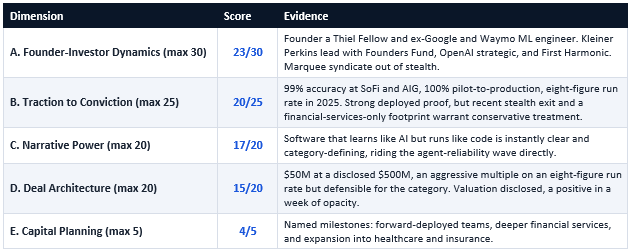
Why this scored: The highest score of the week reflects the strongest deployed-proof profile in a thin field. Poetic, formerly Forge, is not another autonomous agent. It is a deterministic execution engine that runs high-stakes processes with the reliability of code. The proof is verifiable in diligence: ninety-nine percent accuracy executing fraud investigations end-to-end at SoFi within five weeks; ninety-nine percent accuracy on a complex, multi-hour process at AIG; a one-hundred percent pilot-to-production conversion rate; and an eight-figure run rate reached in 2025 with a tiny team.
The Setup: Led by Kleiner Perkins, with Founders Fund, First Harmonic, and OpenAI participating, Poetic emerged from stealth this week at a $500M valuation. Founder and CEO Markie Wagner, a Thiel Fellow and former machine-learning engineer at Google and Waymo, built the company after watching AI systems that looked impressive in demos fall apart in real operations. Rather than deploying a model that reasons autonomously, Poetic built a proprietary programming language that lets operators describe complex workflows in natural language, then converts that logic into deterministic, near-tokenless execution that is controllable, auditable, and repeatable at scale.
The Numbers: $50M Series A at a $500M valuation, led by Kleiner Perkins. Ninety-nine percent accuracy on processes that large enterprises had failed to automate for decades. At SoFi, end-to-end fraud investigations were 99% quality within 5 weeks, with 100% process adherence reported as it scaled. At AIG, 99% accuracy in a complex, multi-hour process. One hundred percent pilot-to-production conversion. An eight-figure run rate was reached in 2025. Use of funds: expand forward-deployed teams, deepen financial services, and move into healthcare and insurance.
Fundability Lessons: Poetic is the reliability-over-autonomy template. First, sell the error rate, not the autonomy, because in regulated workflows, accuracy is the product. Second, name the customer where you hit the number, because SoFi and AIG turn a claim into a reference. Third, show conversion, because a one-hundred percent pilot-to-production rate tells an investor the product survives contact with real operations, which is the single hardest thing to fake.
Your Takeaway: If you build agentic or enterprise AI, frame your value as a before-and-after in accuracy and labor, attach a named customer, and show that pilots convert. The market this week paid a $500M valuation for an AI that runs like code and showed the receipts at two Fortune 500 financial institutions.
The Founder Mistake to Avoid: Founders pitch an agent who assists as autonomous. The mistake is selling a copilot that creates review work while claiming to remove it. Poetic scored because it executes end-to-end, logs every action, and books the accuracy number. An agent that still needs a human to check every output is a feature, and it will not be clear at this multiple.
Edge Markets
Banking and Payment Rails for Prediction Markets | Series A | $29.2M | Valuation Undisclosed
Eisen Fundability Score: 71 / 100
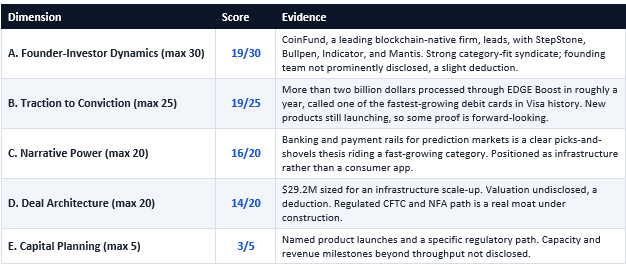
Why this scored: Edge is the regulated-rail play of the week. It does not run a prediction market. It moves the money in and out of them. The proof is in the throughput, not a pitch: its EDGE Boost debit program processed more than two billion dollars in transactions in roughly a year, which the company calls one of the fastest-growing debit card programs in Visa history. The score reflects strong deployed usage, an undisclosed valuation, and products that are still launching.
The Setup: New York-based Edge Markets builds banking and payment products for the gaming, crypto, and prediction markets sectors. The $29.2M Series A was led by CoinFund, with Indicator Ventures, Mantis VC, StepStone Group, and Bullpen Capital. The capital funds two new products: EDGE Pro, a high-throughput banking platform that enables market makers to make real-time deposits into CFTC-regulated exchanges, and EDGE Connect, a purpose-built payment rail that the company says cuts transaction costs by more than 70%. The wedge is the plumbing problem: getting funds in and out of venues like Kalshi and Polymarket fast enough to keep up with real-world events.
The Numbers: $29.2M Series A led by CoinFund. EDGE Boost has processed more than two billion dollars in transactions since its launch about a year ago. A compliant crypto-to-USD conversion path built with ZeroHash. EDGE Connect is targeting a seventy percent reduction in transaction costs. A pending National Futures Association path as an introducing broker and futures commission merchant. Use of funds: launch EDGE Pro and EDGE Connect and pursue the regulated licensing that the single-account model depends on.
Fundability Lessons: Edge is the own-the-rail template. First, sell throughput, because two billion dollars already moved is a fact a partner can verify, not a forecast. Second, anchor to a regulated path, because CFTC and NFA alignment is a barrier that a faster competitor cannot shortcut. Third, position underneath a hot category rather than inside it, because every prediction-market app needs to move money, and Edge wants to be the layer they all route through.
Your Takeaway: If your category is having a gold rush, ask what the miners must buy. Owning the regulated rail beneath a hot application layer is a stronger fundability claim than owning one more app, because the rail compounds across every competitor in the category.
The Founder Mistake to Avoid: Founders chase the visible app in a hot category, only to end up in a crowded, undifferentiated race. The mistake is building the storefront when the durable value is in the plumbing. Edge scored on two billion dollars of throughput and a regulated path, not on a consumer interface. If your category has a payment, data, or compliance bottleneck, owning it beats competing on top of it.
Jedify
Context Graph Infrastructure for Enterprise AI Agents | Series A | $24M | Valuation Undisclosed
Eisen Fundability Score: 69 / 100
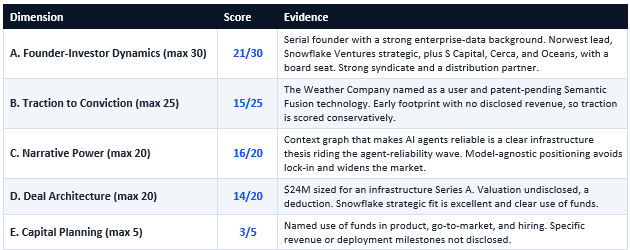
Why this scored: Jedify is the scarce-input play in enterprise AI. It sells the trusted business context that AI agents need to be accurate, the layer every serious agent deployment must consult. The proof is a strategic Snowflake investment and a named enterprise user, The Weather Company, running on its graph. The score reflects a strong infrastructure thesis and an elite syndicate, despite an early footprint and undisclosed revenue.
The Setup: New York-based Jedify, led by serial founder Assaf Henkin, builds an autonomous context graph that fuses an enterprise’s structured data, from warehouses, CRMs, and financial systems, with its unstructured knowledge, from documents, playbooks, Slack, and meeting recordings. Its patent-pending Semantic Fusion technology turns that fragmented knowledge into a continuously updated graph that captures business definitions, relationships, permissions, and operational assumptions, so agents stop hallucinating and stop burning tokens. The platform is model-agnostic, which gives enterprises flexibility rather than lock-in.
The Numbers: $24M Series A led by Norwest, with a strategic investment from Snowflake Ventures and participation from S Capital VC, Cerca Partners, and Oceans Ventures. Total funding now over $33M, following an $8.5M seed in 2023. A Norwest partner joins the board. The Weather Company cited as running its agents and analysts on Jedify’s context graphs. Use of funds: accelerate product development, expand go-to-market, and grow the team.
Fundability Lessons: Jedify is the context-as-infrastructure template. First, sell the thing agents cannot work without, because trusted context is the bottleneck every enterprise AI deployment hits. Second, secure a strategic partner that owns adjacent distribution, because Snowflake Ventures is both a check and a channel into the data platforms where the context lives. Third, build a model-agnostic one, because in a world of interchangeable models, the durable value lies in the permissioned layer that sits above them all.
Your Takeaway: If you build AI infrastructure, own the layer that compounds across every model and every agent, rather than betting on a single application. A permissioned context layer that gets smarter with every interaction is a moat that a better model cannot erase.
The Founder Mistake to Avoid: Founders build a flashy agent and treat the data plumbing as an afterthought. The mistake is competing when models commoditize, rather than owning the context they all depend on. Jedify scored on a strategic Snowflake check and a named enterprise user, not on a demo. If your category has a context or data bottleneck, owning it beats building one more agent on top of it.
Golden Analytics
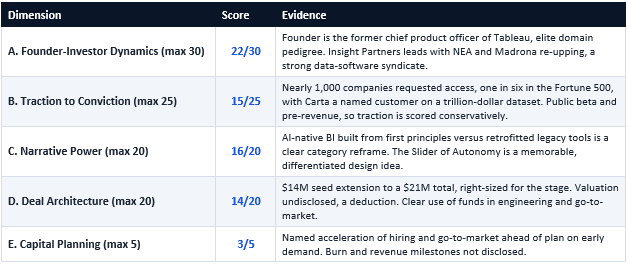
AI-Native Business Intelligence Platform | Seed Extension | $14M | Valuation Undisclosed
Eisen Fundability Score: 70 / 100
Why this scored: Golden is the AI-native-substrate play. It is not retrofitting AI onto a legacy BI tool. It is rebuilding business intelligence from first principles for the AI era. The proof is demand density: nearly a thousand companies requested early access within weeks of launch, roughly one in six of them in the Fortune 500, and Carta is already using it on a dataset representing more than a trillion dollars in investments. The score reflects an elite founder and backers against a public-beta, pre-revenue stage.
The Setup: Bellevue-based Golden Analytics raised a $14M seed extension led by Insight Partners, with NEA and Madrona re-upping, bringing total seed funding to $21M. The company is led by Francois Ajenstat, the former chief product officer at Tableau, which gives it a rare domain pedigree in the very category it is attacking. Golden surfaces insights, patterns, and visualizations the moment a user connects their data, and its Slider of Autonomy lets users choose how much the AI does versus how much they do, from manual exploration to fully automated dashboards, while staying in control.
The Numbers: $14M seed extension led by Insight Partners, total seed funding $21M. Emerged from stealth in April with a $7M seed from NEA and Madrona. Nearly 1,000 companies requested early access within weeks, roughly 1 in 6 of the Fortune 500. Carta was named as an early customer, analyzing a proprietary dataset representing more than $1.2 trillion in investments. Use of funds: accelerate hiring in engineering and go-to-market, ahead of schedule, on the strength of early demand.
Fundability Lessons: Golden is the rebuild-the-substrate template. First, attack a category from first principles rather than bolting AI onto an incumbent, because investors paid Insight to back a clean architecture, not a retrofit. Second, lead with demand density, because a thousand companies in line and a Fortune 500 mix is proof that the market is pulling. Third, let the founder's pedigree carry the risk, because an ex-Tableau CPO building the next Tableau is a story a diligence partner underwrites quickly.
Your Takeaway: If you are rebuilding an entrenched category for the AI era, show demand density and name a marquee early customer. A waitlist of 1,000 companies with a Fortune 500 skew is a stronger Series-stage proof than any feature comparison against the incumbent.
The Founder Mistake to Avoid: Founders pitch AI bolted onto a familiar product and call it a new category. The mistake is retrofitting when the opportunity is a rebuild. Golden scored because it started from first principles and drew a thousand companies before charging them. If you are merely adding an AI panel to an existing tool, you are competing on features rather than defining a category.
Evotrex
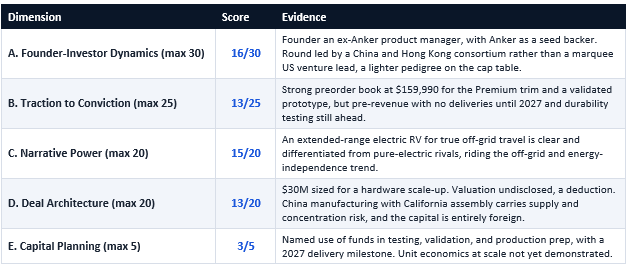
Hybrid Off-Grid Electric RV Platform | Series A | $30M | Valuation Undisclosed
Eisen Fundability Score: 60 / 100
Why this scored: Evotrex is the physical-product play, and the cleanest example this week of an order book standing in for deployed revenue. The Los Angeles startup is building an extended-range electric RV that pairs a battery pack with an onboard generator, solving the range problem that has kept pure-electric trailers off-grid. The score is the lowest of the deep dives because the company is genuinely pre-revenue: it has a validated prototype and a strong preorder book, but no deliveries until 2027 and a manufacturing dependency on China.
The Setup: Evotrex raised a $30M Series A, bringing total funding to $46M, from a consortium of investment firms in China and Hong Kong, including GSR United Capital, Forebright Concerto Capital, TTGG Ventures, and Pegasus Capital, with consumer electronics company Anker among its seed backers. Founder and CEO Alex Xiao, formerly a product manager at Anker, is pursuing an extended-range electric vehicle architecture rather than a pure electric one, arguing it is the practical bridge for off-grid travel. The flagship PG5 trailer debuted at this year’s Consumer Electronics Show after the company emerged from stealth in 2025.
The Numbers: $30M Series A, $46M total raised. Roughly ninety percent of the order book is for the fully loaded Premium trim at $159,990. A validated functional prototype, with ten to twelve months of durability and safety testing ahead. Planned deliveries in 2027 and an initial target of about 1,000 units per year. Manufacturing in China with final assembly in California. A telling operating choice: the first service employee was hired about six months ago, and the first sales employee only last month. Use of funds: complete development, automotive-standard testing, and production preparation.
Fundability Lessons: Evotrex is the demand-before-delivery template, with a clear caution attached. First, a strong preorder book at a real price point is a legitimate proof of demand for a hardware company that cannot yet show revenue. Second, hiring service before sales signals an operator who is building to support customers, not just to sell them, which lowers perceived execution risk. Third, an order book is not deployed revenue, and the score reflects that gap honestly.
Your Takeaway: If you build hardware, a priced preorder book and a validated prototype are the proof you lead with before deliveries exist. But be clear-eyed: until units ship and perform, your proof is demand, not outcome, and your valuation and moat are still being built.
The Founder Mistake to Avoid: Hardware founders pitch the vision and the spec sheet and bury the operational risk. The mistake is selling the product before you can show you can build and support it at scale. Evotrex scored where it did because the order book is real, but the deliveries, the durability data, and the supply chain are not yet proven. Lead with what is validated, and do not let the narrative outrun the build.
Fundraising Playbook: 5 Tactical Plans From This Week
Five plans, each producing a concrete output you can use immediately. No vague tasks. Each is built directly from this week’s verified signals.
1. The Reliability One-Liner (Positioning and Narrative)
Why this matters: Poetic and Jedify cleared by selling reliability and control, not autonomy. The market repriced the layer that makes AI trustworthy above the agent that acts on its own.
Deliverable: A single sentence that replaces your current pitch headline. Structure: we run the workflow that performs X with Y% accuracy, logging every action. It must name the process and a verified accuracy or outcome number, not a capability.
Time estimate: 2 to 4 hours, finalized before your next investor meeting.
Expected outcome: A headline that survives the first diligence question. Investors stop asking how autonomous your agent is and start asking how quickly you can scale a process that already works at 99%.
Reframe: Wrong approach: a fully autonomous AI agent for finance. Right approach: we execute fraud investigations end-to-end with 99% accuracy and a 100% pilot-to-production rate.
2. The One-Page Proof Stack (Traction and Metrics Packaging)
Why this matters: In a thin lane, every featured round led with deployed usage. Proof of usage stayed the seed, and Series A bar, and the thinness made it sharper, not softer.
Deliverable: A one-page proof stack with exactly four lines: units or accounts deployed, usage volume per period, the measurable outcome you changed, and retention or expansion. Numbers only, no adjectives.
Time estimate: 3 to 5 hours. If you cannot fill all four lines, the next two weeks should focus on generating the missing line rather than polishing the deck.
Expected outcome: A single artifact that converts a story-only deck into an evidence-led one. Edge could write two billion dollars processed. Reset could write 1.2 million members in pilot. You need your equivalent.
Reframe: Wrong approach: a roadmap slide of what the product will do. Right approach: a usage table of what it already does, at what volume, with what result.
3. Eisen Self-Score and Gap Diagnosis (Readiness)
Why this matters: This week’s deals clustered between 60 and 79. The gap between a fundable company and a fundable round was almost always a deployed number versus a promised one, the same two dimensions the score isolates.
Deliverable: Score your round across the five dimensions: founder-investor dynamics, traction-to-conviction, narrative power, deal architecture, and capital planning. Identify your lowest two dimensions and write one concrete action to lift each.
Time estimate: 2 to 3 hours, repeated before each raise.
Expected outcome: A ranked list of your two weakest dimensions, with a specific fix for each, so you can spend the next two weeks on the gap that is actually pricing your round down.
Reframe: Wrong approach: improve the pitch everywhere. Right approach: fix the lowest two scored dimensions and leave the rest alone.
4. The Strategic and Customer Anchor Map (Investor Targeting)
Why this matters: This week, strategics and customers anchored the hard rounds: Snowflake in Jedify, OpenAI in Poetic, Merck in Rejuvenate, and the credit unions that led Reset’s round outright.
Deliverable: A target list segmented by who brings channel, validation, or demand in your exact category. List every customer who could plausibly invest, and every strategist who owns adjacent distribution. For each, write the specific reason they would care and the warm path.
Time estimate: 6 to 10 hours of research, refreshed each quarter.
Expected outcome: A 10- to 15-name list led by strategics and customers who can underwrite your core risk or supply-demand risk, ahead of the generalists. Fewer educational meetings, faster conviction.
Reframe: Wrong approach: start with the famous generalists and add strategies later. Right approach: line up the strategic or customer who validates your hardest risk first, then let the generalists follow the signal.
5. The 90-Day Clone Test and Rail Build (Defensibility and Momentum)
Why this matters: The regulated rail and the scarce input beat the app again. Edge’s CFTC-aligned rails, Jedify’s permissioned context graph, and Golden’s AI-native substrate are barriers a competitor cannot clone in a quarter.
Deliverable: Run the 90-day clone test. Write down what a well-funded competitor could replicate in one quarter. Then name the single regulated rail, permissioned data layer, or scarce input you can build in the next two quarters that would fail that test, and make it your use-of-funds headline.
Time estimate: 3 to 5 hours, iterated against the question: what would a competitor with a better model need to replicate this?
Expected outcome: A defensibility statement tied to a fundable use of proceeds, so your round buys a moat rather than a runway.
Reframe: Wrong approach: our app is faster and better designed. Right approach: here is the regulated rail or permissioned data layer we own that a competitor cannot shortcut.
Looking Forward: Next 1 to 3 Weeks
Three evidence-based scenarios and one wild card. Predictions are anchored to this week’s verified data, not speculation.
Scenario 1: The Barbell Persists and the Mid-Market Stays Thin (High Probability)
Evidence: This week, the giant rounds soaked up the overwhelming share of capital while the US sub-$100M tier cleared just $166M across eight rounds, the thinnest in this series. The quarter’s read shows record dollars concentrating in a handful of platform bets.
What to watch: Whether mid-sized rounds, the classic Series B and growth checks, stay scarce in the weekly slates, and whether the seed and Series A rounds that do clear keep leading with usage metrics in the announcement rather than just amount and lead.
What founders should do: If you plan to raise in the mid-market this quarter, generate one more cohort of usage data before you open, and size your round to the thinner lane. A smaller round you can close on proof beats a larger round that stalls while the barbell holds.
Scenario 2: The Reliability Layer Keeps Outbidding Autonomous Agents (High Probability)
Evidence: Poetic and Jedify, the two strongest enterprise-AI rounds this week, both sold reliability and trusted context rather than autonomy, and both drew strategic capital from OpenAI and Snowflake, respectively.
What to watch: New rounds for AI evaluation, observability, deterministic execution, context and memory layers, and guardrails. Watch for accuracy and auditability figures to migrate into the headline, as Poetic led with 99%.
What founders should do: If you build agentic AI, audit your reliability story this week. Put your error rate, your auditability, and your pilot-to-production conversion on slide one. If you cannot, the next two weeks are about generating those numbers before the reliability premium prices you out.
Scenario 3: Customer and Strategic Capital Anchors More Early Rounds (Medium-High Probability)
Evidence: Reset’s round was led by the credit unions it serves; Jedify drew a strategic check from Snowflake; Poetic drew a check from OpenAI; and Rejuvenate paired its round with a Merck R&D collaboration. Where the risk was trust or distribution, the anchor came from a customer or a strategic.
What to watch: Early rounds where a corporate strategic or a marquee customer takes a lead or anchor position, and generalist names appear only as participants. Watch for buyers writing checks to lock in supply, distribution, or a product they depend on.
What founders should do: If your category is regulated, technical, or trust-dependent, build the strategic and customer pool now. Ask your best customers whether they would anchor before you approach a single generalist fund.
Wild Card: A Mid-Market Snapback as Giant-Round Capital Recirculates (Medium Probability)
Evidence: A barbell is rarely stable. When a handful of companies absorb tens of billions in a single week, the funds and angels around those deals are left with dry powder and fresh paper gains, which historically recirculate into the next tier within a quarter.
What founders should do: If you are raising soon, treat the current thinness as a window rather than a permanent state. Get your proof stack and your strategic anchors ready now, so that when mid-market capital snaps back, you are the first proof-led round in the inbox, not the founder still assembling the deck. The founders who are ready when the lane reopens set the terms. The ones still preparing take them.
The Bottom Line
The real insight is not the $166M total. It is that the total is intentionally small. With the giant rounds and IPO traffic removed, the market that actually prices your round did not just reprice; it thinned, and the proof bar migrated up and out of the sub-$100M tier. What was left still followed one rule: capital paid for documented usage and a reliable, owned layer, not for narrative or autonomy. Three conviction profiles took the thin week.
Profile 1: Reliability and execution. Poetic (79) and Jedify (69) sell the layer that makes AI trustworthy. Poetic runs high-stakes processes with 99% accuracy and full auditability. Jedify feeds agents the trusted context that stops them from hallucinating. The proof is the error rate and the named customer, not the autonomy.
Profile 2: Regulated rails and scarce inputs. Edge Markets (71) and Golden Analytics (70) own the substrate. Edge owns the compliant payment rails that move two billion dollars in and out of prediction markets. Golden owns the AI-native BI layer that a thousand companies lined up for. The proof is that competitors must route through them.
Profile 3: Strategic and customer-anchored builders. Reset (65) and Rejuvenate Bio (60) let the people who would know underwrite the risk. Reset’s customers led its round. Rejuvenate paired its raise with a collaboration with Merck. The proof is who anchored, and why.
Everything else competed for a smaller residual. The message is unmistakable. In a barbell week, the sub-$100M lane pays for reliability you can audit, a rail you own, or a strategic partner who validates you, and it pays only when you show the usage. Anything short of that waits for the lane to widen.
5 New Rules for Founders
Rule 1. The proof bar moved up, not down. In a barbell week, the strongest proof migrates into giant rounds, so the mid-market lane gets thinner and more selective. Lead with a deployed number or wait until you have one.
Rule 2. Sell reliability, not autonomy. In high-stakes AI, accuracy and auditability are the moat. Put your error rate and your pilot-to-production rate on slide one, and delete the word autonomous.
Rule 3. Proof of usage is still the seed and Series A bar. Units deployed, volume, outcome delta, and retention. A story-only deck gets delayed, not declined, and in a thin market, the delay costs more.
Rule 4. Let a strategic or a customer anchor the hard rounds. A smaller check from someone who can underwrite your core risk or supply your demand beats a larger generalist check. When your customers invest, the signal prices the round.
Rule 5. Own the rail, not the app. When the application layer commoditizes, value moves to the regulated rail, the permissioned data layer, or the scarce input every competitor must route through. Make owning it your use-of-funds headline.
4 Monday Actions
(1) Rewrite your one-liner. Replace your pitch headline with: We run the workflow that does X at Y percent accuracy, with every action logged. Name the process and a verified number.
(2) Build the proof stack. One page, four lines: units or accounts deployed, usage volume, outcome delta, retention. If a line is empty, that is your two-week priority.
(3) Map your anchors. List every customer who could invest and every strategist who owns adjacent distribution. Put the ones who can underwrite your hardest risk at the top, ahead of the generalists.
(4) Run the 90-day clone test. Write what a competitor could copy in a quarter, then name the regulated rail, data layer, or scarce input you will own next and make it your use-of-funds headline.
Your competitors are reading the same tape. In a thin week, the founders who lead with deployed proof and a strategic anchor own the small slice of attention that is moving. The ones who lead with narrative wait for the lane to widen, and negotiate against the bar when it does.
Research Methodology and Sources
Data collection period: June 8-14, 2026, with the bulk of verified primary disclosures clustered from June 8 to June 11. Verification standard: a minimum of two independent primary sources per featured deal, with company press releases and regulated newswires prioritized as anchor sources and at least one tier-one or specialist outlet per deal for corroboration. Eisen Fundability Scores are proprietary analytical estimates, not endorsements or investment advice. All dollar figures reflect announced primary capital at close unless noted.
Total deals tracked: 8 verified US mid-market rounds, approximately $166.2M in combined primary capital, every round under $100M. Editorial scope for this issue excludes giant rounds and public-market events by request.
Primary and Secondary Validation Sources
Anchor company and newswire sources reviewed for the featured deals include PRNewswire releases for Poetic, Edge Markets, and Golden Analytics; GlobeNewswire releases for Jedify, Lexful, and Evotrex; and BusinessWire releases for Reset and Rejuvenate Bio. Tier-one and specialist corroboration reviewed includes Bloomberg and Benzinga (Poetic), TechCrunch (Evotrex), GeekWire (Golden Analytics), CryptoBriefing (Edge Markets), CTech and Ynetnews (Jedify and PointFive context), Refresh Miami and ChannelE2E (Lexful), FinSMEs (Reset), and BioSpace (Rejuvenate Bio). Sector and macro context drew on the Tech Startups daily funding roundups for June 8 to June 11, as well as the Crunchbase and Carta market data referenced therein. Secondary corroboration drew on Pulse2, citybiz, TheSaaSNews, and additional trade outlets, each used only to confirm figures already anchored in a primary source.
Verification Notes
All eight featured rounds are rated HIGH source confidence, meaning each was confirmed by a company or lead-investor source plus at least one independent tier-one or specialist outlet. One valuation figure is disclosed and confirmed: Poetic at $500M. The roundup that surfaced several of these deals contained attribution errors that this fact-check corrected: Poetic is led by Kleiner Perkins, not co-led by Founders Fund, its founder is Markie Wagner, and its named customers are SoFi and AIG. All internal figures in this report, including the weekly total, average, median, chart values, and scorecard entries, were checked for arithmetic consistency before delivery. The eight tracked amounts sum to $166.2M, the average is $20.8M, and the median is $19.0M.
Research completion timestamp: June 14, 2026.
DISCLAIMER: This article is for informational and strategic intelligence purposes only. It does not constitute investment advice. The Eisen Fundability Score is a proprietary diagnostic within Fundables OS™, not a financial recommendation.
If this article was useful, share it with founders who are about to raise.
— Leon Eisen, 4x Founder, Venture Capitalist, and Creator of Fundables OS™