

In 2019, I had everything a pitch deck should have.
FDA clearance. Clinical validation. A patent portfolio. A wearable medical device company signing five new healthcare providers every month in an exploding remote patient monitoring market.
I sent the deck to dozens of investors over six months. Every deck was packed with clinical data, market projections, unit economics, and technical specifications. I assumed more data would create more interest. It had worked for me before.
It did not work. Meeting after meeting went nowhere. Conversations started warm and cooled by the following week. Competitors with weaker metrics and inferior technology raised millions while we burned runway. By the end of the year, we had laid off half the company, including engineers we had spent months recruiting.
The company was not the problem. The data was not the problem. I was speaking to the wrong brain.
That year taught me the most expensive lesson of my career. Fundraising is not a rational contest where the best company wins. It is a human decision made by people who are worried about their reputation, their partners, and their next fund. The founders who understand that raise faster, at better prices, from better partners. The founders who don’t keep polishing the deck.
If you are raising now, you know the sound of this. “Interesting.” “Keep us posted.” “Come back with more traction.” “We need a lead.” Then silence. You have a product. You have customers. Twenty meetings in, nobody is moving, and you are starting to wonder whether you just need more intros.
You don’t need more intros. Investors can’t fund what hasn’t been made fundable. Between your company and the money sits a layer most founders never see: Fundability. The rules that build it are what I call the Invisible Game.
In physics, the force that shapes the universe is invisible. Nothing pushes a planet around the sun. Nothing touches it. Mass bends the space around it, and everything nearby falls into orbit. We call that invisible force gravity.
Fundraising works the same way. Founders who close competing term sheets aren't pushing harder than everyone else. They have built mass: authority, proof, momentum, insiders who keep coming back. Capital bends toward them. The visible game is pushing. The invisible game is building gravity.
That is the goal of everything that follows. Not a better pitch. More gravity.
This post is the map. If you read one thing on Fundable Notes, read this.
Two Games, Same Market
Two ways to raise a round.
The Visible Game: more proof, more clinical data, more market projections, more unit economics, more technical detail.
The Invisible Game is a decision mechanism underneath: psychology, fundability, tonality, wording, momentum and charisma.
Here is the difference in practice. In my book, Invisible Game: The Secrets of the Term Sheet Magnet, I use a composite of two founders I see all the time. Both run B2B software platforms serving mid-market customers. Both sit at roughly $2M in annual recurring revenue. Both are raising a Series A to scale sales.
The first founder collects her thirteenth rejection in six months. Every one follows the same arc: a warm first meeting, sharp questions, genuine excitement, then a two-line email after the Monday partner meeting. She tells investors how badly she needs the money and how little runway is left. She thinks that creates urgency. It creates fear.
The second founder is juggling three term sheets. He is not pitching. He is running what he calls a selection process. He frames the round as capital to accelerate, not capital to survive. He mentions his path to profitability and a committed credit line. Four top-tier funds are evaluating him in the same two-week window, and each knows it.
Same market. Same traction. The second founder closes at roughly double the first founder’s best offer, within thirty days.
Then the first founder rebuilds her approach. Same business, same numbers. New positioning, new process, new sequencing. Her second attempt produces four term sheets, including two from funds that had already passed on her.
The business did not change. The system did.
That is the entire thesis of the Invisible Game. Most fundable companies fail to raise not because they lack potential, but because they misread how investment decisions are actually made. They optimize the wrong metrics. They tell stories that don’t move money. They hand control of the process to the investor. They react to feedback instead of shaping it.
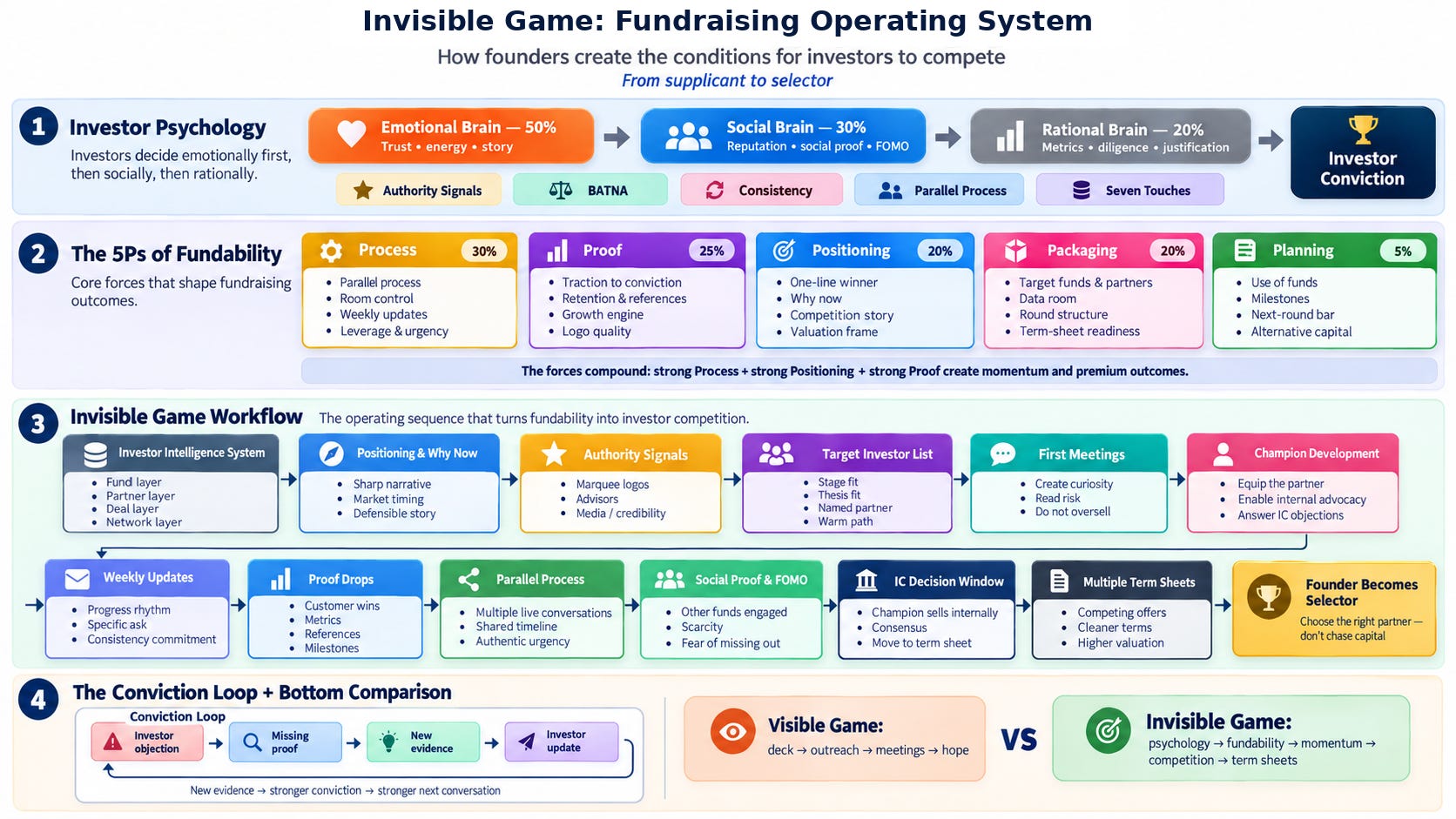
The operating system has four layers. Here they are.
Layer 1: Investor Psychology
Three brains, one decision
Every investor decision passes through three systems, in a fixed order.
The Emotional Brain, roughly 50% of the decision. It fires first. Within the first thirty seconds of a meeting, it runs what VCs privately call the ten-year test: could I work with this person for the next decade? It responds to energy, trust and story. It rewards passion without desperation, confidence without arrogance, vision without delusion. When it engages, the investor starts rooting for you. When it doesn’t, your best retention number becomes one more data point to cross-examine.
The Social Brain, roughly 30%. It asks a completely different question: will this deal make me look smart to my partners, my LPs and my peers? It is why a single marquee customer can outweigh pages of metrics. It is why competition between funds triggers bidding wars that defy the model. It reads authority signals, and it worries more about missing the next breakout company than about quietly backing a failure.
The Rational Brain, roughly 20%. It loves your cohort analysis and your payback period. It is the brain investors believe is in charge. It gets a fifth of the vote, and by the time it starts working, the real decision has usually been made. Its job is to justify what the other two already concluded.
Treat the percentages as a weighting model, not a brain scan. The point is the order. Emotional first, social second, rational last. Most founders build their entire raise for the last one.

Five levers that move all three
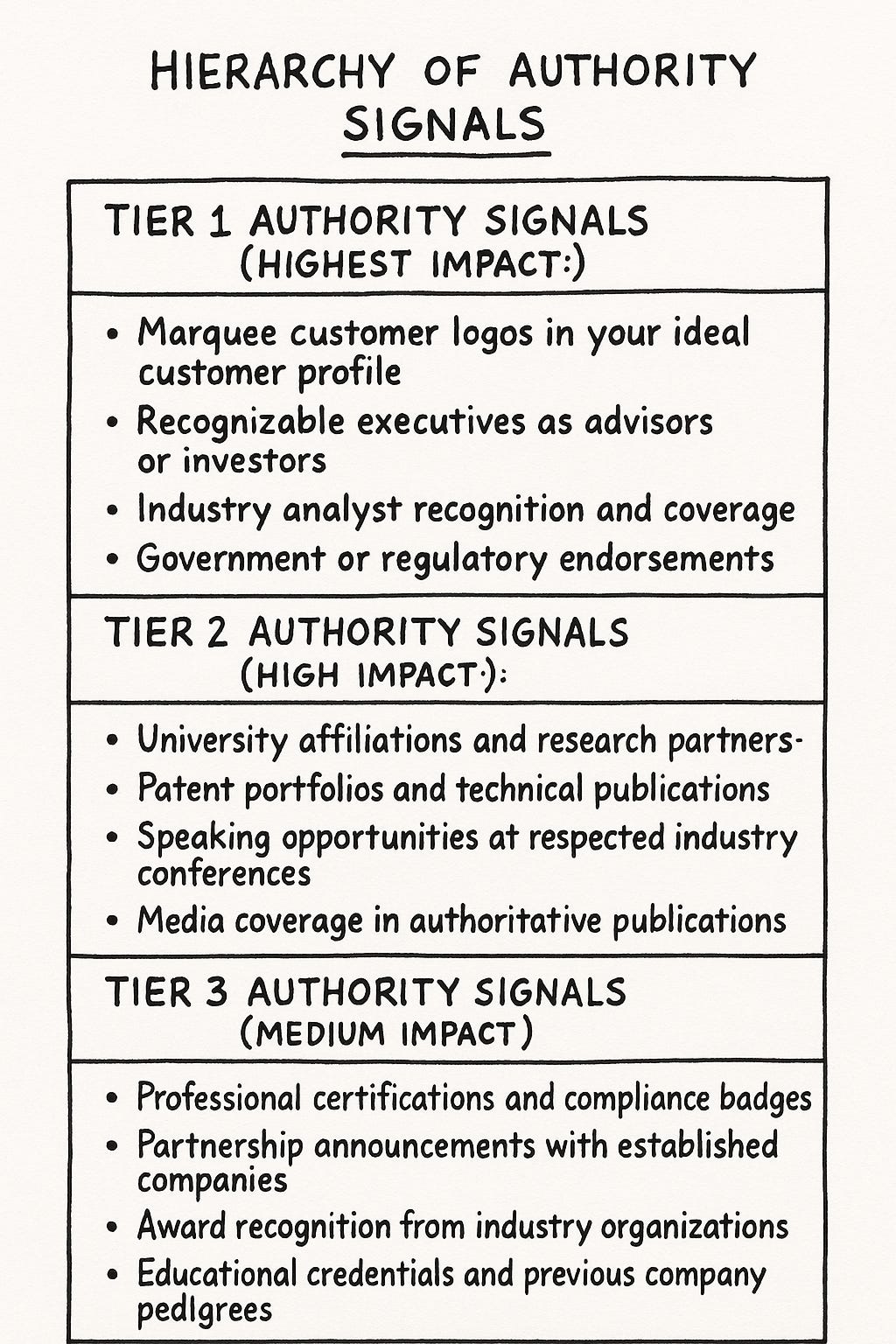
1. Authority Signals. Humans use shortcuts to make complex decisions fast. In venture, the most powerful one is authority: if a respected party validated this, it must be good. That is why one marquee logo in your ideal customer profile can move an investment committee more than a perfect model. Rank what you have. Tier 1 is marquee customers, recognizable executives as investors or advisors, and government or regulatory validation. Tier 2 is university partnerships, patents, and serious technical publications. Tier 3 is certifications and partnership announcements. The same heuristic that let Theranos borrow credibility from a board of former cabinet secretaries works honestly for you when the authority is real and relevant.
2. BATNA. Your Best Alternative to a Negotiated Agreement. Losses hurt roughly twice as much as equivalent gains feel good, and that asymmetry is the most reliable force in a negotiation. When an investor believes you have real options, such as extended runway, venture debt, revenue-based financing, customer prepayments or a strategic investor, their loss aversion activates. They stop evaluating whether to take the deal and start worrying about losing it. When you signal need, you activate their risk aversion instead. “We are raising to accelerate market capture” and “we need funding to survive” can describe the same company. They produce opposite outcomes.
3. Consistency. Once a person commits to a position, even a small one, they defend it. Every investor relationship climbs a ladder of micro-commitments. The partner asks for updates. Then asks detailed questions. Then they introduce you to a portfolio company, a public signal. Then brings in a colleague. Then presents you to the investment committee, with their reputation now on the line. Then drafts the term sheet. Each rung raises the psychological cost of saying no. Elite founders design that ladder deliberately.
4. Parallel Process. When an investor knows other quality funds are evaluating you at the same time, four things fire at once: social validation, scarcity pressure, competitive curiosity about what the others see, and fear of missing the company of the year. A parallel process also removes the Social Brain’s biggest fear: being the only one who backed you.
5. Seven Touches. Trust rarely forms in one meeting. Most people need around seven meaningful exposures to move from awareness to conviction. First meeting. Follow-up materials. Customer reference call. Team and product. Market and competition. Terms and partnership vision. Investment committee. Amateurs spread those over six months. Elite founders compress them into three to four weeks by giving each touch a real reason to exist.
The partner is not your decision maker
This is the mistake almost every founder makes. The partner across the table does not decide. The investment committee does. The partner is your internal salesperson, and their real question is not whether you are a good company. It is whether they can win the internal debate without looking naive, and how much of their limited political capital they should spend on you.
So stop trying to convince the partner. Equip them. Pre-empt the objections they will face in the room you are not in. Give them shareable evidence. Make references available within 48 hours. Arm them with the competitive picture that supports their thesis.
And understand how committees behave. The first valuation mentioned becomes the anchor for everything after it. Committees prefer consensus to controversy and will pass on a great company rather than split the partnership. One strong champion can carry several lukewarm partners, but one determined opponent kills a deal whose champion is weak. Build one real champion. Neutralize the likely opponent. Introduce your valuation logic early, before someone else anchors it.
Layer 2: The 5Ps of Fundability
After studying hundreds of fundraising processes, five forces kept appearing in every round that produced competing term sheets. They became the Fundables OS™, and each carries a different weight. The weights are the part founders find shocking.
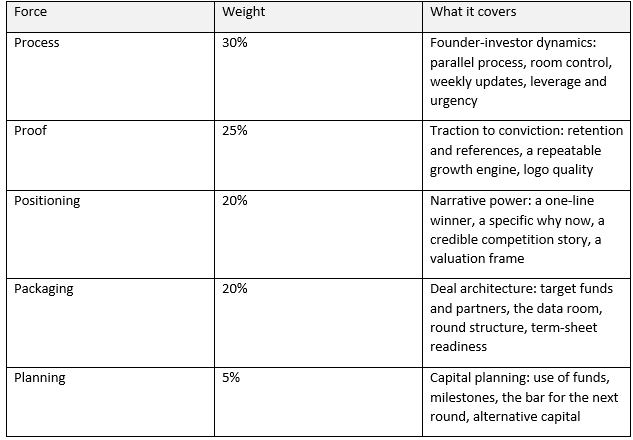
Process outweighs Proof. Read that again, because it breaks the most common belief in startups: that great companies raise themselves. They don’t. Great companies with poor process routinely stall, and average companies with superior process routinely close.
The forces compound
The 5Ps do not add. They multiply.
Proof × Positioning = Inevitability. Strong numbers with a weak story create interest without urgency. A great story with weak numbers creates excitement without confidence. Together they create the one feeling that moves capital: this company is going to win with or without me. That feeling changes the investor’s question from “should we invest” to “how do we get our allocation.”
Process × Packaging = Authority. Process control with sloppy materials looks amateur. Beautiful materials with no process control means the investor runs your timeline. Together they signal a founder who can execute.
Positioning × Process = Momentum. A great story without process fades as the timeline drifts. A tight process without a great story is efficient and cold. Together, they produce visible momentum that pulls in more investors on its own.
Founders who score 75 or above on the Eisen Fundability Score share one pattern. They are strong on at least four of the five forces, and Process is their defining strength.
Score yourself in five minutes: the Offer Power Index
The 5Ps tell you what to build. The Offer Power Index tells you whether your raise is actually ready to create competition. Score each item: 1 for yes, 0.5 for in progress, 0 for no.
1. Two or more serious lead candidates engaged inside the same 10-day window.
2. Weekly investor updates running, with a close deadline you have communicated.
3. 20 to 40% of the round soft-circled from insiders and angels before you open.
4. Three to five customer references ready to schedule within 48 hours.
5. Runway or alternative capital to cover 8 to 12 weeks of negotiation.
6. Valuation logic built on comparables, inside the presentation.
7. Your stance on board composition and option pool stated explicitly.
8. A tiered lead list with named partners and the recent deals each one led.
9. Your external milestones timed to land inside the close window.
10. Counsel on the calendar for 48- to 72-hour redlines.
Above 8, you are positioned for a premium outcome. Below 5, expect a long timeline and worse terms, regardless of how good the business is.
The market keeps proving it
I don’t ask you to take any of this on faith. Every Sunday, Fundable Notes publishes the weekly VC Market Intelligence Report and Playbook. It covers only the part of the market that prices your round: US mid-market rounds between $5M and $100M, no mega-rounds, no public market noise. We verify every deal against at least two independent sources across three passes, and we score every round on the Eisen Fundability Score.
The Invisible Game shows up in the data week after week. As an example, here is what the September 7 to 13 issue found across 24 verified rounds.
Consistency, measured. Sixteen of 24 rounds had at least one investor from a prior round writing again. Those sixteen averaged 61.7. The eight without a returning investor averaged 44.1. That is a 17.6-point gap, and 16.2 points of it survive after removing the sub-dimension that scores insider support directly. The people who watched you for twelve months are the only investors pricing information no diligence process can reproduce. That is the consistency ladder, fully climbed, and it is why item 3 on the Offer Power Index exists.
Authority, measured. Thirteen of 24 rounds carried strategic, corporate, or customer-side capital, moving 61.6% of the week’s money. One construction software company raised $12M with a general contractor’s venture arm on the cap table while that same contractor was a named customer. The investor was the buyer. It outscored rounds five times its size. That is the Social Brain at work: every other general contractor in the pipeline no longer has to be first.
External validation, measured. Five rounds carried a checkpoint controlled by an outside body: a regulatory clearance, a government contract vehicle, licenses granted by regulators. They averaged 65.4 against 53.3 for everyone else. Tier 1 authority signals, priced in real time.
BATNA, measured. Mid-market capital fell 16.8% that week, and deal count fell 16.0%. The median round rose 7.7%. Founders who read the headline and cut their ask handed back dilution to a market that didn't cut anything. The market got smaller, not cheaper. Knowing the difference is leverage.
The book explains the mechanics. The Sunday report measures them. Together they tell you what to change in your raise this week.
Layer 3: The Workflow
Psychology and the 5Ps tell you what matters. The workflow tells you what to do, in what order. Thirteen steps, from invisible to inevitable.
1. Investor Intelligence System. Four layers: fund, partner, deal, network. Partner-level intelligence matters more than fund-level, because individual decision-makers bring their own history, biases, and motivations. Roughly half the intelligence that actually changes outcomes comes from your network, not from public research.
2. Positioning and Why Now. A one-line narrative someone can repeat in a partner meeting you are not in. A why now built on a specific shift, not a trend.
3. Authority Signals. Assemble them before outreach. Logos, advisors, validations.
4. Target Investor List. Stage fit, thesis fit, a named partner, a warm path. No brand-only names.
5. First Meetings. Create curiosity. Surface the risks yourself. Never oversell.
6. Champion Development. Equip one partner to win the internal debate.
7. Weekly Updates. A fixed rhythm. One specific ask per update. Each one a rung on the consistency ladder.
8. Proof Drops. Release customer wins, references, and milestones across the process, not dumped in week one.
9. Parallel Process. Multiple live conversations on one shared timeline.
10. Social Proof and FOMO. Other funds engaged, real scarcity, real urgency.
11. IC Decision Window. Your champion sells internally, consensus forms, the deal moves to a term sheet.
12. Multiple Term Sheets. Competing offers, cleaner terms, better price.
13. Founder Becomes Selector. You choose the right partner. You stop chasing capital.
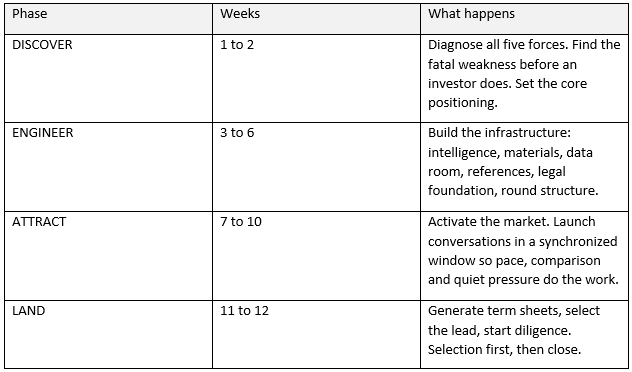
Twelve weeks, four phases: the DEAL Sprint
Most founders raise over six to eight months and lose momentum in month three. The DEAL Sprint compresses the workflow into twelve focused weeks.
Design scarcity into the round itself
Real FOMO is structural. It is built into how the round is designed, not performed in meetings. Compare two sentences.
The amateur: “We’re raising $2M to $3M for our Series A. We’d love to have you participate.”
The professional: “We’re raising $3M. $2M is allocated to our lead strategic partner, $750K to operators with customer networks, and $250K is reserved for our existing angels. We expect to be oversubscribed, and we’re selecting for strategic fit.”
Same company. Same money. The first sounds like hope. The second sounds like a partnership investors should compete to join.
One rule holds everything together: authentic scarcity beats artificial pressure every time. Running out of money never creates urgency. It creates desperation. A deadline with no business reason behind it reads as a tactic. Claiming other investors you don’t have is lying, and sophisticated investors spot it immediately. Urgency works when it comes from real product launches, real customer commitments, and real competitive timing.
Layer 4: The Conviction Loop
Every objection is information. Most founders treat it as rejection.
The Conviction Loop turns it into the next touch. An investor objects. You identify the missing proof behind the objection. You go get new evidence. You send it in your next update. New evidence creates stronger conviction, and stronger conviction creates a better next conversation. Run the loop three times, and the objection that nearly killed the deal becomes the reason the partner believes.
For objections in the room, use PIVOT.
Pause. A deliberate beat. It signals control, not hesitation.
Identify. Find the real concern under the surface question.
Validate. Acknowledge that the concern is legitimate. Respect is not surrender.
Offer. Give your view with evidence and reasoning, calmly.
Turn. Bring it back to your core advantage. That is the move from answering to leading.
A founder asked about competing with a giant does not defend. They widen the frame: the giant’s size is exactly why it cannot move fast enough on the specific workflow this company owns. The objection becomes the opportunity.
Three Levels of Fundraising
Every founder sits at one of three levels.
Level 1, product-focused. “Our product is great, investors should want it.” Features, technology, market size. Success depends on finding investors who get it instantly. Most first-time founders start here.
Level 2, metrics-focused. “Our traction proves we deserve investment.” Growth rates, unit economics, polished materials. Competent. This is where most founders plateau.
Level 3, psychology-focused. “We engineer the conditions where investors compete for allocation.” Process control, positioning, competitive dynamics. This is where elite founders operate, and the advantage compounds across every future round, because investors who experience a professional process become the advocates for your next one.
The jump from Level 2 to Level 3 does not require a better company. It requires a different operating system.
Do It Now
1. Call your existing investors first. Ask each one with a board seat or a meaningful position for a specific number in writing, and a yes or no on whether they would lead. Do it four weeks before you open. If they won’t re-up, you want to learn that now, from people who already take your calls.
2. Score your Offer Power Index. Ten questions, five minutes. Circle your two lowest items. Those are your next two weeks.
3. Rewrite how you describe the raise. Delete every sentence built on need. Replace it with what the capital accelerates and which alternatives you already have.
4. Map your champion’s battlefield. Write down the three objections your target partner will face in their committee. Build one piece of shareable evidence for each, before your first meeting.
What You Get When You Subscribe
Fundable Notes publishes three times a week.
Sunday: The Fundability Report. Every verified US mid-market round of the week, scored on the Eisen Fundability Score, with the market shifts that actually changed and exactly what to do about them in your raise. No news recap. A founder operating brief. Always free.
Wednesday: The Deep Dive. One fundrisisng framework, one deal pattern or one chapter of the Invisible Game taken apart in full. Alternates between free and paid.
Friday: The Strategy Essay. The thinking behind the system.
It is written for Seed to Series A founders raising in the next twelve months, and for angels and operators who want to see how the other side of the table reads a round.
Who Is Writing This
I’m Leon Eisen. I have been on both sides of the table.
I am a 4x founder. I founded Oxitone Medical, invented the first FDA-cleared wrist-worn pulse oximeter, and raised more than $20M for it, including the 2019 raise that taught me everything in this post the hard way. I hold a PhD in physics from the Weizmann Institute, which is probably why I see fundraising as a system of forces rather than a series of lucky meetings.
Today I am a Venture Partner at NetworkVC, where I read funding decisions from the investor’s chair, and President of Venture Growth Group, a venture studio. I built Fundables OS™ to help founders engineer fundability, investor access and round execution. Teams I have worked with have raised more than $100M. I host the Venture Growth Show, and I wrote Invisible Game: The Secrets of Term Sheet Magnet, the complete operating system behind everything above.
The Choice
You can keep playing the visible game. Perfect the deck. Send it wider. Wait for the investor who finally gets it.
Or you can learn the rules the best-funded founders already play by, and build the gravity that pulls investors into your orbit.
The invisible game stays invisible only to founders who choose not to look. Every Sunday, I’ll show you where it moved.
If this was useful, share it with a founder who is about to raise.
- Leon Eisen, 4x Founder, Venture Capitalist, and Creator of Fundables OS™