

Playbook, Perspective and Pattern for founders raising now. This report strips out giant rounds and public market traffic so you can read the part of the market that actually prices your round. Every round below was verified against at least two independent sources then re-checked in an adversarial pass aimed at date windows, amount composition, headquarters and returning-investor claims, and finally re-verified in a second full pass that checked every fact and recomputed every figure. This is the fourth issue scored on the v2 rubrics, so scores compare directly with the September 13, September 20 and September 27 issues and with nothing before them.
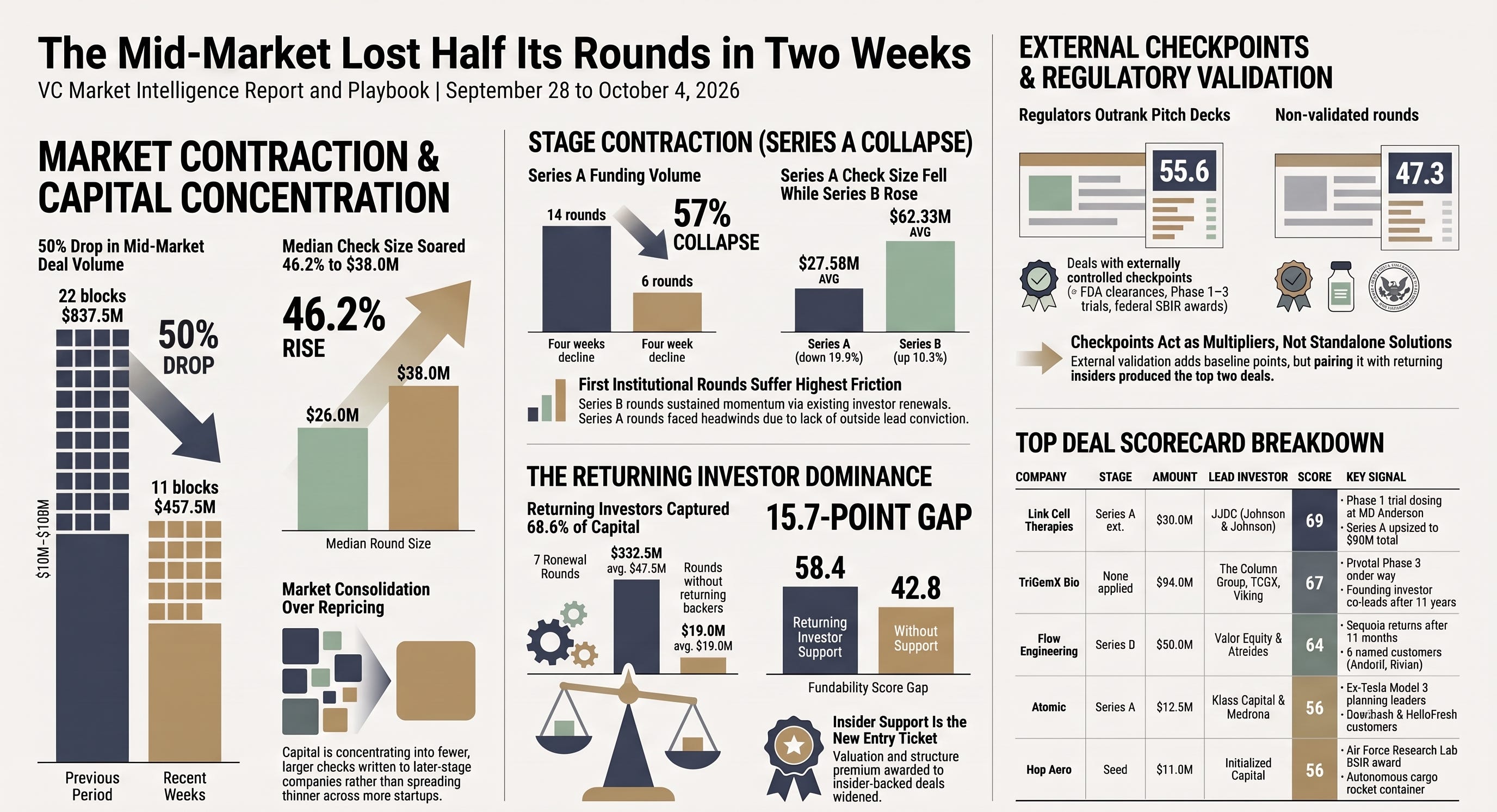
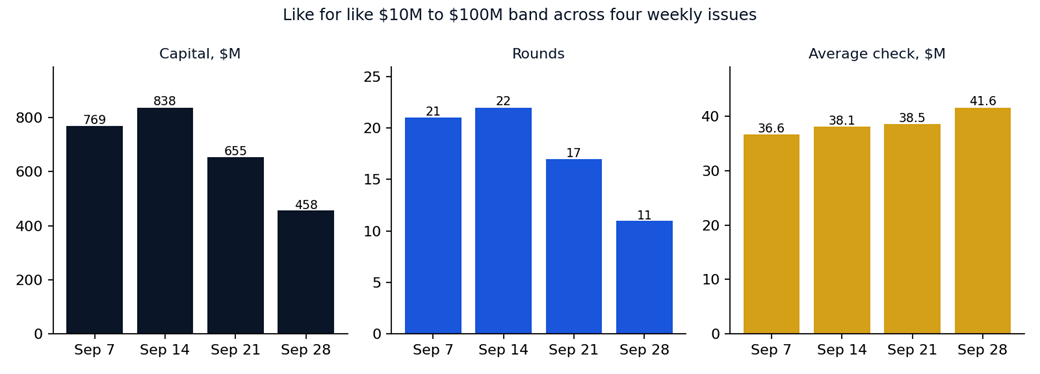
Two weeks ago the mid-market band held twenty-two rounds and $837.5M. This week it held eleven rounds and $457.5M. Half the rounds and 45.4% of the capital are gone in two issues, and the average check rose in each, from $38.07M to $38.53M to $41.59M. This week alone the median jumped 46.2%, from $26.0M to $38.0M, and deal count fell to the lowest level in the seven issues back to August 17.
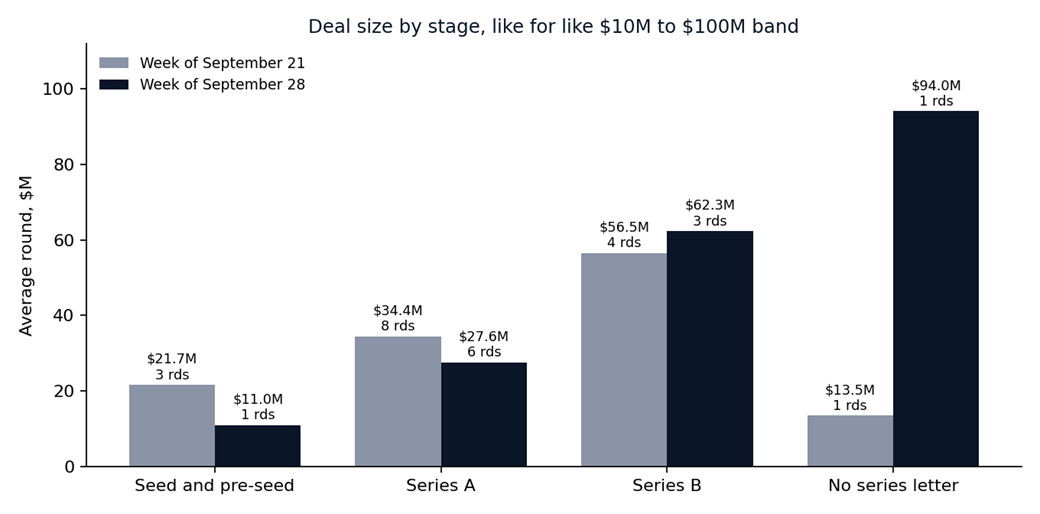
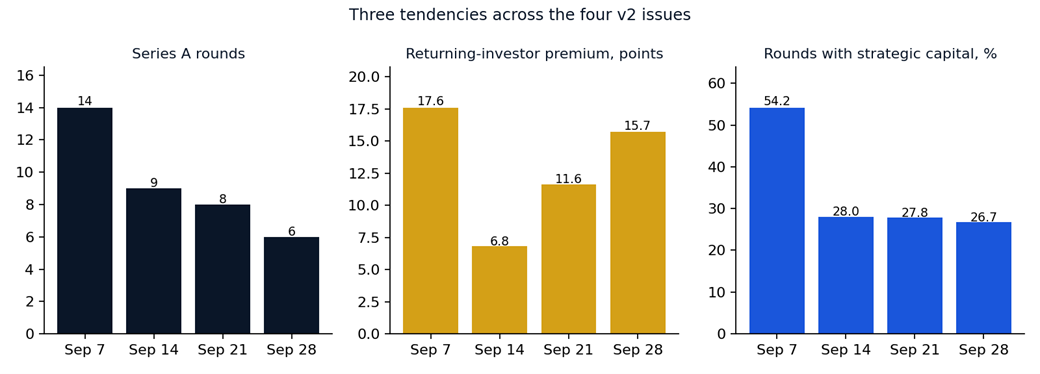
The shrinkage has an address. Series A produced fourteen rounds in the week of September 7, nine the week after, eight last week and six this week. It has fallen every week on the Series A. Series B held between two and seven rounds, and this week its average check rose to $62.33M while the Series A check fell to $27.58M.
This report has already shown that returning investors matter; the September 13 issue made them the headline. What is new is the direction. The share of rounds with a returning investor has sat between 44% and 48% for three issues, but the premium attached to it has widened twice in a row, from 6.8 points to 11.6 to 15.7 this week. The seven renewal rounds this week took 68.6% of capital at $47.5M a round. The eight rounds with no follow-on averaged $19.0M.
Consequence for Monday. The market is not closing. It is consolidating toward later, larger, insider-anchored rounds, and it is thinning fastest at the first institutional round. If you are raising a Series A this quarter, you are raising into the lane that lost more than half its rounds in four weeks. Before you put a number in a deck, find out whether anyone who has already wired you money will do it again, and in writing.
The Week in One Sentence
Primary insight. For a second straight week, the mid-market shed rounds faster than capital, the average check rose for a third straight week, and Series A fell for a third straight week to six rounds, leaving a market increasingly made of later, insider-backed rounds.
Total tracked mid-market capital, 15 verified rounds: $484.6M in new primary capital, every deal between $5M and $100M, every company US-headquartered, every announcement dated September 28 to October 2, 2026.
Like-for-like against the prior issue: $457.5M across 11 rounds in the $10M to $100M band, against $655.0M across 17 rounds. Capital down 30.2%, deal count down 35.3%.
Average round size: $32.31M across the full set, against $36.76M a week earlier. On a like-for-like basis, $41.59M against $38.53M, up 7.9%.
Median round size: $22.0M across the full set. On a like-for-like basis, $38.0M against $26.0M, up 46.2%.
Largest tracked round: Efficient Computer, a $97.0M Series B in energy-efficient processors. Smallest: F2 at $5.0M, a strategic investment from Golub Capital.
Rounds with a designated lead investor: 14 of 15, or 93.3%, against 17 of 18, or 94.4%, last week. Biotia is the only round without one, and three of its eleven named investors backed earlier rounds.
Rounds carrying strategic, corporate or customer-side capital: 4 of 15, or 26.7%, moving $180.0M or 37.1% of capital, against 5 of 18, or 27.8%, and 24.4% of capital last week. Efficient Computer, ai3Bio, Link Cell Therapies and F2.
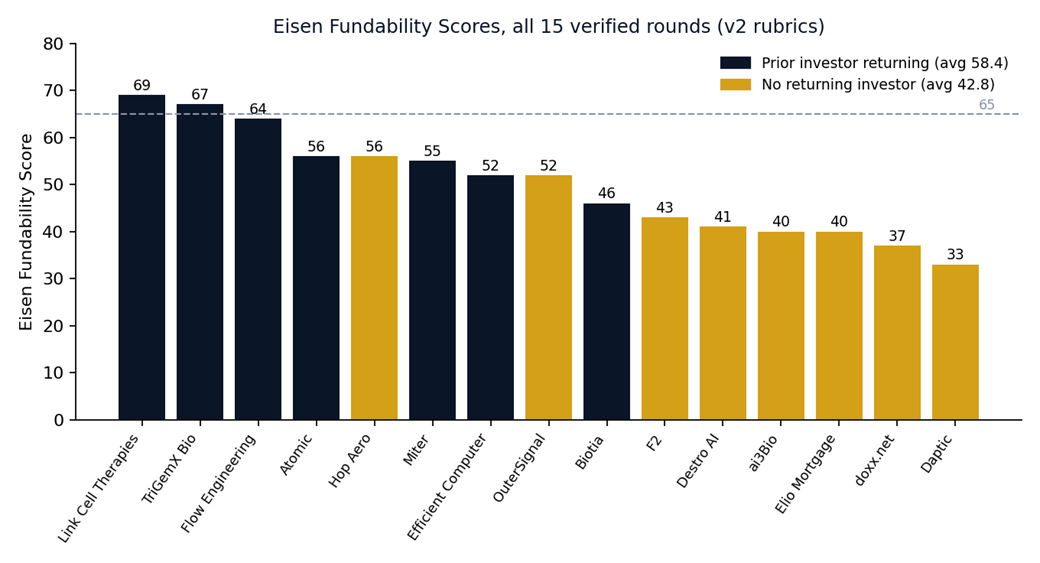
Rounds with at least one prior investor returning: 7 of 15, or 46.7%, against 8 of 18, or 44.4%, last week. Those seven averaged 58.4 against 42.8 for the eight without, a gap of 15.7 against 11.6 a week earlier.
Highest Eisen Fundability Score: Link Cell Therapies at 69. Lowest: Daptic at 33. A 36-point band, with 2 of 15 rounds clearing 65 and a mean of 50.1 against 56.7 last week.
Defining structural feature: Series A has fallen from fourteen rounds to six across the four v2 issues, while every Series B this week had a returning investor. The market is consolidating toward later-stage renewals.
Framework note: this is the fourth issue on the v2 rubrics. Capital, deal count, check size, stage, sector, geography and investor behavior remain comparable across the full series.
The Deal Scorecard
Eisen Fundability Scores are calculated across five weighted dimensions: Founder-Investor Dynamics (30), Traction to Conviction Conversion (25), Narrative Power (20), Deal Architecture (20) and Capital Planning (5). Scores of 90 and above signal an inevitable, market-defining outcome. Scores of 85 to 89 signal extremely strong execution. Scores of 75 to 84 signal solid fundamentals. Scores of 65 to 74 signal a good company with some gaps. Below 65 signals early-stage or structurally incomplete. Traction to Conviction measures only what third parties have already underwritten.
What the Scorecard Says at a Glance
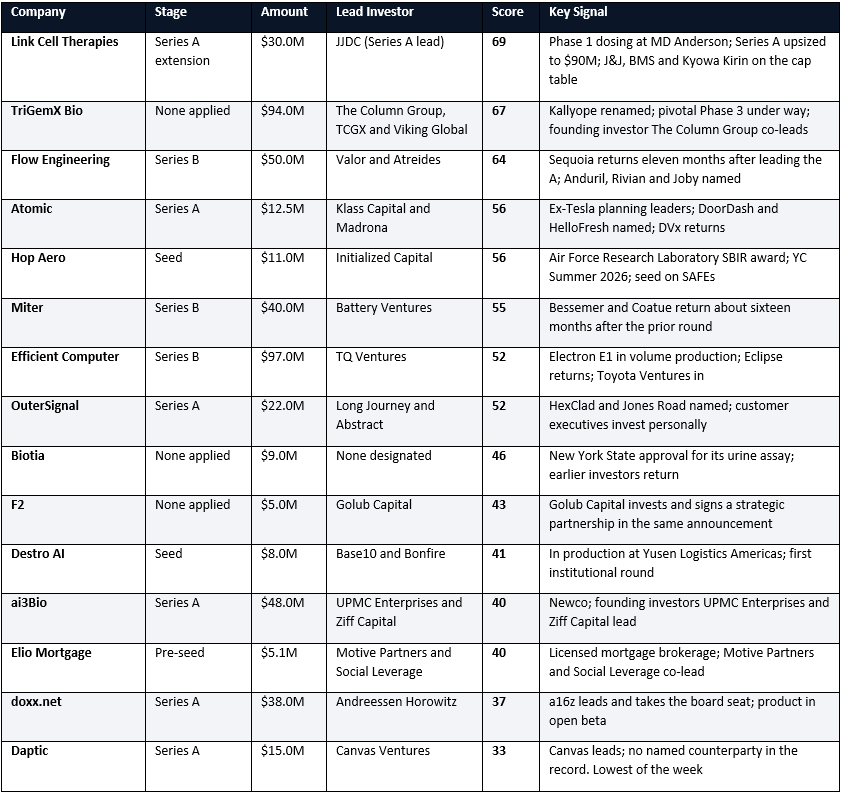
The top two rounds both had a clinic attached and an insider in the round. Link Cell Therapies at 69 began dosing patients in a Phase 1 trial at MD Anderson and upsized a Series A that Johnson & Johnson’s venture arm led nine months earlier. TriGemX Bio at 67 is running a pivotal Phase 3 and raised $94M with The Column Group, one of its 2015 founding investors, back in the lead seat. Only one other round has both a regulator-controlled checkpoint and a returning investor: Biotia, at 46, with New York State approval for its urine assay and earlier backers in the round. The difference is everything around those two facts. Link Cell and TriGemX built tier-one syndicates and sized their rounds to dated trials. Biotia raised $9M with no designated lead.
The best value in the set is an $11M rocket seed. Hop Aero has never flown untethered, and it scored 56, four points above Efficient Computer’s $97.0M Series B. The difference sits in one sub-dimension: Hop Aero carries an Air Force Research Laboratory SBIR award, so a federal buyer has already paid for its work. Efficient Computer, which ships a processor in volume, has no named counterparty in the record. Size and score stayed uncorrelated again. Atomic at $12.5M outscored ai3Bio at $48.0M by sixteen points.
The most expensive lesson costs $38M. doxx.net raised a Series A led by Andreessen Horowitz, with a partner taking the board seat, and scored 8 of 10 on Investor Quality. It scored 37 overall because no founder background is in the public record reviewed, no counterparty is named, and no prior investor is confirmed by two sources. A tier-one lead carries one sub-dimension. It does not carry a round.
The floor is structural. Daptic at 33 raised $15M from Canvas Ventures with no founder background located in the record reviewed and no named counterparty. doxx.net at 37 and ai3Bio and Elio Mortgage at 40 sit just above it. These are real companies with real money. The score measures how much of the transaction a new investor could reconstruct from outside, and at the bottom of the band are the amount, the lead, and a little around them.
Read the scorecard by color, not by rank. The seven rounds with a returning investor run from 46 to 69, and six of the seven score 52 or higher. The eight without run from 33 to 56, and only two of them, Hop Aero and OuterSignal, cleared 50. A returning investor did not guarantee a high score. Its absence nearly guaranteed a low one.
What Changed This Week: Five Market Shifts
Each shift is verified against multiple sources and ranked by structural impact on founder fundraising, not by deal size. Every shift ends with what it means for your raise next week.
Shift 1: Half the Rounds Gone in Two Weeks, and the Check Grew Every Week
Pattern, what happened. On a like-for-like $10M to $100M band, the mid-market has shrunk two weeks in a row. It held twenty-two rounds and $837.5M in the week of September 14, seventeen rounds and $655.0M in the week of September 21, and eleven rounds and $457.5M this week. That is half the rounds and 45.4% of the capital gone in two issues. Over the same weeks, the average check rose each time, from $38.07M to $38.53M to $41.59M, and this week the median jumped 46.2% to $38.0M. Geography broke pattern too: New York took seven of fifteen rounds and 32.6% of capital, while California fell to 27.0% after taking more than half of capital in each of the three prior issues.
Perspective, what it means. A capital pool can shrink in three ways. It can reprice, where the same number of companies split less money. It can narrow, where capital and company count fall together and the check holds. Or it can concentrate, where company count falls faster than capital and the surviving checks get larger. The week of September 7 narrowed. The last two weeks concentrated, and the second week concentrated harder than the first. That is a direction, not a blip: the partners still writing are writing fewer, larger checks, and they are writing them to companies further along.
Founder Blindspot, what most miss. Founders see a 46% jump in the median and read it as a hot market, a reason to push the ask up. The median did not rise because any given company was priced higher. It rose because smaller, earlier rounds dropped out of the queue two weeks in a row. If you set your number off this week’s median without asking which rounds produced it, you are pricing yourself against companies with an insider in the room and a later stage on the cover page.
Playbook, what to do. Before you set a number, answer two questions in writing. Has anyone who already funded you committed to fund you again? Does your company carry a fact that someone outside it controls, such as a clearance, a contract award or a license? Seven in ten dollars this week went to rounds that could answer yes to at least one of the two. If both answers are no, size the round to one dated milestone and run a short, targeted process.
Contrast. The week of September 7 narrowed, with capital and count falling together and the check flat. The week of September 14 grew on every size metric. The weeks of September 21 and 28 both shrank, and the average check rose in both. Two consecutive weeks of concentration, with the check up three weeks running, is the first sustained trend in this series that points in one direction.
What this means for your raise: The market is consolidating, not repricing. Expect fewer slots and larger checks, and price your round off the rounds that look like yours.
Shift 2: Series A Has Shrunk Every Week Since September 7
Pattern, what happened. Series A produced fourteen rounds in the week of September 7, nine in the week of September 14, eight in the week of September 21 and six this week, counting Link Cell Therapies’ extension. That is three consecutive declines and 57% of the lane gone in four issues. The average Series A check moved from $30.14M to $28.33M to $34.44M and now $27.58M, down 19.9% this week. Series B did not follow: two, seven, four and now three rounds, with the average check at $62.33M this week, up 10.3%. All three Series B rounds this week had a returning investor. Only two of the six Series A rounds did: Link Cell and Atomic.
Perspective, what it means. The first institutional round is where consolidation happens. A Series B is usually a renewal: an existing investor has watched the company for a year and a half and can anchor the next price. A Series A is more often a sale to someone new, and a market that is concentrating on companies it already knows has less appetite for the sale. Three weeks of falling Series A counts, with the Series B lane holding, is what that preference looks like in the data.
Founder Blindspot, what most miss. Series A founders read the weekly totals, see large rounds still clearing, and assume their lane is open. The large rounds are later-stage renewals. The Series A lane has narrowed every week, and four of this week’s six Series A rounds closed with no prior investor confirmed.
Playbook, what to do. If you are raising a Series A in the next quarter, get your seed lead’s participation decision before you open, size the round to the milestone the money buys rather than to a weekly average, and plan for a shorter target list of firms that led a Series A in your category in the last ninety days. If you are raising a Series B, velocity is your argument: Flow Engineering came back eleven months after its Series A and Miter about sixteen months after its last round, both at a larger size.
Contrast. Across the four v2 issues, Series A went 14, 9, 8, and 6 rounds, while Series B went 2, 7, 4, and 3. The gap between the average Series A and Series B check widened from $22.06M last week to $34.75M this week.
What this means for your raise: The lane you are most likely raising in is the one that has shrunk every week. Bring an insider, or bring a smaller and sharper round.
Shift 3: The Insider Premium Widened for a Second Straight Week
Pattern, what happened. Returning investors are familiar with this report. The September 13 issue made them the headline, when sixteen of twenty-four rounds had one and the gap was 17.6 points. What has changed since is the direction. The share of rounds with a returning investor fell to 48.0% in the week of September 14 and has held near that level since, at 44.4% and now 46.7%. The premium attached to it has widened twice in a row: 6.8 points, then 11.6, then 15.7 this week, or 14.5 once the Insider Support sub-dimension is removed. This week the seven rounds with a returning investor, Efficient Computer, TriGemX Bio, Flow Engineering, Miter, Link Cell Therapies, Atomic and Biotia, took $332.5M, or 68.6% of capital, at $47.5M a round, against $19.0M for the eight without.
Perspective, what it means. A stable share with a rising premium means the same proportion of companies is getting insider support, and the market is paying more for it each week. That is what scarcity of outside conviction looks like. When new leads write fewer first checks, a round anchored by someone who already knows the company clears at a larger size and with a stronger structure, and the gap between the two groups grows even though the groups stay the same size. Remove Founder Track Record as well as Insider Support, because five rounds whose founder backgrounds were not located all sit in the group without an insider, and the gap still holds at 11.1.
Founder Blindspot, what most miss. Founders who read the September 13 issue may have concluded that insider support was a one-week story. The trend says the opposite: it has become more valuable each of the last two weeks, while the number of companies with it has not grown.
Playbook, what to do. Four weeks before you open, ask every investor with a board seat or a meaningful position for a specific number above pro rata, and whether they would co-lead if a new lead prices the round. Get both answers in writing. If an insider says no, ask what would have to be true for them to write again, and write the answer down.
Contrast. Share of rounds with a returning investor across the four v2 issues: 66.7%, 48.0%, 44.4%, 46.7%. Score premium: 17.6, 6.8, 11.6, 15.7. The share settled in mid-September and the premium has climbed since.
What this means for your raise: If the trend holds for another week, an insider commitment is no longer an advantage in this market. It is the entry ticket to a full-size round.
Shift 4: A Checkpoint Opened the Door but Did Not Carry the Round
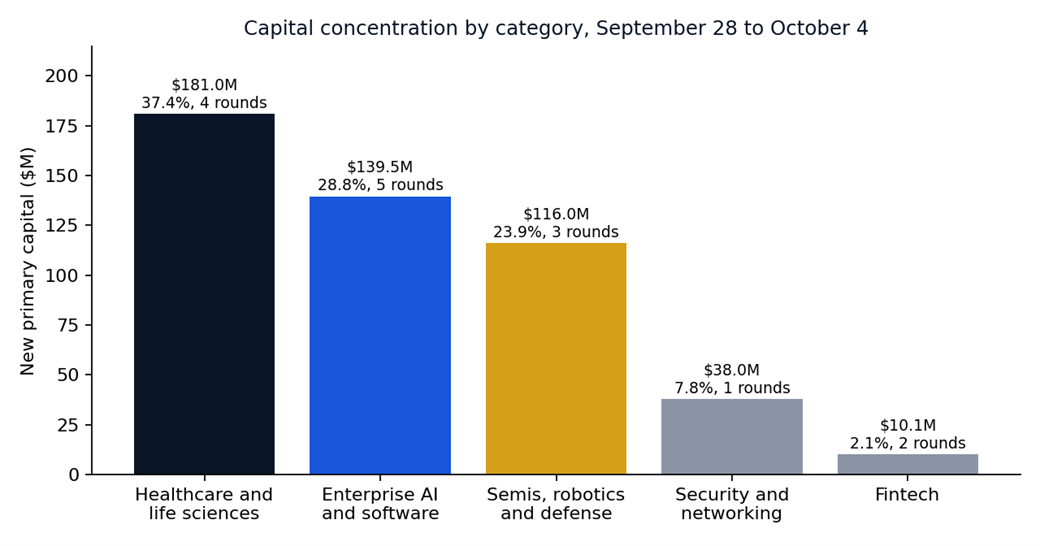
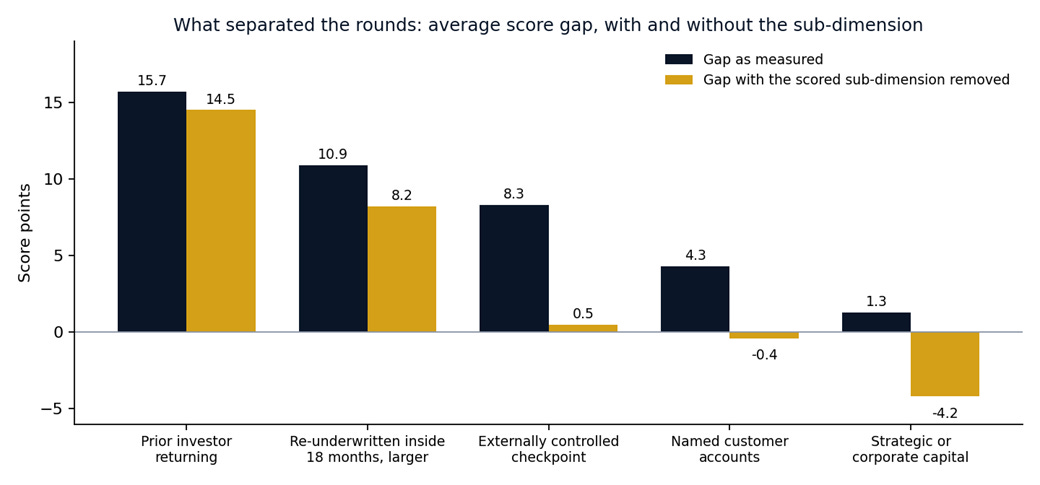
Pattern, what happened. Five rounds carried a checkpoint that an outside body controls: TriGemX Bio, running a pivotal Phase 3 of its lead migraine drug; Link Cell Therapies, which began dosing patients in a Phase 1 trial at MD Anderson; Hop Aero, which holds an Air Force Research Laboratory SBIR award; Biotia, whose urine assay is approved by the New York State Department of Health; and Elio Mortgage, which operates as a licensed mortgage brokerage. Those five averaged 55.6 against 47.3 for the other ten, an 8.3-point gap that falls to 0.5 once the Independent Validation sub-dimension is removed. Healthcare and life sciences took $181.0M across four rounds, or 37.4% of capital, up from 22.2% a week earlier.
Perspective, what it means. A residual of 0.5 means the checkpoint rounds were not stronger on anything else. The checkpoint bought its own points and almost nothing more. Split the five and the pattern is plain. TriGemX and Link Cell paired the checkpoint with a top-tier syndicate, a returning investor and a round sized to a dated trial, and finished first and second. Hop Aero paired it with a strong story and a credible seed lead and finished tied for fourth. Biotia and Elio had the checkpoint with much less around it and scored 46 and 40. An outside fact makes a round easier to underwrite. It doesn't replace the people and structure that make the round worth underwriting.
Founder Blindspot, what most miss. Founders who win a clearance or a license treat it as the round. It is one input. This week the market paid for a checkpoint when it arrived with an insider and a dated use of funds, and paid little for it on its own. Founders outside regulated categories make the opposite mistake and skip checkpoints entirely. Hop Aero scored 56 on an $11M seed, above Efficient Computer’s $97.0M Series B and Miter’s $40.0M Series B, because a federal buyer had already reviewed and funded its work.
Playbook, what to do. List every gate in your category that a third party controls: a regulatory clearance, an SBIR or other federal research award, a state license, a certification, a standards listing, a contract vehicle. Mark the one you could obtain in the next two quarters and assign an owner and a submission date this week. Then build the round around it: secure the insider commitment before you open, and size the raise to the next dated milestone the checkpoint unlocks.
Contrast. Last week the checkpoint gap was 11.0 with a residual of 5.4. This week the gap is 8.3 and the residual is 0.5. Healthcare rose from 22.2% of capital to 37.4%, and the two healthcare rounds at the top of the band combined a clinical checkpoint with a returning investor.
What this means for your raise: Get the outside fact, then build the round around it. On its own it is worth a few points. Paired with an insider and a dated milestone, it put two companies at the top of the week.
Shift 5: Corporate Money Has Lost Its Signal Over Four Weeks
Pattern, what happened. Four of fifteen rounds carried strategic, corporate or customer-side capital: Efficient Computer with Toyota Ventures, ai3Bio with UPMC Enterprises, Link Cell Therapies with Johnson & Johnson, Bristol Myers Squibb and Kyowa Kirin, and F2 with Golub Capital. That is 26.7% of rounds and $180.0M, or 37.1% of capital. Those four averaged 51.0 against 49.7 for the rest, a 1.3-point gap that turns into a 4.2-point deficit once the Customer-Side Capital sub-dimension is removed.
Perspective, what it means. Corporate capital is a multiplier on substance, not a substitute. Link Cell scored 69 because its pharma investors sat on top of a clinical checkpoint and a returning syndicate. F2 has the purest buyer-as-investor structure in the set: Golub Capital, a private credit manager, invested and signed a strategic partnership in the same announcement, which scores 8 of 8 on Customer-Side Capital. F2 still scored 43 because the rest of the record around it is thin. The strategic tells a new investor the product has a buyer. It does not tell them the company can raise the next round.
Founder Blindspot, what most miss. Founders chase a recognizable corporate name to compensate for a thin round, on the theory that the logo will carry the process. This week the logo carried nothing on its own. The corporate rounds that scored well had a checkpoint or an insider underneath the corporate check.
Playbook, what to do. If you take strategic money, attach a commercial agreement to it, as F2 did, so the investment is a receipt rather than a hedge. Then stack it on a second fact a new investor can verify: a returning investor, an outside checkpoint or a named deployment. Decide your position on right of first refusal, exclusivity and information rights before the strategic offers, not under a signing deadline.
Contrast. In the week of September 7, thirteen of twenty-four rounds carried strategic capital and the buyer-on-the-cap-table structure was worth 12.1 points, 6.4 after removal. The share has since fallen to 28.0%, 27.8%, and now 26.7%, and the separating power has gone with it.
What this means for your raise: A corporate check proves you have a buyer. It does not prove you have a round. Put it on top of something else.
The Deals That Matter, Top 5
Five deep dives across logic-gated cell therapy, a migraine drug in Phase 3, AI for hardware engineering, supply chain planning and defense logistics. These are the week's five highest-scoring rounds. All facts are verified against two or more sources.
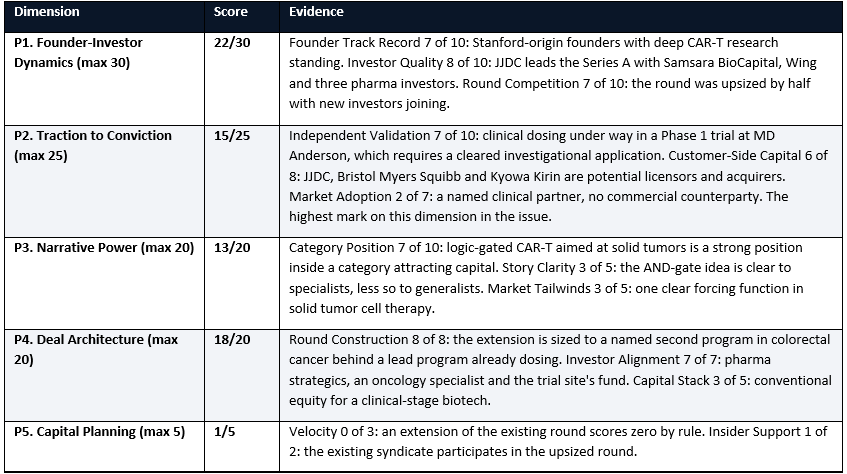
Link Cell Therapies
Logic-gated CAR-T for solid tumors | Series A extension | $30.0M | Series A led by Johnson & Johnson Innovation (JJDC)
Eisen Fundability Score: 69 / 100
Why this scored. The highest score of the week and the strongest Traction to Conviction mark in the set at 15 of 25. Link Cell is the only round that combines a regulator-controlled clinical checkpoint, three pharmaceutical companies on the cap table and a returning syndicate. It reopened its Series A on the strength of a dated external event, and new money came in as a result.
The Setup. Link Cell Therapies is a South San Francisco oncology cell therapy company founded in 2022 by Robbie Majzner, M.D., and Crystal Mackall, M.D., out of research at Stanford University. Its CAR-T cells are logic-gated: they are designed to activate only when they recognize a pair of antigens on a tumor cell, which should let a potent therapy attack solid tumors while sparing healthy tissue. The lead program, LNK001, is in a Phase 1 study at MD Anderson Cancer Center in advanced or metastatic clear cell renal cell carcinoma.
The Deal. A $30.0M expansion announced September 29, 2026, upsizing the Series A from $60M to $90M to advance a second solid tumor program in colorectal cancer and expand the pipeline, alongside first clinical dosing of LNK001 and three additions to the executive team. The original $60M Series A, announced December 15, 2025, was led by Johnson & Johnson Innovation through JJDC, with founding investors Samsara BioCapital and Sheatree Capital, Wing Venture Capital, and new investors including Bristol Myers Squibb, Kyowa Kirin, Sherpa Healthcare Partners, Western Technology Investment and the MD Anderson Cancer Focus Fund. Samsara and Sheatree led the 2022 seed. Seed and Series A together now total $122M.
The Pattern. This is the checkpoint-triggered upsize. Link Cell did not open a new round or raise a bridge. It went back into the round it had already priced, as it began dosing patients, and added $30M. The trigger was an event a regulator and a trial site control, not a date on the company’s calendar.
The Perspective. Look at who sits around the trial. The Phase 1 runs at MD Anderson, and the MD Anderson Cancer Focus Fund is in the syndicate. Johnson & Johnson, Bristol Myers Squibb and Kyowa Kirin are three companies that license and acquire oncology assets, which means the exit conversation started at the Series A. And the founding investors from 2022 are still in. Each party has a different reason to know whether the science works, and they're all on the same cap table.
The Playbook. Build the upsize into the original round. When you close a Series A ahead of a dated external milestone, such as first dosing, a clearance or a contract award, negotiate a right to extend the round at the same price for a set window after the milestone lands. You get a second close price before the good news, and new investors get a clear reason to come in. Then put the milestone and the extension in the same announcement.
The Founder Mistake to Avoid. Founders open an extension because they are running low on cash and call it momentum. The market reads that as a bridge, and the rubric scores it that way: an extension earns zero on Round-to-Round Velocity, which Link Cell took. What made this extension work is that it arrived with clinical dosing underway and new strategic names. Without the event, the same upsize reads as a company that could not raise its next round.
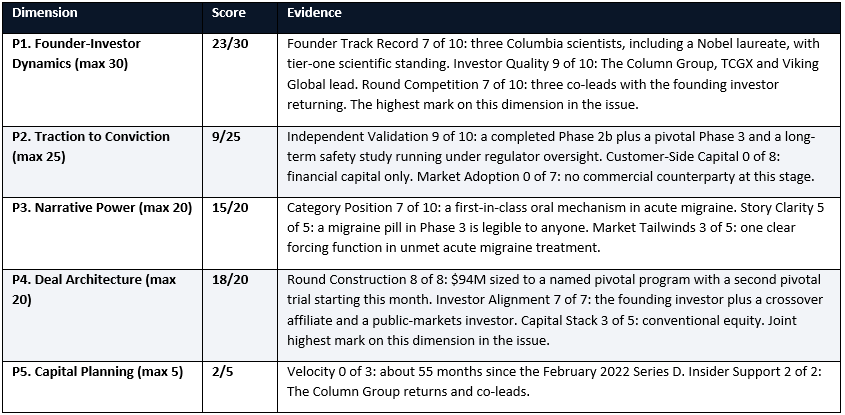
TriGemX Bio
Oral migraine drug in Phase 3 | No series letter applied | $94.0M | Led by The Column Group, TCGX and Viking Global
Eisen Fundability Score: 67 / 100
Why this scored. The highest Independent Validation mark in the set at 9 of 10 and the joint highest Deal Architecture mark at 18 of 20. TriGemX is the round with the most advanced external checkpoint of the week, a pivotal Phase 3, and it is led in part by one of the firms that funded the company’s first round eleven years ago.
The Setup. TriGemX Bio is the new name of Kallyope, the New York gut-brain axis company founded in 2015 by Columbia scientists Charles Zuker, Richard Axel and Thomas Maniatis and headquartered at the Alexandria Center for Life Science. The name refers to the trigeminal ganglion, the migraine-relevant structure where the drug’s target is expressed. The lead program, elismetrep, is an oral TRPM8 channel blocker for acute migraine. It reduced migraine pain and associated symptoms in a Phase 2b trial and was well tolerated. The company is running a pivotal Phase 3 and a long-term safety study and plans to start a second pivotal trial this month.
The Deal. $94.0M financing announced September 30, 2026, led by The Column Group, TCGX, and Viking Global Investors, with other investors, to advance elismetrep through Phase 3. Total equity raised since inception is $573M. The prior round was a $236M Series D in February 2022, co-led by Mubadala Investment Company and The Column Group. The Column Group was also in the company’s first financing, a $44M Series A in 2015 alongside Lux Capital and Polaris Partners. No series letter is applied to this round.
The Pattern. This is the reset round. A company more than four and a half years past its last financing renamed itself around a single late-stage asset and raised less than it raised last time, to fund one dated set of trials. It is the opposite of the platform story Kallyope told in 2022, and it scored well because it is the opposite.
The Perspective. The size went down and the underwriting got easier. A platform is hard to diligence from outside. A Phase 3 migraine drug with a Phase 2b readout behind it is a question a specialist can answer. Then look at who led. The Column Group has watched this company since 2015, and it came back to co-lead. TCGX, its crossover affiliate, came in alongside it, and crossover capital usually appears when a company is being prepared for a public-market path. Viking Global is a large public-markets investor. That is a syndicate assembled for the next financing, not just this one.
The Playbook. If your company has been private for years and its story has narrowed to one asset, rename and refocus around that asset before you raise, and size the round to the dated readout rather than to your last round. Then go to the investor who has known you longest and ask them to lead. A founding investor leading a late financing tells every new investor that the people with the most information still want more exposure.
The Founder Mistake to Avoid. Founders of older companies try to protect the size of their last round and keep pitching the platform, because a smaller round feels like an admission. TriGemX did the reverse and scored 67. The rubric penalized the 55 months since its last round with zero on velocity. It rewarded everything else, because a focused round with a dated pivotal trial and an insider lead is easier to underwrite than a large round with a broad story.
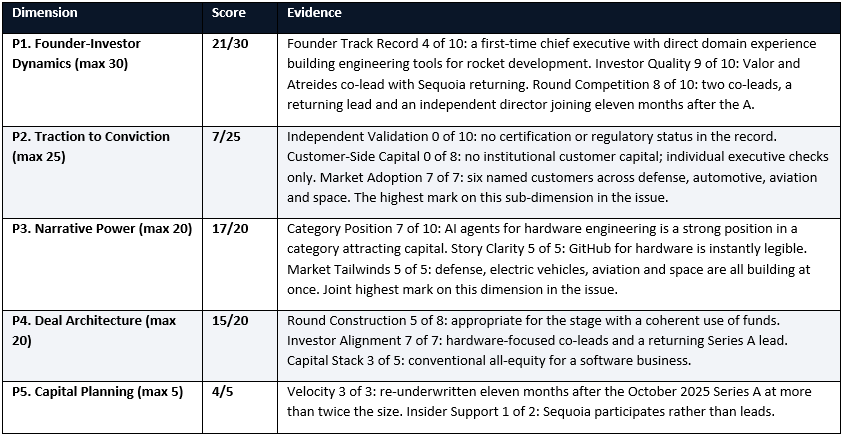
Flow Engineering
Agentic platform for hardware engineering | Series B | $50.0M | Co-led by Valor Equity Partners and Atreides Management
Eisen Fundability Score: 64 / 100
Why this scored. The strongest Market Adoption mark in the set at 7 of 7 and the joint highest Narrative Power mark at 17 of 20. Flow has six named customers across defense, electric vehicles, aviation and space, a returning Series A lead, and a Series B that arrived eleven months after the A at more than twice its size.
The Setup. Flow Engineering is a three-year-old San Francisco company whose AI agents automatically align CAD drawings with product requirements, simulation results, and test data- the verification work that slows down every hardware program. Chief executive Pari Singh founded the company in 2023, building on a tool he had developed to help design rocket engines. Named customers include Anduril, Rivian, Joby Aviation, GM PPU, a joint venture between General Motors and TWG Motorsports, RV Tech, the Rivian-Volkswagen joint venture, and Stoke Space.
The Deal. $50.0M Series B announced September 30, 2026, co-led by Antonio Gracias of Valor Equity Partners and Gavin Baker of Atreides Management. Sequoia Capital, which led the $23M Series A in October 2025, participated, alongside Human Capital, Evantic, SV Angel, Odyssey and EQT, with individual checks from Hugging Face co-founder Thomas Wolf, Mercedes-Benz chief information officer Jonas von Malottki and Formula 1 champion Nico Rosberg. Roelof Botha joined the board as an independent director and invested personally.
The Pattern. This is the customer-list round. Flow’s strongest asset is not its model; it is six named hardware companies across four segments whose engineers use the product, each one a reference call a new investor can make without Flow in the room. In a market that pays for what it can verify, a customer list spanning defense, automotive, aviation, and space is the software version of a regulatory checkpoint.
The Perspective. Look at the investor fit. Valor and Atreides both back capital-intensive hardware, which is exactly the kind of company Flow sells to. Sequoia stayed in after leading the A. An executive from an automaker also wrote a personal check. The syndicate reads like a map of Flow’s buyers and the people who fund them, which is why Investor Alignment scored 7 of 7. The round competition signal is strong too: two co-leads, a returning lead and an independent director joining, within a year of the last round.
The Playbook. Build a reference ladder before you open. List every named customer, the segment it sits in and the person who will take a reference call, and get their agreement in advance. Aim for at least three segments, because a customer list concentrated in one industry tells a new investor about that industry rather than about your product. Then hand the ladder to every new lead in the first meeting.
The Founder Mistake to Avoid. Founders with marquee customers lead with the logos and assume the round will follow. Flow’s customer list scored 7 of 7 and still left points on the table: no independent validation, no customer-side capital, and an insider who participated rather than led. A logo wall is one sub-dimension. If one of those customers’ venture arms had taken a position, Flow would likely have cleared 65.
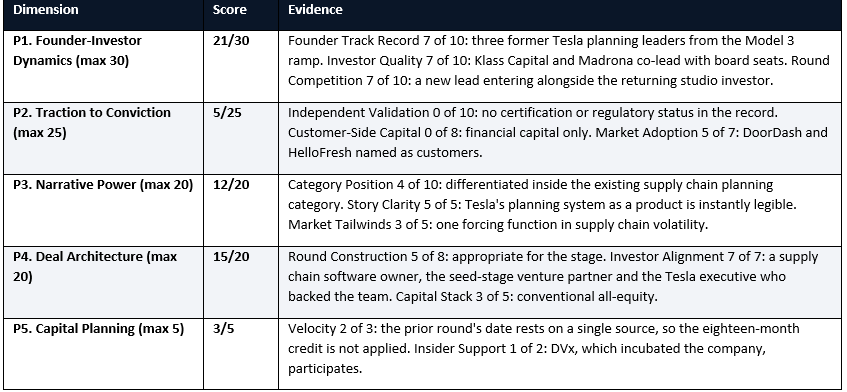
Atomic
AI-native supply chain planning | Series A | $12.5M | Co-led by Klass Capital and Madrona
Eisen Fundability Score: 56 / 100
Why this scored. A Founder Track Record mark of 7 of 10 on the smallest round in the top five. Atomic’s founders built the planning system for Tesla’s Model 3 ramp, two named customers run on the product, and the studio that incubated the company stayed on as two new board members.
The Setup. Atomic is a Boston company that sells supply chain planning software built by the people who ran planning at Tesla. Chief executive Michael Rossiter and chief product officer Neal Suidan led sales and operations planning during the Model 3 production ramp, and former Tesla planning director Jeff Goodrich has joined as chief technology officer and third co-founder. The software models supply-chain scenarios to decide how much inventory a company should hold and where, then recommends or executes a response. Customers include DoorDash and HelloFresh. DVx Ventures, founded by former Tesla president Jon McNeill, incubated the company.
The Deal. $12.5M Series A announced September 29, 2026, led by Klass Capital and Madrona. Adrian Schauer of Klass Capital and Matt McIlwain of Madrona join the board alongside Jon McNeill. Alumni Ventures, Sandberg Bernthal Venture Partners and DVx also back the company, and total funding is just over $15M. Klass Capital is a Toronto firm whose portfolio includes supply chain software company Nulogy.
The Pattern. This is the operator-pedigree round. The product is a system its founders already ran at scale inside one of the most demanding supply chains in manufacturing, and the people who can vouch for that, starting with Tesla’s former president, are on the cap table. The diligence question shifts from whether the team can build it to whether other companies will buy it, and two named customers start to answer that.
The Perspective. Klass Capital is the investor most founders would skip past and the one worth studying. A growth firm that already owns a supply chain software business brings a buyer network and a view of what the category pays for. Pair that with Madrona and with DVx staying in, and Investor Alignment scores 7 of 7 on a $12.5M round. The constraint is the Traction dimension: two named customers and no outside validation leave it at 5 of 25.
The Playbook. If your founding story is that you built this inside a tier-one company, make it checkable. Name the system and the scale it ran at, and get the most senior person who can vouch for it onto your cap table or your board before you raise. A former executive who saw the work is a reference a new investor will call first.
The Founder Mistake to Avoid. Two co-leads, each taking a board seat, beside a studio founder already on the board, is three investor-affiliated directors on a $12.5M Series A. Founders accept that structure to secure both leads and discover at the Series B that the board math is already set. Count your seats before you accept a second lead, and negotiate an independent seat if the investor side is growing faster than the company.
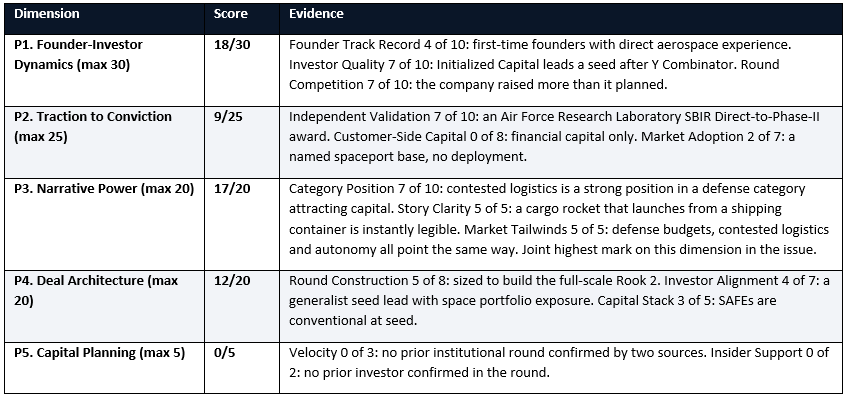
Hop Aero
Autonomous suborbital cargo rockets for defense logistics | Seed | $11.0M | Led by Initialized Capital
Eisen Fundability Score: 56 / 100
Why this scored. The joint highest Narrative Power mark at 17 of 20 and one of five rounds in the set with an externally controlled checkpoint. Hop Aero scored 56 on an $11M seed with no prior institutional round, above two Series B rounds of $40M and $97M, because a federal research program has already funded its work.
The Setup. Hop Aero, founded in 2024 and based in Southern California, is building Rook, an autonomous cargo rocket designed to launch from a standard 40-foot shipping container, fly a suborbital arc and land cargo hundreds of miles away in minutes. Its first target is defense logistics: carrying swarms of autonomous systems into contested environments and deploying them on arrival. Co-founders are chief executive Matija Milenovic and chief technology officer Jacob Balaj. The company has completed a tethered flight of a small-scale prototype at an Oklahoma spaceport and hot-fired its engine. It has not yet flown untethered.
The Deal. $11.0M seed announced October 1, 2026, after the company’s Y Combinator Summer 2026 batch, led by Initialized Capital and structured on SAFEs. The capital funds the development of the full-scale Rook 2. The company holds an Air Force Research Laboratory SBIR Direct-to-Phase-II award.
The Pattern. This is the government-validated seed. Most seed rounds rest on a team and a demo. Hop Aero’s rests on a team, a demo and a federal technical review that ended in an award, which means a defense buyer has already looked at the work and paid for more of it.
The Perspective. Look at what the award does to an early-stage defense round. A seed investor in defense is betting that a government customer will eventually pay. An SBIR award moves part of that bet from the future to the past. It doesn't prove the rocket works, and the company hasn't flown untethered yet. It does prove that the buyer the company is pitching has already engaged. That is why a $11M seed with no institutional history scored higher than two Series B rounds this week.
The Playbook. If you sell to government, apply for an SBIR or STTR award before you raise, and use Direct-to-Phase-II where your prior work qualifies. Map your product to a specific open topic, name the program office, and put the submission date on your fundraising calendar. The award is small next to a seed round, but it changes the question a new investor asks from whether the government will care to how fast it will buy.
The Founder Mistake to Avoid. An $11M seed on SAFEs, where the company raised more than it planned, defers the price to the Series A. Founders celebrate the oversubscription and forget that every uncapped or high-cap SAFE converts into dilution on the day the A is priced. Model the conversion at three Series A prices before you accept the last SAFE, and set the cap with the A in mind, not this week’s demand.
The Fundraising Playbook, Five Tactical Plans
Five plans, each producing a concrete artifact you can use immediately. Each is built directly from this week’s verified signals.
1. The Dated Milestone Headline (Narrative and Investor Framing)
Why this matters. The two highest-scoring rounds of the week each raised against one dated external event. TriGemX Bio raised $94M to run a pivotal Phase 3 with a second pivotal trial starting this month. Link Cell Therapies added $30M as it began dosing patients to fund a second program. Both scored 18 of 20 on Deal Architecture because the round and the milestone were the same sentence. In a concentrating market, a partner with less time per company backs the round whose purpose fits on one line.
Exact deliverable. Rewrite your deck’s first slide into one sentence of the form: this round buys [named milestone] by [date], and [named third party] decides whether we hit it. Then write a one-page milestone memo behind it: the milestone, the date, who controls the outcome, what it costs to get there, and what the company is worth to the next investor if it lands. If you cannot name a third party in the sentence, that is the gap Plan 2 closes.
Time estimate. Two hours for the sentence, three hours for the memo, one review with your most skeptical board member.
Expected outcome. A headline that converts your round from a request into a schedule. New investors can test it against a date rather than against your enthusiasm, and the milestone becomes the anchor for size and timing.
The reframe. Wrong approach: open with the category and the vision, and get to the milestone on slide twelve. Right approach: open with the milestone, the date and the third party who controls it, and let the vision explain why it matters.
2. Obtain One Externally Controlled Checkpoint (Proof Architecture)
Why this matters. Five rounds carried a checkpoint an outside body controls and averaged 55.6 against 47.3 for the other ten. The two that paired it with a returning investor and a round sized to a dated trial, Link Cell Therapies and TriGemX Bio, took the top two places. One of the five is an $11M rocket seed: Hop Aero holds an Air Force Research Laboratory SBIR award and scored above two Series B rounds of $40M and $97M.
Exact deliverable. A one-page checkpoint plan with four columns: the checkpoint, the body that grants it, the earliest realistic decision date, and the internal owner. List every candidate in your category, including SBIR and STTR awards, regulatory clearances, certifications, standards listings and government contract vehicles. Pick the one you can obtain fastest, assign the owner this week, and put the submission date on the same calendar as your raise. The deliverable is a plan to obtain the checkpoint, not a plan to announce it.
Time estimate. Three hours for the plan. Two to six months to obtain most checkpoints, which is why the clock starts now rather than when the process opens.
Expected outcome. One fact about your company that a new investor can verify without calling you. On its own, this week, a checkpoint earned little beyond its own points. The rounds that turned one into a top-two finish paired it with an insider and a dated milestone, so run this plan together with Plans 1 and 4.
The reframe. Wrong approach: build a case an investor has to accept on trust and hope the deck carries it. Right approach: count the facts about you that somebody else certifies, and go get one more before you open.
3. Eisen Self-Score and Gap Diagnosis (Readiness)
Why this matters. The band ran from 33 to 69 with a mean of 50.1, and only two of fifteen rounds cleared 65. Seven of fifteen scored below 50, and six of those seven raised without a returning investor. The market discriminated hard, and it discriminated on structure.
Exact deliverable. Score your round on the five v2 dimensions: Founder-Investor Dynamics (30), Traction to Conviction (25), Narrative Power (20), Deal Architecture (20) and Capital Planning (5). Mark your two lowest dimensions. Then apply this week’s test. Above 60, with a returning investor committed, run a competitive process now with a hard deadline. Between 45 and 60, fix the lowest dimension before you open, because that is where this week’s rounds without an insider sat. Below 45, the problem is structural: no insider, no checkpoint, no named counterparty. A better deck will not fix it.
Time estimate. Two to three hours, repeated before every raise and again after every insider conversation.
Expected outcome. A decision between a competitive process and a repair sprint, made this week rather than in month three of a process that is not converting.
The reframe. Wrong approach: score yourself, feel discouraged and rewrite the deck. Right approach: score yourself, name the two lowest dimensions, and choose between a process and a repair sprint before you book a single meeting.
4. The Insider Commitment Gate (Deal Architecture and Investor Targeting)
Why this matters. This is the highest leverage plan in the issue. Seven rounds with a returning investor took 68.6% of the week’s capital at $47.5M a round. Eight without one averaged $19.0M. The score gap was 15.7 points, 14.5 with the insider sub-dimension removed. Every Series B this week had a returning investor.
Exact deliverable. Three outputs, in this order. First, four weeks before you open, a written number from every investor with a board seat or meaningful position, above pro rata where they will go there, plus a yes or no on co-leading. Second, a new-lead target list built only after those answers are in, limited to firms that led a round in your stage and category in the last ninety days. This week’s mid-market leads included TQ Ventures, Valor Equity Partners, Atreides Management, Battery Ventures, Klass Capital, Madrona, Initialized Capital, Long Journey Ventures, Abstract Ventures, Canvas Ventures, Base10 Partners, Bonfire Ventures, Andreessen Horowitz, Motive Partners, Social Leverage, The Column Group and Johnson & Johnson Innovation. Third, a one-page term position on right of first refusal, exclusivity and information rights, decided before any strategic offers.
Time estimate. Two weeks of calendar for the insider conversations and four hours of preparation.
Expected outcome. You open with a floor under the round and a number to quote to new leads, or you learn three months early that the people who know you best will not write again, and why.
The reframe. Wrong approach: run the new-money process first and go back to insiders if it stalls. Right approach: get the insider number and the co-lead answer in writing before the first new-lead meeting, and quote it as the floor.
5. The Milestone-Linked Close (Momentum and Conversion Mechanics)
Why this matters. Link Cell Therapies reopened its round as clinical dosing began and added $30M with new investors. Flow Engineering returned to market eleven months after its Series A at more than twice the size. Both used an external event to create a reason to decide now. In a market where partners are concentrating, a dated reason to decide is what turns a second meeting into a term sheet.
Exact deliverable. A fourteen-day follow-up cadence tied to dated milestones. Day one, the first meeting with the milestone memo from Plan 1. Day four, a written update on one concrete item: a signed customer, a submitted application, a test result. Day eight, a reference call with a named customer or the insider who committed in Plan 4. Day eleven, a second update tied to the milestone date. Day fourteen, a stated decision date. If your milestone lands mid-process, negotiate a second close at the same price for a fixed window after it, and put the milestone and the close in the same announcement.
Time estimate. One afternoon to build the cadence, then thirty minutes per investor per update.
Expected outcome. A process that creates urgency from facts rather than pressure, plus a second-close option that lets new money enter after good news without repricing the round.
The reframe. Wrong approach: send a deck, wait for feedback, and follow up when you remember. Right approach: run every active investor on the same fourteen-day clock, and give each touchpoint a new fact rather than a reminder.
Looking Forward, Next 1 to 3 Weeks
Three evidence-based scenarios and one wild card. Every prediction is anchored to this week’s verified data.
Scenario 1: The Fourth Quarter Opens Concentrated (High Probability)
Evidence from this week. Band deal count fell to eleven, the fewest in the seven issues back to August 17, while the median check rose 46.2% to $38.0M. Rounds with a returning investor took 68.6% of capital. This was the last week of the third quarter, and the pattern is what a market looks like when partners are finishing commitments to companies they already know.
What to watch. Whether band deal count recovers above fifteen in either of the next two issues. If it does and the median falls back toward $30M, this week was quarter-end timing. If count stays near eleven and the median holds above $35M, concentration is the fourth-quarter regime.
What founders should do before others notice. Treat the next six weeks as an insider market. Run Plan 4 now, while your existing investors are setting their fourth-quarter reserves, rather than in November when those reserves are allocated.
Scenario 2: The Series A Lane Keeps Thinning (Medium-High Probability)
Evidence from this week. Series A has fallen every week on the v2 series, from fourteen rounds to nine, eight and now six. This week the six averaged $27.58M, down 19.9%, and four of the six had no returning investor. Every Series B had one, and the Series B check rose 10.3%. The gap between the two stages widened from $22.06M to $34.75M in one week.
What to watch. Whether Series A falls below six rounds for a fourth straight decline, and whether the rounds that do clear keep carrying a returning investor. Two more weeks of that pattern makes insider participation the price of a full-size Series A.
What founders should do before others notice. If you are raising a Series A in the next quarter, secure your seed lead’s participation decision this month, and build your use of funds around one dated milestone so a smaller check still reaches it.
Scenario 3: Clinical Checkpoints Keep Pulling Healthcare’s Share Up (Medium Probability)
Evidence from this week. Healthcare and life sciences took 37.4% of capital, up from 22.2%, and the two highest scores of the week were both clinical-stage companies that combined a regulator-controlled checkpoint with a returning investor. Checkpoints alone did not separate the field: the gap was 8.3 with a residual of 0.5, against 11.0 and 5.4 last week.
What to watch. Whether healthcare’s share stays above 30% in the next issue, and whether the rounds that carry it remain clinical-stage rather than discovery-stage. A rising share made up of clinical rounds is a verification trade. A rising share made up of discovery rounds would be a sector rotation, which is a different signal.
What founders should do before others notice. Outside healthcare, borrow the mechanism, not the sector. Identify the regulatory, certification or government award gate in your category and start the application before you start the raise.
Wild Card: The Reset Round Becomes a Template (Medium Probability)
Evidence from this week. TriGemX Bio raised $94M more than four and a half years after a $236M Series D, renamed itself around one asset, and scored 67 with its founding investor co-leading. The rubric charged it zero for velocity and it still finished second, because the round was easy to underwrite.
What to watch. Whether other companies with long gaps since their last round follow the same pattern: a new name or a narrowed story, a round sized to one dated readout, and a founding or early investor in the lead seat. Two or three more in the next month would make the reset round a recognizable financing category.
What founders should do before others notice. If your last round was more than three years ago, stop trying to protect its size. Rebuild the story around the one asset or product closest to an external milestone, size the round to reach it, and ask your longest-standing investor to lead.
The Bottom Line
The real insight is not the $484.6M. It is the direction. In two weeks, the mid-market lost half its rounds while the average check rose every week, Series A fell for the third week in a row, and the premium for a returning investor widened for the second week in a row. This week, seven renewal rounds took two-thirds of the money, and eight first-time or outside-led rounds averaged $19.0M. That produced three conviction profiles.
Profile 1: Somebody came back. TriGemX Bio (67) had The Column Group, one of its 2015 founding investors, return to co-lead. Flow Engineering (64) had Sequoia back eleven months after leading its Series A. Atomic (56) kept DVx, the studio that incubated it. Miter (55) brought back Bessemer and Coatue. Efficient Computer (52) had Eclipse, which backed it from the start. Link Cell Therapies (69) upsized a round its syndicate already held. Biotia (46) brought back investors from its earlier rounds. The seven averaged 58.4 against 42.8 for the eight without a returning investor.
Profile 2: Somebody outside the company had already said yes, and an insider was in the room. TriGemX Bio is running a pivotal Phase 3. Link Cell Therapies is dosing patients at MD Anderson. Both also had a returning investor and a round sized to a data-driven trial, and they took the top two places. Three other rounds carried an outside checkpoint without that full combination: Hop Aero (56) with an Air Force Research Laboratory SBIR award, Biotia (46) with New York State approval, and Elio Mortgage (40) as a licensed brokerage. Across all five, the checkpoint was worth its own points and almost nothing more, a residual of 0.5. The checkpoint opened the door. The insider and the structure carried the round.
Profile 3: Somebody re-underwrote fast and bigger. Flow Engineering raised a Series B eleven months after a $23M Series A, at more than twice the size. Miter raised $40M about sixteen months after a $23M round. The two averaged 59.5 against 48.6 for the rest, a 10.9-point gap that holds at 8.2 after removing the velocity sub-dimension.
Everything else competed for the residual. Eight companies raised with no returning investor, and the bottom of the band shares one shape: Daptic at 33, doxx.net at 37 and ai3Bio at 40 each closed with a capable lead, no named counterparty and nothing an outside body has validated. These are real companies with real capital. What the score measures is how much of the transaction a new investor could reconstruct, and here the answer is the amount, the lead and little else.
Five New Rules for Founders
1. A consolidating market is not a hot market. The deal count fell from twenty-two to eleven in two weeks while the average check rose every week and the median jumped 46.2% this week. The check rose because small and early rounds left the queue. Price your round off the rounds that look like yours.
2. Renewals get funded, sales get discounted. Seven rounds with a returning investor averaged $47.5M and scored 58.4. Eight without averaged $19.0M and scored 42.8. Get a written number and a co-lead answer from your insiders before you open.
3. Own one fact you do not control, then build the round around it. Five rounds carried an outside checkpoint. The two that paired it with an insider and a dated trial finished first and second, and the three that didn't averaged 47.3. A pivotal trial, clinical dosing, a state approval and an Air Force award all count. None of them carried a round alone.
4. A corporate check is a multiplier, not a substitute. Strategic capital this week separated nothing on its own, a 1.3 point gap that turns negative after removal. Attach a commercial agreement and stack it with another fact.
5. Come back fast and come back bigger. Series A has shrunk every week since September 7, from fourteen rounds to six. Every Series B this week had a returning investor, and the two re-underwritten inside eighteen months at a larger size averaged 59.5. If your next round is more than eighteen months away, the step-up has to come from a milestone.
Four Monday Actions
1. Call every investor with a board seat or a meaningful position. Ask for a specific number above pro rata and a written yes or no on co-leading, four weeks before you open.
2. Write your dated milestone headline. One sentence: this round buys a named milestone by a date, and a named third party decides whether you hit it.
3. Start one checkpoint application. Pick the SBIR award, clearance, certification or contract vehicle you can obtain fastest, assign an owner and put the submission date on your fundraising calendar.
4. Score yourself on the five dimensions and decide between a competitive process and a repair sprint before you book a single new-lead meeting.
Fifteen companies closed this week, and two-thirds of the money went to the seven whose investors came back. The other eight were not worse companies. They were strangers to the people writing checks. You can change that this week with two calls you have been putting off and one application you have not started. Founders who make them walk into the fourth quarter with a renewal, not a pitch.
Research Methodology, Sources and Verification
Data Collection Period and Verification Standard
Data collection period: September 28 to October 4, 2026. Every verified US mid-market round was announced between Monday, September 28 and Friday, October 2. No qualifying round was found for Saturday, October 3 or Sunday, October 4, and any round announced over that weekend carries into the next issue. Verification standard: a minimum of two independent sources per deal, with company releases, investor posts and regulated newswires prioritized as anchor sources, plus at least one independent outlet. Every round was then rechecked in an adversarial pass aimed at four failure modes: announcements recirculated from earlier weeks, headline amounts that blend new capital with earlier closes or debt, headquarters outside the United States, and returning-investor or prior-round claims that rest on a single source. A second full verification pass then re-checked every fact behind every score, corrected the record where it was incomplete, and recomputed all arithmetic from the final deal record. Eisen Fundability Scores are proprietary analytical estimates, not endorsements or investment advice.
Core Capital Totals and What They Include
The $484.6M weekly total includes only the fifteen verified US rounds in the scorecard, each confirmed at the stated amount. Mid-market is defined as a US-headquartered round of new primary capital between $5M and $100M. Week-over-week structural comparisons use the $10M to $100M subset that every recent issue has published: eleven rounds totaling $457.5M at an average of $41.59M and a median of $38.0M, against seventeen rounds totaling $655.0M at an average of $38.53M and a median of $26.0M in the week of September 21. The four rounds below $10M, totaling $27.1M, are included in the scorecard, the scores and the sector and geography analysis, and excluded from every week-over-week structural comparison, including every stage average quoted in this issue.
Debt facilities, secondary purchases, previously closed tranches, majority private equity investments, binding term sheets that have not closed, and announcements that do not separate new capital from earlier closes are excluded from the counted amount. Link Cell Therapies is counted at the $30.0M expansion, not at the $90M upsized Series A total. Hop Aero’s seed is structured on SAFEs and is counted as new capital raised in the window. Sector subtotals ($181.0M healthcare and life sciences, $139.5M enterprise AI and software, $116.0M semiconductors, robotics and defense, $38.0M security and networking, $10.1M fintech), stage subtotals ($187.0M across three Series B rounds, $165.5M across six Series A rounds including one extension, $108.0M across three rounds with no series letter, $19.0M across two seed rounds and $5.1M in one pre-seed) and state subtotals ($158.1M New York, $131.0M California, $97.0M Pennsylvania, $60.5M Massachusetts, $38.0M Florida) each sum to $484.6M across fifteen deals.
Scoring Calibration Notes
Founder Track Record is scored on the verifiable public record. Where no founder background was located in the sources reviewed, the sub-dimension scores zero, which applied to doxx.net, Daptic, Destro AI, Elio Mortgage and F2. All five sit in the group without a returning investor, so the returning-investor gap is published three ways: 15.7 as measured, 14.5 without Insider Support, and 11.1 without Insider Support and Founder Track Record. Rounds with no designated lead are scored on the institutional quality actually present, which gives Biotia 4 of 10 on Investor Quality across eleven named investors. Newly formed companies with no prior institutional round score zero on velocity by construction. Extensions score zero on velocity by rule, which applied to Link Cell Therapies. Where a prior round’s date rests on a single source, the eighteen-month velocity credit is not applied, which held Efficient Computer and Atomic at 2 of 3. Returning-investor status requires two sources, which is why doxx.net is not counted as having a returning investor, although one profile lists a participant as an earlier backer.
Circularity control. Where a finding rests on a scored sub-dimension, that sub-dimension is removed from both sides and the residual is published alongside the headline. Returning investor: 15.7 and 14.5. Externally controlled checkpoint: 8.3 and 0.5. Re-underwritten within eighteen months at a larger size: 10.9 and 8.2. Named customer accounts: 4.3 and negative 0.4. Strategic or corporate capital: 1.3 and negative 4.2. Every pair appears in Chart 5.
Deal Citations, Two or More Sources per Deal
Link Cell Therapies, $30.0M Series A extension. PR Newswire company release of September 29, 2026, on first clinical dosing and the upsize from $60M to $90M; FinSMEs, September 29; Fundz. Series A history from the PR Newswire release of December 15, 2025, Precision Medicine Online and The Pharma Letter. Rated HIGH.
TriGemX Bio, $94.0M, no series letter. BusinessWire company release dated September 30, 2026; Fierce Biotech fundraising tracker entry for October 1; AlleyWatch daily funding report of October 2. Prior financing history from the BusinessWire Series D release of February 2022, BioSpace and BioPharma Dive. Rated HIGH.
Flow Engineering, $50.0M Series B. TechCrunch, read through syndication; VC News Daily, September 30; FinSMEs, October 1; company Series B memo listed by startups.gallery. Series A history from Fortune, October 2025. Rated HIGH.
Atomic, $12.5M Series A. TechCrunch of September 29, read through syndication; FinSMEs, September 29; VC News Daily; Pulse 2.0; The SaaS News; Tech Funding News for the investor list. Rated HIGH.
Hop Aero, $11.0M Seed. Payload exclusive; FinSMEs, October 1; Fundz for the SAFE structure. Air Force Research Laboratory award from the company’s Y Combinator profile as summarized by YesPress, corroborated by RuntimeWire. Rated HIGH.
Miter, $40.0M Series B. PR Newswire company release of September 30, 2026, read through Construction Dive; Pulse 2.0; Unite.AI; Axios via startups.gallery. Prior round from Axios and Pulse 2.0, May 2025. Rated HIGH.
Efficient Computer, $97.0M Series B. Company release datelined Pittsburgh, September 29, 2026; Reuters; Pulse 2.0; Unite.AI. Rated HIGH.
OuterSignal, $22.0M Series A. AlleyWatch daily funding report of September 30; FinSMEs, September 30; VC News Daily; Pulse 2.0; company about page for founder background and named customers. Rated HIGH.
F2, $5.0M. FinSMEs, September 28, for the Golub Capital investment and strategic partnership; AlleyWatch daily funding report of September 29. Rated HIGH.
Destro AI, $8.0M Seed. AlleyWatch daily funding report of September 30; Tech Startups funding report of September 30. Rated HIGH.
ai3Bio, $48.0M Series A. FinSMEs, September 29; Startup Researcher; Fierce Biotech; Fundz. Rated HIGH.
doxx.net, $38.0M Series A. SaasRise deal record of October 2, 2026; FinSMEs; CB Insights company profile for the Miami headquarters. Rated MEDIUM.
Biotia, $9.0M. AlleyWatch daily funding report of October 1 and AlleyWatch feature; FinSMEs, October 1. Prior investors from the August 2022 Series A release, read through HIT Consultant and Patsnap Synapse. New York State Department of Health approval of the BIOTIA-ID urine assay from Clinical Lab Products, corroborated by YesPress. Rated HIGH.
Daptic, $15.0M Series A. AlleyWatch daily funding report of October 1; FinSMEs, October 1. Rated HIGH.
Elio Mortgage, $5.1M Pre-seed. FF News, September 29, 2026; AlleyWatch daily funding report of September 29; FinSMEs, September 29; The SaaS News; Startup Researcher; National Mortgage Professional. Co-led by Motive Partners and Social Leverage, with Insight Partners co-founder Jeff Horing as an angel. Rated HIGH.
Market Comparison Sources
Contrast set: Crunchbase News ranking of the ten largest US rounds for September 26 to October 2, 2026, totaling $2,863.5M: Instinct ($1B), EliseAI ($350M), Armadin ($255.5M), Kahua ($250M), GMI Cloud ($223M plus $445M in debt), General Intuition ($220M), SiMa.ai ($150M), Supabase ($150M), CScale ($145M) and Homeward ($120M plus $330M in debt). Candidate sources: AlleyWatch daily funding reports for September 29 to October 2; FinSMEs USA listings for September 28 to October 2; Tech Startups funding reports for September 30 and October 1; VC News Daily funding records; startups.gallery funding feed; Fierce Biotech fundraising tracker for 2026. We used aggregator listings to find candidates and never treated them as sufficient on their own.
Prior periods. September 21 to 27: eighteen rounds totaling $661.7M, of which seventeen totaling $655.0M sat in the $10M to $100M band at an average of $38.53M and a median of $26.0M; Series A at $34.44M across eight rounds and Series B at $56.50M across four; healthcare 22.2% and California 56.5% of capital; mean score 56.7; returning-investor gap 11.6; checkpoint gap 11.0 with a residual of 5.4; eight of eighteen rounds with a returning investor. September 14 to 20: twenty-two rounds in the band totaling $837.5M at an average of $38.07M; mean score 51.4; Series A at $28.33M across nine rounds and Series B at $43.43M across seven; twelve of twenty-five rounds with a returning investor and a gap of 6.8; California 52.6% of capital. September 7 to 13: twenty-one rounds in the band totaling $769.0M at an average of $36.62M; fourteen Series A rounds at $30.14M and two Series B rounds at $55.00M; sixteen of twenty-four rounds with a returning investor and a gap of 17.6; thirteen of twenty-four rounds carried strategic capital; California 51.8% of capital.
Verification Notes
Fourteen of the fifteen rounds are rated HIGH source confidence, meaning each was confirmed by a company, investor or regulated newswire source plus at least one independent outlet with no unresolved conflict affecting the counted amount, the stage or the inclusion decision. One is rated MEDIUM: doxx.net, because its Miami headquarters rests on a single company profile and no founder is named in the sources reviewed.
Recorded source conflicts, not resolved by assertion. Atomic: an SEC filing cited by Tech Funding News shows $18.5M sold against the announced $12.5M; $12.5M is counted. Efficient Computer: Reuters first reported $100M and corrected the figure to $97M; the company states more than $97M, and $97.0M is counted. Flow Engineering: TechCrunch and VC News Daily list the company in San Francisco, while a Dealroom profile lists London and Los Angeles. Hop Aero: headquarters is reported as Orange, California and as Los Angeles. ai3Bio: Fierce Biotech’s coverage describes the pipeline’s mechanism differently from the company’s release, so this report describes the company only as autoimmune-focused. Link Cell Therapies: the release lists the full upsized Series A syndicate without allocating the $30M expansion among investors.
Changes from the second verification pass. Elio Mortgage: the first pass recorded no investors; four outlets confirm a pre-seed co-led by Motive Partners and Social Leverage, and two confirm the company operates as a licensed mortgage brokerage. Its score moves from 22 to 40 and its confidence from MEDIUM to HIGH. Biotia: the first pass missed New York State Department of Health approval of its urine assay and the return of investors from its 2022 Series A; its score moves from 36 to 46 and it joins the returning-investor group. TriGemX Bio: The Column Group is described as one of the company’s 2015 founding investors rather than as its founder. Link Cell Therapies: The release states that clinical dosing has begun, replacing earlier wording about a first patient dosed. Together, these moved the returning-investor gap from 20.5 to 15.7, the checkpoint gap from 19.8 to 8.3 with a residual of 0.5, the mean from 48.2 to 50.1, and the floor from 22 to 33. Shift 3: the playbook and the bottom line were rewritten to match.
Deals Analyzed and Excluded, With Rationale
Deals analyzed: 15 verified US mid-market rounds of new primary capital between $5M and $100M.
Giant rounds, rounds above the ceiling and non-venture financings, excluded by editorial scope: the ten Crunchbase contrast-set rounds above, plus Varda ($251M), PaleBlueDot AI ($200M), Quartermaster ($140M in Series B and debt), Hertha Metals ($133.65M Series A, including a $65M equity investment from the US government), Jeeves ($110M), NexBank Capital ($150M in non-voting common stock) and NorthStar Medical Technologies (a growth capital facility of up to $185M).
Non-US rounds, excluded for scorecard comparability. Metaview ($60M Series C) is the closest call: VC News Daily lists a San Francisco address, while the company’s 2025 financing was reported with a London headquarters and it operates hubs in both cities. Reco ($55M) is listed by FinSMEs in Altamonte Springs, Florida, while other coverage describes an Israeli startup, and its stage is reported as both a Series B extension and a Series C. The same treatment applied to Cymphony and AIR Security in earlier issues applies here. Also excluded: Breye Therapeutics (Denmark), AnaCardio (Sweden), Rayon (France), IPercept Technology (Sweden), Osavul (Luxembourg), Foundational (United Kingdom), Deepslate (Germany), Zenithon (United Kingdom), Gravity (India), Arivihan (India), Simple Energy (India), Seeds Fincap (India), Rig Security (Israel), Promenaut (United Kingdom), Heartbeats (Japan), OSCP (Canada, amount not stated, closed in August), Blue Health Intelligence (Netherlands) and syte (Germany).
Outside the date window: Chamelio ($26M Series A, scored in the September 27 issue and recirculated on October 1), Solcoa Industries ($75M seed) and Ando ($20M seed), both dated September 24 by their sources.
Structural exclusions. ArkeaBio: AgFunderNews reports a $15M Series A2 and FinSMEs a $7M Series A1, and a $7M first close was reported earlier, so we can't isolate new capital in the window. Kairos Power: a binding term sheet for a $100M strategic investment from Samsung C&T, not a closed round. Myriad360: a majority investment by One Equity Partners with no amount stated.
Single aggregator source, excluded until a second source confirms: Parakeet Health ($10M Series A), Rivet by MeantToBe ($10.5M seed), Presto Phoenix ($10M), AI Hospitality Group ($7.5M seed), RemoteThreat ($7M pre-seed) and HiringCafe ($6.8M pre-seed).
Below the $5M floor: Walapay ($4.6M), Tangent Robotics ($4.5M), Photon ($4.5M), Overlord Labs ($4.35M seed extension), SedMed ($4M), Mona ($3.5M) and Augmeta ($3M).
Deals excluded: 17 giant, above-ceiling or non-venture financings, 20 non-US rounds, 3 outside the date window, 3 on structure, 6 single-source and 7 below the floor.
Research Completion Timestamp
October 4, 2026, after the adversarial verification pass and a full recomputation of every total, average, median, subtotal, percentage and chart value.
DISCLAIMER: This article is for informational and strategic intelligence purposes only. It does not constitute investment advice. The Eisen Fundability Score is a proprietary diagnostic within Fundables OS™, not a financial recommendation.
If this article was useful, share it with founders who are about to raise.
— Leon Eisen, 4x Founder, Venture Capitalist, and Creator of Fundables OS™