

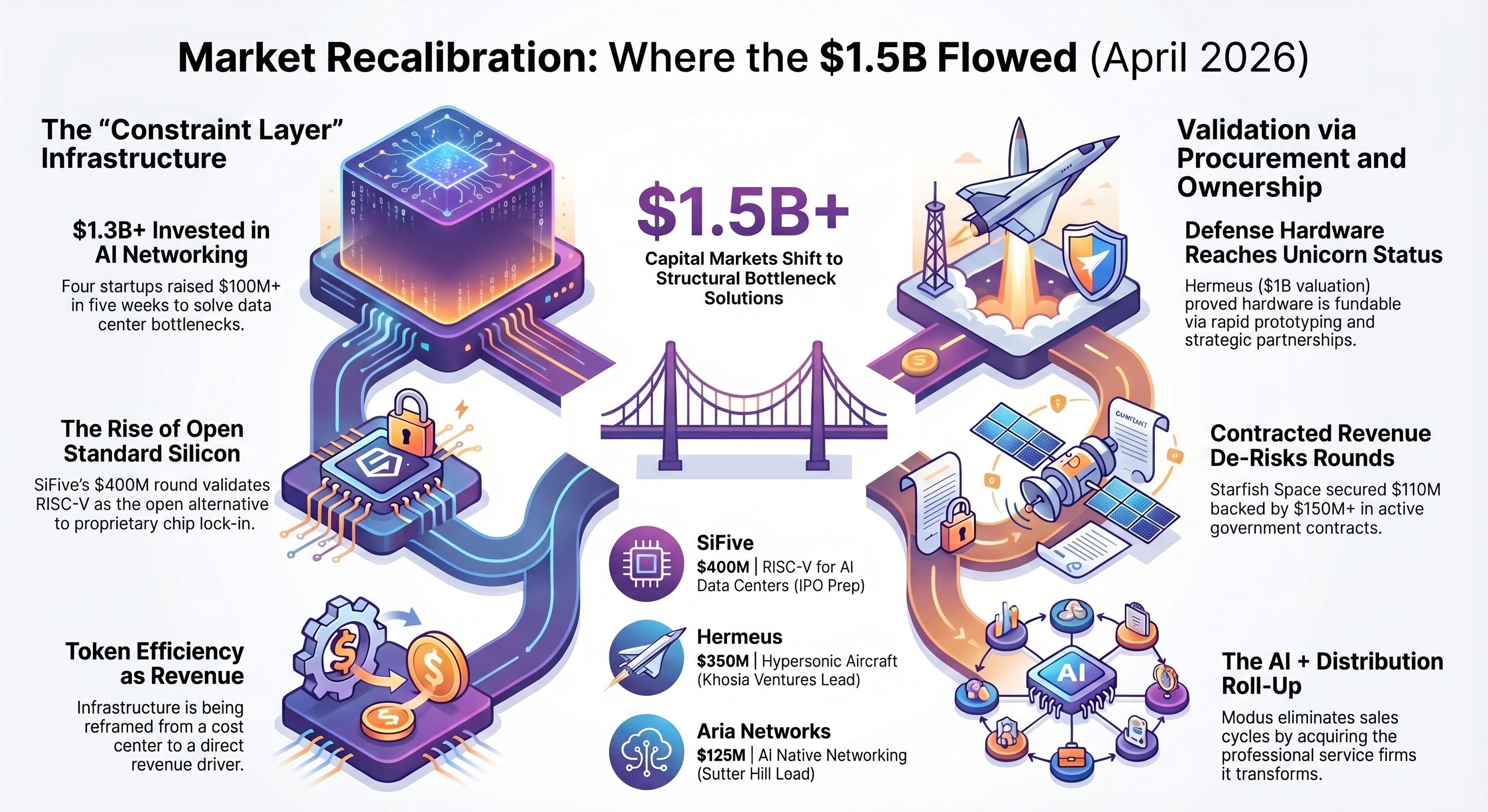
No billion-dollar rounds. No frontier lab mega deals. This was a signal week, not a scale week.
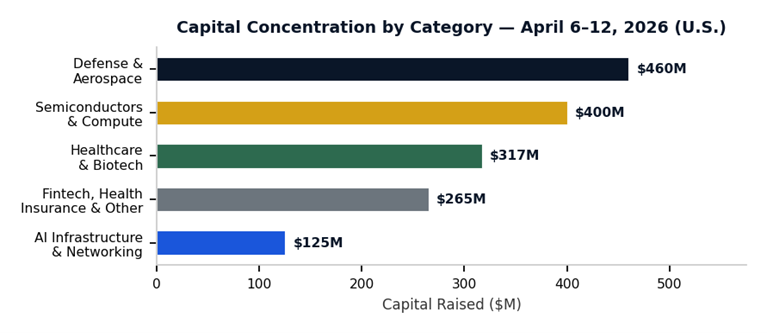
Open standard semiconductors, defense aviation, AI networking, and satellite servicing collectively absorbed $1.5B+ in verified U.S. deals, with zero frontier lab mega rounds, signaling a market recalibration from narrative scale to constraint-layer infrastructure and procurement-validated execution.
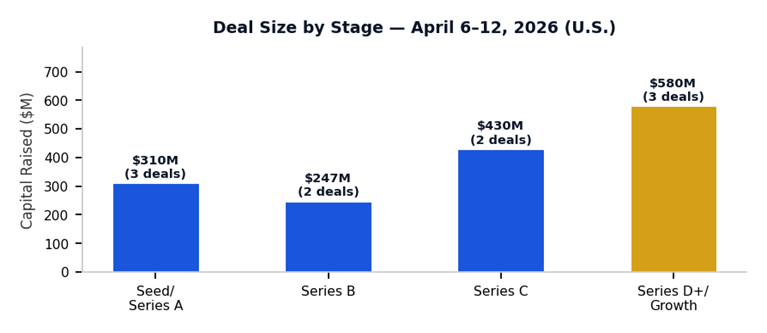
In the week of April 6–12, 2026, the largest U.S. deal was $400M for SiFive, a semiconductor IP company building RISC-V processors to challenge Arm Holdings in AI data centers. NVIDIA invested alongside Atreides Management, Apollo Global, and T. Rowe Price. The CEO called it the company’s last private round before an IPO. That is not venture enthusiasm. That is public market preparation.
The second signal: $460M flowed into defense and aerospace across Hermeus ($350M for hypersonic unmanned aircraft, Khosla Ventures lead, $1B valuation) and Starfish Space ($110M for satellite servicing, Point72 lead). Both companies have active U.S. government contracts. Capital followed procurement, not narrative.
The third: Aria Networks raised $125M in stealth mode for AI-native data center networking, the fourth AI networking startup to raise $100M+ in five weeks. Nexthop ($500M March 10), Eridu ($200M March 10), Ayar Labs ($500M March 3), now Aria. $1.3B+ into AI networking in five weeks. The constraint layer of AI infrastructure is absorbing capital at unprecedented speed.
Meanwhile, Modus raised $85M to build AI native audit technology, proving that Lightspeed sees the same opportunity Harvey exploited in legal AI: regulated professional services are the last undigitized $800B+ markets. The pattern is clear.
THE WEEK’S DEAL SCORECARD
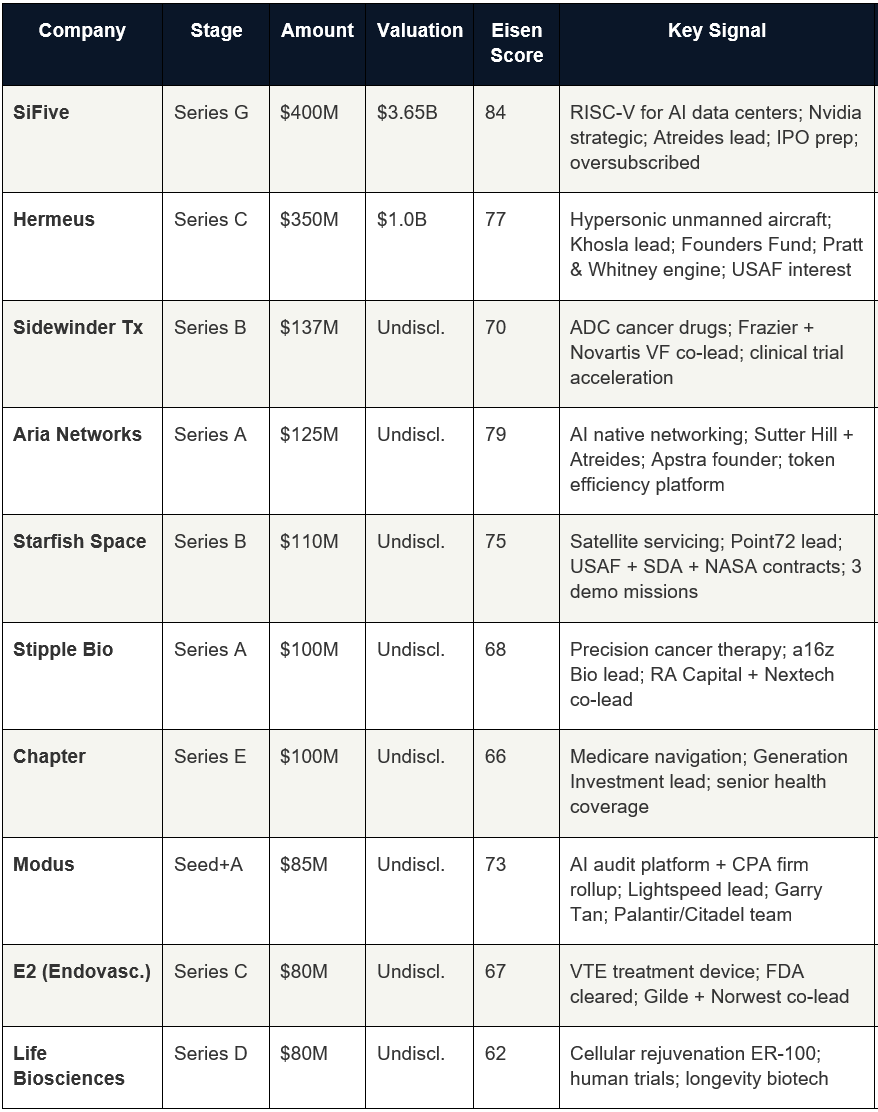
What the Eisen Fundability Score says at a glance
SiFive scores highest (84) because the deal architecture is flawless: RISC-V is the only open standard alternative for AI data center CPUs, NVIDIA invested strategically, the round was oversubscribed, and the CEO declared it the last private round before an IPO. That is constraint-removal positioning with public-market validation. Aria Networks (79) scores above its round size because the founder pedigree (Mansour Karam sold Apstra to Juniper for $190M) and investor caliber (Sutter Hill + Atreides with board seats) compress the risk profile dramatically. Hermeus (77) benefits from active USAF interest and a SpaceX-style rapid-prototyping model, but its pre-revenue status limits the traction score. Starfish Space (75) is the sleeper: $150M+ in government contracts across Space Force, SDA, NASA, and SES, with three successful orbital demonstrations. The week’s median score (71) reflects a market rewarding execution proof rather than narrative momentum.
WHAT CHANGED THIS WEEK: 5 MARKET SHIFTS
SHIFT 1: OPEN STANDARD SEMICONDUCTOR IP IS THE NEW CONSTRAINT LAYER BET
Pattern: SiFive raised $400M Series G at $3.65B (Atreides lead, Nvidia strategic, April 9). Oversubscribed. CEO Patrick Little declared it the company’s last private round before an IPO. NVIDIA’s NVLink Fusion integration, announced in January 2026, enables RISC-V CPUs to connect directly to NVIDIA GPUs. 10 billion RISC-V cores shipped. 500+ active designs.
Perspective: Arm Holdings acquired a 10% stake in Ampere Computing in 2024, transforming from a neutral IP licensor to a vertical competitor. That created the strategic vacuum RISC-V is filling. Intel’s $2B acquisition attempt of SiFive collapsed over valuation in 2021. Now, SiFive is IPO-bound at $3.65B, with NVIDIA on the cap table. The hyperscaler demand is real: Google, Qualcomm, and others want customizable CPU IP without Arm’s royalty structure. When Atreides’ Gavin Baker calls this “the long-term winner in the shift to open architecture,” he is pricing an entire industry transition, not a chip company.
Founder Blindspot: Founders see SiFive and think “RISC-V is a semiconductor story.” Wrong scope. This is a platform dependency story. Any company locked into a proprietary architecture (chip, protocol, API) is now a target for open standard disruption. The investor logic: proprietary lock-in creates a structural vulnerability that open standard alternatives eventually exploit. SiFive is proving that thesis in silicon. Founders in any category with dominant proprietary incumbents should study this playbook.
Playbook: If your product replaces a proprietary standard with an open alternative, build a “structural independence” slide in your deck. Show the total cost of the incumbent’s lock-in (royalties, design restrictions, vendor dependence) versus your open standard approach. SiFive’s pitch is not “better chips.” It is “architectural freedom for hyperscalers.” Frame your product around what the customer gains by switching away from the incumbent, not what your product does better.
Contrast: In 2024, RISC-V was positioned as an edge computing play. In April 2026, $400M was invested in RISC-V for AI data center infrastructure, with NVIDIA as a strategic investor. The market has moved from the periphery to the core.
What this means for your raise: If your product replaces proprietary lock-in with open standard flexibility, you are pricing an industry transition. Frame it that way.
SHIFT 2: DEFENSE AVIATION CROSSED $1B IN TWO CONSECUTIVE WEEKS
Pattern: Hermeus raised $350M Series C at $1B (Khosla lead, Founders Fund, RTX Ventures, IQT, April 7). Starfish Space raised $110M Series B (Point72 lead, Shield Capital, April 7). Combined: $460M into defense aerospace in one day. Add last week’s Saronic $1.75B, and the pattern is unmistakable.
Perspective: Two weeks ago, Saronic ($1.75B for autonomous naval vessels) proved defense tech can clear billion-dollar rounds. This week, Hermeus proved that pre-revenue defense hardware can reach unicorn status, with Khosla Ventures leading the way. The investor logic: Hermeus is executing a SpaceX-style rapid prototyping model (two flight demonstrations in under a year, Pratt & Whitney F100 engine integration) with RTX’s venture arm on the cap table. The defense industrial base is actively funding the companies that will supply next-generation platforms.
Founder Blindspot: Founders see Hermeus and Saronic and think “defense tech is a single category.” It is not. The capital is going to three distinct profiles: autonomous software (Shield AI), autonomous platforms (Saronic, Hermeus), and space servicing (Starfish Space). Each requires different proof. Shield AI needed combat deployment data. Hermeus needs flight test milestones. Starfish needs orbital demonstration missions. Match your proof to your subcategory.
Playbook: If you are building defense hardware, identify the defense prime whose existing platform or engine your product can integrate with. Hermeus’s inflection point was shifting from building its own engine to modifying Pratt & Whitney’s F100. That decision converted RTX from a potential competitor to a strategic investor and accelerated the timeline by years. Find the equivalent integration decision for your product.
Contrast: In 2024, defense tech unicorns required $1B+ in cumulative funding across 5+ rounds. In April 2026, Hermeus reached unicorn status in its Series C on the strength of two flight demonstrations and a strategic engine partnership.
What this means for your raise: If you are building defense hardware, your strategic integration partner is more important than your proprietary technology. Lead with the partnership, not the product.
SHIFT 3: AI NETWORKING HIT $1.3B+ IN FIVE WEEKS, THE FOURTH $100M+ STARTUP
Pattern: Aria Networks raised $125M Series A (Sutter Hill lead, Atreides + Valor + Eclipse, April 7). Founded in 2025 by Mansour Karam (sold Apstra to Juniper for ~$190M). This is the fourth AI networking startup to raise $100M+ in five weeks: Ayar Labs ($500M March 3), Nexthop ($500M March 10), Eridu ($200M March 10), now Aria ($125M April 7). Combined: $1.3B+ into AI networking infrastructure.
Perspective: The AI networking constraint is now the single most-funded infrastructure subcategory in Q1-Q2 2026, after frontier labs themselves. Each startup targets a different layer: Ayar Labs (co-packaged optics), Nexthop (switches), Eridu (data center switches), Aria (AI-native networking software + switches). The investor logic: hyperscalers project $650B in AI infrastructure spend in 2026, and the networking layer is the bottleneck. Four funded companies in five weeks means investors believe the market supports multiple winners at different stack positions.
Founder Blindspot: Founders see four networking startups and think “the market is crowded.” Wrong. Four $100M+ raises in the same sub-sector in five weeks means the total addressable market is large enough that investors are funding every viable layer. Aria’s differentiation is “token efficiency,” which directly links networking performance to AI revenue. That framing converts a cost center (networking) into a revenue driver. If you are in any infrastructure category, study that reframe.
Playbook: If you are building AI infrastructure, name the metric your product moves that directly impacts your customer’s revenue. Aria’s “token efficiency” is the AI networking equivalent of Nexthop’s “copper fails at 10,000 GPUs.” Both reframe infrastructure costs as business outcomes. Write one sentence: “A [X]% improvement in [our metric] equals [Y]% more revenue for [customer type].” That sentence is your Series A pitch.
Contrast: In 2024, AI networking was an incumbent market (Arista, Cisco). In April 2026, four startups collectively raised $1.3B+ in five weeks. The window for infrastructure layer positioning is the widest it has been in a generation.
What this means for your raise: If you solve a constraint in the AI data center, convert your performance metric into a revenue metric for the customer. That conversion is worth 3x on your valuation.
SHIFT 4: PROFESSIONAL SERVICES AI IS THE NEXT $10B CATEGORY
Pattern: Modus raised $85M Seed+A (Lightspeed lead, Garry Tan, April 7) to build AI native audit technology and acquire CPA firms. Team from Palantir, Citadel, Ramp, and Thoma Bravo. Already invested in a Top 200 accounting firm with $30M+ revenue. Projected to double that firm’s organic growth rate in 2026.
Perspective: Harvey proved the playbook at $11B: embed AI into a regulated professional service, deploy engineers inside client organizations, create compounding switching costs. Modus is applying the identical playbook to accounting. The difference: Modus is also buying equity stakes in the firms it transforms. That is a technology + private equity hybrid model that creates lock-in at two levels: the software and the ownership structure. Lightspeed’s thesis: the $140B global audit market has not had a meaningful technology upgrade in decades. The first-mover advantage in AI-native accounting is enormous.
Founder Blindspot: Founders see Harvey’s success and think, “I should build vertical AI for [industry].” Modus shows the next evolution: build the AI AND acquire the distribution. By buying stakes in CPA firms, Modus guarantees deployment. There is no enterprise sales cycle. The customer is the firm you just invested in. That is captured distribution at its purest. If you are in vertical AI and struggling with enterprise sales cycles, study this model.
Playbook: Identify the top 3 regulated professional services categories (legal, accounting, healthcare, insurance, consulting) that are under-digitized and have fragmented provider markets. For each: (1) What is the total annual spend? (2) What is the typical technology stack? (3) How many firms would you need to acquire for market density? If the answer to #3 is fewer than 50, the roll-up model works. Build your pitch around technology and distribution, not just technology.
Contrast: In 2024, vertical AI companies sold software to professional services firms. In April 2026, Modus is buying the firms AND deploying its own software inside them. The go-to-market model shifted from selling to owning.
Confidence: HIGH | What this means for your raise: If you are building vertical AI for a fragmented professional services market, consider the technology + roll-up hybrid model. It eliminates the enterprise sales cycle entirely.
SHIFT 5: SPACE SERVICING GRADUATED FROM DEMONSTRATION TO PROCUREMENT
Pattern: Starfish Space raised $110M Series B (Point72 lead, Shield Capital, April 7). The company has active contracts with the U.S. Space Force ($37.5M + $54.5M), Space Development Agency ($52.5M), NASA ($15M), SES (commercial), and Intelsat. Three successful orbital demonstrations completed. $150M+ total raised. 90+ employees. The first operational Otter mission is scheduled to launch later in 2026.
Perspective: Five years ago, satellite servicing was a conference slide. Two years ago, it was a technology demonstration. In April 2026, the Pentagon is co-investing alongside Point72 in production satellite servicing contracts. The STRATFI mechanism (Defense Innovation Unit) means government dollars and venture dollars are funding the same spacecraft. That dual-use structure means Starfish is building for both defense and commercial use simultaneously, with neither subsidizing the other.
Founder Blindspot: Founders see Starfish and think “space is too capital-intensive for me.” Wrong takeaway. The fundability lesson is that government contract revenue de-risks venture investment. Starfish’s $150M+ in signed contracts across five customers converts speculative technology into contracted revenue. Any company with signed government contracts is sitting on the strongest possible de-risking signal for venture investors. Frame your contracts as forward revenue, not customer logos.
Playbook: If you have government or enterprise contracts, build a “contracted revenue pipeline” slide showing: (1) Signed contract value, (2) Revenue recognition timeline, (3) Expansion potential (additional task orders, follow-on contracts). Starfish has $150M+ in contracted revenue across five customers. That is not a prospect list. That is a revenue forecast. Frame it accordingly.
Contrast: In 2024, space servicing was funded as technology R&D. In April 2026, $110M went to a company with $150M+ in signed government contracts and three successful orbital demonstrations. The bar shifted from technology proof to procurement readiness.
What this means for your raise: Government contracts are the strongest de-risking signal for venture. If you have them, lead with contracted revenue, not technology demonstrations.
THE TOP 3 DEALS THAT MATTER
SIFIVE
Semiconductors / RISC-V | Series G | $400M | $3.65B
EISEN FUNDABILITY SCORE: 84 / 100
Why this scored: The highest score this week reflects the rarest deal architecture in semiconductors: the only open-standard alternative for AI data center CPUs, with Nvidia as a strategic investor, an oversubscribed round led by a high-conviction fund (Atreides), and an explicit IPO declaration. This is infrastructure positioning at public market readiness.
The Setup: SiFive was founded by the Berkeley researchers who created the RISC-V instruction set architecture. CEO Patrick Little (a former Qualcomm and Intel exec) repositioned the company from edge-computing IP to high-performance AI data center solutions. The inflection: Arm’s acquisition of an Ampere stake in 2024 shifted Arm from a neutral licensor to a vertical competitor, creating structural demand for RISC-V as an open-standard alternative. Intel’s failed $2B acquisition attempt in 2021 validated the strategic value at a fraction of the current price.
The Numbers: $400M Series G (April 9, 2026) | $3.65B valuation (up from $2.5B in March 2022, +46%) | Lead: Atreides Management (Gavin Baker) | Strategics: Nvidia, Apollo Global, Point72 Turion, T. Rowe Price, Sutter Hill Ventures, Prosperity7 | 10B+ cores shipped | 500+ active designs | Record revenue in 2025 | NVLink Fusion integration with Nvidia (Jan 2026) | Oversubscribed | CEO: Last private round before IPO
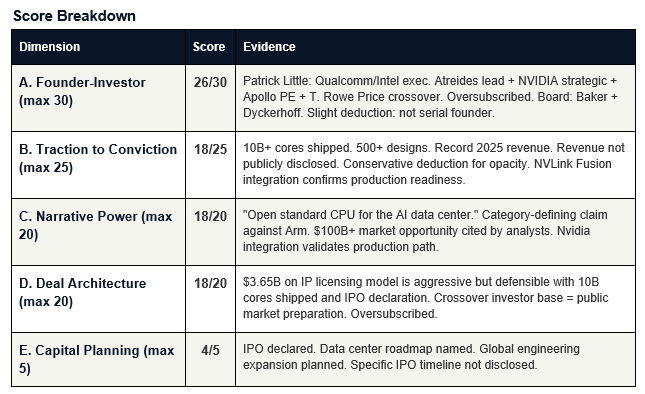
Fundability Lessons: SiFive’s investor composition tells the story. Atreides (growth equity), Apollo (PE), T. Rowe Price (public market crossover), Nvidia (strategic) — that is an IPO investor base, not a venture syndicate. The company is raising its last private round from the exact investors who will anchor its public offering. NVIDIA’s NVLink Fusion integration means RISC-V CPUs work natively alongside NVIDIA GPUs in the Vera Rubin platform architecture. That technical integration converts “open standard alternative” from thesis to production reality.
The key lesson: at the pre-IPO stage, your investor syndicate should mirror your future public market shareholder base. If crossover funds and strategics are writing checks, the IPO is priced before it happens.
Your Takeaway: If your product replaces a proprietary standard with an open alternative, the most powerful fundraising signal is a strategic investment from the ecosystem leader who benefits from your success. NVIDIA investing in SiFive is the equivalent of AWS investing in an open-source database company. It converts competitive positioning into ecosystem validation.
The Founder Mistake to Avoid: Founders see SiFive and want to “build RISC-V chips.” Wrong lesson. SiFive does not manufacture chips. It licenses IP. The asset is the design blueprints and the ecosystem relationships, not the silicon. The lesson: in semiconductor IP, the moat is the standard you define and the ecosystem you build around it, not the hardware you ship.
ARIA NETWORKS
AI Infrastructure / Networking | Series A | $125M | Undisclosed
EISEN FUNDABILITY SCORE: 79 / 100
Why this scored: A $125M Series A from stealth is unusually large, but the founder pedigree justifies it. Mansour Karam built and sold Apstra to Juniper Networks for approximately $190M after pioneering intent-based networking. This is a proven category creator rebuilding for AI. Sutter Hill Ventures, led by Atreides’ Gavin Baker, joins the board, confirming institutional conviction at the earliest stage.
The Setup: Founded in January 2025, Aria Networks spent a year in stealth building what it calls Deep Networking: a platform combining purpose-built Ethernet switches (800G and 1.6T), hardened SONiC software, microsecond-level telemetry, and AI agents that optimize data center networking for token efficiency. The key insight: traditional switches were designed for general-purpose data center traffic. AI training and inference workloads have fundamentally different patterns. Aria is building the networking equivalent of what Nexthop builds for interconnects: AI native from the ground up.
The Numbers: $125M Series A (April 7, 2026) | Lead: Sutter Hill Ventures | Co-investors: Atreides Management (Gavin Baker, board), Valor Equity Partners, Eclipse Ventures | Founder: Mansour Karam (Apstra, sold to Juniper ~$190M) | CTO: Subhachandra Chandra | Products: Aria Switch 800G, Aria Switch 1.6T, Cluster Software | Metric: Token efficiency | Compatibility: Nvidia, Google AI chips | Customer orders confirmed
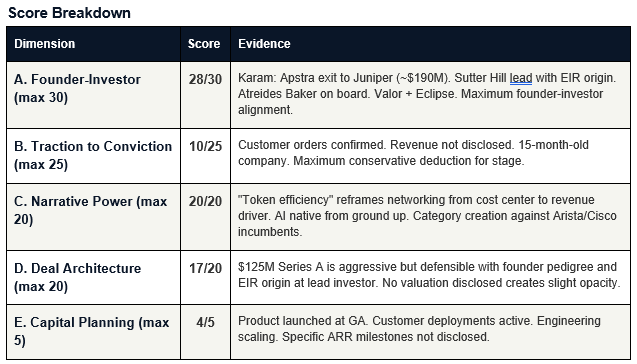
Fundability Lessons: Aria’s “token efficiency” framing is the most important positioning move in the AI networking space this month. Traditional networking companies sell on throughput and latency. Aria sells on “tokens per second per dollar.” That reframe converts networking from a cost center into a revenue driver. When a 10% improvement in tokens per second equals a 10% improvement in revenue, the networking budget moves from IT to the P&L. That is how you get $125M Series A rounds for a 15-month-old company.
The Founder Mistake to Avoid: Founders see Aria’s $125M and think, “I need a big name founder to raise big.” Partially right. But the deeper lesson is that Karam spent two years at Sutter Hill as an entrepreneur-in-residence, designing the company with the firm before launching. The $125M was pre-positioned by the relationship, not cold-raised in a process. If you are planning a company, the EIR model at a top-tier fund is the highest leverage pre-founding move available.
HERMEUS
Defense Aviation / Hypersonic | Series C | $350M | $1.0B
EISEN FUNDABILITY SCORE: 77 / 100
Why this scored: Unicorn status on Series C for a pre-revenue defense hardware company reflects one critical decision: Hermeus stopped building its own engine and partnered with Pratt & Whitney (RTX). That integration decision elevated RTX from a spectator to a strategic investor and accelerated the flight-test timeline from years to months. Two successful test flights in under a year. Khosla Ventures leading with Founders Fund and In-Q-Tel in the syndicate. This is the SpaceX rapid prototyping model applied to hypersonic defense aircraft.
The Setup: Founded in 2018 by AJ Piplica and engineers from SpaceX, Blue Origin, and NASA. Hermeus builds high-Mach unmanned military aircraft. The company recently tested its Quarterhorse Mk 2.1, an F-16 scale remotely piloted aircraft, at White Sands Missile Range. The next milestone: supersonic flight. The company is relocating its HQ to El Segundo, California, while keeping its Atlanta facility as the production hub.
The Numbers: $350M Series C ($200M equity + $150M debt, April 7, 2026) | $1B post-money valuation | Lead: Khosla Ventures | Co-investors: Canaan Partners, Founders Fund, RTX Ventures, Bling Capital, In-Q-Tel, Cox Enterprises/Socium Ventures, Destiny Tech100, Georgia Tech Foundation | Total raised: $500M+ | Employees: ~300 | Two successful flight tests | Pratt & Whitney F100 engine integration | Debt: SVB, Hercules Capital, Trinity Capital
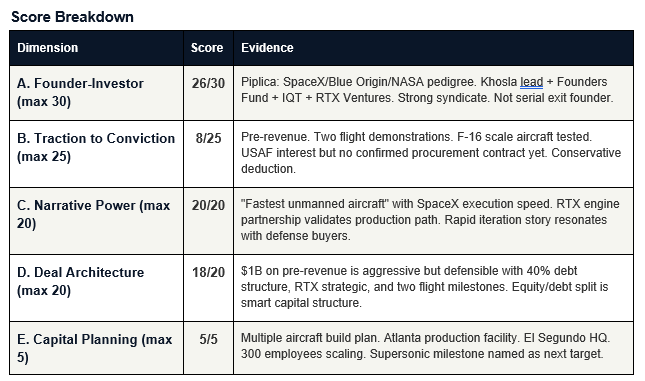
Fundability Lessons: Hermeus’s non-dilutive debt structure ($150M of $350M) is the most instructive financing decision of the week. For capital-intensive hardware companies, structuring 40%+ of the raise as debt preserves founder equity while funding manufacturing scale. The company is building multiple aircraft simultaneously and financing the hardware with debt while financing the R&D with equity. That split is the optimal capital structure for hardware-first defense companies.
The key lesson: match capital type to the use of funds. Equity for R&D. Debt for hardware and manufacturing.
The Founder Mistake to Avoid: Founders see Hermeus’s $1B valuation and want to build “hypersonic aircraft.” Wrong takeaway. Hermeus’s $1B is priced off two things: the Pratt & Whitney engine partnership (eliminating the hardest technical risk) and the SpaceX-style rapid-iteration model (two flights in under a year). The lesson is not the vehicle. It is the execution velocity and the strategic partnership that removed the biggest risk from the company’s roadmap.
THIS WEEK PLAYBOOK: 5 DAYS, 5 DELIVERABLES
This week’s data gave you 5 shifts. Here is how to translate them into actions.
DAY 1. OPEN STANDARD AUDIT: ARE YOU REPLACING A PROPRIETARY LOCK-IN?
Why this matters: SiFive raised $400M because hyperscalers want architectural freedom from Arm’s proprietary ISA. Any market with a dominant proprietary incumbent has the same structural vulnerability.
Deliverable: Identify the proprietary standard your customer is locked into. Calculate the total switching cost (royalties + design constraints + vendor dependency). Write one sentence: “[Customer type] pays [$X/year] in [proprietary lock-in costs]. Our open standard approach eliminates [specific cost] while enabling [specific freedom].” This becomes your “structural independence” slide.
Expected outcome: A structural independence positioning statement that converts your product from “better alternative” to “industry transition play.”
DAY 2. STRATEGIC INTEGRATION MAP: WHO IS YOUR PRATT & WHITNEY?
Why this matters: Hermeus reached unicorn status by abandoning its own engine and partnering with Pratt & Whitney. That decision removed the biggest technical risk and converted RTX into a strategic investor.
Deliverable: Identify the single highest-risk technical component in your product. For that component: (1) Can you partner with an established player instead of building it? (2) Does that partner have a venture arm or strategic investment function? (3) Would that partnership accelerate your timeline by 12+ months? If yes to all three, initiate the conversation this week.
Time estimate: 2 hours Tuesday | Expected outcome: A strategic integration target that removes your biggest technical risk and adds a strategic investor.
DAY 3. PROOF STACK BUILD: EISEN SELF-SCORE
Why this matters: SiFive scored 84/100 and Aria Networks scored 79/100 this week. Both scores reflect verifiable evidence across all five Eisen dimensions. Most founders score 55–70 on honest self-assessment.
Deliverable: Score yourself on the 5 Eisen dimensions (max 100). If a metric is not publicly verifiable, do not assume it is strong. Find your 2 lowest scores. For each, write one concrete action that moves it 5+ points in 30 days.
Expected outcome: A clear picture of why your raise is not closing faster, and a specific 30-day sprint plan.
DAY 4. REVENUE METRIC REFRAME: WHAT IS YOUR “TOKEN EFFICIENCY”?
Why this matters: Aria Networks reframed networking performance as “token efficiency,” directly tying infrastructure costs to AI revenue output. That reframe converts a cost center into a revenue driver and justifies premium multiples.
Deliverable: Write one sentence: “A [X]% improvement in [our core metric] equals [Y]% more [revenue/margin/throughput] for [customer type].” If you cannot fill in those blanks with real data, that gap is your biggest fundraising obstacle. Get the data from your top 3 customers this week.
Expected outcome: A revenue-linked metric that replaces your current performance-focused positioning.
DAY 5. CONTRACTED REVENUE PIPELINE: FRAME YOUR BACKLOG
Why this matters: Starfish Space raised $110M backed by $150M+ in signed contracts across five government and commercial customers. Contracted revenue is the strongest de-risking signal for venture investors.
Deliverable: Build a “contracted revenue pipeline” slide: (1) Total signed contract value, (2) Revenue recognition timeline by quarter, (3) Expansion potential (task orders, renewals, upsell). If you have LOIs or signed contracts, this slide converts the “pipeline” sales metric into a de-risking proof point.
Expected outcome: A forward revenue slide that converts investor risk perception from speculative to structured.
LOOKING FORWARD: NEXT 1–3 WEEKS
Scenario 1: RISC-V Ecosystem Acceleration (HIGH PROBABILITY)
Evidence: SiFive’s $400M with Nvidia strategic + IPO declaration. NVLink Fusion integration with Nvidia’s Vera Rubin platform. Google, Qualcomm, and other hyperscalers are actively evaluating RISC-V for data center CPUs. Arm’s vertical integration strategy is creating structural demand for alternatives.
What to watch: SiFive IPO timeline announcements. NVIDIA GTC 2026 RISC-V integration depth. New RISC-V startups targeting specific AI accelerator IP.
What founders should do: If you build on any proprietary architecture where the vendor has vertically integrated, map open-standard alternatives and start positioning as an “architectural independence” play. The investor appetite is confirmed.
Scenario 2: AI Networking Consolidation Pressure (HIGH PROBABILITY)
Evidence: $1.3B+ into four AI networking startups in five weeks. Arista Networks’ public market cap at $120B validates the TAM. Cisco at $250B. Four well-funded startups in one sub-sector is consolidation math within 18 months.
What to watch: Acquisition rumors involving Nexthop, Eridu, or Aria Networks. Arista or Cisco defensive acquisitions. Hyperscaler vendor selection announcements.
What founders should do: If you are a smaller AI infrastructure company, build your relationships with strategic acquirers now. Four well-capitalized competitors in the same subsector accelerate the M&A timeline.
Scenario 3: Defense IPO Pipeline Builds (MEDIUM-HIGH PROBABILITY)
Evidence: Shield AI ($12.7B, board stating “definitive path to going public”). Saronic ($1.75B). Hermeus ($1B, new unicorn). Anduril (large and expanding). SpaceX confidential IPO filing. Multiple defense tech companies at or above $1B valuations with government contracts and revenue growth.
What to watch: Shield AI IPO timeline. SpaceX roadshow (June 2026). Saronic or Hermeus follow-on announcements. Public market appetite for defense tech via Palantir and Kratos comps.
What founders should do: If you are building defense tech, the public market window is opening. Build your IPO readiness (governance, audits, revenue disclosure standards) 18 months before you think you need it.
Wild Card: Humans& $480M Seed Signals a New Lab Category (MEDIUM)
Evidence: Humans&, an AI lab founded by researchers from Google, Anthropic, xAI, OpenAI, and Meta, raised a $480M seed round. The company says it will apply AI in ways that are centered on people and relationships. If confirmed, this would be among the largest seed rounds ever.
What founders should do: Watch this closely. A $480M seed for a “people-centered AI lab” signals investors believe the next wave of AI companies will be defined by application philosophy, not model performance. If your AI product has a distinctive human interaction thesis, the funding environment for that positioning is warming.
THE BOTTOM LINE
The real insight from this week is not that semiconductors raised $400M or that defense raised $500M+. The real insight is that capital is flowing to companies that remove structural dependencies, and the proof requirements for each are specific and non-negotiable.
Profile 1: Open standard infrastructure replacing proprietary lock-in. SiFive ($400M, $3.65B): RISC-V replacing Arm in AI data centers. Aria Networks ($125M): AI native networking replacing legacy Cisco/Arista architectures. The proof: strategic validation from the ecosystem leader (Nvidia) and a production-ready alternative.
Profile 2: Procurement-validated defense hardware with rapid iteration. Hermeus ($350M, $1B): Hypersonic aircraft with two flight tests in under a year and RTX engine partnership. Starfish Space ($110M): Satellite servicing with $150M+ in signed government contracts. The proof: flight demonstrations and signed contracts.
Profile 3: Technology + distribution hybrid models in regulated professional services. Modus ($85M): An AI audit platform that acquires the firms it transforms. The proof: signed firm investment with demonstrated growth acceleration. Harvey proved the thesis at $11B. Modus is applying it at the earliest stage.
Everything else is competing for the remaining conviction capital.
5 New Rules for Founders (Evidence-Based)
Rule 1: Open standard positioning outprices feature positioning. SiFive’s $3.65B valuation is based on the RISC-V industry transition, not chip performance. If your product replaces proprietary lock-in, frame the transition, not the product.
Rule 2: Strategic integration partnerships remove risk faster than internal R&D. Hermeus reached unicorn status by integrating Pratt & Whitney’s F100 engine instead of building its own. Identify the single partnership that removes your biggest technical risk.
Rule 3: Convert your infrastructure metric into a revenue metric for the customer. Aria’s “token efficiency” reframes networking cost as AI revenue output. A 10% gain in your metric equals X% more revenue for your customer. If you cannot write that equation, your positioning is incomplete.
Rule 4: Contracted revenue is the strongest de-risking signal at any stage. Starfish Space’s $150M+ in signed contracts converted a pre-revenue satellite company into a structured revenue story. Frame your contracts as forward revenue, not customer logos.
Rule 5: The technology + distribution hybrid model eliminates enterprise sales cycles. Modus does not sell to accounting firms. It invests in them and deploys its AI inside. If you are in vertical AI and fighting long sales cycles, the ownership model is the next evolution.
4 this week's actions
Proprietary Lock-In Audit: Identify the proprietary standard your customer is trapped in. Calculate the switching cost. Write a one-sentence “structural independence” claim.
Strategic Integration Target: Identify the single partnership that removes your biggest technical risk and adds a strategic investor. Initiate contact this week.
Revenue Metric Reframe: Write: “A [X]% improvement in [our metric] = [Y]% more [revenue/margin] for [customer].” If you cannot fill in the blanks, get the data from your top 3 customers.
Eisen Self-Score: Score your company on all 5 dimensions. Find your 2 lowest scores. Commit to one concrete action per dimension in 30 days.
Your competitors are reading the same data. The founders who act on Monday own the narrative by Friday.
Research Methodology
Data collection period: April 6–12, 2026
Verification standard: minimum of 2 independent sources per featured deal, with official press releases prioritized.
Eisen Fundability Scores are proprietary analytical estimates, not endorsements or investment advice.
All dollar amounts reflect announced figures at close.
Research completion timestamp: April 13, 2026.
Total deals analyzed: 10 (U.S., verified).
DISCLAIMER: This report is for informational and strategic intelligence purposes only. It does not constitute investment advice. Eisen Fundability Scores are analytical frameworks, not financial recommendations. All data is sourced from publicly available information and primary company announcements.