

Playbook, Perspective, and Pattern for founders raising now. This report strips out the megarounds and the public market traffic so you can read the part of the market that actually prices your round. Every figure below survived a second independent verification pass against primary sources.
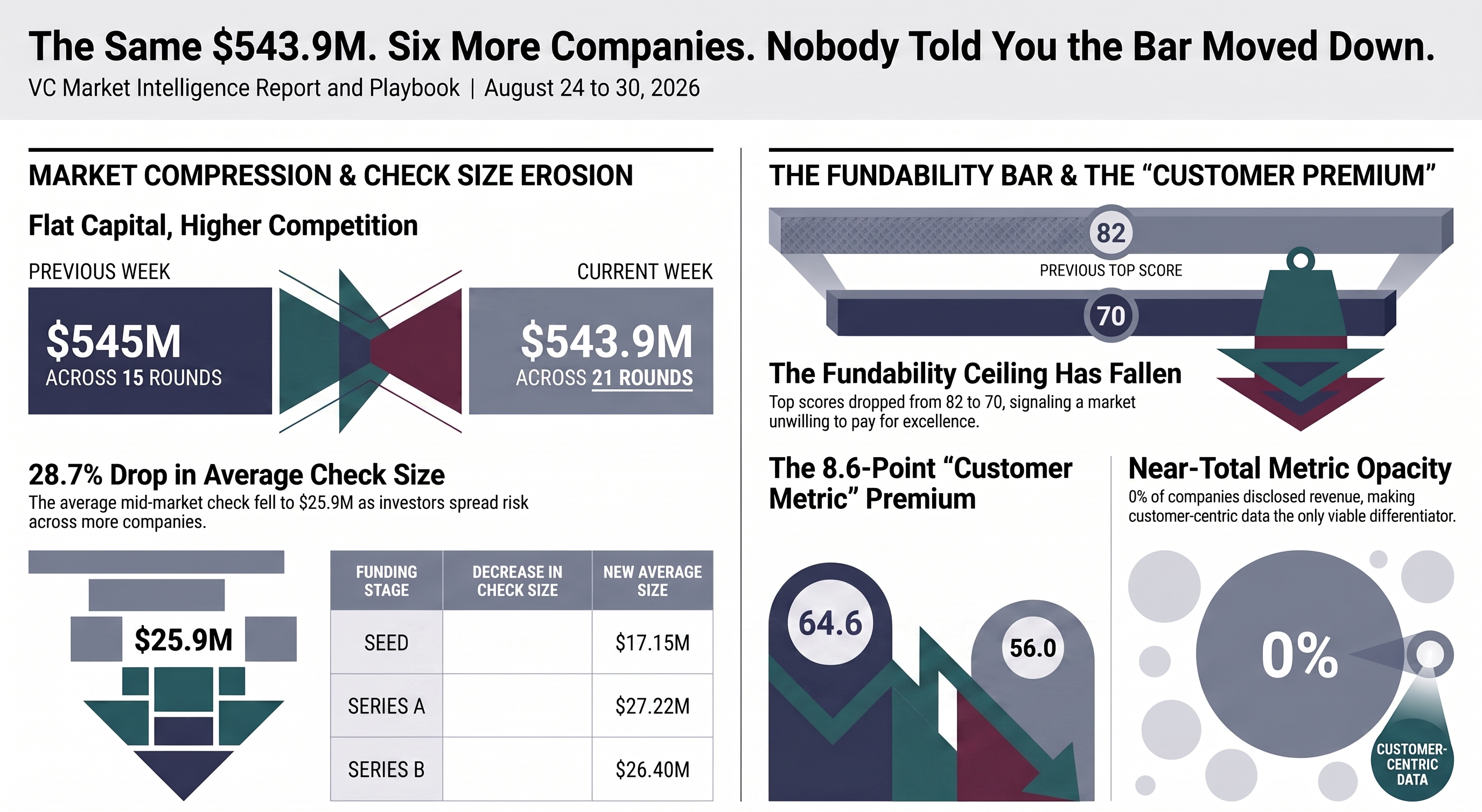
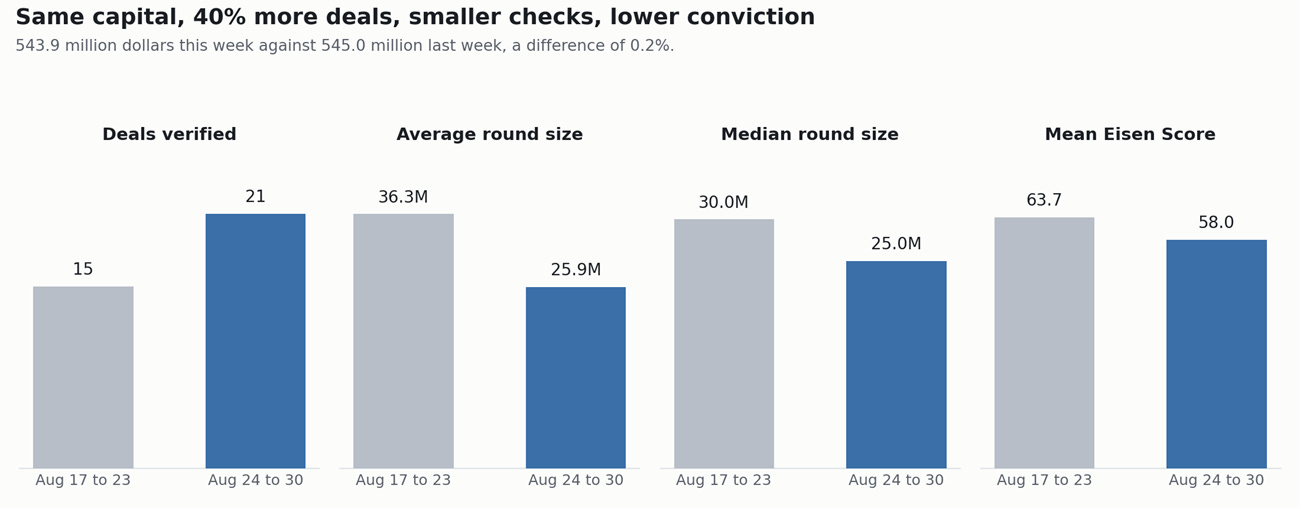
Last week the mid-market moved $545.0M across fifteen verified rounds. This week it moved $543.9M across twenty-one. That is a difference of 0.2% in capital and 40% in deal count. The pool did not grow. The queue did.
The average check fell 28.7%, from $36.3M to $25.9M. The median fell 16.7%. Every stage fell. Seed fell hardest, down 49% from a week ago. And the Eisen Fundability band did something it has not done in this report series: the ceiling came down. The top score last week was 82. This week the top score is 70. Not one of twenty-one rounds reached 75, the threshold this framework calls solid fundamentals.
Here is the number that explains the rest. None of the 21 companies disclosed a revenue figure. Twenty of twenty-one disclosed no growth rate. Twenty of twenty-one disclosed no valuation. The market did not stop funding. It stopped pricing on the company’s own numbers, because almost nobody put one on the record.
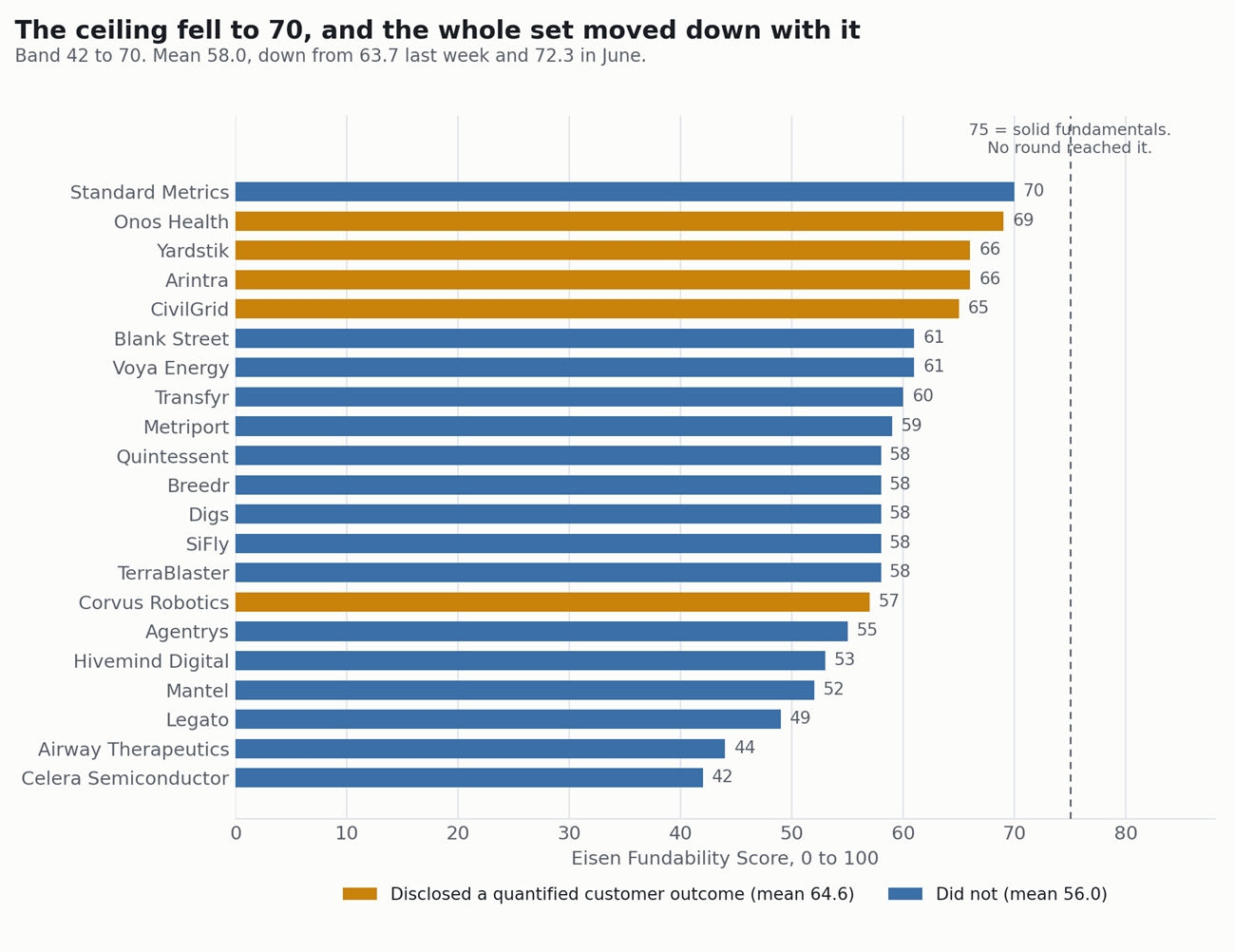
So the five rounds that cleared 65 did something else. They led with the customer’s number instead. Onos Health disclosed a 6% reduction in its health plan clients’ behavioral health program costs. Arintra reported a 5.1% increase in compliant revenue capture and a 43% decrease in coding denials at named health systems. CivilGrid disclosed more than $60M in paving conflicts eliminated at PG&E. Those five averaged 64.6, compared to 56.0 for everyone else.
Consequence for Monday. You are now one of twenty-one companies asking for a check that got 29% smaller, in a week where no sector took more than a fifth of the money, and no round scored above 70. Your own metrics will not set you apart, because most founders are holding theirs back, too. The number that separates you is your customer’s number, and you probably have not asked them for it.
The Week in One Sentence
Primary insight. With megarounds and public market traffic removed, the mid-market held its capital flat while spreading it across 40% more companies, dissolving sector concentration entirely and pulling the top of the fundability band down ten points, so the only thing that separated a funded round was proof of what the customer got.
● Total tracked mid-market capital (21 verified rounds): $543.9M in new primary capital, every deal between $10M and $100M.
● Average round size: $25.9M, down 28.7% from $36.3M last week.
● Median round size: $25.0M, down 16.7% from $30.0M. The midpoint sits inside a two-way tie at $25.0M between Arintra and Transfyr, with Digs just above at $25.3M.
● Disclosed valuations: one of twenty-one. Blank Street at $650M, up from $500M in 2025. That is a 95.2% opacity rate against 93.3% last week and 80% in June, a third consecutive rise.
● Disclosed revenue figures: zero of twenty-one. Disclosed growth rates: one of twenty-one, Yardstik at 149% year over year.
● Largest tracked round: Blank Street, $75.0M of new primary capital at a $650M valuation, reported as a Series C, which also ranked tenth on the week’s list of ten largest rounds. A coffee chain made the megaround tape because it had thinned.
● Highest Eisen Fundability Score: Standard Metrics at 70, the lowest weekly high this report series has recorded.
● Lowest Eisen Fundability Score: Celera Semiconductor at 42, a $30M Series B funded entirely by the single investor that also wrote its $20M Series A twelve months earlier, with no customer, revenue, or growth figure of any kind on the record.
● Defining structural feature: a 28-point score band against 46 points last week, and the compression happened downward. The floor rose six points, from 36 to 42. The ceiling fell twelve points, from 82 to 70.
Data Integrity Notes
All twenty-one featured rounds were verified against at least two independent sources, then rechecked in a second independent verification pass against primary sources. That pass removed four deals, restated three headline amounts, corrected one stage label, and corrected eight attributions. Resolutions and exclusions applied:
● Editorial scope excludes giant rounds and public market events by request. Removed from the tracked set: Instinct ($250M), Owner ($240M), Generalist AI ($200M), Gatik ($200M), Socure ($156M), Emerald AI ($150M), Regent Craft ($120M), AusperBio ($120M) and Starcloud ($250M). These are used only as a contrast set. The week’s ten largest rounds, excluding Blank Street, which sits inside the mid-market set at $75M and ranked tenth on that list, totaled $1,512M against $3,215M for the prior week’s ten largest. The megaround tape fell 53% while the mid-market held flat. One of those ten, Stability AI at $76M, is UK-headquartered and is separately excluded from the mid-market set for comparability.
● Three headline amounts were restated to new primary capital. Blank Street’s announcement carries $105M; the company release and independent reporting separate that into $75M of primary capital and $30M of secondary share purchases, so $75.0M is counted. Airway Therapeutics’ announcement includes $50M; the primary source breaks that down into $26M from a prior SAFE financing and $24M from a Series E-2, so $24.0M is counted. Agentry's announcement carries $24.5M; the primary source breaks that down into a $19.1M seed and a previously closed $5.4M pre-seed, so $19.1M is counted.
● Two rounds were excluded because new in-window capital could not be isolated. Hike Medical announced $22.5M in combined seed and Series A financing with no breakdown between the two, so it is excluded from all totals, charts, and scores rather than counted at its headline figure. Quaise Energy announced the close of a $180M Series B with a $35M investment from Nabors Industries; the round total sits above the mid-market ceiling, and the in-window money is a tranche of it, so it is excluded on both counts.
● Date window control removed two deals. Princeton Critical Minerals ($16M) circulated widely within this window via aggregator republication, but the announcement is dated August 12, 2026 in its exclusive coverage and August 20 in the trade press. Discern Security ($13M Series A) recirculated on August 26 against a July 30, 2026 primary release. Both are marked as news-cycle resurfaced and excluded from every total.
● Stage opacity is reported rather than filled in. Mantel’s round is described by the company as a strategic investment and reported by two aggregators as either a Series A extension or a Series C extension; no stage is asserted here. Metriport disclosed no stage. Hivemind Digital Group disclosed no stage. Three of twenty-one rounds carry no stage label at all, and each was penalized in Deal Architecture rather than assigned a stage by inference.
● Blank Street has no primary source and is not a Series B. No company release, no lead investor post, and no newswire announcement exists. The story broke in the Financial Times on August 24, and the primary and secondary split traces to an SEC filing reported by trade press at $104,999,981, which is not yet indexed in EDGAR. Blank Street already closed a $20M Series B in March 2023, so the Series B label carried by one aggregator is wrong; two outlets report this round as a Series C, and the filing applies no series label. It is reported here as a Series C at MEDIUM confidence. Store count is 106 locations worldwide, and the footprint extends beyond New York and London to Boston, Washington, DC, multiple UK cities, and now Los Angeles. Tiger Global’s participation is contested and is not asserted: three outlets name it, while Axios names HOF Capital instead.
● Metric provenance. Every operating figure in this issue is company-supplied. Arintra’s revenue capture and denial reduction figures, Onos Health’s cost and adherence figures, CivilGrid’s PG&E savings figures, Corvus Robotics’ customer discrepancy counts, and Yardstik’s growth and retention figures are treated as verifiable rather than independently audited, and scored on that basis. Mantel’s claim that its system reduces energy losses by 97% is company boilerplate describing its own technology, not a customer result, and is attributed rather than asserted. TerraBlaster’s per-acre savings are projections, not realized results, and are not scored as customer proof.
● What this report can and cannot see. Scores reflect proof that was verifiable at announcement. Investors receive far more in a private data room, and a company that puts nothing on the record may have answered every question during diligence. The public record is a proxy for whether the numbers existed in a defensible form while the round was running, not a measure of what a company knows about itself, nor a requirement to publish anything.
The Deal Scorecard
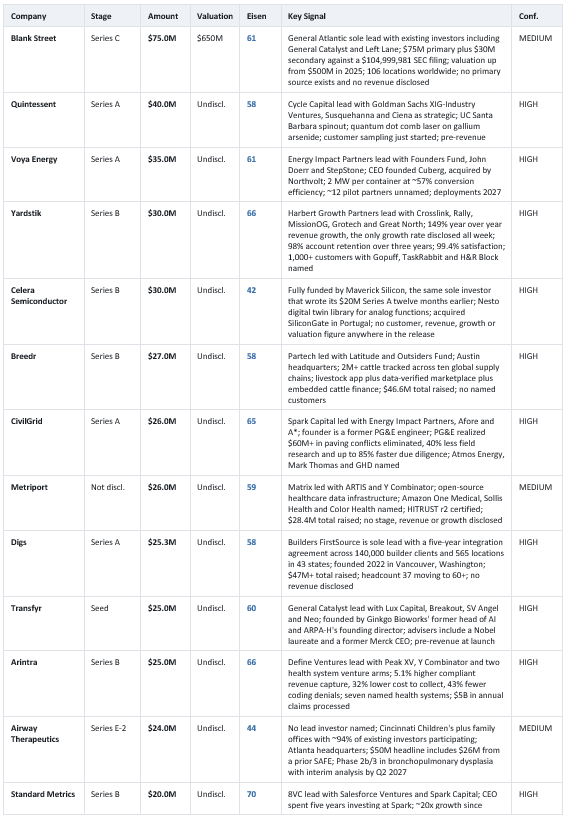
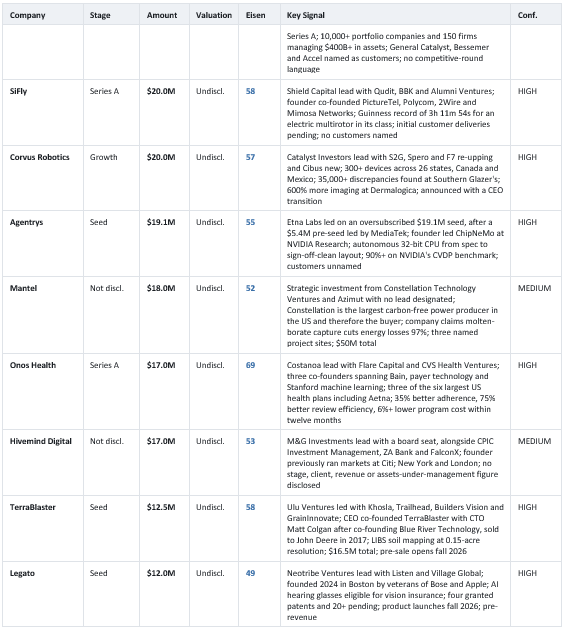
Eisen Fundability Scores are calculated across five weighted dimensions: Founder-Investor Dynamics (30), Traction-to-Conviction Conversion (25), Narrative Power (20), Deal Architecture (20), and Capital Planning (5). Scores of 85 and above signal an inevitable outcome. Scores of 70 to 84 signal strong execution. Scores below 70 signal early-stage or the need for repositioning. Missing metrics are scored conservatively, and opacity is penalized rather than assumed strong.
What the Scorecard Says at a Glance
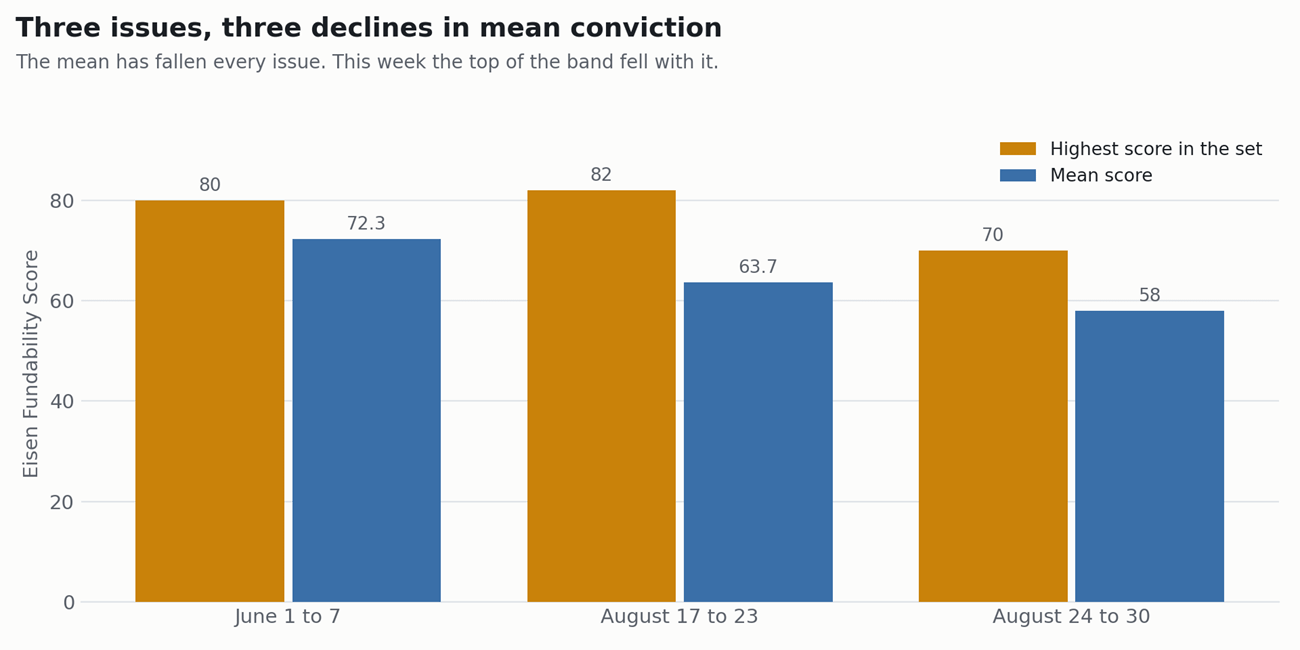
The ceiling is the message. For three issues, this report has watched the mean fall: 72.3 in June, 63.7 last week, 58.0 this week. That alone reads as a market getting harder. What happened this week is different and worse. The floor rose six points, from 36 to 42. The ceiling fell twelve points, from 82 to 70. Nothing reached 75. When the bottom of a band rises, and the top falls, the market is not becoming more selective. It is becoming less willing to pay a premium for anything.
Nobody disclosed their own numbers, so the customer’s number decided the order. Zero of twenty-one companies put a revenue figure on the record. One put a growth rate on it. The five deals that disclosed a quantified customer outcome averaged 64.6. The sixteen that did not averaged 56.0. That is an 8.6-point spread earned entirely by describing what the buyer got rather than what the seller has.
Standard Metrics (70) took the top spot without a single customer outcome, and did so by 10 points more than last week’s winner. It scored 20 out of 30 on Founder-Investor Dynamics, the highest in the set, on a founder who spent five years investing at Spark Capital before building the company, 8VC leading, and Salesforce Ventures and Spark participating alongside roughly twenty times business growth since its Series A. It then named General Catalyst, Bessemer, and Accel as customers and disclosed that its platform carries more than $400B in assets across 150 firms. That is scale as a substitute for outcomes. It works only when the logos on your customer list are the same firms your investor calls every week. Note what it did not have: no revenue, no growth rate, no valuation, and no competitive-round language anywhere in the release. The top of this market was reachable without any of it.
The bottom of the band is a disclosure story, not a quality story. Celera Semiconductor (42) raised $30M for a Series B funded entirely by Maverick Silicon, the same sole investor that wrote its $20M Series A twelve months earlier, disclosed no customer, no revenue, no growth, and no valuation, and announced an acquisition in the same release. A 50% larger re-up from the same investor within a year is real conviction, and it is why Celera does not score lower. Airway Therapeutics (44) raised $24M of new money with roughly 94% of its existing investors participating and no institutional lead named. Both are real companies with real capital. What the score measures is what a new investor could verify without asking, and in both cases the answer was close to nothing.
Two rounds show what a corporate check is worth. Digs scored 14 out of 30 on Founder-Investor Dynamics, the lowest in the set, and still cleared $25.3M because Builders FirstSource led the round outright and attached a five-year integration agreement across 140,000 builder clients and 565 locations in 43 states. Mantel scored 11 on the same dimension, the second-lowest, and cleared $18M on a strategic investment from Constellation Technology Ventures, the venture arm of the largest carbon-free power producer in the United States, which makes the investor the customer. Neither round was won on founder brand. Both were won on channel. Note the asymmetry: Digs got a named lead and Mantel did not, and that single difference is six points of separation between them.
What Changed: Five Market Shifts
Each shift is verified against multiple sources and ranked by structural impact on founder fundraising, not by deal size. Every shift ends with what it means for your raise next week.
Shift 1: Same Money, Forty Percent More Claimants
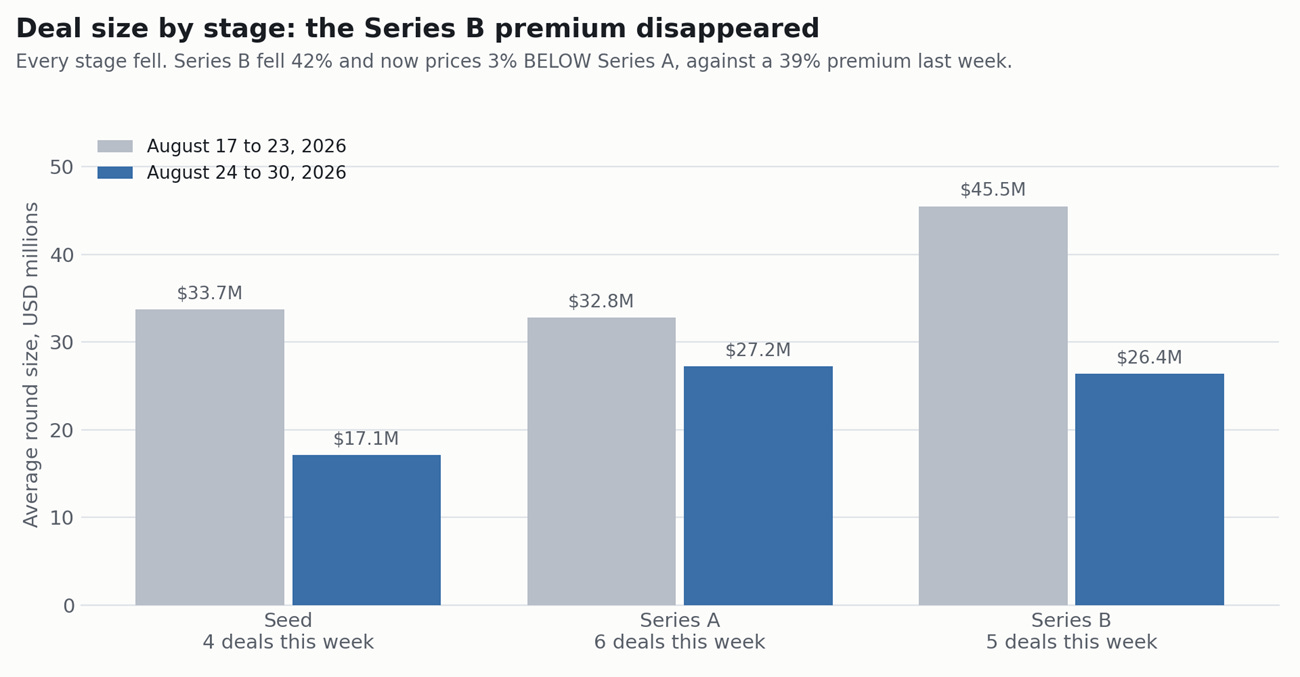
Pattern, what happened. Twenty-one verified mid-market rounds moved $543.9M. Fifteen rounds moved $545.0M the week before. That is a 0.2% difference in capital against a 40% increase in deal count. Average check size fell from $36.3M to $25.9M, a 28.7% decline. Median fell from $30.0M to $25.0M, a 16.7% decrease. Every stage fell: seed from $33.7M to $17.15M, down 49%; Series A from $32.8M to $27.22M, down 17%; and Series B from $45.5M to $26.40M, down 42%.
Perspective, what it means. A flat pool split more ways is not a broadening market. It is a rationing market. Partners who wrote one $36M check last week wrote one and a half $26M checks this week, which means they took the same portfolio risk across more companies and gave each of them less runway to prove it. That changes what a round has to buy. At $36M you fund a two-year plan. At $26M you fund an eighteen-month plan and a second raise, which means your next milestone has to arrive faster than the one you were planning.
Founder Blindspot, what most miss. Founders read a rising deal count as evidence the window is opening and accelerate their process to catch it. The deal count rose because check sizes fell, not because appetite grew. Running faster into a market that pays 29% less per round is how founders end up accepting the first term sheet at a size that does not meet the milestone they promised.
Playbook, what to do. Recut your use of funds against 72% of your target raise before you open. Write down the one milestone that survives at the smaller number and the two that do not. If the surviving milestone is not enough to price a Series A or B, your problem is not the raise; it is the plan to raise funds, and you should fix that this week rather than in a partner meeting.
Contrast. Last week, the story was capital broadening from ten deals in June to fifteen, with an average check 24% smaller. This week it broadened again, to twenty-one at a further 29% smaller check, without adding a dollar. Two consecutive weeks of dilution in the size of the average opportunity.
What this means for your raise: Size your ask to the check the market is actually writing, then design a milestone that fits inside it. A right-sized round that funds a real milestone beats an oversized ask that funds a slide.
Shift 2: Sector Rotation Stopped Existing
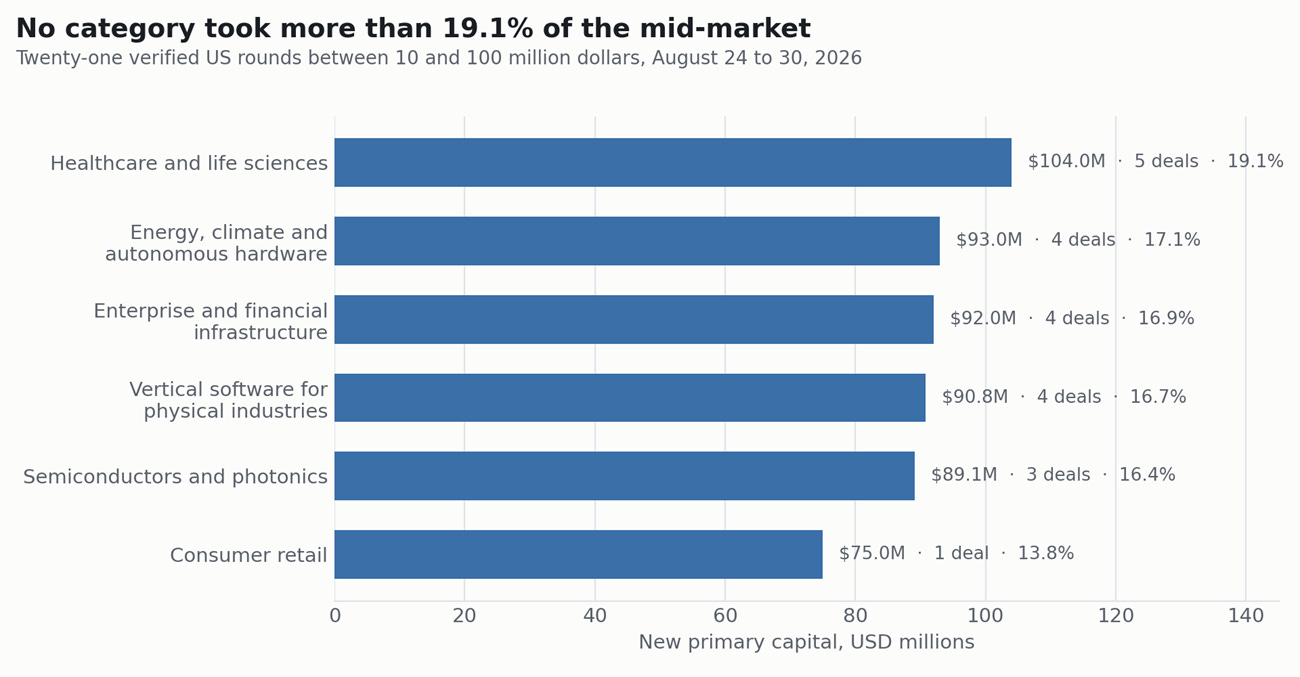
Pattern, what happened. Six categories split the week, and none took more than 19.1% or less than 13.8%. Healthcare and life sciences took $104.0M across five rounds. Energy, climate and autonomous hardware took $93.0M across four. Enterprise and financial infrastructure took $92.0M across four. Vertical software for physical industries took $90.8M across four. Semiconductors and photonics took $89.1M across three. Consumer retail took $75.0M in a single round. Last week, healthcare accounted for 67.1% of the mid-market across nine of fifteen deals. This week it took 19.1% across five of twenty-one.
Perspective, what it means. A 48-point swing in one sector’s share in seven days is not a rotation, because rotations move money from one place to another. This moved money to no place in particular. Investors did not conclude that healthcare was over and semiconductors were on. They stopped underwriting by category and started underwriting one company at a time. That is what a flat capital pool split across more deals looks like from the inside: fewer thesis-driven bets, more case-by-case decisions.
Founder Blindspot, what most miss. Founders spend the week after a hot sector report repositioning into that sector. Anyone who rewrote their deck last weekend to sound like healthcare, on the evidence of a week where healthcare took two-thirds of the mid-market, is now pitching into a category that took a fifth. The sector signal has a shelf life of about seven days, and a repositioning takes three weeks. You will always arrive late.
Playbook, what to do. Delete the market timing slide. Replace the sentence “the market for X is growing at Y percent” with one sentence naming the specific customer budget line your product gets paid from, and the specific event that opened it. Category momentum is not underwritable this month. A budget line is.
Contrast. In June, the mid-market spread across many sectors, with no single dominant sector. Last week, one sector accounted for more than two-thirds. This week, the spread returned and widened beyond June, with the largest and smallest categories separated by 5.3 percentage points.
What this means for your raise: Stop competing to be in the right category. Nobody has one this week. Compete to be the company whose buyer has a funded reason to move this quarter.
Shift 3: The Ceiling Fell, Not the Floor
Pattern, what happened. The score band ran from 42 to 70, a spread of 28 points, compared with 46 points last week. But the compression was one-sided. The lowest score rose from 36 to 42. The highest fell from 82 to 70. Zero of twenty-one rounds reached 75. The mean fell to 58.0 from 63.7 last week and 72.3 in June, a third consecutive decline. Only five of twenty-one rounds cleared 65, or 23.8%, against nine of fifteen the week before, or 60%.
Perspective, what it means. A widening band means uncertainty. A band that compresses downward means something else: the market has stopped paying for excellence. Last week Hopscotch Primary Care scored 82 because it disclosed profitable operations, retention above 90%, an NPS of 89, and a 25-point improvement in medical loss ratio. This week nobody offered anything close, and the market cleared twenty-one rounds anyway. When the best available evidence weakens, and the money still moves, investors are not raising the bar. They are lowering their expectation of what the bar can tell them.
Founder Blindspot, what most miss. Founders read a falling mean as permission to bring less. The opposite is true, and the arithmetic proves it. Last week, nine of fifteen rounds cleared 65, or 60%. This week, five of twenty-one cleared it, or 23.8%. The proportion of rounds that scored well fell by more than half. In a market where almost nobody is separating themselves, the cost of separating yourself has never been lower, and the return has never been higher, because the second-place company is at 58.
Playbook, what to do. Score your own round against the five dimensions this week, honestly, penalizing every blank as a zero the way an investor does. If you land above 65, you are in the top quartile of what actually got funded this week, and you should be running a competitive process, not a sequential one. If you land below 55, understand that you are indistinguishable from most of the sixteen other companies that also cleared, which means you will get funded at their price, not yours.
Contrast. June produced a 13-point band with a mean of 72.3, a market that agreed on what it paid for. Last week produced a 46-point band with a mean of 63.7, a market that had stopped agreeing. This week produced a 28-point band with a mean of 58.0 and no top end.
What this means for your raise: The bar for getting funded has fallen. The bar to get priced well did not move, and almost nobody cleared it. That gap is the entire opportunity in this market.
Shift 4: The Customer’s Number Replaced Yours
Pattern, what happened. None of the 21 companies disclosed a revenue figure. One disclosed a growth rate. Twenty withheld valuation. Against that blackout, five companies disclosed a quantified result their customers received, and those five averaged 64.6, compared with 56.0 for the other sixteen. Onos Health disclosed a 35% improvement in clinical standard adherence, a 75% improvement in clinical review efficiency, and more than a 6% reduction in behavioral health program costs within twelve months at health plans including Aetna. Arintra disclosed a 5.1% increase in compliant revenue capture, a 32% reduction in cost to collect, and a 43% decrease in coding-related denials across named health systems processing $5B in annual claims. CivilGrid disclosed more than $60M in paving conflicts eliminated at PG&E, a 40% reduction in field research and up to an 85% reduction in due diligence time. Corvus Robotics disclosed 35,000-plus inventory discrepancies identified at Southern Glazer’s and a 600% increase in imaging frequency at Dermalogica. Yardstik disclosed 149% revenue growth, 98% account retention over three years, and 99.4% customer satisfaction.
Perspective, what it means. An investor underwriting a company with no disclosed revenue is underwriting a hypothesis about future revenue. A quantified customer outcome converts that hypothesis into arithmetic by telling the investor the buyer’s payback period and, therefore, how hard the next hundred sales will be. A 43% reduction in coding denials at a health system with $50B in net patient revenue is a renewal argument, an expansion argument, and a pricing argument in one figure. Your own ARR is none of those things. It tells an investor what you already sold, not why the next buyer signs.
Founder Blindspot, what most miss. Founders treat customer results as marketing material and their own metrics as investor material, and then wonder why a deck full of ARR and logos produces polite second meetings. The order is backward. In a week when the whole market went dark on its own numbers, the founders who put the buyer’s number on slide two were the only ones giving an investor anything to model. And note what this does not require: none of these five disclosed their revenue either.
Playbook, what to do. This is the single highest-leverage action in this issue. Call your three best customers this week and ask one question: what changed in a number you already track since you started using us? Not “are you happy?” A number, with a before and an after, and permission to use it. Then write three lines in this exact form: customer name, metric, before, after, time elapsed. Put those three lines on slide two and move your own metrics to slide nine.
Contrast. Last week the divider was proof readiness, whether a company’s own numbers existed in defensible form when the round opened, worth 13.4 points. This week the divider moved one step outward. It is no longer whether you can produce your numbers. It is whether you can produce your customers, and the premium is 8.6 points in a market where the ceiling itself fell twelve.
What this means for your raise: Your metrics prove you exist. Your customers’ metrics prove you matter. In a week when nobody showed either, the second one was worth nearly nine points and four of the top five slots.
Shift 5: Distribution Replaced the Lead Investor
Pattern, what happened. Two of twenty-one rounds were led outright by a corporate or strategic investor rather than a venture firm, a third was funded by corporate strategics with no lead designated at all, and nine of twenty-one carried strategic money. Builders FirstSource led Digs’ $25.3M Series A as sole lead and attached a five-year commercial agreement extending Digs across 140,000 builder clients and 565 locations in 43 states. M&G Investments led Hivemind Digital Group’s $17M round and took a board seat; M&G is precisely the institutional asset manager Hivemind’s tokenization infrastructure is built to serve. Mantel’s $18M came as a strategic investment from Constellation Technology Ventures and Azimut, with no lead named; Constellation is the largest carbon-free power producer in the United States and therefore the buyer. MediaTek led Agentry’s pre-seed round and returned in the seed round. CVS Health Ventures joined Onos Health, whose customers are health plans. Yale New Haven Health and Endeavor Health Ventures joined Arintra, and both are exactly the kind of health system that buys revenue cycle software. Ciena joined Quintessent, and GrainInnovate and the Hort Innovation Venture Fund joined TerraBlaster. Outside the counted set, Orthofeet joined Hike Medical as both investor and commercial partner.
Perspective, what it means. When the average check falls 29%, and the deal count rises 40%, a purely financial lead is buying less influence per dollar than it used to. A strategic that is also a buyer or a channel does two jobs with one check: it prices the round, and it removes the top-line risk. Digs is the clearest evidence. It scored 14 out of 30 on founder and investor dynamics, the lowest in the set, and cleared $25.3M anyway, because the lead investor was the distribution. Mantel is the counter-evidence and the caution. Its strategic funding came from the right buyer, yet it still scored 52, second-from-bottom, because no investor took the lead seat and no stage was disclosed. Strategic capital substitutes for founder brand. It does not substitute for someone setting the price.
Founder Blindspot, what most miss. Founders rank corporate money below venture money on the assumption that it is slower, more conditional, and a negative signal to the next round. This week it was the fastest path to a priced round for companies whose own proof was thin. The trap is real, but it is not the one founders name: the danger in strategic capital is a right of first refusal or an exclusivity clause that shrinks your buyer universe, not the reputational question, which nobody in this week’s data appears to have been penalized for.
Playbook, what to do. Build a second target list this week, twelve names long, of corporates who buy what you sell or sell to who you sell to. For each one, write the specific first customer they can deliver in the first ninety days. Then read your existing term sheet template and delete any language granting exclusivity, right of first refusal on an acquisition, or category lockout, because that is the only part of strategic money that actually costs you.
Contrast. Last week’s leads were almost entirely venture and specialist funds: ARCH, New Leaf, 8VC, Costanoa, Section 32, Battery, OrbiMed, ARCHIMED. Two of fifteen rounds carried a corporate as a co-lead, Olympus Innovation Ventures at MaxQ Medical and Aramco Ventures at Twin1 AI, and neither led alone. This week, two rounds were led outright by a corporate or strategic asset manager; a third was funded by corporate strategics with no lead at all; and nine of twenty-one carried strategic money.
What this means for your raise: Rank your investor list by which customer each one delivers, not by which name looks best in the announcement. In a rationed market, the check that comes with a buyer is worth more than the check that comes with a brand.
The Deals That Matter, Top 5
Five deep dives across private markets infrastructure, behavioral health AI, healthcare revenue assurance, workforce risk, and subsurface infrastructure data. These are the five highest-scoring rounds of the week. All metrics are company-supplied, verified against two or more sources, and re-checked in a second pass.
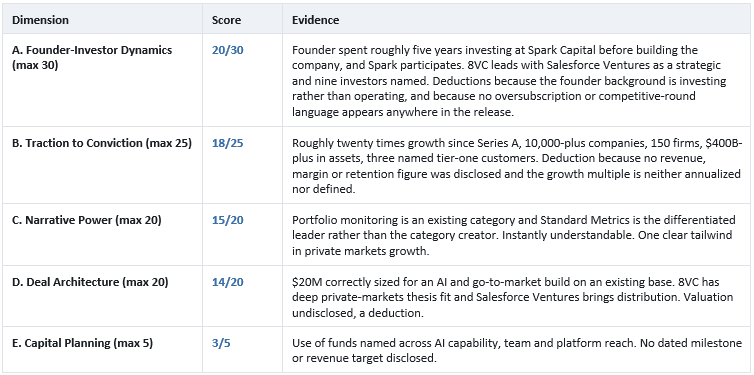
Standard Metrics
AI Portfolio Management for Private Markets | Series B | $20M | Valuation Undisclosed
Eisen Fundability Score: 70 / 100
Why this scored. The highest score of the week, and the smallest round in the top five. Standard Metrics did not disclose revenue, growth rate, or valuation. What it disclosed was position: more than 10,000 portfolio companies on the platform, 150 firms managing more than $400B in assets, roughly twenty times business growth since its Series A, General Catalyst, Bessemer, and Accel named as customers, and a claim that 30% of Forbes Midas List investors are customers. It then paired that with the highest Founder-Investor Dynamics score in the set, 20 out of 30, on an 8VC lead with Salesforce Ventures and Spark Capital participating.
The Setup. Standard Metrics, founded in 2020 and headquartered in San Francisco, sells portfolio monitoring and reporting infrastructure to venture and private equity firms. Chief executive John Melas-Kyriazi co-founded the company after roughly five years as an investor at Spark Capital, which participates in this round. That biography matters more than usual here, because the buyer is a venture investor and the founder was one. He is not selling into a market he researched. He is selling the thing he wanted and could not buy.
The Numbers. $20M Series B led by 8VC, announced August 24, 2026, with Salesforce Ventures, Spark Capital, January Capital, First Trust Capital Partners, Socii Capital, Kindergarten Ventures, Calm Ventures, and Gaingels participating. More than 10,000 portfolio companies supported. 150 firms managing more than $400B in assets. Approximately twenty times business growth since the Series A, a company-stated and undefined multiple that does not specify revenue. Named customers: General Catalyst, Bessemer Venture Partners, and Accel. The company states that 30% of the current Forbes Midas List are customers. Announced alongside launches of AI document parsing, an AI Analyst tool, and MCP interoperability. Founded in 2020. Revenue, growth rate, and valuation not disclosed, and the release contains no oversubscription or competitive-round language.
The Pattern. This is scale substituting for outcomes. Standard Metrics is the only company in the top five that did not disclose a quantified customer result, and it reached the top anyway by disclosing how much of the market it already holds. Assets on the platform are not a customer outcome but a defensible, countable, third-party-verifiable position, and at $400B, they answer the only question an investor has about an infrastructure company: is it already the standard?
The Perspective. There are exactly two ways to win an infrastructure round without revenue disclosure. Prove that the customer’s economics have improved, or prove that you already hold the market. The second is only available if you actually hold it, and most founders overstate their version of it by counting logos instead of volume. Standard Metrics counted volume: companies, firms, and dollars on the platform. Three countable denominators, each verifiable by any investor who asks two peers.
The Playbook. Find the one denominator in your category that a stranger could verify by calling two people, and measure yourself against it. Not “500 customers.” Assets, transactions, patients, acres, claims, seats under management. Then state your number and the denominator in the same sentence. A number without a denominator is a brag. A number with one is a market share claim, and market share is the only metric that survives a week when nobody discloses revenue.
The Founder Mistake to Avoid. Founders read this deal as proof that a big customer list wins rounds and go collect logos. Standard Metrics’ customers are the firms its investors talk to daily, which means every reference call was pre-cleared before the process opened. If your customer list cannot be checked by your target investor in a single text message, it is not doing the work you think it is, and you should be building the outcome numbers instead.
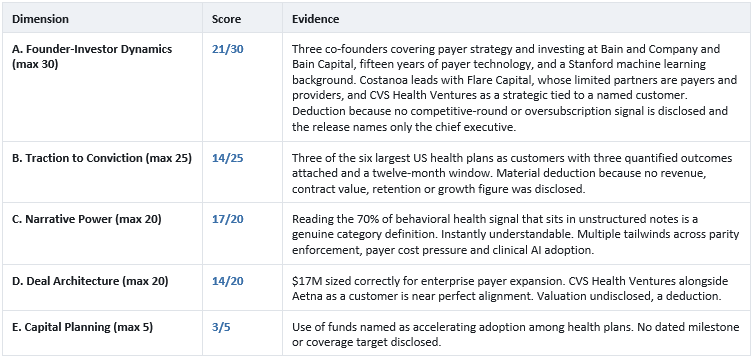
Onos Health
Behavioral Health Clinical Intelligence for Payers | Series A | $17M | Valuation Undisclosed
Eisen Fundability Score: 69 / 100
Why this scored. The best customer-outcome disclosure of the week, in the second smallest round in the top five. Onos scored 14 out of 25 on Traction to Conviction with zero disclosed revenue, because it disclosed what its customers got instead: a 35% improvement in clinical standard adherence, a 75% improvement in clinical review efficiency, and more than a 6% reduction in behavioral health program costs within twelve months. It then named the buyers: three of the six largest health plans in the United States, including Aetna. CVS Health Ventures, which is Aetna’s corporate parent’s venture arm, invested.
The Setup. Onos Health, headquartered in San Francisco, sells an AI platform that reads the unstructured clinical documentation health plans already hold and turns it into behavioral health quality and cost signals. It has three co-founders. Chief executive Akshay Agrawal advised health plan executives at Bain and Company, invested in healthcare at Bain Capital, and held executive roles at mPulse and Presence. Chief product officer Josh Levitan spent fifteen years building technology for health plans and government healthcare programs. Chief technology officer Suhaas Prasad holds a master’s degree from Stanford in machine learning and 15 years of experience in enterprise software and AI. Agrawal frames the problem precisely: roughly 70% of behavioral health care quality signals sit in unstructured documentation that no payer system can read. Behavioral health carries more than $140B in direct annual medical cost in the United States, and more than 23% of adults experience a mental health condition each year, and payers have almost no visibility into whether the care they paid for was any good.
The Numbers. $17M Series A led by Costanoa, announced August 26, 2026, with Flare Capital Partners and CVS Health Ventures participating. Three of the six largest US health plans are customers, including Aetna. 35% improvement in adherence to clinical standards. 75% improvement in clinical review efficiency. More than 6% reduction in behavioral health program costs within twelve months. Approximately 70% of behavioral health quality signals found in unstructured documentation. Headquartered in San Francisco. Revenue, growth rate, retention, and valuation not disclosed.
The Pattern. This is the customer-number round in its purest form. Onos disclosed nothing about itself, three specific details about its buyers, and one of those buyers invested in the round. The 6% program cost reduction is the load-bearing figure because behavioral health spend at a top-six plan runs into the billions, making 6% a number a payer executive can take to a budget meeting without a slide.
The Perspective. A cost-reduction percentage with a named payer is worth more than your ARR because it reflects the deal from the buyer’s perspective. An investor can multiply 6% by the plan’s behavioral health spend, subtract your contract value, and see the payback period without asking you a question. That calculation is what converts a second meeting into a term sheet. Founders who lead with their own revenue force investors to do the harder version of the same math from the outside, with less information.
The Playbook. Identify the single line item in your customer’s budget that your product moves, then measure the movement and publish the percentage with the time window attached. 12 months is the right window because it aligns with a renewal cycle. If you cannot yet measure the movement, instrument it this quarter with one customer and one metric. One measured customer beats ten unmeasured ones, and it takes a quarter rather than a year.
The Founder Mistake to Avoid. Founders copy the format and produce percentages without a denominator, a named customer, or a time window: “improves efficiency by 75%.” Onos attached its figures to health plans a diligence team can call and a window a finance team can audit. An unattributed percentage in a deck is worse than no percentage, because the first reference call exposes it and the investor stops believing the rest of the page.
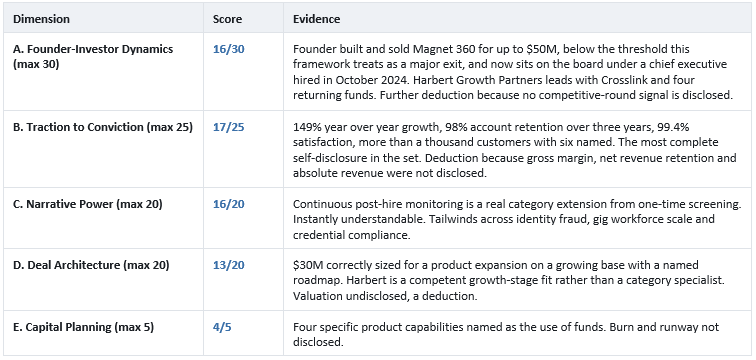
Yardstik
Continuous Workforce Risk Monitoring | Series B | $30M | Valuation Undisclosed
Eisen Fundability Score: 66 / 100
Why this scored. The only company in twenty-one to disclose a growth rate, and it scored 17 out of 25 on Traction to Conviction, the second highest in the set. Yardstik disclosed 149% year-over-year revenue growth, 98% account retention over a three-year period, and 99.4% customer satisfaction across more than a thousand customers, naming Gopuff, TaskRabbit, Liveops, Sharetown, HUNGRY, and H&R Block among them. In a week when 20 companies disclosed nothing about their own trajectory, one company disclosing 3 verified numbers is a competitive act, not a communications choice.
The Setup. Yardstik, headquartered in Minneapolis, began as a background screening company for the gig economy and has repositioned into continuous post-hire workforce monitoring. The category insight is that screening someone once at hire is a snapshot in a world where identity fraud, credential expiration, and changes to driving records occur continuously. The new product surface is motor vehicle report monitoring, inspector general exclusion tracking, and automated credential expiration alerts. Founder Matt Meents previously built Magnet 360 and sold it to Mindtree in 2016 for up to $50M, and remains on the board; Andrew Johnson, previously chief operating officer, became chief executive in October 2024.
The Numbers. $30M Series B led by Harbert Growth Partners, announced August 27, 2026, with Rally Ventures, MissionOG, Crosslink Capital, Grotech Ventures and Great North Ventures participating. 149% year over year revenue growth. 98% account retention over a three-year period. 99.4% customer satisfaction. Ranked 861 on the 2026 Inc. 5000. Total funding of $65M. More than a thousand customers, including Gopuff, LiveOps, Sharetown, TaskRabbit, HUNGRY, and H&R Block. Use of funds is broken down across fraud prevention, motor vehicle report monitoring, exclusion tracking, and credential expiration alerts. Valuation not disclosed.
The Pattern. Yardstik is the category-extension round. It did not defend background screening, a crowded and price-compressed category. It reframed the purchase as continuous risk monitoring and shifted the buying decision from a one-time procurement to a subscription tied to ongoing exposure. The 98% retention over three years is the proof that the reframe held, because retention is the only metric that distinguishes a repositioning from a rebrand.
The Perspective. Growth rate plus retention is the complete story, and neither alone is. 149% growth without retention could be churn masked by new logos. 98% retention without growth could be a stagnant base. Together, they say the same customers are spending more, which is the closest thing to net revenue retention available without disclosing it. Yardstik found the disclosure that carries the information without giving away the dollar figure, and that is a deliberate, replicable choice.
The Playbook. Pick the two-metric pair in your business that constrains the interpretation of both. Growth plus retention. Volume plus margin. Users plus frequency. Disclose the pair and hold the absolutes. A single metric invites a skeptical reading; a pair that cannot both be flattering under a bad interpretation forecloses that reading. Then write down, in one line, the bad interpretation each metric alone would invite, and confirm your pair kills it.
The Founder Mistake to Avoid. Founders in a repositioning announce a new category while continuing to sell the old product. Yardstik shipped the surface that only makes sense in the new frame: continuous monitoring of records that change after hire. If your repositioning does not create a product feature that would be incoherent in your old category, you have renamed something rather than moved it, and the retention number will eventually say so.
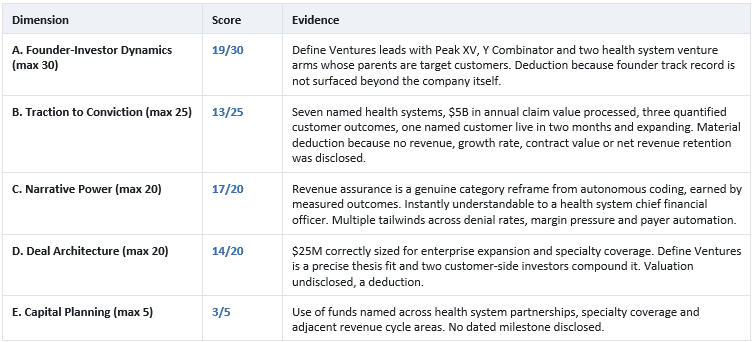
Arintra
Autonomous Medical Coding and Revenue Assurance | Series B | $25M | Valuation Undisclosed
Eisen Fundability Score: 66 / 100
Why this scored. The deepest customer-outcome disclosure in the set, attached to the most named customers. Arintra disclosed a 5.1% increase in compliant revenue capture, a 32% reduction in cost to collect, and a 43% decrease in coding-related denials, then named seven health systems: UC Davis Health, Mercyhealth, Meritus Health, Rochester Regional Health, Reid Health, Mercy Medical Center, and Endeavor Health. Two health system venture arms invested in the round, which converts a reference call into a cap table entry.
The Setup. Arintra, founded in 2020 and headquartered in San Francisco, sells autonomous medical coding across more than twenty-three specialties, and this round is the moment it stopped selling that. The company repositioned the purchase as revenue assurance, a category framing that moves it out of a coding software line item and into the chief financial officer’s margin problem. Chief executive Nitesh Shroff put the reframe in one line: revenue assurance is no longer optional; it is how health systems build a financial foundation that matches the quality of care they deliver.
The Numbers. $25M Series B led by Define Ventures, announced August 26, 2026, with Peak XV Partners, Yale New Haven Health Center for Health Care Innovation, Endeavor Health Ventures, Y Combinator, Counterpart Ventures, Ten13 and Spider Capital participating. Processes $5B in annual claim value. Customers represent $50B in combined net patient revenue. 5.1% increase in compliant revenue capture. 32% reduction in cost to collect. 43% decrease in coding-related denials. Meritus Health went live within two months and expanded across multiple specialties. Total funding: $51M. Founded in 2020. Revenue, growth rate, and valuation not disclosed.
The Pattern. Arintra is the denominator round. It never states its own revenue, and it does not need to, because it states the volume it runs through: $5B in annual claims for customers with $50B in net patient revenue. An investor can size the opportunity from the denominator without a single company figure. That is the same move Standard Metrics made with $400B in assets, executed in healthcare, and both landed in the top four.
The Perspective. The two health-system venture arms are the parts most founders will miss. Yale New Haven and Endeavor Health are not financial investors reaching for healthcare exposure. They are buyers whose parent organizations are exactly the customers Arintra sells to, and their presence on the cap table signals to every other health system in the pipeline that two peers have already run diligence. In an enterprise sale with a nine-month cycle, that is worth more than the capital.
The Playbook. Ask your two best enterprise customers whether their organization has a venture arm, a strategic investment vehicle, or an innovation fund, and whether it would take a small position in your round. Most large health systems, utilities, banks, and retailers have one. You are not raising money from them. You are raising from them so the next twelve buyers in your pipeline never have to be the first.
The Founder Mistake to Avoid. Founders copy the reframe without the receipts. “Revenue assurance,” rather than “medical coding,” is a stronger frame only because Arintra can show 5.1%, 32%, and 43% against seven named systems. A category reframe with no measured outcome underneath it reads as a positioning exercise, and sophisticated investors have seen the same rename in every vertical software category this year. Earn the frame with numbers before you claim it.
CivilGrid
Subsurface and Regulatory Data for Infrastructure | Series A | $26M | Valuation Undisclosed
Eisen Fundability Score: 65 / 100
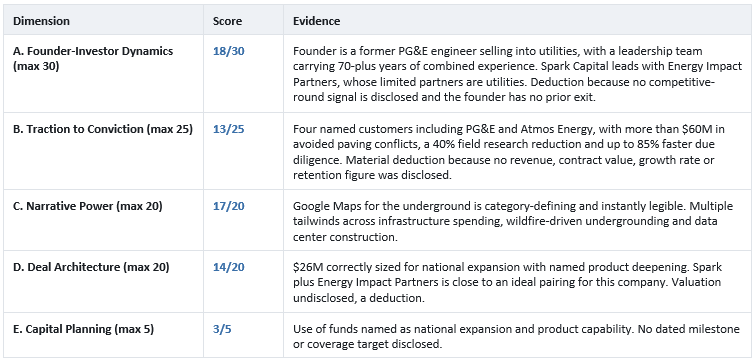
Why this scored. The strongest investor quality mark in the set, 9 out of 10, on a Spark Capital lead with Energy Impact Partners, paired with the largest single dollar outcome disclosed anywhere this week: more than $60M in paving conflicts eliminated at PG&E through portfolio optimization. CivilGrid also disclosed a 40% reduction in field research and survey activity and up to an 85% reduction in due diligence time, against named customers including PG&E, Atmos Energy, Mark Thomas and GHD.
The Setup. CivilGrid, headquartered in San Francisco, consolidates fragmented subsurface and regulatory data into a single mapping environment for infrastructure teams. Chief executive and co-founder Josh Mackanic is a former PG&E engineer, and the company sells back into the utility he came from. The problem is specific and expensive: utility strikes and project delays cost roughly $30B annually in the $2.2 trillion US construction industry, and the data required to avoid them is scattered across dozens of unconnected municipal, utility, and regulatory systems. The framing that stuck with the press was Google Maps for the underground.
The Numbers. $26M Series A led by Spark Capital, announced August 27, 2026, with Energy Impact Partners, Afore Capital, A*, Ford Street Ventures, and SNR Ventures participating. PG&E realized more than $60M in paving conflicts eliminated through portfolio optimization. 40% reduction in field research and survey activities at PG&E. Project timelines up to four months faster. Up to 85% reduction in due diligence time. Named customers: PG&E, Atmos Energy, Mark Thomas, and GHD. Leadership team with more than 70 years of combined industry experience. Headquartered in San Francisco. Revenue, growth rate, contract value, and valuation not disclosed.
The Pattern. CivilGrid is the operator-turned-vendor round, and the $60M figure is what makes it work. Most infrastructure software sells time savings, which a procurement team discounts by half on instinct. CivilGrid sold an avoided cost with a dollar sign on it at a named utility, which a procurement team cannot discount because it appears in their own accounting. The founder, being a former PG&E engineer, is what made that number attainable in the first place.
The Perspective. Energy Impact Partners’ limited partners are utilities. That is not a logo on the cap table; it is a customer pipeline, and in a $26M Series A it is worth more than a larger check from a generalist. Pair it with a Spark Capital lead, and the round has both halves of what an early enterprise infrastructure company needs: a firm that prices growth and a firm that opens doors. Founders routinely optimize for one and treat the other as filler.
The Playbook. Convert your best time-savings claim into an avoided-cost claim in dollars this week. Take the hours you save, find what the customer pays for those hours or what the failure they avoid costs them, and get one customer to confirm the arithmetic in writing. Then name the customer. A percentage is a claim about your product. A dollar figure at a named account is a claim about their books, and only one of those survives diligence intact.
The Founder Mistake to Avoid. Founders with a marquee customer treat it as a logo slide and never extract the number. PG&E is not the asset here; the $60M PG&E can attribute is. The trap is spending a year winning a lighthouse account and then never asking it to quantify what changed, which leaves you pitching the same reference call that every other vendor in your category is also pitching.
The Fundraising Playbook: Five Tactical Plans
Five plans, each producing a concrete output you can use immediately. No vague tasks. Each is built directly from this week’s verified signals.
1. The Three Customer Numbers (Narrative and Investor Framing)
Why this matters. Zero of twenty-one companies disclosed revenue, and one disclosed a growth rate. The five that disclosed a quantified customer outcome averaged 64.6, compared with 56.0 for the other sixteen. In a week when the whole market went dark on its own metrics, the customer’s metric was the only thing an investor could model.
Exact deliverable. Three lines, each in this form: customer name, the metric, the value before, the value after, the time elapsed. Onos Health’s version reads as a 6% reduction in behavioral health program costs within twelve months at a top-six health plan. Arintra’s reads as a 43% decrease in coding denials at named health systems. CivilGrid’s reads as more than $60M in paving conflicts eliminated at PG&E. Get written permission to use the customer name and the figure. Put the three lines on slide two and move your own metrics to slide nine.
Expected outcome. You move from the 56.0 bucket to the 64.6 bucket without changing anything about the business. An investor can compute your buyer’s payback period from your second slide, which is the calculation that converts a second meeting into a term sheet.
The reframe. Wrong approach: lead with your ARR and use customer results as marketing collateral. Right approach: lead with the customer’s result and hold your ARR for the data room.
2. The Verifiable Denominator (Proof and Metrics Packaging)
Why this matters. Standard Metrics took the top score of the week at 70, with no revenue, no growth rate, and no valuation disclosed, by citing three countable denominators: 10,000-plus companies, 150 firms, and $400B-plus in assets on the platform. Arintra did the same in healthcare with $5B in annual claim value across customers representing $50B in net patient revenue. Both landed in the top four.
Exact deliverable. One sentence naming the volume that runs through your product and the market denominator it sits inside. Assets, claims, transactions, acres, patients, seats, gigawatts, cattle, miles. Both numbers must be countable by a stranger who calls two people in your industry. Write it, then hand it to someone outside your company and ask them to tell you how big your market share is. If they cannot, the denominator is wrong.
Expected outcome. An investor can size your position without asking you for revenue. In a market with a 95.2% valuation opacity rate, that is the substitute for a price conversation you are not ready to have.
The reframe. Wrong approach: 500 customers, growing fast. Right approach: $5B in annual claim volume for customers representing $50B in net patient revenue.
3. Eisen Self-Score Against a Falling Ceiling (Readiness)
Why this matters. The top score this week was 70, and nothing reached 75. Only five of twenty-one rounds cleared 65, down from nine of fifteen last week, so the share of well-scored rounds fell from 60% to 23.8%. The cost of separating yourself has never been lower, and the return has never been higher, because sixth place this week was a 61, and the median round score was 58.
Exact deliverable. Score your round across the five dimensions: Founder-Investor Dynamics (30), Traction to Conviction (25), Narrative Power (20), Deal Architecture (20), and Capital Planning (5). Penalize every blank as a zero, the way an investor does. Then apply this week’s specific test: if your score is above 65, you are in the top quartile of what actually cleared, and you should run a parallel process with a deadline rather than a sequential one. If you are below 55, you are indistinguishable from the 16 companies that also cleared, and you will be priced like them.
Expected outcome. A decision about process design, not just a list of weaknesses. The score tells you whether to run a competitive process or fix the gaps first, and running the wrong one costs a quarter.
The reframe. Wrong approach: score yourself, feel discouraged, revise the deck. Right approach: score yourself, decide whether you are running a competitive process or a repair sprint, and commit to one.
4. The Channel-Weighted Target List (Deal Architecture)
Why this matters. Two of twenty-one rounds were led outright by a corporate or strategic investor, a third came from corporate strategics with no lead named, and nine of twenty-one carried strategic money. Digs scored 14 out of 30 on founder and investor dynamics, the lowest in the set, and cleared $25.3M because Builders FirstSource led outright and attached a five-year agreement across 140,000 builder clients. Mantel cleared $18M in strategic funding from Constellation Technology Ventures, the buyer, but scored 52 because no one took the lead seat.
Exact deliverable. Two lists. First, a financial list cut to 30 names, where each name passes one test: you can write a sentence naming the specific deal they led in your category in the last twelve months. Second, a strategic list of 12 corporates who either buy what you sell or sell to whom you sell, and for each one, the specific customer they can introduce in the first ninety days. Then decide which list your lead comes from, because Mantel’s work shows that strategic money without a designated lead prices worse than either alone. Finally, open your term sheet template and pre-draft your position on exclusivity, right of first refusal on acquisition, and category lockout, because that is the only part of strategic capital that actually costs you.
Expected outcome. A process where every conversation carries either a price or a customer, and you know which before you take the meeting.
The reframe. Wrong approach: rank investors by fund size and brand, treat corporate money as a fallback. Right approach: rank by the number of customers each one delivers, and negotiate the exclusivity language before you need it.
5. The Milestone That Survives a Smaller Check (Momentum and Conversion)
Why this matters. Average check size fell 28.7% in one week, and every stage fell. Seed fell 49%, Series B fell 42%, and Series A fell 17%. Founders planning against last quarter’s round sizes are building a use of funds that the market will not finance, and they will discover it in week six of a process rather than week zero.
Exact deliverable. Re-cut your use of funds at 72% of your target raise, which is what the average check did this week. Write down the one milestone that still lands and the two that do not. Then write the one sentence you would say to a partner about what the smaller round buys. If that sentence is weaker than your current one, the round is not the problem; the plan is, and you have two weeks to fix it before you open rather than six weeks to discover it after.
Time estimate. 3 hours with your finance lead, plus 1 hour to rewrite the use-of-funds slide.
Expected outcome. You walk into the first meeting already priced for the existing market, which means you negotiate on terms rather than on size, and you do not spend a month defending an ask the market has stopped writing.
The reframe. Wrong approach: hold the ask, hope for the exception, discount later under pressure. Right approach: size to the market, fund one real milestone, and let the competitive process push the number back up.
Looking Forward, Next 1 to 3 Weeks
Three evidence-based scenarios and one wild card. Every prediction is anchored to this week’s verified data, not speculation.
Scenario 1: Check Sizes Stay Compressed (High Probability)
Evidence from this week. Two consecutive weeks of the same pattern. Average check fell 24% into last week and a further 28.7% into this one, while total capital moved less than 1%. Every stage fell this week, not just one, which rules out a mix effect and points to a repricing of the round itself. Series B fell the hardest in dollar terms, from $45.5M to $26.40M, and now trades at a 3% discount to Series A.
What to watch. Whether Series A settles below $30M for a third week and whether the Series B premium stays gone. Six Series A rounds averaged $27.22M this week against $32.8M last week, and five Series B rounds averaged $26.40M against $45.5M. If the next issue lands in the mid-twenties again at both stages, that is a new normal rather than a summer effect, and every Series A deck built on a $35M ask, and every Series B deck built on a $45M ask, is misaligned.
What founders should do before others notice. Rebuild your use of funds at the smaller number now, while you have time to design the milestone rather than defend the ask. Founders who reprice in week six of a process do so under pressure and lose terms.
Scenario 2: Disclosure Keeps Falling, and Customer Proof Keeps Rising (High Probability)
Evidence from this week. Valuation opacity rose for a third consecutive period, from 80% in June to 93.3% last week to 95.2% this week. Zero companies disclosed revenue and one disclosed growth. Against that, five companies disclosed quantified customer outcomes and took five of the top six slots.
What to watch. Whether customer-outcome disclosure spreads outside enterprise software and healthcare. Corvus Robotics did it in warehouse robotics this week with named accounts and specific counts, which suggests the pattern is not category-bound. When a hardware or climate company leads with a named customer’s avoided cost rather than a product specification, the pattern has generalized.
What founders should do before others notice. Instrument one customer this quarter. Pick the account most likely to say yes, agree on the metric before you start measuring, and set a twelve-month window. You are building the asset the market will price in six weeks, and it takes a quarter to produce, which means starting after you see it in a report is starting too late.
Scenario 3: Strategic Capital Keeps Taking the Lead Seat (Medium-High Probability)
Evidence from this week. Two rounds led outright by corporate or strategic investors, a third funded by corporate strategics with no lead, and nine of twenty-one carrying strategic money. The lowest founder-dimension score in the set, Digs at 14 out of 30, still cleared $25.3M because its corporate lead brought distribution. Compressed check sizes make a check that also carries a customer structurally more attractive to both sides.
What to watch. Whether corporate leads start appearing at Series B and later rather than concentrating at Series A and seed, and whether any of this week’s strategic rounds later disclose exclusivity terms. The first tells you the pattern is deepening. The second tells you what it costs.
What founders should do before others notice. Have the exclusivity conversation with counsel before a corporate offers to lead, not after. The terms that matter- right of first refusal on acquisition, category exclusivity, and channel lockout- are far easier to negotiate as a stated policy than as a reaction to a specific term sheet.
Wild Card: The First 75 in Six Weeks Resets the Ceiling (Medium Probability)
Evidence from this week. The ceiling has fallen from 82 to 70 in one week, and nothing reached 75. The proof that produced last week’s 82 was a single disclosure: profitable operations in a defined region alongside a 25-point improvement in medical loss ratio. That is not a rare business condition. It is a rare disclosure decision, and it is available to any company with a profitable segment, region, cohort, or product line.
What founders should do before others notice. Find the one slice of your business that is already profitable, even if it is a single region, one product, or one customer cohort, and reconcile the economics for that slice specifically. You are not disclosing company profitability. You are disclosing that a defined unit of your business works, which is what an investor is trying to determine anyway. In a week where the ceiling fell to 70, the first company to bring that slice will be the only one in its category at 80.
The Bottom Line
The real insight is not the $543.9M total. It is that the total did not move while the number of companies competing for it rose 40%, and the market responded by paying less for everything and less again for the best of it. The ceiling fell twelve points. The floor rose six. Nothing reached 75. That is what a rationing market looks like from the inside, and it produced exactly three conviction profiles.
Profile 1: Companies that disclosed the customer’s number. Onos Health (69) disclosed a 6% reduction in behavioral health program costs at a top-six health plan. Arintra (66) disclosed a 43% drop in coding denials across seven named health systems. CivilGrid (65) disclosed more than $60M in paving conflicts eliminated at PG&E. Corvus Robotics (57) disclosed 35,000-plus discrepancies found at Southern Glazer’s. None of them disclosed their own revenue. All of them gave an investor a number to model. Five such companies averaged 64.6, compared with 56.0 for the other sixteen.
Profile 2: Companies that disclosed a verifiable denominator. Standard Metrics (70) took the week’s top score with more than $400B in assets across 150 firms and three tier-one venture firms named as customers. Arintra (66) processed $5B in annual claims for health systems representing $50B in net patient revenue. Neither stated a revenue figure. Both let an investor size the position from the outside. When you cannot show what you earn, show what runs through you.
Profile 3: Companies whose lead investor was the channel. Digs (58) posted the lowest founder and investor dynamics score in the set, 14 out of 30, and cleared $25.3M because Builders FirstSource led outright and attached five years of access to 140,000 builder clients. Hivemind (53) cleared $17M because M&G Investments led and took a board seat. Mantel (52) secured $18M in strategic funding from the buyer itself, Constellation Technology Ventures, but ranked lowest of the three because no investor took the lead seat and no stage was disclosed. When your own proof is thin, the fastest available substitute is an investor who is also a buyer. It only works if that investor is willing to lead.
Everything else competed for the residual. Sixteen companies raised real money from real investors with nothing on the record that a new investor could verify, and they averaged 56.0. Each of them answered questions in diligence that never became public, and none of them owed anyone a press release. The difference is that the top of the band handed the investor a number that did the underwriting for them. In a week when the ceiling fell to 70, the founder who brings one verified customer outcome does not just clear. They lead.
Five New Rules for Founders
1. Size to the check the market is writing. Average round size fell 28.7% in one week, and every stage fell with it. Recut your use of funds to 72% of your ask and find the milestone that survives before a partner finds it for you.
2. Your customer’s number outranks yours. Zero of twenty-one companies disclosed revenue. The five who disclosed a quantified customer outcome averaged 64.6, compared with 56.0. Name the customer, name the metric, name the window.
3. Category is not a strategy this month. Six sectors split the week inside a 5.3-point range after one sector took 67.1% seven days earlier. Underwriting went company by company. Pitch the budget line, not the market size.
4. When you cannot show revenue, show volume. Standard Metrics took the top score on $400B in assets on platform. Arintra tied for third on $5B in annual claim value. A countable denominator is the substitute for a number you are not ready to publish.
5. The best check may come with a customer attached, but somebody still has to lead. Two of the twenty-one rounds were led outright by a corporate or strategic investor, and the company with the lowest founder score in the set raised $25.3M in one of them. The round that took strategic money without a designated lead scored 52. Get the strategic, and get it to lead. Negotiate the exclusivity terms first, then take the money.
Four Monday Actions
1. Call three customers and get one number each. Metric, before, after, elapsed time, permission to name them. Three lines on slide two. Everything about your own performance moves to slide nine.
2. Write your denominator sentence. The volume that runs through your product and the market it sits inside, both countable by a stranger. Hand it to an outsider and ask them to state your market share back to you.
3. Re-cut the use of funds at 72% of the ask. Name the one milestone that survives and the two that do not. If the surviving milestone does not include pricing for your next round, fix the plan this week.
4. Build the twelve-name strategic list. Corporates who buy what you sell or sell to who you sell to, each with the specific customer they can deliver in ninety days. Then pre-draft your exclusivity position with counsel.
Twenty-one companies were cleared this week, and sixteen of them are indistinguishable from one another in the public record. The median round scored a 58. The founder who walks in on Monday with one named customer, one measured outcome, and one verifiable denominator is not competing against the top of this market because there was no top this week. They are the top.
Research Methodology, Sources and Verification
Data collection period: August 24 to 30, 2026, with verified primary disclosures clustered August 24 to 27. No verified US mid-market round was announced on August 29 or 30. Verification standard: a minimum of two independent sources per deal, with company press releases and regulated newswires (BusinessWire, PRNewswire, GlobeNewswire) prioritized as anchor sources, plus at least one independent outlet for corroboration. This issue was then put through a second, independent verification pass in which every company, amount, stage, investor, date, and reported metric was re-checked against primary sources. That pass removed four deals, restated three headline amounts to new primary capital, and corrected five attributions. Its findings are documented in the Data Integrity Notes and the corrections log below. Eisen Fundability Scores are proprietary analytical estimates, not endorsements or investment advice. All dollar figures reflect the announced new primary capital at close unless noted otherwise.
Core Capital Totals and What They Include
The $543.9M weekly total includes only the twenty-one verified US rounds in the scorecard, each independently confirmed at the stated amount and stage. Mid-market is defined for this issue as a US-headquartered round of new primary capital between $10M and $100M. Secondary share purchases, SAFE conversions from prior periods, previously closed tranches, and cumulative restatements are excluded from the counted amount even where a headline figure includes them. Announcements that do not separate new capital from cumulative totals are excluded entirely. No aggregator-only figure was treated as fact without corroboration in a company release or an independent outlet. Arithmetic on the total, the average, the median, all stage and sector subtotals and every chart value was recomputed and reconciled after the second verification pass: the six sector subtotals ($104.0M, $93.0M, $92.0M, $90.8M, $89.1M and $75.0M) and the seven stage subtotals ($163.3M across six Series A rounds, $132.0M across five Series B rounds, $75.0M in one Series C, $68.6M across four seed rounds, $61.0M across three rounds with no disclosed stage, $24.0M in one Series E-2 and $20.0M in one growth round) each sum to $543.9M across twenty-one deals.c
Exclusions and Documented Rationale
● Giant rounds and public market events, excluded by editorial scope: Instinct ($250M), Owner ($240M), Generalist AI ($200M), Gatik ($200M), Socure ($156M), Emerald AI ($150M), Regent Craft ($120M), AusperBio ($120M), Starcloud ($250M) and Unrivaled ($106M). The week’s ten largest rounds excluding Blank Street totaled $1,512M and are used only as the contrast set.
● Non-US rounds, excluded for scorecard comparability: Stability AI (UK, $76M, which ranked ninth on the week’s list of ten largest rounds), Liner (South Korea, $36.1M), WRTN Technologies (South Korea, $72.2M), PayRewards and Pay.com.au (Australia, $28M), W4 Games (Ireland, $18M), Airbound (India, $37M), Fasset (UAE, $68M), Cyclic Materials (Canada, $75M), Purple Style Labs (India, $40M), Certain Energy (UK), Ringg AI (India), M Village (Vietnam), Lupin Dental (France) and ColibriTD (France).
● Outside the date window: Princeton Critical Minerals ($16M, announced August 12) and Discern Security ($13M Series A, announced July 30), both marked news-cycle resurfaced despite circulating inside the window through aggregator republication.
● New capital could not be isolated: Hike Medical ($22.5M combined seed and Series A with no breakdown) and Quaise Energy ($180M Series B close with a $35M in-window tranche).
● Below the mid-market floor: Bevel ($6M), Teragen Energy ($6M), Mara ($7M), Stellaria ($6.8M), Light Links ($6M), Boldr ($5M), Soctera ($4M), EULER ($4.3M) and Embedd ($2.7M), each below the $10M threshold used in this issue.
Deal Citations, Two or More Sources per Deal
● Blank Street, $75.0M Series C (reported). Financial Times coverage dated August 24, 2026; Axios for the primary and secondary split, quoted as $75M of primary capital and $30M of secondaries; Daily Coffee News for the SEC filing figure of $104,999,981 and the 106 location count; Benzinga Private Markets and AlleyWatch, both of which label the round a Series C; Dealroom, which labels it a Series B and is not followed here; SEC EDGAR filing history (CIK 0001815159) confirming a $20M Series B in March 2023. No company release, investor post, or newswire announcement exists; rated MEDIUM confidence on that basis.
● Quintessent, $40.0M Series A. Company release syndicated via Yahoo Finance dated August 24, 2026; Photonics Spectra; Santa Barbara Independent; citybiz; Light Reading; innovosource GAP Pipeline Brief for the UC Santa Barbara spinout origin.
● Voya Energy, $35.0M Series A. Company release dated August 26, 2026; FinSMEs; Mercom Capital Group; Bloomberg; MINING.COM; Axios Pro climate deals for the week of August 24.
● Yardstik, $30.0M Series B. PRNewswire company release dated August 27, 2026; Pulse 2.0 for the growth, retention, and satisfaction figures; SiliconANGLE; ID Tech Wire; FinSMEs; Tech Funding News.
● Celera Semiconductor, $30.0M Series B. PRNewswire company release dated August 25, 2026, stating the round was fully funded by Maverick Silicon; company PRNewswire release dated August 5, 2025 for the prior $20M Series A from the same investor; Semiconductor Digest; citybiz; Latham & Watkins deal announcement.
● Breedr, $27.0M Series B. FinSMEs dated August 26, 2026, for the Austin headquarters and total raised; Tech Startups funding roundup of August 27, 2026; Partech investor materials.
● CivilGrid, $26.0M Series A. BusinessWire company release dated August 27, 2026, for the PG&E figures and customer names; TechCrunch; Dealroom; Morningstar syndication; FinSMEs; The SaaS News.
● Metriport, $26.0M. PRNewswire company release dated August 27, 2026; Pulse 2.0 for the named customers and total funding; Endpoints News; HIT Consultant; citybiz.
● Digs, $25.3M Series A. PRNewswire joint Builders FirstSource and Digs release dated August 25, 2026, confirming Builders FirstSource as sole lead, the five-year agreement, 140,000 builder clients and 565 locations across 43 states; GeekWire; Dealroom for the founding date and headcount; HousingWire; Modern Distribution Management; Silicon Florist.
● Transfyr, $25.0M Seed. Company release syndicated via Yahoo Finance dated August 26, 2026; Morningstar BusinessWire syndication; citybiz; FinSMEs; company site for founder backgrounds.
● Arintra, $25.0M Series B. BioSpace press release dated August 26, 2026, for the customer names and outcome figures; Fierce Healthcare; MobiHealthNews; HIT Consultant; Dealroom.
● Airway Therapeutics, $24.0M Series E-2. PRNewswire company release dated August 25, 2026, with an Atlanta dateline, stating that the E-round consists of $26M previously raised through a SAFE financing and $24M through the Series E-2, and that approximately 94% of existing investors participated; company locations page confirming Atlanta headquarters and a Cincinnati laboratory; citybiz; Clinical Trials Arena.
● Standard Metrics, $20.0M Series B. PRNewswire company release dated August 24, 2026, read through Yahoo Finance syndication; Pulse 2.0 for the platform metrics; January Capital investment memo and the founder’s own site for the Spark Capital background; Finextra; The SaaS News; FinSMEs.
● SiFly, $20.0M Series A. PRNewswire company release dated August 26, 2026 for the round, investors, and Guinness record; University of Maryland Innovation Hall of Fame and Wikipedia for Brian Hinman’s PictureTel, Polycom, and 2Wire co-foundings, none of which appear in the funding release; DroneLife; Aviation Week; citybiz; Robotics Tomorrow.
● Corvus Robotics, $20.0M. GlobeNewswire company release dated August 25, 2026 for the leadership transition; Robotics 24/7 dated August 27, 2026 for the round, investors, deployment counts, and customer figures; DroneLife; Supply Chain 24/7.
● Agentrys, $19.1M Seed. Semiconductor Digest for the seed and pre-seed split and founder background; Silicon Valley Daily dated August 27, 2026, for the San Jose headquarters; SemiWiki; Ventureburn; Tech Startups roundup of August 27, 2026.
● Mantel, $18.0M. GlobeNewswire company release dated August 24, 2026, describing a strategic investment from Constellation Technology Ventures and Azimut with no lead designated and no stage disclosed, total funding of $50M, and three named project sites; ESG Today; Carbon Herald, which supplies the led-by framing not used here; Axios Pro climate deals; Hydrocarbon Engineering.
● Onos Health, $17.0M Series A. PRNewswire company release dated August 26, 2026 for the customer and outcome figures; company about page for the three co-founders' backgrounds; Behavioral Health Business; MedCity News; HIT Consultant; Axios Pro health tech deals. Tech Funding News’ ex-Bain operators framing is not followed here.
● Hivemind Digital Group, $17.0M. PRNewswire company release dated August 25, 2026; Morningstar syndication; TradingView via Reuters; The Next Web; citybiz; Dealroom.
● TerraBlaster, $12.5M Seed. AgFunderNews dated August 25, 2026, for the investor list, the 0.15-acre resolution, and the commercial timeline; Ulu Ventures’ own investment post confirming Heraud co-founded the company with Matt Colgan; separate AgFunderNews interview for Heraud’s Blue River Technology background and his arrival from an advisory role; Precision Farming Dealer; FinSMEs; AgNavigator, which is the sole source for the oversubscription characterization.
● Legato, $12.0M. GlobeNewswire company release dated August 26, 2026; TechCrunch; Hearing Health and Technology Matters; HearingTracker; HLTH.
Research completion timestamp: August 30, 2026.
DISCLAIMER: This article is for informational and strategic intelligence purposes only. It does not constitute investment advice. The Eisen Fundability Score is a proprietary diagnostic within Fundables OS™, not a financial recommendation.
If this article was useful, share it with founders who are about to raise.
— Leon Eisen, 4x Founder, Venture Capitalist, and Creator of Fundables OS™