

Playbook, Perspective and Pattern for founders raising now. This report strips out giant rounds and public market traffic so you can read the part of the market that actually prices your round. Every figure below was verified against at least two independent sources and rechecked in two further passes: the first adversarial and focused on date windows, amount composition, headquarters, and lead designation; the second on every claim resting on a single source.
Opening
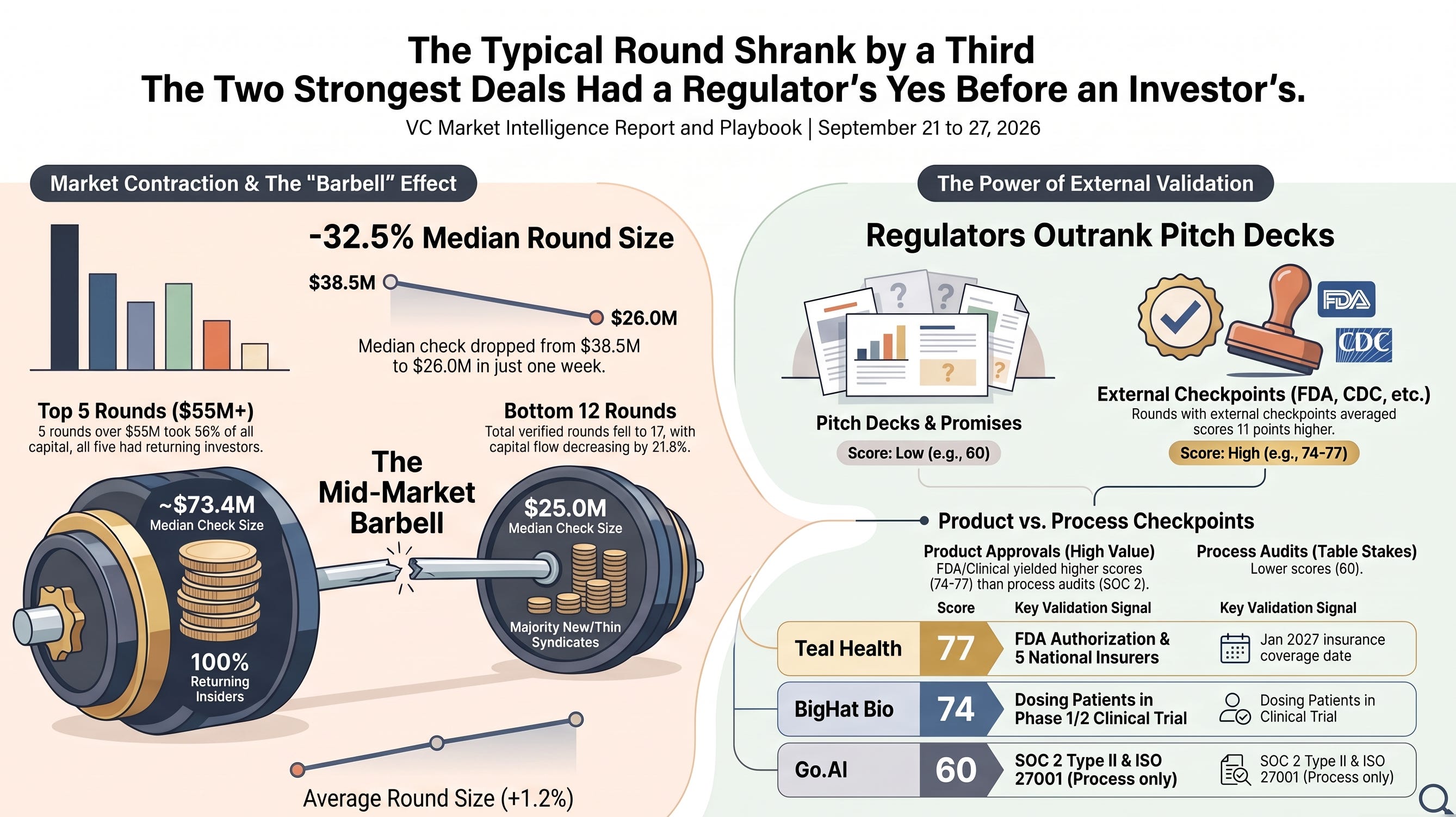
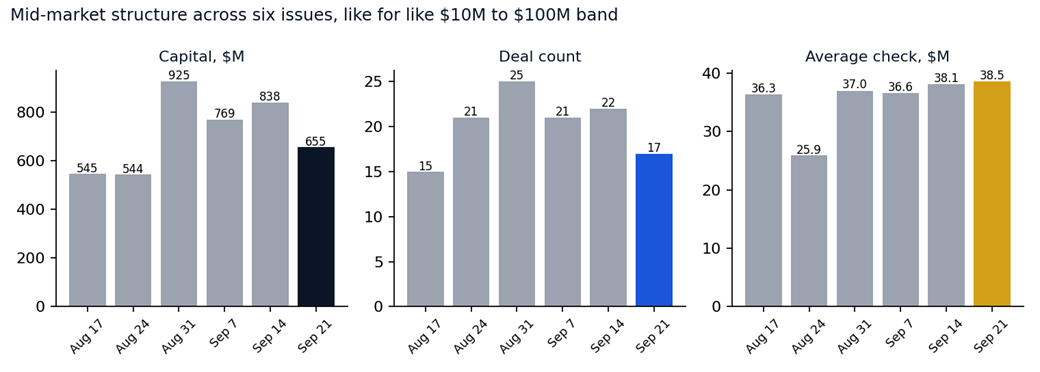
The mid-market got shorter and thinner that week. In a like-for-like $10M to $100M band, seventeen verified rounds moved $655.0M against twenty-two rounds and $837.5M a week earlier. Capital fell 21.8%. Deal count fell 22.7%. The average check held at $38.53M, up 1.2%, but that number hides the week: the median fell 32.5%, from $38.5M to $26.0M.
The average held because five rounds of $55M or more took 56.0% of the band’s capital, and each brought back an investor from the prior round. The other twelve cleared at a median of $25.0M. The market did not reprice uniformly. It split, and the split ran along one line: whether somebody who had already underwritten the company was willing to write again, and larger.
The quality signal ran the other way from the money. The mean Eisen Fundability Score rose to 56.7 from 51.4 on the same rubric. Only two rounds cleared 65, and they share one feature no press release can manufacture: a regulator had already said yes. One carries an FDA authorization and acceptance from five national insurers. The other is dosing patients in a Phase 1 trial.
Consequence for Monday. If your round sits in the middle of the ladder, you are negotiating against a median check that just lost a third of its size, while the partners writing large checks are writing them to companies with an outside fact attached. The five rounds carrying an externally controlled checkpoint averaged 64.6 against 53.6 for the rest. Before you set a number this quarter, name the one fact about your company that someone outside your company has already confirmed. If you cannot, that is the work, and it comes before the deck.
The Week in One Sentence
Primary insight. Mid-market capital and deal count both fell by more than a fifth, while the average check held flat on the strength of five insider-backed large rounds, and the best-performing rounds carried a checkpoint controlled by a regulator, an auditor, or a federal agency.
Total tracked mid-market capital, 18 verified rounds: $661.7M in new primary capital, every deal between $5M and $100M, every company US-headquartered, every announcement dated September 21 to 25, 2026.
Like-for-like against the prior issue: $655.0M across 17 rounds in the $10M to $100M band, against $837.5M across 22 rounds. Capital down 21.8%, deal count down 22.7%.
Average round size: $36.76M across the full set. On a like-for-like basis, $38.53M against $38.07M, up 1.2%.
Median round size: $25.5M across the full set. On a like-for-like basis, $26.0M against $38.5M, down 32.5%.
Largest tracked round: Go.AI, an $85.0M Series A in on-premises AI infrastructure for regulated institutions. Smallest: Dextr AI, a $6.7M seed in hospitality AI agents.
Rounds with a designated lead investor: 17 of 18, or 94.4%, against 21 of 25, or 84.0%, last week. Atum is the only round whose company announcement designates no lead.
Rounds carrying strategic, corporate, or customer-side capital: 5 of 18, or 27.8%, moving $161.5M or 24.4% of capital, against 7 of 25, or 28.0%, last week. BigHat Biosciences, Ramona Optics, Chamelio, Atum and Teal Health.
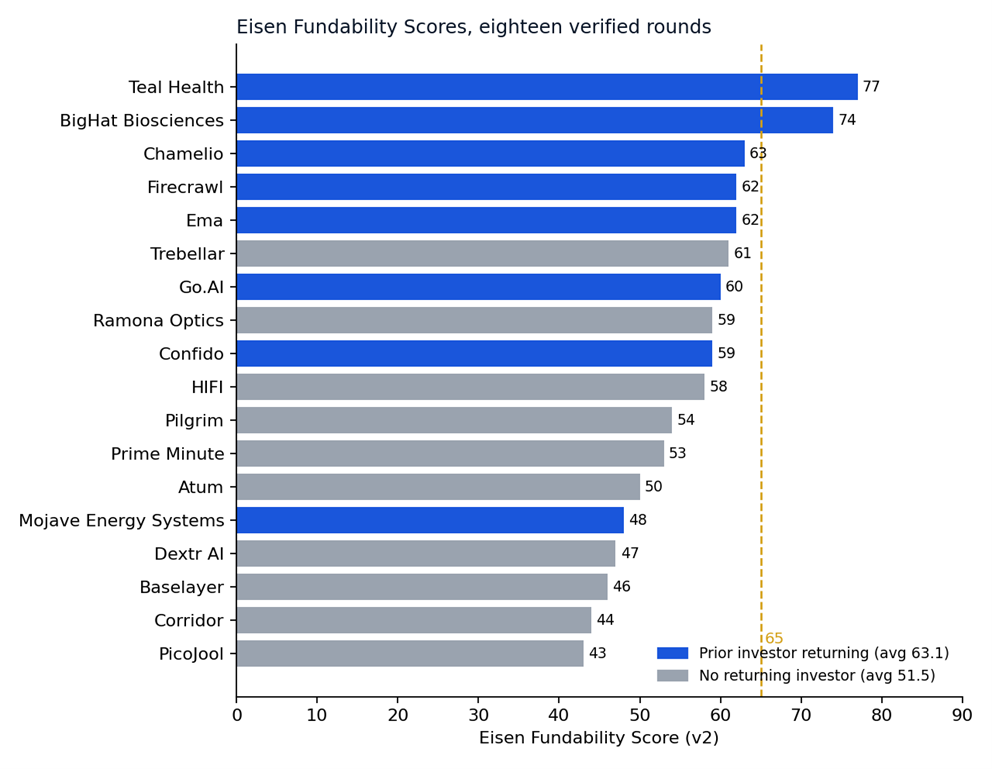
Rounds with at least one prior investor returning: 8 of 18, or 44.4%, against 12 of 25, or 48.0%, last week. Those eight averaged 63.1 against 51.5 for the ten without, a gap of 11.6 against 6.8 a week earlier.
Highest Eisen Fundability Score: Teal Health at 77, the first score above 75 since the v2 rubrics began. Lowest: PicoJool at 43. A 34-point band, with 2 of 18 rounds clearing 65 and a mean of 56.7 vs. 51.4 last week.
Defining structural feature: a barbell inside the band. Five rounds of $55M or more took 56.0% of like-for-like capital, and all five carried a returning investor. Of the twelve rounds below that line, three did.
Framework note: this is the third issue on the v2 rubrics. Scores compare directly with the September 13 and September 20 issues and with no issue before them. Capital, deal count, check size, stage, sector, geography, and investor behavior remain comparable across the full series.
The Deal Scorecard
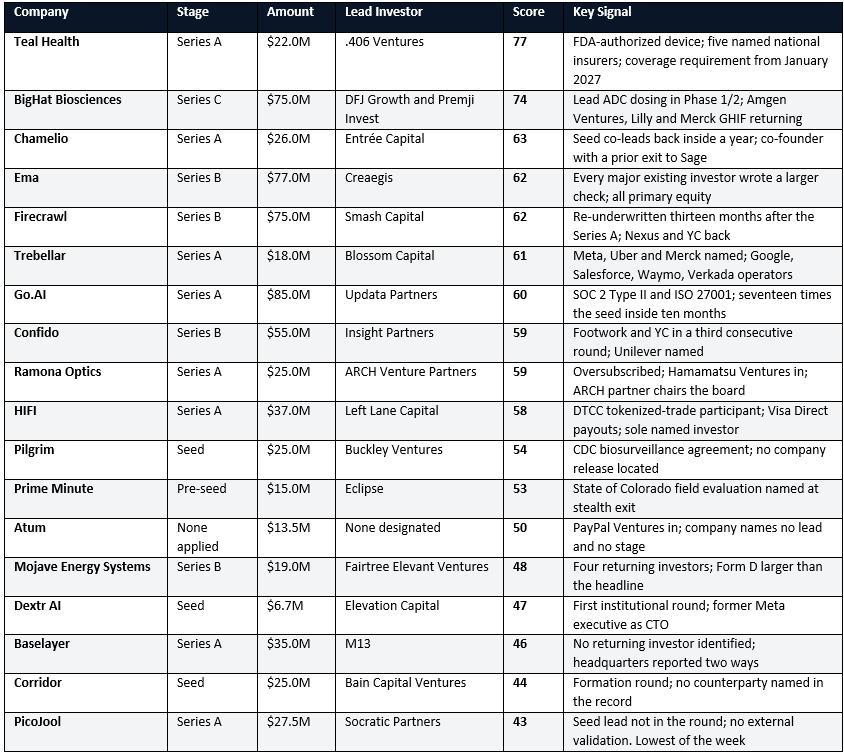
Eisen Fundability Scores are calculated across five weighted dimensions: Founder-Investor Dynamics (30), Traction to Conviction Conversion (25), Narrative Power (20), Deal Architecture (20) and Capital Planning (5). Scores of 90 and above signal an inevitable, market-defining outcome. Scores of 85 to 89 signal extremely strong execution. Scores of 75 to 84 signal solid fundamentals. Scores of 65 to 74 signal a good company with some gaps. Below 65 signals early-stage or structurally incomplete. Traction to Conviction measures only what third parties have already underwritten.
What the Scorecard Says at a Glance
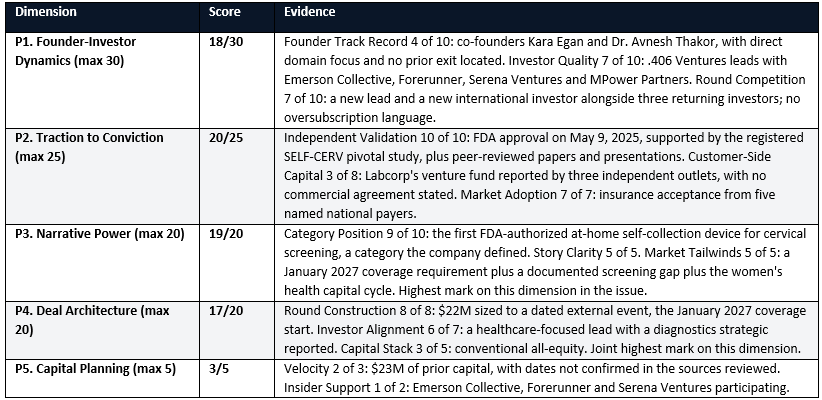
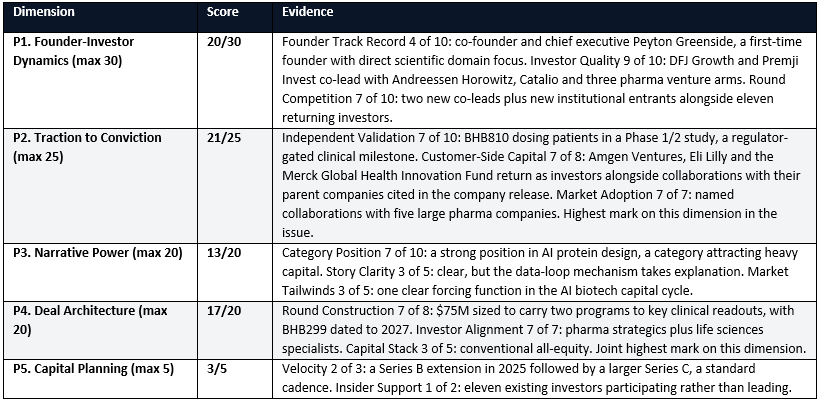
The top of the band is a regulator story. Teal Health at 77 scored 10 of 10 on Independent Validation: an FDA authorization for its self-collection device, a body of peer-reviewed papers and presentations, and insurance acceptance from Aetna, Anthem, Cigna, Blue Cross Blue Shield and UnitedHealthcare. BigHat Biosciences at 74 scored 21 of 25 on Traction to Conviction, the highest mark on that dimension this week, because its lead antibody-drug conjugate is dosing patients in a Phase 1/2 study while Amgen Ventures, Eli Lilly and the Merck Global Health Innovation Fund sit on the cap table as returning investors. Last week’s best round scored 69. This week two rounds beat it, and both did it on facts a regulator owns.
The strongest single position in the issue costs $22M. Teal is the thirteenth largest round of eighteen and it finished first, with the highest Narrative Power mark at 19 of 20 and the joint highest Deal Architecture mark at 17 of 20. The round was sized to arrive ahead of a coverage requirement with a published start date, which is the most precisely constructed raise in the set.
The most expensive lesson costs $85M and sits at 60. Go.AI raised the week's largest round, holds two audited certifications that earned 8 of 10 on Independent Validation, and scored 0 of 7 on Market Adoption because no source named a customer. Auditors confirmed the controls. Nobody outside the company confirmed the buyers. A Series A seventeen times the size of a seed closed ten months earlier needs both.
The floor is a formation and solo-investor story. PicoJool at 43 announced its seed lead as prior backing, but that lead did not appear in the Series A and carries no external validation. Corridor at 44 is a formation round with no counterparty in the record. Baselayer at 46 has no returning investor identified, and the company reports headquarters in New York while Crunchbase lists San Francisco. The four formation rounds averaged 48.5, compared with 59.0 for the other fourteen.
Size and score remain uncorrelated for a sixth consecutive issue. Teal Health at $22.0M outscored Go.AI at $85.0M by seventeen points. Trebellar at $18.0M outscored Baselayer at $35.0M by fifteen. Chamelio at $26.0M outscored Ema at $77.0M by one point and Go.AI by three. If you calibrate your ask against the week’s largest rounds, you calibrate against a variable that predicts nothing.
What Changed This Week: Five Market Shifts
Each shift is verified against multiple sources and ranked by structural impact on founder fundraising, not by deal size. Every shift ends with what it means for your raise next week.
The Median Round Lost a Third
Pattern, what happened. On a like-for-like basis, capital fell 21.8% to $655.0M and deal count fell 22.7% to seventeen rounds. The average check rose 1.2% to $38.53M, the highest in six issues. The median fell 32.5%, from $38.5M to $26.0M. Five rounds of $55M or more- Go.AI, Ema, Firecrawl, BigHat Biosciences, and Confido- took $367.0M, or 56.0% of the band, and the other twelve cleared at a median of $25.0M.
Perspective, what it means. This is two markets sharing one headline. The large checks went exclusively to companies whose prior investors came back: all five rounds above $55M carried a returning investor, against three of the twelve below that line. A partner writing a $75M check this week was not pricing a pitch. The partner was pricing an insider’s decision, made with a year or more of board-level information, to write again. Everyone without that decision was priced on the median.
Founder Blindspot, what most miss. Founders read the average and anchor on $38M. The average is five companies whose last investors re-upped. For a round without that commitment, the honest comparable is $25.0M, and an ask anchored on the average opens a process that spends its first month being repriced.
Playbook, what to do. Write two numbers before you open. The first is the round you can defend if your existing lead re-ups at or above pro rata. The second is the round you can defend if nobody on your cap table writes again. If you do not hold the insider commitment in writing, the second number is your number.
Contrast. Last week capital rose 8.9% and the median rose 10.0%. The week of September 7, capital and deal count fell together while the check held. This week the count fell and the typical check fell with it. Only the top of the band held its price.
What this means for your raise: The average is a club price. Unless your insiders are writing larger, price to the median.
A Regulator’s Yes Outranked the Round Size
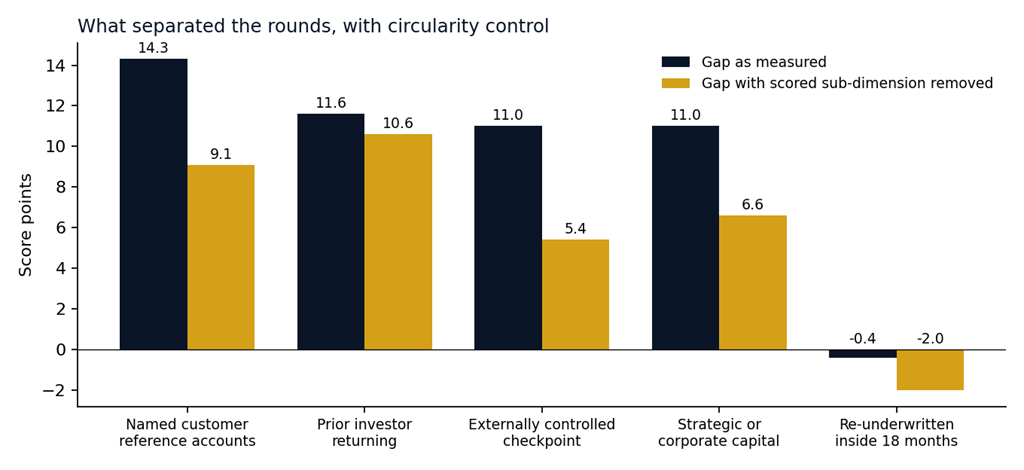
Pattern, what happened. Five rounds carried an externally controlled checkpoint scoring 7 or higher on Independent Validation: Teal Health with an FDA authorization and five named insurers, BigHat Biosciences with a lead program dosing in a Phase 1/2 study, HIFI as a participant in DTCC’s July production trades using tokenized securities, Go.AI with SOC 2 Type II and ISO 27001, and Pilgrim with a CDC biosurveillance agreement. They averaged 64.6 against 53.6 for the other thirteen, a gap of 11.0 that shrinks to 5.4 after removing the sub-dimension from both sides. Both rounds above 65 sit in this group.
Perspective, what it means. A checkpoint compresses diligence into a lookup. In a week with fewer deals and a smaller median check, partners paid for facts somebody else already owns. The ordering inside the group is the more useful signal. Checkpoints that certify the product itself, an FDA authorization and a dosed clinical program, scored 77 and 74. Checkpoints that certify a buyer relationship, a CDC agreement, and a DTCC selection scored 54 and 58. Certifications of process, SOC 2 and ISO 27001, scored 60 on the largest round in the set. Approval of what you sell outranks certification of how you run.
Founder Blindspot, what most miss. Founders treat a compliance certification as equivalent to a regulatory approval. SOC 2 says your controls operate as described. It says nothing about whether the product works or whether anyone buys it. Go.AI holds two audited certifications and still scored 0 of 7 on Market Adoption.
Playbook, what to do. Sort every checkpoint you hold into three columns: product checkpoints (a clearance, an authorization, a registered trial, a published benchmark), buyer checkpoints (a contract vehicle, a payer agreement, a named procurement), and process checkpoints (SOC 2, ISO, HIPAA attestations). Before you raise, hold at least one entry in each of the first two columns. Process certifications are table stakes, not signal.
Contrast. On September 20, the checkpoint gap was 13.7, and all five checkpoint rounds finished in the top ten. This week, two of the five finished outside the top eight, at 54 and 58, because a checkpoint did not rescue a sole-investor round or a thin syndicate.
What this means for your raise: Get the regulator’s yes before the investor’s, and know which kind of yes you hold.
Insiders Came Back, and Came Back Larger
Pattern, what happened. Eight of eighteen rounds carried a returning investor and averaged 63.1 against 51.5, a gap of 11.6 that holds at 10.6 after removing the two-point Insider Support sub-dimension. Last week the gap was 6.8. At Ema, every major existing investor, Accel, S32, and Prosus, increased its position. Footwork and Y Combinator backed Confido for a third consecutive round. Both of Chamelio’s seed co-leads returned within a year. Speed alone did not matter: the five rounds re-underwritten within eighteen months at a larger size averaged 56.4 against 56.8, no gap at all.
Perspective, what it means. An insider re-up is the only signal in an announcement that carries information a new investor cannot buy. A re-up at a larger size is a stronger version of the same signal, because the insider is increasing exposure with information nobody else has. That is why the residual gap survives almost intact once the mechanical component comes out: rounds with returning investors scored higher on founder quality, syndicate construction and round design at the same time.
Founder Blindspot, what most miss. A seed lead named in your release as prior backing, but absent from the new round, reads as a pass. PicoJool’s Series A announcement describes Playground Global’s earlier backing without Playground in the round. A new lead reads that sentence and asks one question, and the round scored 43.
Playbook, what to do. Four weeks before you open, get every lead from your last two rounds to state in writing whether they will take at least pro rata, and whether they would take more than pro rata. If a prior lead declines, keep them out of the announcement’s list of backers for this round and prepare a one-line answer for why.
Contrast. The insider gap was 17.6 on September 13 and fell to 6.8 on September 20 as seven formation rounds with no prior investors entered the set. This week, formation fell back to four rounds, and the gap rebounded to 11.6.
What this means for your raise: Your last investors are the first to get a term sheet. Make the re-up larger than last time, or have an honest reason it isn't.
Series B Got Scarcer, Bigger and Entirely Insider-Backed
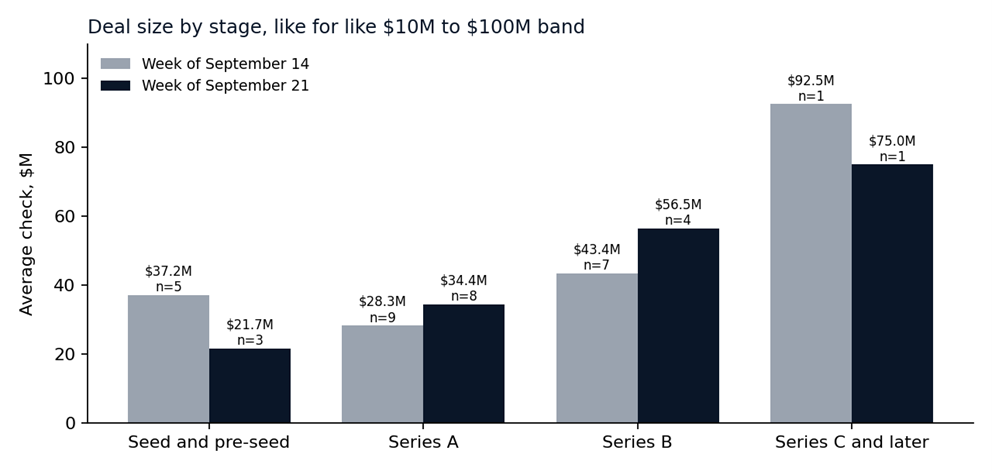
Pattern, what happened. Four Series B rounds totaled $226.0M at an average of $56.50M, up 30.1% from seven rounds at $43.43M last week. All four carried a returning investor: Ema, Firecrawl, Confido and Mojave Energy Systems. Across the last two issues, ten of eleven Series B rounds have carried one. Series A produced eight rounds at an average of $34.44M, up 21.6% from $28.33M, but only three carried a returning investor.
Perspective, what it means. Insider continuity has moved from differentiator to entry requirement at Series B. Three of the four cleared at $55M or more, and all three scored 7 of 7 on Market Adoption on named enterprise customers: Unilever at Confido, Shopify and Canva at Firecrawl, NTT Data, ADP and Microsoft at Ema. The fourth, Mojave, is climate hardware at $19.0M with no named customer in the record, and scored 48.
Founder Blindspot, what most miss. Founders see the Series B average rise 30% and raise their ask. The lane that cleared was three enterprise AI platforms with named reference accounts and insiders writing larger. Without both, the relevant comparable is Mojave, not Ema.
Playbook, what to do. If you are inside six months of a Series B, secure two things before the first external meeting: a written re-up from your Series A lead, and three customers who have approved being named in the announcement and whose procurement contacts will take a partner’s call.
Contrast. Last week, Series B reopened to seven rounds at a lower check. This week it narrowed to four at a higher one. The insider condition held in both weeks.
What this means for your raise: A Series B without your last investors in it is not a round this market has cleared in the last two weeks.
Formation Capital Shrank to Credentials and Specialists
Pattern, what happened. Four companies took a first institutional round or came out of stealth: Corridor at $25.0M, Prime Minute at $15.0M, Atum at $13.5M and Dextr AI at $6.7M. Together, they raised $60.2M, or 9.1% of the week’s capital, with an average score of 48.5 against 59.0 for the other fourteen. Last week, seven formation rounds took $232.0M, or 26.9%. Seed and pre-seed rounds above $10M fell from five at an average of $37.20M to three at $21.67M.
Perspective, what it means. Every formation round was led by a thesis specialist and every one rests on a tier-one credential: a former Scale AI product lead at Corridor, the former head of Visa’s crypto product team at Atum, a former Meta executive as Dextr’s chief technology officer, and a team of Palantir and Forterra alumni at Prime Minute. The market is still funding formation. It stopped paying formation prices.
Founder Blindspot, what most miss. Founders read a low formation score as a verdict on the company. It is a statement about what is visible: nobody outside the company has underwritten anything yet. Prime Minute scored highest of the four at 53 because its launch release names a counterparty: the State of Colorado. Corridor, with a stronger lead and no counterparty in the record, scored 44.
Playbook, what to do. Before you come out of stealth, secure one named counterparty willing to appear in the release: a pilot customer, a state or federal agency, a design partner. This week it was a nine-point difference between two formation rounds.
Contrast. On September 20, formation rounds averaged 46.9 against 53.3. The gap widened this week from 6.4 to 10.5 as the non-formation rounds strengthened.
What this means for your raise: If you are raising a first institutional round now, bring a named counterparty and expect the check to be priced near $15M, not near $37M.
The Deals That Matter: Top 5
Five deep dives across at-home cancer screening, AI-designed antibodies, legal AI, enterprise agents and web data for AI agents. These are the week's five highest-scoring rounds. All facts are verified against two or more sources.
Teal Health
At-Home HPV Cervical Cancer Screening | Series A | $22.0M | Led by .406 Ventures
Eisen Fundability Score: 77 / 100
Why this scored. The first round on the v2 rubrics to clear 75, with the highest Narrative Power and Independent Validation marks in the issue. Every one of its strongest facts is owned by somebody else: the FDA, five national insurers, peer reviewers and a federal coverage requirement with a published start date.
The Setup. Teal Health, headquartered in San Francisco and founded in 2020 by Kara Egan and Dr. Avnesh Thakor, makes the Teal Wand, the first FDA-authorized self-collection device for at-home HPV cervical cancer screening. The device pairs with a telehealth visit, secure results delivery and connection to follow-up care. The company accepts insurance from Aetna, Anthem, Cigna, Blue Cross Blue Shield and UnitedHealthcare, and sits on the Cervical Cancer Roundtable, a collaboration between the American Cancer Society and Cancer Moonshot.
The Deal. $22.0M Series A led by .406 Ventures, announced September 22, 2026, with continued backing from Emerson Collective, Forerunner and Serena Ventures and new participation from Japan’s MPower Partners. Fierce Healthcare, Tech Funding News and FutureFemHealth also name Labcorp’s venture fund as a participant; the company release does not, and the conflict is recorded. Total capital: $45M, all equity. The round arrives ahead of broad insurance coverage of self-collected HPV screening beginning in January 2027.
The Pattern. This is the dated-mandate round. The round was sized and timed to land before a coverage requirement with a published start date, so the use of funds and the market’s opening date are the same sentence. A partner can verify the date, the authorization and the payer list without calling the company.
The Perspective. Count how many outside parties did work before this round opened. A regulator reviewed the device. Five insurers agreed to pay for it. Peer reviewers assessed the evidence. A federal guideline set the date the market widens. The investment committee’s job was reduced to confirming facts, which is why a $22M Series A scored 20 of 25 on Traction to Conviction while rounds four times its size scored half that.
The Playbook. Find the dated external event in your market, whether a coverage mandate, a compliance deadline, a standards effective date or a procurement cycle, and time your close to land three to six months ahead of it. Put the date and the body that set it in the first paragraph of your deck and your announcement.
The Founder Mistake to Avoid. Founders with a regulatory approval treat the approval as the story. Teal’s FDA approval date is May 9, 2025, more than a year before this round. What made this round a 77 was converting the approval into payer acceptance and a dated coverage event. An approval with no reimbursement path is a permission, not a market.
BigHat Biosciences
AI-Designed Protein Therapeutics | Series C | $75.0M | Co-led by DFJ Growth and Premji Invest
Eisen Fundability Score: 74 / 100
Why this scored. The highest Traction to Conviction mark in the issue at 21 of 25, because three kinds of outside confirmation stack in one round: a clinical program dosing patients, pharma collaborations, and the same pharma companies’ venture arms returning as investors.
The Setup. BigHat Biosciences, headquartered in San Mateo, California and led by co-founder and chief executive Peyton Greenside, combines AI protein design with autonomous, high-throughput experimentation that generates its own biological data. Lead program BHB810, a CDH17-directed antibody-drug conjugate, is in a Phase 1/2 study in advanced gastric and gastroesophageal junction adenocarcinoma and has dosed its first patient. The Pharma Letter dates the study start to July 2026, and TechEdgeAI to September 2026, and the conflict is noted. Second candidate BHB299, a CEACAM6 T-cell engager, is planned for human trials in 2027. The company’s release cites collaborations with Amgen, Merck, Johnson & Johnson, AbbVie and Lilly, including a completed collaboration with Johnson & Johnson and three project collaborations with Merck.
The Deal. $75.0M Series C co-led by DFJ Growth and Premji Invest, announced September 24, 2026, with new investors Catalio Capital Management, LG Technology Ventures and Sigmas Group, and existing investors 8VC, Alexandria Venture Investments, Amgen Ventures, Andreessen Horowitz, Discovery Ventures, GRIDS Capital, Intermountain Ventures, Eli Lilly and Company, Merck Global Health Innovation Fund, Quadrille Capital and Section 32. Total capital is about $223M, following an $80M Series B in 2022 and a $44M Series B extension in 2025. All equity.
The Pattern. This is the partner-as-shareholder round. The pharma companies are the collaborators buying the platform’s output and they are also on the cap table, returning. The investor who knows the science best is also the investor with the most to lose if the science is wrong, and that alignment is visible from outside.
The Perspective. Two growth-stage co-leads new to the company, with eleven existing investors staying in, tells a new investor the insiders did not merely hold their position: the partners paid twice, once through collaboration and again through equity. Combined with a dosed clinical program, that is the densest external underwriting in the set.
The Playbook. If you sell platform access to large companies, ask each collaboration partner’s venture arm to take a position in your next round, and ask before the partnership renews, when your leverage is highest and the partner’s internal champion is most motivated.
The Founder Mistake to Avoid. Founders read the AI framing as the reason this cleared. BigHat scored only 13 of 20 on Narrative Power because AI protein design is a crowded category. The round cleared on a dosed patient and on pharma money. Copying the framing without the wet-lab data loop and a clinical asset gets you the narrative score without the traction score.
Chamelio
AI-Native Platform for In-House Legal Teams | Series A | $26.0M | Led by Entrée Capital
Eisen Fundability Score: 63 / 100
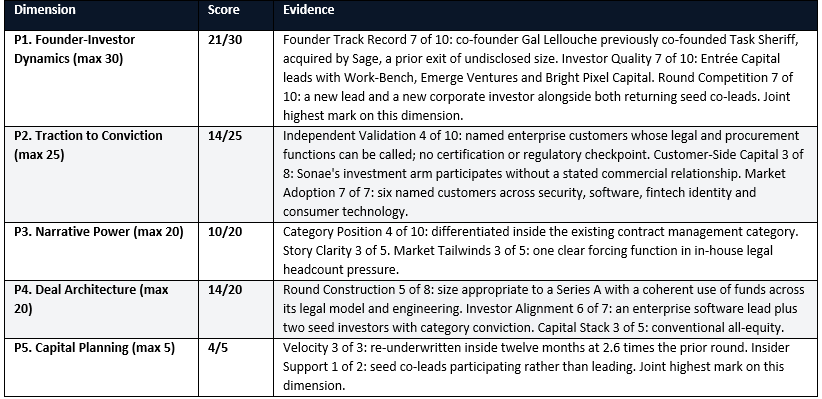
Why this scored. The joint-highest Founder-Investor Dynamics mark (21 of 30) and the joint-highest Capital Planning mark (4 of 5), with a co-founder with a prior acquisition, both seed co-leads returning, and a re-underwriting within a year at 2.6x the seed.
The Setup. Chamelio is headquartered in New York after being established in Israel. It was founded in 2024 by chief executive Alex Zilberman, formerly vice president of growth and partnerships at Pagaya and a co-founder of AnyVision; chief technology officer Gal Lellouche, who co-founded Task Sheriff, acquired by Sage, and later served as senior director for AI at Sage; and chief operating officer Gil Banyas, a former general counsel. Named customers include Wiz, monday.com, Socure, AppsFlyer, Lightricks and Wonderful.ai.
The Deal. $26.0M Series A led by Entrée Capital, announced September 22, 2026, with existing investors Work-Bench and Emerge Ventures and new investor Bright Pixel Capital, the technology investment arm of Sonae. The seed was $10M in January 2026, co-led by Work-Bench and Emerge. The company describes the interval as five months; Work-Bench’s own post describes eight. Both are recorded. All equity.
The Pattern. This is the fast re-underwriting round. Both seed co-leads returned in a round 2.6 times their own, within a year, and one of them published its reasons publicly within days of the announcement.
The Perspective. A seed lead writing publicly, within days of the announcement, about why it is re-upping, with named customers and a specific account of what it saw during diligence, is a reference call performed in the open. Every future investor reads it before the first meeting. Chamelio is rated MEDIUM on geography: an independent outlet states a single New York headquarters, which distinguishes it from rounds excluded in earlier issues where reporting placed the headquarters across New York and Tel Aviv.
The Playbook. Ask your returning lead to publish its own account of why it wrote again, on announcement day, naming what it saw. It costs nothing and it answers the first question every new investor asks.
The Founder Mistake to Avoid. Founders with a strong team and returning insiders neglect category position. Chamelio scored 10 of 20 on Narrative Power because AI contract management is a crowded category with well-funded incumbents. And when two credible sources disagree on your seed date by three months, a diligence team will ask which one is true. Reconcile your own timeline before your investors describe it.
Ema
Enterprise AI Agent Platform | Series B | $77.0M | Led by Creaegis
Eisen Fundability Score: 62 / 100
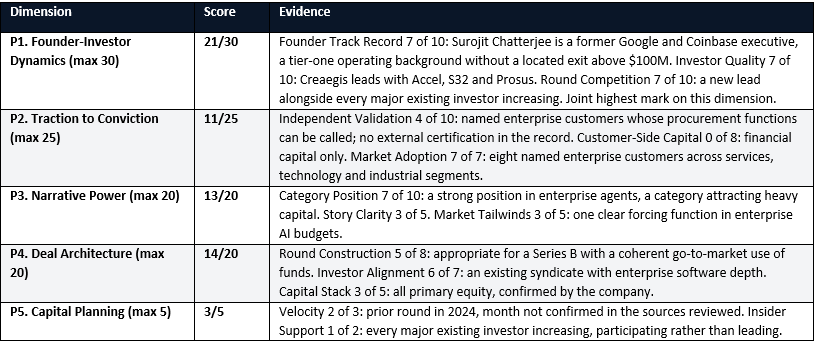
Why this scored. The joint highest Founder-Investor Dynamics mark at 21 of 30, on a founder who is a former Google and Coinbase executive, and a round in which every major existing investor wrote a larger check than last time.
The Setup. Ema, based in Mountain View, California, was founded in 2023 by Surojit Chatterjee, a former Google and Coinbase executive, and Souvik Sen, formerly of Okta. It coordinates teams of AI agents that execute multi-step work across HR, IT and finance systems a company already runs. TechCrunch names customers including NTT Data, Hitachi, ADP, PwC, Google, KPMG, Wipro and Microsoft.
The Deal. $77.0M Series B led by Bengaluru-based Creaegis, announced September 23, 2026, with existing investors Accel, S32 and Prosus each increasing its investment. Ema confirmed to TechCrunch that the round is entirely primary equity, with no debt and no secondary sales. Total capital: $140M. The prior round closed in 2024.
The Pattern. This is the insider-escalation round. The existing syndicate did not hold or trim; it increased, and the company stated the structure: all primary, no secondary. That combination tells a new investor that no one took liquidity while insiders added exposure.
The Perspective. The phrase to notice is not the size. It is the structural disclosure. When a company confirms that insiders increased and no shares changed hands on the way out, a diligence team can check it against the cap table in minutes, and it removes the most common suspicion attached to a large later-stage round.
The Playbook. When your insiders increase, say so as a verifiable fact with the structure attached: each existing investor larger, all primary, no secondary. Then make sure the cap table says exactly that.
The Founder Mistake to Avoid. Ema scored 11 of 25 on Traction to Conviction because named customers are the only outside fact in the record. Microsoft and Google appear as customers, and neither appears as a contract vehicle, a certification or a cap table entry. Founders with blue-chip customers rarely convert even one into a structural fact, and that is where the points were.
Firecrawl
Web Data Infrastructure for AI Agents | Series B | $75.0M | Led by Smash Capital
Eisen Fundability Score: 62 / 100
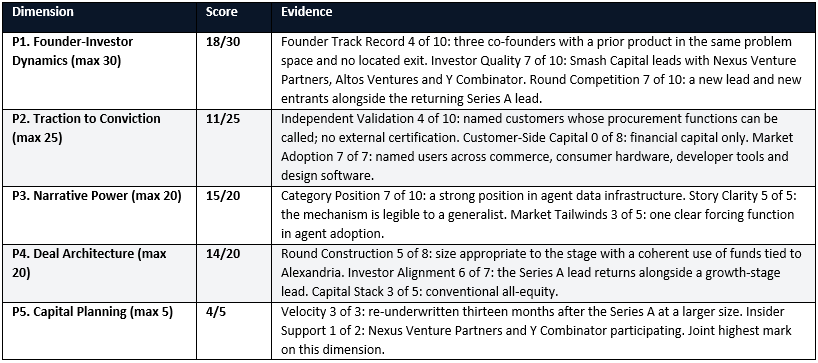
Why this scored. Re-underwritten thirteen months after its Series A at roughly five times the size on the $14.5M Series A figure, with the Series A lead and Y Combinator back, and named adoption at reference-grade customers.
The Setup. Firecrawl, headquartered in San Francisco, turns web pages into structured data that AI agents can use and is launching Alexandria, a library that connects agents to official data providers under paid agreements, Firecrawl’s own indexes and the live web. It was founded by chief executive Caleb Peffer, Eric Ciarla and Nicolas Silberstein Camara, who previously built Mendable and SideGuide, and went through Y Combinator. The company’s website names Apple, Canva and Lovable among its users, and Dealroom and Exame add Shopify. Wikimedia Enterprise is a paid data provider.
The Deal. $75.0M Series B led by Smash Capital, announced September 22, 2026, with Altos Ventures, Nexus Venture Partners, Y Combinator, Freestyle and Offline Ventures. The Series A in August 2025 was led by Nexus and is reported at $14.5M by WOWTALE and RuntimeWire and at $20.7M by Dealroom. A Form D filed by the legal issuer, SideGuide Technologies, reports $82,063,463 of preferred stock sold to seven investors. RuntimeWire first reported the financing from that filing around September 14. A filing alone is not an announcement under this report’s standard, so the company’s September 22 announcement governs; the announced $75.0M is counted, and both differences are recorded.
The Pattern. This is the velocity round: thirteen months from Series A to Series B, a roughly fivefold step in size, with the prior lead returning. It is also a product-launch round, with the financing and Alexandria announced together.
The Perspective. Look at the filing. A Form D larger than the announcement usually reflects converted notes or a second close, and a diligence team will reconcile the two numbers whether or not the company does. Mojave Energy Systems attributed its own Form D gap to converted securities when asked this week. Firecrawl’s reconciliation is not in the record reviewed.
The Playbook. Before you announce, reconcile your announcement to your Form D. If they differ, prepare one sentence explaining why, and have it ready for the first investor who asks.
The Founder Mistake to Avoid. Firecrawl pays Wikimedia Enterprise for data and scored 0 of 8 on Customer-Side Capital. Suppliers and marquee users are both candidates for the cap table. A data provider or a reference customer with a small position would have converted a relationship into a structural fact.
The Fundraising Playbook: Five Tactical Plans
Five plans, each producing a concrete artifact you can use immediately. No vague tasks. Each is built directly from this week’s verified signals.
Lead With the Date Somebody Else Set (Narrative and Investor Framing)
Why this matters. The highest-scoring round of the week, Teal Health at 77, anchored its entire narrative to a coverage requirement with a published start date, and scored 19 of 20 on Narrative Power. Corridor’s launch named the fourth quarter as the window when most small employers choose health plans. The strongest stories this week borrowed their urgency from a party the company does not control.
Exact deliverable. One sentence, no longer than thirty words, that states your category, the dated external event that opens or widens your market, and the body that set the date. Test it on someone outside your industry. If they cannot repeat the date back to you, rewrite it.
Time estimate. Two hours to draft and test. One week to confirm the date against the primary source, whether a regulator’s notice, a standard’s effective date or a published procurement calendar.
Expected outcome. Your deck’s first slide stops arguing that the market is coming and starts citing when it arrives. A partner can verify the claim in a search, which is the fastest conviction you can hand an investment committee.
The reframe. Wrong approach: open with market size and a growth rate you calculated. Right approach: open with the date a regulator, standards body or buyer already fixed, and size the round to land before it.
Get a Product or Buyer Checkpoint, Not Just a Process One (Proof Architecture)
Why this matters. Five rounds carried an externally controlled checkpoint and averaged 64.6 against 53.6, a gap that holds at 5.4 after removing the sub-dimension. Within that group, product checkpoints scored 77 and 74, buyer-relationship checkpoints scored 54 and 58, and process certifications scored 60 in the week's largest round.
Exact deliverable. A three-column inventory: product checkpoints (clearance, authorization, registered trial, published benchmark), buyer checkpoints (contract vehicle, payer agreement, government agreement, named procurement) and process checkpoints (SOC 2, ISO 27001, HIPAA attestation). Mark what you hold. Then write a plan with a named owner and start date to obtain the fastest missing entry in either of the first two columns. The deliverable is a plan to obtain one, not a plan to announce one.
Time estimate. Three hours for the inventory. Two to six months for a buyer checkpoint such as a pilot agreement with a public agency; longer for a regulatory one, which is why the start date belongs in this quarter.
Expected outcome. You enter your next process with at least one fact that a regulator or a buyer owns, and you stop presenting an audit report as evidence that the product works.
The reframe. Wrong approach: treat a completed SOC 2 as your validation story. Right approach: treat SOC 2 as table stakes and go get a checkpoint on the product or the buyer.
Score Yourself Against This Week’s Band (Readiness)
Why this matters. The band ran from 43 to 77 with a mean of 56.7. Two rounds cleared 65. Eight of eighteen sat between 55 and 64, and the eight below 55 share one of two shapes: a formation round with no counterparty in the record, or a round with no returning investor and a thin syndicate.
Exact deliverable. Score your round on the v2 rubrics across Founder-Investor Dynamics (30), Traction to Conviction (25), Narrative Power (20), Deal Architecture (20) and Capital Planning (5). Then apply this week’s test. Above 65, you are in the top two of eighteen, so run a tight competitive process with a deadline. Between 55 and 64, you sit in the crowded middle and will be priced at the $25.0M median unless you fix your lowest dimension first. Below 55, the problem is structural, meaning no returning investor, no counterparty and no checkpoint, and no process design will fix it.
Time estimate. Two to three hours, repeated before every raise and again after any new checkpoint lands.
Expected outcome. A decision about process design rather than a list of weaknesses: compete now, or run a four- to eight-week repair sprint on your two lowest dimensions first.
The reframe. Wrong approach: score yourself, feel discouraged, and revise the deck. Right approach: score yourself, name your two lowest sub-dimensions, and decide this week between a competitive process and a repair sprint.
Put a Larger Insider Re-Up in Writing Before You Open (Deal Architecture)
Why this matters. Eight rounds with a returning investor averaged 63.1 against 51.5, a gap that holds at 10.6 after removing the sub-dimension. All five rounds of $55M or more carried one. Ten of the last eleven Series B rounds carried one. Where a prior lead was mentioned but absent, the round scored 43.
Exact deliverable. Four outputs, in order. First, a written statement from every lead of your last two rounds: whether they will take pro rata, whether they will take more, and whether they would lead if nobody else does. Second, a reconciliation of your planned announcement amount against your Form D, with one sentence explaining any difference. Third, a use of funds split into two columns: outcomes that are genuinely unproven and a predictable cash cycle such as inventory, receivables, or payment float, with the second column totaled and priced against a credit facility. Fourth, pre-drafted positions on information rights and pro rata for any strategic investor.
Time estimate. Two weeks of calendar for the insider conversations, four hours for the Form D reconciliation and the use of funds split.
Expected outcome. You open with a floor under the round, a larger-than-last-time insider signal to quote, a number that matches your filing, and a smaller equity ask if part of your need is financeable.
The reframe. Wrong approach: run the new-money process first and ask insiders to fill the gap. Right approach: get the insiders’ larger number in writing first, and let new money compete for the rest.
Make Every Claim in the Announcement Owned by Someone Else (Momentum and Conversion)
Why this matters. Prime Minute scored 53 and Corridor 44 as formation rounds with comparable leads, and the difference was a named state counterparty in the launch release. Three Series B rounds scored 7 of 7 on Market Adoption because customers were named. Chamelio’s seed lead published its own account of why it re-upped. Momentum this week came from facts third parties put their names to.
Exact deliverable. A one-page announcement plan. List every substantive claim you intend to make. Next to each, name the third party who owns it: the customer who approved being named, the agency or partner in the pilot, the insider willing to explain in writing why they wrote again. Remove or replace any claim without an owner. Then set a fourteen-day follow-up cadence for your process in which each touchpoint delivers one new dated fact from that list.
Time estimate. Four hours to build the list and three to five customer approvals, which typically take one to two weeks to clear legal review.
Expected outcome. Every follow-up carries new, verifiable information, and the investor waiting for proof gets it during the process rather than after the round closes.
The reframe. Wrong approach: announce with adjectives and follow up with enthusiasm. Right approach: announce with owned facts and follow up with the next one.
Looking Forward: Next 1 to 3 Weeks
Three evidence-based scenarios and one wild card. Every projection is anchored to this week’s verified data.
First, last week’s call. The September 20 issue projected that the barbell would hold, with formation rounds and Series B both staying wide, and named four or more Series B rounds as the threshold to watch. Half right. Series B held at exactly four. The formation end thinned, from five seed and pre-seed rounds above $10M to three, at less than two-thirds of the prior average check.
The Barbell Moves Inside the Band (Medium-High Probability)
Evidence from this week. Five rounds of $55M or more took 56.0% of like-for-like capital, while the median fell 32.5% to $26.0M. All five carried a returning investor. The top of the band is priced on insider decisions and the middle on everything else.
What to watch. Whether the like-for-like median stays below $30M while the average stays above $35M for a second week. If it does, the split is structural rather than a one-week mix effect, and every pricing conversation should start from the median.
What founders should do before others notice. Price your round to the median unless you hold a written insider re-up at or above pro rata. If you hold one, lead your process with it and quote it as a floor.
Series B Stays Insider-Only (High Probability)
Evidence from this week. Four of four Series B rounds carried a returning investor, after six of seven a week earlier. Ten of eleven across two issues. The three large ones all named enterprise customers.
What to watch. Whether any Series B without a returning investor clears above a score of 55 in the next two issues. A single one would signal the requirement is loosening. None would confirm it as a market rule.
What founders should do before others notice. If you are inside six months of a Series B, secure your Series A lead’s written re-up and three named, callable customers before your first external meeting.
Dated Coverage and Enrollment Windows Pull Healthcare Rounds Forward (Medium Probability)
Evidence from this week. Two of four healthcare rounds tied their timing to a dated window: Teal Health to broad self-collection coverage beginning January 2027, and Corridor to the fourth quarter, when most small employers choose health plans. Healthcare’s share fell to 22.2% this week, but the rounds that cleared were timed to a calendar someone else controls.
What to watch. Whether healthcare rounds announced in the next three weeks cite a coverage, enrollment or reimbursement date, and whether healthcare’s share rebounds above 25%.
What founders should do before others notice. If your market has a coverage, reimbursement or enrollment date in the next two quarters, close before it, not after it. The same round is a forecast before the date and a lagging indicator after.
Wild Card: Regulated Infrastructure Replaces AI-Native as the Premium Frame (Medium Probability)
Evidence from this week. Four rounds selling into regulated buyers: Go.AI to banks and credit unions, HIFI into tokenized securities settlement, Baselayer to financial institutions, and Pilgrim to the CDC, took $182.0M, or 27.5% of the week’s capital. Each was positioned on examiner readiness, settlement participation, or a government agreement rather than on the model.
What founders should do before others notice. If you sell to a regulated buyer, write down what that buyer’s examiner or auditor will ask about your product and build the answer into your data room now. Readiness for someone else’s inspection is becoming the premium frame, and it is verifiable in a way that the word AI-native is not.
The Bottom Line
The real insight is not the $661.7M. It is that the median check lost a third while the average held, and the rounds that scored highest carried a fact that a regulator, an auditor or a federal agency owns, backed by insiders who came back larger. That produced three conviction profiles.
Profile 1: Companies a regulator or auditor had already said yes to. Teal Health (77) holds an FDA authorization and five named insurers. BigHat Biosciences (74) is dosing patients in a Phase 1/2 study. Go.AI (60) holds SOC 2 Type II and ISO 27001. HIFI (58) took part in DTCC’s July production trades. Pilgrim (54) holds a CDC biosurveillance agreement. Five rounds averaged 64.6 against 53.6, and rankings within the group ran from product approval to process certification.
Profile 2: Companies whose insiders came back, and larger. Every major investor at Ema (62) increased its position. Footwork and Y Combinator backed Confido (59) for a third consecutive round. Both of Chamelio’s (63) seed co-leads returned within a year. Nexus and Y Combinator returned in Firecrawl’s (62) Series B. Eight rounds with a returning investor averaged 63.1 against 51.5, and every round of $55M or more was one of them.
Profile 3: Companies whose named customers do the reference calls. Trebellar (61) named Meta, Uber and Merck. Confido named Unilever. Chamelio named Wiz and monday.com. Seven rounds scored 7 of 7 on Market Adoption and averaged 65.4 against 51.1, the widest measured gap in the issue, holding at 9.1 after the sub-dimension came out.
Everything else competed for the residual. The four formation rounds averaged 48.5, and the floor, PicoJool at 43, Corridor at 44, and Baselayer at 46, share the same shape: no returning investor in the round and no counterparty, checkpoint, or customer named by anyone outside the company. These are real companies funded by credible investors. The score measures how much of the transaction a new investor could confirm without asking; for these three, the answer is the amount and the lead.
Five New Rules for Founders
1. Price to the median unless your insiders are writing larger. The like-for-like median fell 32.5% to $26.0M while the average held at $38.53M, and all five rounds above $55M carried a returning investor.
2. A regulator’s yes outranks an auditor’s. Product checkpoints scored 77 and 74; process certifications scored 60 on the largest round of the week. Hold at least one checkpoint on the product or the buyer before you raise.
3. A Series B now needs your last investors in it. Ten of the last eleven Series B rounds carried a returning investor.
4. Name your customers or lose the points. Seven rounds with named reference accounts averaged 65.4 against 51.1.
5. Come out of stealth with a counterparty in the release. A named state agency was a nine-point difference between two formation rounds this week.
Four Monday Actions
1. Write your two numbers: the round you can defend with a written insider re-up, and the round you can defend without one. Use the second until the first is in writing.
2. Build the three-column checkpoint inventory: product, buyer, and process, and put a start date on the fastest missing product or buyer checkpoint.
3. Ask three customers to approve being named in your next announcement, and send the legal review requests today.
4. Reconcile your planned announcement amount to your Form D, and remove any prior investor from your backer list who is not writing again.
Eighteen companies cleared this week and the typical check lost a third of its size. The two that finished on top had a regulator’s yes, and the five that raised the most had insiders who came back with larger checks. Neither of those facts is luck, and both can be started on Monday: one conversation with the people already on your cap table, and one application to the body whose approval your buyer already trusts.
Research Methodology, Sources and Verification
Data Collection and Verification Standard
Data collection period: September 21 to 27, 2026, with every verified primary announcement dated September 21 to 25. This issue was completed on Saturday, September 26, before the week closed; any round announced on September 26 or 27 will be carried in the next issue. Verification standard: a minimum of two independent sources per deal, with company releases and regulated newswires (BusinessWire, PR Newswire, GlobeNewswire, NewMediaWire) as anchor sources and at least one independent outlet for corroboration. We then rechecked every deal in two further passes. The first was adversarial and directed at four failure modes: announcements dated before the window and recirculated inside it, headline figures that blend more than one financing, headquarters outside the United States, and lead investors named by outlets but not by the company. The second re-checked every fact resting on a single source and every derived figure, and recomputed all arithmetic from the corrected deal record. Eisen Fundability Scores are proprietary analytical estimates, not endorsements or investment advice. All dollar figures reflect announced new primary capital at close unless noted.
Core Capital Totals and What They Include
The $661.7M weekly total includes only the eighteen verified US rounds in the scorecard. Mid-market is defined as a US-headquartered round of new primary capital between $5M and $100M. Every week-over-week comparison is calculated on the $10M to $100M subset used by the three issues before September 13: seventeen rounds totaling $655.0M at an average of $38.53M and a median of $26.0M, against twenty-two rounds totaling $837.5M at an average of $38.07M and a median of $38.5M in the prior issue. The one round below $10M, Dextr AI at $6.7M, is included in the scorecard, the scores and the sector and geography analysis and excluded from all structural comparisons, including every stage average.
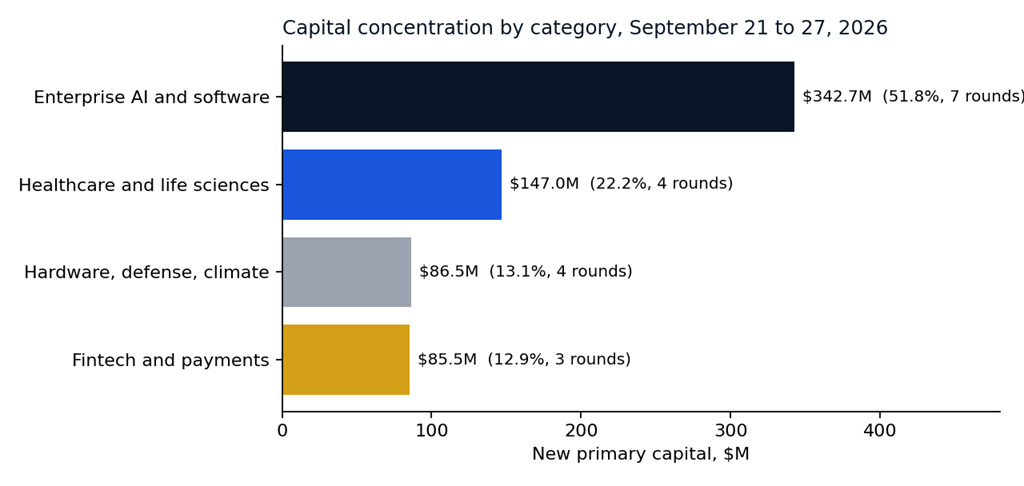
Credit facilities, debt financings, secondary purchases, in-kind services, conditional commitments, grants and cumulative restatements are excluded from the counted amount. Announcements that combine two financing stages without separating them are excluded entirely. Arithmetic was recomputed after the adversarial pass. The four sector subtotals ($342.7M enterprise AI and software across seven rounds, $147.0M healthcare and life sciences across four, $86.5M hardware, defense, climate and semiconductors across four, and $85.5M fintech and payments across three) and the six stage subtotals ($275.5M across eight Series A rounds, $226.0M across four Series B rounds, $75.0M in one Series C, $56.7M across three seed rounds, $15.0M in one pre-seed and $13.5M in one round with no stage applied) each sum to $661.7M across eighteen deals. Geography: California $373.7M across eleven rounds (56.5%), New York $178.0M across five (26.9%), Illinois $85.0M in one and North Carolina $25.0M in one.
Scoring Calibration Notes
All eighteen rounds were scored on the v2 rubrics published with the September 13 issue, so scores compare directly with the September 13 and September 20 issues. Founder Track Record is scored from the public record located during the research window: 7 for a senior operating role at a tier-one company or a prior acquisition of undisclosed size, 4 for direct domain experience including multi-year tenure building in the category. Round-to-Round Velocity is scored 2 where prior institutional rounds exist but dates could not be confirmed, and 0 for formation rounds. Rounds with no designated lead are scored on the institutional quality actually present, which applied to Atum. Customer-Side Capital credits a corporate investor only where two or more sources place it in the round, which applied to Labcorp’s venture fund at Teal Health. No score reflects any operating metric a company published about itself.
Circularity control. Where a finding rests on a scored input, the sub-dimension is removed from both sides and the residual is published: named reference customers 14.3 and 9.1, returning investor 11.6 and 10.6, externally controlled checkpoint 11.0 and 5.4, strategic or corporate capital 11.0 and 6.6, and re-underwriting inside eighteen months at a larger size negative 0.4 and negative 2.0. Every one of these appears in Chart 4 in both forms. Score bands are stated once, in The Deal Scorecard.
Deal Citations, Two or More Sources per Deal
Teal Health, $22.0M Series A. PR Newswire company release dated September 22, 2026, read through BioSpace; Fierce Healthcare; MedCity News; MobiHealthNews; Tech Funding News; FutureFemHealth; Fortune Term Sheet of September 23; the company release of May 9, 2025, UPI and The ASCO Post for the FDA approval date. Labcorp participation reported by Fierce Healthcare, Tech Funding News and FutureFemHealth and absent from the release. Rated HIGH.
BigHat Biosciences, $75.0M Series C. BusinessWire company release dated September 24, 2026, read through BioSpace; allsci, which confirms the 2022 Series B and 2025 extension; The Pharma Letter, which confirms the Phase 1/2 dosing; HedgeCo Insights; The AI Insider; Tech Startups roundup of September 24; TechEdgeAI and The AI Insider, which, with the company release, confirm the pharma collaborations. Rated HIGH, with the Phase 1/2 start month recorded as a conflict.
Chamelio, $26.0M Series A. PR Newswire company release dated September 22, 2026, New York dateline; AlleyWatch daily report of September 22; Global Legal Post, which states the New York headquarters and the January seed; ynetnews; Dealroom; Work-Bench’s own post; VC News Daily. Rated MEDIUM on geography and an unreconciled seed interval.
Ema, $77.0M Series B. GlobeNewswire company release dated September 23, 2026, Mountain View dateline; TechCrunch of September 23, which confirms the all-primary structure; AI Weekly; The SaaS News; Tech Startups roundup of September 23. One weekly newsletter places Ema in San Francisco; the release dateline is followed. Rated HIGH.
Firecrawl, $75.0M Series B. Company blog post and PR.com release dated September 22, 2026, San Francisco dateline; company about page for the San Francisco headquarters; SiliconANGLE; RuntimeWire, which reported the Form D around September 14 and again on September 22; WOWTALE; Dealroom and Exame, which name Shopify alongside the users on the company website; Tech Startups roundup of September 22. Rated HIGH on amount with the Form D and Series A conflicts recorded.
Trebellar, $18.0M Series A. BusinessWire company release dated September 24, 2026, San Francisco dateline, which names Meta, Uber and Merck; Axios Pro exclusive; Dealroom; citybiz; Unite.AI; company blog. A fourth customer, Cohesity, appears in one outlet only and is not credited. Rated HIGH.
Go.AI, $85.0M Series A. BusinessWire company release dated September 22, 2026, Chicago dateline; Finovate, the Go Abacus BusinessWire release of March 24, 2026, and CUInsight, which confirm the certifications; FinTech Global; RuntimeWire, which confirms the $5M seed of November 2025; The Investor Society; Tech Startups roundup of September 22. Rated HIGH.
Confido, $55.0M Series B. BusinessWire company release dated September 22, 2026, New York dateline; AlleyWatch daily report of September 22; company blog; citybiz; The SaaS News; BevNET syndication. Rated HIGH.
Ramona Optics, $25.0M Series A. BusinessWire company release dated September 22, 2026, Durham dateline, read through BioSpace; Fortune Term Sheet of September 23; Hoodline citing Axios; Tech Startups roundup of September 22. Rated HIGH.
HIFI, $37.0M Series A. NewMediaWire company release dated September 24, 2026, New York dateline; company blog; Axios Pro exclusive; The Block; AlleyWatch daily report of September 24; CryptoPotato; Altcoin Buzz. Rated HIGH on amount with the total-funding conflict recorded.
Pilgrim, $25.0M Seed. Wall Street Journal report of September 23, 2026, read through Techmeme; AI Weekly; RuntimeWire; The Investor Society, which states the Redwood City headquarters and the CDC agreement; Tech Startups roundups of September 23 and 24; Axios for the 2025 seed. One outlet places Peter Thiel, a 2025 seed backer, in this round; with no second source, no returning investor is credited. Rated MEDIUM because no company release was located.
Prime Minute, $15.0M Pre-seed. PR Newswire company release dated September 24, 2026, Palo Alto dateline; Inc.; Dealroom; Silicon Valley Daily; VC News Daily; Tech Startups roundup of September 24. Rated HIGH.
Atum, $13.5M. PR Newswire company release dated September 22, 2026, San Francisco dateline; Crypto Briefing; RuntimeWire, which notes the company names no round or lead; Fintech Garden; VC News Daily. Rated HIGH on amount with the lead conflict recorded.
Mojave Energy Systems, $19.0M Series B. GlobeNewswire company release dated September 23, 2026, Sunnyvale dateline; company website; Axios Pro exclusive; Pulse 2.0; RuntimeWire, which reports the Form D; PR Newswire release of December 2024 for the $9.5M Series A. Rated HIGH.
Dextr AI, $6.7M Seed. Crunchbase News exclusive dated September 24, 2026; Dealroom; YourStory; Entrackr; RuntimeWire; The SaaS News. Rated HIGH.
Baselayer, $35.0M Series A. PR Newswire company release dated September 22, 2026, New York dateline; Crunchbase News exclusive, which places the company in San Francisco and dates its founding to 2023; Pulse 2.0; Finextra; FinTech Global; Tech Funding News. Rated HIGH on amount with the headquarters and founding-year conflicts recorded.
Corridor, $25.0M Seed. BusinessWire company release dated September 21, 2026, New York dateline; TechCrunch of September 21; The Next Web; FinTech Global; The SaaS News. Rated HIGH.
PicoJool, $27.5M Series A. BusinessWire company release dated September 24, 2026, Palo Alto dateline; SiliconANGLE, which confirms the November 2025 seed led by Playground Global; HPCwire; Converge Digest; Compound Semiconductor; citybiz. Rated HIGH.
Market Comparison Sources
Contrast set: Crunchbase News weekly ranking of the ten largest US rounds for September 19 to 25, 2026, published September 25, which lists Island ($400M), Cyera ($400M), Snorkel AI ($350M), Enveda ($311M), Precision Neuroscience ($250M), Hubble Network ($200M), Rightway ($155M), Rainmaker ($100M), Numeral ($100M) and Micro1 (more than $100M, reported), totaling at least $2,366M. Candidate sources: Tech Startups venture roundups for September 21, 22, 23 and 24 and funding news for September 24 and 25; AlleyWatch daily funding reports for September 22, 23, 24 and 25; VC News Daily listings for September 21 to 25, date-checked against primary releases in every case because its posting dates lag primary announcements; the Fierce Biotech and Fierce Healthcare fundraising trackers for 2026; FinSMEs; Dealroom news. Prior-period comparisons are limited to figures that do not depend on the scoring rubric, except where the September 13 and September 20 issues used the same v2 rubric.
Prior periods. September 14 to 20: twenty-five rounds totaling $861.7M, of which twenty-two totaling $837.5M sat in the $10M to $100M band at an average of $38.07M and a median of $38.5M; stage averages of $37.20M for seed and pre-seed above $10M, $28.33M at Series A and $43.43M at Series B; enterprise AI 41.7%, healthcare 27.7%, California 52.6%; mean score 51.4; returning investor gap 6.8; checkpoint gap 13.7. September 7 to 13: twenty-one rounds totaling $769.0M at an average of $36.62M. August 31 to September 6: twenty-five rounds totaling $924.6M at $36.98M. August 24 to 30: twenty-one rounds totaling $543.9M at $25.9M. August 17 to 23: fifteen rounds totaling $545.0M at $36.3M.
Verification Notes
Sixteen of the eighteen rounds are rated HIGH source confidence, meaning each was confirmed by a company, investor or regulated newswire source plus at least one independent outlet with no unresolved conflict affecting the counted amount, the stage or the inclusion decision. Two are rated MEDIUM. Chamelio is MEDIUM because it was established in Israel and its release was distributed through PR Newswire Israel, although an independent outlet states a single New York headquarters. Pilgrim is MEDIUM because the round is documented in the Wall Street Journal and independent outlets, but no company release was found.
Recorded source conflicts, not resolved by assertion. Firecrawl: a Form D reports $82,063,463 of preferred stock sold against the announced $75M, and the Series A is reported at $14.5M by WOWTALE and RuntimeWire, supported by Exame’s figure in reais, and at $20.7M by Dealroom. RuntimeWire’s filing-based report of the round preceded the window by about eight days; the company announcement on September 22 governs. Mojave Energy Systems: a Form D reports $24,976,722 sold, which the company attributes to previously issued convertible securities converting alongside the $19M round. HIFI: total funding reported at $37M by one outlet and $47M by another. Baselayer: headquarters reported as New York in the release and San Francisco by Crunchbase, founding year reported as 2023 and 2024. Chamelio: seed interval reported as five and as eight months; the Work-Bench post followed the announcement by about two days. BigHat Biosciences: Phase 1/2 study start dated July 2026 and September 2026. Pilgrim: a returning investor reported by one outlet only, not credited. Trebellar: Cohesity reported as a customer by one outlet only, not credited. Teal Health: Labcorp participation reported by three outlets and absent from the release. Atum: outlets name Variant as lead while the company names none. Confido: the release lists Footwork and Y Combinator as returning investors while the company blog lists all five participants as returning; the release is followed. Prime Minute: a Dealroom summary line cites $9.71M against the $15M stated by the company and every other source; $15.0M is counted. Soteris: investor lists differ between outlets.
Deals Analyzed and Excluded, With Rationale
Deals analyzed: 18 verified US mid-market rounds of new primary capital between $5M and $100M.
Outside the date window, marked news-cycle resurfaced and excluded from every total, chart and score. Raindrop, announced September 17 by BusinessWire and recirculated September 21; the $50M is total funding, and the Series A amount is undisclosed. CorePower Magnetics ($10.6M), announced September 17 and recirculated September 21. Soteris ($8M seed), announced as a stealth exit on September 22 but reported by Coverager in July 2025. Sling Therapeutics ($123M) and Arcee AI (at least $150M), both on September 16. Temporal ($550M), ranked in Crunchbase’s top ten for the prior week. Harvey ($550M), carried in the September 13 issue’s contrast set.
Structural exclusions. Kairos Power: Samsung C&T’s $70M equity is a committed strategic investment subject to regulatory approvals, with the agreement signing reported for September 23, not a closed round. Ande: more than $52M across seed and Series A with no split by stage or closing date, and a Dealroom summary citing $42M. Sela: $21M across seed and Series A with no split. Aqua Medical: Series B closed with no amount stated. Bird.com: $450M debt financing.
Giant rounds and public market events, excluded by editorial scope and used only as a contrast set: Island ($400M), Cyera ($400M), Snorkel AI ($350M), Enveda ($311M), Precision Neuroscience ($250M), Ridgeline ($250M), Cornelis ($205M), Hubble Network ($200M), Rightway ($155M, formally announced September 24 after an SEC filing carried in the September 13 issue), Nex (more than $150M in equity and debt), Mazama Energy ($135M), Rainmaker ($100M, at the ceiling), Numeral ($100M, at the ceiling) and Micro1 (more than $100M, reported).
Non-US rounds, excluded for scorecard comparability: Heidi Health (Australia, $100M equity plus a $240M facility), Amber Electric (Australia), HEO (Australia), Kheops (France), Sprive (United Kingdom), Xingyun Integrated Circuit (China), Zhongyi Embodied Intelligence (China), Jierendi Electronic Technology (China), Tekever (Portugal), Brahma AI (Los Angeles, London and Mumbai with no single headquarters), Basecamp Research (United Kingdom), UltraSight (Israel), NG.CASH (Brazil), Axya (Canada), Kasvu Therapeutics (Finland), CellPoint (United Kingdom), Benford (Norway), BCI-Sonics (China), Wealthcome (France) and Clastix (Italy).
Below the $5M floor: Snag ($4M), Beagle Labs ($4.1M), Topdog ($2.5M), Crux Analytics ($2.2M), Neurath ($1.52M, SEC filing) and ByteAsk ($1M).
Deals excluded: 7 outside the date window, 5 on structure, 14 giant rounds by editorial scope, 20 non-US rounds and 6 below the floor.
Research completion timestamp: September 26, 2026. After two further passes- the first adversarial and directed at date windows, blended amounts, headquarters, and lead designation; the second directed at every single-source claim- one returning-investor credit and one customer name were removed, and two further conflicts were recorded.
DISCLAIMER: This article is for informational and strategic intelligence purposes only. It does not constitute investment advice. The Eisen Fundability Score is a proprietary diagnostic within Fundables OS™, not a financial recommendation.
If this article was useful, share it with founders who are about to raise.
— Leon Eisen, 4x Founder, Venture Capitalist, and Author of Invisible Game: The Secrets of the Term Sheet Magnet.