

This week wasn’t “a market.” It was a verdict. Capital didn’t spread. It concentrated. Hard. If you’re raising right now, the bar didn’t move evenly. It polarized.
Thirteen deals closed in the past seven days. $32.5B deployed, and $30B of that was a single round. The largest private tech raise in history. The median deal was $130M. If you’re still pitching like it’s 2025, you’ll feel it in your next investor reply. This week changed your game, whether you know it or not.
Here’s what shifted, what it means for your raise, and what you need to do.
The Week’s Headline
The market is paying infinity for compounding advantage and discounting everything else.
Total Capital Deployed: $32.501B
Average Deal Size: $2.50B (misleading because one deal dominates)
Average Deal Size (excluding the mega-round): $116.9M
Median Deal Size: $130M
Median Disclosed Valuation: ~$1.35B (based on limited disclosed valuations)
Fastest Close: ~5 months from Series A to Series B (Vega Security)
Founders who manufactured inevitability through published revenue, strategic partners, or measurable outcomes raised at will this week. Everyone else is still duct-taping narrative to an under-instrumented business. The gap between "fundable" and "funded" widened again.
Eisen Fundability Score: Proprietary assessment combining founder–investor dynamics (30%), traction-to-conviction conversion (25%), narrative power (20%), deal architecture (20%), and capital planning (5%). Scores 85+ indicate inevitable fundraising outcomes; 70–84 represent strong execution with clear momentum; below 70 signals opportunity but requires strategic repositioning.
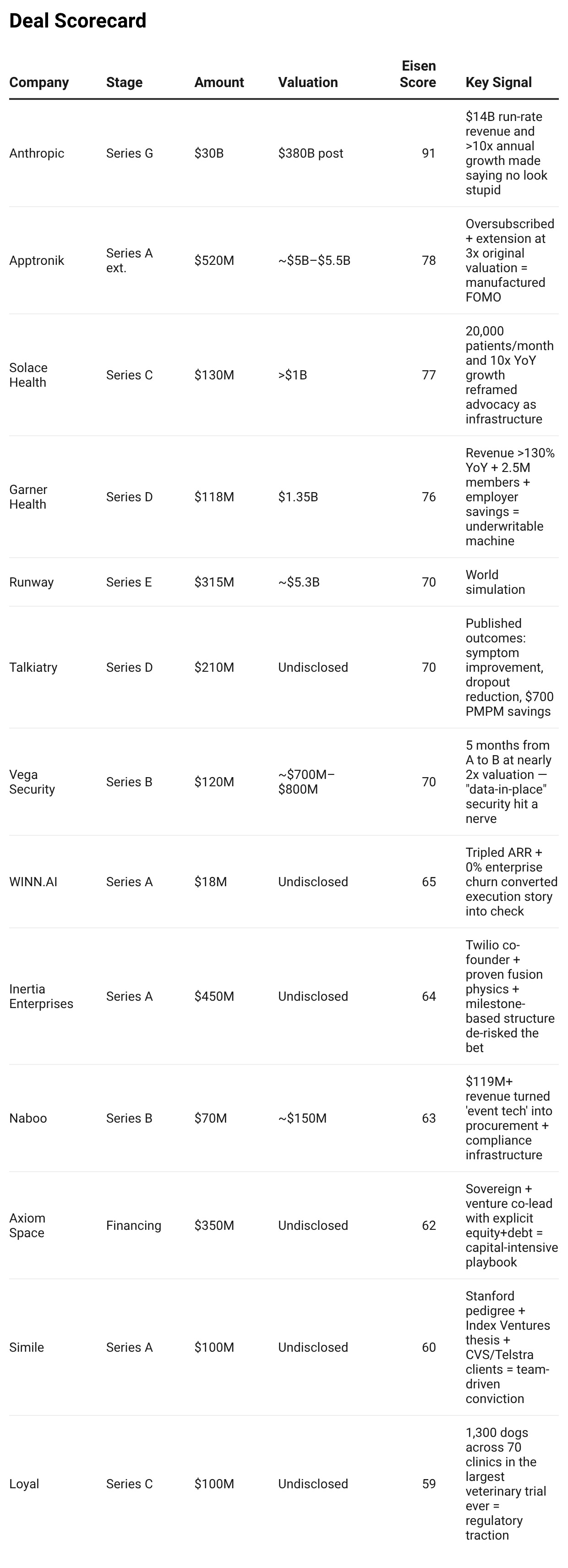
What Changed This Week: 4 Market Shifts You Can’t Ignore
Shift #1: Power-Law Capital Concentration Hardened
Before: Mega-rounds existed but felt episodic. Last week, Waymo raised $16B at a $ 126 B valuation. Big, but bounded.
Now: Anthropic raised $30B at $380B, nearly double Waymo’s valuation, and disclosed $14B run-rate revenue growing >10x annually. One deal consumed 92.3% of the week’s total capital. This is infrastructure-scale finance masquerading as venture capital.
The evidence: Anthropic disclosed 500+ customers paying over $1M annually (up from ~12 two years ago), eight Fortune 10 companies on the platform, and Claude Code alone running at >$2.5B. This is a utility pricing its next phase.
What this means for your raise: Stop benchmarking against the mega-round. You’re not competing for the same capital. Your real benchmark is the $20M–$200M cohort that closed this week, and every one of those required published proof, not narrative.
If you’re not building compounding advantage, investors will treat you like a replaceable feature.
Your pitch must answer:
“Why does your advantage get stronger every month and without proportional cost?”
What to do:
Build a one-page “Compounding Advantage Proof” that includes:
Your flywheel (what increases with every customer)
The moat input (data, distribution, workflow lock, regulation)
The conversion point (when this becomes uncatchable)
Shift #2: “Series A” Stopped Meaning Early
Before: Series A bought 18–24 months to find repeatability. Typical check: $10M–$30M.
Now: Three companies raised $100M+ at Series A. Inertia Enterprises closed $450M for fusion commercialization, led by Bessemer with GV participating. Apptronik extended its Series A to $935M total (including the original $415M oversubscribed tranche) for humanoid robotics manufacturing. Simile raised $100M from Index Ventures for behavioral simulation with no disclosed revenue.
The pattern: capital-intensive categories are rewriting stage definitions entirely. These aren’t “Series A” rounds in the traditional sense. Their infrastructure commitments are structured as a venture to capture the upside of category creation.
Translation: If your product requires atoms, manufacturing, regulated pathways, or massive compute, the old stage labels don’t apply. You either raise “A-as-infrastructure” with strategic capital, or you die by a thousand bridge rounds.
What to do: Design your Series A around milestone-gated tranches, not a single lump sum. Inertia’s deal was explicitly described as “milestone-based funding” - that’s the template. And reframe “use of funds” from “growth” to industrialization: capacity, deployments, compliance, integration, proof loops.
Shift #3: Healthcare Money Returned, But Only for Outcome Publishers
The numbers tell the story. Three healthcare companies cleared $100M+ this week, and every one of them led with measurable results — not convenience, not “digital health,” not TAM slides.
Talkiatry ($210M Series D): Published 87% anxiety and 86% depression symptom improvement after two visits, 60% lower dropout than industry benchmarks, and $700 per-member-per-month cost reductions from a national payer study.
Solace Health ($130M Series C): Disclosed 20,000 patients monthly served through a network of 2,000+ advocates, with 10x year-over-year growth.
Garner Health ($118M Series D): Reported revenue up >130% YoY, 2.5M members served, and average 12% employer healthcare spend reduction in year one.
Before (2021–2022): Digital health sold convenience and consumer acquisition funnels.
Now (2026): The market buys measurable clinical outcomes and measurable spend reduction. Period.
What this means for your raise: If you sell into payers, employers, or health systems, your outcomes story can’t be a testimonial. It must be an evidence package. Investors now ask: “Can you survive actuarial scrutiny and payer procurement at scale?”
Your pitch needs an outcomes table on slide 3. Not the appendix. Slide 3. If you’re in healthcare and you can’t publish a cost-per-outcome or a before/after economic comparison, you’re not ready for a growth round.
What to do: Create an “Outcomes Readiness Packet” that you can hand to a payer, an employer, and an investor:
Clinical or operational outcomes summary: symptom improvement rates, time-to-resolution, engagement/adherence metrics
Cost impact map: per-member-per-month savings, total cost of care reduction, or ROI by employer cohort with methodology disclosed
Population scale proof: members served, patients treated, visits completed. Use absolute numbers, not just percentages
Retention and quality indicators: dropout rates vs. industry benchmarks, NPS, re-enrollment rates, or NRR equivalent for health services
Evidence and validation roadmap: peer-reviewed studies completed or in progress, payer-matched cohort analyses, and timeline to independent audit or actuarial review
Shift #4: Strategic Capital Acting as Lead Check Again
Before: During the downturn, corporate VCs and sovereign wealth funds went quiet or behaved as passive followers writing small checks into later-stage syndicates.
Now: Strategic capital showed up as a lead or co-lead across three of this week’s biggest non-AI rounds.
Apptronik’s $520M extension included Google, Mercedes-Benz, AT&T Ventures, John Deere, and the Qatar Investment Authority alongside traditional VCs.
Axiom Space’s $350M was co-led by Type One Ventures and the Qatar Investment Authority, with an equity-plus-debt structure for long-term horizons.
Bessemer led Inertia’s $450M Series A with participation from GV (Alphabet’s venture arm).
The pattern: strategic assets are showing up where the asset is scarce, embodied AI, space infrastructure, and long-horizon energy. These aren’t vanity checks. They’re deployment bets by organizations that need these technologies to exist.
What this means for your raise: reframe the bar. Your cap table can’t be a list of financial sponsors; it must be a strategic coalition. Investors now ask whether corporates or sovereigns need this technology to exist, and whether it is already in the round.
What to do: If you’re in a capital-intensive sector, build a strategic syndicate map of 10 organizations that benefit if you exist: platforms, channels, incumbents, sovereign entities. Then the engineer demonstrates that those strategies can be sponsored internally: pilots, distribution partnerships, and deployment data. Here we offer a five-part strategic syndicate map that founders build before opening a round:
Dependency map: 10 orgs that benefit if you exist
Pilot and proof-point pipeline: deployments that generate data strategies can take to their investment committee
Co-investment trigger matrix: the specific milestone that converts each strategic from observer to check-writer
Round architecture plan: staged extensions, equity+debt, tranche triggers for flexible strategic entry
Internal champion playbook: named contacts and what proof they need to sponsor you inside their org
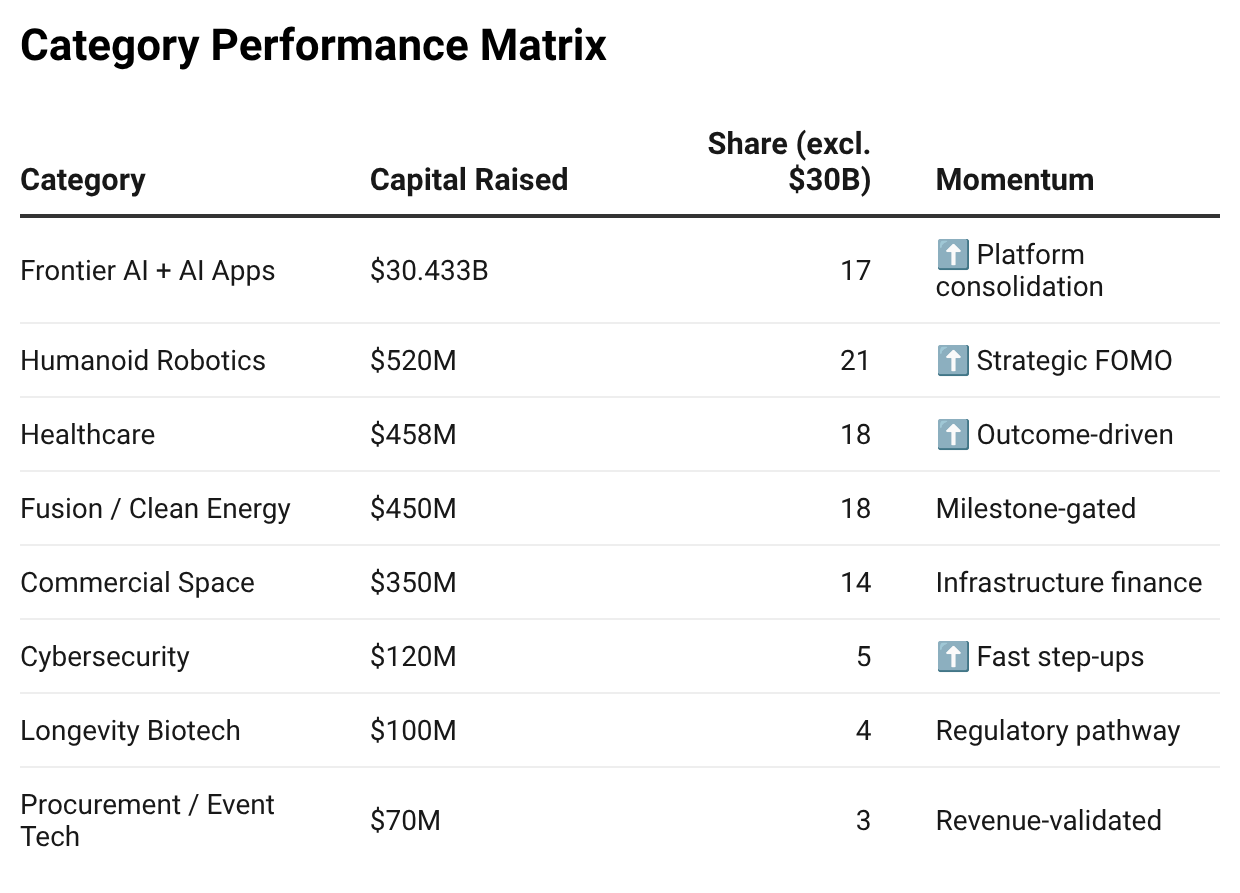
What's missing at the headline tier: Consumer social, crypto, and most fintech narratives didn't break into this week's top deals. That's not proof they got zero funding overall, but the signal is clear about where conviction capital is flowing.
Apptronik: Embodied AI with Inbound FOMO
Eisen Score: 78 - because they structured the round to scream inevitability.
The Setup: $520M Series A extension (bringing total Series A to $935M). Extension priced at roughly 3x the original Series A valuation. Reuters reported the company was valued at about $5B; Bloomberg reported it was above $5.5B. Backers include Google, Mercedes-Benz, AT&T Ventures, John Deere, and Qatar Investment Authority.
The Fundability Lesson: “Oversubscribed” is not a vibe word. It’s a mechanism. When you can show strategic demand, and you’re capital-constrained, you can keep reopening your round at higher prices without losing narrative coherence. Apptronik oversubscribed the initial $350M, expanded to $415M, then added $520M more at a step-up. That’s a case study in FOMO engineering.
Score Breakdown:
Founder-Investor Dynamics: 24/30 (Strong syndicate with strategic depth; corporate backers signal deployment path)
Traction-Conviction: 16/25 (Pre-revenue hardware; conviction driven by partnerships + prototype progress)
Narrative Power: 16/20 (Humanoid robotics is the hottest hardware category; clear “why now” from AI advances)
Deal Architecture: 18/20 (Extension structure at premium pricing is textbook; right amount for manufacturing scale-up)
Capital Planning: 4/5 (Phased capital deployment with clear milestone gates)
Your takeaway: In hardware, build a pipeline that creates inbound demand. Then make the round structure do the talking: staged extensions, clear step-ups, and a “why now” that strategics can’t ignore.
Solace Health: Reimbursable Operations Become Infrastructure
Eisen Score: 77 — because they reframed “patient advocacy” from concierge service to a scalable layer of care delivery and backed it with growth and scale metrics.
The Setup: $130M Series C led by IVP at >$1B valuation. National network of 2,000+ advocates, 20,000 patients monthly, and 10x year-over-year growth. Founded in 2022, it took three years from founding to becoming a unicorn.
The Fundability Lesson: Winners in healthcare are packaging a system-level wedge (reduce friction, reduce spend) with a distribution story (payers and providers) and real scale. Solace isn’t marketing to consumers. It’s selling into budgets. 95% of patients don’t pay out of pocket because Solace bills through the existing insurance infrastructure. That’s the moat.
Score Breakdown:
Founder-Investor Dynamics: 21/30 (IVP lead is strong; syndicate includes Menlo, SignalFire; founders have domain expertise)
Traction-Conviction: 19/25 (10x growth and 20K patients/month is compelling; unit economics not fully disclosed)
Narrative Power: 19/20 (Category-creating: “healthcare advocacy as infrastructure” is a new frame with regulatory tailwinds)
Deal Architecture: 14/20 (>$1B valuation on limited disclosed revenue metrics requires some faith; round size appropriate for stage)
Capital Planning: 4/5 (CEO targeting IPO by 2028 signals milestone clarity)
Your takeaway: In healthcare, AI is a garnish. What gets funded is a measurable reduction in friction and cost, plus an adoption path that doesn’t depend on consumer marketing.
Garner Health: Outcomes + Incentives Is the New Moat
Eisen Score: 76 — because they tied growth, cost savings, and incentive design into a clean story a top-tier lead can underwrite.
The Setup: $118M Series D led by Kleiner Perkins at $1.35B valuation. Serving 2.5M members through 700+ clients and partners. Revenue up >130% YoY. Average 12% reduction in employer healthcare spend in year one.
The Fundability Lesson: Data alone isn’t a moat. Incentives are. The funding story isn’t “we rank doctors.” It’s “we change behavior at scale and capture the savings.” Garner’s dataset of 60 billion medical records from 320M patients is the engine, but the fundable story is the employer spend reduction.
Score Breakdown:
Founder-Investor Dynamics: 24/30 (Kleiner Perkins lead; Kaiser Permanente Ventures strategic participation; strong credibility signal)
Traction-Conviction: 20/25 (>130% revenue growth, 2.5M members, published employer savings, all verified)
Narrative Power: 14/20 (Strong category position but not category-defining; care navigation is crowded)
Deal Architecture: 15/20 ($1.35B on >130% growth is premium but defensible; round right-sized for stage)
Capital Planning: 3/5 (Growth mentioned, but specific milestones not articulated beyond scaling)
Your takeaway: Show before/after economics. Then show why behavior changes. If you can’t change behavior, your “data product” is a dashboard. Dashboards don’t get $118M Series Ds.
Your Playbook: What to Do NextThis Week
Forget theory. Here’s how to respond to this week’s market signals.
Rewrite Your Fundraising Narrative Around Inevitability
Old approach: “We’re building X in a hot market.” New approach: “Here is the constraint in the system, here’s the proof it’s already bending, and here’s why capital accelerates inevitability.”
Action items: (1) Write a one-page “why now” memo that names the structural constraint your company addresses. (2) Build a metric spine — five numbers you would allow a reporter to print today. (3) Draft a use-of-funds map tied to milestones, not tasks.
❌ “We’re an AI-powered platform disrupting healthcare.”
✅ “We reduced employer healthcare spend by 12% in year one across 2.5M members. $118M lets us triple coverage by Q4.”
Instrument Outcomes Like a Public Company
Diagnostic question: If a reporter called today, what numbers would you allow them to print? This week’s winners printed the numbers. Talkiatry published symptom improvement rates. Garner published employer savings percentages. Solace published patient volumes and growth rates.
Action item: Pick three outcome metrics (cost saved, time saved, conversion uplift, retention/NRR, clinical outcomes). Define them with precision. Build a weekly internal reporting loop. Time: 3 hours. Output: a publishable outcomes dashboard.
Calculate Your Eisen Fundability Score
Use this simplified self-assessment:
Founder-Investor Dynamics (30): Who are you and who is willing to lead you? Score your track record (0–10), investor quality of your likely leads (0–10), and competitive dynamics in your raise (0–10).
Traction-Conviction (25): What proof closes the skepticism gap? Score your growth trajectory (0–10), business model validation (0–8), and market proof points (0–7).
Narrative Power (20): Is the category hot, and do you have a unique wedge? Score your category position (0–10), story clarity (0–5), and market tailwinds (0–5).
Deal Architecture (20): Is the round size and valuation defensible for your stage? Score valuation reasonableness (0–8), investor alignment (0–7), and round construction (0–5).
Capital Planning (5): Do you have 18+ months to the next value inflection? Score runway adequacy (0–3) and milestone clarity (0–2).
Your interpretation: 85+ is run a tight process, be selective, you’re in the driver’s seat. 70–84 is fundable, but tighten your proof points before a broad process. Below 70 is sharpen your wedge, instrument your metrics, or consider a bridge before a full raise.
Please, subscribe or comment “Score” and receive Eisen Fundability Score Complete Calculation Guide.
Engineer a Syndicate, Not a Cap Table
This week’s biggest non-software checks were built on strategic conviction, not just financial underwriting. Apptronik’s syndicate included automakers, telecoms, and sovereign wealth. Axiom Space paired with sovereign capital and structured equity-plus-debt.
Action items: (1) Build a “strategic map” of 10 organizations that benefit if you exist — platforms, channels, incumbents. (2) Identify pilot or partnership opportunities that generate data that these strategies can use to justify internal investment. (3) Have three strategic conversations started by the end of the week. Time: 4 hours. Returns: a pre-wired syndicate when you open your next round.
Prepare for a Bifurcated Investor Conversation
Reality: Some investors are underwriting mega-rounds and will ignore you unless you look like a category endpoint. Others are underwriting efficiency and outcomes, and will fund you if you can prove them. This split was visible directly in the disclosure patterns this week.
Action items:
(1) Run two narrative tracks in your deck - one for category ambition, one for next-12-months measurable milestones.
(2) Build a tiered target list: Tier 1 = investors whose thesis matches your category; Tier 2 = investors whose thesis matches your metrics.
(3) Tailor your outreach to match. Time: 2 hours. Returns: a fundraising process that doesn’t waste meetings on mismatched investors.
Looking Forward: What to Watch Next 1–3 Weeks
Based on deal flow patterns and investor signaling from this week, here’s what’s likely coming.
Scenario 1: More Extensions and Multi-Tranche Rounds in Capital-Intensive Categories
Apptronik’s “reopen the round with price step-ups” template works for any capital-constrained, high-demand company. Expect humanoid robotics, autonomous vehicles, and energy companies to adopt this structure as mega-round dynamics return to the market.
Your watch list: any robotics or energy company that closed a round in the last 6 months. Your response: design your financings as staged options with tranche triggers tied to deployment milestones.
Scenario 2: Digital Health Clears Big Checks, But Only for Outcomes Models
Three healthcare companies cleared $100M+ in one week, all leading with payer/employer ROI. The bar is set: if you’re in digital health and you can’t publish a cost-per-outcome figure, you’re going to have a harder time in the next 90 days than you did in the last 90.
Your response: invest in outcomes instrumentation and payer-ready evidence before you open a growth-round process. Build the data asset first.
Scenario 3: “Behavioral Simulation” Becomes a Contested Category
Simile’s $100M Series A from stealth and Runway’s $315M Series E both positioned around simulation — Simile for human behavior, Runway for visual worlds. Expect more companies to launch with “simulation” or “digital twin” positioning as the AI narrative fragments beyond chatbots and copilots.
Your positioning: if you’re an AI applications company, either ride this wave with a defensible data moat or avoid the narrative entirely and sell concrete workflow ROI.
Wild Cards:
A second mega-round lands and rehydrates late-stage risk appetite. If another $10B+ round closes within weeks, LP allocators will accelerate re-ups, and growth-stage deal velocity will spike.
A regulatory or platform shock changes deployment rules for AI in healthcare or security. Companies with compliance built in, like Talkiatry’s in-network insurer model or Vega’s data-in-place architecture, would benefit disproportionately.
The Bottom Line: Your Next Move
This week, the market drew a bright line between companies that publish proof and those that pitch potential.
The new rules:
Revenue gravity trumps narrative. Anthropic made the round inevitable. Instrument your metrics so they’re publishable.
Outcomes are the language of capital in healthcare. Three $100M+ healthcare rounds all led with measurable cost reduction or clinical improvement. Your outcomes table belongs on slide 3.
Stage labels are dead in capital-intensive sectors. $450M and $520M at Series A means the old playbook is gone - structure milestone-gated tranches, not lump sums.
Strategic capital is a signal, not a nice-to-have. Sovereign wealth funds and corporate VCs co-led or anchored the biggest non-AI rounds. Build the strategic syndicate map before you need it.
Speed is a fundability signal. Vega went from Series A to Series B in five months. Solace went from founding to unicorn in three years. The market rewards companies that compress timelines.
The market just showed you the playbook. The question is whether you’ll run it before your competitors do.
About This Analysis
This weekly market intelligence report analyzes fundability dynamics using the proprietary Eisen Fundability Score framework developed through 20+ years in the startup ecosystem and validated across 100+ startups. All data sourced from verified public sources with a minimum of two independent confirmations per deal. Eisen Fundability Scores are part of Fundables OS and reflect a multidimensional assessment of deal probability based on historical patterns and disclosed metrics.