

Playbook, Perspective, and Pattern for founders raising now. This report deliberately strips out the megarounds and the IPO traffic so you can read the part of the market that actually prices your round.
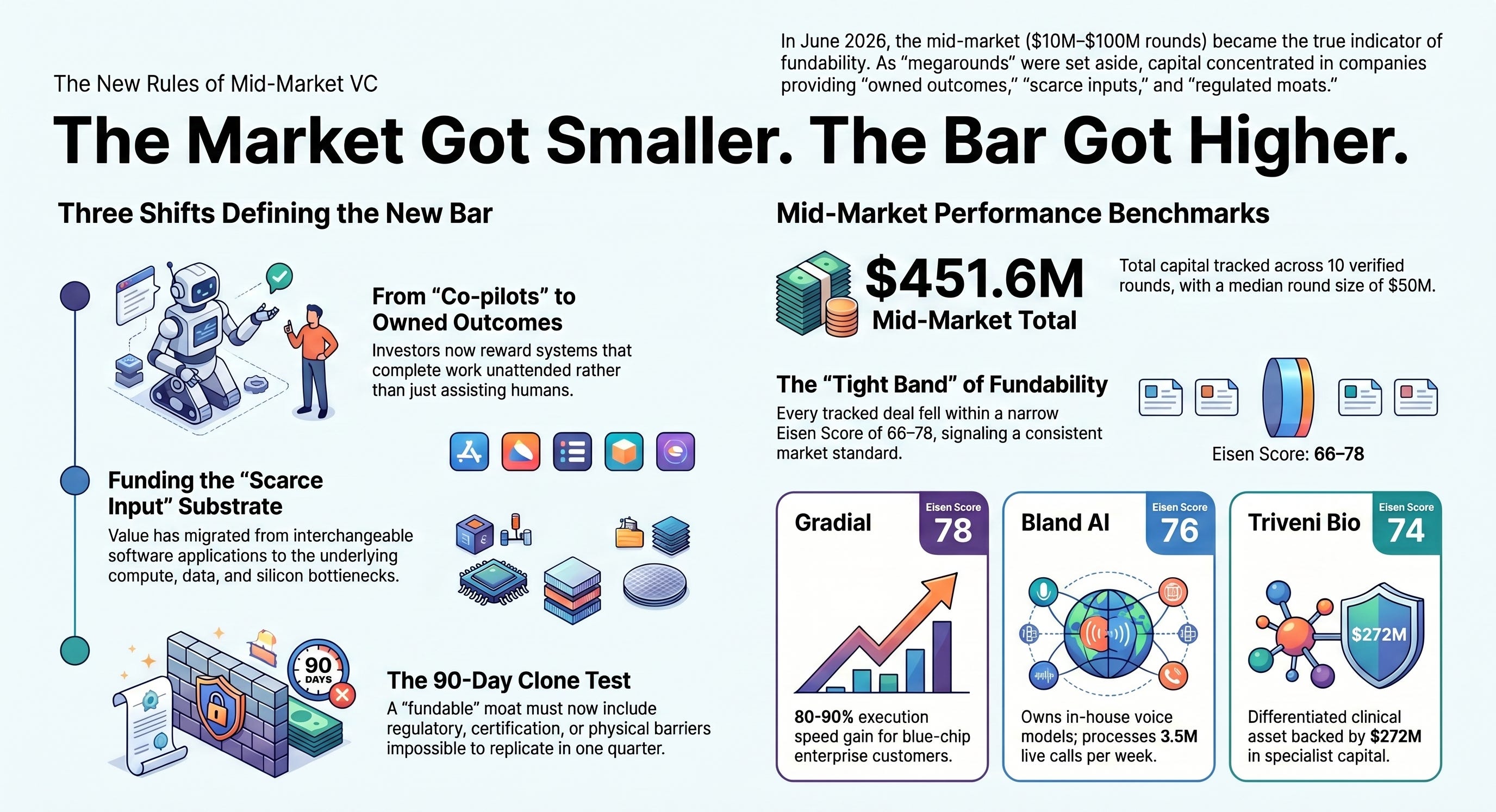
The week of June 15-21, 2026, was a quiet one for giant checks, and that is exactly why it is useful. Set aside the world-model round, the nine-figure cyber raises, and the public-market noise. What remains is the market that prices your Series A and Series B: ten verified rounds, each under $100M, that together raised about $451.6M. The deals got smaller this week. The bar did not.
A voice AI company running more than 3 million live calls a week has raised. A payments company that has cleared more than $50B and has been profitable for three years has raised. An interconnect company with elite chip investors but no shipping product raised. None of them led with a model. Each led with the thing it owns and a number it has already moved, or with the scarce input that everyone above it has to buy.
Here is the consequence for Monday. If your deck still leads with model capability, total addressable market, or the phrase AI-native without deployed usage attached, you are pitching at a discount this week. The founders who led with owned outcomes, regulated rails, or scarce supply. Read every shift below through that lens. Each one tells you what to put on slide one before your next investor meeting.
The Week in One Sentence
Primary insight: With the megadeals and IPO filings removed from view, the mid-market is priced on a single axis. Capital concentrated in AI that sits inside a regulated workflow, a physical or computational bottleneck, or a proprietary data and clinical asset, and it paid for owned outcomes rather than narrative. The application wrapper got discounted. The substrate underneath it got funded.
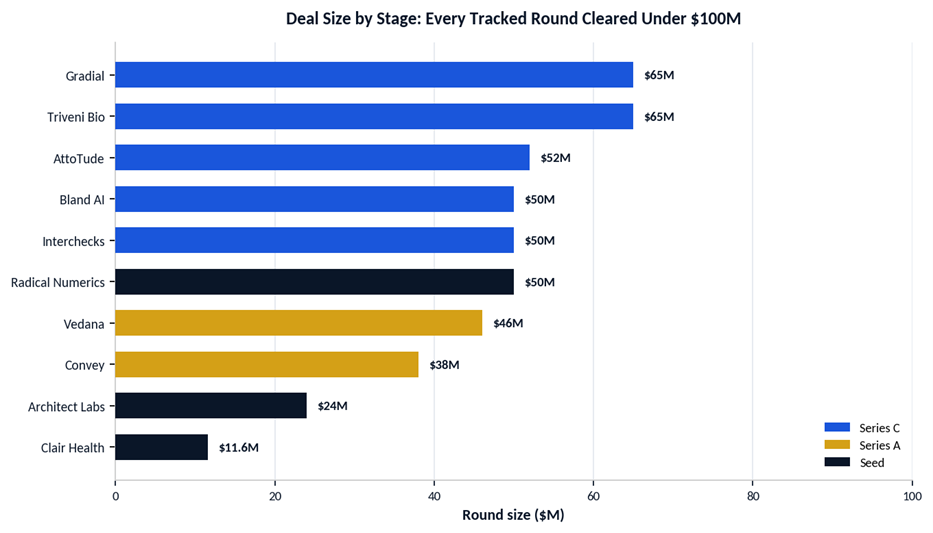
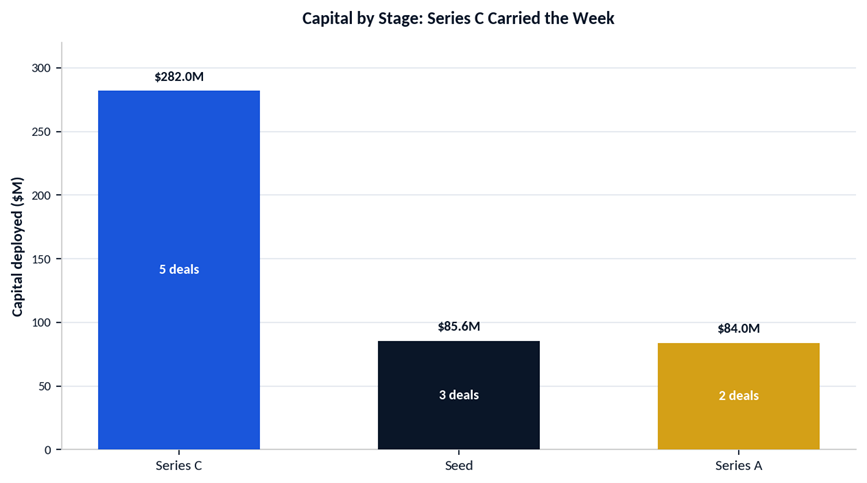
• Total tracked mid-market capital (10 verified rounds): approximately $451.6M, all under $100M per deal.
• Average round size: $45.2M across the ten.
• Median round size: $50M, the midpoint of a cluster of $50M Series C and seed rounds.
• Disclosed valuations: only one of ten. Gradial at $675M. Nine rounds did not disclose, an even tighter opacity than last week, which signals how fast these deals closed.
• Largest tracked round: Gradial and Triveni Bio tied at $65M, an enterprise-AI Series C and a biotech Series C.
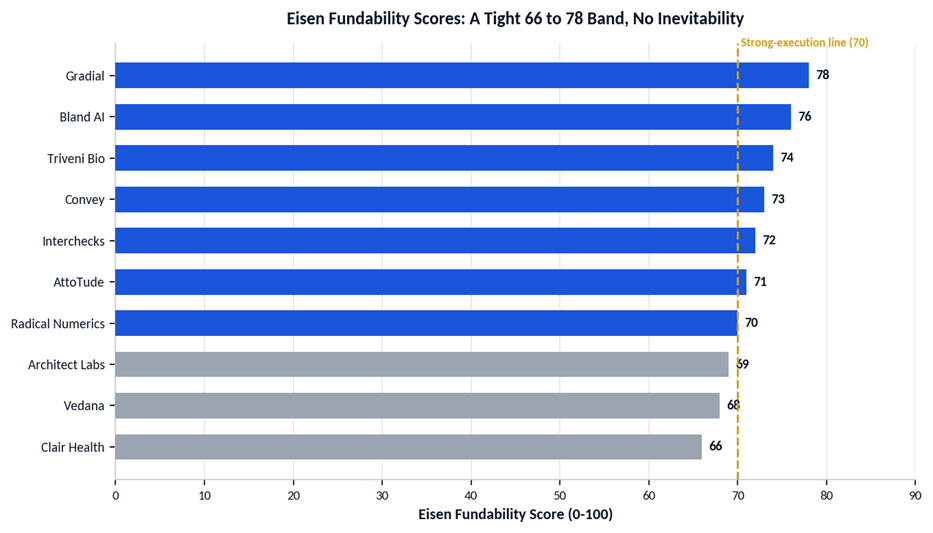
• Highest Eisen Fundability Score: Gradial at 78, on the strongest deployed-proof profile of the week.
• Defining structural feature: a tight Eisen Score band of 66 to 78. No deal reached inevitability, and the cluster shows the market is consistent about what it now pays for: owned proof and a moat a competitor cannot clone in a quarter.
Deal Scorecard
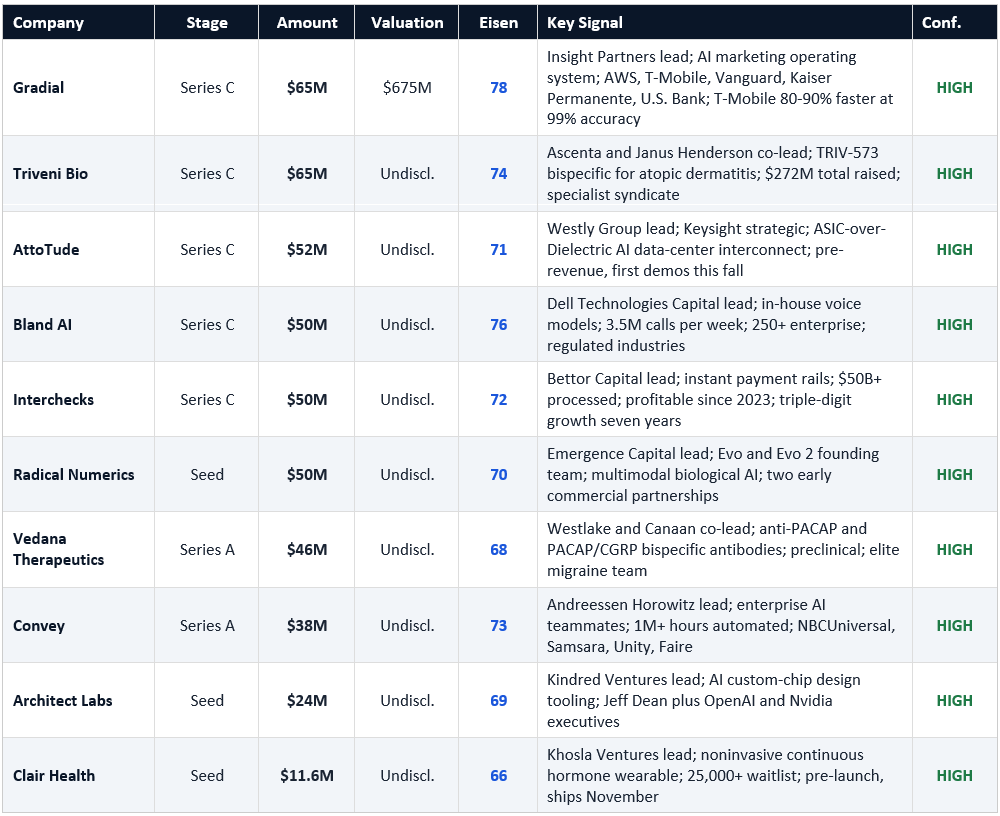
Eisen Fundability Scores are calculated across the 5Ps-weighted dimensions: Founder-Investor Dynamics (Process, 30%), Traction-to-Conviction Conversion (Proof, 25%), Narrative Power (Positioning, 20%), Deal Architecture (Packaging, 20%), and Capital Planning (Planning, 5%). Scores of 85 and above signal an inevitable outcome. Scores of 70 to 84 signal strong execution. Scores below 70 signal early-stage or the need for repositioning. Missing metrics are scored conservatively, and opacity is penalized rather than assumed strong.
What the Scorecard Says at a Glance
The band held tight. Every deal was cleared between 66 and 78. That 12-point spread is as narrow as this report series gets, narrower than last week. Remove the megarounds and the procurement-anchored outliers, and the market becomes remarkably consistent about what it rewards: deployed usage, an owned workflow or rail, or a scarce input a competitor cannot source in a quarter. No deal reached the 85 inevitability line, because inevitability now requires the proof these companies have, plus the scale they are still building toward.
Gradial (78) is the cleanest case of the week. It scored highest not on a famous lead or a disclosed valuation alone, but on deployed proof a diligence team can verify: blue-chip enterprise logos including AWS, T-Mobile, Vanguard, and Kaiser Permanente, and a hard outcome number, T-Mobile cutting campaign execution time by 80 to 90 percent at 99 percent accuracy. That is usage in regulated estates with a measured result attached.
Bland AI (76) and Triveni Bio (74) round out the top three on the same logic in different languages. Bland owns its voice models and runs more than 3.5 million live calls a week across regulated industries, so the agent is doing the work, not assisting it. Triveni shows a differentiated clinical asset backed by specialist life-science leads and $272M raised to date. Different categories, identical underwriting test: what has already been proven, owned, or de-risked at scale.
The lower band is instructive, too. Clair Health (66) and Vedana Therapeutics (68) are credible companies, but Clair is pre-launch with no peer-reviewed data, and Vedana is preclinical with first-in-human studies still a year out. The scoreboard separates a fundable company from a fundable round, and the gap between the two is usually deployed proof plus a defensible moat.
What Changed This Week: 5 Market Shifts
Each shift is verified against multiple primary sources and ranked by structural impact on founder fundraising, not by deal size. Every shift ends with what it means for your raise.
Shift 1: The Scarce-Input Layer Outbids the Application Layer
Pattern: Three of the week’s most-watched rounds funded the substrate beneath the AI boom rather than the app on top. AttoTude raised $52M for an interconnect that moves data across AI clusters, with Keysight as a strategic backer. Architect Labs raised $24M to compress custom-chip design, backed by Jeff Dean, OpenAI, and Nvidia executives. Radical Numerics raised $50M for multimodal models that read DNA, RNA, and proteins at once, the privileged data layer for biology. Each one sits underneath a wave of application companies that have to route through it.
Perspective: When the application layer commoditizes, value accrues to the scarce input. Foundation models are getting cheaper and more interchangeable every quarter, so durable value migrates to whoever owns the compute path, the silicon design loop, or the proprietary scientific data. Elite chip and science investors are not buying interfaces. They are buying the bottleneck that the visible products depend on.
Founder Blindspot: Founders build the visible application because it is the part that customers see. Investors increasingly pay for the unavoidable layer underneath it, the data, the supply, the silicon, or the rail. The selection error is building the easy-to-copy thing instead of the hard-to-source one.
Playbook: Name the input in your category that every competitor must buy from someone. Training data, regulated rails, scarce materials, custom silicon, a measurement layer, a system of record. Then decide this quarter whether you own it, can own it, or are merely a buyer. If you are a buyer, your moat lives upstream, and your strategy needs to move there before your next round.
Contrast: A year ago, the fundable AI story was the end application. This week, the better-funded story was the supplier that the application cannot function without. The picks-and-shovels layer repriced above the storefront, even at small check sizes.
What this means for your raise: If a competitor with a better model could replicate your product in 90 days, you are pitching the storefront. Find the scarce input behind it and reframe the round around owning that.
Shift 2: Owning the Outcome Replaced the Co-pilot Pitch
Pattern: The strongest application rounds led with execution rather than assistance. Bland processes more than 3.5 million calls per week using its own voice models and tells customers it will own the results of the call. Convey raised $38M from Andreessen Horowitz on a deliberate rebrand from agent to teammate, with more than one million hours of work automated for NBCUniversal, Samsara, and Unity. Gradial showed an enterprise customer cutting execution time by 80-90 percent with 99 percent accuracy. The proof is in the work removed, not in time saved.
Perspective: In a week without megaround gravity, the discriminator between a yes and a maybe is documented outcome ownership. The market has tired of the word agent precisely because so many agents still hand work back to a human. Capital is now underwriting the systems that finish the job unattended and book a measurable result, because that is what a partner can verify in an afternoon.
Founder Blindspot: Founders over-index on model sophistication and a long feature roadmap. Investors this week were scanning for the opposite: units of work completed, the outcome delta, and whether the system runs without a human checking every output. A copilot that creates review work reads as a feature. A teammate who owns an outcome reads as a company.
Playbook: Build a one-page proof stack before your next meeting. Four lines only: units deployed or calls run, volume per period, the measurable outcome you changed, and your retention or expansion figure. If you cannot fill all four, your next two weeks should focus on generating the missing line rather than refining the pitch. Wrong approach: a roadmap slide promising what the product will do. Right approach: a usage table showing what it already does, unattended.
Contrast: In 2024, a polished agent demo opened a Series A conversation. This week, the same stage was cleared on outcomes already owned at scale. The bar moved from assistance to execution.
What this means for your raise: A story-only or co-pilot deck gets delayed, not declined, which is worse, because the delay burns runway. Put owned outcomes on page one or expect to be asked for them before the second meeting.
Shift 3: Specialist and Strategic Capital Led the Hard Categories
Pattern: Where the science, regulation, or hardware was hard to underwrite, a domain specialist or a strategist led or co-led. Ascenta Capital and Janus Henderson co-led Triveni Bio in the immunology space. Westlake BioPartners and Canaan Partners co-led Vedana in the neurology space. Keysight took a strategic position in AttoTude in the semiconductor industry. Radical Numerics brought a former U.S. assistant secretary of defense onto its advisory board and partnered with a national lab. Generalists, where present, followed rather than led.
Perspective: In hard categories, the right capital arrives with distribution and validation, not just a wire. A strategic on the cap table is a channel, a regulatory reference, or a customer signal. That is why two clinically complex biotechs and a deep-tech semiconductor company all closed quickly: the lead could underwrite the specific risk, and the co-investors shortened the path to the next milestone.
Founder Blindspot: Founders in hard categories still default to a generalist venture process. The cost is 60 days spent educating investors who cannot price the core risk, ending in a soft pass. The selection error is the fundraising mistake. The wrong pool is more expensive than the wrong deck.
Playbook: Segment your target list this week by who brings channel or validation in your exact category, not by brand or fund size. For each name, write the specific deal they did in your space and the warm path to them. Lead outreach with the specialists and strategics who can underwrite your hardest risk. The right $20M from a domain specialist outperforms a larger check from a generalist who needs to be taught the category.
Contrast: In the 2021 cycle, generalist enthusiasm funded almost everything. In 2026, a hard-category round needs a specialist or strategic anchor before generalists will follow.
What this means for your raise: If your category is clinical, regulated, or hardware-heavy, the first three names on your list should be specialists or strategics. Build that pool before you open the round, not after the generalists stall.
Shift 4: Healthcare and Biotech Quietly Led the Mid-Market
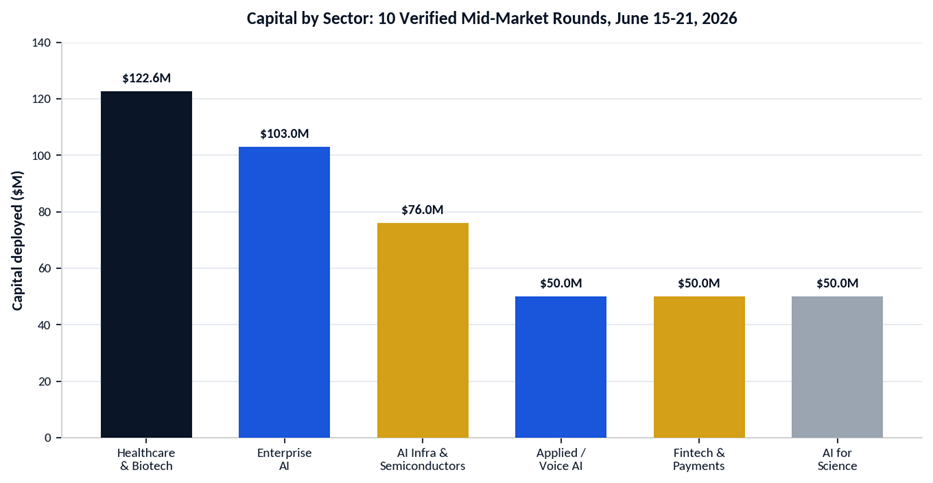
Pattern: Strip out the AI headlines, and the largest sector by dollars was health. Triveni Bio raised $65M for a differentiated bispecific in atopic dermatitis. Vedana Therapeutics raised $46M for next-generation migraine antibodies. Clair Health raised $11.6M for a continuous hormone wearable. Radical Numerics, scored here as AI for science, is a biology-first company in everything but label. Together, the health and biology cluster outweighed any single software category.
Perspective: Health rounds this week were team-anchored and clinically validated, not narrative-driven. Triveni and Vedana were built by operators who have already shipped approved or late-stage medicines, and their leads were specialists who price clinical risk directly. In a market where software features can be cloned quickly, a validated biological target plus a proven development team is a moat that does not commoditize.
Founder Blindspot: Founders outside biotech assume the health rounds are irrelevant to them. They are not. The pattern is portable: capital paid for a team that has done the exact thing before and a target or mechanism that is already de-risked. That is the same underwriting test a software investor applies to deployed usage.
Playbook: Audit your own raise for the health-round pattern. Name the one risk that scares your category most, then show the specific evidence that you have already retired it, whether that is a clinical readout, a reference customer, or a shipped result. Lead with the retired risk, not the roadmap.
Contrast: A year ago, a generic AI label could outraise a specialist health story on hype alone. This week, the quiet, team-anchored, clinically validated rounds carried the most mid-market capital.
What this means for your raise: Investors are paying for retired risk and proven teams. If you cannot point to a risk you have already removed, that is your next two weeks, not another deck revision.
Shift 5: Regulated and Physical Moats Repriced Above Pure Software
Pattern: The strongest scores this week attach to a regulatory or physical barrier a competitor cannot clone in a quarter. Interchecks carries PCI Level 1 and SOC 2 certification and a decade of profitable payment rails. Bland carries owned voice models live in regulated healthcare and financial calls. AttoTude has hardware and physics barriers. Triveni and Vedana carry a clinical and FDA path. The moat is the slow, hard, regulated build, not the interface.
Perspective: Model commoditization pushed defensibility away from software margins and toward regulation, hardware, deployment, and proprietary data. A feature can be copied in weeks. A profitable, certified payment rail, a clinical program, a qualified interconnect, or a set of in-house voice models cannot. Investors are now treating that hard, unglamorous work as the moat rather than as a cost to be minimized.
Founder Blindspot: Founders treat compliance, certification, and hardware as overhead to keep light. Investors treated them as a durable barrier this week. The companies that underinvested in the regulated build are the ones that look most cloneable in diligence.
Playbook: Run the 90-day clone test on your own company. Ask what a well-funded competitor could replicate in a single quarter. If the answer is most of it, your moat is the regulatory, certification, or physical work you have not done yet. Name the one barrier you can build in the next two quarters that would fail that test, and make it the use-of-funds headline in your raise.
Contrast: The 2020 and 2021 cycle prized speed and software gross margins. The June 2026 market prizes the slow, hard, regulated build that competitors cannot shortcut.
What this means for your raise: If your defensibility is speed or design, name the regulatory, certification, or physical moat you are building next. That barrier, not your feature set, is what now prices the round.
The Deals That Matter: Top 5
Five deep dives across enterprise AI, voice AI, biotech, AI infrastructure, and payments. Each is selected for a distinct playbook value, not deal size. All metrics are verified against two or more primary sources.
Gradial
Enterprise AI Marketing Operating System | Series C | $65M | $675M Valuation
Eisen Fundability Score: 78 / 100
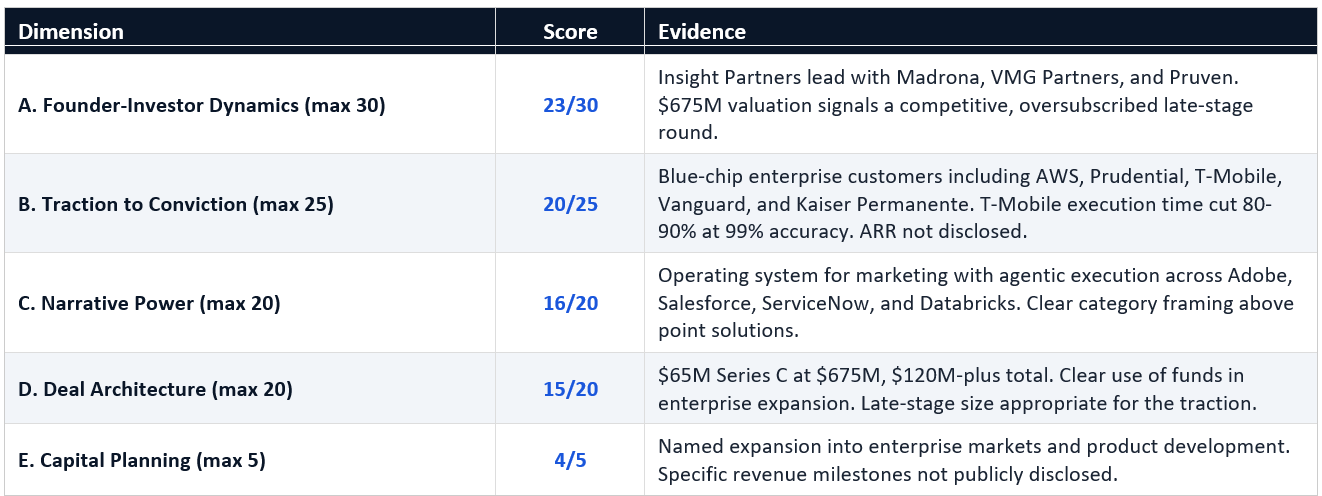
Why this scored: The highest score of the week reflects the strongest deployed-proof profile in the report. Gradial is not a marketing-tech point solution. It is an operating system with agents that execute across Adobe, Salesforce, ServiceNow, and Databricks inside complex, regulated enterprise estates. The proof is verifiable in diligence: customers including AWS, Prudential, T-Mobile, Vanguard, Kaiser Permanente, and U.S. Bank, with T-Mobile cutting campaign execution time by 80 to 90 percent at 99 percent accuracy.
The Setup: Led by Insight Partners, with Madrona, VMG Partners, and Pruven participating, Seattle-based Gradial raised at a $675M valuation. The company positions itself as the operating layer for marketing operations, where poor automation is expensive, and compliance logic must live within the workflow. That reference set turns the story from marketing tech into enterprise operations software with agentic execution.
The Numbers: $65M Series C at a $675M valuation. More than $120M raised to date. Customers include AWS, Prudential, T-Mobile, Vanguard, Kaiser Permanente, and U.S. Bank. T-Mobile reported an 80-90 percent reduction in campaign execution time, with 99 percent accuracy. Agents span Adobe, Salesforce, ServiceNow, and Databricks. Use of funds: enterprise expansion and product development.
Fundability Lessons: Gradial is the template for the platform that spans a fragmented software estate. Three moves built the 78-point case. First, embed compliance logic into the workflow so the product is sticky and hard to replace. Second, lead with a hard outcome number from a marquee customer, the 80 to 90 percent execution-time cut, because enterprise buyers underwrite results, not features. Third, win in regulated environments where poor automation is most expensive, which converts a martech story into enterprise operations software.
Your Takeaway: If you sell into the enterprise, frame your value as a measurable throughput gain inside a named customer, and prove the product spans the tools that the customer already runs. The fundable proof is the outcome you can show on accounts you already serve, not the capability you could deliver.
The Founder Mistake to Avoid: Founders pitch the breadth of integrations and bury the outcome. The mistake is selling surface area when investors are buying results. Gradial scored on a measured execution-time cut at a blue-chip customer, not on a list of connectors. If your enterprise story leads with logos alone, move the outcome metric to the front.
Bland AI
Voice AI for Complex, High-Stakes Conversations | Series C | $50M | Valuation Undisclosed
Eisen Fundability Score: 76 / 100
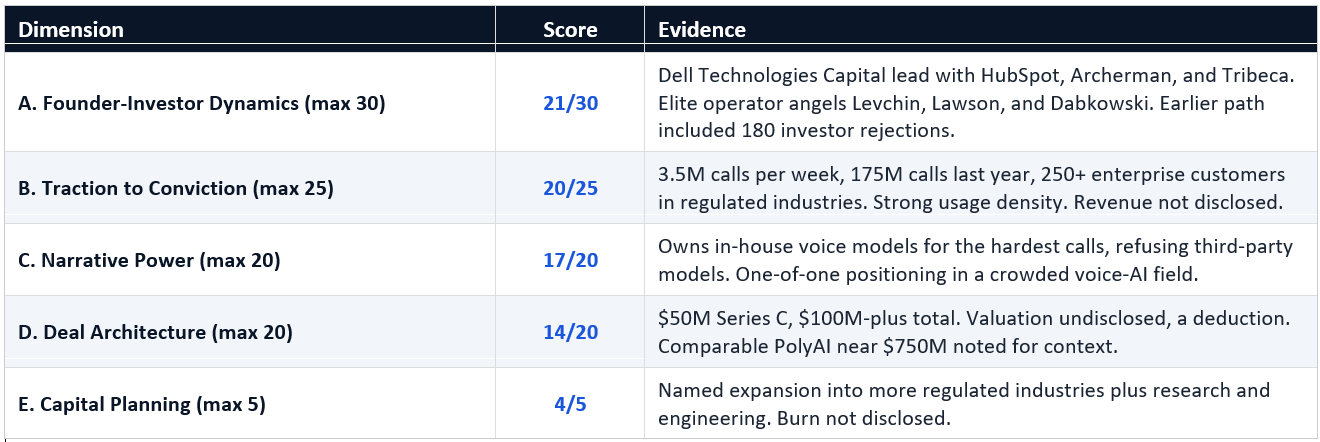
Why this scored: Bland is the cleanest owned-execution case of the week. The agent does the work end-to-end on calls that are long and non-linear, the ones most systems cannot handle. The proof is usage density, a diligence team can verify: more than 3.5 million calls a week, over 175 million AI calls last year, and 250-plus enterprise customers in regulated industries. The score reflects strong usage and an owned model layer, with an undisclosed valuation, in a crowded category.
The Setup: Co-led by Dell Technologies Capital, HubSpot Ventures, Archerman Capital, and Tribeca Venture Partners, and backed by existing backers Emergence, Upfront, Scale Venture Partners, and Y Combinator, San Francisco-based Bland surpassed $100M in total funding. The angel list includes Affirm co-founder Max Levchin, Twilio founder Jeff Lawson, and ElevenLabs CTO Piotr Dabkowski. Founders Isaiah Granet and Sobhan Nejad built the company after a personal failure of the phone system, and they were rejected by 180 investors before this trajectory.
The Numbers: $50M Series C, more than $100M total. More than 3.5 million calls per week. Over 175 million AI phone calls were handled last year. 250-plus enterprise customers, including Samsara, Kin Insurance, and CNO Financial Group. Typical calls run 30 to 45 minutes in healthcare and financial services. Models are built in-house, and the platform will not integrate third-party foundation models. Use of funds: research, engineering, and expansion into more regulated industries.
Fundability Lessons: Bland is the own-the-model template. First, take the hardest version of the problem, the long, high-stakes call, so the moat is the work nobody else will do. Second, own the model layer rather than wrapping a third-party model, which turns latency, interruptions, and continuity into proprietary advantages. Third, lead with usage density, calls per week, and per year, because execution AI is judged on volume run, not demos shown.
Your Takeaway: If you build vertical or agentic AI, decide whether you can own the core model for your domain rather than renting one. Owning it lets you optimize for the constraints that make your problem hard, and it gives a diligence team a defensibility story that a wrapper cannot match.
The Founder Mistake to Avoid: Founders wrap a popular model, handle the easy calls, and claim the hard ones. The mistake is selling a copilot that still needs a human while claiming autonomy. Bland scored because it handles difficult calls end-to-end using its own models. An agent that hands back every output for review is a feature, and it will not be cleared at this level.
Triveni Bio
Antibody Therapeutics for Immune and Inflammatory Disease | Series C | $65M | Valuation Undisclosed
Eisen Fundability Score: 74 / 100
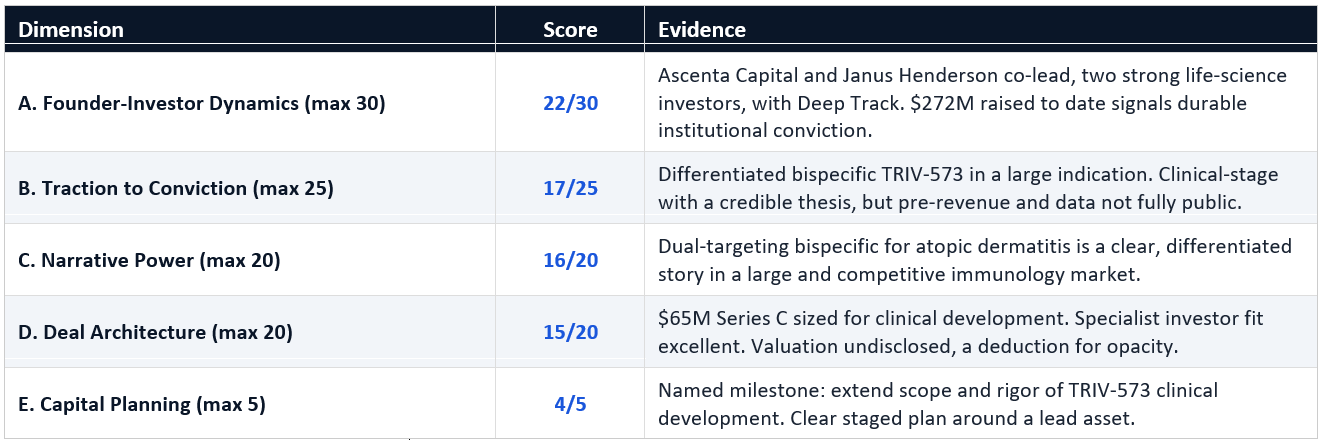
Why this scored: Triveni carries the strongest specialist-conviction profile of the week. The round was co-led by two sharp life-science investors, Ascenta Capital and Janus Henderson, with Deep Track participating, and it funds a differentiated clinical thesis rather than a platform-for-its-own-sake story. The score reflects elite-specialist conviction and $272M raised to date for a program that is clinical-stage and pre-revenue.
The Setup: Watertown, Massachusetts-based Triveni is advancing antibody therapeutics for immunological and inflammatory disorders. The new capital is aimed primarily at extending development of TRIV-573, a dual-targeting bispecific for atopic dermatitis, a large and competitive market where a differentiated mechanism can command attention. The raise reads as a classic differentiated-clinical-thesis round, not a broad discovery-platform bet.
The Numbers: $65M Series C co-led by Ascenta Capital and Janus Henderson, with Deep Track and existing investors. $272M raised in total to date. Lead program TRIV-573, a dual-targeting bispecific for atopic dermatitis. Use of funds: extend the scope and rigor of clinical development for TRIV-573.
Fundability Lessons: Triveni is the differentiated clinical thesis template. First, choose a target and mechanism that is differentiated inside a large, validated market, so the story is not me-too. Second, raise from specialists who can underwrite the clinical risk directly, rather than from generalists who would discount it. Third, point the capital at one named program and readout, so investors price a defined risk reduction rather than an open-ended platform.
Your Takeaway: If you are clinical or deep-tech, sequence your fundraise to your data and your lead asset, not your calendar. Each round should close against a defined program that retires the next stage of risk. A focused, differentiated thesis underwrites better than a broad platform with no lead.
The Founder Mistake to Avoid: Founders pitch the breadth of a platform and bury the lead asset. The mistake is selling optionality when investors are buying a specific, de-risked program. Triveni scored on a named bispecific in a large indication backed by specialist leads. A platform with no lead asset is pitching potential without the proof that backs it up.
AttoTude
ASIC-over-Dielectric AI Data-Center Interconnect | Series C | $52M | Valuation Undisclosed
Eisen Fundability Score: 71 / 100
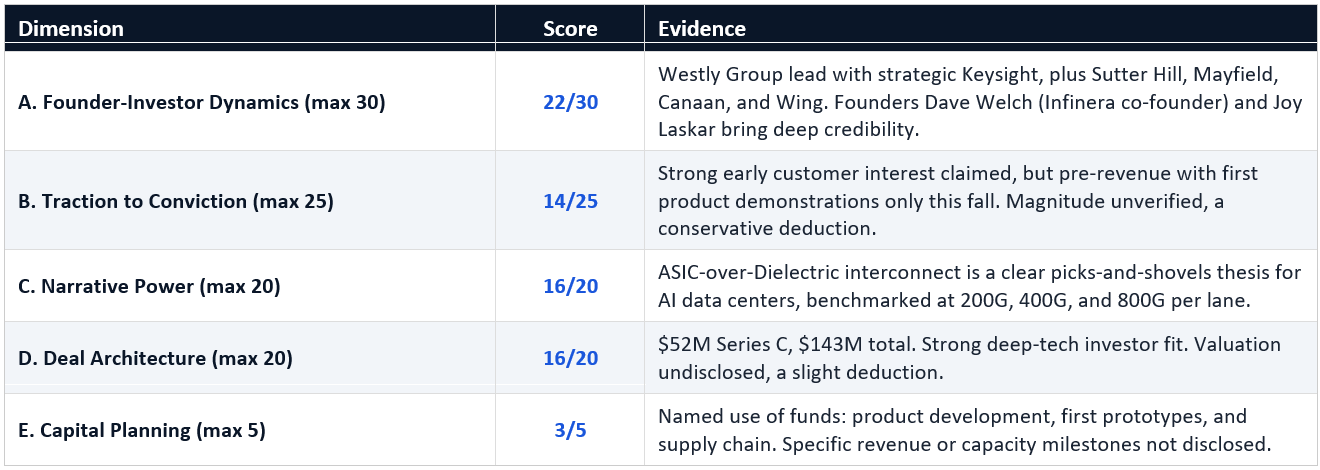
Why this scored: AttoTude is the clearest scarce-input play of the week. It is building a new class of interconnect that moves data across AI clusters, the bottleneck that becomes more expensive as GPU counts scale. The lead is The Westly Group, joined by strategic investor Keysight and a deep bench of semiconductor backers. The score reflects an elite syndicate and a real physical moat against a company that is still pre-revenue, with its first product demonstrations coming only this fall.
The Setup: Menlo Park-based AttoTude, founded in 2024 by Dave Welch, a co-founder of Infinera, and Joy Laskar, a serial entrepreneur and former Georgia Tech professor, develops what it calls an ASIC-over-Dielectric architecture. The approach sends electrical signals over low-loss dielectric waveguides, positioning between copper and optics for high-bandwidth, energy-efficient connectivity inside AI and hyperscale data centers.
The Numbers: $52M Series C led by The Westly Group, with new strategic investors Keysight, Allegis Capital, and DNX, and existing backers Sutter Hill Ventures, Mayfield, Canaan, and Wing Venture Capital. Total funding now $143M. Supports per-lane data rates of 200G, 400G, and 800G. Pre-revenue, with first product demonstrations expected this fall. Use of funds: advance product development, build first prototypes, and establish a scalable supply chain.
Fundability Lessons: AttoTude is the sell-the-bottleneck template. First, attack a physical chokepoint that the AI build-out cannot avoid, data movement, rather than a software layer above it. Second, stack a syndicate that can underwrite deep tech and signal validation, including a strategic partner like Keysight that understands the measurement ecosystem. Third, make the technical claim concrete and benchmarked, per-lane data rates against copper and optics, so the value proposition needs no translation.
Your Takeaway: If you sit at a physical or computational bottleneck, lead with the benchmarked performance delta and the strategic investors who validate it. A hard-to-source physical advantage yields a stronger fundability claim in 2026 than a software margin, even before revenue, because buyers are urgent and substitutes are slow.
The Founder Mistake to Avoid: Pre-revenue deep-tech founders over-promise a near-term revenue ramp and lose credibility. The mistake is dressing a research-stage company as a commercial one. AttoTude scored with an elite syndicate, a strategic validator, and an honest pre-revenue posture, with demos scheduled for this fall. Name your real stage and let the moat and the syndicate carry the round.
Interchecks
Instant Payments Infrastructure | Series C | $50M | Valuation Undisclosed
Eisen Fundability Score: 72 / 100
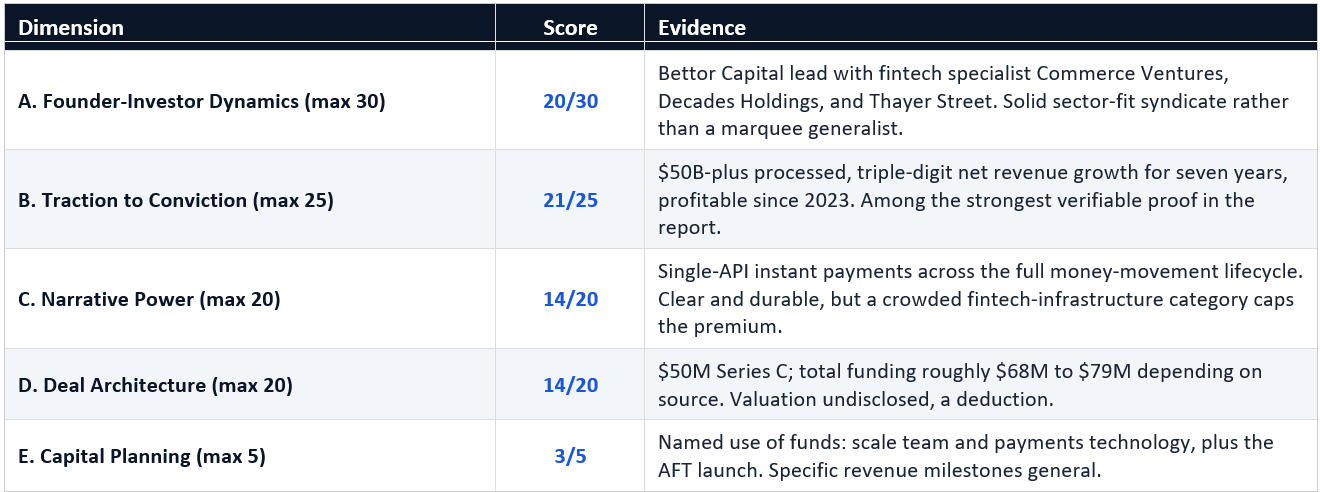
Why this scored: Interchecks is the cleanest regulated-rail case of the week. It is not a story about projected growth. It is a profitable, certified payments platform that has already moved real money at scale. The proof is operational and financial: more than $50B processed over a decade, triple-digit net revenue growth for seven straight years, and profitability since 2023. The score reflects unusually strong proof against an undisclosed valuation and a crowded fintech-infrastructure field.
The Setup: New York-based Interchecks, led by co-founder and CEO Dylan Massey, runs an instant payments platform that serves sportsbooks, fintechs, and financial institutions via a single RESTful API for both funding and payouts. Alongside the raise, the company moved its Account Funding Transactions product to general availability, extending the platform across the full lifecycle of money movement with embedded fraud and risk controls.
The Numbers: $50M Series C led by Bettor Capital, Commerce Ventures, Decades Holdings, and Thayer Street Partners. More than $50B processed over a ten-year history. Triple-digit year-over-year net revenue growth for seven years. Profitable since 2023. PCI Level 1 and SOC 2 Type 2 certified, working with Visa and Mastercard. Use of funds: scale the team and accelerate payments technology.
Fundability Lessons: Interchecks is the profitable-rail template. First, build inside a regulated, high-velocity vertical where speed and compliance are the product, so the moat is the certification and the rail rather than the interface. Second, lead with profitability and processed volume, because a rail that already clears $50B and earns money underwrites differently than one that promises to. Third, expand the lifecycle you own, from payouts into funding, so each integration deepens rather than fragments the relationship.
Your Takeaway: If you build financial or operational infrastructure, lead with the volume you already move and the profitability you already have. In 2026, a profitable, certified rail is a stronger fundability claim than a fast-growing but unprofitable application, because the proof is in the cleared transactions, not the projections.
The Founder Mistake to Avoid: Infrastructure founders bury profitability and lead with a growth-at-all-costs narrative. The mistake is hiding the very thing that now determines the round's price. Interchecks have scored on profitability since 2023, and $50B has been processed. If you have real financial proof, put it on slide one rather than a hockey-stick projection.
Fundraising Playbook: 5 Tactical Plans From This Week
Five plans, each producing a concrete output you can use immediately. No vague tasks. Each is built directly from this week’s verified signals.
1. The Scarce-Input Audit (Positioning and Defensibility)
Why this matters: AttoTude, Architect Labs, and Radical Numerics all drew capital by owning the input beneath the AI application layer. Standalone application positioning was discounted this week.
Deliverable: A one-paragraph statement naming the scarce input in your category, the data, the rail, the silicon, or the supply that every competitor must buy, and a one-line decision on whether you own it, can own it, or are merely a buyer of it.
Time estimate: 2 to 4 hours, finalized before your next investor meeting.
Expected outcome: A defensibility statement that survives the first diligence question. Investors stop asking how good your app is and start asking how unavoidable your layer is.
Reframe: Wrong approach: we are the best application in our category. Right approach: we own the input that every competitor in this category has to route through.
2. The Owned-Outcome Proof Stack (Traction and Metrics Packaging)
Why this matters: Bland, Convey, and Gradial all cleared by owning outcomes rather than assisting. The market discounted the co-pilot pitch and the word agent this week.
Deliverable: A one-page proof stack with exactly four lines: units of work completed unattended, volume per period, the measurable outcome you changed, and retention or expansion. Numbers only, no adjectives.
Time estimate: 3 to 5 hours. If you cannot fill all four lines, the next two weeks are about generating the missing line rather than polishing the deck.
Expected outcome: A single artifact that converts a co-pilot story into an execution story, moving your raise from delayed to advancing.
Reframe: Wrong approach: a roadmap of what the agent will do. Right approach: a usage table of work that it already completes unattended, at what volume, with what result.
3. Eisen Self-Score and Gap Diagnosis (Readiness)
Why this matters: This week’s deals clustered between 66 and 78. The gap between a fundable company and a fundable round was almost always deployed proof or a defensible moat, the same two dimensions the score isolates.
Deliverable: Score your round across the five dimensions: founder-investor dynamics, traction-to-conviction, narrative power, deal architecture, and capital planning. Identify your lowest two dimensions and write one concrete action to lift each.
Time estimate: 2 to 3 hours, repeated before each raise.
Expected outcome: A ranked list of your two weakest dimensions and a specific fix for each, so you spend the next two weeks on the gap that is actually pricing your round down.
Reframe: Wrong approach: improve the pitch everywhere. Right approach: fix the lowest two scored dimensions and leave the rest alone.
4. The Specialist and Strategic Capital Map (Investor Targeting)
Why this matters: In hard categories this week, specialists and strategics led: Ascenta and Janus Henderson in immunology, Westlake and Canaan in neurology, Keysight in semiconductors. Generalist processes stalled.
Deliverable: A target list segmented by who brings channel or validation in your exact category. For each name, write the specific deal they did in your space and the warm intro path. Lead with the specialists and strategics who can underwrite your hardest risk.
Time estimate: 6-10 hours of research, refreshed quarterly.
Expected outcome: A 12 to 15-name list ordered by ability to price your core risk, not by brand. Fewer educational meetings, faster conviction.
Reframe: Wrong approach: start with the famous generalists and expand. Right approach: start with the specialist or strategist who can underwrite the risk that scares everyone else.
5. The 90-Day Clone Test and Moat Build (Defensibility and Momentum)
Why this matters: Regulated and physical moats repriced above pure software this week. Interchecks profitability and certification, Bland owned voice models, and AttoTude hardware are barriers a competitor cannot clone in a quarter.
Deliverable: Run the 90-day clone test. Write down what a well-funded competitor could replicate in one quarter. Then name the single regulatory, certification, data, or physical barrier you can build in the next two quarters that would fail that test, and make it your use-of-funds headline.
Time estimate: 3 to 5 hours, iterated against the question: what would a competitor with a better model need to replicate this?
Expected outcome: A defensibility statement tied to a fundable use of proceeds, so your round buys a moat rather than a runway.
Reframe: Wrong approach: our software is faster and better designed. Right approach: Here is the regulatory or physical barrier we are building that a competitor cannot shortcut.
Looking Forward: Next 1 to 3 Weeks
Three evidence-based scenarios and one wild card. Predictions are anchored to this week’s verified data, not speculation.
Scenario 1: The Scarce-Input Trade Keeps Widening (High Probability)
Evidence: This week funded interconnect, custom-chip design, and proprietary biological data, all inputs beneath the AI application layer. Capital is moving toward the bottleneck rather than the app, even at small check sizes.
What to watch: New rounds for AI compute infrastructure, custom silicon tooling, proprietary data layers, and measurement or evaluation tooling. Watch for strategic investors from the chip and measurement ecosystem taking lead or co-lead positions.
What founders should do: If you build anything in AI, audit your position this week. Decide whether you own a scarce input or must buy one. If you are a buyer, your strategy needs to move upstream before your next round.
Scenario 2: Specialist and Strategic Capital Leads More Hard-Category Rounds (High Probability)
Evidence: This week, specialists or strategics led or co-led in immunology, neurology, and semiconductors. Generalists increasingly followed rather than led where the core risk was technical or regulated.
What to watch: Hard-category rounds in which a corporate strategist or domain specialist takes the lead role, with generalists appearing only as participants. Watch for strategics writing earlier checks to secure the channel and supply.
What founders should do: If your category is clinical, regulated, or hardware-heavy, build the specialist and strategic pool now. Put three names that can underwrite your hardest risk at the top of your list before you talk to a single generalist.
Scenario 3: The Word Agent Keeps Losing Its Premium (Medium-High Probability)
Evidence: Convey was raised by deliberately rebranding from agent to teammate, an” and Bland won by owning outcomes end-to-end. The market is repricing assistance down and execution up.
What to watch: Application-AI rounds that lead with completed work, hours removed, or outcomes owned, rather than with the word agent. Watch for diligence questions shifting from model quality to unattended completion and retention.
What founders should do: If your positioning leans on the word "agent" without an owned-outcome figure, treat it as a near-term risk. Reframe around the work your system completes unattended before the bar moves further.
Wild Card: Pre-Launch Hardware and Health Hype Faces Sharper Diligence (Medium Probability)
Evidence: Clair Health raised on a large waitlist and pre-orders but has no peer-reviewed data, and AttoTude raised pre-revenue with demos still months away. The market is funded at both the team and category levels, but the proof gap remains visible.
What founders should do: If your positioning leans on a waitlist, a demo date, or a category tailwind rather than validated results, treat that as a near-term risk. Generate the first independent or clinical proof point before the next round, because companies that act before the bar moves keep the multiple, and those that wait negotiate against it.
The Bottom Line
The real insight is not the $451.6M total. It is that with the megarounds and IPO traffic removed, the market that actually prices your round revealed one consistent rule: capital paid for owned outcomes, a scarce input, or a regulated moat, not for narrative or model capability. Three conviction profiles took the week.
Profile 1: Outcome owners. Gradial (78), Bland AI (76), and Convey (73) own the work and lead with a moved metric. Gradial shows an 80-90% execution-time cut for a blue-chip customer. Bland runs 3.5 million calls a week on its own models. Convey automates more than a million hours of enterprise work. The proof is the outcome owned, not the model used.
Profile 2: Scarce-input suppliers. AttoTude (71), Architect Labs (69), and Radical Numerics (70) own the substrate. AttoTude owns the interconnect, Architect Labs owns the chip design loop, and Radical Numerics owns the multimodal biological data. The proof is that competitors must route through them.
Profile 3: Regulated and clinical builders. Triveni Bio (74), Interchecks (72), and Vedana Therapeutics (68) own a barrier that a competitor cannot clone in a quarter. Triveni has differentiated bispecific and specialist leads; Interchecks has a profitable, certified rail; Vedana has a validated mechanism and an elite team. The proof is the slow, hard work already done.
Everything else competed for the residual. The message is unmistakable. Own the outcome, supply the scarce input, or build the regulated moat, and show the proof. Anything short of that is a feature competing for the leftover selectivity capital.
5 New Rules for Founders
Rule 1. Own the input, not just the app. When the application layer commoditizes, value moves to the data, the rail, the silicon, or the supply that everyone else must buy. Find your category’s scarce input and own it.
Rule 2. Own the outcome, not the assist. Lead with work completed unattended and the metric you moved, not the model or the word agent. A c”. A c”. A c”. A co-pilot who creates review work earns no premium this week.
Rule 3. Match capital to category. In hard categories, a specialist or strategist who can underwrite your core risk beats a larger generalist check. The wrong pool costs more than the wrong deck.
Rule 4. Lead with retired risk. The health rounds carried the mid-market by showing a proven team and a de-risked target. Name the risk you have already removed before the roadmap you still have.
Rule 5. Build the moat that fails the 90-day clone test. If a competitor could replicate you in a quarter, your moat is the regulatory, certification, data, or physical work you have not done yet. Make it the use-of-funds headline.
4 Monday Actions
(1) Run the scarce-input audit. Name the input every competitor in your category must buy, and decide whether you own it, can own it, or are a buyer.
(2) Build the owned-outcome proof stack. One page, four lines: work completed unattended, volume, outcome delta, retention. If a line is empty, that is your two-week priority.
(3) Re-segment your investor list. Put the three specialists or strategics who can underwrite your hardest risk at the top. Write the specific deal each did in your category, along with the warm path.
(4) Run the 90-day clone test. Write what a competitor could copy in a quarter, then name the one moat you will build next and make it your use-of-funds headline.
Your competitors are reading the same tape. The founders who lead with proof this week own the conversation. The ones who lead with narrative negotiate against the bar that just moved.
Research Methodology and Sources
Data collection period: June 15-21, 2026, with the bulk of verified primary disclosures clustered from June 15 to June 18. Verification standard: a minimum of two independent primary sources per featured deal, with company press releases and regulated newswires prioritized as anchor sources and at least one tier-one outlet per deal for corroboration. Eisen Fundability Scores are proprietary analytical estimates, not endorsements or investment advice. All dollar figures reflect announced primary capital at close unless noted.
Total deals tracked: 10 verified U.S. mid-market rounds, approximately $451.6M in combined primary capital, every round under $100M. Editorial scope for this issue excludes giant rounds and public-market events by request.
Core Capital Totals and What They Include
The $451.6M weekly total includes only the ten verified U.S. rounds in the scorecard, each independently confirmed at the stated amount and stage. Seed rounds are included where they functioned as primary growth financings and are noted as such. No announced-but-unclosed round was counted. No aggregator-only figure was treated as fact without corroboration in a company release or tier-one outlet.
Exclusions and Documented Rationale
• Giant rounds and public-market events, excluded by editorial scope: Odyssey ($310M), Chronograph ($140M), Hydra Host ($100M), Ent.AI ($100M), Twenty Technologies ($100M), Atom Computing ($100M), and Genspark.ai ($100M Series B extension). Public-market and partnership items are also out of scope.
• Non-U.S. rounds, excluded for scorecard comparability: Conduct (London), Respond.io (Malaysia), Dream (Israel, UAE, Austria), Behavox (London), NeuralTrust (Spain), Range (Switzerland), and TruNativ (India).
• Recirculated, cutoff-flagged, or oversized: Odyssey, reported June 17, is flagged by its own coverage as predating the strict same-window cutoff and is also a giant round. Atom Computing announced June 16, within the window, but it is excluded from the $100M-plus round.
• Sourcing discipline: Richard Roths Media ($52M) appeared as a first outside financing with thin single-source sourcing and an unusual structure, and was held out for insufficient corroboration.
Primary and Secondary Validation Sources
Anchor company and newswire sources reviewed for the featured deals include BusinessWire releases for AttoTude, Radical Numerics, Vedana Therapeutics, and Convey; PRNewswire releases for Interchecks and Bland; and company and investor announcements for Gradial, Triveni Bio, Architect Labs, and Clair Health. Tier-one corroboration reviewed includes: Fortune for Bland, Radical Numerics, Vedana, and the Term Sheet deal log; Axios for Gradial; Reuters for Architect Labs; Sector and trade corroboration drew on PYMNTS and Fintech Futures for Interchecks, Fierce Biotech, BioPharma Dive, and GeekWire for Vedana, GenomeWeb for Radical Numerics, MobiHealthNews and Femtech Insider for Clair Health, and citybiz, Pulse 2.0, and FinSMEs, each used only to confirm figures already anchored in a primary source.
Verification Notes
All ten featured rounds are rated HIGH source confidence, meaning each was confirmed by a company or lead-investor source plus at least one independent tier-one outlet. One valuation figure is disclosed: Gradial at $675M, sourced to Axios. Nine rounds did not disclose valuation, and each score reflects a deduction for that opacity. Where total-funding figures varied across sources, the report cites the range or the most conservative figure. All internal figures in this report, including the weekly total, average, median, chart values, and scorecard entries, were checked for arithmetic consistency before delivery.
Research completion timestamp: June 21, 2026.
DISCLAIMER: This article is for informational and strategic intelligence purposes only. It does not constitute investment advice. The Eisen Fundability Score is a proprietary diagnostic within Fundables OS™, not a financial recommendation.
If this article was useful, share it with founders who are about to raise.
— Leon Eisen, 4x Founder, Venture Capitalist, and Creator of Fundables OS™