

Playbook, Perspective, and Pattern for founders raising now. This report strips out the megarounds and the public-market traffic so you can read the part of the market that actually prices your round.
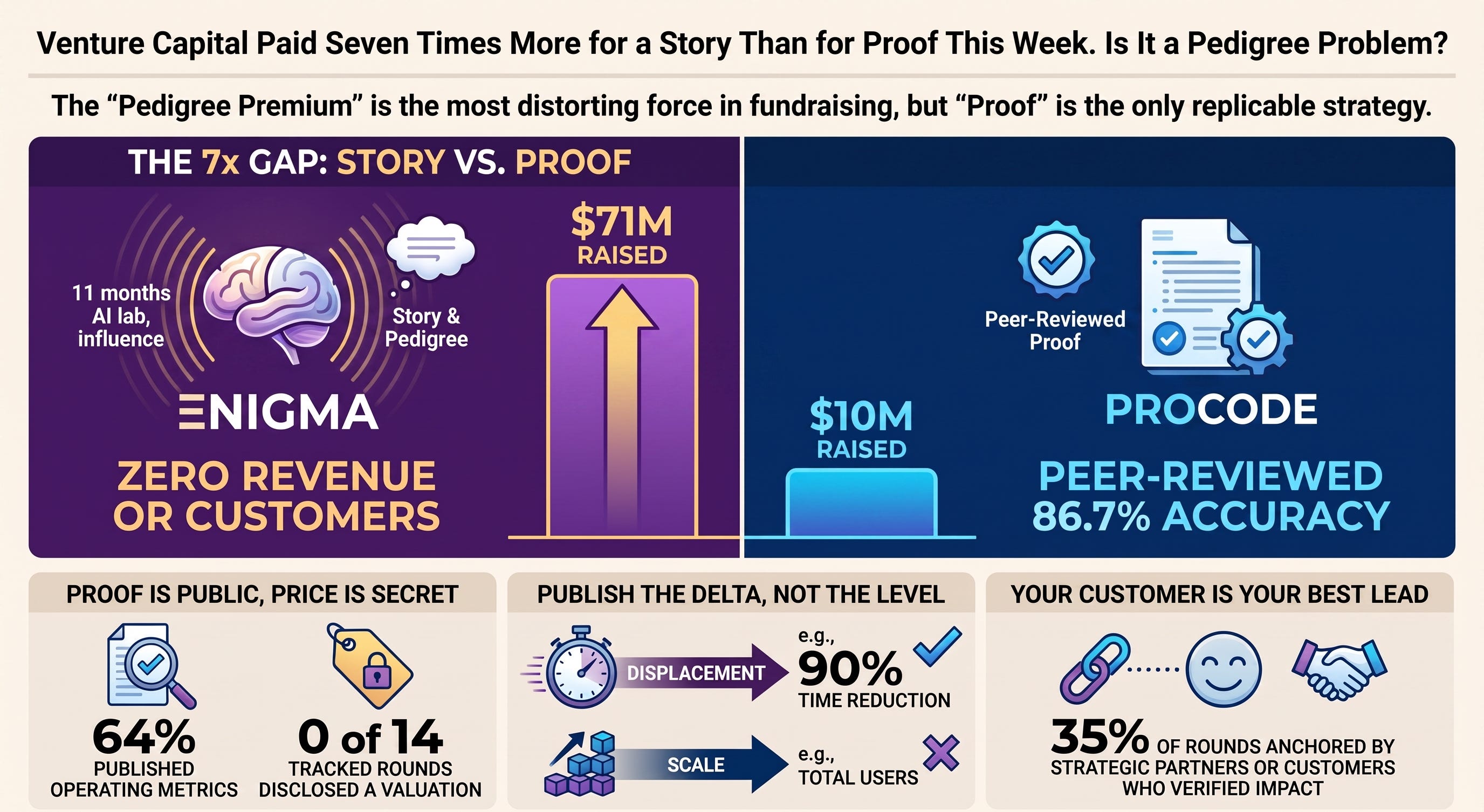
$71M for No Customers. $10M for Peer-Reviewed Proof. Two companies raised capital within the same 48 hours this week. One of them proved its product works. The other one got seven times the money. The $71M company was eleven months old at close. It published no revenue, no customers, and no outcome of any kind. What it had was a founding team with an extraordinary origin story and a syndicate stacked with operators from every frontier AI lab. The $10M company ran a comparative study of its core claim against the humans it replaces and against the cheap substitute everyone tries first, then published the result in its buyers’ own peer-reviewed professional journal: 86.7% accuracy versus 42.5% for human auditors and 35.8% for the best general-purpose model.
Call the gap what it is. It is a pedigree premium, and it is the single most distorting force in early-stage fundraising right now. Not because the big round was irrational. It was entirely rational for the investors who wrote it, and that is exactly the problem. A bet on a rare founding team is cheap to underwrite, impossible to benchmark, and available to perhaps fifty people on earth. It gets written fast, it gets covered loudly, and then a hundred thousand founders read the coverage and rebuild their decks around a lane they were never eligible to enter.
That is the enemy this newsletter exists to fight. Not investors, and not the founders who win those rounds. The enemy is the belief that fundability is something you are born into rather than something you build, and the industry habit of rewarding narrative fluency over measured evidence loudly enough to make that belief look true.
The week’s own data say otherwise, and they do so at scale. Across all fourteen tracked rounds, nine published an operating metric and five published a hard outcome delta: a hospitalization rate, a coding accuracy rate, a documentation time reduction, a design cycle reduction, an employer cost reduction. Those five averaged 65.4 on the Eisen Fundability Score, this report’s 100-point measure of how underwritable a round is. The five that published nothing measurable averaged 56.4. Nine points, and the top and bottom of the entire band fell on opposite sides of that line. Meanwhile, zero of fourteen disclosed a valuation, and exactly one disclosed revenue, so the market will happily let you broadcast what your product does to a customer and tell you nothing about what anything is worth.
Here is what that means on Monday. Pedigree is allocated. Proof is manufacturable. You cannot retroactively acquire a founding story, but you can run the study, publish the delta, and put a number in front of an investor that nobody in the pedigree lane bothered to generate. The $10M company in this week’s set did precisely that, and it is the most replicable thing that happened all week. Every plan in this issue is built to help you copy it.
The Week in One Sentence
Primary insight: With the megarounds and public-market events removed, the mid-market separated proof from price. Capital paid for a published, measurable outcome delta or for an elite founder-and-syndicate signal, and it paid without publishing a valuation in a single case out of fourteen.
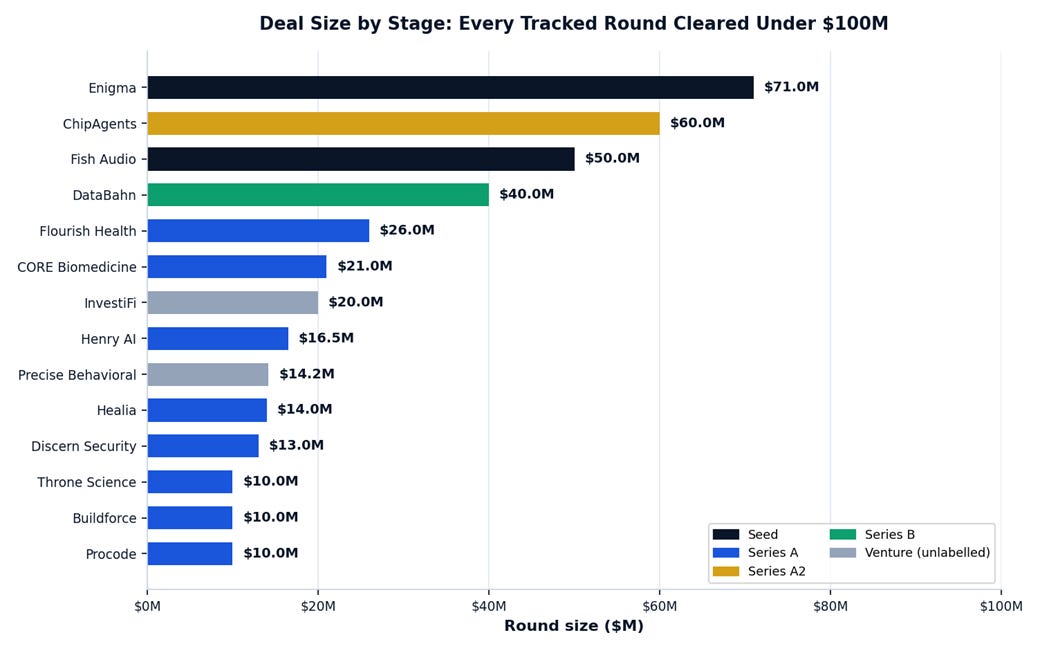
▪ Total tracked mid-market capital (14 verified rounds): $375.7M, every round under $100M per deal and at or above a $10M inclusion floor.
▪ Average round size: $26.8M across the fourteen.
▪ Median round size: $18.25M, the midpoint between Henry AI and InvestiFi.
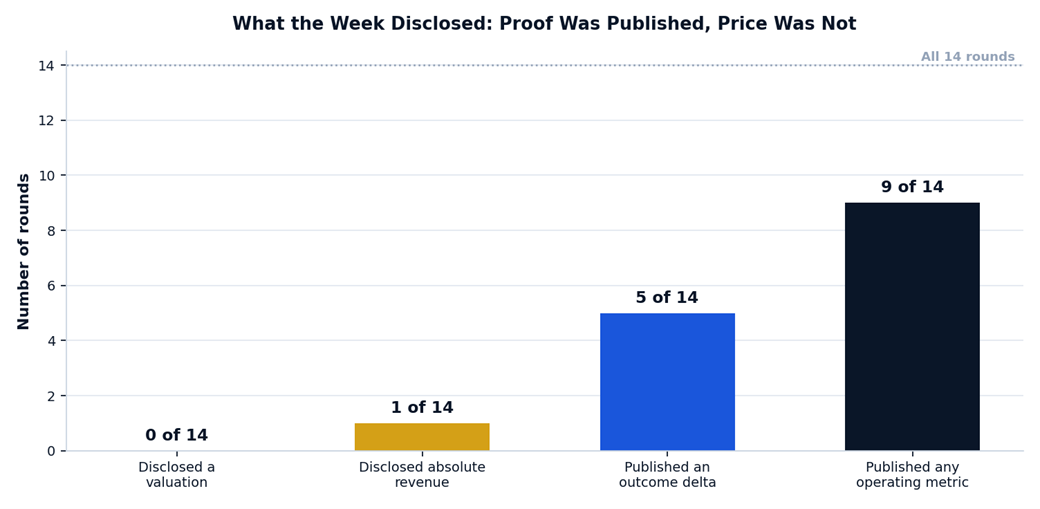
▪ Disclosed valuations: zero of fourteen. This is the defining data point of the week and the first clean sweep this report series has recorded.
▪ Disclosed absolute revenue: one of fourteen. Fish Audio at $21M ARR. ChipAgents disclosed 6x ARR growth without the base, and Precise Behavioral disclosed profitability without the number to back it up.
▪ Published an operating metric of any kind: nine of fourteen. Published a hard outcome delta: five of fourteen. The proof layer stayed open while the pricing layer closed.
▪ Largest tracked round: Enigma, $71M seed, a physical-AI research lab eleven months old at close. It scored 62, ninth of fourteen.
▪ Smallest tracked round: Procode, $10M Series A. It scored 66, fourth of fourteen, on the only peer-reviewed proof published in the set. Capital and fundability moved in opposite directions at both ends of the range.
▪ Highest Eisen Fundability Score: ChipAgents at 80, the only profile combining a growth rate, a deployment count, an outcome delta, and strategic customer capital.
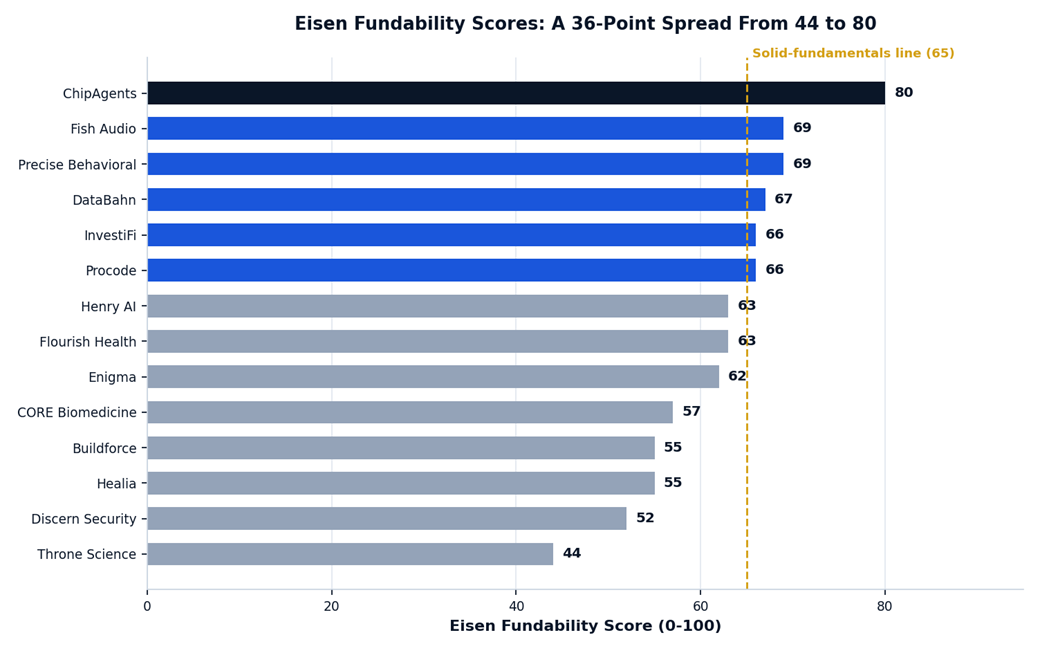
▪ Defining structural feature: an Eisen Score band of 44 to 80 with an average of 62.0 and only six rounds at or above 65. That 36-point spread is the widest this report series has recorded against a tightest-ever band of 13 points.
Deal Scorecard
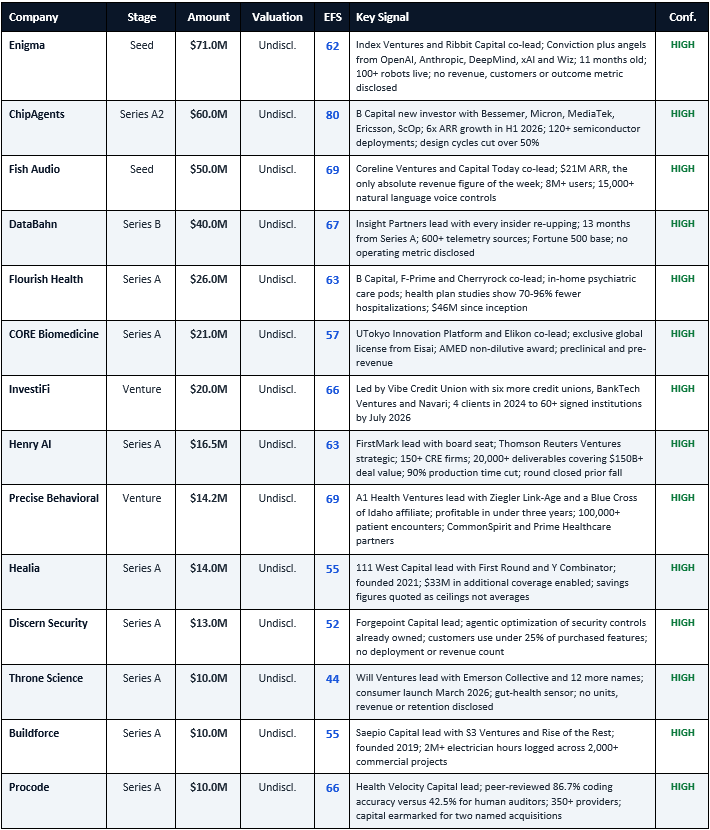
Eisen Fundability Scores are calculated across five weighted dimensions: Founder-Investor Dynamics (30%), Traction-to-Conviction Conversion (25%), Narrative Power (20%), Deal Architecture (20%), and Capital Planning (5%). Scores of 85 and above signal an inevitable outcome. Scores of 75 to 84 signal solid fundamentals. Scores of 65 to 74 signal a good company with visible gaps. Scores below 65 signal early stage or missing elements. Missing metrics are scored conservatively. Opacity is penalized, never assumed strong. Because no company disclosed a valuation, every round in this table carries the same deal-architecture deduction, and the separation between them comes almost entirely from what they proved.
What the Scorecard Says at a Glance
The band is the message, and this week the band broke. Scores ran from 44 to 80 with an average of 62.0. That 36-point spread is the widest this series has tracked against a tightest-ever band of 13 points. When the market applies one underwriting test, scores cluster. When it applies two at once, scores scatter. They scattered.
Only one deal cleared 75, and only six cleared 65. ChipAgents at 80 was the sole round that carried together a growth rate, a deployment count, an outcome delta, and strategic customer capital. Behind it sat two rounds at 69, Fish Audio on revenue and Precise Behavioral on profitability, then DataBahn at 67 on insider velocity, and InvestiFi and Procode tied at 66 on customer capital and published evidence, respectively. Eight of fourteen scored below 65.
Check size and fundability came apart completely. Enigma raised the largest round of the week at $71M and scored 62. ChipAgents raised $60M and scored 80. Procode raised the smallest round in the set at $10M and scored 66, four points above the company that raised seven times as much. Price this week reflected who was asking and what category they were in, not what had been proven.
The bottom of the band is a disclosure problem, not a business problem. Discern Security at 52 has a sharp thesis and a specialist lead. Buildforce at 55 has logged two million hours of real work. Throne at 44 is shipping a product to consumers. None of them published a delta a diligence team could test. The scoreboard separates a fundable company from a fundable round, and this week the gap between the two was a single measured number.
What Changed This Week: 5 Market Shifts
Each shift is verified against multiple primary sources and ranked by structural impact on founder fundraising, not by deal size. Every shift ends with what it means for your raise.
Shift 1: The Market Went Dark on Price and Stayed Open on Proof
Pattern: Zero of fourteen rounds disclosed a valuation. Not either seed, not the $60M extension, not the $40M Series B, not one of the eight Series A rounds, not either unlabelled venture round. One company in fourteen disclosed an absolute revenue figure. Yet nine of fourteen published an operating metric and five published a hard outcome delta. Founders were happy to tell you what their product does. Nobody would tell you what it earns or what it is worth.
Perspective: This is a deliberate split, not an accident, and it tells you where each side thinks its risk sits. Publishing an outcome delta is close to free for a founder: it is marketing, recruiting, and an invitation to customers. Publishing a valuation or an ARR figure is a commitment that constrains the next round, sets a multiple the market can argue with, and hands competitors a target. Investors have no incentive to push for disclosure either, because the absence of public comps means they price the next founder without an anchor. Both parties benefit privately. The cost lands entirely on the founder who is not in the room.
Founder Blindspot: Founders read a wave of undisclosed valuations as neutral market noise and assume the same silence protects them. It does the opposite. Silence transfers pricing power to whoever holds the private data, which is the investor with a portfolio and a database, not the founder with one round. Worse, founders then mirror the silence on proof as well, and lose the one disclosure that costs them nothing and buys them the most.
Playbook: Split your disclosure decision in two, because the market already has. On proof, publish aggressively: one measured delta, in the release, in the first line of the deck. On price and economics, publish nothing you are not prepared to defend for two years. Then build a private comp sheet from the handful of rounds that disclosed a valuation in your stage and category, and walk into the pricing conversation by naming your own multiple and the metric it attaches to. Wrong approach: companies like us raised $40M. Right approach: we are asking for this multiple on this metric, and here is the delta that justifies it.
Contrast: In the tracked week of June 1 to 7, two of ten mid-market rounds published valuations, and both became reference points that other founders cited. This week produced no reference points at all. The public comp layer thinned to nothing in eight weeks while the public proof layer stayed wide open.
What this means for your raise: publish the delta, protect the price. Founders who invert that order give away the leverage and keep the thing that would have won them the meeting.
Shift 2: The Metric That Got Published Was a Delta, Not a Level
Pattern: Of the nine companies that published an operating metric, five published a before-and-after rather than a size. Flourish Health cited health plan studies showing a 70% to 96% decrease in hospitalizations and a 69% to 90% decrease in residential treatment. Procode published peer-reviewed research in a plastic surgery journal reporting 86.7% coding accuracy against 42.5% for human auditors and 35.8% for the best general-purpose model. ChipAgents reported design cycles cut by more than 50%. Henry AI reported deliverable production time down 90%. Healia reported employer healthcare costs down as much as 76% per enrolled household.
Perspective: A level tells an investor how big you are. A delta tells them what happens to a customer’s P&L when they buy. In a market where nobody is publishing revenue, the delta becomes the only quantity that travels, because it is the one number a partner can verify by calling a customer rather than by reading a data room. Also note which deltas were strongest: they were measured relative to the incumbent alternative, not to zero. Procode did not report that its model is accurate. It reported that its model is twice as accurate as the human auditors it replaces. That comparison is the entire argument.
Founder Blindspot: Founders default to levels because levels feel like scale. Customer counts, users, hours, transactions. Those numbers answer how big, which is the question a growth investor asks at Series C. The question in this market is what changes, and a founder with a small base and a large verified delta is currently outperforming a founder with a large base and no measured change. The smallest round in the tracked set scored above the largest one on exactly this basis.
Playbook: Build the delta line this week and make it comparative. Structure: our customers went from A to B, measured against the alternative they were using, across N deployments over T months. Then decide who validates it. The strongest version of this in the tracked week was peer-reviewed publication in the buyer’s own professional journal, which converts a vendor claim into a citable fact. If publication is not available in your category, the next-best instruments are a named customer case study with the customer’s own numbers or a study run jointly with a payer, platform, or standards body your buyer already trusts.
Contrast: In 2023 and 2024, the fundable early metric was a level, usually ARR or users, because capital was pricing growth. In this week’s market, the fundable early metric is a comparative delta, because capital is pricing displacement. The bar moved from how much you have to how much you change.
What this means for your raise: if you cannot present your product as a before-and-after comparison against the incumbent, you do not yet have a metric. You have a description.
Shift 3: Your Customer Became Your Lead Investor
Pattern: Five of fourteen rounds were anchored by a party with a commercial relationship rather than a purely financial thesis. InvestiFi was led by Vibe Credit Union, with six additional credit unions participating, and its CEO said plainly that much of the raise came from institutions that use the platform every day. ChipAgents took capital from Micron, MediaTek, and Ericsson, and its own release names Micron and MediaTek among the 120-plus semiconductor companies running the product. Precise Behavioral took investment from Granite Financial Holdings, an affiliate of Blue Cross of Idaho, alongside the Ziegler Link-Age Fund. Henry AI took Thomson Reuters Ventures as a strategic. CORE Biomedicine did not take corporate equity but built its entire pipeline on an exclusive global license from Eisai.
Perspective: A customer who invests has already completed the hardest part of diligence. They ran the product in production, measured the outcome, and renewed. When that party writes the check, the financial investors behind them are not underwriting a thesis; they are underwriting a purchase order that already cleared procurement. Precise Behavioral’s founder described the raise as very strategic on those grounds, noting that the investors were already in the health system space and that the company raised for growth rather than need after reaching profitability in under three years.
Founder Blindspot: Founders treat strategics as slow, structurally conflicted, and best approached after the round is priced. That sequencing is expensive. It burns sixty days educating generalists on a category your customers already understand, and it wastes the single most credible signal you own, which is that the people who pay you want to own you. The selection error is not the deck. It is the order of the list.
Playbook: Run a corporate-venture audit this week. Take your top fifteen customers and partners, and for each one write down whether they have a venture arm or an affiliated investment vehicle, what that vehicle backed over the last eighteen months, and who inside the account can make the introduction. Then rank them by which one, if it appeared on your cap table, would shorten a generalist’s diligence the most. Approach the top three before you open the round. Wrong approach: build a target list of funds by brand and fund size. Right approach: build it from your own invoice ledger, then add the funds that follow those strategics.
Contrast: In the 2021 cycle, strategics were the late follow-on, adding logos to a priced round. This week, strategics and customers anchored rounds, and the financial investors joined behind them. The order reversed.
What this means for your raise: if a customer would invest and you have not asked, you are leaving your cheapest conviction on the table. Ask before you open the process, because that answer changes the whole list.
Shift 4: Two Seed Rounds Matched Eight Series A Rounds
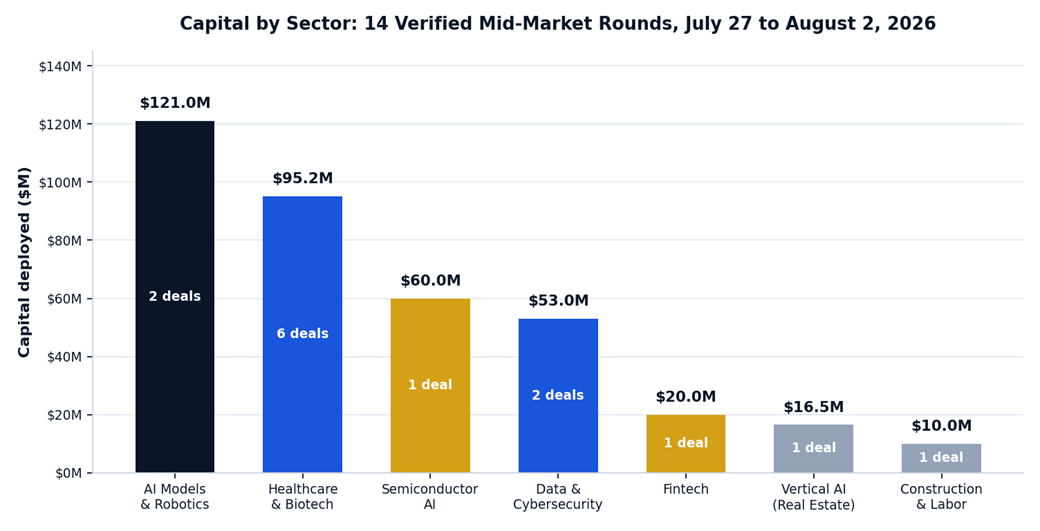
Pattern: The two rounds labeled seed absorbed $121.0M between them. The eight Series A rounds absorbed $120.5M between them. Two deals equaled eight. Average seed size was $60.5M. Average Series A size was $15.1M, a ratio of roughly 4-to-1 in favor of the earlier label.
Perspective: The label has detached from the stage and now describes cap-table history rather than company maturity. Two very different companies qualify as seed. The first is a research bet in which the founder-and-syndicate signal entirely substitutes for proof: Enigma, at eleven months old, with no disclosed customers. The second is a company that reached real revenue without needing institutional money, so its first priced round happens to be called seed, which is Fish Audio at $21M ARR, whose CEO said the company was running efficiently and did not need capital until it wanted to train bigger models. One is pre-proof. One is post-proof. Both are seed, and the Series A cohort sitting between them averaged a quarter of their size.
Founder Blindspot: Founders benchmark their seed against a median seed size and conclude they are raising the right amount. That median describes neither of the companies that actually cleared. It is the average of a research bet and a revenue company, and it corresponds to no live deal. Anchoring on it produces a round too small to be a credible research bet and too large to justify without revenue.
Playbook: Decide which seed you are before you write the deck, because the two require opposite artifacts. If you are the research bet, the artifact is a founder-and-team dossier: what each person built before, why the team could not be assembled by a competitor, and which named operators will vouch for it. If you are the revenue company, the artifact is a proof stack with a comparative delta at the top. Building both dilutes both. Pick the lane, then size the round to the lane rather than to the median.
Contrast: In 2023 and 2024, the Series A was the largest early round, and the seed was the proving ground. This week, two seed rounds accounted for a third of all mid-market capital, while the eight-deal Series A cohort averaged just over $15M. The proving ground moved to Series A and the swing-for-the-fences moved to seed.
What this means for your raise: name your seed type in the first meeting. Pedigree bet or proof bet. Investors are already sorting you into one of the two, and the founder who sorts first controls the frame.
Shift 5: Healthcare Took the Deal Count, and AI Took the Dollars
Pattern: Healthcare and biotech accounted for six of the fourteen tracked rounds, more than any other sector, and $95.2M in capital at an average round size of $15.9M. AI models and robotics accounted for two rounds totaling $121.0M, with an average of $ 60.5 M per round. Four of the five outcome deltas published this week came from healthcare or healthcare-adjacent companies. Neither of the two AI rounds published one.
Perspective: These are two different financing physics operating in the same week. Healthcare rounds cleared on measured clinical or economic outcomes at modest check sizes, because the buyer is a payer or a health system that underwrites on evidence and the market pays in reimbursement rather than in multiples. AI rounds cleared on team, category, and talent scarcity at four times the size, because the underwriting question is whether this team can win a category that does not yet exist. Neither is wrong. But a founder who imports one fundraising style into the other will be badly mispriced.
Founder Blindspot: Healthcare founders watch AI seed rounds and conclude the market is paying for vision, then underinvest in the evidence generation that actually prices their category. AI founders watch healthcare rounds, conclude that evidence is optional, and then arrive at Series B with a narrative and no measured delta. Both are reading the wrong tape. The dollar headline belongs to one physics and the deal count belongs to the other.
Playbook: Identify which physics your category runs on, then budget accordingly. If your buyer underwrites on evidence, your next raise is funded by a study, not a deck, and the study belongs in your use-of-funds. Put a line item for outcome measurement in the round you are raising now, name the endpoint, and name who will validate it. If your buyer underwrites category leadership, your next raise is funded by team density and a defensible wedge, and the money goes into recruiting before sales.
Contrast: Through 2024 and early 2025, healthcare and AI competed for the same narrative capital and healthcare largely lost. This week, healthcare won on volume, score distribution, and evidence quality, while losing on headline dollars. That is a healthier market for operators and a worse one for storytellers.
What this means for your raise: work out whether your category pays for evidence or for category leadership, then fund that specific thing in this round. Building the wrong asset is the most expensive error you can make right now.
The Deals That Matter: Top 5
Five deep dives across semiconductor AI, voice models, behavioral health, revenue cycle management, and physical AI. Each is selected for distinct playbook value, not deal size. Three of the five raised under $15M. All metrics are verified against two or more primary sources.
ChipAgents
Agentic AI for Semiconductor Design | Series A2 | $60.0M | Valuation Undisclosed
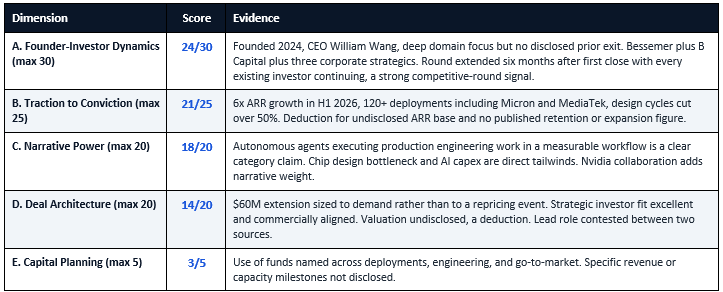
Eisen Fundability Score: 80 / 100
Why this scored: The highest score of the week and the only round carrying all four underwriting inputs at once. A growth rate: 6x ARR in six months. A deployment count a partner can call and check: more than 120 semiconductor companies. An outcome delta: design cycles cut by more than half. And a syndicate where the strategic investors are named customers of the product they funded. The score is capped below 85 by an undisclosed valuation and an undisclosed ARR base, which means the 6x is a rate without a denominator.
The Setup: Santa Clara-based ChipAgents, founded in 2024 and led by CEO William Wang, sells an AI-native platform that turns specifications and code into production-ready RTL, verification assets, and automated root-cause analysis. The company’s framing is that the industry is moving past AI assistants toward autonomous agents that execute meaningful engineering work. Chip verification is one of the few enterprise workflows in which the buyer already measures cycle time to the day, so an agent that compresses it requires no translation layer. Two days before the financing, ChipAgents announced an expanded collaboration with Nvidia covering a specialized chip-design model. Wang declined to say whether Nvidia is an investor.
The Numbers: $60M in Series A2 financing, bringing the expanded Series A to $134M six months after the initial close. B Capital joined as a new investor alongside Bessemer Venture Partners, Micron, MediaTek, Ericsson, and ScOp. Six times ARR growth across the first half of 2026. Deployed at more than 120 semiconductor companies, including Micron and MediaTek. Design cycles reduced by over 50%. Founded 2024. Valuation not disclosed. Use of funds: scale customer deployments, grow engineering and go-to-market teams, accelerate platform development.
The Pattern: This is the customer-capital template in its cleanest form. Micron and MediaTek are simultaneously named as investors and as deployments. That sentence does more diligence work than any slide. It tells a new investor that the product survived procurement, security review, and a renewal cycle at two companies whose entire businesses depend on getting chip verification right. B Capital’s job in that round was not to validate the technology. It was to price a company whose validation had already been published by its own customers.
The Perspective: The fundable unit here is not the agent. It is the cycle-time delta inside a workflow where the buyer already keeps the clock. Founders in enterprise AI keep looking for categories where they can explain the value. The better search is for categories where the buyer already measures the thing you improve, because then you do not have to prove the metric matters, only that you moved it. Chip verification, claims coding, and clinical documentation all share that property. Generic knowledge work does not.
The Playbook: Find the number your buyer already reports to their own leadership, and make your product the reason that number changes. Then convert your three largest deployments into cap-table participants or, failing that, into named references who will allow you to publish their logos alongside a delta. Extend the round rather than repricing it if your existing strategics will re-up, because a six-month extension signed by your customers is a stronger market signal than a new lead at a higher headline.
The Founder Mistake to Avoid: Founders publish a growth multiple while withholding the base, believing it signals momentum. It reads as a company not ready to show the number. ChipAgents can carry that because 120 named-category deployments and two corporate customers on the cap table do the work the base would have done. Without that substitute, 6x on an undisclosed base invites the diligence question you were trying to avoid, two weeks later, with less leverage.
Fish Audio
Voice Models for Creators and Enterprises | Seed | $50.0M | Valuation Undisclosed
Eisen Fundability Score: 69 / 100
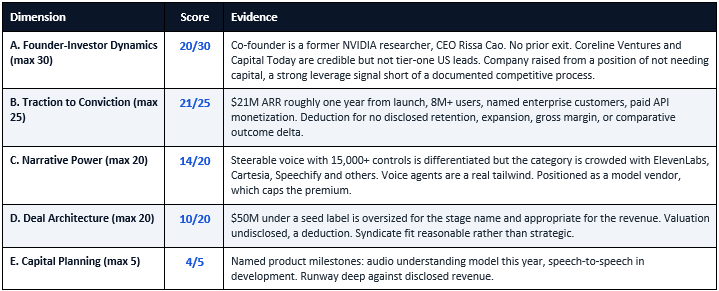
Why this scored: The only company of the fourteen to publish an absolute revenue number, and it went from launch to $21M ARR in roughly a year with more than 8 million people using the models. That is the strongest level-based traction profile of the week. The score sits below 75 because it published no comparative delta, the category is crowded with better-capitalized competitors, the syndicate is credible but not top-tier, the valuation is undisclosed, and the corpus powering the product carries an unresolved consent exposure.
The Setup: Palo Alto-based Fish Audio began as a side project by former NVIDIA researcher Shijia Liao, who trained a voice generation model on a single GPU and open-sourced it. The Fish Speech repository now carries more than 31,000 GitHub stars. CEO and co-founder Rissa Cao runs a business that monetizes through paid creator plans and an enterprise API. Three of the four speech generation models are open-source, and the newest is a paid API only. The commercial thesis is steerability: more than 15,000 natural-language controls, because a gaming studio, an avatar platform, and a voice-agent company each need a different kind of expressiveness from the same engine.
The Numbers: $50M seed led by Coreline Ventures and Capital Today, with 359 Capital, Parable, Play Time, Alphalist Partners, Bayhouse Ventures, Carya Venture Partners, and HF0. $21M in annual recurring revenue. More than 8 million users across the open-source and hosted models. Five models shipped in the past year, four speech generation and one speech-to-text, with the newest available only through the paid API. Named enterprise users include HeyGen, Sanas, and Plaud. Valuation not disclosed. Roadmap: an audio understanding model this year and a speech-to-speech model.
The Pattern: This is the post-proof seed. Cao’s own account is that the company was running efficiently and did not need money, and raised capital because it wanted to train larger models while enterprise interest was ramping up. That is a fundamentally different transaction from a pre-proof seed. The company was not buying runway. It was buying a training budget and choosing the moment when investor interest peaked. Founders who reach revenue without institutional capital hold the timing option, and this round is what exercising that option looks like.
The Perspective: The interesting fundability signal is not the ARR. It is that an open-source-first distribution strategy produced 8 million users and then converted a closed flagship model into paid revenue. Open source served as the customer acquisition channel, and the newest model served as the monetization gate. That structure is replicable outside voice, and it is considerably cheaper than the enterprise sales motion most competitors are funding.
The Playbook: If you have revenue and no institutional investor, treat your raise as a timing decision rather than a survival one, and say so in the first meeting. The sentence we did not need this money is the strongest deal-architecture line a founder can deliver, and it is only available to companies that made it true first. Then explicitly decide which layer is free and which is paid, and make the paid layer the one that improves fastest, so the free tier compounds distribution rather than cannibalizing revenue.
The Founder Mistake to Avoid: Founders building on user-contributed data treat consent as a support ticket rather than a balance-sheet item. Fish Audio faced creator allegations that voices were uploaded without permission, and its remedy was to compress takedown turnaround to under three minutes. That is a good operational answer to a structural problem: nothing stops the next unauthorized upload. Its lead investor publicly said that a community data model only becomes durable when consent, transparency, and attribution are built into the product. Read that as the diligence question you will be asked, and build the answer into the architecture before someone builds it into your term sheet.
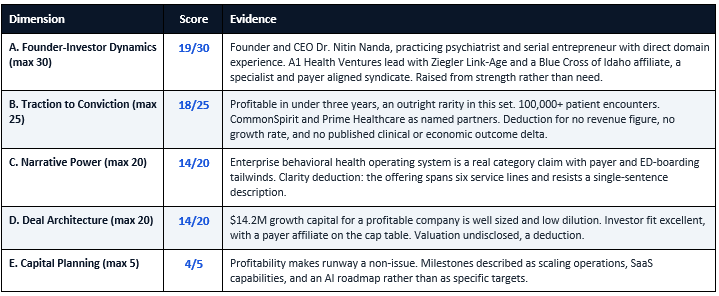
Precise Behavioral
Enterprise Behavioral Health Operating System | Venture Round | $14.2M | Valuation Undisclosed
Eisen Fundability Score: 69 / 100
Why this scored: The only profitable company in the tracked set, and it raised anyway. Profitability in under three years, more than 100,000 patient encounters, and named health system partners give it the second-strongest traction profile of the week on a round one-fifth the size of the largest. The score is capped by an undisclosed valuation, no published revenue figure, a complex multi-modal offering that resists a one-line description, and use of funds described only in general growth terms.
The Setup: Los Angeles-based Precise Behavioral was founded in 2022 by Dr. Nitin Nanda, a practicing geriatric psychiatrist and serial entrepreneur who has worked inside hospitals, emergency rooms, and skilled nursing facilities. The company sells what it calls the Precise Behavioral Operating System, which unifies clinical delivery, operational workflow, and revenue cycle management into a single system spanning consultation-liaison psychiatry, outpatient behavioral health, collaborative care, digital patient engagement, referral management, and care navigation. It is one of the few providers delivering behavioral healthcare both virtually and in person across inpatient, emergency, and ambulatory settings while also managing the billing.
The Numbers: $14.2M in venture funding led by A1 Health Ventures, with participation from the Ziegler Link-Age Fund, Converge Capital Partners, and Granite Financial Holdings, an affiliate of Blue Cross of Idaho. Profitable in under three years. More than 100,000 patient encounters delivered. Health system partners include CommonSpirit and Prime Healthcare. Founded 2022. Valuation not disclosed. Use of funds: scale operations, digital SaaS capabilities, and the AI roadmap.
The Pattern: This is the leverage raise, and it is the mirror image of most rounds in this report. Nanda told Behavioral Health Business that the raise was very strategic, that the investors were already in the health system space, and that the only reason the company raised capital was to fund growth and further expansion. A1 Health Ventures’ managing partner acknowledged it is not typical for the firm to invest in a company that is already profitable. Profitability did not remove the need for capital. It removed the urgency, and urgency is what founders trade away in a negotiation.
The Perspective: There is a positioning lesson here that has nothing to do with healthcare. The investor’s stated reason for the check was that Precise treated the problem as an operating system rather than as a point solution, spanning outpatient, inpatient, emergency, and revenue cycle rather than picking one. Most founders are advised to narrow. That advice is right at seed and increasingly wrong at the enterprise round, because a hospital buying six point solutions is buying six integration projects. Owning the whole workflow is what converts a vendor into infrastructure, and infrastructure is what a strategic investor will fund.
The Playbook: Reach profitability before you need to raise, then raise anyway and say why. Write the two sentences out before your first meeting: here is when we became profitable, and here is the specific expansion this capital buys that we could not fund from cash flow. That framing converts your raise from a requirement into a decision, and it is the single cheapest way to improve your terms. Then take the money from investors who already sell into your buyer, because in a category where the customer is an institution, a payer or an operator on your cap table is a distribution asset as much as a financial one.
The Founder Mistake to Avoid: Profitable founders often skip disclosure entirely, reasoning that the business speaks for itself. A precise published profitability and an encounter count, but no revenue figure, no growth rate, and no outcome delta, and its score is capped as a result. Profitability tells an investor you will survive. It does not tell them how fast you compound or what you change for a patient. The next round will be led by someone who needs both, and the reporting you did not build this year is what you will be asked for next year under time pressure.
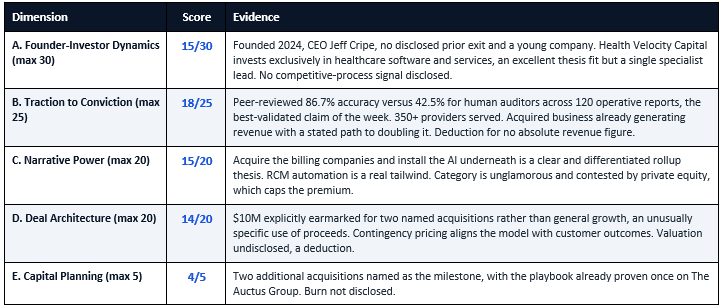
Procode
AI Revenue Cycle Management for Surgeons | Series A | $10.0M | Valuation Undisclosed
Eisen Fundability Score: 66 / 100
Why this scored: The smallest round in the tracked set and the fourth-highest score, on the strength of the best-validated proof of the week. Procode published peer-reviewed research in the buyer’s own professional journal showing 86.7% coding accuracy against 42.5% for human auditors. No other company this week put its core claim through external review. The score is held below 70 by an undisclosed valuation, an undisclosed revenue base, a young company founded in 2024, and an acquisition-dependent strategy with the next two deals unannounced.
The Setup: Los Angeles-based Procode, founded in 2024 and led by CEO Jeff Cripe, builds AI billing infrastructure for surgeons in private practice. The strategy is a rollup with a technology layer: acquire the best specialty surgical billing companies, keep the specialty expertise that made them valuable, and install Procode’s AI underneath. Its first acquisition was The Auctus Group, the leading revenue cycle management company for plastic surgeons and dermatologists. The platform spans Procode for automated surgical coding, from charge capture to claim submission; Procollect as an operating system for billing teams; and a provider app for real-time financials. The company charges on a contingency basis, so it is paid only when its clients are paid.
The Numbers: $10M Series A led by Health Velocity Capital, bringing total venture funding to $14M. More than 350 plastic surgery and dermatology providers served through The Auctus Group. Peer-reviewed comparative study published in Plastic and Reconstructive Surgery Global Open, the open-access journal of the American Society of Plastic Surgeons: across 120 operative reports, 86.7% overall accuracy versus 42.5% for human auditors and 35.8% for the best general-purpose model, reaching 100% on the easiest cases and 80% on the hardest group involving four or more CPT codes, where general-purpose models ranged from 5% to 12.5%. Cripe states the company is on track to double The Auctus Group’s revenue and quintuple its EBITDA margin. Valuation not disclosed. Use of funds: two additional acquisitions to be announced.
The Pattern: This is the published-evidence template, and it is the most transferable lesson in this issue. Procode did not claim its model was good. It ran a comparative study against the humans it replaces and the general-purpose models it competes with, then published the result where its buyers already read. That converts a vendor claim into a citable fact, and it does something no case study can do: it survives contact with a skeptical diligence partner who has heard every accuracy claim in the category.
The Perspective: Notice what the contingency pricing model does to the argument. Cripe’s own framing is that because Procode bills on contingency and only gets paid when clients get paid, growth is itself proof the AI is putting more dollars in providers’ pockets. That is deal architecture doing narrative work. A pricing model that fails when the product fails removes the buyer’s risk and, simultaneously, converts your revenue line into an outcome metric. Founders treat pricing as a commercial decision. In this market, it is a fundability decision.
The Playbook: Two moves. First, run the comparative study. Take your core claim, measure it against the incumbent alternative and against the obvious cheap substitute, on a sample you did not select, and get it in front of a body your buyer already trusts. Peer review is the strongest version. A jointly authored study with a customer, payer, or standards body is the practical version. Second, ask whether your pricing can be restructured so that you only win when the customer wins. If it can, that single change does more for your next round than any deck revision.
The Founder Mistake to Avoid: Founders in rollup strategies pitch the acquisition pipeline and bury the technology proof, because acquisitions feel like the plan. Investors buy the opposite order. Health Velocity’s stated reason for leading was that Procode gives small billing practice owners an AI strategy no traditional buyer can match. The AI is what makes the rollup non-commoditized. If you pitch the rollup first, you are competing with private equity on cost of capital, and you will lose that comparison every time.
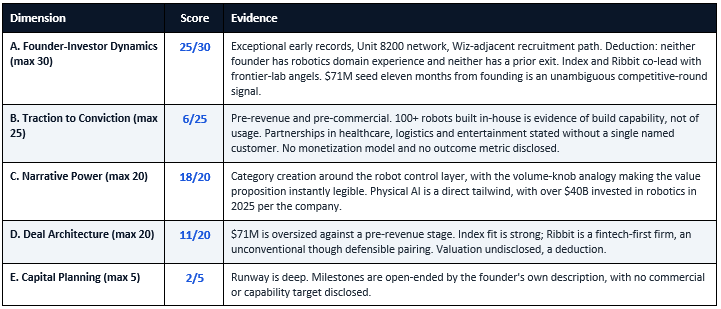
Enigma
Physical AI Models and Robot Interfaces | Seed | $71.0M | Valuation Undisclosed
Eisen Fundability Score: 62 / 100
Why this scored: The largest check of the week and the ninth-highest score, which is the single most instructive fact in this issue. Enigma scores at the ceiling on founder-investor dynamics and narrative power, and near the floor on traction. Eleven months old, no disclosed revenue, no named customers, no outcome metric, no valuation, and an experiment its own founder describes as very open-ended. The Eisen Score measures replicable fundability, and this round is the least replicable transaction of the week.
The Setup: San Francisco-based Enigma emerged from stealth on July 27 with a public experiment at robots. online, where anyone can control more than 100 of its proprietary robots in real time from hangars in California and Israel. Co-founders Jonathan Jacobi and Gal Niv met as teenagers in hacking competitions and served together in Israel’s Unit 8200. Jacobi began a computer science degree at 13 and became the youngest-ever employee at both Microsoft and Check Point at 17, recruited at Microsoft by Wiz founder Assaf Rappaport. Neither founder is a roboticist. Index partner Shardul Shah framed that as the thesis: an insider starts with teleoperation or dexterity, while outsiders start from what the ultimate experience should be.
The Numbers: $71M seed co-led by Index Ventures and Ribbit Capital, with Conviction Partners and angels including leaders from OpenAI, Anthropic, DeepMind, xAI, Cognition, and Wiz. Founded less than a year before the raise, with the team assembled in eleven months from AI lab alumni, math Olympiad medallists, and PhD dropouts. More than 100 proprietary robots built in-house, with the arms and the underlying models developed from the ground up. Partnerships stated in healthcare, logistics, and entertainment, with no company named and no use case disclosed. No revenue. No valuation.
The Pattern: This is the pedigree seed, a real and legitimate lane with a narrow entrance. The underwriting inputs are the founders’ verifiable early record, the density of the technical network they can recruit from, and a syndicate including operators from every frontier lab. Ribbit Capital is the tell. A fund known for Robinhood, Coinbase, Nubank, and Stripe co-leading a robotics seed signals the round was priced as a generational-talent bet rather than as a robotics-sector allocation.
The Perspective: The strategic claim underlying the check is worth extracting, even if you cannot raise it like this. Enigma is betting that robot hardware commoditizes faster than robot intelligence, and that the durable margin belongs to whoever owns the control layer rather than the chassis. That is the same structural bet as owning the workflow rather than the model, but moved one layer down the physical stack. The robots.online experiment is not marketing. It is a data-acquisition machine that generates human-robot interaction data no competitor has, funded by public curiosity rather than by a sales team.
The Playbook: Do not copy the round. Copy the data-acquisition design. Enigma turned its product launch into an instrument that collects the exact proprietary corpus its models need, from users who pay in attention rather than dollars. Ask one question about your own launch: does using this product generate data that makes the next version harder to replicate, and if not, what would have to change? If your launch generates revenue but no compounding corpus, you have built a business, not a moat, and the moat is what prices the round after this one.
The Founder Mistake to Avoid: Founders read a round like this and conclude that vision plus a strong team is now fundable at scale. It is fundable at scale for approximately fifty people on earth. The inputs that priced this round were a documented record starting at age 13, a Unit 8200 network, and a Wiz-adjacent relationship graph, none of which can be built within a fundraising cycle. If you cannot list your equivalents by name, you are in the proof lane, and every hour spent building a vision deck instead of a measured delta is an hour spent competing in a race you were never entered in.
Fundraising Playbook: 5 Tactical Plans From This Week
Five plans, each producing a concrete output you can use immediately. No vague tasks. Each is built directly from this week’s verified signals.
1. The Comparative Delta Line (Positioning and Narrative)
Why this matters: Five of fourteen rounds published a measurable before-and-after, and those five included the highest score of the week and the smallest round in the set. The five companies that published nothing measurable occupy the bottom of the band.
Deliverable: One sentence, structured: our customers went from A to B, measured against the alternative they were using, across N deployments over T months. It must name the incumbent you beat, not just the improvement you delivered. Put it on slide one and in the first line of any release.
Time estimate: 2 to 4 hours if you have the data, two weeks if you do not. If you do not, that is the work.
Expected outcome: A claim that survives the first diligence question, because it was already framed as the comparison a skeptic would have demanded.
Reframe: Wrong approach: our platform is highly accurate and serves 350 providers. Right approach: 86.7% accuracy against 42.5% for the human auditors we replace, across 120 cases, published where our buyers read.
2. The External Validation Path (Proof and Credibility)
Why this matters: The single most differentiated proof artifact of the week was a peer-reviewed study in the buyer’s own professional journal. It carried a $10M round to the fourth-highest score in the set, above companies that raised five and seven times as much.
Deliverable: A one-page validation plan naming the claim to be tested, the incumbent comparison, the sample and how it will be selected, the third party who will run or review it, and the publication venue. Rank three candidate venues by how much your buyer already trusts them.
Time estimate: 4 hours to plan, one to two quarters to execute. Start it in this round so the result exists for the next one.
Expected outcome: A citable fact instead of a vendor claim, and a diligence conversation that starts from your evidence rather than from the investor’s skepticism.
Reframe: Wrong approach: commission a case study with your happiest customer. Right approach: run a comparative study on a sample you did not select and publish it where your buyer already reads.
3. The Split Disclosure Decision (Deal Architecture)
Why this matters: None of the 14 rounds published a valuation, and only 1 published absolute revenue, while 9 published operating metrics. The market has already decided which disclosures are free and which are expensive. Most founders have not.
Deliverable: Two lists. Publish list: every proof metric you will put in the release and the deck, led by your comparative delta. Protect list: valuation, ARR, burn, and any number you are not prepared to defend for two years. Plus a one-page private comp sheet with three columns: company, disclosed valuation, and the metric it was priced against, using only rounds that genuinely disclosed a price.
Time estimate: 1 hour for the two lists, 4 to 6 hours for the comp sheet, refreshed monthly while raising.
Expected outcome: You walk into the price conversation with a multiple and a basis rather than a range and a hope, and you stop trading away the disclosure that would have won the meeting.
Reframe: Wrong approach: keep everything quiet because that is what the market is doing. Right approach: publish the delta loudly and hold the price, because those two disclosures carry opposite costs.
4. The Customer Capital Audit (Investor Targeting)
Why this matters: Five of fourteen rounds were anchored by a party with a commercial relationship: a credit union leading with six peers, two chip manufacturers investing in the platform they run, a payer affiliate backing a behavioral health provider, a professional-information company taking a strategic position, and a biotech built on a pharmaceutical license.
Deliverable: A ranked table of your top fifteen customers and partners with four columns: do they have a venture arm or affiliated investment vehicle, what did it back over the last eighteen months, who inside the account owns the introduction, and how much generalist diligence their participation would remove. Approach the top three before you open the round.
Time estimate: 4 to 6 hours, plus three conversations over the following two weeks.
Expected outcome: A shorter process with fewer educational meetings, and at least one investor validating the product from inside their own production environment.
Reframe: Wrong approach: build the target list from fund brand and check size. Right approach: build it from your invoice ledger, then add the funds that follow those strategics.
5. The Leverage Raise Frame (Momentum and Process Design)
Why this matters: The two strongest deal-architecture positions of the week both came from companies that did not need the money. One was profitable in under three years and raised for expansion. One was running efficiently on an open-source distribution and raised funds for a training budget. Both chose their moment rather than having it chosen for them.
Deliverable: Two written sentences, delivered in the first meeting. Sentence one: Here is our cash position and why we can operate without this round. Sentence two: Here is the specific expansion this capital buys that we cannot fund from cash flow. Plus a written pro-rata intent log recording, for every existing investor, whether they will participate, at what size, and whether they will act as a reference. Collect it ninety days before you open.
Time estimate: 2 hours for the framing, one conversation per existing investor.
Expected outcome: Your raise converts from a requirement into a decision, and you open the process already knowing what percentage is committed. A new lead then arrives to price an existing round rather than to create one.
Reframe: Wrong approach: open the round when the runway forces it and surprise your existing investors. Right approach: reach the position where you can walk away, recruit your insiders a quarter early, then choose the moment.
Looking Forward: Next 1 to 3 Weeks
Three evidence-based scenarios and one wild card. Predictions are anchored to this week’s verified data, not speculation.
Scenario 1: Valuation Disclosure Stays Suppressed While Proof Disclosure Rises (High Probability)
Evidence: None of the 14 rounds disclosed a valuation across 5 stages and 7 sectors, spanning a $71M seed and 4 $10M Series A rounds. Over the same 14 rounds, 9 published operating metrics and 5 published outcome deltas. Uniform suppression on one axis and broad publication on the other is a norm, not a coincidence.
What to watch: Whether any mid-market round publishes a price unprompted in the next three weeks, and separately whether the outcome delta migrates into release headlines rather than sitting in the body. Extension and bridge rounds are the first place a flat or down price gets hidden, so watch those closely.
What founders should do: Stop waiting for a comp that isn't coming, and build the private comp sheet this week. Then push your delta higher in your own release than the amount raised. The founder who sets the anchor in the first pricing conversation holds more of the range than the founder who asks what the market is paying.
Scenario 2: Strategic and Customer Capital Anchors More Mid-Market Rounds (High Probability)
Evidence: Five of fourteen rounds were anchored by a commercial counterparty this week, spanning fintech, semiconductors, behavioral health, real estate software, and biotech. The pattern crossed every sector in which it was available.
What to watch: Rounds where the strategic takes the lead position and financial investors appear only as participants, and rounds where the release names the corporate investor as a customer in the same paragraph. That second pattern is the strongest single diligence shortcut currently available.
What founders should do: Run the customer capital audit before you open. If any of your top fifteen accounts has a venture arm or an affiliated fund, that conversation belongs in week one of the process, not week six. The right $5M from a customer removes more diligence friction than a larger check from a fund that has to be taught the category.
Scenario 3: Healthcare Keeps the Deal Count and Widens Its Evidence Advantage (Medium-High Probability)
Evidence: Healthcare and biotech took six of fourteen rounds, more than any other sector, at an average size of $15.9M. Four of the five outcome deltas published this week came from healthcare or healthcare-adjacent companies, including the only peer-reviewed study in the set. The one profitable company in the tracked set is also a healthcare company.
What to watch: Whether the healthcare average round size stays in the mid-teens while deal count holds, which would confirm an evidence-priced rather than a narrative-priced market. Watch also for more payer- and health-system-affiliated vehicles appearing on cap tables, following the Blue Cross of Idaho affiliate pattern.
What founders should do: If you sell into a payer or a health system, include a funded outcome-measurement line item in the round you are raising now, and specify the endpoint and the validator. In this category, your next raise is funded by a study rather than by a deck, and studies take two quarters you have to start paying for today.
Wild Card: A Disclosure Premium Emerges for Companies That Publish Economics (Medium Probability)
Evidence: One of fourteen companies published an absolute revenue figure this week, and it raised the third-largest round in the set on a seed label roughly a year from launch. When almost nobody discloses economics, the marginal value of disclosing rises, because a published number becomes the only verifiable object in a market of adjectives.
What founders should do: If your numbers are good, consider publishing one economic figure at announcement rather than following the crowd into silence. A single hard number does three things at once: it filters out investors who would have wasted your next six weeks, it sets the anchor for your own next round, and it makes you the comp other founders cite. Companies that disclose from strength while the market hides will own the reference points when disclosure returns. Those that hide by default lose the option to be the benchmark.
The Bottom Line
The real insight is not the $375.7M total. It is that the pedigree premium is real, large, and not the lane most founders are in. One eleven-month-old company with no disclosed customers raised seven times as much as the best-evidenced company in the set. That gap is what makes the rest of this data worth acting on rather than resenting, because the same fourteen rounds show exactly what the other lane pays for. Three conviction profiles took the week.
Profile 1: Measured operators. ChipAgents (80), Precise Behavioral (69), and Procode (66) published something a third party could test: a cycle-time reduction across 120 named deployments, profitability in under three years across 100,000 patient encounters, and a peer-reviewed accuracy result against the humans being replaced. Two of those three raised under $15M. Proof and check size were unrelated.
Profile 2: Coalition-backed infrastructure. DataBahn (67) and InvestiFi (66) converted relationships into rounds. Every insider re-upped in thirteen months for one. Seven credit unions, including the lead, plus a bank-technology fund, for the other. Neither published revenue, and neither needed to, because the people writing the checks are the people running the product.
Profile 3: Signal-priced bets. Enigma (62) at the top of the size range and Throne Science (44) at the bottom were priced on who and on why-now rather than on what has been proven. That lane is real, legitimate, and not available to most founders. Confusing it for the lane you are in is the most expensive positioning error available right now.
Everything else competed for the residual. Eight of fourteen rounds scored below the solid-fundamentals line, almost entirely on the absence of a measured delta rather than on business quality. In a week where the entire market hid its price, the founder who published one verified comparison became the only object in the room with edges.
5 New Rules for Founders
1. Publish the delta, protect the price. The market has already sorted disclosures into cheap and expensive. Zero of fourteen published a valuation. Nine published proof.
2. A level is not a metric. Customer counts and users answer how big. This market asks what changes. State your product as a before-and-after comparison against the incumbent, or indicate that you do not have a number yet.
3. Your customer is your best lead investor. Five of fourteen rounds were anchored by a commercial counterparty. Build the target list from your invoice ledger before you build it from fund brands.
4. Name your lane before the market names it for you. Pedigree bet or proof bet. Two seed rounds matched eight Series A rounds this week, and the two seeds sat at opposite ends of the proof spectrum.
5. Pedigree is allocated, proof is manufacturable. You cannot acquire a founding story inside a fundraising cycle. You can run the study, publish the delta, and reach profitability before you raise. Both of the strongest deal-architecture positions this week belonged to companies that did not need the money and said so.
4 Monday Actions
1. Write the comparative delta line. From A to B, against the incumbent, across N deployments over T months. If you cannot fill it, generating that number is your next two weeks.
2. Draft the validation plan. One page: the claim, the comparison, the sample, the third party, the venue. Fund it inside the round you are raising now.
3. Split your disclosure lists. Publish list and protect list, plus a private comp sheet using only rounds that genuinely disclosed a price.
4. Run the customer capital audit. Top fifteen accounts, venture arms, introduction owners, diligence value. Approach the top three this month.
You will not out-pedigree the pedigree lane, and you were never supposed to. You can out-prove it. In a week when nobody published a price and only one company published its revenue, the founder who brings one validated comparison sets the anchor. Everyone else negotiates against it.
Research Methodology and Sources
Data collection period: July 27 to August 2, 2026, with all verified primary disclosures falling between July 27 and July 31. Verification standard: a minimum of two independent primary sources per featured deal, with company press releases and regulated newswires prioritized as anchor sources and at least one tier-one or specialist trade outlet per deal for corroboration. Eisen Fundability Scores are proprietary analytical estimates, not endorsements or investment advice. All dollar figures reflect announced primary capital at close unless noted.
Total deals tracked: 14 verified U.S. mid-market rounds, $375.7M in combined primary capital, every round at or above $10M and below $100M. Editorial scope for this issue excludes giant rounds and public-market events by request.
Core Capital Totals and What They Include
The $375.7M weekly total includes only the fourteen verified U.S. rounds in the scorecard, each independently confirmed at the stated amount and stage. Where a company announced a cumulative figure alongside a single round, only the single round is counted. Flourish Health is valued at $26M for its Series A, rather than the $46M since-inception figure that appeared in most headlines. Healia is counted at $14M for its Series A rather than at its $18M cumulative figure. ChipAgents is counted at $60M for the Series A2 rather than at the $134M expanded Series A total. No announced-but-unclosed round was counted. No aggregator-only figure was treated as fact without corroboration in a company release or tier-one outlet.
Exclusions and Documented Rationale
▪ Below the $10M inclusion floor: Adjuvia Therapeutics, Dopl Technologies, Alpen, Aurenar, Polar, Freight Hero, Pilot Protocol, CopySight, and Dimension.
▪ Giant rounds and public-market events, excluded by editorial scope: Commonwealth Fusion Systems, Antora Energy, K2 Space, Antares, Function Health, Simile, ThreatLocker, Glow, Augustus, Onyx Security, and groundcover.
▪ Recirculated or prior-window, excluded: Town ($55M Series A, announced June 3, 2026), Abstract Security ($25M, announced July 23, 2026), Aegis AI ($36M, July 23), Paper ($34M, July 23), Ropedia ($22M, July 23), and Andera ($37M, July 24). Each appeared in a roundup published within the window; none was originally announced there.
▪ Unresolved amount conflict, excluded: SoundHealth. The company release describes an oversubscribed Series A bringing total funding to date to $12.25M; MassDevice reports the new round at $5.25M following a $7M seed in July 2024; multiple aggregators reported $12.25M as the round size. Excluded rather than counted at a contested figure, and below the inclusion floor at the reconciled number in any case.
▪ Incomplete disclosure, excluded: Centralize ($19M described as total funding raised rather than a single round), Provable Markets and Gravie (rounds announced inside the window without a disclosed amount).
▪ Non-U.S., excluded for scorecard comparability: Telli ($15M seed, Berlin) and other non-U.S. rounds surfacing in the same daily roundups.
Primary and Secondary Validation Sources
Anchor company and newswire sources reviewed for the featured deals include the BusinessWire releases for ChipAgents and Throne Science, the PRNewswire releases for DataBahn, Henry AI, InvestiFi, Healia, CORE Biomedicine, Discern Security, Precise Behavioral, Buildforce, and Procode, the GlobeNewswire release for Flourish Health, and the ACCESS Newswire release for Enigma. Tier-one and specialist corroboration reviewed includes TechCrunch for Enigma and Fish Audio, Quartz and HPCwire for ChipAgents, SiliconANGLE and SecurityWeek for DataBahn and Discern Security, Upstarts Media for Henry AI, Behavioral Health Business for Precise Behavioral and Flourish Health, Plastic and Reconstructive Surgery Global Open as the publication venue cited by Procode, MassDevice for the SoundHealth amount conflict, BioSpace for CORE Biomedicine, MedCity News for Throne Science, InnovationMap and the S3 Ventures newsroom for Buildforce, and CUInsight and Finextra for InvestiFi. Secondary corroboration drew on FinSMEs, citybiz, Pulse 2.0, VC News Daily, and additional trade outlets, each used only to confirm figures already anchored in a primary source. Aggregator listings, including startups.gallery and daily funding roundups, were used exclusively for deal discovery and treated as unverified until matched to a primary release.
Verification Notes
All fourteen featured rounds are rated HIGH source confidence, meaning each was confirmed by a company or lead-investor source plus at least one independent outlet. No valuation figure appears in this issue because none was disclosed in any of the fourteen rounds; the Undiscl. entries in the scorecard reflect verified non-disclosure rather than missing research. Five amount conflicts were identified and resolved to the company release: Enigma at $71M, Fish Audio at $50M, Flourish Health at $26M, Healia at $14M, and ChipAgents at $60M. One amount conflict was identified and left unresolved, and the deal excluded: SoundHealth. One lead-investor conflict was identified and left unresolved: B Capital’s role in the ChipAgents round is described as participation by the company and as a lead by one outlet, and is recorded here as participation. One disclosure-lag deal was identified and flagged: Henry AI’s round was reported as having been raised the prior fall and announced on July 29. This issue supersedes an earlier ten-deal draft of the same week; three qualifying rounds above the inclusion floor were added on a completeness re-sweep, and a fourth surfaced during that sweep. All internal figures, including the weekly total, average, median, chart values, stage and sector splits, disclosure counts, and scorecard entries, were checked for arithmetic consistency before delivery.
Research completion timestamp: August 2, 2026.
DISCLAIMER: This article is for informational and strategic intelligence purposes only. It does not constitute investment advice. The Eisen Fundability Score is a proprietary diagnostic within Fundables OS™, not a financial recommendation.
If this article was useful, share it with founders who are about to raise.
— Leon Eisen, 4x Founder, Venture Capitalist, and Creator of Fundables OS™