

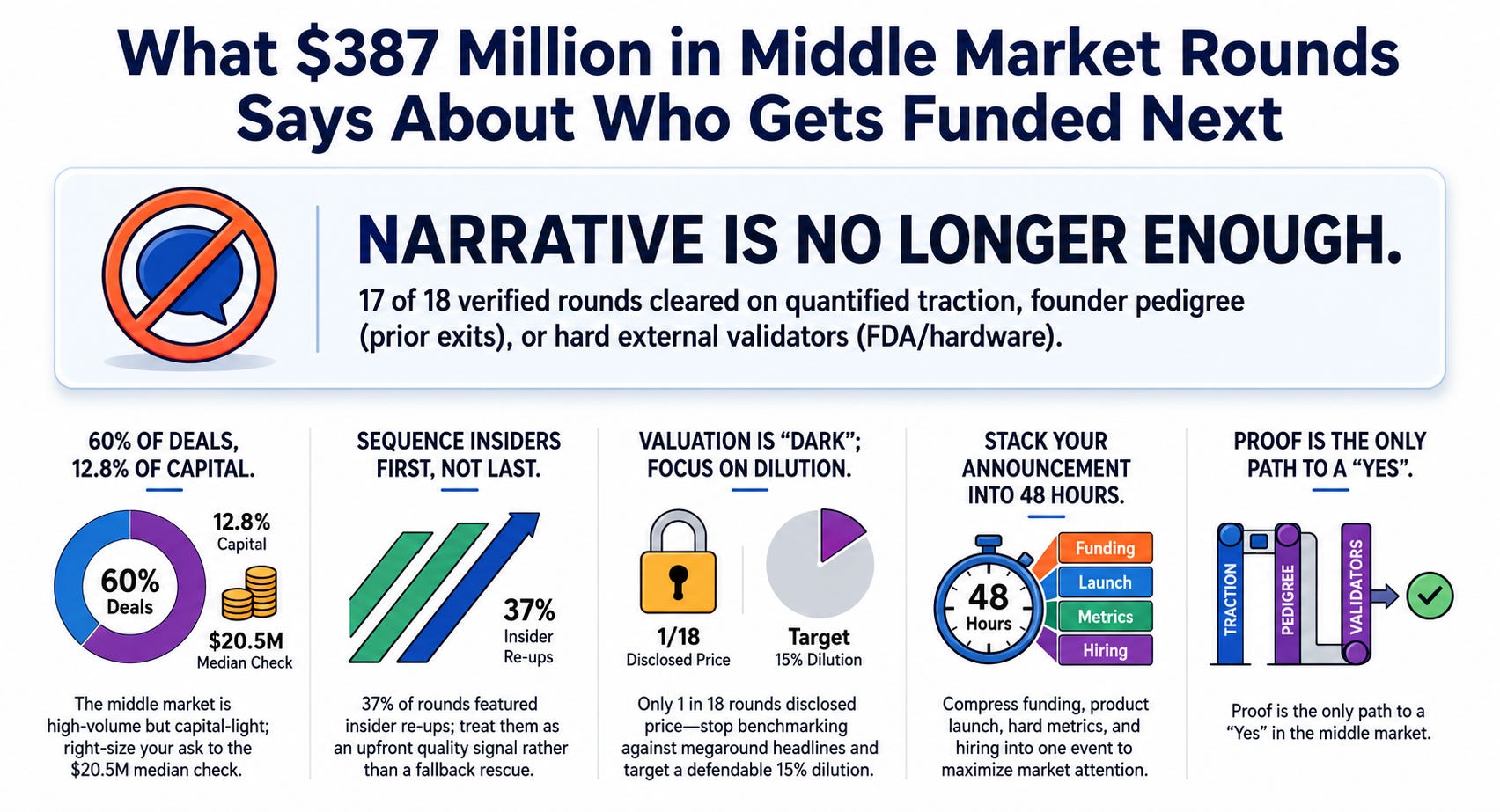
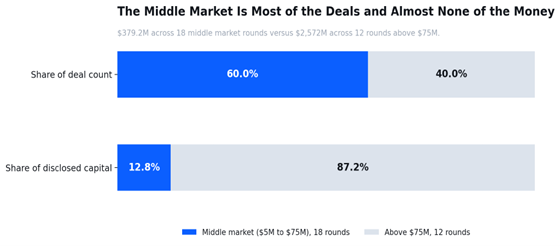
Eighteen companies raised between $5 million and $75 million this week. Together, they took $379.2 million. Twelve companies above that line took $2,572 million. The middle market accounted for 60 percent of the deals and 12.8 percent of the money.
That is the market you are actually raising into. The megaround tape is a different economy with different physics, and reading it will mislead you about your own price, your own timeline, and your own bar.
Here is what the middle market tape actually says. Seventeen of the eighteen verified USD rounds cleared on one of three things: quantified traction, founder pedigree with a prior exit or a category-defining build, or a hard external validator such as an FDA clearance or physical hardware already delivered. Exactly one cleared without any of the three, and it scored 36, the lowest in the cohort.
If you cannot name which of the three you are selling, you are not in a process. You are in a conversation. Fix that.
THE WEEK IN ONE SENTENCE
Primary market insight. The middle market is not underfunded; it is under-priced and under-documented. Capital cleared for nineteen companies. Only one of them told the market what it paid.
Total capital deployed. $379.2 million across 18 verified USD-denominated rounds, plus one euro-denominated round of 11 million euros at Brenus Pharma.
Average deal size: $21.1 million.
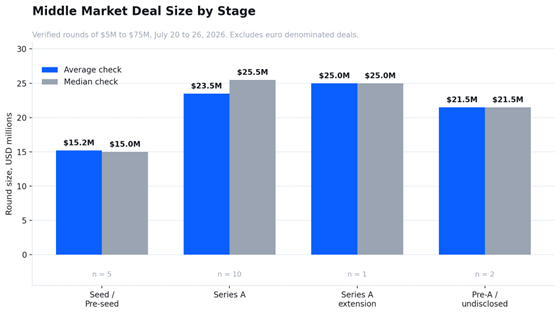
Median deal size: $20.5 million. Series A median: $25.5 million. Seed and pre-seed median: $15.0 million.
Median valuation. Not computable. One of eighteen rounds disclosed a valuation: Infinity at $100 million post-money on a $15 million seed, roughly 15 percent dilution. Any median claimed from this week would be fiction.
Fastest close. Natural, which raised a $30 million Series A led by Kirsten Green at Forerunner 193 days after launch. AegisAI closed a $36 million Series A less than a year after leaving stealth.
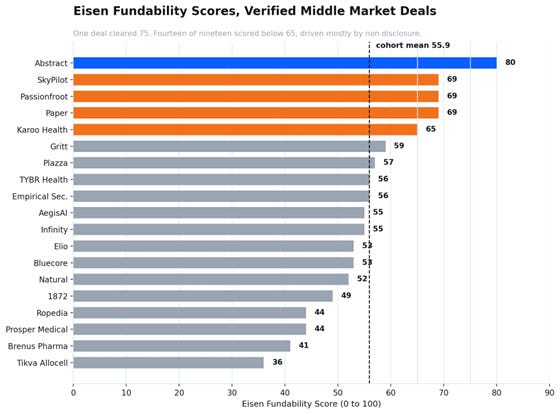
Mean Eisen Fundability Score. 55.9 out of 100 across nineteen scored deals. One deal cleared 75. Five scored 65 or above. Fourteen scored below 65.
DEAL SCORECARD
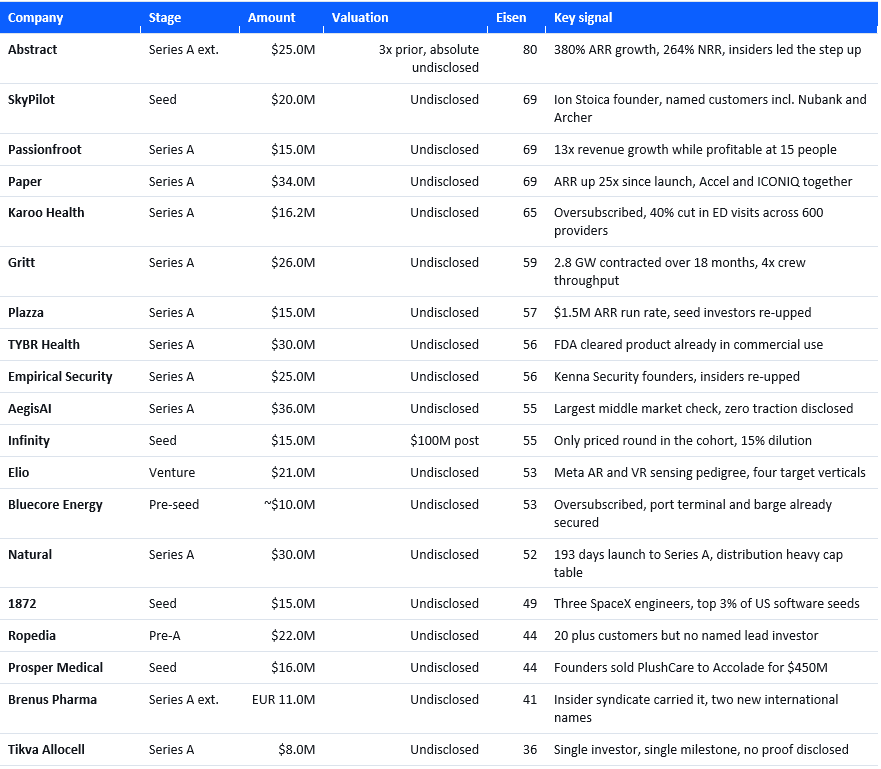
All verified middle market rounds announced July 20 to 26, 2026. Scored on the Eisen Fundability framework, 0 to 100. Missing data is penalized; never assumed favorable.
What the Scorecard Says at a Glance
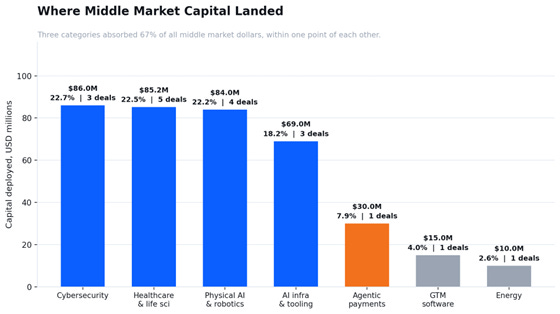
Read the spread, not the ranking. Check size and fundability score decoupled almost completely this week. AegisAI took the largest middle market check at $36 million and scored 55, because it disclosed no growth, no revenue quality and no customer proof. Abstract took $25 million and scored 80, because it disclosed all three. Ropedia raised $22 million and scored 44, because it never named a lead investor despite serving more than twenty robotics and foundation model customers. The scorecard is not measuring who raised the most. It is measuring who made it easy for the next investor to say yes, and those are different companies.
WHAT CHANGED THIS WEEK
SHIFT ONE: The Barbell Skipped The Middle
Pattern: what happened
• $379.2 million cleared across 18 middle market rounds while $2,572 million cleared across 12 rounds above $75 million in the same four announcement days.
• Middle market rounds were 60 percent of deal count and 12.8 percent of disclosed capital.
• PitchBook and NVCA data reported by Axios put US venture investment at $412.7 billion in the first half of 2026, already above any prior full year, with more than 81 percent of those dollars going into rounds of $100 million or more.
• The Wall Street Journal reported that 16 megafunds took nearly 70 percent of the $72.4 billion raised by US venture funds in the first half.
Perspective: what it means
You are not competing with other startups for a fixed pool of dollars. You are competing for partner attention inside funds whose economics now require ownership at scale. A $20 million Series A is a deliberately small decision inside a firm built to write $100 million checks. That changes who runs your process, how fast it moves, and how much conviction is required to justify the time.
Founder blindspot: what most miss
Founders read the record headline totals as an open market and calibrate the ask upward. They walk in asking for $40 million with $20 million of proof, and get read as someone who does not know their own tier.
Playbook: what to do
Right size the ask to the tier you can actually document. The median middle market check this week was $20.5 million. Series A median was $25.5 million. Seed median was $15.0 million. If you are asking above your tier’s median, you need the disclosure profile of the tier above: a named valuation, disclosed growth rate, and a top-tier lead. Cut the ask or add the proof. Do not ask and hope.
Contrast
The prior norm was to raise the largest round you can close. This week says the largest round available to you is set by your proof tier, not by your ambition or the market’s headline total.
What this means for your raise next week: rewrite your ask slide to the median for your stage, and put the reason for that specific number on the same slide.
SHIFT TWO: Proof Or Pedigree, Never Neither
Pattern: what happened
• Nine of eighteen rounds disclosed a quantified traction, adoption, or performance metric. Abstract at 380 percent ARR growth and 264 percent net revenue retention. Paper at 25x ARR since its early 2026 launch. Passionfroot at 13x revenue growth while profitable with a team of fifteen. Karoo Health: independent analyses show more than 40 percent reductions in emergency department visits and admissions across 600 cardiology providers in 11 states. Gritt at 3,000 to 4,000 panels per crew day against 800 conventionally, with 2.8 gigawatts contracted over 18 months. Plazza at a $1.5 million annual run rate against a $10 million December target.
• Eight of the remaining nine substituted founder pedigree or a hard external validator. AegisAI’s founders built Google’s reCAPTCHA and Safe Browsing. Prosper Medical’s founders sold PlushCare to Accolade for $450 million. Elio’s founders sold Pebbles Interfaces to Meta and then led Meta’s AR and VR sensing for seven years. Empirical Security’s founders built Kenna Security. 1872 was founded by three former SpaceX engineers. TYBR Health carried an FDA-cleared product. Bluecore Energy had already secured a port terminal, acquired a barge, and begun reactor construction inside six months.
• Several carried both. Abstract paired 380 percent growth with founders from ArcSight, Mandiant and Palo Alto Networks. SkyPilot paired 14 million open source downloads and named customers including Nubank, Abridge and Archer with Databricks co-founder Ion Stoica.
• Exactly one round, Tikva Allocell at $8 million, disclosed none of the three. It scored 36, the lowest in the cohort.
• The nine deals that disclosed traction averaged 63.0 on the Eisen framework. The nine that did not averaged 50.4.
Perspective: what it means
Investors are pricing the cost of being wrong, not the size of the opportunity. Traction lowers that cost by showing the market already answered. Pedigree lowers it by showing this team has converted an unknown into an outcome before. A validator such as regulatory clearance or delivered hardware lowers it by outsourcing the judgment to someone with no financial interest in the round. Narrative lowers nothing.
Founder blindspot: what most miss
Founders believe a sharp category thesis is a third path. It is not. Narrative determines whether you get the meeting and how the proof is framed, and it never substitutes for the proof itself. The founders who raised on pedigree this week did not raise on story; they raised on a prior outcome a partner could underwrite in one sentence. The single exception proves the rule rather than breaking it: Tikva Allocell raised the smallest round in the cohort at the lowest score, on a defined regulatory pathway and nothing else.
Playbook: what to do
Name your lane out loud in the first ninety seconds. If you have traction, lead with the two numbers that move fastest and show the trend line, not the snapshot. If you have pedigree, state the prior outcome with its number attached and explain the specific transfer to this problem. If you have a validator, put the clearance, the contract, or the delivered unit on slide two. If you have none of the three, your quarter’s job is to manufacture one validator, not rewrite the deck.
Contrast
In the 2021 cycle, a credible category thesis plus a clean team could open a Series A. This week it opened one round, the smallest and lowest scoring in the entire verified set.
What this means for your raise next week: write the one sentence a partner will repeat to their partnership. If it does not contain a number or a prior outcome, you do not have a round yet.
SHIFT THREE: The Middle Market Went Price Dark
Pattern: what happened
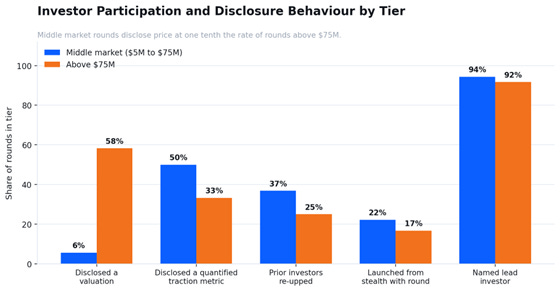
• One of eighteen middle market rounds disclosed a valuation. Infinity, $15 million seed at $100 million post-money.
• Above $75 million, seven of twelve disclosed: Etched at $10.3 billion, CuspAI at $2.6 billion, Meshy at $1.5 billion, Cathedral at $1.4 billion, Humanoid at $1.35 billion post-money, Glow at $1.2 billion, and Augustus at $1 billion.
• Abstract disclosed only a relative mark, triple its prior valuation, without an absolute number.
• Middle market rounds disclosed price at roughly one tenth the rate of rounds above $75 million.
Perspective: what it means
Price disclosure is a marketing decision, and it only pays when the price is the story. At $1.2 billion, the number recruits engineers and intimidates competitors. At $60 million, it does neither, and it hands your next lead a fixed anchor to negotiate down from and a public ceiling to price your Series B against. The middle market is going dark because disclosure is asymmetrically costly down here.
Founder blindspot: what most miss
Founders benchmark their own valuation from press coverage that systematically overrepresents the priced tier. They see seven billion dollar marks in a week and conclude the market is hot, when the eighteen rounds closest to their own size published no price at all. The comp set they are using does not contain a single company like them.
Playbook: what to do
Stop pricing off headlines and start pricing off dilution. Infinity is the only usable anchor in the band this week at roughly 15 percent for a $15 million seed. Build your target from the dilution you can defend, then back into the valuation. Then decide disclosure deliberately: stay dark unless a named price wins you a specific hire or a specific customer.
Contrast
Valuation disclosure was near universal as a recruiting signal in the last cycle. It has now inverted at the middle while intensifying at the top.
What this means for your raise next week: replace every headline comp in your valuation model with a dilution target you can defend to a partner in one sentence.
SHIFT FOUR: Insiders Became The Lead Signal
Pattern: what happened
• Seven of nineteen verified middle market deals featured explicit prior investor re-up. Accel and Foundation Capital returned for AegisAI. Hyde Park Angels and Costanoa Ventures returned for Empirical Security. Crosslink Capital and Rally Ventures followed on at Abstract. UpWest and Resolute Ventures returned at Elio. Gritt’s seed backers, including First Round Capital, Climactic, Congruent Ventures and VSC Ventures, carried into the Series A. Plazza’s seed investors, All In Capital and Better Capital, re-upped roughly ten months after leading a $1.4 million seed. Brenus Pharma’s extension was carried by its existing French syndicate plus two new international names.
• Abstract’s insider-led extension cleared at three times its prior valuation.
• Insider re-up ran at 37 percent in the middle market against 25 percent above $75 million.
Perspective: what it means
When new leads are scarce and slow, an insider check is the cheapest possible evidence that the last eighteen months went to plan. The people with the most information about your company are voting with capital. New leads read that as diligence already performed by someone who cannot lie to themselves about the numbers. Absence of insider participation reads the opposite way, and it reads loudly.
Founder blindspot: what most miss
Founders treat existing investors as the fallback if the outside process stalls, and go to them last. That inverts the leverage entirely. By the time you ask, the ask itself signals that the process failed. Abstract got a three-times step-up because insiders led it, not despite it.
Playbook: what to do
Sequence insiders first and get a written commitment for a specific dollar amount before you open the outside process. Then that number goes on slide one, and every new lead reads it as confirmation rather than as a rescue. If an insider declines, you have learned something critical for free, before you burned six weeks of outside meetings.
Contrast
Insider participation used to be read as a bridge or a down round warning. This week it was the strongest available quality signal in the band.
What this means for your raise next week: book your existing investors before your target list, and ask for a number, not for support.
SHIFT FIVE: Launch And Round Became One Event
Pattern: what happened
• Four of eighteen middle market rounds were announced as the company’s public launch: SkyPilot at $20 million led by Lux Capital, Gritt at $26 million led by Obvious Ventures, 1872 at $15 million led by The O.H.I.O. Fund, and Bluecore Energy at approximately $10 million led by Slauson and Co.
• The same choreography ran above the line at Neo, $100 million out of stealth, and Glow, $180 million out of stealth at a $1.2 billion valuation.
• Every one of the four paired the round with a hard proof point in the same release: SkyPilot with 14 million open source downloads and 10,000 GPUs under management in private preview, Gritt with 2.8 gigawatts contracted, 1872 with its Path Robotics partnership and a physical factory, Bluecore with a delivered barge and test reactor.
Perspective: what it means
The announcement is being used as a demand generation event, not a public relations obligation. Compressing company launch, funding, customer proof, and hiring into a single 48-hour window produces more inbound than any of the four spread across a quarter. Attention is the scarcest input in a market where 60 percent of deals share 13 percent of the dollars, and stacking is how you concentrate it.
Founder blindspot: what most miss
Founders announce the round the week the wire slot opens, then launch the product six weeks later, then publish the customer logo the month after. They spend the same attention three times at a third of the strength each time, and wonder why the round produced no inbound.
Playbook: what to do
Hold the announcement until you can stack it. Round, a named customer or a hard metric, and an open hiring push in the same 48 hours. Build the stack backward from the wire date and hold the release if any element is not ready. A round announced alone is a receipt. A round announced with proof and a hiring push is a market event.
Contrast
The old sequence was raise quietly, announce later, launch separately. Four of eighteen rounds this week collapsed all of it into one day.
What this means for your raise next week: pick your announcement date first, then work backward and refuse to publish until the stack is complete.
THE DEALS THAT MATTER
Abstract
Composable security operations, San Francisco.
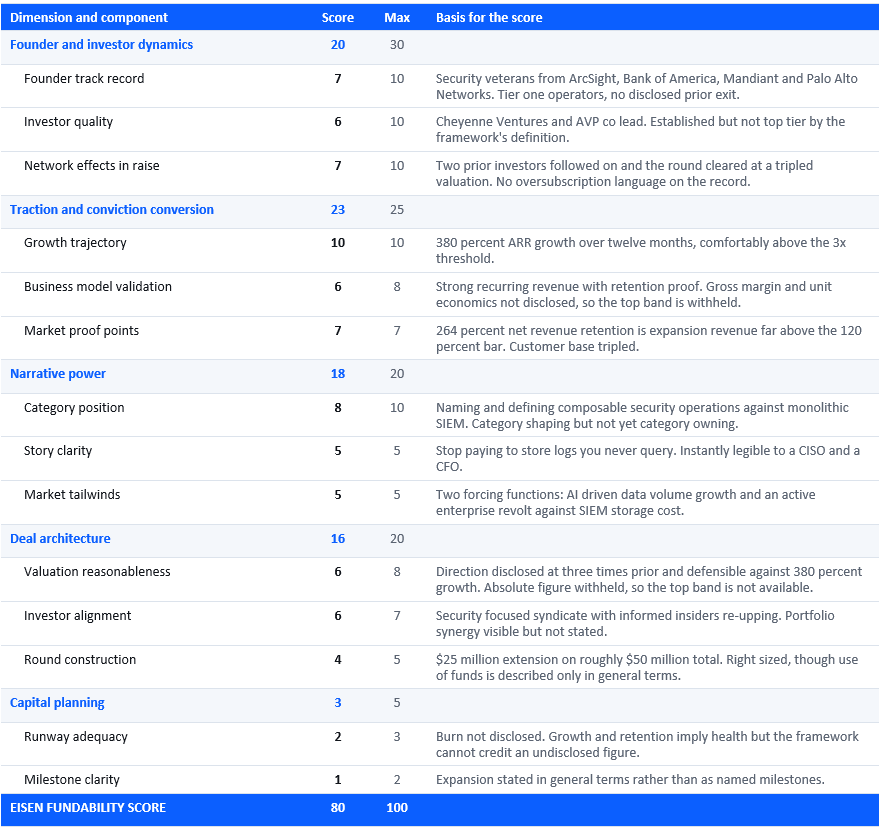
Eisen Fundability Score 80 out of 100. Round $25.0 million.
Why this scored where it did. The only round in the verified middle market cohort that disclosed growth rate, retention quality, and a valuation direction at the same time, and the only one to clear the solid fundamentals band.
The setup. Abstract announced a $25 million round co-led by Cheyenne Ventures and AVP, with Olive Hill Ventures participating and Crosslink Capital and Rally Ventures following on. The round brings total funding to nearly $50 million at triple the prior valuation. Founded in 2023 by security veterans from ArcSight, Bank of America, Mandiant and Palo Alto Networks, the company sells a streaming-first architecture that detects threats before data reaches storage, positioned directly against monolithic SIEM platforms and their storage economics.
The numbers. 380 percent ARR growth over the prior year. 264 percent net revenue retention. Customer base tripled. Total funding near $50 million. Valuation tripled versus the prior round, absolute figure not disclosed.
The pattern. This is what a fully packaged proof stack looks like in a price-dark market. Abstract could not or would not disclose an absolute valuation, so it disclosed everything else: a growth multiple, a retention figure well above the 120 percent that signals genuine expansion revenue, a customer count direction, and a valuation direction. It gave the market enough to underwrite the price without publishing the price.
The perspective. 264 percent net revenue retention is the number that carried this round, not the 380 percent growth. Growth tells an investor you can sell. Retention above 200 percent tells them the product becomes load-bearing after purchase, which means the growth compounds without proportional sales spend. That is the difference between a company that needs the next round and a company that will get offered it.
The playbook. Build the two-number pair. One acquisition number and one expansion number, both stated as a rate over a named period. Most middle market founders lead with a revenue total, which invites a comparison they lose. Abstract led with rates, which invites a comparison they win. If your expansion number is weak, fix the product before you fix the deck.
The founder mistake to avoid. Founders copy the 380 percent and ignore the 264 percent. Growth rate off a small base is cheap, and every investor knows it. The retention figure is what made this round underwritable, and it is the harder of the two to manufacture. Do not lead with the number that is easy to discount.
Score breakdown
SkyPilot
Cross-cloud AI compute control plane, San Francisco.
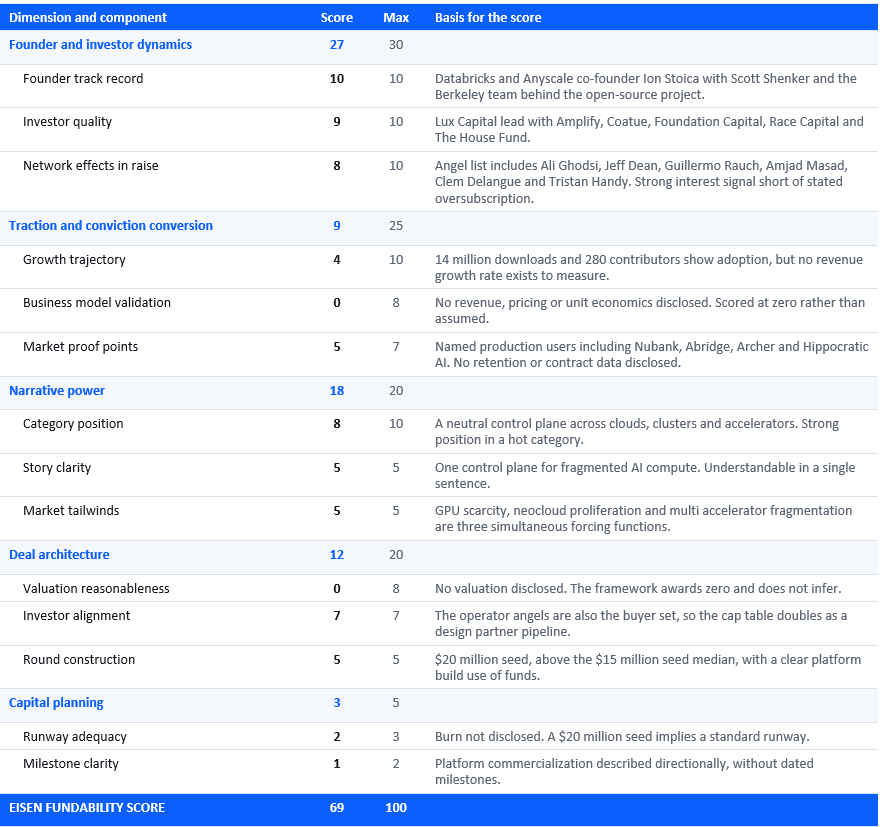
Eisen Fundability Score 69 out of 100. Round $20.0 million seed.
Why this scored where it did. The strongest founder and investor dynamics score in the cohort, 27 of 30, on a seed round with no disclosed revenue but named enterprise customers already in production.
The setup. SkyPilot launched from stealth with a $20 million seed led by Lux Capital, with Coatue and Amplify Partners writing checks alongside Foundation Capital, Race Capital and The House Fund. The founding group includes Zongheng Yang, Zhanghao Wu and Romil Bhardwaj alongside Databricks co-founder Ion Stoica and Scott Shenker. The operator angel list includes Ali Ghodsi of Databricks, Jeff Dean of Google, Guillermo Rauch of Vercel, Amjad Masad of Replit, Clem Delangue of Hugging Face and Tristan Handy of dbt Labs. The product unifies AI workloads across hyperscalers, neoclouds, Kubernetes clusters and multiple accelerator types into one control plane.
The numbers. More than 14 million open source downloads and more than 280 contributors. Used by hundreds of organizations including Nubank, Abridge, Applied Compute, H Company, Archer and Hippocratic AI. Private preview customers managed more than 10,000 GPUs. Performance improvements of up to 20x versus the open source project. No revenue figure disclosed.
The pattern. Open source adoption functioned as the traction proof that revenue normally provides. 14 million downloads and 280 contributors are a distribution asset that exists before monetization. Named production users such as Nubank and Archer convert that community metric into enterprise credibility, and 10,000 GPUs under management in private preview prove the scale works. The company sold adoption depth in place of an ARR number it did not have.
The perspective. Look at who wrote the angel checks. Ghodsi, Dean, Rauch, Masad, Delangue, and Handy all run companies that consume large amounts of fragmented compute. They are not just signal; they are the design partner list and the first revenue cohort wearing an investor label. A cap table that doubles as a customer pipeline is worth more than the valuation premium it costs.
The playbook. If you are pre-revenue, build the substitute proof asset deliberately and instrument it. Downloads, contributors, workloads under management, units deployed. Pick the metric that most closely predicts commercial usage and report it as a level and a rate. Then convert the angel round into a design partner program with named logos before the Series A conversation starts.
The founder mistake to avoid. Founders see the Stoica name and conclude pedigree carried the round on its own. It did not, and the score shows where the gap sits. SkyPilot still scored zero on business model validation, because named users are not the same as disclosed paying customers and no revenue figure exists. The pedigree and the adoption bought a $20 million seed. Neither will buy the Series A. That round will be priced on the conversion rate from 14 million downloads and named logos to contracted revenue, and the clock on that number is already running.
Score breakdown
Passionfroot
B2B creator-led growth infrastructure, Berlin.
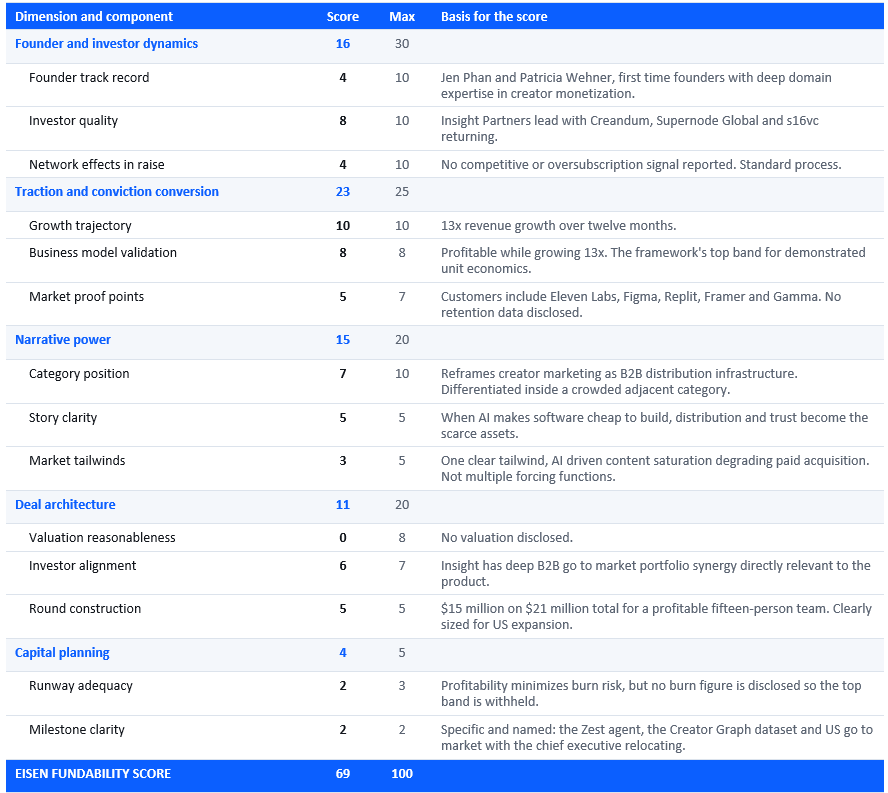
Eisen Fundability Score 69 out of 100. Round $15.0 million.
Why this scored where it did. Profitable at 13x revenue growth with fifteen people, which is the cleanest capital efficiency story in the cohort and the reason Insight Partners led a European Series A at this size.
The setup. Passionfroot raised a $15 million Series A led by Insight Partners with participation from existing investors Creandum, Supernode Global, and s16vc, bringing total funding above $21 million. Founded in 2021 by Jen Phan and Patricia Wehner, the company runs an AI-powered marketplace and workflow layer connecting B2B creators with brands, covering discovery through contracting, campaign execution, payment and measurement. Its AI agent Zest runs campaigns end-to-end off the Creator Graph, a proprietary dataset of B2B creator pricing and performance built from thousands of campaigns. Chief Executive Jen Phan is relocating to New York to run US expansion while product and engineering stay in Berlin.
The numbers. Revenue grew 13x over the past year. Profitable. Team of fifteen. Customers include ElevenLabs, Figma, Replit, Framer, and Gamma. Total funding above $21 million.
The pattern. The thesis is second order, and that is why it worked. Passionfroot did not pitch an AI product. It pitched the consequence of AI: when software creation gets cheap, product differentiation compresses and distribution plus human trust become the scarce assets. That reframes a category investors were tired of, creator marketing, into infrastructure for a shift investors already believe in.
The perspective. Profitability at this stage is not a virtue signal; it is a negotiating position. A company growing 13x while profitable does not need the round, which is the single strongest position from which to price one. Insight leading a Berlin Series A at $15 million against a fifteen-person profitable team is a bet on the multiple, not on the runway. The customer list does the rest of the work: ElevenLabs, Figma, and Replit are the exact companies whose growth thesis validates the product thesis.
The playbook. Find the second-order consequence of the trend everyone is already funding, and build your narrative there. Everyone is funding AI that makes software cheaper to build. Passionfroot asked what becomes scarce when that happens, and sold the answer. Write the sentence: because the market now believes X, the scarce asset becomes Y, and we are the infrastructure for Y.
The founder mistake to avoid. Founders copy the profitability and starve growth to get there. That is backward. Passionfruit is profitable at 13x growth, which is a function of a fifteen-person team serving a high-value marketplace, not of cost discipline applied to a slow business. Profitability without growth reads as a lifestyle business and will not draw Insight Partners.
Score breakdown
Paper
Design platform for the agentic era, San Francisco.
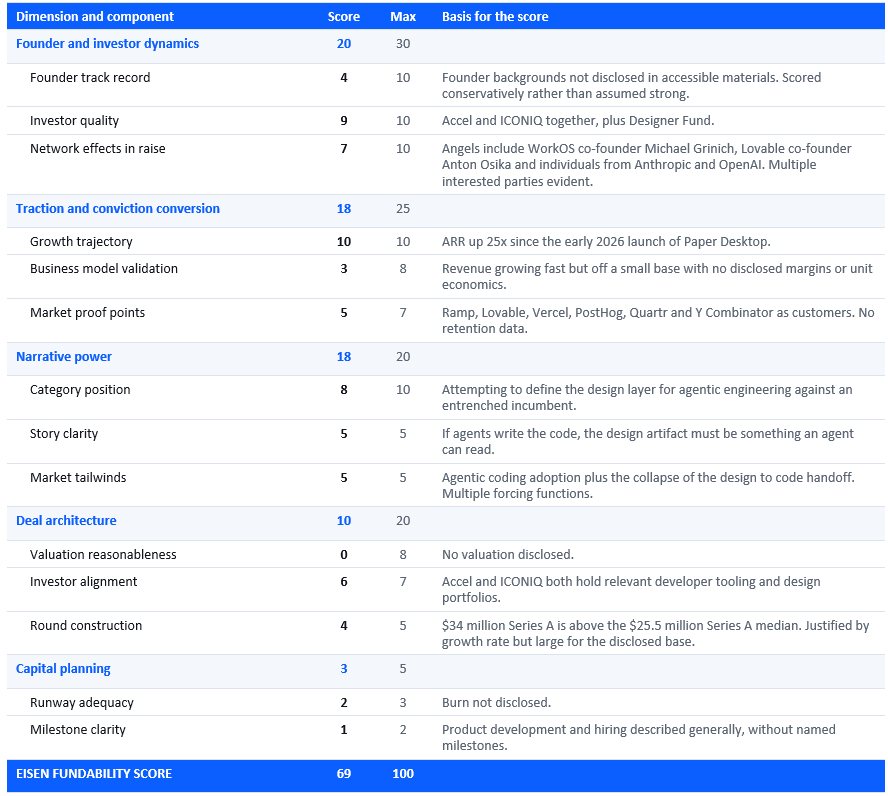
Eisen Fundability Score 69 out of 100. Round $34.0 million.
Why this scored where it did. 25x ARR growth since an early 2026 launch, plus a syndicate that reads as a category endorsement rather than a financing.
The setup. Paper closed a $34 million Series A led by Accel and ICONIQ with participation from Designer Fund, WorkOS co-founder Michael Grinich, Lovable co-founder Anton Osika, and engineers and designers from Anthropic and OpenAI. The company argues that design should render in HTML and CSS and operate natively alongside agentic engineering workflows, collapsing the handoff between mocks and production. Paper Desktop, launched in early 2026, turns the design canvas into a shared workspace for humans and AI agents.
The numbers. ARR up 25x since the early 2026 launch of Paper Desktop. Named on Ramp’s fastest-growing companies list for four consecutive months. Customers include Ramp, Lovable, Vercel, PostHog, Quartr, and Y Combinator. Valuation not disclosed.
The pattern. The angel list is the signal, not the lead. Grinich built WorkOS, Osika built Lovable, and the individual participants came from Anthropic and OpenAI. These are not passive angels; they are the buyers and the adjacent builders. When the people who would be your customers and your closest competitors both put money in, a lead investor reads that as market validation they cannot get from a reference call.
The perspective. Paper is attacking Figma, which is the kind of positioning that normally gets a founder laughed out of a partner meeting. It worked because the attack is on a specific technical seam rather than on features: if agents write the code, the design artifact must be something an agent can read, and a proprietary canvas format is not. That converts an unwinnable brand fight into a winnable architecture argument.
The playbook. When you go after an entrenched incumbent, attack the seam that the platform shift opened, never the feature set. Write the sentence that starts with the shift and ends with the incumbent’s architecture as the liability. Then recruit angels from the buyer set to prove the seam is real before the lead has to believe you on faith.
The founder mistake to avoid. Founders read 25x ARR and conclude that growth rate alone unlocked a $34 million Series A. It did not. 25x off a launch six months earlier is a small absolute base, and Accel knows it. What unlocked the round was the combination of that rate with a customer list of AI native companies that constitute the future market, plus angels who validated the architecture thesis. The rate was the entry ticket, not the argument.
Score breakdown
Karoo Health
Cardiovascular care operating system, Albuquerque.
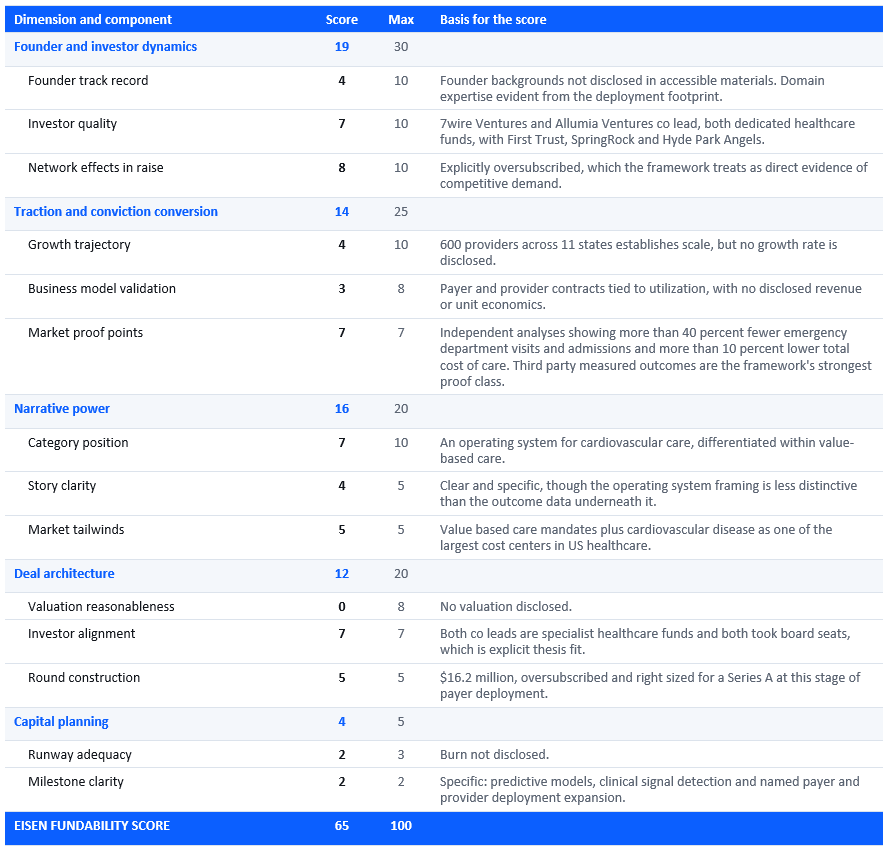
Eisen Fundability Score 65 out of 100. Round $16.2 million.
Why this scored where it did. The only deal in the cohort where an independent third party quantified the customer’s economic outcome, which is the highest quality proof available to a healthcare company.
The setup. Karoo Health closed an oversubscribed $16.2 million Series A co-led by 7wire Ventures and Allumia Ventures, with First Trust Capital Partners, SpringRock Ventures and Hyde Park Angels participating. Lee Shapiro of 7wire and Jeff Stolte of Allumia joined the board. The company builds a unified data and workflow layer connecting payers, providers and patients for cardiovascular care, supporting earlier risk detection and care coordination.
The numbers. More than 600 cardiology providers across 11 states. Independent analyses of deployed programs show more than 40 percent reductions in emergency department visits and inpatient admissions, and more than a 10 percent reduction in total cost of care across attributed populations. Oversubscribed. Two board seats taken by specialist healthcare funds.
The pattern. The word independent is doing enormous work in that metric. Every healthcare startup claims to reduce utilization. Karoo had the reduction measured by someone else and stated the population it applied to. That converts a marketing claim into a diligence artifact a payer’s actuary can act on, which is why the round was oversubscribed at a modest size.
The perspective. Notice what Karoo did not disclose: revenue, growth rate, contract value. It scored only 4 of 10 on growth trajectory. It cleared 65 anyway because the proof it did disclose is the proof its buyer actually purchases. Payers do not buy ARR; they buy medical loss ratio improvement. Karoo packaged for the buyer’s underwriting model rather than the investor’s, and the investors followed the buyer.
The playbook. Identify the single number your buyer’s finance function uses to approve spend, then get that number measured by a third party and publish it with the population size attached. One independently verified outcome metric outperforms five self-reported product metrics in any regulated or budget-constrained market.
The founder mistake to avoid. Founders copy the format and self-report the number. A 40 percent reduction you calculated yourself is worth close to nothing in healthcare, and everyone in the room knows it. The cost and delay of third-party measurement is the entire point. If you cannot afford the study, say the number is internal and state the methodology, but do not imply independence you do not have.
Score breakdown
THIS WEEK’S FUNDRAISING PLAYBOOK
Five tactical plans derived from this week’s evidence. Each produces a concrete artifact you can use in a partner meeting.
PLAN ONE: Rewrite Your Headline As A Risk Reduction Claim
Focus. Narrative, positioning, and investor framing.
Why this matters now. Zero verified middle market rounds this week cleared on category narrative. Every one cleared on traction, pedigree, or an external validator. Investors funded the reduction in their cost of being wrong, not the size of the opportunity.
Exact deliverable. One slide with a single sentence in this form: for a buyer with problem X, we have already proven Y, measured by Z. Underneath it, three supporting lines and nothing else. Delete every adjective. Delete the market size. Delete the word platform.
Time estimate. Two hours to draft, one hour to test on three people outside your company.
Expected outcome. A partner can repeat your positioning accurately to their partnership from memory after one meeting. That is the actual mechanism by which deals get to a second meeting.
The reframe. Wrong: we are building the operating system for cardiovascular care. Right: independent analysis of our deployed programs shows more than 40 percent fewer emergency department visits across 600 providers in 11 states.
PLAN TWO: Build A One Page Proof Stack With A Rate And A Retention Number
Focus. Proof, traction, and metrics packaging.
Why this matters now. Abstract scored 80, the only deal above 75, by disclosing 380 percent ARR growth and 264 percent net revenue retention together. The nine deals that disclosed a quantified metric averaged 63.0 on the Eisen framework. The nine that disclosed none averaged 50.4. That is a 12.6-point gap across effectively identical round sizes, and it is the single largest recoverable spread in the data.
Exact deliverable. A single page with exactly four blocks: one acquisition rate over a named period, one expansion or retention rate, one named customer with the outcome they got, and one line of methodology stating how each number was calculated. Attach the raw data as an appendix.
Time estimate. Four hours if your data is clean. If it takes longer, you have found your real problem, and it is not fundraising.
Expected outcome. Diligence compresses from weeks to days because you pre-answered the three questions every associate asks. Deals die in diligence lag more often than in the partner meeting.
The reframe. Wrong: we have grown 4x this year and have great customer love. Right: ARR grew 380 percent over twelve months, net revenue retention was 264 percent over the same period, and Customer A expanded from $40,000 to $190,000 in eight months.
PLAN THREE: Score Your Round And Attack Your Two Weakest Dimensions
Focus. Self-diagnosis using the Eisen Fundability framework.
Why this matters now. The cohort mean was 55.9 out of 100. The single largest destroyer of points was not weak business quality; it was non-disclosure: eighteen of nineteen deals scored zero on valuation reasonableness, and nine scored zero on growth trajectory. Founders are losing points they could recover in a week.
Exact deliverable. Score yourself across all five dimensions. Write the number for each. Then take the two lowest and write one specific, dated action per dimension that raises the score by at least three points before your first partner meeting.
Time estimate. Ninety minutes for the scoring, then the actions run in parallel with your process.
Expected outcome. You stop optimizing the dimension you enjoy, usually narrative, and start fixing the dimension that is actually blocking the round, usually traction packaging or investor fit.
The reframe. Wrong: our deck needs another design pass. Right: we score 3 of 25 on traction conviction because we have never published a retention number, so that is the only work that matters this month.
PLAN FOUR: Lock An Insider Commitment Before You Open The Process
Focus. Deal architecture, investor targeting and process design.
Why this matters now. Seven of nineteen deals featured explicit prior investor re-up, at a 37 percent rate against 25 percent above $75 million. Abstract’s insider-led extension cleared at three times its prior valuation. Insider participation was the strongest available quality signal in this band.
Exact deliverable. A written commitment from at least one existing investor for a specific dollar amount, secured before any new investor meeting. Then cut your target list to no more than thirty-five names selected on thesis fit, using this week's actual leads as the filter: which of these funds led a round in your category and stage in the last ninety days.
Time estimate. One week for insider conversations, one day to cut the list.
Expected outcome. You enter every new meeting with the round already partially closed, which changes the conversation from whether to how much. You also avoid burning six weeks discovering an insider concern that a new lead will find anyway.
The reframe. Wrong: we will go to our existing investors if the outside process stalls. Right: our seed lead has committed $3 million, and it is on slide one, so every new lead reads their participation as confirmation rather than rescue.
PLAN FIVE: Design The Announcement As One Stacked 48 Hour Event
Focus. Momentum, conversion mechanics, and post-close leverage.
Why this matters now. Four of eighteen middle market rounds were announced simultaneously with the company’s public launch, and each paired the round with a hard proof point in the same release. SkyPilot published 14 million downloads and 10,000 GPUs. Gritt published 2.8 gigawatts contracted. Bluecore published a delivered barge and test reactor.
Exact deliverable. A 48-hour announcement plan built backward from the wire date, with four required elements: the round, a named customer or a hard metric, an open hiring push with specific roles, and a founder-written piece explaining the market shift rather than the company. Hold the release if any element is missing.
Time estimate. Three hours to plan, two weeks of lead time to assemble the elements.
Expected outcome. Inbound from candidates, customers, and next round investors concentrates in a single window instead of dissipating across three separate small announcements. That inbound is the actual return on the announcement.
The reframe. Wrong: we will announce the round when the wire slot opens and launch the product next month. Right: we hold the announcement until the customer logo, the metric, and the job postings all go live in the same 48 hours.
LOOKING FORWARD, NEXT ONE TO THREE WEEKS
SCENARIO ONE: Security operations consolidation pressure builds within two to three weeks
Why this is likely. Three cyber rounds cleared in the middle market in four days across three distinct budget lines: AegisAI at $36 million for inbox prevention, Empirical Security at $25 million for exposure prediction, Abstract at $25 million for security operations architecture. Above the line, Glow took $180 million at the endpoint, and Neo took $100 million for AI application security. Five separate layers of the security stack were funded in four days. That density of funding into adjacent budget lines historically precedes either platform bundling or an acquisition wave, because no CISO can run five new point vendors.
What founders should watch. Watch for the first middle market cyber company to announce a second product line rather than a new customer segment. That is the tell that the bundling pressure has reached the founders.
What to do before others notice. If you sell security, get your expansion revenue number measured and published now, before buyers start consolidating vendors. Abstract’s 264 percent net revenue retention is exactly the number that survives a consolidation cycle, because it proves you are the one being expanded into rather than the one being cut.
SCENARIO TWO: The insider-led extension becomes a standard instrument this quarter
Why this is likely. Abstract raised an extension at three times its prior valuation with insiders following on. Brenus Pharma extended a Series A rather than resetting. Seven of nineteen deals had explicit insider re-up. In a market where 81 percent of dollars go to rounds above $100 million, the middle market needs an instrument that does not require finding a new lead, and the insider-led extension at a step-up is that instrument.
What founders should watch. Watch for extensions being announced with an explicit step-up multiple rather than being buried. Abstract publishing triple its prior valuation without an absolute number is the template.
What to do before others notice. Stop treating extension as a failure word. Model it as a deliberate instrument: raise 40 to 60 percent of a full round from insiders at a defensible step-up, buy twelve months, and enter the next process with a fresh proof point instead of a fresh story.
SCENARIO THREE: Physical AI splits into four separately financeable layers
Why this is likely. In one week, four distinct layers of the physical AI supply chain were funded from four different investor pools: Ropedia at $22 million for training data, Elio at $21 million for machine native sensing, Gritt at $26 million for field deployment, and 1872 at $15 million for autonomous production. Above the line, Humanoid took $152 million for the robot itself. Investors have stopped underwriting robotics as one category and started underwriting the bottlenecks separately.
What founders should watch. Watch whether the next physical AI rounds name their layer explicitly in the first line of the release. Category self-identification is how a market signals it has fragmented into financeable segments.
What to do before others notice. If you are building in physical AI, pick one layer and say its name. Companies that pitched the full stack this week did not raise in the middle market. Elio’s four target verticals cost it points on round construction for exactly this reason.
WILD CARDS
Valuation disclosure returns as a differentiator
Why this is possible. If price dark becomes universal in the middle market, and it is close at one disclosure in eighteen, then disclosure itself becomes a scarce signal. The first companies to publish a defensible number will read as confident while everyone else reads as negotiating. Infinity was the only priced round this week, and its $100 million post-money on a $15 million seed became the sole usable anchor in the band.
What founders should watch. Watch for a middle market company to publish a valuation with the metrics that justify it in the same release. That pairing is what turns disclosure from a ceiling into a signal.
What to do before others notice. Model both paths now. Know the number you would publish and the metric pair that defends it, so the decision is strategic when the moment comes rather than reactive.
Singapore emerges as a physical AI data hub
Why this is possible. Two Singapore companies cleared the middle market in one week: Ropedia at $22 million for physical AI training data and Tikva Allocell at $8 million in cell therapy. Ropedia claims one of the industry’s largest human experience datasets at 10 million interaction episodes and more than 10,000 hours of multimodal recordings, built without a robot fleet, and says it already serves more than twenty robotics and foundation model companies while cutting collection cost by up to fifty times.
What founders should watch. Watch whether Ropedia’s next round names institutional leads. It scored 44 despite real commercial traction, almost entirely because no lead investor was disclosed. If a named tier one lead appears, the geography thesis gets real.
What to do before others notice. If you need real-world interaction data, evaluate Singapore-based collection now while the capacity is being built rather than after it is contracted.
THE BOTTOM LINE
The Real Insight
The real insight is not that $387 million cleared the middle market. It is that the middle market has quietly split into two populations that look identical in a funding table and behave nothing alike. One population disclosed a rate, a retention figure or an independently measured outcome, and averaged 63.0. The other disclosed a founder biography and averaged 50.4. Both got funded this week. Only one of them will get funded again without a new story, because the first population handed the market a number that keeps working and the second handed it a reputation that has already been spent.
Five New Rules For Founders
1. Your tier sets your ask, not your ambition. The median middle market check was $20.5 million, and the median Series A was $25.5 million. Asking above your tier without the disclosure profile of the tier above marks you as someone who has not read the market.
2. You raise on proof, pedigree, or a validator. Narrative is not a fourth option. Seventeen of eighteen verified rounds carried at least one of the three. The one that carried none raised the smallest cheque in the cohort at the lowest score. Narrative gets the meeting and frames the proof. It has never been the proof.
3. An expansion number beats a growth number. Abstract’s 264 percent net revenue retention did more work than its 380 percent ARR growth, because retention proves the product becomes load-bearing while growth only proves you can sell.
4. Insiders go first, not last. Insider re-up ran at 37 percent in the middle market and produced a three-times step-up at Abstract. An insider check secured before your process is confirmation. The same check secured after is a rescue, and every new lead can tell the difference.
5. Independently measured beats self-reported, every time. Karoo Health cleared $16.2 million on a round with no disclosed revenue because a third party measured the outcome its buyer actually purchases.
Four Monday Actions
1. Score yourself on the Eisen framework across all five dimensions, write down the two lowest, and pick one dated action for each. Ninety minutes.
2. Rewrite your headline slide into the risk reduction form: for a buyer with problem X, we have already proven Y, measured by Z. Delete the market size slide entirely. Two hours.
3. Book your existing investors this week and ask each for a specific dollar commitment before you contact a single new fund. One week to close.
4. Cut your target list to thirty-five names using one filter: did this fund lead a round in your category and your stage in the last ninety days. One hour.
Every founder reading a weekly funding roundup this morning is reading the megaround tape and calibrating to the wrong market. The eighteen companies that actually raised in your band this week won on proof, price discipline, and insider sequencing, not on story. You have roughly two weeks before that becomes obvious to everyone competing for the same partner’s attention. Use them.
SOURCES AND VERIFICATION
Verification Method
Data collection period. July 20 to July 26, 2026. Source roundups published Monday, July 20 through Thursday, July 23. No equivalent Friday, Saturday, or Sunday roundup was published.
Research completed. July 26, 2026.
Deals analyzed. 31 disclosed rounds reviewed. 19 verified rounds scored in the $5 million to $75 million middle market band. 12 rounds above $75 million retained only as the comparison tier.
Deals excluded. Andera, stale, June 17, 2026 close resurfaced in July aggregation. Brenus Pharma second listing, duplicate across the July 20 and July 22 roundups. StrongestLayer, Coverwatch, Cast Insights and Immitra Bio, below the $5 million floor. Quorum, Wagmo and HALO X-ray Technologies, amount undisclosed and therefore unscoreable.
Sourcing standard. Every scored deal carries at least two independent sources with at least one at High confidence, defined as a company release, lead investor statement, or wire service. Traction figures are used only where stated on the record by the company or its lead investor.
Known limitations. Weekend deal flow is not represented. Valuation medians are not computable because only one of eighteen USD rounds disclosed a price. Brenus Pharma is reported in euros and is excluded from USD totals rather than converted at an unverified rate.
Primary Deal Sources
Daily funding tape, July 20. TechStartups roundup, July 20, 2026. techstartups.com/2026/07/20/venture-capital-startup-funding-roundup-july-20-2026/
Daily funding tape, July 21. TechStartups roundup, July 21, 2026. techstartups.com/2026/07/21/
Daily funding tape, July 22. TechStartups roundup, July 22, 2026. techstartups.com/2026/07/22/
Daily funding tape, July 23. TechStartups roundup, July 23, 2026. techstartups.com/2026/07/23/
Abstract. PR Newswire release, July 23, 2026. SiliconANGLE, Abstract Security raises $25M Series A extension, recurring revenue up 380 percent, July 23, 2026. AVP investor note.
Passionfroot. PR Newswire release, July 22, 2026. TechCrunch, Passionfroot raises $15M to expand its B2B creator marketplace to the US, July 22, 2026.
Paper. Business Wire release, July 23, 2026. Axios Pro Enterprise Software Deals, July 23, 2026. Company blog.
SkyPilot. Company launch release via Yahoo Finance, July 21, 2026. Fortune, SkyPilot, from Databricks cofounder, raises $20M to be the Switzerland of AI compute, July 21, 2026.
Karoo Health. PR Newswire release, July 21, 2026. Fierce Healthcare, July 2026. BioSpace press release archive.
AegisAI. PR Newswire release, July 23, 2026. TechCrunch, July 23, 2026. SecurityWeek, July 2026.
Empirical Security. Axios Pro Enterprise Software Deals, July 20, 2026. SecurityWeek, July 2026. FinSMEs, July 2026.
Natural. PR Newswire release, July 20, 2026. TechCrunch, Natural raises $30M to reinvent payments for AI agents, July 20, 2026. Finextra, July 2026.
Gritt. TechCrunch, Gritt exits stealth, July 21, 2026. FinSMEs, July 2026. Note: amount reported inconsistently across outlets, reconciled to a $26 million Series A.
TYBR Health. PR Newswire release, July 21, 2026. Medical Device Network, July 2026. Newswise archive.
Elio. Business Wire release, July 23, 2026. Calcalist Ctech, July 2026. Semiconductor Digest, July 2026.
Infinity. Business Wire release, July 20, 2026. TechCrunch, Inference startup Infinity raises $15M, July 20, 2026.
1872. Business Wire release, July 22, 2026. The O.H.I.O. Fund announcement. Dealroom note, July 2026.
Prosper Medical. Business Wire release, July 23, 2026. Fierce Healthcare, July 2026. HIT Consultant, July 23, 2026.
Bluecore Energy. TechCrunch, Bluecore Energy raises $10M to build portable nuclear reactors on barges, July 21, 2026. SiliconANGLE, July 21, 2026. Axios Pro Climate Deals, July 21, 2026. NucNet, July 2026.
Plazza. Entrackr, July 20, 2026. YourStory, July 2026. Outlook Business, July 2026. Run rate figures reported by Entrackr.
Ropedia. TNGlobal, Singapore’s Ropedia raises $22M pre-Series A, $30M in total, July 24, 2026. FinSMEs, July 2026. AIthority, July 2026. Note: the $30 million headline aggregates an $8 million March 2026 seed with the $22 million round announced this week.
Tikva Allocell. PR Newswire release, July 22, 2026. TNGlobal, July 23, 2026. BioSpectrum Asia, July 2026. Dealroom note.
Brenus Pharma. Business Wire release, July 2026, reported in both the July 20 and July 22 roundups.
Andera, excluded. Axios Pro Fintech Deals, June 17, 2026. Lightspeed Venture Partners investment note. FinSMEs, June 2026.
Market Comparison Sources
US venture totals and round concentration. PitchBook and NVCA data reported by Axios: $412.7 billion in US venture investment in the first half of 2026, with more than 81 percent of dollars in rounds of $100 million or more. Cited in the TechStartups July 23, 2026 roundup.
Venture fund concentration. The Wall Street Journal: 16 megafunds raised nearly 70 percent of the $72.4 billion in US venture fundraising in the first half of 2026. Cited in the TechStartups July 23, 2026 roundup.
Global AI capital share. Crunchbase Q2 2026: more than 70 percent of global startup capital went to AI-focused companies, and more than 40 percent of all first-half venture funding went to two companies. Cited in the TechStartups July 21, 2026 roundup.
Robotics funding. Crunchbase: global robotics funding reached $18.8 billion in 2026 through late June, above the 2025 full-year total. Cited in the TechStartups July 21, 2026 roundup.
Comparison tier deal set. Crunchbase News, The Week’s 10 Biggest Funding Rounds, covering July 18 to 24, 2026.
DISCLAIMER: This article is for informational and strategic intelligence purposes only. It does not constitute investment advice. The Eisen Fundability Score is a proprietary diagnostic within Fundables OS™, not a financial recommendation.
If this article was useful, share it with founders who are about to raise.
— Leon Eisen, 4x Founder, Venture Capitalist, and Creator of Fundables OS™