

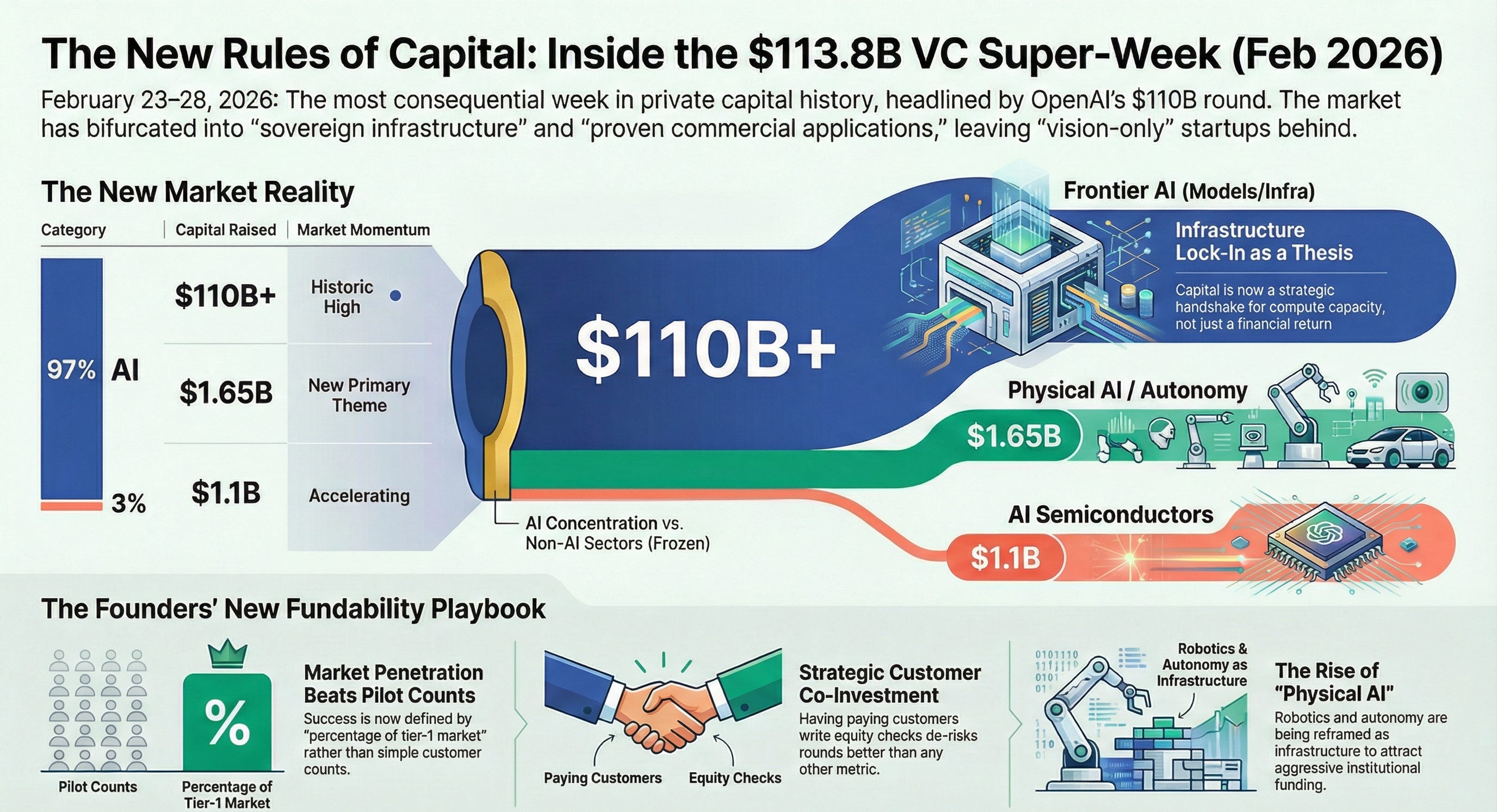
February 2026 just became the most consequential week in the history of private capital. One deal alone eclipses the entire 2023 U.S. VC market. The remaining $3.8B in supporting deals is quietly rewriting every stage benchmark you thought you knew.
OpenAI just raised more in a single deal than the entire US venture market deployed in 2023. That is not a data point. That is a structural event, and it changes what investors expect when they look at your deck on Monday.
The shift founders can miss: when capital concentrates this aggressively at the frontier, it does not disappear from early-stage markets. It raises the conviction bar for every round below it. Investors who didn’t get into OpenAI’s $840B post-money round are now scanning their Series A and B pipelines harder than ever, looking for the next category-defining bet with measurable proof, not just a strong story.
This week also delivered $1.2B into autonomous vehicles, $1.1B+ into Nvidia alternatives, a unicorn in AI accounting built on industry penetration data, and vertical AI agents closing with customer ROI evidence, not pilot promises as before. The market polarized completely: AI infrastructure and vertical agents captured 97% of all capital. Everything else gravitates to a statistical zero.
The message goes far beyond ‘AI is hot.’ The message is this: investors now require proof of readiness, evidence of industry penetration, or sovereign-scale relevance. If your pitch still reads like a 2023 deck, you will be deferred, not declined. Now is the time to fix that.
Deals Scorecard
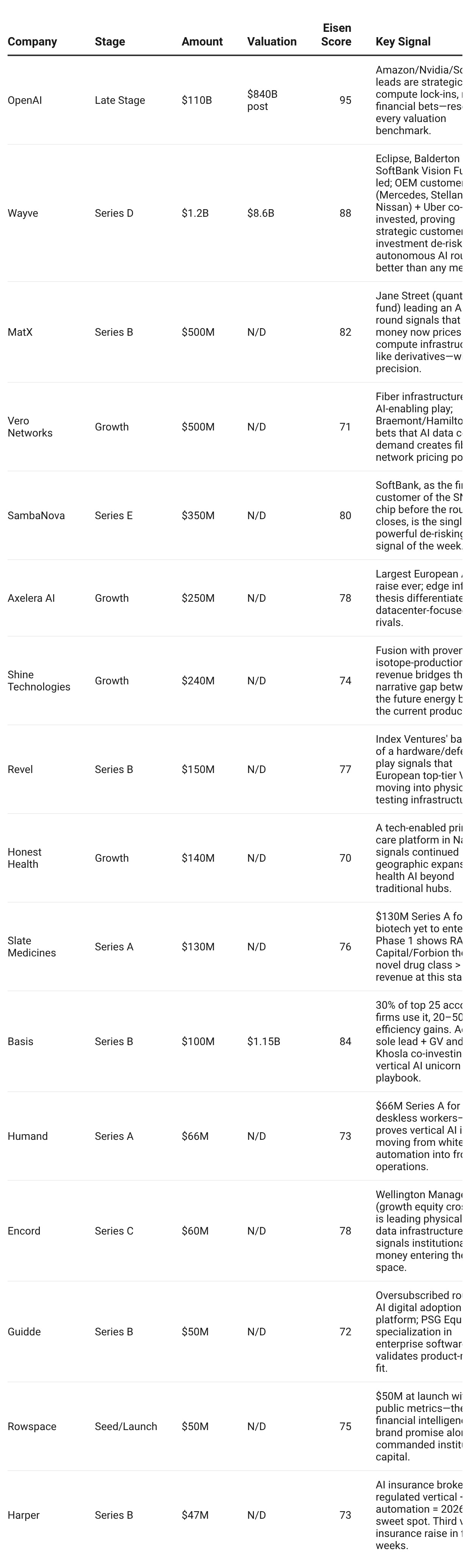
What Changed This Week (5 Shifts)
SHIFT 1: AI Has Entered Its Sovereign Infrastructure Phase
PATTERN: What Happened
OpenAI closed at a $ 110 B valuation on Friday, February 27, with a post-money valuation of $840B. Amazon ($50B), Nvidia ($30B), and SoftBank ($30B) anchor the round - the three largest check-writers in AI history committing to a single company in a single round. The round remains open, with interest from sovereign wealth funds active. ChatGPT now serves 900M weekly active users and 50M consumer subscribers. Codex users tripled year-to-date to 1.6M. January and February are pacing as OpenAI’s largest subscriber growth months ever.
PERSPECTIVE: What It Means
These are not venture investments in the traditional sense. Amazon secures exclusive enterprise cloud distribution for OpenAI Frontier. NVIDIA locks in its largest customer as a financial partner. SoftBank advances its AI infrastructure empire at scale. Every party is solving a strategic problem — infrastructure exclusivity, supply chain certainty, distribution lock-in, and not making a financial return bet. OpenAI has exited the venture paradigm. It is now a sovereign digital infrastructure, priced like it.
FOUNDER BLINDSPOT: What Most Miss
Founders see $110B and think they need to pitch bigger ambitions. The actual signal is inverted. The reason this round closed is that every investor faced an existential cost of passing rather than an opportunity cost. Amazon can’t afford to lose OpenAI to Azure. NVIDIA can’t afford to lose its largest customer to source compute elsewhere. SoftBank can’t afford to be irrelevant to AGI. Your job at Series A–C is to create the same investor psychology at your size: make the downside of passing feel real, not just the upside of investing.
PLAYBOOK: What To Do
Reframe your narrative from ‘we are building AI’ to ‘we deliver specific measurable ROI on top of AI infrastructure.’ Identify your efficiency gain. Name your customer proof. Quantify it. ‘We reduce [specific workflow] cost by 40% at firms with $200M+ revenue’ wins every meeting over ‘we are building AI for finance.’
CONTRAST
Prior norm (2023–2024): Series B+ VCs leading with product narratives, TAM slides, and vision decks.
February 2026: Sovereign capital leading with infrastructure partnerships, compute exclusivity clauses, and binding commercial commitments. Series A and B VCs are now recalibrating conviction to ‘does this company own something that sits durably on top of the sovereign AI infrastructure layer?’
What this means for your raise: Investors scanning your deck asking one question: are you building on top of the infrastructure layer, or competing with it? If your answer is unclear in the first 30 seconds, your round will stall.
SHIFT 2: The Nvidia Diversification Race Is Now a Standalone Funding Category
PATTERN: What Happened
MatX secured $500M Series B on February 25, led by Jane Street and Situational Awareness, with Marvell and the Stripe co-founders participating. MatX claims 10x GPU performance improvement for AI model training.
Axelera AI closed $250M on February 24, the largest European AI chip raise in history, for edge inference chips.
SambaNova closed $350M on February 24, with Vista Equity and Intel Capital, and SoftBank Corp confirmed as the first customer for its SN50 inference chip deployment in Japan.
Combined: $1.1B into NVIDIA alternatives in 72 hours. When you include Taalas ($169M, Feb 19), over $1.2B flowed into the compute diversification thesis in a single week.
PERSPECTIVE: What It Means
Computing supply chain concentration risk is now an investable thesis at an institutional scale. Investors are not just chasing AI companies; they are systematically hedging against their dependence on NVIDIA. For Intel Capital (SambaNova), Marvell (MatX), and the Stripe co-founders (MatX), this is strategic portfolio protection. Jane Street leading MatX’s $500M round is the clearest signal: sophisticated, long-only, pattern-matching capital has underwritten the hardware diversification bet. This moves the thesis from ‘interesting’ to ‘inevitable’ in investor vernacular.
FOUNDER BLINDSPOT: What Most Miss
Most founders assume AI chip competition is a ‘deep tech hardware track’ conversation, off-limits unless you are an ex-TSMC engineer or semiconductor PhD. The real takeaway is broader: any company that reduces AI infrastructure cost, makes inference cheaper across chip types, or allows AI workloads to move off NVIDIA hardware is suddenly highly fundable. Callosum closed a $10.25M seed round this same week for multi-chip AI orchestration software, founded by Cambridge neuroscientists, no hardware background required. You do not need to build chips. You need to reduce compute cost.
PLAYBOOK: What To Do
If your product reduces AI infrastructure cost, improves inference efficiency, or enables AI workloads on non-NVIDIA hardware, add one slide that quantifies that claim. ‘We reduce inference cost by X% across chip types’ or ‘our platform runs on 4 chip architectures, reducing customer lock-in risk’ is a Category 1 investor hook in March 2026 that did not exist 90 days ago. Build that slide before your next meeting.
CONTRAST
Six months ago: no single week had seen $1B+ in committed capital to NVIDIA-alternative AI chip investments.
February 23–28: $1.1B in 72 hours from institutional leads who do not back speculative science projects. The compute diversification thesis has moved from ‘interesting conversation’ to ‘active deployment.’
What this means for your raise: If you are building anything that reduces compute cost or chip dependency, you have a new funding angle that did not exist in Q4 2025. Name it explicitly in your next investor conversation.
SHIFT 3: Pilots Are Dead as Proof
PATTERN: What Happened
Basis closed a $100M Series B round at a $1.15B valuation on February 26, co-led by Accel and Google Ventures, with Khosla Ventures participating. The disclosed metric: approximately 30% of the top 25 US accounting firms are actively deploying Basis agents. Efficiency gains of 20–50% disclosed across the customer base. Humand ($66M Series A) targets the 2B+ deskless worker market with an AI operating system and discloses enterprise-scale deployments. Rowspace ($50M Series A, Sequoia and Emergence Capital co-lead) launches publicly on February 25 with AI financial intelligence already deployed at PE firms and hedge funds, not in pilot. Vertical AI agents now require evidence of industry penetration.
PERSPECTIVE: What It Means
Basis did not pitch a vision. It pitched an industry takeover in progress. A 30% penetration rate among the top 25 US accounting firms is not a traction metric. It is a market share number that shifts the investor question from ‘will this work?’ to ‘can the remaining 70% of the top 25 afford not to adopt this?’ That is a fundamentally different risk perception, and it is the reason two Tier-1 co-leads are both committed. Neither Accel nor GV wanted to be the firm that missed the AI accounting category leader after it had already achieved 30% of the most demanding customer segment. In addition to validating the product, the proof manufactured FOMO at the institutional level.
FOUNDER BLINDSPOT: What Most Miss
Founders with five pilots believe they have proof. They don’t. Pilots are experiments that a company is running to decide whether to buy. Penetration is evidence that they already bought, that the product works at scale, and that peers within the industry have made the same judgment. These are completely different investor risk profiles. A company with 5 pilots is asking an investor to believe it will work. A company with 30% of its target industry deployed is already showing it. If your traction slide uses the word ‘pilots’ anywhere, you are presenting 2024 evidence style to 2026 investors.
PLAYBOOK: What To Do
Rewrite your traction slide. Remove ‘pilots’ and ‘in discussions’ as categories. Replace with penetration language: ‘3 of the top 10 [your target vertical],’ ‘40% of [specific sub-market],’ ‘deployed across [specific customer type] with [specific outcome].’ If you cannot make that claim yet, identify the specific penetration milestone that would change your narrative from validation to inevitability, and make it your next 90-day fundraising milestone.
CONTRAST
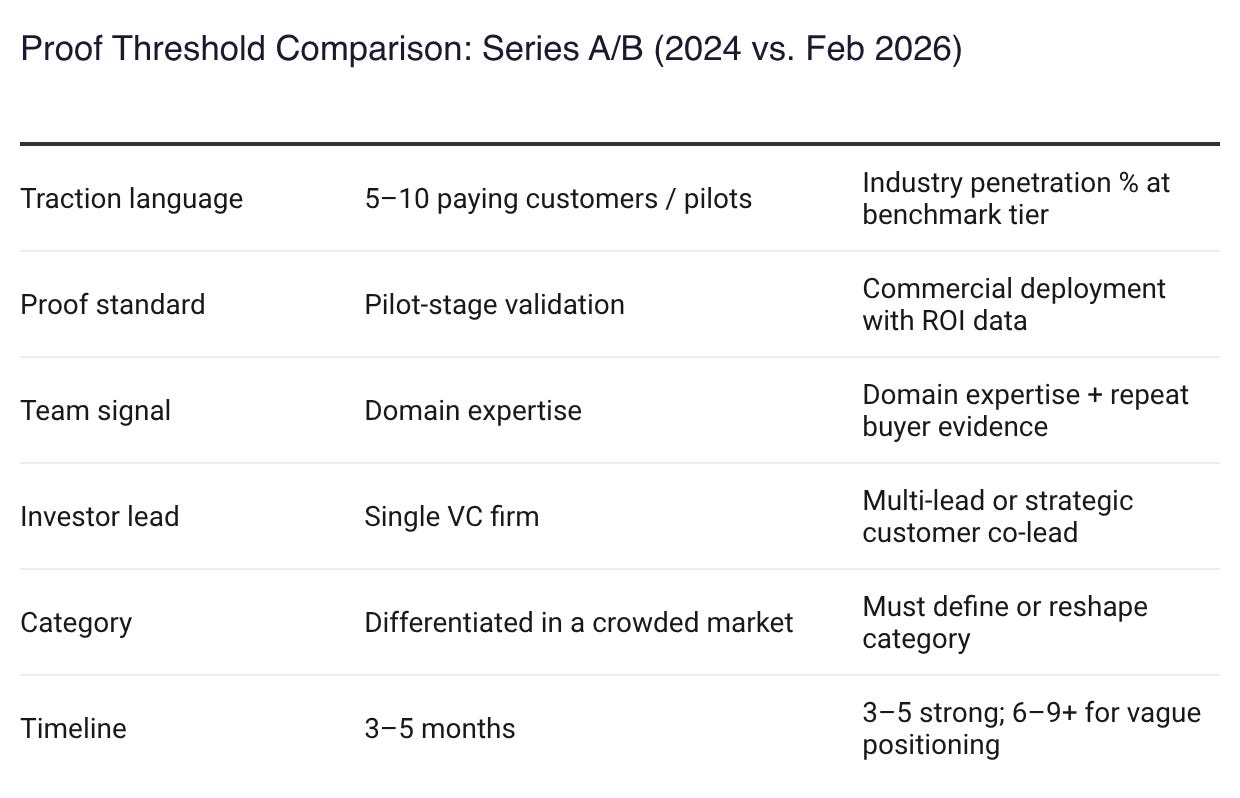
Series A vertical SaaS in 2024: 5–10 paying customers with clear product-market fit was sufficient for top-tier consideration.
Series A/B vertical AI in February 2026: industry penetration data at benchmark-tier (top 10, top 25, top 50) with ROI evidence is the minimum threshold for top-tier leads. The bar has moved.
What this means for your raise: If your traction is in ‘pilots’ language and not ‘penetration’ language, you are presenting 2024 evidence to investors who reviewed a 30%-market-penetration unicorn this week. Translate before your next meeting.
SHIFT 4: Customers-as-Investors Is Now the Strongest Deal Architecture Signal Available
PATTERN: What Happened
Wayve raised $1.2B Series D on February 25, led by Mercedes-Benz, Stellantis, Nissan, and Uber, the same companies that will commercially deploy Wayve’s autonomous driving systems in 2026. Uber is specifically planning Wayve-powered robotaxi deployments across multiple cities this year. The round includes milestone-linked tranches, bringing total committed capital to $1.5B. Wayve’s total funding reached approximately $2.8B.
PERSPECTIVE: What It Means
When your customers lead your round, investor risk collapses. The commercial question, like ‘will anyone buy this?’ is answered by the people writing the checks. Mercedes, Stellantis, Nissan, and Uber are not making a financial bet on Wayve. They are making strategic supply chain decisions. Their investment is simultaneously a commercial commitment, a validation of the product roadmap, and a distribution guarantee in a single structure. VC co-investors cannot pass on a round where the buyers are already locked in. The downside of not co-investing is watching your competitors get access to a company whose commercial success is guaranteed by its own customers.
FOUNDER BLINDSPOT: What Most Miss
Most B2B founders treat strategic investors as validation-layer participants who join a VC-led round to add credibility. That is the wrong direction entirely. The more powerful round architecture is: identify which customers have a strategic dependency on your product’s success, and structure their participation as a lead position with financial VCs following their conviction. This architecture is available to far more founders than realize it. You do not need to be building autonomous vehicles. You need one or two anchor customers for whom your product’s failure would create a meaningful operational or competitive problem.
PLAYBOOK: What To Do
Identify your top three enterprise customers or potential customers. For each, ask: what is the financial cost or competitive damage to them if your product does not exist in 18 months? If the answer exceeds $1M per customer, you have the foundation of a strategic investment conversation. Draft a one-paragraph strategic ask for each of those three. Do not pitch equity upside. Pitch strategic access, co-development rights, or supply chain exclusivity. Do it before VC conversations.
CONTRAST
Prior three years: strategic investors as secondary or co-investors in VC-led rounds, typically 5–15% of the round size.
February 2026: customer-led rounds in which buyers drive pricing, terms, and conviction, with financial VCs following. Represents a structural shift from ‘financial conviction leading’ to ‘commercial conviction leading.’
What this means for your raise: If you have an anchor customer whose growth or operations depend on your product, your most powerful fundraising move may be a conversation with their corporate development team, not another VC cold outreach.
SHIFT 5: The Mega-Seed Normalization Is Creating a Barbell That Harms Mid-Tier Founders
PATTERN: What Happened
Over 40% of all 2026 seed and Series A investment has gone to rounds of $100M or more. In the US, the proportion exceeds 50% of early-stage capital in mega-financings. In the same week that the OpenAI round closed, market data confirm the $480M seed round for Humans&, a new AI lab founded by Google, Anthropic, xAI, OpenAI, and Meta researchers, as the largest seed round in history. AI lab seed rounds are now averaging $180M+ in 2026. The standard $2M–$5M pre-seed and $10M–$18M Series A rounds are capturing a structurally shrinking share of available partner attention at top-tier firms.
PERSPECTIVE: What It Means
The AI lab mega-seed is not seed funding. It is a sovereign infrastructure deployment wearing seed-stage clothing. When a general partner at a Tier-1 firm runs diligence on a $480M seed in the same week they review a $15M Series A, their internal comparison framework recalibrates, consciously or not. The $15M company is measured against what a $480M bet could be. That is not a fair comparison, but it is the psychological reality of how partner attention works at constrained firms. The barbell is compressing the mid-market: either you are raising at mega-seed prices for a category-defining AI lab, or you need to be extremely targeted about differentiation, defensibility, and urgency.
FOUNDER BLINDSPOT: What Most Miss
Founders raising $10M–$25M in AI assume they are competing with other companies at their stage for investor attention. They are not. They are competing against the mental residue of $480M seed rounds for partner time and conviction. The comparative perception problem is real and structural. The solution is not to pitch bigger or raise more. The solution is to be undeniably different, not in vision, but in defensibility, proof, and the mechanics of urgency. Ambition without a moat gets quietly deferred in a market where the partner just reviewed an AI lab staffed by ex-OpenAI, Anthropic, and DeepMind researchers.
PLAYBOOK: What To Do
Do not chase size. Chase defensibility and urgency mechanics. Identify and articulate the one thing your company owns that a better-funded competitor cannot replicate in 18 months: proprietary data, customer lock-in, regulatory moat, distribution exclusivity, or a network effect. Write one paragraph on that defensibility. Then create a specific closing mechanism, a hard timeline, a milestone-based trigger, or a lead-investor commitment that expires, to generate urgency that does not depend on FOMO in your vision.
CONTRAST
2024: Standard seed and Series A in AI attracted normal diligence timelines and competitive dynamics across a broad investor set.
February 2026: Mega-rounds are distorting partner attention allocation at Tier-1 firms. Mid-tier founders face longer cycles, more re-reviews, and weaker initial conviction unless their narrative creates its own urgency independent of the broader market noise.
What this means for your raise: If you are raising $10M–$25M in AI without explicit urgency mechanics built into your round, your close timeline will drift. Create urgency!
Non-AI Capital Is Approaching Statistical Zero
This week’s capital concentration is stark. Of the 17 deals analyzed, 14 have direct AI as the core value proposition. The two exceptions, Vero Networks (fiber broadband) and healthcare deals (Honest Health, Slate Medicines), are adjacent plays. Fiber enables AI data centers, while Honest Health targets the enablement of value-based care for health systems. Also worth mentioning is migraine biotech (anti-PACAP monoclonal antibody) company Slate Medicines, which is built on a Chinese-licensed asset with phase 1 trials targeted for mid-2026.
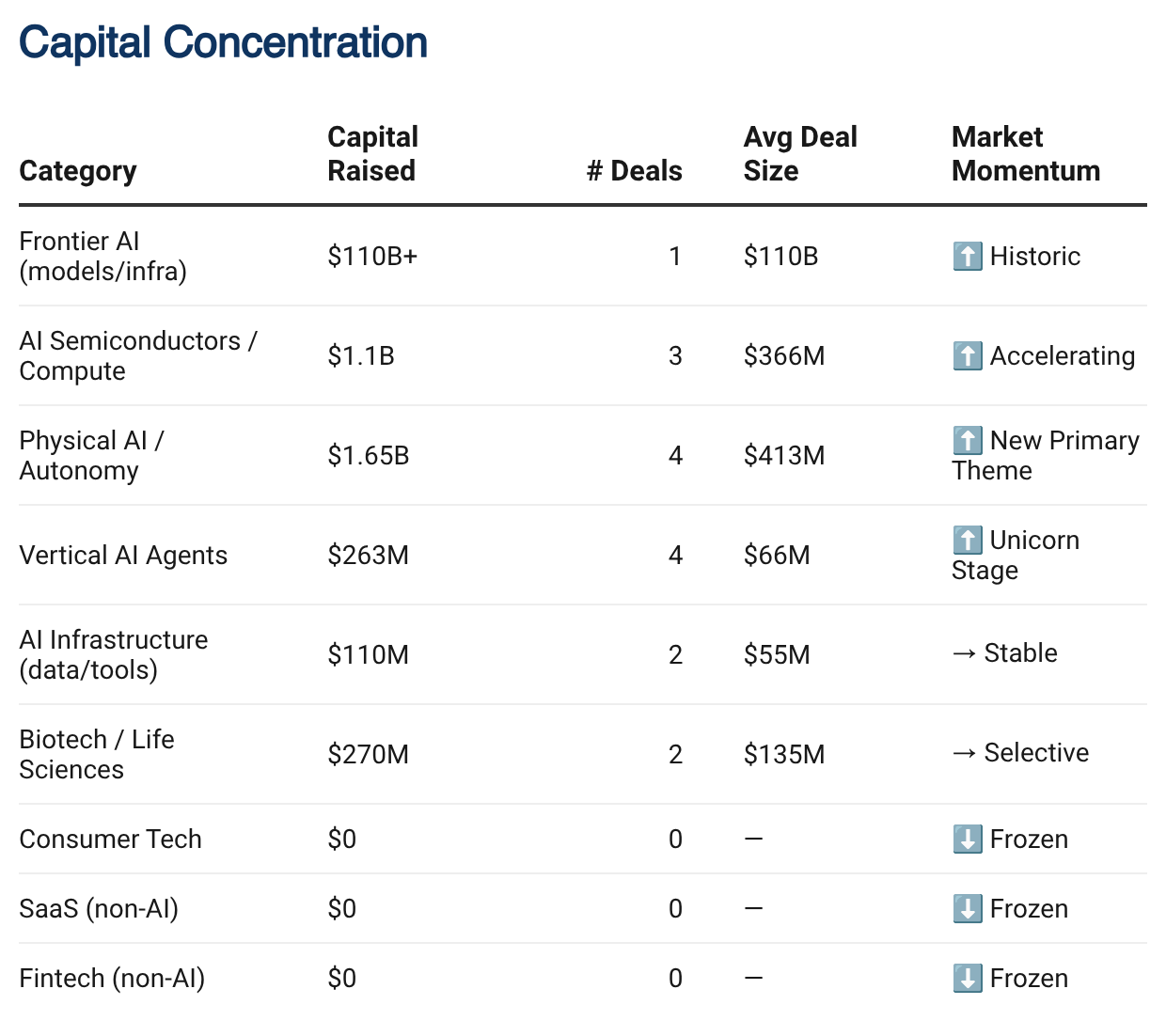
The non-AI category is not recovering any time soon. If your pitch doesn’t have a credible, primary AI value driver (not ‘we use AI to improve our workflow’), you are raising into a structurally hostile market. Repositioning is not marketing; it is survival.
The Top 3 Deals That Matter
Wayve: The Customer Co-Investment Architecture
Eisen Fundability Score: 88
Extremely strong execution. VC-led and customer co-investment model validated.
The setup: $1.2B Series D at $8.6B valuation. Autonomous driving AI for automakers. Led by Eclipse, Balderton Capital, and SoftBank Vision Fund 2. Strategic co-investors: Mercedes-Benz, Stellantis, Nissan, Uber (paying customers), plus NVIDIA and Microsoft. Ontario Teachers’ Pension Plan and Baillie Gifford also participated. UK-based.
The fundability lesson: Wayve’s round architecture is this year’s most instructive Series B+ deal for founders. Eclipse, Balderton Capital, and SoftBank Vision Fund 2 led the round with institutional conviction. But the mechanism that made the round inevitable was the co-investor layer: Mercedes-Benz, Stellantis, Nissan, and Uber, all paying customers of Wayve’s autonomous driving AI, chose to write equity checks alongside the institutional leads. Their capital wasn’t the largest in the round. It was the most important signal in the room.
When your biggest customers co-invest, you’ve answered the hardest VC diligence question without speaking a word. The customers’ equity checks say: ‘This technology is irreplaceable in our product roadmap.’ That validation made ‘no’ structurally irrational for every other investor in the process. Wayve didn’t need customers to lead; they needed customers to confirm. The result is an $8.6B valuation on a company with no traditional ARR disclosure.
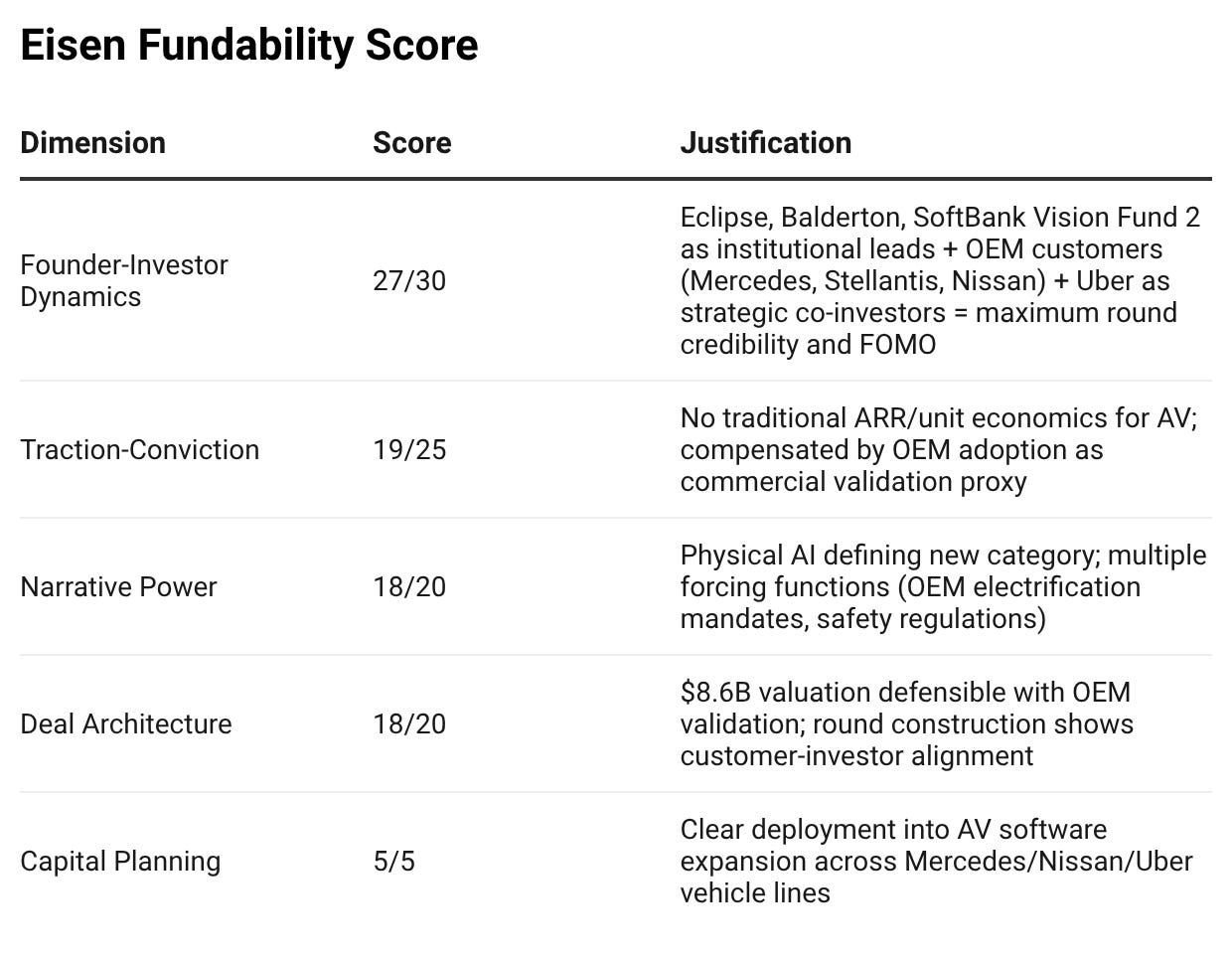
Your takeaway: The most powerful way to de-risk a pre-revenue round is to have your first commercial customers lead it. Their check is simultaneously a purchase commitment, a product validation, and a competitive lock-in. Identify who has the most to lose if your product doesn't exist. Even a $500K–$2M customer check alongside a Tier-1 VC lead fundamentally changes your round's credibility.
Copy the round architecture: identify 3–5 potential customers whose strategic dependency on your product makes their investment a logical hedge, not a financial bet. The structure is sector-agnostic.
Basis: The Vertical AI Unicorn Formula
Eisen Fundability Score: 84
Solid fundamentals. First accounting AI unicorn.
The setup: $100M Series B at $1.15B valuation. AI agents for accounting workflows (tax, audit, bookkeeping). Led by Accel (sole lead), with GV (Google Ventures), Khosla Ventures, and Lloyd Blankfein (former Goldman Sachs CEO) participating. ~30% of the top 25 accounting firms are customers. 20–50% efficiency gains reported.
The fundability lesson: Basis’s score of 84 comes from one thing: the single most powerful proof point in their deck. ‘~30% of top 25 accounting firms’ is a market penetration statistic that makes ‘no’ look reckless. They didn’t sell Accel and GV on the accounting market opportunity. They demonstrated market penetration that forced the institutional question from ‘is this real?’ to ‘how big does this get?’
Notice what Basis didn’t need: a glamorous founding team press release, a category-defining manifesto, or a product demo. The customer concentration metric, specifically targeting the top 25 firms rather than ‘hundreds of accounting firms,’ told the entire story. Tier-1 at 30% penetration with 20–50% efficiency gains leaves no room for objection.
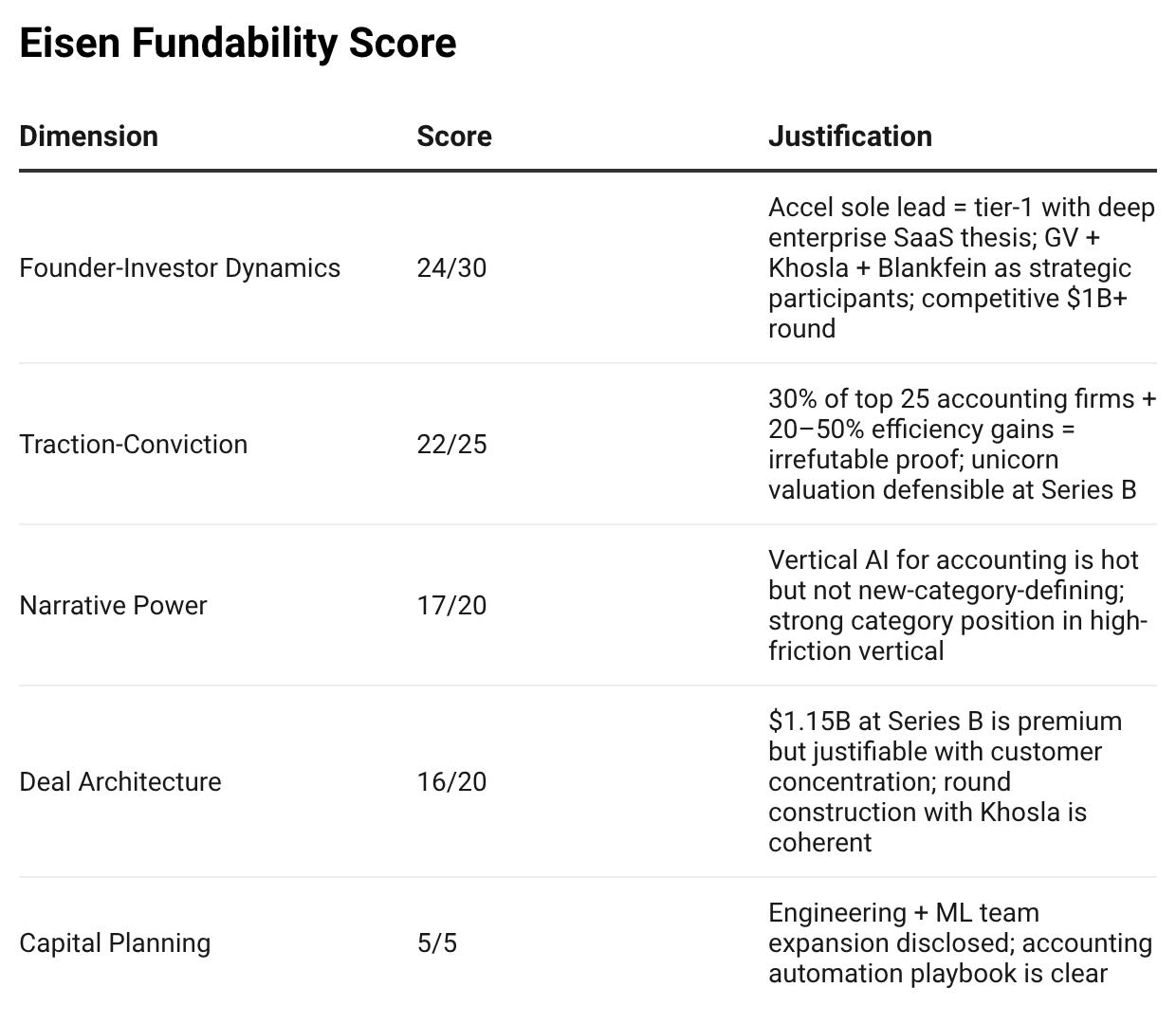
Your takeaway: founders confuse traction with the number of customers. Traction is about the percentage of the benchmark tier you own. Replace your ‘number of customers’ metric with a ‘percentage of the tier-1 market’ metric. ‘30% of the top 25’ is a market penetration number, not a customer count. Identify your industry’s benchmark tier, go deep on the top 25 before announcing, and do not raise until you can name the percentage you own.
OpenAI: The Infrastructure Lock-In Masterclass
Eisen Score: 95
Category-defining. The ceiling just moved.
The Setup: $110B raised at $730B pre-money / $840B post-money. Investors: Amazon ($50B), Nvidia ($30B), SoftBank ($30B). Round remains open.
The fundability lesson: OpenAI’s deal isn’t fundable in the traditional sense. It has transcended venture capital entirely. But the lesson is structural. Every dollar in this round came with a compute obligation attached. Amazon’s $50B buys 2GW of AWS demand. NVIDIA’s $30B secures 5GW of chip deployment. The capital is the handshake. The infrastructure commitment is the actual deal. OpenAI has weaponized investment to pre-purchase its supply chain.
The most sophisticated thing you can do at your stage is reverse-engineer this. Turn your investors into locked-in product partners before the term sheet is signed. Your seed investor should be your first customer. Your Series A lead should sit on your technical advisory board. Investment should create obligation, not just cash.
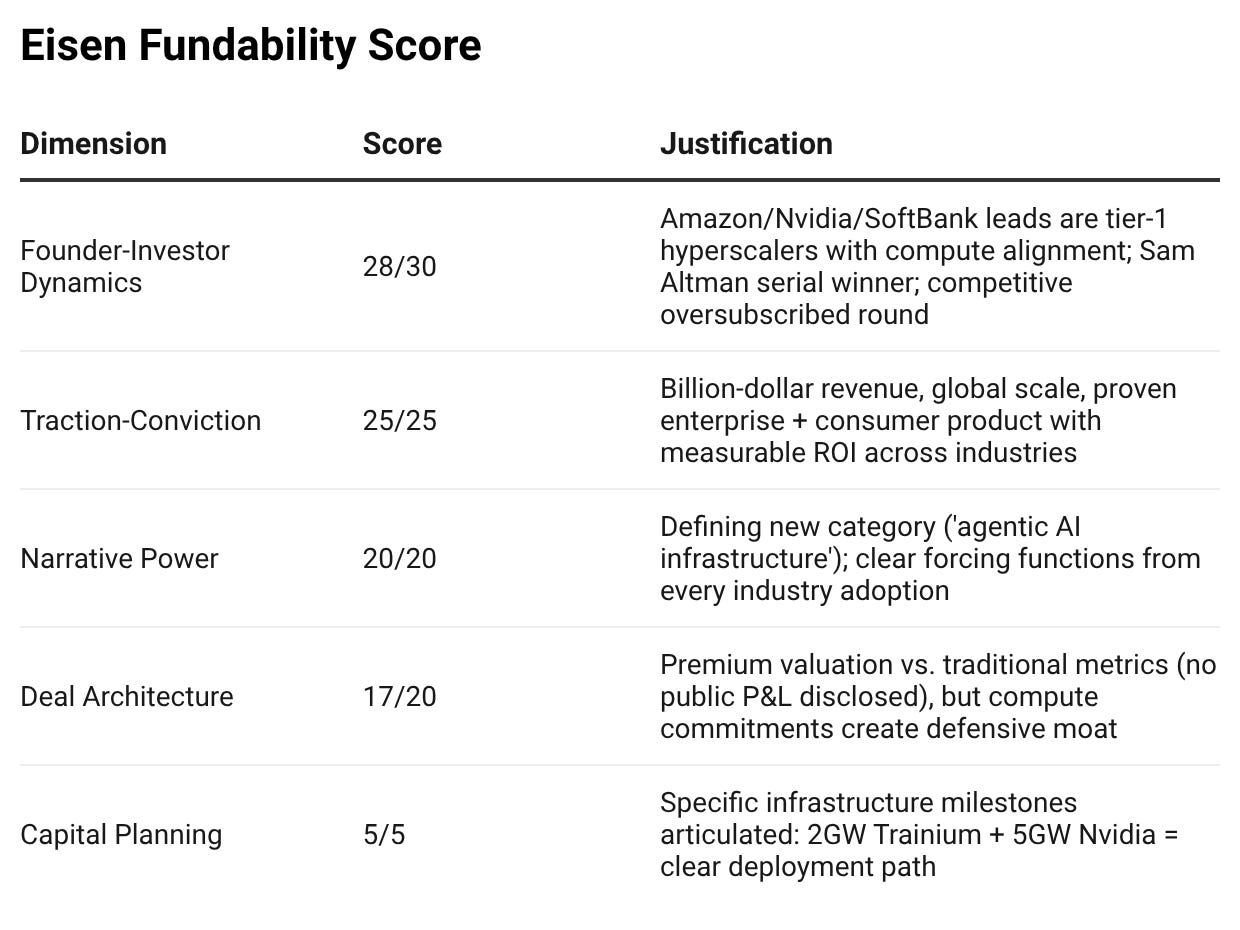
Your takeaway: When your proof is at scale, not only ‘strong growth’ but category-defining adoption, your round architecture becomes strategic. Frame your deal so investors solve a strategic problem, rather than pursue a return.
Founders usually copy OpenAI by pitching gigantic TAMs and computing ambitions. The real lesson: OpenAI’s round closed because the downside of passing was existential for every party that invested. Build that psychology at your scale.
Fundraising Playbook based on what this week revealed.
1. Audit Your AI Infrastructure Angle
Old approach: Describe how your company uses AI to improve your product.
New approach: Position your product as an infrastructure that enables the next layer of AI applications or compute deployment.
Action items:
Map your product against the AI compute stack: are you at the model layer, inference layer, data layer, or application layer? Write one sentence per layer.
Identify which of the three chip ecosystems (NVIDIA, NVIDIA-alternatives, edge inference) your product benefits from, and which destroys it if it wins.
Rewrite your 30-second pitch, replacing ‘we use AI’ with ‘we enable [specific AI infrastructure use case]’ and test it on 3 investors this week.
❌ Wrong: “We use AI to automate X for Y customers.”
✅ Right: “We are the data infrastructure layer that enables physical AI systems to train on real-world X inputs. The same problem Encord solved for robotics, now applied to [your vertical].”
2. Map Your Customer Co-Investment Opportunity
Question: Which of your top 10 customers would write a check if you asked them to co-invest alongside a VC lead? You haven’t asked.
Action items:
List your top 10 customers by revenue. For each, identify: (a) their strategic rationale for needing you to exist, (b) their corporate venture fund or M&A team, and (c) whether they could lead your next round.
Draft a 3-paragraph ‘strategic investment memo’ for your #1 customer explaining why their equity investment (not just their contract) is in their strategic interest.
Email your primary contact at that customer with the subject line: ‘A different kind of conversation—15 minutes?’ Time investment: 2 hours. Returns: potential to restructure your entire next round.
3. Reframe Your Proof Statement as Market Penetration
Basis closed at $1.15B because ‘30% of top 25 accounting firms’ is a market penetration number, not a customer count. Your customer list is sitting dormant. Turn it into a market capture claim.
Action items:
1. Define your ‘top 25’ list. In your specific sub-vertical, who are the most prestigious/largest 25 potential customers?
2. Calculate your penetration: How many of the top 25 (or top 50, or top 100) do you serve today?
3. Rewrite your traction slide, replacing ‘X customers’ with ‘[N]% of the top [Y] [your vertical] companies in [geography/segment].’ Time investment: 90 minutes. Returns: the single most defensible proof statement in your deck.
4. Pre-Position for the Valuation Environment Shift
OpenAI’s $840B post-money valuation will compress multiples for every non-frontier AI company. When the headline number is that large, every other valuation looks small by comparison. Your next investor will ask: ‘Why aren’t you OpenAI?’ Get your answer ready before they do.
Action items:
1. Write your ‘not OpenAI but...’ positioning statement: what specific problem do you solve that OpenAI doesn’t and won’t solve in your vertical within 3 years?
2. Build your defensibility case around the three moats that frontier AI cannot replicate quickly: proprietary data, regulatory relationships, and customer workflow integration depth.
3. Schedule a conversation with your existing investors or advisors to pressure-test your valuation expectation against the new market benchmarks. Time investment: 3 hours. Returns: saves 3 months of mis-priced round delays.
5. Calculate Your Eisen Fundability Score
Use the framework below to score your own fundability. Be brutal because investors will be. Score your own raise across all 5 Fundability Forces. Identify your lowest 2 scores. For each, write one specific action with an owner and a deadline that would improve that score before your next investor meeting.
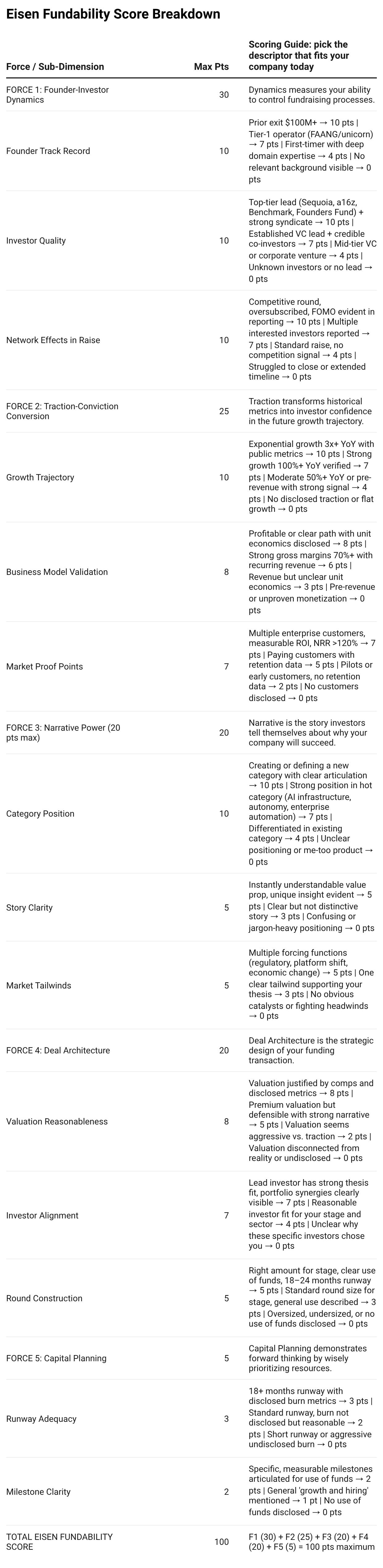
85+: You’re raising from a position of strength. Focus on investor selection, not investor access.
70–84: You have a fundable company with execution gaps. Fix the lowest-scoring dimension before outreach.
Below 70: Don’t raise broadly yet. Spend 60 days proving the one metric that would move your score to 75+.
65–74: Good company, real gaps. Don’t raise broadly until you’ve moved at least one Force from its current score to the next tier.
Below 65: Spend 60 days proving the one metric that moves your score to 70+. Premature fundraising at this score wastes your most valuable relationship capital.
Looking Forward: What to Watch in the Next 1–3 Weeks
Based on deal flow patterns and investor signaling, here’s what’s coming:
Scenario 1: AI Chip Consolidation Begins (High Probability)
With $1.2B+ into NVIDIA alternatives in one week (MatX, SambaNova, Axelera), the market has now funded multiple competing approaches. Within 3–4 weeks, enterprise customers will begin announcing which chip ecosystem their data centers are standardizing on. First-mover commitments from AWS, Azure, or Google Cloud to any of these three will immediately create a two-tier market.
Your watch list: AWS, Azure, GCP, and public announcements of chip partnerships this week.
Your response: If you’re compute-dependent, lock in pricing agreements before customer chip ecosystem decisions are made.
Scenario 2: OpenAI’s Open Round Accelerates Existing Raises (High Probability)
OpenAI’s round remains open with ‘additional investors expected to join.’ This creates FOMO dynamics that will accelerate decision timelines at every other AI company’s active raise. Investors who missed OpenAI will overcompensate by accelerating their current pipeline. The next 2–3 weeks will see compressed diligence timelines and faster term sheets for AI companies already in process.
Your response: If you’re in active fundraising conversations, push for a timeline commitment this week. Use the urgency of the market moment. Founders who do this get term sheets 2–4 weeks faster.
Scenario 3: Physical AI Becomes a Primary Fundraising Category (Medium Probability)
Wayve ($1.2B), Encord ($60M), and Revel ($150M) collectively deployed $1.41B into physical AI infrastructure in one week. The asset class that was ‘robotics/autonomy’ is being reframed as ‘physical AI,’ and the rebrand matters for pitch positioning. VCs who sat out autonomous driving will re-engage within 90 days under the physical AI framing.
Your positioning: If you operate in any physical-world AI application (manufacturing, logistics, construction, agriculture), this week is the moment to reframe your pitch as ‘physical AI infrastructure’ rather than ‘robotics software.’
Wild Cards
Microsoft Re-Entry: Microsoft did not participate in OpenAI’s $110B round while reaffirming its existing partnership. A counter-move, an investment in a competing frontier AI lab, or a competing infrastructure bet, is now structurally necessary. Watch for a Microsoft AI infrastructure announcement within 4–6 weeks.
NVIDIA Conflict of Interest Backlash: NVIDIA just invested $30B in OpenAI while serving as its primary chip supplier. Antitrust scrutiny of vertical integration in AI infrastructure is the next regulatory surface. Companies with Nvidia-independent compute strategies become more attractive to investors, managing regulatory risk.
The Bottom Line: Your Next Move
This week was about the market publishing its 2026 operating manual in real time. Every deal this week gave you a chapter.
The Real Insight This Week
$110B in a single round is not the story. The story is what that number means for the next 500 founders opening their decks. AI capital has bifurcated into two tiers: sovereign infrastructure, which is trillion-dollar-scale and structurally inaccessible to most founders, and proven commercial applications, such as Basis, Wayve, and Rowspace, that closed with measurable enterprise penetration, customer-led conviction, or commercial lock-in. The middle, ‘promising AI startup with 5 pilots and a vision,’ has no comfortable home in either tier. The founders who understand this shift will adjust their narrative, their proof, and their investor targeting before Friday. The ones who don’t will be ‘deferred’ six weeks from now and wonder why.
5 New Rules for Founders (Derived From This Week’s Evidence)
Penetration beats pilots. ‘30% of the top 25 in your industry’ closes rounds. ‘5 pilots in progress’ extends timelines. Translate all traction language before your next meeting.
Customers-as-investors collapse commercial risk. Identify 3 anchor customers with strategic dependency on your product — then have the investment conversation before the VC conversation.
Compute cost reduction is the new ‘AI is hot.’ Any product that reduces inference cost, chip dependency, or AI infrastructure spend has a new funding angle that didn’t exist 90 days ago. Claim it explicitly.
Round design creates investor urgency. Two Tier-1 co-leads (Basis), OEM consortium (Wayve), and milestone-linked tranches (OpenAI) all manufactured urgency through structural design, not just narrative. Engineer your round.
Valuation must be justified by comps and metrics, not optimism. Even OpenAI’s 2x valuation jump in months draws scrutiny at $840B. Your $25M pre-money valuation at $120M needs a 3-line comp argument, not a TAM slide.
The market just showed you the playbook. OpenAI proved that infrastructure lock-in beats financial return as an investment thesis. Wayve proved VC-led rounds with strategic customer co-investors de-risk better than any benchmark metric alone. Basis proved market penetration percentages close to unicorn rounds. The question is whether you’ll run it before your competitors do.