

“Come back with more traction.”
You have customers. A pilot that worked. Maybe real revenue.
And the investor still says it.
A month later, you hear the same firm backed a team with no product at all.
That stings. It also points to the most useful idea a founder can learn about early-stage capital:
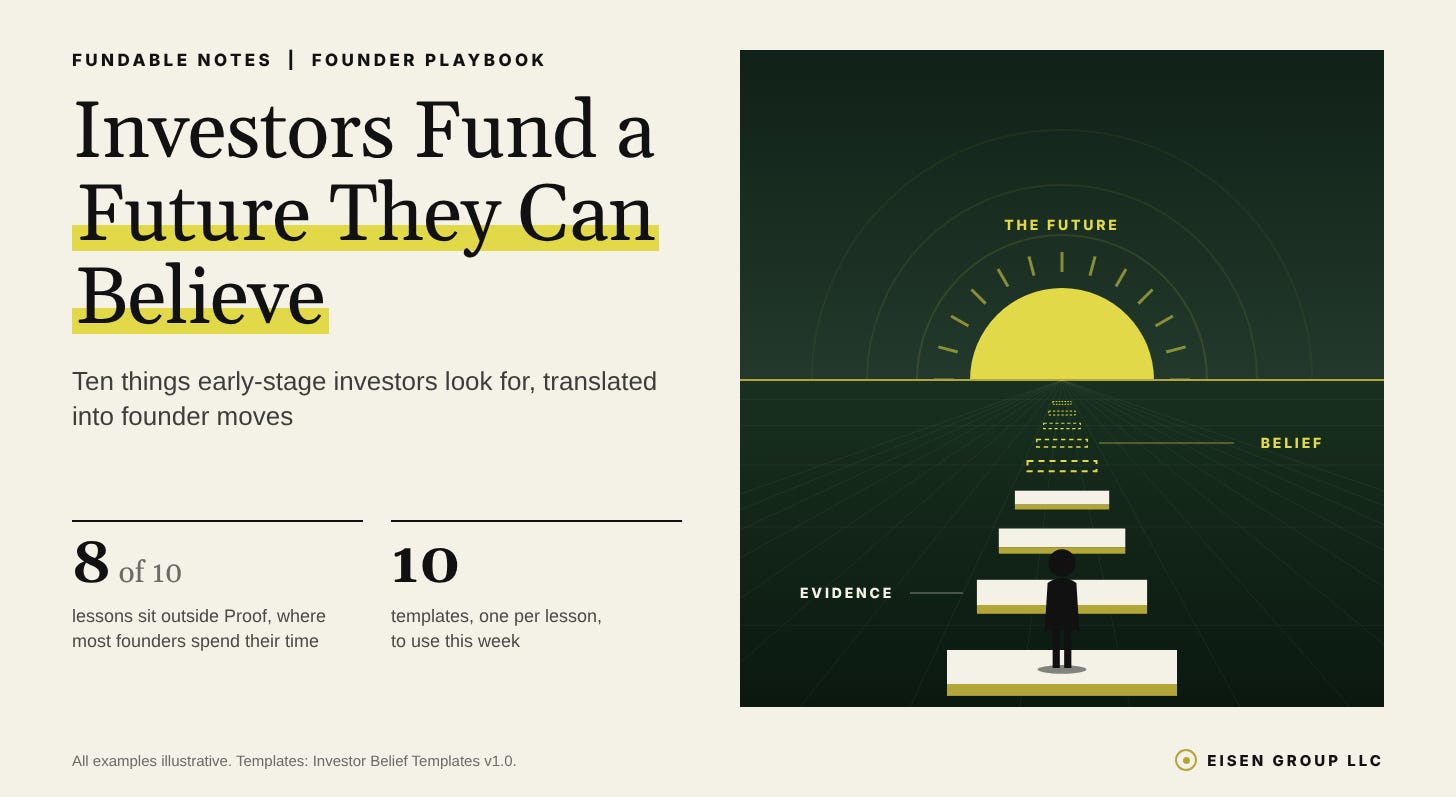
Early-stage investors put money into the future they believe a founder can build. What your startup has achieved so far matters as evidence for that future, and the evidence only works when it makes that specific future easier to believe.
How an early decision actually looks. Some commit millions of dollars with almost no data. Spreadsheets can’t carry that decision alone. What carries it is whether the investor can picture a future in which the company changes its market, and whether the person across the table looks like the one who will get there.
This is the Invisible Game of capital.
The Visible Game is your deck, your metrics, your product, your credentials. The Invisible Game is belief, trust, risk, timing and human judgment. Investors see the visible facts. Then human beings interpret them. The interpretation decides the round.
So the founder’s question has to change.
From: What else can I show them?
To: What does this investor need to believe, and what evidence would make it easy to believe?
Below are ten things early-stage investors keep returning to. For each one, you get the pattern, what sits underneath it, an illustrative example, and a template. All ten templates also come as one ready-to-use Excel workbook, the Investor Belief Templates. You’ll find the download link at the end of this article.
A suggestion before you start. Read all ten once. Then go back to the one that matches the last “no” you heard. That’s where the work is.
1. Investors fund a believable future, and certainty will never arrive.
The pattern. At pre-seed, investors commit with very little proof. What moves them is the ability to imagine a future where the company transforms a market.
What sits underneath. Most decks explain the product. Very few explain what becomes possible once the product wins. That leaves the investor to build the future in their own head, and most investors won’t do that work for you. They have forty other decks this week.
When you describe the future clearly, something else happens. Every proof point you show afterward gets read as evidence for that future. Without the future, a pilot is just a pilot.
The evidence also has to fit the stage. At pre-seed, founder insight and early customer pull can be enough. At seed, investors want to see a signal repeat. By Series A, they want an engine. Showing Series A evidence for a pre-seed future, or pre-seed evidence for a Series A future, breaks the belief in both directions.
Example.
Weak:
We build AI scheduling software for outpatient clinics.
Stronger:
Outpatient clinics lose [X]% of booked hours to no-shows and manual rebooking [source]. When scheduling runs itself, a clinic can grow patient volume without adding front-desk staff. We start with [physiotherapy clinics in the US] since they feel the loss first and buy fast. If we succeed, we become the operating layer every outpatient clinic runs on.
The first version describes software. The second describes a future, a starting point and a reason to start there.
Template: The Believable Future Statement.
Today, [specific customer] loses [concrete cost in money, time or risk] to [the problem].
When we succeed, [what becomes possible for that customer], and [what changes in the market as a result].
We start with [beachhead segment], since [why this group feels the pain first or buys fastest].
The evidence that this future has already started: [one to three proof points that fit your stage].
What this round makes true next: [the single milestone the money buys].
Test: Could an investor repeat your future in one sentence to their partners on Monday morning without your deck open? If not, the future still lives only in your head.
2. A good idea attracts competitors. An insight explains why you win.
The pattern. Industry experience alone falls short. Investors want to know what the founder understands that everyone else has overlooked. Every investor ends up asking a version of the same question: why this founder, and not five other equally smart teams?
What sits underneath. Investors meet several smart teams in the same category in the same quarter. After you leave the room, a partner has to explain why you, specifically, will see the next move before the others. Years of experience can’t do that job. Lots of people have years of experience.
An insight can. An insight is something you know about the market, the customer or the technology that most people in your category believe differently. You earned it somewhere specific, and it shapes what you build.
This sits inside Positioning in the Eisen Fundability Score. Many founders can explain their product in detail and still can’t say what they see that others miss.
Example.
Weak:
I spent 12 years in freight logistics, so I understand the problem deeply.
Stronger:
In 12 years of freight logistics, I watched carriers lose money on the empty return trip, every single week. Every load-matching tool on the market optimizes the outbound leg. Nobody prices the return. We price the return.
The first sentence asks the investor to trust your résumé. The second gives them something to repeat.
Template: The three answers.
What I see that others miss:
Most [players in the category] believe [common assumption]. What I learned is [what actually happens], and I learned it from [the specific experience, data or access that taught you].
Why now:
[What changed: technology, regulation, cost curve, buyer behavior, distribution] makes this possible in the next [timeframe], when it was impossible [X years] ago.
Why us:
We can act on this first since we have [unfair access, proprietary data, relationships, a team that lived the problem].
Red flag check: If a well-funded competitor could say your insight word for word, you have a market observation. Keep digging until the sentence could only come from you.
3. “We need more traction” can mean something else.
If you read only one section, read this one.
The pattern. Some firms back founders with no product while asking revenue-generating companies to show more progress. The difference comes down to belief: in the founder, the market or the opportunity.
What sits underneath. “Come back with more traction” is polite language. Polite language protects the relationship. It also hides the actual objection.
So the founder hears a request for metrics and spends six months trying to grow every number at once. Meanwhile, the investor’s doubt sits somewhere else entirely. Maybe in market size. Maybe in whether customers renew once the pilot discount ends. Maybe in whether this team can sell to enterprises.
Proof carries 25% of the Eisen Fundability Score. Real weight. And still, proof alone almost never closes a round. Impressive numbers convert only when they answer the question the investor is actually asking.
[Optional, Leon: two or three lines from a real moment where an investor’s “more traction” turned out to mean something else. Oxitone or an advisory engagement, with permission. Delete this line if you skip it.]
Example.
A founder at [$40K] in monthly recurring revenue hears “more traction.” Instead of going away, she asks one question:
If we came back at $80K a month, what would that prove to you that today’s numbers leave open?
The investor’s answer:
Honestly, I’m unsure enterprise buyers will renew once your pilot pricing ends.
Now the work is clear. Doubling revenue would miss the point. Three enterprise renewals at full price would hit it directly, and they might take ten weeks instead of six months.
Template: The Traction Translation Worksheet.
1. The exact words the investor used: “[...]”
2. The question I asked, or will ask, in reply: “If we came back with [the metric they named, doubled], what would that prove to you that today’s numbers leave open?”
3. The belief that remains unresolved (pick one):
☐ The market is big enough
☐ Customers will keep paying
☐ We can acquire customers at a sane cost
☐ This team can execute the next stage
☐ The timing is right
☐ Something about me as a founder
4. The smallest evidence that would resolve that belief: [...]
5. Can we produce it in 30 to 90 days? What does it cost? [...]
6. How many other investors raised the same concern, in any wording? One investor: likely a fit question. Three or more: a real gap in the story or the business.
Run this after every “no” and every “keep us posted.” After five investors, the worksheets will tell you more than the pipeline spreadsheet ever did.
4. Fundraising belongs inside building the company.
The pattern. Investors listen for one sentence in particular: a founder saying they want to finish fundraising so they can get back to running the business. Raising capital, communicating, recruiting and attracting partners are core CEO work.
What sits underneath. That sentence sounds harmless to the founder. The investor hears something different: this CEO sees one of the main parts of the job as a distraction.
Think about what raising capital actually requires. You need to make a skeptical, busy person believe in a future that hasn’t happened yet, and then act on that belief. The same capability closes your first enterprise customer. It hires the VP of Sales who has three other offers. It wins the distribution partner who has no reason to take your call.
An investor watching you pitch is also watching a sample of how you’ll recruit, sell and lead. Process carries 30% of the Eisen Fundability Score, more than any other pillar, for exactly this reason.
Example.
Weak, said in a first meeting:
Once we close this round, I can finally get back to the product.
Stronger:
Raising is part of how I build. The same story you’re hearing today closed [our last two senior hires] and [our first enterprise pilot].
Only use the second version if it’s true. If you can’t say it honestly yet, you know what to practice.
Template: The same story for every audience.
